Rapid Application
Development
Fall 2016
Author: Chris Haddad
Goals
• Higher Throughput
• Efficiently build enterprise-grade applications using a high productivity
development environment
• Faster Pace
• Accelerate release cycle with streamlined DevOps and failsafe release process
• Omni-channel development and delivery
Principles
• Low code / no code development
• Full-stack, visual development workbench
• Model and meta-data driven application design and delivery
• Convention over configuration over customization
• Hide technical concerns
• Shield design, build, and DevOps teams from infrastructure concerns (CPU, network, memory,
storage)
• Data caching and offline access
• Data driven and Process oriented development approach
• User interfaces and service endpoints generated from data
• Graphical workflow designer and sophisticated workflow constructs
• Maintain Reusability and Extensibility
• Vendor provided pre-built components and Apis
• Augment pre-build components with custom data
• Easily connect with external data sources
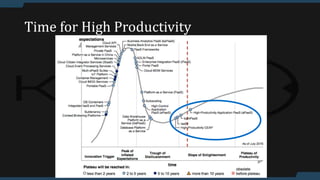
Time for High Productivity
Digital Corporate Applications
Enterprise Core APIs and Microservices
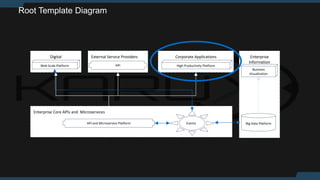
Root Template Diagram
EventsAPI and Microservice Platform
Web Scale Platform High Productivity Platform
Enterprise
Information
Big Data Platform
Business
Visualization
External Service Providers
API
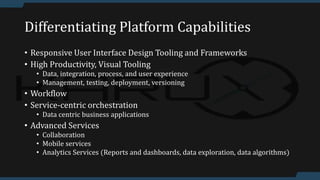
Differentiating Platform Capabilities
• Responsive User Interface Design Tooling and Frameworks
• High Productivity, Visual Tooling
• Data, integration, process, and user experience
• Management, testing, deployment, versioning
• Workflow
• Service-centric orchestration
• Data centric business applications
• Advanced Services
• Collaboration
• Mobile services
• Analytics Services (Reports and dashboards, data exploration, data algorithms)
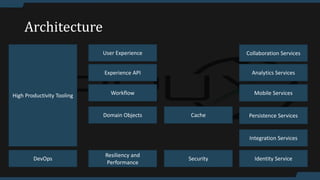
Architecture
Workflow
Cache
Integration Services
Experience API
Domain Objects
Mobile Services
Resiliency and
Performance
Security Identity ServiceDevOps
User Experience
High Productivity Tooling
Analytics Services
Collaboration Services
Persistence Services
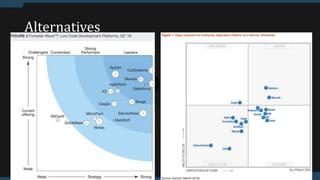
Alternatives
Founder and Chief Architect of KaruX
F500/G2000 Advisor
Former Gartner Research Team Leader
Assisting organizations navigate the tectonic
shift towards;
 Microservices
 API Centric Architecture
 DevOps
 Cloud-Native Container Platforms
/in/cobiacom
m@cobiacomm
slideshare.net./cobiacomm
About Chris Haddad

High Productivity Platform

  • 1.
  • 2.
    Goals • Higher Throughput •Efficiently build enterprise-grade applications using a high productivity development environment • Faster Pace • Accelerate release cycle with streamlined DevOps and failsafe release process • Omni-channel development and delivery
  • 3.
    Principles • Low code/ no code development • Full-stack, visual development workbench • Model and meta-data driven application design and delivery • Convention over configuration over customization • Hide technical concerns • Shield design, build, and DevOps teams from infrastructure concerns (CPU, network, memory, storage) • Data caching and offline access • Data driven and Process oriented development approach • User interfaces and service endpoints generated from data • Graphical workflow designer and sophisticated workflow constructs • Maintain Reusability and Extensibility • Vendor provided pre-built components and Apis • Augment pre-build components with custom data • Easily connect with external data sources
  • 4.
    Time for HighProductivity
  • 5.
    Digital Corporate Applications EnterpriseCore APIs and Microservices Root Template Diagram EventsAPI and Microservice Platform Web Scale Platform High Productivity Platform Enterprise Information Big Data Platform Business Visualization External Service Providers API
  • 6.
    Differentiating Platform Capabilities •Responsive User Interface Design Tooling and Frameworks • High Productivity, Visual Tooling • Data, integration, process, and user experience • Management, testing, deployment, versioning • Workflow • Service-centric orchestration • Data centric business applications • Advanced Services • Collaboration • Mobile services • Analytics Services (Reports and dashboards, data exploration, data algorithms)
  • 7.
    Architecture Workflow Cache Integration Services Experience API DomainObjects Mobile Services Resiliency and Performance Security Identity ServiceDevOps User Experience High Productivity Tooling Analytics Services Collaboration Services Persistence Services
  • 8.
  • 10.
    Founder and ChiefArchitect of KaruX F500/G2000 Advisor Former Gartner Research Team Leader Assisting organizations navigate the tectonic shift towards;  Microservices  API Centric Architecture  DevOps  Cloud-Native Container Platforms /in/cobiacom m@cobiacomm slideshare.net./cobiacomm About Chris Haddad

Editor's Notes

  • #6 API-first, microservices oriented, container-driven, and Cloud native platforms create an agile, composable environment that improves pace and throughput. Business teams can incrementally deliver new features on a daily release bases, expand digital experience relevance and engagement, and enhance solution modularity. The platform relies on best-of-breed architecture that is tuned for specific use cases; Digital, Corporate Applications, Enterprise Information Management, and Enterprise Core APIs. Digital is built upon a Cloud Native Web Scale Platform architecture that enables an adaptive, responsive, and contextual user experience at scale. The Digital experience business team can rapidly experiment by dynamically and incrementally turning new business features on and off for specific user demographics. The platform incorporates security policy and rules as first class concepts, and relies on real-time integration with foundational Renovation Enterprise Core APIs to present up-to-date information. Corporate Applications are built upon a high productivity, rapid application development platform that shields business solution teams from complex infrastructure and application frameworks. Relying on convention instead of configuration, the High Productivity Platform hides technical concerns and creates a low code environment while maintaining reusability and extensibility. The development approach is data driven and process oriented. Enterprise Information Management (EIM) implements real-time data ingestion, flexibly stores historical and temporal datasets, and decouples business visualization from data source. The architecture enables ad hoc data exploration, event streaming analysis (i.e inline dynamic offers), and structured analytics. Enterprise Core API and Microservices platform presents API-first, microservices oriented, container driven, application building blocks. Applications tap into core business capabilities by interacting with APIs. APIs interconnect with business microservices, event receivers, and Big Data repositories to interact with transactional, behavioral, and analytical data. By factoring business capabilities as loosely coupled and tightly integrated services, teams can rapidly integrate and operationalize new business scenarios. Each platform incorporates DevOps and security best practices that foster an agile environment improving IT operational efficiency and customer satisfaction. Each platform rapidly adapts capabilities to new business scenarios by deploying new configuration blueprints and updated containers. Tightly integrated management, container frameworks, and cloud infrastructure services decrease manual intervention while maintaining high service levels and performance by automating performance monitoring against service level agreements (SLAs), scaling resources on-demand, and providing operational visibility.