SCAFFOLDING CONTENT AND LANGUAGE CIEB-MADRID 2011 Fernando Zapico Teijeiro
AIMS Showing that the terms 'bilingual' and 'CLIL' might be  too  versatile Defining the role of FL teachers  Presenting 'scaffolding' as one of the key elements in bilingual teaching
SUMMARY Our CLIL Programme The outcomes The problems Solutions: scaffolding content and language CIEB 2011-Fernando Zapico Teijeiro
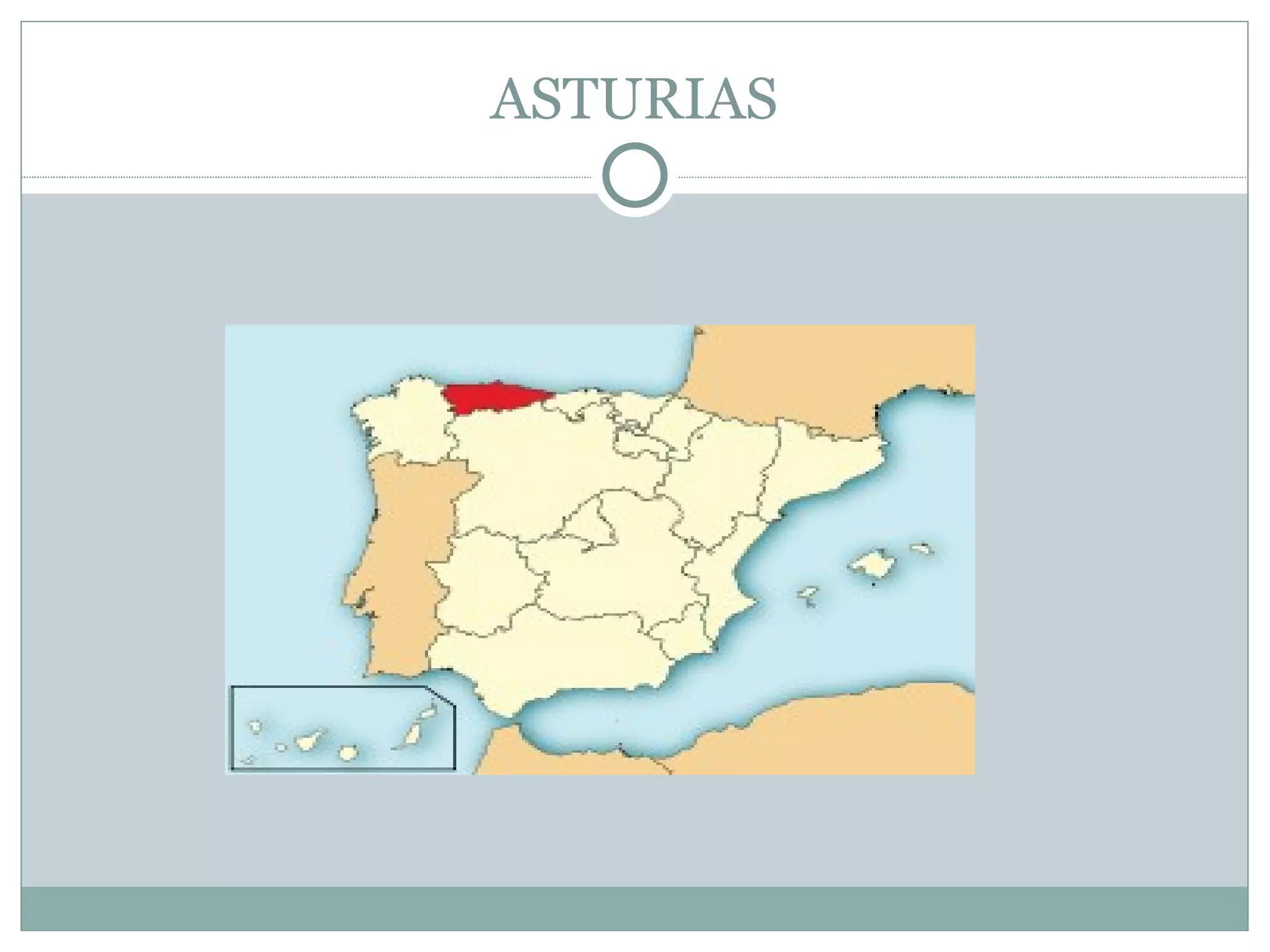
ASTURIAS
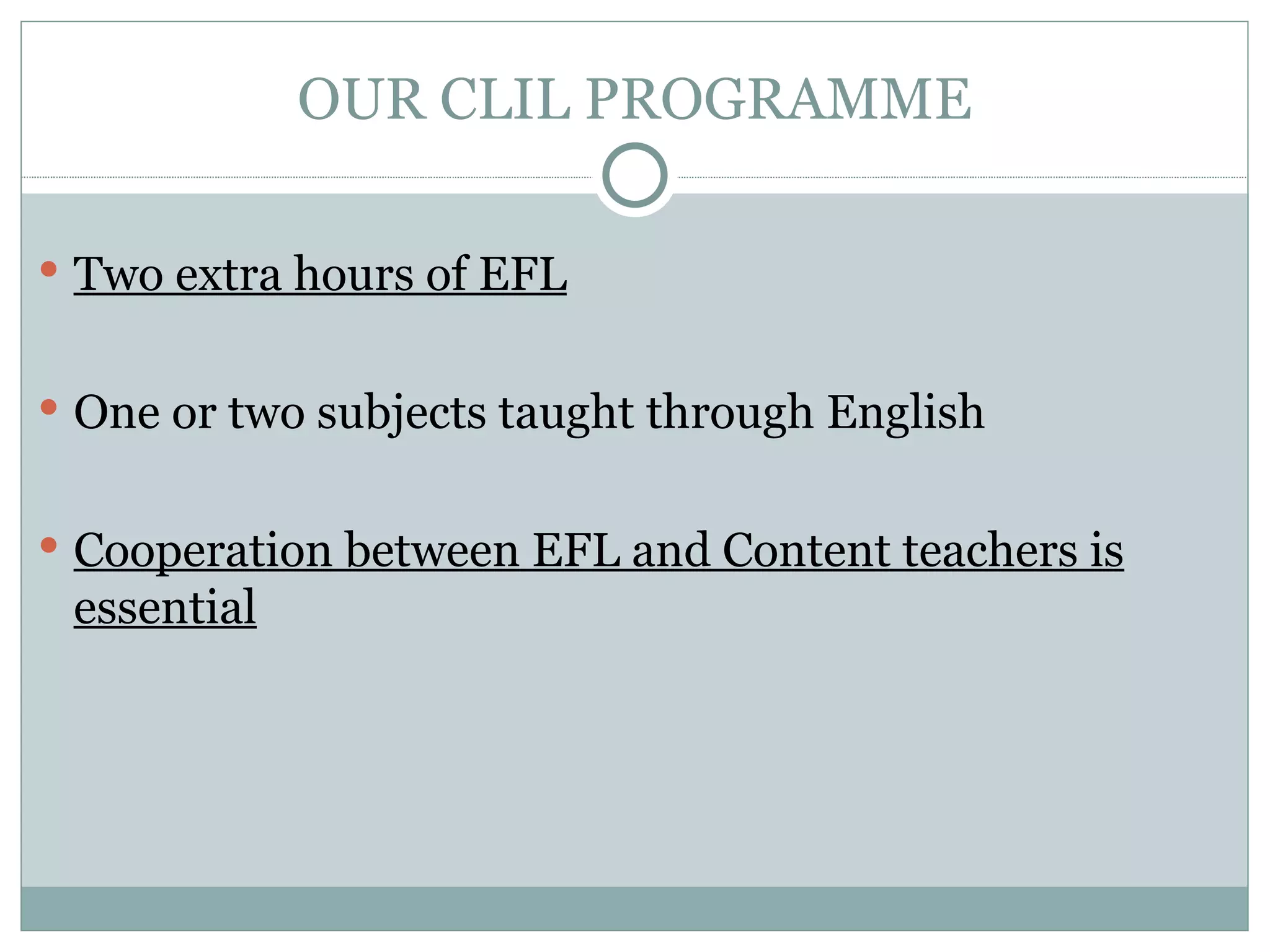
OUR CLIL PROGRAMME Two extra hours of EFL One or two subjects taught through English Cooperation between EFL and Content teachers is essential
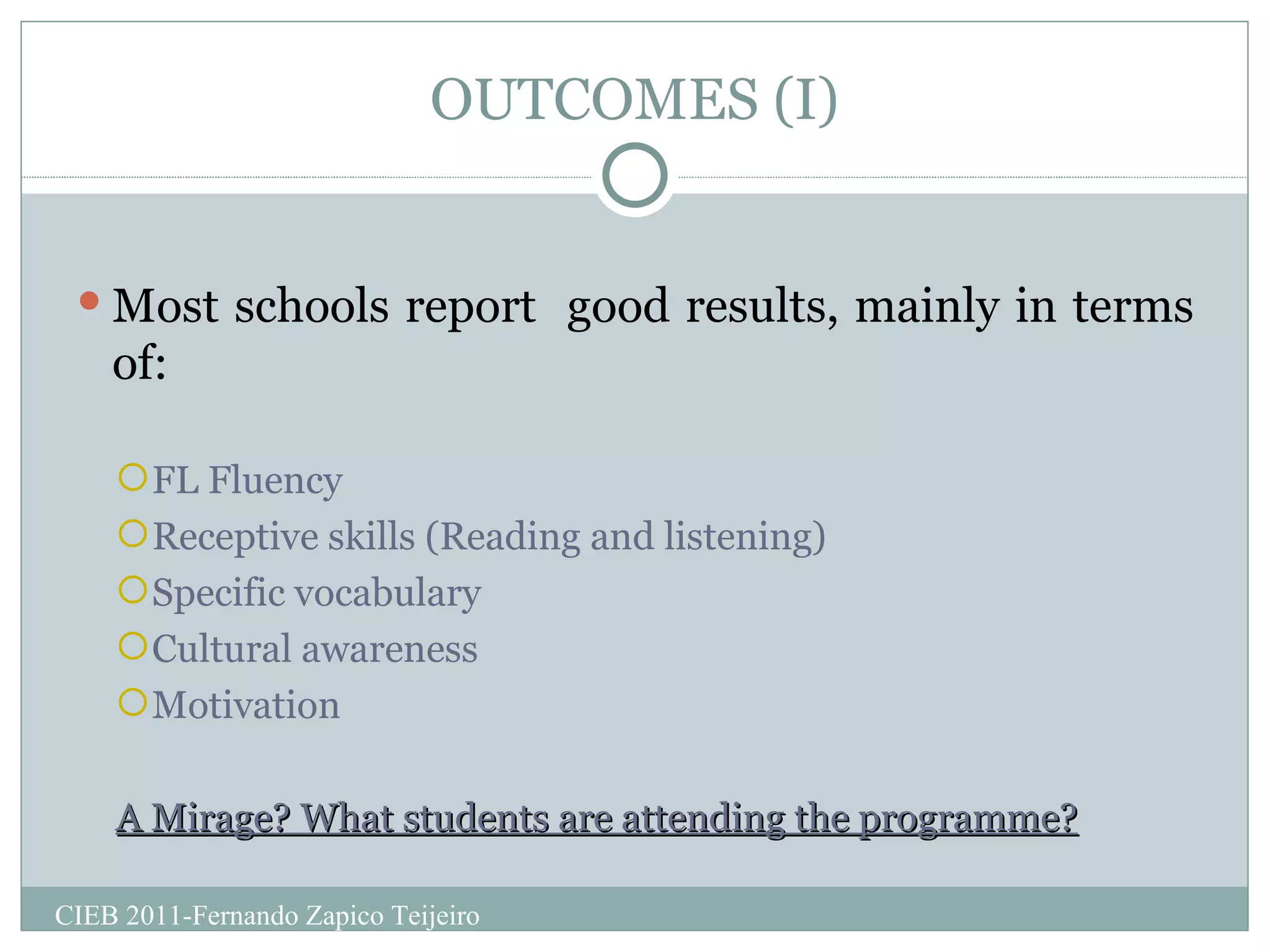
OUTCOMES (I) Most schools report  good results, mainly in terms of: FL Fluency Receptive skills (Reading and listening) Specific vocabulary Cultural awareness Motivation A Mirage? What students are attending the programme? CIEB 2011-Fernando Zapico Teijeiro
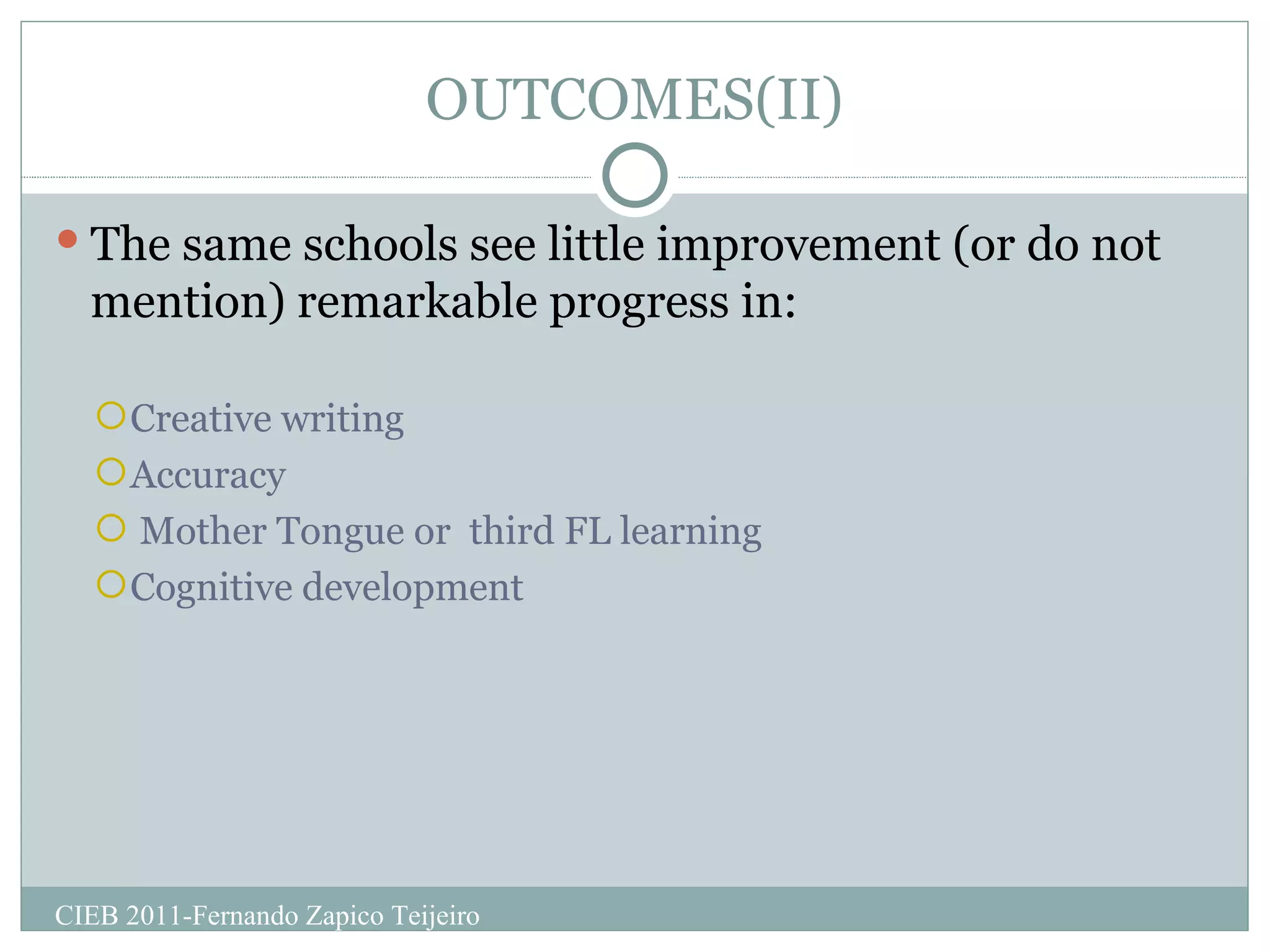
OUTCOMES(II) The same schools see little improvement (or do not mention) remarkable progress in: Creative writing Accuracy Mother Tongue or  third FL learning Cognitive development CIEB 2011-Fernando Zapico Teijeiro
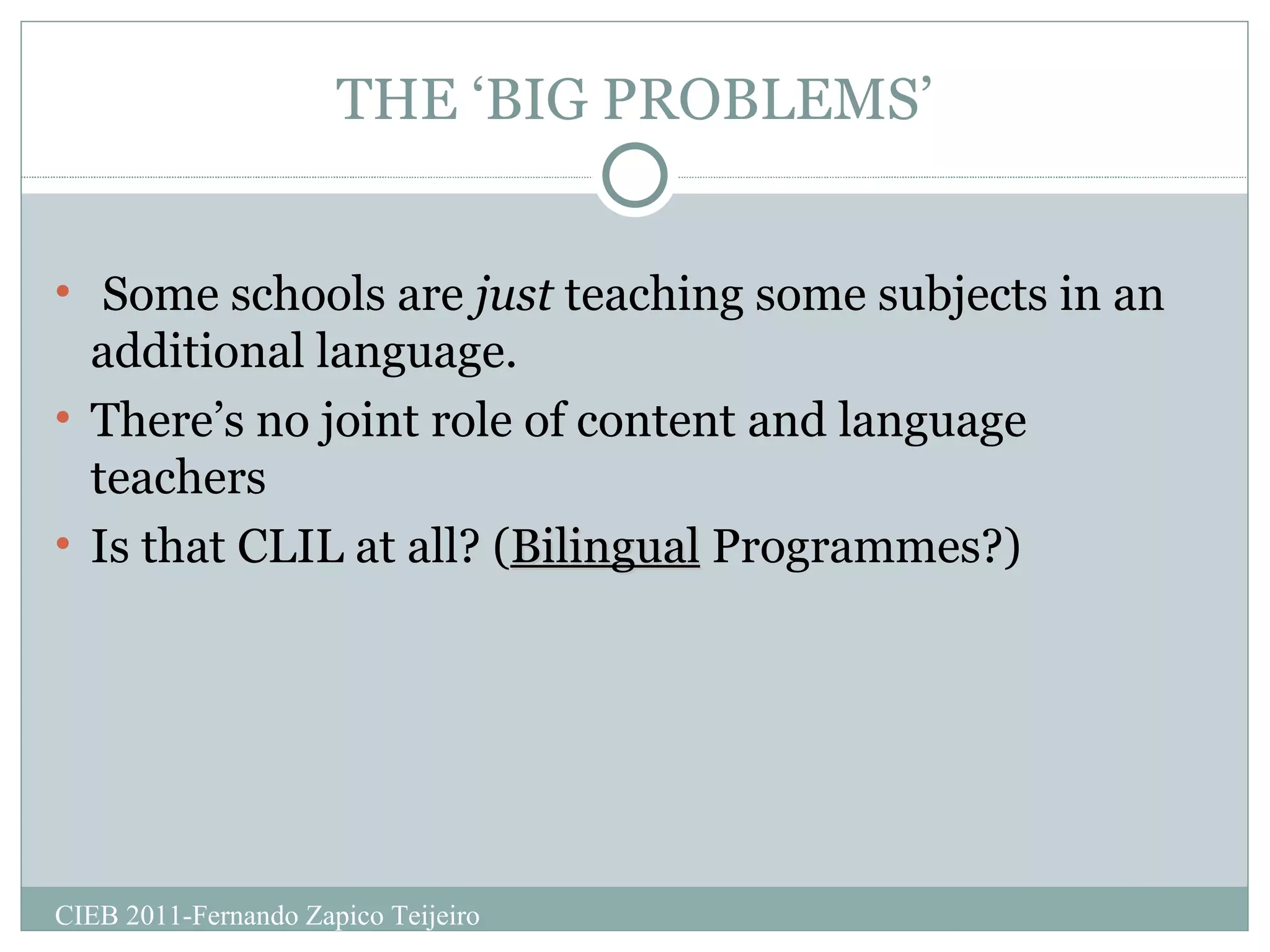
THE ‘BIG PROBLEMS’ Some schools are  just  teaching some subjects in an additional language. There’s no joint role of content and language teachers Is that CLIL at all? ( Bilingual  Programmes?) CIEB 2011-Fernando Zapico Teijeiro
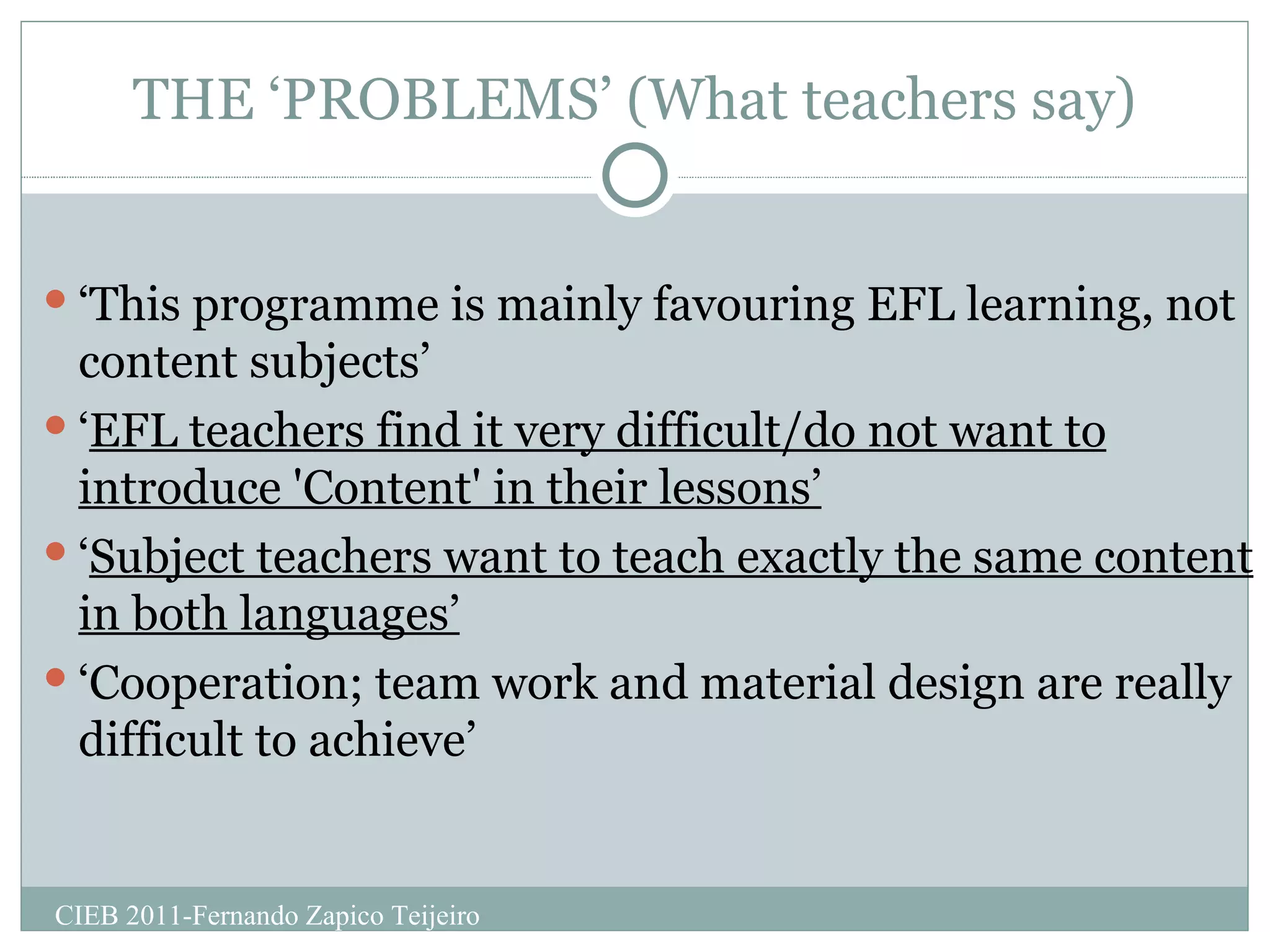
THE ‘PROBLEMS’ (What teachers say) ‘ This programme is mainly favouring EFL learning, not content subjects’ ‘ EFL teachers find it very difficult/do not want to introduce 'Content' in their lessons’ ‘ Subject teachers want to teach exactly the same content in both languages’ ‘ Cooperation; team work and material design are really difficult to achieve’ CIEB 2011-Fernando Zapico Teijeiro
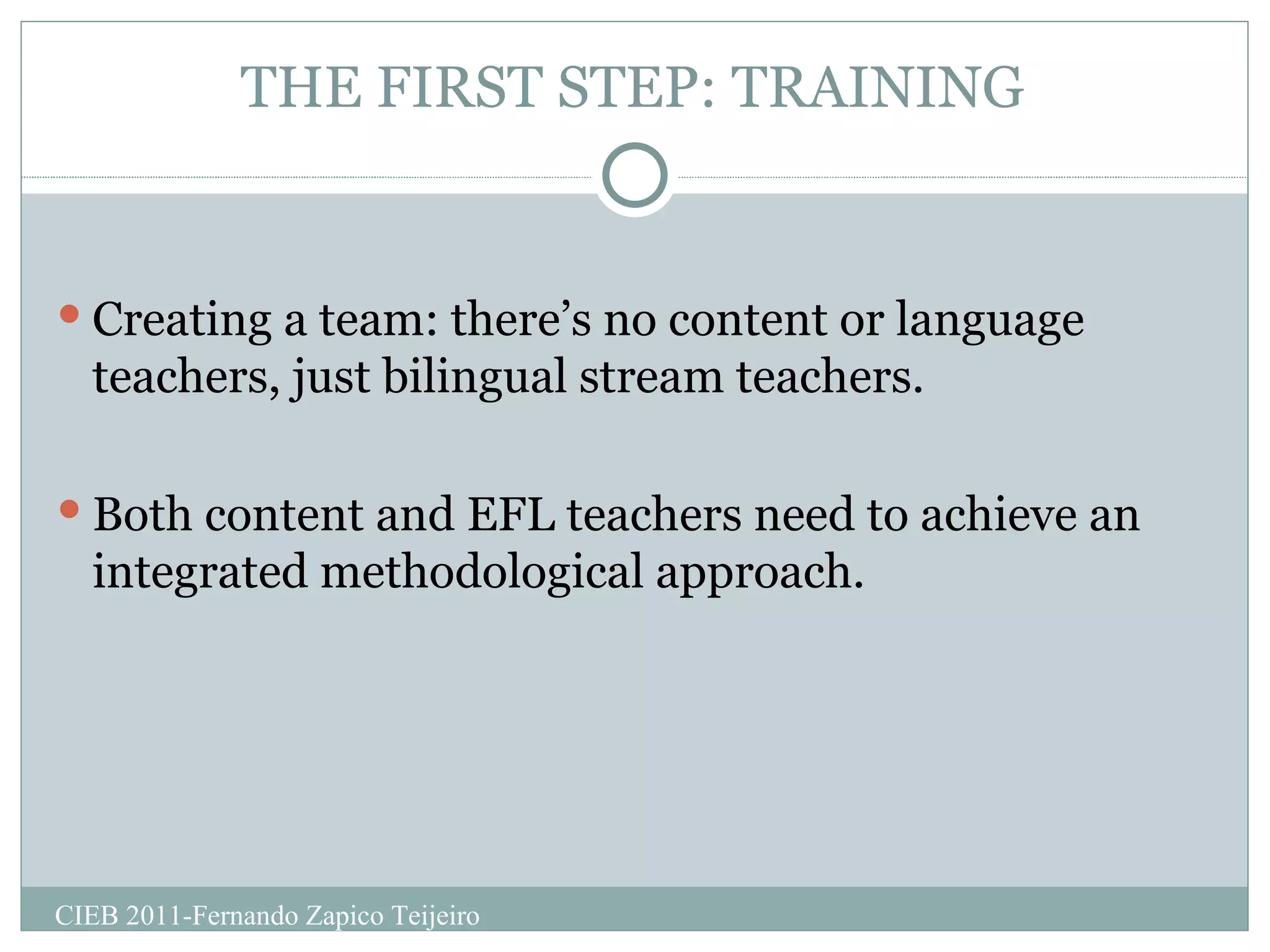
THE FIRST STEP: TRAINING Creating a team: there’s no content or language teachers, just bilingual stream teachers. Both content and EFL teachers need to achieve an integrated methodological approach.  CIEB 2011-Fernando Zapico Teijeiro
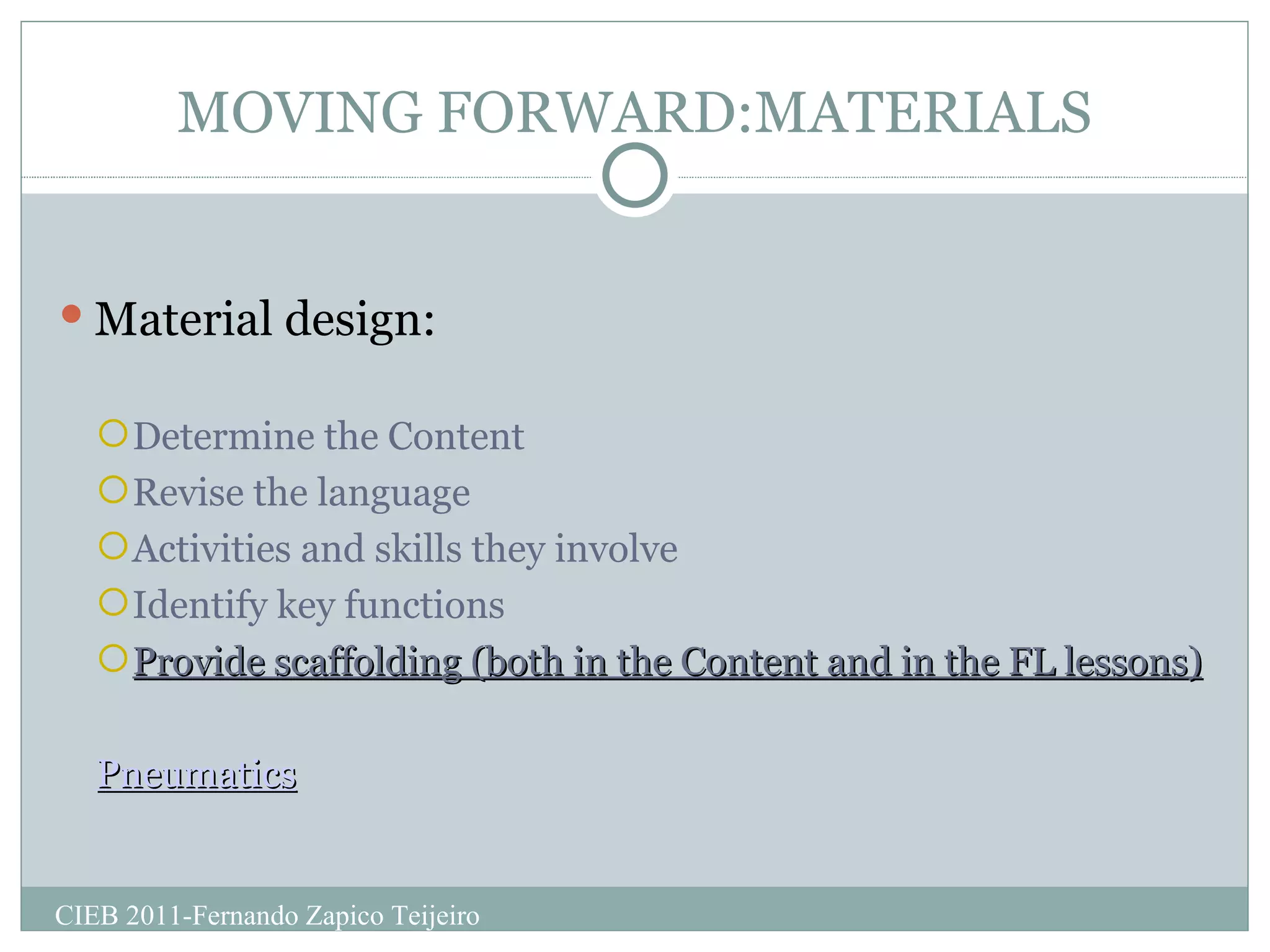
MOVING FORWARD:MATERIALS Material design: Determine the Content Revise the language Activities and skills they involve Identify key functions Provide scaffolding (both in the Content and in the FL lessons) Pneumatics CIEB 2011-Fernando Zapico Teijeiro
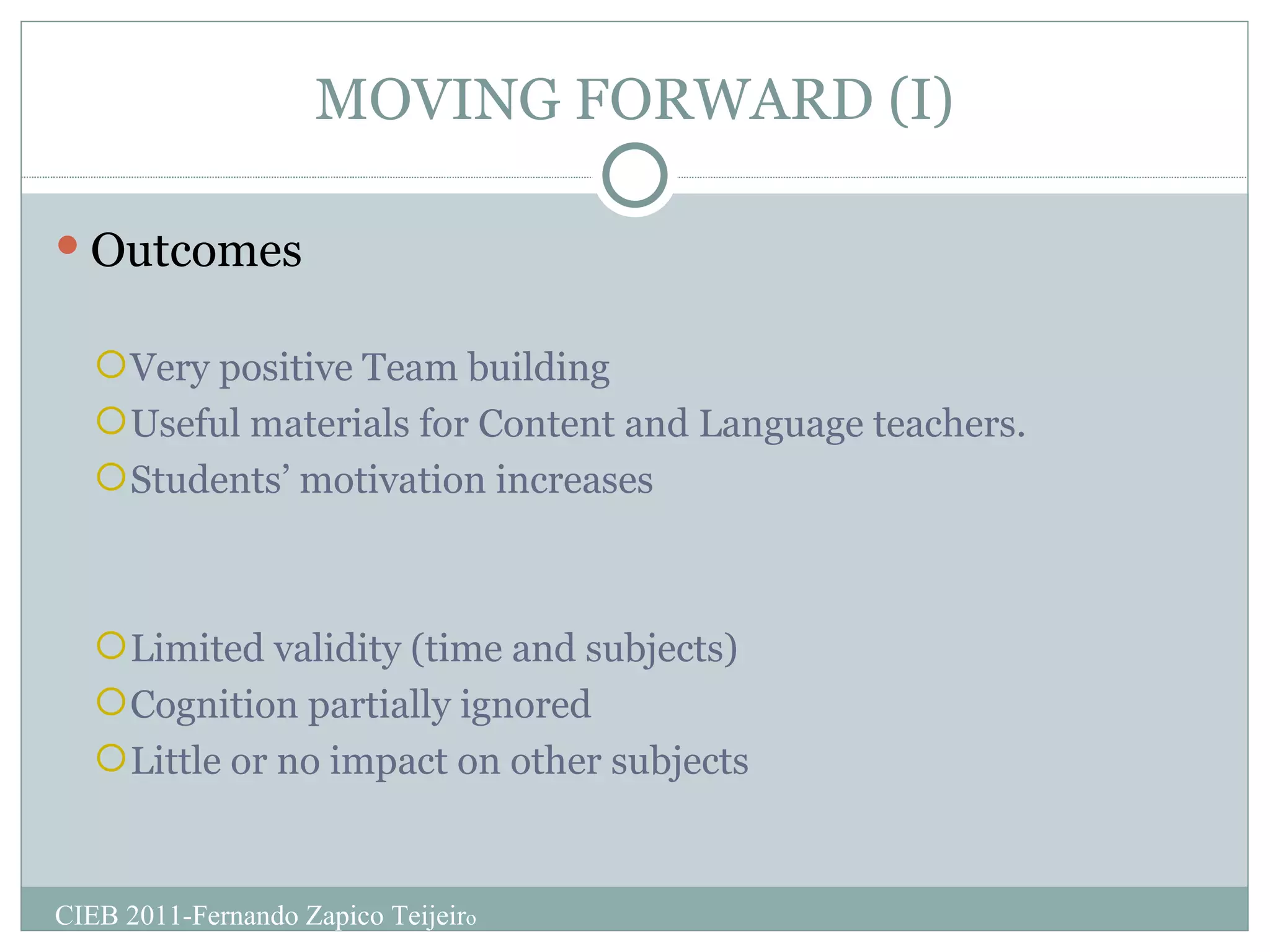
MOVING FORWARD (I) Outcomes Very positive Team building Useful materials for Content and Language teachers. Students’ motivation increases Limited validity (time and subjects) Cognition partially ignored Little or no impact on other subjects CIEB 2011-Fernando Zapico Teijeir o
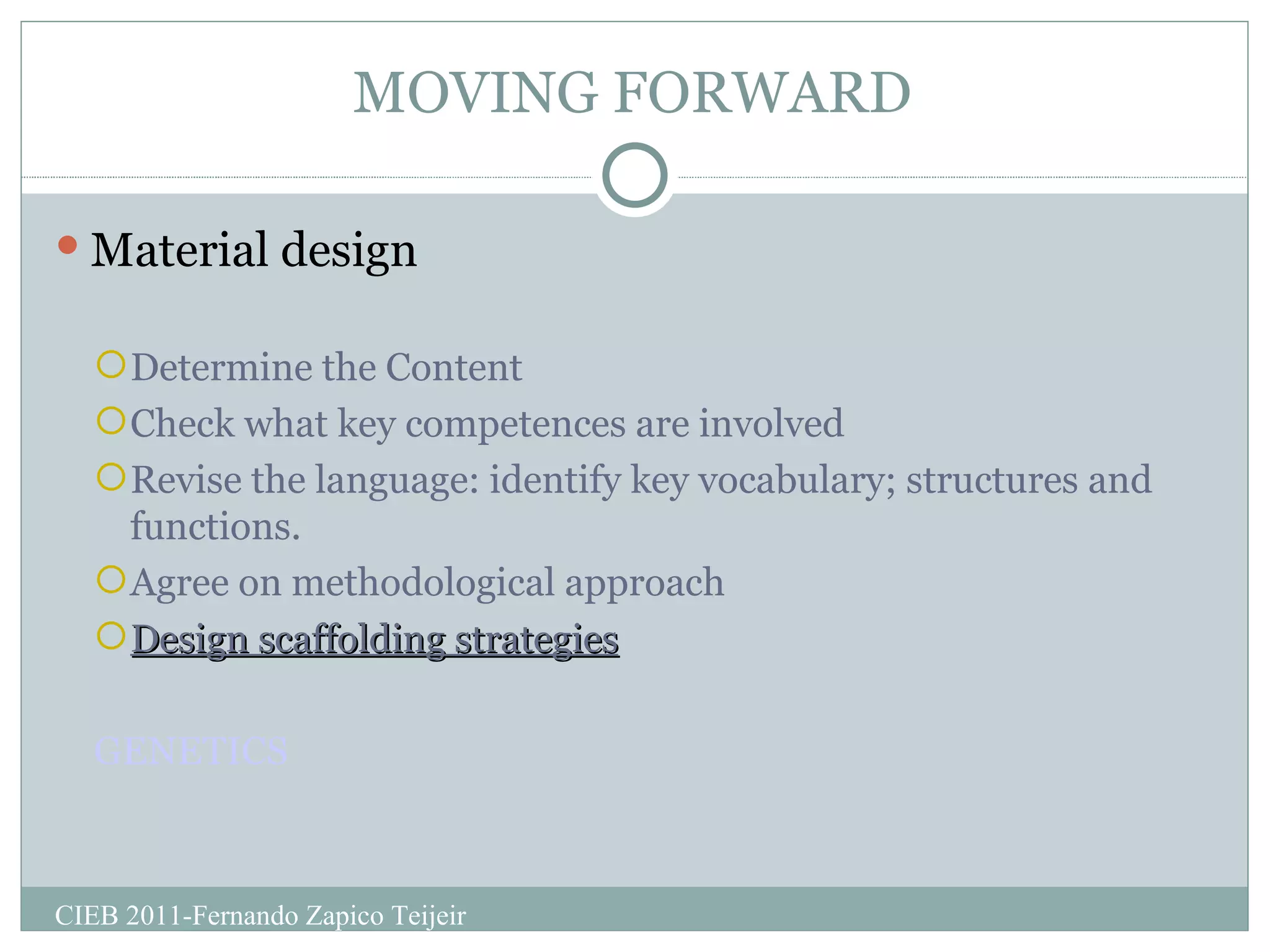
MOVING FORWARD Material design Determine the Content  Check what key competences are involved Revise the language: identify key vocabulary; structures and functions. Agree on methodological approach Design scaffolding strategies GENETICS CIEB 2011-Fernando Zapico Teijeir
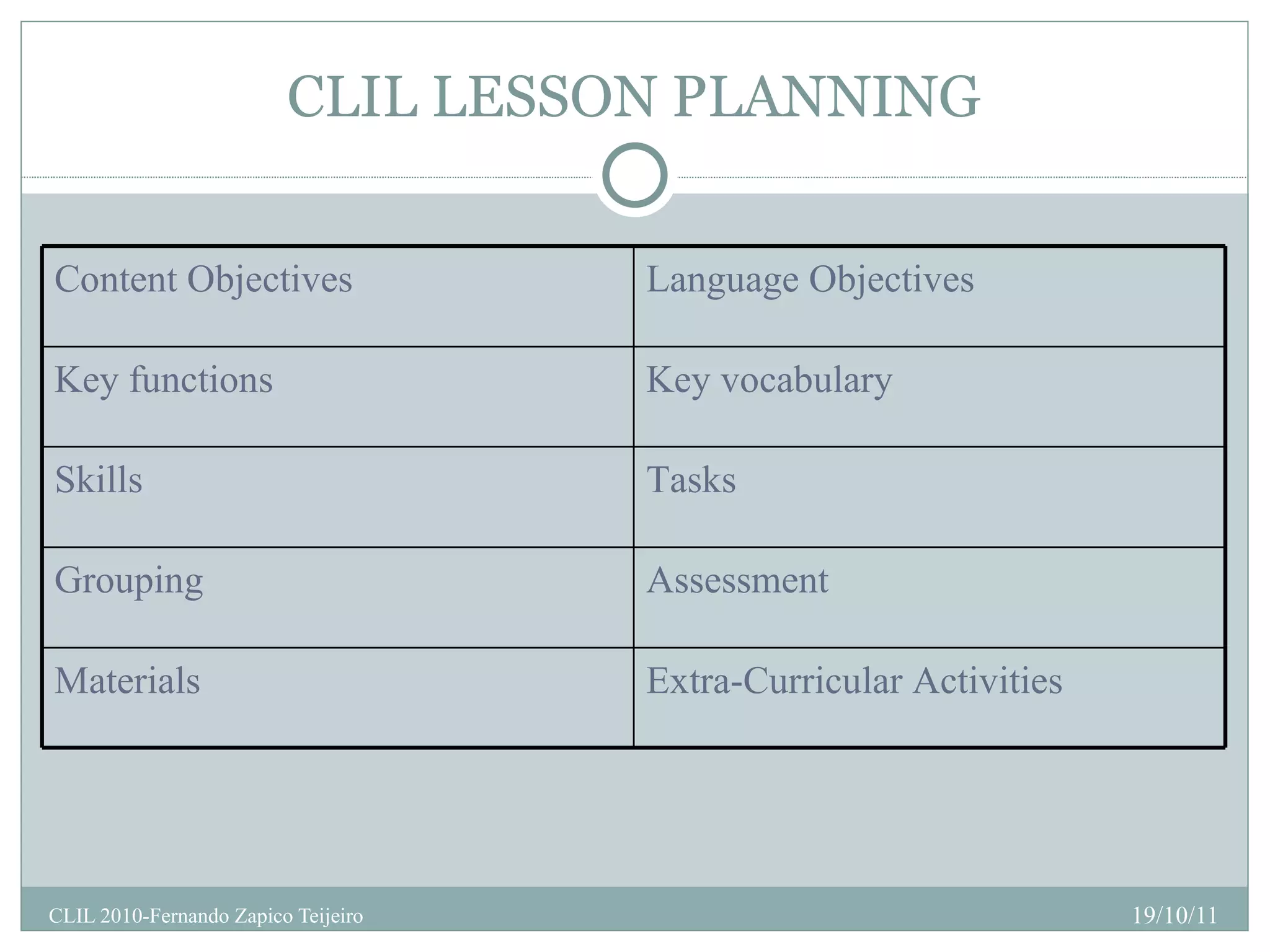
CLIL LESSON PLANNING Extra-Curricular Activities Materials Assessment Grouping Tasks Skills Key vocabulary Key functions Language Objectives Content Objectives
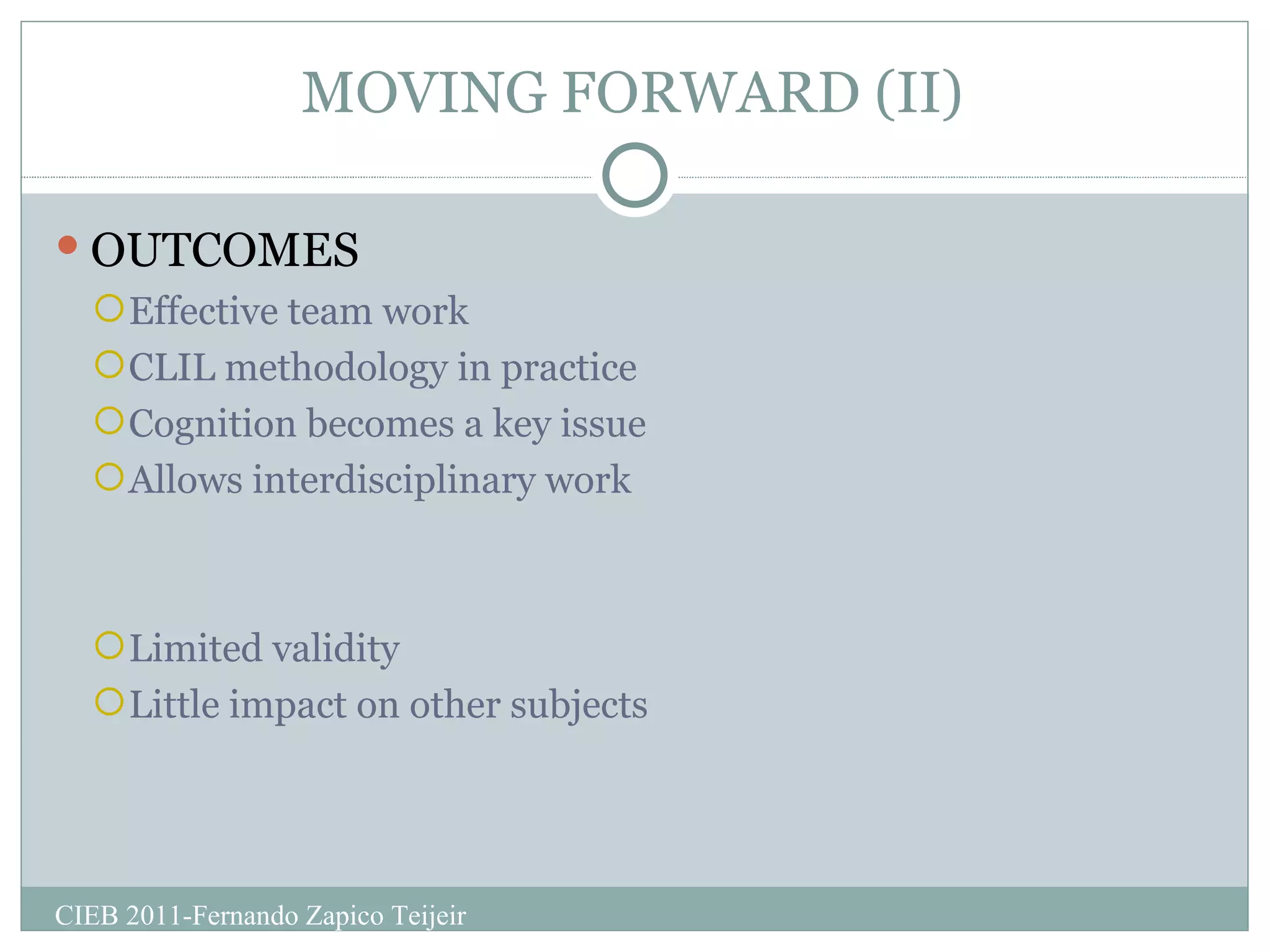
MOVING FORWARD (II) OUTCOMES Effective team work CLIL methodology in practice Cognition becomes a key issue Allows interdisciplinary work Limited validity Little impact on other subjects CIEB 2011-Fernando Zapico Teijeir
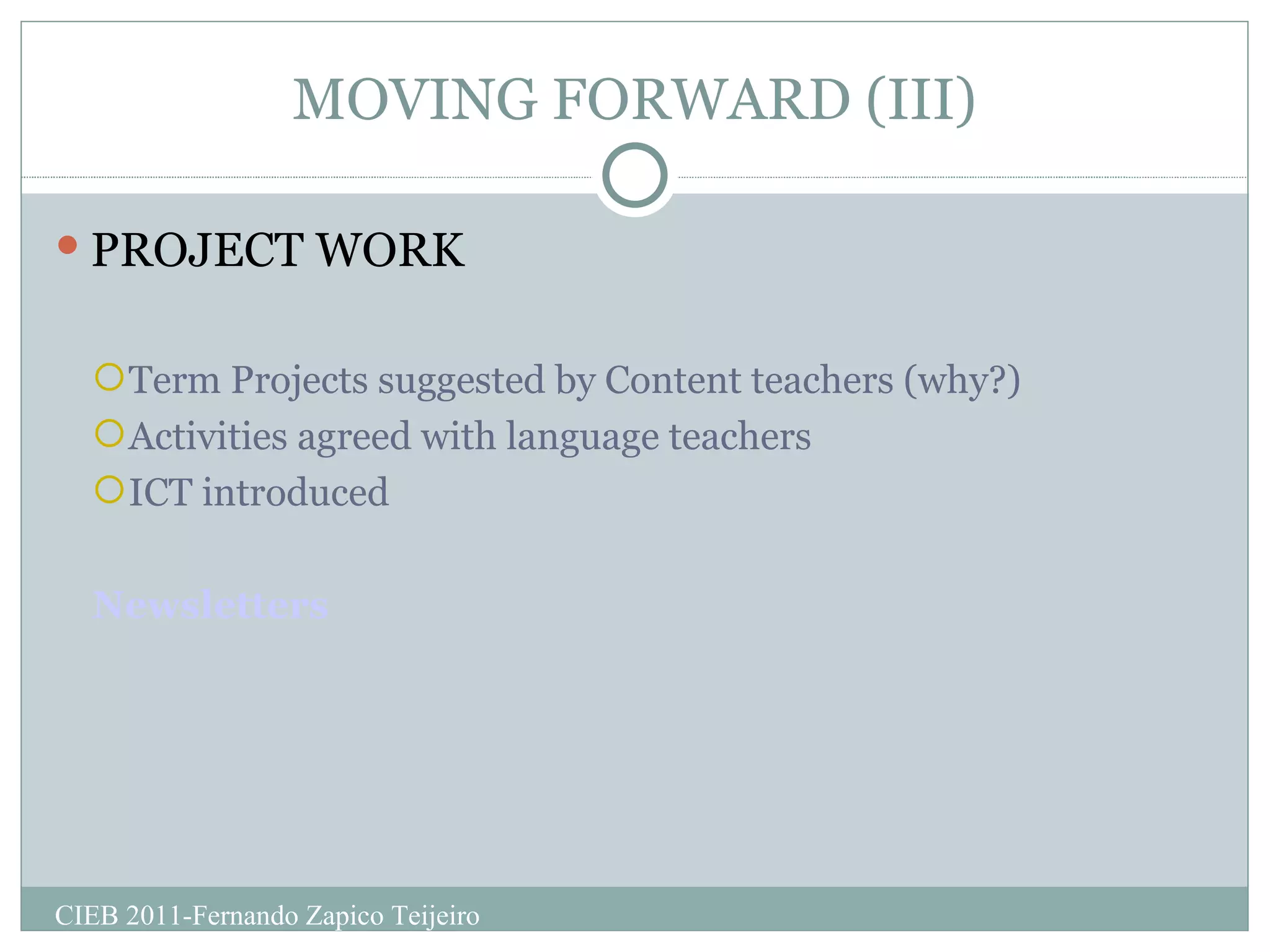
MOVING FORWARD (III) PROJECT WORK Term Projects suggested by Content teachers (why?) Activities agreed with language teachers ICT introduced Newsletters CIEB 2011-Fernando Zapico Teijeiro
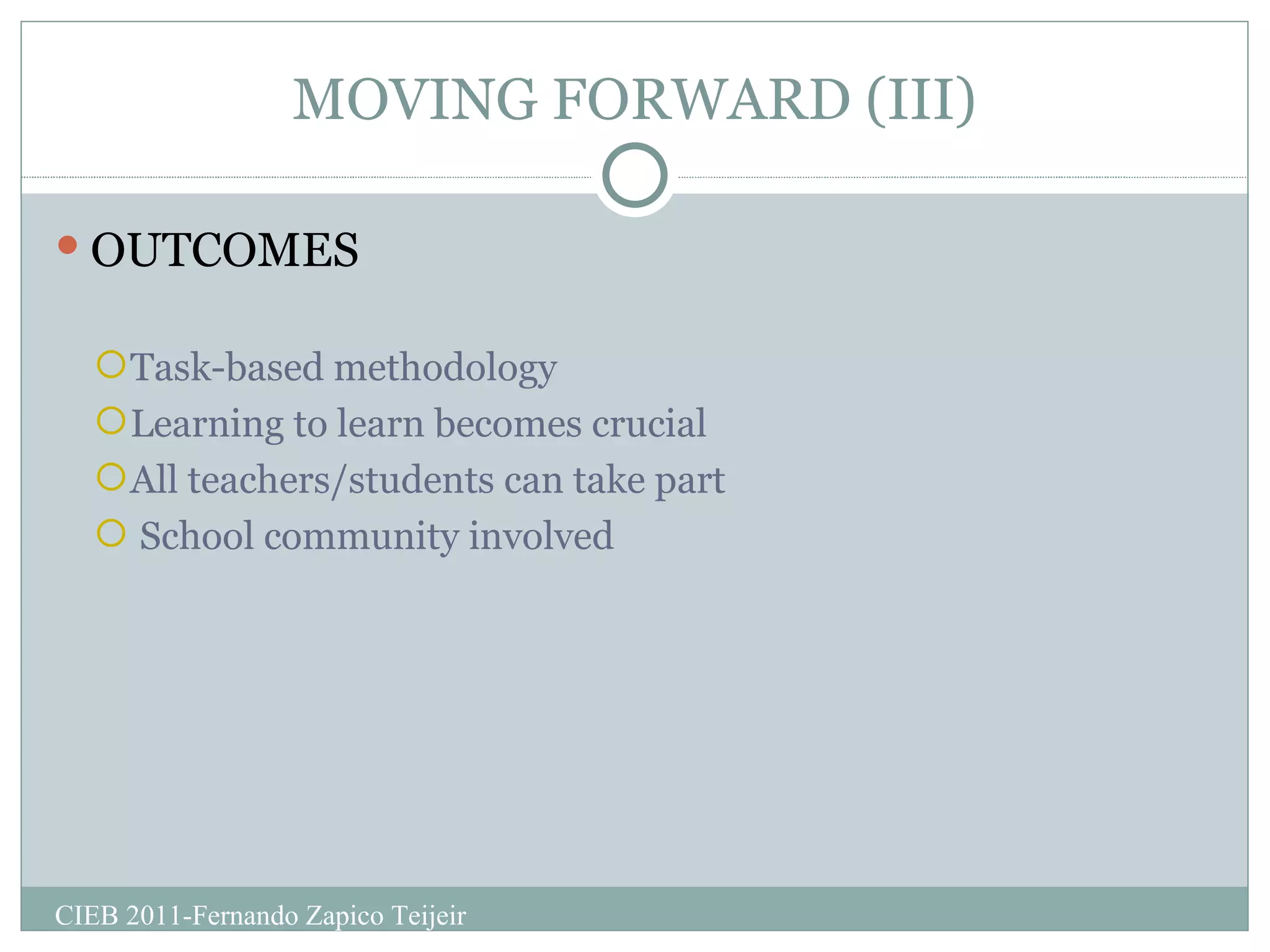
MOVING FORWARD (III) OUTCOMES Task-based methodology Learning to learn becomes crucial All teachers/students can take part School community involved CIEB 2011-Fernando Zapico Teijeir
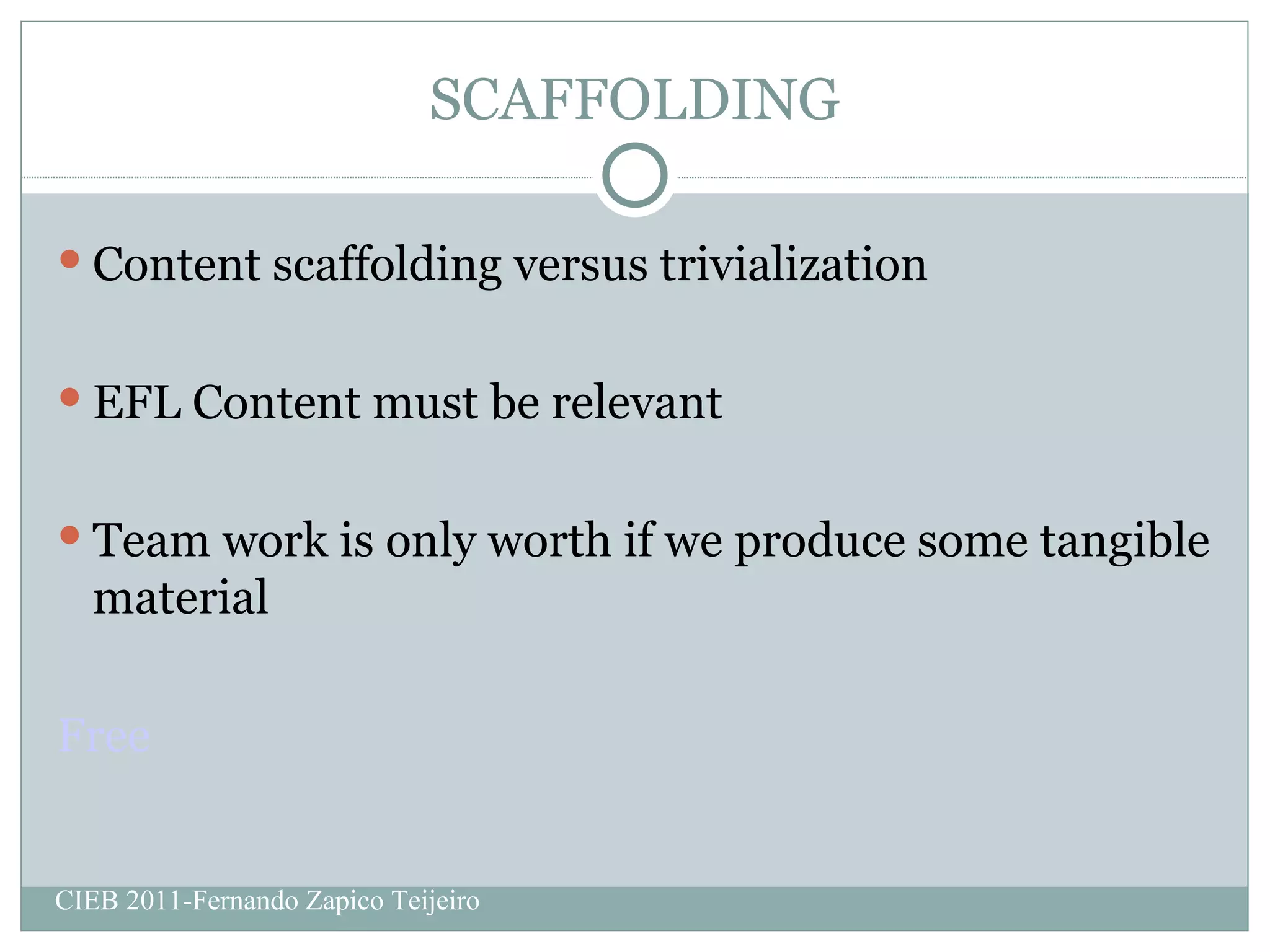
SCAFFOLDING Content scaffolding versus trivialization EFL Content must be relevant Team work is only worth if we produce some tangible material Free CIEB 2011-Fernando Zapico Teijeiro
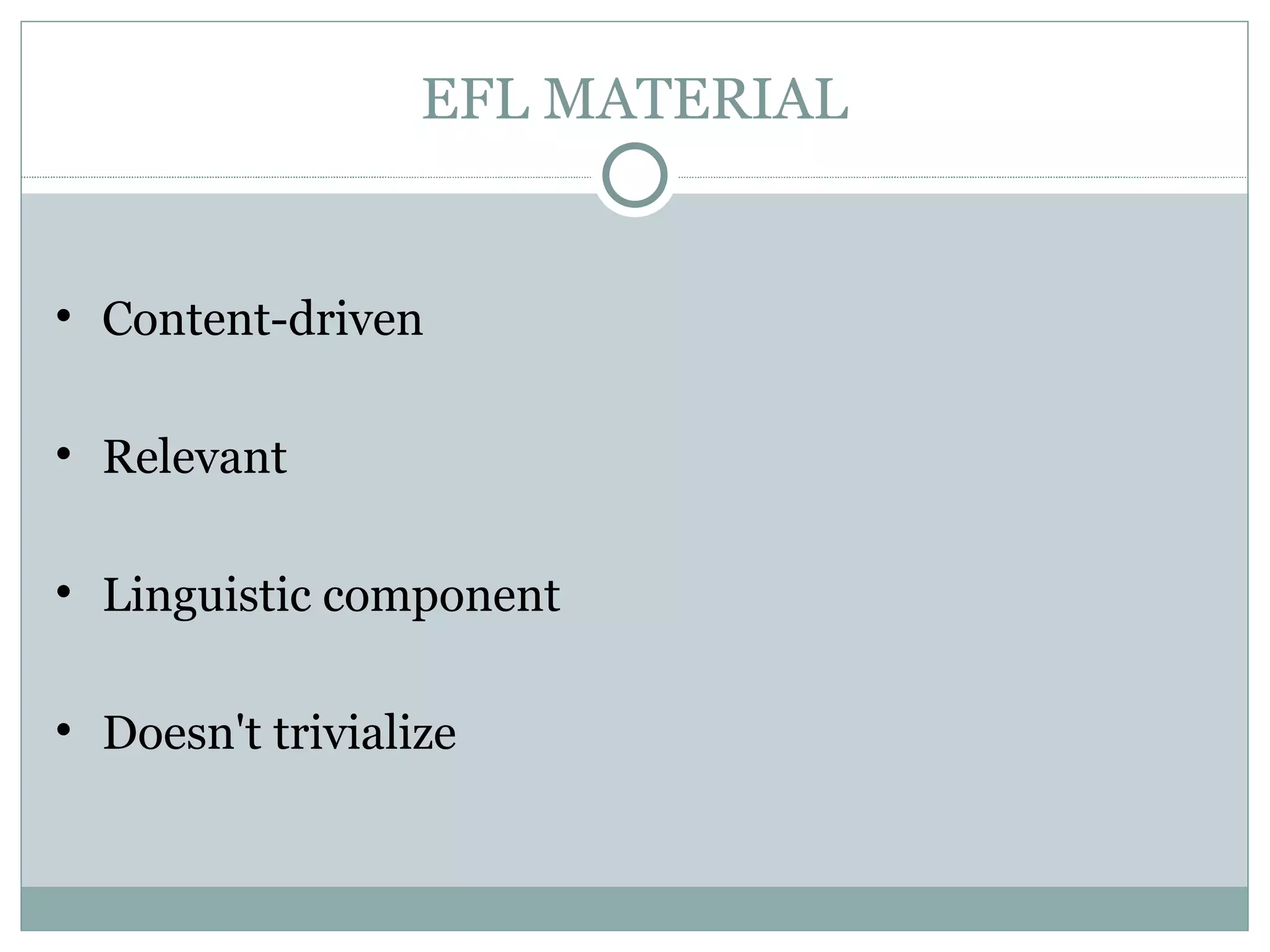
EFL MATERIAL Content-driven Relevant Linguistic component Doesn't trivialize
Thanks for your attention!!! [email_address] [email_address]

Scaffolding content and language

  • 1.
    SCAFFOLDING CONTENT ANDLANGUAGE CIEB-MADRID 2011 Fernando Zapico Teijeiro
  • 2.
    AIMS Showing thatthe terms 'bilingual' and 'CLIL' might be too versatile Defining the role of FL teachers Presenting 'scaffolding' as one of the key elements in bilingual teaching
  • 3.
    SUMMARY Our CLILProgramme The outcomes The problems Solutions: scaffolding content and language CIEB 2011-Fernando Zapico Teijeiro
  • 4.
  • 5.
    OUR CLIL PROGRAMMETwo extra hours of EFL One or two subjects taught through English Cooperation between EFL and Content teachers is essential
  • 6.
    OUTCOMES (I) Mostschools report good results, mainly in terms of: FL Fluency Receptive skills (Reading and listening) Specific vocabulary Cultural awareness Motivation A Mirage? What students are attending the programme? CIEB 2011-Fernando Zapico Teijeiro
  • 7.
    OUTCOMES(II) The sameschools see little improvement (or do not mention) remarkable progress in: Creative writing Accuracy Mother Tongue or third FL learning Cognitive development CIEB 2011-Fernando Zapico Teijeiro
  • 8.
    THE ‘BIG PROBLEMS’Some schools are just teaching some subjects in an additional language. There’s no joint role of content and language teachers Is that CLIL at all? ( Bilingual Programmes?) CIEB 2011-Fernando Zapico Teijeiro
  • 9.
    THE ‘PROBLEMS’ (Whatteachers say) ‘ This programme is mainly favouring EFL learning, not content subjects’ ‘ EFL teachers find it very difficult/do not want to introduce 'Content' in their lessons’ ‘ Subject teachers want to teach exactly the same content in both languages’ ‘ Cooperation; team work and material design are really difficult to achieve’ CIEB 2011-Fernando Zapico Teijeiro
  • 10.
    THE FIRST STEP:TRAINING Creating a team: there’s no content or language teachers, just bilingual stream teachers. Both content and EFL teachers need to achieve an integrated methodological approach. CIEB 2011-Fernando Zapico Teijeiro
  • 11.
    MOVING FORWARD:MATERIALS Materialdesign: Determine the Content Revise the language Activities and skills they involve Identify key functions Provide scaffolding (both in the Content and in the FL lessons) Pneumatics CIEB 2011-Fernando Zapico Teijeiro
  • 12.
    MOVING FORWARD (I)Outcomes Very positive Team building Useful materials for Content and Language teachers. Students’ motivation increases Limited validity (time and subjects) Cognition partially ignored Little or no impact on other subjects CIEB 2011-Fernando Zapico Teijeir o
  • 13.
    MOVING FORWARD Materialdesign Determine the Content Check what key competences are involved Revise the language: identify key vocabulary; structures and functions. Agree on methodological approach Design scaffolding strategies GENETICS CIEB 2011-Fernando Zapico Teijeir
  • 14.
    CLIL LESSON PLANNINGExtra-Curricular Activities Materials Assessment Grouping Tasks Skills Key vocabulary Key functions Language Objectives Content Objectives
  • 15.
    MOVING FORWARD (II)OUTCOMES Effective team work CLIL methodology in practice Cognition becomes a key issue Allows interdisciplinary work Limited validity Little impact on other subjects CIEB 2011-Fernando Zapico Teijeir
  • 16.
    MOVING FORWARD (III)PROJECT WORK Term Projects suggested by Content teachers (why?) Activities agreed with language teachers ICT introduced Newsletters CIEB 2011-Fernando Zapico Teijeiro
  • 17.
    MOVING FORWARD (III)OUTCOMES Task-based methodology Learning to learn becomes crucial All teachers/students can take part School community involved CIEB 2011-Fernando Zapico Teijeir
  • 18.
    SCAFFOLDING Content scaffoldingversus trivialization EFL Content must be relevant Team work is only worth if we produce some tangible material Free CIEB 2011-Fernando Zapico Teijeiro
  • 19.
    EFL MATERIAL Content-drivenRelevant Linguistic component Doesn't trivialize
  • 20.
    Thanks for yourattention!!! [email_address] [email_address]