Content and Language Integrated 
Learning 
Boys Can Learn Languages!
Context 
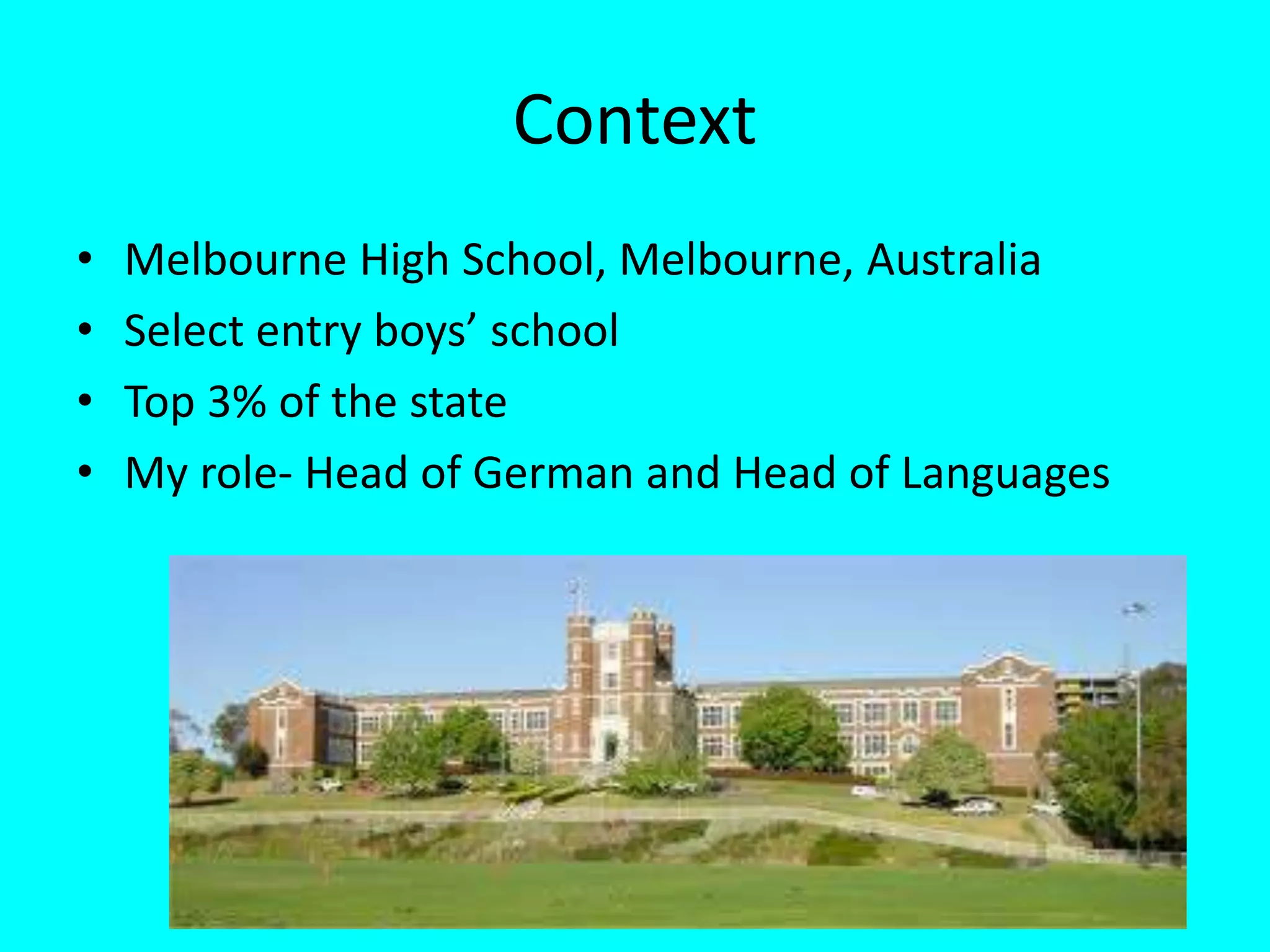
• Melbourne High School, Melbourne, Australia 
• Select entry boys’ school 
• Top 3% of the state 
• My role- Head of German and Head of Languages
What are some of the problems in 
language education? 
• Students not challenged 
• Language study irrelevant 
• Students have no immediate need to improve 
in or focus on their language skills 
• English is the universal language
Questions 
Why? 
What? 
How? 
With what results?
Second Language Acquisition 
• The current research on second language 
acquisition tells us that to become competent 
in a language it must be presented in a 
relevant context and must have a 
communicative function (Richard and Rogers, 
2001).
What is meant by CLIL? 
• Content and Language Integrated Learning 
(CLIL) is a dual-focused educational approach. 
• The additional language (foreign language) is 
used for the teaching of both content and 
language. 
• I teach the history curriculum through the 
German language.
Why? Teaching boys at MHS? 
Why did we trial a CLIL program at Melbourne High 
School? 
- Boys and language learning 
- High achieving students 
- Language drop off 
- German program was not necessarily relevant to 
the students needs and interests 
- High order thinking 
- Cognitive advantages of bilingualism
How do you teach a CLIL program? 
• Integrated content-based instruction 
–Content and language objectives are 
planned concurrently 
–Key vocabulary is pre-taught (essential) 
–Highly scaffolded 
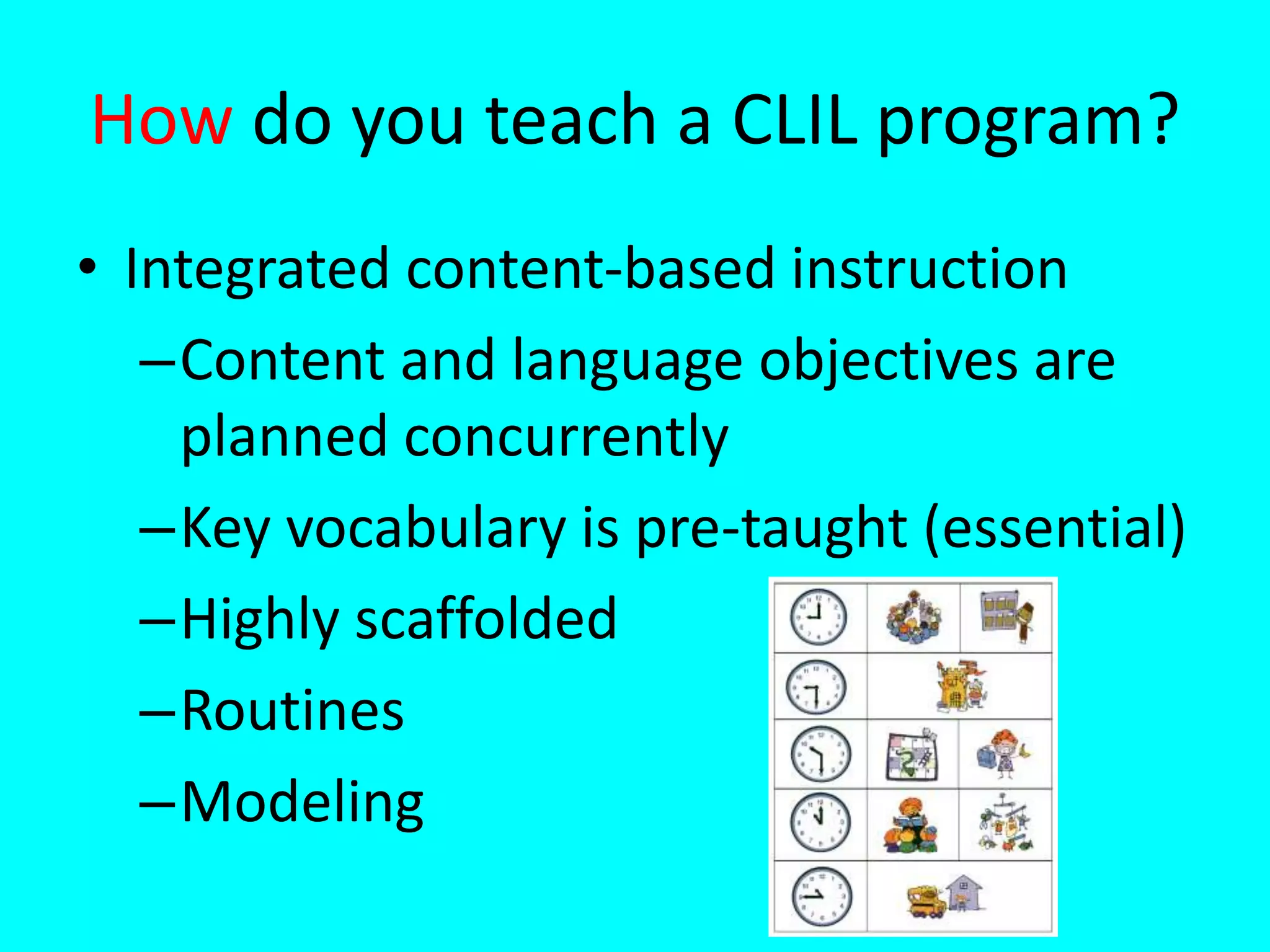
–Routines 
–Modeling
With what results? Program Review 
• Student Survey (start and end of program) 
• The students want to learn! 
• Changed classroom atmosphere. 
• They are creative with the language. 
• Don’t rely on translators. 
• Create complicated sentences. 
• Students sat the year 9 history exam-results 
were in-line with the year level results .
With what results? 
Continued evaluation 
• The year 9 CLIL students from 2013 are now 
studying German in year 10. 
• It will be interesting to see what happens to 
the numbers at year 11 in 2015. 
• For further information please email me at: 
briggs.elizabeth.e@edumail.vic.gov.au

Aprendizaje de contenido y lenguaje integrado

  • 1.
    Content and LanguageIntegrated Learning Boys Can Learn Languages!
  • 2.
    Context • MelbourneHigh School, Melbourne, Australia • Select entry boys’ school • Top 3% of the state • My role- Head of German and Head of Languages
  • 3.
    What are someof the problems in language education? • Students not challenged • Language study irrelevant • Students have no immediate need to improve in or focus on their language skills • English is the universal language
  • 4.
    Questions Why? What? How? With what results?
  • 5.
    Second Language Acquisition • The current research on second language acquisition tells us that to become competent in a language it must be presented in a relevant context and must have a communicative function (Richard and Rogers, 2001).
  • 6.
    What is meantby CLIL? • Content and Language Integrated Learning (CLIL) is a dual-focused educational approach. • The additional language (foreign language) is used for the teaching of both content and language. • I teach the history curriculum through the German language.
  • 7.
    Why? Teaching boysat MHS? Why did we trial a CLIL program at Melbourne High School? - Boys and language learning - High achieving students - Language drop off - German program was not necessarily relevant to the students needs and interests - High order thinking - Cognitive advantages of bilingualism
  • 8.
    How do youteach a CLIL program? • Integrated content-based instruction –Content and language objectives are planned concurrently –Key vocabulary is pre-taught (essential) –Highly scaffolded –Routines –Modeling
  • 9.
    With what results?Program Review • Student Survey (start and end of program) • The students want to learn! • Changed classroom atmosphere. • They are creative with the language. • Don’t rely on translators. • Create complicated sentences. • Students sat the year 9 history exam-results were in-line with the year level results .
  • 10.
    With what results? Continued evaluation • The year 9 CLIL students from 2013 are now studying German in year 10. • It will be interesting to see what happens to the numbers at year 11 in 2015. • For further information please email me at: briggs.elizabeth.e@edumail.vic.gov.au