SCAFFOLDING
DEFINITION “ A temporary structure from which persons can gain access to a place in order to carry out building operation” “  A temporary frame usually constructed from steel or aluminium alloy tubes clipped or coupled together to provide a means of access to high-level working areas as well as providing as a safe platform from which to work.”
FUNCTION As a working platform - so that the worker can stand on the platform  do the work easily & safely As a platform for placing material & logistic  needed by the workers to carry out their job As a platform and walking passage - scaffolding support the platform that been  used by the worker as their walking path to  transport the material & logistic
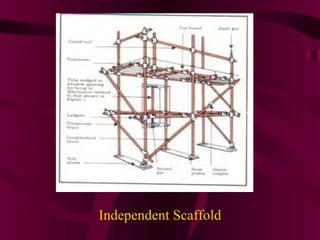
2 Basic forms of scaffolding are as follows: Putlog Scaffold - Single row of uprights / standards set  outside the perimeter of the building. - It’s a partly supported by the structure Independent Scaffolds - It have 2 rows of standards that are tied  by cross members called transoms.
Among the factors need to be considered  during the design process of scaffold are as follows: Easier to be erected Strong Light / Not heavy Safe Suitable Passage Link / Passage connecting to other places
Scaffold can be made of the following  material: Tubular steel  b)  Tubular aluminium  alloy c)  Timber
STEEL SCAFFOLD Steel tubes are nearly 3 times heavier than aluminium alloy tubes but are far stronger. Longer span can be used since it deflection is  approximately 1/3 of aluminium alloy tubes. There 2 types that is: - Galvanized steel tubes - Ungalvanized steel tubes that need special care (painting, varnishing or oil bath after use)
Steel Scaffolding
ALUMINIUM SCAFFOLDS Need protective treatment when they are to  be used in contact with materials such as  damp line, wet cement & sea water to  prevent corrosion to the tubes. Coating the tube with bitumastic paint  before using it would be a suitable  protective treatment.
Aluminium Scaffolding                                                      
TIMBER SCAFFOLD Extensively used in the developing country Members are lashed together with wire or  rope instead of the coupling fittings used  with metal scaffolds.
Timber Scaffold
Bamboo Scaffolding (In Hong Kong)
Bamboo Scaffolding
SCAFFOLD ELEMENTS Standards / “Tiang” Ledger / “belebas” Transom / “Pepat” Double Coupler / “Pengganding Berkembar” Swivel Coupler / “Pengganding Swivel” Putlog Coupler / “Pengganding Putlog”  Base Plate /  Split Joint Pin Reveal Pin Putlog End
BASE PLATE DOUBLE  COUPLER STANDARD
STANDARD
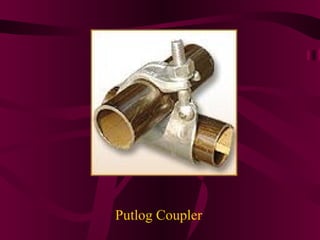
Double Coupler - the only real loadbearing fitting used in  scaffolding - used to join ledgers to standards Swivel Coupler - Composed of 2 single coupler riveted  together so that it is possible to rotate them &  use them for connecting 2 scaffold tubes at  any angle. c)  Putlog Coupler - use solely for fixing putlogs/transoms to the  horizontal ledgers.
d) Base Plate - It is used to distribute the load from the foot of  a standard on to a sole plate or firm ground. e) Split Joint Pin - A connection fitting used to joint scaffold tubes  end to end. - A centre bolt expands the 2 segments that grip  on the bore of the tubes f) Reveal Pin - Fits into the end of a tube to form an adjustable  strut
g) Putlog End - A flat plate that fits on the end of a  scaffold tube to convert it into a putlog
Putlog Coupler
Double Coupler
Swivel Coupler
Base Plate For Scaffold
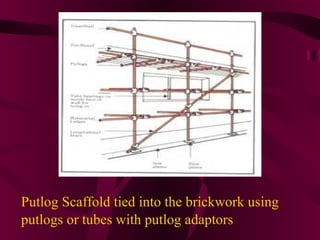
PUTLOG SCAFFOLDS It consists of a single row of uprights or  standards set away from the wall at a distance  that will accommodate the required width of the  working platform. The standards are joined together with  horizontal members called “ledgers” The ledgers are tied to the building with cross  members called putlog. It is erected as the building rises & mostly used  for buildings of traditional brick construction
Putlog Scaffold tied into the brickwork using  putlogs or tubes with putlog adaptors
INDEPENDENT SCAFFOLD This scaffold has 2 rows of standards that  are toed by cross members called transoms. This scaffold doesn’t rely upon the building  for support Suitable for use in conjunction with framed  structures.
Independent Scaffold
OTHER TYPES OF SCAFFOLD Besides pulog scaffold & independent scaffold there are other such as: Slung Scaffold Truss-Out Scaffold Suspended Scaffolds Mobile Tower Scaffold Birdcage Scaffolds Gantries
MOBILE TOWER SCAFFOLD The mobile scaffold would have small tyres  under the standards. Designed to be easily moved Commonly used for things such as painting   and plastering, where workers must frequently   change position. Used mainly by painters & maintenance to  gain access to ceilings.
Mobile Tower Scaffold
Mobile Scaffold
Suspended Scaffold It is platform that is suspended by rope or other non-rigid means, from an overhead structure There are many types of suspended scaffolds such two point (swing stage), multipoint adjustable, catenary and others.
Two Point (Swing Stage) is hung by ropes or cable connected to stirrups at each end of the platform.  It is used by window washers or skyscrapers
Two Point (Swing Stage)
SAFETY PRECAUTION Standard must be on the same level and   vertically straight on the base plate. The supporting platform wood must be   supported properly. Working platform must been equipped with  safety elements such as hand rail. Scaffold must be inspected at certain times. Use safety tools such as safety boots, safety  helmet and etc when using platform.
Supervision of scaffold erection & progress /safety reports are undertaken by a suitable  experience & qualified person that normally    occurs: a) within the preceding 7 days b) after adverse weather conditions that may  have affected the scaffold’s strength or  stability c) whenever alterations / additions are made to    the scaffold
The report made after inspection must consist  : Location & description of scaffold Date of inspection Result of inspection, statin the condition of  scaffold Signature & office of the person making  the inspection  Badly assembled & neglected scaffold have been  a significant contributory factor to the high  accident rate associated with the construction  industry.

Scaffolding

  • 1.
  • 2.
    DEFINITION “ Atemporary structure from which persons can gain access to a place in order to carry out building operation” “ A temporary frame usually constructed from steel or aluminium alloy tubes clipped or coupled together to provide a means of access to high-level working areas as well as providing as a safe platform from which to work.”
  • 3.
    FUNCTION As aworking platform - so that the worker can stand on the platform do the work easily & safely As a platform for placing material & logistic needed by the workers to carry out their job As a platform and walking passage - scaffolding support the platform that been used by the worker as their walking path to transport the material & logistic
  • 4.
    2 Basic formsof scaffolding are as follows: Putlog Scaffold - Single row of uprights / standards set outside the perimeter of the building. - It’s a partly supported by the structure Independent Scaffolds - It have 2 rows of standards that are tied by cross members called transoms.
  • 5.
    Among the factorsneed to be considered during the design process of scaffold are as follows: Easier to be erected Strong Light / Not heavy Safe Suitable Passage Link / Passage connecting to other places
  • 6.
    Scaffold can bemade of the following material: Tubular steel b) Tubular aluminium alloy c) Timber
  • 7.
    STEEL SCAFFOLD Steeltubes are nearly 3 times heavier than aluminium alloy tubes but are far stronger. Longer span can be used since it deflection is approximately 1/3 of aluminium alloy tubes. There 2 types that is: - Galvanized steel tubes - Ungalvanized steel tubes that need special care (painting, varnishing or oil bath after use)
  • 8.
  • 9.
    ALUMINIUM SCAFFOLDS Needprotective treatment when they are to be used in contact with materials such as damp line, wet cement & sea water to prevent corrosion to the tubes. Coating the tube with bitumastic paint before using it would be a suitable protective treatment.
  • 10.
    Aluminium Scaffolding                                                     
  • 11.
    TIMBER SCAFFOLD Extensivelyused in the developing country Members are lashed together with wire or rope instead of the coupling fittings used with metal scaffolds.
  • 12.
  • 13.
  • 14.
  • 15.
    SCAFFOLD ELEMENTS Standards/ “Tiang” Ledger / “belebas” Transom / “Pepat” Double Coupler / “Pengganding Berkembar” Swivel Coupler / “Pengganding Swivel” Putlog Coupler / “Pengganding Putlog” Base Plate / Split Joint Pin Reveal Pin Putlog End
  • 16.
    BASE PLATE DOUBLE COUPLER STANDARD
  • 17.
  • 18.
    Double Coupler -the only real loadbearing fitting used in scaffolding - used to join ledgers to standards Swivel Coupler - Composed of 2 single coupler riveted together so that it is possible to rotate them & use them for connecting 2 scaffold tubes at any angle. c) Putlog Coupler - use solely for fixing putlogs/transoms to the horizontal ledgers.
  • 19.
    d) Base Plate- It is used to distribute the load from the foot of a standard on to a sole plate or firm ground. e) Split Joint Pin - A connection fitting used to joint scaffold tubes end to end. - A centre bolt expands the 2 segments that grip on the bore of the tubes f) Reveal Pin - Fits into the end of a tube to form an adjustable strut
  • 20.
    g) Putlog End- A flat plate that fits on the end of a scaffold tube to convert it into a putlog
  • 21.
  • 22.
  • 23.
  • 24.
  • 25.
    PUTLOG SCAFFOLDS Itconsists of a single row of uprights or standards set away from the wall at a distance that will accommodate the required width of the working platform. The standards are joined together with horizontal members called “ledgers” The ledgers are tied to the building with cross members called putlog. It is erected as the building rises & mostly used for buildings of traditional brick construction
  • 26.
    Putlog Scaffold tiedinto the brickwork using putlogs or tubes with putlog adaptors
  • 27.
    INDEPENDENT SCAFFOLD Thisscaffold has 2 rows of standards that are toed by cross members called transoms. This scaffold doesn’t rely upon the building for support Suitable for use in conjunction with framed structures.
  • 28.
  • 29.
    OTHER TYPES OFSCAFFOLD Besides pulog scaffold & independent scaffold there are other such as: Slung Scaffold Truss-Out Scaffold Suspended Scaffolds Mobile Tower Scaffold Birdcage Scaffolds Gantries
  • 30.
    MOBILE TOWER SCAFFOLDThe mobile scaffold would have small tyres under the standards. Designed to be easily moved Commonly used for things such as painting and plastering, where workers must frequently change position. Used mainly by painters & maintenance to gain access to ceilings.
  • 31.
  • 32.
  • 33.
    Suspended Scaffold Itis platform that is suspended by rope or other non-rigid means, from an overhead structure There are many types of suspended scaffolds such two point (swing stage), multipoint adjustable, catenary and others.
  • 34.
    Two Point (SwingStage) is hung by ropes or cable connected to stirrups at each end of the platform. It is used by window washers or skyscrapers
  • 35.
  • 36.
    SAFETY PRECAUTION Standardmust be on the same level and vertically straight on the base plate. The supporting platform wood must be supported properly. Working platform must been equipped with safety elements such as hand rail. Scaffold must be inspected at certain times. Use safety tools such as safety boots, safety helmet and etc when using platform.
  • 37.
    Supervision of scaffolderection & progress /safety reports are undertaken by a suitable experience & qualified person that normally occurs: a) within the preceding 7 days b) after adverse weather conditions that may have affected the scaffold’s strength or stability c) whenever alterations / additions are made to the scaffold
  • 38.
    The report madeafter inspection must consist : Location & description of scaffold Date of inspection Result of inspection, statin the condition of scaffold Signature & office of the person making the inspection Badly assembled & neglected scaffold have been a significant contributory factor to the high accident rate associated with the construction industry.