REVIEW
• The roof system
• What are the different roof system?
JUMBLED WORDS
• 1. Rtsocnontec
•Connectors
•Slcok
•
•locks
•Gfscflodian
•scaffolding
•Aseb tplae
•Base plate
•Idnulibg
•building
Different Scaffold
Locks, Connectors
and their Uses
OBJECTIVE:
a. identify the different locks;
b. classify locks and connectors according to their usage; and
c. appreciate the importance of scaffolds in building construction.
TLE_IACP9-12IF-IIa-IVj-2
WHAT IS A
SCAFFOLDING?
SCAFFOLDING is a temporary framework used to
support people and material in the construction or repair of
buildings and other large structures. It is usually a modular
system of metal pipes (termed tubes in Britain), although it
can be made out of other materials.
• CONSIDERATION IN THE PROPER SELECTION
OF SCAFFOLDINGS AND ITS RELATED
COMPONENTS
 Weight of workers, tools, materials, and equipment to be
carried by the scaffold
 Site conditions (e.g., interior, exterior, backfill, concrete
floors, type and condition of walls, access for the
equipment, variations in elevation, anchorage points)
• IMPORTANCE OF SCAFFOLDING IN CONSTRUCTION
• It allows builders to safely erect high-rise buildings
and/ or carry out necessary repairs and maintenance
of any structure or building. Scaffolding also ensures
fast completion of the construction work needed,
whilst guaranteeing the safety of workers and the
general public. That is why it is important to hire an
experienced and credible scaffolding contractor.
HERE ARE 4 KEY REASONS WHY
THE CONSTRUCTION INDUSTRY
USES SCAFFOLDING:
•
IT IS EFFICIENT
•Scaffolding provides builders and workers
with a safe and secure platform to carry out
their duties. By being able to manoeuvre
around buildings of any shape and size both
quickly and easily, scaffolding improves the
efficiency of any construction job.
•IT ENSURES SAFETY
•Working at height always carries with it
some element of danger and risk. As
previously mentioned, scaffolding
platforms provide a safe and secure
setting for builders to carry out their
tasks while working at a considerable
height.
•EASY TO ACCESS
•In order to build and construct in a more
creative way, scaffolding provides
builders and workers with access to
parts of buildings which would
otherwise be tricky to reach. Specifically
bespoke scaffolding, platforms can be
built in a way which means that no
design or blueprint is beyond the
workers.
•PRIME POSITION FOR WORKERS
•One of the biggest advantages for
builders or workers is that scaffolding
places them in a strategic position to
carry out their work. The elevation
scaffolding provides to them means they
are not solely rely on ladders, which can
be unstable and not secure. Ladders
often makes the worker or builder is
working at an angle; they don’t have a
solid platform to work from and they
don’t often great balance.
•Whereas, scaffolding places workers
directly in front of the building, meaning
they are able to work easily on portions
of the wall or ceiling. It also opens up
the potential for multiple workers to
work simultaneously beside each other
– something not possible with a ladder.
DIFFERENT PARTS OF SCAFFOLDS
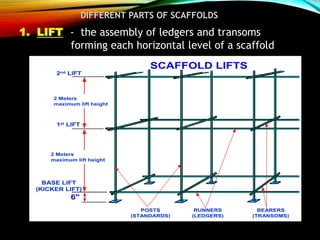
1. LIFT - the assembly of ledgers and transoms
forming each horizontal level of a scaffold
2nd LIFT
1st LIFT
2 Meters (6’ 6”)
maximum lift height
2 Meters (6’ 6”)
maximum lift height
BASE LIFT
(KICKER LIFT)
POSTS
(STANDARDS)
RUNNERS
(LEDGERS)
BEARERS
(TRANSOMS)
2nd LIFT
1st LIFT
2 Meters (6’ 6”)
maximum lift height
2 Meters (6’ 6”)
maximum lift height
BASE LIFT
(KICKER LIFT)
POSTS
(STANDARDS)
RUNNERS
(LEDGERS)
BEARERS
(TRANSOMS)
SCAFFOLD LIFTS
6"
DIFFERENT PARTS OF SCAFFOLDS
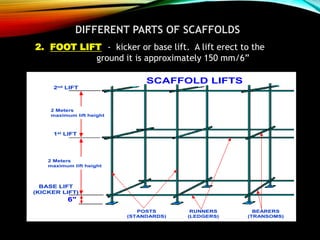
2. FOOT LIFT - kicker or base lift. A lift erect to the
ground it is approximately 150 mm/6”
2nd LIFT
1st LIFT
2 Meters (6’ 6”)
maximum lift height
2 Meters (6’ 6”)
maximum lift height
BASE LIFT
(KICKER LIFT)
POSTS
(STANDARDS)
RUNNERS
(LEDGERS)
BEARERS
(TRANSOMS)
2nd LIFT
1st LIFT
2 Meters (6’ 6”)
maximum lift height
2 Meters (6’ 6”)
maximum lift height
BASE LIFT
(KICKER LIFT)
POSTS
(STANDARDS)
RUNNERS
(LEDGERS)
BEARERS
(TRANSOMS)
SCAFFOLD LIFTS
6"
DIFFERENT PARTS OF SCAFFOLDS
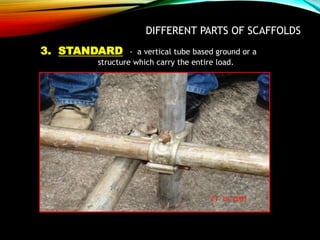
3. STANDARD - a vertical tube based ground or a
structure which carry the entire load.
DIFFERENT PARTS OF SCAFFOLDS
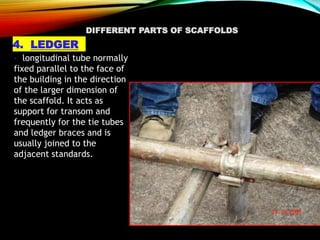
- longitudinal tube normally
fixed parallel to the face of
the building in the direction
of the larger dimension of
the scaffold. It acts as
support for transom and
frequently for the tie tubes
and ledger braces and is
usually joined to the
adjacent standards.
4. LEDGER
DIFFERENT PARTS OF SCAFFOLDS
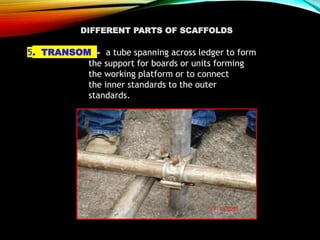
5. TRANSOM - a tube spanning across ledger to form
the support for boards or units forming
the working platform or to connect
the inner standards to the outer
standards.
DIFFERENT PARTS OF SCAFFOLDS
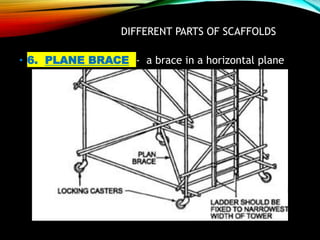
• 6. PLANE BRACE - a brace in a horizontal plane
DIFFERENT PARTS OF SCAFFOLDS
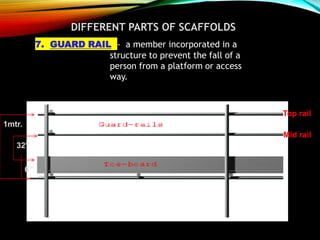
7. GUARD RAIL - a member incorporated in a
structure to prevent the fall of a
person from a platform or access
way.
Top rail
Mid rail
1mtr.
32”
6”
DIFFERENT PARTS OF SCAFFOLDS
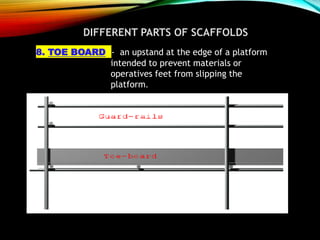
8. TOE BOARD - an upstand at the edge of a platform
intended to prevent materials or
operatives feet from slipping the
platform.
Toe Board
Toe board shall be installed along all edges of elevated work
areas (including platforms) more than 1.8 meter (6ft.) above
lower levels, unless personnel access to the lower level under
the elevated work area is physically prevented.
Wooden toe boards shall be at least 50mm (2inch) thick
Toe boards shall be securely fastened in place along the outermost edges of the
platform and have not more than 6mm (1/4inch) clearance above the walking or
working platform surface.
Toe boards shall be solid and capable of withstanding, without
failure a force of at least 23 kilogram in any downward or
horizontal direction at any point along the toe boards.
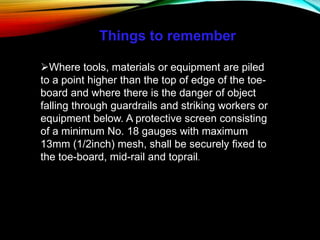
Things to remember
Where tools, materials or equipment are piled
to a point higher than the top of edge of the toe-
board and where there is the danger of object
falling through guardrails and striking workers or
equipment below. A protective screen consisting
of a minimum No. 18 gauges with maximum
13mm (1/2inch) mesh, shall be securely fixed to
the toe-board, mid-rail and toprail.
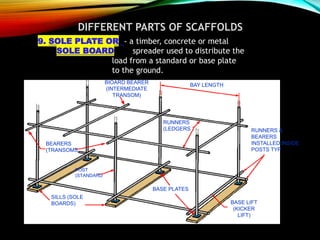
DIFFERENT PARTS OF SCAFFOLDS
9. SOLE PLATE OR - a timber, concrete or metal
SOLE BOARD spreader used to distribute the
load from a standard or base plate
to the ground.
BIOARD BEARER
(INTERMEDIATE
TRANSOM)
BAY LENGTH
RUNNERS &
BEARERS
INSTALLED INSIDE
POSTS TYP
RUNNERS
(LEDGERS
BASE LIFT
(KICKER
LIFT)
BASE PLATES
SILLS (SOLE
BOARDS)
POST
(STANDARD
BEARERS
(TRANSOMS
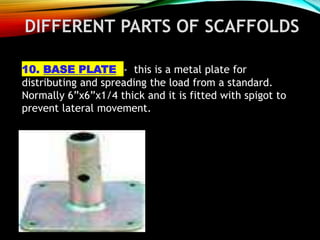
DIFFERENT PARTS OF SCAFFOLDS
10. BASE PLATE - this is a metal plate for
distributing and spreading the load from a standard.
Normally 6”x6”x1/4 thick and it is fitted with spigot to
prevent lateral movement.
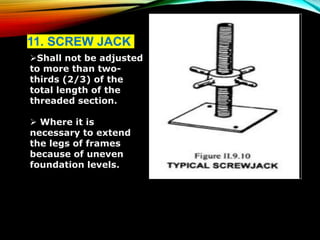
11. SCREW JACK
Shall not be adjusted
to more than two-
thirds (2/3) of the
total length of the
threaded section.
 Where it is
necessary to extend
the legs of frames
because of uneven
foundation levels.
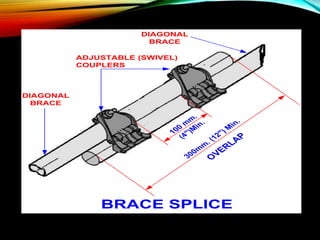
1
0
0
m
m
.
(
4
"
)
M
i
n
.
3
0
0
m
m
.
(
1
2
"
)
M
i
n
.
O
V
E
R
L
A
P
ADJUSTABLE (SWIVEL)
COUPLERS
DIAGONAL
BRACE
DIAGONAL
BRACE
BRACE SPLICE
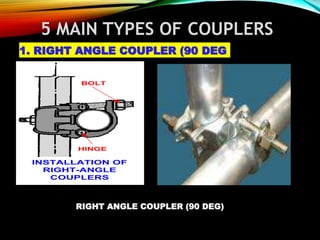
5 MAIN TYPES OF COUPLERS
1. RIGHT ANGLE COUPLER (90 DEG
INSTALLATION OF
RIGHT-ANGLE
COUPLERS
HINGE
BOLT
RIGHT ANGLE COUPLER (90 DEG)
5 MAIN TYPES OF COUPLERS
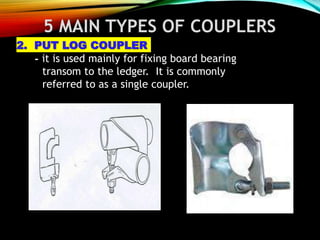
2. PUT LOG COUPLER
- it is used mainly for fixing board bearing
transom to the ledger. It is commonly
referred to as a single coupler.
5 MAIN TYPES OF COUPLERS
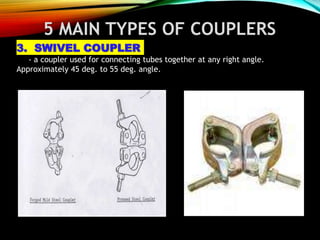
3. SWIVEL COUPLER
- a coupler used for connecting tubes together at any right angle.
Approximately 45 deg. to 55 deg. angle.
5 MAIN TYPES OF COUPLERS
4. SLEEVE COUPLER
- this is an external sleeve
which clamps two
tubes together.
5 MAIN TYPES OF COUPLERS
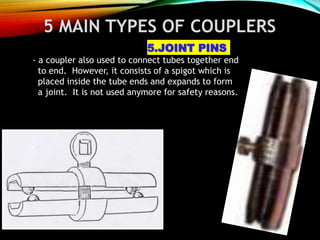
5.JOINT PINS
- a coupler also used to connect tubes together end
to end. However, it consists of a spigot which is
placed inside the tube ends and expands to form
a joint. It is not used anymore for safety reasons.
APPLICATION
• Direction:
• Go out of the classroom and observe the structure of the
school buildings. Take note on how many floors /storey are
there and if you are to construct the building what is the
possible scaffolding structure can you design? You can use
the internet for possible designs.
• Place your drawing in a 1 whole sheet of A4 bond paper.
ASSESSMENT:
THANK YOU

Scaffolding2. CO3.ppt

  • 1.
    REVIEW • The roofsystem • What are the different roof system?
  • 5.
    JUMBLED WORDS • 1.Rtsocnontec •Connectors
  • 6.
  • 7.
  • 8.
  • 9.
  • 10.
  • 11.
    OBJECTIVE: a. identify thedifferent locks; b. classify locks and connectors according to their usage; and c. appreciate the importance of scaffolds in building construction. TLE_IACP9-12IF-IIa-IVj-2
  • 13.
  • 14.
    SCAFFOLDING is atemporary framework used to support people and material in the construction or repair of buildings and other large structures. It is usually a modular system of metal pipes (termed tubes in Britain), although it can be made out of other materials.
  • 15.
    • CONSIDERATION INTHE PROPER SELECTION OF SCAFFOLDINGS AND ITS RELATED COMPONENTS  Weight of workers, tools, materials, and equipment to be carried by the scaffold  Site conditions (e.g., interior, exterior, backfill, concrete floors, type and condition of walls, access for the equipment, variations in elevation, anchorage points)
  • 16.
    • IMPORTANCE OFSCAFFOLDING IN CONSTRUCTION • It allows builders to safely erect high-rise buildings and/ or carry out necessary repairs and maintenance of any structure or building. Scaffolding also ensures fast completion of the construction work needed, whilst guaranteeing the safety of workers and the general public. That is why it is important to hire an experienced and credible scaffolding contractor.
  • 17.
    HERE ARE 4KEY REASONS WHY THE CONSTRUCTION INDUSTRY USES SCAFFOLDING: • IT IS EFFICIENT •Scaffolding provides builders and workers with a safe and secure platform to carry out their duties. By being able to manoeuvre around buildings of any shape and size both quickly and easily, scaffolding improves the efficiency of any construction job.
  • 18.
    •IT ENSURES SAFETY •Workingat height always carries with it some element of danger and risk. As previously mentioned, scaffolding platforms provide a safe and secure setting for builders to carry out their tasks while working at a considerable height.
  • 19.
    •EASY TO ACCESS •Inorder to build and construct in a more creative way, scaffolding provides builders and workers with access to parts of buildings which would otherwise be tricky to reach. Specifically bespoke scaffolding, platforms can be built in a way which means that no design or blueprint is beyond the workers.
  • 20.
    •PRIME POSITION FORWORKERS •One of the biggest advantages for builders or workers is that scaffolding places them in a strategic position to carry out their work. The elevation scaffolding provides to them means they are not solely rely on ladders, which can be unstable and not secure. Ladders often makes the worker or builder is working at an angle; they don’t have a solid platform to work from and they don’t often great balance.
  • 21.
    •Whereas, scaffolding placesworkers directly in front of the building, meaning they are able to work easily on portions of the wall or ceiling. It also opens up the potential for multiple workers to work simultaneously beside each other – something not possible with a ladder.
  • 22.
    DIFFERENT PARTS OFSCAFFOLDS 1. LIFT - the assembly of ledgers and transoms forming each horizontal level of a scaffold 2nd LIFT 1st LIFT 2 Meters (6’ 6”) maximum lift height 2 Meters (6’ 6”) maximum lift height BASE LIFT (KICKER LIFT) POSTS (STANDARDS) RUNNERS (LEDGERS) BEARERS (TRANSOMS) 2nd LIFT 1st LIFT 2 Meters (6’ 6”) maximum lift height 2 Meters (6’ 6”) maximum lift height BASE LIFT (KICKER LIFT) POSTS (STANDARDS) RUNNERS (LEDGERS) BEARERS (TRANSOMS) SCAFFOLD LIFTS 6"
  • 23.
    DIFFERENT PARTS OFSCAFFOLDS 2. FOOT LIFT - kicker or base lift. A lift erect to the ground it is approximately 150 mm/6” 2nd LIFT 1st LIFT 2 Meters (6’ 6”) maximum lift height 2 Meters (6’ 6”) maximum lift height BASE LIFT (KICKER LIFT) POSTS (STANDARDS) RUNNERS (LEDGERS) BEARERS (TRANSOMS) 2nd LIFT 1st LIFT 2 Meters (6’ 6”) maximum lift height 2 Meters (6’ 6”) maximum lift height BASE LIFT (KICKER LIFT) POSTS (STANDARDS) RUNNERS (LEDGERS) BEARERS (TRANSOMS) SCAFFOLD LIFTS 6"
  • 24.
    DIFFERENT PARTS OFSCAFFOLDS 3. STANDARD - a vertical tube based ground or a structure which carry the entire load.
  • 25.
    DIFFERENT PARTS OFSCAFFOLDS - longitudinal tube normally fixed parallel to the face of the building in the direction of the larger dimension of the scaffold. It acts as support for transom and frequently for the tie tubes and ledger braces and is usually joined to the adjacent standards. 4. LEDGER
  • 26.
    DIFFERENT PARTS OFSCAFFOLDS 5. TRANSOM - a tube spanning across ledger to form the support for boards or units forming the working platform or to connect the inner standards to the outer standards.
  • 27.
    DIFFERENT PARTS OFSCAFFOLDS • 6. PLANE BRACE - a brace in a horizontal plane
  • 28.
    DIFFERENT PARTS OFSCAFFOLDS 7. GUARD RAIL - a member incorporated in a structure to prevent the fall of a person from a platform or access way. Top rail Mid rail 1mtr. 32” 6”
  • 29.
    DIFFERENT PARTS OFSCAFFOLDS 8. TOE BOARD - an upstand at the edge of a platform intended to prevent materials or operatives feet from slipping the platform.
  • 30.
    Toe Board Toe boardshall be installed along all edges of elevated work areas (including platforms) more than 1.8 meter (6ft.) above lower levels, unless personnel access to the lower level under the elevated work area is physically prevented. Wooden toe boards shall be at least 50mm (2inch) thick Toe boards shall be securely fastened in place along the outermost edges of the platform and have not more than 6mm (1/4inch) clearance above the walking or working platform surface. Toe boards shall be solid and capable of withstanding, without failure a force of at least 23 kilogram in any downward or horizontal direction at any point along the toe boards.
  • 31.
    Things to remember Wheretools, materials or equipment are piled to a point higher than the top of edge of the toe- board and where there is the danger of object falling through guardrails and striking workers or equipment below. A protective screen consisting of a minimum No. 18 gauges with maximum 13mm (1/2inch) mesh, shall be securely fixed to the toe-board, mid-rail and toprail.
  • 32.
    DIFFERENT PARTS OFSCAFFOLDS 9. SOLE PLATE OR - a timber, concrete or metal SOLE BOARD spreader used to distribute the load from a standard or base plate to the ground. BIOARD BEARER (INTERMEDIATE TRANSOM) BAY LENGTH RUNNERS & BEARERS INSTALLED INSIDE POSTS TYP RUNNERS (LEDGERS BASE LIFT (KICKER LIFT) BASE PLATES SILLS (SOLE BOARDS) POST (STANDARD BEARERS (TRANSOMS
  • 33.
    DIFFERENT PARTS OFSCAFFOLDS 10. BASE PLATE - this is a metal plate for distributing and spreading the load from a standard. Normally 6”x6”x1/4 thick and it is fitted with spigot to prevent lateral movement.
  • 34.
    11. SCREW JACK Shallnot be adjusted to more than two- thirds (2/3) of the total length of the threaded section.  Where it is necessary to extend the legs of frames because of uneven foundation levels.
  • 35.
  • 36.
    5 MAIN TYPESOF COUPLERS 1. RIGHT ANGLE COUPLER (90 DEG INSTALLATION OF RIGHT-ANGLE COUPLERS HINGE BOLT RIGHT ANGLE COUPLER (90 DEG)
  • 37.
    5 MAIN TYPESOF COUPLERS 2. PUT LOG COUPLER - it is used mainly for fixing board bearing transom to the ledger. It is commonly referred to as a single coupler.
  • 38.
    5 MAIN TYPESOF COUPLERS 3. SWIVEL COUPLER - a coupler used for connecting tubes together at any right angle. Approximately 45 deg. to 55 deg. angle.
  • 39.
    5 MAIN TYPESOF COUPLERS 4. SLEEVE COUPLER - this is an external sleeve which clamps two tubes together.
  • 40.
    5 MAIN TYPESOF COUPLERS 5.JOINT PINS - a coupler also used to connect tubes together end to end. However, it consists of a spigot which is placed inside the tube ends and expands to form a joint. It is not used anymore for safety reasons.
  • 41.
    APPLICATION • Direction: • Goout of the classroom and observe the structure of the school buildings. Take note on how many floors /storey are there and if you are to construct the building what is the possible scaffolding structure can you design? You can use the internet for possible designs. • Place your drawing in a 1 whole sheet of A4 bond paper.
  • 44.
  • 45.