AIAG & VDA FMEA
Handbook
Sept 13, 2019
Scott Gray
Director, Quality Products and Services
Topics Covered
• Project Objectives
• Highlights of Major Changes
• The Benefits of Robust FMEAs
• OEM Deployment Plans & Timing
• Training Options
• Q & A
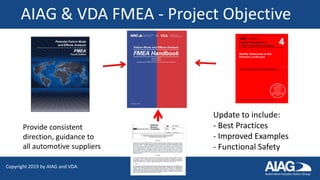
AIAG & VDA FMEA - Project Objective
Provide consistent
direction, guidance to
all automotive suppliers
Update to include:
- Best Practices
- Improved Examples
- Functional Safety
Copyright 2019 by AIAG and VDA
Importance of New Methods and Tools
• Effective FMEA risk identification - never been more critical
– Rapid growth in component/system interactions
– Increasingly specialized technologies
– No change in legal obligations of producers
• Effective FMEA includes:
– Cross-functional team contributions
– Carefully identified system boundaries
– Thorough documentation of risks and actions
Copyright 2019 by AIAG and VDA
Highlights of Major Changes
• 7 Step Approach
• New Severity, Occurrence, Detection Tables
• Action Priority (AP) Tables
• Form Sheets and Report Views
• Supplemental FMEA – MSR
More Structured Approach – Leverages Lessons Learned – Prevention Driven
Copyright 2019 by AIAG and VDA
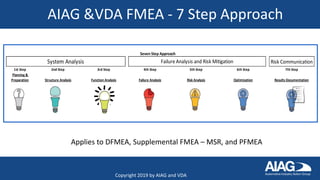
AIAG &VDA FMEA - 7 Step Approach
Risk Communication
1st Step 2nd Step 3rd Step 4th Step 5th Step 6th Step 7th Step
Planning &
Preparation Structure Analysis Function Analysis Failure Analysis Risk Analysis Optimization Results Documentation
System Analysis Failure Analysis and Risk Mitigation
Seven Step Approach
Applies to DFMEA, Supplemental FMEA – MSR, and PFMEA
Copyright 2019 by AIAG and VDA
AIAG & VDA FMEA – 7 Step Approach
• Step 1 – Planning and Preparation
– Definition of 5T’s
• InTent, Timing, Team, Task, Tools
– Question raised during Stakeholder Review
• The new methodology can be executed with either
spreadsheets or FMEA Software
• No recommendation or mandate to use specialized software
• Handbook supports both:
– Spreadsheets – Form Sheets
– FMEA Software – Report Views
Copyright 2019 by AIAG and VDA
AIAG & VDA FMEA – 7 Step Approach
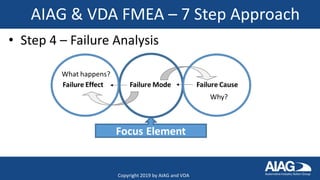
• Step 4 – Failure Analysis
Copyright 2019 by AIAG and VDA
AIAG & VDA FMEA – 7 Step Approach
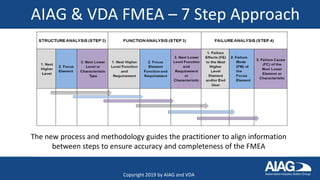
The new process and methodology guides the practitioner to align information
between steps to ensure accuracy and completeness of the FMEA
Copyright 2019 by AIAG and VDA
AIAG & VDA FMEA – 7 Step Approach
• Step 6 – Optimization
– Identify and assign actions to reduce risk
– Commitment to take specific, measurable, and
achievable actions
• Lower likelihood of Occurrence
• Increase robustness of Detection
– Keeps track of original S, O, D values
– Collaboration between the FMEA team, management,
customers and suppliers
Copyright 2019 by AIAG and VDA
New Severity, Occurrence, and Detection Tables
• New Severity, Occurrence and Detection Tables
– DFMEA, PFMEA, FMEA – MSR
• Severity (of Effect) Table
– Rated from Very High (10) to Very Low (1)
• Occurrence (Prediction of Failure Cause Occurring) Table
– Rated from Extremely High (10) to Extremely Low (1)
– Alternate Occurrence Tables
• Incidents per Thousand Items/Vehicles
• Time Based Failure Prediction Values
• Detection (Ability to Detect) Table
– Rated from Very Low (10) to Very High (1)
Copyright 2019 by AIAG and VDA
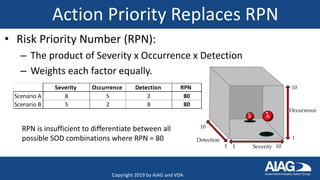
Action Priority Replaces RPN
• Risk Priority Number (RPN):
– The product of Severity x Occurrence x Detection
– Weights each factor equally.
RPN is insufficient to differentiate between all
possible SOD combinations where RPN = 80
Copyright 2019 by AIAG and VDA
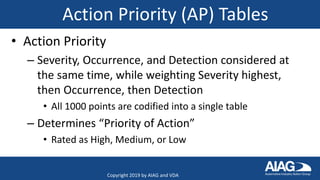
Action Priority (AP) Tables
• Action Priority
– Severity, Occurrence, and Detection considered at
the same time, while weighting Severity highest,
then Occurrence, then Detection
• All 1000 points are codified into a single table
– Determines “Priority of Action”
• Rated as High, Medium, or Low
Copyright 2019 by AIAG and VDA
Form Sheets and Report Views
• Appendix A includes:
– “Standard” and “Alternate” Form Sheets
• DFMEA, PFMEA, and FMEA - MSR
– Software “Views” – Potential Report Layouts
• DFMEA, PFMEA, and FMEA - MSR
• Appendix B includes:
– “Hints” on how the form sheet would look when
updated following examples from the Handbook
Copyright 2019 by AIAG and VDA
Supplemental FMEA - MSR
• FMEA MSR = Monitoring and System Response
– Supplemental approach for Design FMEA
– Addresses Risk Analysis of “Mechatronic Systems”
• Not previously addressed in AIAG 4th Edition FMEA
– Describes linkages between Design FMEA and Functional Safety (ISO
26262) concepts and analyses
– Severity Table common with DFMEA
– Unique Frequency (F), Monitoring (M) and Action Priority (AP) Rating
Tables
Copyright 2019 by AIAG and VDA
The Essential Link Between COQ and FMEA
• Leverage FMEA to Improve Cost of Quality Results
– You can leverage a robust FMEA to make sure COQ /
COPQ improvement targets are met;
– You will need actual COQ / COPQ results on similar
products or processes to make sure the FMEA risk
evaluation of the new product or process is realistic
Copyright 2019 by AIAG and VDA
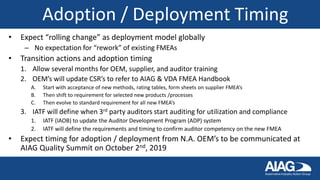
Adoption / Deployment Timing
• Expect “rolling change” as deployment model globally
– No expectation for “rework” of existing FMEAs
• Transition actions and adoption timing
1. Allow several months for OEM, supplier, and auditor training
2. OEM’s will update CSR’s to refer to AIAG & VDA FMEA Handbook
A. Start with acceptance of new methods, rating tables, form sheets on supplier FMEA’s
B. Then shift to requirement for selected new products /processes
C. Then evolve to standard requirement for all new FMEA’s
3. IATF will define when 3rd party auditors start auditing for utilization and compliance
1. IATF (IAOB) to update the Auditor Development Program (ADP) system
2. IATF will define the requirements and timing to confirm auditor competency on the new FMEA
• Expect timing for adoption / deployment from N.A. OEM’s to be communicated at
AIAG Quality Summit on October 2nd, 2019
AIAG & VDA FMEA Handbook
• Translations
– AIAG announcing availability of the Chinese translation
• Pre-orders can be placed now
• Hardcopy deliveries to occur in by end of September
• To assure you have an official translation, only accept
Handbooks with the official Chinese ISBN #
– Spanish, Portuguese, Japanese, Korean coming soon
– VDA is translating into other European languages
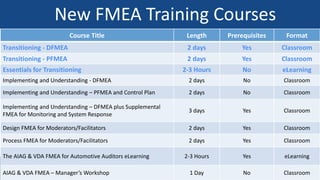
New FMEA Training Courses
Course Title Length Prerequisites Format
Transitioning - DFMEA 2 days Yes Classroom
Transitioning - PFMEA 2 days Yes Classroom
Essentials for Transitioning 2-3 Hours No eLearning
Implementing and Understanding - DFMEA 2 days No Classroom
Implementing and Understanding – PFMEA and Control Plan 2 days No Classroom
Implementing and Understanding – DFMEA plus Supplemental
FMEA for Monitoring and System Response
3 days Yes Classroom
Design FMEA for Moderators/Facilitators 2 days Yes Classroom
Process FMEA for Moderators/Facilitators 2 days Yes Classroom
The AIAG & VDA FMEA for Automotive Auditors eLearning 2-3 Hours Yes eLearning
AIAG & VDA FMEA – Manager’s Workshop 1 Day No Classroom
AIAG & VDA FMEA
Handbook
Sept 13, 2019
Scott Gray
Director, Quality Products and Services

SCAC-2019-FMEA-Handbook-SG-Final-13-Sept-2019.pdf

  • 1.
    AIAG & VDAFMEA Handbook Sept 13, 2019 Scott Gray Director, Quality Products and Services
  • 2.
    Topics Covered • ProjectObjectives • Highlights of Major Changes • The Benefits of Robust FMEAs • OEM Deployment Plans & Timing • Training Options • Q & A
  • 3.
    AIAG & VDAFMEA - Project Objective Provide consistent direction, guidance to all automotive suppliers Update to include: - Best Practices - Improved Examples - Functional Safety Copyright 2019 by AIAG and VDA
  • 4.
    Importance of NewMethods and Tools • Effective FMEA risk identification - never been more critical – Rapid growth in component/system interactions – Increasingly specialized technologies – No change in legal obligations of producers • Effective FMEA includes: – Cross-functional team contributions – Carefully identified system boundaries – Thorough documentation of risks and actions Copyright 2019 by AIAG and VDA
  • 5.
    Highlights of MajorChanges • 7 Step Approach • New Severity, Occurrence, Detection Tables • Action Priority (AP) Tables • Form Sheets and Report Views • Supplemental FMEA – MSR More Structured Approach – Leverages Lessons Learned – Prevention Driven Copyright 2019 by AIAG and VDA
  • 6.
    AIAG &VDA FMEA- 7 Step Approach Risk Communication 1st Step 2nd Step 3rd Step 4th Step 5th Step 6th Step 7th Step Planning & Preparation Structure Analysis Function Analysis Failure Analysis Risk Analysis Optimization Results Documentation System Analysis Failure Analysis and Risk Mitigation Seven Step Approach Applies to DFMEA, Supplemental FMEA – MSR, and PFMEA Copyright 2019 by AIAG and VDA
  • 7.
    AIAG & VDAFMEA – 7 Step Approach • Step 1 – Planning and Preparation – Definition of 5T’s • InTent, Timing, Team, Task, Tools – Question raised during Stakeholder Review • The new methodology can be executed with either spreadsheets or FMEA Software • No recommendation or mandate to use specialized software • Handbook supports both: – Spreadsheets – Form Sheets – FMEA Software – Report Views Copyright 2019 by AIAG and VDA
  • 8.
    AIAG & VDAFMEA – 7 Step Approach • Step 4 – Failure Analysis Copyright 2019 by AIAG and VDA
  • 9.
    AIAG & VDAFMEA – 7 Step Approach The new process and methodology guides the practitioner to align information between steps to ensure accuracy and completeness of the FMEA Copyright 2019 by AIAG and VDA
  • 10.
    AIAG & VDAFMEA – 7 Step Approach • Step 6 – Optimization – Identify and assign actions to reduce risk – Commitment to take specific, measurable, and achievable actions • Lower likelihood of Occurrence • Increase robustness of Detection – Keeps track of original S, O, D values – Collaboration between the FMEA team, management, customers and suppliers Copyright 2019 by AIAG and VDA
  • 11.
    New Severity, Occurrence,and Detection Tables • New Severity, Occurrence and Detection Tables – DFMEA, PFMEA, FMEA – MSR • Severity (of Effect) Table – Rated from Very High (10) to Very Low (1) • Occurrence (Prediction of Failure Cause Occurring) Table – Rated from Extremely High (10) to Extremely Low (1) – Alternate Occurrence Tables • Incidents per Thousand Items/Vehicles • Time Based Failure Prediction Values • Detection (Ability to Detect) Table – Rated from Very Low (10) to Very High (1) Copyright 2019 by AIAG and VDA
  • 12.
    Action Priority ReplacesRPN • Risk Priority Number (RPN): – The product of Severity x Occurrence x Detection – Weights each factor equally. RPN is insufficient to differentiate between all possible SOD combinations where RPN = 80 Copyright 2019 by AIAG and VDA
  • 13.
    Action Priority (AP)Tables • Action Priority – Severity, Occurrence, and Detection considered at the same time, while weighting Severity highest, then Occurrence, then Detection • All 1000 points are codified into a single table – Determines “Priority of Action” • Rated as High, Medium, or Low Copyright 2019 by AIAG and VDA
  • 14.
    Form Sheets andReport Views • Appendix A includes: – “Standard” and “Alternate” Form Sheets • DFMEA, PFMEA, and FMEA - MSR – Software “Views” – Potential Report Layouts • DFMEA, PFMEA, and FMEA - MSR • Appendix B includes: – “Hints” on how the form sheet would look when updated following examples from the Handbook Copyright 2019 by AIAG and VDA
  • 15.
    Supplemental FMEA -MSR • FMEA MSR = Monitoring and System Response – Supplemental approach for Design FMEA – Addresses Risk Analysis of “Mechatronic Systems” • Not previously addressed in AIAG 4th Edition FMEA – Describes linkages between Design FMEA and Functional Safety (ISO 26262) concepts and analyses – Severity Table common with DFMEA – Unique Frequency (F), Monitoring (M) and Action Priority (AP) Rating Tables Copyright 2019 by AIAG and VDA
  • 16.
    The Essential LinkBetween COQ and FMEA • Leverage FMEA to Improve Cost of Quality Results – You can leverage a robust FMEA to make sure COQ / COPQ improvement targets are met; – You will need actual COQ / COPQ results on similar products or processes to make sure the FMEA risk evaluation of the new product or process is realistic Copyright 2019 by AIAG and VDA
  • 17.
    Adoption / DeploymentTiming • Expect “rolling change” as deployment model globally – No expectation for “rework” of existing FMEAs • Transition actions and adoption timing 1. Allow several months for OEM, supplier, and auditor training 2. OEM’s will update CSR’s to refer to AIAG & VDA FMEA Handbook A. Start with acceptance of new methods, rating tables, form sheets on supplier FMEA’s B. Then shift to requirement for selected new products /processes C. Then evolve to standard requirement for all new FMEA’s 3. IATF will define when 3rd party auditors start auditing for utilization and compliance 1. IATF (IAOB) to update the Auditor Development Program (ADP) system 2. IATF will define the requirements and timing to confirm auditor competency on the new FMEA • Expect timing for adoption / deployment from N.A. OEM’s to be communicated at AIAG Quality Summit on October 2nd, 2019
  • 18.
    AIAG & VDAFMEA Handbook • Translations – AIAG announcing availability of the Chinese translation • Pre-orders can be placed now • Hardcopy deliveries to occur in by end of September • To assure you have an official translation, only accept Handbooks with the official Chinese ISBN # – Spanish, Portuguese, Japanese, Korean coming soon – VDA is translating into other European languages
  • 19.
    New FMEA TrainingCourses Course Title Length Prerequisites Format Transitioning - DFMEA 2 days Yes Classroom Transitioning - PFMEA 2 days Yes Classroom Essentials for Transitioning 2-3 Hours No eLearning Implementing and Understanding - DFMEA 2 days No Classroom Implementing and Understanding – PFMEA and Control Plan 2 days No Classroom Implementing and Understanding – DFMEA plus Supplemental FMEA for Monitoring and System Response 3 days Yes Classroom Design FMEA for Moderators/Facilitators 2 days Yes Classroom Process FMEA for Moderators/Facilitators 2 days Yes Classroom The AIAG & VDA FMEA for Automotive Auditors eLearning 2-3 Hours Yes eLearning AIAG & VDA FMEA – Manager’s Workshop 1 Day No Classroom
  • 20.
    AIAG & VDAFMEA Handbook Sept 13, 2019 Scott Gray Director, Quality Products and Services