Välkommen, welcome, huān yíng, welkom, Bienvenue, willkommen,
fogadtatás, benvenuto, velkommen, powitanie, bem-vindo, croeso, bienvenido, vítejte
Advanced Powertrain Control
Symposium 9th July 2013
05/07/2013 www.fmea.co.uk 1
The Effective Application of FMEA
• Who am I?
• What is FMEA?
• Why do FMEA?
• Application of FMEA
• A Structured Approach
• Effective FMEA
• Use Software for FMEA
• Use an FMEA Facilitator
05/07/2013 www.fmea.co.uk 2
What is FMEA?
Contrary to popular belief FMEA is actually an acronym for a risk analysis called Failure Modes
& Effects Analysis, and not ‘Five Men Endlessly Arguing’.
“Failure Modes & Effects Analysis is an activity that brings minds together in a
collaborative and pre-emptive way in order to avoid failure of a system!”
FMEA is a systematic procedure that focuses on a system(s) in order to uncover weaknesses,
i.e. what can go wrong, what could possibly cause it and what are the potential effects. FMEA
then focuses on these weaknesses with the objective of making them obsolete, or by reducing
the likelihood of failure (or risk of failure) though the implementation of corrective methods,
which in turn optimises the system.
05/07/2013 www.fmea.co.uk 3
What is FMEA?
FMEA is a living document and if used correctly records:
• intellectual property
• weaknesses within the system
• quantified risk of system failure
• mistakes made
• solutions to problems
• responsibility for controls methods
Failure are any potential errors or defects within a process, design, or part,
especially ones that affect the ‘customer’, environment and law.
05/07/2013 www.fmea.co.uk 4
What is FMEA?
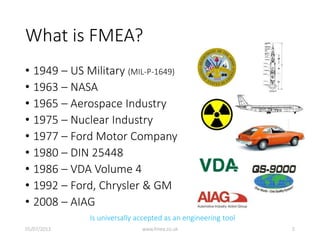
• 1949 – US Military (MIL-P-1649)
• 1963 – NASA
• 1965 – Aerospace Industry
• 1975 – Nuclear Industry
• 1977 – Ford Motor Company
• 1980 – DIN 25448
• 1986 – VDA Volume 4
• 1992 – Ford, Chrysler & GM
• 2008 – AIAG
Is universally accepted as an engineering tool
05/07/2013 www.fmea.co.uk 5
Why do FMEA?
• Cost reduction and increased profits
• Demand for higher quality
• Extended warranty periods
• Product liability
• Quality standard demands
• Retention of knowledge
• Make processes more robust
• Enhanced communication within the business, customer
& suppliers
• Shorter development times
• Functional Safety & Reliability
05/07/2013 www.fmea.co.uk 6
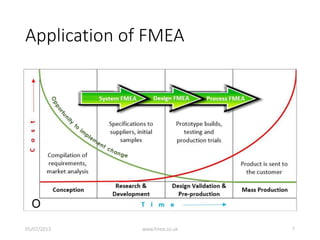
Application of FMEA
05/07/2013 www.fmea.co.uk 7
Application of FMEA
There are two main schools of thought about the
methodology to use and which is most effective?
• Rose with a different name
• Procedure
• Document formats
• Adherence to ISO / TS 16949
• Basis for ISO / TS 26262
05/07/2013 www.fmea.co.uk 8
Application of FMEA
To get the best out of FMEA you should have:
• Cross functional team
• FMEA Moderator / Facilitator
• Props and documentation
• Structured approach
• FMEA Software
• Management Support!
05/07/2013 www.fmea.co.uk 9
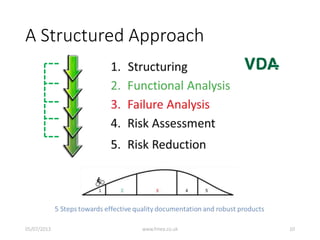
A Structured Approach
05/07/2013 www.fmea.co.uk 10
Effective FMEA
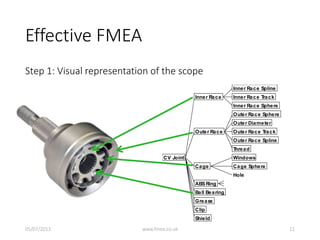
Step 1: Visual representation of the scope
CV Joint
Inner Race
Inner Race Spline
Inner Race Track
Inner Race Sphere
Outer Race
Outer Race Sphere
Outer Diameter
Outer Race Track
Outer Race Spline
Thread
Cage
Windows
Cage Sphere
Hole
ABSRing
Ball Bearing
Grease
Clip
Shield
05/07/2013 www.fmea.co.uk 11
Effective FMEA
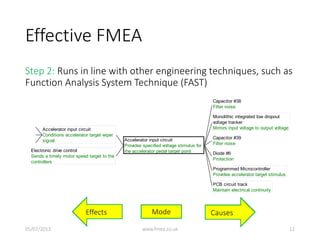
Step 2: Runs in line with other engineering techniques, such as
Function Analysis System Technique (FAST)
How?Why?Effects Causes
Accelerator input circuit
Provides specified voltage stimulus for
the accelerator pedal target point
Capacitor #38
Filter noise
Monolithic integrated low dropout
voltage tracker
Mirrors input voltage to output voltage
Capacitor #39
Filter noise
Diode #6
Protection
Programmed Microcontroller
Provides accelerator target stimulus
PCB circuit track
Maintain electrical continuity
Accelerator input circuit
Conditions accelerator target wiper
signal
Electronic drive control
Sends a timely motor speed target to the
controllers
Mode
05/07/2013 www.fmea.co.uk 12
Accelerator input circuit
Provides specified voltage stimulus for
the accelerator pedal target point
Capacitor #38
Filter noise
Monolithic integrated low dropout
voltage tracker
Mirrors input voltage to output voltage
Capacitor #39
Filter noise
Diode #6
Protection
Programmed Microcontroller
Provides accelerator target stimulus
PCB circuit track
Maintain electrical continuity
Accelerator input circuit
Conditions accelerator target wiper
signal
Electronic drive control
Sends a timely motor speed target to the
controllers
Effective FMEA
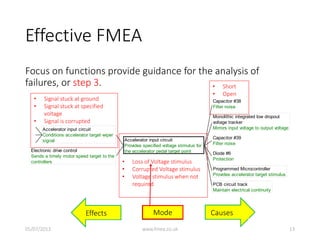
Focus on functions provide guidance for the analysis of
failures, or step 3.
• Loss of Voltage stimulus
• Corrupted Voltage stimulus
• Voltage stimulus when not
required
• Signal stuck at ground
• Signal stuck at specified
voltage
• Signal is corrupted
• Short
• Open
Effects CausesMode
05/07/2013 www.fmea.co.uk 13
Effective FMEA
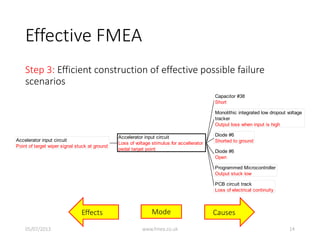
Step 3: Efficient construction of effective possible failure
scenarios
Effects Causes
Accelerator input circuit
Loss of voltage stimulus for accellerator
pedal target point
Capacitor #38
Short
Monolithic integrated low dropout voltage
tracker
Output loss when input is high
Diode #6
Shorted to ground
Diode #6
Open
Programmed Microcontroller
Output stuck low
PCB circuit track
Loss of electrical continuity
Accelerator input circuit
Point of target wiper signal stuck at ground
Mode
05/07/2013 www.fmea.co.uk 14
Effective FMEA
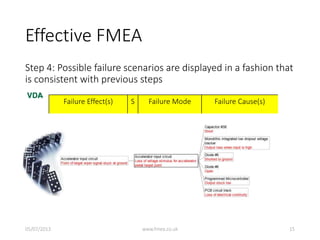
Step 4: Possible failure scenarios are displayed in a fashion that
is consistent with previous steps
Failure Effect(s) S Failure Mode Failure Cause(s)
05/07/2013 www.fmea.co.uk 15
Effective FMEA
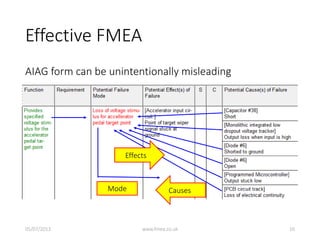
AIAG form can be unintentionally misleading
Mode Causes
Effects
05/07/2013 www.fmea.co.uk 16
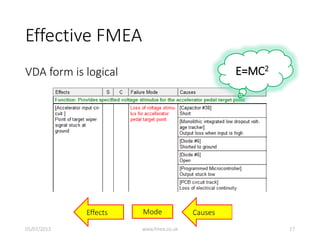
Effective FMEA
VDA form is logical
Effects Mode Causes
E=MC2
05/07/2013 www.fmea.co.uk 17
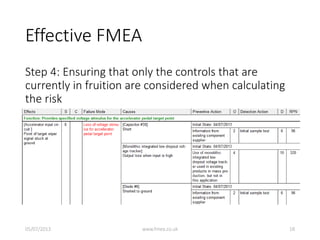
Effective FMEA
Step 4: Ensuring that only the controls that are
currently in fruition are considered when calculating
the risk
05/07/2013 www.fmea.co.uk 18
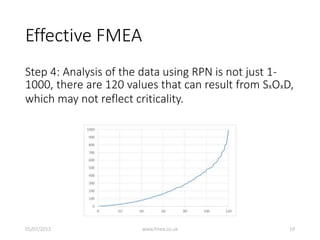
Effective FMEA
Step 4: Analysis of the data using RPN is not just 1-
1000, there are 120 values that can result from SxOxD,
which may not reflect criticality.
05/07/2013 www.fmea.co.uk 19
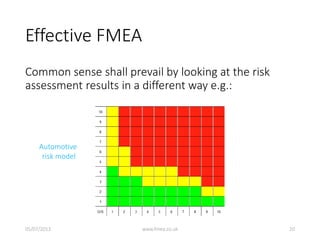
Effective FMEA
Common sense shall prevail by looking at the risk
assessment results in a different way e.g.:
05/07/2013 www.fmea.co.uk 20
Automotive
risk model
Effective FMEA
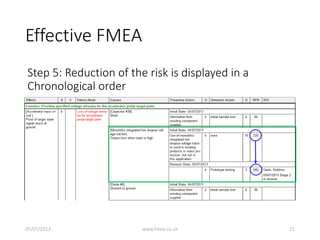
Step 5: Reduction of the risk is displayed in a
Chronological order
05/07/2013 www.fmea.co.uk 21
Effective FMEA
Create your own descriptions of the risk factors of
Severity (S), Occurrence (O) and Detection (D):
• Reflect what you do as a business
• Reflect the product you make
• Is there a customer mandate?
• Using ‘rule of thumb’ statements & benchmark
examples
• Use AIAG descriptions as guidance*
05/07/2013 www.fmea.co.uk 22
Use Software for FMEA
Due to the complexities of modern products &
processes, software is essential. Many companies use
MS Excel, but dedicated software can provide a visual
representation of:
• the system analysed
• interfaces between sub-systems, plus inputs and
outputs
• complex relationships between the failures
05/07/2013 www.fmea.co.uk 23
Use Software for FMEA
In addition to this dedicated software allows the FMEA to:
• be filtered or colour coded according to your own
criteria
• produce additional statistical data and additional quality
documentation as a consequence
• Switch easily between FMEA form layouts
• handles variances
• Supports delegation and tracking of corrective measures
05/07/2013 www.fmea.co.uk 24
Use an FMEA facilitator
• Experienced FMEA facilitation will ultimately save time
and make meetings more focused & constructive.
• An experienced FMEA facilitation minimises digression
into different types of FMEA.
• An external FMEA facilitator may ask the ‘stupid
questions’ that may have been overlooked as they may
be thinking outside of the box
• An effective FMEA records intellectual capital for the
future developments (semantics)
05/07/2013 www.fmea.co.uk 25
078 999 625 53 - 01785 711 296
gavin@fmea.co.uk
Penkridge, Stafford, ST19 5TE. UK
tack, thanks, xièxie, dank u wel, merci, danke, köszönöm, grazie,
tak, dziękuję, obrigado, diolch, gracias, děkuj, ďakujem
05/07/2013 www.fmea.co.uk 26

Birmingham apcs

  • 1.
    Välkommen, welcome, huānyíng, welkom, Bienvenue, willkommen, fogadtatás, benvenuto, velkommen, powitanie, bem-vindo, croeso, bienvenido, vítejte Advanced Powertrain Control Symposium 9th July 2013 05/07/2013 www.fmea.co.uk 1
  • 2.
    The Effective Applicationof FMEA • Who am I? • What is FMEA? • Why do FMEA? • Application of FMEA • A Structured Approach • Effective FMEA • Use Software for FMEA • Use an FMEA Facilitator 05/07/2013 www.fmea.co.uk 2
  • 3.
    What is FMEA? Contraryto popular belief FMEA is actually an acronym for a risk analysis called Failure Modes & Effects Analysis, and not ‘Five Men Endlessly Arguing’. “Failure Modes & Effects Analysis is an activity that brings minds together in a collaborative and pre-emptive way in order to avoid failure of a system!” FMEA is a systematic procedure that focuses on a system(s) in order to uncover weaknesses, i.e. what can go wrong, what could possibly cause it and what are the potential effects. FMEA then focuses on these weaknesses with the objective of making them obsolete, or by reducing the likelihood of failure (or risk of failure) though the implementation of corrective methods, which in turn optimises the system. 05/07/2013 www.fmea.co.uk 3
  • 4.
    What is FMEA? FMEAis a living document and if used correctly records: • intellectual property • weaknesses within the system • quantified risk of system failure • mistakes made • solutions to problems • responsibility for controls methods Failure are any potential errors or defects within a process, design, or part, especially ones that affect the ‘customer’, environment and law. 05/07/2013 www.fmea.co.uk 4
  • 5.
    What is FMEA? •1949 – US Military (MIL-P-1649) • 1963 – NASA • 1965 – Aerospace Industry • 1975 – Nuclear Industry • 1977 – Ford Motor Company • 1980 – DIN 25448 • 1986 – VDA Volume 4 • 1992 – Ford, Chrysler & GM • 2008 – AIAG Is universally accepted as an engineering tool 05/07/2013 www.fmea.co.uk 5
  • 6.
    Why do FMEA? •Cost reduction and increased profits • Demand for higher quality • Extended warranty periods • Product liability • Quality standard demands • Retention of knowledge • Make processes more robust • Enhanced communication within the business, customer & suppliers • Shorter development times • Functional Safety & Reliability 05/07/2013 www.fmea.co.uk 6
  • 7.
  • 8.
    Application of FMEA Thereare two main schools of thought about the methodology to use and which is most effective? • Rose with a different name • Procedure • Document formats • Adherence to ISO / TS 16949 • Basis for ISO / TS 26262 05/07/2013 www.fmea.co.uk 8
  • 9.
    Application of FMEA Toget the best out of FMEA you should have: • Cross functional team • FMEA Moderator / Facilitator • Props and documentation • Structured approach • FMEA Software • Management Support! 05/07/2013 www.fmea.co.uk 9
  • 10.
  • 11.
    Effective FMEA Step 1:Visual representation of the scope CV Joint Inner Race Inner Race Spline Inner Race Track Inner Race Sphere Outer Race Outer Race Sphere Outer Diameter Outer Race Track Outer Race Spline Thread Cage Windows Cage Sphere Hole ABSRing Ball Bearing Grease Clip Shield 05/07/2013 www.fmea.co.uk 11
  • 12.
    Effective FMEA Step 2:Runs in line with other engineering techniques, such as Function Analysis System Technique (FAST) How?Why?Effects Causes Accelerator input circuit Provides specified voltage stimulus for the accelerator pedal target point Capacitor #38 Filter noise Monolithic integrated low dropout voltage tracker Mirrors input voltage to output voltage Capacitor #39 Filter noise Diode #6 Protection Programmed Microcontroller Provides accelerator target stimulus PCB circuit track Maintain electrical continuity Accelerator input circuit Conditions accelerator target wiper signal Electronic drive control Sends a timely motor speed target to the controllers Mode 05/07/2013 www.fmea.co.uk 12
  • 13.
    Accelerator input circuit Providesspecified voltage stimulus for the accelerator pedal target point Capacitor #38 Filter noise Monolithic integrated low dropout voltage tracker Mirrors input voltage to output voltage Capacitor #39 Filter noise Diode #6 Protection Programmed Microcontroller Provides accelerator target stimulus PCB circuit track Maintain electrical continuity Accelerator input circuit Conditions accelerator target wiper signal Electronic drive control Sends a timely motor speed target to the controllers Effective FMEA Focus on functions provide guidance for the analysis of failures, or step 3. • Loss of Voltage stimulus • Corrupted Voltage stimulus • Voltage stimulus when not required • Signal stuck at ground • Signal stuck at specified voltage • Signal is corrupted • Short • Open Effects CausesMode 05/07/2013 www.fmea.co.uk 13
  • 14.
    Effective FMEA Step 3:Efficient construction of effective possible failure scenarios Effects Causes Accelerator input circuit Loss of voltage stimulus for accellerator pedal target point Capacitor #38 Short Monolithic integrated low dropout voltage tracker Output loss when input is high Diode #6 Shorted to ground Diode #6 Open Programmed Microcontroller Output stuck low PCB circuit track Loss of electrical continuity Accelerator input circuit Point of target wiper signal stuck at ground Mode 05/07/2013 www.fmea.co.uk 14
  • 15.
    Effective FMEA Step 4:Possible failure scenarios are displayed in a fashion that is consistent with previous steps Failure Effect(s) S Failure Mode Failure Cause(s) 05/07/2013 www.fmea.co.uk 15
  • 16.
    Effective FMEA AIAG formcan be unintentionally misleading Mode Causes Effects 05/07/2013 www.fmea.co.uk 16
  • 17.
    Effective FMEA VDA formis logical Effects Mode Causes E=MC2 05/07/2013 www.fmea.co.uk 17
  • 18.
    Effective FMEA Step 4:Ensuring that only the controls that are currently in fruition are considered when calculating the risk 05/07/2013 www.fmea.co.uk 18
  • 19.
    Effective FMEA Step 4:Analysis of the data using RPN is not just 1- 1000, there are 120 values that can result from SxOxD, which may not reflect criticality. 05/07/2013 www.fmea.co.uk 19
  • 20.
    Effective FMEA Common senseshall prevail by looking at the risk assessment results in a different way e.g.: 05/07/2013 www.fmea.co.uk 20 Automotive risk model
  • 21.
    Effective FMEA Step 5:Reduction of the risk is displayed in a Chronological order 05/07/2013 www.fmea.co.uk 21
  • 22.
    Effective FMEA Create yourown descriptions of the risk factors of Severity (S), Occurrence (O) and Detection (D): • Reflect what you do as a business • Reflect the product you make • Is there a customer mandate? • Using ‘rule of thumb’ statements & benchmark examples • Use AIAG descriptions as guidance* 05/07/2013 www.fmea.co.uk 22
  • 23.
    Use Software forFMEA Due to the complexities of modern products & processes, software is essential. Many companies use MS Excel, but dedicated software can provide a visual representation of: • the system analysed • interfaces between sub-systems, plus inputs and outputs • complex relationships between the failures 05/07/2013 www.fmea.co.uk 23
  • 24.
    Use Software forFMEA In addition to this dedicated software allows the FMEA to: • be filtered or colour coded according to your own criteria • produce additional statistical data and additional quality documentation as a consequence • Switch easily between FMEA form layouts • handles variances • Supports delegation and tracking of corrective measures 05/07/2013 www.fmea.co.uk 24
  • 25.
    Use an FMEAfacilitator • Experienced FMEA facilitation will ultimately save time and make meetings more focused & constructive. • An experienced FMEA facilitation minimises digression into different types of FMEA. • An external FMEA facilitator may ask the ‘stupid questions’ that may have been overlooked as they may be thinking outside of the box • An effective FMEA records intellectual capital for the future developments (semantics) 05/07/2013 www.fmea.co.uk 25
  • 26.
    078 999 62553 - 01785 711 296 gavin@fmea.co.uk Penkridge, Stafford, ST19 5TE. UK tack, thanks, xièxie, dank u wel, merci, danke, köszönöm, grazie, tak, dziękuję, obrigado, diolch, gracias, děkuj, ďakujem 05/07/2013 www.fmea.co.uk 26

Editor's Notes

  • #3 Call last week FMEA guy kick into touch Est. 2007 / Experience2000 - Europe, Asia, Americas, Scandinavia, Africa Exposure: Automotive, Aerospace, Medical, Nuclear, Food & Marine Exposure to products: PCB, Dynamic positioning systems, Cranes, power train, Heaters, Medical devices Frustrations about not doing FMEA effectively (Time? Bad reputation?)
  • #4 Before event – aftter fact
  • #5 Mistake here is that people don’t record potential events because of the “we have already fixed it with controls” FMEA is a living document that captures the intellectual capital within the business and is therefore a record of mistakes made, solutions to problems discovered and communication within the business. Discovery of weaknesses within a system are discovered by quantifying risk, which takes into account the current controls. It is widely used in manufacturing industries in various phases of the product life cycle.
  • #6 1949: US military on the 9th November (MIL-P-1649) to analyse equipment reliability in order to minimise losses of personnel and equipment. 1963: NASA for the Apollo project. 1965: adopted by the aerospace industry. 1975: nuclear power engineering.. 1977: 1st deployed within the automotive industry by Ford 1986: VDA: Quality Assurance Prior to Serial Application 1992: formation of QS-9000 subsequently taken up by medicine, telecommunication and non-technological companies. 1996: Verband der Automobileindustrie (VDA) volume 4, part 2, Quality Assurance Prior to Serial Application with the subtitle System FMEA was published. 2000: TS/ISO 16949 standard. This SAE paper served for the revision of the FMEA as the QS-9000 3rd edition. 2008: QS-9000 4th Edition is officially released and is now re-branded as AIAG (Automotive Industry Action Group).
  • #7 Bad reputation due to being undertaken inefficiently / effectively Proof of due diligence Determine HAZARDS VDA, ISO 9001 ISO/TS 16949
  • #8 Milestones – different types of FMEA £1 spent on FMEA can save £1,000 at a later date! Fits in with existing company norms regardless of the buzz words used to brand the product life cycle
  • #9 This VDA approach coerces the FMEA participants to analyse, Focus re-analysing previous steps ultimately ensuring that all potential risks have been considered and dealt with accordingly.   Disciplined approach is now widely employed by many international manufacturing companies as has 5 clear stages
  • #10 Core and peripheral team members Structured approach (prioritised) Without Management > ‘check box exercise’
  • #11 All singing from the same ‘hymn sheet’ Effort made at the start The document is the end result
  • #12 Influential factors
  • #13 Charles Bytheway 1964 - Higher Order & Lower Order Functions Why? & How? Verb noun description MODE = Way something is done or happens – intended behaviour Cause / Effect levels Provides focus & promotes understanding Why Green?
  • #14 Captures the thought process of the design Positives & Negatives Why red? red represents danger in most cultures (not China) MALFUNCTIONS
  • #15 Step 2 offer suggested possible Failure Causes & Effects
  • #16  Logical layout is more representative of a domino effect
  • #17 Well market widely used Many columns make it daunting Cause and effect confussion - ambiguous Severity value relationship confusing i.e. S of the cause?? Keeps being revised and is gradually become more VDA in it’s appearance
  • #18 living document that needs to be easy to pick up, understand and then modify Minimises opportunity for erroneous entries Efficient use of paper (when printed) Mnemonic E = mc2 . mass–energy equivalence
  • #19 People feel coerced to fill out the cells and sometimes they do so with controls that they intend, or are going to do.
  • #20 S=10 x O=1 x D=10 S=1 x O=10 x D=10 >>S=10 x O=10 x D=1
  • #21 Green is no action Amber will be dealt with as a continual improvement task, but is not priority Red deemed to warrant action Combination of RPN and SxO according to Company Norms Focus on high D?
  • #22 Allows you to add Guestimates and recommended actions to one cell i.e. Do not have to move from recommended to action taken columns
  • #23 S=9/10 is always about injury to end user, laws, HS and regulations etc AIAG is not always the best Severity from design
  • #26 Chair meetings and listen to all Semantics= The meaning of a word, phrase, sentence, or text
  • #27 Summarise.. FMEA if done correctly takes time, but will Cost reduction and increased profits Demand for higher quality Extended warranty periods Product liability Quality standard demands Retention of knowledge Make processes more robust Enhanced communication within the business, customer & suppliers Shorter development times Functional Safety & Reliability