1
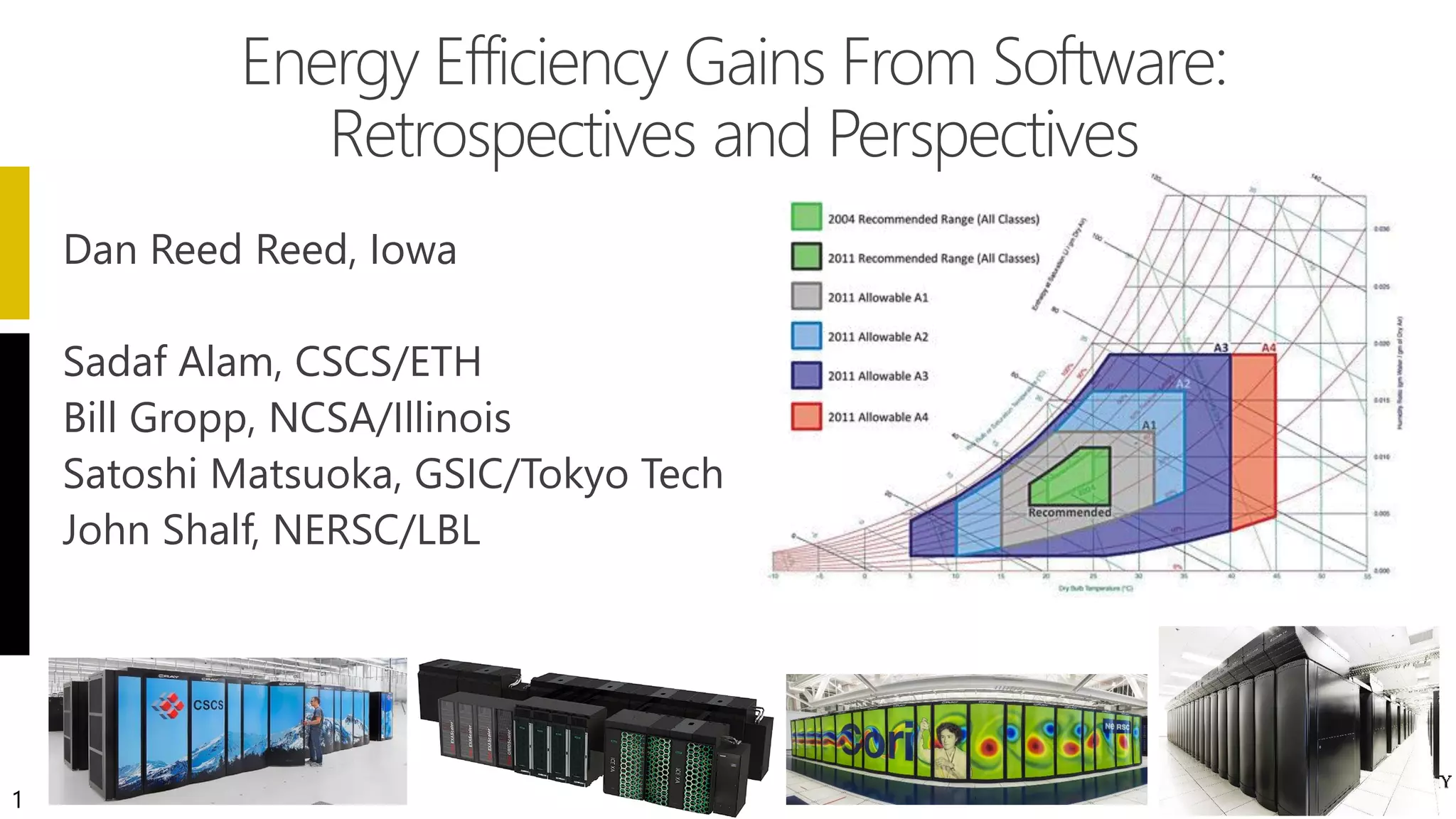
Dan Reed Reed, Iowa
Sadaf Alam, CSCS/ETH
Bill Gropp, NCSA/Illinois
Satoshi Matsuoka, GSIC/Tokyo Tech
John Shalf, NERSC/LBL
2
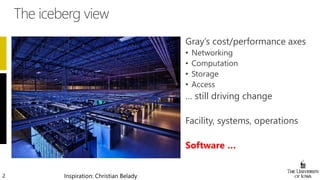
Gray’s cost/performance axes
• Networking
• Computation
• Storage
• Access
… still driving change
Facility, systems, operations
Software …
3
4
What system software has been most helpful in improving system energy efficiency?
Which software stack layers should support energy awareness?
Is there user willingness to exploit libraries for energy efficiency?
What might encourage adoption of APIs for measurement/management?
Where are the biggest opportunities for energy efficiency improvements?
5
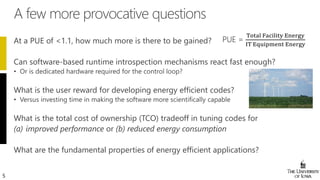
At a PUE of <1.1, how much more is there to be gained?
Can software-based runtime introspection mechanisms react fast enough?
What is the user reward for developing energy efficient codes?
What is the total cost of ownership (TCO) tradeoff in tuning codes for
(a) improved performance or (b) reduced energy consumption
What are the fundamental properties of energy efficient applications?
SC17 Panel: Energy Efficiency Gains From Software:
Retrospectives and Perspectives
Sadaf Alam
Chief Technology Officer
Swiss National Supercomputing Centre
November 17, 2017
SC17 Panel 7
Piz Daint and the User Lab
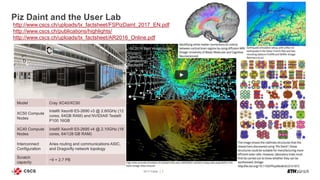
Model Cray XC40/XC50
XC50 Compute
Nodes
Intel® Xeon® E5-2690 v3 @ 2.60GHz (12
cores, 64GB RAM) and NVIDIA® Tesla®
P100 16GB
XC40 Compute
Nodes
Intel® Xeon® E5-2695 v4 @ 2.10GHz (18
cores, 64/128 GB RAM)
Interconnect
Configuration
Aries routing and communications ASIC,
and Dragonfly network topology
Scratch
capacity
~9 + 2.7 PB
http://www.cscs.ch/uploads/tx_factsheet/FSPizDaint_2017_EN.pdf
http://www.cscs.ch/publications/highlights/
http://www.cscs.ch/uploads/tx_factsheet/AR2016_Online.pdf
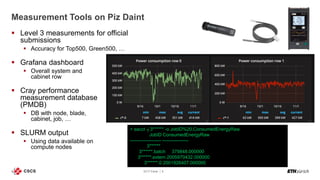
Measurement Tools on Piz Daint
 Level 3 measurements for official
submissions
 Accuracy for Top500, Green500, …
 Grafana dashboard
 Overall system and
cabinet row
 Cray performance
measurement database
(PMDB)
 DB with node, blade,
cabinet, job, …
 SLURM output
 Using data available on
compute nodes
SC17 Panel 8
> sacct -j 3****** -o JobID%20,ConsumedEnergyRaw
JobID ConsumedEnergyRaw
-------------------- -----------------
3******
3******.batch 379848.000000
3******.extern 2005970432.000000
3******.0 2001926407.000000
SC17 Panel 9
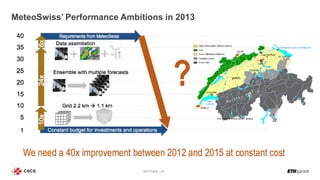
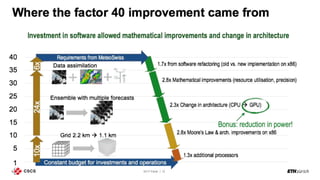
MeteoSwiss’ Performance Ambitions in 2013
SC17 Panel 10
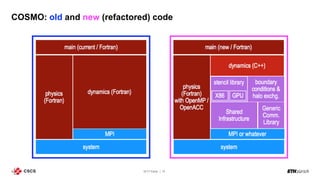
COSMO: old and new (refactored) code
SC17 Panel 11
SC17 Panel 12
SC17 Panel 13
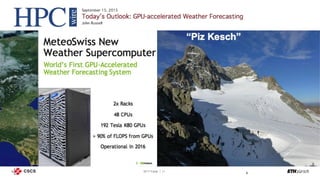
Only system in top 10 with level 3 submission
Subset of cores with lower CPU frequency for Green500
submission
Green500 top systems contain accelerator
devices
Engaging users and developers
Thank you for your attention.
Four Steps to Energy Efficiency Through Software
William Gropp
Wgropp.cs.illinois.edu
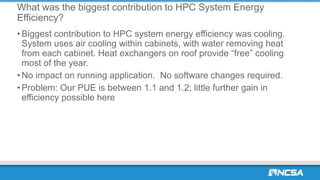
What was the biggest contribution to HPC System Energy
Efficiency?
• Biggest contribution to HPC system energy efficiency was cooling.
System uses air cooling within cabinets, with water removing heat
from each cabinet. Heat exchangers on roof provide “free” cooling
most of the year.
• No impact on running application. No software changes required.
• Problem: Our PUE is between 1.1 and 1.2; little further gain in
efficiency possible here
National Petascale Computing Facility
• Only Facility in the world of this
scale on an Academic Campus
• Capable of sustained 24 MW today
• Expandable in space, power and
cooling [50,000 ft2 (4,645+ m2) machine
room gallery and sustained 100 MW]
• Modern Data Center
• 90,000+ ft2 (8,360+ m2) total
• 30,000 ft2 (2,790+ m2) raised floor
20,000 ft2 (1,860+ m2) machine room gallery
• Energy Efficiency
• LEED certified Gold
• Power Utilization Efficiency, PUE = 1.1–1.2
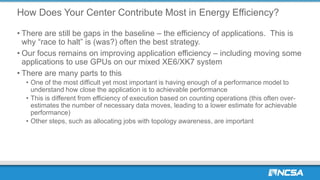
How Does Your Center Contribute Most in Energy Efficiency?
• There are still be gaps in the baseline – the efficiency of applications. This is
why “race to halt” is (was?) often the best strategy.
• Our focus remains on improving application efficiency – including moving some
applications to use GPUs on our mixed XE6/XK7 system
• There are many parts to this
• One of the most difficult yet most important is having enough of a performance model to
understand how close the application is to achievable performance
• This is different from efficiency of execution based on counting operations (this often over-
estimates the number of necessary data moves, leading to a lower estimate for achievable
performance)
• Other steps, such as allocating jobs with topology awareness, are important
Where Should Energy-Awareness Be Added to the Software
Stack?
•Easiest if in runtime, scheduler, or closed application
• That is, easiest if programmers don’t see it
•Answer needs to be in context of goal
• Information gathering (such as we did for I/O performance) including
interconnect contribution and message wait (opportunity to reduce power)
can be done with limited impact using MPI profiling interface or similar
system intercept interfaces
•If runtime can “do no harm”, then do it in the runtime
• If you can’t guarantee that, allow users to opt out.
• See discussion of incentives
Will Users Make Codes Energy Efficient?
•No.
•There is no incentive, and in fact, there is usually a negative
incentive: if energy efficiency slows down the application
•Some users may be willing to experiment or to be good “global
citizens,” but most are focused on their science.
•Different charging policies must be approved; in our case, by NSF.
• For example, could charge allocation with a weight that included energy
consumed, providing an incentive. But must include full cost of system
including depreciation
Does the Community Need to Collect and Share Data?
• Yes. To provide better incentives, there is a need to both measure energy use
and provide actionable feedback to users. We need to to collect data on
different approaches and reflect them in the context of user incentives
• There are many complexities in this, and it will be hard to provide accurate data
about energy use by application
• This is not the same as having a deterministic way to charge for energy use.
• The problem is that the actions of other applications may impact the energy use of shared
resources (e.g., network, file system) and it may not be possible to determine what each
application really used, as compared with what it was charged
• Yes, this is also true for time charged to applications. That is not the issue; it is whether the
users accept the approximations that are used
Four Steps for Energy Efficiency
1. Performance Efficiency
• Like conservation, first step is to get more from the same (or less)
• Performance modeling
• Performance tuning
2. Recognize Hardware Realities
• Next is to adapt to realities of the hardware
• Rethink the algorithm
• Adapt to memory latency, wide vectors, etc.
• Can’t compare algorithms by comparing floating point counts, or even memory
references
• Avoid BSP-style programs
• Separate communication and computation phases, and synchronization, waste energy
Four Steps (con’t)
3. You Get What You Measure
•You get what you measure (and reward/penalize)
• Again, focus on performance
• Expose the cost of waiting
4. Consider The Total Cost
•Finally, need to consider total workflow costs
• Local and global optimums not necessarily the same
• Consider data motion for a data set – moving data back and forth can be expensive –
even (locally) less efficient in situ analysis may be cheaper overall
• And how that total cost is exposed/charged to the user
• There must be a positive incentive to the user for pursuing energy efficiency
Green Computingin Tsubame2 and 3
Satoshi Matsuoka
Professor, GSIC, Tokyo Institute of Technology /
Director, AIST-Tokyo Tech. Big Data Open Innovation Lab /
Fellow, Artificial Intelligence Research Center, AIST, Japan /
Vis. Researcher, Advanced Institute for Computational Science, Riken
SC17 Green PanelTalk
2017/11/17
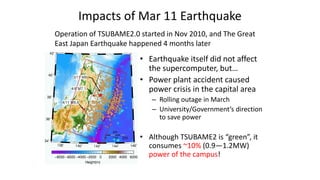
Impacts of Mar 11 Earthquake
• Earthquake itself did not affect
the supercomputer, but…
• Power plant accident caused
power crisis in the capital area
– Rolling outage in March
– University/Government’s direction
to save power
• Although TSUBAME2 is “green”, it
consumes ~10% (0.9—1.2MW)
power of the campus!
Operation of TSUBAME2.0 started in Nov 2010, and The Great
East Japan Earthquake happened 4 months later
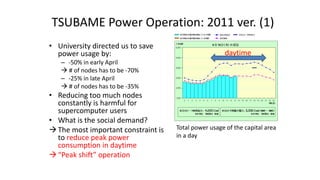
TSUBAME Power Operation: 2011 ver. (1)
• University directed us to save
power usage by:
– -50% in early April
 # of nodes has to be -70%
– -25% in late April
 # of nodes has to be -35%
• Reducing too much nodes
constantly is harmful for
supercomputer users
• What is the social demand?
The most important constraint is
to reduce peak power
consumption in daytime
“Peak shift” operation
Total power usage of the capital area
in a day
daytime
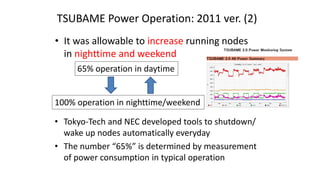
TSUBAME Power Operation: 2011 ver. (2)
• It was allowable to increase running nodes
in nighttime and weekend
65% operation in daytime
100% operation in nighttime/weekend
• Tokyo-Tech and NEC developed tools to shutdown/
wake up nodes automatically everyday
• The number “65%” is determined by measurement
of power consumption in typical operation
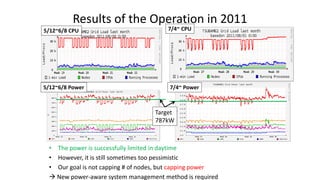
Results of the Operation in 2011
5/12~6/8 CPU
5/12~6/8 Power 7/4~ Power
7/4~ CPU
Target
787kW
• The power is successfully limited in daytime
• However, it is still sometimes too pessimistic
• Our goal is not capping # of nodes, but capping power
 New power-aware system management method is required
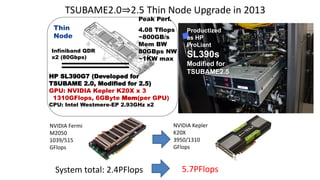
TSUBAME2.0⇒2.5 Thin Node Upgrade in 2013
HP SL390G7 (Developed for
TSUBAME 2.0, Modified for 2.5)
GPU: NVIDIA Kepler K20X x 3
1310GFlops, 6GByte Mem(per GPU)
CPU: Intel Westmere-EP 2.93GHz x2
Thin
Node
Infiniband QDR
x2 (80Gbps)
Productized
as HP
ProLiant
SL390s
Modified for
TSUBAME2.5
Peak Perf.
4.08 Tflops
~800GB/s
Mem BW
80GBps NW
~1KW max
NVIDIA Fermi
M2050
1039/515
GFlops
NVIDIA Kepler
K20X
3950/1310
GFlops
System total: 2.4PFlops 5.7PFlops
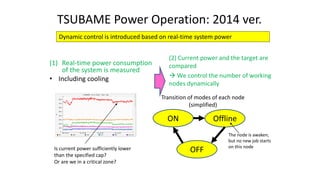
TSUBAME Power Operation: 2014 ver.
(1) Real-time power consumption
of the system is measured
• Including cooling
Is current power sufficiently lower
than the specified cap?
Or are we in a critical zone?
(2) Current power and the target are
compared
 We control the number of working
nodes dynamically
Transition of modes of each node
(simplified)
ON
OFF
Offline
The node is awaken,
but no new job starts
on this node
Dynamic control is introduced based on real-time system power
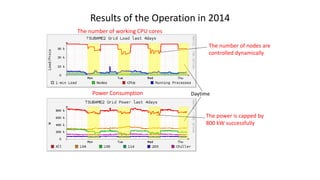
Results of the Operation in 2014
The number of working CPU cores
Power Consumption Daytime
The number of nodes are
controlled dynamically
The power is capped by
800 kW successfully
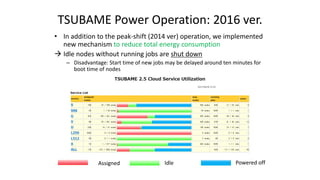
TSUBAME Power Operation: 2016 ver.
• In addition to the peak-shift (2014 ver) operation, we implemented
new mechanism to reduce total energy consumption
 Idle nodes without running jobs are shut down
– Disadvantage: Start time of new jobs may be delayed around ten minutes for
boot time of nodes
Assigned Idle Powered off
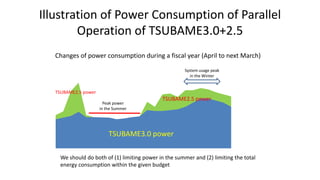
Illustration of Power Consumption of Parallel
Operation of TSUBAME3.0+2.5
Changes of power consumption during a fiscal year (April to next March)
TSUBAME3.0 power
TSUBAME2.5 power
TSUBAME2.5 power
Peak power
in the Summer
We should do both of (1) limiting power in the summer and (2) limiting the total
energy consumption within the given budget
System usage peak
in the Winter
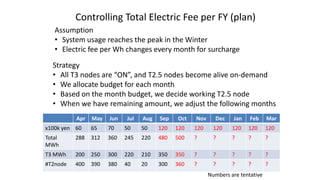
Controlling Total Electric Fee per FY (plan)
Assumption
• System usage reaches the peak in the Winter
• Electric fee per Wh changes every month for surcharge
Strategy
• All T3 nodes are “ON”, and T2.5 nodes become alive on-demand
• We allocate budget for each month
• Based on the month budget, we decide working T2.5 node
• When we have remaining amount, we adjust the following months
Apr May Jun Jul Aug Sep Oct Nov Dec Jan Feb Mar
x100k yen 60 65 70 50 50 120 120 120 120 120 120 120
Total
MWh
288 312 360 245 220 480 500 ? ? ? ? ?
T3 MWh 200 250 300 220 210 350 350 ? ? ? ? ?
#T2node 400 390 380 40 20 300 360 ? ? ? ? ?
Numbers are tentative
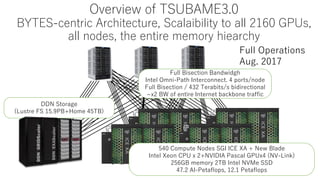
Overview of TSUBAME3.0
BYTES-centric Architecture, Scalaibility to all 2160 GPUs,
all nodes, the entire memory hiearchy
Full Bisection Bandwidgh
Intel Omni-Path Interconnect. 4 ports/node
Full Bisection / 432 Terabits/s bidirectional
~x2 BW of entire Internet backbone traffic
DDN Storage
(Lustre FS 15.9PB+Home 45TB)
540 Compute Nodes SGI ICE XA + New Blade
Intel Xeon CPU x 2+NVIDIA Pascal GPUx4 (NV-Link)
256GB memory 2TB Intel NVMe SSD
47.2 AI-Petaflops, 12.1 Petaflops
Full Operations
Aug. 2017
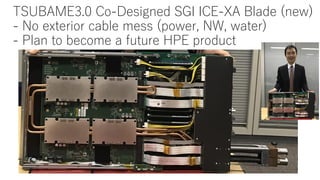
TSUBAME3.0 Co-Designed SGI ICE-XA Blade (new)
- No exterior cable mess (power, NW, water)
- Plan to become a future HPE product
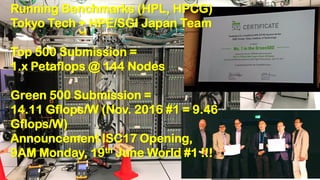
Power Meters
Running Benchmarks (HPL, HPCG)
Tokyo Tech + HPE/SGI Japan Team
Top 500 Submission =
1.x Petaflops @ 144 Nodes
Green 500 Submission =
14.11 Gflops/W (Nov. 2016 #1 = 9.46
Gflops/W)
Announcement ISC17 Opening,
9AM Monday, 19th June World #1 !!!
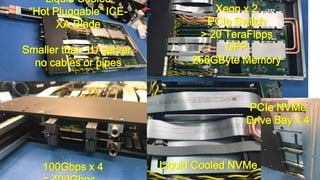
100Gbps x 4 Liquid Cooled NVMe
PCIe NVMe
Drive Bay x 4
Liquid Cooled
“Hot Pluggable” ICE-
XA Blade
Smaller than 1U server,
no cables or pipes
Xeon x 2
PCIe Switch
> 20 TeraFlops
DFP
256GByte Memory
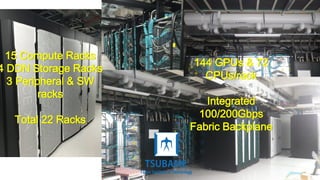
144 GPUs & 72
CPUs/rack
Integrated
100/200Gbps
Fabric Backplane
15 Compute Racks
4 DDN Storage Racks
3 Peripheral & SW
racks
Total 22 Racks
40
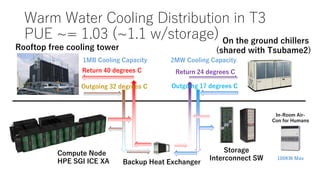
Warm Water Cooling Distribution in T3
PUE ~= 1.03 (~1.1 w/storage)
Compute Node
HPE SGI ICE XA
Storage
Interconnect SW
Rooftop free cooling tower
In-Room Air-
Con for Humans
On the ground chillers
(shared with Tsubame2)
Outgoing 32 degrees C
Return 40 degrees C
Backup Heat Exchanger
Outgoing 17 degrees C
1MB Cooling Capacity 2MW Cooling Capacity
100KW Max
Return 24 degrees C
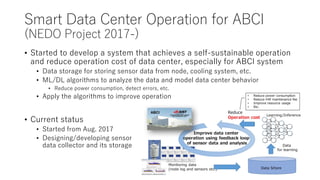
Smart Data Center Operation for ABCI
(NEDO Project 2017-)
• Started to develop a system that achieves a self-sustainable operation
and reduce operation cost of data center, especially for ABCI system
• Data storage for storing sensor data from node, cooling system, etc.
• ML/DL algorithms to analyze the data and model data center behavior
• Reduce power consumption, detect errors, etc.
• Apply the algorithms to improve operation
• Current status
• Started from Aug. 2017
• Designing/developing sensor
data collector and its storage
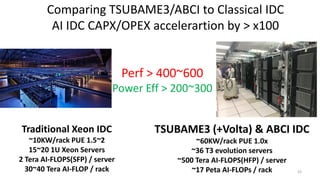
Comparing TSUBAME3/ABCI to Classical IDC
AI IDC CAPX/OPEX accelerartion by > x100
43
Traditional Xeon IDC
~10KW/rack PUE 1.5~2
15~20 1U Xeon Servers
2 Tera AI-FLOPS(SFP) / server
30~40 Tera AI-FLOP / rack
TSUBAME3 (+Volta) & ABCI IDC
~60KW/rack PUE 1.0x
~36 T3 evolution servers
~500 Tera AI-FLOPS(HFP) / server
~17 Peta AI-FLOPs / rack
Perf > 400~600
Power Eff > 200~300
Energy Efficiency Gains from
Software:
Retrospectives and Perspectives
SC17
November, 2017
John Shalf
Lawrence Berkeley
National Laboratory
Measurement and Metrics
"If you can not measure it,
you can not improve it.”
-Lord Kelvin (1883)
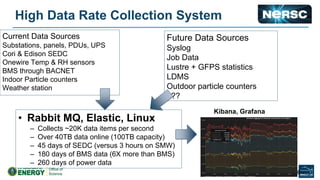
High Data Rate Collection System
Future Data Sources
Syslog
Job Data
Lustre + GFPS statistics
LDMS
Outdoor particle counters
???
- 46 -
Current Data Sources
Substations, panels, PDUs, UPS
Cori & Edison SEDC
Onewire Temp & RH sensors
BMS through BACNET
Indoor Particle counters
Weather station
• Rabbit MQ, Elastic, Linux
– Collects ~20K data items per second
– Over 40TB data online (100TB capacity)
– 45 days of SEDC (versus 3 hours on SMW)
– 180 days of BMS data (6X more than BMS)
– 260 days of power data
Kibana, Grafana
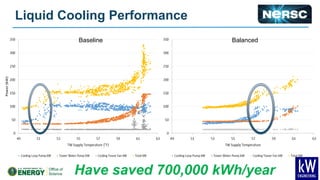
Liquid Cooling Performance
- 47 -
Baseline Balanced
Have saved 700,000 kWh/year
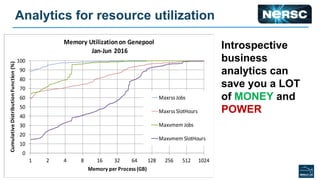
Analytics for resource utilization
0
10
20
30
40
50
60
70
80
90
100
1 2 4 8 16 32 64 128 256 512 1024
CumulativeDistributionFunction(%)
Memory per Process (GB)
Memory Utilizationon Genepool
Jan-Jun 2016
Maxrss Jobs
Maxrss SlotHours
Maxvmem Jobs
Maxvmem SlotHours
Introspective
business
analytics can
save you a LOT
of MONEY and
POWER
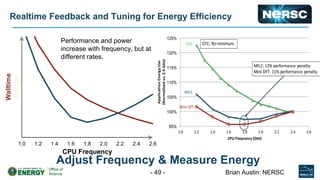
Realtime Feedback and Tuning for Energy Efficiency
- 49 -
65250.0
1.0 1.2 1.4 1.6 1.8 2.0 2.2 2.4 2.6
Walltime
Energy
CPU Frequency
Performance and power
increase with frequency, but at
different rates.
Brian Austin: NERSC
GTC
MILC
Mini-DFT
95%
100%
105%
110%
115%
120%
125%
1.0 1.2 1.4 1.6 1.8 2.0 2.2 2.4 2.6
ApplicationEnergyUse
(Normalizedvs.2.4GHz)
CPU Frequency (GHz)
GTC: No minimum.
MILC: 13% performance penalty.
Mini-DFT: 11% performance penalty.
Adjust Frequency & Measure Energy
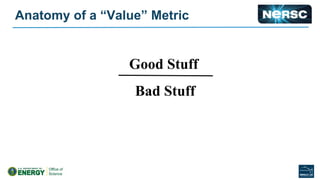
Anatomy of a “Value” Metric
Good Stuff
Bad Stuff
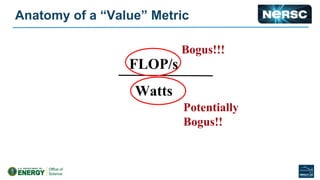
Anatomy of a “Value” Metric
FLOP/s
Watts
Bogus!!!
Potentially
Bogus!!
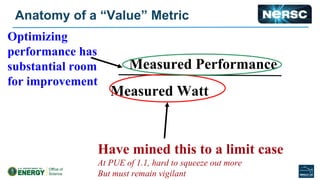
Anatomy of a “Value” Metric
Measured Performance
Measured Watt
Have mined this to a limit case
At PUE of 1.1, hard to squeeze out more
But must remain vigilant
Optimizing
performance has
substantial room
for improvement
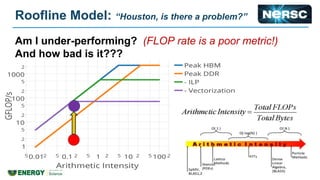
Roofline Model: “Houston, is there a problem?”
Am I under-performing? (FLOP rate is a poor metric!)
And how bad is it???
54
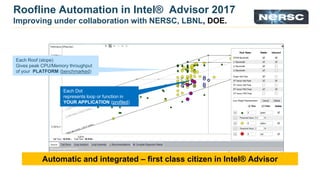
Roofline Automation in Intel® Advisor 2017
Improving under collaboration with NERSC, LBNL, DOE.
Each Dot
represents loop or function in
YOUR APPLICATION (profiled)
Each Roof (slope)
Gives peak CPU/Memory throughput
of your PLATFORM (benchmarked)
Automatic and integrated – first class citizen in Intel® Advisor
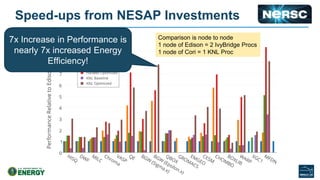
Speed-ups from NESAP Investments
55
Comparison is node to node
1 node of Edison = 2 IvyBridge Procs
1 node of Cori = 1 KNL Proc
7x Increase in Performance is
nearly 7x increased Energy
Efficiency!
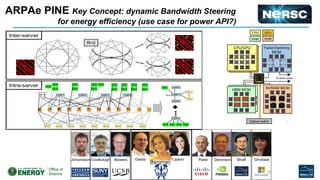
ARPAe PINE Key Concept: dynamic Bandwidth Steering
for energy efficiency (use case for power API?)
56
Compute MCM
HBM MCM NVRAM MCM
NVM
NVM
NVM
NVM
RX
RX
TX
TX
Packet Switching
MCM
RX
RX
TX
TX
To other nodes
CPU/GPU
HBM MCM
CPU GPU
RAM NVM
Optical switch 3
CMP1 CMP2 CMP3 CMP4
GPU3GPU1 GPU2 GPU8GPU6 GPU7GPU5GPU4 GPU9
MEM
MEM
MEM
MEM
MEM
MEM MEM
MEM
MEM
MEM
MEM
MEM
MEM
MEM
CMP1
CMP2
CMP4
MEM
MEM
CMP3
MEM MEM MEM MEM
MEM
GPU1
GPU3
Interconnect
R=2
Intra-server
Inter-server
Bergman
Gaeta LipsonBowersCoolbaughJohansson Patel Dennison Shalf Ghobadi
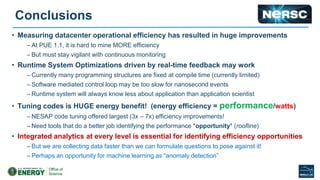
Conclusions
• Measuring datacenter operational efficiency has resulted in huge improvements
– At PUE 1.1, it is hard to mine MORE efficiency
– But must stay vigilant with continuous monitoring
• Runtime System Optimizations driven by real-time feedback may work
– Currently many programming structures are fixed at compile time (currently limited)
– Software mediated control loop may be too slow for nanosecond events
– Runtime system will always know less about application than application scientist
• Tuning codes is HUGE energy benefit! (energy efficiency = performance/watts)
– NESAP code tuning offered largest (3x – 7x) efficiency improvements!
– Need tools that do a better job identifying the performance *opportunity* (roofline)
• Integrated analytics at every level is essential for identifying efficiency opportunities
– But we are collecting data faster than we can formulate questions to pose against it!
– Perhaps an opportunity for machine learning as “anomaly detection”
58
What system software has been most helpful in improving system energy efficiency?
Which software stack layers should support energy awareness?
Is there user willingness to exploit libraries for energy efficiency?
What might encourage adoption of APIs for measurement/management?
Where are the biggest opportunities for energy efficiency improvements?
Can software-based runtime introspection mechanisms react fast enough?
What is the user reward for developing energy efficient codes?
What is the total cost of ownership (TCO) tradeoff in tuning codes for
(a) improved performance or (b) reduced energy consumption
What are the fundamental properties of energy efficient applications?

SC17 Panel: Energy Efficiency Gains From HPC Software

  • 1.
    1 Dan Reed Reed,Iowa Sadaf Alam, CSCS/ETH Bill Gropp, NCSA/Illinois Satoshi Matsuoka, GSIC/Tokyo Tech John Shalf, NERSC/LBL
  • 2.
    2 Gray’s cost/performance axes •Networking • Computation • Storage • Access … still driving change Facility, systems, operations Software …
  • 3.
  • 4.
    4 What system softwarehas been most helpful in improving system energy efficiency? Which software stack layers should support energy awareness? Is there user willingness to exploit libraries for energy efficiency? What might encourage adoption of APIs for measurement/management? Where are the biggest opportunities for energy efficiency improvements?
  • 5.
    5 At a PUEof <1.1, how much more is there to be gained? Can software-based runtime introspection mechanisms react fast enough? What is the user reward for developing energy efficient codes? What is the total cost of ownership (TCO) tradeoff in tuning codes for (a) improved performance or (b) reduced energy consumption What are the fundamental properties of energy efficient applications?
  • 6.
    SC17 Panel: EnergyEfficiency Gains From Software: Retrospectives and Perspectives Sadaf Alam Chief Technology Officer Swiss National Supercomputing Centre November 17, 2017
  • 7.
    SC17 Panel 7 PizDaint and the User Lab Model Cray XC40/XC50 XC50 Compute Nodes Intel® Xeon® E5-2690 v3 @ 2.60GHz (12 cores, 64GB RAM) and NVIDIA® Tesla® P100 16GB XC40 Compute Nodes Intel® Xeon® E5-2695 v4 @ 2.10GHz (18 cores, 64/128 GB RAM) Interconnect Configuration Aries routing and communications ASIC, and Dragonfly network topology Scratch capacity ~9 + 2.7 PB http://www.cscs.ch/uploads/tx_factsheet/FSPizDaint_2017_EN.pdf http://www.cscs.ch/publications/highlights/ http://www.cscs.ch/uploads/tx_factsheet/AR2016_Online.pdf
  • 8.
    Measurement Tools onPiz Daint  Level 3 measurements for official submissions  Accuracy for Top500, Green500, …  Grafana dashboard  Overall system and cabinet row  Cray performance measurement database (PMDB)  DB with node, blade, cabinet, job, …  SLURM output  Using data available on compute nodes SC17 Panel 8 > sacct -j 3****** -o JobID%20,ConsumedEnergyRaw JobID ConsumedEnergyRaw -------------------- ----------------- 3****** 3******.batch 379848.000000 3******.extern 2005970432.000000 3******.0 2001926407.000000
  • 9.
    SC17 Panel 9 MeteoSwiss’Performance Ambitions in 2013
  • 10.
    SC17 Panel 10 COSMO:old and new (refactored) code
  • 11.
  • 12.
  • 13.
    SC17 Panel 13 Onlysystem in top 10 with level 3 submission Subset of cores with lower CPU frequency for Green500 submission Green500 top systems contain accelerator devices Engaging users and developers
  • 14.
    Thank you foryour attention.
  • 15.
    Four Steps toEnergy Efficiency Through Software William Gropp Wgropp.cs.illinois.edu
  • 16.
    What was thebiggest contribution to HPC System Energy Efficiency? • Biggest contribution to HPC system energy efficiency was cooling. System uses air cooling within cabinets, with water removing heat from each cabinet. Heat exchangers on roof provide “free” cooling most of the year. • No impact on running application. No software changes required. • Problem: Our PUE is between 1.1 and 1.2; little further gain in efficiency possible here
  • 17.
    National Petascale ComputingFacility • Only Facility in the world of this scale on an Academic Campus • Capable of sustained 24 MW today • Expandable in space, power and cooling [50,000 ft2 (4,645+ m2) machine room gallery and sustained 100 MW] • Modern Data Center • 90,000+ ft2 (8,360+ m2) total • 30,000 ft2 (2,790+ m2) raised floor 20,000 ft2 (1,860+ m2) machine room gallery • Energy Efficiency • LEED certified Gold • Power Utilization Efficiency, PUE = 1.1–1.2
  • 18.
    How Does YourCenter Contribute Most in Energy Efficiency? • There are still be gaps in the baseline – the efficiency of applications. This is why “race to halt” is (was?) often the best strategy. • Our focus remains on improving application efficiency – including moving some applications to use GPUs on our mixed XE6/XK7 system • There are many parts to this • One of the most difficult yet most important is having enough of a performance model to understand how close the application is to achievable performance • This is different from efficiency of execution based on counting operations (this often over- estimates the number of necessary data moves, leading to a lower estimate for achievable performance) • Other steps, such as allocating jobs with topology awareness, are important
  • 19.
    Where Should Energy-AwarenessBe Added to the Software Stack? •Easiest if in runtime, scheduler, or closed application • That is, easiest if programmers don’t see it •Answer needs to be in context of goal • Information gathering (such as we did for I/O performance) including interconnect contribution and message wait (opportunity to reduce power) can be done with limited impact using MPI profiling interface or similar system intercept interfaces •If runtime can “do no harm”, then do it in the runtime • If you can’t guarantee that, allow users to opt out. • See discussion of incentives
  • 20.
    Will Users MakeCodes Energy Efficient? •No. •There is no incentive, and in fact, there is usually a negative incentive: if energy efficiency slows down the application •Some users may be willing to experiment or to be good “global citizens,” but most are focused on their science. •Different charging policies must be approved; in our case, by NSF. • For example, could charge allocation with a weight that included energy consumed, providing an incentive. But must include full cost of system including depreciation
  • 21.
    Does the CommunityNeed to Collect and Share Data? • Yes. To provide better incentives, there is a need to both measure energy use and provide actionable feedback to users. We need to to collect data on different approaches and reflect them in the context of user incentives • There are many complexities in this, and it will be hard to provide accurate data about energy use by application • This is not the same as having a deterministic way to charge for energy use. • The problem is that the actions of other applications may impact the energy use of shared resources (e.g., network, file system) and it may not be possible to determine what each application really used, as compared with what it was charged • Yes, this is also true for time charged to applications. That is not the issue; it is whether the users accept the approximations that are used
  • 22.
    Four Steps forEnergy Efficiency 1. Performance Efficiency • Like conservation, first step is to get more from the same (or less) • Performance modeling • Performance tuning 2. Recognize Hardware Realities • Next is to adapt to realities of the hardware • Rethink the algorithm • Adapt to memory latency, wide vectors, etc. • Can’t compare algorithms by comparing floating point counts, or even memory references • Avoid BSP-style programs • Separate communication and computation phases, and synchronization, waste energy
  • 23.
    Four Steps (con’t) 3.You Get What You Measure •You get what you measure (and reward/penalize) • Again, focus on performance • Expose the cost of waiting 4. Consider The Total Cost •Finally, need to consider total workflow costs • Local and global optimums not necessarily the same • Consider data motion for a data set – moving data back and forth can be expensive – even (locally) less efficient in situ analysis may be cheaper overall • And how that total cost is exposed/charged to the user • There must be a positive incentive to the user for pursuing energy efficiency
  • 24.
    Green Computingin Tsubame2and 3 Satoshi Matsuoka Professor, GSIC, Tokyo Institute of Technology / Director, AIST-Tokyo Tech. Big Data Open Innovation Lab / Fellow, Artificial Intelligence Research Center, AIST, Japan / Vis. Researcher, Advanced Institute for Computational Science, Riken SC17 Green PanelTalk 2017/11/17
  • 25.
    Impacts of Mar11 Earthquake • Earthquake itself did not affect the supercomputer, but… • Power plant accident caused power crisis in the capital area – Rolling outage in March – University/Government’s direction to save power • Although TSUBAME2 is “green”, it consumes ~10% (0.9—1.2MW) power of the campus! Operation of TSUBAME2.0 started in Nov 2010, and The Great East Japan Earthquake happened 4 months later
  • 26.
    TSUBAME Power Operation:2011 ver. (1) • University directed us to save power usage by: – -50% in early April  # of nodes has to be -70% – -25% in late April  # of nodes has to be -35% • Reducing too much nodes constantly is harmful for supercomputer users • What is the social demand? The most important constraint is to reduce peak power consumption in daytime “Peak shift” operation Total power usage of the capital area in a day daytime
  • 27.
    TSUBAME Power Operation:2011 ver. (2) • It was allowable to increase running nodes in nighttime and weekend 65% operation in daytime 100% operation in nighttime/weekend • Tokyo-Tech and NEC developed tools to shutdown/ wake up nodes automatically everyday • The number “65%” is determined by measurement of power consumption in typical operation
  • 28.
    Results of theOperation in 2011 5/12~6/8 CPU 5/12~6/8 Power 7/4~ Power 7/4~ CPU Target 787kW • The power is successfully limited in daytime • However, it is still sometimes too pessimistic • Our goal is not capping # of nodes, but capping power  New power-aware system management method is required
  • 29.
    TSUBAME2.0⇒2.5 Thin NodeUpgrade in 2013 HP SL390G7 (Developed for TSUBAME 2.0, Modified for 2.5) GPU: NVIDIA Kepler K20X x 3 1310GFlops, 6GByte Mem(per GPU) CPU: Intel Westmere-EP 2.93GHz x2 Thin Node Infiniband QDR x2 (80Gbps) Productized as HP ProLiant SL390s Modified for TSUBAME2.5 Peak Perf. 4.08 Tflops ~800GB/s Mem BW 80GBps NW ~1KW max NVIDIA Fermi M2050 1039/515 GFlops NVIDIA Kepler K20X 3950/1310 GFlops System total: 2.4PFlops 5.7PFlops
  • 30.
    TSUBAME Power Operation:2014 ver. (1) Real-time power consumption of the system is measured • Including cooling Is current power sufficiently lower than the specified cap? Or are we in a critical zone? (2) Current power and the target are compared  We control the number of working nodes dynamically Transition of modes of each node (simplified) ON OFF Offline The node is awaken, but no new job starts on this node Dynamic control is introduced based on real-time system power
  • 31.
    Results of theOperation in 2014 The number of working CPU cores Power Consumption Daytime The number of nodes are controlled dynamically The power is capped by 800 kW successfully
  • 32.
    TSUBAME Power Operation:2016 ver. • In addition to the peak-shift (2014 ver) operation, we implemented new mechanism to reduce total energy consumption  Idle nodes without running jobs are shut down – Disadvantage: Start time of new jobs may be delayed around ten minutes for boot time of nodes Assigned Idle Powered off
  • 33.
    Illustration of PowerConsumption of Parallel Operation of TSUBAME3.0+2.5 Changes of power consumption during a fiscal year (April to next March) TSUBAME3.0 power TSUBAME2.5 power TSUBAME2.5 power Peak power in the Summer We should do both of (1) limiting power in the summer and (2) limiting the total energy consumption within the given budget System usage peak in the Winter
  • 34.
    Controlling Total ElectricFee per FY (plan) Assumption • System usage reaches the peak in the Winter • Electric fee per Wh changes every month for surcharge Strategy • All T3 nodes are “ON”, and T2.5 nodes become alive on-demand • We allocate budget for each month • Based on the month budget, we decide working T2.5 node • When we have remaining amount, we adjust the following months Apr May Jun Jul Aug Sep Oct Nov Dec Jan Feb Mar x100k yen 60 65 70 50 50 120 120 120 120 120 120 120 Total MWh 288 312 360 245 220 480 500 ? ? ? ? ? T3 MWh 200 250 300 220 210 350 350 ? ? ? ? ? #T2node 400 390 380 40 20 300 360 ? ? ? ? ? Numbers are tentative
  • 35.
    Overview of TSUBAME3.0 BYTES-centricArchitecture, Scalaibility to all 2160 GPUs, all nodes, the entire memory hiearchy Full Bisection Bandwidgh Intel Omni-Path Interconnect. 4 ports/node Full Bisection / 432 Terabits/s bidirectional ~x2 BW of entire Internet backbone traffic DDN Storage (Lustre FS 15.9PB+Home 45TB) 540 Compute Nodes SGI ICE XA + New Blade Intel Xeon CPU x 2+NVIDIA Pascal GPUx4 (NV-Link) 256GB memory 2TB Intel NVMe SSD 47.2 AI-Petaflops, 12.1 Petaflops Full Operations Aug. 2017
  • 36.
    TSUBAME3.0 Co-Designed SGIICE-XA Blade (new) - No exterior cable mess (power, NW, water) - Plan to become a future HPE product
  • 37.
    Power Meters Running Benchmarks(HPL, HPCG) Tokyo Tech + HPE/SGI Japan Team Top 500 Submission = 1.x Petaflops @ 144 Nodes Green 500 Submission = 14.11 Gflops/W (Nov. 2016 #1 = 9.46 Gflops/W) Announcement ISC17 Opening, 9AM Monday, 19th June World #1 !!!
  • 38.
    100Gbps x 4Liquid Cooled NVMe PCIe NVMe Drive Bay x 4 Liquid Cooled “Hot Pluggable” ICE- XA Blade Smaller than 1U server, no cables or pipes Xeon x 2 PCIe Switch > 20 TeraFlops DFP 256GByte Memory
  • 39.
    144 GPUs &72 CPUs/rack Integrated 100/200Gbps Fabric Backplane 15 Compute Racks 4 DDN Storage Racks 3 Peripheral & SW racks Total 22 Racks
  • 40.
  • 41.
    Warm Water CoolingDistribution in T3 PUE ~= 1.03 (~1.1 w/storage) Compute Node HPE SGI ICE XA Storage Interconnect SW Rooftop free cooling tower In-Room Air- Con for Humans On the ground chillers (shared with Tsubame2) Outgoing 32 degrees C Return 40 degrees C Backup Heat Exchanger Outgoing 17 degrees C 1MB Cooling Capacity 2MW Cooling Capacity 100KW Max Return 24 degrees C
  • 42.
    Smart Data CenterOperation for ABCI (NEDO Project 2017-) • Started to develop a system that achieves a self-sustainable operation and reduce operation cost of data center, especially for ABCI system • Data storage for storing sensor data from node, cooling system, etc. • ML/DL algorithms to analyze the data and model data center behavior • Reduce power consumption, detect errors, etc. • Apply the algorithms to improve operation • Current status • Started from Aug. 2017 • Designing/developing sensor data collector and its storage
  • 43.
    Comparing TSUBAME3/ABCI toClassical IDC AI IDC CAPX/OPEX accelerartion by > x100 43 Traditional Xeon IDC ~10KW/rack PUE 1.5~2 15~20 1U Xeon Servers 2 Tera AI-FLOPS(SFP) / server 30~40 Tera AI-FLOP / rack TSUBAME3 (+Volta) & ABCI IDC ~60KW/rack PUE 1.0x ~36 T3 evolution servers ~500 Tera AI-FLOPS(HFP) / server ~17 Peta AI-FLOPs / rack Perf > 400~600 Power Eff > 200~300
  • 44.
    Energy Efficiency Gainsfrom Software: Retrospectives and Perspectives SC17 November, 2017 John Shalf Lawrence Berkeley National Laboratory
  • 45.
    Measurement and Metrics "Ifyou can not measure it, you can not improve it.” -Lord Kelvin (1883)
  • 46.
    High Data RateCollection System Future Data Sources Syslog Job Data Lustre + GFPS statistics LDMS Outdoor particle counters ??? - 46 - Current Data Sources Substations, panels, PDUs, UPS Cori & Edison SEDC Onewire Temp & RH sensors BMS through BACNET Indoor Particle counters Weather station • Rabbit MQ, Elastic, Linux – Collects ~20K data items per second – Over 40TB data online (100TB capacity) – 45 days of SEDC (versus 3 hours on SMW) – 180 days of BMS data (6X more than BMS) – 260 days of power data Kibana, Grafana
  • 47.
    Liquid Cooling Performance -47 - Baseline Balanced Have saved 700,000 kWh/year
  • 48.
    Analytics for resourceutilization 0 10 20 30 40 50 60 70 80 90 100 1 2 4 8 16 32 64 128 256 512 1024 CumulativeDistributionFunction(%) Memory per Process (GB) Memory Utilizationon Genepool Jan-Jun 2016 Maxrss Jobs Maxrss SlotHours Maxvmem Jobs Maxvmem SlotHours Introspective business analytics can save you a LOT of MONEY and POWER
  • 49.
    Realtime Feedback andTuning for Energy Efficiency - 49 - 65250.0 1.0 1.2 1.4 1.6 1.8 2.0 2.2 2.4 2.6 Walltime Energy CPU Frequency Performance and power increase with frequency, but at different rates. Brian Austin: NERSC GTC MILC Mini-DFT 95% 100% 105% 110% 115% 120% 125% 1.0 1.2 1.4 1.6 1.8 2.0 2.2 2.4 2.6 ApplicationEnergyUse (Normalizedvs.2.4GHz) CPU Frequency (GHz) GTC: No minimum. MILC: 13% performance penalty. Mini-DFT: 11% performance penalty. Adjust Frequency & Measure Energy
  • 50.
    Anatomy of a“Value” Metric Good Stuff Bad Stuff
  • 51.
    Anatomy of a“Value” Metric FLOP/s Watts Bogus!!! Potentially Bogus!!
  • 52.
    Anatomy of a“Value” Metric Measured Performance Measured Watt Have mined this to a limit case At PUE of 1.1, hard to squeeze out more But must remain vigilant Optimizing performance has substantial room for improvement
  • 53.
    Roofline Model: “Houston,is there a problem?” Am I under-performing? (FLOP rate is a poor metric!) And how bad is it???
  • 54.
    54 Roofline Automation inIntel® Advisor 2017 Improving under collaboration with NERSC, LBNL, DOE. Each Dot represents loop or function in YOUR APPLICATION (profiled) Each Roof (slope) Gives peak CPU/Memory throughput of your PLATFORM (benchmarked) Automatic and integrated – first class citizen in Intel® Advisor
  • 55.
    Speed-ups from NESAPInvestments 55 Comparison is node to node 1 node of Edison = 2 IvyBridge Procs 1 node of Cori = 1 KNL Proc 7x Increase in Performance is nearly 7x increased Energy Efficiency!
  • 56.
    ARPAe PINE KeyConcept: dynamic Bandwidth Steering for energy efficiency (use case for power API?) 56 Compute MCM HBM MCM NVRAM MCM NVM NVM NVM NVM RX RX TX TX Packet Switching MCM RX RX TX TX To other nodes CPU/GPU HBM MCM CPU GPU RAM NVM Optical switch 3 CMP1 CMP2 CMP3 CMP4 GPU3GPU1 GPU2 GPU8GPU6 GPU7GPU5GPU4 GPU9 MEM MEM MEM MEM MEM MEM MEM MEM MEM MEM MEM MEM MEM MEM CMP1 CMP2 CMP4 MEM MEM CMP3 MEM MEM MEM MEM MEM GPU1 GPU3 Interconnect R=2 Intra-server Inter-server Bergman Gaeta LipsonBowersCoolbaughJohansson Patel Dennison Shalf Ghobadi
  • 57.
    Conclusions • Measuring datacenteroperational efficiency has resulted in huge improvements – At PUE 1.1, it is hard to mine MORE efficiency – But must stay vigilant with continuous monitoring • Runtime System Optimizations driven by real-time feedback may work – Currently many programming structures are fixed at compile time (currently limited) – Software mediated control loop may be too slow for nanosecond events – Runtime system will always know less about application than application scientist • Tuning codes is HUGE energy benefit! (energy efficiency = performance/watts) – NESAP code tuning offered largest (3x – 7x) efficiency improvements! – Need tools that do a better job identifying the performance *opportunity* (roofline) • Integrated analytics at every level is essential for identifying efficiency opportunities – But we are collecting data faster than we can formulate questions to pose against it! – Perhaps an opportunity for machine learning as “anomaly detection”
  • 58.
    58 What system softwarehas been most helpful in improving system energy efficiency? Which software stack layers should support energy awareness? Is there user willingness to exploit libraries for energy efficiency? What might encourage adoption of APIs for measurement/management? Where are the biggest opportunities for energy efficiency improvements? Can software-based runtime introspection mechanisms react fast enough? What is the user reward for developing energy efficient codes? What is the total cost of ownership (TCO) tradeoff in tuning codes for (a) improved performance or (b) reduced energy consumption What are the fundamental properties of energy efficient applications?