Cloud-Native & Sustainability: How and
Why to Build Sustainable Workloads 🌱
Software Craft Community @ DATEV, June 2023
Nico Meisenzahl
(Head of DevOps Consulting & Operations,
Cloud Solution Architect)
+49 8031 230159-0
nico.meisenzahl@whiteduck.de
@nmeisenzahl
www.linkedin.com/in/nicomeisenzahl
Who am I?
• Doing Cloud Native, Kubernetes & Azure
• Microsoft MVP
• Microsoft Azure
• Developer Technologies
• GitLab Hero
Agenda
• What is sustainability?
• Cloud-native & sustainable workloads
• Patterns & best-practice for cloud-native apps
• Real-world examples
• Current state & how to get started
4
What is sustainability? 🌱
5
6
Sustainability means creating and maintaining software systems
with minimal negative impact on the environment, society, and the
economy.
In software development, the overall goal is to develop and operate
carbon-efficient applications. 🌱
Principles to be carbon efficient
• Energy Efficiency
• Carbon Awareness
• Hardware Efficiency
• Measurement
• Climate Commitments
7
Energy Efficiency
“Use the least amount of energy possible”
• most electricity is still generated by burning fossil fuels and is responsible
for 49%* of carbon emissions into the atmosphere
• already a common pattern for mobile apps
• needs to be expanded to all workloads
• waste as little as possible within the whole developer lifecycle
• also think about the end-user
• aim for a high utilization of compute resources
• the relationship between power consumption and utilization is not linear
8
* https://ourworldindata.org/co2-and-greenhouse-gas-emissions#co2-emissions-by-sector
Carbon Awareness
“Do more when the electricity is cleaner and do less when the
electricity is dirtier”
• carbon intensity varies depending on the time and place it is consumed
• prefer green energy over brown even if it comes with downsides
• we need to push/invest into green energy
• WattTime or Electricity Maps can help gaining insights by providing real-time
data and forecasts of the current carbon intensity on a specific location
• https://www.watttime.org
• https://www.electricitymaps.com
9
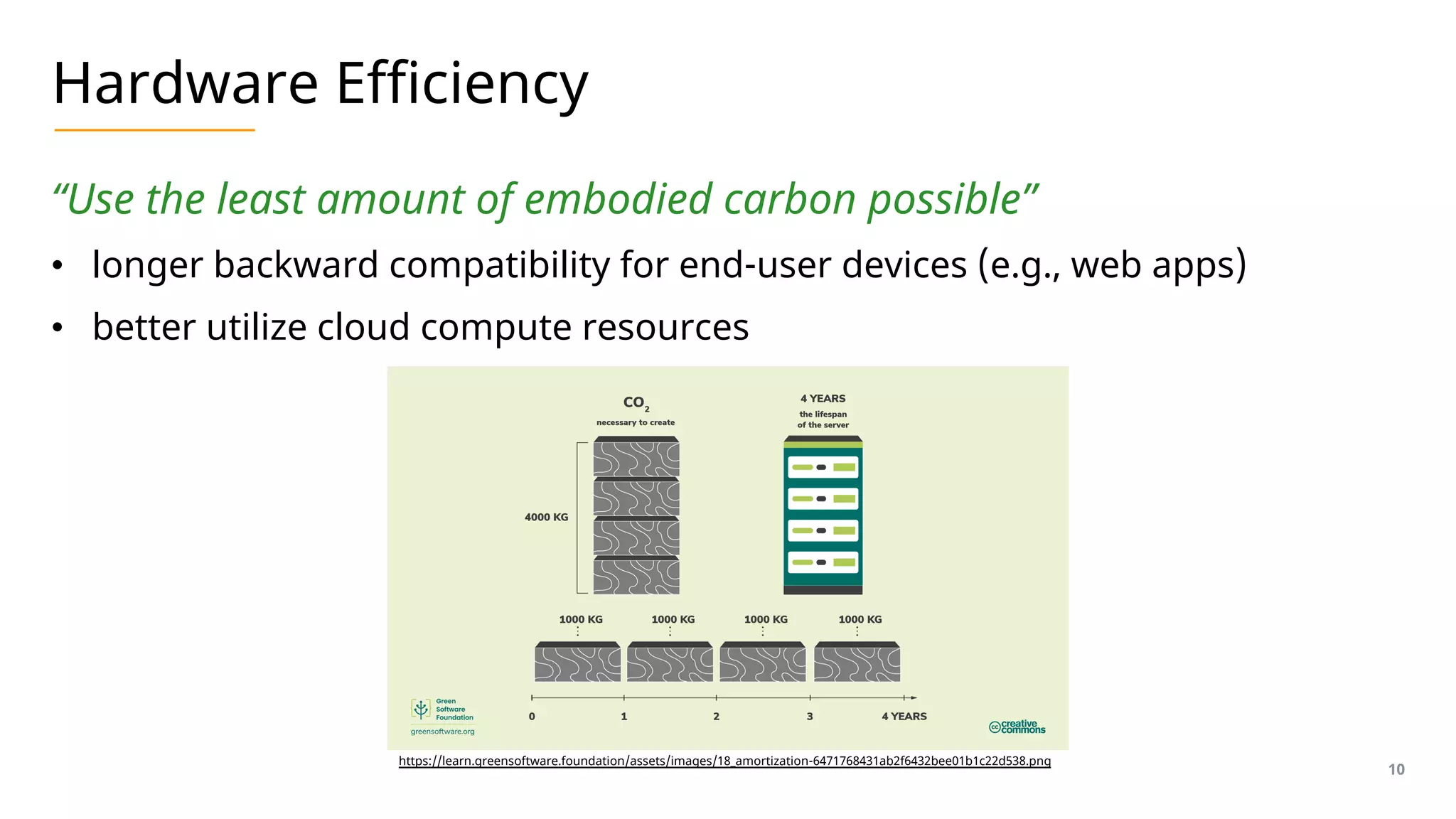
Hardware Efficiency
“Use the least amount of embodied carbon possible”
• longer backward compatibility for end-user devices (e.g., web apps)
• better utilize cloud compute resources
10
https://learn.greensoftware.foundation/assets/images/18_amortization-6471768431ab2f6432bee01b1c22d538.png
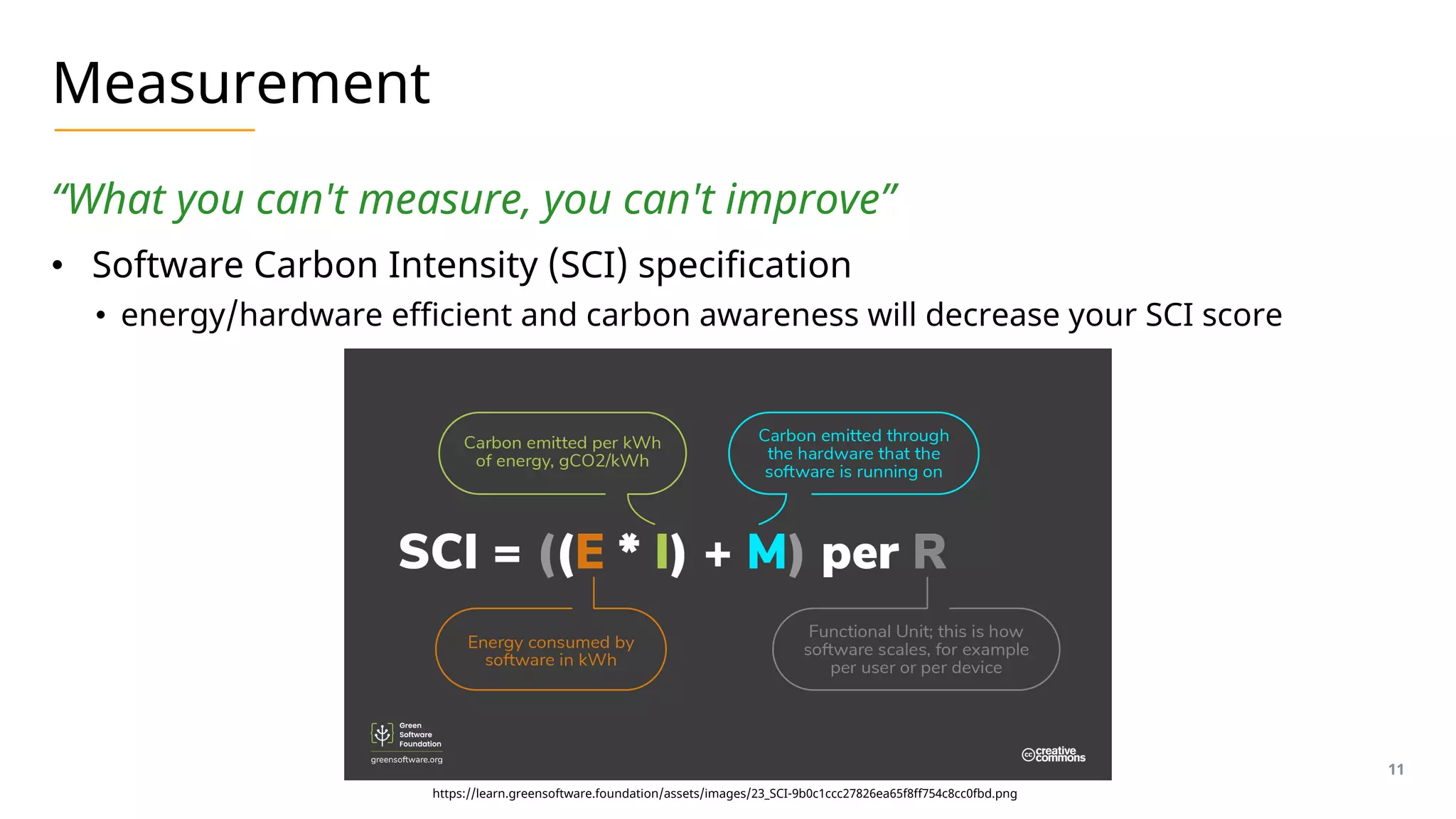
Measurement
“What you can't measure, you can't improve”
• Software Carbon Intensity (SCI) specification
• energy/hardware efficient and carbon awareness will decrease your SCI score
11
https://learn.greensoftware.foundation/assets/images/23_SCI-9b0c1ccc27826ea65f8ff754c8cc0fbd.png
Climate Commitments
“Understand the exact mechanism of carbon reduction”
• carbon neutral – must cover direct emissions (indirect is optional)
• no need reduce carbon emissions
• compensation to reduce emissions outside of their value chain
• net zero – the actual amount of carbon in the atmosphere remains constant
• through carbon removals (neutralizations)
• requires emissions reductions in line with a 1.5°C pathway
• carbon negative – remove more CO2 from the atmosphere than emitting
• 100% renewable – either “direct powered by” or via certificates
12
Cloud-native & sustainable workloads 💚
13
Sustainable workloads are…
• developed and operated while being aware of the environmental impact
• optimized for environmental impact
• maximize utilization while minimizing waste
• ultimately reducing the footprint on the environment
• carbon efficiency, i.e., emitting as few carbon emissions as possible
14
Isn’t cloud-native enough?
• it's a first step into the right direction, but you can do more
• you benefit from advantages through cloud native design patterns
• you rely on the commitment and work from Microsoft Azure
• but it’s still a shared responsibility
• “Azure services are up to 98 percent more carbon efficient and up to 93%
more energy efficient than a traditional enterprise datacenter”*
15
* https://datacenters.microsoft.com/globe/powering-sustainable-transformation
Microsoft commitments*
• $1 billion Climate Innovation Fund
• Commitment to protecting more land than we use by 2025
• Zero-waste certification by 2030
• Water positive by 2030 – replenish more water than we consume
• Diesel-free backup power by 2030
• 100 percent of our electricity consumption, 100 percent of the time, matched
by zero carbon energy purchases by 2030
16
* https://datacenters.microsoft.com/globe/powering-sustainable-transformation
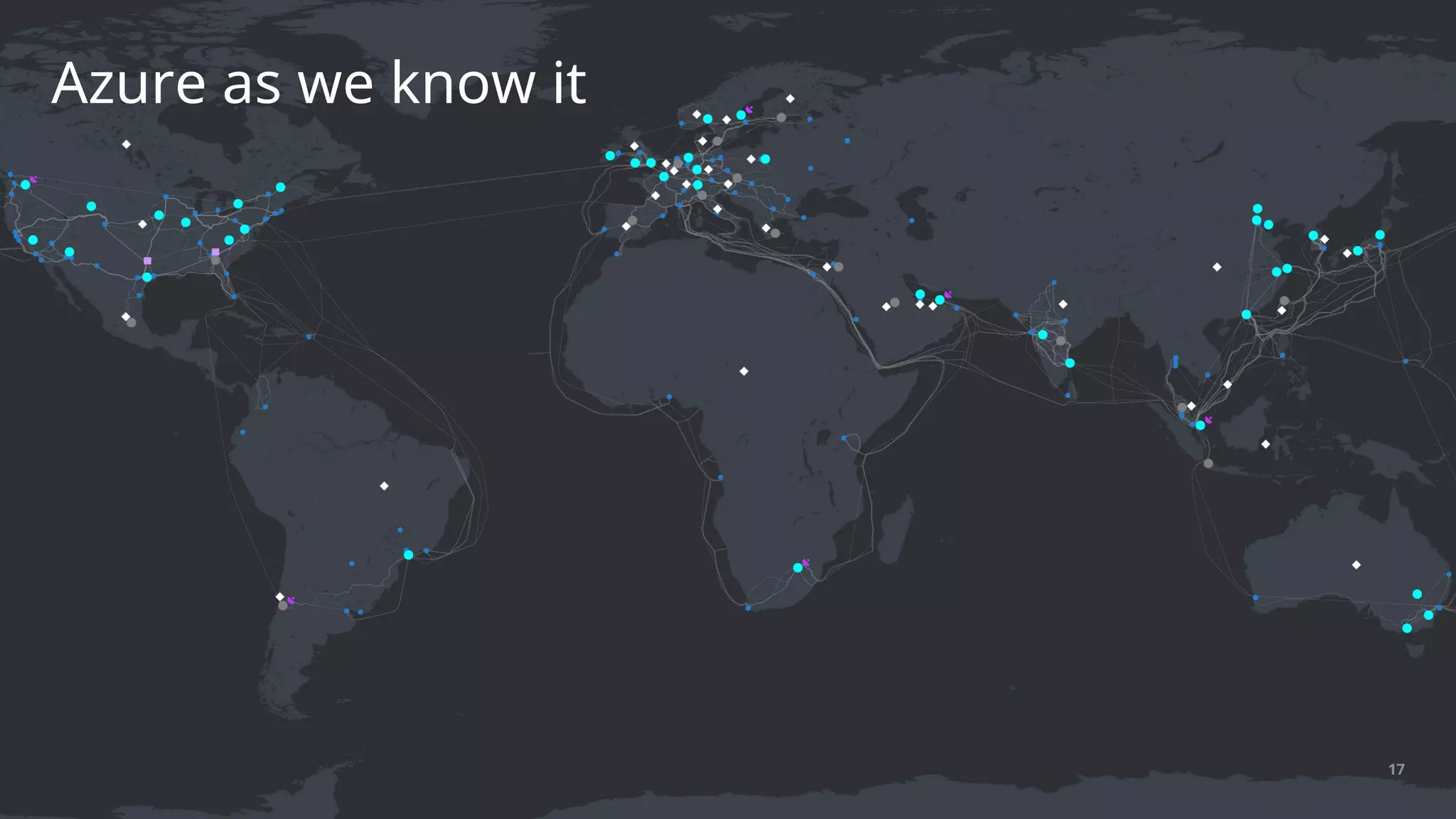
Azure as we know it
17
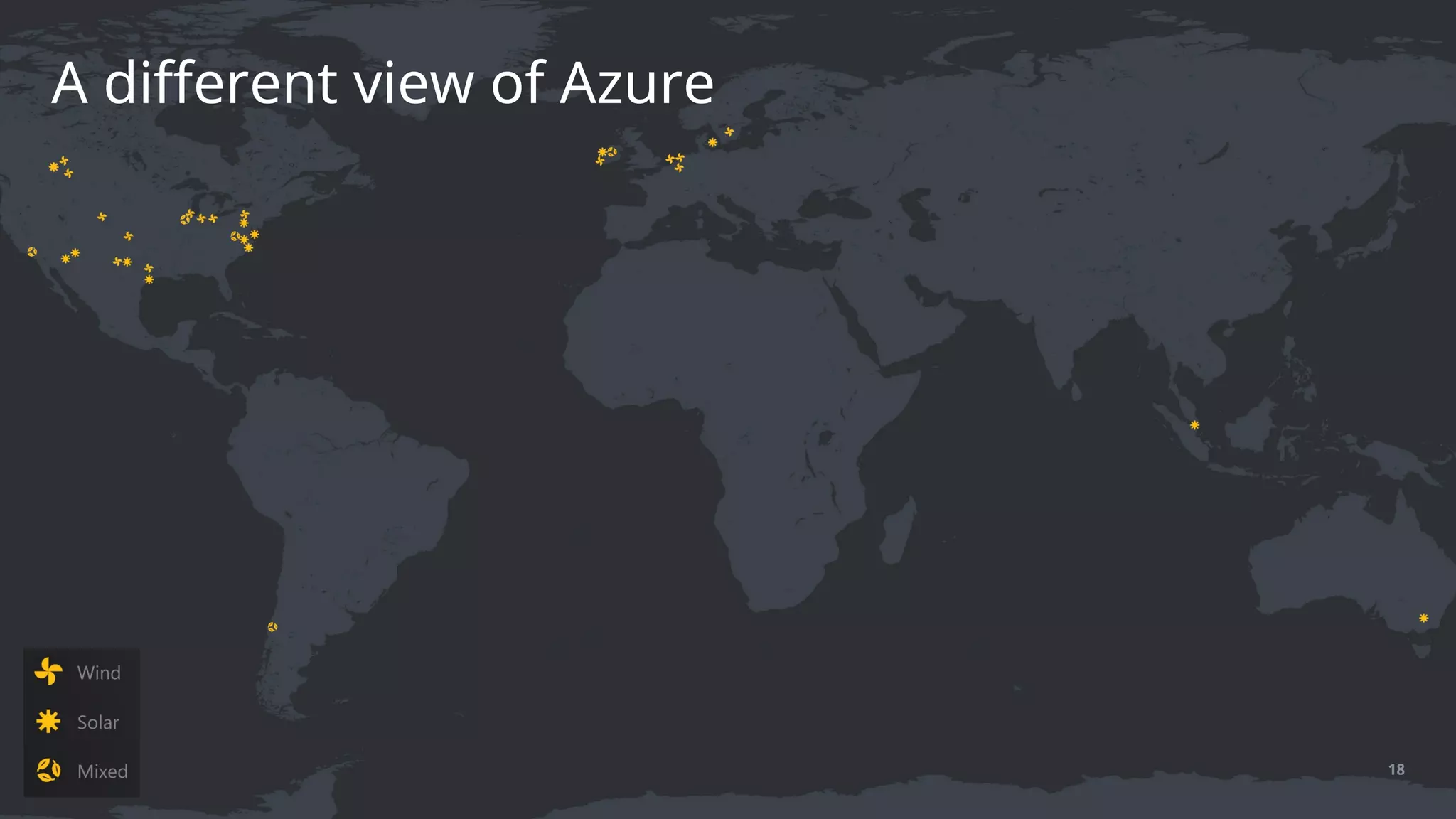
A different view of Azure
18
An example: Sweden Region datacenter*
• launched in November 2021
• 30 percent reduction in energy costs and 90 percent less water usage
• free cooling – allows the warm air in the building to be mixed with cool outside air to
maintain the correct temperature
• rainwater harvesting – rain is captured and stored to be mainly to produce
humidification for cooling
• recycle and repurposing hardware using Microsoft’s Circular Center
• not yet needed in Sweden (hardware lifetime is about 6 years)
• Amsterdam Circular Center has resulted in 83 percent of hardware being reused
19
* https://news.microsoft.com/europe/features/how-microsofts-new-datacenter-region-in-sweden-incorporates-the-companys-sustainability-commitments
An example: Sweden Region datacenter*
• 100 percent renewable energy
• this can be ensured with near real-time monitoring and partnering with Vattenfall
• every megawatt hour consumed is matched with a MWh of renewable energy
generated during the same hour of consumption
• 45% lower net carbon dioxide emissions for backup power
• by using less carbon-intensive fuel (containing 50% renewable diesel)
20
* https://news.microsoft.com/europe/features/how-microsofts-new-datacenter-region-in-sweden-incorporates-the-companys-sustainability-commitments
Current status (Azure’s and yours)
• “2022 Environmental Sustainability Report”
• https://www.microsoft.com/corporate-responsibility/sustainability/report
• Emissions Impact Dashboard for Azure
• https://appsource.microsoft.com/product/power-bi/coi-
sustainability.emissions_impact_dashboard
• Power BI Pro license required
• Cloud for Sustainability API (Preview)
• https://learn.microsoft.com/industry/sustainability/api-overview
• currently no support for CSP and PAYG
21
Patterns & best practice for
cloud-native apps
22
Decide on the right location
• not the easiest one!
• you should choose a region
• near to your users
• relying on green energy
• even if there are downsides you should still prefer green energy over brown
• we need to invest in green energy to develop it further
• there might not be just one…
23
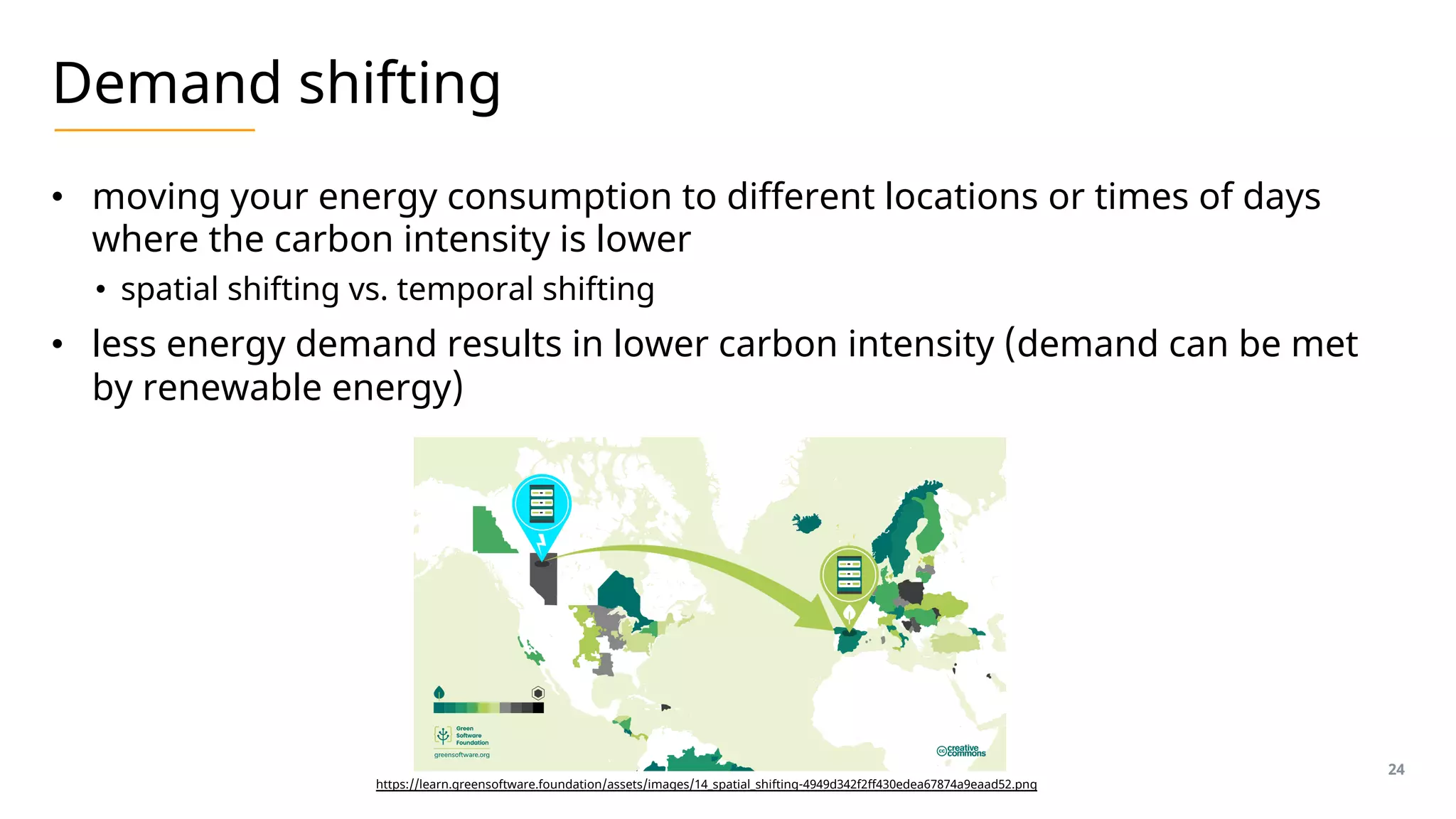
Demand shifting
• moving your energy consumption to different locations or times of days
where the carbon intensity is lower
• spatial shifting vs. temporal shifting
• less energy demand results in lower carbon intensity (demand can be met
by renewable energy)
24
https://learn.greensoftware.foundation/assets/images/14_spatial_shifting-4949d342f2ff430edea67874a9eaad52.png
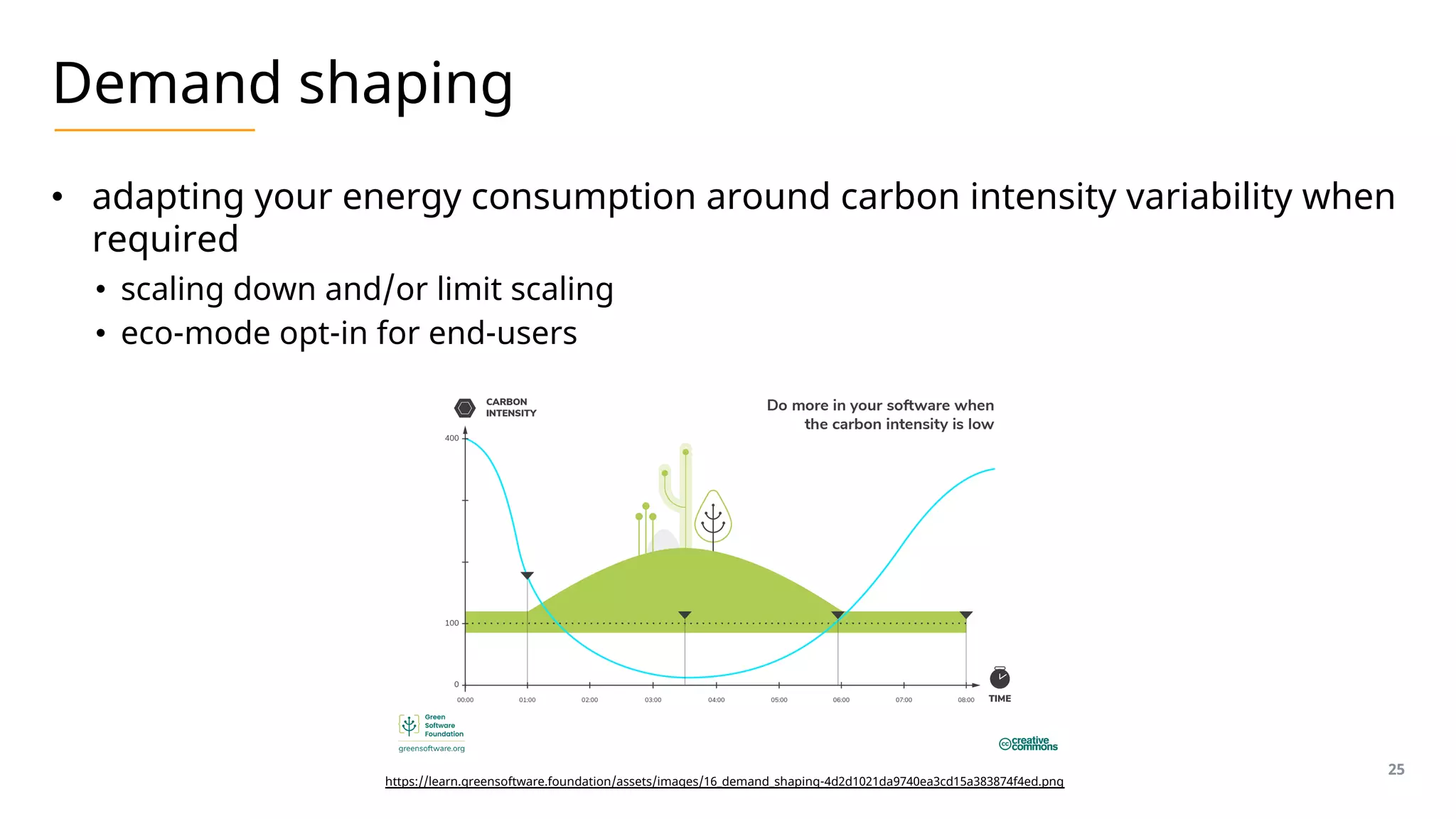
Demand shaping
• adapting your energy consumption around carbon intensity variability when
required
• scaling down and/or limit scaling
• eco-mode opt-in for end-users
25
https://learn.greensoftware.foundation/assets/images/16_demand_shaping-4d2d1021da9740ea3cd15a383874f4ed.png
Networking
• the goal is to further eliminate unnecessary traffic
• implement a CDN (Content Delivery Network) for static assets
• follow caching best practices to reduce requests
• enable network compression
• implement DDoS protection
• opt-in for TLS termination where possible
26
Optimize for efficiency
• think about your overall hardware utilization
• the energy does not increase linearly with consumption
• utilize auto-scaling, bursting capabilities (B-Series VMs) & Spot VMs
• latter utilize the otherwise wasted capacity
• rely on Platform as a Service (PaaS)
• managed services are highly optimized and operate on more efficient hardware
• better overall utilization
• build your application based on serverless (Azure Functions)
• delete zombie workloads
• and implement a process to clean them up 27
Microservices
• think about moving to a microservice architecture
• but: they come with an overhead
• monoliths can still be the best choice for smaller applications
• also, don’t build micro-monoliths (not only because of the network overhead)!
• extra overhead on the CI/CD parts
• they allow to scale parts of the application independent form each other
• opt-in for containerization for smaller footprint
28
Think about your data
• Data is gold – but think about how to store it!
• store less frequent requested data to cold or archive storage
• only store what is relevant
• no data is the most sustainable data 😉
• revise your backup and retention policies
• optimize the collection of your metrics & logs
• again, think about what you really need
• also optimize your application logging to not create data you don’t need
29
Real-world examples
30
Rethink your UI/UX
• reduce the components to load and render
• use optimized assets
• don’t render full-size images as thumbnails (network traffic, local CPU usage)
• decide to use lower resolutions in general
• rely on system fonts
• provide an optional eco-mode (opt-in)
• enabled dark-mode
• shifting async jobs to times where green energy is available
• reduced UI
31
Optimize your database (access)
• invest in reducing your database load
• optimize your database queries & indexes
• implement caching where possible
• validate & rework your data design
• this can save a lot of compute & energy
• positive side effect: your applications performance will increase
32
Optimize your code
• implement circuit breaker patterns
• repeated failures can lead to overhead and unnecessary processing
• optimize your code for efficient resource usage
• use optimized and efficient algorithms and design patterns
• rely the “don't repeat yourself” (DRY) principle
• rely on asynchronous access patterns
• queue and buffer requests, then process in batch
• actively decide when and where to process them
• invest into your legacy code
• identify inefficient code and start modernizing it
33
ARM-based compute resources
• “Ampere Altra VMs outperform equivalently sized Intel and AMD instances
from the same generation by 39% and 47%, respectively. In addition to being
the high-performance choice, Ampere Altra processors are extremely power
efficient, directly reducing users’ overall carbon footprint”*
• if you don’t care, move your workload to ARM-based resources
• otherwise, invest time to migrate
• make use of ARM-based resources in runtime and build time (CI/CD)
34
* https://amperecomputing.com/en/blogs/ampere-altra-now-available-on-microsoft-azure-cloud-platform
server-side vs. client-side rendering
• again, this isn’t an easy one
• do you know your end-users?
• server-side pros
• you can opt-in for green energy and better utilization
• less chatty (browser-to-server round-trips) and centralized caching
• lower requirements on the client-side
• client-side pros
• no need for a server, as you can rely on static storage
• it’s more efficient only to render what's needed
• less network traffic
35
Improve API efficiency
• GraphQL can help with chatty I/O antipattern
• “GraphQL is a query language for APIs and a runtime for fulfilling those queries with
your existing data”
• reduce unnecessary load with rate limits and throttling
• implement caching to reduce workload on your backends
• e.g., implement caching via API Management
36
Think about your CI/CD
• rely on shared resources like managed agents
• implement scaling to zero with VM scale sets or containerization
• e.g., run your CI/CD jobs in a shared Kubernetes Cluster
• optimize your pipeline for caching
• don’t build identical things multiple times
• split large code repos (to be able to build just parts of your code)
• reduce your GitOps sync interval
37
Testing is energy intensive
• rely on demand shifting for your integration, performance, load, or any
other intense testing
• move them to a different time or region to reduce carbon intense
• implement chaos engineering
• introduction of chaos engineering can significantly help improve reliability and
resilience and how the applications react to failures
• allows you optimizing your workload to handle failures gracefully with less wasted
resources
38
Don’t use AI for everything! Sorry…
• AI can help to be more sustainable
• e.g., Microsoft uses AI in there Sweden datacenters to manage green energy
consumption
• but AI requires extensive resources for training and hosting models*
• rely on it, but only for use-cases where AI really shines
• do not build the next chat bot
• use it selectively in particular use cases or parts of it
39
* https://sustainabilitymag.com/sustainability/sustainability-applications-for-artificial-intelligence
Kubernetes Event-driven Autoscaling (KEDA)
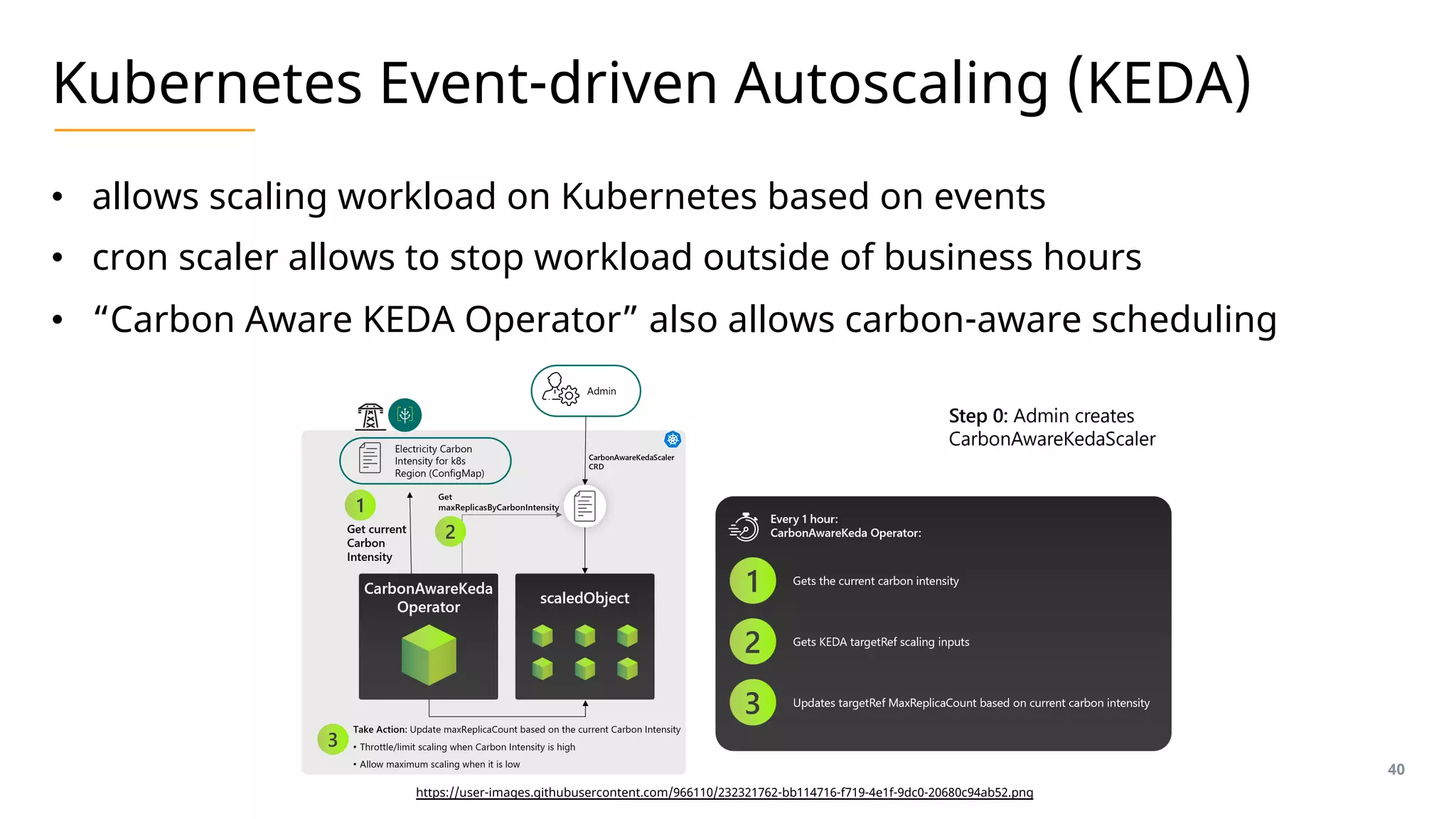
• allows scaling workload on Kubernetes based on events
• cron scaler allows to stop workload outside of business hours
• “Carbon Aware KEDA Operator” also allows carbon-aware scheduling
40
https://user-images.githubusercontent.com/966110/232321762-bb114716-f719-4e1f-9dc0-20680c94ab52.png
Carbon Aware KEDA Operator
• use carbon intensity data from third party sources such as WattTime,
Electricity Map or any other provider, to dynamically adjust the scaling
• integrates with any KEDA scaler
• allows scaling to zero (as it relies on KEDA)
• more details and current status
• https://github.com/Azure/carbon-aware-keda-operator
• https://www.tfir.io/carbon-aware-kubernetes-scaling-a-step-towards-greener-cloud-
computing
• https://github.com/kedacore/keda/issues/3467
41
Kubernetes Carbon Intensity Exporter
• retrieves the 24-hour carbon intensity forecast data every 12 hours and
stores it into a ConfigMap to be consumed
• therefore, can be used with any application
• currently supports Watttime only
• also used by KEDA Operator
• https://github.com/Azure/kubernetes-carbon-intensity-exporter
42
eBPF & Sustainability
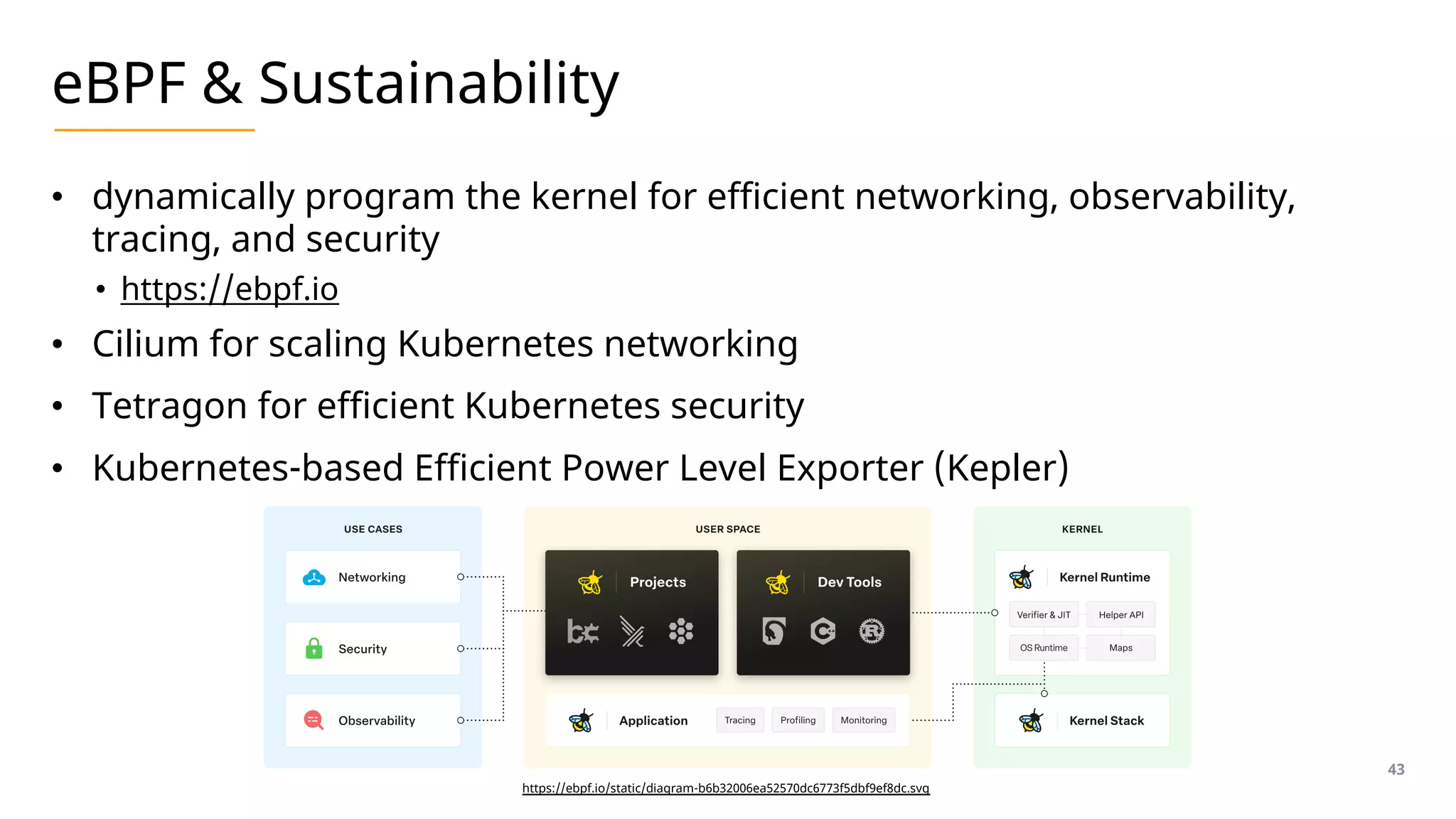
• dynamically program the kernel for efficient networking, observability,
tracing, and security
• https://ebpf.io
• Cilium for scaling Kubernetes networking
• Tetragon for efficient Kubernetes security
• Kubernetes-based Efficient Power Level Exporter (Kepler)
43
https://ebpf.io/static/diagram-b6b32006ea52570dc6773f5dbf9ef8dc.svg
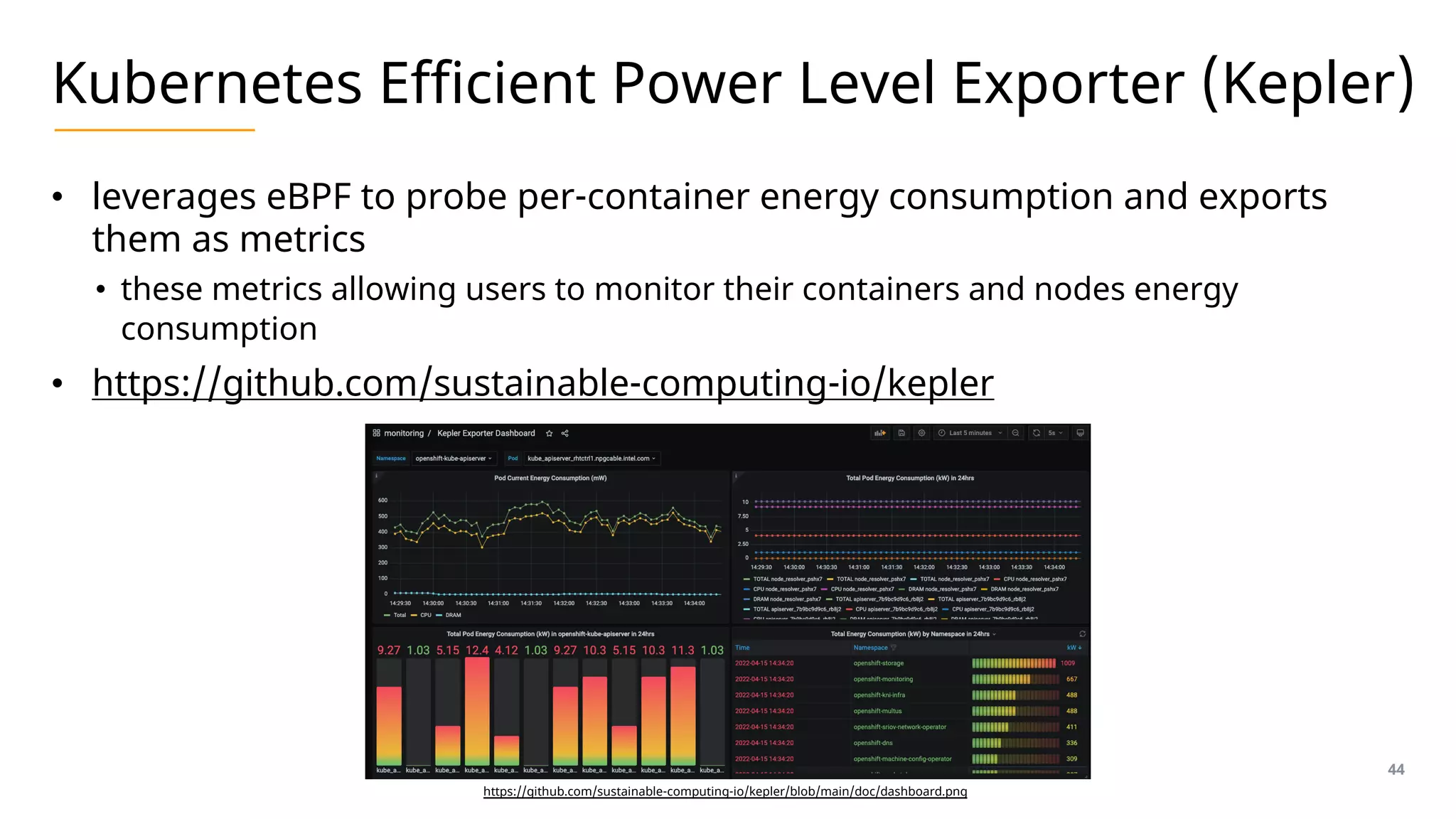
Kubernetes Efficient Power Level Exporter (Kepler)
• leverages eBPF to probe per-container energy consumption and exports
them as metrics
• these metrics allowing users to monitor their containers and nodes energy
consumption
• https://github.com/sustainable-computing-io/kepler
44
https://github.com/sustainable-computing-io/kepler/blob/main/doc/dashboard.png
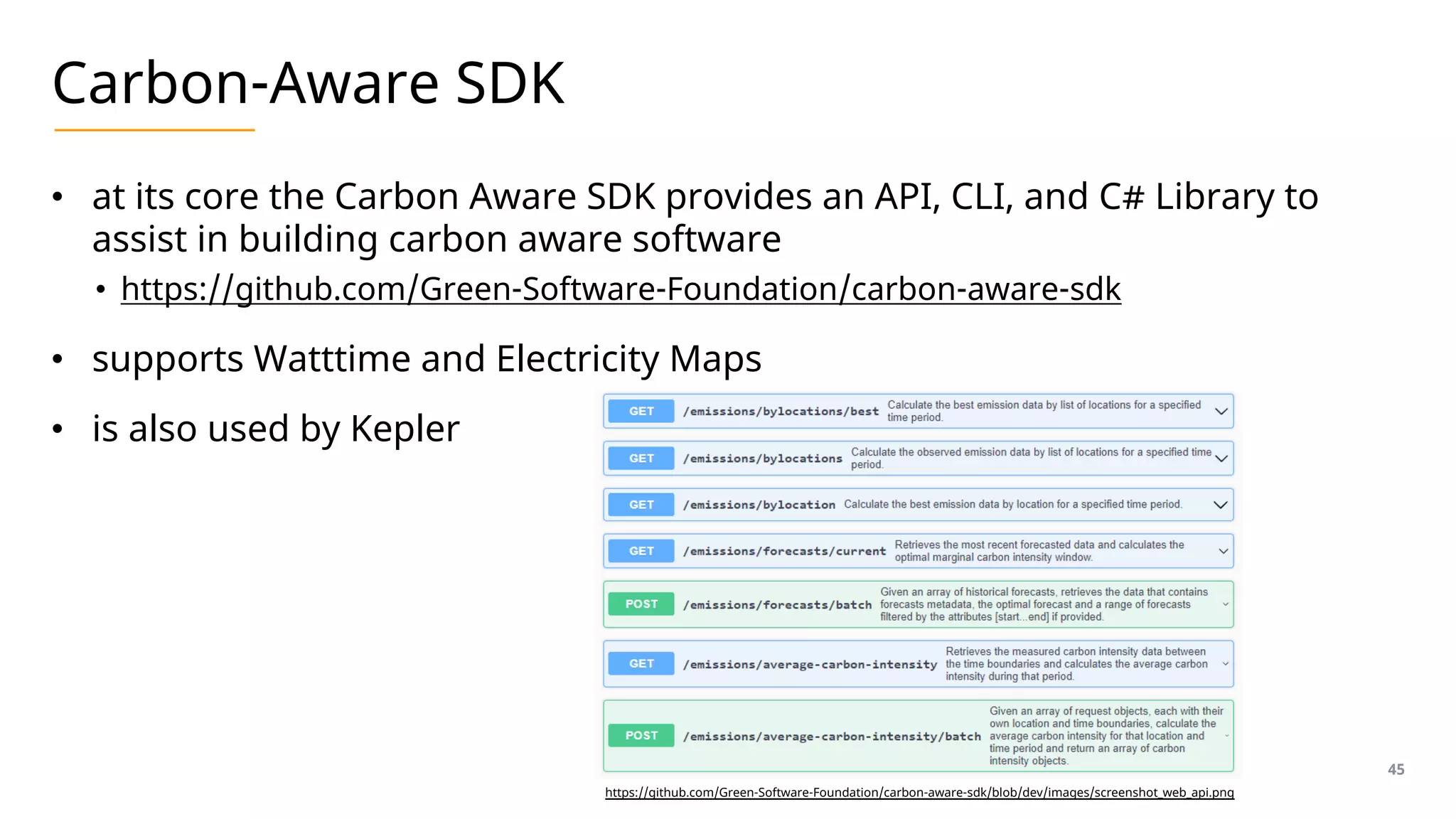
Carbon-Aware SDK
• at its core the Carbon Aware SDK provides an API, CLI, and C# Library to
assist in building carbon aware software
• https://github.com/Green-Software-Foundation/carbon-aware-sdk
• supports Watttime and Electricity Maps
• is also used by Kepler
45
https://github.com/Green-Software-Foundation/carbon-aware-sdk/blob/dev/images/screenshot_web_api.png
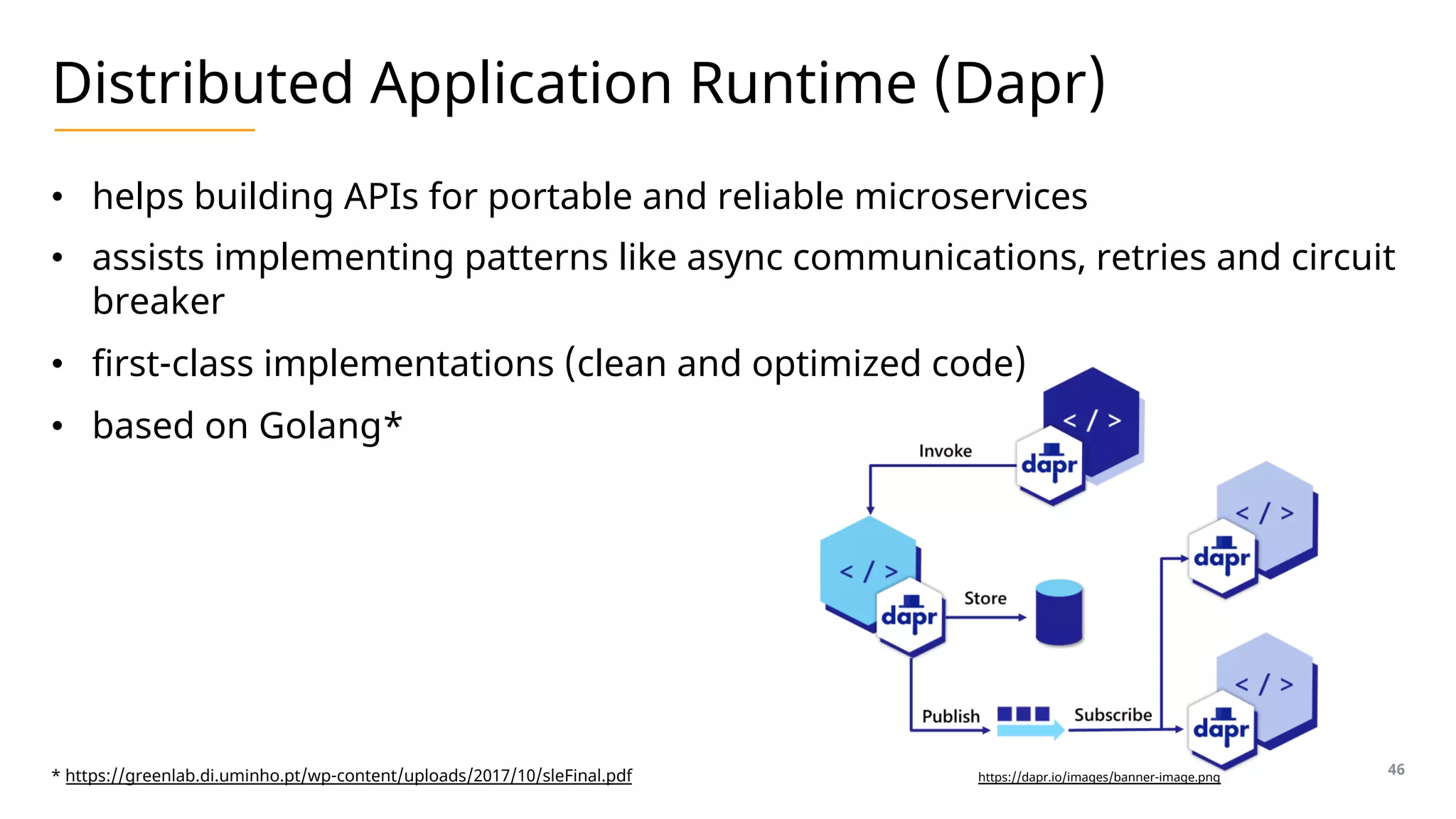
Distributed Application Runtime (Dapr)
• helps building APIs for portable and reliable microservices
• assists implementing patterns like async communications, retries and circuit
breaker
• first-class implementations (clean and optimized code)
• based on Golang*
46
* https://greenlab.di.uminho.pt/wp-content/uploads/2017/10/sleFinal.pdf https://dapr.io/images/banner-image.png
Current state & how to get started
47
Awareness is rising
• “Gartner Says Three Emerging Environmental Sustainability Technologies
Will See Early Mainstream Adoption by 2025”
• https://www.gartner.com/en/newsroom/press-releases/2022-04-21-gartner-says-
three-emerging-environmental-sustainability-technologies-will-see-early-
mainstream-adoption-by-2025
• the tooling ecosystem and projects are still in early stages
• in development, the current focus is on carbon and energy reduction
• not yet about water consumption and waste
48
Get started
• Basics
• https://greensoftware.foundation
• https://principles.green
• https://learn.microsoft.com/en-us/azure/well-architected/sustainability
• https://github.com/Green-Software-Foundation/awesome-green-software
• Container & Kubernetes focus
• https://github.com/cncf/tag-env-sustainability
• German sustainability meetup
• https://www.greenmanifesto.de
49
Thank you!

Cloud-Native & Sustainability: How and Why to Build Sustainable Workloads

  • 2.
    Cloud-Native & Sustainability:How and Why to Build Sustainable Workloads 🌱 Software Craft Community @ DATEV, June 2023
  • 3.
    Nico Meisenzahl (Head ofDevOps Consulting & Operations, Cloud Solution Architect) +49 8031 230159-0 nico.meisenzahl@whiteduck.de @nmeisenzahl www.linkedin.com/in/nicomeisenzahl Who am I? • Doing Cloud Native, Kubernetes & Azure • Microsoft MVP • Microsoft Azure • Developer Technologies • GitLab Hero
  • 4.
    Agenda • What issustainability? • Cloud-native & sustainable workloads • Patterns & best-practice for cloud-native apps • Real-world examples • Current state & how to get started 4
  • 5.
  • 6.
    6 Sustainability means creatingand maintaining software systems with minimal negative impact on the environment, society, and the economy. In software development, the overall goal is to develop and operate carbon-efficient applications. 🌱
  • 7.
    Principles to becarbon efficient • Energy Efficiency • Carbon Awareness • Hardware Efficiency • Measurement • Climate Commitments 7
  • 8.
    Energy Efficiency “Use theleast amount of energy possible” • most electricity is still generated by burning fossil fuels and is responsible for 49%* of carbon emissions into the atmosphere • already a common pattern for mobile apps • needs to be expanded to all workloads • waste as little as possible within the whole developer lifecycle • also think about the end-user • aim for a high utilization of compute resources • the relationship between power consumption and utilization is not linear 8 * https://ourworldindata.org/co2-and-greenhouse-gas-emissions#co2-emissions-by-sector
  • 9.
    Carbon Awareness “Do morewhen the electricity is cleaner and do less when the electricity is dirtier” • carbon intensity varies depending on the time and place it is consumed • prefer green energy over brown even if it comes with downsides • we need to push/invest into green energy • WattTime or Electricity Maps can help gaining insights by providing real-time data and forecasts of the current carbon intensity on a specific location • https://www.watttime.org • https://www.electricitymaps.com 9
  • 10.
    Hardware Efficiency “Use theleast amount of embodied carbon possible” • longer backward compatibility for end-user devices (e.g., web apps) • better utilize cloud compute resources 10 https://learn.greensoftware.foundation/assets/images/18_amortization-6471768431ab2f6432bee01b1c22d538.png
  • 11.
    Measurement “What you can'tmeasure, you can't improve” • Software Carbon Intensity (SCI) specification • energy/hardware efficient and carbon awareness will decrease your SCI score 11 https://learn.greensoftware.foundation/assets/images/23_SCI-9b0c1ccc27826ea65f8ff754c8cc0fbd.png
  • 12.
    Climate Commitments “Understand theexact mechanism of carbon reduction” • carbon neutral – must cover direct emissions (indirect is optional) • no need reduce carbon emissions • compensation to reduce emissions outside of their value chain • net zero – the actual amount of carbon in the atmosphere remains constant • through carbon removals (neutralizations) • requires emissions reductions in line with a 1.5°C pathway • carbon negative – remove more CO2 from the atmosphere than emitting • 100% renewable – either “direct powered by” or via certificates 12
  • 13.
    Cloud-native & sustainableworkloads 💚 13
  • 14.
    Sustainable workloads are… •developed and operated while being aware of the environmental impact • optimized for environmental impact • maximize utilization while minimizing waste • ultimately reducing the footprint on the environment • carbon efficiency, i.e., emitting as few carbon emissions as possible 14
  • 15.
    Isn’t cloud-native enough? •it's a first step into the right direction, but you can do more • you benefit from advantages through cloud native design patterns • you rely on the commitment and work from Microsoft Azure • but it’s still a shared responsibility • “Azure services are up to 98 percent more carbon efficient and up to 93% more energy efficient than a traditional enterprise datacenter”* 15 * https://datacenters.microsoft.com/globe/powering-sustainable-transformation
  • 16.
    Microsoft commitments* • $1billion Climate Innovation Fund • Commitment to protecting more land than we use by 2025 • Zero-waste certification by 2030 • Water positive by 2030 – replenish more water than we consume • Diesel-free backup power by 2030 • 100 percent of our electricity consumption, 100 percent of the time, matched by zero carbon energy purchases by 2030 16 * https://datacenters.microsoft.com/globe/powering-sustainable-transformation
  • 17.
    Azure as weknow it 17
  • 18.
    A different viewof Azure 18
  • 19.
    An example: SwedenRegion datacenter* • launched in November 2021 • 30 percent reduction in energy costs and 90 percent less water usage • free cooling – allows the warm air in the building to be mixed with cool outside air to maintain the correct temperature • rainwater harvesting – rain is captured and stored to be mainly to produce humidification for cooling • recycle and repurposing hardware using Microsoft’s Circular Center • not yet needed in Sweden (hardware lifetime is about 6 years) • Amsterdam Circular Center has resulted in 83 percent of hardware being reused 19 * https://news.microsoft.com/europe/features/how-microsofts-new-datacenter-region-in-sweden-incorporates-the-companys-sustainability-commitments
  • 20.
    An example: SwedenRegion datacenter* • 100 percent renewable energy • this can be ensured with near real-time monitoring and partnering with Vattenfall • every megawatt hour consumed is matched with a MWh of renewable energy generated during the same hour of consumption • 45% lower net carbon dioxide emissions for backup power • by using less carbon-intensive fuel (containing 50% renewable diesel) 20 * https://news.microsoft.com/europe/features/how-microsofts-new-datacenter-region-in-sweden-incorporates-the-companys-sustainability-commitments
  • 21.
    Current status (Azure’sand yours) • “2022 Environmental Sustainability Report” • https://www.microsoft.com/corporate-responsibility/sustainability/report • Emissions Impact Dashboard for Azure • https://appsource.microsoft.com/product/power-bi/coi- sustainability.emissions_impact_dashboard • Power BI Pro license required • Cloud for Sustainability API (Preview) • https://learn.microsoft.com/industry/sustainability/api-overview • currently no support for CSP and PAYG 21
  • 22.
    Patterns & bestpractice for cloud-native apps 22
  • 23.
    Decide on theright location • not the easiest one! • you should choose a region • near to your users • relying on green energy • even if there are downsides you should still prefer green energy over brown • we need to invest in green energy to develop it further • there might not be just one… 23
  • 24.
    Demand shifting • movingyour energy consumption to different locations or times of days where the carbon intensity is lower • spatial shifting vs. temporal shifting • less energy demand results in lower carbon intensity (demand can be met by renewable energy) 24 https://learn.greensoftware.foundation/assets/images/14_spatial_shifting-4949d342f2ff430edea67874a9eaad52.png
  • 25.
    Demand shaping • adaptingyour energy consumption around carbon intensity variability when required • scaling down and/or limit scaling • eco-mode opt-in for end-users 25 https://learn.greensoftware.foundation/assets/images/16_demand_shaping-4d2d1021da9740ea3cd15a383874f4ed.png
  • 26.
    Networking • the goalis to further eliminate unnecessary traffic • implement a CDN (Content Delivery Network) for static assets • follow caching best practices to reduce requests • enable network compression • implement DDoS protection • opt-in for TLS termination where possible 26
  • 27.
    Optimize for efficiency •think about your overall hardware utilization • the energy does not increase linearly with consumption • utilize auto-scaling, bursting capabilities (B-Series VMs) & Spot VMs • latter utilize the otherwise wasted capacity • rely on Platform as a Service (PaaS) • managed services are highly optimized and operate on more efficient hardware • better overall utilization • build your application based on serverless (Azure Functions) • delete zombie workloads • and implement a process to clean them up 27
  • 28.
    Microservices • think aboutmoving to a microservice architecture • but: they come with an overhead • monoliths can still be the best choice for smaller applications • also, don’t build micro-monoliths (not only because of the network overhead)! • extra overhead on the CI/CD parts • they allow to scale parts of the application independent form each other • opt-in for containerization for smaller footprint 28
  • 29.
    Think about yourdata • Data is gold – but think about how to store it! • store less frequent requested data to cold or archive storage • only store what is relevant • no data is the most sustainable data 😉 • revise your backup and retention policies • optimize the collection of your metrics & logs • again, think about what you really need • also optimize your application logging to not create data you don’t need 29
  • 30.
  • 31.
    Rethink your UI/UX •reduce the components to load and render • use optimized assets • don’t render full-size images as thumbnails (network traffic, local CPU usage) • decide to use lower resolutions in general • rely on system fonts • provide an optional eco-mode (opt-in) • enabled dark-mode • shifting async jobs to times where green energy is available • reduced UI 31
  • 32.
    Optimize your database(access) • invest in reducing your database load • optimize your database queries & indexes • implement caching where possible • validate & rework your data design • this can save a lot of compute & energy • positive side effect: your applications performance will increase 32
  • 33.
    Optimize your code •implement circuit breaker patterns • repeated failures can lead to overhead and unnecessary processing • optimize your code for efficient resource usage • use optimized and efficient algorithms and design patterns • rely the “don't repeat yourself” (DRY) principle • rely on asynchronous access patterns • queue and buffer requests, then process in batch • actively decide when and where to process them • invest into your legacy code • identify inefficient code and start modernizing it 33
  • 34.
    ARM-based compute resources •“Ampere Altra VMs outperform equivalently sized Intel and AMD instances from the same generation by 39% and 47%, respectively. In addition to being the high-performance choice, Ampere Altra processors are extremely power efficient, directly reducing users’ overall carbon footprint”* • if you don’t care, move your workload to ARM-based resources • otherwise, invest time to migrate • make use of ARM-based resources in runtime and build time (CI/CD) 34 * https://amperecomputing.com/en/blogs/ampere-altra-now-available-on-microsoft-azure-cloud-platform
  • 35.
    server-side vs. client-siderendering • again, this isn’t an easy one • do you know your end-users? • server-side pros • you can opt-in for green energy and better utilization • less chatty (browser-to-server round-trips) and centralized caching • lower requirements on the client-side • client-side pros • no need for a server, as you can rely on static storage • it’s more efficient only to render what's needed • less network traffic 35
  • 36.
    Improve API efficiency •GraphQL can help with chatty I/O antipattern • “GraphQL is a query language for APIs and a runtime for fulfilling those queries with your existing data” • reduce unnecessary load with rate limits and throttling • implement caching to reduce workload on your backends • e.g., implement caching via API Management 36
  • 37.
    Think about yourCI/CD • rely on shared resources like managed agents • implement scaling to zero with VM scale sets or containerization • e.g., run your CI/CD jobs in a shared Kubernetes Cluster • optimize your pipeline for caching • don’t build identical things multiple times • split large code repos (to be able to build just parts of your code) • reduce your GitOps sync interval 37
  • 38.
    Testing is energyintensive • rely on demand shifting for your integration, performance, load, or any other intense testing • move them to a different time or region to reduce carbon intense • implement chaos engineering • introduction of chaos engineering can significantly help improve reliability and resilience and how the applications react to failures • allows you optimizing your workload to handle failures gracefully with less wasted resources 38
  • 39.
    Don’t use AIfor everything! Sorry… • AI can help to be more sustainable • e.g., Microsoft uses AI in there Sweden datacenters to manage green energy consumption • but AI requires extensive resources for training and hosting models* • rely on it, but only for use-cases where AI really shines • do not build the next chat bot • use it selectively in particular use cases or parts of it 39 * https://sustainabilitymag.com/sustainability/sustainability-applications-for-artificial-intelligence
  • 40.
    Kubernetes Event-driven Autoscaling(KEDA) • allows scaling workload on Kubernetes based on events • cron scaler allows to stop workload outside of business hours • “Carbon Aware KEDA Operator” also allows carbon-aware scheduling 40 https://user-images.githubusercontent.com/966110/232321762-bb114716-f719-4e1f-9dc0-20680c94ab52.png
  • 41.
    Carbon Aware KEDAOperator • use carbon intensity data from third party sources such as WattTime, Electricity Map or any other provider, to dynamically adjust the scaling • integrates with any KEDA scaler • allows scaling to zero (as it relies on KEDA) • more details and current status • https://github.com/Azure/carbon-aware-keda-operator • https://www.tfir.io/carbon-aware-kubernetes-scaling-a-step-towards-greener-cloud- computing • https://github.com/kedacore/keda/issues/3467 41
  • 42.
    Kubernetes Carbon IntensityExporter • retrieves the 24-hour carbon intensity forecast data every 12 hours and stores it into a ConfigMap to be consumed • therefore, can be used with any application • currently supports Watttime only • also used by KEDA Operator • https://github.com/Azure/kubernetes-carbon-intensity-exporter 42
  • 43.
    eBPF & Sustainability •dynamically program the kernel for efficient networking, observability, tracing, and security • https://ebpf.io • Cilium for scaling Kubernetes networking • Tetragon for efficient Kubernetes security • Kubernetes-based Efficient Power Level Exporter (Kepler) 43 https://ebpf.io/static/diagram-b6b32006ea52570dc6773f5dbf9ef8dc.svg
  • 44.
    Kubernetes Efficient PowerLevel Exporter (Kepler) • leverages eBPF to probe per-container energy consumption and exports them as metrics • these metrics allowing users to monitor their containers and nodes energy consumption • https://github.com/sustainable-computing-io/kepler 44 https://github.com/sustainable-computing-io/kepler/blob/main/doc/dashboard.png
  • 45.
    Carbon-Aware SDK • atits core the Carbon Aware SDK provides an API, CLI, and C# Library to assist in building carbon aware software • https://github.com/Green-Software-Foundation/carbon-aware-sdk • supports Watttime and Electricity Maps • is also used by Kepler 45 https://github.com/Green-Software-Foundation/carbon-aware-sdk/blob/dev/images/screenshot_web_api.png
  • 46.
    Distributed Application Runtime(Dapr) • helps building APIs for portable and reliable microservices • assists implementing patterns like async communications, retries and circuit breaker • first-class implementations (clean and optimized code) • based on Golang* 46 * https://greenlab.di.uminho.pt/wp-content/uploads/2017/10/sleFinal.pdf https://dapr.io/images/banner-image.png
  • 47.
    Current state &how to get started 47
  • 48.
    Awareness is rising •“Gartner Says Three Emerging Environmental Sustainability Technologies Will See Early Mainstream Adoption by 2025” • https://www.gartner.com/en/newsroom/press-releases/2022-04-21-gartner-says- three-emerging-environmental-sustainability-technologies-will-see-early- mainstream-adoption-by-2025 • the tooling ecosystem and projects are still in early stages • in development, the current focus is on carbon and energy reduction • not yet about water consumption and waste 48
  • 49.
    Get started • Basics •https://greensoftware.foundation • https://principles.green • https://learn.microsoft.com/en-us/azure/well-architected/sustainability • https://github.com/Green-Software-Foundation/awesome-green-software • Container & Kubernetes focus • https://github.com/cncf/tag-env-sustainability • German sustainability meetup • https://www.greenmanifesto.de 49
  • 50.