
Enabling Energy Efficient & Adaptive IT infrastructure for Banking Industry  Ravi Kumar Country Manager – BFSI & Government Video
> Agenda Changing Scenario of Facility Concerns Energy Logic Concept 10 Best Strategies to reduce data center energy consumption About  Emerson
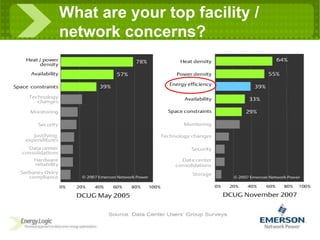
What are your top facility / network concerns?
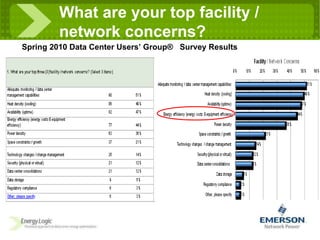
What are your top facility / network concerns? Spring 2010 Data Center Users’ Group®  Survey Results
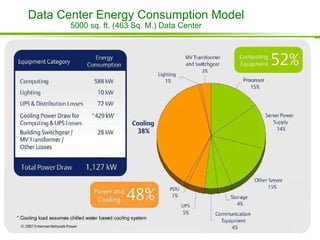
Data Center Energy Consumption Model 5000 sq. ft. (463 Sq. M.) Data Center
 “ Energy Logic”  : Energy Efficient Data Centers :    A Holistic Way To Reduce Data Center Energy Usage Without Compromising On Reliability.
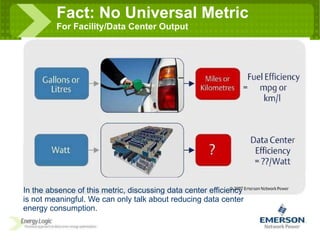
Fact: No Universal Metric  For Facility/Data Center Output In the absence of this metric, discussing data center efficiency is not meaningful. We can only talk about reducing data center energy consumption.
IT Perspective on Energy Efficiency Top priority is delivering on service level agreements Performance - provide adequate compute capacity Reliability - redundancy at all steps Ability to support Security Does IT care about energy efficiency? Yes, but not if it impacts performance & reliability What if it frees up power and cooling capacity? Yes! If it does not impact performance and reliability
What FM/Data Centers Managers  Are Looking For Objective ‘vendor – neutral’ analysis Holistic view of the data center Quantification of savings from different strategies Prioritization of actions Actionable advice Tailored to different types of data centers 24x7 vs. 8x5; compute-intensive vs transaction-intensive Payback / ROI analysis to help sell to management
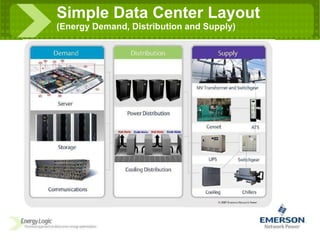
Simple Data Center Layout (Energy Demand, Distribution and Supply)
Energy Logic: What is it?
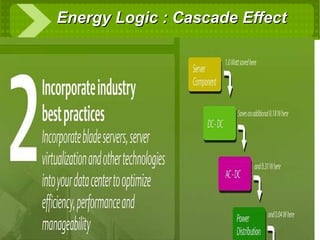
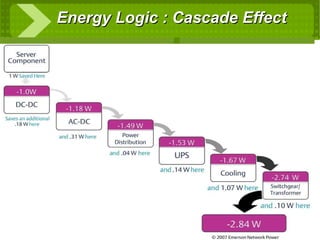
Energy Logic:  The Three Key Messages The most effective strategy to save energy: Start with reducing losses / consumption at the IT equipment level and work your way back through the supporting equipment Every watt saved at the equipment level has a cascading effect upstream As you reduce energy consumption, make sure you do not compromise on availability and flexibility Efficiency Without Compromise ™ High-density architecture helps reduce energy consumption
Energy Logic : Cascade Effect
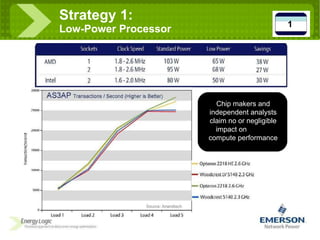
Strategy 1:  Low-Power Processor Chip makers and independent analysts claim no or negligible impact on  compute performance 1
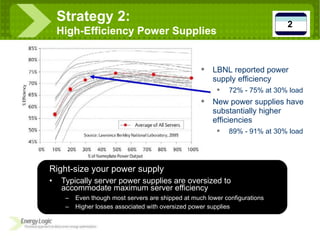
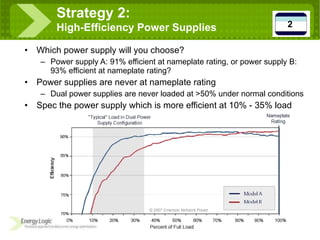
Strategy 2:   High-Efficiency Power Supplies Right-size your power supply Typically server power supplies are oversized to accommodate maximum server efficiency Even though most servers are shipped at much lower configurations Higher losses associated with oversized power supplies LBNL reported power supply efficiency 72% - 75% at 30% load New power supplies have substantially higher efficiencies 89% - 91% at 30% load 2
Which power supply will you choose? Power supply A: 91% efficient at nameplate rating, or power supply B: 93% efficient at nameplate rating? Power supplies are never at nameplate rating Dual power supplies are never loaded at >50% under normal conditions Spec the power supply which is more efficient at 10% - 35% load Strategy 2:   High-Efficiency Power Supplies 2
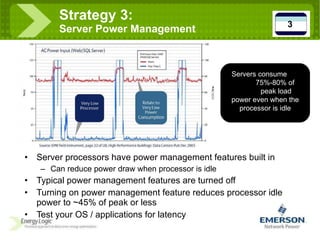
Strategy 3:  Server Power Management Server processors have power management features built in Can reduce power draw when processor is idle Typical power management features are turned off Turning on power management feature reduces processor idle power to ~45% of peak or less Test your OS / applications for latency Servers consume  75%-80% of  peak load power even when the processor is idle 3
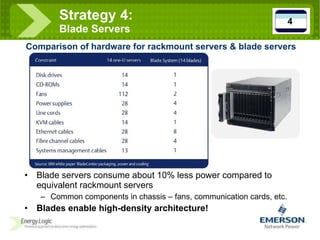
Strategy 4:  Blade Servers Blade servers consume about 10% less power compared to equivalent rackmount servers Common components in chassis – fans, communication cards, etc. Blades enable high-density architecture! Comparison of hardware for rackmount servers & blade servers 4
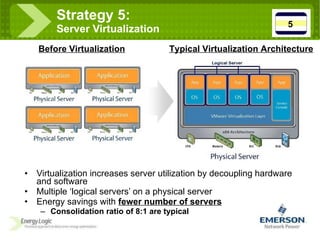
Strategy 5:  Server Virtualization Virtualization increases server utilization by decoupling hardware and software Multiple ‘logical servers’ on a physical server Energy savings with  fewer number of servers Consolidation ratio of 8:1 are typical Before Virtualization   Typical Virtualization Architecture 5
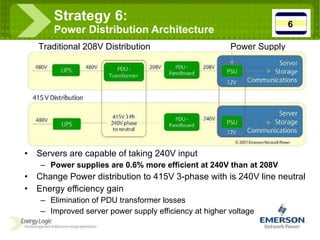
Strategy 6:  Power Distribution Architecture Servers are capable of taking 240V input Power supplies are 0.6% more efficient at 240V than at 208V Change Power distribution to 415V 3-phase with is 240V line neutral Energy efficiency gain Elimination of PDU transformer losses Improved server power supply efficiency at higher voltage Traditional 208V Distribution Power Supply 6
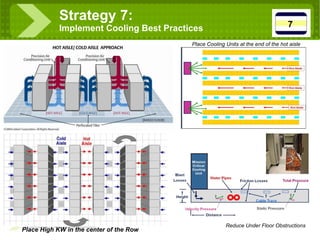
Strategy 7:  Implement Cooling Best Practices 7 Place Cooling Units at the end of the hot aisle Optimize Room  Reduce Under Floor Obstructions Place High KW in the center of the Row
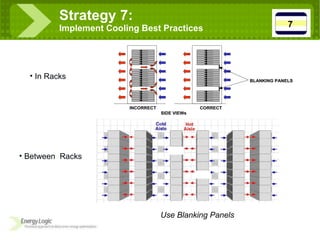
Strategy 7:  Implement Cooling Best Practices In Racks Between  Racks Use Blanking Panels 7
Reduce energy waste Improve vapor barrier – unnecessary humidification / dehumidification Reduce solar heat gain; air leakages in the room, under-floor and ceiling Use optimal set points Proper cold aisle temperature – adjust room set point (20 ° to 21°C) Raise the chilled water temperature above 7°C ASHRAE guideline books available Thermal assessments can help jump start the process Strategy 7:  Implement Cooling Best Practices 7
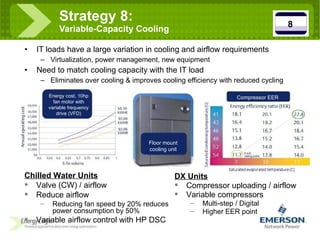
Strategy 8:  Variable-Capacity Cooling IT loads have a large variation in cooling and airflow requirements Virtualization, power management, new equipment Need to match cooling capacity with the IT load Eliminates over cooling & improves cooling efficiency with reduced cycling 8 Energy cost, 10hp fan motor with variable frequency drive (VFD) Floor mount cooling unit Compressor EER Chilled Water Units Valve (CW) / airflow Reduce airflow Reducing fan speed by 20% reduces power consumption by 50% Variable airflow control with HP DSC  DX Units Compressor uploading / airflow Variable compressors Multi-step / Digital Higher EER point
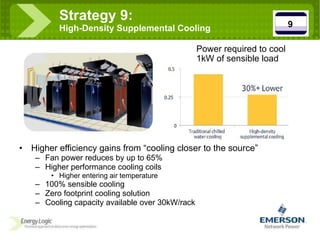
Strategy 9:  High-Density Supplemental Cooling Higher efficiency gains from “cooling closer to the source” Fan power reduces by up to 65% Higher performance cooling coils Higher entering air temperature 100% sensible cooling Zero footprint cooling solution Cooling capacity available over 30kW/rack 9 Power required to cool 1kW of sensible load
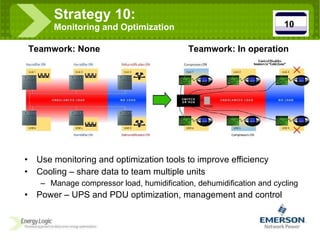
Strategy 10:  Monitoring and Optimization Use monitoring and optimization tools to improve efficiency Cooling – share data to team multiple units Manage compressor load, humidification, dehumidification and cycling Power – UPS and PDU optimization, management and control 10 Teamwork: None Teamwork: In operation
Other Opportunities Identify and disconnect ‘ghost servers’ Servers not performing useful tasks but still consuming power Storage Consolidate data storage from direct attached storage to network attached storage Faster disks consume more power Reorganize data so less frequently used data is on slower drives Use economizers where appropriate Economizers allow outside air to be used to support data center cooling during colder months Monitor and reduce ‘parasitic’ losses Parasitic losses of 30kW to 50kW by generators for 1MW load Exterior lighting, security and fire suppression systems Perimeter access control, employee services
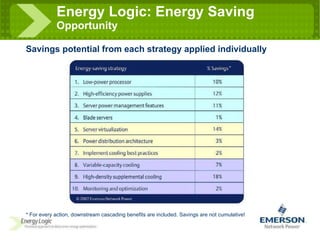
Energy Logic: Energy Saving Opportunity Savings potential from each strategy applied individually * For every action, downstream cascading benefits are included. Savings are not cumulative!
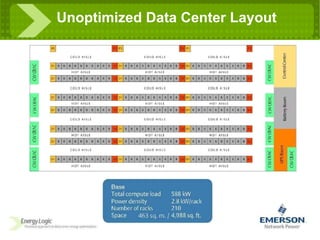
Unoptimized Data Center Layout
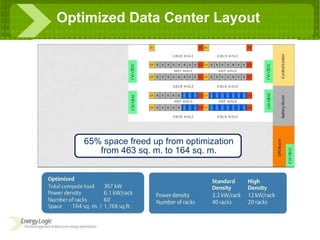
Optimized Data Center Layout 65% space freed up from optimization from 463 sq. m. to 164 sq. m.
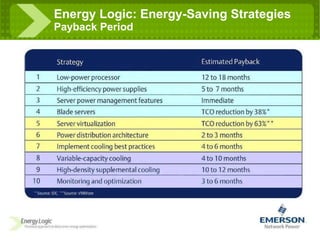
Energy Logic: Energy-Saving Strategies  Payback Period
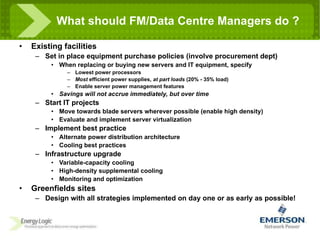
Existing facilities Set in place equipment purchase policies (involve procurement dept) When replacing or buying new servers and IT equipment, specify Lowest power processors Most  efficient power supplies,  at part loads  (20% - 35% load) Enable server power management features Savings will not accrue immediately, but over time Start IT projects Move towards blade servers wherever possible (enable high density) Evaluate and implement server virtualization Implement best practice Alternate power distribution architecture Cooling best practices Infrastructure upgrade Variable-capacity cooling High-density supplemental cooling Monitoring and optimization Greenfields sites Design with all strategies implemented on day one or as early as possible! What should FM/Data Centre Managers do ?
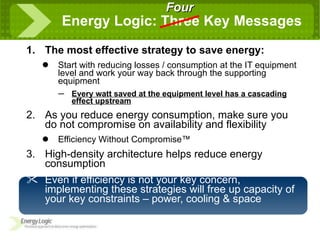
Energy Logic: Three Key Messages The most effective strategy to save energy: Start with reducing losses / consumption at the IT equipment level and work your way back through the supporting equipment Every watt saved at the equipment level has a cascading effect upstream As you reduce energy consumption, make sure you do not compromise on availability and flexibility Efficiency Without Compromise ™ High-density architecture helps reduce energy consumption Even if efficiency is not your key concern, implementing these strategies will free up capacity of your key constraints – power, cooling & space Four
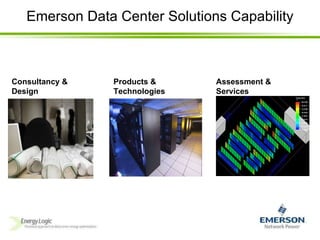
Emerson Data Center Solutions Capability Consultancy & Design Products & Technologies Assessment & Services
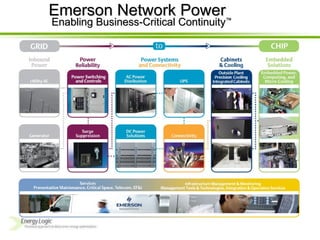
Emerson Network Power     Enabling Business-Critical Continuity ™
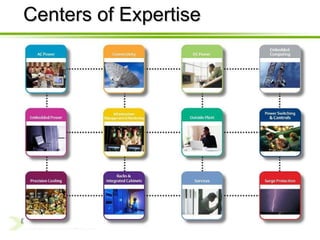
Centers of Expertise
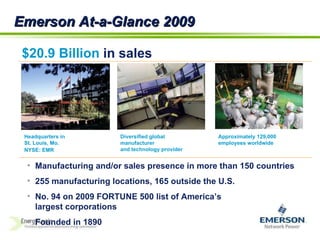
Emerson At-a-Glance 2009 $20.9 Billion  in sales Manufacturing and/or sales presence in more than 150 countries 255 manufacturing locations, 165 outside the U.S. No. 94 on 2009 FORTUNE 500 list of America’s  largest corporations Founded in 1890 Diversified global manufacturer  and technology provider Approximately 129,000 employees worldwide Headquarters in  St. Louis, Mo. NYSE: EMR  Need new numbers
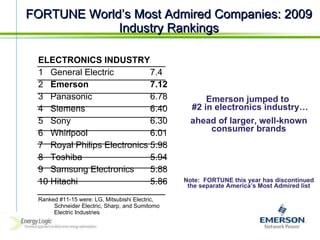
FORTUNE World’s Most Admired Companies: 2009 Industry Rankings ELECTRONICS INDUSTRY 1  General Electric 7.4 2  Emerson 7.12 3  Panasonic 6.78 4  Siemens  6.40 5  Sony 6.30 6  Whirlpool 6.01 7  Royal Philips Electronics 5.98 8  Toshiba 5.94 9  Samsung Electronics 5.88 10 Hitachi 5.86 Ranked #11-15 were: LG, Mitsubishi Electric, Schneider Electric, Sharp, and Sumitomo Electric Industries Emerson jumped to   #2 in electronics industry… ahead of larger, well-known consumer brands Note:  FORTUNE this year has discontinued the separate America’s Most Admired list
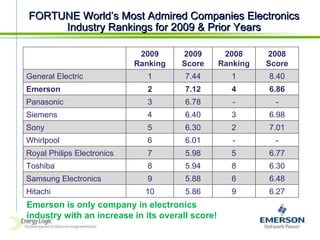
FORTUNE World’s Most Admired Companies Electronics Industry Rankings for 2009 & Prior Years Emerson is only company in electronics industry with an increase in its overall score! 2009 Ranking 2009 Score 2008 Ranking 2008 Score General Electric 1 7.44 1 8.40 Emerson 2 7.12 4 6.86 Panasonic 3 6.78 - - Siemens 4 6.40 3 6.98 Sony 5 6.30 2 7.01 Whirlpool 6 6.01 - - Royal Philips Electronics 7 5.98 5 6.77 Toshiba  8 5.94 8 6.30 Samsung Electronics 9 5.88 6 6.48 Hitachi 10 5.86 9 6.27
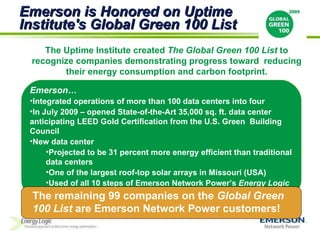
Emerson… Integrated operations of more than 100 data centers into four In July 2009 – opened State-of-the-Art 35,000 sq. ft. data center anticipating LEED Gold Certification from the U.S. Green  Building Council New data center Projected to be 31 percent more energy efficient than traditional data centers One of the largest roof-top solar arrays in Missouri (USA) Used of all 10 steps of Emerson Network Power’s  Energy Logic  Emerson is Honored on Uptime Institute's Global Green 100 List The Uptime Institute created  The Global Green 100 List  to recognize companies demonstrating progress toward  reducing their energy consumption and carbon footprint. The remaining 99 companies on the  Global Green 100 List  are Emerson Network Power customers!
Note: While every precaution has been taken to ensure the accuracy and completeness of the information presented, Emerson Network Power assumes no responsibility and disclaim all liability for damages resulting from the use of this information or for any errors or omissions.

Emerson Energy Logic

  • 1.
    Enabling Energy Efficient& Adaptive IT infrastructure for Banking Industry Ravi Kumar Country Manager – BFSI & Government Video
  • 2.
    > Agenda ChangingScenario of Facility Concerns Energy Logic Concept 10 Best Strategies to reduce data center energy consumption About Emerson
  • 3.
    What are yourtop facility / network concerns?
  • 4.
    What are yourtop facility / network concerns? Spring 2010 Data Center Users’ Group® Survey Results
  • 5.
    Data Center EnergyConsumption Model 5000 sq. ft. (463 Sq. M.) Data Center
  • 6.
    “ EnergyLogic” : Energy Efficient Data Centers : A Holistic Way To Reduce Data Center Energy Usage Without Compromising On Reliability.
  • 7.
    Fact: No UniversalMetric For Facility/Data Center Output In the absence of this metric, discussing data center efficiency is not meaningful. We can only talk about reducing data center energy consumption.
  • 8.
    IT Perspective onEnergy Efficiency Top priority is delivering on service level agreements Performance - provide adequate compute capacity Reliability - redundancy at all steps Ability to support Security Does IT care about energy efficiency? Yes, but not if it impacts performance & reliability What if it frees up power and cooling capacity? Yes! If it does not impact performance and reliability
  • 9.
    What FM/Data CentersManagers Are Looking For Objective ‘vendor – neutral’ analysis Holistic view of the data center Quantification of savings from different strategies Prioritization of actions Actionable advice Tailored to different types of data centers 24x7 vs. 8x5; compute-intensive vs transaction-intensive Payback / ROI analysis to help sell to management
  • 10.
    Simple Data CenterLayout (Energy Demand, Distribution and Supply)
  • 11.
  • 12.
    Energy Logic: The Three Key Messages The most effective strategy to save energy: Start with reducing losses / consumption at the IT equipment level and work your way back through the supporting equipment Every watt saved at the equipment level has a cascading effect upstream As you reduce energy consumption, make sure you do not compromise on availability and flexibility Efficiency Without Compromise ™ High-density architecture helps reduce energy consumption
  • 13.
    Energy Logic :Cascade Effect
  • 14.
    Energy Logic :Cascade Effect
  • 15.
    Strategy 1: Low-Power Processor Chip makers and independent analysts claim no or negligible impact on compute performance 1
  • 16.
    Strategy 2: High-Efficiency Power Supplies Right-size your power supply Typically server power supplies are oversized to accommodate maximum server efficiency Even though most servers are shipped at much lower configurations Higher losses associated with oversized power supplies LBNL reported power supply efficiency 72% - 75% at 30% load New power supplies have substantially higher efficiencies 89% - 91% at 30% load 2
  • 17.
    Which power supplywill you choose? Power supply A: 91% efficient at nameplate rating, or power supply B: 93% efficient at nameplate rating? Power supplies are never at nameplate rating Dual power supplies are never loaded at >50% under normal conditions Spec the power supply which is more efficient at 10% - 35% load Strategy 2: High-Efficiency Power Supplies 2
  • 18.
    Strategy 3: Server Power Management Server processors have power management features built in Can reduce power draw when processor is idle Typical power management features are turned off Turning on power management feature reduces processor idle power to ~45% of peak or less Test your OS / applications for latency Servers consume 75%-80% of peak load power even when the processor is idle 3
  • 19.
    Strategy 4: Blade Servers Blade servers consume about 10% less power compared to equivalent rackmount servers Common components in chassis – fans, communication cards, etc. Blades enable high-density architecture! Comparison of hardware for rackmount servers & blade servers 4
  • 20.
    Strategy 5: Server Virtualization Virtualization increases server utilization by decoupling hardware and software Multiple ‘logical servers’ on a physical server Energy savings with fewer number of servers Consolidation ratio of 8:1 are typical Before Virtualization Typical Virtualization Architecture 5
  • 21.
    Strategy 6: Power Distribution Architecture Servers are capable of taking 240V input Power supplies are 0.6% more efficient at 240V than at 208V Change Power distribution to 415V 3-phase with is 240V line neutral Energy efficiency gain Elimination of PDU transformer losses Improved server power supply efficiency at higher voltage Traditional 208V Distribution Power Supply 6
  • 22.
    Strategy 7: Implement Cooling Best Practices 7 Place Cooling Units at the end of the hot aisle Optimize Room Reduce Under Floor Obstructions Place High KW in the center of the Row
  • 23.
    Strategy 7: Implement Cooling Best Practices In Racks Between Racks Use Blanking Panels 7
  • 24.
    Reduce energy wasteImprove vapor barrier – unnecessary humidification / dehumidification Reduce solar heat gain; air leakages in the room, under-floor and ceiling Use optimal set points Proper cold aisle temperature – adjust room set point (20 ° to 21°C) Raise the chilled water temperature above 7°C ASHRAE guideline books available Thermal assessments can help jump start the process Strategy 7: Implement Cooling Best Practices 7
  • 25.
    Strategy 8: Variable-Capacity Cooling IT loads have a large variation in cooling and airflow requirements Virtualization, power management, new equipment Need to match cooling capacity with the IT load Eliminates over cooling & improves cooling efficiency with reduced cycling 8 Energy cost, 10hp fan motor with variable frequency drive (VFD) Floor mount cooling unit Compressor EER Chilled Water Units Valve (CW) / airflow Reduce airflow Reducing fan speed by 20% reduces power consumption by 50% Variable airflow control with HP DSC DX Units Compressor uploading / airflow Variable compressors Multi-step / Digital Higher EER point
  • 26.
    Strategy 9: High-Density Supplemental Cooling Higher efficiency gains from “cooling closer to the source” Fan power reduces by up to 65% Higher performance cooling coils Higher entering air temperature 100% sensible cooling Zero footprint cooling solution Cooling capacity available over 30kW/rack 9 Power required to cool 1kW of sensible load
  • 27.
    Strategy 10: Monitoring and Optimization Use monitoring and optimization tools to improve efficiency Cooling – share data to team multiple units Manage compressor load, humidification, dehumidification and cycling Power – UPS and PDU optimization, management and control 10 Teamwork: None Teamwork: In operation
  • 28.
    Other Opportunities Identifyand disconnect ‘ghost servers’ Servers not performing useful tasks but still consuming power Storage Consolidate data storage from direct attached storage to network attached storage Faster disks consume more power Reorganize data so less frequently used data is on slower drives Use economizers where appropriate Economizers allow outside air to be used to support data center cooling during colder months Monitor and reduce ‘parasitic’ losses Parasitic losses of 30kW to 50kW by generators for 1MW load Exterior lighting, security and fire suppression systems Perimeter access control, employee services
  • 29.
    Energy Logic: EnergySaving Opportunity Savings potential from each strategy applied individually * For every action, downstream cascading benefits are included. Savings are not cumulative!
  • 30.
  • 31.
    Optimized Data CenterLayout 65% space freed up from optimization from 463 sq. m. to 164 sq. m.
  • 32.
    Energy Logic: Energy-SavingStrategies Payback Period
  • 33.
    Existing facilities Setin place equipment purchase policies (involve procurement dept) When replacing or buying new servers and IT equipment, specify Lowest power processors Most efficient power supplies, at part loads (20% - 35% load) Enable server power management features Savings will not accrue immediately, but over time Start IT projects Move towards blade servers wherever possible (enable high density) Evaluate and implement server virtualization Implement best practice Alternate power distribution architecture Cooling best practices Infrastructure upgrade Variable-capacity cooling High-density supplemental cooling Monitoring and optimization Greenfields sites Design with all strategies implemented on day one or as early as possible! What should FM/Data Centre Managers do ?
  • 34.
    Energy Logic: ThreeKey Messages The most effective strategy to save energy: Start with reducing losses / consumption at the IT equipment level and work your way back through the supporting equipment Every watt saved at the equipment level has a cascading effect upstream As you reduce energy consumption, make sure you do not compromise on availability and flexibility Efficiency Without Compromise ™ High-density architecture helps reduce energy consumption Even if efficiency is not your key concern, implementing these strategies will free up capacity of your key constraints – power, cooling & space Four
  • 35.
    Emerson Data CenterSolutions Capability Consultancy & Design Products & Technologies Assessment & Services
  • 36.
    Emerson Network Power Enabling Business-Critical Continuity ™
  • 37.
  • 38.
    Emerson At-a-Glance 2009$20.9 Billion in sales Manufacturing and/or sales presence in more than 150 countries 255 manufacturing locations, 165 outside the U.S. No. 94 on 2009 FORTUNE 500 list of America’s largest corporations Founded in 1890 Diversified global manufacturer and technology provider Approximately 129,000 employees worldwide Headquarters in St. Louis, Mo. NYSE: EMR Need new numbers
  • 39.
    FORTUNE World’s MostAdmired Companies: 2009 Industry Rankings ELECTRONICS INDUSTRY 1 General Electric 7.4 2 Emerson 7.12 3 Panasonic 6.78 4 Siemens 6.40 5 Sony 6.30 6 Whirlpool 6.01 7 Royal Philips Electronics 5.98 8 Toshiba 5.94 9 Samsung Electronics 5.88 10 Hitachi 5.86 Ranked #11-15 were: LG, Mitsubishi Electric, Schneider Electric, Sharp, and Sumitomo Electric Industries Emerson jumped to #2 in electronics industry… ahead of larger, well-known consumer brands Note: FORTUNE this year has discontinued the separate America’s Most Admired list
  • 40.
    FORTUNE World’s MostAdmired Companies Electronics Industry Rankings for 2009 & Prior Years Emerson is only company in electronics industry with an increase in its overall score! 2009 Ranking 2009 Score 2008 Ranking 2008 Score General Electric 1 7.44 1 8.40 Emerson 2 7.12 4 6.86 Panasonic 3 6.78 - - Siemens 4 6.40 3 6.98 Sony 5 6.30 2 7.01 Whirlpool 6 6.01 - - Royal Philips Electronics 7 5.98 5 6.77 Toshiba 8 5.94 8 6.30 Samsung Electronics 9 5.88 6 6.48 Hitachi 10 5.86 9 6.27
  • 41.
    Emerson… Integrated operationsof more than 100 data centers into four In July 2009 – opened State-of-the-Art 35,000 sq. ft. data center anticipating LEED Gold Certification from the U.S. Green Building Council New data center Projected to be 31 percent more energy efficient than traditional data centers One of the largest roof-top solar arrays in Missouri (USA) Used of all 10 steps of Emerson Network Power’s Energy Logic Emerson is Honored on Uptime Institute's Global Green 100 List The Uptime Institute created The Global Green 100 List to recognize companies demonstrating progress toward reducing their energy consumption and carbon footprint. The remaining 99 companies on the Global Green 100 List are Emerson Network Power customers!
  • 42.
    Note: While everyprecaution has been taken to ensure the accuracy and completeness of the information presented, Emerson Network Power assumes no responsibility and disclaim all liability for damages resulting from the use of this information or for any errors or omissions.

Editor's Notes

  • #2 At the outset lemme tell u abt the long theme for todays presentation..we too thought of putting a simple Green framework of DC..or just 10 Steps for Green Data center..but Green has become too jargonised, not just used rampantly but rather Abused..…Green Data Center..Green Servers…Green PCs..Green Rack..everything around is green..to think of it..Reams of Papers have not been just published but printed to orchestrate ..Ironic it may sound..Printing abt green…when concept of printing itself is Anti Green..so we had a long but easily digestible theme..EL..holistics….Period.
  • #3 Agenda is very basic..we are not here to hard sell u any emerson products..neither are we peddling any emerson Solutions to anyone through our presentation..As “Thought Leader” in IT support infrastruture..we would like to evangelise the concept of EL..we would talk abt DC AS..which again guides DC users on industry best practises.. We would also like to take u thru one of the most exciting tool available to Indian customers on how to configure your dc even before laying its first brick…how can users optimise their DC by trying out various permutation combinations..again it highlights the industry best practises..which are vendor neutral. At the end..as a platinum sponsor of the event we deserve to talk abt emerson in single Slide..just one slide on emerson..
  • #4 Since green is gaining so much of traction offlate..we need to get to the root of why EE is becoming so critical to one and all in Data Center..Emerson Network power USA conducts Survey DC user group twice every year..once in fall and once in spring..and till nov 2007 EE never featured in top 10 concerns of the user group..but in nov 2007 EE catapulted to no 3 concern amongst the useres…we need to get at rack level to understand this phenomenon ..increasing heat density within Rack compounded by spiralling energy cost compelled users to take EE seriously..u can say the Heat in the rack was too much for all to handle..
  • #5 Since green is gaining so much of traction offlate..we need to get to the root of why EE is becoming so critical to one and all in Data Center..Emerson Network power USA conducts Survey DC user group twice every year..once in fall and once in spring..and till nov 2007 EE never featured in top 10 concerns of the user group..but in nov 2007 EE catapulted to no 3 concern amongst the useres…we need to get at rack level to understand this phenomenon ..increasing heat density within Rack compounded by spiralling energy cost compelled users to take EE seriously..u can say the Heat in the rack was too much for all to handle..
  • #8 One of the current pain point with the data center users is…that there is no std metric to measure the efficacy of the energy efficiencies undertaken by the orgn..is it Compute /watt or CUPS compute unit per second..GG try to come out with metric called PUE..Power Usage Effectiveness ie total power draw by DC ecosystem/ power draw by Compute Load..ie IT (Servers+ storage+commn) but still it is a far cry from standardised unit of measure of data Center efficiency…
  • #9 Data Centers draw a lot of power, so. IT is not in the business of worrying about power consumption or increasing energy costs, we care about performance, reliability, ease of support, and security and anything else that impacts our ability or inability to meet our Customer SLA’s. In most cases we don’t even know what our energy costs are. We have a data center tucked away in a room inside of dual use facility, maybe an office building, manufacturing location, where all of those energy costs roll up into the total facility and are allocated based on some square footage calculation. IT never even sees it. Well I was like that until a year ago, when out of the blue we received notice from an outsource provider supporting our main corporate data center forewarning us of a power shortage that is going to increase our operating costs by 100%, and oh by the way this is occurring in 8 months, and thanking us business. Okay now you got my attention. As I dug into this, not an isolated event, seems to occurs more and more often, and from listening to some of these presentations, frequency will increase. One of the main problems is getting the IT community to understand the issues of energy efficiency. Either they get hit between the eyes like us, or it must become a priority for the company to lower energy costs. And the first step in this process is to answer the question, what do I spend today? And how will these actions impact performance and reliability. Let me show how we have used this to our advantage in Emerson.
  • #10 Data Center managers need more holistic and vendor neutral soln..need quantified savings and definitive and assured payback calculations..tailored solns for compute intensive 24X7 and 8X5 transaction intensive …actionable advise..prioritisation of actions.
  • #11 Simple layout of data center ecosystem..it can be broadly split in three parts..IT side comprising of Compute equipments / storage and communincation/nw equipments..now what is supplied by UPS/cooling is completely a function of what is demanded by the IT side..distribution is a viaduct for supply of this power to Load ie IT side.
  • #40 In the electronics industry category – which is where FORTUNE magazine places us – we were just behind GE which was ranked second in the overall survey – and we’re ahead of Sony, a well-known consumer brand that was added to the category this year.
  • #41 In the electronics industry category – which is where FORTUNE magazine places us – we were just behind GE which was ranked second in the overall survey – and we’re ahead of Sony, a well-known consumer brand that was added to the category this year.
  • #42 LAND ENVIRONMENT ECONOMICS & DEVELOPMENT