
Energy-aware Computing
Software approaches and other technologies
Name ID
Abd ElRahman Abd Elkawy 19-4735
Kareem Rezk 19-9237
Mohamed Elhawary 19-7157
Omar Elshal 19-8014
Content Layout:
• Why Energy-aware ?
• Energy and Environment (Green Computing)
• Power reduction Approaches
• Low power through parallelism
• Graphene, how can it contribute to Energy-aware?
• Graphene supercapacitor
• References
Why Energy-aware?
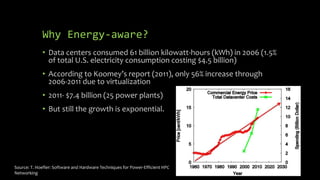
• Data centers consumed 61 billion kilowatt-hours (kWh) in 2006 (1.5%
of total U.S. electricity consumption costing $4.5 billion)
• According to Koomey’s report (2011), only 56% increase through
2006-2011 due to virtualization
• 2011- $7.4 billion (25 power plants)
• But still the growth is exponential.
Source: T. Hoefler: Software and Hardware Techniques for Power-Efficient HPC
Networking
Why Energy-aware?
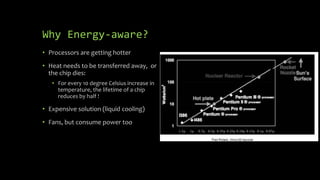
• Processors are getting hotter
• Heat needs to be transferred away, or
the chip dies:
• For every 10 degree Celsius increase in
temperature, the lifetime of a chip
reduces by half !
• Expensive solution (liquid cooling)
• Fans, but consume power too
Energy and Environment (Green Computing)
• It’s the study of designing, manufacturing, using and disposing of
computers, servers and associated subsystems efficiently and
effectively with minimal on environment.
• According to German Federal Environment office, computers
consume around 17billion kWh each year in standby mode only !
• The CO2 dissipated from ‘sleeping devices’ = 1/7 the CO2 emitted
from a car
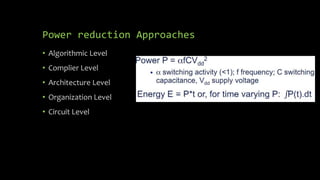
Power reduction Approaches
• Algorithmic Level
• Complier Level
• Architecture Level
• Organization Level
• Circuit Level
Algorithmic level
• Fewer instructions/cycles reduces energy
• Trying alternative algorithms with lower complexity:
• E.g. quick sort O(nlogn) , bubble sort O(n^2)
• Heuristic approach, go for a good solution, but not the best
• Biggest gains at this level
Compiler level
• Strength reduction
• E.g. replace multiplications with Add’s and Shift’s
• E.g. replace floating point with fixed point
• Source-to-Source transformation
• Loop transformation to improve locality
• Reorder instructions to reduce bit-transition
• Reduce register pressure (number of accesses to register file)
• Perform special optimizations per scenario of each execution mode
Architecture, Organization level
• Going parallel
• Add local memories
 For Organization level (micro Architecture)
• Reducing Vdd by using lower freq.
• Pipelining(cheap way of parallelism)
• Reducing register traffic
• Avoid unnecessary reads and writes
Circuit level
• Clock gating
• add more logic to circuit to prune clock tree
• Power gating
• shut off current to blocks not in use in circuit
• Use special SRAM cells
• Normal SRAM can’t scale below Vdd =0.7-0.8 Volt
• Multiple Vdd modes
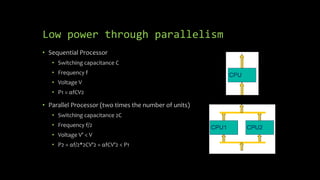
Low power through parallelism
• Sequential Processor
• Switching capacitance C
• Frequency f
• Voltage V
• P1 = αfCV2
• Parallel Processor (two times the number of units)
• Switching capacitance 2C
• Frequency f/2
• Voltage V’ < V
• P2 = αf/2*2CV’2 = αfCV’2 < P1
Graphene & Energy-aware
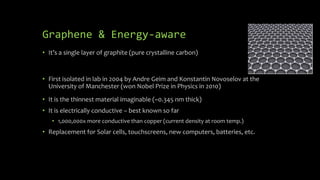
• It’s a single layer of graphite (pure crystalline carbon)
• First isolated in lab in 2004 by Andre Geim and Konstantin Novoselov at the
University of Manchester (won Nobel Prize in Physics in 2010)
• It is the thinnest material imaginable (~0.345 nm thick)
• It is electrically conductive – best known so far
• 1,000,000x more conductive than copper (current density at room temp.)
• Replacement for Solar cells, touchscreens, new computers, batteries, etc.
Graphene supercapacitor
• The graphene supercapacitor is capable of charging up to 1,000 times faster than
a normal battery
• Fully charge your phone in 30 seconds and last for days
• Contains no toxic chemical, carbon based (Green)
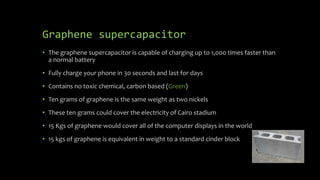
• Ten grams of graphene is the same weight as two nickels
• These ten grams could cover the electricity of Cairo stadium
• 15 Kgs of graphene would cover all of the computer displays in the world
• 15 kgs of graphene is equivalent in weight to a standard cinder block
References
• http://htor.inf.ethz.ch/publications/img/hoefler-energy-utah.pdf
• http://www.slideshare.net/snehasispanigrahi/green-computing-9739418
• www.inf.ed.ac.uk/teaching/courses/eac/01_Intro.pdf
• http://www.ics.ele.tue.nl/~heco/courses/ASCI-winterschools/Energy-aware-
computing-27mar2012.ppt
• http://cloudbus.org/papers/Energy-Aware-CloudResourceAllocation-FGCS2012.pdf
Questions ?

Energy-aware Computing

  • 1.
    Energy-aware Computing Software approachesand other technologies Name ID Abd ElRahman Abd Elkawy 19-4735 Kareem Rezk 19-9237 Mohamed Elhawary 19-7157 Omar Elshal 19-8014
  • 2.
    Content Layout: • WhyEnergy-aware ? • Energy and Environment (Green Computing) • Power reduction Approaches • Low power through parallelism • Graphene, how can it contribute to Energy-aware? • Graphene supercapacitor • References
  • 3.
    Why Energy-aware? • Datacenters consumed 61 billion kilowatt-hours (kWh) in 2006 (1.5% of total U.S. electricity consumption costing $4.5 billion) • According to Koomey’s report (2011), only 56% increase through 2006-2011 due to virtualization • 2011- $7.4 billion (25 power plants) • But still the growth is exponential. Source: T. Hoefler: Software and Hardware Techniques for Power-Efficient HPC Networking
  • 4.
    Why Energy-aware? • Processorsare getting hotter • Heat needs to be transferred away, or the chip dies: • For every 10 degree Celsius increase in temperature, the lifetime of a chip reduces by half ! • Expensive solution (liquid cooling) • Fans, but consume power too
  • 5.
    Energy and Environment(Green Computing) • It’s the study of designing, manufacturing, using and disposing of computers, servers and associated subsystems efficiently and effectively with minimal on environment. • According to German Federal Environment office, computers consume around 17billion kWh each year in standby mode only ! • The CO2 dissipated from ‘sleeping devices’ = 1/7 the CO2 emitted from a car
  • 6.
    Power reduction Approaches •Algorithmic Level • Complier Level • Architecture Level • Organization Level • Circuit Level
  • 7.
    Algorithmic level • Fewerinstructions/cycles reduces energy • Trying alternative algorithms with lower complexity: • E.g. quick sort O(nlogn) , bubble sort O(n^2) • Heuristic approach, go for a good solution, but not the best • Biggest gains at this level
  • 8.
    Compiler level • Strengthreduction • E.g. replace multiplications with Add’s and Shift’s • E.g. replace floating point with fixed point • Source-to-Source transformation • Loop transformation to improve locality • Reorder instructions to reduce bit-transition • Reduce register pressure (number of accesses to register file) • Perform special optimizations per scenario of each execution mode
  • 9.
    Architecture, Organization level •Going parallel • Add local memories  For Organization level (micro Architecture) • Reducing Vdd by using lower freq. • Pipelining(cheap way of parallelism) • Reducing register traffic • Avoid unnecessary reads and writes
  • 10.
    Circuit level • Clockgating • add more logic to circuit to prune clock tree • Power gating • shut off current to blocks not in use in circuit • Use special SRAM cells • Normal SRAM can’t scale below Vdd =0.7-0.8 Volt • Multiple Vdd modes
  • 11.
    Low power throughparallelism • Sequential Processor • Switching capacitance C • Frequency f • Voltage V • P1 = αfCV2 • Parallel Processor (two times the number of units) • Switching capacitance 2C • Frequency f/2 • Voltage V’ < V • P2 = αf/2*2CV’2 = αfCV’2 < P1
  • 12.
    Graphene & Energy-aware •It’s a single layer of graphite (pure crystalline carbon) • First isolated in lab in 2004 by Andre Geim and Konstantin Novoselov at the University of Manchester (won Nobel Prize in Physics in 2010) • It is the thinnest material imaginable (~0.345 nm thick) • It is electrically conductive – best known so far • 1,000,000x more conductive than copper (current density at room temp.) • Replacement for Solar cells, touchscreens, new computers, batteries, etc.
  • 13.
    Graphene supercapacitor • Thegraphene supercapacitor is capable of charging up to 1,000 times faster than a normal battery • Fully charge your phone in 30 seconds and last for days • Contains no toxic chemical, carbon based (Green) • Ten grams of graphene is the same weight as two nickels • These ten grams could cover the electricity of Cairo stadium • 15 Kgs of graphene would cover all of the computer displays in the world • 15 kgs of graphene is equivalent in weight to a standard cinder block
  • 14.
    References • http://htor.inf.ethz.ch/publications/img/hoefler-energy-utah.pdf • http://www.slideshare.net/snehasispanigrahi/green-computing-9739418 •www.inf.ed.ac.uk/teaching/courses/eac/01_Intro.pdf • http://www.ics.ele.tue.nl/~heco/courses/ASCI-winterschools/Energy-aware- computing-27mar2012.ppt • http://cloudbus.org/papers/Energy-Aware-CloudResourceAllocation-FGCS2012.pdf
  • 15.

Editor's Notes

  • #11 clock gating saves power by adding more logic to a circuit to prune the clock tree. Pruning the clock disables portions of the circuitry so that the flip-flops in them do not have to switch states. Switching states consumes power. When not being switched, the switching power consumption goes to zero