Lessons learned?
Safe, green and sustainable
Nuclear power – an oxymoron
Nuclear Power – an overview
• In 1991, 17% of world’s power was generated by nuclear reactors.
(Damian, 1992)
• In 2010 this fell to 15%.
(World Nuclear Association, 2010)
• Market share expected to further decline, “with capacity additions in
developing countries and economies in transition roughly balancing
plants being retired in OECD countries”.
(Sims, Rogner, & Gregory, 2003, p. 1316)
• In OECD countries, nuclear power
suffers from a public relations
problem.
(Tonnessen, Mardberg & Weisaeth, 2005)
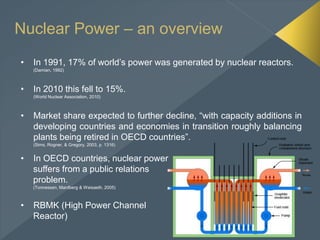
• RBMK (High Power Channel
Reactor)
The Australian Context
• Recently the Australian government expressed an interest in the
development of nuclear power for peaceful purposes
• The government's argument is based on the premise that in an age
of global warming Australia should look towards a proven, cost
effective energy source that does not emit greenhouse gasses.
energy.
• Australia contains 40% of the worlds uranium supply, giving us a
unique capacity to develop a ‘self reliant’ nuclear power industry.
• Greenhouse gas emissions from nuclear
power are equivalent to “green” energy
alternatives such as solar, hydroelectric
and wind.
(Copland, Jones, et al., 2008)
Cost effective?
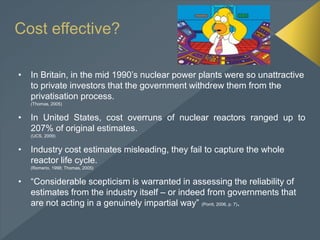
• In Britain, in the mid 1990’s nuclear power plants were so unattractive
to private investors that the government withdrew them from the
privatisation process.
(Thomas, 2005)
• In United States, cost overruns of nuclear reactors ranged up to
207% of original estimates.
(UCS, 2009)
• Industry cost estimates misleading, they fail to capture the whole
reactor life cycle.
(Romerio, 1998; Thomas, 2005)
• “Considerable scepticism is warranted in assessing the reliability of
estimates from the industry itself – or indeed from governments that
are not acting in a genuinely impartial way” (Porrit, 2006, p. 7).
Low emission?
• Only the operation of nuclear reactors is
practically CO2 free.
• Mining processes involved in extracting uranium produce such vast
quantities of CO2 so as to make nuclear power life cycle emissions
comparable to those of combined-cycle gas fired power station.
(Diesendorf, 2007)
• “Lifetime [greenhouse gas] emissions from solar and nuclear fuel
cycles in the United States are comparable under actual production
conditions and average solar irradiation” (Fthenakis & Kim, 2007, p. 2549).
What about waste?
• Waste repositories are universally unwanted by public opinion, only a
few governments were able to construct long term storage facilities.
(Dawson & Darst, 2005; Kunreuther, Desvousges, & Slovic 1988)
• Some interim storage facilities, near the reactor sites, are getting so
overloaded that unless the issue is resolved, number of reactors may
be forced to shut down.
(Macfarlane, 2001)
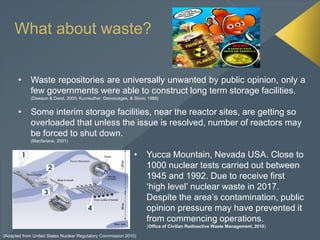
• Yucca Mountain, Nevada USA. Close to
1000 nuclear tests carried out between
1945 and 1992. Due to receive first
‘high level’ nuclear waste in 2017.
Despite the area’s contamination, public
opinion pressure may have prevented it
from commencing operations.
(Office of Civilian Radioactive Waste Management, 2010)
(Adapted from United States Nuclear Regulatory Commission 2010)
The Chernobyl ‘disaster’.
• 26 April 1986, 1:23:00: A test of the cooling system begins in unit
no. 4 of the Chernobyl power plant
• 26 April 1986, 1:23:40: The emergency shutdown fails.
• 26 April 1986, 1:23:44: The reactor in unit no. 4 runs out of control and
explodes.
• 27 April to 5 May 1986: About 1800 helicopter flights deposit around 5000
tonnes of extinguishing materials such as sand and lead onto the burning
reactor.
• 27 April 1986: The inhabitants of the Pripyat power plant settlement are
evacuated.
• 28 April 1986, 21:00: The Soviet news agency Tass announces that there
Has been an accident at the Chernobyl nuclear power station and that
there have been casualties. An investigative committee is established.
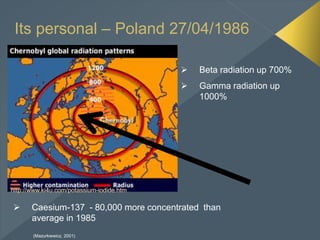
Its personal – Poland 27/04/1986
 Beta radiation up 700%
 Gamma radiation up
1000%
 Caesium-137 - 80,000 more concentrated than
average in 1985
(Mazurkiewicz, 2001)
Official information
• Only 31 Chernobyl firemen
and workers received acute radiation from fission products
and died.
• Chronic radiation, although it is feared as much as acute
radiation, is actually beneficial to people.
• Workers and public outside of the plant were benefited when
fission products diluted and decayed to chronic radiation.
• 4,000 thyroid cancers are expected to occur, but few deaths
• An estimated 3940 emergency workers will die from radiation-
induced cancers
(Keuter, 2007; IAEA, 2004; Stephenson, 2005; Luan 2004)
The ‘other’ information
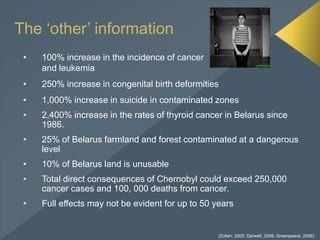
• 100% increase in the incidence of cancer
and leukemia
• 250% increase in congenital birth deformities
• 1,000% increase in suicide in contaminated zones
• 2,400% increase in the rates of thyroid cancer in Belarus since
1986.
• 25% of Belarus farmland and forest contaminated at a dangerous
level
• 10% of Belarus land is unusable
• Total direct consequences of Chernobyl could exceed 250,000
cancer cases and 100, 000 deaths from cancer.
• Full effects may not be evident for up to 50 years
(Zoltan, 2005; Darwell, 2006; Greenpeace, 2006)
The liquidators
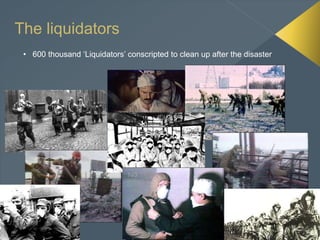
• 600 thousand ‘Liquidators’ conscripted to clean up after the disaster
The liquidators
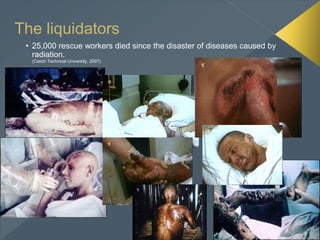
• 25,000 rescue workers died since the disaster of diseases caused by
radiation.
(Czech Technical University, 2007)
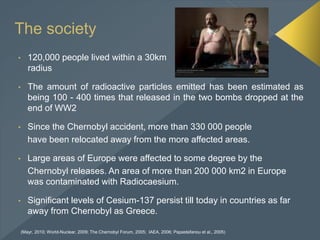
• 120,000 people lived within a 30km
radius
• The amount of radioactive particles emitted has been estimated as
being 100 - 400 times that released in the two bombs dropped at the
end of WW2
• Since the Chernobyl accident, more than 330 000 people
have been relocated away from the more affected areas.
• Large areas of Europe were affected to some degree by the
Chernobyl releases. An area of more than 200 000 km2 in Europe
was contaminated with Radiocaesium.
• Significant levels of Cesium-137 persist till today in countries as far
away from Chernobyl as Greece.
The society
(Mayr, 2010; World-Nuclear, 2009; The Chernobyl Forum, 2005; IAEA, 2006; Papastefanou et al., 2005)
Safety
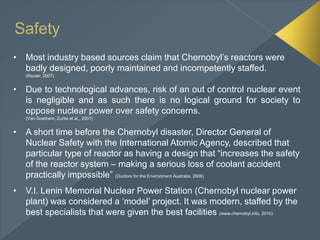
• Most industry based sources claim that Chernobyl’s reactors were
badly designed, poorly maintained and incompetently staffed.
(Keuter, 2007)
• Due to technological advances, risk of an out of control nuclear event
is negligible and as such there is no logical ground for society to
oppose nuclear power over safety concerns.
(Van Goethem, Zurita et al., 2001)
• A short time before the Chernobyl disaster, Director General of
Nuclear Safety with the International Atomic Agency, described that
particular type of reactor as having a design that “increases the safety
of the reactor system – making a serious loss of coolant accident
practically impossible” (Doctors for the Environment Australia, 2006)
• V.I. Lenin Memorial Nuclear Power Station (Chernobyl nuclear power
plant) was considered a ‘model’ project. It was modern, staffed by the
best specialists that were given the best facilities (www.chernobyl.info, 2010)
The hypocrisy
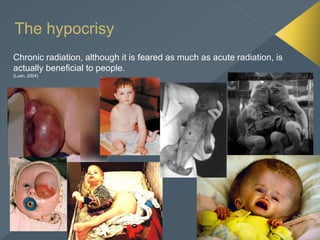
Chronic radiation, although it is feared as much as acute radiation, is
actually beneficial to people.
(Luan, 2004)
The hypocrisy
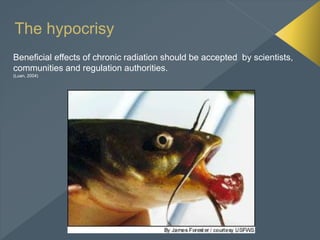
Beneficial effects of chronic radiation should be accepted by scientists,
communities and regulation authorities.
(Luan, 2004)
It can’t happen again. Can it?
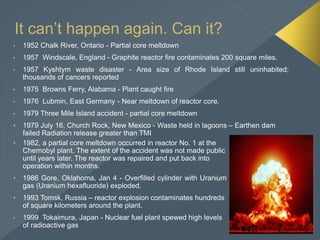
• 1952 Chalk River, Ontario - Partial core meltdown
• 1957 Windscale, England - Graphite reactor fire contaminates 200 square miles.
• 1957 Kyshtym waste disaster - Area size of Rhode Island still uninhabited;
thousands of cancers reported
• 1975 Browns Ferry, Alabama - Plant caught fire
• 1976 Lubmin, East Germany - Near meltdown of reactor core.
• 1979 Three Mile Island accident - partial core meltdown
• 1979 July 16, Church Rock, New Mexico - Waste held in lagoons – Earthen dam
failed Radiation release greater than TMI
• 1982, a partial core meltdown occurred in reactor No. 1 at the
Chernobyl plant. The extent of the accident was not made public
until years later. The reactor was repaired and put back into
operation within months.
• 1986 Gore, Oklahoma, Jan 4 - Overfilled cylinder with Uranium
gas (Uranium hexafluoride) exploded.
• 1993 Tomsk, Russia – reactor explosion contaminates hundreds
of square kilometers around the plant.
• 1999 Tokaimura, Japan - Nuclear fuel plant spewed high levels
of radioactive gas
Risk and ‘risk acceptability’
“[W]here risk is being imposed on workers, or
passengers, or members of the public, the
concept of acceptable risk is contentious.
‘Acceptable to whom?’ we are entitled to ask”
(Hopkins, 2004, p. 2)
Alternatives?
• It is possible for high power consuming, first world economies
to reinvent their power generation balance, reducing
worldwide CO2 emissions to levels required in order to
prevent global warming, whilst phasing out all nuclear
generated power by 2050. (EREC, 2009)
• Sweden, a country with one of the world’s highest levels of
energy use, with greater per capita commitment to nuclear
power than most other countries, has started a deliberate
phase out of nuclear power generation and its replacement
with alternate means (Lidskog, 1999).
Picture is worth a thousand words
A thought to take home...
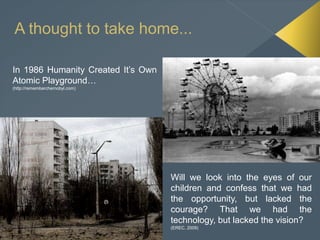
In 1986 Humanity Created It’s Own
Atomic Playground…
(http://rememberchernobyl.com)
Will we look into the eyes of our
children and confess that we had
the opportunity, but lacked the
courage? That we had the
technology, but lacked the vision?
(EREC, 2009)
Facts behind Chernobyl

Facts behind Chernobyl

  • 1.
    Lessons learned? Safe, greenand sustainable Nuclear power – an oxymoron
  • 2.
    Nuclear Power –an overview • In 1991, 17% of world’s power was generated by nuclear reactors. (Damian, 1992) • In 2010 this fell to 15%. (World Nuclear Association, 2010) • Market share expected to further decline, “with capacity additions in developing countries and economies in transition roughly balancing plants being retired in OECD countries”. (Sims, Rogner, & Gregory, 2003, p. 1316) • In OECD countries, nuclear power suffers from a public relations problem. (Tonnessen, Mardberg & Weisaeth, 2005) • RBMK (High Power Channel Reactor)
  • 3.
    The Australian Context •Recently the Australian government expressed an interest in the development of nuclear power for peaceful purposes • The government's argument is based on the premise that in an age of global warming Australia should look towards a proven, cost effective energy source that does not emit greenhouse gasses. energy. • Australia contains 40% of the worlds uranium supply, giving us a unique capacity to develop a ‘self reliant’ nuclear power industry. • Greenhouse gas emissions from nuclear power are equivalent to “green” energy alternatives such as solar, hydroelectric and wind. (Copland, Jones, et al., 2008)
  • 4.
    Cost effective? • InBritain, in the mid 1990’s nuclear power plants were so unattractive to private investors that the government withdrew them from the privatisation process. (Thomas, 2005) • In United States, cost overruns of nuclear reactors ranged up to 207% of original estimates. (UCS, 2009) • Industry cost estimates misleading, they fail to capture the whole reactor life cycle. (Romerio, 1998; Thomas, 2005) • “Considerable scepticism is warranted in assessing the reliability of estimates from the industry itself – or indeed from governments that are not acting in a genuinely impartial way” (Porrit, 2006, p. 7).
  • 5.
    Low emission? • Onlythe operation of nuclear reactors is practically CO2 free. • Mining processes involved in extracting uranium produce such vast quantities of CO2 so as to make nuclear power life cycle emissions comparable to those of combined-cycle gas fired power station. (Diesendorf, 2007) • “Lifetime [greenhouse gas] emissions from solar and nuclear fuel cycles in the United States are comparable under actual production conditions and average solar irradiation” (Fthenakis & Kim, 2007, p. 2549).
  • 6.
    What about waste? •Waste repositories are universally unwanted by public opinion, only a few governments were able to construct long term storage facilities. (Dawson & Darst, 2005; Kunreuther, Desvousges, & Slovic 1988) • Some interim storage facilities, near the reactor sites, are getting so overloaded that unless the issue is resolved, number of reactors may be forced to shut down. (Macfarlane, 2001) • Yucca Mountain, Nevada USA. Close to 1000 nuclear tests carried out between 1945 and 1992. Due to receive first ‘high level’ nuclear waste in 2017. Despite the area’s contamination, public opinion pressure may have prevented it from commencing operations. (Office of Civilian Radioactive Waste Management, 2010) (Adapted from United States Nuclear Regulatory Commission 2010)
  • 7.
    The Chernobyl ‘disaster’. •26 April 1986, 1:23:00: A test of the cooling system begins in unit no. 4 of the Chernobyl power plant • 26 April 1986, 1:23:40: The emergency shutdown fails. • 26 April 1986, 1:23:44: The reactor in unit no. 4 runs out of control and explodes. • 27 April to 5 May 1986: About 1800 helicopter flights deposit around 5000 tonnes of extinguishing materials such as sand and lead onto the burning reactor. • 27 April 1986: The inhabitants of the Pripyat power plant settlement are evacuated. • 28 April 1986, 21:00: The Soviet news agency Tass announces that there Has been an accident at the Chernobyl nuclear power station and that there have been casualties. An investigative committee is established.
  • 8.
    Its personal –Poland 27/04/1986  Beta radiation up 700%  Gamma radiation up 1000%  Caesium-137 - 80,000 more concentrated than average in 1985 (Mazurkiewicz, 2001)
  • 9.
    Official information • Only31 Chernobyl firemen and workers received acute radiation from fission products and died. • Chronic radiation, although it is feared as much as acute radiation, is actually beneficial to people. • Workers and public outside of the plant were benefited when fission products diluted and decayed to chronic radiation. • 4,000 thyroid cancers are expected to occur, but few deaths • An estimated 3940 emergency workers will die from radiation- induced cancers (Keuter, 2007; IAEA, 2004; Stephenson, 2005; Luan 2004)
  • 10.
    The ‘other’ information •100% increase in the incidence of cancer and leukemia • 250% increase in congenital birth deformities • 1,000% increase in suicide in contaminated zones • 2,400% increase in the rates of thyroid cancer in Belarus since 1986. • 25% of Belarus farmland and forest contaminated at a dangerous level • 10% of Belarus land is unusable • Total direct consequences of Chernobyl could exceed 250,000 cancer cases and 100, 000 deaths from cancer. • Full effects may not be evident for up to 50 years (Zoltan, 2005; Darwell, 2006; Greenpeace, 2006)
  • 11.
    The liquidators • 600thousand ‘Liquidators’ conscripted to clean up after the disaster
  • 12.
    The liquidators • 25,000rescue workers died since the disaster of diseases caused by radiation. (Czech Technical University, 2007)
  • 13.
    • 120,000 peoplelived within a 30km radius • The amount of radioactive particles emitted has been estimated as being 100 - 400 times that released in the two bombs dropped at the end of WW2 • Since the Chernobyl accident, more than 330 000 people have been relocated away from the more affected areas. • Large areas of Europe were affected to some degree by the Chernobyl releases. An area of more than 200 000 km2 in Europe was contaminated with Radiocaesium. • Significant levels of Cesium-137 persist till today in countries as far away from Chernobyl as Greece. The society (Mayr, 2010; World-Nuclear, 2009; The Chernobyl Forum, 2005; IAEA, 2006; Papastefanou et al., 2005)
  • 14.
    Safety • Most industrybased sources claim that Chernobyl’s reactors were badly designed, poorly maintained and incompetently staffed. (Keuter, 2007) • Due to technological advances, risk of an out of control nuclear event is negligible and as such there is no logical ground for society to oppose nuclear power over safety concerns. (Van Goethem, Zurita et al., 2001) • A short time before the Chernobyl disaster, Director General of Nuclear Safety with the International Atomic Agency, described that particular type of reactor as having a design that “increases the safety of the reactor system – making a serious loss of coolant accident practically impossible” (Doctors for the Environment Australia, 2006) • V.I. Lenin Memorial Nuclear Power Station (Chernobyl nuclear power plant) was considered a ‘model’ project. It was modern, staffed by the best specialists that were given the best facilities (www.chernobyl.info, 2010)
  • 15.
    The hypocrisy Chronic radiation,although it is feared as much as acute radiation, is actually beneficial to people. (Luan, 2004)
  • 16.
    The hypocrisy Beneficial effectsof chronic radiation should be accepted by scientists, communities and regulation authorities. (Luan, 2004)
  • 17.
    It can’t happenagain. Can it? • 1952 Chalk River, Ontario - Partial core meltdown • 1957 Windscale, England - Graphite reactor fire contaminates 200 square miles. • 1957 Kyshtym waste disaster - Area size of Rhode Island still uninhabited; thousands of cancers reported • 1975 Browns Ferry, Alabama - Plant caught fire • 1976 Lubmin, East Germany - Near meltdown of reactor core. • 1979 Three Mile Island accident - partial core meltdown • 1979 July 16, Church Rock, New Mexico - Waste held in lagoons – Earthen dam failed Radiation release greater than TMI • 1982, a partial core meltdown occurred in reactor No. 1 at the Chernobyl plant. The extent of the accident was not made public until years later. The reactor was repaired and put back into operation within months. • 1986 Gore, Oklahoma, Jan 4 - Overfilled cylinder with Uranium gas (Uranium hexafluoride) exploded. • 1993 Tomsk, Russia – reactor explosion contaminates hundreds of square kilometers around the plant. • 1999 Tokaimura, Japan - Nuclear fuel plant spewed high levels of radioactive gas
  • 18.
    Risk and ‘riskacceptability’ “[W]here risk is being imposed on workers, or passengers, or members of the public, the concept of acceptable risk is contentious. ‘Acceptable to whom?’ we are entitled to ask” (Hopkins, 2004, p. 2)
  • 19.
    Alternatives? • It ispossible for high power consuming, first world economies to reinvent their power generation balance, reducing worldwide CO2 emissions to levels required in order to prevent global warming, whilst phasing out all nuclear generated power by 2050. (EREC, 2009) • Sweden, a country with one of the world’s highest levels of energy use, with greater per capita commitment to nuclear power than most other countries, has started a deliberate phase out of nuclear power generation and its replacement with alternate means (Lidskog, 1999).
  • 20.
    Picture is wortha thousand words
  • 21.
    A thought totake home... In 1986 Humanity Created It’s Own Atomic Playground… (http://rememberchernobyl.com) Will we look into the eyes of our children and confess that we had the opportunity, but lacked the courage? That we had the technology, but lacked the vision? (EREC, 2009)

Editor's Notes

  • #3 RBMK (High Power Channel Reactor) These reactors were designed in the Soviet Union and are a pressurised water reactor with individual fuel channels. These reactors were designed and used for both plutonium production and power generation. Features include: Fuel - Low-enriched uranium dioxide (UO2), which contains about 1.8% uranium-235 (U235) Moderator - Graphite Control Rods - Boron carbide Coolant - Water Operation: The structure of the reactor consists of a large graphite core containing around 1700 vertical channels, each containing enriched uranium dioxide fuel. Heat is removed from the fuel by pumping water up through the channels where it is allowed to boil and pass into steam drums to drive electrical turbine-generators. The combination of graphite moderator and water coolant is found in no other power reactors. The design characteristics of the reactor mean that it is unstable at low power levels, and this was shown in the Chernobyl accident. The instability is due primarily to control rod design and a positive void coefficient. The water that becomes steam tends to increase the rate at which the nuclear reaction proceeds. In a water-moderated reactor, this effect is countered by the reduction in moderation, but in the RBMK the moderating effect of the graphite continues to slow down neutrons, and hence as more steam is created, there is a further increase in power generation. This is known as the positive void coefficient.
  • #11 In the cancer ward of a Kiev hospital in the Ukraine, 19-year-old Elena is being treated for her second case of thyroid cancer in just 3 years
  • #18 Graphical representation of nuclear disasters around the world