Satellites and Spacecrafts 
{ 
By: Martín Álvarez, Víctor Horno and 
Álvaro García de Jalón
Main Points 
 Difference between satellites and spacecrafts 
 Spacecrafts 
 History of spacecrafts 
 Satellites 
 NASA
Concept 
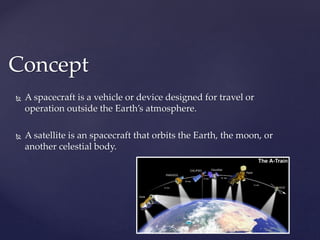
 A spacecraft is a vehicle or device designed for travel or 
operation outside the Earth’s atmosphere. 
 A satellite is an spacecraft that orbits the Earth, the moon, or 
another celestial body.
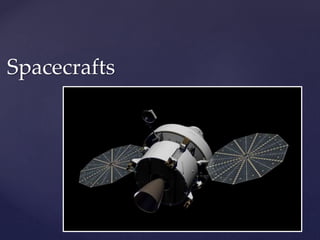
Spacecrafts
Spacecrafts 
 Aspacecraft is a vehicle designed to fly in outer space. 
 Spacecraft are used for a variety of purposes: 
including communications, earth 
observation, meteorology, navigation, space 
colonization, planetary exploration, and 
transportation of humans and cargo. 
 Just 24 nations actually have spacefaring technology, this are the 
most important ones: Russia, the United States, the member 
states of the European Space Agency, the Republic of China, 
Japan.
History of Spacecrafts 
 The name of the first artificial spacecraft which was 
launched into an elliptical low Earth orbit by the Soviet 
Union in 1957 was Sputnik . 
 As it reached the space new political, military, 
technological, and scientific developments took place. 
 While Sputnik 1 was the first spacecraft to orbit the 
Earth, other man-made objects had previously reached 
an altitude of 100 km, which is the height required by 
the international organization Fédération 
Aéronautique Internationale to count as a spaceflight.
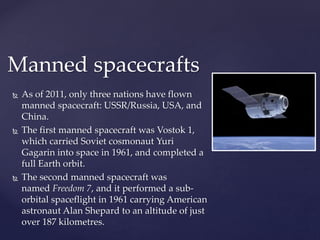
Manned spacecrafts 
 As of 2011, only three nations have flown 
manned spacecraft: USSR/Russia, USA, and 
China. 
 The first manned spacecraft was Vostok 1, 
which carried Soviet cosmonaut Yuri 
Gagarin into space in 1961, and completed a 
full Earth orbit. 
 The second manned spacecraft was 
named Freedom 7, and it performed a sub-orbital 
spaceflight in 1961 carrying American 
astronaut Alan Shepard to an altitude of just 
over 187 kilometres.
Spaceplanes 
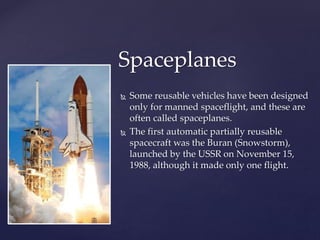
 Some reusable vehicles have been designed 
only for manned spaceflight, and these are 
often called spaceplanes. 
 The first automatic partially reusable 
spacecraft was the Buran (Snowstorm), 
launched by the USSR on November 15, 
1988, although it made only one flight.
Satellites
Satellites 
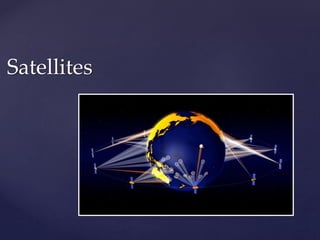
 Asatellite is an artificial object which has been 
intentionally placed into orbit. 
 Satellites are used for a large number of purposes. 
Common types include military and civilian, Earth 
observation satellites, communication, navigation 
satellites, weather satellites, and research satellites. 
 The name of the first artificial satellite which was 
launched into an elliptical low Earth orbit by the 
Soviet Union in 1957 was Sputnik .
Satellites 
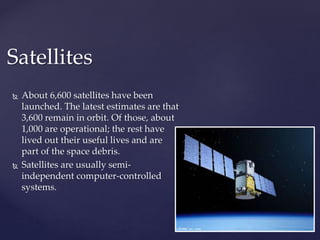
 About 6,600 satellites have been 
launched. The latest estimates are that 
3,600 remain in orbit. Of those, about 
1,000 are operational; the rest have 
lived out their useful lives and are 
part of the space debris. 
 Satellites are usually semi-independent 
computer-controlled 
systems.
NASA 
 The National Aeronautics and Space 
Administration (NASA) is the United States 
government agency that is responsible for the 
civilian space program as well as 
for aeronautics and aerospace research. 
 NASA collaborate in the Apollo moon landing 
missions and other important programs. 
 NASA shares data with various 
national and international 
organizations.

Satellites and spacecrafts

  • 1.
    Satellites and Spacecrafts { By: Martín Álvarez, Víctor Horno and Álvaro García de Jalón
  • 2.
    Main Points Difference between satellites and spacecrafts  Spacecrafts  History of spacecrafts  Satellites  NASA
  • 3.
    Concept  Aspacecraft is a vehicle or device designed for travel or operation outside the Earth’s atmosphere.  A satellite is an spacecraft that orbits the Earth, the moon, or another celestial body.
  • 4.
  • 5.
    Spacecrafts  Aspacecraftis a vehicle designed to fly in outer space.  Spacecraft are used for a variety of purposes: including communications, earth observation, meteorology, navigation, space colonization, planetary exploration, and transportation of humans and cargo.  Just 24 nations actually have spacefaring technology, this are the most important ones: Russia, the United States, the member states of the European Space Agency, the Republic of China, Japan.
  • 6.
    History of Spacecrafts  The name of the first artificial spacecraft which was launched into an elliptical low Earth orbit by the Soviet Union in 1957 was Sputnik .  As it reached the space new political, military, technological, and scientific developments took place.  While Sputnik 1 was the first spacecraft to orbit the Earth, other man-made objects had previously reached an altitude of 100 km, which is the height required by the international organization Fédération Aéronautique Internationale to count as a spaceflight.
  • 7.
    Manned spacecrafts As of 2011, only three nations have flown manned spacecraft: USSR/Russia, USA, and China.  The first manned spacecraft was Vostok 1, which carried Soviet cosmonaut Yuri Gagarin into space in 1961, and completed a full Earth orbit.  The second manned spacecraft was named Freedom 7, and it performed a sub-orbital spaceflight in 1961 carrying American astronaut Alan Shepard to an altitude of just over 187 kilometres.
  • 8.
    Spaceplanes  Somereusable vehicles have been designed only for manned spaceflight, and these are often called spaceplanes.  The first automatic partially reusable spacecraft was the Buran (Snowstorm), launched by the USSR on November 15, 1988, although it made only one flight.
  • 9.
  • 10.
    Satellites  Asatelliteis an artificial object which has been intentionally placed into orbit.  Satellites are used for a large number of purposes. Common types include military and civilian, Earth observation satellites, communication, navigation satellites, weather satellites, and research satellites.  The name of the first artificial satellite which was launched into an elliptical low Earth orbit by the Soviet Union in 1957 was Sputnik .
  • 11.
    Satellites  About6,600 satellites have been launched. The latest estimates are that 3,600 remain in orbit. Of those, about 1,000 are operational; the rest have lived out their useful lives and are part of the space debris.  Satellites are usually semi-independent computer-controlled systems.
  • 12.
    NASA  TheNational Aeronautics and Space Administration (NASA) is the United States government agency that is responsible for the civilian space program as well as for aeronautics and aerospace research.  NASA collaborate in the Apollo moon landing missions and other important programs.  NASA shares data with various national and international organizations.