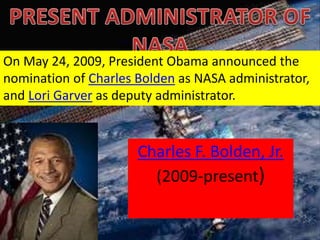
Charles F. Bolden, Jr.
(2009-present)
On May 24, 2009, President Obama announced the
nomination of Charles Bolden as NASA administrator,
and Lori Garver as deputy administrator.
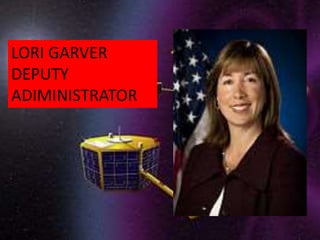
LORI GARVER
DEPUTY
ADIMINISTRATOR
National Aeronautics and Space Administration
NASA is an executive branch
agency of the United States
government, responsible for the
nation's civilian space program and
aeronautics and aerospace
research.
Formed
July 29, 1958 (1958-07-29)
(53 years ago)
Preceding agency NACA (1915-1958)[2]
Jurisdiction United States government
Headquarters
Washington, D.C.
38°52′59″N 77°0′59″W
/ 38.88306°N 77.01639°W /
38.88306; -77.01639
Employees 18,800+[3]
Annual budget
US$17.6 billion (FY 2009)[4]
See also NASA Budget
Agency executives
Charles Bolden, administrator
Lori Garver, deputy administrator
Mission name STS-135
Space shuttle Atlantis
Launch pad 39A
Launch date
8 July 2011 11:29:03 EDT
(15:29 UTC)[1][2]
Landing
21 July 2011 05:57:54 EDT
(09:57 UTC) at KSC[3]
Mission duration
12 days, 18 hours, 28
minutes, 50 seconds[3]
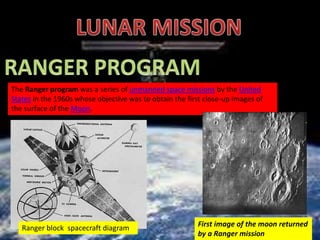
The Ranger program was a series of unmanned space missions by the United
States in the 1960s whose objective was to obtain the first close-up images of
the surface of the Moon.
First image of the moon returned
by a Ranger mission
Ranger block spacecraft diagram
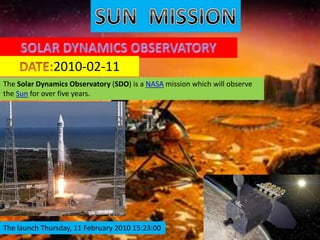
2010-02-11
The Solar Dynamics Observatory (SDO) is a NASA mission which will observe
the Sun for over five years.
The launch Thursday, 11 February 2010 15:23:00
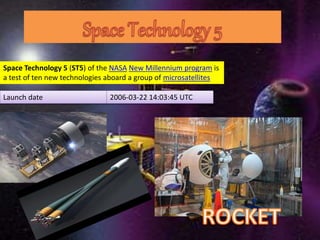
Space Technology 5 (ST5) of the NASA New Millennium program is
a test of ten new technologies aboard a group of microsatellites
Launch date 2006-03-22 14:03:45 UTC
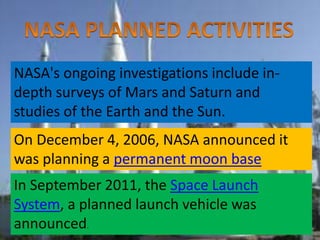
NASA's ongoing investigations include in-
depth surveys of Mars and Saturn and
studies of the Earth and the Sun.
On December 4, 2006, NASA announced it
was planning a permanent moon base
In September 2011, the Space Launch
System, a planned launch vehicle was
announced.
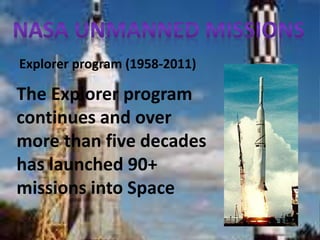
Explorer program (1958-2011)
The Explorer program
continues and over
more than five decades
has launched 90+
missions into Space
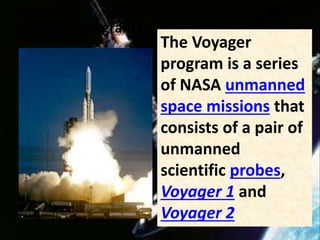
Voyager program (1977)
The Voyager
program is a series
of NASA unmanned
space missions that
consists of a pair of
unmanned
scientific probes,
Voyager 1 and
Voyager 2
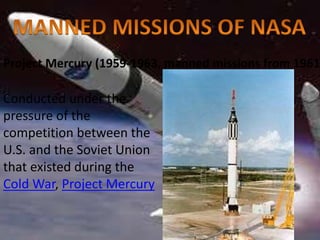
Project Mercury (1959-1963, manned missions from 1961
Conducted under the
pressure of the
competition between the
U.S. and the Soviet Union
that existed during the
Cold War, Project Mercury
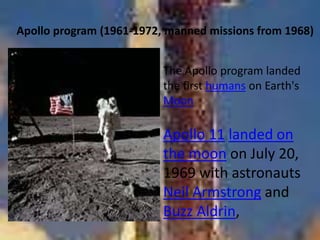
Apollo program (1961-1972, manned missions from 1968)
The Apollo program landed
the first humans on Earth's
Moon
Apollo 11 landed on
the moon on July 20,
1969 with astronauts
Neil Armstrong and
Buzz Aldrin,
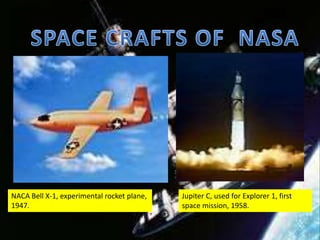
NACA Bell X-1, experimental rocket plane,
1947.
Jupiter C, used for Explorer 1, first
space mission, 1958.
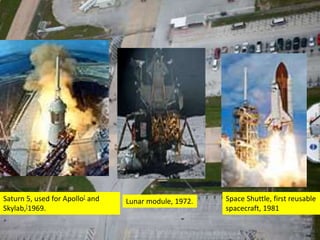
Saturn 5, used for Apollo[ and
Skylab,[1969.
Lunar module, 1972. Space Shuttle, first reusable
spacecraft, 1981
Nasa 3 ppt on physics class 8

Nasa 3 ppt on physics class 8

  • 2.
    Charles F. Bolden,Jr. (2009-present) On May 24, 2009, President Obama announced the nomination of Charles Bolden as NASA administrator, and Lori Garver as deputy administrator.
  • 3.
  • 5.
    National Aeronautics andSpace Administration NASA is an executive branch agency of the United States government, responsible for the nation's civilian space program and aeronautics and aerospace research.
  • 6.
    Formed July 29, 1958(1958-07-29) (53 years ago) Preceding agency NACA (1915-1958)[2] Jurisdiction United States government Headquarters Washington, D.C. 38°52′59″N 77°0′59″W / 38.88306°N 77.01639°W / 38.88306; -77.01639 Employees 18,800+[3] Annual budget US$17.6 billion (FY 2009)[4] See also NASA Budget Agency executives Charles Bolden, administrator Lori Garver, deputy administrator
  • 7.
    Mission name STS-135 Spaceshuttle Atlantis Launch pad 39A Launch date 8 July 2011 11:29:03 EDT (15:29 UTC)[1][2] Landing 21 July 2011 05:57:54 EDT (09:57 UTC) at KSC[3] Mission duration 12 days, 18 hours, 28 minutes, 50 seconds[3]
  • 8.
    The Ranger programwas a series of unmanned space missions by the United States in the 1960s whose objective was to obtain the first close-up images of the surface of the Moon. First image of the moon returned by a Ranger mission Ranger block spacecraft diagram
  • 9.
    2010-02-11 The Solar DynamicsObservatory (SDO) is a NASA mission which will observe the Sun for over five years. The launch Thursday, 11 February 2010 15:23:00
  • 10.
    Space Technology 5(ST5) of the NASA New Millennium program is a test of ten new technologies aboard a group of microsatellites Launch date 2006-03-22 14:03:45 UTC
  • 12.
    NASA's ongoing investigationsinclude in- depth surveys of Mars and Saturn and studies of the Earth and the Sun. On December 4, 2006, NASA announced it was planning a permanent moon base In September 2011, the Space Launch System, a planned launch vehicle was announced.
  • 13.
    Explorer program (1958-2011) TheExplorer program continues and over more than five decades has launched 90+ missions into Space
  • 14.
    Voyager program (1977) TheVoyager program is a series of NASA unmanned space missions that consists of a pair of unmanned scientific probes, Voyager 1 and Voyager 2
  • 15.
    Project Mercury (1959-1963,manned missions from 1961 Conducted under the pressure of the competition between the U.S. and the Soviet Union that existed during the Cold War, Project Mercury
  • 16.
    Apollo program (1961-1972,manned missions from 1968) The Apollo program landed the first humans on Earth's Moon Apollo 11 landed on the moon on July 20, 1969 with astronauts Neil Armstrong and Buzz Aldrin,
  • 18.
    NACA Bell X-1,experimental rocket plane, 1947. Jupiter C, used for Explorer 1, first space mission, 1958.
  • 19.
    Saturn 5, usedfor Apollo[ and Skylab,[1969. Lunar module, 1972. Space Shuttle, first reusable spacecraft, 1981