Satellites 1
Presented by Steven Cornelius December 11,2009
Table of Contents Definition of Satellites Components of a Satellite History Evolution Uses of Satellites Environmental Impact Summary and Conclusion References Questions
What is a Satellite By definition a Satellite is anything that orbits around a planet in a circular or elliptical path
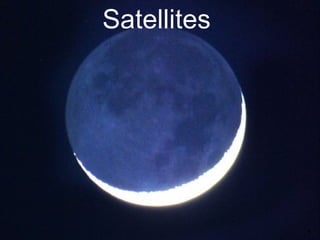
What is a Satellite The moon is the earths first and largest satellite. It serves many purposes such as regulating the tides and providing reflective light to earth.
Components of a Satellite With varying shapes and sizes, all satellites have a few things in common Power supply, can consist of solar panels and batteries, fuel cells, or in some cases nuclear power A computer system to run its functions A radio system, to communicate with ground control Altitude Control system, the ACS allows the satellite to maintain a position in space
History This is Sputnik. It was a 58cm  83 kg aluminum ball launched into earth orbit from Baikonur, Kazakhstan, on an R-7/Semiorka rocket   by the USSR on October 4, 1957 It contained  A battery A thermometer A radio transmitter Sputnik was filled with pressurized nitrogen gas, had 4 antennas which sent information back via short-wave frequency and only lasted 92 days in space.
History The first successful U.S. satellite,  Explorer I,  was launched into Earth orbit by the Army on Jan. 31, 1958, at Cape Canaveral, Florida, four months after Russia orbited  Sputnik.  The 8.1 kg satellite had a cylindrical shape and was 80 inches long and six inches in diameter. Explorer I's  small package of instruments produced the first major discovery of the Space Age—The Van Allen radiation belts surrounding the Earth.  Explorer I  burned up in the atmosphere on March 30, 1970.
History September 29 Canada becomes the third country to have a satellite in space, after Russia and the U.S. We successfully launch the science satellite Alouette 1 from Vandenberg Air Force Base in California, at an altitude of 1000 km. Designed with a one-year lifetime, it transmits useful data for over 10 years. It studies the ionosphere, the electrically-charged layer of the upper atmosphere that can affect long-distance radio transmission. Alouette 2 is launched on November 29, 1965.
Evolution of the Satellite Partially due to the Cold War and the American need to be First, Spunik launched the space age From humble beginnings to the multi million dollar technical marvels of today Cdn Radarsat
Evolution of the Satellite Since the 1960’s the US military has been sending satellites into space The US military has pioneered most uses of satellites other than science (GPS, communication, Imaging) 1962 AT&T sent the first commercial satellite into orbit The first N.A. satellite to carry TV was Canada’s Anik1 in 1972 The first commercial GPS satellite was launched in 1989
Evolution of the Satellite Since these early satellites, thousands more have been launched. There are limited details on the costs of the pioneering models but current satellites can cost up to a Billion dollars
Japanese satellite Akebono
Uses of Satellites The most common purposes for satellites are for weather monitoring, GPS, communications and science Within communications, satellites transmit broadcast signals, data, and telephony
 
Environmental Impact
Environmental Impact There are millions of man made objects orbiting the earth Of those millions, 25 thousand or so are considered space junk All of the objects are traveling at thousands of Km/hr with varying orbits If they are they are not being controlled eventually they will impact something
Environmental Impact Space junk have varying degree of toxicity due to the materials they were made with and materials they carried Many objects burn up when they re-enter earths atmosphere, but if they are large enough they can make it to the surface
Summary and Conclusion As technology goes satellites have advanced our lives in so many ways We can track major storms around the globe We can get instant video footage of event around the world We can communicate with almost anyone almost anywhere around the world
Summary and Conclusion The downside is that we have just have a new place where pollution is going unchecked The carelessness of the early years will eventually will be problems of the future Maybe there will be a day where we cannot safely launch a spacecraft into orbit  for fear of a collision with space junk.
Image Resources www.netaxs.com, The Moon As seen from the Northern Hemisphere , Michael Myers http://z.about.com/d/space/1/0/X/e/gpn-2000-001138.jpg www.satsig.net ,Opus 2 Satellite www.photojournal.jpl.nasa.gov/catalog/PIA08002 http://static.howstuffworks.com/gif/satellite1.jpg http://atlas.nrcan.gc.ca/site/english/maps/environment/seaice/sar_satellite.jpg www.asc-csa.gc.ca/eng/satellites/ www. how www.asc-csa.gc.ca/eng/satellites/sms.asp www.space.com/php/multimedia/imagedisplay/img_display.php
References www.howstuffworks.com/satellite.htm, How Stuff works, How Satellelites work,  Gary Brown www.infoplease.com , Health and Science/ Space Exploration, First U.S. Satelite www.asc-csa.gc.ca/eng/satellites/alouette.asp www.space.com , Space Junk Threatens Orbiting Satellites, Jonathan Lipman, August 25 1999
Thank You Question and answer period

Satellites

  • 1.
  • 2.
    Presented by StevenCornelius December 11,2009
  • 3.
    Table of ContentsDefinition of Satellites Components of a Satellite History Evolution Uses of Satellites Environmental Impact Summary and Conclusion References Questions
  • 4.
    What is aSatellite By definition a Satellite is anything that orbits around a planet in a circular or elliptical path
  • 5.
    What is aSatellite The moon is the earths first and largest satellite. It serves many purposes such as regulating the tides and providing reflective light to earth.
  • 6.
    Components of aSatellite With varying shapes and sizes, all satellites have a few things in common Power supply, can consist of solar panels and batteries, fuel cells, or in some cases nuclear power A computer system to run its functions A radio system, to communicate with ground control Altitude Control system, the ACS allows the satellite to maintain a position in space
  • 7.
    History This isSputnik. It was a 58cm 83 kg aluminum ball launched into earth orbit from Baikonur, Kazakhstan, on an R-7/Semiorka rocket by the USSR on October 4, 1957 It contained A battery A thermometer A radio transmitter Sputnik was filled with pressurized nitrogen gas, had 4 antennas which sent information back via short-wave frequency and only lasted 92 days in space.
  • 8.
    History The firstsuccessful U.S. satellite, Explorer I, was launched into Earth orbit by the Army on Jan. 31, 1958, at Cape Canaveral, Florida, four months after Russia orbited Sputnik. The 8.1 kg satellite had a cylindrical shape and was 80 inches long and six inches in diameter. Explorer I's small package of instruments produced the first major discovery of the Space Age—The Van Allen radiation belts surrounding the Earth. Explorer I burned up in the atmosphere on March 30, 1970.
  • 9.
    History September 29Canada becomes the third country to have a satellite in space, after Russia and the U.S. We successfully launch the science satellite Alouette 1 from Vandenberg Air Force Base in California, at an altitude of 1000 km. Designed with a one-year lifetime, it transmits useful data for over 10 years. It studies the ionosphere, the electrically-charged layer of the upper atmosphere that can affect long-distance radio transmission. Alouette 2 is launched on November 29, 1965.
  • 10.
    Evolution of theSatellite Partially due to the Cold War and the American need to be First, Spunik launched the space age From humble beginnings to the multi million dollar technical marvels of today Cdn Radarsat
  • 11.
    Evolution of theSatellite Since the 1960’s the US military has been sending satellites into space The US military has pioneered most uses of satellites other than science (GPS, communication, Imaging) 1962 AT&T sent the first commercial satellite into orbit The first N.A. satellite to carry TV was Canada’s Anik1 in 1972 The first commercial GPS satellite was launched in 1989
  • 12.
    Evolution of theSatellite Since these early satellites, thousands more have been launched. There are limited details on the costs of the pioneering models but current satellites can cost up to a Billion dollars
  • 13.
  • 14.
    Uses of SatellitesThe most common purposes for satellites are for weather monitoring, GPS, communications and science Within communications, satellites transmit broadcast signals, data, and telephony
  • 15.
  • 16.
  • 17.
    Environmental Impact Thereare millions of man made objects orbiting the earth Of those millions, 25 thousand or so are considered space junk All of the objects are traveling at thousands of Km/hr with varying orbits If they are they are not being controlled eventually they will impact something
  • 18.
    Environmental Impact Spacejunk have varying degree of toxicity due to the materials they were made with and materials they carried Many objects burn up when they re-enter earths atmosphere, but if they are large enough they can make it to the surface
  • 19.
    Summary and ConclusionAs technology goes satellites have advanced our lives in so many ways We can track major storms around the globe We can get instant video footage of event around the world We can communicate with almost anyone almost anywhere around the world
  • 20.
    Summary and ConclusionThe downside is that we have just have a new place where pollution is going unchecked The carelessness of the early years will eventually will be problems of the future Maybe there will be a day where we cannot safely launch a spacecraft into orbit for fear of a collision with space junk.
  • 21.
    Image Resources www.netaxs.com,The Moon As seen from the Northern Hemisphere , Michael Myers http://z.about.com/d/space/1/0/X/e/gpn-2000-001138.jpg www.satsig.net ,Opus 2 Satellite www.photojournal.jpl.nasa.gov/catalog/PIA08002 http://static.howstuffworks.com/gif/satellite1.jpg http://atlas.nrcan.gc.ca/site/english/maps/environment/seaice/sar_satellite.jpg www.asc-csa.gc.ca/eng/satellites/ www. how www.asc-csa.gc.ca/eng/satellites/sms.asp www.space.com/php/multimedia/imagedisplay/img_display.php
  • 22.
    References www.howstuffworks.com/satellite.htm, HowStuff works, How Satellelites work, Gary Brown www.infoplease.com , Health and Science/ Space Exploration, First U.S. Satelite www.asc-csa.gc.ca/eng/satellites/alouette.asp www.space.com , Space Junk Threatens Orbiting Satellites, Jonathan Lipman, August 25 1999
  • 23.
    Thank You Questionand answer period