





PERFORMANCE EVALUATION ON
              DIFFERENT STEGNOGRAPHIC
                    ALGORITHMS


JAYESH S, AP , Archana College Of Engineering – ALAPPUZHA
    AJAL.A.J , ASSISTANT PROFESSOR , FISAT – KOCHI
  VINOTHKUMAR.S , Scholar at PRIST University, Thanjavur
      HRIDYA K S - A P , K R G C E W – ALAPPUZHA
http://edition.cnn.com/video/?/video/world/2012/04/30/pkg-robertson-al-qaeda-documen
http://www.usatoday.com/tech/news/2001-02-05-binladen.htm
Contents


Steganography and Steganalysis

  Steganographic schemes

        System Features

   Improvement / Comparison

  Conclusion and Future Work
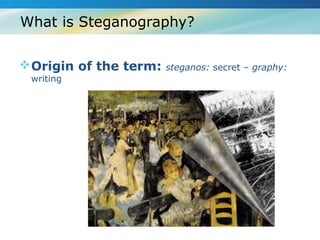
What is Steganography?

 Origin of the term:   steganos: secret – graphy:
 writing
Steganalysis
♦ Passive steganalysis
   – detect the presence or absence of a message
♦ Active Steganalysis
  – Estimate the message length and location
  – Estimate the Secret Key in embedding
  – Extract the message


   crypto + graphy ( secret + writing )
   stegano + graphy ( cover + writing )
Types of Steganalysis


 Targeted Steganalysis
   Relys on knowing the method used to hide the data & using
    known distinguishing statistics to detect stego images
   Sometimes steganalysts reverse engineer steganographic
    methods
 Blind Steganalysis
   Most beneficial to forensics because it’s not based on
    knowing the algorithm
   Most difficult because the type of images and method of
    hiding data are enormous and continuously changing.
   The current trend is to develop a neural network using
    training images and multiple statistical features. A method
    beyond the scope of this talk.
Other previous work
          in steganalysis

 Provos analyzed two million eBay images (jpeg) but although he
    identified thousands of “suspicious” images, nothing conclusive was
    recovered from any of them
   A statistical method based on pairs of values (POVs) was
    introduced by Pfitzmann and Westfeld, providing very reliable
    results if the message was placed in sequential pixel locations in the
    image
   Fridrich et al has a statistical method called RS steganalysis for
    detection of LSB embedding
   It uses dual statistics derived from spatial correlations in an image
   In a typical cover image the LSB plane can (to some degree) be
    predicted from the remaining 7 bit planes
   This intuitive idea is formulated mathematically resulting in the RS
    method
   The safe-bit rate for the LSB embedding algorithms is less than
Modern Stego Techniques


Outguess
 Stego framework is created by embedding
  hidden data using redundancy of cover image.
 Outguess preserves statistics of the BDCT
  coefficients histogram
 Stego takes two measures before embedding
  data
  - Redundant BDCT coefficients, which has least
  effect on cover image.
  - Adjusts the untouched coefficients.
                                                   9
Modern Stego Techniques (cont’d.)

F5
• Works on JPEG format only.
• Two main security actions against steganalysis
  attacks:
  - Straddling: scatters message uniformly over
  the cover
    image
  - Matrix Embedding: Improves embedding
  efficiency (no. of bits/ change of BDCT coeff.)


                                                    10
Modern Stego Techniques (cont’d.)


MB (Model-based Steganography)
• Correlates embedded data with cover
 image
• Splits cover image into two parts
  - Models parameter of distribution of second given first
  part
  - Encodes second part using model and hidden message
  - Combine these two parts to form stego image
• MB1 operates on JPEG images, uses Cauchy
  distribution to model JPEG histogram


                                                             11
Future of Steganography

 The most important use of
  steganographic techniques will
  probably lie in the field of digital
  watermarking

 Might become limited under laws -
  governments claimed that
  criminals use steganography to
  communicate


                              ...the End
SasuriE ajal
SasuriE ajal
SasuriE ajal
SasuriE ajal

SasuriE ajal

  • 1.
    PERFORMANCE EVALUATION ON DIFFERENT STEGNOGRAPHIC ALGORITHMS JAYESH S, AP , Archana College Of Engineering – ALAPPUZHA AJAL.A.J , ASSISTANT PROFESSOR , FISAT – KOCHI VINOTHKUMAR.S , Scholar at PRIST University, Thanjavur HRIDYA K S - A P , K R G C E W – ALAPPUZHA
  • 2.
  • 3.
  • 4.
    Contents Steganography and Steganalysis Steganographic schemes System Features Improvement / Comparison Conclusion and Future Work
  • 5.
    What is Steganography? Origin of the term: steganos: secret – graphy: writing
  • 6.
    Steganalysis ♦ Passive steganalysis – detect the presence or absence of a message ♦ Active Steganalysis – Estimate the message length and location – Estimate the Secret Key in embedding – Extract the message crypto + graphy ( secret + writing ) stegano + graphy ( cover + writing )
  • 7.
    Types of Steganalysis Targeted Steganalysis  Relys on knowing the method used to hide the data & using known distinguishing statistics to detect stego images  Sometimes steganalysts reverse engineer steganographic methods  Blind Steganalysis  Most beneficial to forensics because it’s not based on knowing the algorithm  Most difficult because the type of images and method of hiding data are enormous and continuously changing.  The current trend is to develop a neural network using training images and multiple statistical features. A method beyond the scope of this talk.
  • 8.
    Other previous work in steganalysis  Provos analyzed two million eBay images (jpeg) but although he identified thousands of “suspicious” images, nothing conclusive was recovered from any of them  A statistical method based on pairs of values (POVs) was introduced by Pfitzmann and Westfeld, providing very reliable results if the message was placed in sequential pixel locations in the image  Fridrich et al has a statistical method called RS steganalysis for detection of LSB embedding  It uses dual statistics derived from spatial correlations in an image  In a typical cover image the LSB plane can (to some degree) be predicted from the remaining 7 bit planes  This intuitive idea is formulated mathematically resulting in the RS method  The safe-bit rate for the LSB embedding algorithms is less than
  • 9.
    Modern Stego Techniques Outguess Stego framework is created by embedding hidden data using redundancy of cover image.  Outguess preserves statistics of the BDCT coefficients histogram  Stego takes two measures before embedding data - Redundant BDCT coefficients, which has least effect on cover image. - Adjusts the untouched coefficients. 9
  • 10.
    Modern Stego Techniques(cont’d.) F5 • Works on JPEG format only. • Two main security actions against steganalysis attacks: - Straddling: scatters message uniformly over the cover image - Matrix Embedding: Improves embedding efficiency (no. of bits/ change of BDCT coeff.) 10
  • 11.
    Modern Stego Techniques(cont’d.) MB (Model-based Steganography) • Correlates embedded data with cover image • Splits cover image into two parts - Models parameter of distribution of second given first part - Encodes second part using model and hidden message - Combine these two parts to form stego image • MB1 operates on JPEG images, uses Cauchy distribution to model JPEG histogram 11
  • 12.
    Future of Steganography The most important use of steganographic techniques will probably lie in the field of digital watermarking  Might become limited under laws - governments claimed that criminals use steganography to communicate ...the End