Steganography
NAME --Santu Chall
Roll No – 001130401005
Dept. – School of Education Technology
Course – Master in Multimedia Development
What is Steganography ?
• Comes from greek
‘steganos’ – covered
‘graphie’ – writing
• Steganography is the art and science of
writing hidden messages in such a way
that no one apart from the intended
recipient knows of the existence of the
message.
• Carrier: text, image, video, audio, etc.
Stegosaurus: a covered lizard
(but not a type of cryptography)
What is Computer Image
• Computer image is an array of pixels
• Pixels represent different light intensities
Are encoded as bit patterns
• Bit-depth
8bit grayscale – 256 levels of gray
24bit RGB – 16,777,216 million colors
Image Compression
• Lossy vs Lossless Compression
• Lossy (JPEG)
Discards excess image data, removes details that are too
small for human eye to differentiate.
Smaller file size.
• Lossless (TIF,BMP,GIF)
No loss of data, uncompressed image bit-by-bit identical
to original.
Larger file size.
Steganography Techniques
• Least-significant bit modifications(LSB)
• Masking and filtering
• Transformations
Least-significant bit
modifications(LSB)
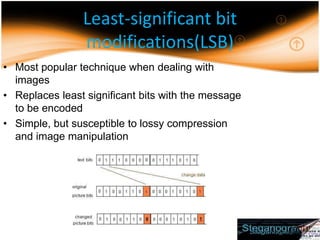
• Most popular technique when dealing with
images
• Replaces least significant bits with the message
to be encoded
• Simple, but susceptible to lossy compression
and image manipulation
Uses of LSB
• Storing passwords and/or other confidential
information
• Covert communication of sensitive data
• Speculated uses in terrorist activities
• Being widely used to hide and/or transfer
illegal content
MASKING & FILTERING
• Masks secret data over the original
data by changing the luminance of
particular areas
• During masking, it embed the
message within significant bits of the
cover image
• Not susceptible to lossy techniques
because image manipulation does not
affect the secret message
Uses of MASKING & FILTERING
• Digital Watermarking – provides
identification pertaining to the owner;
i.e. license or copyright information
- Invisible vs Visible
• Fingerprinting – provides
identification of the user; used to
identify and track illegal use of
content
TRANSFORMATION
• Discrete cosine transformations
(DCT)
• Hiding in Frequency Domain
Uses of TRANSFORMATION
• Harder to implement
• More Robust against attack and
alteration
• Can be used in lossy compression
• Very Hard to detect as changes in
frequency domain are orders of
magnitude smaller than signal
Basics of Modern Steganography
fE: steganographic function "embedding"
fE-1: steganographic function "extracting"
cover: cover data in which emb will be hidden
emb: message to be hidden
key: parameter of fE
stego: cover data with the hidden message
DETECTING STEGANOGRAPHY ON
IMAGE
• Most Steganography algorithm are used LSB.
• Uses the Stastical Analysis on the LSB.
• Detect the secret data using the DCT method
while using the loosy format picture.
DRAWBACKS and RECOVER FROM
STEGANOGRAPHY IN IMAGE
• Do not uses loosy compression technique .
• Do not resize images.
• Do not convert to an image to another
format image.
• Do not change the luminance of an image.
SUMMARY
• Steganography as a whole has existed in many
forms throughout much of history.
• Lossless compression of images with a great
deal of color variation work best as a cover
image to embed a message.
• Steganography can be used as beneficial tool
for privacy
1.http://en.wikipedia.org/wiki/Steganography
2.http://www.jjtc.com/stegdoc/index.html
3. C. Kurak, J. McHugh, "A Cautionary Note On
Image Downgrading," IEEE Eighth Annual Computer Security
Applications Conference, 1992.

SteganographyonImage.ppt

  • 1.
    Steganography NAME --Santu Chall RollNo – 001130401005 Dept. – School of Education Technology Course – Master in Multimedia Development
  • 2.
    What is Steganography? • Comes from greek ‘steganos’ – covered ‘graphie’ – writing • Steganography is the art and science of writing hidden messages in such a way that no one apart from the intended recipient knows of the existence of the message. • Carrier: text, image, video, audio, etc. Stegosaurus: a covered lizard (but not a type of cryptography)
  • 3.
    What is ComputerImage • Computer image is an array of pixels • Pixels represent different light intensities Are encoded as bit patterns • Bit-depth 8bit grayscale – 256 levels of gray 24bit RGB – 16,777,216 million colors
  • 4.
    Image Compression • Lossyvs Lossless Compression • Lossy (JPEG) Discards excess image data, removes details that are too small for human eye to differentiate. Smaller file size. • Lossless (TIF,BMP,GIF) No loss of data, uncompressed image bit-by-bit identical to original. Larger file size.
  • 5.
    Steganography Techniques • Least-significantbit modifications(LSB) • Masking and filtering • Transformations
  • 6.
    Least-significant bit modifications(LSB) • Mostpopular technique when dealing with images • Replaces least significant bits with the message to be encoded • Simple, but susceptible to lossy compression and image manipulation
  • 7.
    Uses of LSB •Storing passwords and/or other confidential information • Covert communication of sensitive data • Speculated uses in terrorist activities • Being widely used to hide and/or transfer illegal content
  • 8.
    MASKING & FILTERING •Masks secret data over the original data by changing the luminance of particular areas • During masking, it embed the message within significant bits of the cover image • Not susceptible to lossy techniques because image manipulation does not affect the secret message
  • 9.
    Uses of MASKING& FILTERING • Digital Watermarking – provides identification pertaining to the owner; i.e. license or copyright information - Invisible vs Visible • Fingerprinting – provides identification of the user; used to identify and track illegal use of content
  • 10.
    TRANSFORMATION • Discrete cosinetransformations (DCT) • Hiding in Frequency Domain
  • 11.
    Uses of TRANSFORMATION •Harder to implement • More Robust against attack and alteration • Can be used in lossy compression • Very Hard to detect as changes in frequency domain are orders of magnitude smaller than signal
  • 12.
    Basics of ModernSteganography fE: steganographic function "embedding" fE-1: steganographic function "extracting" cover: cover data in which emb will be hidden emb: message to be hidden key: parameter of fE stego: cover data with the hidden message
  • 13.
    DETECTING STEGANOGRAPHY ON IMAGE •Most Steganography algorithm are used LSB. • Uses the Stastical Analysis on the LSB. • Detect the secret data using the DCT method while using the loosy format picture.
  • 14.
    DRAWBACKS and RECOVERFROM STEGANOGRAPHY IN IMAGE • Do not uses loosy compression technique . • Do not resize images. • Do not convert to an image to another format image. • Do not change the luminance of an image.
  • 15.
    SUMMARY • Steganography asa whole has existed in many forms throughout much of history. • Lossless compression of images with a great deal of color variation work best as a cover image to embed a message. • Steganography can be used as beneficial tool for privacy
  • 16.
    1.http://en.wikipedia.org/wiki/Steganography 2.http://www.jjtc.com/stegdoc/index.html 3. C. Kurak,J. McHugh, "A Cautionary Note On Image Downgrading," IEEE Eighth Annual Computer Security Applications Conference, 1992.