
ERP: Why, What, Which, How


Barry M. Cole, Interim Change and Transformation Management
cxo@gate.net
Do We Have Answers

So we are thinking about ERP. And, we understand
that it will alter the way we do business for the next
10 to 20 years. So…
         1.   Why are thinking about ERP?
         2.   What does ERP mean?
              a.   To the business?
              b.   To the People?
              c.   To our customers?
         3.   Which ERP framework?
         4.   How do we start?
Why Are We Thinking ERP?
Successfully implementing Enterprise Resource Planning
requires understanding “WHY” at an organizational level.
   1.    Is our senior technology manager saying: “the systems are twenty
         years old and new technology will put us where we need to be”?
   2.    Are the ERP vendors saying: “out of the box; we have all the bells
         and whistles to make your life wonderful… And, here is our TCO
         white paper”?
   3.    Are employees saying: “it looks old… The screens aren’t easy”?
   4.    Or, is the business asking: “How can we more agile, increase
         innovation, and have more vitality in the marketplace”?
   5.    All of the above? None of the Above?
What ERP Means

A key to successfully implementing Enterprise Resource
Planning is understanding that it not about technology. It is
about managing Fundamental Change effecting:
   1.   Business Processes (running the business)
   2.   Financial and Regulatory Constraints
   3.   People: Producers and Users of Company Information
   4.   External Relationships: Customers, Trading Partners, Financial
        Partners, Suppliers, Investors…
Why This Discussion Is Important

Up to 80% all ERP implementations are judged to have failed to
fully meet expectations. How would the below impact our business?
                        Took longer than expected
                        Duration exceeded planned timelines
                        Implementation exceeded planned budget
                        Increase in total implementation costs as a percentage of total revenues
                        Increases in expected implementation costs
                        Organizational resistance and learning curves
                        Major operational disruptions with go-live


  Only 68% of executives and 61% of employees are at least somewhat satisfied with their implemented ERP solution (Panorama study, 2009).
Selection Criteria: Which


Analyze the magnitude of the change?
   1.   What should our operating environment look like when this
        new ERP is in place?
   2.   What will our organization look like?
   3.   How will the constraints inherent in each of the considered
        ERP’s influence the “how” of questions 1 and 2 above.
   4.   Can the new process, execution, and technology skills
        demanded by each considered ERP be developed or if they
        must be recruited; can they be easily found?
Selection Criteria: Which


Does the ERP vendor understand my sector and business
model?
   1.    Financials including valuations
   2.    Product Management life-cycle
   3.    Supply Chain
   4.    Production Modes
   5.    Servicing and Customer Support Models
   6.    Fulfillment
        Note: ERP platform modules are often highly configurable… These same questions should be asked
        when selecting an implementation partner for the chosen platform.
        The perfect platform with the wrong partner adds very major risks to a successful implementation.
Selection Criteria: Which


Does ERP platform X meet our unique company needs?
   1.   Multi-company/Multi-national operations
   2.   Volatile marketplace
   3.   Varying order and production handling modes
   4.   Regulatory compliance and reporting
   5.   Product life-cycle management
   6.   Sales and customer communications and support
   7.   Financial reporting agility (internal & external)
ERP Project Management

Always remember that ERP is about managing the business.
1.        ERP as fundamental enterprise change requires continuing buy-in and
          involvement of the entire executive team. Throughout the entire process;
          decision makers must be, involved, available, and willing to make decisions.
2.        Viewing an ERP as implementation of technology is a major project risk!
3.        Business complexity and volatility will significantly impact the
          implementation budget and continuing TCM (total cost of maintenance).
     a)     How able are we to look out to a 18 or 24 month horizon?
     b)     How able are we to “freeze” our business model for an extended period?
     c)     Do we understand the effects of interim business changes on an ERP
            implementation? (Platform vendors will often make “out-of-the box” product
            representations that are generally true under only the simplest business models).
KEY DECISION: ERP Project Manager

ERP project management is about movement toward the business “to-be”.
The LEADER of the ERP project should have:
1.    In-depth conceptual knowledge of each operating area of the business to be
      effected by the new ERP value stream. Knowledge of process modeling, best
      practices, and financials is very helpful. (The implementation partner should
      bring real sector specific to the project)
2.    Strong conceptual knowledge (not expertise) of technology infrastructure and
      programming needed to guide technology team. (in more larger and complex
      implementations, a separate project manager for the IT sub-project may be appropriate)

3.    Significant matrix management experience and relationship skills. Strong oral,
      written, and presentation skills. Able to communicate effectively with the
      executive suite, process management, the financial team, or the plant floor.
Risk Consideration: (The right project manager positioned incorrectly will add significant risk - Choose someone capable of
      acting as a trusted advisor to the President ) Organizational dynamics must be considered since this is ENTERPRISE
      level business change. This role should be positioned as a part of senior management. Ideally position the ERP Project
      Manager as a direct or dotted line report to the President.
Suggested ERP Startup Steps

1. Name an qualified internal project manager to coordinate and
   guide subsequent steps.
2. Create detailed gap analysis of as-is and the defined to-be.
     A.     Identify and resolve intermediate steps.
     B.     Identify and begin staffing process for new functional areas.
3.        Develop a project charter, scope document, and preliminary
          budget.
4.        Identify and negotiate the ERP platform and implementation
          partner.
5.        Approve project planned budget. ((3E +2W +1B )/6)
6.        Project kickoff and core team commissioning.
7.        Formal project plan.
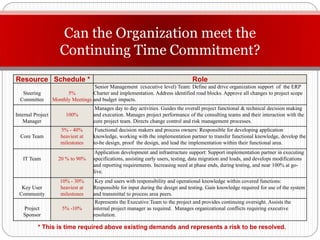
Can the Organization meet the
                      Continuing Time Commitment?
Resource Schedule *                                                                 Role
                                     Senior Management (executive level) Team: Define and drive organization support of the ERP
   Steering              5%         Charter and implementation. Address identified road blocks. Approve all changes to project scope
  Committee        Monthly Meetings and budget impacts.
                                      Manages day to day activities. Guides the overall project functional & technical decision making
Internal Project         100%        and execution. Manages project performance of the consulting teams and their interaction with the
    Manager                          core project team. Directs change control and risk management processes.
                      5% - 40%        Functional decision makers and process owners: Responsible for developing application
  Core Team           heaviest at    knowledge, working with the implementation partner to transfer functional knowledge, develop the
                      milestones     to-be design, proof the design, and lead the implementation within their functional area.
                                      Application development and infrastructure support: Support implementation partner in executing
   IT Team           20 % to 90%     specifications, assisting early users, testing, data migration and loads, and develops modifications
                                     and reporting requirements. Increasing need at phase ends, during testing, and near 100% at go-
                                     live.
                      10% - 30%       Key end users with responsibility and operational knowledge within covered functions:
  Key User            heaviest at    Responsible for input during the design and testing. Gain knowledge required for use of the system
 Community            milestones     and transmittal to process area peers.
                                      Represents the Executive Team to the project and provides continuing oversight. Assists the
   Project             5% -10%       internal project manager as required. Manages organizational conflicts requiring executive
   Sponsor                           resolution.

          * This is time required above existing demands and represents a risk to be resolved.
Discussion

ERP: Start The Discussion

  • 1.
    ERP: Why, What,Which, How Barry M. Cole, Interim Change and Transformation Management cxo@gate.net
  • 2.
    Do We HaveAnswers So we are thinking about ERP. And, we understand that it will alter the way we do business for the next 10 to 20 years. So… 1. Why are thinking about ERP? 2. What does ERP mean? a. To the business? b. To the People? c. To our customers? 3. Which ERP framework? 4. How do we start?
  • 3.
    Why Are WeThinking ERP? Successfully implementing Enterprise Resource Planning requires understanding “WHY” at an organizational level. 1. Is our senior technology manager saying: “the systems are twenty years old and new technology will put us where we need to be”? 2. Are the ERP vendors saying: “out of the box; we have all the bells and whistles to make your life wonderful… And, here is our TCO white paper”? 3. Are employees saying: “it looks old… The screens aren’t easy”? 4. Or, is the business asking: “How can we more agile, increase innovation, and have more vitality in the marketplace”? 5. All of the above? None of the Above?
  • 4.
    What ERP Means Akey to successfully implementing Enterprise Resource Planning is understanding that it not about technology. It is about managing Fundamental Change effecting: 1. Business Processes (running the business) 2. Financial and Regulatory Constraints 3. People: Producers and Users of Company Information 4. External Relationships: Customers, Trading Partners, Financial Partners, Suppliers, Investors…
  • 5.
    Why This DiscussionIs Important Up to 80% all ERP implementations are judged to have failed to fully meet expectations. How would the below impact our business?  Took longer than expected  Duration exceeded planned timelines  Implementation exceeded planned budget  Increase in total implementation costs as a percentage of total revenues  Increases in expected implementation costs  Organizational resistance and learning curves  Major operational disruptions with go-live Only 68% of executives and 61% of employees are at least somewhat satisfied with their implemented ERP solution (Panorama study, 2009).
  • 6.
    Selection Criteria: Which Analyzethe magnitude of the change? 1. What should our operating environment look like when this new ERP is in place? 2. What will our organization look like? 3. How will the constraints inherent in each of the considered ERP’s influence the “how” of questions 1 and 2 above. 4. Can the new process, execution, and technology skills demanded by each considered ERP be developed or if they must be recruited; can they be easily found?
  • 7.
    Selection Criteria: Which Doesthe ERP vendor understand my sector and business model? 1. Financials including valuations 2. Product Management life-cycle 3. Supply Chain 4. Production Modes 5. Servicing and Customer Support Models 6. Fulfillment Note: ERP platform modules are often highly configurable… These same questions should be asked when selecting an implementation partner for the chosen platform. The perfect platform with the wrong partner adds very major risks to a successful implementation.
  • 8.
    Selection Criteria: Which DoesERP platform X meet our unique company needs? 1. Multi-company/Multi-national operations 2. Volatile marketplace 3. Varying order and production handling modes 4. Regulatory compliance and reporting 5. Product life-cycle management 6. Sales and customer communications and support 7. Financial reporting agility (internal & external)
  • 9.
    ERP Project Management Alwaysremember that ERP is about managing the business. 1. ERP as fundamental enterprise change requires continuing buy-in and involvement of the entire executive team. Throughout the entire process; decision makers must be, involved, available, and willing to make decisions. 2. Viewing an ERP as implementation of technology is a major project risk! 3. Business complexity and volatility will significantly impact the implementation budget and continuing TCM (total cost of maintenance). a) How able are we to look out to a 18 or 24 month horizon? b) How able are we to “freeze” our business model for an extended period? c) Do we understand the effects of interim business changes on an ERP implementation? (Platform vendors will often make “out-of-the box” product representations that are generally true under only the simplest business models).
  • 10.
    KEY DECISION: ERPProject Manager ERP project management is about movement toward the business “to-be”. The LEADER of the ERP project should have: 1. In-depth conceptual knowledge of each operating area of the business to be effected by the new ERP value stream. Knowledge of process modeling, best practices, and financials is very helpful. (The implementation partner should bring real sector specific to the project) 2. Strong conceptual knowledge (not expertise) of technology infrastructure and programming needed to guide technology team. (in more larger and complex implementations, a separate project manager for the IT sub-project may be appropriate) 3. Significant matrix management experience and relationship skills. Strong oral, written, and presentation skills. Able to communicate effectively with the executive suite, process management, the financial team, or the plant floor. Risk Consideration: (The right project manager positioned incorrectly will add significant risk - Choose someone capable of acting as a trusted advisor to the President ) Organizational dynamics must be considered since this is ENTERPRISE level business change. This role should be positioned as a part of senior management. Ideally position the ERP Project Manager as a direct or dotted line report to the President.
  • 11.
    Suggested ERP StartupSteps 1. Name an qualified internal project manager to coordinate and guide subsequent steps. 2. Create detailed gap analysis of as-is and the defined to-be. A. Identify and resolve intermediate steps. B. Identify and begin staffing process for new functional areas. 3. Develop a project charter, scope document, and preliminary budget. 4. Identify and negotiate the ERP platform and implementation partner. 5. Approve project planned budget. ((3E +2W +1B )/6) 6. Project kickoff and core team commissioning. 7. Formal project plan.
  • 12.
    Can the Organizationmeet the Continuing Time Commitment? Resource Schedule * Role Senior Management (executive level) Team: Define and drive organization support of the ERP Steering 5% Charter and implementation. Address identified road blocks. Approve all changes to project scope Committee Monthly Meetings and budget impacts. Manages day to day activities. Guides the overall project functional & technical decision making Internal Project 100% and execution. Manages project performance of the consulting teams and their interaction with the Manager core project team. Directs change control and risk management processes. 5% - 40% Functional decision makers and process owners: Responsible for developing application Core Team heaviest at knowledge, working with the implementation partner to transfer functional knowledge, develop the milestones to-be design, proof the design, and lead the implementation within their functional area. Application development and infrastructure support: Support implementation partner in executing IT Team 20 % to 90% specifications, assisting early users, testing, data migration and loads, and develops modifications and reporting requirements. Increasing need at phase ends, during testing, and near 100% at go- live. 10% - 30% Key end users with responsibility and operational knowledge within covered functions: Key User heaviest at Responsible for input during the design and testing. Gain knowledge required for use of the system Community milestones and transmittal to process area peers. Represents the Executive Team to the project and provides continuing oversight. Assists the Project 5% -10% internal project manager as required. Manages organizational conflicts requiring executive Sponsor resolution. * This is time required above existing demands and represents a risk to be resolved.
  • 13.