Enterprise Resources : MULE
2
What is an ESB?
An Enterprise Service Bus (ESB) is fundamentally an architecture. It is a
set of rules and principles for integrating numerous applications together
over a bus-like infrastructure. ESB products enable users to build this type
of architecture, but vary in the way that they do it and the capabilities that
they offer. The core concept of the ESB architecture is that you integrate
different applications by putting a communication bus between them and
then enable each application to talk to the bus. This decouples systems
from each other, allowing them to communicate without dependency on or
knowledge of other systems on the bus. The concept of ESB was born out
of the need to move away from point-to-point integration, which becomes
brittle and hard to manage over time. Point-to-point integration results in
custom integration code being spread among applications with no central
way to monitor or troubleshoot. This is often referred to as "spaghetti code"
and does not scale because it creates tight dependencies between
applications.
3
WHY USE AN ESB?
Providing an External HTTP or HTTPS Port
ESBIncreasing organizational agility by reducing time to market for
new initiatives is one of the most common reasons that companies
implement an ESB as the backbone of their IT infrastructure. An ESB
architecture facilitates this by providing a simple, well defined,
"pluggable" system that scales really well. Additionally, an ESB
provides a way to leverage your existing systems and expose them to
new applications using its communication and transformation
capabilities –
See more at:
https://www.mulesoft.com/resources/esb/what-esb#sthash.Bm6MFBKj.
4
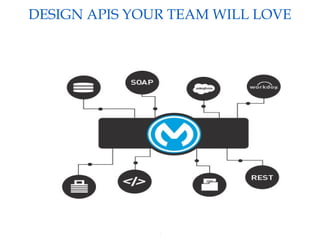
DESIGN APIS YOUR TEAM WILL LOVE
Providing an External HTTP or HTTPS Port
5
IMPLEMENTATION
Providing an External HTTP or HTTPS Port
The ESB architecture has some key principles that allow for business
agility and scale. The key focus is to decouple systems from each
other while allowing them to communicate in a consistent and
manageable way.
The "bus" concept decouples applications from each other. This is
usually acheived using a messaging server like JMS or AMQP.
The data that travels on the bus is a canonical format and is almost
always XML.
There is an "adapter" between the application and the bus that
marshals data between the two parties.
The adapter is responsible for talking to the backend application and
transforming data from the application format to the bus format. The
adapter can also perform a host of other activities such as message
routing transaction management, security, monitoring, error handling,
etc.
6
INTEGRATION CORE PRINCIPLES
Providing an External HTTP or HTTPS Port
Let's take a look at how an ESB architecture maps to our five core
integration principles:
Orchestration: Composing several existing fine-grained components
into a single higher order composite service. This can be done to
achieve appropriate "granularity" of services and promote reuse and
manageability of the underlying components.
Transformation: Data transformation between canonical data formats
and specific data formats required by each ESB connector. An
example of this would be transforming between CSV, Cobol copybook
or EDI formats to either SOAP/XML or JSON. Canoncial data formats
can greatly simplify the transformation requirements associated with
a large ESB implementation where there are many consumers and
providers, each with their own data formats and definitions.
Transportation: Transport protocol negotiation between multiple
formats (such as HTTP, JMS, JDBC). Note: Mule treats databases like
another "service" by making JDBC just another transport (or
endpoint) where data can be accessed.
7
CHOOSING AN ESB PLATFORM
Providing an External HTTP or HTTPS Port
There are many ESB platforms out there, from big proprietary vendors
to niche and open source vendors. On paper, there are lots of
similarities. Here are some points to consider when making an ESB
selection.
Lightweight
Mule is the most lightweight integration platform available, with the
fully loaded distribution weighing in at 40 MB. It is modular by design
so you can strip out unwanted modules if you need to reduce the
footprint. We don't see "lightweight" as just about size either; it is
also the cost of making changes to existing integrations and the
amount of heavy lifting you need to do to make changes. The Mule
run-time offers modularization and super-fast hot deployment as well
as a configuration model that makes it easy to re-order and
add/change functionality.
8
CHOOSING AN ESB PLATFORM
Providing an External HTTP or HTTPS Port
Not just mediation
Most vendors think of an ESB as purely mediation between systems
and have separate products for hosting business logic and publishing
services. We see this as unnecessary complexity. Mule provides a
light and scalable service container for publishing REST and SOAP
services. Since Mule integrates tightly with Spring, it means
developers can also leverage the capabilities of Spring to implement
business logic.
- See more at: https://www.mulesoft.com/resources/esb/what-
esb#sthash.Bm6MFBKj.dpuf
THANK YOU
THANK YOU

Enterprise resources and mule

  • 1.
  • 2.
    2 What is anESB? An Enterprise Service Bus (ESB) is fundamentally an architecture. It is a set of rules and principles for integrating numerous applications together over a bus-like infrastructure. ESB products enable users to build this type of architecture, but vary in the way that they do it and the capabilities that they offer. The core concept of the ESB architecture is that you integrate different applications by putting a communication bus between them and then enable each application to talk to the bus. This decouples systems from each other, allowing them to communicate without dependency on or knowledge of other systems on the bus. The concept of ESB was born out of the need to move away from point-to-point integration, which becomes brittle and hard to manage over time. Point-to-point integration results in custom integration code being spread among applications with no central way to monitor or troubleshoot. This is often referred to as "spaghetti code" and does not scale because it creates tight dependencies between applications.
  • 3.
    3 WHY USE ANESB? Providing an External HTTP or HTTPS Port ESBIncreasing organizational agility by reducing time to market for new initiatives is one of the most common reasons that companies implement an ESB as the backbone of their IT infrastructure. An ESB architecture facilitates this by providing a simple, well defined, "pluggable" system that scales really well. Additionally, an ESB provides a way to leverage your existing systems and expose them to new applications using its communication and transformation capabilities – See more at: https://www.mulesoft.com/resources/esb/what-esb#sthash.Bm6MFBKj.
  • 4.
    4 DESIGN APIS YOURTEAM WILL LOVE Providing an External HTTP or HTTPS Port
  • 5.
    5 IMPLEMENTATION Providing an ExternalHTTP or HTTPS Port The ESB architecture has some key principles that allow for business agility and scale. The key focus is to decouple systems from each other while allowing them to communicate in a consistent and manageable way. The "bus" concept decouples applications from each other. This is usually acheived using a messaging server like JMS or AMQP. The data that travels on the bus is a canonical format and is almost always XML. There is an "adapter" between the application and the bus that marshals data between the two parties. The adapter is responsible for talking to the backend application and transforming data from the application format to the bus format. The adapter can also perform a host of other activities such as message routing transaction management, security, monitoring, error handling, etc.
  • 6.
    6 INTEGRATION CORE PRINCIPLES Providingan External HTTP or HTTPS Port Let's take a look at how an ESB architecture maps to our five core integration principles: Orchestration: Composing several existing fine-grained components into a single higher order composite service. This can be done to achieve appropriate "granularity" of services and promote reuse and manageability of the underlying components. Transformation: Data transformation between canonical data formats and specific data formats required by each ESB connector. An example of this would be transforming between CSV, Cobol copybook or EDI formats to either SOAP/XML or JSON. Canoncial data formats can greatly simplify the transformation requirements associated with a large ESB implementation where there are many consumers and providers, each with their own data formats and definitions. Transportation: Transport protocol negotiation between multiple formats (such as HTTP, JMS, JDBC). Note: Mule treats databases like another "service" by making JDBC just another transport (or endpoint) where data can be accessed.
  • 7.
    7 CHOOSING AN ESBPLATFORM Providing an External HTTP or HTTPS Port There are many ESB platforms out there, from big proprietary vendors to niche and open source vendors. On paper, there are lots of similarities. Here are some points to consider when making an ESB selection. Lightweight Mule is the most lightweight integration platform available, with the fully loaded distribution weighing in at 40 MB. It is modular by design so you can strip out unwanted modules if you need to reduce the footprint. We don't see "lightweight" as just about size either; it is also the cost of making changes to existing integrations and the amount of heavy lifting you need to do to make changes. The Mule run-time offers modularization and super-fast hot deployment as well as a configuration model that makes it easy to re-order and add/change functionality.
  • 8.
    8 CHOOSING AN ESBPLATFORM Providing an External HTTP or HTTPS Port Not just mediation Most vendors think of an ESB as purely mediation between systems and have separate products for hosting business logic and publishing services. We see this as unnecessary complexity. Mule provides a light and scalable service container for publishing REST and SOAP services. Since Mule integrates tightly with Spring, it means developers can also leverage the capabilities of Spring to implement business logic. - See more at: https://www.mulesoft.com/resources/esb/what- esb#sthash.Bm6MFBKj.dpuf
  • 9.
  • 10.