IPADS IN THE CLASSROOM: A SYSTEMATIC
LITERATURE REVIEW
E-LEARN: WORLD CONFERENCE ON E-LEARNING
NOVEMBER 14-16, 2016, THE WESTIN ALEXANDRIA, USA
PRESENTER: MD. SAIFUDDIN KHALID
Asst. Prof., PhD (HCCI), M.Sc. & B.Sc. (Comp. Sci.),
Motivation
• Explore & emphasize on the technological
functionalities, pedagogical design, and barriers to the
integration of iPads in Lessons.
• Facilitate reluctant teachers, school leaders,
parents, and other stakeholders
• Research Question: What are the technological and
pedagogical potentials and problems of integrating
iPad in schools?
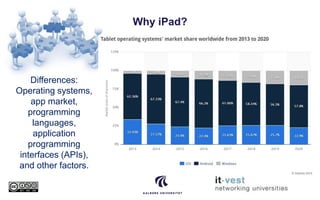
Why iPad?
Differences:
Operating systems,
app market,
programming
languages,
application
programming
interfaces (APIs),
and other factors.
Methodology
• Method: PRISMA checklist for reporting systematic reviews and
meta-analyses (Liberati et al., 2009)
• Databases: EBSCOhost (21 databases, including ERIC & Academic
Search Premier), Google Scholar, and IEEE Xplore Digital Library
• Keywords: iPad, education, and school
• Timeline: January 2010 and September 2014
• Note: Using “K-12” instead of “school” returns duplicates.
• Full-papers for screening: 59
• Included: 17 peer-reviewed articles
• Exclusion: ADHD and autism; contexts of higher educational
institutions; and pre-schools or kindergartens
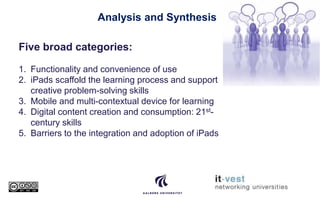
Analysis and Synthesis
Five broad categories:
1. Functionality and convenience of use
2. iPads scaffold the learning process and support
creative problem-solving skills
3. Mobile and multi-contextual device for learning
4. Digital content creation and consumption: 21st-
century skills
5. Barriers to the integration and adoption of iPads
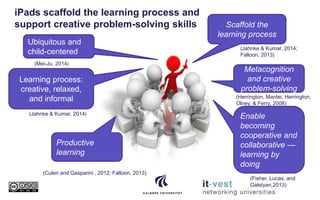
iPads scaffold the learning process and
support creative problem-solving skills
Ubiquitous and
child-centered
Learning process:
creative, relaxed,
and informal
Scaffold the
learning process
Metacognition
and creative
problem-solving
Enable
becoming
cooperative and
collaborative —
learning by
doing
Productive
learning
(Jahnke & Kumar, 2014)
(Culen and Gasparini , 2012; Falloon, 2013)
(Jahnke & Kumar, 2014;
Falloon, 2013)
(Fisher, Lucas, and
Galstyan,2013)
(Herrington, Mantei, Herrington,
Olney, & Ferry, 2008)
(Mei-Ju, 2014)
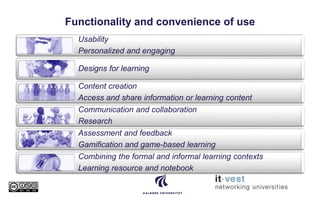
Functionality and convenience of use
Usability
Personalized and engaging
Designs for learning
Content creation
Access and share information or learning content
Communication and collaboration
Research
Assessment and feedback
Gamification and game-based learning
Combining the formal and informal learning contexts
Learning resource and notebook
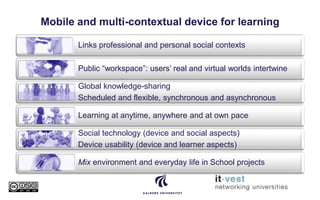
Mobile and multi-contextual device for learning
Links professional and personal social contexts
Public “workspace”: users’ real and virtual worlds intertwine
Global knowledge-sharing
Scheduled and flexible, synchronous and asynchronous
Learning at anytime, anywhere and at own pace
Social technology (device and social aspects)
Device usability (device and learner aspects)
Mix environment and everyday life in School projects
Barriers to iPad integration and adoption
• Operation and maintenance
• Access
• Attitude
• Distraction
• Advertisements
• Motivation for learning
• Omnipresence
• Apps
• Security
• Miscellaneous: human contact,
ergonomics, bandwidth requirements,
startup cost, recurring costs, cheating
during exams, and class disruption
Scope of Further Research (Authors): Method of Analysis
• Categorize iPad use in classroom by applying ICT-TPCK framework,
i.e.:
• Technology (functionality, Usability and UX),
• Pedagogy,
• Content,
• Learners and Context (Anglei, C. & Valanides, N, 2009).
• Pedagogy: as Activity System (Engeström et al., 1999)
References
• Angeli, C., & Valanides, N. (2009). Epistemological and methodological issues for the
conceptualization, development, and assessment of ICT–TPCK: Advances in technological
pedagogical content knowledge (TPCK). Computers & Education, 52(1), 154–168.
https://doi.org/10.1016/j.compedu.2008.07.006
• Engeström, Y., Miettinen, R., & Punamäki, R.-L. (1999). Perspectives on Activity Theory. Cambridge
University Press.
Scope of Further Research: From reviewed articles
• Kearney et al.’s (2015): Mobile technologies in informal spaces outside
school.
• Mei-Ju (2014): Children’s development in the kindergarten.
• Falloon & Khoo (2014): Hypothesized, conscious and permanent
compositions by children could improve learning.
• to identify, to devise and to compare different frameworks for digital
didactical designs
• Mangen, Robinet, Olivier, and Velay (2014): Readers have more
difficulty remembering details and sequence of stories when they read
on the tablet instead of on paper. Valid and reliable? If yes, is it
desirable?
Scope of Further Research (Authors)
• iPad-integrated pedagogical design of subject-specific lessons.
• How can a combination of specific iPad apps and analog resources be
integrated into lessons in different subjects?
• What are individual students’ cognitive and social challenges when
engaging in collaborative or cooperative learning with iPads?
• How can teachers differentiate teaching activities with iPads?
• How can formative and summative evaluation be made convenient for
students and teachers?
• Identify or devise and apply frameworks for digital didactic designs.
Scope of Further Research (Authors, Cont.)
• UX factors: Text editing, copy-pasting, the lack of arrow keys, multitasking,
file copying.
• Empirical studies and reviews on
• the digital didactic designs,
• appropriated apps for different subjects,
• signature pedagogies,
• assessment or feedback, and
• evaluation of the application of different digital didactic designs.
• For improved replicability, iPad-integrated case studies should be subject-
specific, student-focused and app-appropriated. Research findings from
such iPad-integrated pedagogy-focused action research would contribute
significantly to the fields of education and educational technology.
Question and Answer
Md. Saifuddin Khalid professorkhalid@gmail.com
Khalid and Peture E-Learn 2016 2 Washington DC

Khalid and Peture E-Learn 2016 2 Washington DC

  • 1.
    IPADS IN THECLASSROOM: A SYSTEMATIC LITERATURE REVIEW E-LEARN: WORLD CONFERENCE ON E-LEARNING NOVEMBER 14-16, 2016, THE WESTIN ALEXANDRIA, USA PRESENTER: MD. SAIFUDDIN KHALID Asst. Prof., PhD (HCCI), M.Sc. & B.Sc. (Comp. Sci.),
  • 2.
    Motivation • Explore &emphasize on the technological functionalities, pedagogical design, and barriers to the integration of iPads in Lessons. • Facilitate reluctant teachers, school leaders, parents, and other stakeholders • Research Question: What are the technological and pedagogical potentials and problems of integrating iPad in schools?
  • 3.
    Why iPad? Differences: Operating systems, appmarket, programming languages, application programming interfaces (APIs), and other factors.
  • 4.
    Methodology • Method: PRISMAchecklist for reporting systematic reviews and meta-analyses (Liberati et al., 2009) • Databases: EBSCOhost (21 databases, including ERIC & Academic Search Premier), Google Scholar, and IEEE Xplore Digital Library • Keywords: iPad, education, and school • Timeline: January 2010 and September 2014 • Note: Using “K-12” instead of “school” returns duplicates. • Full-papers for screening: 59 • Included: 17 peer-reviewed articles • Exclusion: ADHD and autism; contexts of higher educational institutions; and pre-schools or kindergartens
  • 5.
    Analysis and Synthesis Fivebroad categories: 1. Functionality and convenience of use 2. iPads scaffold the learning process and support creative problem-solving skills 3. Mobile and multi-contextual device for learning 4. Digital content creation and consumption: 21st- century skills 5. Barriers to the integration and adoption of iPads
  • 6.
    iPads scaffold thelearning process and support creative problem-solving skills Ubiquitous and child-centered Learning process: creative, relaxed, and informal Scaffold the learning process Metacognition and creative problem-solving Enable becoming cooperative and collaborative — learning by doing Productive learning (Jahnke & Kumar, 2014) (Culen and Gasparini , 2012; Falloon, 2013) (Jahnke & Kumar, 2014; Falloon, 2013) (Fisher, Lucas, and Galstyan,2013) (Herrington, Mantei, Herrington, Olney, & Ferry, 2008) (Mei-Ju, 2014)
  • 7.
    Functionality and convenienceof use Usability Personalized and engaging Designs for learning Content creation Access and share information or learning content Communication and collaboration Research Assessment and feedback Gamification and game-based learning Combining the formal and informal learning contexts Learning resource and notebook
  • 8.
    Mobile and multi-contextualdevice for learning Links professional and personal social contexts Public “workspace”: users’ real and virtual worlds intertwine Global knowledge-sharing Scheduled and flexible, synchronous and asynchronous Learning at anytime, anywhere and at own pace Social technology (device and social aspects) Device usability (device and learner aspects) Mix environment and everyday life in School projects
  • 9.
    Barriers to iPadintegration and adoption • Operation and maintenance • Access • Attitude • Distraction • Advertisements • Motivation for learning • Omnipresence • Apps • Security • Miscellaneous: human contact, ergonomics, bandwidth requirements, startup cost, recurring costs, cheating during exams, and class disruption
  • 10.
    Scope of FurtherResearch (Authors): Method of Analysis • Categorize iPad use in classroom by applying ICT-TPCK framework, i.e.: • Technology (functionality, Usability and UX), • Pedagogy, • Content, • Learners and Context (Anglei, C. & Valanides, N, 2009). • Pedagogy: as Activity System (Engeström et al., 1999) References • Angeli, C., & Valanides, N. (2009). Epistemological and methodological issues for the conceptualization, development, and assessment of ICT–TPCK: Advances in technological pedagogical content knowledge (TPCK). Computers & Education, 52(1), 154–168. https://doi.org/10.1016/j.compedu.2008.07.006 • Engeström, Y., Miettinen, R., & Punamäki, R.-L. (1999). Perspectives on Activity Theory. Cambridge University Press.
  • 11.
    Scope of FurtherResearch: From reviewed articles • Kearney et al.’s (2015): Mobile technologies in informal spaces outside school. • Mei-Ju (2014): Children’s development in the kindergarten. • Falloon & Khoo (2014): Hypothesized, conscious and permanent compositions by children could improve learning. • to identify, to devise and to compare different frameworks for digital didactical designs • Mangen, Robinet, Olivier, and Velay (2014): Readers have more difficulty remembering details and sequence of stories when they read on the tablet instead of on paper. Valid and reliable? If yes, is it desirable?
  • 12.
    Scope of FurtherResearch (Authors) • iPad-integrated pedagogical design of subject-specific lessons. • How can a combination of specific iPad apps and analog resources be integrated into lessons in different subjects? • What are individual students’ cognitive and social challenges when engaging in collaborative or cooperative learning with iPads? • How can teachers differentiate teaching activities with iPads? • How can formative and summative evaluation be made convenient for students and teachers? • Identify or devise and apply frameworks for digital didactic designs.
  • 13.
    Scope of FurtherResearch (Authors, Cont.) • UX factors: Text editing, copy-pasting, the lack of arrow keys, multitasking, file copying. • Empirical studies and reviews on • the digital didactic designs, • appropriated apps for different subjects, • signature pedagogies, • assessment or feedback, and • evaluation of the application of different digital didactic designs. • For improved replicability, iPad-integrated case studies should be subject- specific, student-focused and app-appropriated. Research findings from such iPad-integrated pedagogy-focused action research would contribute significantly to the fields of education and educational technology.
  • 14.
    Question and Answer Md.Saifuddin Khalid professorkhalid@gmail.com

Editor's Notes

  • #4 Source> https://www.statista.com/statistics/272446/global-market-share-held-by-tablet-operating-systems/
  • #10 Image source: https://fthmb.tqn.com/xLP5GfXJTJ-cOmUokIB4blDkTnM=/768x0/filters:no_upscale()/about/broken_ipad_hires-581a007b5f9b581c0b8fbe6b.png