IPTR 1- REVIEW
ST JOSEPH UNIVERSITY COLLEGE OF
ENGINEERING AND TECHNOLOGY
COMPANY NAME : TANGANYIKA PLANTING COMPANY
(TPC) Ltd.
STUDENT NAME : AMRAN HASHIM ALLY
REGISTRATION NO. : 14171052003
MECHANICAL ENGINEERING
ABSTRACT
My training report is about Workshop
activities during industrial maintenance
which involves difference mechanical
process such as
machining(drilling,milling,turning,threading
ect.),metal fabrication and pattern design
and molding(sand casting).
TANGANYIKA PLANTING COMPANY (TPC) Ltd.
Is one of the sugar industry in Tanzania which is located
at Moshi established in early 1930s. The company was
registered in Tanzania as TPC on 29th June 1973 and
shareholders remained the same M/s A.P.Moller of Denmark.
Sukari Investment Company Ltd purchased 75% of shares of
TPC limited in March 2000, and became the majority
shareholders of the company; the government retained the
remaining 25%. . The factory crushing capacity has been
increased from 125TCH to 160 TCH, the area under
sugarcane was extended from about 6000ha to 8000ha. The
harvests season at Tpc lasts for 8.5 months from July to mid-
March because of the long rains which usually hindering the
harvesting and transportation of cane, the sucrose content also
falls to the lowest level during the rainy season.
COMPANY DETAILS
SAND
CASTING
PATTERN DESIGN AND MOULDING PROCESS
PATTERN DESIGN
 Pattern making:
1. Motor fan
2. Bush
3. Hollow shaft
4. Ejector
5. Square nut
MOULDING
Molding or moulding ; is the process
of manufacturing by shaping liquid or pliable raw
material using a rigid frame called a mold or
matrix. This itself may have been made using a
pattern or model of the final object
MOLD MATERIALS
 There are four main components for
making a sand casting mold: base
sand, a binder, additives, and
a parting compound.
 Molding sands, also known
as foundry sands, are defined by
eight characteristics:
refractoriness, chemical
inertness, permeability, surface
finish, cohesiveness, flow ability,
collapsibility, and availability/cost
 Binders are added to base sand
to bond the sand particles
together (i.e. it is the glue that
holds the mold together).
 A mixture of clay and water is the
most commonly used binder.
There are two types of clay
commonly
used: bentonite and kaolinite
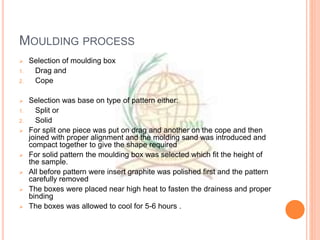
PREPARATION OF MOULDING SAND
 Required to mix
1. Non mineral sea sand
2. Bentonite
3. Water
 Mixing of water was gradual process for proper
wetness (low wet sand was required) ,the mixture
allowed to settle while little water spread.
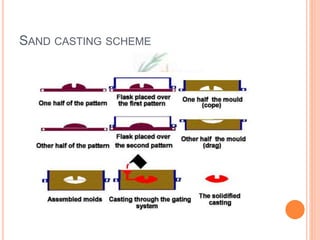
MOULDING PROCESS
 Selection of moulding box
1. Drag and
2. Cope
 Selection was base on type of pattern either:
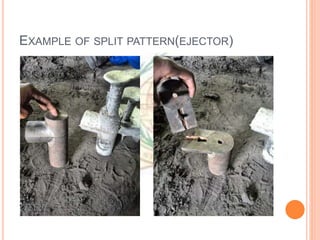
1. Split or
2. Solid
 For split one piece was put on drag and another on the cope and then
joined with proper alignment and the molding sand was introduced and
compact together to give the shape required
 For solid pattern the moulding box was selected which fit the height of
the sample.
 All before pattern were insert graphite was polished first and the pattern
carefully removed
 The boxes were placed near high heat to fasten the drainess and proper
binding
 The boxes was allowed to cool for 5-6 hours .
SAND CASTING SCHEME
EXAMPLE OF SPLIT PATTERN(EJECTOR)
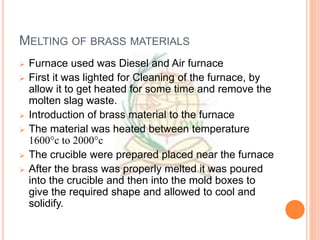
MELTING OF BRASS MATERIALS
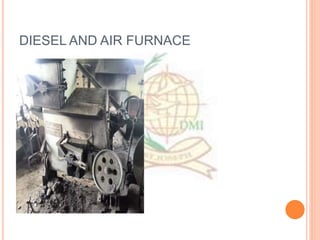
 Furnace used was Diesel and Air furnace
 First it was lighted for Cleaning of the furnace, by
allow it to get heated for some time and remove the
molten slag waste.
 Introduction of brass material to the furnace
 The material was heated between temperature
1600°c to 2000°c
 The crucible were prepared placed near the furnace
 After the brass was properly melted it was poured
into the crucible and then into the mold boxes to
give the required shape and allowed to cool and
solidify.
DIESEL AND AIR FURNACE
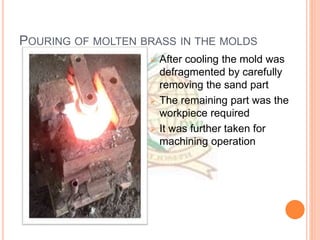
POURING OF MOLTEN BRASS IN THE MOLDS
 After cooling the mold was
defragmented by carefully
removing the sand part
 The remaining part was the
workpiece required
 It was further taken for
machining operation
FOLLOWING SAFE PRACTICES
 Wear heat-safe gloves, apron, and boots
 Wear cotton or wool clothing
 Protect your face and eyes
 Consider a respirator
CONCLUSION
I am well satisfied with my training. I have
learned many new technical subjects, acquired a
number of new technical skills and improved
another group of existing skills such as:
 Increased skills in repairing faulty in machine
process
 Large steps in improving my abilities in
designing and repairing of materials
 Most important is how team work create high
efficiency and excellent work performance.
THANK YOU

sand casting

  • 1.
    IPTR 1- REVIEW STJOSEPH UNIVERSITY COLLEGE OF ENGINEERING AND TECHNOLOGY COMPANY NAME : TANGANYIKA PLANTING COMPANY (TPC) Ltd. STUDENT NAME : AMRAN HASHIM ALLY REGISTRATION NO. : 14171052003 MECHANICAL ENGINEERING
  • 2.
    ABSTRACT My training reportis about Workshop activities during industrial maintenance which involves difference mechanical process such as machining(drilling,milling,turning,threading ect.),metal fabrication and pattern design and molding(sand casting).
  • 3.
    TANGANYIKA PLANTING COMPANY(TPC) Ltd. Is one of the sugar industry in Tanzania which is located at Moshi established in early 1930s. The company was registered in Tanzania as TPC on 29th June 1973 and shareholders remained the same M/s A.P.Moller of Denmark. Sukari Investment Company Ltd purchased 75% of shares of TPC limited in March 2000, and became the majority shareholders of the company; the government retained the remaining 25%. . The factory crushing capacity has been increased from 125TCH to 160 TCH, the area under sugarcane was extended from about 6000ha to 8000ha. The harvests season at Tpc lasts for 8.5 months from July to mid- March because of the long rains which usually hindering the harvesting and transportation of cane, the sucrose content also falls to the lowest level during the rainy season. COMPANY DETAILS
  • 4.
  • 5.
    PATTERN DESIGN  Patternmaking: 1. Motor fan 2. Bush 3. Hollow shaft 4. Ejector 5. Square nut
  • 6.
    MOULDING Molding or moulding; is the process of manufacturing by shaping liquid or pliable raw material using a rigid frame called a mold or matrix. This itself may have been made using a pattern or model of the final object
  • 7.
    MOLD MATERIALS  Thereare four main components for making a sand casting mold: base sand, a binder, additives, and a parting compound.  Molding sands, also known as foundry sands, are defined by eight characteristics: refractoriness, chemical inertness, permeability, surface finish, cohesiveness, flow ability, collapsibility, and availability/cost  Binders are added to base sand to bond the sand particles together (i.e. it is the glue that holds the mold together).  A mixture of clay and water is the most commonly used binder. There are two types of clay commonly used: bentonite and kaolinite
  • 8.
    PREPARATION OF MOULDINGSAND  Required to mix 1. Non mineral sea sand 2. Bentonite 3. Water  Mixing of water was gradual process for proper wetness (low wet sand was required) ,the mixture allowed to settle while little water spread.
  • 9.
    MOULDING PROCESS  Selectionof moulding box 1. Drag and 2. Cope  Selection was base on type of pattern either: 1. Split or 2. Solid  For split one piece was put on drag and another on the cope and then joined with proper alignment and the molding sand was introduced and compact together to give the shape required  For solid pattern the moulding box was selected which fit the height of the sample.  All before pattern were insert graphite was polished first and the pattern carefully removed  The boxes were placed near high heat to fasten the drainess and proper binding  The boxes was allowed to cool for 5-6 hours .
  • 10.
  • 11.
    EXAMPLE OF SPLITPATTERN(EJECTOR)
  • 12.
    MELTING OF BRASSMATERIALS  Furnace used was Diesel and Air furnace  First it was lighted for Cleaning of the furnace, by allow it to get heated for some time and remove the molten slag waste.  Introduction of brass material to the furnace  The material was heated between temperature 1600°c to 2000°c  The crucible were prepared placed near the furnace  After the brass was properly melted it was poured into the crucible and then into the mold boxes to give the required shape and allowed to cool and solidify.
  • 13.
  • 14.
    POURING OF MOLTENBRASS IN THE MOLDS  After cooling the mold was defragmented by carefully removing the sand part  The remaining part was the workpiece required  It was further taken for machining operation
  • 15.
    FOLLOWING SAFE PRACTICES Wear heat-safe gloves, apron, and boots  Wear cotton or wool clothing  Protect your face and eyes  Consider a respirator
  • 16.
    CONCLUSION I am wellsatisfied with my training. I have learned many new technical subjects, acquired a number of new technical skills and improved another group of existing skills such as:  Increased skills in repairing faulty in machine process  Large steps in improving my abilities in designing and repairing of materials  Most important is how team work create high efficiency and excellent work performance.
  • 17.