PRESENTED BY:
IMPANA U S
1ST M.COM
Under the guidance of
Sundar B. N.
Asst. Prof. & Course Co-ordinator
GFGCW, PG Studies in Commerce
Holenarasipura
CONTENTS
Introduction
Meaning
Types
Conclusion
Bibliography
 Statistical agencies prefer the probability random
sampling. In business, companies, marketers mostly
relay on non-probability sampling for their research,
the researcher prefers that because of getting
confidence cooperation from his respondent
especially in the business sample survey like
consumer price index.
Meaning
A sample is a subset of individuals from a larger
population. Sampling means selecting the group that
you will actually collect data from in your research.
For example, if you are researching the opinions of
students in your university, you could survey a
sample of 100 students.
In statistics, sampling allows you to test a hypothesis
about the characteristics of a population.
Type of Sampling
1. Probability Sampling:-Probability sampling is
known as ‘random sampling’ this is a sampling which
permits every single item from the universe to have an equal
chance of presence in the sample. For instance in a raffle draw
were individual units will be picked from the over all group
not a deliberately nonetheless by certain process, this incident
is only a blind of chance that will limits whether unique items
are the additional items is to be preferred
2. Non-probability Sampling :
Non probability sample a particular member of the population
being chosen is unknown.
In Probability sampling, randomness is the element of control.
In Non-probability sampling, it relies on personal judgment .
Probability Sampling
•Population divided
into clusters, random
sample of cluster is
selected from as
simple random
design
•Population is
divide
•Into sub-
population/stratu
m and subjects
selected randomly
•Every nth element
chosen started at
random and
picking every n’th
element in
succession
• All elements are
considered and
each has equal
chance of being
selected
Simple
Random
sampling
Systematic
sampling
C l u s t e r
sampling
Stratified
sampling
Probability sampling
1. Simple Random Sampling: here all member have
the same chance(probability) of being selected.
Random method provides an unbiased cross
selection of the population.
For example,
we wish to draw a sample of 50 students from a
population of 400 students. Place all 400 names in a
container and draw out 50 names one by one.
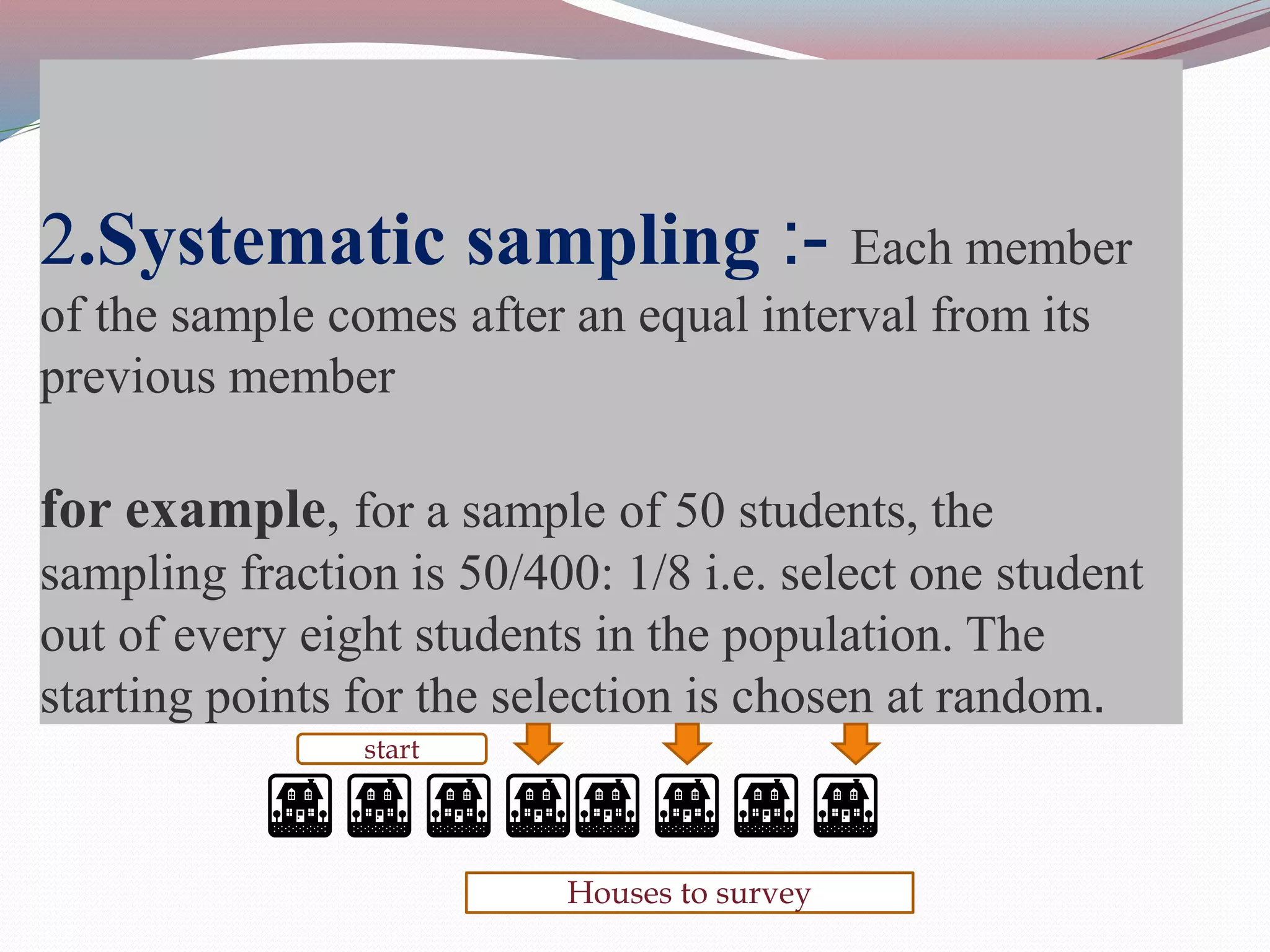
2.Systematic sampling :- Each member
of the sample comes after an equal interval from its
previous member
for example, for a sample of 50 students, the
sampling fraction is 50/400: 1/8 i.e. select one student
out of every eight students in the population. The
starting points for the selection is chosen at random.
start
Houses to survey
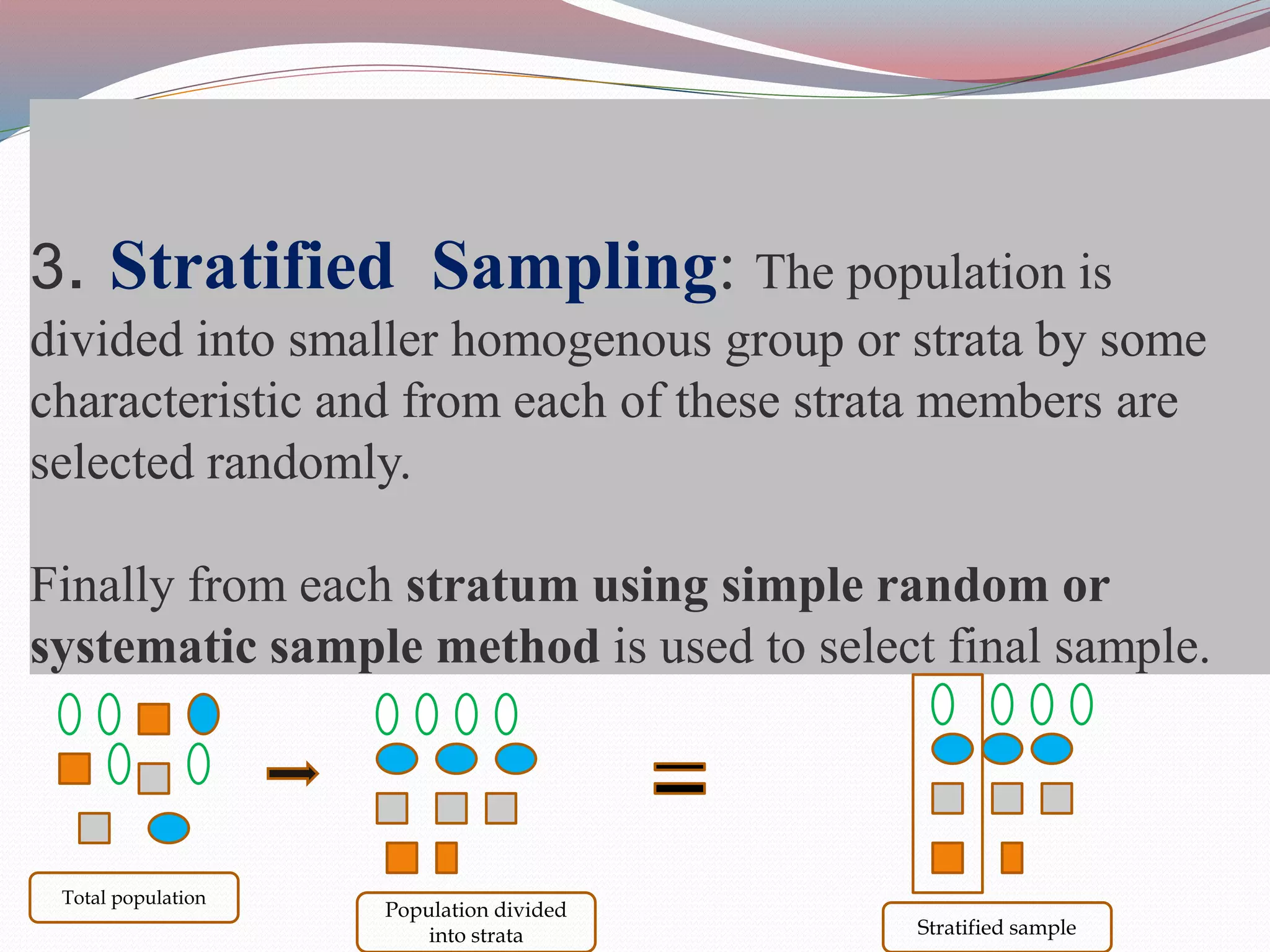
3. Stratified Sampling: The population is
divided into smaller homogenous group or strata by some
characteristic and from each of these strata members are
selected randomly.
Finally from each stratum using simple random or
systematic sample method is used to select final sample.
Total population
Population divided
into strata Stratified sample
4.Cluster sampling(Area
sampling)
A researcher/enumerator selects sampling units at
random and then does complete observation of all
units in the group
For example, the study involves primary schools.
Select randomly 15 schools . Then study all the children
of 15 schools . in cluster sampling the unit of
sampling consists of multiple cases. It is also know as
area sampling . as the selection of individuals member
is made on the basis of place residence or employment
Non probability sampling
• Referred by
current
sample
elements
•Relevant
characteristics are
used to segregate the
sample to improve
its
representativeness
• Deliberately
selected
sample to
conform to
some criteria
• Based on
ease of
accessibility
Convenience
sampling
Judgmental
sampling
Snowball
sampling
Quota
sampling
Non probability sampling
1. Purposive sampling : In this sampling
method, the researcher selects a “typically group” of
individuals who might represent the larger
population and then collects data from this group.
also know as judgmental sampling.
Purposive sample
2. Convenience sampling : It refers to the
procedures of obtaining units or members who are
most conveniently available. It consists of units
which are obtained because cases are readily
available.
In selecting the incidental sample, the researcher
determines the required sample size and then
simply collects data on that number of individuals
who available easily.
Researcher
No black figures in
sample
Convenienc
e sample
3. Quote Sampling : The selection of the sample is
made by the researcher, who decides the quotas for selecting
sample from specified sub group of the population.
For example, an interviewer might be need data from 40
adults and 20 adolescents in order to study students’
television viewing habits.
Selection will be
20 adult men and 20 adult women
10 adolescent girls and 10 adolescent boys
4. Snowball sampling:
In snowball sampling, the researcher Identifying
and selecting available respondent who meet the criteria
for inclusion.
After the data have been collected from the subject, the
researcher asks for a referral of other individuals, who
would also meet the criteria and represent the population of
concern.
Conclusion
In conclusion the probability random sampling in
more preferable because the researcher generate his
data for the use of entire population by using
probabilistic method to control biased during the
sampling , based on evidence generated by the
agencies of statistical official that the non-probability
techniques is based on purpose that lead to
assumption which resulting to risk. Basing on
assumption means one will generate inappropriate
generalization of the population
Bibliography
Sampling meaning and Types(Retrieved from,
https://www.slideshare.net.)Date:-22/4/2021)
Sampling meaning and types(Retrieved from
Dohert M. probability versus Non probability
sampling in sample surveys. The new zealand
statistical review.1994.p.77-100.)
SAMPLING  MEANING AND TYPES

SAMPLING MEANING AND TYPES

  • 1.
    PRESENTED BY: IMPANA US 1ST M.COM Under the guidance of Sundar B. N. Asst. Prof. & Course Co-ordinator GFGCW, PG Studies in Commerce Holenarasipura
  • 2.
  • 3.
     Statistical agenciesprefer the probability random sampling. In business, companies, marketers mostly relay on non-probability sampling for their research, the researcher prefers that because of getting confidence cooperation from his respondent especially in the business sample survey like consumer price index.
  • 4.
    Meaning A sample isa subset of individuals from a larger population. Sampling means selecting the group that you will actually collect data from in your research. For example, if you are researching the opinions of students in your university, you could survey a sample of 100 students. In statistics, sampling allows you to test a hypothesis about the characteristics of a population.
  • 5.
    Type of Sampling 1.Probability Sampling:-Probability sampling is known as ‘random sampling’ this is a sampling which permits every single item from the universe to have an equal chance of presence in the sample. For instance in a raffle draw were individual units will be picked from the over all group not a deliberately nonetheless by certain process, this incident is only a blind of chance that will limits whether unique items are the additional items is to be preferred 2. Non-probability Sampling : Non probability sample a particular member of the population being chosen is unknown. In Probability sampling, randomness is the element of control. In Non-probability sampling, it relies on personal judgment .
  • 6.
    Probability Sampling •Population divided intoclusters, random sample of cluster is selected from as simple random design •Population is divide •Into sub- population/stratu m and subjects selected randomly •Every nth element chosen started at random and picking every n’th element in succession • All elements are considered and each has equal chance of being selected Simple Random sampling Systematic sampling C l u s t e r sampling Stratified sampling
  • 7.
    Probability sampling 1. SimpleRandom Sampling: here all member have the same chance(probability) of being selected. Random method provides an unbiased cross selection of the population. For example, we wish to draw a sample of 50 students from a population of 400 students. Place all 400 names in a container and draw out 50 names one by one.
  • 8.
    2.Systematic sampling :-Each member of the sample comes after an equal interval from its previous member for example, for a sample of 50 students, the sampling fraction is 50/400: 1/8 i.e. select one student out of every eight students in the population. The starting points for the selection is chosen at random. start Houses to survey
  • 9.
    3. Stratified Sampling:The population is divided into smaller homogenous group or strata by some characteristic and from each of these strata members are selected randomly. Finally from each stratum using simple random or systematic sample method is used to select final sample. Total population Population divided into strata Stratified sample
  • 10.
    4.Cluster sampling(Area sampling) A researcher/enumeratorselects sampling units at random and then does complete observation of all units in the group For example, the study involves primary schools. Select randomly 15 schools . Then study all the children of 15 schools . in cluster sampling the unit of sampling consists of multiple cases. It is also know as area sampling . as the selection of individuals member is made on the basis of place residence or employment
  • 11.
    Non probability sampling •Referred by current sample elements •Relevant characteristics are used to segregate the sample to improve its representativeness • Deliberately selected sample to conform to some criteria • Based on ease of accessibility Convenience sampling Judgmental sampling Snowball sampling Quota sampling
  • 12.
    Non probability sampling 1.Purposive sampling : In this sampling method, the researcher selects a “typically group” of individuals who might represent the larger population and then collects data from this group. also know as judgmental sampling. Purposive sample
  • 13.
    2. Convenience sampling: It refers to the procedures of obtaining units or members who are most conveniently available. It consists of units which are obtained because cases are readily available. In selecting the incidental sample, the researcher determines the required sample size and then simply collects data on that number of individuals who available easily. Researcher No black figures in sample Convenienc e sample
  • 14.
    3. Quote Sampling: The selection of the sample is made by the researcher, who decides the quotas for selecting sample from specified sub group of the population. For example, an interviewer might be need data from 40 adults and 20 adolescents in order to study students’ television viewing habits. Selection will be 20 adult men and 20 adult women 10 adolescent girls and 10 adolescent boys
  • 15.
    4. Snowball sampling: Insnowball sampling, the researcher Identifying and selecting available respondent who meet the criteria for inclusion. After the data have been collected from the subject, the researcher asks for a referral of other individuals, who would also meet the criteria and represent the population of concern.
  • 16.
    Conclusion In conclusion theprobability random sampling in more preferable because the researcher generate his data for the use of entire population by using probabilistic method to control biased during the sampling , based on evidence generated by the agencies of statistical official that the non-probability techniques is based on purpose that lead to assumption which resulting to risk. Basing on assumption means one will generate inappropriate generalization of the population
  • 17.
    Bibliography Sampling meaning andTypes(Retrieved from, https://www.slideshare.net.)Date:-22/4/2021) Sampling meaning and types(Retrieved from Dohert M. probability versus Non probability sampling in sample surveys. The new zealand statistical review.1994.p.77-100.)