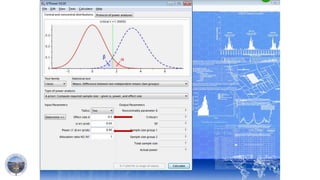
How to determine the
correct sample size
of a research
Sample size
calculation
• The sample size calculation or estimation
has no one single formula that can apply
universally to all situations and
circumstances.
• The sample size estimation can be done
either by using;
• Manual calculation,
• Sample size software,
• Sample size tables from scientific
published articles,
• Adopting various acceptable rule-of-
thumbs.
Bujang MA, 2021
Factors that
must be
estimated
to calculate
sample size
• There are four factors that must be
known or estimated to calculate
sample size:
1. The effect size;
2. The population standard deviation;
3. The power of the experiment; and
4. The significance level.
Dell et al., 2002
1. The effect size
• The effect size indicates how meaningful the relationship
between variables or the difference between groups is. It also indicates the
practical significance of a research outcome.
• The effect sizes are independent of the sample size, only the data is used to
calculate effect sizes.
• A large effect size means that a research finding has practical significance,
while a small effect size indicates limited practical applications.
• The practical significance shows that the effect is large enough to be
meaningful in the real world.
Bujang MA, 2021; Bhandari P, 2022
1. The effect size cont’d
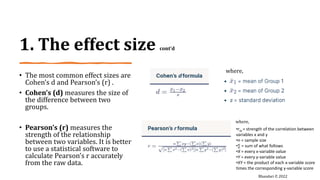
• The most common effect sizes are
Cohen’s d and Pearson’s (r) .
• Cohen’s (d) measures the size of
the difference between two
groups.
• Pearson’s (r) measures the
strength of the relationship
between two variables. It is better
to use a statistical software to
calculate Pearson’s r accurately
from the raw data.
Bhandari P, 2022
•rxy = strength of the correlation between
variables x and y
•n = sample size
•∑ = sum of what follows
•X = every x-variable value
•Y = every y-variable value
•XY = the product of each x-variable score
times the corresponding y-variable score
where,
where,
Estimation
of the
effect size
• It is usually quite challenging to estimate an
accurate effect size since the exact value of
the effect size is not known until the study is
completed. However, the researcher will still
have to set the value of effect size for the
purpose of sample size calculation or
estimation.
Bujang MA, 2021
Estimation of the effect size cont’d
The effect size can be estimated from:
 Literature review
• the acceptable and desirable way.
• it is better to obtain the needed information from recent articles (within 5 years)
that used almost similar design, same treatment and similar patient
characteristics.
 From historical data or secondary data
• provided researcher has access to all data of different group
• not always feasible since a new intervention may not have been assessed yet
 Educated guess or expert opinion
• researches/experts can use his experience and knowledge to set up an effect size
that is scientifically or clinically meaningful
Bujang MA, 2021
2. The population standard deviation
• The standard deviation is used
with continuous data, but not categorical data.
• The population standard deviation is a parameter.
• It is a fixed value calculated from every individual in
the population.
• The standard deviation, is appropriate when the
continuous data is not significantly skewed or has
outliers.
• It can be derived from literature review, pilot
study or from any reliable source.
Laerd Statistics [cited 2022 Sep 9]
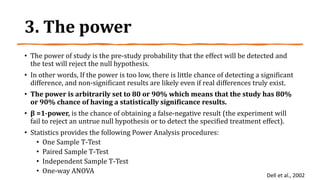
3. The power
• The power of study is the pre-study probability that the effect will be detected and
the test will reject the null hypothesis.
• In other words, If the power is too low, there is little chance of detecting a significant
difference, and non-significant results are likely even if real differences truly exist.
• The power is arbitrarily set to 80 or 90% which means that the study has 80%
or 90% chance of having a statistically significance results.
• β =1-power, is the chance of obtaining a false-negative result (the experiment will
fail to reject an untrue null hypothesis or to detect the specified treatment effect).
• Statistics provides the following Power Analysis procedures:
• One Sample T-Test
• Paired Sample T-Test
• Independent Sample T-Test
• One-way ANOVA
Dell et al., 2002
• Type I error Alpha (α): rejecting the
null hypothesis of no effect when it is
actually true. False positive
• Type II error Beta (β): not rejecting
the null hypothesis of no effect when
it is actually false. False negative
3. The power cont’d
StatisticsHowTo.com [cited 2022 Sep 5]
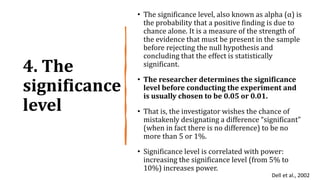
4. The
significance
level
• The significance level, also known as alpha (α) is
the probability that a positive finding is due to
chance alone. It is a measure of the strength of
the evidence that must be present in the sample
before rejecting the null hypothesis and
concluding that the effect is statistically
significant.
• The researcher determines the significance
level before conducting the experiment and
is usually chosen to be 0.05 or 0.01.
• That is, the investigator wishes the chance of
mistakenly designating a difference “significant”
(when in fact there is no difference) to be no
more than 5 or 1%.
• Significance level is correlated with power:
increasing the significance level (from 5% to
10%) increases power.
Dell et al., 2002
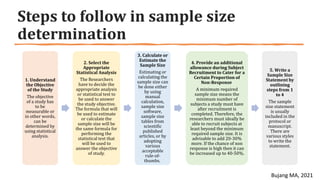
Steps to follow in sample size
determination
Bujang MA, 2021
1. Understand
the Objective
of the Study
The objective
of a study has
to be
measurable or
in other words,
can be
determined by
using statistical
analysis.
2. Select the
Appropriate
Statistical Analysis
The Researchers
have to decide the
appropriate analysis
or statistical test to
be used to answer
the study objective.
The formula that will
be used to estimate
or calculate the
sample size will be
the same formula for
performing the
statistical test that
will be used to
answer the objective
of study.
3. Calculate or
Estimate the
Sample Size
Estimating or
calculating the
sample size can
be done either
by using
manual
calculation,
sample size
software,
sample size
tables from
scientific
published
articles, or by
adopting
various
acceptable
rule-of-
thumbs.
4. Provide an additional
allowance during Subject
Recruitment to Cater for a
Certain Proportion of
Non-Response
A minimum required
sample size means the
minimum number of
subjects a study must have
after recruitment is
completed. Therefore, the
researchers must ideally be
able to recruit subjects at
least beyond the minimum
required sample size. It is
advisable to add 20-30%
more. If the chance of non
response is high then it can
be increased up to 40-50%.
5. Write a
Sample Size
Statement by
outlining
steps from 1
to 4
The sample
size statement
is usually
included in the
protocol or
manuscript.
There are
various styles
to write the
statement.
Examples of free sample size calculator tools
 ClinCalc LLC. Sample Size Calculator: https://clincalc.com/stats/SampleSize.aspx
• A free online sample size calculator
 Epi Info™ is a free software that can be downloaded from the Centers for Disease Control and
Prevention (CDC) website at: https://www.cdc.gov/epiinfo.
• Watch the Epi Info™ 7 Tutorial Videos.
 OpenEpi.com: https://www.openepi.com
• An open-source web tool that provides epidemiologic statistics.
 PS: Power and Sample Size Calculation:
https://biostat.app.vumc.org/wiki/Main/PowerSampleSize
 A free interactive program for performing power and sample size calculations
 StatCalc: https://www.cdc.gov/epiinfo/user-guide/statcalc/statcalcintro.html
• A utility tool in Epi Info™ and statistical calculator that produces summary epidemiologic information.
• Six types of calculations are available including Sample Size and Power calculations for Population Survey, Cohort
or Cross-Sectional, and Unmatched Case-Control.
 STEPS Sample Size Calculator and Sampling Spreadsheet
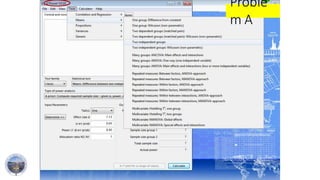
Proble
m A
Proble
m A
Proble
m B
Proble
m C
(1)
Proble
m C
(2)
Case Control study
Proble
m
A
Proble
m B
Cohort
study
Experimental design
Proble
m A
 Asdrop out ratewasconsidered to be 10%
 New sample = n/(1-Non response rate)
 New sample = 210 /(1-0.10)= 233
Problem B
We firstshould calculate Effectsize
Effectsize = Change at experimental group – Change at control group / Baseline SD of control group
Effectsize = ((mean before - mean after for Experimental group) -((mean before - mean after for control group)) / Baseline
SD of control group
Effectsize = ((8.3-6.0)-(8.7-8.5)) / 2.2
Effectsize = 0.95
References for more reading
1. Bhandari P. What is Effect Size and Why Does It Matter? (Examples) [Internet]. Scribbr. 2020 [cited 2022
Sep 9]. Available from: https://www.scribbr.com/statistics/effect-size/
2. Bujang MA. A Step-by-Step Process on Sample Size Determination for Medical Research. Malays J Med Sci
MJMS. 2021 Apr;28(2):15–27.
3. Dell RB, Holleran S, Ramakrishnan R. Sample Size Determination. Ilar J. 2002;43(4):207–13.
4. Greenland S, Senn SJ, Rothman KJ, Carlin JB, Poole C, Goodman SN, et al. Statistical tests, P values,
confidence intervals, and power: a guide to misinterpretations. Eur J Epidemiol. 2016;31:337–50.
5. Sullivan L. Power and Sample Size Determination [Internet]. [cited 2022 Sep 9]. Available from:
https://sphweb.bumc.bu.edu/otlt/mph-modules/bs/bs704_power/bs704_power_print.html
6. Standard Deviation | How and when to use the Sample and Population Standard Deviation - A measure of
spread | Laerd Statistics [Internet]. [cited 2022 Sep 9]. Available from:
https://statistics.laerd.com/statistical-guides/measures-of-spread-standard-deviation.php
7. Statistical Power: What it is, How to Calculate it [Internet]. Statistics How To. [cited 2022 Sep 5]. Available
from: https://www.statisticshowto.com/probability-and-statistics/statistics-definitions/statistical-power/
Useful websites for sample size calculation
• ClinCalc LLC. Sample Size Calculator [website]. C2002. Available at: https://clincalc.com/stats/SampleSize.aspx
• Dean AG, Sullivan KM, Soe MM. OpenEpi: Open Source Epidemiologic Statistics for Public Health, Version.
www.OpenEpi.com, updated 2013/04/06. Available at: https://www.openepi.com
• GIGAcalculator. Power & Sample Size Calculator [website]. c2017-2022. Available at:
https://www.gigacalculator.com/calculators/power-sample-size-calculator.php
• Kohn MA, Senyak J. Sample Size Calculators [website]. UCSF CTSI. 20 December 2021. Available at
https://www.sample-size.net/
• PS: Power and Sample Size Calculation [website]. Vanderbilt Biostatistics Wiki, c2013-2022. Available from:
https://biostat.app.vumc.org/wiki/Main/PowerSampleSize.
• StatCalc in Epi Info™, Division of Health Informatics & Surveillance (DHIS), Center for Surveillance, Epidemiology &
Laboratory Services (CSELS) [website]. CDC. Available at: https://www.cdc.gov/epiinfo/user-
guide/statcalc/samplesize.html
• <http://www.biomath.info>: a simple website of the biomathematics division of the Department of Pediatrics at the
College of Physicians & Surgeons at Columbia University, which implements the equations and conditions discussed
in this article
• <http://davidmlane.com/hyperstat/power.html>: a clear and concise review of the basic principles of statistics,
which includes a discussion of sample size calculations with links to sites where actual calculations can be
performed
• nQuery Advisor, SPSS, MINITAB and SAS/STAT are paid statistical programs and software that can be used both for
sample size calculations and statistical data analysis
Thank you!

Sample-size-comprehensive.pptx

  • 1.
    How to determinethe correct sample size of a research
  • 2.
    Sample size calculation • Thesample size calculation or estimation has no one single formula that can apply universally to all situations and circumstances. • The sample size estimation can be done either by using; • Manual calculation, • Sample size software, • Sample size tables from scientific published articles, • Adopting various acceptable rule-of- thumbs. Bujang MA, 2021
  • 3.
    Factors that must be estimated tocalculate sample size • There are four factors that must be known or estimated to calculate sample size: 1. The effect size; 2. The population standard deviation; 3. The power of the experiment; and 4. The significance level. Dell et al., 2002
  • 4.
    1. The effectsize • The effect size indicates how meaningful the relationship between variables or the difference between groups is. It also indicates the practical significance of a research outcome. • The effect sizes are independent of the sample size, only the data is used to calculate effect sizes. • A large effect size means that a research finding has practical significance, while a small effect size indicates limited practical applications. • The practical significance shows that the effect is large enough to be meaningful in the real world. Bujang MA, 2021; Bhandari P, 2022
  • 5.
    1. The effectsize cont’d • The most common effect sizes are Cohen’s d and Pearson’s (r) . • Cohen’s (d) measures the size of the difference between two groups. • Pearson’s (r) measures the strength of the relationship between two variables. It is better to use a statistical software to calculate Pearson’s r accurately from the raw data. Bhandari P, 2022 •rxy = strength of the correlation between variables x and y •n = sample size •∑ = sum of what follows •X = every x-variable value •Y = every y-variable value •XY = the product of each x-variable score times the corresponding y-variable score where, where,
  • 6.
    Estimation of the effect size •It is usually quite challenging to estimate an accurate effect size since the exact value of the effect size is not known until the study is completed. However, the researcher will still have to set the value of effect size for the purpose of sample size calculation or estimation. Bujang MA, 2021
  • 7.
    Estimation of theeffect size cont’d The effect size can be estimated from:  Literature review • the acceptable and desirable way. • it is better to obtain the needed information from recent articles (within 5 years) that used almost similar design, same treatment and similar patient characteristics.  From historical data or secondary data • provided researcher has access to all data of different group • not always feasible since a new intervention may not have been assessed yet  Educated guess or expert opinion • researches/experts can use his experience and knowledge to set up an effect size that is scientifically or clinically meaningful Bujang MA, 2021
  • 8.
    2. The populationstandard deviation • The standard deviation is used with continuous data, but not categorical data. • The population standard deviation is a parameter. • It is a fixed value calculated from every individual in the population. • The standard deviation, is appropriate when the continuous data is not significantly skewed or has outliers. • It can be derived from literature review, pilot study or from any reliable source. Laerd Statistics [cited 2022 Sep 9]
  • 9.
    3. The power •The power of study is the pre-study probability that the effect will be detected and the test will reject the null hypothesis. • In other words, If the power is too low, there is little chance of detecting a significant difference, and non-significant results are likely even if real differences truly exist. • The power is arbitrarily set to 80 or 90% which means that the study has 80% or 90% chance of having a statistically significance results. • β =1-power, is the chance of obtaining a false-negative result (the experiment will fail to reject an untrue null hypothesis or to detect the specified treatment effect). • Statistics provides the following Power Analysis procedures: • One Sample T-Test • Paired Sample T-Test • Independent Sample T-Test • One-way ANOVA Dell et al., 2002
  • 10.
    • Type Ierror Alpha (α): rejecting the null hypothesis of no effect when it is actually true. False positive • Type II error Beta (β): not rejecting the null hypothesis of no effect when it is actually false. False negative 3. The power cont’d StatisticsHowTo.com [cited 2022 Sep 5]
  • 11.
    4. The significance level • Thesignificance level, also known as alpha (α) is the probability that a positive finding is due to chance alone. It is a measure of the strength of the evidence that must be present in the sample before rejecting the null hypothesis and concluding that the effect is statistically significant. • The researcher determines the significance level before conducting the experiment and is usually chosen to be 0.05 or 0.01. • That is, the investigator wishes the chance of mistakenly designating a difference “significant” (when in fact there is no difference) to be no more than 5 or 1%. • Significance level is correlated with power: increasing the significance level (from 5% to 10%) increases power. Dell et al., 2002
  • 12.
    Steps to followin sample size determination Bujang MA, 2021 1. Understand the Objective of the Study The objective of a study has to be measurable or in other words, can be determined by using statistical analysis. 2. Select the Appropriate Statistical Analysis The Researchers have to decide the appropriate analysis or statistical test to be used to answer the study objective. The formula that will be used to estimate or calculate the sample size will be the same formula for performing the statistical test that will be used to answer the objective of study. 3. Calculate or Estimate the Sample Size Estimating or calculating the sample size can be done either by using manual calculation, sample size software, sample size tables from scientific published articles, or by adopting various acceptable rule-of- thumbs. 4. Provide an additional allowance during Subject Recruitment to Cater for a Certain Proportion of Non-Response A minimum required sample size means the minimum number of subjects a study must have after recruitment is completed. Therefore, the researchers must ideally be able to recruit subjects at least beyond the minimum required sample size. It is advisable to add 20-30% more. If the chance of non response is high then it can be increased up to 40-50%. 5. Write a Sample Size Statement by outlining steps from 1 to 4 The sample size statement is usually included in the protocol or manuscript. There are various styles to write the statement.
  • 13.
    Examples of freesample size calculator tools  ClinCalc LLC. Sample Size Calculator: https://clincalc.com/stats/SampleSize.aspx • A free online sample size calculator  Epi Info™ is a free software that can be downloaded from the Centers for Disease Control and Prevention (CDC) website at: https://www.cdc.gov/epiinfo. • Watch the Epi Info™ 7 Tutorial Videos.  OpenEpi.com: https://www.openepi.com • An open-source web tool that provides epidemiologic statistics.  PS: Power and Sample Size Calculation: https://biostat.app.vumc.org/wiki/Main/PowerSampleSize  A free interactive program for performing power and sample size calculations  StatCalc: https://www.cdc.gov/epiinfo/user-guide/statcalc/statcalcintro.html • A utility tool in Epi Info™ and statistical calculator that produces summary epidemiologic information. • Six types of calculations are available including Sample Size and Power calculations for Population Survey, Cohort or Cross-Sectional, and Unmatched Case-Control.  STEPS Sample Size Calculator and Sampling Spreadsheet
  • 15.
  • 16.
  • 17.
  • 18.
  • 21.
  • 23.
  • 24.
  • 26.
  • 31.
  • 34.
  • 35.
  • 38.
     Asdrop outratewasconsidered to be 10%  New sample = n/(1-Non response rate)  New sample = 210 /(1-0.10)= 233
  • 39.
  • 42.
    We firstshould calculateEffectsize Effectsize = Change at experimental group – Change at control group / Baseline SD of control group Effectsize = ((mean before - mean after for Experimental group) -((mean before - mean after for control group)) / Baseline SD of control group Effectsize = ((8.3-6.0)-(8.7-8.5)) / 2.2 Effectsize = 0.95
  • 46.
    References for morereading 1. Bhandari P. What is Effect Size and Why Does It Matter? (Examples) [Internet]. Scribbr. 2020 [cited 2022 Sep 9]. Available from: https://www.scribbr.com/statistics/effect-size/ 2. Bujang MA. A Step-by-Step Process on Sample Size Determination for Medical Research. Malays J Med Sci MJMS. 2021 Apr;28(2):15–27. 3. Dell RB, Holleran S, Ramakrishnan R. Sample Size Determination. Ilar J. 2002;43(4):207–13. 4. Greenland S, Senn SJ, Rothman KJ, Carlin JB, Poole C, Goodman SN, et al. Statistical tests, P values, confidence intervals, and power: a guide to misinterpretations. Eur J Epidemiol. 2016;31:337–50. 5. Sullivan L. Power and Sample Size Determination [Internet]. [cited 2022 Sep 9]. Available from: https://sphweb.bumc.bu.edu/otlt/mph-modules/bs/bs704_power/bs704_power_print.html 6. Standard Deviation | How and when to use the Sample and Population Standard Deviation - A measure of spread | Laerd Statistics [Internet]. [cited 2022 Sep 9]. Available from: https://statistics.laerd.com/statistical-guides/measures-of-spread-standard-deviation.php 7. Statistical Power: What it is, How to Calculate it [Internet]. Statistics How To. [cited 2022 Sep 5]. Available from: https://www.statisticshowto.com/probability-and-statistics/statistics-definitions/statistical-power/
  • 47.
    Useful websites forsample size calculation • ClinCalc LLC. Sample Size Calculator [website]. C2002. Available at: https://clincalc.com/stats/SampleSize.aspx • Dean AG, Sullivan KM, Soe MM. OpenEpi: Open Source Epidemiologic Statistics for Public Health, Version. www.OpenEpi.com, updated 2013/04/06. Available at: https://www.openepi.com • GIGAcalculator. Power & Sample Size Calculator [website]. c2017-2022. Available at: https://www.gigacalculator.com/calculators/power-sample-size-calculator.php • Kohn MA, Senyak J. Sample Size Calculators [website]. UCSF CTSI. 20 December 2021. Available at https://www.sample-size.net/ • PS: Power and Sample Size Calculation [website]. Vanderbilt Biostatistics Wiki, c2013-2022. Available from: https://biostat.app.vumc.org/wiki/Main/PowerSampleSize. • StatCalc in Epi Info™, Division of Health Informatics & Surveillance (DHIS), Center for Surveillance, Epidemiology & Laboratory Services (CSELS) [website]. CDC. Available at: https://www.cdc.gov/epiinfo/user- guide/statcalc/samplesize.html • <http://www.biomath.info>: a simple website of the biomathematics division of the Department of Pediatrics at the College of Physicians & Surgeons at Columbia University, which implements the equations and conditions discussed in this article • <http://davidmlane.com/hyperstat/power.html>: a clear and concise review of the basic principles of statistics, which includes a discussion of sample size calculations with links to sites where actual calculations can be performed • nQuery Advisor, SPSS, MINITAB and SAS/STAT are paid statistical programs and software that can be used both for sample size calculations and statistical data analysis
  • 48.