Samoilă Mârza-the almost unknown story
of the only photographer of the Great
Union
Gresoi Mariana - MIEADR IMAPA,
Group 8212
University of Agronomic Sciences
and Veterinary Medicine of
Bucharest, Romania
Samoilă Mârza-the almost unknown story of the
only photographer of the Great Union
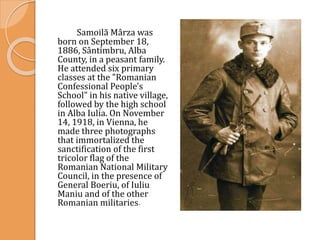
The great
moments of the Great
Union in 1918 were
immortalized.
Although it may seem
hard to believe, the
merit belongs to one
man named Samoila
Mârza. He made both
photographs of the
moments of the Great
Union and other
major events of
Romania's recent
history.
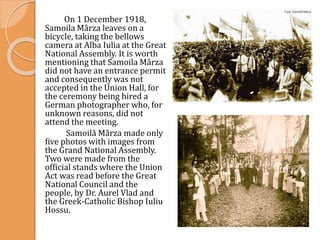
Samoilă Mârza was
born on September 18,
1886, Sântimbru, Alba
County, in a peasant family.
He attended six primary
classes at the "Romanian
Confessional People's
School" in his native village,
followed by the high school
in Alba Iulia. On November
14, 1918, in Vienna, he
made three photographs
that immortalized the
sanctification of the first
tricolor flag of the
Romanian National Military
Council, in the presence of
General Boeriu, of Iuliu
Maniu and of the other
Romanian militaries.
On 1 December 1918,
Samoila Mârza leaves on a
bicycle, taking the bellows
camera at Alba Iulia at the Great
National Assembly. It is worth
mentioning that Samoila Mârza
did not have an entrance permit
and consequently was not
accepted in the Union Hall, for
the ceremony being hired a
German photographer who, for
unknown reasons, did not
attend the meeting.
Samoilă Mârza made only
five photos with images from
the Grand National Assembly.
Two were made from the
official stands where the Union
Act was read before the Great
National Council and the
people, by Dr. Aurel Vlad and
the Greek-Catholic Bishop Iuliu
Hossu.
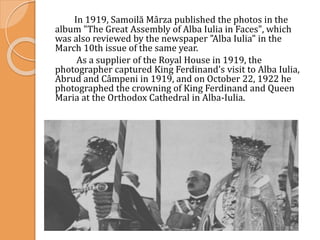
In 1919, Samoilă Mârza published the photos in the
album "The Great Assembly of Alba Iulia in Faces", which
was also reviewed by the newspaper "Alba Iulia" in the
March 10th issue of the same year.
As a supplier of the Royal House in 1919, the
photographer captured King Ferdinand's visit to Alba Iulia,
Abrud and Câmpeni in 1919, and on October 22, 1922 he
photographed the crowning of King Ferdinand and Queen
Maria at the Orthodox Cathedral in Alba-Iulia.
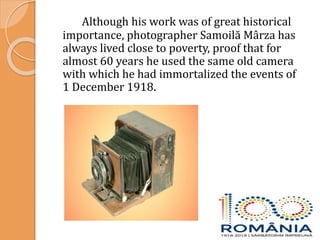
Although his work was of great historical
importance, photographer Samoilă Mârza has
always lived close to poverty, proof that for
almost 60 years he used the same old camera
with which he had immortalized the events of
1 December 1918.
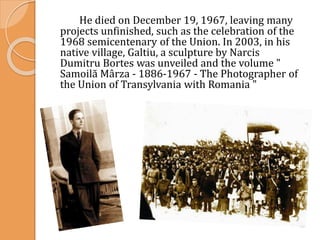
He died on December 19, 1967, leaving many
projects unfinished, such as the celebration of the
1968 semicentenary of the Union. In 2003, in his
native village, Galtiu, a sculpture by Narcis
Dumitru Bortes was unveiled and the volume "
Samoilă Mârza - 1886-1967 - The Photographer of
the Union of Transylvania with Romania "
References
 https://editiadedimineata.ro/samoila-marza-
povestea-aproape-nestiuta-a-singurului-fotograf-al-
marii-uniri/
 momenteistorice.ro
 rri.ro
 https://ro.wikipedia.org

Samoila marza

  • 1.
    Samoilă Mârza-the almostunknown story of the only photographer of the Great Union Gresoi Mariana - MIEADR IMAPA, Group 8212 University of Agronomic Sciences and Veterinary Medicine of Bucharest, Romania
  • 2.
    Samoilă Mârza-the almostunknown story of the only photographer of the Great Union The great moments of the Great Union in 1918 were immortalized. Although it may seem hard to believe, the merit belongs to one man named Samoila Mârza. He made both photographs of the moments of the Great Union and other major events of Romania's recent history.
  • 3.
    Samoilă Mârza was bornon September 18, 1886, Sântimbru, Alba County, in a peasant family. He attended six primary classes at the "Romanian Confessional People's School" in his native village, followed by the high school in Alba Iulia. On November 14, 1918, in Vienna, he made three photographs that immortalized the sanctification of the first tricolor flag of the Romanian National Military Council, in the presence of General Boeriu, of Iuliu Maniu and of the other Romanian militaries.
  • 4.
    On 1 December1918, Samoila Mârza leaves on a bicycle, taking the bellows camera at Alba Iulia at the Great National Assembly. It is worth mentioning that Samoila Mârza did not have an entrance permit and consequently was not accepted in the Union Hall, for the ceremony being hired a German photographer who, for unknown reasons, did not attend the meeting. Samoilă Mârza made only five photos with images from the Grand National Assembly. Two were made from the official stands where the Union Act was read before the Great National Council and the people, by Dr. Aurel Vlad and the Greek-Catholic Bishop Iuliu Hossu.
  • 5.
    In 1919, SamoilăMârza published the photos in the album "The Great Assembly of Alba Iulia in Faces", which was also reviewed by the newspaper "Alba Iulia" in the March 10th issue of the same year. As a supplier of the Royal House in 1919, the photographer captured King Ferdinand's visit to Alba Iulia, Abrud and Câmpeni in 1919, and on October 22, 1922 he photographed the crowning of King Ferdinand and Queen Maria at the Orthodox Cathedral in Alba-Iulia.
  • 6.
    Although his workwas of great historical importance, photographer Samoilă Mârza has always lived close to poverty, proof that for almost 60 years he used the same old camera with which he had immortalized the events of 1 December 1918.
  • 7.
    He died onDecember 19, 1967, leaving many projects unfinished, such as the celebration of the 1968 semicentenary of the Union. In 2003, in his native village, Galtiu, a sculpture by Narcis Dumitru Bortes was unveiled and the volume " Samoilă Mârza - 1886-1967 - The Photographer of the Union of Transylvania with Romania "
  • 8.