ISTRATE DENISA-
LOREDANA.
GRUPA 8312
On 1 December 1918 the most important desideratum of the Romanian
nation was made: the last historical province was united with
Romania. Following an ups and downs evolution in World War I,
when Romania entered the Entente in war against Austria and
Germany, the historical provinces of Basarabia, Bucovina and
Transylvania agreed to form a union with Romania on a unitary and
national basis.
Throughout the centuries, the Romanians had a holy dream, living in a
single state, in a Romanian state.
Although they spoke the same language, they had the same faith, the
same habits and the same historical past, injustice, oppression,
stories of history made them live in several states: Transylvania,
Moldova, Wallachia, Dobrogea.
Thus, in November-December 1918, a series of National Assemblies
took place in all these provinces and represented both Romanians
and ethnic minorities. With a sweeping majority voted in favor of the
Union, the voices of those who demanded autonomy or
independence, finding no support. . A particular situation had
Bessarabia, which, after being detached from Russia, was in danger of
being transformed into a Soviet republic by the Bolsheviks who were
in the midst of the revolution. The Romanian army entered
Bessarabia only after the provisional authorities formally requested
this, and disarmed the former tsarist military units that acted
anarchically. In Transylvania, the Hungarian revisionist elements
wanted integration of Hungary and Transylvania into a state separate
from Austria. The actions of the Romanian patriots (Vaida-Voievod,
Iuliu Maniu, V. Goldiş, etc.), together with the support offered by the
Romanian government, have thwarted the actions.
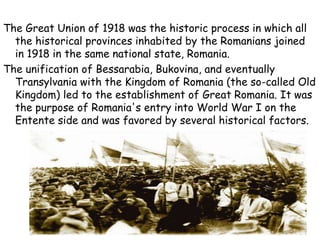
The Great Union of 1918 was the historic process in which all
the historical provinces inhabited by the Romanians joined
in 1918 in the same national state, Romania.
The unification of Bessarabia, Bukovina, and eventually
Transylvania with the Kingdom of Romania (the so-called Old
Kingdom) led to the establishment of Great Romania. It was
the purpose of Romania's entry into World War I on the
Entente side and was favored by several historical factors.
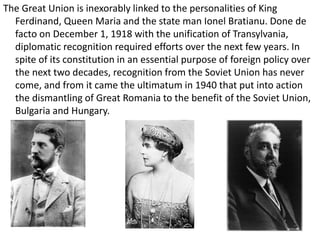
The Great Union is inexorably linked to the personalities of King
Ferdinand, Queen Maria and the state man Ionel Bratianu. Done de
facto on December 1, 1918 with the unification of Transylvania,
diplomatic recognition required efforts over the next few years. In
spite of its constitution in an essential purpose of foreign policy over
the next two decades, recognition from the Soviet Union has never
come, and from it came the ultimatum in 1940 that put into action
the dismantling of Great Romania to the benefit of the Soviet Union,
Bulgaria and Hungary.
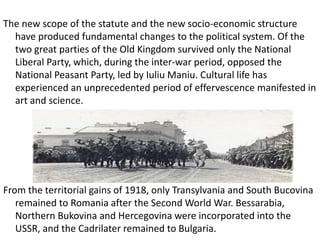
The new scope of the statute and the new socio-economic structure
have produced fundamental changes to the political system. Of the
two great parties of the Old Kingdom survived only the National
Liberal Party, which, during the inter-war period, opposed the
National Peasant Party, led by Iuliu Maniu. Cultural life has
experienced an unprecedented period of effervescence manifested in
art and science.
From the territorial gains of 1918, only Transylvania and South Bucovina
remained to Romania after the Second World War. Bessarabia,
Northern Bukovina and Hercegovina were incorporated into the
USSR, and the Cadrilater remained to Bulgaria.
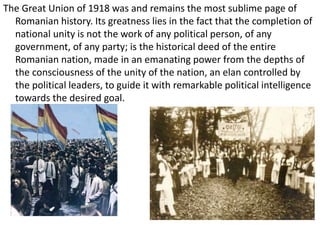
The Great Union of 1918 was and remains the most sublime page of
Romanian history. Its greatness lies in the fact that the completion of
national unity is not the work of any political person, of any
government, of any party; is the historical deed of the entire
Romanian nation, made in an emanating power from the depths of
the consciousness of the unity of the nation, an elan controlled by
the political leaders, to guide it with remarkable political intelligence
towards the desired goal.

Great union

  • 1.
  • 2.
    On 1 December1918 the most important desideratum of the Romanian nation was made: the last historical province was united with Romania. Following an ups and downs evolution in World War I, when Romania entered the Entente in war against Austria and Germany, the historical provinces of Basarabia, Bucovina and Transylvania agreed to form a union with Romania on a unitary and national basis. Throughout the centuries, the Romanians had a holy dream, living in a single state, in a Romanian state. Although they spoke the same language, they had the same faith, the same habits and the same historical past, injustice, oppression, stories of history made them live in several states: Transylvania, Moldova, Wallachia, Dobrogea.
  • 3.
    Thus, in November-December1918, a series of National Assemblies took place in all these provinces and represented both Romanians and ethnic minorities. With a sweeping majority voted in favor of the Union, the voices of those who demanded autonomy or independence, finding no support. . A particular situation had Bessarabia, which, after being detached from Russia, was in danger of being transformed into a Soviet republic by the Bolsheviks who were in the midst of the revolution. The Romanian army entered Bessarabia only after the provisional authorities formally requested this, and disarmed the former tsarist military units that acted anarchically. In Transylvania, the Hungarian revisionist elements wanted integration of Hungary and Transylvania into a state separate from Austria. The actions of the Romanian patriots (Vaida-Voievod, Iuliu Maniu, V. Goldiş, etc.), together with the support offered by the Romanian government, have thwarted the actions.
  • 4.
    The Great Unionof 1918 was the historic process in which all the historical provinces inhabited by the Romanians joined in 1918 in the same national state, Romania. The unification of Bessarabia, Bukovina, and eventually Transylvania with the Kingdom of Romania (the so-called Old Kingdom) led to the establishment of Great Romania. It was the purpose of Romania's entry into World War I on the Entente side and was favored by several historical factors.
  • 5.
    The Great Unionis inexorably linked to the personalities of King Ferdinand, Queen Maria and the state man Ionel Bratianu. Done de facto on December 1, 1918 with the unification of Transylvania, diplomatic recognition required efforts over the next few years. In spite of its constitution in an essential purpose of foreign policy over the next two decades, recognition from the Soviet Union has never come, and from it came the ultimatum in 1940 that put into action the dismantling of Great Romania to the benefit of the Soviet Union, Bulgaria and Hungary.
  • 6.
    The new scopeof the statute and the new socio-economic structure have produced fundamental changes to the political system. Of the two great parties of the Old Kingdom survived only the National Liberal Party, which, during the inter-war period, opposed the National Peasant Party, led by Iuliu Maniu. Cultural life has experienced an unprecedented period of effervescence manifested in art and science. From the territorial gains of 1918, only Transylvania and South Bucovina remained to Romania after the Second World War. Bessarabia, Northern Bukovina and Hercegovina were incorporated into the USSR, and the Cadrilater remained to Bulgaria.
  • 7.
    The Great Unionof 1918 was and remains the most sublime page of Romanian history. Its greatness lies in the fact that the completion of national unity is not the work of any political person, of any government, of any party; is the historical deed of the entire Romanian nation, made in an emanating power from the depths of the consciousness of the unity of the nation, an elan controlled by the political leaders, to guide it with remarkable political intelligence towards the desired goal.