Boosting Skill Sets- Increasing
Employability of Indian youth
Abhisha Shrivastava
Hardik Rathod
Praveen Poonia
Rahul Jain
Sharth Mandan
IIT BOMBAY
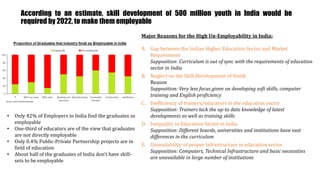
According to an estimate, skill development of 500 million youth in India would be
required by 2022, to make them employable
• Only 42% of Employers in India find the graduates as
employable
• One-third of educators are of the view that graduates
are not directly employable
• Only 0.4% Public-Private Partnership projects are in
field of education
• About half of the graduates of India don’t have skill-
sets to be employable
Major Reasons for the High Un-Employability in India:
A. Gap between the Indian Higher Education Sector and Market
Requirement
Supposition: Curriculum is out of sync with the requirements of education
sector in India
B. Neglect on the Skill-Development of Youth
Reason
Supposition: Very less focus given on developing soft skills, computer
training and English proficiency
C. Inefficiency of trainers/educators in the education sector
Supposition: Trainers lack the up-to date knowledge of latest
developments as well as training skills
D. Inequality in Education Sector in India
Supposition: Different boards, universities and institutions have vast
differences in the curriculum
E. Unavailability of proper Infrastructure in education sector
Supposition: Computers, Technical Infrastructure and basic necessities
are unavailable in large number of institutions
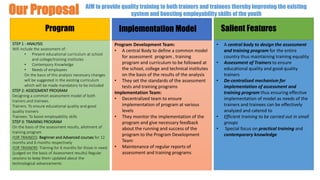
Our Proposal AIM to provide quality training to both trainers and trainees thereby improving the existing
system and boosting employability skills of the youth
Program Salient FeaturesImplementation Model
STEP 1 : ANALYSIS
Will include the assessment of:
• Present educational curriculum at school
and college/training institutes
• Contempory Knowledge
• Needs of employees
On the basis of this analysis necessary changes
will be suggested in the existing curriculum
which will be made mandatory to be included
STEP 2: ASSESSMENT PROGRAM
Designing a common assessment model of both
trainers and trainees.
Trainers: To ensure educational quality and good
quality trainers
Trainees: To boost employability skills
STEP 3: TRAINING PROGRAM
On the basis of the assessment results, allotment of
training program
FOR TRAINEES: Beginner and Advanced courses for 12
months and 6 months respectively
FOR TRAINERS: Training for 6 months for those in need
(judged on the basis of Assessment results) Regular
sessions to keep them updated about the
technological advancements
Program Development Team:
• A central Body to define a common model
for assessment program , training
program and curriculum to be followed at
the school, college and technical institutes
on the basis of the results of the analysis
• They set the standards of the assessment
tests and training programs
Implementation Team:
• Decentralized team to ensure
implementation of program at various
levels
• They monitor the implementation of the
program and give necessary feedback
about the running and success of the
program to the Program Development
Team
• Maintenance of regular reports of
assessment and training programs
• A central body to design the assessment
and training program for the entire
country thus maintaining training equality
• Assessment of Trainers to ensure
educational quality and good quality
trainers
• De-centralised mechanism for
implementation of assessment and
training program thus ensuring effective
implementation of model as needs of the
trainers and trainees can be effectively
analyzed and catered to
• Efficient training to be carried out in small
groups
• Special focus on practical training and
contemporary knowledge
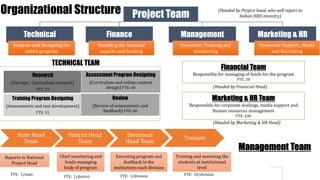
Organizational Structure Project Team
Technical Finance Management Marketing & HR
Analysis and Designing the
entire program
Handling the financial
aspects and funding
Execution, Training and
monitoring
Corporate Support, Media
and Recruiting
Research
(Surveys , Curriculum research)
FTE: 25
Assessment Program Designing
(Curriculum and online content
design) FTE: 60
Training Program Designing
(Assessments and test development)
FTE: 15
Review
(Review of assessments and
feedback) FTE: 60
TECHNICAL TEAM
Financial Team
Responsible for managing of funds for the program
FTE: 20
Marketing & HR Team
Responsible for corporate dealings, media support and
Human resources management
FTE: 100
(Headed by Financial Head)
(Headed by Marketing & HR Head)
State Head
Team
District Head
Team
Divisional
Head Team
Trainers
Reports to National
Project Head
Chief monitoring and
funds managing
body of program
Executing program and
feedback in the
institutions each division
Training and assessing the
students at institutional
level
FTE: 1/state
FTE: 1/district FTE: 1/division FTE: 10/division
Management Team
(Headed by Project head, who will report to
Indian HRD ministry)
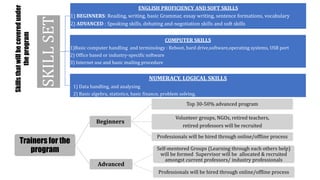
SKILLSET
ENGLISH PROFICIENCY AND SOFT SKILLS
1) BEGINNERS: Reading, writing, basic Grammar, essay writing, sentence formations, vocabulary
2) ADVANCED : Speaking skills, debating and negotiation skills and soft skills
COMPUTER SKILLS
1)Basic computer handling and terminology : Reboot, hard drive,software,operating systems, USB port
2) Office based or industry-specific software
3) Internet use and basic mailing procedure
NUMERACY, LOGICAL SKILLS
1) Data handling, and analysing
2) Basic algebra, statistics, basic finance, problem solving,
Trainers for the
program
Beginners
Top 30-50% advanced program
Volunteer groups, NGOs, retired teachers,
retired professors will be recruited
Professionals will be hired through online/offline process
Advanced
Professionals will be hired through online/offline process
Self-mentored Groups (Learning through each others help)
will be formed Supervisor will be allocated & recruited
amongst current professors/ industry professionals
Skillsthatwillbecoveredunder
theprogram
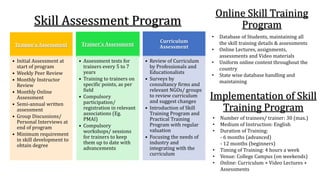
Skill Assessment Program
Trainee’s Assessment
• Initial Assessment at
start of program
• Weekly Peer Review
• Monthly Instructor
Review
• Monthly Online
Assessment
• Semi-annual written
assessment
• Group Discussions/
Personal Interviews at
end of program
• Minimum requirement
in skill development to
obtain degree
Trainer’s Assessment
• Assessment tests for
trainers every 5 to 7
years
• Training to trainers on
specific points, as per
field
• Compulsory
participation/
registration in relevant
associations (Eg.
PMAI)
• Compulsory
workshops/ sessions
for trainers to keep
them up to date with
advancements
Curriculum
Assessment
• Review of Curriculum
by Professionals and
Educationalists
• Surveys by
consultancy firms and
relevant NGOs/ groups
to review curriculum
and suggest changes
• Introduction of Skill
Training Program and
Practical Training
Program with regular
valuation
• Focusing the needs of
industry and
integrating with the
curriculum
Implementation of Skill
Training Program
• Number of trainees/ trainer: 30 (max.)
• Medium of Instruction: English
• Duration of Training:
- 6 months (advanced)
- 12 months (beginners)
• Timing of Training: 4 hours a week
• Venue: College Campus (on weekends)
• Online: Curriculum + Video Lectures +
Assessments
Online Skill Training
Program
• Database of Students, maintaining all
the skill training details & assessments
• Online Lectures, assignments,
assessments and Video materials
• Uniform online content throughout the
country
• State wise database handling and
maintaining
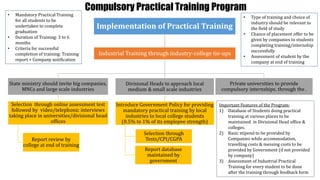
Implementation of Practical Training
Industrial Training through industry-college tie-ups
State ministry should invite big companies,
MNCs and large scale industries
Selection through online assessment test
followed by video/telephonic interviews
taking place in universities/divisional head
offices
Report review by
college at end of training
Divisional Heads to approach local
medium & small scale industries
Introduce Government Policy for providing
mandatory practical training by local
industries to local college students
(0.5% to 1% of its employee strength)
Selection through
Tests/CPI/CGPA
Report database
maintained by
government
Private universities to provide
compulsory internships, through the .
Important Features of the Program:
1) Database of Students doing practical
training at various places to be
maintained in Divisional Head office &
colleges.
2) Basic stipend to be provided by
Companies while accommodation,
travelling costs & messing costs to be
provided by Government (if not provided
by company)
3) Assessment of Industrial Practical
Training for every student to be done
after the training through feedback form
Compulsory Practical Training Program
• Mandatory Practical Training
for all students to be
undertaken to complete
graduation
• Duration of Training: 3 to 6
months
• Criteria for successful
completion of training: Training
report + Company notification
• Type of training and choice of
industry should be relevant to
the field of study
• Chance of placement offer to be
given by companies to students
completing training/internship
successfully
• Assessment of student by the
company at end of training
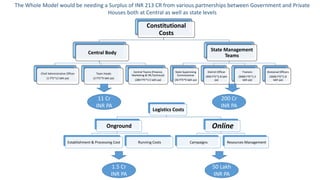
Constitutional
Costs
Central Body
Chief Administrative Officer
(1 FTE*12 lakh pa)
Team Heads
(3 FTE*9 lakh pa)
Central Teams (Finance,
Marketing & HR,Technical)
(280 FTE*3.5 lakh pa)
State Management
Teams
State Supervising
Commissioner
(30 FTE*9 lakh pa)
District Officer
(900 FTE*2.8 lakh
pa)
Trainers
(9000 FTE*1.2
lakh pa)
Divisional Officers
(3600 FTE*1.8
lakh pa)
Logistics Costs
Onground
Establishment & Processing Cost Running Costs
Online
Campaigns Resources Management
11 Cr
INR PA
200 Cr
INR PA
1.5 Cr
INR PA
50 Lakh
INR PA
The Whole Model would be needing a Surplus of INR 213 CR from various partnerships between Government and Private
Houses both at Central as well as state levels
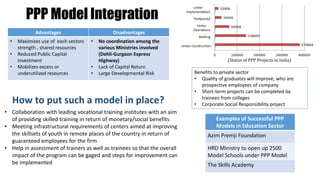
PPP Model Integration
(Status of PPP Projects in India)
Advantages Disadvantages
• Maximizes use of each sectors
strength , shared resources
• Reduced Public Capital
Investment
• Mobilizes excess or
underutilized resources
• No coordination among the
various Ministries involved
(Dehli-Gurgaon Express
Highway)
• Lack of Capital Return
• Large Developmental Risk
• Collaboration with leading vocational training institutes with an aim
of providing skilled training in return of monetary/social benefits
• Meeting infrastructural requirements of centers aimed at improving
the skillsets of youth in remote places of the country in return of
guaranteed employees for the firm
• Help in assessment of trainers as well as trainees so that the overall
impact of the program can be gaged and steps for improvement can
be implemented
How to put such a model in place?
Examples of Successful PPP
Models in Education Sector
Azim Premji Foundation
HRD Ministry to open up 2500
Model Schools under PPP Model
The Skills Academy
Benefits to private sector
• Quality of graduates will improve, who are
prospective employees of company
• Short-term projects can be completed by
trainees from colleges
• Corporate Social Responsibility project
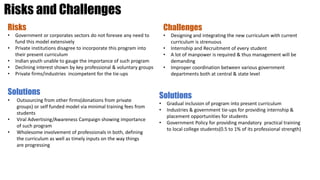
Risks and Challenges
Risks
• Government or corporates sectors do not foresee any need to
fund this model extensively
• Private institutions disagree to incorporate this program into
their present curriculum
• Indian youth unable to gauge the importance of such program
• Declining interest shown by key professional & voluntary groups
• Private firms/industries incompetent for the tie-ups
Challenges
• Designing and integrating the new curriculum with current
curriculum is strenuous
• Internship and Recruitment of every student
• A lot of manpower is required & thus management will be
demanding
• Improper coordination between various government
departments both at central & state level
Solutions
• Outsourcing from other firms(donations from private
groups) or self funded model via minimal training fees from
students
• Viral Advertising/Awareness Campaign showing importance
of such program
• Wholesome involvement of professionals in both, defining
the curriculum as well as timely inputs on the way things
are progressing
Solutions
• Gradual inclusion of program into present curriculum
• Industries & government tie-ups for providing internship &
placement opportunities for students
• Government Policy for providing mandatory practical training
to local college students(0.5 to 1% of its professional strength)
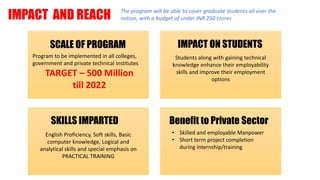
IMPACT AND REACH
SCALE OF PROGRAM
Program to be implemented in all colleges,
government and private technical institutes
TARGET – 500 Million
till 2022
Benefit to Private SectorSKILLS IMPARTED
IMPACT ON STUDENTS
Students along with gaining technical
knowledge enhance their employability
skills and improve their employment
options
English Proficiency, Soft skills, Basic
computer knowledge, Logical and
analytical skills and special emphasis on
PRACTICAL TRAINING
• Skilled and employable Manpower
• Short term project completion
during internship/training
The program will be able to cover graduate students all over the
nation, with a budget of under INR 250 crores

Titanz

  • 1.
    Boosting Skill Sets-Increasing Employability of Indian youth Abhisha Shrivastava Hardik Rathod Praveen Poonia Rahul Jain Sharth Mandan IIT BOMBAY
  • 2.
    According to anestimate, skill development of 500 million youth in India would be required by 2022, to make them employable • Only 42% of Employers in India find the graduates as employable • One-third of educators are of the view that graduates are not directly employable • Only 0.4% Public-Private Partnership projects are in field of education • About half of the graduates of India don’t have skill- sets to be employable Major Reasons for the High Un-Employability in India: A. Gap between the Indian Higher Education Sector and Market Requirement Supposition: Curriculum is out of sync with the requirements of education sector in India B. Neglect on the Skill-Development of Youth Reason Supposition: Very less focus given on developing soft skills, computer training and English proficiency C. Inefficiency of trainers/educators in the education sector Supposition: Trainers lack the up-to date knowledge of latest developments as well as training skills D. Inequality in Education Sector in India Supposition: Different boards, universities and institutions have vast differences in the curriculum E. Unavailability of proper Infrastructure in education sector Supposition: Computers, Technical Infrastructure and basic necessities are unavailable in large number of institutions
  • 3.
    Our Proposal AIMto provide quality training to both trainers and trainees thereby improving the existing system and boosting employability skills of the youth Program Salient FeaturesImplementation Model STEP 1 : ANALYSIS Will include the assessment of: • Present educational curriculum at school and college/training institutes • Contempory Knowledge • Needs of employees On the basis of this analysis necessary changes will be suggested in the existing curriculum which will be made mandatory to be included STEP 2: ASSESSMENT PROGRAM Designing a common assessment model of both trainers and trainees. Trainers: To ensure educational quality and good quality trainers Trainees: To boost employability skills STEP 3: TRAINING PROGRAM On the basis of the assessment results, allotment of training program FOR TRAINEES: Beginner and Advanced courses for 12 months and 6 months respectively FOR TRAINERS: Training for 6 months for those in need (judged on the basis of Assessment results) Regular sessions to keep them updated about the technological advancements Program Development Team: • A central Body to define a common model for assessment program , training program and curriculum to be followed at the school, college and technical institutes on the basis of the results of the analysis • They set the standards of the assessment tests and training programs Implementation Team: • Decentralized team to ensure implementation of program at various levels • They monitor the implementation of the program and give necessary feedback about the running and success of the program to the Program Development Team • Maintenance of regular reports of assessment and training programs • A central body to design the assessment and training program for the entire country thus maintaining training equality • Assessment of Trainers to ensure educational quality and good quality trainers • De-centralised mechanism for implementation of assessment and training program thus ensuring effective implementation of model as needs of the trainers and trainees can be effectively analyzed and catered to • Efficient training to be carried out in small groups • Special focus on practical training and contemporary knowledge
  • 4.
    Organizational Structure ProjectTeam Technical Finance Management Marketing & HR Analysis and Designing the entire program Handling the financial aspects and funding Execution, Training and monitoring Corporate Support, Media and Recruiting Research (Surveys , Curriculum research) FTE: 25 Assessment Program Designing (Curriculum and online content design) FTE: 60 Training Program Designing (Assessments and test development) FTE: 15 Review (Review of assessments and feedback) FTE: 60 TECHNICAL TEAM Financial Team Responsible for managing of funds for the program FTE: 20 Marketing & HR Team Responsible for corporate dealings, media support and Human resources management FTE: 100 (Headed by Financial Head) (Headed by Marketing & HR Head) State Head Team District Head Team Divisional Head Team Trainers Reports to National Project Head Chief monitoring and funds managing body of program Executing program and feedback in the institutions each division Training and assessing the students at institutional level FTE: 1/state FTE: 1/district FTE: 1/division FTE: 10/division Management Team (Headed by Project head, who will report to Indian HRD ministry)
  • 5.
    SKILLSET ENGLISH PROFICIENCY ANDSOFT SKILLS 1) BEGINNERS: Reading, writing, basic Grammar, essay writing, sentence formations, vocabulary 2) ADVANCED : Speaking skills, debating and negotiation skills and soft skills COMPUTER SKILLS 1)Basic computer handling and terminology : Reboot, hard drive,software,operating systems, USB port 2) Office based or industry-specific software 3) Internet use and basic mailing procedure NUMERACY, LOGICAL SKILLS 1) Data handling, and analysing 2) Basic algebra, statistics, basic finance, problem solving, Trainers for the program Beginners Top 30-50% advanced program Volunteer groups, NGOs, retired teachers, retired professors will be recruited Professionals will be hired through online/offline process Advanced Professionals will be hired through online/offline process Self-mentored Groups (Learning through each others help) will be formed Supervisor will be allocated & recruited amongst current professors/ industry professionals Skillsthatwillbecoveredunder theprogram
  • 6.
    Skill Assessment Program Trainee’sAssessment • Initial Assessment at start of program • Weekly Peer Review • Monthly Instructor Review • Monthly Online Assessment • Semi-annual written assessment • Group Discussions/ Personal Interviews at end of program • Minimum requirement in skill development to obtain degree Trainer’s Assessment • Assessment tests for trainers every 5 to 7 years • Training to trainers on specific points, as per field • Compulsory participation/ registration in relevant associations (Eg. PMAI) • Compulsory workshops/ sessions for trainers to keep them up to date with advancements Curriculum Assessment • Review of Curriculum by Professionals and Educationalists • Surveys by consultancy firms and relevant NGOs/ groups to review curriculum and suggest changes • Introduction of Skill Training Program and Practical Training Program with regular valuation • Focusing the needs of industry and integrating with the curriculum Implementation of Skill Training Program • Number of trainees/ trainer: 30 (max.) • Medium of Instruction: English • Duration of Training: - 6 months (advanced) - 12 months (beginners) • Timing of Training: 4 hours a week • Venue: College Campus (on weekends) • Online: Curriculum + Video Lectures + Assessments Online Skill Training Program • Database of Students, maintaining all the skill training details & assessments • Online Lectures, assignments, assessments and Video materials • Uniform online content throughout the country • State wise database handling and maintaining
  • 7.
    Implementation of PracticalTraining Industrial Training through industry-college tie-ups State ministry should invite big companies, MNCs and large scale industries Selection through online assessment test followed by video/telephonic interviews taking place in universities/divisional head offices Report review by college at end of training Divisional Heads to approach local medium & small scale industries Introduce Government Policy for providing mandatory practical training by local industries to local college students (0.5% to 1% of its employee strength) Selection through Tests/CPI/CGPA Report database maintained by government Private universities to provide compulsory internships, through the . Important Features of the Program: 1) Database of Students doing practical training at various places to be maintained in Divisional Head office & colleges. 2) Basic stipend to be provided by Companies while accommodation, travelling costs & messing costs to be provided by Government (if not provided by company) 3) Assessment of Industrial Practical Training for every student to be done after the training through feedback form Compulsory Practical Training Program • Mandatory Practical Training for all students to be undertaken to complete graduation • Duration of Training: 3 to 6 months • Criteria for successful completion of training: Training report + Company notification • Type of training and choice of industry should be relevant to the field of study • Chance of placement offer to be given by companies to students completing training/internship successfully • Assessment of student by the company at end of training
  • 8.
    Constitutional Costs Central Body Chief AdministrativeOfficer (1 FTE*12 lakh pa) Team Heads (3 FTE*9 lakh pa) Central Teams (Finance, Marketing & HR,Technical) (280 FTE*3.5 lakh pa) State Management Teams State Supervising Commissioner (30 FTE*9 lakh pa) District Officer (900 FTE*2.8 lakh pa) Trainers (9000 FTE*1.2 lakh pa) Divisional Officers (3600 FTE*1.8 lakh pa) Logistics Costs Onground Establishment & Processing Cost Running Costs Online Campaigns Resources Management 11 Cr INR PA 200 Cr INR PA 1.5 Cr INR PA 50 Lakh INR PA The Whole Model would be needing a Surplus of INR 213 CR from various partnerships between Government and Private Houses both at Central as well as state levels
  • 9.
    PPP Model Integration (Statusof PPP Projects in India) Advantages Disadvantages • Maximizes use of each sectors strength , shared resources • Reduced Public Capital Investment • Mobilizes excess or underutilized resources • No coordination among the various Ministries involved (Dehli-Gurgaon Express Highway) • Lack of Capital Return • Large Developmental Risk • Collaboration with leading vocational training institutes with an aim of providing skilled training in return of monetary/social benefits • Meeting infrastructural requirements of centers aimed at improving the skillsets of youth in remote places of the country in return of guaranteed employees for the firm • Help in assessment of trainers as well as trainees so that the overall impact of the program can be gaged and steps for improvement can be implemented How to put such a model in place? Examples of Successful PPP Models in Education Sector Azim Premji Foundation HRD Ministry to open up 2500 Model Schools under PPP Model The Skills Academy Benefits to private sector • Quality of graduates will improve, who are prospective employees of company • Short-term projects can be completed by trainees from colleges • Corporate Social Responsibility project
  • 10.
    Risks and Challenges Risks •Government or corporates sectors do not foresee any need to fund this model extensively • Private institutions disagree to incorporate this program into their present curriculum • Indian youth unable to gauge the importance of such program • Declining interest shown by key professional & voluntary groups • Private firms/industries incompetent for the tie-ups Challenges • Designing and integrating the new curriculum with current curriculum is strenuous • Internship and Recruitment of every student • A lot of manpower is required & thus management will be demanding • Improper coordination between various government departments both at central & state level Solutions • Outsourcing from other firms(donations from private groups) or self funded model via minimal training fees from students • Viral Advertising/Awareness Campaign showing importance of such program • Wholesome involvement of professionals in both, defining the curriculum as well as timely inputs on the way things are progressing Solutions • Gradual inclusion of program into present curriculum • Industries & government tie-ups for providing internship & placement opportunities for students • Government Policy for providing mandatory practical training to local college students(0.5 to 1% of its professional strength)
  • 11.
    IMPACT AND REACH SCALEOF PROGRAM Program to be implemented in all colleges, government and private technical institutes TARGET – 500 Million till 2022 Benefit to Private SectorSKILLS IMPARTED IMPACT ON STUDENTS Students along with gaining technical knowledge enhance their employability skills and improve their employment options English Proficiency, Soft skills, Basic computer knowledge, Logical and analytical skills and special emphasis on PRACTICAL TRAINING • Skilled and employable Manpower • Short term project completion during internship/training The program will be able to cover graduate students all over the nation, with a budget of under INR 250 crores