PRESENTATION FOR CA#1
TOPIC: SALIENT FEATURES OF LINEAR
PROGRAMMING AND ITS APPLICATIONS
Name: Somnil Paul
Roll: 18700721013
Stream: ME
Sem: 6th
Paper name: Humanities II(Operations Research)
Paper code: HM HU 601
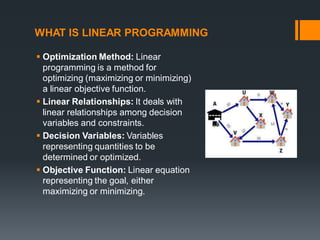
WHAT IS LINEAR PROGRAMMING
 Optimization Method: Linear
programming is a method for
optimizing (maximizing or minimizing)
a linear objective function.
 Linear Relationships: It deals with
linear relationships among decision
variables and constraints.
 Decision Variables: Variables
representing quantities to be
determined or optimized.
 Objective Function: Linear equation
representing the goal, either
maximizing or minimizing.
 Constraints: Linear relationships restricting the possible
values for decision variables.
 Feasible Region: Set of values satisfying all constraints.
 Non-negativity Constraints: Typically, decision variables
are constrained to non-negative values.
 Mathematical Modelling: Involves setting up a
mathematical model to represent real-world problems with
linear relationships.
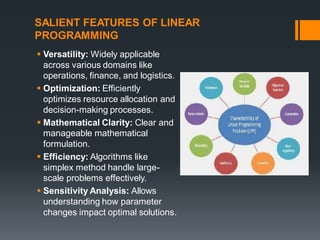
SALIENT FEATURES OF LINEAR
PROGRAMMING
 Versatility: Widely applicable
across various domains like
operations, finance, and logistics.
 Optimization: Efficiently
optimizes resource allocation and
decision-making processes.
 Mathematical Clarity: Clear and
manageable mathematical
formulation.
 Efficiency: Algorithms like
simplex method handle large-
scale problems effectively.
 Sensitivity Analysis: Allows
understanding how parameter
changes impact optimal solutions.
 Quantitative Decision-Making: Provides a quantitative
basis for decision-makers.
 Resource Optimization: Optimizes resource use,
minimizing costs or maximizing profits.
 Easy Interpretation: Results are often easy to understand
and interpret.
 Software Integration: Easily integrated into software tools
for automated solutions.
 Proven Track Record: Successfully applied in various
industries for real-world problem-solving.
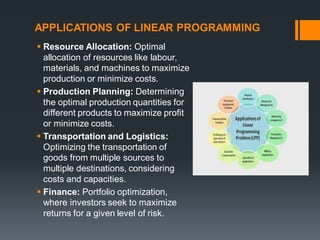
APPLICATIONS OF LINEAR PROGRAMMING
 Resource Allocation: Optimal
allocation of resources like labour,
materials, and machines to maximize
production or minimize costs.
 Production Planning: Determining
the optimal production quantities for
different products to maximize profit
or minimize costs.
 Transportation and Logistics:
Optimizing the transportation of
goods from multiple sources to
multiple destinations, considering
costs and capacities.
 Finance: Portfolio optimization,
where investors seek to maximize
returns for a given level of risk.
 Marketing: Determining the optimal mix of advertising
channels to maximize reach or sales while considering
budget constraints.
 Scheduling: Assigning tasks to resources efficiently,
considering time and resource constraints.
 Supply Chain Management: Optimizing supply chain
activities, including inventory management, production
planning, and distribution.
 Network Flow Problems: Maximizing or minimizing flow
through a network, such as in the design of communication
or transportation networks.
 Environmental Management: Optimizing resource use and
waste disposal to minimize environmental impact.
 Healthcare: Resource allocation in healthcare facilities, such
as staff scheduling or bed allocation, to optimize efficiency.
THANK YOU

Salient features of linear programming and its applications

  • 1.
    PRESENTATION FOR CA#1 TOPIC:SALIENT FEATURES OF LINEAR PROGRAMMING AND ITS APPLICATIONS Name: Somnil Paul Roll: 18700721013 Stream: ME Sem: 6th Paper name: Humanities II(Operations Research) Paper code: HM HU 601
  • 2.
    WHAT IS LINEARPROGRAMMING  Optimization Method: Linear programming is a method for optimizing (maximizing or minimizing) a linear objective function.  Linear Relationships: It deals with linear relationships among decision variables and constraints.  Decision Variables: Variables representing quantities to be determined or optimized.  Objective Function: Linear equation representing the goal, either maximizing or minimizing.
  • 3.
     Constraints: Linearrelationships restricting the possible values for decision variables.  Feasible Region: Set of values satisfying all constraints.  Non-negativity Constraints: Typically, decision variables are constrained to non-negative values.  Mathematical Modelling: Involves setting up a mathematical model to represent real-world problems with linear relationships.
  • 4.
    SALIENT FEATURES OFLINEAR PROGRAMMING  Versatility: Widely applicable across various domains like operations, finance, and logistics.  Optimization: Efficiently optimizes resource allocation and decision-making processes.  Mathematical Clarity: Clear and manageable mathematical formulation.  Efficiency: Algorithms like simplex method handle large- scale problems effectively.  Sensitivity Analysis: Allows understanding how parameter changes impact optimal solutions.
  • 5.
     Quantitative Decision-Making:Provides a quantitative basis for decision-makers.  Resource Optimization: Optimizes resource use, minimizing costs or maximizing profits.  Easy Interpretation: Results are often easy to understand and interpret.  Software Integration: Easily integrated into software tools for automated solutions.  Proven Track Record: Successfully applied in various industries for real-world problem-solving.
  • 6.
    APPLICATIONS OF LINEARPROGRAMMING  Resource Allocation: Optimal allocation of resources like labour, materials, and machines to maximize production or minimize costs.  Production Planning: Determining the optimal production quantities for different products to maximize profit or minimize costs.  Transportation and Logistics: Optimizing the transportation of goods from multiple sources to multiple destinations, considering costs and capacities.  Finance: Portfolio optimization, where investors seek to maximize returns for a given level of risk.
  • 7.
     Marketing: Determiningthe optimal mix of advertising channels to maximize reach or sales while considering budget constraints.  Scheduling: Assigning tasks to resources efficiently, considering time and resource constraints.  Supply Chain Management: Optimizing supply chain activities, including inventory management, production planning, and distribution.  Network Flow Problems: Maximizing or minimizing flow through a network, such as in the design of communication or transportation networks.  Environmental Management: Optimizing resource use and waste disposal to minimize environmental impact.  Healthcare: Resource allocation in healthcare facilities, such as staff scheduling or bed allocation, to optimize efficiency.
  • 8.