VI Semester Civil CE6602 Structural Analysis-II by Ms.S.Nagajothi AP / Civil Page 1
SRI VIDYA COLLEGE OF ENGINEERING & TECHNOLOGY
VIRUDHUNAGAR
QUESTION BANK
DEPARTMENT: CIVIL SEMESTER: VI
SUBJECT CODE / Name: CE 6602 / STRUCTURAL ANALYSIS-II
UNIT 5 - SPACE AND CABLE STRUCTURES
PART - A (2 marks)
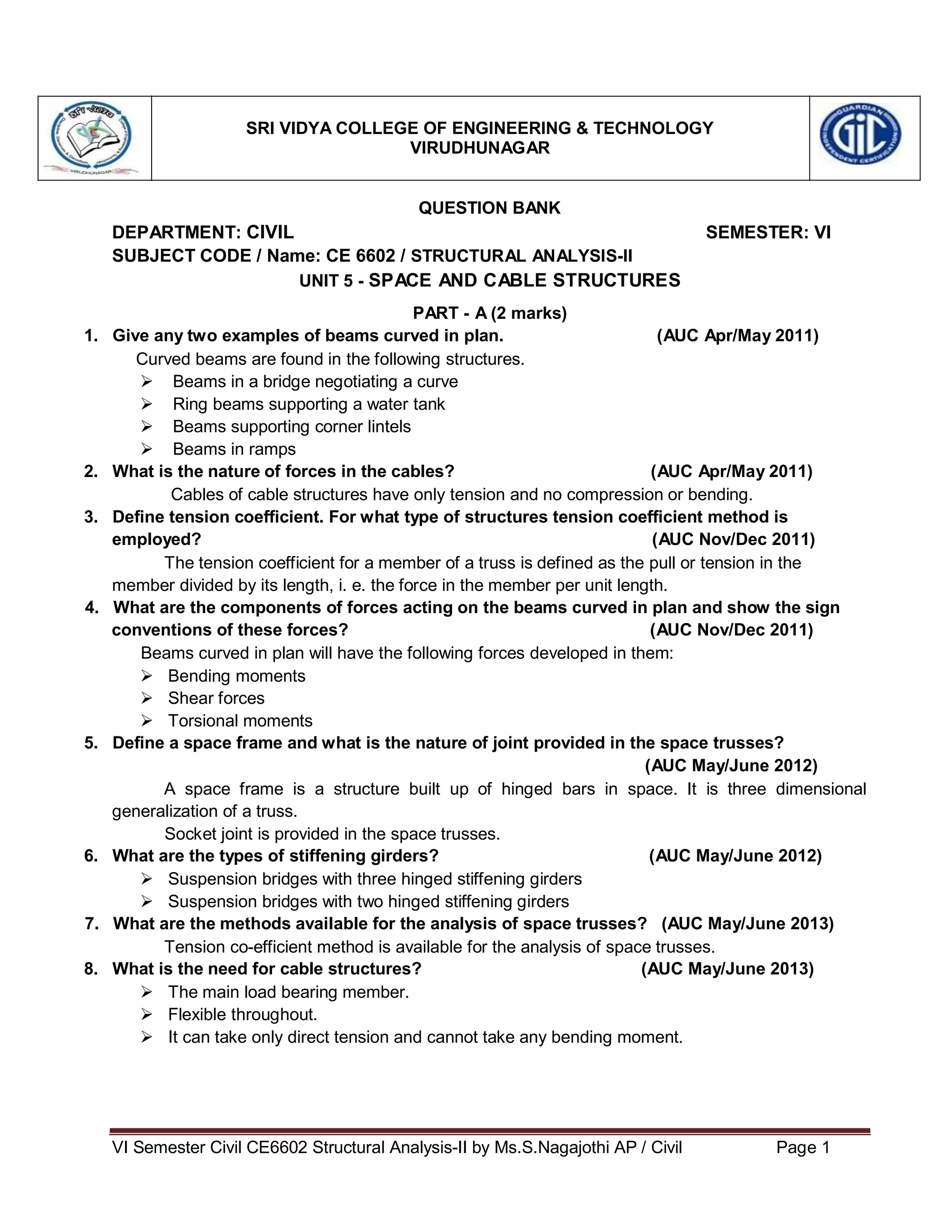
1. Give any two examples of beams curved in plan. (AUC Apr/May 2011)
Curved beams are found in the following structures.
 Beams in a bridge negotiating a curve
 Ring beams supporting a water tank
 Beams supporting corner lintels
 Beams in ramps
2. What is the nature of forces in the cables? (AUC Apr/May 2011)
Cables of cable structures have only tension and no compression or bending.
3. Define tension coefficient. For what type of structures tension coefficient method is
employed? (AUC Nov/Dec 2011)
The tension coefficient for a member of a truss is defined as the pull or tension in the
member divided by its length, i. e. the force in the member per unit length.
4. What are the components of forces acting on the beams curved in plan and show the sign
conventions of these forces? (AUC Nov/Dec 2011)
Beams curved in plan will have the following forces developed in them:
 Bending moments
 Shear forces
 Torsional moments
5. Define a space frame and what is the nature of joint provided in the space trusses?
(AUC May/June 2012)
A space frame is a structure built up of hinged bars in space. It is three dimensional
generalization of a truss.
Socket joint is provided in the space trusses.
6. What are the types of stiffening girders? (AUC May/June 2012)
 Suspension bridges with three hinged stiffening girders
 Suspension bridges with two hinged stiffening girders
7. What are the methods available for the analysis of space trusses? (AUC May/June 2013)
Tension co-efficient method is available for the analysis of space trusses.
8. What is the need for cable structures? (AUC May/June 2013)
 The main load bearing member.
 Flexible throughout.
 It can take only direct tension and cannot take any bending moment.
VI Semester Civil CE6602 Structural Analysis-II by Ms.S.Nagajothi AP / Civil Page 2
H2
V2
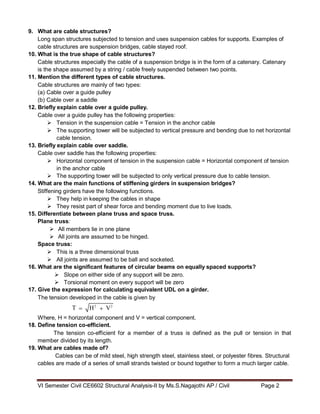
9. What are cable structures?
Long span structures subjected to tension and uses suspension cables for supports. Examples of
cable structures are suspension bridges, cable stayed roof.
10. What is the true shape of cable structures?
Cable structures especially the cable of a suspension bridge is in the form of a catenary. Catenary
is the shape assumed by a string / cable freely suspended between two points.
11. Mention the different types of cable structures.
Cable structures are mainly of two types:
(a) Cable over a guide pulley
(b) Cable over a saddle
12. Briefly explain cable over a guide pulley.
Cable over a guide pulley has the following properties:
 Tension in the suspension cable = Tension in the anchor cable
 The supporting tower will be subjected to vertical pressure and bending due to net horizontal
cable tension.
13. Briefly explain cable over saddle.
Cable over saddle has the following properties:
 Horizontal component of tension in the suspension cable = Horizontal component of tension
in the anchor cable
 The supporting tower will be subjected to only vertical pressure due to cable tension.
14. What are the main functions of stiffening girders in suspension bridges?
Stiffening girders have the following functions.
 They help in keeping the cables in shape
 They resist part of shear force and bending moment due to live loads.
15. Differentiate between plane truss and space truss.
Plane truss:
 All members lie in one plane
 All joints are assumed to be hinged.
Space truss:
 This is a three dimensional truss
 All joints are assumed to be ball and socketed.
16. What are the significant features of circular beams on equally spaced supports?
 Slope on either side of any support will be zero.
 Torsional moment on every support will be zero
17. Give the expression for calculating equivalent UDL on a girder.
The tension developed in the cable is given by
T
Where, H = horizontal component and V = vertical component.
18. Define tension co-efficient.
The tension co-efficient for a member of a truss is defined as the pull or tension in that
member divided by its length.
19. What are cables made of?
Cables can be of mild steel, high strength steel, stainless steel, or polyester fibres. Structural
cables are made of a series of small strands twisted or bound together to form a much larger cable.
VI Semester Civil CE6602 Structural Analysis-II by Ms.S.Nagajothi AP / Civil Page 3
V = 0
M@ B
H 132 0
0.05H 6.6 ..........
Steel cables are either spiral strand, where circular rods are twisted together or locked coil strand,
where individual interlocking steel strands form the cable (often with a spiral strand core).
Spiral strand is slightly weaker than locked coil strand. Steel spiral strand cables have a
Young's modulus, E of 150 ± 10 kN/mm² and come in sizes from 3 to 90 mm diameter. Spiral strand
suffers from construction stretch, where the strands compact when the cable is loaded.
20. Give the types of significant cable structures
Linear structures:
 Suspension bridges
 Draped cables
 Cable-stayed beams or trusses
 Cable trusses
 Straight tensioned cables
Three-dimensional structures:
 Bi-cycle roof
 3D cable trusses
 Tensegrity structures
 Tensairity structures
PART - B (16 marks)
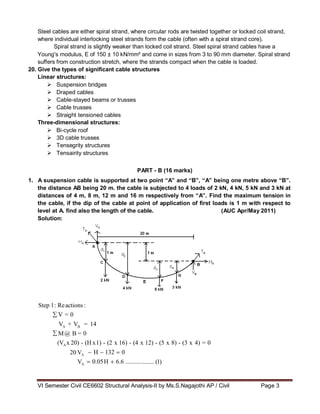
1. A suspension cable is supported at two point “A” and “B”, “A” being one metre above “B”.
the distance AB being 20 m. the cable is subjected to 4 loads of 2 kN, 4 kN, 5 kN and 3 kN at
distances of 4 m, 8 m, 12 m and 16 m respectively from “A”. Find the maximum tension in
the cable, if the dip of the cable at point of application of first loads is 1 m with respect to
level at A. find also the length of the cable. (AUC Apr/May 2011)
Solution:
Step 1: Reactions :
VA
+ VB
= 14
= 0
(VA x 20) - (H x1) - (2 x 16) - (4 x 12) - (5 x 8) - (3 x 4) = 0
20 VA
VA ........ (1)
VI Semester Civil CE6602 Structural Analysis-II by Ms.S.Nagajothi AP / Civil Page 4
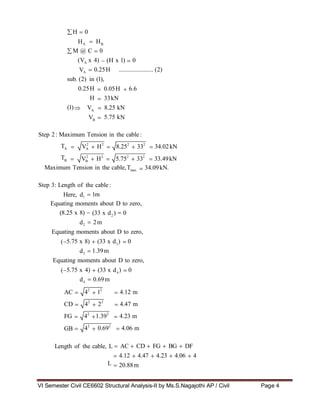
(H x 1) 0
0.05H 6.6
33kN
VA
8.25 kN
5.75 k
V2
H2
8.252
332
34.02kN
A
V2
H2
5.752
332
33.49kN
B
34.09k
5.75 x 8) (33 x d3
) 0
5.75 x 4) (33 x d4
) 0
42
12
4.12 m
42
22
4.47 m
42
1.392
4.23 m
42
0.692
4.06 m
4.12 4.47 4.23 4.06 4
20.88m
H 0
HB
M @ C 0
0.25H
1m
(33 x d2
) 0
2m
1.39m
0.69m
AC CD FG BG DF
HA
(VA x 4)
VA
sub. (2) in (1),
0.25H
H
...................... (2)
(1)
VB
N
Step 2: Maximum Tension in the cable:
TA
TB
Maximum Tension in the cable,Tmax N.
Step 3: Length of the cable:
Here, d1
Equating moments about D to zero,
(8.25 x 8)
d2
Equating moments about D to zero,
(
d3
Equating moments about D to zero,
(
d4
AC
CD
FG
GB
Length of the cable, L
L
VI Semester Civil CE6602 Structural Analysis-II by Ms.S.Nagajothi AP / Civil Page 5
30 x 152
= 0
2
67.5kN
(VB
x 50)
382.5k
V2
H2
382.52
421.872
569.46kN
A
V2
H2
67.52
421.872
427.24kN
B
Tmax 569.46 x
949.1 m
V = 0
M@ A
H 0
HB
M @ C 0
(H x 4) (30 x 15 x (7.5 10)) 0
421.87
569.46
. A
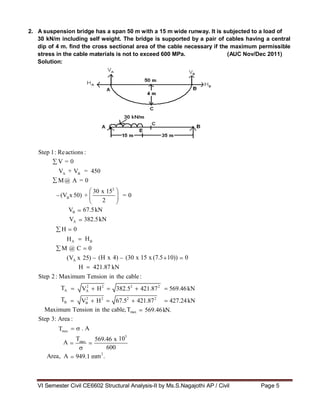
2. A suspension bridge has a span 50 m with a 15 m wide runway. It is subjected to a load of
30 kN/m including self weight. The bridge is supported by a pair of cables having a central
dip of 4 m. find the cross sectional area of the cable necessary if the maximum permissible
stress in the cable materials is not to exceed 600 MPa. (AUC Nov/Dec 2011)
Solution:
Step 1: Reactions :
VA
+ VB
= 450
= 0
+
VB
VA N
HA
(VA x 25)
H kN
Step 2: Maximum Tension in the cable:
TA
TB
Maximum Tension in the cable,Tmax
Step 3: Area :
Tmax
kN.
A
Area, A m2
.
600
103
VI Semester Civil CE6602 Structural Analysis-II by Ms.S.Nagajothi AP / Civil Page 6
M@ B
4d
( 2x)
4 x10
(100 (2 x 30))
2 2
0.16
14 10 (30 x 0.
V = 0
(10 x 80) (10 x 60)
14kN
6 kN
H 0
HB
M @ C 0
(H x 10) (10 x 30) (10 x 10) 0
30kN
VA
10 H tan
0.8 kN
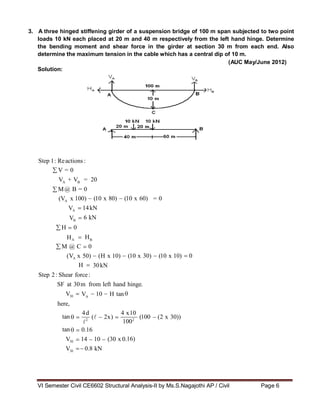
3. A three hinged stiffening girder of a suspension bridge of 100 m span subjected to two point
loads 10 kN each placed at 20 m and 40 m respectively from the left hand hinge. Determine
the bending moment and shear force in the girder at section 30 m from each end. Also
determine the maximum tension in the cable which has a central dip of 10 m.
(AUC May/June 2012)
Solution:
Step 1: Reactions :
VA + VB = 20
= 0
(VA x 100) = 0
VA
VB
HA
(VA x 50)
H
Step 2: Shear force:
SF at 30m from left hand hinge.
V30
here,
tan
tan
V30
V30
100
16)
VI Semester Civil CE6602 Structural Analysis-II by Ms.S.Nagajothi AP / Civil Page 7
4d
x X( X2
)
4x10
x 30(100 30)
2 2
8.4m
(14x30) (30x8.4) 100 68 kNm.
VB
x 30 H x
V2
H2
142
302
33.11kN
A
V2
H2
62
302
30.59kN
B
VB
H tan
6 (30 x 0.
1.2 kN
VA
x 30 H x y 10 x 10
(6 x 30) (30 x 8.4
72 kNm
33.11 k
SF at 30m from right hand hinge.
V30
V30
Step3: Bending Moment :
16)
BM at 30m from left hand hinge.
BM30
here, y at 30m from each end,
y
y
BM30
100
BM at 30m from right hand hinge.
BM30 y
)
BM30 .
Step 4: Maximum Tension in the cable:
TA
TB
Maximum Tension in the cable,Tmax N.
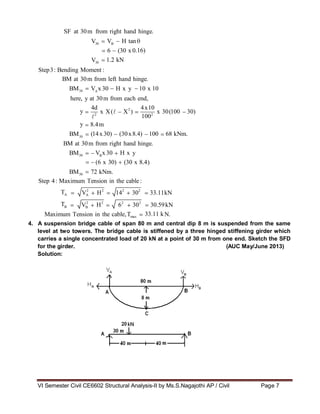
4. A suspension bridge cable of span 80 m and central dip 8 m is suspended from the same
level at two towers. The bridge cable is stiffened by a three hinged stiffening girder which
carries a single concentrated load of 20 kN at a point of 30 m from one end. Sketch the SFD
for the girder. (AUC May/June 2013)
Solution:
VI Semester Civil CE6602 Structural Analysis-II by Ms.S.Nagajothi AP / Civil Page 8
37.5 k
4d
( 2x)
4 x8
(80 (2 x 40))
2 2
0
(20 x 5
12.5kN
7.5 kN
H 0
HB
M @ C 0
(20 x 10) (H x 8) 0
VA
20 H tan
12.5 20 (37.5 x 0
7.5 kN
Step 1: Reactions :
V = 0
VA + VB = 20
M@ B = 0
(VA x 80) 0) = 0
VA
VB
HA
(VA x 40)
H N
Step 2: Shear force:
SF at 40m from left hand hinge.
V40
here,
tan
80
tan
V40 )
V40
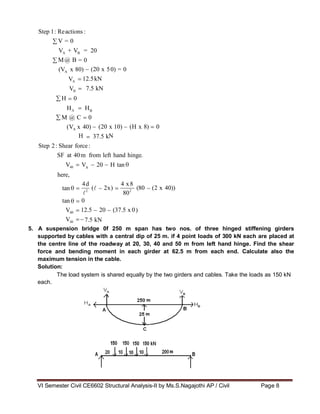
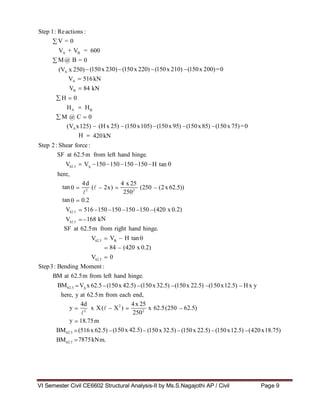
5. A suspension bridge 0f 250 m span has two nos. of three hinged stiffening girders
supported by cables with a central dip of 25 m. if 4 point loads of 300 kN each are placed at
the centre line of the roadway at 20, 30, 40 and 50 m from left hand hinge. Find the shear
force and bending moment in each girder at 62.5 m from each end. Calculate also the
maximum tension in the cable.
Solution:
The load system is shared equally by the two girders and cables. Take the loads as 150 kN
each.
VI Semester Civil CE6602 Structural Analysis-II by Ms.S.Nagajothi AP / Civil Page 9
4d
( 2x)
4 x 25
(250 (2x 62.5))
2 2
0.2
516 150 150 150 150 (420 x 0.
168 k
4d
x X( X2
)
4x 25
x 62.5(250 62.5)
2 2
18.75m
VA
x 62.5 (150x 42.5) (150x32.5) (150x 22.5) (150x12.5) H x y
(516x 62.5) (1 (150x 32.5) (150x 22.5) (150x12.5) (420x18.75)
(150x 230) (150x 220) (150x 210) (150x 200)=0
516kN
84 kN
H 0
HB
M @ C 0
(H x 25) (150x105) (150x 95) (150x85) (150x 75)=0
420kN
VA
150 150 150 150 H tan
VB
H tan
84 (420 x 0
0
7875kN
Step 1: Reactions :
V = 0
VA + VB = 600
M@ B = 0
(VA x 250)
VA
VB
HA
(VAx125)
H
Step 2: Shear force:
SF at 62.5m from left hand hinge.
V62.5
here,
tan
tan
V62.5
V62.5
250
2)
N
SF at 62.5m from right hand hinge.
V62.5
V62.5
Step3: Bending Moment :
BM at 62.5m from left hand hinge.
BM62.5
here, y at 62.5m from each end,
.2)
y
y
BM62.5
BM62.5 m.
250
50x 42.5)
VI Semester Civil CE6602 Structural Analysis-II by Ms.S.Nagajothi AP / Civil Page 10
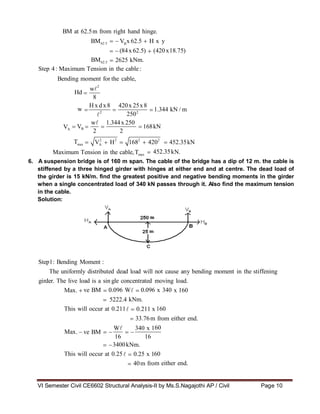
(84x 62.5) (420x18.
2625 k
w 2
H x dx8 420x 25x8
1.344 kN / m
2 2
V
w 1.344x 250
168kN
B
V2
H2
1682
4202
452.35kN
A
ve BM
W 340 x 1
5222.4
0.211 x
33.76m
ve BM 0.096 W 0.096 x 340
3400k
0.25 x 1
40m fro
VB
x 62.5 H x y
452.35
BM at 62.5m from right hand hinge.
BM62.5
BM62.5 Nm.
Step 4: Maximum Tension in the cable:
Bending moment for the cable,
75)
Hd
w
VA
Tmax
8
250
2 2
Maximum Tension in the cable,Tmax
kN.
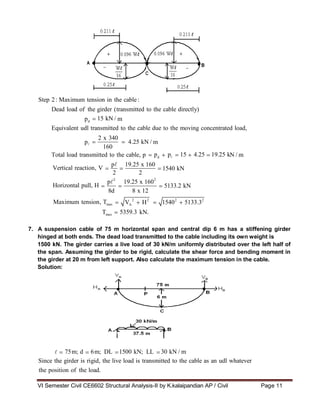
6. A suspension bridge is of 160 m span. The cable of the bridge has a dip of 12 m. the cable is
stiffened by a three hinged girder with hinges at either end and at centre. The dead load of
the girder is 15 kN/m. find the greatest positive and negative bending moments in the girder
when a single concentrated load of 340 kN passes through it. Also find the maximum tension
in the cable.
Solution:
Step1: Bending Moment :
The uniformly distributed dead load will not cause any bending moment in the stiffening
girder. The live load is a sin gle concentrated moving load.
Max. x 160
kNm.
This will occur at 0.211 160
from either end.
Max.
60
16 16
Nm.
This will occur at 0.25 60
m either end.
VI Semester Civil CE6602 Structural Analysis-II by K.kalaipandian AP / Civil Page 11
2 x 340
4.25 kN /
p 19.25 x 160
1540 kN
p 19.25 x 160
5133.2 kN
2
V 2
H2
15402
5133.32
A
5359.3
pd
p 15 4.25 19.25 k
75m; d 6m; DL 1500 kN; LL 30 kN / m
15 kN /
Step 2: Maximum tension in the cable:
Dead load of the girder (transmitted to the cable directly)
pd m
Equivalent udl transmitted to the cable due to the moving concentrated load,
p m
160
Total load transmitted to the cable, p N / m
Vertical reaction, V
Horizontal pull, H
2 2
2
8d 8 x 12
Maximum tension, Tmax
Tmax kN.
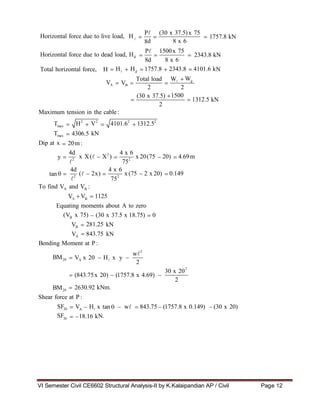
7. A suspension cable of 75 m horizontal span and central dip 6 m has a stiffening girder
hinged at both ends. The dead load transmitted to the cable including its own weight is
1500 kN. The girder carries a live load of 30 kN/m uniformly distributed over the left half of
the span. Assuming the girder to be rigid, calculate the shear force and bending moment in
the girder at 20 m from left support. Also calculate the maximum tension in the cable.
Solution:
Since the girder is rigid, the live load is transmitted to the cable as an udl whatever
the position of the load.
VI Semester Civil CE6602 Structural Analysis-II by K.Kalaipandian AP / Civil Page 12
P (30 x 37.5)x 75
1757.8 kN
8
P 1500x 75
2343.8 kN
Wd
V
Total load W
B
H Hd
1757.8 2343.8 4101.6 k
(30 x 3 1500
1312.5
H2
V2
4101.62
1312.52
4306.5
4d
x X( X2
)
4 x 6
x 20(75 20) 4.69m
2 2
4d
( 2x)
4 x 6
x (75 2 x 20) 0.149
2 2
20m :
(30 x 37.5 x 18.75) 0
V x 20 H x y
w
A
2
(843.75x 20) (1757.8 x 4.69)
30 x 20
VA
H x tan w 843.75 (1757.8 x 0.149) (30 x 20)
18.16 k
VB
1125
281.25
843.75
2630.92
Horizontal force due to live load, H
Horizontal force due to dead load, Hd
d 8 x 6
8d 8 x 6
Total horizontal force, H N
VA
Maximum tension in the cable:
Tmax
Tmax kN
Dip at x
2 2
7.5)
kN
2
y
75
tan
75
To find VA and VB :
VA
Equating moments about A to zero
(VB x 75)
VB kN
VA kN
Bending Moment at P :
BM20
BM20
Shear force at P :
SF20
SF20
2
2
2
kNm.
N.
VI Semester Civil CE6602 Structural Analysis-II by K.Kalaipandian AP / Civil Page 13
100 100
0.83 kN /
120
V
w 0.83x120
50kN
B
V2
H2
502
1502
158.1kN
A
158.1k
V = 0
M@ A
(VB
x12
25kN
75kN
H 0
HB
M @ C 0
(VB
x 60) (H x10) =0
150kN
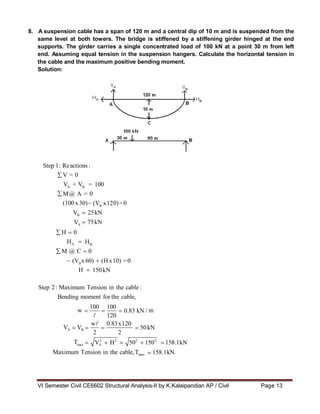
8. A suspension cable has a span of 120 m and a central dip of 10 m and is suspended from the
same level at both towers. The bridge is stiffened by a stiffening girder hinged at the end
supports. The girder carries a single concentrated load of 100 kN at a point 30 m from left
end. Assuming equal tension in the suspension hangers. Calculate the horizontal tension in
the cable and the maximum positive bending moment.
Solution:
Step 1: Reactions :
VA
+ VB
= 100
= 0
(100x 30) 0)=0
VB
VA
HA
H
Step 2: Maximum Tension in the cable:
Bending moment for the cable,
w m
VA
2 2
Tmax
Maximum Tension in the cable,Tmax N.
VI Semester Civil CE6602 Structural Analysis-II by K.Kalaipandian AP / Civil Page 14
4d
x X( X2
)
4x10
x 30(120 30)
2 2
7.5m
(75x 30) (150x 7.5)
1125
R (1 cos )
VA
x 30 Hx y
Step3: Maximum positive Bending Moment :
Maximum positive Bending moment will occur at under the point load.
BM30
here, y at 30m from left end,
y
y
BM30
BM30
kNm.
120
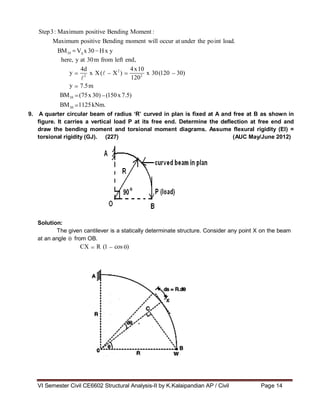
9. A quarter circular beam of radius „R‟ curved in plan is fixed at A and free at B as shown in
figure. It carries a vertical load P at its free end. Determine the deflection at free end and
draw the bending moment and torsional moment diagrams. Assume flexural rigidity (EI) =
torsional rigidity (GJ). (227) (AUC May/June 2012)
Solution:
The given cantilever is a statically determinate structure. Consider any point X on the beam
at an angle from OB.
CX
VI Semester Civil CE6602 Structural Analysis-II by K.Kalaipandian AP / Civil Page 15
, MA
WR
W (CB
W. R sin
0, MB
0
1 cos WR
, TA
WR
2
W (CX
WR (1 cos )
0, TB
WR (1 cos ) 0
ds T ds
M
2 EI 2 GJ
2 2
1
( WR sin )2
R d
1
[ WR (1 cos )]2
R d
2GJ
2
1
(W2
R2
sin2
)R d
1
[W
2
cos 2
2cos )R d
2
R2
(1
2 2
cos2 1 2 3 1 cos2
1
1
W2
R3
d x W R 1 2cos d
2 2GJ 2
0
W
and unif
Step1: Shear force:
SF at the section X, Fo
Fo is independent of orm throughout.
Step2: Bending Moment :
BM at the section X, M )
M
At
At
2
Step3: Twisting Moment :
Twisting moment at the section X, T )
T
At
At
2
Step4: Deflection at the free end B:
Method of strain energy is used to find the deflection at the free end B.
2 2
Strain energy, U
2EI 0 0
2EI 0
2GJ 0
2EI 0
VI Semester Civil CE6602 Structural Analysis-II by K.Kalaipandian AP / Civil Page 16
2 2 3 2
W R
1 cos2 d
W R
x 2 1 cos2 4cos d
4GJ
2 2 3 2
W R sin 2
sin 2
W R
x 3 4sin
2 4GJ 2
0 0
W2
R3
3
W R
4
2 4GJ 2
W2
R3
W R
(3 8)
dU
B
WR3
WR
(3 8)
B
2 3
4EI 0 0
2 3
4EI
2 3
4EI
2 3
U
8EI 8GJ
dW
3
4EI 4GJ
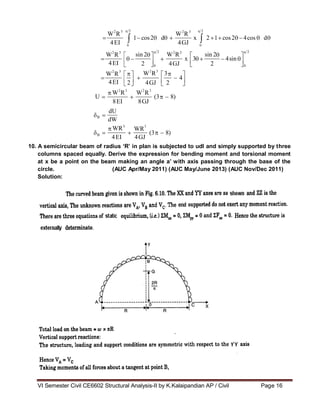
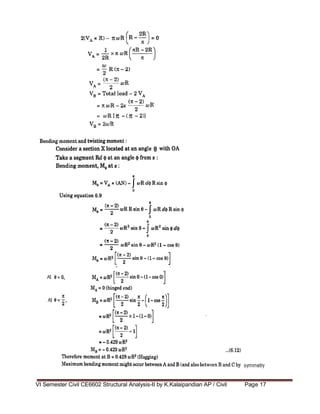
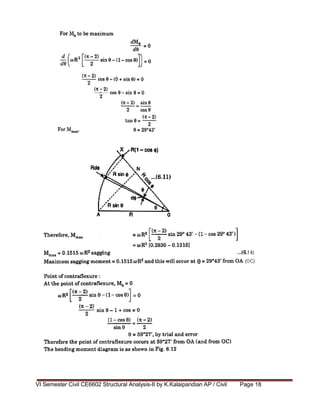
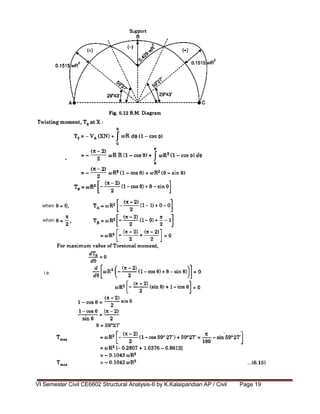
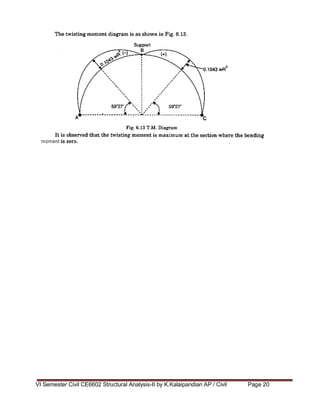
10. A semicircular beam of radius „R‟ in plan is subjected to udl and simply supported by three
columns spaced equally. Derive the expression for bending moment and torsional moment
at x be a point on the beam making an angle a‟ with axis passing through the base of the
circle. (AUC Apr/May 2011) (AUC May/June 2013) (AUC Nov/Dec 2011)
Solution:
VI Semester Civil CE6602 Structural Analysis-II by K.Kalaipandian AP / Civil Page 17
VI Semester Civil CE6602 Structural Analysis-II by K.Kalaipandian AP / Civil Page 18
VI Semester Civil CE6602 Structural Analysis-II by K.Kalaipandian AP / Civil Page 19
VI Semester Civil CE6602 Structural Analysis-II by K.Kalaipandian AP / Civil Page 20

SA-II Notes.pdf

  • 1.
    VI Semester CivilCE6602 Structural Analysis-II by Ms.S.Nagajothi AP / Civil Page 1 SRI VIDYA COLLEGE OF ENGINEERING & TECHNOLOGY VIRUDHUNAGAR QUESTION BANK DEPARTMENT: CIVIL SEMESTER: VI SUBJECT CODE / Name: CE 6602 / STRUCTURAL ANALYSIS-II UNIT 5 - SPACE AND CABLE STRUCTURES PART - A (2 marks) 1. Give any two examples of beams curved in plan. (AUC Apr/May 2011) Curved beams are found in the following structures.  Beams in a bridge negotiating a curve  Ring beams supporting a water tank  Beams supporting corner lintels  Beams in ramps 2. What is the nature of forces in the cables? (AUC Apr/May 2011) Cables of cable structures have only tension and no compression or bending. 3. Define tension coefficient. For what type of structures tension coefficient method is employed? (AUC Nov/Dec 2011) The tension coefficient for a member of a truss is defined as the pull or tension in the member divided by its length, i. e. the force in the member per unit length. 4. What are the components of forces acting on the beams curved in plan and show the sign conventions of these forces? (AUC Nov/Dec 2011) Beams curved in plan will have the following forces developed in them:  Bending moments  Shear forces  Torsional moments 5. Define a space frame and what is the nature of joint provided in the space trusses? (AUC May/June 2012) A space frame is a structure built up of hinged bars in space. It is three dimensional generalization of a truss. Socket joint is provided in the space trusses. 6. What are the types of stiffening girders? (AUC May/June 2012)  Suspension bridges with three hinged stiffening girders  Suspension bridges with two hinged stiffening girders 7. What are the methods available for the analysis of space trusses? (AUC May/June 2013) Tension co-efficient method is available for the analysis of space trusses. 8. What is the need for cable structures? (AUC May/June 2013)  The main load bearing member.  Flexible throughout.  It can take only direct tension and cannot take any bending moment.
  • 2.
    VI Semester CivilCE6602 Structural Analysis-II by Ms.S.Nagajothi AP / Civil Page 2 H2 V2 9. What are cable structures? Long span structures subjected to tension and uses suspension cables for supports. Examples of cable structures are suspension bridges, cable stayed roof. 10. What is the true shape of cable structures? Cable structures especially the cable of a suspension bridge is in the form of a catenary. Catenary is the shape assumed by a string / cable freely suspended between two points. 11. Mention the different types of cable structures. Cable structures are mainly of two types: (a) Cable over a guide pulley (b) Cable over a saddle 12. Briefly explain cable over a guide pulley. Cable over a guide pulley has the following properties:  Tension in the suspension cable = Tension in the anchor cable  The supporting tower will be subjected to vertical pressure and bending due to net horizontal cable tension. 13. Briefly explain cable over saddle. Cable over saddle has the following properties:  Horizontal component of tension in the suspension cable = Horizontal component of tension in the anchor cable  The supporting tower will be subjected to only vertical pressure due to cable tension. 14. What are the main functions of stiffening girders in suspension bridges? Stiffening girders have the following functions.  They help in keeping the cables in shape  They resist part of shear force and bending moment due to live loads. 15. Differentiate between plane truss and space truss. Plane truss:  All members lie in one plane  All joints are assumed to be hinged. Space truss:  This is a three dimensional truss  All joints are assumed to be ball and socketed. 16. What are the significant features of circular beams on equally spaced supports?  Slope on either side of any support will be zero.  Torsional moment on every support will be zero 17. Give the expression for calculating equivalent UDL on a girder. The tension developed in the cable is given by T Where, H = horizontal component and V = vertical component. 18. Define tension co-efficient. The tension co-efficient for a member of a truss is defined as the pull or tension in that member divided by its length. 19. What are cables made of? Cables can be of mild steel, high strength steel, stainless steel, or polyester fibres. Structural cables are made of a series of small strands twisted or bound together to form a much larger cable.
  • 3.
    VI Semester CivilCE6602 Structural Analysis-II by Ms.S.Nagajothi AP / Civil Page 3 V = 0 M@ B H 132 0 0.05H 6.6 .......... Steel cables are either spiral strand, where circular rods are twisted together or locked coil strand, where individual interlocking steel strands form the cable (often with a spiral strand core). Spiral strand is slightly weaker than locked coil strand. Steel spiral strand cables have a Young's modulus, E of 150 ± 10 kN/mm² and come in sizes from 3 to 90 mm diameter. Spiral strand suffers from construction stretch, where the strands compact when the cable is loaded. 20. Give the types of significant cable structures Linear structures:  Suspension bridges  Draped cables  Cable-stayed beams or trusses  Cable trusses  Straight tensioned cables Three-dimensional structures:  Bi-cycle roof  3D cable trusses  Tensegrity structures  Tensairity structures PART - B (16 marks) 1. A suspension cable is supported at two point “A” and “B”, “A” being one metre above “B”. the distance AB being 20 m. the cable is subjected to 4 loads of 2 kN, 4 kN, 5 kN and 3 kN at distances of 4 m, 8 m, 12 m and 16 m respectively from “A”. Find the maximum tension in the cable, if the dip of the cable at point of application of first loads is 1 m with respect to level at A. find also the length of the cable. (AUC Apr/May 2011) Solution: Step 1: Reactions : VA + VB = 14 = 0 (VA x 20) - (H x1) - (2 x 16) - (4 x 12) - (5 x 8) - (3 x 4) = 0 20 VA VA ........ (1)
  • 4.
    VI Semester CivilCE6602 Structural Analysis-II by Ms.S.Nagajothi AP / Civil Page 4 (H x 1) 0 0.05H 6.6 33kN VA 8.25 kN 5.75 k V2 H2 8.252 332 34.02kN A V2 H2 5.752 332 33.49kN B 34.09k 5.75 x 8) (33 x d3 ) 0 5.75 x 4) (33 x d4 ) 0 42 12 4.12 m 42 22 4.47 m 42 1.392 4.23 m 42 0.692 4.06 m 4.12 4.47 4.23 4.06 4 20.88m H 0 HB M @ C 0 0.25H 1m (33 x d2 ) 0 2m 1.39m 0.69m AC CD FG BG DF HA (VA x 4) VA sub. (2) in (1), 0.25H H ...................... (2) (1) VB N Step 2: Maximum Tension in the cable: TA TB Maximum Tension in the cable,Tmax N. Step 3: Length of the cable: Here, d1 Equating moments about D to zero, (8.25 x 8) d2 Equating moments about D to zero, ( d3 Equating moments about D to zero, ( d4 AC CD FG GB Length of the cable, L L
  • 5.
    VI Semester CivilCE6602 Structural Analysis-II by Ms.S.Nagajothi AP / Civil Page 5 30 x 152 = 0 2 67.5kN (VB x 50) 382.5k V2 H2 382.52 421.872 569.46kN A V2 H2 67.52 421.872 427.24kN B Tmax 569.46 x 949.1 m V = 0 M@ A H 0 HB M @ C 0 (H x 4) (30 x 15 x (7.5 10)) 0 421.87 569.46 . A 2. A suspension bridge has a span 50 m with a 15 m wide runway. It is subjected to a load of 30 kN/m including self weight. The bridge is supported by a pair of cables having a central dip of 4 m. find the cross sectional area of the cable necessary if the maximum permissible stress in the cable materials is not to exceed 600 MPa. (AUC Nov/Dec 2011) Solution: Step 1: Reactions : VA + VB = 450 = 0 + VB VA N HA (VA x 25) H kN Step 2: Maximum Tension in the cable: TA TB Maximum Tension in the cable,Tmax Step 3: Area : Tmax kN. A Area, A m2 . 600 103
  • 6.
    VI Semester CivilCE6602 Structural Analysis-II by Ms.S.Nagajothi AP / Civil Page 6 M@ B 4d ( 2x) 4 x10 (100 (2 x 30)) 2 2 0.16 14 10 (30 x 0. V = 0 (10 x 80) (10 x 60) 14kN 6 kN H 0 HB M @ C 0 (H x 10) (10 x 30) (10 x 10) 0 30kN VA 10 H tan 0.8 kN 3. A three hinged stiffening girder of a suspension bridge of 100 m span subjected to two point loads 10 kN each placed at 20 m and 40 m respectively from the left hand hinge. Determine the bending moment and shear force in the girder at section 30 m from each end. Also determine the maximum tension in the cable which has a central dip of 10 m. (AUC May/June 2012) Solution: Step 1: Reactions : VA + VB = 20 = 0 (VA x 100) = 0 VA VB HA (VA x 50) H Step 2: Shear force: SF at 30m from left hand hinge. V30 here, tan tan V30 V30 100 16)
  • 7.
    VI Semester CivilCE6602 Structural Analysis-II by Ms.S.Nagajothi AP / Civil Page 7 4d x X( X2 ) 4x10 x 30(100 30) 2 2 8.4m (14x30) (30x8.4) 100 68 kNm. VB x 30 H x V2 H2 142 302 33.11kN A V2 H2 62 302 30.59kN B VB H tan 6 (30 x 0. 1.2 kN VA x 30 H x y 10 x 10 (6 x 30) (30 x 8.4 72 kNm 33.11 k SF at 30m from right hand hinge. V30 V30 Step3: Bending Moment : 16) BM at 30m from left hand hinge. BM30 here, y at 30m from each end, y y BM30 100 BM at 30m from right hand hinge. BM30 y ) BM30 . Step 4: Maximum Tension in the cable: TA TB Maximum Tension in the cable,Tmax N. 4. A suspension bridge cable of span 80 m and central dip 8 m is suspended from the same level at two towers. The bridge cable is stiffened by a three hinged stiffening girder which carries a single concentrated load of 20 kN at a point of 30 m from one end. Sketch the SFD for the girder. (AUC May/June 2013) Solution:
  • 8.
    VI Semester CivilCE6602 Structural Analysis-II by Ms.S.Nagajothi AP / Civil Page 8 37.5 k 4d ( 2x) 4 x8 (80 (2 x 40)) 2 2 0 (20 x 5 12.5kN 7.5 kN H 0 HB M @ C 0 (20 x 10) (H x 8) 0 VA 20 H tan 12.5 20 (37.5 x 0 7.5 kN Step 1: Reactions : V = 0 VA + VB = 20 M@ B = 0 (VA x 80) 0) = 0 VA VB HA (VA x 40) H N Step 2: Shear force: SF at 40m from left hand hinge. V40 here, tan 80 tan V40 ) V40 5. A suspension bridge 0f 250 m span has two nos. of three hinged stiffening girders supported by cables with a central dip of 25 m. if 4 point loads of 300 kN each are placed at the centre line of the roadway at 20, 30, 40 and 50 m from left hand hinge. Find the shear force and bending moment in each girder at 62.5 m from each end. Calculate also the maximum tension in the cable. Solution: The load system is shared equally by the two girders and cables. Take the loads as 150 kN each.
  • 9.
    VI Semester CivilCE6602 Structural Analysis-II by Ms.S.Nagajothi AP / Civil Page 9 4d ( 2x) 4 x 25 (250 (2x 62.5)) 2 2 0.2 516 150 150 150 150 (420 x 0. 168 k 4d x X( X2 ) 4x 25 x 62.5(250 62.5) 2 2 18.75m VA x 62.5 (150x 42.5) (150x32.5) (150x 22.5) (150x12.5) H x y (516x 62.5) (1 (150x 32.5) (150x 22.5) (150x12.5) (420x18.75) (150x 230) (150x 220) (150x 210) (150x 200)=0 516kN 84 kN H 0 HB M @ C 0 (H x 25) (150x105) (150x 95) (150x85) (150x 75)=0 420kN VA 150 150 150 150 H tan VB H tan 84 (420 x 0 0 7875kN Step 1: Reactions : V = 0 VA + VB = 600 M@ B = 0 (VA x 250) VA VB HA (VAx125) H Step 2: Shear force: SF at 62.5m from left hand hinge. V62.5 here, tan tan V62.5 V62.5 250 2) N SF at 62.5m from right hand hinge. V62.5 V62.5 Step3: Bending Moment : BM at 62.5m from left hand hinge. BM62.5 here, y at 62.5m from each end, .2) y y BM62.5 BM62.5 m. 250 50x 42.5)
  • 10.
    VI Semester CivilCE6602 Structural Analysis-II by Ms.S.Nagajothi AP / Civil Page 10 (84x 62.5) (420x18. 2625 k w 2 H x dx8 420x 25x8 1.344 kN / m 2 2 V w 1.344x 250 168kN B V2 H2 1682 4202 452.35kN A ve BM W 340 x 1 5222.4 0.211 x 33.76m ve BM 0.096 W 0.096 x 340 3400k 0.25 x 1 40m fro VB x 62.5 H x y 452.35 BM at 62.5m from right hand hinge. BM62.5 BM62.5 Nm. Step 4: Maximum Tension in the cable: Bending moment for the cable, 75) Hd w VA Tmax 8 250 2 2 Maximum Tension in the cable,Tmax kN. 6. A suspension bridge is of 160 m span. The cable of the bridge has a dip of 12 m. the cable is stiffened by a three hinged girder with hinges at either end and at centre. The dead load of the girder is 15 kN/m. find the greatest positive and negative bending moments in the girder when a single concentrated load of 340 kN passes through it. Also find the maximum tension in the cable. Solution: Step1: Bending Moment : The uniformly distributed dead load will not cause any bending moment in the stiffening girder. The live load is a sin gle concentrated moving load. Max. x 160 kNm. This will occur at 0.211 160 from either end. Max. 60 16 16 Nm. This will occur at 0.25 60 m either end.
  • 11.
    VI Semester CivilCE6602 Structural Analysis-II by K.kalaipandian AP / Civil Page 11 2 x 340 4.25 kN / p 19.25 x 160 1540 kN p 19.25 x 160 5133.2 kN 2 V 2 H2 15402 5133.32 A 5359.3 pd p 15 4.25 19.25 k 75m; d 6m; DL 1500 kN; LL 30 kN / m 15 kN / Step 2: Maximum tension in the cable: Dead load of the girder (transmitted to the cable directly) pd m Equivalent udl transmitted to the cable due to the moving concentrated load, p m 160 Total load transmitted to the cable, p N / m Vertical reaction, V Horizontal pull, H 2 2 2 8d 8 x 12 Maximum tension, Tmax Tmax kN. 7. A suspension cable of 75 m horizontal span and central dip 6 m has a stiffening girder hinged at both ends. The dead load transmitted to the cable including its own weight is 1500 kN. The girder carries a live load of 30 kN/m uniformly distributed over the left half of the span. Assuming the girder to be rigid, calculate the shear force and bending moment in the girder at 20 m from left support. Also calculate the maximum tension in the cable. Solution: Since the girder is rigid, the live load is transmitted to the cable as an udl whatever the position of the load.
  • 12.
    VI Semester CivilCE6602 Structural Analysis-II by K.Kalaipandian AP / Civil Page 12 P (30 x 37.5)x 75 1757.8 kN 8 P 1500x 75 2343.8 kN Wd V Total load W B H Hd 1757.8 2343.8 4101.6 k (30 x 3 1500 1312.5 H2 V2 4101.62 1312.52 4306.5 4d x X( X2 ) 4 x 6 x 20(75 20) 4.69m 2 2 4d ( 2x) 4 x 6 x (75 2 x 20) 0.149 2 2 20m : (30 x 37.5 x 18.75) 0 V x 20 H x y w A 2 (843.75x 20) (1757.8 x 4.69) 30 x 20 VA H x tan w 843.75 (1757.8 x 0.149) (30 x 20) 18.16 k VB 1125 281.25 843.75 2630.92 Horizontal force due to live load, H Horizontal force due to dead load, Hd d 8 x 6 8d 8 x 6 Total horizontal force, H N VA Maximum tension in the cable: Tmax Tmax kN Dip at x 2 2 7.5) kN 2 y 75 tan 75 To find VA and VB : VA Equating moments about A to zero (VB x 75) VB kN VA kN Bending Moment at P : BM20 BM20 Shear force at P : SF20 SF20 2 2 2 kNm. N.
  • 13.
    VI Semester CivilCE6602 Structural Analysis-II by K.Kalaipandian AP / Civil Page 13 100 100 0.83 kN / 120 V w 0.83x120 50kN B V2 H2 502 1502 158.1kN A 158.1k V = 0 M@ A (VB x12 25kN 75kN H 0 HB M @ C 0 (VB x 60) (H x10) =0 150kN 8. A suspension cable has a span of 120 m and a central dip of 10 m and is suspended from the same level at both towers. The bridge is stiffened by a stiffening girder hinged at the end supports. The girder carries a single concentrated load of 100 kN at a point 30 m from left end. Assuming equal tension in the suspension hangers. Calculate the horizontal tension in the cable and the maximum positive bending moment. Solution: Step 1: Reactions : VA + VB = 100 = 0 (100x 30) 0)=0 VB VA HA H Step 2: Maximum Tension in the cable: Bending moment for the cable, w m VA 2 2 Tmax Maximum Tension in the cable,Tmax N.
  • 14.
    VI Semester CivilCE6602 Structural Analysis-II by K.Kalaipandian AP / Civil Page 14 4d x X( X2 ) 4x10 x 30(120 30) 2 2 7.5m (75x 30) (150x 7.5) 1125 R (1 cos ) VA x 30 Hx y Step3: Maximum positive Bending Moment : Maximum positive Bending moment will occur at under the point load. BM30 here, y at 30m from left end, y y BM30 BM30 kNm. 120 9. A quarter circular beam of radius „R‟ curved in plan is fixed at A and free at B as shown in figure. It carries a vertical load P at its free end. Determine the deflection at free end and draw the bending moment and torsional moment diagrams. Assume flexural rigidity (EI) = torsional rigidity (GJ). (227) (AUC May/June 2012) Solution: The given cantilever is a statically determinate structure. Consider any point X on the beam at an angle from OB. CX
  • 15.
    VI Semester CivilCE6602 Structural Analysis-II by K.Kalaipandian AP / Civil Page 15 , MA WR W (CB W. R sin 0, MB 0 1 cos WR , TA WR 2 W (CX WR (1 cos ) 0, TB WR (1 cos ) 0 ds T ds M 2 EI 2 GJ 2 2 1 ( WR sin )2 R d 1 [ WR (1 cos )]2 R d 2GJ 2 1 (W2 R2 sin2 )R d 1 [W 2 cos 2 2cos )R d 2 R2 (1 2 2 cos2 1 2 3 1 cos2 1 1 W2 R3 d x W R 1 2cos d 2 2GJ 2 0 W and unif Step1: Shear force: SF at the section X, Fo Fo is independent of orm throughout. Step2: Bending Moment : BM at the section X, M ) M At At 2 Step3: Twisting Moment : Twisting moment at the section X, T ) T At At 2 Step4: Deflection at the free end B: Method of strain energy is used to find the deflection at the free end B. 2 2 Strain energy, U 2EI 0 0 2EI 0 2GJ 0 2EI 0
  • 16.
    VI Semester CivilCE6602 Structural Analysis-II by K.Kalaipandian AP / Civil Page 16 2 2 3 2 W R 1 cos2 d W R x 2 1 cos2 4cos d 4GJ 2 2 3 2 W R sin 2 sin 2 W R x 3 4sin 2 4GJ 2 0 0 W2 R3 3 W R 4 2 4GJ 2 W2 R3 W R (3 8) dU B WR3 WR (3 8) B 2 3 4EI 0 0 2 3 4EI 2 3 4EI 2 3 U 8EI 8GJ dW 3 4EI 4GJ 10. A semicircular beam of radius „R‟ in plan is subjected to udl and simply supported by three columns spaced equally. Derive the expression for bending moment and torsional moment at x be a point on the beam making an angle a‟ with axis passing through the base of the circle. (AUC Apr/May 2011) (AUC May/June 2013) (AUC Nov/Dec 2011) Solution:
  • 17.
    VI Semester CivilCE6602 Structural Analysis-II by K.Kalaipandian AP / Civil Page 17
  • 18.
    VI Semester CivilCE6602 Structural Analysis-II by K.Kalaipandian AP / Civil Page 18
  • 19.
    VI Semester CivilCE6602 Structural Analysis-II by K.Kalaipandian AP / Civil Page 19
  • 20.
    VI Semester CivilCE6602 Structural Analysis-II by K.Kalaipandian AP / Civil Page 20