Cables subjected to
Concentrated Loads,
Parabolic Cables, and Catenary
Cables
Lesson Objectives:
At the end of the module you will be able to:
1. Determine the use of cables in structural system
2. Analyze cables subjected to single concentrated loads.
3. Apply profile, length and tension formula for parabolic and
catenary cables.
4. Identify and utilize techniques for obtaining numerical
solutions of parabolic and catenary cables.
Cables are flexible wire like system having no flexural (bending)
stiffness, and they can carry only axial tension and no other type
of force
Flexible cables and chains are used to support and transmit loads
from one member to another . In suspension bridges, transmission
lines, aerial tramways and guy wire for high towers, they carry
majority of the loads.
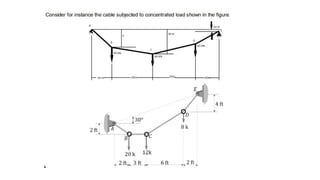
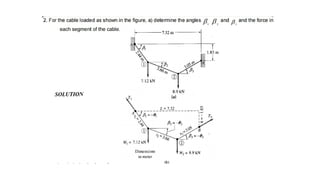
Cables with Concentrated Loads
For analysis assume:
a) concentrated vertical loads on given vertical lines.
b) weight of Cable is negligible.
Note: When the weight of the cable is neglected in analysis and is
subjected to only concentrated loads, the cable takes the form of
several straight line segments; the shape is called as funicular
polygon.
c) cable is flexible that is resistance to bending is small.
d) portions of cable between successive loads maybe treated as two
force members.
SAMPLE: Cable Suspension Bridge
ADVANTAGES:
1) Longer main spans are achievable than with any other type of
bridge.
2) Less material maybe required than other bridge type, even at
spans they can achieve, leading to a reduced construction cost.
3) Maybe better to withstand earthquake movements than
heavier and more rigid bridges.
4) Bridges decks can have deck sections replaced in order to
widen traffic lanes for larger vehicles or add additions width for
separated cycling / pedestrian path.
DISADVANTAGES:
1) Considering stiffness or aerodynamic profiling maybe
required to prevent the bridge deck vibrating under high winds.
2) The relatively low decks stiffness compared to other (non-
suspension) types of bridges make it more difficult to carry
heavy rail traffic where high concentrated live load occur.
3) Some access below maybe required during construction, to
lift the initial cables or to lift deck units. This access can often be
avoided in cable stayed bridge construction.
Parabolic Cables
The cable is parabolic if the loading is uniformly distributed
horizontally and the span-to-sag ratio is
greater than 10 or L/d > 10.
Catenary
The cable is a catenary if the loading is uniformly distributed along
the length of the cable and the span-to-sag ratio is lesser than or
equal to 10.
CABLES.pptxadsadadadsadasdsadsadsadasdds

CABLES.pptxadsadadadsadasdsadsadsadasdds

  • 1.
    Cables subjected to ConcentratedLoads, Parabolic Cables, and Catenary Cables
  • 2.
    Lesson Objectives: At theend of the module you will be able to: 1. Determine the use of cables in structural system 2. Analyze cables subjected to single concentrated loads. 3. Apply profile, length and tension formula for parabolic and catenary cables. 4. Identify and utilize techniques for obtaining numerical solutions of parabolic and catenary cables.
  • 3.
    Cables are flexiblewire like system having no flexural (bending) stiffness, and they can carry only axial tension and no other type of force
  • 4.
    Flexible cables andchains are used to support and transmit loads from one member to another . In suspension bridges, transmission lines, aerial tramways and guy wire for high towers, they carry majority of the loads.
  • 5.
    Cables with ConcentratedLoads For analysis assume: a) concentrated vertical loads on given vertical lines. b) weight of Cable is negligible. Note: When the weight of the cable is neglected in analysis and is subjected to only concentrated loads, the cable takes the form of several straight line segments; the shape is called as funicular polygon. c) cable is flexible that is resistance to bending is small. d) portions of cable between successive loads maybe treated as two force members.
  • 7.
    SAMPLE: Cable SuspensionBridge ADVANTAGES: 1) Longer main spans are achievable than with any other type of bridge. 2) Less material maybe required than other bridge type, even at spans they can achieve, leading to a reduced construction cost. 3) Maybe better to withstand earthquake movements than heavier and more rigid bridges. 4) Bridges decks can have deck sections replaced in order to widen traffic lanes for larger vehicles or add additions width for separated cycling / pedestrian path.
  • 9.
    DISADVANTAGES: 1) Considering stiffnessor aerodynamic profiling maybe required to prevent the bridge deck vibrating under high winds. 2) The relatively low decks stiffness compared to other (non- suspension) types of bridges make it more difficult to carry heavy rail traffic where high concentrated live load occur. 3) Some access below maybe required during construction, to lift the initial cables or to lift deck units. This access can often be avoided in cable stayed bridge construction.
  • 11.
    Parabolic Cables The cableis parabolic if the loading is uniformly distributed horizontally and the span-to-sag ratio is greater than 10 or L/d > 10.
  • 13.
    Catenary The cable isa catenary if the loading is uniformly distributed along the length of the cable and the span-to-sag ratio is lesser than or equal to 10.