1
5.1 GENERAL REMARKS
5.2 CABLES SUBJECTED TO
CONCENTRATED LOADS
5.3 CABLES SUBJECTED TO
UNIFORMLY DISTRIBUTED LOADS
5.CABLES
2
5.1 General Remarks
 Cables often form the main load-carrying element in
many types of structures.
 In this chapter we will discuss some of the important
aspects related to their structural analysis.
 Cables are mainly used in bridge construction.
 Examples of uses of cables are shown in the next slide.
3
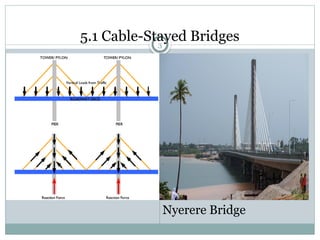
5.1 Cable-Stayed Bridges
Nyerere Bridge
4
5.1 Cable-Stayed Bridges
Selander Bridge-Tanzania
5
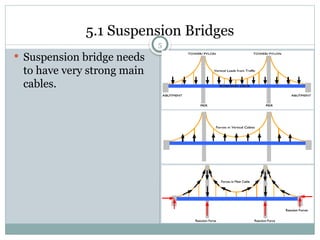
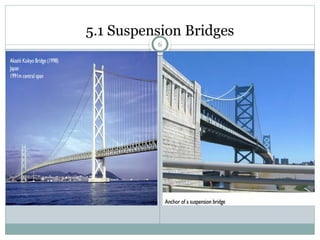
5.1 Suspension Bridges
 Suspension bridge needs
to have very strong main
cables.
6
5.1 Suspension Bridges
7
5.2 Cables
 Cables are often used in Engineering structures for support
and to transmit loads from one member to another.
 When used to support suspension roofs, bridges, and trolley
wheels, cables form the main load-carrying element in the
structure.
 In the force analysis of such systems, the self weight of the
cable may be neglected; however, when cables are used as
guys for radio antennas, electrical transmission lines, and
derricks, the cable weight may become important and must
be included in the structural analysis.
 Cables are also used for prestressing in concrete beams.
8
5.2 Cables…Cont’d
 Two cases will be considered in the structural
analysis of cables; a cable subjected to concentrated
loads and a cable subjected to a distributed load.
 When deriving the necessary relations between the
force in the cable and its slope, we will make the
assumptions that the cable is perfectly flexible and
inextensible.
 Due to its flexibility, the cable offers no resistance to
shear or bending and, therefore, the force acting in
the cable is always tangent to the cable at points
along its length.
9
5.2 Cables…Cont’d
 Being inextensible, the cable has a constant length
both before and after the load is applied. As a result,
once the load is applied, the geometry of the cable
remains fixed, and the cable or a segment of it can be
treated as a rigid body.
10
5.2.1 Cable subjected to concentrated loads
11
5.2.1 Cable subjected to concentrated loads
12
5.2.1 Cable subjected to concentrated loads
13
5.2.1 Cable subjected to concentrated loads
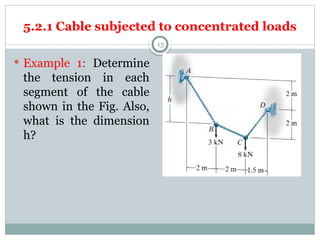
 Example 1: Determine
the tension in each
segment of the cable
shown in the Fig. Also,
what is the dimension
h?
14
5.2.2 Cable subjected to a uniform distributed
load
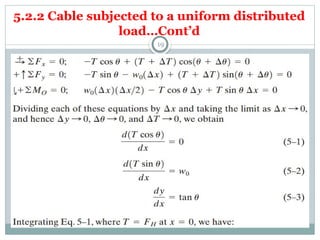
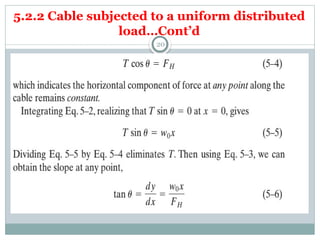
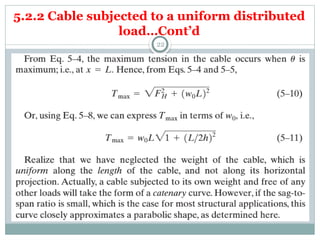
 Cables provide a very effective means of supporting
the dead weight of girders or bridge decks having
very long span.
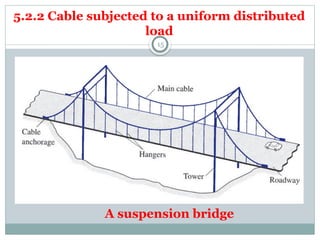
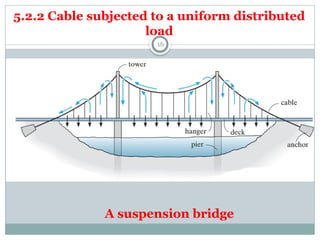
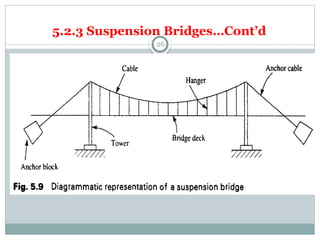
 A suspension bridge is a typical example, in which
the deck is suspended from the cable using a series of
close and equally spaced hangers. See Fig in the next
slide.
15
5.2.2 Cable subjected to a uniform distributed
load
A suspension bridge
16
5.2.2 Cable subjected to a uniform distributed
load
A suspension bridge
17
5.2.2 Cable subjected to a uniform distributed
load…Cont’d
18
5.2.2 Cable subjected to a uniform distributed
load…Cont’d
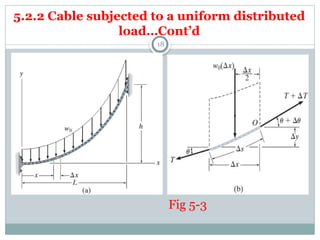
Fig 5-3
19
5.2.2 Cable subjected to a uniform distributed
load…Cont’d
20
5.2.2 Cable subjected to a uniform distributed
load…Cont’d
21
5.2.2 Cable subjected to a uniform distributed
load…Cont’d
22
5.2.2 Cable subjected to a uniform distributed
load…Cont’d
23
5.2.2 Cable subjected to a uniform distributed
load…Cont’d
24
5.2.2 Cable subjected to a uniform distributed
load…Cont’d
25
5.2.3 Suspension Bridges
26
5.2.3 Suspension Bridges…Cont’d
27
5.2.3 Suspension Bridges…Cont’d
28
5.2.3 Suspension Bridges…Cont’d
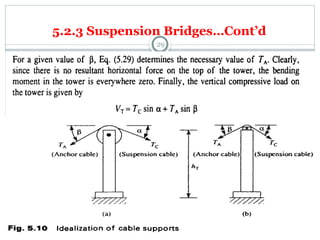
29
5.2.3 Suspension Bridges…Cont’d
30
5.2.2 Cable subjected to a uniform distributed
load…Cont’d
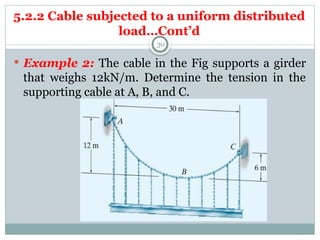
 Example 2: The cable in the Fig supports a girder
that weighs 12kN/m. Determine the tension in the
supporting cable at A, B, and C.

Lecture 5- Cables.pptx. tension, loading effects