Safety Training
for 2013:
Everyone Benefits
Speaker: Brooke Fernandez
Workplace Answers
@WorkplaceAnswer
#WorkSafely
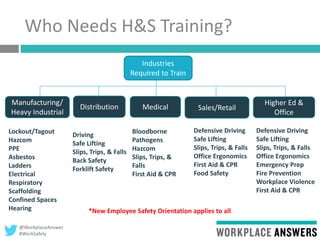
Who Needs H&S Training?
Higher Ed &
Office
Distribution Sales/Retail
Driving
Safe Lifting
Slips, Trips, & Falls
Back Safety
Forklift Safety
Defensive Driving
Safe Lifting
Slips, Trips, & Falls
Office Ergonomics
First Aid & CPR
Food Safety
Manufacturing/
Heavy Industrial
Defensive Driving
Safe Lifting
Slips, Trips, & Falls
Office Ergonomics
Emergency Prep
Fire Prevention
Workplace Violence
First Aid & CPR
Industries
Required to Train
Lockout/Tagout
Hazcom
PPE
Asbestos
Ladders
Electrical
Respiratory
Scaffolding
Confined Spaces
Hearing
Medical
Bloodborne
Pathogens
Hazcom
Slips, Trips, &
Falls
First Aid & CPR
*New Employee Safety Orientation applies to all
@WorkplaceAnswer
#WorkSafely
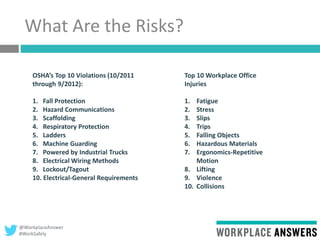
What Are the Risks?
Top 10 Workplace Office
Injuries
1. Fatigue
2. Stress
3. Slips
4. Trips
5. Falling Objects
6. Hazardous Materials
7. Ergonomics-Repetitive
Motion
8. Lifting
9. Violence
10. Collisions
OSHA’s Top 10 Violations (10/2011
through 9/2012):
1. Fall Protection
2. Hazard Communications
3. Scaffolding
4. Respiratory Protection
5. Ladders
6. Machine Guarding
7. Powered by Industrial Trucks
8. Electrical Wiring Methods
9. Lockout/Tagout
10. Electrical-General Requirements
@WorkplaceAnswer
#WorkSafely
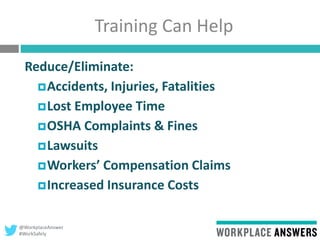
Training Can Help
Reduce/Eliminate:
Accidents, Injuries, Fatalities
Lost Employee Time
OSHA Complaints & Fines
Lawsuits
Workers’ Compensation Claims
Increased Insurance Costs
@WorkplaceAnswer
#WorkSafely
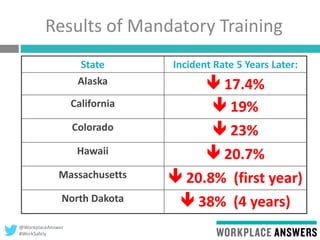
Results of Mandatory Training
State Incident Rate 5 Years Later:
Alaska  17.4%
California  19%
Colorado  23%
Hawaii  20.7%
Massachusetts  20.8% (first year)
North Dakota  38% (4 years)
@WorkplaceAnswer
#WorkSafely
The Message is Clear
 Safety Training
 Saves Lives
 Reduces Injuries
 Lowers costs:
 Insurance
 Workers’ Compensation
 Lawsuits
 Increases:
 Productivity
 Morale
@WorkplaceAnswer
#WorkSafely
Why do Safety Training Online?
 Saves Lives
 Reduces Injuries
 Reduces Insurance
Costs
 Prevents
Litigation/Fines
 Improves Productivity
 Increases Morale
 Consistent
 Reaches everyone
 Verifiable
 Easy tracking
 More productivity
SAFETY TRAINING ONLINE
www.workplaceanswers.com 512.298.0797
Twitter: #WorkSafely @WorkplaceAnswer
December 1, 2013 Training Deadline
Hazard Communication
@WorkplaceAnswer
#WorkSafely
HCS Meets GHS
 Aligning with The Globally Harmonized System of
Classification and Labeling of Chemicals (GHS)
 Training is required to understand significant changes to:
 Safety Data Sheets (SDS) (formerly MSDS),
 labeling, and
 other forms of hazard communication
 One of OSHA’s goals:
 …to evolve from the worker’s "right to know” to the
worker’s “right to understand."
@WorkplaceAnswer
#WorkSafely
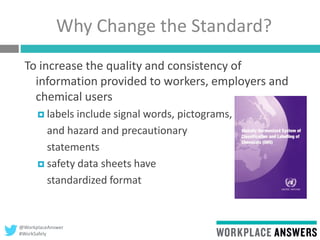
Why Change the Standard?
To increase the quality and consistency of
information provided to workers, employers and
chemical users
 labels include signal words, pictograms,
and hazard and precautionary
statements
 safety data sheets have
standardized format
@WorkplaceAnswer
#WorkSafely
 Hazard classification: Provides specific criteria for
classification of health and physical hazards, as well as
classification of mixtures.
 Labels: Include a harmonized signal word, pictogram, and
hazard and/or precautionary statement for each class and
category.
 Safety Data Sheets: Specified 16-section format.
 Information and training: All employers with hazardous
chemicals in their workplaces must have labels and safety
data sheets for their exposed workers, and train them to
handle the chemicals appropriately.
Major Changes
@WorkplaceAnswer
#WorkSafely
Impact on Employers
 Compliance training must be completed before
December 1, 2013
 Over 40 million workers in 5 million workplaces will
be affected
 OSHA estimates that the revised standard will
prevent 43 fatalities and 585 injuries and illnesses
annually.
@WorkplaceAnswer
#WorkSafely
Safety Training Requirements
By December 1, 2013:
OSHA 29 CFR 1910.1200 (C):
Each employee who may be "exposed" to
hazardous chemicals when working must be
provided information and trained prior to initial
assignment to work with a hazardous chemical, and
whenever the hazard changes.
@WorkplaceAnswer
#WorkSafely
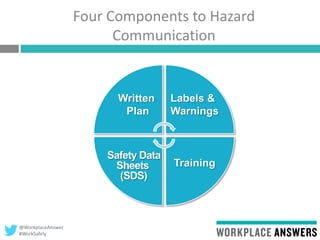
Four Components to Hazard
Communication
Written
Plan
Labels &
Warnings
Safety Data
Sheets
(SDS)
Training
www.workplaceanswers.com 512.298.0797
Twitter: #WorkSafely @WorkplaceAnswer
New Employee Safety Orientation
Must – Have Training:
@WorkplaceAnswer
#WorkSafely
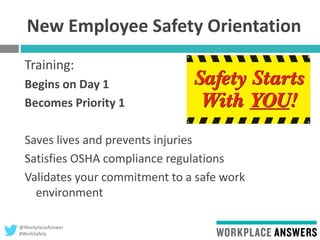
New Employee Safety Orientation
Training:
Begins on Day 1
Becomes Priority 1
Saves lives and prevents injuries
Satisfies OSHA compliance regulations
Validates your commitment to a safe work
environment
@WorkplaceAnswer
#WorkSafely
New Employee Safety Orientation
 Training should cover at least 5-8 of the main
topics that affect your workplace.
 Most accidents occur within an employee’s first 6
months on a new job.
@WorkplaceAnswer
#WorkSafely
What Should New Employee
Safety Orientation Cover?
 Fire Safety
 Preventing Slips, Trips,
and Falls
 Back Injury Prevention
 Ergonomics for the
Office
 Hazard
Communication
 Bloodborne
Pathogens
 Personal Protective
Equipment
 Defensive Driving
General Workplace Safety Topics OSHA Safety Topics
@WorkplaceAnswer
#WorkSafely
Statistics
Almost 3.0 million nonfatal workplace
injuries and illnesses in 2011 were the
result of workplace hazards.
Incidence rate:
3.5 cases per 100 full-time workers
across all industries
@WorkplaceAnswer
#WorkSafely
@WorkplaceAnswer
#WorkSafely
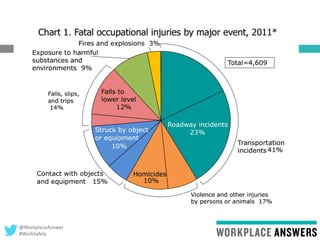
Fatal Injuries are Not Just for
Manufacturing Workers
Through May 1, 2013 over 200 American workers
have died on the job.
 1/18/2013 Worker died from sepsis after an object
penetrated his foot.
 2/19/2013 Employee killed in natural gas explosion.
 4/3/2013 Worker died after falling down steps while
transporting materials.
@WorkplaceAnswer
#WorkSafely
Training that Pays
 Lockout/Tagout
 Asbestos Awareness
 Personal Protective Equipment
 New Employee Safety Orientation
 First Aid / CPR
 Emergency Preparedness
 Fire Prevention
 General Ergonomics
 Workplace Violence
 Defensive Driving
@WorkplaceAnswer
#WorkSafely
Workplace Answers Satisfies Your OSHA
Training Mandate
 Comprehensive, verifiable
training modules
 Interactive lessons that
engage the learner
 Off-site record
maintenance
Questions?
866 861 4410
@workplaceanswer #worksafely

Safety Training for 2013

  • 1.
    Safety Training for 2013: EveryoneBenefits Speaker: Brooke Fernandez Workplace Answers
  • 2.
    @WorkplaceAnswer #WorkSafely Who Needs H&STraining? Higher Ed & Office Distribution Sales/Retail Driving Safe Lifting Slips, Trips, & Falls Back Safety Forklift Safety Defensive Driving Safe Lifting Slips, Trips, & Falls Office Ergonomics First Aid & CPR Food Safety Manufacturing/ Heavy Industrial Defensive Driving Safe Lifting Slips, Trips, & Falls Office Ergonomics Emergency Prep Fire Prevention Workplace Violence First Aid & CPR Industries Required to Train Lockout/Tagout Hazcom PPE Asbestos Ladders Electrical Respiratory Scaffolding Confined Spaces Hearing Medical Bloodborne Pathogens Hazcom Slips, Trips, & Falls First Aid & CPR *New Employee Safety Orientation applies to all
  • 3.
    @WorkplaceAnswer #WorkSafely What Are theRisks? Top 10 Workplace Office Injuries 1. Fatigue 2. Stress 3. Slips 4. Trips 5. Falling Objects 6. Hazardous Materials 7. Ergonomics-Repetitive Motion 8. Lifting 9. Violence 10. Collisions OSHA’s Top 10 Violations (10/2011 through 9/2012): 1. Fall Protection 2. Hazard Communications 3. Scaffolding 4. Respiratory Protection 5. Ladders 6. Machine Guarding 7. Powered by Industrial Trucks 8. Electrical Wiring Methods 9. Lockout/Tagout 10. Electrical-General Requirements
  • 4.
    @WorkplaceAnswer #WorkSafely Training Can Help Reduce/Eliminate: Accidents,Injuries, Fatalities Lost Employee Time OSHA Complaints & Fines Lawsuits Workers’ Compensation Claims Increased Insurance Costs
  • 5.
    @WorkplaceAnswer #WorkSafely Results of MandatoryTraining State Incident Rate 5 Years Later: Alaska  17.4% California  19% Colorado  23% Hawaii  20.7% Massachusetts  20.8% (first year) North Dakota  38% (4 years)
  • 7.
    @WorkplaceAnswer #WorkSafely The Message isClear  Safety Training  Saves Lives  Reduces Injuries  Lowers costs:  Insurance  Workers’ Compensation  Lawsuits  Increases:  Productivity  Morale
  • 8.
    @WorkplaceAnswer #WorkSafely Why do SafetyTraining Online?  Saves Lives  Reduces Injuries  Reduces Insurance Costs  Prevents Litigation/Fines  Improves Productivity  Increases Morale  Consistent  Reaches everyone  Verifiable  Easy tracking  More productivity SAFETY TRAINING ONLINE
  • 9.
    www.workplaceanswers.com 512.298.0797 Twitter: #WorkSafely@WorkplaceAnswer December 1, 2013 Training Deadline Hazard Communication
  • 10.
    @WorkplaceAnswer #WorkSafely HCS Meets GHS Aligning with The Globally Harmonized System of Classification and Labeling of Chemicals (GHS)  Training is required to understand significant changes to:  Safety Data Sheets (SDS) (formerly MSDS),  labeling, and  other forms of hazard communication  One of OSHA’s goals:  …to evolve from the worker’s "right to know” to the worker’s “right to understand."
  • 11.
    @WorkplaceAnswer #WorkSafely Why Change theStandard? To increase the quality and consistency of information provided to workers, employers and chemical users  labels include signal words, pictograms, and hazard and precautionary statements  safety data sheets have standardized format
  • 12.
    @WorkplaceAnswer #WorkSafely  Hazard classification:Provides specific criteria for classification of health and physical hazards, as well as classification of mixtures.  Labels: Include a harmonized signal word, pictogram, and hazard and/or precautionary statement for each class and category.  Safety Data Sheets: Specified 16-section format.  Information and training: All employers with hazardous chemicals in their workplaces must have labels and safety data sheets for their exposed workers, and train them to handle the chemicals appropriately. Major Changes
  • 13.
    @WorkplaceAnswer #WorkSafely Impact on Employers Compliance training must be completed before December 1, 2013  Over 40 million workers in 5 million workplaces will be affected  OSHA estimates that the revised standard will prevent 43 fatalities and 585 injuries and illnesses annually.
  • 14.
    @WorkplaceAnswer #WorkSafely Safety Training Requirements ByDecember 1, 2013: OSHA 29 CFR 1910.1200 (C): Each employee who may be "exposed" to hazardous chemicals when working must be provided information and trained prior to initial assignment to work with a hazardous chemical, and whenever the hazard changes.
  • 15.
    @WorkplaceAnswer #WorkSafely Four Components toHazard Communication Written Plan Labels & Warnings Safety Data Sheets (SDS) Training
  • 16.
    www.workplaceanswers.com 512.298.0797 Twitter: #WorkSafely@WorkplaceAnswer New Employee Safety Orientation Must – Have Training:
  • 17.
    @WorkplaceAnswer #WorkSafely New Employee SafetyOrientation Training: Begins on Day 1 Becomes Priority 1 Saves lives and prevents injuries Satisfies OSHA compliance regulations Validates your commitment to a safe work environment
  • 18.
    @WorkplaceAnswer #WorkSafely New Employee SafetyOrientation  Training should cover at least 5-8 of the main topics that affect your workplace.  Most accidents occur within an employee’s first 6 months on a new job.
  • 19.
    @WorkplaceAnswer #WorkSafely What Should NewEmployee Safety Orientation Cover?  Fire Safety  Preventing Slips, Trips, and Falls  Back Injury Prevention  Ergonomics for the Office  Hazard Communication  Bloodborne Pathogens  Personal Protective Equipment  Defensive Driving General Workplace Safety Topics OSHA Safety Topics
  • 20.
    @WorkplaceAnswer #WorkSafely Statistics Almost 3.0 millionnonfatal workplace injuries and illnesses in 2011 were the result of workplace hazards. Incidence rate: 3.5 cases per 100 full-time workers across all industries
  • 21.
  • 22.
    @WorkplaceAnswer #WorkSafely Fatal Injuries areNot Just for Manufacturing Workers Through May 1, 2013 over 200 American workers have died on the job.  1/18/2013 Worker died from sepsis after an object penetrated his foot.  2/19/2013 Employee killed in natural gas explosion.  4/3/2013 Worker died after falling down steps while transporting materials.
  • 23.
    @WorkplaceAnswer #WorkSafely Training that Pays Lockout/Tagout  Asbestos Awareness  Personal Protective Equipment  New Employee Safety Orientation  First Aid / CPR  Emergency Preparedness  Fire Prevention  General Ergonomics  Workplace Violence  Defensive Driving
  • 24.
    @WorkplaceAnswer #WorkSafely Workplace Answers SatisfiesYour OSHA Training Mandate  Comprehensive, verifiable training modules  Interactive lessons that engage the learner  Off-site record maintenance
  • 25.