Hazard
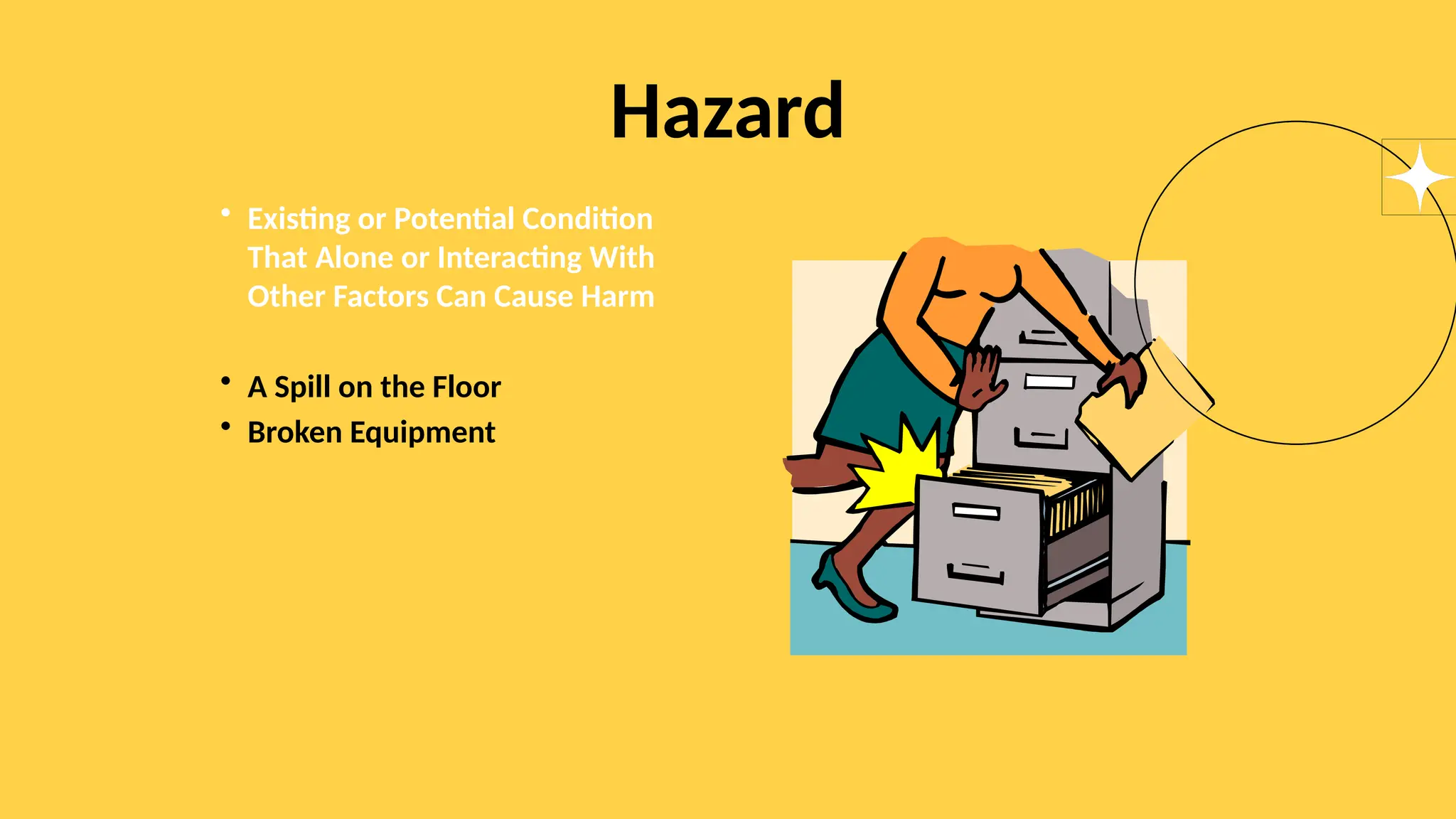
• Existing orPotential Condition
That Alone or Interacting With
Other Factors Can Cause Harm
• A Spill on the Floor
• Broken Equipment
3.
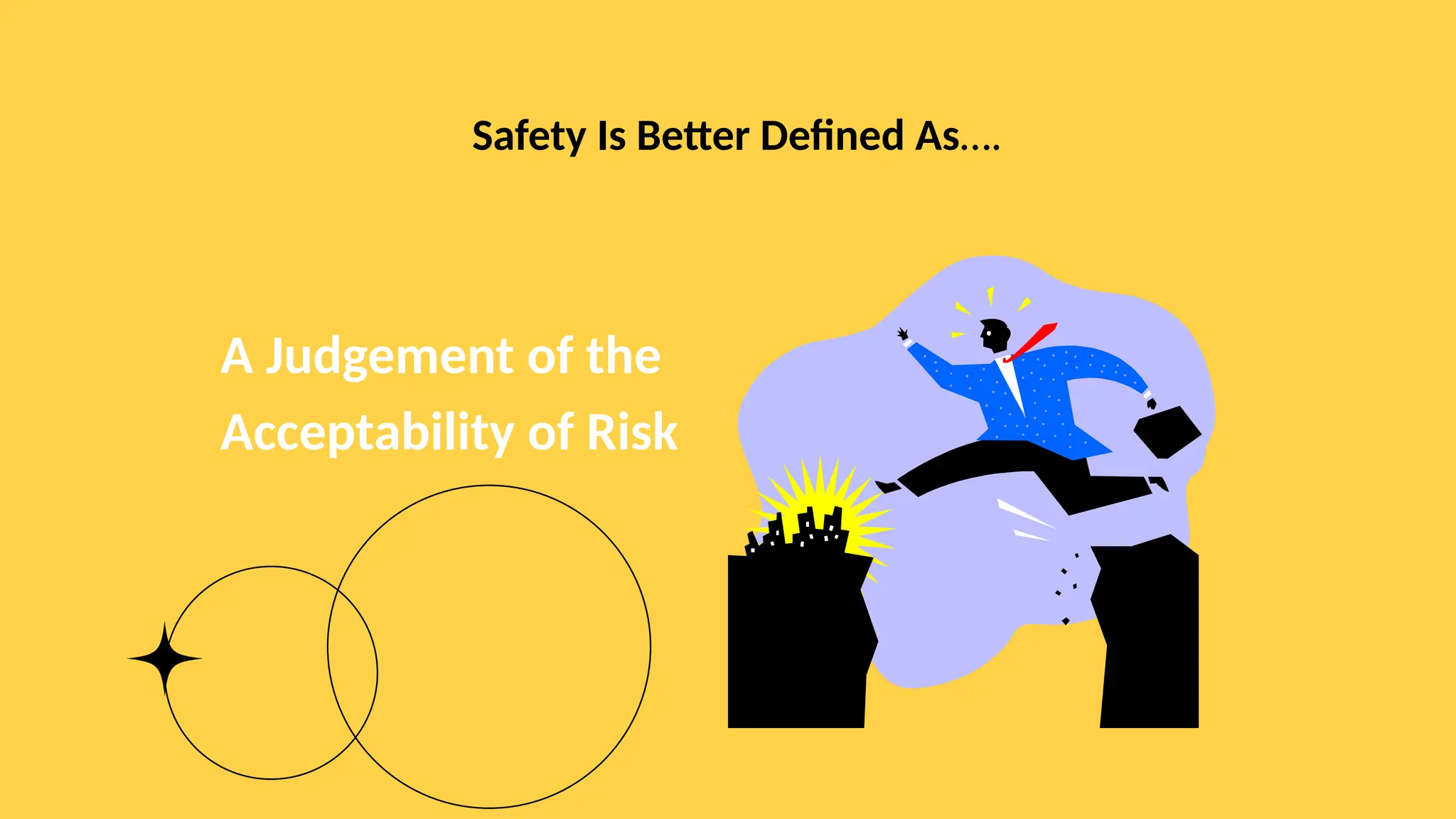
Risk
• A measureof the probability and severity of a hazard to harm
human health, property, or the environment
• A measure of how likely harm is to occur and an indication of
how serious the harm might be
Risk 0
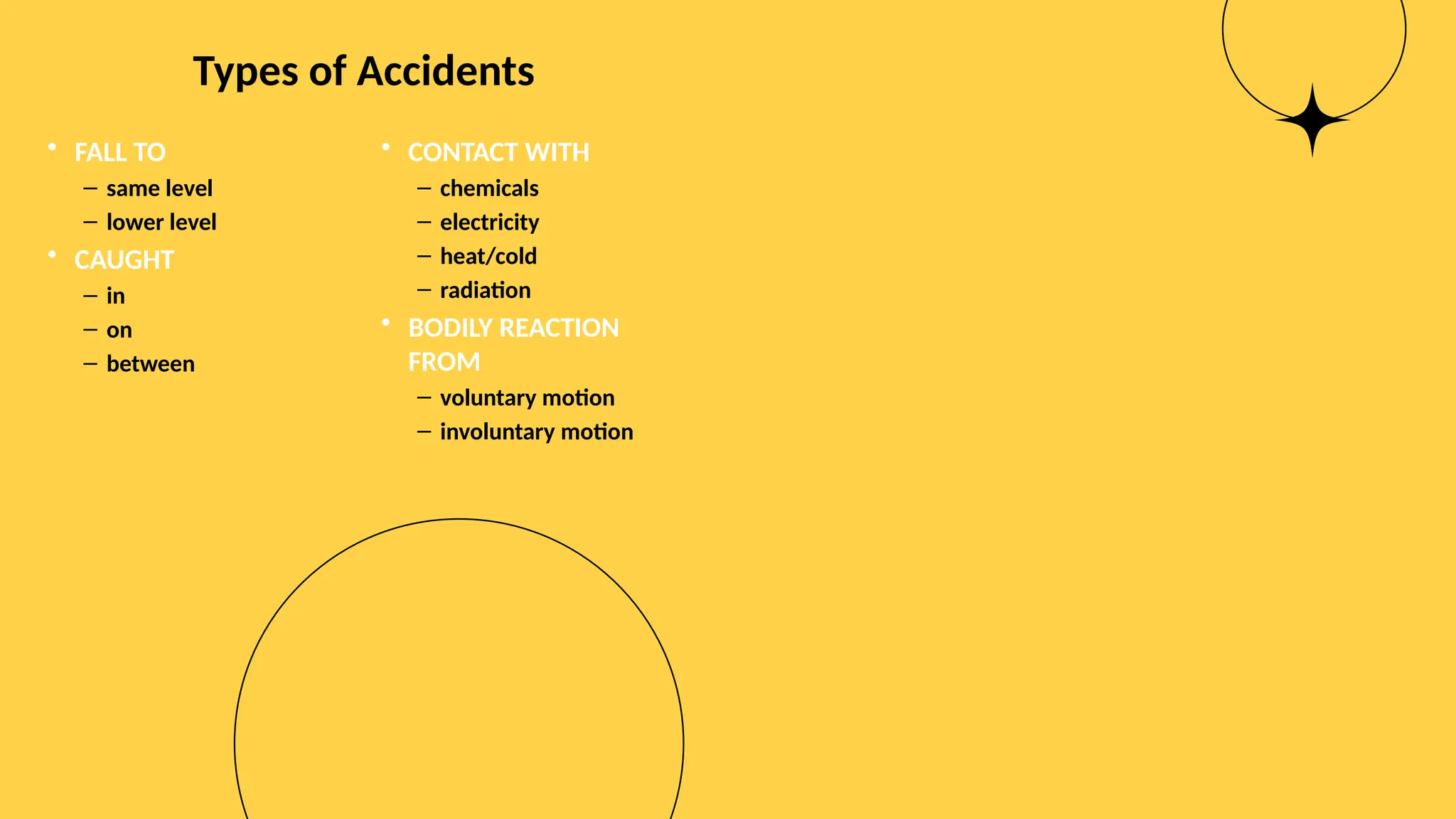
Types of Accidents
•FALL TO
– same level
– lower level
• CAUGHT
– in
– on
– between
• CONTACT WITH
– chemicals
– electricity
– heat/cold
– radiation
• BODILY REACTION
FROM
– voluntary motion
– involuntary motion
8.
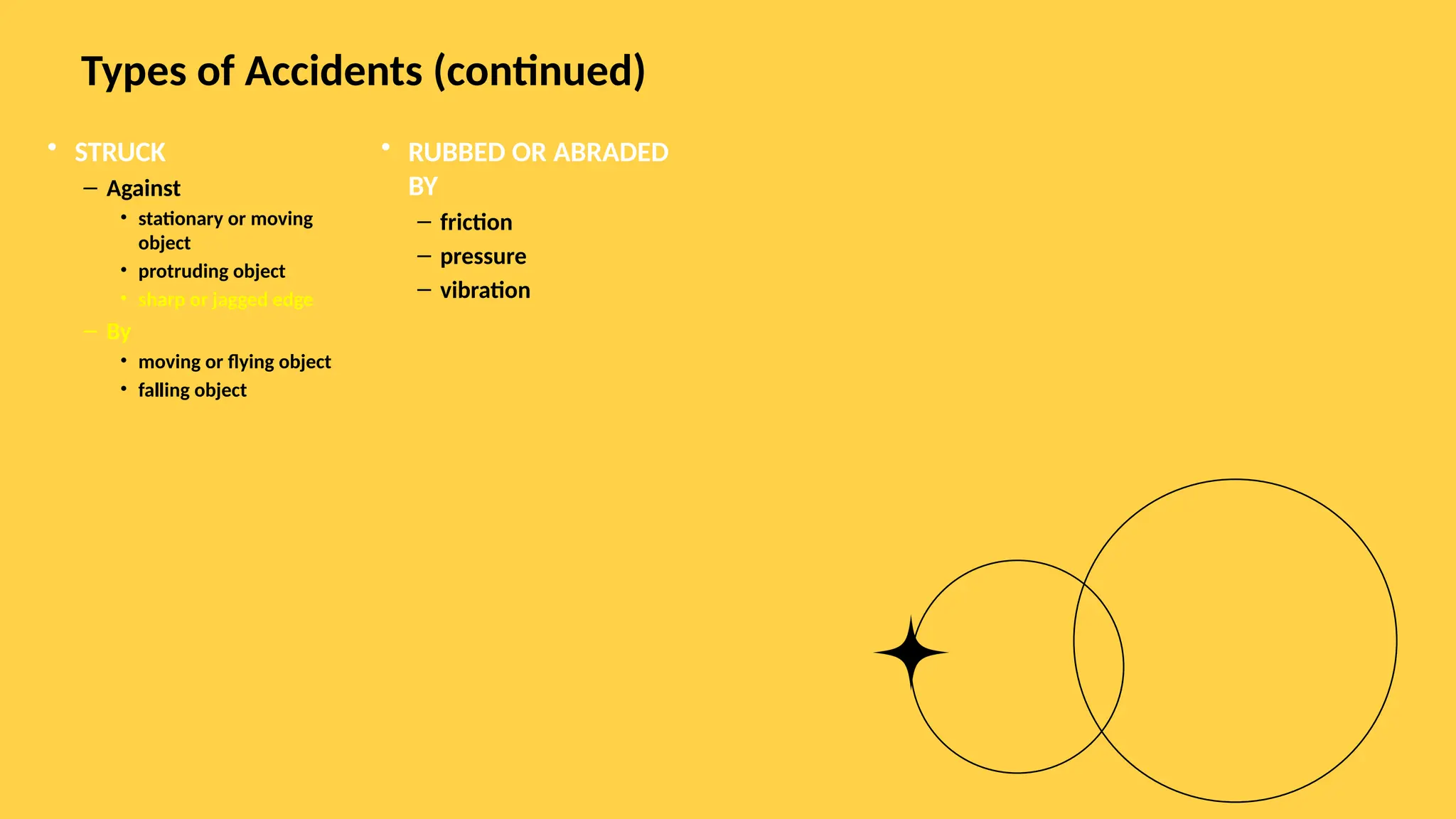
Types of Accidents(continued)
• STRUCK
– Against
• stationary or moving
object
• protruding object
• sharp or jagged edge
– By
• moving or flying object
• falling object
• RUBBED OR ABRADED
BY
– friction
– pressure
– vibration
9.
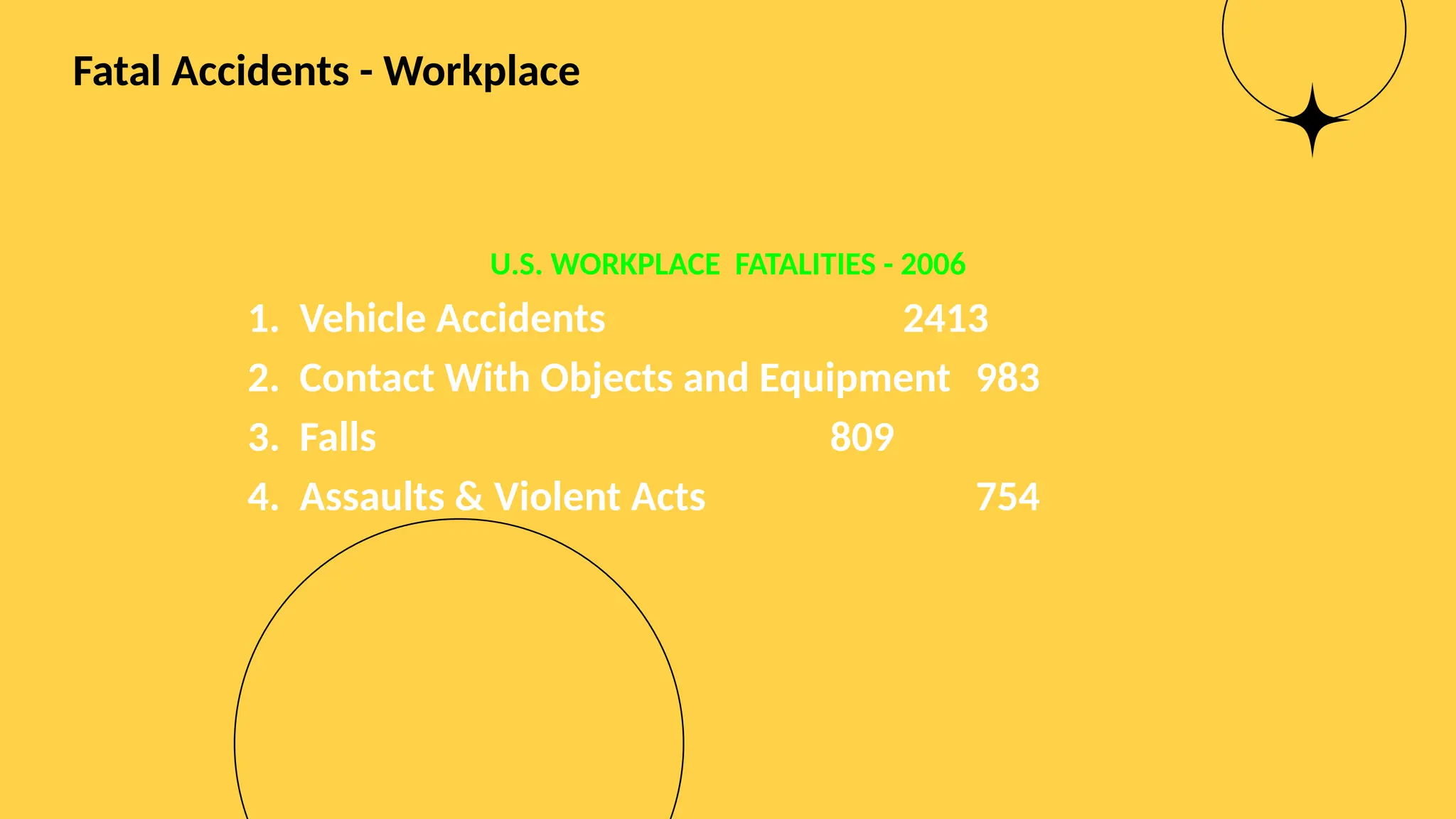
Fatal Accidents -Workplace
U.S. WORKPLACE FATALITIES - 2006
1. Vehicle Accidents 2413
2. Contact With Objects and Equipment 983
3. Falls 809
4. Assaults & Violent Acts 754
10.
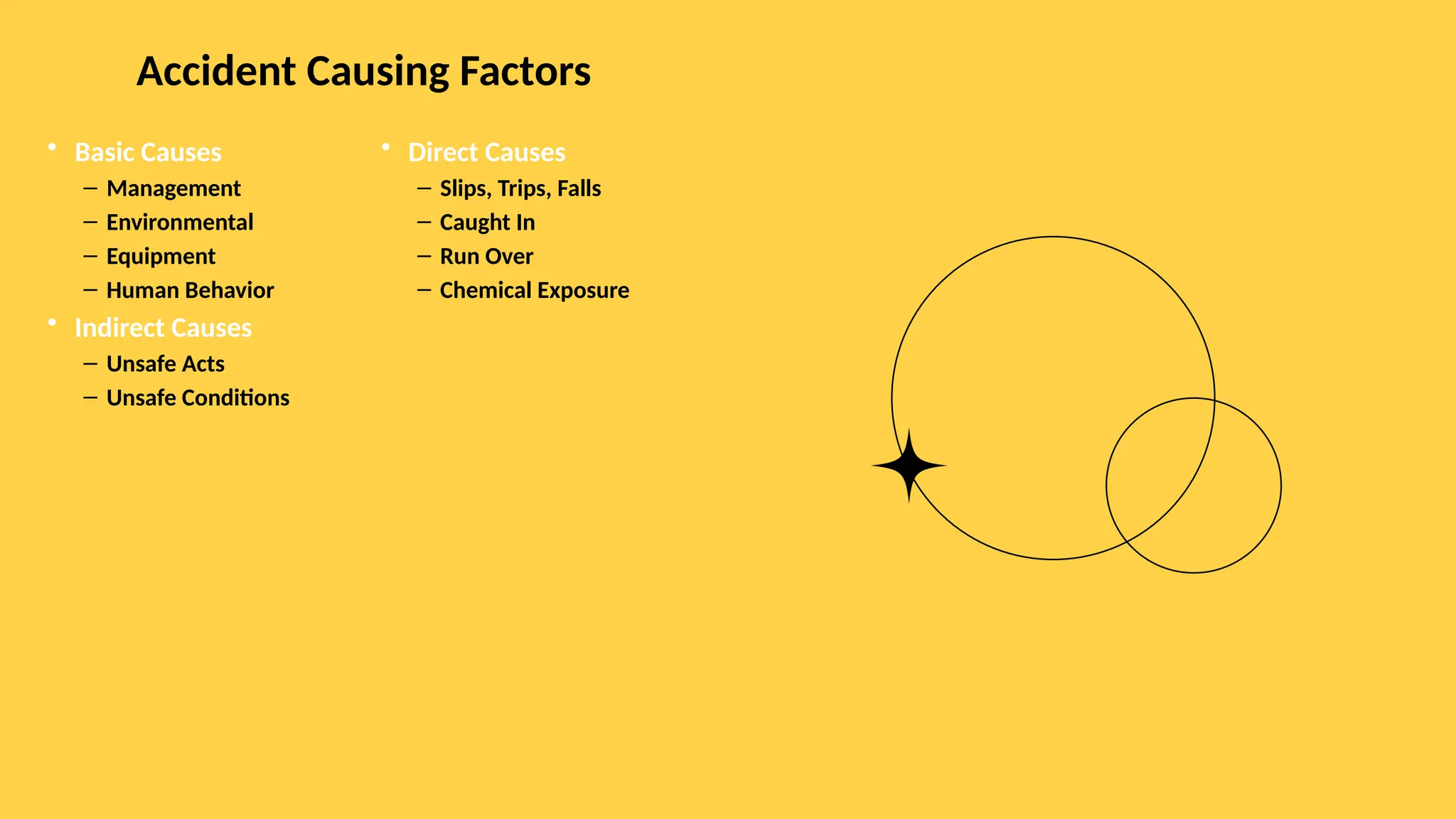
Accident Causing Factors
•Basic Causes
– Management
– Environmental
– Equipment
– Human Behavior
• Indirect Causes
– Unsafe Acts
– Unsafe Conditions
• Direct Causes
– Slips, Trips, Falls
– Caught In
– Run Over
– Chemical Exposure
11.
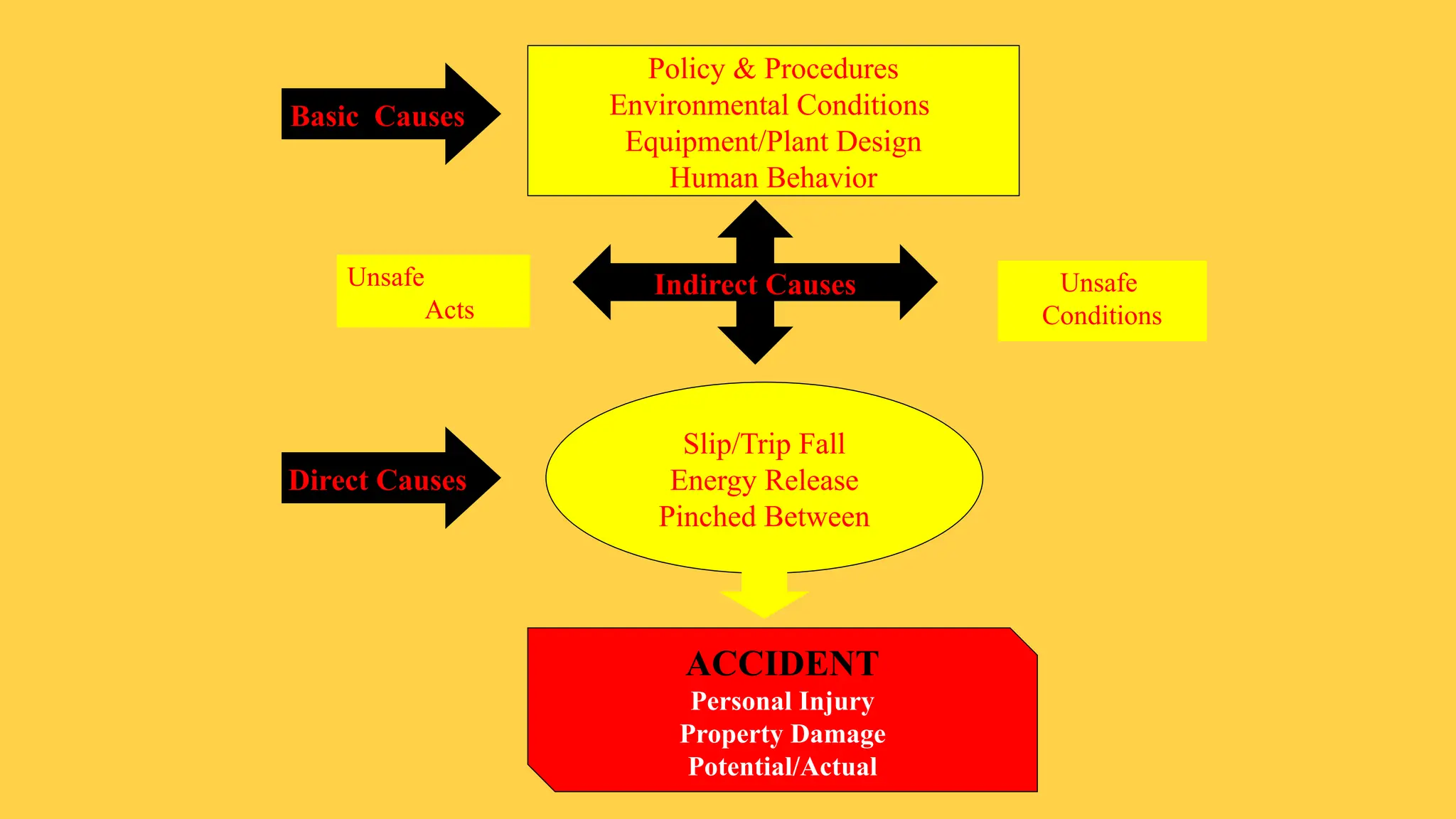
Policy & Procedures
EnvironmentalConditions
Equipment/Plant Design
Human Behavior
Slip/Trip Fall
Energy Release
Pinched Between
Indirect Causes
Direct Causes
ACCIDENT
Personal Injury
Property Damage
Potential/Actual
Basic Causes
Unsafe
Acts
Unsafe
Conditions
12.
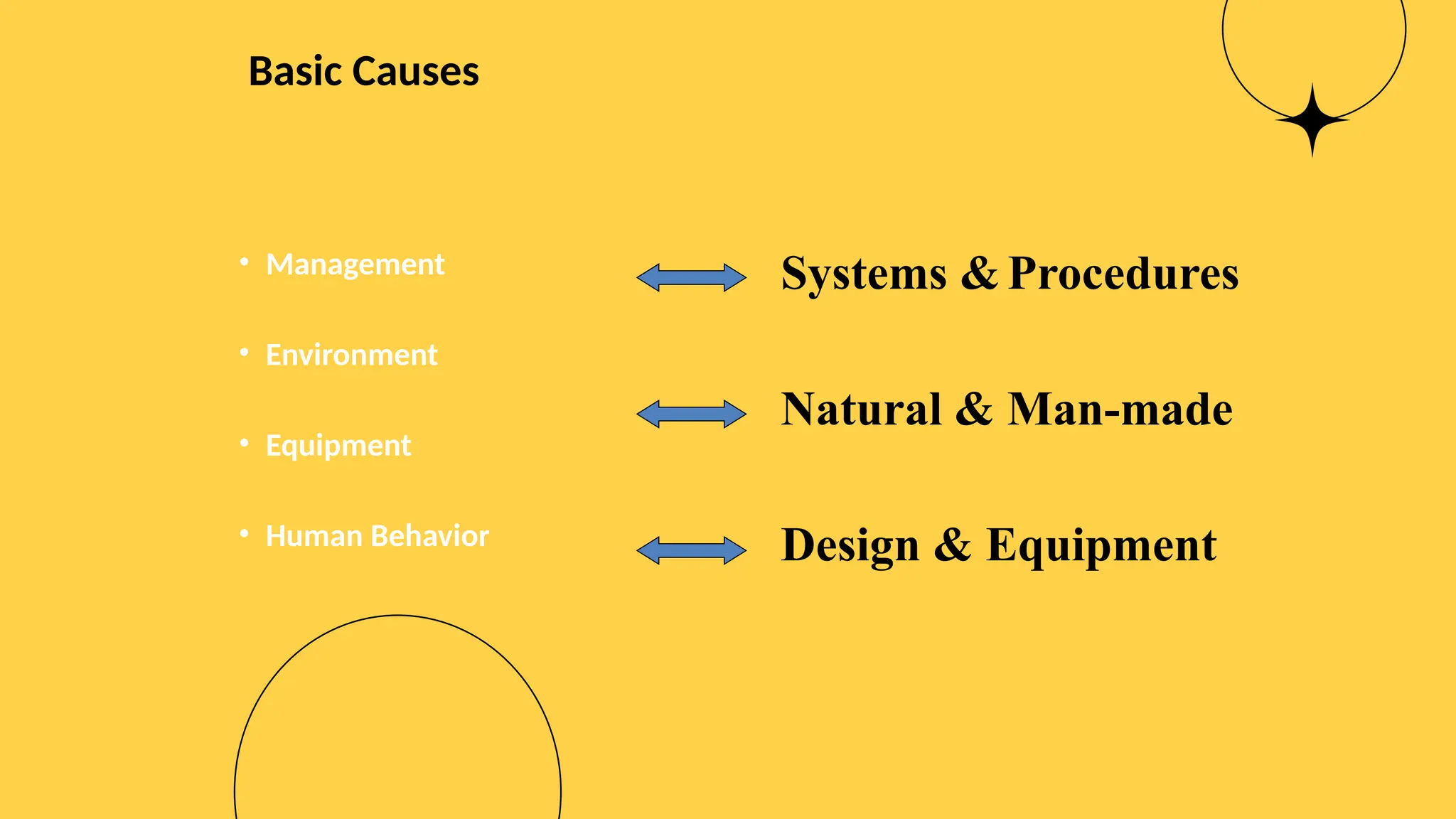
Basic Causes
• Management
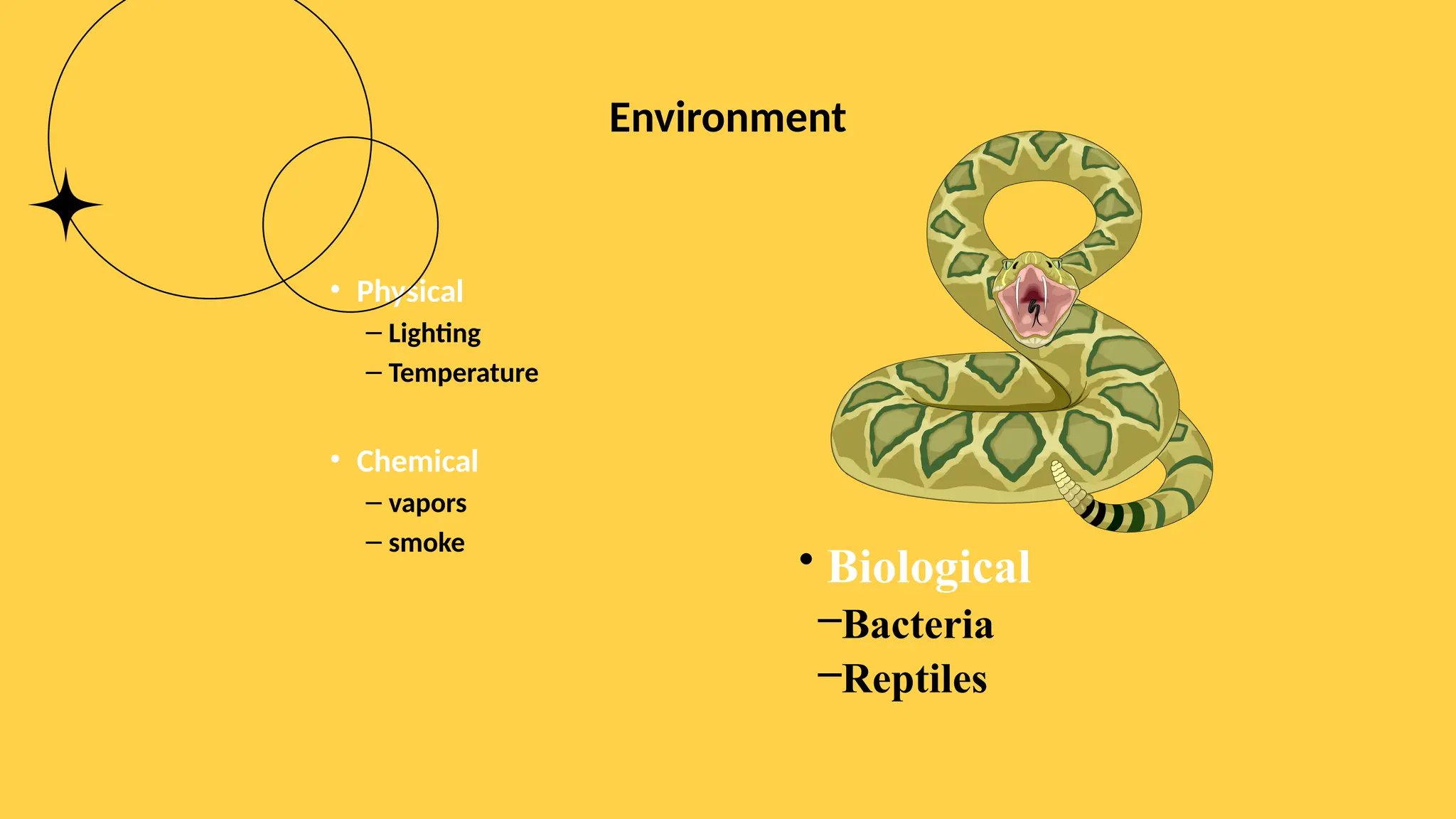
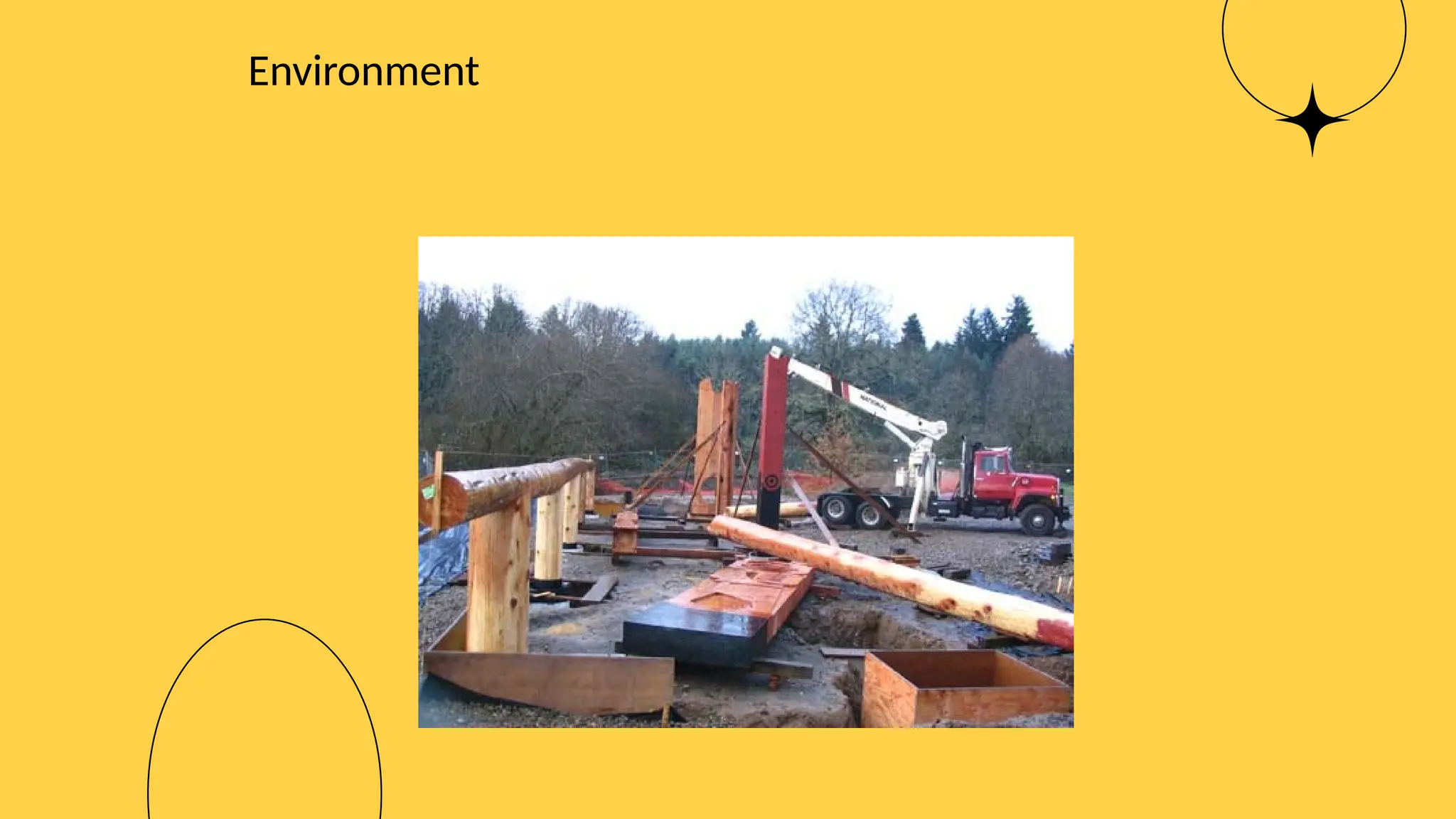
•Environment
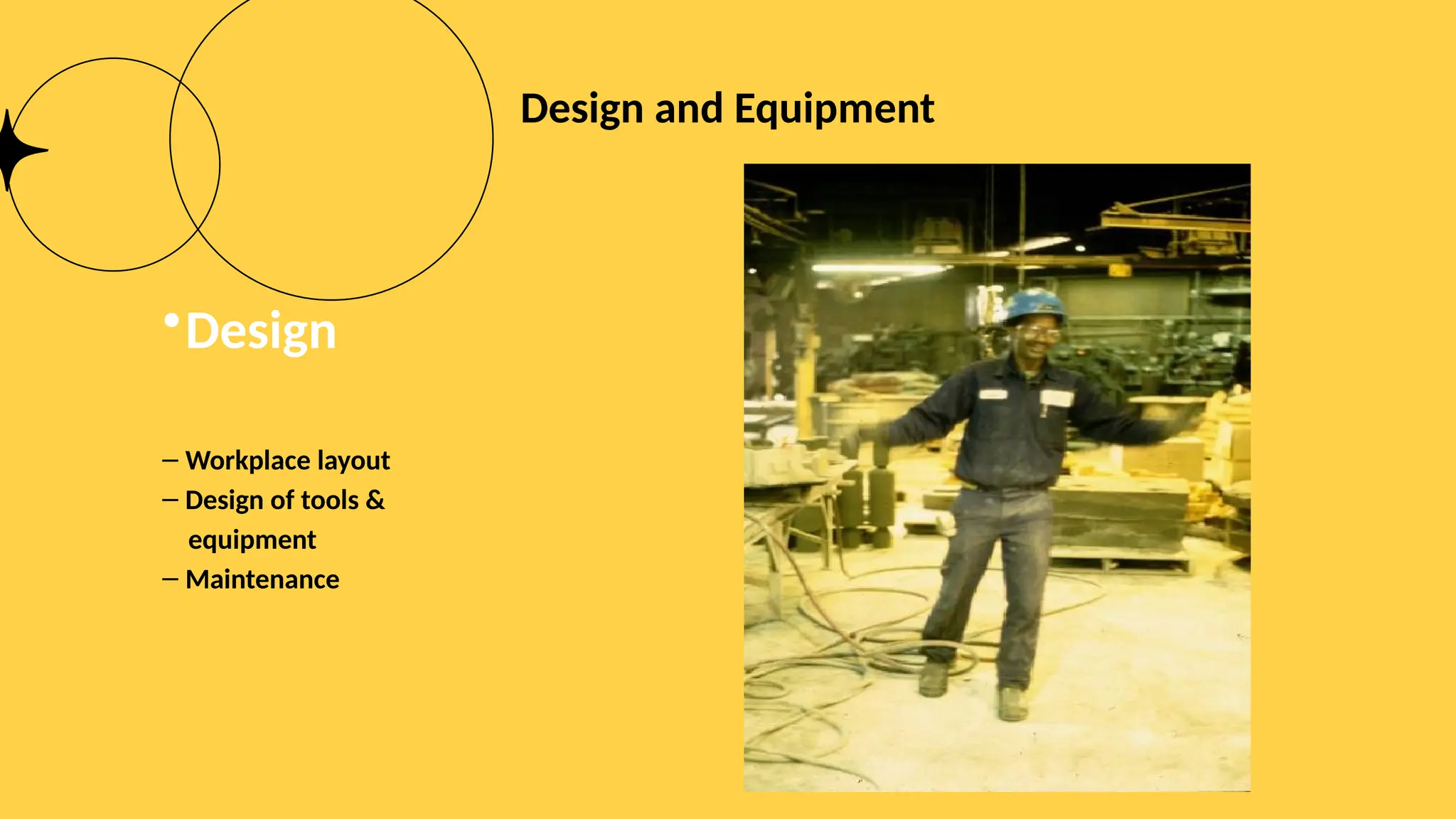
• Equipment
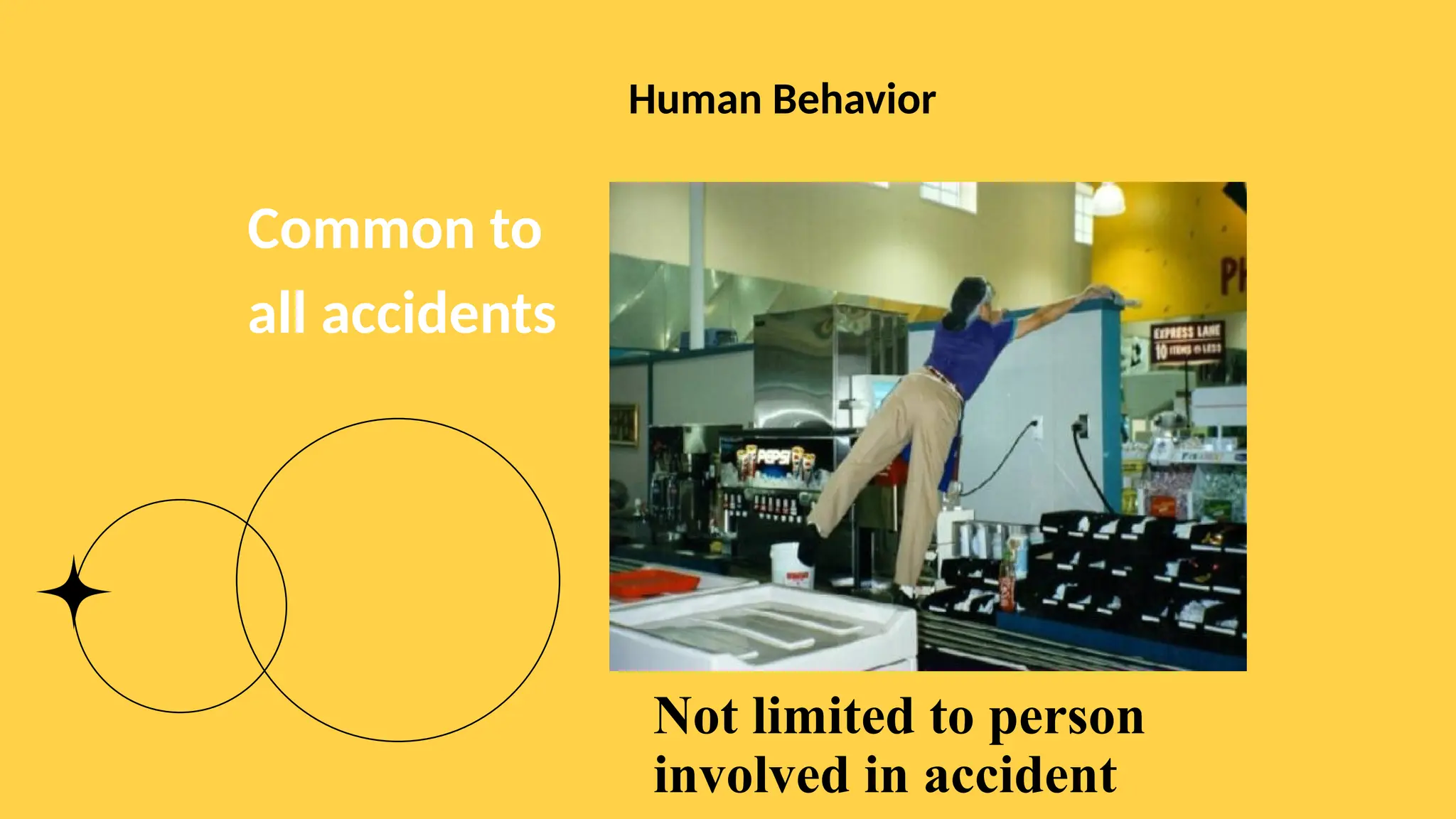
• Human Behavior
Systems &Procedures
Natural & Man-made
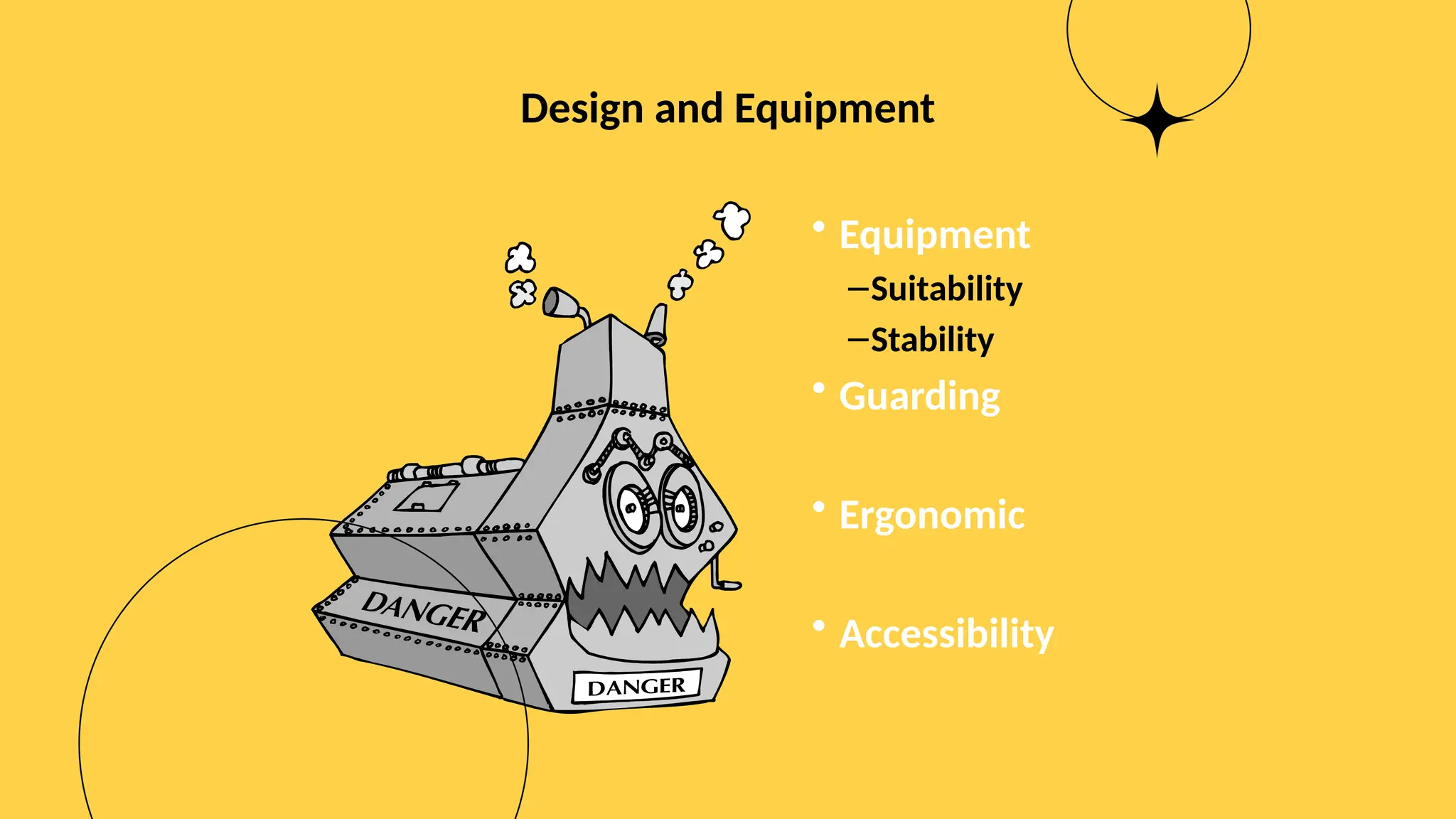
Design & Equipment
13.
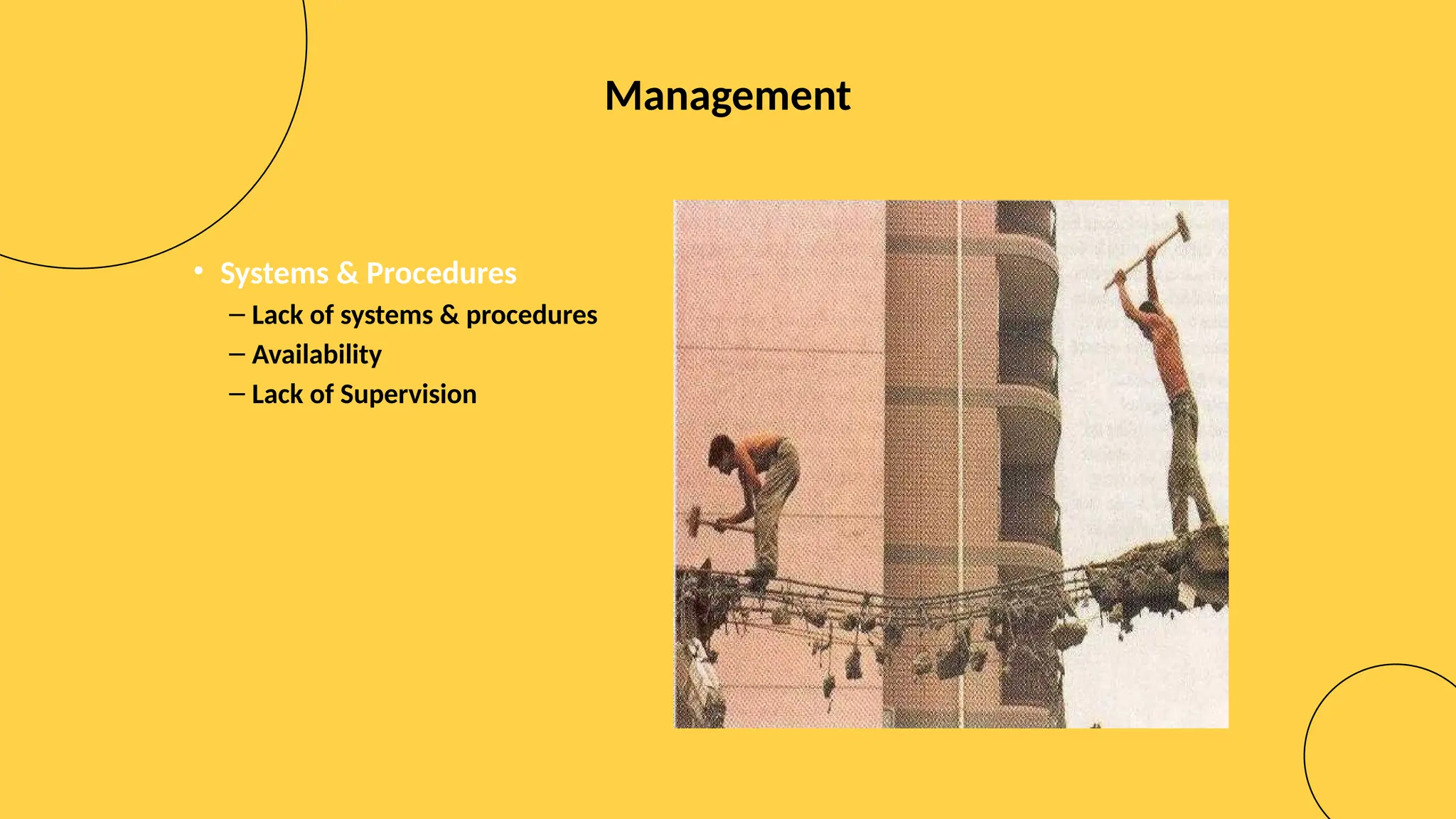
Management
• Systems &Procedures
– Lack of systems & procedures
– Availability
– Lack of Supervision
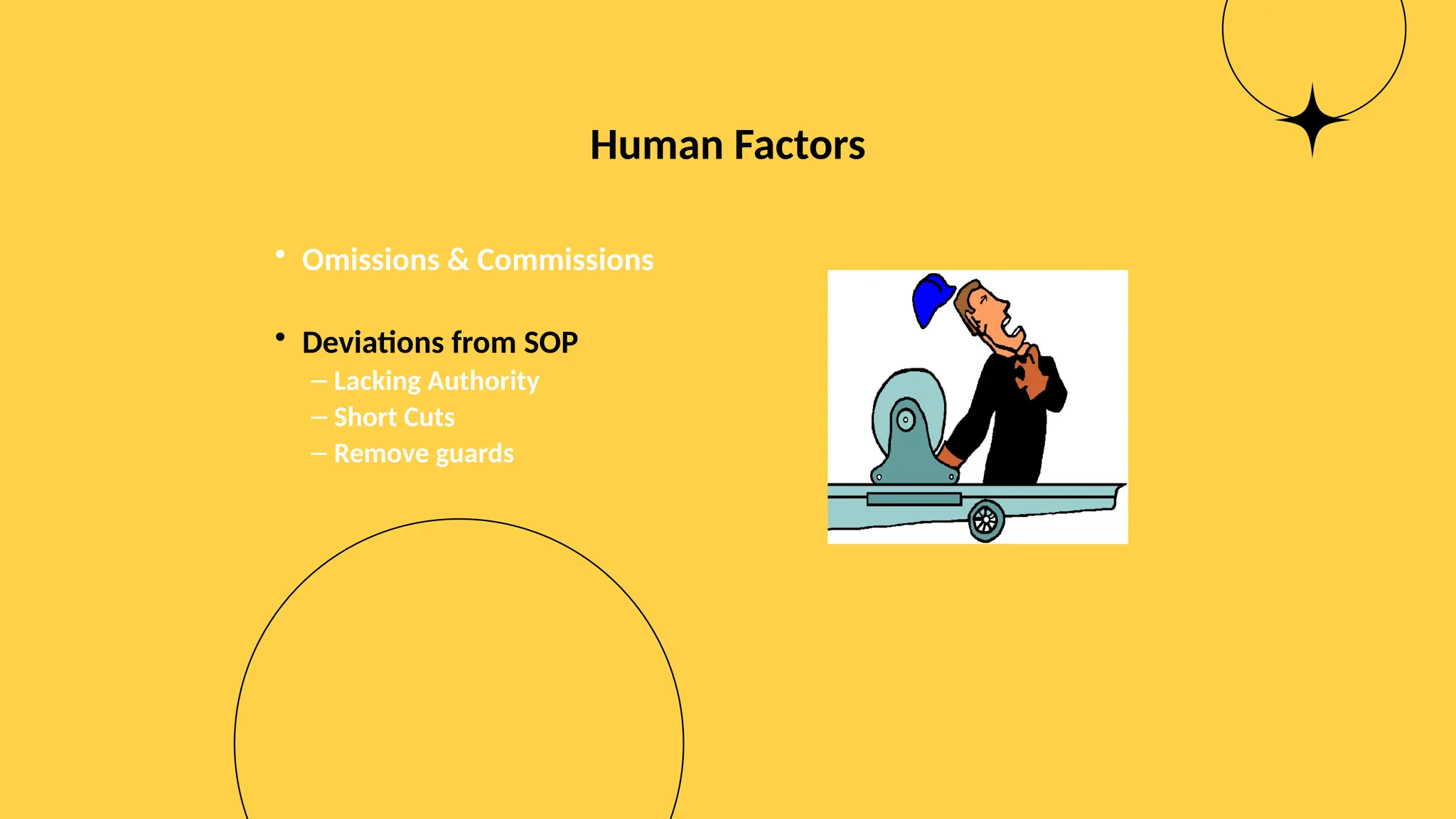
Human Factors
• Omissions& Commissions
• Deviations from SOP
– Lacking Authority
– Short Cuts
– Remove guards
20.
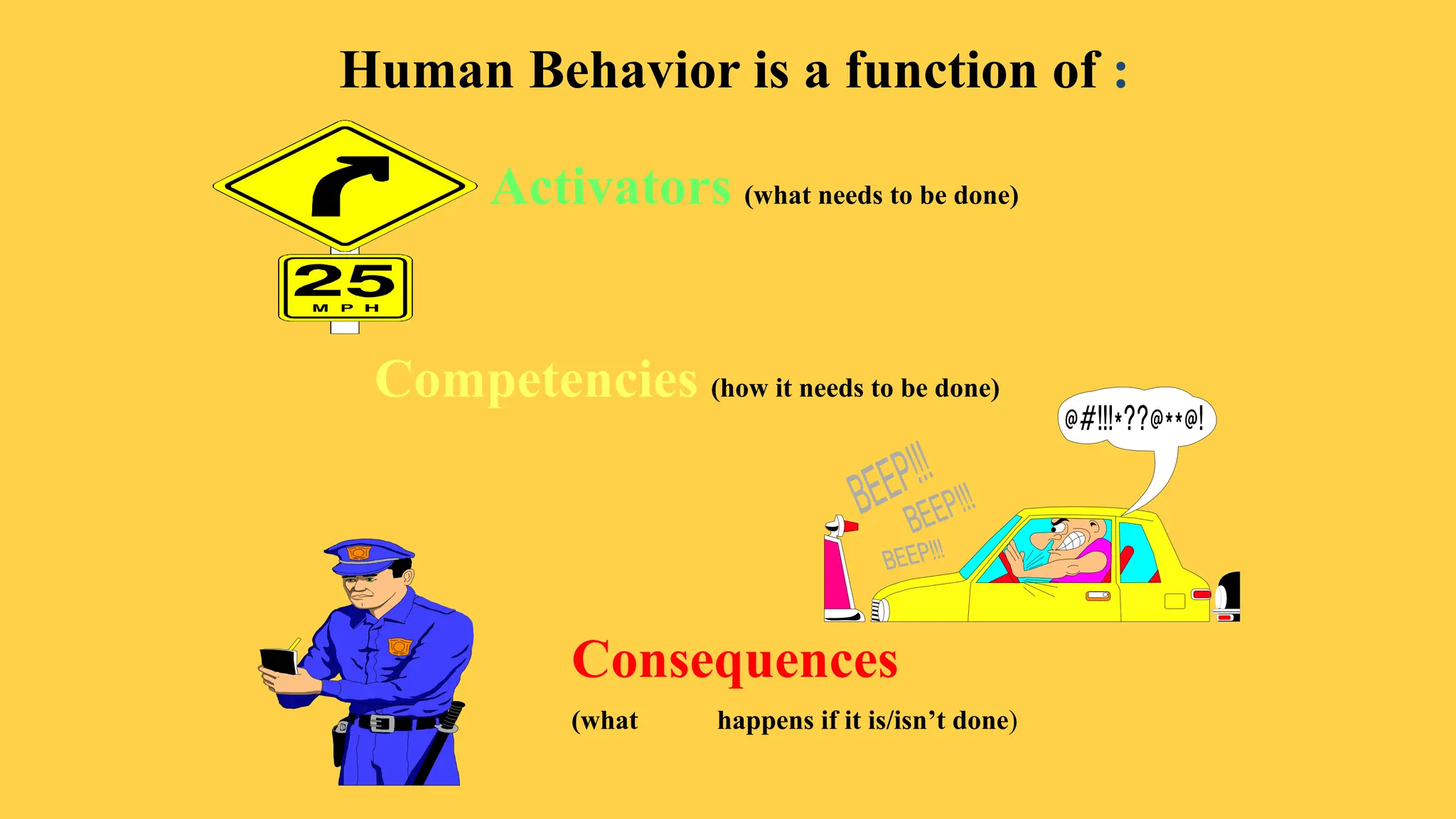
Competencies (how itneeds to be done)
Human Behavior is a function of :
Activators (what needs to be done)
Consequences
(what happens if it is/isn’t done)
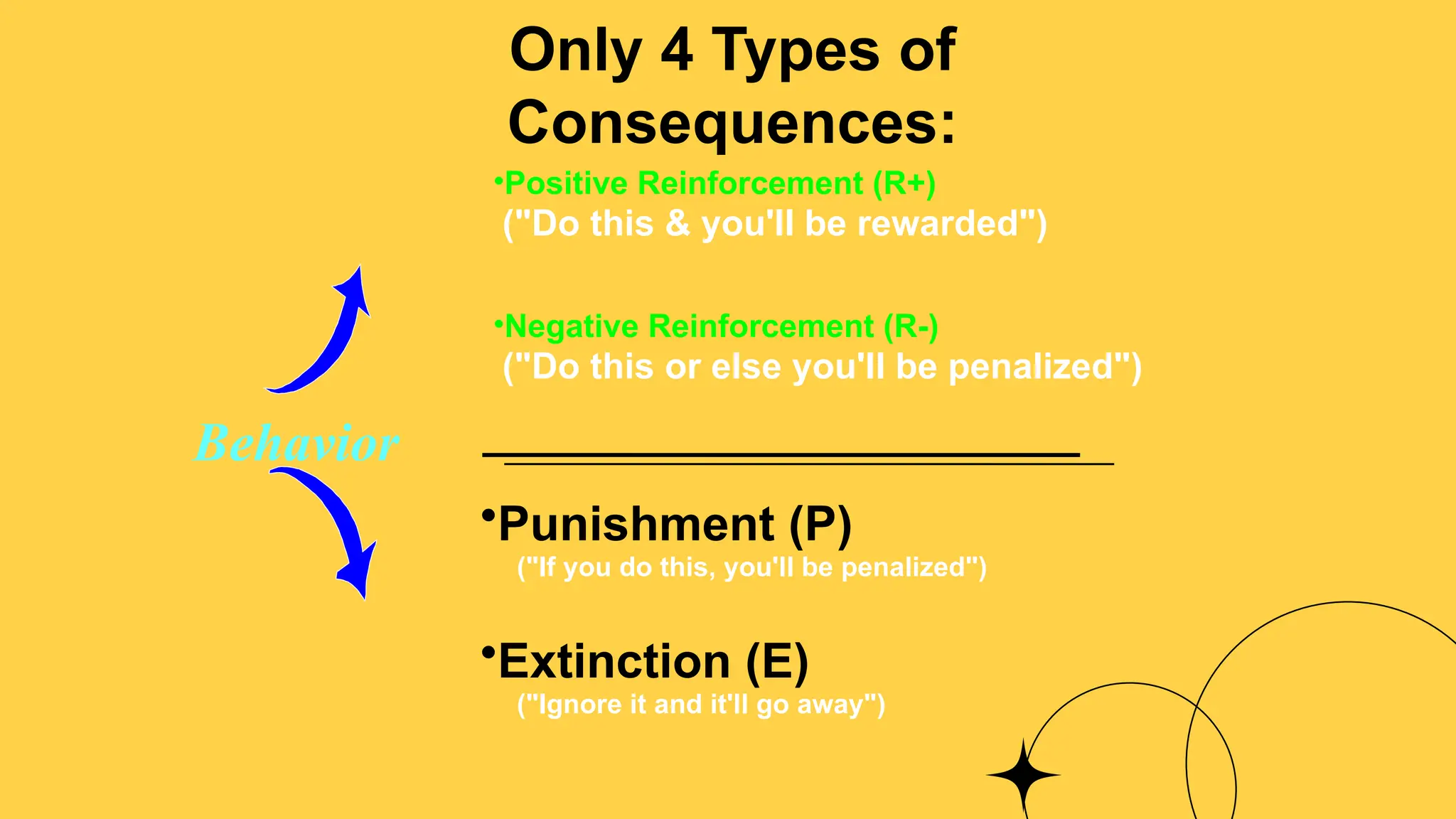
•Positive Reinforcement (R+)
("Dothis & you'll be rewarded")
•Negative Reinforcement (R-)
("Do this or else you'll be penalized")
Only 4 Types of
Consequences:
Behavior
•Punishment (P)
("If you do this, you'll be penalized")
•Extinction (E)
("Ignore it and it'll go away")
23.
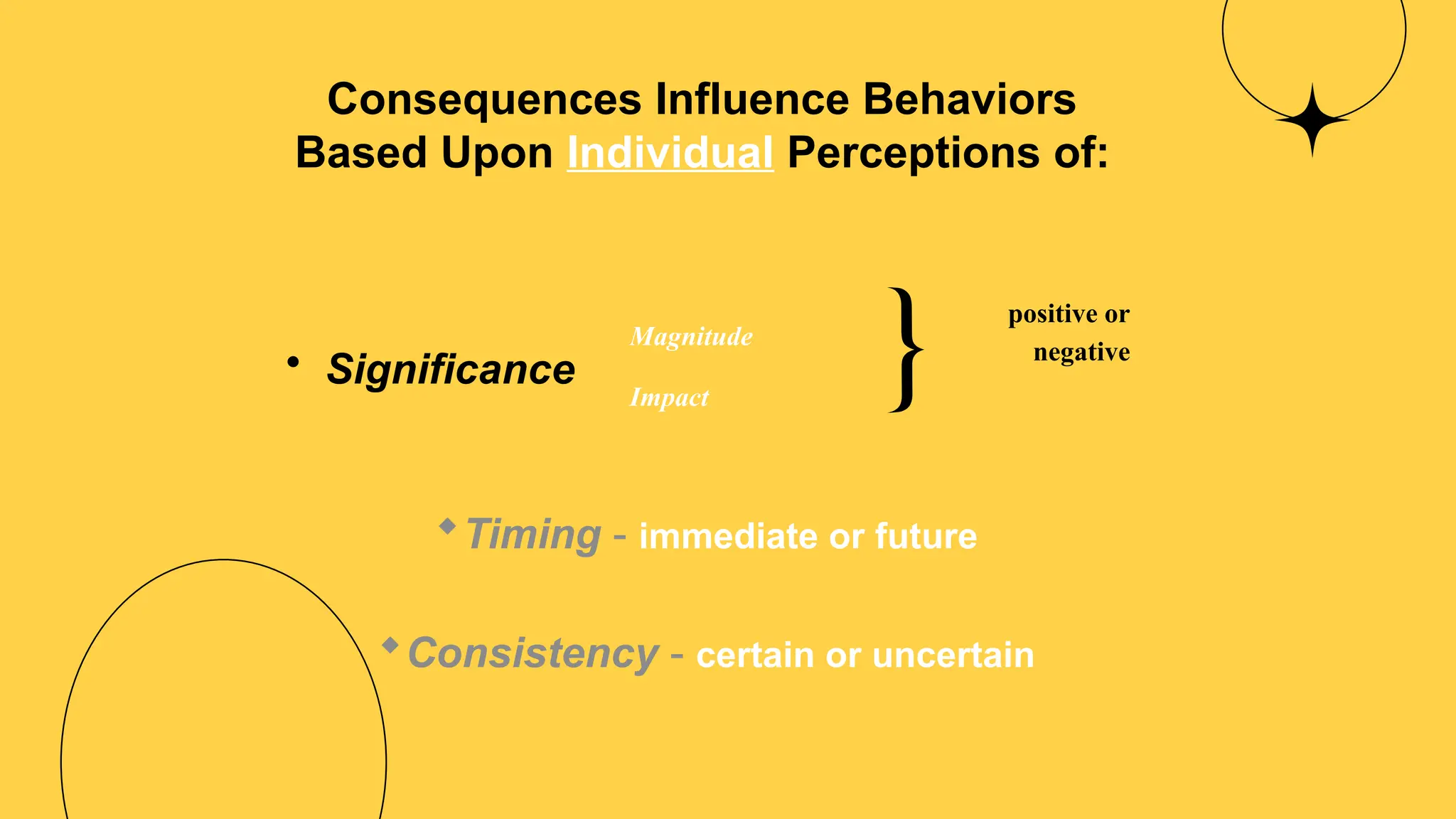
Consequences Influence Behaviors
BasedUpon Individual Perceptions of:
Timing - immediate or future
Consistency - certain or uncertain
• Significance
{
Magnitude
Impact
positive or
negative
24.
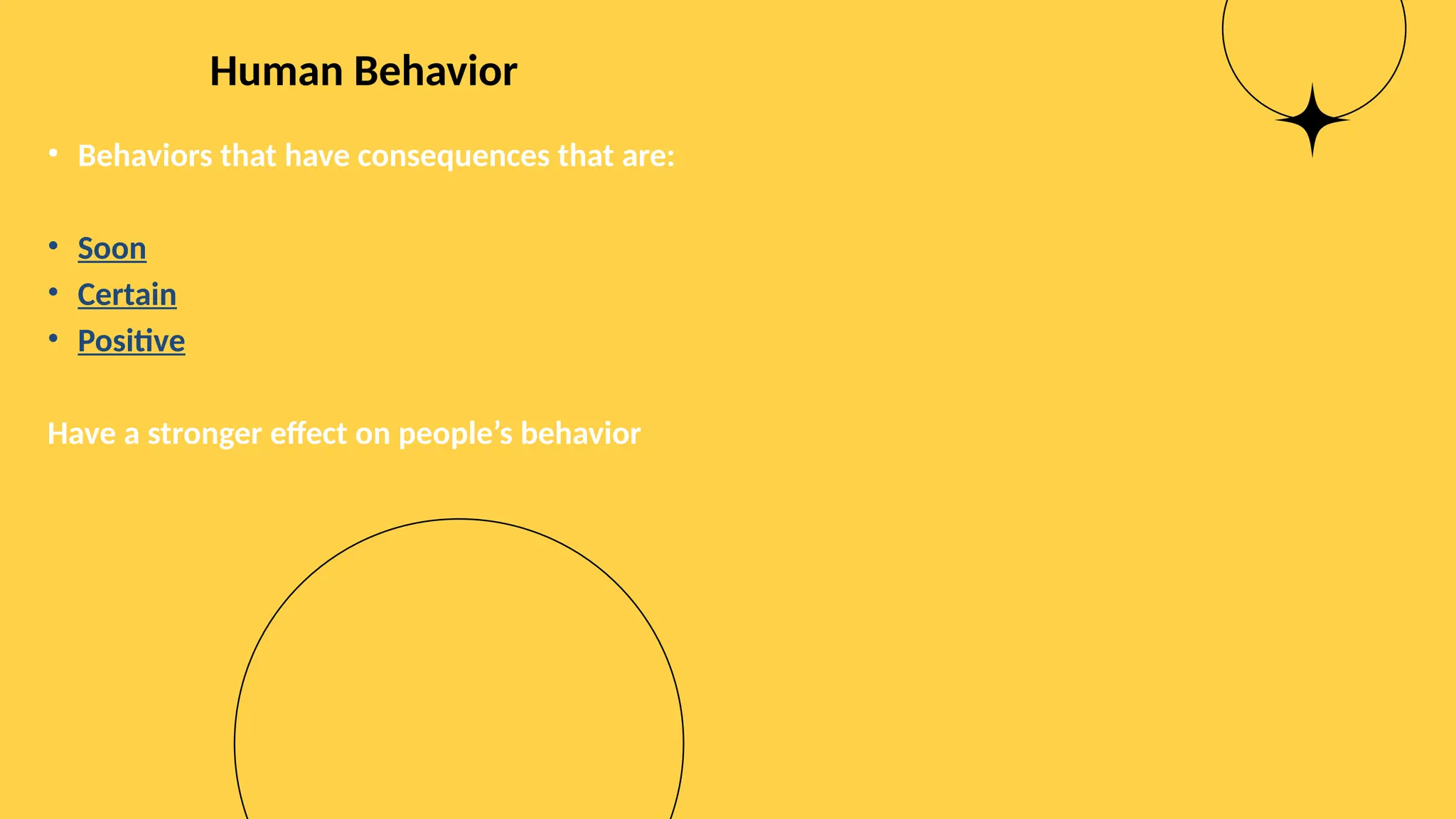
Human Behavior
• Behaviorsthat have consequences that are:
• Soon
• Certain
• Positive
Have a stronger effect on people’s behavior
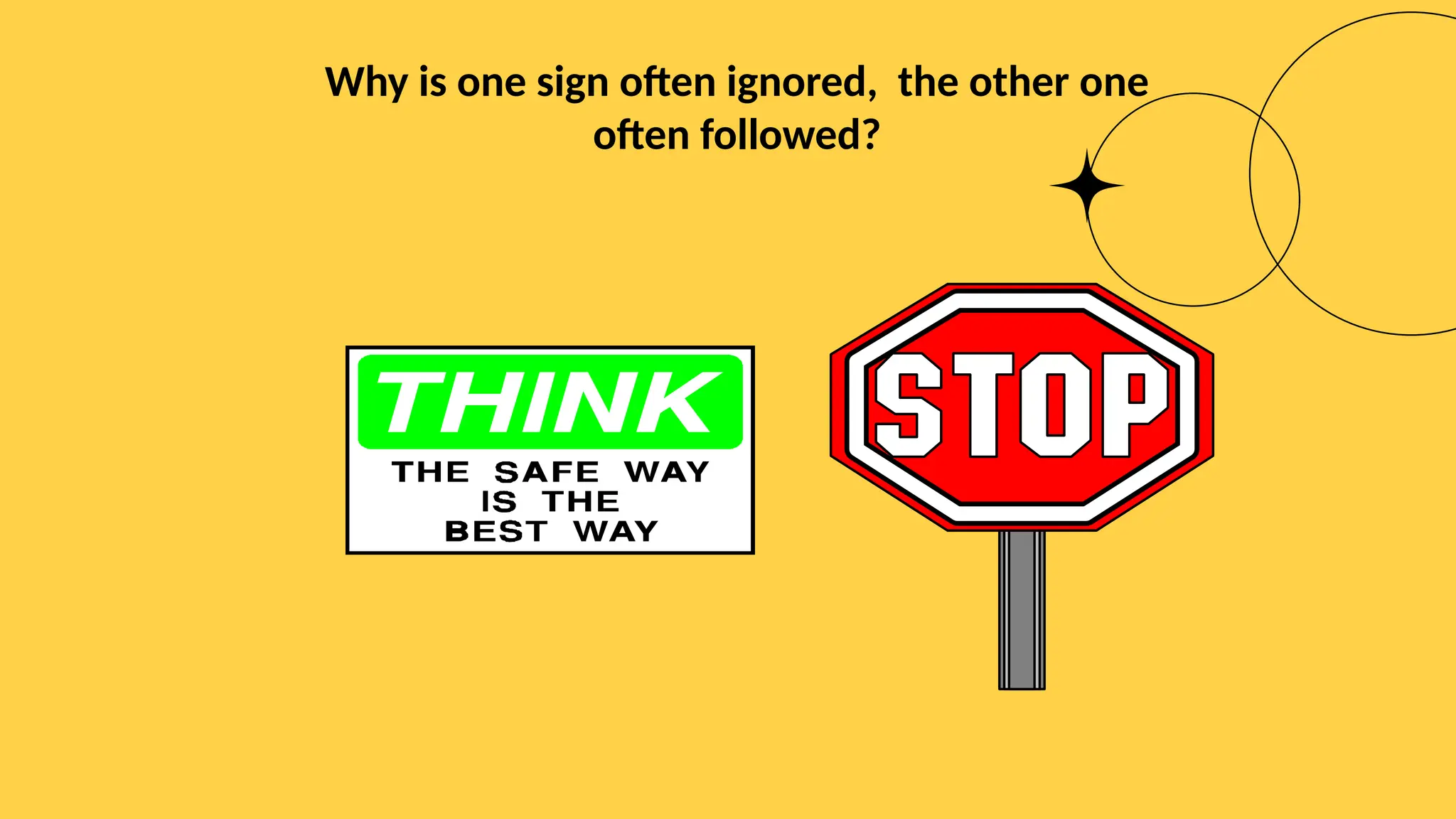
Why is onesign often ignored, the other one
often followed?
27.
Human Behavior
• Soon
•A consequence that follows soon after a
behavior has a stronger influence than
consequences that occur later
• Silence is considered to be consent
• Failure to correct unsafe behavior influences
employees to continue the behavior
28.
Human Behavior
• Certain
•A consequence that is certain to follow a
behavior has more influence than an
uncertain or unpredictable consequence
• Corrective Action must be:
– Prompt
– Consistent
– Persistent
29.
Human Behavior
• Positive
•A positive consequence influences behavior
more powerfully than a negative
consequence
• Penalties and Punishment don’t work
• Speeding Ticket Analogy
30.
Human Behavior
• Example:Smokers find it hard to stop
smoking because the consequences are:
A) Soon (immediate)
B) Certain (they happen every time)
C) Positive (a nicotine high)
The other consequences are:
A) Late (years later)
B) Uncertain (not all smokers get lung cancer)
C) Negative (lung cancer)
31.
Deviations from SOP
•No Safe Procedure
• Employee Didn’t know Safe Procedure
• Employee knew, did not follow Safe
Procedure
• Procedure encouraged risk-taking
• Employee changed approved procedure
32.
Human Behavior
• ThoughtQuestion:
What would you do as a worker if you had to
take 10-15 minutes to don the correct P.P.E.
to enter an area to turn off a control valve
which took 10 seconds?
33.
Human Behavior
• Punishmentor threatening workers is a behavioral method used by
some Safety Management programs
• Punishment only works if:
– It is immediate
– Occurs every time there is an unsafe behavior
• This is very hard to do
34.
Human Behavior
• Thesoon, certain, positive reinforcement
from unsafe behavior outweighs the
uncertain, late, negative reinforcement from
inconsistent punishment
• People tend to respond more positively to
praise and social approval than any other
factors
35.
Human Behavior
• Someexperts believe you can change worker’s
safety behavior by changing their “Attitude”
• Accident Report – “Safety Attitude”
• A person’s “Attitude” toward any subject is
linked with a set of other attitudes - Trying to
change them all would be nearly impossible
• A Behavior change leads to a new “Attitude”
because people reduce tension between
Behavior and their “Attitude”
36.
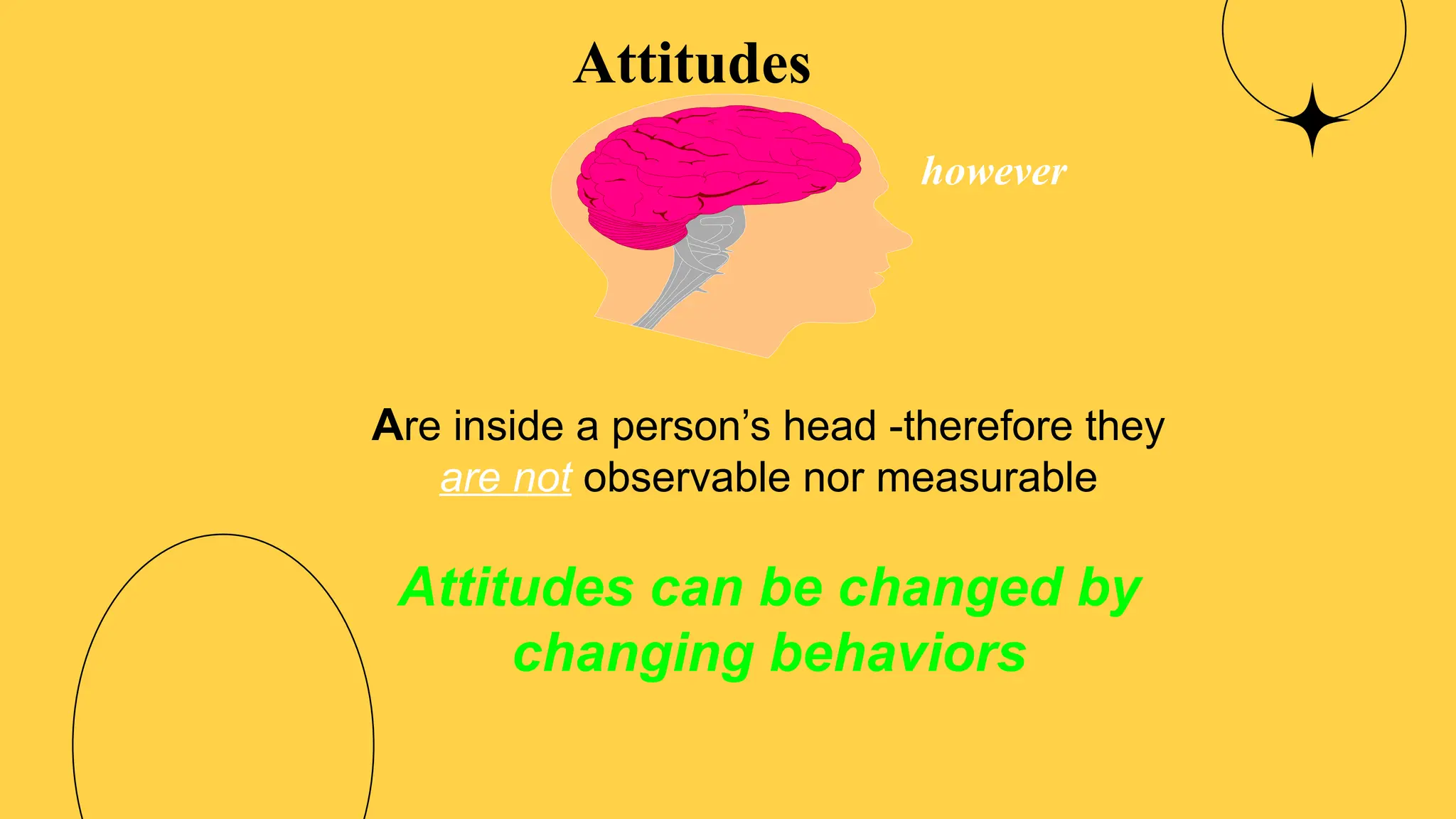
Are inside aperson’s head -therefore they
are not observable nor measurable
Attitudes can be changed by
changing behaviors
however
Attitudes
37.
Human Behavior
• “Attention”Behavioral Safety approach
– Focuses on getting workers to pay “Attention”
– Inability to control “Attention” is a contributing
factor in many injuries
• You can’t scare workers into a safety focus
with “Pay Attention” campaigns
38.
Reasons for Lackof Attention
1. Technology encourages short attention spans (TV remote,
Computer Mouse)
2. Increased Job Stress caused by uncertainty (mergers &
downsizing)
3. Lean staffing and increased workloads require quick attention
shifts between tasks
4. Fast pace of work – little time to learn new tasks and do familiar
ones safely
39.
Reasons for Lackof Attention
5. Work repetition can lull workers into a
loss of attention
6. Low level of loyalty shown to employees
by an ever reorganizing employer may lead
to:
a) Disinterested workers
b) Detached workers (no connection to employer)
c) Inattentive workers
40.
Human Behavior
• Focusingon “Awareness” is a typical educational approach to
change safety behavior
• Example: You provide employees with a persuasive rationale for
wearing safety glasses and hearing protection in certain work
areas
41.
Human Behavior
Developing PersonalSafety Awareness
A) Before starting, consider how to do job safely
B) Understand required P.P.E. and how to use it
C) Determine correct tools and ensure they are in good
condition
D) Scan work area – know what is going on
E) As you work, check work position – reduce any strain
F) Any unsafe act or condition should be corrected
G) Remain aware of any changes in your workplace – people
coming, going, etc.
H) Talk to other workers about safety
I) Take safety home with you
42.
Human Behavior
Some ThoughtQuestions:
1. Do you want to work safely?
2. Do you want others to work safely?
3. Do you want to learn how to prevent
accidents/injuries?
4. How often do you think about safety as you
work?
5. How often do you look for actions that could
cause or prevent injuries?
43.
Human Behavior
• MoreThought Questions:
a) Have you ever carried wood without wearing gloves?
b) Have you ever left something in a walkway that was a tripping
hazard?
c) Have you ever carried a stack of boxes that blocked your view?
d) Have you ever used a tool /equipment you didn’t know how to
operate?
e) Have you ever left a desk or file drawer open while you worked
in an area?
f) Have you ever placed something on a stair “Just for a minute”?
g) Have you ever done anything unsafe because “I’ve always done
it this way”?
44.
Human Behavior
TIME!
“All thissafety stuff takes time doesn’t it”?
“I’m too busy”!
“I can’t possibly do all this”!
“The boss wants the job done now”!
45.
Human Behavior
• Doesrushing through the job, working quickly
without considering safety, really save time?
• Remember – if an incident occurs, the job
may not get done on time and someone could
be injured – and that someone could be YOU!!
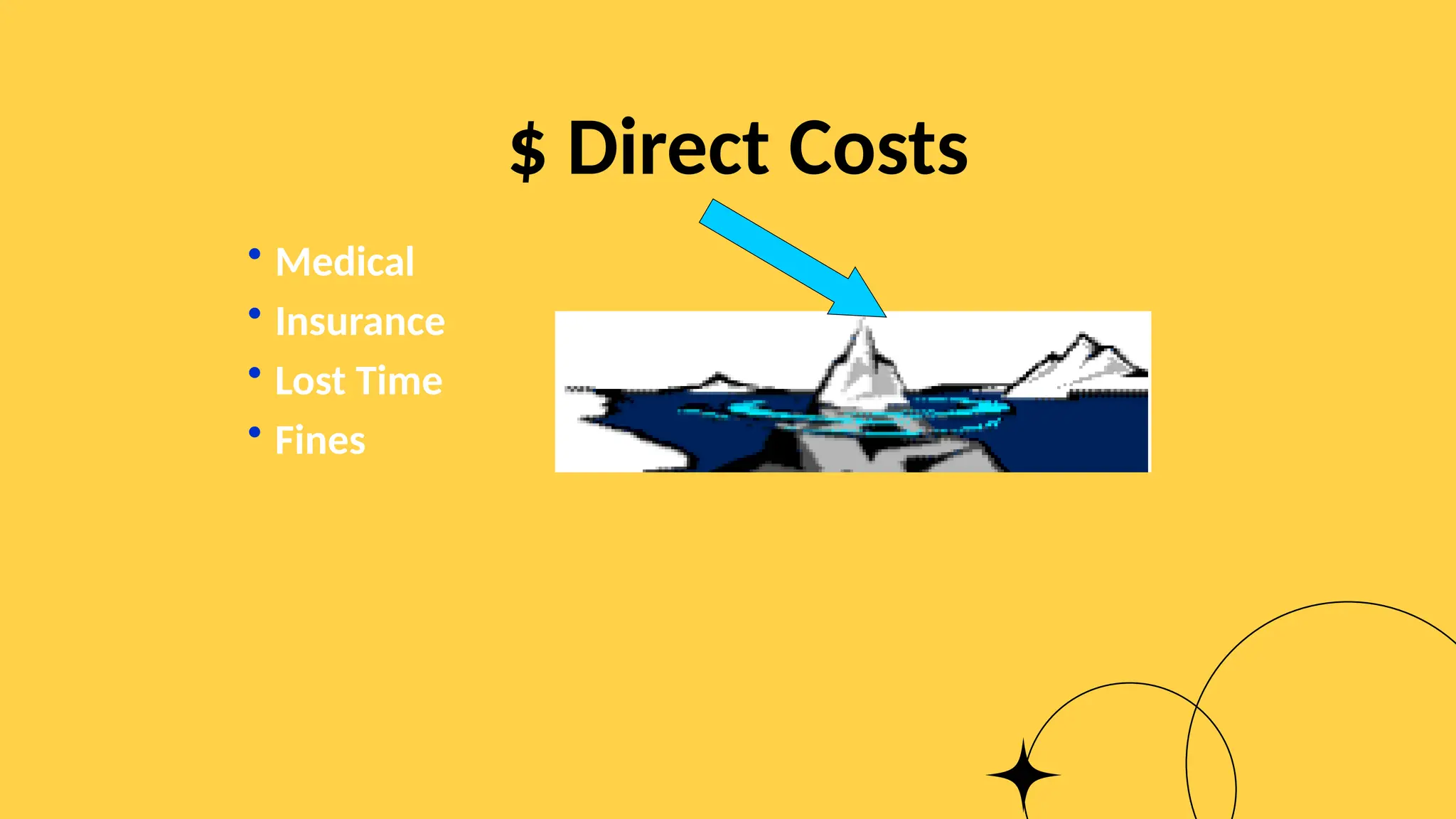
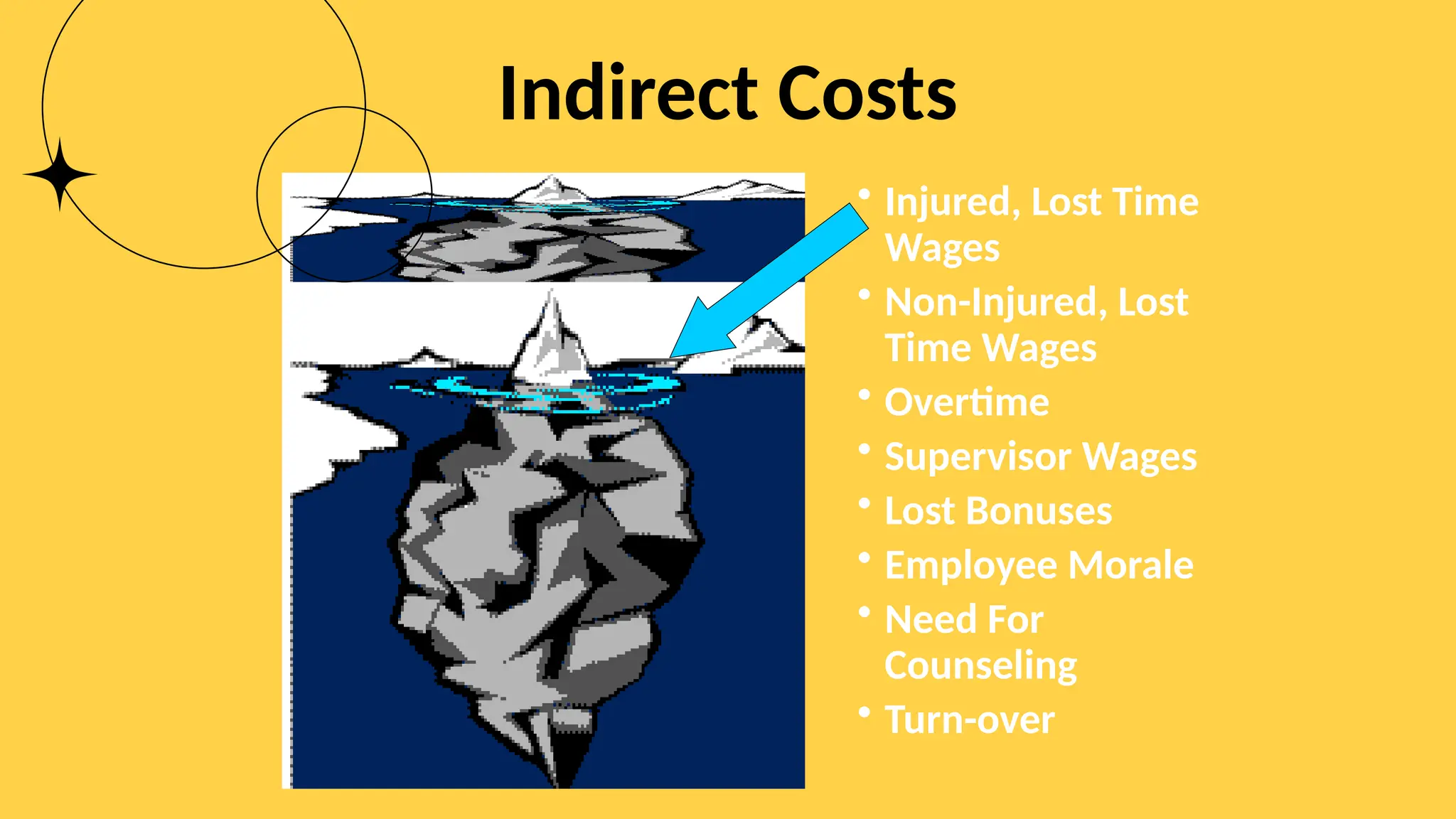
Indirect Costs
• Injured,Lost Time
Wages
• Non-Injured, Lost
Time Wages
• Overtime
• Supervisor Wages
• Lost Bonuses
• Employee Morale
• Need For
Counseling
• Turn-over
49.
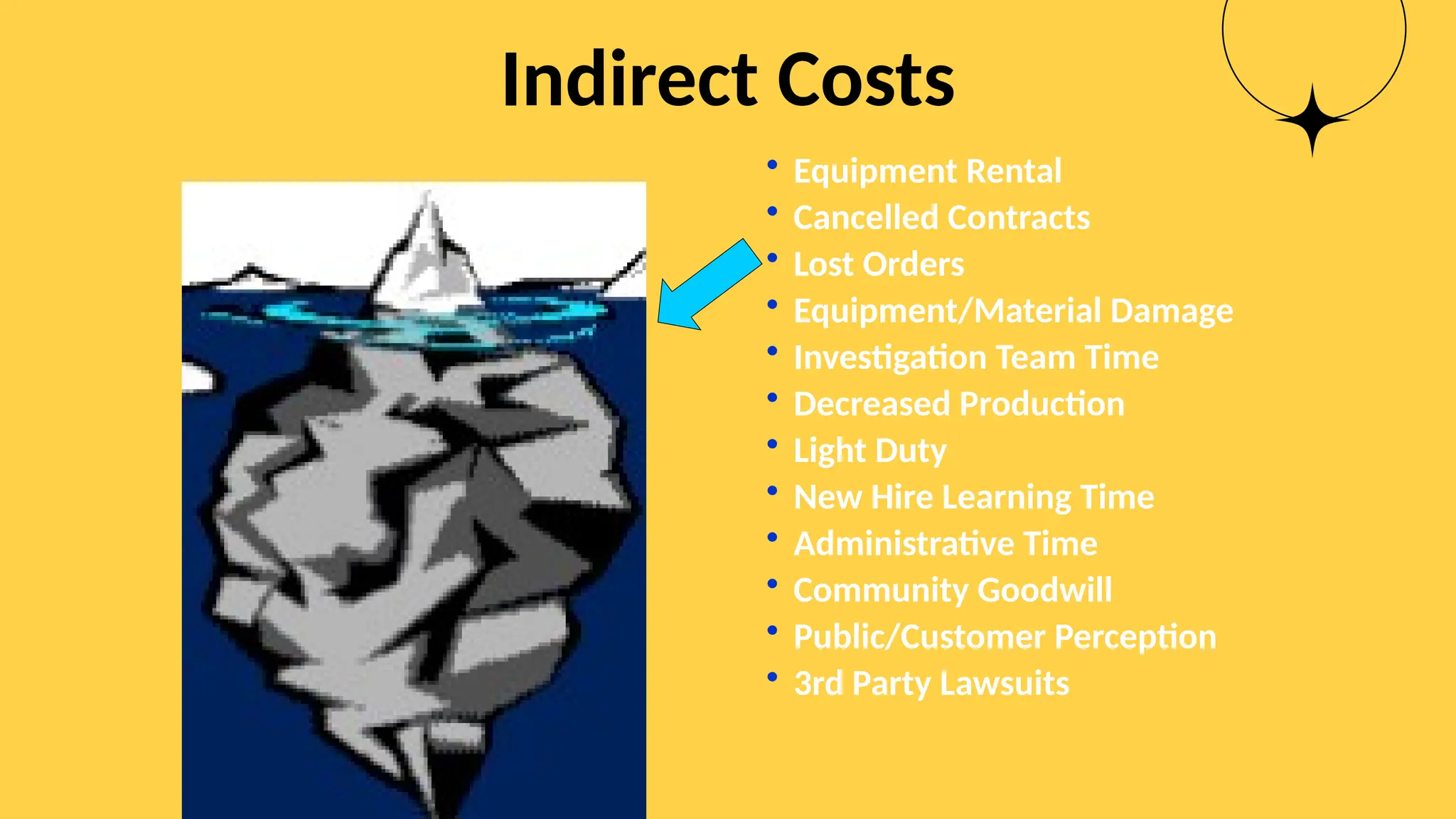
Indirect Costs
• EquipmentRental
• Cancelled Contracts
• Lost Orders
• Equipment/Material Damage
• Investigation Team Time
• Decreased Production
• Light Duty
• New Hire Learning Time
• Administrative Time
• Community Goodwill
• Public/Customer Perception
• 3rd Party Lawsuits
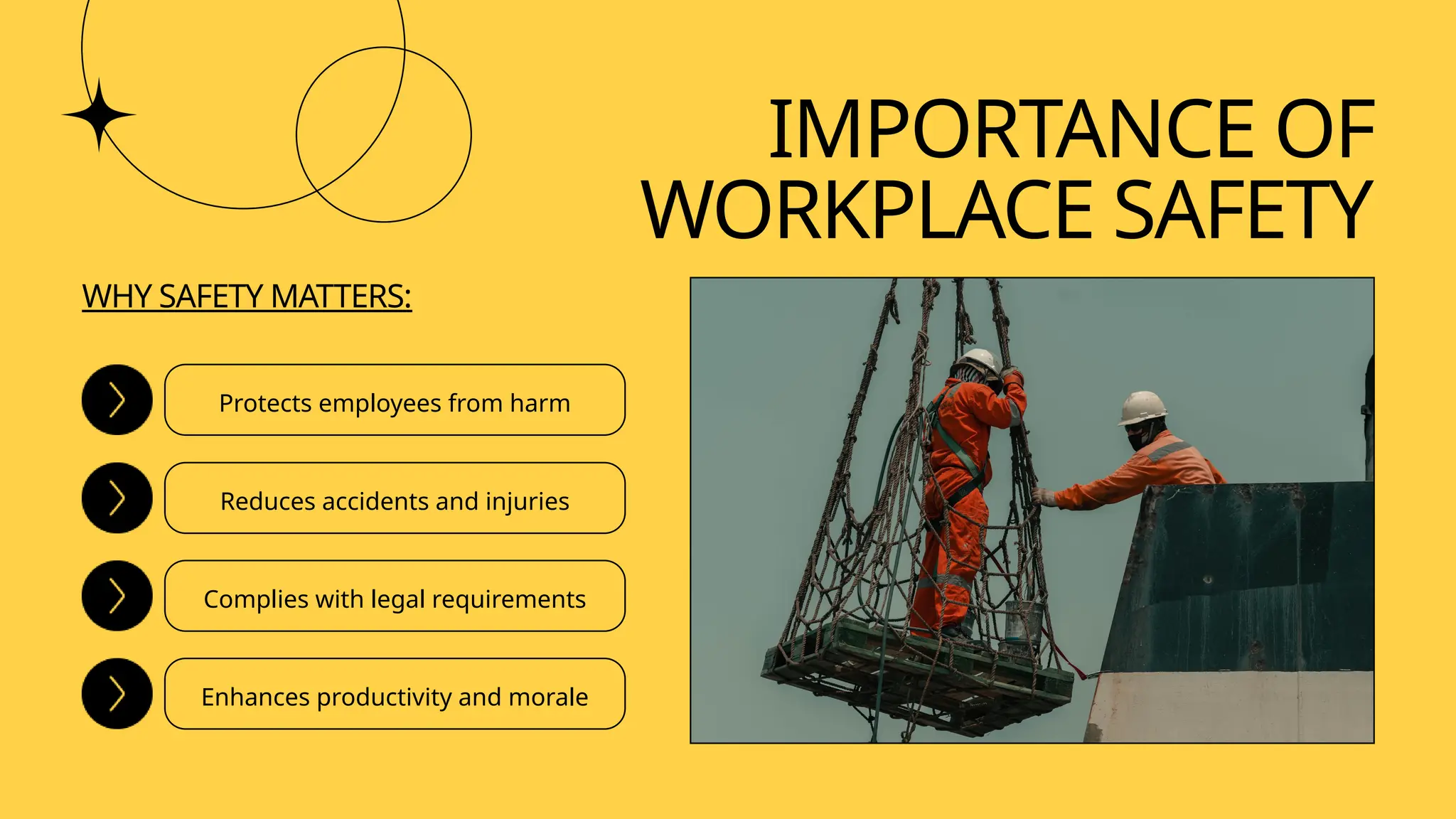
IMPORTANCE OF
WORKPLACE SAFETY
WHYSAFETY MATTERS:
Protects employees from harm
Reduces accidents and injuries
Complies with legal requirements
Enhances productivity and morale
53.
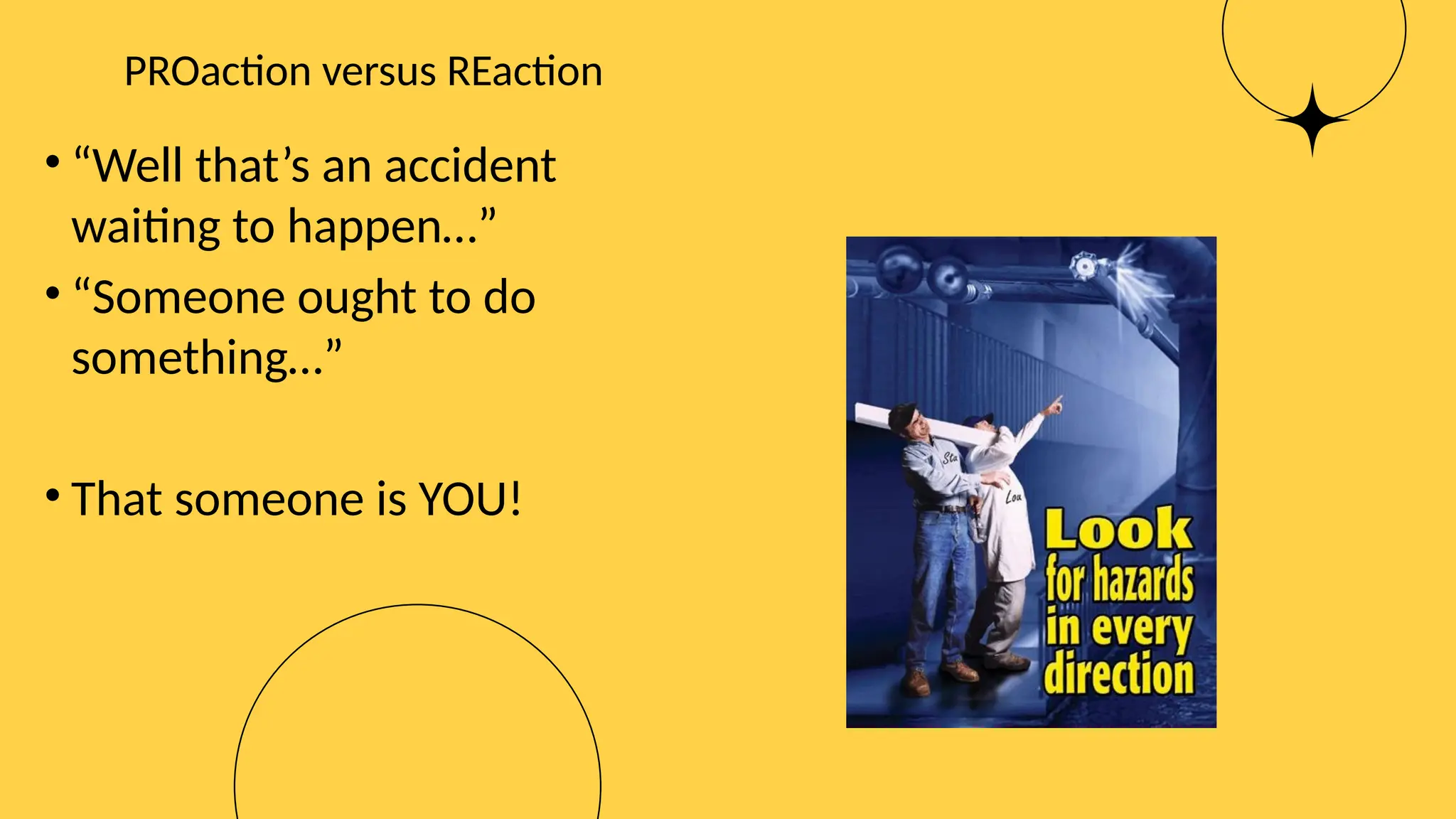
PROaction versus REaction
•“Well that’s an accident
waiting to happen…”
• “Someone ought to do
something…”
• That someone is YOU!
54.
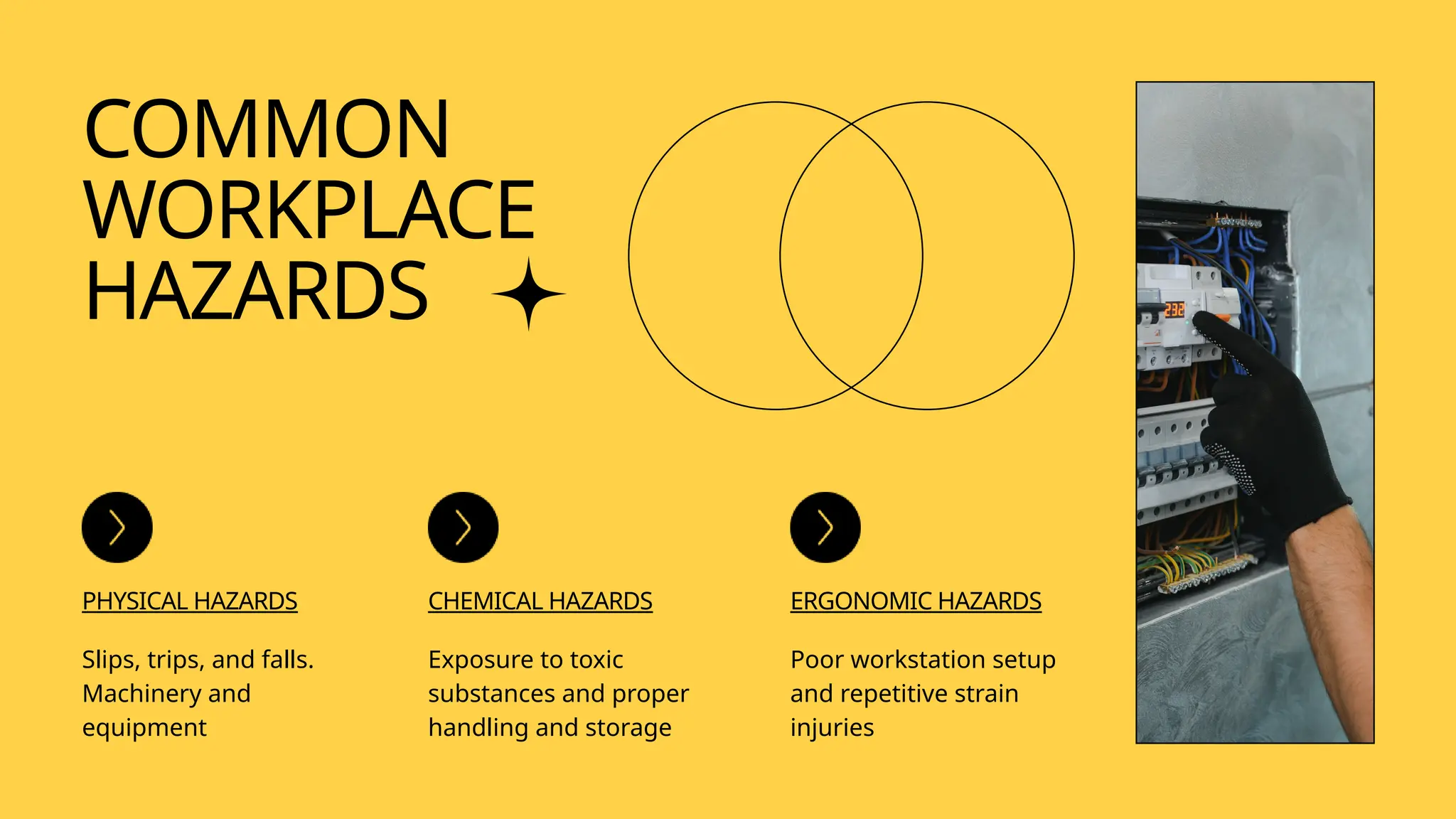
COMMON
WORKPLACE
HAZARDS
PHYSICAL HAZARDS
Slips, trips,and falls.
Machinery and
equipment
CHEMICAL HAZARDS
Exposure to toxic
substances and proper
handling and storage
ERGONOMIC HAZARDS
Poor workstation setup
and repetitive strain
injuries
55.
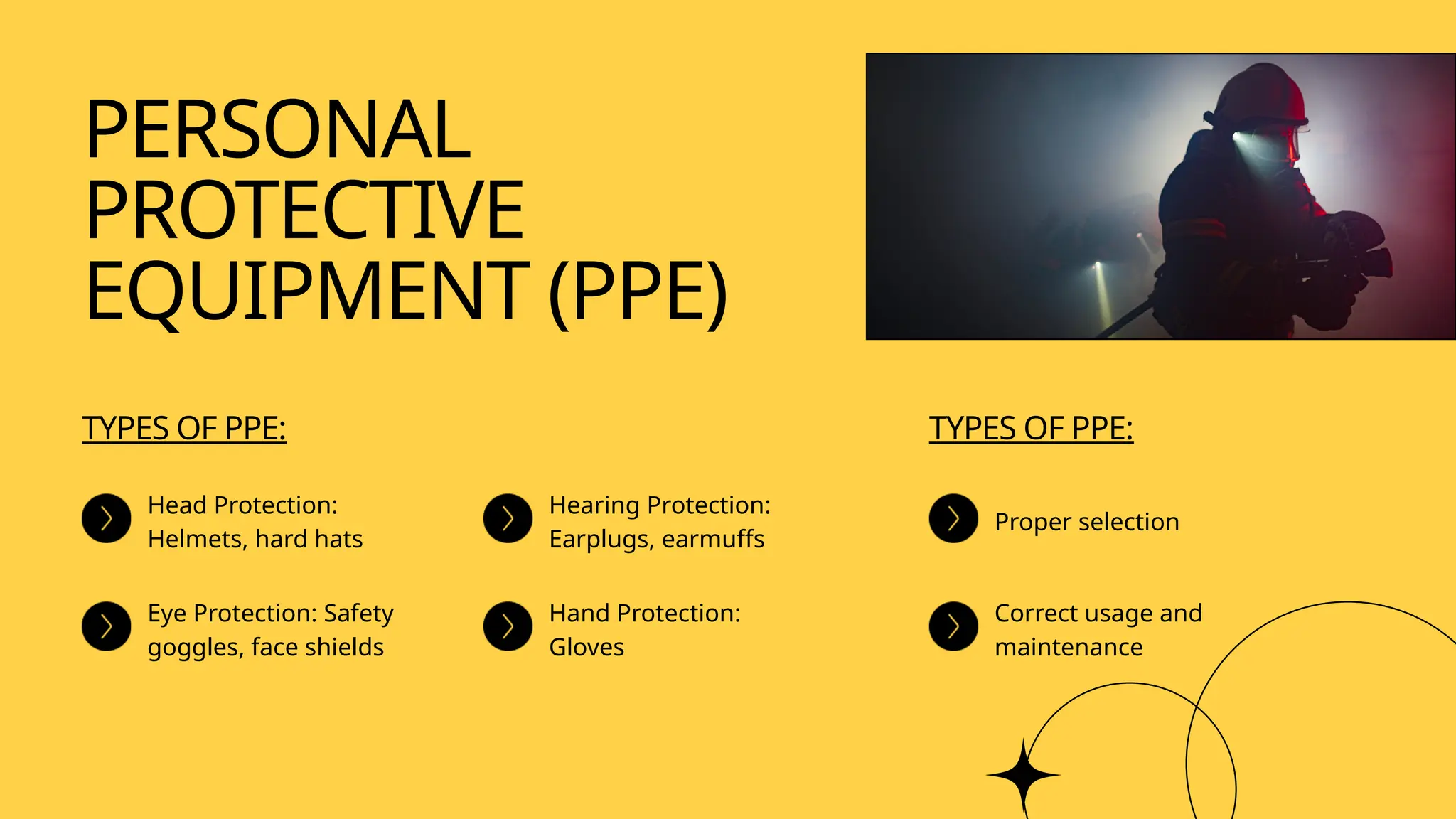
PERSONAL
PROTECTIVE
EQUIPMENT (PPE)
TYPES OFPPE:
Head Protection:
Helmets, hard hats
Eye Protection: Safety
goggles, face shields
Hearing Protection:
Earplugs, earmuffs
Hand Protection:
Gloves
TYPES OF PPE:
Proper selection
Correct usage and
maintenance
56.
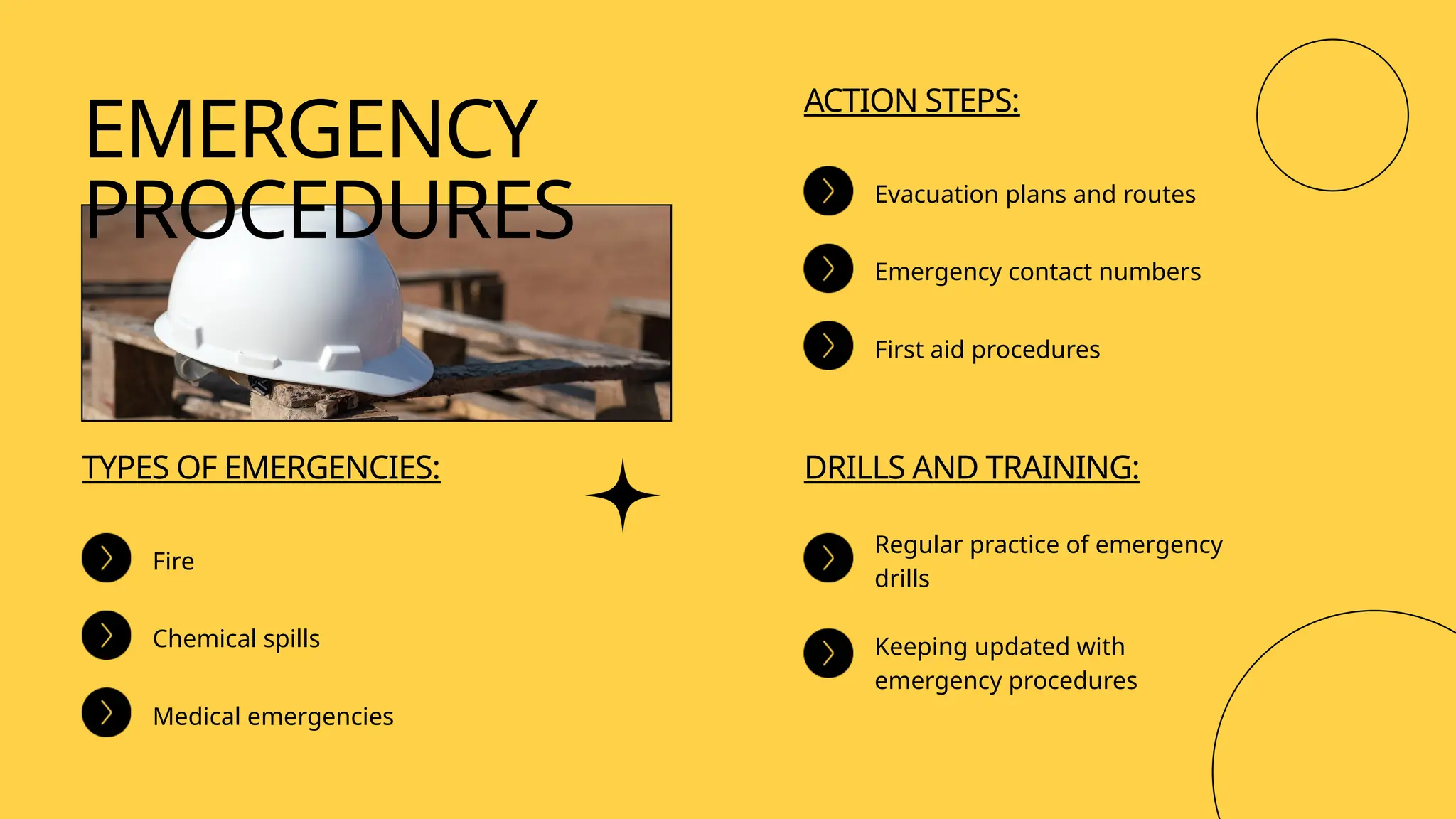
EMERGENCY
PROCEDURES
TYPES OF EMERGENCIES:
Fire
Chemicalspills
Medical emergencies
ACTION STEPS:
Evacuation plans and routes
Emergency contact numbers
First aid procedures
DRILLS AND TRAINING:
Regular practice of emergency
drills
Keeping updated with
emergency procedures
57.
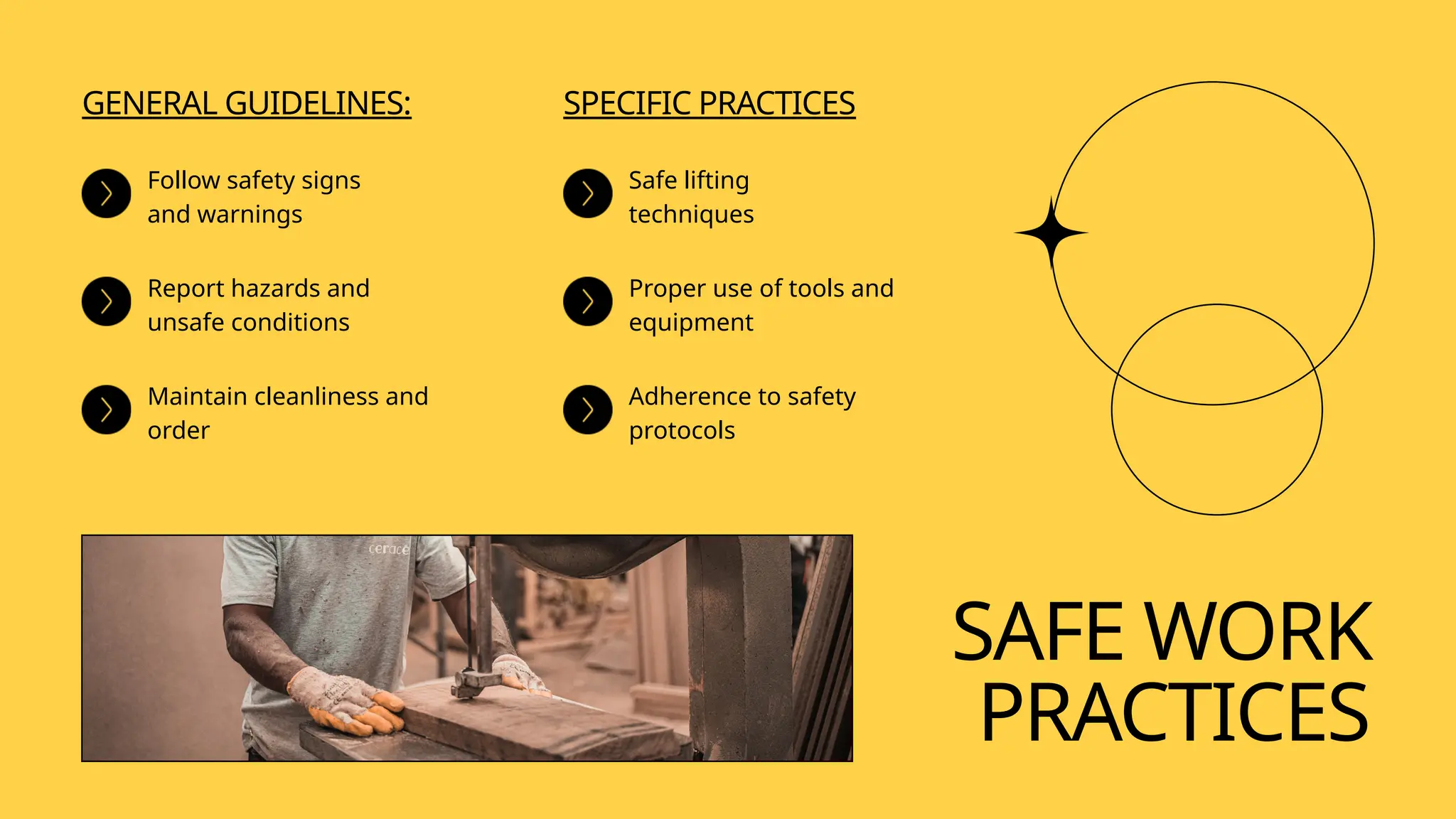
SAFE WORK
PRACTICES
GENERAL GUIDELINES:
Followsafety signs
and warnings
Report hazards and
unsafe conditions
Maintain cleanliness and
order
SPECIFIC PRACTICES
Safe lifting
techniques
Proper use of tools and
equipment
Adherence to safety
protocols
58.
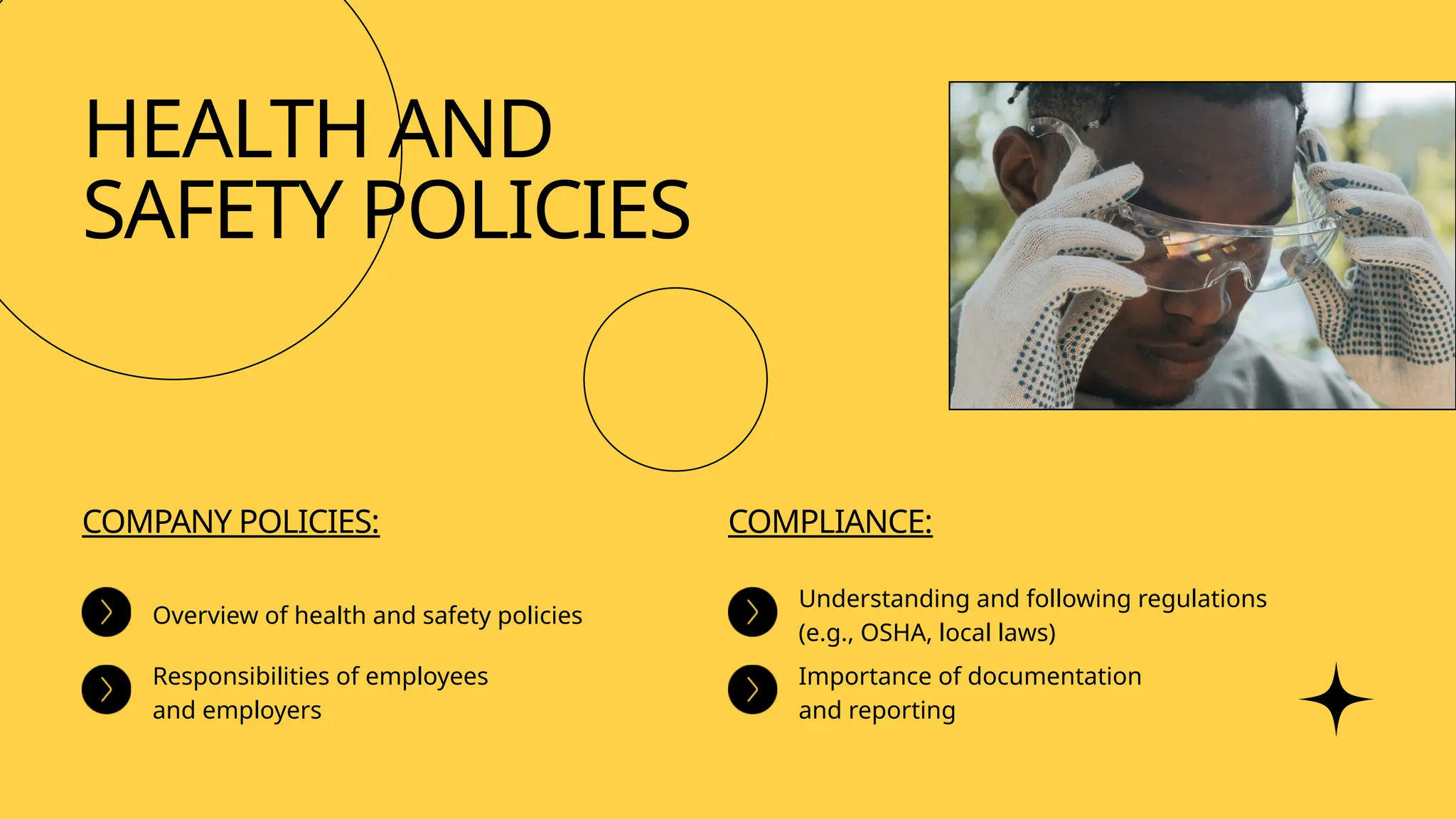
HEALTH AND
SAFETY POLICIES
COMPANYPOLICIES:
Overview of health and safety policies
Responsibilities of employees
and employers
COMPLIANCE:
Understanding and following regulations
(e.g., OSHA, local laws)
Importance of documentation
and reporting
59.
SAFETY
TRAINING
AND
AWARENESS
TRAINING PROGRAMS:
Initial trainingfor new employees
Refresher courses for existing
employees
PROMOTING SAFETY CULTURE
Encouraging safety discussions
Recognizing and rewarding safe
behavior
RESOURCES
Access to safety manuals and guidelines
Contact information for safety
officers
60.
SUMMARY
Ongoing safety trainingand awareness of the
importance of safety help create a strong safety
culture. Open discussions and regular training
reinforce safety knowledge and skills.
Company
Presentation
Safety Training
#2 Unsafe Conditions – examples
Poor housekeeping , Blocked walkways, Improper or damaged PPE
Machine guards removed, Exposed electrical wires Slippery floors,
Physical Factors – noise, vibration, illumination, temperature extremes
Chemical Factors – exposures that may impair a worker’s skill, reactions,
Judgment Ergonomic Factors –workstation design, habits,
#5 More people are injured or killed each day while driving their automobiles.
Driving a car is risky. We accept that risk,
WHY?
Rules in place to protect us (Engineering and Administrative)
Equipment in place to protect us (Engineering and PPE)
Training in place to protect us. (Administrative)
Perceive the benefits outweigh the risks
#9 Some 6,023 fatal work injuries occurred during 1999, nearly the same as 1998’s
total, though more people were employed in 1999. Decreases in job-related deaths
from homicides and electrocutions in 1999 were offset by increases from workers
struck by falling objects or caught in running machinery.
Washington state
Transportation Accidents (43%)
Contact w/objects & Equipment (25%)
Falls (10%)
Homicide (10%)
Homicides fell from the second-leading cause of fatal work
injuries to the third, behind highway fatalities, which remained
the number one occupational killer, and falls.
#10 Normally three cause levels: Most accidents are preventable by eliminating one or more causes.
At the lowest level, an accident results only when a person or object receives an amount of energy or
hazardous material that cannot be absorbed safely. This energy or hazardous material is the
DIRECT CAUSE of the accident. The direct cause is usually the result of one or more unsafe
acts or unsafe conditions, or both. Unsafe acts and conditions are the INDIRECT CAUSES
or symptoms. In turn, indirect causes are usually traceable to poor management policies and
decisions, or to personal or environmental factors. These are the BASIC CAUSES.
#11 Accidents are usually complex. May have10 or more events that can be causes.
#19 Unsafe Acts - examples
Unauthorized operation or repair of equipment, Running - Horse Play, Not following procedures
Improper use of chemicals By-passing safety devices, Not using protective equipment, influence
of drugs or alcohol, Improper lifting, Not cleaning up spills immediately
REAL CONCERN IS WHY THE DEVIATION OCCURRED.
1. No known standard for safe job procedure --Perform JSA and develop good JIT
2.Employee did not know the safe procedures --Train in the correct procedure
3.Employee knew, bud did not follow safe procedures;Work pressure, difficulty , time
consuming, prior success Countermeasure: Employee performance evaluation, test validity of
procedure, counsel employees/manager’s, change work procedures, job requirements, Train
4.Employee knew and followed safe procedures --Develop safe procedures - train
5.Procedure encouraged risk-taking (incentive pay) --Change unsafe job design, procedure or incentive program
6.Employee changed the approved procedure or bypassed safety equipment--Evaulate safety
measures, change safety methods so they can not be bypassed
7.Individual Characteristics -- Counsel employees, consider change in work procedures,
workstation design or job requirements, in-depth training.
Unsafe Acts - system approach. Management and Worker Responsibility
#20 management needs to understand the forces that drive human behavior.
The three forces are: activators, competencies, and consequences.
Activators precede behavior. If activators are effective then they get the right behaviors started.
Competencies are the skills and abilities that people possess now or will need to posses in order to perform the desired functions. Competencies are demonstrated on the job in the form of behaviors.
Consequences are the most powerful force. The consequences of a person’s actions determine whether he or she will continue or increase the desired behavior or discontinue or decrease it.
The challenge is to use consequences in a strategic and honest way in order to create a win/win situation for everyone, not a win/win for some and a win/lose situation for others.
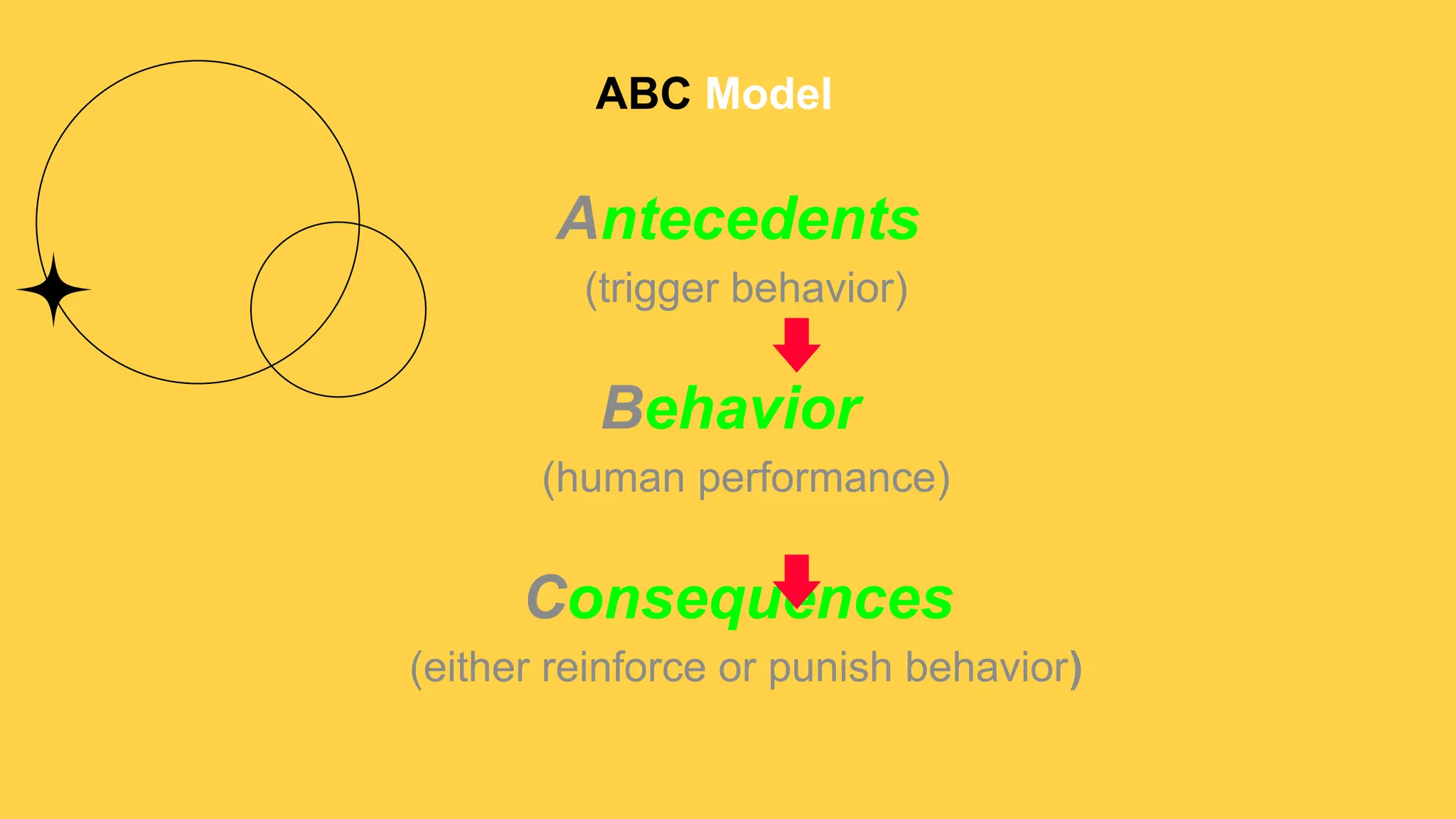
#21 The ABC model of behavior change has 3 components that lend it it’s name:
Antecedents (also frequently referred to as activators) are objects, people, sensory perceptions, or environmental stimuli that serve as the trigger for a particular behavior. For example, seeing a stop sign is a trigger for a driver to slow down and cover the brake before coming to a stop.
Behavior, as we have already said, is anything that you are able to observe a person do - walk, sit, stand, grasp, lift, read, sleep, etc..
Consequences are what the person who performs the behavior perceives or actually receives when he/she demonstrates a particular behavior. Consequences can either reinforce behavior (leading to an increase in performance) or punish or work to make the behavior extinct (leading to a decrease in performance).
#22 Key Concepts
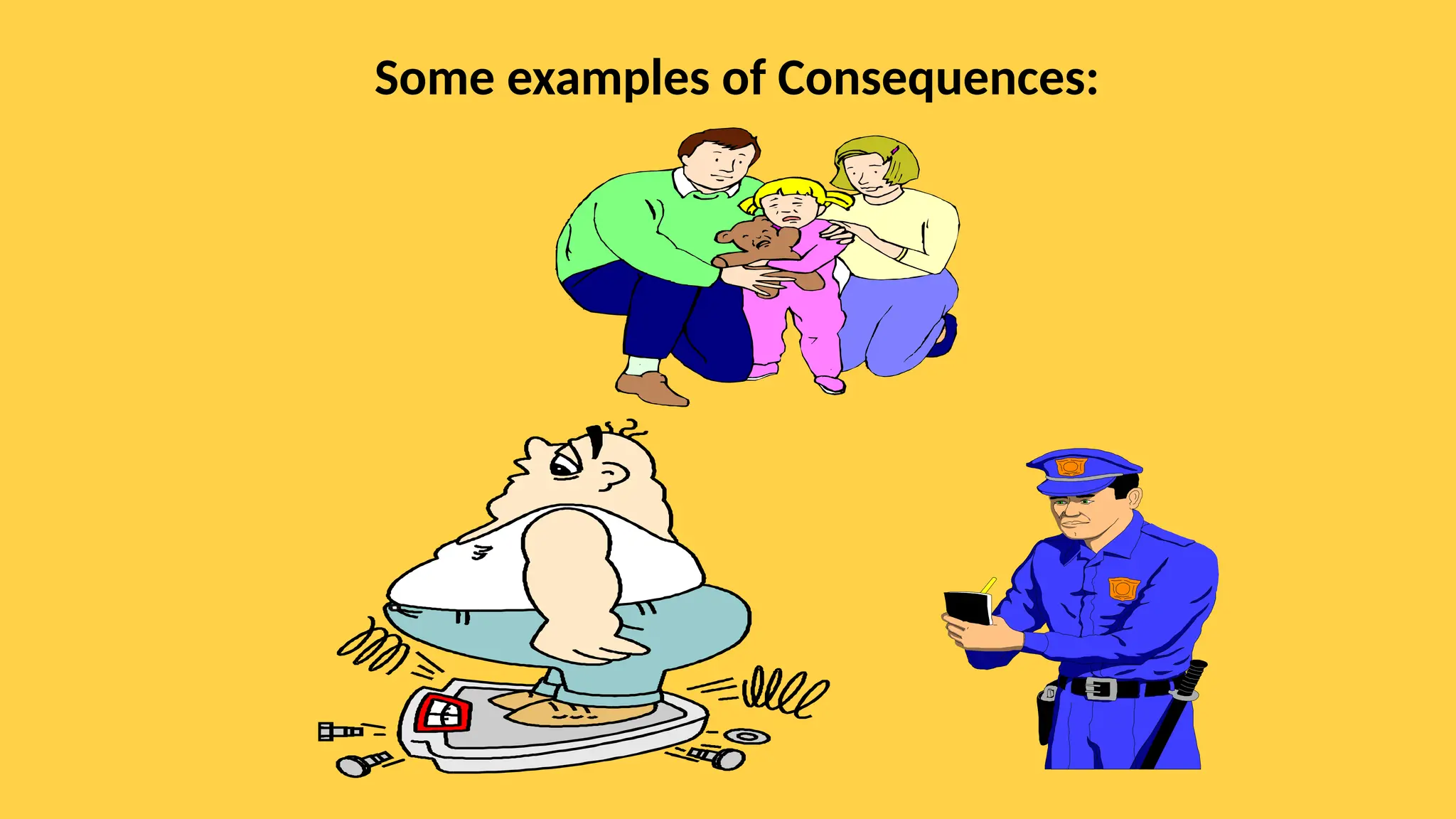
Extinction (essentially there’s no consequence). Seldom used in business to decrease undesired safety behaviors, but commonly (unknowingly) used to decrease desired safety behaviors. (Mgrs./Peers never saying thanks for cleaning up that spill/picking up that tool etc.) Crying Baby example.
Punishment: Very effective & essential -- there always will be behaviors that cannot be tolerated. We need to understand how the punishment affects the person being punished. WHEN WOULD YOU USE PUNISHMENT? (Severe situations, repeated violations, knowingly disregard)
Positive and Negative Reinforcement can both increase behavior, but Positive gives the benefit of discretionary effort.
Positive Reinforcement is not necessarily always beneficial: it can increase undesired behavior as well (ex: peer support for violating safety rules, slack enforcement results in +reinforcement to continue bad behavior)
Consequences are negative or positive based upon receiver’s perception, not sender’s intent
#23 Consequences influence behavior based upon three factors: timing, consistency, and significance. Significance is dependent on magnitude and impact. The different combinations of these factors will determine the likelihood of behavior increasing or decreasing in the future.
Timing: Is the consequence immediate or does it happen in the future? For example, the consequence of putting your hand on a red hot burner on the stove is immediate - pain!! The consequence of not exercising for most of your adult life is not so immediate. Poor health in old age may come years down the road from now. More Timely the consequence the more influencing/effective.
Consistency: Is the consequence certain to happen or is there uncertainty? For example, if everyone who smoked cigarettes was guaranteed that by the time they had smoked their third cigarette they would have developed lung cancer, you’d have a lot less smokers. Because of the high degree of uncertainty of contracting lung cancer due to smoking, many people still smoke.
Significance refers to whether the consequence is viewed as positive or negative by the person who receives the consequence. If I find that a friendly pat on the back by my boss is a positive stroke, another female co-worker may see that hand on her shoulder as a sign of sexual harassment - very negative. Significance means is the consequence of large or small magnitude and what impact does it have on the person receiving it.
#31 1. No known standard for safe job procedure --Perform JSA and develop good JIT
2.Employee did not know the safe procedures --Train in the correct procedure
3.Employee knew, bud did not follow safe procedures;Work pressure, difficulty , time
consuming, prior success Countermeasure: Employee performance evaluation, test validity of
procedure, counsel employees/manager’s, change work procedures, job requirements, Train
4.Employee knew and followed safe procedures --Develop safe procedures - train
5.Procedure encouraged risk-taking (incentive pay) --Change unsafe job design, procedure or incentive program
6.Employee changed the approved procedure or bypassed safety equipment--Evaulate safety
measures, change safety methods so they can not be bypassed
7.Individual Characteristics -- Counsel employees, consider change in work procedures,
workstation design or job requirements, in-depth training.
#36 We often hear managers talk about an employee having a “bad attitude towards safety” or a “bad attitude about work in general” or that an employee “has a good attitude towards his/her job.” These statements reflect an overall perception that has been formed by observing a series of behaviors over time. Unfortunately they are not precise enough statements to allow us to pinpoint the specific behaviors that were being observed over time that led to this perception.
You cannot see a person’s attitude. You can see his/her behaviors and form an opinion on what is causing that “attitude” but you can never be 100% certain that you are right.
If our perception of a person’s attitude is based on our observation of his/her behaviors, remember that we just said that we can manage behaviors. If we can manage behaviors effectively enough we can get people to perform differently. If they perform differently long enough and are provided with positive reinforcement for their behavior changes, their attitude towards a particular work task will begin to change. How we manage behaviors will determine if that attitude change takes place quickly or slowly. If we use the technique of positive reinforcement we are likely to see the most rapid change. If we use mostly negative reinforcement and punishment we will probably see a slow change in attitude or perhaps very little change at all.
#47 National Safe Workplace Institute - FATALITIES
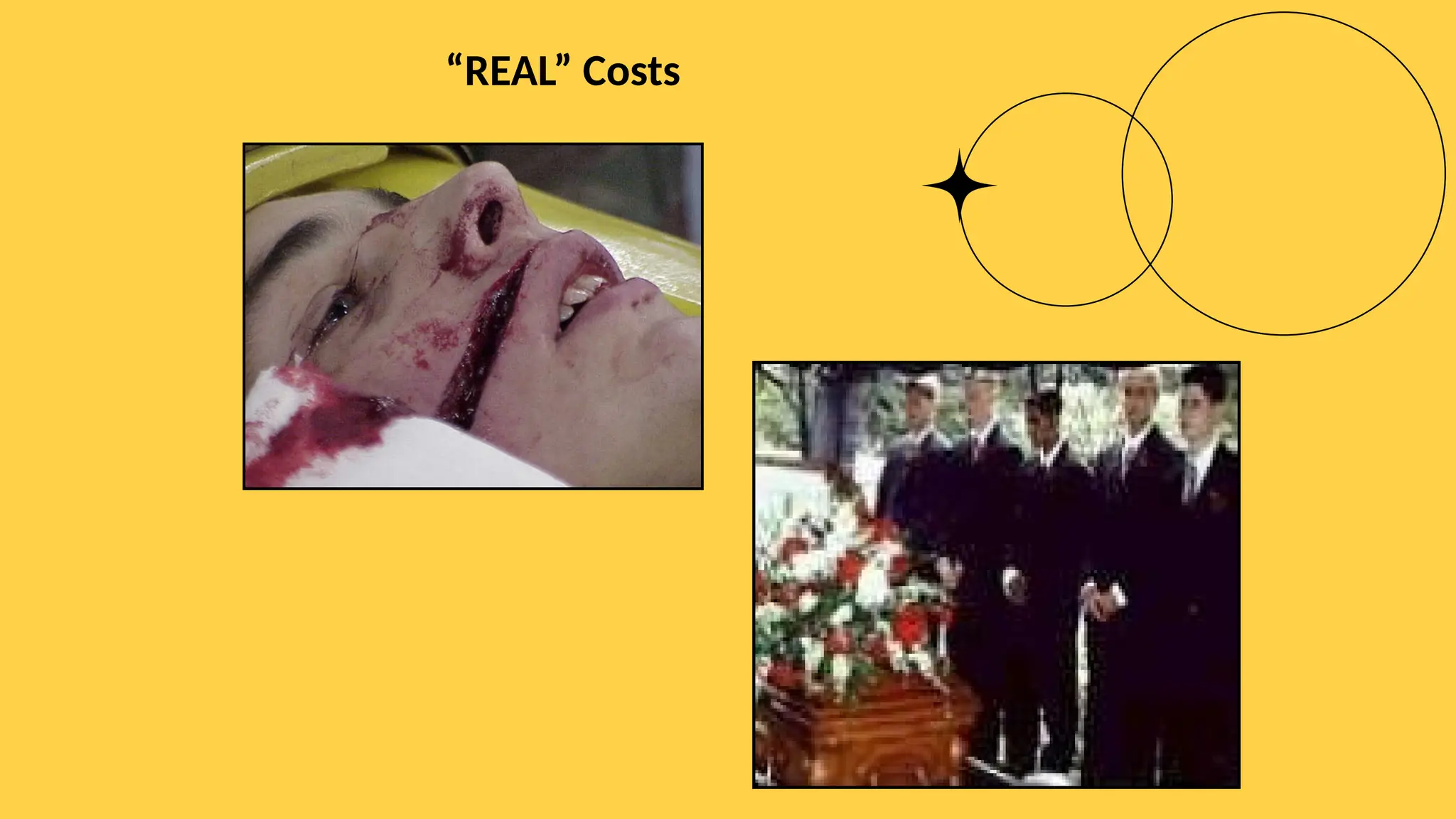
#48 From the perspective of the witness/victim and their families, the
ramifications of WorkPlace acccidents is devastating. The loss of human
life (co-workers, friends, and supervisors) can never be replaced. The
emotional trauma of being involved and witnessing a serious/fatal accident
cannot be described in words. After a fatality has occurred, many
valuable employees may not return to work – Especially in cases of violence.
#49 .
Compare $4.4 Million sanctioned against Equilon by L&I to $45M in out-of-court settlement with families of 6 deceased employees.
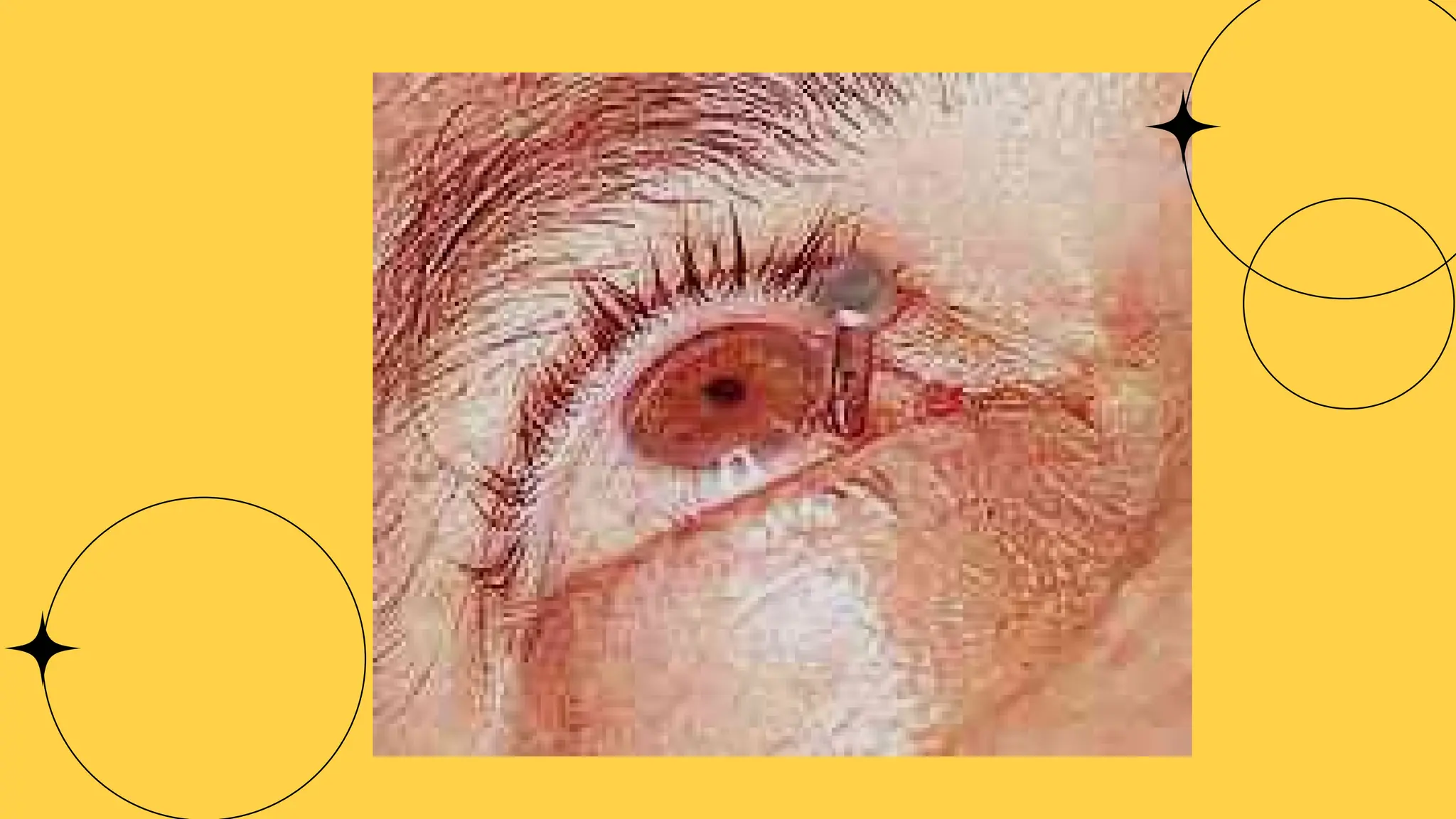
#51 Pneumatic nailer. Reached around board and nailed in his own direction. Nail went through the board and into his eye. Dr. Hsushi Yeh (Tacoma)