INDUSTRIAL SAFETY, HEALTH
AND ENVIRONMENTAL MANAGEMENT
EMM 5616
INCENTIVE PROGRAM
1. Incentive Programs in SHE
2. Effectiveness of the Program
3. Education and Training
4. Encouragement Campaign, Roles
and Contribution of Small Group
Activities
PRESENTATION OUTLINES
INCENTIVE PROGRAMMES
IN SHE
INTRODUCTION
Incentive Programs
 Employee motivational program designed to encourage
commitment to increasing productivity or in achieving some
worthwhile objective.
Safety Incentive Programs
 provides workers with rewards for achieving certain goals related to
the safety; reduction of workplace accidents, illnesses, and
hazards.
 It is arranged by organization as a part of the safety and health
management system .
Two types of safety programs found exist:
 Rate-based programs
 rewards workers for achieving low rates of reported injuries or
illnesses
 Behavior-based programs
 which rewards workers for certain behaviors, such as
recommending safety improvements
SAFETY INCENTIVE
PROGRAMS
Purpose Of Safety Incentive Programs for helping to
motivate and encourage employees to:
1. Practice safe job behavior.
2. Follow the safety rules and regulations at workplace.
3. Reduce accidents and injuries.
4. Attend company safety meetings.
5. Promote safety culture in the workplace
An effective safety incentive program includes the
following:
 A safety policy for employees, customers and visitors
 Standard operation procedure (SOP)
 Policies that well describe employee responsibilities for safety at
work
 A health, safety and environment committee and appointed safety
personnel
 Methods for appropriate corrective action
 Management’s support for the safety
 A performance appraisal system including safety performance
EFFECTIVENESS OF THE
PROGRAM
 The following strategies are recommended for enhancing the
effectiveness of incentive programs.
1. Define objectives
- what is supposed to be accomplished.
2. Develop specific criteria
- On what basis will the incentives be awarded?
EFFECTIVENESS OF THE
PROGRAM
3. Make rewards meaningful
- To determine what types of rewards will be meaningful, it is
necessary to involve employee
4. Recognize that only employees who will participate in
an incentive program know what incentives will motivate
them
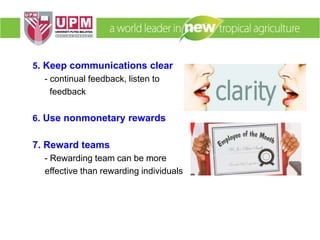
5. Keep communications clear
- continual feedback, listen to
feedback
6. Use nonmonetary rewards
7. Reward teams
- Rewarding team can be more
effective than rewarding individuals
 OSHA‘ concern is that safety incentives that are not properly
handled might encourage employee to cover up safety problems
rather than report them.
 Example : A minor accidents occurs but the individual involved does
not report it because of the peer pressure from his colleagues and
direct pressure from his supervisor to keep quiet.
OSHA’S STAND ON SAFETY
INCENTIVES
EDUCATION AND TRAINING
 NIOSH is committed to ensure a safe and healthy working
environment to all employees and others involved in or affected by its
operation taking into account statutory requirement and relevant
national and international standards and codes of practices.
 Implementation and effectiveness of this policy is a line management
responsibility together with the participation and involvement of all
employees and NIOSH will ensure that adequate resources, training
and time are made available.
NOISH
 OSH matter will be given equal priority with other major business
objectives.
 Safety and Health management systems and programs will be
regularly reviewed to ensure continuous improvement.
 Humanistic approach will be adopted by NIOSH to promote a safe and
healthy work culture which employer and employees share the
common responsibility of creating a better work environment for all.
1. Occupational Safety and Health Act 1994
 Objectives: At the end of the course, the participant will be able to:
i. Interpret the requirements of the Act
ii. Explain the duties and responsibilities as an employer, manufacturer,
designer or supplier and employee
iii. Describe the components of safety and health policy
iv. Describe the needs of Safety and Health Committee
 Target groups:
i. OSH Practitioners
ii. Production/ HR/Safety Managers
iii. Safety and Health Officers
iv. Safety and Health Committee Members
v. Supervisors
COURSE OFFER BY NIOSH
2. Compliance to Factories and Machinery Act 1967 and It’s
Regulations
 Objectives: At the end of the course, the participant will be able to:
i. Describe the history of FMA and OSHA, “Machinery”, their registration
and other legal requirements
ii. Describe the Safety, Health and Welfare Regulations 1970 and
Building Operations and Work of Engineering Construction (Safety)
Regulations, 1986
iii. Explain the new inspection fees, 2004 and the new penalties, 2007
iv. Explain the four regulations on health i.e. Lead 1984, Asbestos
Process 1986, Noise Exposure 1989 and Mineral Dust 1989
 Target groups:
i. Factory/Production/Human Resource/Safety and Health Manager
ii. Safety and Health Officers
iii. Safety and Health Committee Members
iv. Safety Supervisors or Union Representatives
3. Process Safety Management
 Objectives: At the end of the course, the participant will be able to:
i. Understand and explain the component of PSM;
ii. Link PSM to other management systems (eg: OSH MS, OHSAS,
QMS, HSE MS);
iii. Relate with OSHA 1994, FMA 1967 and CIMAH regulations;
 Target groups:
i. SHOs;
ii. OSH / HSE / Safety Managers;
iii. OSH / HSE / Safety Professionals;
iv. Potential CIMAH Competent Persons;
v. Process, Electrical & Instrumentation (E&I), Project, Control and
Process Safety Management Professionals;
vi. Operators involved in conducting process safety studies; and
vii. Other people who are interested in PSM.
 Objective is to have an effective and consistent learning on health
and safety, which will accelerate the behavior changing process for
teammates, contract workers and visitors towards being the safest
company not only in the sector but across all industries.
 Specifically it is also to:
 Enable authorized teammates to facilitate safety induction training
for new employees, contract workers and visitors.
 Have a centralized training venue, which will provide classroom and
visual learning experience to all.
 Enhance safety and health knowledge through visual observation
and practical experience.
SAFETY INDUCTION CENTRE
BY LAFARGE
TRAINING
WHAT IS TRAINING?
 Training means helping people to learn how to do something,
telling people what they should or should not do, or simply giving
them information. Training isn’t just about formal ‘classroom’
courses. OSHA can offer your company effective and cost efficient
program. OSHA also conducts employee training in high participant
format and consults on delivery modes and effective formats.
 Ensure that people who work for you know how to work safely and
without risks to health
 Develop a positive health and safety culture, where safe and
healthy working becomes second nature to everyone
 Meet your legal duty to protect the health and safety of your
employees.
WHY PROVIDE HEALTH AND
SAFETY TRAINING
 Will contribute towards making your employees competent in
health and safety.
 Can help your business avoid the distress that accidents and ill
health cause.
 Can help you avoid the financial costs of accidents and
occupational ill health, such as damaged products, lost production
and demotivated staff.
EFFECTIVE TRAINING
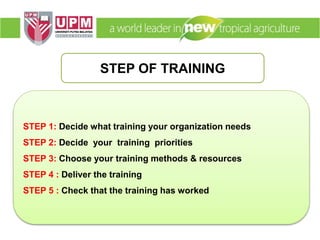
STEP 1: Decide what training your organization needs
STEP 2: Decide your training priorities
STEP 3: Choose your training methods & resources
STEP 4 : Deliver the training
STEP 5 : Check that the training has worked
STEP OF TRAINING
EMM 5704 Computer Applications in Manufacturing
Systems By: Dr. Faieza Abdul Aziz
ENCOURGEMENT
CAMPAIGN, ROLES AND
CONTRIBUTION
OF SMALL GROUP
ACTIVITIES
EMM 5704 Computer Applications in Manufacturing
Systems By: Dr. Faieza Abdul Aziz
To complete, to planned course of action formulated and to achieve
defined objectives in marketing, public relations, quality enhancement,
revenue generation and safety standards.
In safety, roles attempt to make workplace be a better, safer and
healthier place to work.
In term of safety, contribution is the lower occupational risk level and
accident rate. In the others word, contribution is the outcome of the
campaign.
DEFINITION OF CAMPAIGN
DEFINITION OF ROLES
DEFINITION OF
CONTRIBUTION
EMM 5704 Computer Applications in Manufacturing
Systems By: Dr. Faieza Abdul Aziz
In order to be an effective team, need to have several characteristic
which are supportive environment, team player skills, role clarity, clear
direction, team-oriented rewards and accountability.
 Supportive Environment
Open Communication
Constructive, non-hostile interaction
Mutually supportive approach to work
Positive, respectful climate
 Team Player Skills
Honesty
Selflessness
Initiative
Resourcefulness
Punctuality
Tolerance
CHARACTERISTIC OF
EFFECTIVE TEAM
EMM 5704 Computer Applications in Manufacturing
Systems By: Dr. Faieza Abdul Aziz
 Role Clarify
Each team member was played different roles.
All the team members understand their respective roles and play
those roles.
 Clear Direction
Team members should be understand the mission, objective and
accountability measure in team.
All the team members know how to do the work ; how supposed
to do; and what the team member’s responsibilities.
 Team-Oriented Rewards
The organization need to adopt team-oriented reward, incentives
and recognition strategies
 Accountability
Being held responsible for accomplishing specific objectives. To
be a effective team, each members know their responsibilities to
team.
EMM 5704 Computer Applications in Manufacturing
Systems By: Dr. Faieza Abdul Aziz
 Better understanding of safety rules and regulations
 Visibility for safety
 Greater employee awareness
 Positive, productive competition
 Continual improvement
 Broader employee input and acceptance
 It can take a integrated effort in long period in order to form an
effective group team.
 Conflict in decision making due to different opinion among group
member.
 Sleeping partner. Have a member poorly motivated and lazy, so
he/she will avoid to participate in any discussion.
POTENTIAL BENEFITS OF
TEAMWORK IN PROMOTING SAFETY
POTENTIAL PROBLEMS WITH TEAM
EMM 5704 Computer Applications in Manufacturing
Systems By: Dr. Faieza Abdul Aziz
 Participate in all the activities created by the group.
 Be punctual when attend any meeting or discussion.
 Honesty and open minded toward team members.
 Be a good listener to the team members.
RESPONSIBILITIES OF TEAM
MEMBERS
EMM 5704 Computer Applications in Manufacturing
Systems By: Dr. Faieza Abdul Aziz
 Example 1 : Promote Wellness in the Workplace
Campaign  Promote preventive care. Use the protection to avoid
infection diseases to others. Example during flu season.
Roles  Bring vaccination to the workplace to prevent the infection.
Contribution Reduce the number of staff MC, reduce cost of
medical on the workers and able to built up excellent environment in
workplace.
EXAMPLE OF ENCOURAGEMENT
CAMPAIGN, ROLES AND CONTRIBUTION
OF SMALL GROUP ACTIVITIES
EMM 5704 Computer Applications in Manufacturing
Systems By: Dr. Faieza Abdul Aziz
 Example 2 : Promote Wellness in the Workplace
Campaign  Be mindful of mental health.
Roles  Encourage employees to take simple steps to reduce
stress, like taking several breaks a day to go for a walk, chat with a
co-worker, or just get outside for a breath of fresh air.
Contribution  Improve the quality, efficiency, job satisfaction of
work and absence of worker; reduce the employees stress.
EMM 5704 Computer Applications in Manufacturing
Systems By: Dr. Faieza Abdul Aziz
 Example 3 : Promote Wellness in the Workplace
Campaign  5 Minutes Morning Exercise
Roles  Encourage employees to do a simple exercise before
start their work. Employee need to be in workplace 5 minutes before
work time.
Contribution  Increase the productivity and spirit of employees to
work.
So, the company must provide the prize to the winner of every
month. Winners must have the specific criteria such as lowest
number of MC and have a good work performance. So with this
awarded, employee will take seriously about the safety in their
workplace and will reduce the number of accident in work place.
EMM 5704 Computer Applications in Manufacturing
Systems By: Dr. Faieza Abdul Aziz
 As a result, promotion strategies relating to safety and health
have one overall goal; which is to gain and maintain the
commitment of all personnel to working safely. The two
approaches to persuasive communication are projective &
receptive communication.
 Safety training should be a fundamental part of any effort to
promote safety. Safety training ensures that employees know
how to work safely, and it shows that management is committed
to safety.
 Safety committees can help promote safety if they are properly
structured. The composition of the committee can be a major
factor in the committee’s success. The most effective
committees are composed of a broad cross-section of workers
representing all departments.
CONCLUSION
EMM 5704 Computer Applications in Manufacturing
Systems By: Dr. Faieza Abdul Aziz
THANK YOU
FOR ATTENTION

steady.pptx

  • 1.
    INDUSTRIAL SAFETY, HEALTH ANDENVIRONMENTAL MANAGEMENT EMM 5616 INCENTIVE PROGRAM
  • 2.
    1. Incentive Programsin SHE 2. Effectiveness of the Program 3. Education and Training 4. Encouragement Campaign, Roles and Contribution of Small Group Activities PRESENTATION OUTLINES
  • 3.
  • 4.
    INTRODUCTION Incentive Programs  Employeemotivational program designed to encourage commitment to increasing productivity or in achieving some worthwhile objective. Safety Incentive Programs  provides workers with rewards for achieving certain goals related to the safety; reduction of workplace accidents, illnesses, and hazards.  It is arranged by organization as a part of the safety and health management system .
  • 5.
    Two types ofsafety programs found exist:  Rate-based programs  rewards workers for achieving low rates of reported injuries or illnesses  Behavior-based programs  which rewards workers for certain behaviors, such as recommending safety improvements SAFETY INCENTIVE PROGRAMS
  • 6.
    Purpose Of SafetyIncentive Programs for helping to motivate and encourage employees to: 1. Practice safe job behavior. 2. Follow the safety rules and regulations at workplace. 3. Reduce accidents and injuries. 4. Attend company safety meetings. 5. Promote safety culture in the workplace
  • 7.
    An effective safetyincentive program includes the following:  A safety policy for employees, customers and visitors  Standard operation procedure (SOP)  Policies that well describe employee responsibilities for safety at work  A health, safety and environment committee and appointed safety personnel  Methods for appropriate corrective action  Management’s support for the safety  A performance appraisal system including safety performance
  • 8.
  • 9.
     The followingstrategies are recommended for enhancing the effectiveness of incentive programs. 1. Define objectives - what is supposed to be accomplished. 2. Develop specific criteria - On what basis will the incentives be awarded? EFFECTIVENESS OF THE PROGRAM
  • 10.
    3. Make rewardsmeaningful - To determine what types of rewards will be meaningful, it is necessary to involve employee 4. Recognize that only employees who will participate in an incentive program know what incentives will motivate them
  • 11.
    5. Keep communicationsclear - continual feedback, listen to feedback 6. Use nonmonetary rewards 7. Reward teams - Rewarding team can be more effective than rewarding individuals
  • 12.
     OSHA‘ concernis that safety incentives that are not properly handled might encourage employee to cover up safety problems rather than report them.  Example : A minor accidents occurs but the individual involved does not report it because of the peer pressure from his colleagues and direct pressure from his supervisor to keep quiet. OSHA’S STAND ON SAFETY INCENTIVES
  • 13.
  • 14.
     NIOSH iscommitted to ensure a safe and healthy working environment to all employees and others involved in or affected by its operation taking into account statutory requirement and relevant national and international standards and codes of practices.  Implementation and effectiveness of this policy is a line management responsibility together with the participation and involvement of all employees and NIOSH will ensure that adequate resources, training and time are made available. NOISH
  • 15.
     OSH matterwill be given equal priority with other major business objectives.  Safety and Health management systems and programs will be regularly reviewed to ensure continuous improvement.  Humanistic approach will be adopted by NIOSH to promote a safe and healthy work culture which employer and employees share the common responsibility of creating a better work environment for all.
  • 16.
    1. Occupational Safetyand Health Act 1994  Objectives: At the end of the course, the participant will be able to: i. Interpret the requirements of the Act ii. Explain the duties and responsibilities as an employer, manufacturer, designer or supplier and employee iii. Describe the components of safety and health policy iv. Describe the needs of Safety and Health Committee  Target groups: i. OSH Practitioners ii. Production/ HR/Safety Managers iii. Safety and Health Officers iv. Safety and Health Committee Members v. Supervisors COURSE OFFER BY NIOSH
  • 17.
    2. Compliance toFactories and Machinery Act 1967 and It’s Regulations  Objectives: At the end of the course, the participant will be able to: i. Describe the history of FMA and OSHA, “Machinery”, their registration and other legal requirements ii. Describe the Safety, Health and Welfare Regulations 1970 and Building Operations and Work of Engineering Construction (Safety) Regulations, 1986 iii. Explain the new inspection fees, 2004 and the new penalties, 2007 iv. Explain the four regulations on health i.e. Lead 1984, Asbestos Process 1986, Noise Exposure 1989 and Mineral Dust 1989  Target groups: i. Factory/Production/Human Resource/Safety and Health Manager ii. Safety and Health Officers iii. Safety and Health Committee Members iv. Safety Supervisors or Union Representatives
  • 18.
    3. Process SafetyManagement  Objectives: At the end of the course, the participant will be able to: i. Understand and explain the component of PSM; ii. Link PSM to other management systems (eg: OSH MS, OHSAS, QMS, HSE MS); iii. Relate with OSHA 1994, FMA 1967 and CIMAH regulations;  Target groups: i. SHOs; ii. OSH / HSE / Safety Managers; iii. OSH / HSE / Safety Professionals; iv. Potential CIMAH Competent Persons; v. Process, Electrical & Instrumentation (E&I), Project, Control and Process Safety Management Professionals; vi. Operators involved in conducting process safety studies; and vii. Other people who are interested in PSM.
  • 19.
     Objective isto have an effective and consistent learning on health and safety, which will accelerate the behavior changing process for teammates, contract workers and visitors towards being the safest company not only in the sector but across all industries.  Specifically it is also to:  Enable authorized teammates to facilitate safety induction training for new employees, contract workers and visitors.  Have a centralized training venue, which will provide classroom and visual learning experience to all.  Enhance safety and health knowledge through visual observation and practical experience. SAFETY INDUCTION CENTRE BY LAFARGE
  • 20.
    TRAINING WHAT IS TRAINING? Training means helping people to learn how to do something, telling people what they should or should not do, or simply giving them information. Training isn’t just about formal ‘classroom’ courses. OSHA can offer your company effective and cost efficient program. OSHA also conducts employee training in high participant format and consults on delivery modes and effective formats.
  • 21.
     Ensure thatpeople who work for you know how to work safely and without risks to health  Develop a positive health and safety culture, where safe and healthy working becomes second nature to everyone  Meet your legal duty to protect the health and safety of your employees. WHY PROVIDE HEALTH AND SAFETY TRAINING
  • 22.
     Will contributetowards making your employees competent in health and safety.  Can help your business avoid the distress that accidents and ill health cause.  Can help you avoid the financial costs of accidents and occupational ill health, such as damaged products, lost production and demotivated staff. EFFECTIVE TRAINING
  • 23.
    STEP 1: Decidewhat training your organization needs STEP 2: Decide your training priorities STEP 3: Choose your training methods & resources STEP 4 : Deliver the training STEP 5 : Check that the training has worked STEP OF TRAINING
  • 24.
    EMM 5704 ComputerApplications in Manufacturing Systems By: Dr. Faieza Abdul Aziz ENCOURGEMENT CAMPAIGN, ROLES AND CONTRIBUTION OF SMALL GROUP ACTIVITIES
  • 25.
    EMM 5704 ComputerApplications in Manufacturing Systems By: Dr. Faieza Abdul Aziz To complete, to planned course of action formulated and to achieve defined objectives in marketing, public relations, quality enhancement, revenue generation and safety standards. In safety, roles attempt to make workplace be a better, safer and healthier place to work. In term of safety, contribution is the lower occupational risk level and accident rate. In the others word, contribution is the outcome of the campaign. DEFINITION OF CAMPAIGN DEFINITION OF ROLES DEFINITION OF CONTRIBUTION
  • 26.
    EMM 5704 ComputerApplications in Manufacturing Systems By: Dr. Faieza Abdul Aziz In order to be an effective team, need to have several characteristic which are supportive environment, team player skills, role clarity, clear direction, team-oriented rewards and accountability.  Supportive Environment Open Communication Constructive, non-hostile interaction Mutually supportive approach to work Positive, respectful climate  Team Player Skills Honesty Selflessness Initiative Resourcefulness Punctuality Tolerance CHARACTERISTIC OF EFFECTIVE TEAM
  • 27.
    EMM 5704 ComputerApplications in Manufacturing Systems By: Dr. Faieza Abdul Aziz  Role Clarify Each team member was played different roles. All the team members understand their respective roles and play those roles.  Clear Direction Team members should be understand the mission, objective and accountability measure in team. All the team members know how to do the work ; how supposed to do; and what the team member’s responsibilities.  Team-Oriented Rewards The organization need to adopt team-oriented reward, incentives and recognition strategies  Accountability Being held responsible for accomplishing specific objectives. To be a effective team, each members know their responsibilities to team.
  • 28.
    EMM 5704 ComputerApplications in Manufacturing Systems By: Dr. Faieza Abdul Aziz  Better understanding of safety rules and regulations  Visibility for safety  Greater employee awareness  Positive, productive competition  Continual improvement  Broader employee input and acceptance  It can take a integrated effort in long period in order to form an effective group team.  Conflict in decision making due to different opinion among group member.  Sleeping partner. Have a member poorly motivated and lazy, so he/she will avoid to participate in any discussion. POTENTIAL BENEFITS OF TEAMWORK IN PROMOTING SAFETY POTENTIAL PROBLEMS WITH TEAM
  • 29.
    EMM 5704 ComputerApplications in Manufacturing Systems By: Dr. Faieza Abdul Aziz  Participate in all the activities created by the group.  Be punctual when attend any meeting or discussion.  Honesty and open minded toward team members.  Be a good listener to the team members. RESPONSIBILITIES OF TEAM MEMBERS
  • 30.
    EMM 5704 ComputerApplications in Manufacturing Systems By: Dr. Faieza Abdul Aziz  Example 1 : Promote Wellness in the Workplace Campaign  Promote preventive care. Use the protection to avoid infection diseases to others. Example during flu season. Roles  Bring vaccination to the workplace to prevent the infection. Contribution Reduce the number of staff MC, reduce cost of medical on the workers and able to built up excellent environment in workplace. EXAMPLE OF ENCOURAGEMENT CAMPAIGN, ROLES AND CONTRIBUTION OF SMALL GROUP ACTIVITIES
  • 31.
    EMM 5704 ComputerApplications in Manufacturing Systems By: Dr. Faieza Abdul Aziz  Example 2 : Promote Wellness in the Workplace Campaign  Be mindful of mental health. Roles  Encourage employees to take simple steps to reduce stress, like taking several breaks a day to go for a walk, chat with a co-worker, or just get outside for a breath of fresh air. Contribution  Improve the quality, efficiency, job satisfaction of work and absence of worker; reduce the employees stress.
  • 32.
    EMM 5704 ComputerApplications in Manufacturing Systems By: Dr. Faieza Abdul Aziz  Example 3 : Promote Wellness in the Workplace Campaign  5 Minutes Morning Exercise Roles  Encourage employees to do a simple exercise before start their work. Employee need to be in workplace 5 minutes before work time. Contribution  Increase the productivity and spirit of employees to work. So, the company must provide the prize to the winner of every month. Winners must have the specific criteria such as lowest number of MC and have a good work performance. So with this awarded, employee will take seriously about the safety in their workplace and will reduce the number of accident in work place.
  • 33.
    EMM 5704 ComputerApplications in Manufacturing Systems By: Dr. Faieza Abdul Aziz  As a result, promotion strategies relating to safety and health have one overall goal; which is to gain and maintain the commitment of all personnel to working safely. The two approaches to persuasive communication are projective & receptive communication.  Safety training should be a fundamental part of any effort to promote safety. Safety training ensures that employees know how to work safely, and it shows that management is committed to safety.  Safety committees can help promote safety if they are properly structured. The composition of the committee can be a major factor in the committee’s success. The most effective committees are composed of a broad cross-section of workers representing all departments. CONCLUSION
  • 34.
    EMM 5704 ComputerApplications in Manufacturing Systems By: Dr. Faieza Abdul Aziz THANK YOU FOR ATTENTION

Editor's Notes

  • #5 Read more: http://www.businessdictionary.com/definition/incentive-scheme.html#ixzz3IpSg4BKD http://www.safeopedia.com/definition/793/safety-incentive-program
  • #6 Read more: http://www.businessdictionary.com/definition/incentive-scheme.html#ixzz3IpSg4BKD http://www.safeopedia.com/definition/793/safety-incentive-program
  • #7 Read more: http://www.businessdictionary.com/definition/incentive-scheme.html#ixzz3IpSg4BKD http://www.safeopedia.com/definition/793/safety-incentive-program
  • #8 Read more: http://www.businessdictionary.com/definition/incentive-scheme.html#ixzz3IpSg4BKD http://www.safeopedia.com/definition/793/safety-incentive-program