New Employee
Orientation
Safety objectives and
goals
 An organization’s overall safety
program is guided by objectives
and goals
 Every employee plays a part in
helping to meet these goals
1a
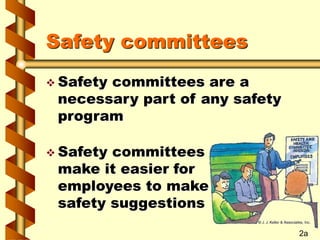
Safety committees
 Safety committees are a
necessary part of any safety
program
 Safety committees
make it easier for
employees to make
safety suggestions
2a
On-the-job injuries
 The first priority is to seek
medical attention
 Stay calm and get help
 Know how to respond in a safe
manner
3a
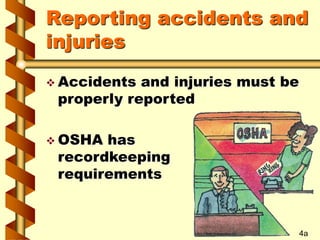
Reporting accidents and
injuries
 Accidents and injuries must be
properly reported
 OSHA has
recordkeeping
requirements
4a
Reporting accidents and
injuries
 Insurance claims must be filed
 Reporting near-miss
incidents can help
prevent future
occurrences
4b
What to do in case of
emergency
 Become familiar with
emergency action plans
 Be aware of procedures to
follow to protect yourself and
others
 Emergency drills are regularly
conducted
5a
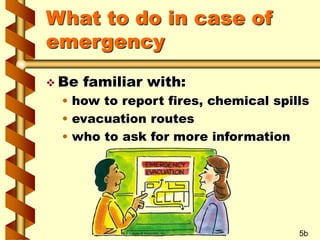
What to do in case of
emergency
 Be familiar with:
• how to report fires, chemical spills
• evacuation routes
• who to ask for more information
5b
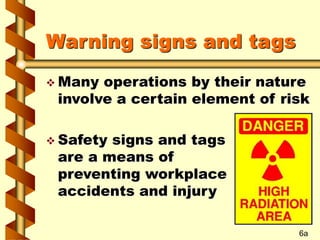
Warning signs and tags
 Many operations by their nature
involve a certain element of risk
 Safety signs and tags
are a means of
preventing workplace
accidents and injury
6a
Warning signs and tags
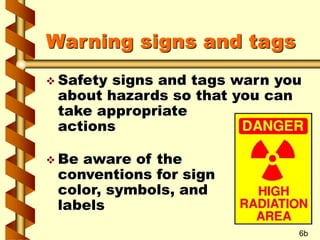
 Safety signs and tags warn you
about hazards so that you can
take appropriate
actions
 Be aware of the
conventions for sign
color, symbols, and
labels
6b
OSHA recordkeeping
requirements
 OSHA requires employers to
keep records of work-related
injuries and illnesses
7a
OSHA recordkeeping
requirements
 Recordkeeping helps OSHA:
• develop information regarding the
causes and prevention of injuries
and illnesses
• maintain a program of collection,
compilation, and analysis of
statistics
• enforce the OSH Act
7b
OSHA recordkeeping
requirements
 Employees have a right to
access relevant exposure and
medical records
 OSHA has a right to access
records
7c
Fire extinguishers
 The best fire protection is fire
prevention
 Fire results from
Heat + Fuel +
Oxygen
8a
Fire extinguishers
 Take away one of the
components from the “fire
triangle” to extinguish the fire
 Know how fires are classified,
how they spread, and when it’s
safe to use an extinguisher
8b
Hazard communication
 About 32 million workers are
potentially exposed to one or
more chemical hazards
 There are an estimated 575,000
existing chemical products
 Exposure poses a serious threat
to many workers
9a
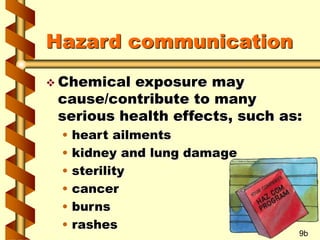
Hazard communication
 Chemical exposure may
cause/contribute to many
serious health effects, such as:
• heart ailments
• kidney and lung damage
• sterility
• cancer
• burns
• rashes
9b
Hazard communication
 Some chemicals are safety
hazards and have the potential
to cause
fires/explosions/serious
accidents
 Right-to-know law
was established to
inform employees of
hazards
9c
Hazard communication
 Hazard Communication
Standard 29 CFR 1910.1200
ensures that hazards are
evaluated and information is
given to employees
9d
Hazard communication
 Hazcom programs include:
• identification of chemical hazards
• chemical labeling
• material safety data sheets
(MSDSs)
9e
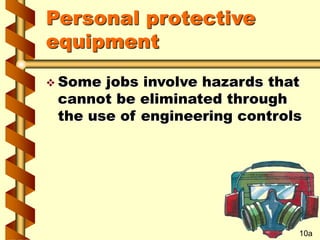
Personal protective
equipment
 Some jobs involve hazards that
cannot be eliminated through
the use of engineering controls
10a
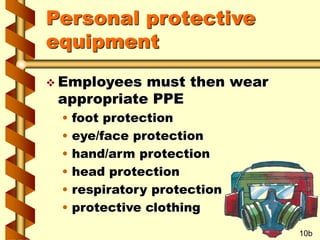
Personal protective
equipment
 Employees must then wear
appropriate PPE
• foot protection
• eye/face protection
• hand/arm protection
• head protection
• respiratory protection
• protective clothing
10b
Personal protective
equipment
 Employers must assess
workplace hazards and
determine if PPE is needed
 Employer selects appropriate
PPE
 PPE must fit properly
10c
Personal protective
equipment
 Employees must receive
training in:
• when PPE is necessary
• what PPE is necessary
• how to properly put on, take off,
adjust, wear PPE
• the limitations of PPE
• the proper care, maintenance,
useful life, disposal of PPE
10d
Bloodborne pathogens
 Know the threats posed by
bloodborne pathogens
 AIDS and Hepatitis
B can result from
exposure incidents
11a
Bloodborne pathogens
 Know which job duties expose
you to bloodborne pathogens
 Employees
rendering first aid,
performing
maintenance, and
housekeeping must
protect themselves
11b
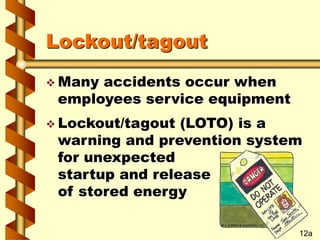
Lockout/tagout
 Many accidents occur when
employees service equipment
 Lockout/tagout (LOTO) is a
warning and prevention system
for unexpected
startup and release
of stored energy
12a
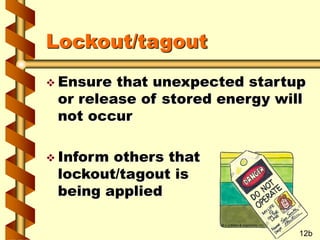
Lockout/tagout
 Ensure that unexpected startup
or release of stored energy will
not occur
 Inform others that
lockout/tagout is
being applied
12b
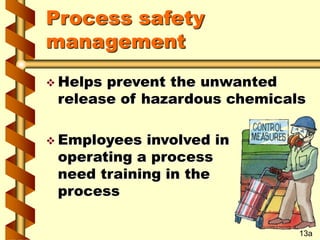
Process safety
management
 Helps prevent the unwanted
release of hazardous chemicals
 Employees involved in
operating a process
need training in the
process
13a
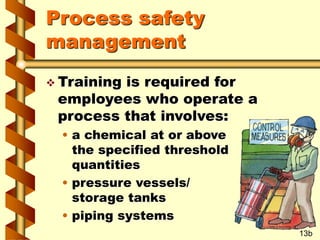
Process safety
management
 Training is required for
employees who operate a
process that involves:
• a chemical at or above
the specified threshold
quantities
• pressure vessels/
storage tanks
• piping systems
13b
Process safety
management
 Training is required for
employees who operate a
process that involves:
• relief and vent systems
• emergency shutdown
systems
• controls
• pumps
13c
Process safety
management
 Training emphasizes:
• specific safety/health hazards
• procedures
• emergency operations that include
shutdowns
• safe practices applicable to job
tasks
• significant changes in processes
13d
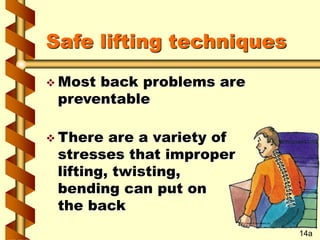
Safe lifting techniques
 Most back problems are
preventable
 There are a variety of
stresses that improper
lifting, twisting,
bending can put on
the back
14a
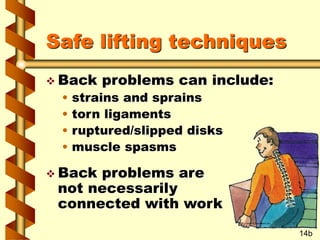
Safe lifting techniques
 Back problems can include:
• strains and sprains
• torn ligaments
• ruptured/slipped disks
• muscle spasms
 Back problems are
not necessarily
connected with work
14b
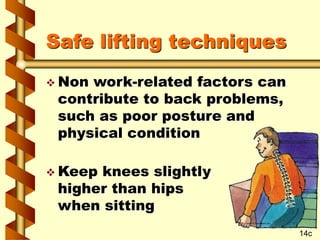
Safe lifting techniques
 Non work-related factors can
contribute to back problems,
such as poor posture and
physical condition
 Keep knees slightly
higher than hips
when sitting
14c
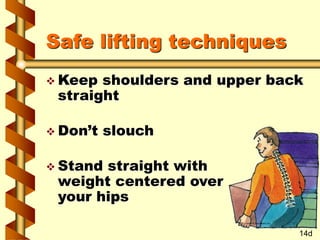
Safe lifting techniques
 Keep shoulders and upper back
straight
 Don’t slouch
 Stand straight with
weight centered over
your hips
14d
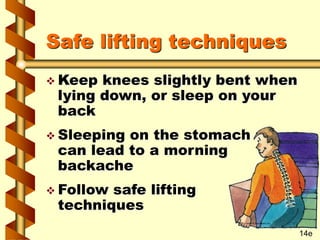
Safe lifting techniques
 Keep knees slightly bent when
lying down, or sleep on your
back
 Sleeping on the stomach
can lead to a morning
backache
 Follow safe lifting
techniques
14e
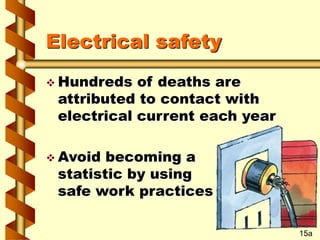
Electrical safety
 Hundreds of deaths are
attributed to contact with
electrical current each year
 Avoid becoming a
statistic by using
safe work practices
15a
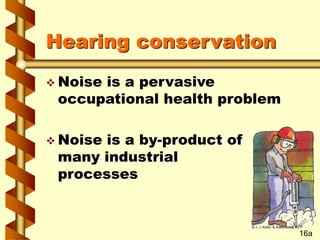
Hearing conservation
 Noise is a pervasive
occupational health problem
 Noise is a by-product of
many industrial
processes
16a
Hearing conservation
 How you are affected by noise
depends on:
• loudness and frequency
• length of exposure
• your age and health
16b
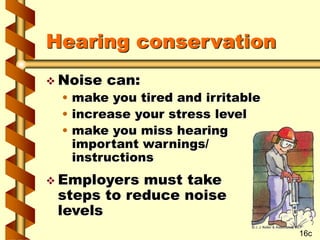
Hearing conservation
 Noise can:
• make you tired and irritable
• increase your stress level
• make you miss hearing
important warnings/
instructions
 Employers must take
steps to reduce noise
levels
16c
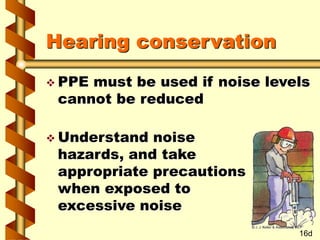
Hearing conservation
 PPE must be used if noise levels
cannot be reduced
 Understand noise
hazards, and take
appropriate precautions
when exposed to
excessive noise
16d

New_Employee_Orientation_.power_point_presentation

  • 1.
  • 2.
    Safety objectives and goals An organization’s overall safety program is guided by objectives and goals  Every employee plays a part in helping to meet these goals 1a
  • 3.
    Safety committees  Safetycommittees are a necessary part of any safety program  Safety committees make it easier for employees to make safety suggestions 2a
  • 4.
    On-the-job injuries  Thefirst priority is to seek medical attention  Stay calm and get help  Know how to respond in a safe manner 3a
  • 5.
    Reporting accidents and injuries Accidents and injuries must be properly reported  OSHA has recordkeeping requirements 4a
  • 6.
    Reporting accidents and injuries Insurance claims must be filed  Reporting near-miss incidents can help prevent future occurrences 4b
  • 7.
    What to doin case of emergency  Become familiar with emergency action plans  Be aware of procedures to follow to protect yourself and others  Emergency drills are regularly conducted 5a
  • 8.
    What to doin case of emergency  Be familiar with: • how to report fires, chemical spills • evacuation routes • who to ask for more information 5b
  • 9.
    Warning signs andtags  Many operations by their nature involve a certain element of risk  Safety signs and tags are a means of preventing workplace accidents and injury 6a
  • 10.
    Warning signs andtags  Safety signs and tags warn you about hazards so that you can take appropriate actions  Be aware of the conventions for sign color, symbols, and labels 6b
  • 11.
    OSHA recordkeeping requirements  OSHArequires employers to keep records of work-related injuries and illnesses 7a
  • 12.
    OSHA recordkeeping requirements  Recordkeepinghelps OSHA: • develop information regarding the causes and prevention of injuries and illnesses • maintain a program of collection, compilation, and analysis of statistics • enforce the OSH Act 7b
  • 13.
    OSHA recordkeeping requirements  Employeeshave a right to access relevant exposure and medical records  OSHA has a right to access records 7c
  • 14.
    Fire extinguishers  Thebest fire protection is fire prevention  Fire results from Heat + Fuel + Oxygen 8a
  • 15.
    Fire extinguishers  Takeaway one of the components from the “fire triangle” to extinguish the fire  Know how fires are classified, how they spread, and when it’s safe to use an extinguisher 8b
  • 16.
    Hazard communication  About32 million workers are potentially exposed to one or more chemical hazards  There are an estimated 575,000 existing chemical products  Exposure poses a serious threat to many workers 9a
  • 17.
    Hazard communication  Chemicalexposure may cause/contribute to many serious health effects, such as: • heart ailments • kidney and lung damage • sterility • cancer • burns • rashes 9b
  • 18.
    Hazard communication  Somechemicals are safety hazards and have the potential to cause fires/explosions/serious accidents  Right-to-know law was established to inform employees of hazards 9c
  • 19.
    Hazard communication  HazardCommunication Standard 29 CFR 1910.1200 ensures that hazards are evaluated and information is given to employees 9d
  • 20.
    Hazard communication  Hazcomprograms include: • identification of chemical hazards • chemical labeling • material safety data sheets (MSDSs) 9e
  • 21.
    Personal protective equipment  Somejobs involve hazards that cannot be eliminated through the use of engineering controls 10a
  • 22.
    Personal protective equipment  Employeesmust then wear appropriate PPE • foot protection • eye/face protection • hand/arm protection • head protection • respiratory protection • protective clothing 10b
  • 23.
    Personal protective equipment  Employersmust assess workplace hazards and determine if PPE is needed  Employer selects appropriate PPE  PPE must fit properly 10c
  • 24.
    Personal protective equipment  Employeesmust receive training in: • when PPE is necessary • what PPE is necessary • how to properly put on, take off, adjust, wear PPE • the limitations of PPE • the proper care, maintenance, useful life, disposal of PPE 10d
  • 25.
    Bloodborne pathogens  Knowthe threats posed by bloodborne pathogens  AIDS and Hepatitis B can result from exposure incidents 11a
  • 26.
    Bloodborne pathogens  Knowwhich job duties expose you to bloodborne pathogens  Employees rendering first aid, performing maintenance, and housekeeping must protect themselves 11b
  • 27.
    Lockout/tagout  Many accidentsoccur when employees service equipment  Lockout/tagout (LOTO) is a warning and prevention system for unexpected startup and release of stored energy 12a
  • 28.
    Lockout/tagout  Ensure thatunexpected startup or release of stored energy will not occur  Inform others that lockout/tagout is being applied 12b
  • 29.
    Process safety management  Helpsprevent the unwanted release of hazardous chemicals  Employees involved in operating a process need training in the process 13a
  • 30.
    Process safety management  Trainingis required for employees who operate a process that involves: • a chemical at or above the specified threshold quantities • pressure vessels/ storage tanks • piping systems 13b
  • 31.
    Process safety management  Trainingis required for employees who operate a process that involves: • relief and vent systems • emergency shutdown systems • controls • pumps 13c
  • 32.
    Process safety management  Trainingemphasizes: • specific safety/health hazards • procedures • emergency operations that include shutdowns • safe practices applicable to job tasks • significant changes in processes 13d
  • 33.
    Safe lifting techniques Most back problems are preventable  There are a variety of stresses that improper lifting, twisting, bending can put on the back 14a
  • 34.
    Safe lifting techniques Back problems can include: • strains and sprains • torn ligaments • ruptured/slipped disks • muscle spasms  Back problems are not necessarily connected with work 14b
  • 35.
    Safe lifting techniques Non work-related factors can contribute to back problems, such as poor posture and physical condition  Keep knees slightly higher than hips when sitting 14c
  • 36.
    Safe lifting techniques Keep shoulders and upper back straight  Don’t slouch  Stand straight with weight centered over your hips 14d
  • 37.
    Safe lifting techniques Keep knees slightly bent when lying down, or sleep on your back  Sleeping on the stomach can lead to a morning backache  Follow safe lifting techniques 14e
  • 38.
    Electrical safety  Hundredsof deaths are attributed to contact with electrical current each year  Avoid becoming a statistic by using safe work practices 15a
  • 39.
    Hearing conservation  Noiseis a pervasive occupational health problem  Noise is a by-product of many industrial processes 16a
  • 40.
    Hearing conservation  Howyou are affected by noise depends on: • loudness and frequency • length of exposure • your age and health 16b
  • 41.
    Hearing conservation  Noisecan: • make you tired and irritable • increase your stress level • make you miss hearing important warnings/ instructions  Employers must take steps to reduce noise levels 16c
  • 42.
    Hearing conservation  PPEmust be used if noise levels cannot be reduced  Understand noise hazards, and take appropriate precautions when exposed to excessive noise 16d