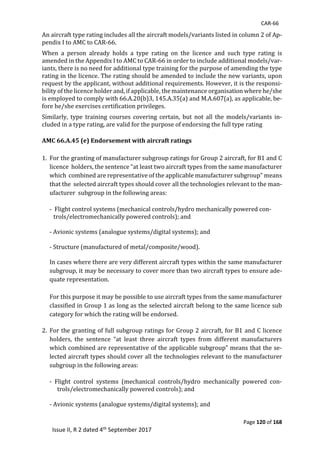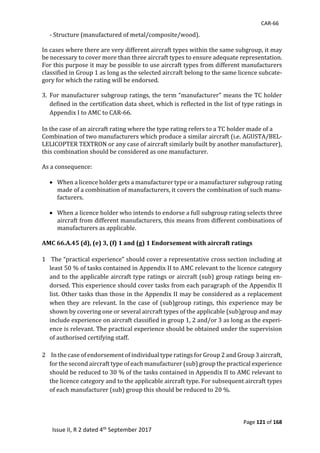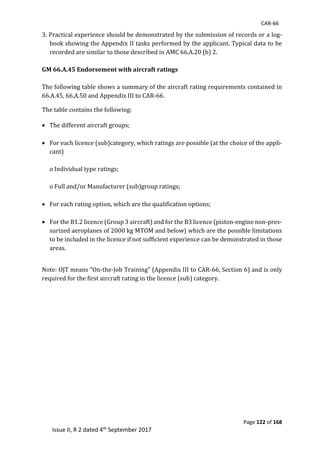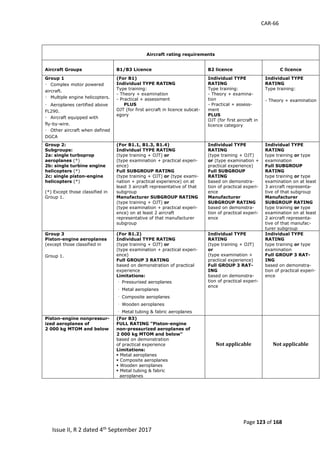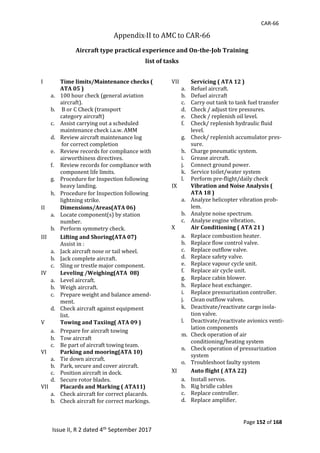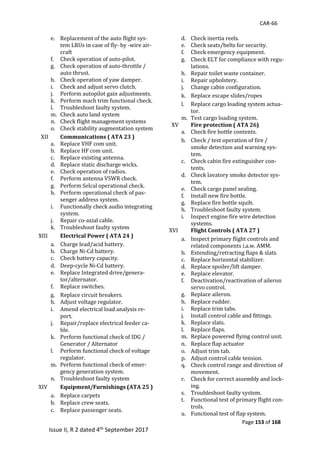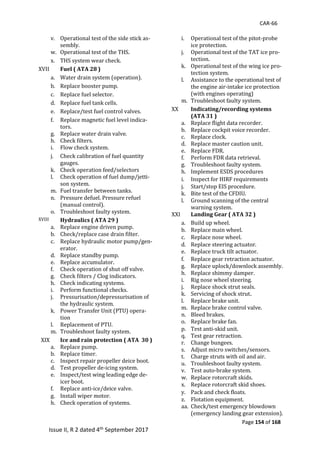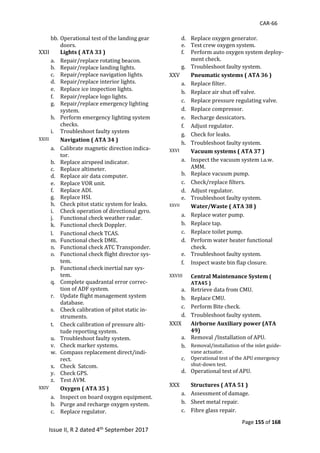
CAR-66
Page 1 of 168
Issue II, R 2 dated 4th September 2017
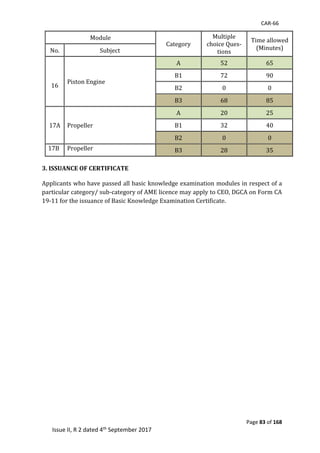
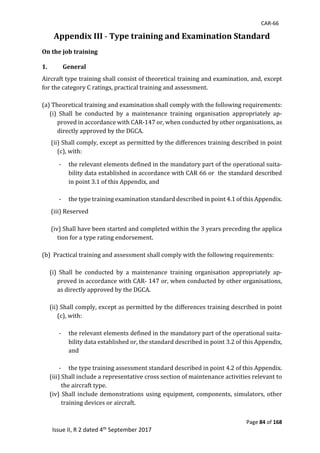
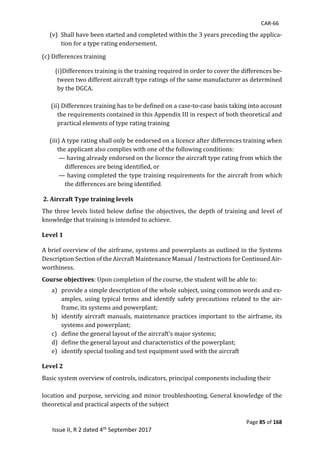
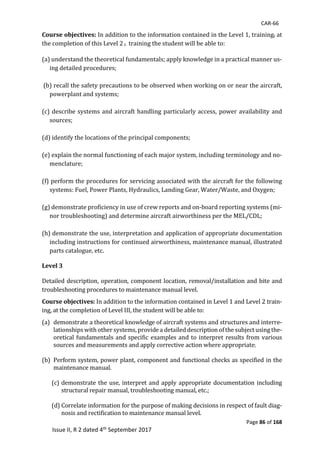
CAR – 66 ISSUE II R 2
LICENSING OF AIRCRAFT
MAINTENANCE ENGINEERS
DIRECTORATE GENERAL OF CIVIL AVIATION
TECHNICAL	CENTRE,	OPP	SAFDURJUNG	AIRPORT,	NEW	DELHI
CAR-66
Page 2 of 168
Issue II, R 2 dated 4th September 2017
Salient	Features	of	the	CAR-66	
The	CAR-66	
 has	been	drafted	in	line	with	the	current	Rule	61	and	to	harmonise	the		aircraft	
maintenance	personnel	licensing	system	with	EASA	Part	66	(	General).	
 details,	requirements	for	qualifying	an	individual	to	obtain	an	Aircraft	Maintenance	
Engineer’s	Licence	and	extension	of	such	licence	[CAR-66]	
 eliminates	the	system	of	obtaining	Airframe,	Engine,	Electrical,	Instrument	and	Ra-
dio	System	Licences	separately	[66.A.03]	
 redefines	 the	 syllabus	 for	 basic	 knowledge	 examination	 in	 modular	 pattern	
[66.A.25]	
 provides	for	endorsement	of	an	AME	licence	after	successful	completion	of	type	
training	and	the	type	training	examination/type	examination	which	shall	consist	of	
both	theoretical	and	practical	examinations	[66.A.45	(c)]	
 lists	the	details	of	practical	tasks	to	qualify	an	individual	to	obtain	a	type	rating	[Ap-
pendix	II	to	AMC]	
 provides	 for	 acquiring	 group	 type	 rating	 of	 aircraft	 and	 certification	 privileges	
[66.A.45	(a)]	
 has	a	provision	to	convert	the	existing	AME	licence		to	CAR	66	licence	[66.A.70]	with	
or	without	limitation.
CAR-66
Page 3 of 168
Issue II, R 2 dated 4th September 2017
GENERAL	
In	order	to	harmonize	Indian	requirements	for	licensing	of	aircraft	maintenance	engi-
neers	with	international	requirements;	CAR-66	Rev.0	dated	11th	November	2011,	was	
introduced.		
This	CAR	is	issued	on	the	basis	of	amended	Rule	61(6th amendment)	of	the	Aircraft	
Rules,	1937	as	notified	vide	GSR	1001(E)	dated	22ndDecember	2010.	
	
This	CAR	is	effective	from	01.01.2012.	However		the	existing	requirements	of	CAR	Section	
-2	Series	L	will	also	continue	till	the	date	notified	by	the	Director	General	for	facilitating	
smooth	transition	of	aircraft	maintenance	engineer	licensing	system	into	CAR	66	pattern.	
	
The	CAR-66	is	applicable	to	all	personnel	/	Organizations	engaged	in	maintenance	and	
/or	certification	of	aircraft	registered	in	India.		
	
The	Section	A	of	CAR-66	establishes	the	requirements	for	the	issue	and	extension	of	an	
aircraft	maintenance	engineer’s	license,	conditions	of	its	validity	and	use.	It	also	has	a	
provision	for	converting	the	aircraft	maintenance	engineer’s	(AME)	license	issued	prior	
to	the	CAR-66	coming	into	force.	The	requirements	are	followed	by	Acceptable	means	of	
compliance	(AMC)	and	Guidance	Material	(GM)	
The	AME	licenses	in	CAR	66	pattern	will	be	available	in	two	different	ways:	
a)	After	conversion	of	existing	AME	licenses	with	applicable	limitation.	
b)	Issue	of	fresh	license	after	passing	of	applicable	modules	of	Basic	Knowledge	Exam	to	
be	conducted	by	CEO.
CAR-66
Page 4 of 168
Issue II, R 2 dated 4th September 2017
Record of Revisions
	Initial Issue (Revision 0) 11th November 2011
	
This	CAR	66	provides	requirements	for	the	issue	of	an	aircraft	maintenance	engineer’s	
licence	and	conditions	of	its	validity	and	use	for	aeroplanes	and	helicopters.	
	
Revision 1, 23rd April 2015
	
The	Revision-01	to	CAR	66	was	issued	to	revise	conversion	of	licences	issued	prior	to	
CAR-66	and	examination	credits.	The	revision	also	revises	the	License	format.	
	
CAR 66 Issue II																																																											
	
The	CAR	66	Issue	II	is	being	issued	to	amend	the	training,	examination,	knowledge	and	
experience	requirements	for	the	issuance	of	aircraft	maintenance	licences		
	
Salient	features	of	the	CAR	66	Issue	II	are:	
	
1.	The	training,	examination,	knowledge	and	experience	requirements	for	the	issuance	of	
aircraft	maintenance	licences	and	to	adapt	these	requirements	to	the	complexity	of	
the	different	categories	of	aircraft	amended		
2.	The	AMCs	and	GMs	related	to	a	point	have	been	brought	together	for	easy	reference	
purposes.	
	
3.		Provision	for	aircraft	grouping	added	(66.A.5)	
	
4.	 Requirements	 for	 completing	 all	 the	 module	 for	 basic	 knowledge	 within	 10	 year	
(66.A.25	(b))	added	
	
5.		Heading	of	(66.A.45)	is	changed	from	type	/task	training	to	Endorsement	with	aircraft	
rating.	Related	AMC	and	GM	amended.	
	
6.		Point	66.	A.	50	and	related	AMC	added	to	make	a	provision	for	introducing	or	removal	
of	limitation	from	the	license	
	
7.		Existing	AMCs	and	GMs	are	suitable	amended.	
		
8. 	Appendix	 -1-	Basic	 knowledge	 requirements	 	amended	to	 	revise	 the	 syllabus	for	
knowledge	examination	
	
9.		Appendix	-2	-Basic	examination	standard	have	been	revised		
	
10. 	Appendix-3-	Type		examination	standard	have	been	amended,		minimum	standard	
and	duration	for	type	training,	course	curriculum	have	been	introduced,						practical	
elements	requirements	to	be	covered	during	type	training	added,	type	training	exam-
inations	and		assessment	standard	have	been	revised,	relevant	AMC		and	GM	have	been	
also	amended/added
CAR-66
Page 5 of 168
Issue II, R 2 dated 4th September 2017
11.			Appendix-III	to	AMC	of	CAR	66	for	competency	assessment	of	assessors	added.	
	
12.		Procedures	for	CAR	-66	(Section	–B)	is	removed	from	this	CAR	and	shall	be	part	of				
Airworthiness	Procedures	Manual	(Chapter-	17)		
	
CAR Issue II Revision 1
	
The	Revision-01	to	CAR	66	Issue	II	is	proposed	to	be	issued	to	incorporate	amendments	
made	in	Rule	61	of	the	Aircraft	Rules,	1937	published	vide	GSR	911	(E)	dated	16-9-2016.	
Salient	revision	in	the	CAR	as	follows:-		
1. CAR	66.A.3	In	the	existing	AME	licence	category,	category	B3	is	introduced	for	cer-
tifying	unpressurised	piston	engine	aircraft	below	2000kgs	MTOW.		
2. Provision	has	been	made	for	issue	of	Category		A	licence	without		type	rating		
3. 66.	A.	20	privileges	of	AME	licence	has	been	replaced	with	new	one	in	line	with	rule	
61.	
4. 66.A.30	Aircraft	Maintenance	Experience	requirements	of	issue	of	Category	A,	B1.2	
and	B	1.4	has	been	revised	to	3	years.			
5. Related	paragraph	in	this	CAR	revised	to	include	new	category	B3	where	ever	re-
quired.	
6. 		66.A.45	endorsement	on	AME	licence	for	aircraft	ratings	has	been	revised	suitably				
			to	include	category	B3	requirement.	
7. Appendix	–I	Basic	knowledge	requirement	has	been	revised	to	include	syllabus	for	
category			B3.		
8. Requirements	for	certifying	staff	engaged	in	certification	of	aircraft	components	are	
detailed	in	Subpart	C	(Component).		
9. Application	and	format	are	separated	from	the	main	CAR	and	published	in	the	form	
section	on	DGCA	website.				
	
CAR Issue II Revision 2
The	salient	features	of	this	revision	are	as	follows:	
1. 66.A.35	amended	to	replace	skill	test	requirement	with	demonstration	of	skill.	
2. 66.A.215	(b)	amended	to	include	AME	Course.	
3. Appendix	–II	(Basic	Examination	Standard)	para	1.5	amended	to	make	provision	for	
appearing	in	failed	module	related	to	limitation	papers	from	90	days	to	30	days.	
4. GM	66.A.35	(Skill	Test	Requirements)	–	Deleted.	
5. Appendix-I	(Appendices	to	AMC	for	CAR	66)	amended	to	add	a	note	on	Type	rating	
endorsement	covering	several	models/	variant.	Group	1	Helicopter	Table	amended	
in	line	with	EASA	guidelines.
CAR-66
Page 6 of 168
Issue II, R 2 dated 4th September 2017
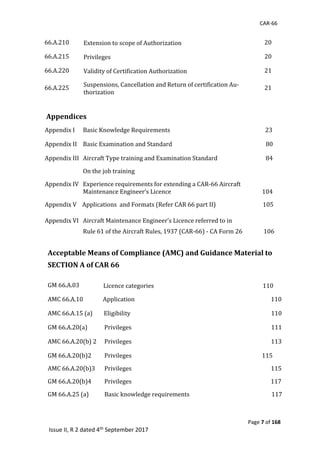
CONTENTS
Paragraph	 Description	 			Page	No	
General																																																																																																																													3
Record	of	Revisions	 												4	
SECTION A
TECHNICAL REQUIREMENTS	
SUBPART A AIRCRAFT MAINTENANCE ENGINEER’S LICENCE AEROPLANES AND HEL-
COPTERS
66.A.01		
66.A.03	
66.A.05
Scope		
Licence	Categories		
Aircraft	Groups	
															10	
															10	
															10	
66.A.10	 Application	 															11	
66.A.15	 Eligibility	 															11	
66.A.20	 Privileges	 															11	
66.A.25	 Basic	knowledge	requirements	 															13	
66.A.30 Basic	Experience	Requirements 															13	
66.A.35		 Demonstration	of	Skill	 															14	
66.A.40	 Continued	validity	of	the	aircraft	maintenance	engineer’s	
licence	
															14	
66.A.45	
66.A.50		
Endorsement	with	Aircraft	ratings		
Limitations		
															15	
															17		
66.A.55	 Evidence	of	qualification	 															17	
66.A.70	 Conversion	provisions	 															17	
Subpart-B Aircraft other than Aeroplane and helicopters 											
66.A.100	 General	 															18	
Subpart-C	 Components 	
66.A.200	 General	 															19	
66.A.205	 Requirements	 															19
CAR-66
Page 7 of 168
Issue II, R 2 dated 4th September 2017
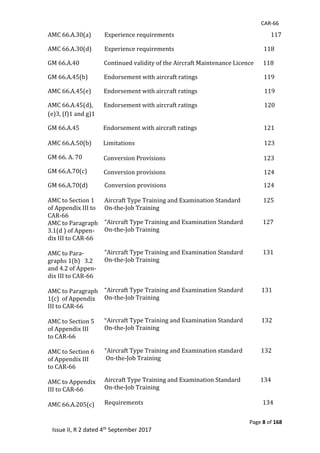
66.A.210	 Extension	to	scope	of	Authorization													 														20	
66.A.215	 Privileges	 														20	
66.A.220	 Validity	of	Certification	Authorization	 														21	
66.A.225	
Suspensions,	Cancellation	and	Return	of	certification	Au-
thorization	
														21	
Appendices	
Appendix	I						Basic	Knowledge	Requirements																																																																			23	
Appendix	II					Basic	Examination	and	Standard																																																																		80	
Appendix	III			Aircraft	Type	training	and	Examination	Standard																																		84	
On	the	job	training																																																																											
Appendix	IV	 Experience	requirements	for	extending	a	CAR-66	Aircraft												
Maintenance	Engineer’s	Licence																																																																104	
Appendix	V				Applications		and	Formats	(Refer	CAR	66	part	II)																																	105																									
Appendix	VI	 Aircraft	Maintenance	Engineer’s	Licence	referred	to	in		
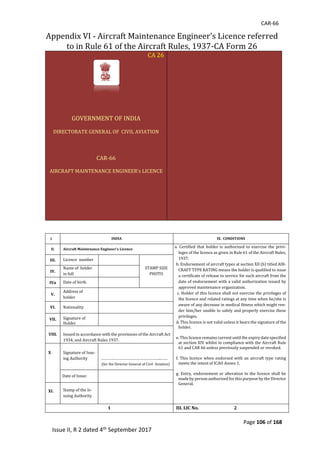
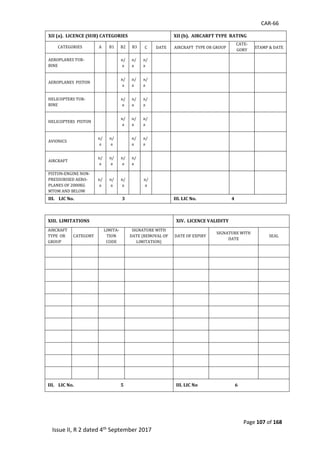
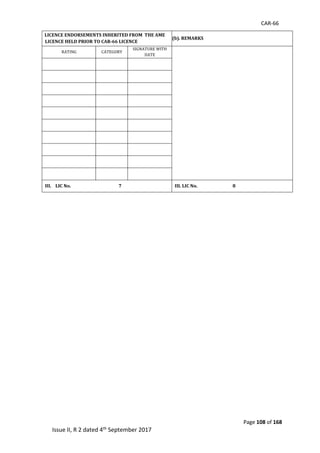
Rule	61	of	the	Aircraft	Rules,	1937	(CAR-66)	-	CA	Form	26															106	
	
Acceptable Means of Compliance (AMC) and Guidance Material to
SECTION A of CAR 66
GM	66.A.03																		Licence	categories 	110	
AMC	66.A.10														Application		 																																																																																									110	
AMC	66.A.15	(a)								Eligibility																																																																																																			110	
GM	66.A.20(a) Privileges 																																																																																													111												
AMC	66.A.20(b)	2 Privileges	 																113
GM	66.A.20(b)2 	 Privileges 115
AMC	66.A.20(b)3	
GM	66.A.20(b)4								
GM	66.A.25	(a)	
Privileges	 115	
Privileges																																																																																																		117	
Basic	knowledge	requirements						 																117
CAR-66
Page 8 of 168
Issue II, R 2 dated 4th September 2017
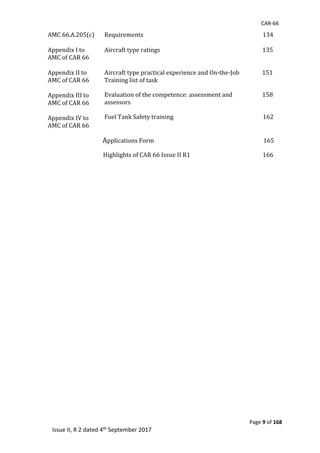
AMC	66.A.30(a) Experience	requirements																																																																				117
AMC	66.A.30(d) Experience	requirements																																																															118																																	
GM	66.A.40							 Continued	validity	of	the	Aircraft	Maintenance	Licence 118
GM	66.A.45(b)	 Endorsement	with	aircraft	ratings 119	
AMC	66.A.45(e)	
AMC	66.A.45(d),	
(e)3,	(f)1	and	g)1	
GM	66.A.45																	
AMC	66.A.50(b)	
GM	66.	A.	70														
GM	66.A.70(c)
Endorsement	with	aircraft	ratings																																															119	
Endorsement	with	aircraft	ratings																																															120																																
		
	Endorsement	with	aircraft	ratings																																															121	
	Limitations																																																																																											123
Conversion	Provisions																																																																					123	
Conversion	provisions 124
GM	66.A.70(d)		
		
AMC	to	Section	1	
of	Appendix	III	to			
CAR-66				
AMC	to	Paragraph	
3.1(d	)	of	Appen-
dix	III	to	CAR-66						
	
AMC	to	Para-
graphs	1(b)			3.2	
and	4.2	of	Appen-
dix	III	to	CAR-66		
						
AMC	to	Paragraph	
1(c)		of	Appendix	
III	to	CAR-66						
	
AMC	to	Section	5	
of	Appendix	III	
to	CAR-66	
	
AMC	to	Section	6	
of	Appendix	III												
to	CAR-66	
	
AMC	to	Appendix	
III	to	CAR-66	
	
AMC	66.A.205(c)						
	
Conversion	provisions 124
	
Aircraft	Type	Training	and	Examination	Standard																125	
On-the-Job	Training	
“Aircraft	Type	Training	and	Examination	Standard														127	
On-the-Job	Training	
	
	
“Aircraft	Type	Training	and	Examination	Standard														131	
On-the-Job	Training	


“Aircraft	Type	Training	and	Examination	Standard													131	
On-the-Job	Training	
	
	
“Aircraft	Type	Training	and	Examination	Standard													132	
On-the-Job	Training	
	
	
“Aircraft	Type	Training	and	Examination	standard													132	
	On-the-Job	Training	
	
Aircraft	Type	Training	and	Examination	Standard														134	
On-the-Job	Training	
	
Requirements																																																																																				134
CAR-66
Page 9 of 168
Issue II, R 2 dated 4th September 2017
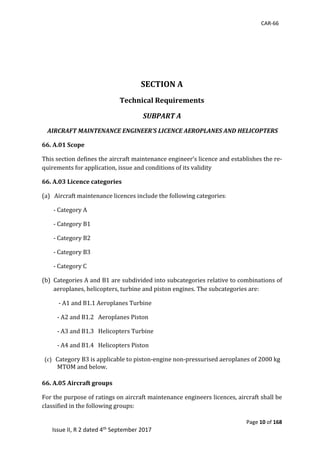
AMC	66.A.205(c)						
	
Appendix	I	to	
AMC	of	CAR	66	
	
Appendix	II	to	
AMC	of	CAR	66	
Requirements																																																																																				134	
	
Aircraft	type	ratings																																																																								135
Aircraft	type	practical	experience	and	On-the-Job																151	
Training	list	of	task	
	
Appendix	III	to	
AMC	of	CAR	66	
Evaluation	of	the	competence:	assessment	and																					158	
assessors							
	
Appendix	IV	to	
AMC	of	CAR	66	
Fuel	Tank	Safety	training																																																															162																																	
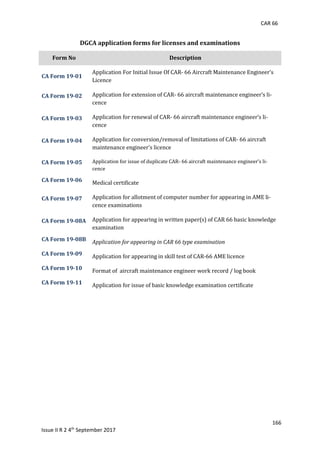
																																	Applications	Form																																																																													165	
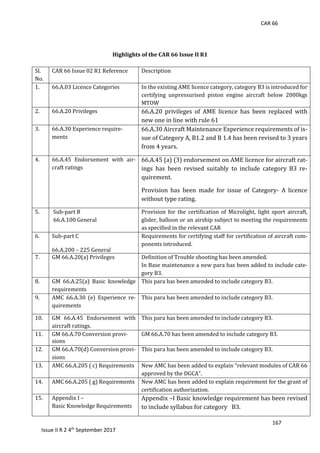
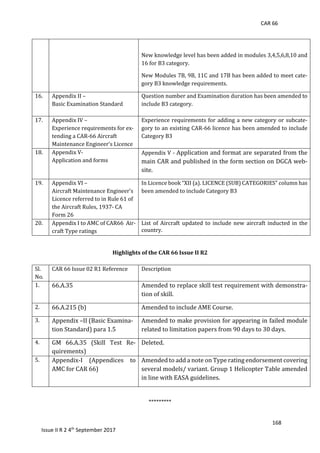
																																							Highlights	of	CAR	66	Issue	II	R1																																																			166
CAR-66
Page 10 of 168
Issue II, R 2 dated 4th September 2017
	 	
SECTION A
Technical Requirements
SUBPART A
AIRCRAFT MAINTENANCE ENGINEER’S LICENCE AEROPLANES AND HELICOPTERS
66. A.01 Scope
This	section	defines	the	aircraft	maintenance	engineer’s	licence	and	establishes	the	re-
quirements	for	application,	issue	and	conditions	of	its	validity	
66. A.03 Licence categories
(a)			Aircraft	maintenance	licences	include	the	following	categories:
-	Category	A	
-	Category	B1	
-	Category	B2	
-	Category	B3	
-	Category	C	
(b) Categories	A	and	B1	are	subdivided	into	subcategories	relative	to	combinations	of	
aeroplanes,	helicopters,	turbine	and	piston	engines.	The	subcategories	are:	
	-	A1	and	B1.1	Aeroplanes	Turbine	
-	A2	and	B1.2			Aeroplanes	Piston	
-	A3	and	B1.3			Helicopters	Turbine	 	
-	A4	and	B1.4			Helicopters	Piston	
		(c)			Category	B3	is	applicable	to	piston-engine	non-pressurised	aeroplanes	of	2000	kg	
MTOM	and	below.	
66. A.05 Aircraft groups
For	the	purpose	of	ratings	on	aircraft	maintenance	engineers	licences,	aircraft	shall	be	
classified	in	the	following	groups:
CAR-66
Page 11 of 168
Issue II, R 2 dated 4th September 2017
	
1.	Group	1:	complex	motor-powered	aircraft	as	well	as	multiple	engine	helicopters,	aer-
oplanes	 with	 maximum	 certified	 operating	 altitude	 exceeding	 FL290,	 aircraft	
equipped	with	fly-by-wire	systems	and	other	aircraft	requiring	an	aircraft	type	rating	
when	defined	so	by	the		DGCA	
2.	Group	2:	aircraft	other	than	those	in	Group	1	belonging	to	the	following	subgroups:	
	—	sub-group	2a:	single	turbo-propeller	engine	aeroplanes		
—	sub-group	2b:	single	turbine	engine	helicopters	
	—	sub-group	2c:	single	piston	engine	helicopters.	
3.	Group	3:	piston	engine	aeroplanes	other	than	those	in	Group	1.
66. A.10. Application		
a)	An	application	for	an	aircraft	maintenance	engineer’s	licence	or	change	to	such	li-
cence	shall	be	made	on	CA	Form	19-01/02	(Refer	Appendix-V)	with	necessary	docu-
ments	and	fees	to	DGCA.		
b)	Reserved.		
c)	In	addition	to	the	documents	required	in	points	66.A.10	(a)	as	appropriate,	the	appli-
cant	for	additional	categories	or	sub-categories	to	an	aircraft	maintenance	engineer’s		
licence	shall	submit	his/her	current	original	aircraft	maintenance	engineer’s	licence	
to	the	DGCA	together	with	CA	Form	19-02.
d)		Reserved
e)			Reserved
(f)	Each	application	shall	be	supported	by	documentation	to	demonstrate	compliance	
with	the	applicable	theoretical	knowledge,	practical	training	and	experience	require-
ments	at	the	time	of	application.	
66. A.15.Eligibility		
	
a)	 The	 applicant	 must	 have	 passed	 10+2	 examination	 in	 Physics,	 Chemistry	 and																					
Mathematics	from	a	recognized	board	or	university	or	its	equivalent	
b)		An	applicant	for	an	aircraft	maintenance	engineer’s	licence	shall	be	at	least	18	years	
of	age.	
66. A.20 Privileges		
a)	Subject	to	the	compliance	with	paragraph	(b),	the	following	privileges	shall	apply:		
1.	 	Category	A	licence	holder	to	issue	certificates	for	release	to	service	after	minor	
scheduled	line	 maintenance	and	simple	 defect	 rectification	 within	 the	 limits	 of
CAR-66
Page 12 of 168
Issue II, R 2 dated 4th September 2017
maintenance	tasks	specifically	endorsed	on	the	authorisation	issued	by	a	mainte-
nance	organisation	approved	under	rule	133B	for	the	broad	category	of	aircraft	
endorsed	on	the	licence	and	the	certification	privileges	shall	be	restricted	to	the	
work	carried	out	by	the	licence	holder	himself	in	the	maintenance	organization	
that	issues	the	authorisation.	
2. Category	B1	licence	holder	to	issue	certificates	for	release	to	service	and	act	as	
support	staff	following	the	maintenance	performed	on	aircraft	structure,	power-
plant,	mechanical	and	electrical	systems,	work	on	avionics	system	requiring	sim-
ple	tests	to	prove	their	serviceability	and	not	requiring	trouble	shooting,	in	re-
spect	of	an	aircraft	type	endorsed	on	the	licence.	
													NOTE:	(a)	Category	B1	shall	include	the	appropriate	sub-category	of	Category	A;			
																			
3					Category	B2	licence	holder	to	issue	―		
						(a)	certificates	of	release	to	service	after	maintenance	on	avionic	and	electrical	
systems,	avionics	and	electrical	system	within	engine	and	mechanical	systems	re-
quiring	only	simple	tests	to	prove	their	serviceability	of	aircraft	type	endorsed	on	
the	licence;		
					(b)	certificates	of	release	to	service	after	minor	scheduled	line	maintenance	and	
simple	defect	rectification	within	the	limits	of	tasks	specifically	endorsed	on	the	
certification	authorisation	issued	by	an	approved	maintenance	organisation	of	air-
craft	type	endorsed	on	the	licence	and	this	certification	privilege	shall	be	restricted	
to	work	that	the	licence	holder	has	personally	performed	in	the	maintenance	or-
ganisation	which	issued	the	certification	authorisation	and	limited	to	the	rating	al-
ready	endorsed	on	the	licence.	
4.			Category	B3	licence	holders	to	issue	certificates	of	release	to	service	after	mainte-
nance	on	aeroplane	structure,	engine	and	mechanical	and	electrical	systems,	work	
on	avionic	systems	requiring	only	simple	tests	to	prove	their	serviceability	and	not	
requiring	troubleshooting	of	‘piston-engine	non-pressurised	aeroplanes	of	2000	
kg	Maximum	Take-off	Mass	and	below’		
5			Category	C	licence	holders	to	issue	certificates	of	release	to	service	after	base	
maintenance	in	respect	of	an	aircraft	of	the	type	endorsed	on	the	licence.	The	priv-
ileges	apply	to	the	aircraft	in	its	entirety	including	all	systems.		
						NOTE―Simple	test	means	a	test	described	in	approved	maintenance	data	and	such	
in	nature	that	aircraft	system	serviceability	is	verified	through	aircraft	controls,	
switches,	Built-in	Test	Equipment	(BITE),	Central	Maintenance	Computer	(CMC)	
or	external	test	equipment	not	requiring	special	training.”	;	
b)		The	holder	of	Aircraft	Maintenance	Engineer	license	may	not	exercise	certification	
privileges	unless:		
1.		in compliance with the applicable requirements of CAR M and/or CAR 145	;	and
CAR-66
Page 13 of 168
Issue II, R 2 dated 4th September 2017
2.		in	the	preceding	two	year	period	he/she	has	either	acquired	six	months	of	mainte-
nance	experience	in	accordance	with	the	privileges	granted	by	the	Aircraft	Mainte-
nance	Engineer’s	Licence	or	met	the	provision	for	the	issue	of	appropriate	privi-
leges;	and	
3.			he/she	has	the	adequate	competence	to	certify	maintenance	on	the	corresponding	
aircraft;	and
4.			he/she	is	able	to	read,	write	and	communicate	to	an	understandable	level	in	the	
language(s)	in	which	the	technical	documentation	and	procedures	necessary	to	
support	the	issue	of	the	certificate	of	release	to	service	are	written.	
66. A.25 Basic Knowledge requirements:		
a)	An	applicant	for	an	aircraft	maintenance	engineer’s	licence	or	the	addition	of	a	cate-
gory	or	subcategory	to	such	an	aircraft	maintenance	engineer’s	licence	shall	demon-
strate	by	examination,	a	level	of	knowledge	in	the	appropriate	subject	modules	in	ac-
cordance	with	Appendix	I	to	this	CAR.	The	basic	knowledge	examination	shall	be	con-
ducted	by	Central	Examination	Organization	of	DGCA.	
b)	The	training	courses	and	examinations	shall	be	passed	within	10	years	prior	to	the	
application				for	an	aircraft	maintenance	licence	or	the	addition	of	a	category	or	sub-
category	to	such	aircraft	maintenance	licence.	Should	this	not	be	the	case,	examina-
tion	credits	may	however	be	obtained	in	accordance	with	point	(c).	
(c)	The	applicant	may	apply	to	the	DGCA	for	full	or	partial	examination	credit	to	the	basic	
knowledge	requirements	for	
1.	basic	knowledge	examinations	that	do	not	meet	the	requirement	described	in	point	
(b)	above;	and	
2.		any	other	technical	qualification	considered	by	the	DGCA	to	be	equivalent	to	the	
knowledge	standard	of	CAR	-66					
					Credits	shall	be	granted	in	accordance	with	APM	Chapter	17.			
d)	Credits	expire	10	years	after	they	were	granted	to	the	applicant	by	the	DGCA.	The	
applicant	may	apply	for	new	credits	after	expiration.	
66. A.30 Basic Experience requirements:			
a)			An	applicant	for	an	aircraft	maintenance	engineer’s	licence	shall	have	acquired:		
1.	 for	category	A,	sub	categories	B1.2	and	B1.4	and	category	B3	three		years	of	prac-
tical	aircraft	maintenance	experience	on	operating	aircraft	.	
2.	 for	category	B2	and	sub-categories	B1.1	and	B1.3	five	years	of	practical	aircraft	
	 maintenance	experience	on	operating	aircraft.		
3.		for	Category	C	with	respect	to	large	aircraft:
CAR-66
Page 14 of 168
Issue II, R 2 dated 4th September 2017
i.		 three	years	of	experience	exercising		category	B1.1	or	B1.3	or	B2	privileges	on	
large	aircraft	or	as	CAR	145	B1.1,	B1.3	or	B2	support	staff,	or,	a	combination	of	
both;	or	
ii.	 five	years	of	experience	exercising	category	B1.2	or	B1.4	privileges	on	large	air-
craft	or	as	CAR	145	B1.2	or	B1.4	support	staff,	or	a	combination	of	both;	or	
4.	 for	category	C	with	respect	to	non	large	aircraft:		
Three	years	of	experience	exercising	category	B1	or	B2	privileges	on	non	large	air-
craft	or	as	CAR	145	B1	or	B2	support	staff,	or	a	combination	of	both.
b)	An	applicant	for	an	extension	to	an	aircraft	maintenance	engineer’s	licence	shall	have	
a	minimum	civil	aircraft	maintenance	experience	requirement	appropriate	to	the	ad-
ditional	category	or	sub-category	of	licence	applied	for	as	defined	in	Appendix	IV	to	
this	CAR.			
c)	The	experience	shall	be	practical	and	involve	with	a	representative	cross	section	of	
maintenance	tasks	on	aircraft.	
d)	At	least	one	year	of	the	required	experience	shall	be	recent	maintenance	experience	
on	aircraft	of	the	category/subcategory	for	which	the	initial	aircraft	maintenance	en-
gineer’s	licence	is	sought.	For	subsequent	category	/subcategory	additions	to	an	ex-
isting	aircraft	maintenance	engineer’s	licence,	the	additional	recent	maintenance	ex-
perience	required	may	be	less	than	one	year,	but	shall	be	at	least	three	months.	The	
required	experience	shall	be	dependent	upon	the	difference	between	the	licence	cat-
egory/subcategory	held	and	applied	for.	Such	additional	experience	must	be	typical	
of	the	new	licence	category/subcategory	sought.	
e)	Twelve	years	of	practical	aircraft	maintenance	experience,	gained	outside	a	civil	air-
craft	maintenance	environment	shall	be	accepted	as	equivalent	to	the	requirements	
laid	down	in	(1)	and	(2)	of	Paragraph	(a)	above,	in	the	relevant	category	supple-
mented	by	at	least	one	year	of	recent	experience	in	the	civil	aircraft	maintenance	en-
vironment;
(f)	Experience	shall	have	been	acquired	within	the	10	years	preceding	the	application	
for	an	aircraft	maintenance	licence	or	the	addition	of	a	category	or	subcategory	to	
such	a	licence.	Notwithstanding	to	this,	the	aircraft	maintenance	experience	gained	in	
defense	environment	in	the	preceding	fifteen	years	shall	be	acceptable.	
66. A. 35 Demonstration of Skill
						An	applicant	for	grant	or	extension	of	Aircraft	Maintenance	Engineer’s	licence	shall	
demonstrate	his	aircraft	maintenance	skill	in	respect	of	each	category	or	sub-category	
of	license	or	specific	type	of	aircraft	in	accordance	with	CAR	66.A.45		for	which	the	
application	has	been	made	to	the	Director	General	
	
66. A.40 Continued validity of the aircraft maintenance engineer’s licence
CAR-66
Page 15 of 168
Issue II, R 2 dated 4th September 2017
(a) The	aircraft	maintenance	engineer’s	licence	becomes	invalid	after	five	years	of	its	
last	issue	or	renewal,	unless	the	holder	submits	his/her	aircraft	maintenance	en-
gineer’s	licence	to	the	DGCA,	in	order	to	verify	the	information	contained	in	the	
licence	is	the	same	as	that	contained	in	the	DGCA	records,	pursuant	to	point	66.	B.	
120.	
(b) The	holder	of	an	aircraft	maintenance	engineer’s	licence	shall	complete	the	CA	
Form	19-03	(Refer	Appendix-V)	and	submit	it	with	the holder’s	copy	of	the	licence	
to	the	DGCA,	unless	the	holder	works	in	a	maintenance	organization	approved	in	
accordance	with	CAR	145	that	has	a	procedure	in	its	exposition	where	by	such	or-
ganisation	 may	 submit	 the	 necessary	 documentation	 on	 behalf	 of	 the	 aircraft	
maintenance	engineer’s	licence	holder.		
(c) Any	certification	privileges	based	upon	an	aircraft	maintenance	engineer’s	licence	
becomes	invalid	as	soon	as	the	aircraft	maintenance	engineer’s	licence	is	invalid.		
(d) The	 aircraft	 maintenance	 engineer’s	 licence	 is	 only	 valid	 when	 issued	 and/or	
changed	by	DGCA	and	when	the	holder	has	signed	the	document.	
66. A.45 Endorsement with aircraft ratings
(a)	In	order	to	be	entitled	to	exercise	certification	privileges	on	a	specific	aircraft	type,	
the	holder	of	an	aircraft	maintenance	engineer	licence	need	to	have	his/her	licence	
endorsed	with	the	relevant	aircraft	ratings.	
—	For	category	B1,	B2	or	C	the	relevant	aircraft	ratings	are	the	following:	
	
1.	For	group	1	aircraft,	the	appropriate	aircraft	type	rating.	
	
2.	For	group	2	aircraft,	the	appropriate	aircraft	type	rating,	manufacturer	sub-group	
rating	or	full	subgroup	rating.	
	
3.	For	group	3	aircraft,	the	appropriate	aircraft	type	rating	or	full	group	rating.	
	
— For	category	B3,	the	relevant	rating	is	‘piston-engine	non-pressurised	aeroplanes	
of	2000	kg	MTOM	and	below.	
	
—	For	category	A,	no	rating	is	required,	subject	to	compliance	with	the	require	ments	
of	paragraph	145.A.35	of	CAR-145.	
(b)	The	endorsement	of	aircraft	type	ratings	requires	the	satisfactory	completion	of	the	
relevant	category	B1,	B2	or	C	aircraft	type	training.	
	
(c)	In	addition	to	the	requirement	of	point	(b),	the	endorsement	of	the	first	aircraft	type	
rating	within	a	given	category/sub-category	requires	satisfactory	completion	of	the	
corresponding	On	the	Job	Training,	as	described	in	Appendix	III	to	CAR-66	
	
(d)	By	derogation	from	points	(b)	and	(c),	for	group	2	and	3	aircraft,	aircraft	type									rat-
ings	may	also	be	granted	after:
CAR-66
Page 16 of 168
Issue II, R 2 dated 4th September 2017
—	satisfactory	completion	of	the	relevant	category		B1	and	B2	or	C	aircraft	type	ex-
amination	described	in	Appendix	III	to	this	Annex	(CAR-66),	and	
	
—	in	the	case	of	B1	and	B2	category,	demonstration	of	practical	experience	on	the	
aircraft	type.	In	that	case,	the	practical	experience	shall	include	a	representative	
cross	section	of	maintenance	activities	relevant	to	the	licence	category.	
						
(e)	For	group	2	aircraft:	
	
1.	the	endorsement	of	manufacturer	sub-group	ratings	for	category	B1	and	C	licence	
holders	requires	complying	with	the	aircraft	type	rating	requirements	of	at	least	
two	aircraft	types	from	the	same	manufacturer	which	combined	are	representative	
of	the	applicable	manufacturer	sub-group;	
	
2.	the	endorsement	of	full	sub-group	ratings	for	category	B1	and	C	licence	holders	
requires	complying	with	the	aircraft	type	rating	requirements	of	at	least	three	air-
craft	types	from	different	manufacturers	which	combined	are	representative	of	the	
applicable	sub-group;	
	
3.	the	endorsement	of	manufacturer	sub-groups	and	full	sub-group	ratings	for	cate-
gory	B2	licence	holders	requires	demonstration	of	practical	experience	which	shall	
include	a	representative	cross	section	of	maintenance	activities	relevant	to	the	li-
cence	category	and	to	the	applicable	aircraft	sub-group.	
	
(f)	For	group	3	aircraft:	
	
1.	the	endorsement	of	the	full	group	3	rating	for	category		B1,	B2	and	C	licence	holders	
requires	demonstration	of	practical	experience,	which	shall	include	a	representa-
tive	cross	section	of	maintenance	activities	relevant	to	the	licence	category	and	to	
the	group	3.	
	
2.	for	category	B1,	unless	the	applicant	provides	evidence	of	appropriate	experience,	
the	group	3	rating	shall	be	subject	to	the	following	limitations,	which	shall	be	en-
dorsed	on	the	licence:	
	
—	pressurised	aeroplanes	
—	metal	structure	aeroplanes	
—	composite	structure	aeroplanes	
—	wooden	structure	aeroplanes	
—	aeroplanes	with	metal	tubing	structure	covered	with	fabric.	
	
		(g)			For	the	B3	licence:	
	
									1.	the	endorsement	of	the	rating	‘piston-engine	non-pressurised	aeroplanes	of															
													2000	kg	MTOM	and	below’	requires	demonstration	of	practical	experience			
													which	shall	include	a	representative	cross-section	of	maintenance	activities							
													relevant	to	the	licence	category.	
	
								2.	unless	the	applicant	provides	evidence	of	appropriate	experience,	the	rating	re-	
												ferred	to	in	point	1	shall	be	subject	to	the	following	limitations,	which	shall	be
CAR-66
Page 17 of 168
Issue II, R 2 dated 4th September 2017
													endorsed	on	the	licence:	
														—	wooden	structure	aeroplanes	
														—	aeroplanes	with	metal	tubing	structure	covered	with	fabric	
														—	metal	structure	aeroplanes	
														—	composite	structure	aeroplanes.	
	
66. A.50 Limitations
	
(a)	Limitations	introduced	on	an	aircraft	maintenance	licence	are	exclusions	from	the	
certification	privileges	and	affect	the	aircraft	in	its	entirety.	
	
(b)	For	limitations	referred	to	in	point	66.A.45,	limitations	shall	be	removed	upon:	
	
1.	demonstration	of	appropriate	experience;	or	
	
2.	after	a	satisfactory	practical	assessment	performed	by	the	DGCA.	
	
c)	For	limitations	referred	to	in	point	66.A.70,	limitations	shall	be	removed	upon	satis-
factory	completion	of	examination	on	those	modules/subjects	defined	in	the	applica-
ble	conversion	report	referred	to	in	APM	Chapter	17	
66. A.55 Evidence of qualification		
Personnel	exercising	certification	privileges	as well	as	support	staff	must	produce	
their	licence	as	evidence	of	qualification,	if	required	by	an	authorized	person	of	DGCA,	
within	24	hours.
66. A.70 Conversion provisions-
a)		The	holder	of	a	valid	Aircraft	Maintenance	Engineer’s	Licence	on	the	date	of	coming	
into	force	of	this	CAR	may	continue	to	exercise	the	privileges	of	his	licence	and	shall	
be	issued,	with	or	without	limitation	and	without	further	examination,	an	Aircraft	
Maintenance	Engineer’s	Licence	in	the	appropriate	category	subject	to	such	condi-
tions	specified	in	Airworthiness	Procedures	Manual	Chapter	17		
b)		A	 person	 undergoing	 a	 qualification	 process,	 prior	 to	 the	 GSR	 No.	 1001(E)	 dated	
22.12.2010	regarding	the	Rule	61	of	the	Aircraft	Rules,	1937	shall	continue	to	be	qual-
ified	till	date	as	specified	by	the	Director	General.		The	holder	of	a	qualification	gained	
following	such	qualification	process	may	be	issued	an	aircraft	maintenance	engineer’s	
licence	subject	to	the	conditions	specified	in	Airworthiness	Procedures	Manual	Chap-
ter	17		
c)	Where	necessary,	the	aircraft	maintenance	engineer’s	licence	shall	contain	limitations	
in	accordance	with	point	66.	A.50	to	reflect	the	differences	between	(i)	the	scope	of	
the	certifying	staff	qualification	(ii)	the	basic	knowledge	requirements	and the	basic	
examination	standards	laid	down	in	Appendix	I	and	II	to	this	CAR	66.	
d)	Aircraft	Maintenance	Engineer’s	Licences	issued	prior	to	this	CAR	coming	into	force	
in	category	“A”	to	cover	Gliders,	Balloons	and	in	category	“B”,	“D”	and	“X”	to	cover	
Aircraft,	Engine,	propeller	and	items	of	equipment	to	carryout	maintenance	and	issue	
‘Certificate	of	Release	to	Service’	that	could	not	be	transferred	to	CAR-66	licence	‘Type
CAR-66
Page 18 of 168
Issue II, R 2 dated 4th September 2017
Rating’	shall	be	transferred	to	the	CAR-66	licence	section	XIV	(a)	without	altering	the	
privileges	hitherto	exercised	by	the	holder.	
	
SUBPART B
AIRCRAFT OTHER THAN AEROPLANES AND HELICOPTERS
66.	A.100	General	
Microlight,	light	sport	aircraft,	glider,	balloon	or	an	airship	shall	be	certified	by	an	air-
craft	maintenance	engineer	holding	a	licence	in	Category	A	or	Category	B1	or	Category	
B3	or	an	authorised	person	subject	to	meeting	the	requirements	as	specified	in	the	rel-
evant	CAR.
CAR-66
Page 19 of 168
Issue II, R 2 dated 4th September 2017
SUBPART C
COMPONENTS
66. A. 200 General
This	subpart	lays	down	the	minimum	requirements	in	respect	of	knowledge,	training,	
experience,	examination	and	procedure	for	issue	of	authorisation	by	CAR	-145	/	CAR	M	
Subpart-F	approved	organisations	to	certifying	staff	employed	in	their	organisation	for	
maintenance	and	certification	of	components	/aircraft	maintenance	as	per	manufac-
turer	maintenance	data.	
	
66. A.205 Requirements
Candidate	for	grant	of	authorization	to	carryout	and	certify	overhaul,	major	repairs	of	
aircraft,	power	plants,	components	and	accessories	thereof,	shall	meet	the	following	re-
quirements:
(a) He	shall	not	be	less	than	21	years	of	age.		
(b) Knowledge:-	The	applicant	shall	have	passed	10+2	with	Physics,	Chemistry	and	
Mathematics	or	equivalent	and		
(c) should	hold	CAR	66	licence		in	appropriate	category		or		
i) passed	3	years	basic	AME	training	course/Diploma	/	Degree		in	Engineering	in	
the	appropriate	branch	and	must	have	passed			relevant	portions	of	modules	of	
CAR	66	knowledge	examination		approved	by	the	DGCA	for	the	purpose	in	the	
MOE	and	examination		conducted	by	the	approved	organisation	in	association	
with	DGCA	or	eligible	for		grant	of	suitable	credit		for	particular		module.		 	
Note 1: Depending on the scope of authorization required, the CAR 145 / CAR M- Sub
Part F approved organization shall documents the module(s) of examination
required to be passed by the applicant in the organisations expositions.
(d) 		Training:			
								The	applicant	must	have	undergone	a	training	programme	conducted	by:		
Manufacturer	of	the	equipment;		
	OR										
An	organization	approved	to	impart	such	training;		
									OR		
Trained	by	a	person	having	specific	approval	covering	the	activity	for	a	period	of	2	
years.
CAR-66
Page 20 of 168
Issue II, R 2 dated 4th September 2017
	
(e) 	Experience:	Applicants	meeting	the	knowledge	requirements		shall	have	the	fol-
lowing	experience:	
i) For	persons	holding	CAR	66	Aircraft		Engineers’	License:	one	year	experience	in	
overhaul,	major	repairs,	modifications	of	the	system	components	and	accesso-
ries,	including	three	months	recent	experience.	
ii) 	For	persons	holding	Diploma/	Degree	in	Engineering:		two	years’	experience	in	
overhaul,	major	repairs,	modifications	of	the	system	components	and	accesso-
ries,	including	six	months	recent	experience.	
	
iii) 	Candidate	for	certification	of	structural	repair/	modification	should	have	mini-
mum	two	years	relevant	field	experience,	and	produce	evidence	that	he	has	per-
formed	similar	structural	repairs	at	least	twice	under	the	supervision	of	an	ap-
proved	person	in	the	preceding	six	months.	
	
(f) Medical	Fitness	
	
The	applicant	should	have	been	assessed	medically	fit	by	a	registered	medical	
practitioner	to	perform	the	scope	of	work	applied	for.	
(g) Competency	check	:-			
Before	grant	of	authorization	the	competency	of	the	candidate	shall	be	assessed	
by	the	organization,	following	procedures	documented	in	the	organization	expo-
sition.			
(h) Organizations	desirous	of	using	the	provisions	of	this	CAR	shall	detail	their	train-
ing	programme,	activities	requiring	certification	authorisation,	education,	expe-
rience,	on	job	training	requirements	and	assessment	procedure	in	their	Mainte-
nance	Organization	Exposition.	
66. A.210 Extension to Scope of Authorization
Candidate	seeking	extension	to	their	scope	of	authorization	of	a	particular	stream	
(	Mechanical	or	Avionics	)	,	in	addition	to	meeting	the	training	requirements	of	
para	66.A.205	(	c)	of	this	CAR	,shall	have	additional	six	months	experience	on	the	
type	of	components	for	which	certification	authorisation	is	required.	When	the	au-
thorization	is	required	to	be	granted	for	additional	stream,	the	applicant	shall	have	
24	months	maintenance	experience	out	of	which	6	months	must	be	recent	experi-
ence.		
Before	grant	of	extension	of	authorization,	the	competency	of	the	candidate	shall	
be	assessed	by	the	organization,	following	procedures	as	mentioned	in	66.A.205	
(g).					
											66. A.215 Privileges
CAR-66
Page 21 of 168
Issue II, R 2 dated 4th September 2017
The	privileges	of	component	certifying	staff	shall	cover ;-
a) Holder	of	 certification	 authorization	on	 the	 basis	 of	CAR	 66	 AME	 Licence:								
Issuance	of	Certificate	of	Maintenance	(CRS)	for	shops	and	systems	of	air-
craft/	engine	(when	at	shop	level	and	not	fitted	on	the	aircraft)
Note: CRS on aircraft and/ or engine shall be done provided the Approval holder
has AME licence in relevant Category.
b) Holder	of	certification	authorization		on	the	basis	of	AME	Course/Diploma	in	
Engineering/	Degree	in	Engineering:	Certify	work	carried	out	as	endorsed	on	
the	certification	authorization		
Note 1: Such a certification	authorization	shall be limited only to shop level
work and shall not include major maintenance of aircraft and/or engine
Note 2: Persons already holding approvals with CRS privileges may continue
to be permitted to issue CRS on being permitted under the CAR 145 / CAR M
Subpart F approval even if they are not meeting the requirement of this CAR.
Such persons may also be considered for grant of additional certification au-
thorization	subject to meeting the requirements
66. A.220 Validity of Certification Authorization
a) The	Certification	Authorization		shall		be	valid	for	a	period	of	one	year	and	
may	be	renewed	by	the	Quality	Manager	subject	to	the	condition	that	that	the	
person		
i) Has	exercised	the	privileges	of	the	authorization		for	a	minimum					period	 of	
three	months	in	the	preceding	12	months;	
ii) Has	undergone	refresher	course	in	the	preceding	24	months;	
iii) Has	been	assessed	medically	fit;	and	
iv) Continues	to	remain	in	the	employment	or	employment	contract		 of	the	or-
ganization.	
66. A.225 Suspensions, Cancellation and Return of Certification
Authorization
(a) A	Certification	Authorization	may		be	withdrawn	where	an	enquiry	con-
ducted	by	the	approved	organization	or	DGCA	establishes	that :-
i) the	holder	of	such	an	authorization		has	performed	work	or	granted	a	cer-
tificate	in	respect	of	work	which	has	not	been	performed	in	a	careful	and	
competent	manner,	or	
ii) the	holder	of	such	an	authorization	has	signed	a	certificate	in	respect	of	
any	matter	which	he	is	not	authorized	to	deal	with,	or
CAR-66
Page 22 of 168
Issue II, R 2 dated 4th September 2017
iii) it	is	undesirable	for	any	other	reason	that	the	holder	of	such	authorization	
should	continue	to	exercise	the	functions	of	an	approval	holder.	
iv) Authorization	of	a	person	withdrawn	as	a	result	of	an	enquiry	shall	not	be	
restored	without	approval	of	the	DGCA	(Regional	Airworthiness	Office).	
Such	person	shall	also	not	be	granted	other	Authorization	without	the	con-
currence	of	the	DGCA	(Regional	Airworthiness	Office).	
v) 	All	disciplinary	actions	taken	against	approved	persons	shall	be	immedi-
ately	 intimated	 to	 the	 DGCA	(Regional	 Airworthiness	 Office).	 Copies	 of	
warnings/	memoranda	issued	to	the	approved	persons	shall	also	be	for-
warded	to	the	DGCA	(Regional	Airworthiness	Office).	
	
	
(B	S	BHULLAR)	
																																																																																																							Director	General	of	Civil	Aviation
CAR-66
Page 23 of 168
Issue II, R 2 dated 4th September 2017


Appendix	I	-	Basic	Knowledge	Requirements	
1. KNOWLEDGE LEVELS - CATEGORY A, B1, B2, B3 AND C AIRCRAFT MAINTENANCE
ENGINEER’s LICENCE
Basic	knowledge	for	categories	A,	B1,	B2	and	B3	are	indicated	by	the	knowledge	levels	
(1,	2	or	3)	against	each	applicable	subject.	Category	C	applicant	shall	meet	either	cat-
egory	B1	or	B2	basic	knowledge	level.	
	
The	knowledge	level	indicators	are	defined	on	defined	on	3	levels	as	follows:	
LEVEL 1
					Familiarization	with	the	principal	elements	of	the	subject.
	 					Objectives:
(a)			The	applicant	should	be	familiar	with	the	basic	elements	of	the	subject.	
(b)			The	applicant	should	be	able	to	give	a	simple	description	of	the	whole	subject,	
using	common	words	and	examples.	
(c)			The	applicant	should	be	able	to	use	typical	terms.	
				LEVEL 2
	 			A	general	knowledge	of	the	theoretical	and	practical	aspects	of	the	subject	and		
	 			an	ability	to	apply	that	knowledge.	
	
	 			Objectives:
(a)		The	applicant	should	be	able	to	understand	theoretical	fundamentals	of	the												
subject.	
	
(b)	 	 The	 applicant	 should	 be	 able	 to	 give	 a	 general	 description	 of	 the	 subject																								
using			as	appropriate,	typical	examples.	
(c)				The	applicant	should	be	able	to	use	mathematical	formulae	in	conjunction		 											
with	physical	laws	describing	the	subject.	
	
(d)		The	applicant	should	be	able	to	read	and	understand	sketches,	drawings	and			
schematics	describing	the	subject.	
	
(e)			The	applicant	should	be	able	to	apply	his	knowledge	in	a	practical	manner										
using	detailed	procedures.	
	
LEVEL 3
CAR-66
Page 24 of 168
Issue II, R 2 dated 4th September 2017
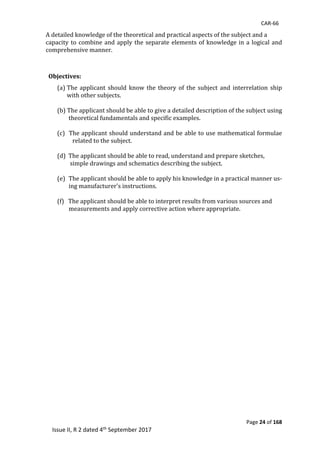
	 A	detailed	knowledge	of	the	theoretical	and	practical	aspects	of	the	subject	and	a		
	 capacity	to	combine	and	apply	the	separate	elements	of	knowledge	in	a	logical	and			
comprehensive	manner.	
	
	 			
																		Objectives:
(a) The	applicant	should	know	 the	 theory	 of	 the	 subject	 and	interrelation	ship				
with	other	subjects.	
	
(b)	The	applicant	should	be	able	to	give	a	detailed	description	of	the	subject	using				
theoretical	fundamentals	and	specific	examples.	
	
(c)		The	applicant	should	understand	and	be	able	to	use	mathematical	formulae					
related	to	the	subject.	
	
(d)		The	applicant	should	be	able	to	read,	understand	and	prepare	sketches,		
									simple	drawings	and	schematics	describing	the	subject.	
	
(e) The	applicant	should	be	able	to	apply	his	knowledge	in	a	practical	manner	us-
ing	manufacturer's	instructions.	
	
(f)			The	applicant	should	be	able	to	interpret	results	from	various	sources	and											
measurements	and	apply	corrective	action	where	appropriate.
CAR-66
Page 25 of 168
Issue II, R 2 dated 4th September 2017
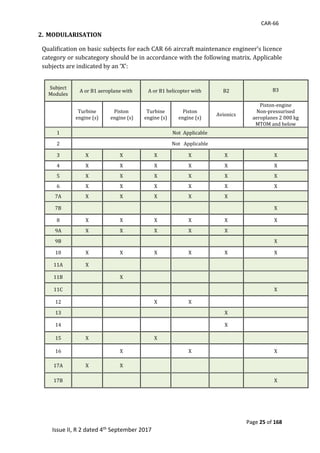
2. MODULARISATION
Qualification	on	basic	subjects	for	each	CAR	66	aircraft	maintenance	engineer’s	licence	
category	or	subcategory	should	be	in	accordance	with	the	following	matrix.	Applicable	
subjects	are	indicated	by	an	‘X’:		
	
Subject	
Modules	
A	or	B1	aeroplane	with	 A	or	B1	helicopter	with	 B2	
	
B3	
		
Turbine	
engine	(s)	
Piston	
	engine	(s)	
Turbine	
engine	(s)	
Piston	
engine	(s)	
Avionics	
Piston-engine		
Non-pressurised	
aeroplanes	2	000	kg	
MTOM	and	below	
1	 Not		Applicable	
2	 Not			Applicable	
3	 X	 X	 X	 X	 X	 X	
4	 X	 X	 X	 X	 X	 X	
5	 X	 X	 X	 X	 X	 X	
6	 X	 X	 X	 X	 X	 X	
7A	 X	 X	 X	 X	 X	 	
7B	 	 	 	 	 	 X	
8	 X	 X	 X	 X	 X	 X	
9A	 X	 X	 X	 X	 X	 	
9B	 	 	 	 	 	 X	
10	 X	 X	 X	 X	 X	 X	
11A	 X	 	 	 	 	 	
11B	 	 X	 	 	 	 	
11C	 	 	 	 	 	 X	
12	 	 	 X	 X	 	 	
13	 	 	 	 	 X	 	
14	 	 	 	 	 X	 	
15	 X	 	 X	 	 	 	
16	 	 X	 	 X	 	 X	
17A	 X	 X	 	 	 	 	
17B	 	 	 	 	 	 X
CAR-66
Page 26 of 168
Issue II, R 2 dated 4th September 2017
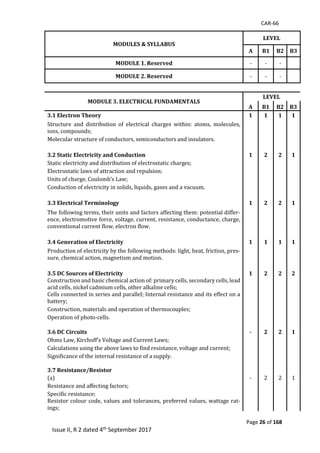
MODULES & SYLLABUS
LEVEL
A B1 B2 B3
MODULE 1. Reserved -	 -	 -	 	
MODULE 2. Reserved -	 -	 -	 	
MODULE 3. ELECTRICAL FUNDAMENTALS
LEVEL
A B1 B2 B3
3.1 Electron Theory 1 1 1 1
Structure	 and	 distribution	 of	 electrical	 charges	 within:	 atoms,	 molecules,	
ions,	compounds;	 		 		
Molecular	structure	of	conductors,	semiconductors	and	insulators.	 		 		
		 		 		
3.2 Static Electricity and Conduction 1 2 2 1
Static	electricity	and	distribution	of	electrostatic	charges;		 		 		
Electrostatic	laws	of	attraction	and	repulsion;		 		 		
Units	of	charge,	Coulomb's	Law;		 		 		
Conduction	of	electricity	in	solids,	liquids,	gases	and	a	vacuum.	 		 		
		 		 		
3.3 Electrical Terminology 1 2 2 1
The	following	terms,	their	units	and	factors	affecting	them:	potential	differ-
ence,	electromotive	force,	voltage,	current,	resistance,	conductance,	charge,	
conventional	current	flow,	electron	flow.	 		 		
		 		 		
3.4 Generation of Electricity 1 1 1 1
Production	of	electricity	by	the	following	methods:	light,	heat,	friction,	pres-
sure,	chemical	action,	magnetism	and	motion.	 		 		
		 		 		
3.5 DC Sources of Electricity 1 2 2 2
Construction	and	basic	chemical	action	of:	primary	cells,	secondary	cells,	lead	
acid	cells,	nickel	cadmium	cells,	other	alkaline	cells;		 		 		
Cells	connected	in	series	and	parallel;	Internal	resistance	and	its	effect	on	a	
battery;	 		 		
Construction,	materials	and	operation	of	thermocouples;		 		 		
Operation	of	photo-cells.	 		 		
		 		 		
3.6 DC Circuits - 2 2 1
Ohms	Law,	Kirchoff's	Voltage	and	Current	Laws;	 	 	
Calculations	using	the	above	laws	to	find	resistance,	voltage	and	current;	 		 		
Significance	of	the	internal	resistance	of	a	supply.	 		 		
		 		 		
3.7 Resistance/Resistor
(a)		 -	 2	 2	 1	
Resistance	and	affecting	factors;	 		 		
Specific	resistance;	 		 		
Resistor	colour	code,	values	and	tolerances,	preferred	values,	wattage	rat-
ings;
CAR-66
Page 27 of 168
Issue II, R 2 dated 4th September 2017
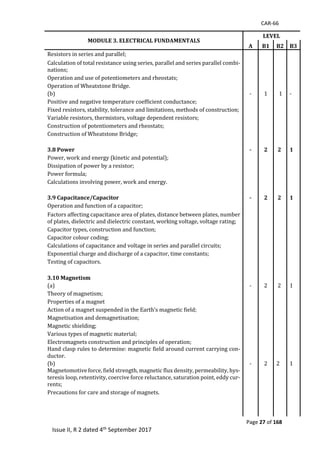
MODULE 3. ELECTRICAL FUNDAMENTALS
LEVEL
A B1 B2 B3
Resistors	in	series	and	parallel;	 		 		
Calculation	of	total	resistance	using	series,	parallel	and	series	parallel	combi-
nations;	 		 		
Operation	and	use	of	potentiometers	and	rheostats;	 		 		
Operation	of	Wheatstone	Bridge.		 		 		
(b)		 -	 1	 		1	 -	
Positive	and	negative	temperature	coefficient	conductance;	 		 		
Fixed	resistors,	stability,	tolerance	and	limitations,	methods	of	construction;	 		 		
Variable	resistors,	thermistors,	voltage	dependent	resistors;	 		 		
Construction	of	potentiometers	and	rheostats;	 		 		
Construction	of	Wheatstone	Bridge;	 		 		
3.8 Power - 2 2 1
Power,	work	and	energy	(kinetic	and	potential);	 		 		
Dissipation	of	power	by	a	resistor;	 		 		
Power	formula;	 		 		
Calculations	involving	power,	work	and	energy.	 		 		
		 		 		
3.9 Capacitance/Capacitor - 2 2 1
Operation	and	function	of	a	capacitor;	 		 		
Factors	affecting	capacitance	area	of	plates,	distance	between	plates,	number	
of	plates,	dielectric	and	dielectric	constant,	working	voltage,	voltage	rating;	 		 		
Capacitor	types,	construction	and	function;	 		 		
Capacitor	colour	coding;	 		 		
Calculations	of	capacitance	and	voltage	in	series	and	parallel	circuits;	 		 		
Exponential	charge	and	discharge	of	a	capacitor,	time	constants;	 		 		
Testing	of	capacitors.	 		 		
		 		 		
3.10 Magnetism
(a)		 -	 2	 	2	 1	
Theory	of	magnetism;	 	 	
Properties	of	a	magnet	 	 	
Action	of	a	magnet	suspended	in	the	Earth's	magnetic	field;	 		 		
Magnetisation	and	demagnetisation;	 		 		
Magnetic	shielding;	 		 		
Various	types	of	magnetic	material;	 		 		
Electromagnets	construction	and	principles	of	operation;	 		 		
Hand	clasp	rules	to	determine:	magnetic	field	around	current	carrying	con-
ductor.	 		 		
(b)		 -	 2	 2	 1	
Magnetomotive	force,	field	strength,	magnetic	flux	density,	permeability,	hys-
teresis	loop,	retentivity,	coercive	force	reluctance,	saturation	point,	eddy	cur-
rents;	 		 		
Precautions	for	care	and	storage	of	magnets.
CAR-66
Page 28 of 168
Issue II, R 2 dated 4th September 2017
MODULE 3. ELECTRICAL FUNDAMENTALS
LEVEL
A B1 B2 B3
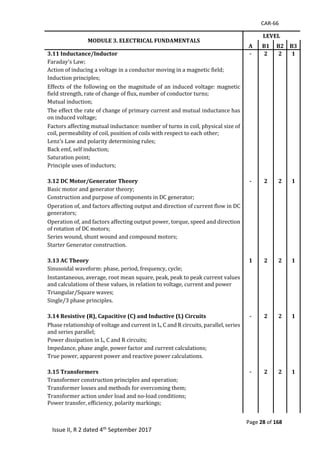
3.11 Inductance/Inductor - 2 2 1
Faraday's	Law;	 		 		
Action	of	inducing	a	voltage	in	a	conductor	moving	in	a	magnetic	field;	 		 		
Induction	principles;	 		 		
Effects	of	the	following	on	the	magnitude	of	an	induced	voltage:	magnetic	
field	strength,	rate	of	change	of	flux,	number	of	conductor	turns;	 		 		
Mutual	induction;	 		 		
The	effect	the	rate	of	change	of	primary	current	and	mutual	inductance	has	
on	induced	voltage;	 		 		
Factors	affecting	mutual	inductance:	number	of	turns	in	coil,	physical	size	of	
coil,	permeability	of	coil,	position	of	coils	with	respect	to	each	other;	 		 		
Lenz's	Law	and	polarity	determining	rules;	 		 		
Back	emf,	self	induction;	 		 		
Saturation	point;	 		 		
Principle	uses	of	inductors;	 		 		
		 		 		
3.12 DC Motor/Generator Theory - 2 2 1
Basic	motor	and	generator	theory;	 		 		
Construction	and	purpose	of	components	in	DC	generator;	 		 		
Operation	of,	and	factors	affecting	output	and	direction	of	current	flow	in	DC	
generators;	 		 		
Operation	of,	and	factors	affecting	output	power,	torque,	speed	and	direction	
of	rotation	of	DC	motors;	 		 		
Series	wound,	shunt	wound	and	compound	motors;	 		 		
Starter	Generator	construction.	 		 		
		 		 		
3.13 AC Theory 1 2 2 1
Sinusoidal	waveform:	phase,	period,	frequency,	cycle;	 		 		
Instantaneous,	average,	root	mean	square,	peak,	peak	to	peak	current	values	
and	calculations	of	these	values,	in	relation	to	voltage,	current	and	power	
Triangular/Square	waves;	 		 		
Single/3	phase	principles.	 		 		
		 		 		
3.14 Resistive (R), Capacitive (C) and Inductive (L) Circuits - 2 2 1
Phase	relationship	of	voltage	and	current	in	L,	C	and	R	circuits,	parallel,	series	
and	series	parallel;	 		 		
Power	dissipation	in	L,	C	and	R	circuits;	 		 		
Impedance,	phase	angle,	power	factor	and	current	calculations;	 		 		
True	power,	apparent	power	and	reactive	power	calculations.	 		 		
		 		 		
3.15 Transformers - 2 2 1
Transformer	construction	principles	and	operation;	 		 		
Transformer	losses	and	methods	for	overcoming	them;	 		 		
Transformer	action	under	load	and	no-load	conditions;	 		 		
Power	transfer,	efficiency,	polarity	markings;
CAR-66
Page 29 of 168
Issue II, R 2 dated 4th September 2017
MODULE 3. ELECTRICAL FUNDAMENTALS
LEVEL
A B1 B2 B3
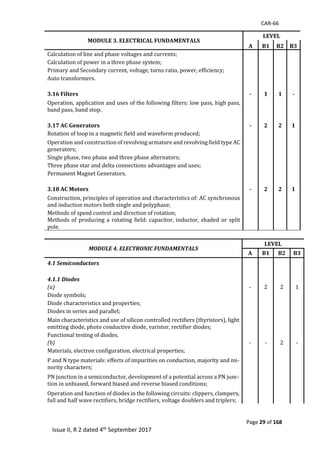
Calculation	of	line	and	phase	voltages	and	currents;	 		 		
Calculation	of	power	in	a	three	phase	system;	 		 		
Primary	and	Secondary	current,	voltage,	turns	ratio,	power,	efficiency;	 		 		
Auto	transformers.	 		 		
		 		 		
3.16 Filters - 1 1 -
Operation,	application	and	uses	of	the	following	filters:	low	pass,	high	pass,	
band	pass,	band	stop.	 		 		
		 		 		
3.17 AC Generators - 2 2 1
Rotation	of	loop	in	a	magnetic	field	and	waveform	produced;	 		 		
Operation	and	construction	of	revolving	armature	and	revolving	field	type	AC	
generators;	 		 		
Single	phase,	two	phase	and	three	phase	alternators;	 		 		
Three	phase	star	and	delta	connections	advantages	and	uses;	 		 		
Permanent	Magnet	Generators.	 		 		
		 		 		
3.18 AC Motors - 2 2 1
Construction,	principles	of	operation	and	characteristics	of:	AC	synchronous	
and	induction	motors	both	single	and	polyphase;	 		 		
Methods	of	speed	control	and	direction	of	rotation;	 		 		
Methods	of	producing	a	rotating	field:	capacitor,	inductor,	shaded	or	split	
pole.	 		 		
MODULE 4. ELECTRONIC FUNDAMENTALS
LEVEL
A B1 B2 B3
4.1 Semiconductors
		 		
4.1.1 Diodes
(a) -	 2	 2	 1	
Diode	symbols;	 		 		
Diode	characteristics	and	properties;	 		 		
Diodes	in	series	and	parallel;	 		 		
Main	characteristics	and	use	of	silicon	controlled	rectifiers	(thyristors),	light	
emitting	diode,	photo	conductive	diode,	varistor,	rectifier	diodes;	 		 		
Functional	testing	of	diodes.	 		 		
(b) -	 -	 2	 -	
Materials,	electron	configuration,	electrical	properties;	 		 		
P	and	N	type	materials:	effects	of	impurities	on	conduction,	majority	and	mi-
nority	characters;	 		 		
PN	junction	in	a	semiconductor,	development	of	a	potential	across	a	PN	junc-
tion	in	unbiased,	forward	biased	and	reverse	biased	conditions;	 		 		
Operation	and	function	of	diodes	in	the	following	circuits:	clippers,	clampers,	
full	and	half	wave	rectifiers,	bridge	rectifiers,	voltage	doublers	and	triplers;
CAR-66
Page 30 of 168
Issue II, R 2 dated 4th September 2017
MODULE 4. ELECTRONIC FUNDAMENTALS
LEVEL
A B1 B2 B3
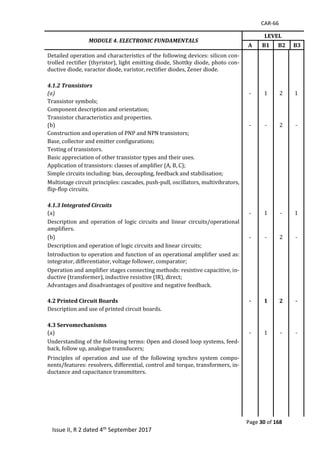
Detailed	operation	and	characteristics	of	the	following	devices:	silicon	con-
trolled	rectifier	(thyristor),	light	emitting	diode,	Shottky	diode,	photo	con-
ductive	diode,	varactor	diode,	varistor,	rectifier	diodes,	Zener	diode.	 		 		
	 	
4.1.2 Transistors
(a) -	 1	 2	 1	
Transistor	symbols;	 		 		
Component	description	and	orientation;	 		 		
Transistor	characteristics	and	properties.	 		 		
(b)		 -	 -	 2	 -	
Construction	and	operation	of	PNP	and	NPN	transistors;	 		 		
Base,	collector	and	emitter	configurations;	 		 		
Testing	of	transistors.	 		 		
Basic	appreciation	of	other	transistor	types	and	their	uses.	 		 		
Application	of	transistors:	classes	of	amplifier	(A,	B,	C);	 		 		
Simple	circuits	including:	bias,	decoupling,	feedback	and	stabilisation;	 		 		
Multistage	circuit	principles:	cascades,	push-pull,	oscillators,	multivibrators,	
flip-flop	circuits.	 		 		
4.1.3 Integrated Circuits
(a)	 -	 1	 -	 1	
Description	and	operation	of	 logic	circuits	and	linear	circuits/operational	
amplifiers.	 		 		
(b)		 -	 -	 2	 -	
Description	and	operation	of	logic	circuits	and	linear	circuits;	 		 		
Introduction	to	operation	and	function	of	an	operational	amplifier	used	as:	
integrator,	differentiator,	voltage	follower,	comparator;	 		 		
Operation	and	amplifier	stages	connecting	methods:	resistive	capacitive,	in-
ductive	(transformer),	inductive	resistive	(IR),	direct;	 		 		
Advantages	and	disadvantages	of	positive	and	negative	feedback.	 		 		
		 		
4.2 Printed Circuit Boards - 1 2 -
Description	and	use	of	printed	circuit	boards.	 		 		
		 		 		
4.3 Servomechanisms
(a)	 -	 1	 -	 -	
Understanding	of	the	following	terms:	Open	and	closed	loop	systems,	feed-
back,	follow	up,	analogue	transducers;	 		 		
Principles	 of	 operation	 and	 use	 of	 the	 following	 synchro	 system	 compo-
nents/features:	resolvers,	differential,	control	and	torque,	transformers,	in-
ductance	and	capacitance	transmitters.
CAR-66
Page 31 of 168
Issue II, R 2 dated 4th September 2017
MODULE 4. ELECTRONIC FUNDAMENTALS
LEVEL
A B1 B2 B3
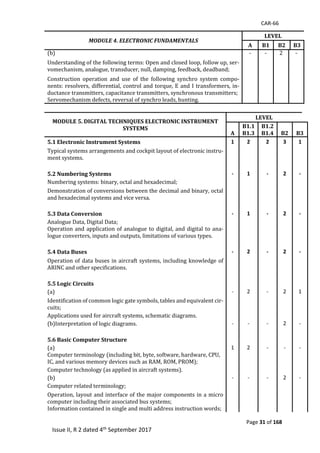
(b)		 -	 -	 2	 -	
Understanding	of	the	following	terms:	Open	and	closed	loop,	follow	up,	ser-
vomechanism,	analogue,	transducer,	null,	damping,	feedback,	deadband;	 		 		
Construction	 operation	 and	 use	 of	 the	 following	 synchro	 system	 compo-
nents:	resolvers,	differential,	control	and	torque,	E	and	I	transformers,	in-
ductance	transmitters,	capacitance	transmitters,	synchronous	transmitters;	 		 		
Servomechanism	defects,	reversal	of	synchro	leads,	hunting.	 		 		
MODULE 5. DIGITAL TECHNIQUES ELECTRONIC INSTRUMENT
SYSTEMS
LEVEL
A
B1.1
B1.3
B1.2
B1.4 B2 B3
5.1 Electronic Instrument Systems 1 2 2 3 1
Typical	systems	arrangements	and	cockpit	layout	of	electronic	instru-
ment	systems.	
5.2 Numbering Systems - 1 - 2 -
Numbering	systems:	binary,	octal	and	hexadecimal;	
Demonstration	of	conversions	between	the	decimal	and	binary,	octal	
and	hexadecimal	systems	and	vice	versa.	
5.3 Data Conversion - 1 - 2 -
Analogue	Data,	Digital	Data;	
Operation	and	application	of	analogue	to	digital,	and	digital	to	ana-
logue	converters,	inputs	and	outputs,	limitations	of	various	types.	
5.4 Data Buses - 2 - 2 -
Operation	of	data	buses	in	aircraft	systems,	including	knowledge	of	
ARINC	and	other	specifications.	
5.5 Logic Circuits
(a)		 - 2 - 2 1
Identification	of	common	logic	gate	symbols,	tables	and	equivalent	cir-
cuits;	
Applications	used	for	aircraft	systems,	schematic	diagrams.	
(b)Interpretation	of	logic	diagrams.	 - - - 2 -
5.6 Basic Computer Structure
(a)		 1 2 - - -
Computer	terminology	(including	bit,	byte,	software,	hardware,	CPU,	
IC,	and	various	memory	devices	such	as	RAM,	ROM,	PROM);	
Computer	technology	(as	applied	in	aircraft	systems).	
(b)		 - - - 2 -
Computer	related	terminology;	
Operation,	layout	and	interface	of	the	major	components	in	a	micro	
computer	including	their	associated	bus	systems;	
Information	contained	in	single	and	multi	address	instruction	words;
CAR-66
Page 32 of 168
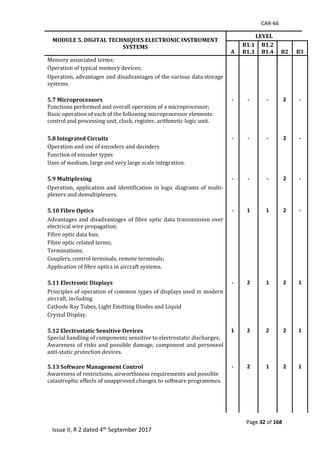
Issue II, R 2 dated 4th September 2017
MODULE 5. DIGITAL TECHNIQUES ELECTRONIC INSTRUMENT
SYSTEMS
LEVEL
A
B1.1
B1.3
B1.2
B1.4 B2 B3
Memory	associated	terms;	
Operation	of	typical	memory	devices;	
Operation,	advantages	and	disadvantages	of	the	various	data	storage	
systems.	
5.7 Microprocessors - - - 2 -
Functions	performed	and	overall	operation	of	a	microprocessor;	
Basic	operation	of	each	of	the	following	microprocessor	elements:	
control	and	processing	unit,	clock,	register,	arithmetic	logic	unit.	
5.8 Integrated Circuits - - - 2 -
Operation	and	use	of	encoders	and	decoders	
Function	of	encoder	types	
Uses	of	medium,	large	and	very	large	scale	integration.	
5.9 Multiplexing - - - 2 -
Operation,	application	and	identification	in	logic	diagrams	of	multi-
plexers	and	demultiplexers.	
5.10 Fibre Optics - 1 1 2 -
Advantages	and	disadvantages	of	fibre	optic	data	transmission	over	
electrical	wire	propagation;	
Fibre	optic	data	bus;	
Fibre	optic	related	terms;	
Terminations;	
Couplers,	control	terminals,	remote	terminals;	
Application	of	fibre	optics	in	aircraft	systems.	
5.11 Electronic Displays - 2 1 2 1
Principles	of	operation	of	common	types	of	displays	used	in	modern	
aircraft,	including	
Cathode	Ray	Tubes,	Light	Emitting	Diodes	and	Liquid	
Crystal	Display.	
5.12 Electrostatic Sensitive Devices 1 2 2 2 1
Special	handling	of	components	sensitive	to	electrostatic	discharges;	
Awareness	of	risks	and	possible	damage,	component	and	personnel	
anti-static	protection	devices.	
	
5.13 Software Management Control - 2 1 2 1
Awareness	of	restrictions,	airworthiness	requirements	and	possible	
catastrophic	effects	of	unapproved	changes	to	software	programmes.
CAR-66
Page 33 of 168
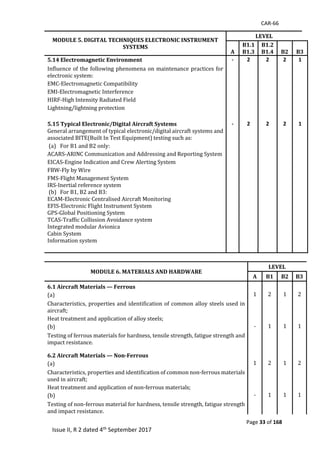
Issue II, R 2 dated 4th September 2017
MODULE 5. DIGITAL TECHNIQUES ELECTRONIC INSTRUMENT
SYSTEMS
LEVEL
A
B1.1
B1.3
B1.2
B1.4 B2 B3
5.14 Electromagnetic Environment - 2 2 2 1
Influence	of	the	following	phenomena	on	maintenance	practices	for	
electronic	system:	
EMC-Electromagnetic	Compatibility	
EMI-Electromagnetic	Interference	
HIRF-High	Intensity	Radiated	Field	
Lightning/lightning	protection	
	
5.15 Typical Electronic/Digital Aircraft Systems - 2 2 2 1
General	arrangement	of	typical	electronic/digital	aircraft	systems	and	
associated	BITE(Built	In	Test	Equipment)	testing	such	as:	
(a) For	B1	and	B2	only:	
ACARS-ARINC	Communication	and	Addressing	and	Reporting	System	
EICAS-Engine	Indication	and	Crew	Alerting	System	
FBW-Fly	by	Wire	
FMS-Flight	Management	System	
IRS-Inertial	reference	system	
(b) For	B1,	B2	and	B3:	
ECAM-Electronic	Centralised	Aircraft	Monitoring		
EFIS-Electronic	Flight	Instrument	System	
GPS-Global	Positioning	System	
TCAS-Traffic	Collission	Avoidance	system		
Integrated	modular	Avionica	
Cabin	System	
Information	system	
	
MODULE 6. MATERIALS AND HARDWARE
LEVEL
A B1 B2 B3
6.1 Aircraft Materials — Ferrous
(a)		 1	 2	 1	 2	
Characteristics,	properties	and	identification	of	common	alloy	steels	used	in	
aircraft;	
	 	
Heat	treatment	and	application	of	alloy	steels;	 	 	
(b)		 -	 1	 1	 1	
Testing	of	ferrous	materials	for	hardness,	tensile	strength,	fatigue	strength	and	
impact	resistance.	
	 	
		 	 	
6.2 Aircraft Materials — Non-Ferrous
(a)		 1	 2	 1	 2	
Characteristics,	properties	and	identification	of	common	non-ferrous	materials	
used	in	aircraft;	
	 	
Heat	treatment	and	application	of	non-ferrous	materials;	 	 	
(b)		 -	 1	 1	 1	
Testing	of	non-ferrous	material	for	hardness,	tensile	strength,	fatigue	strength	
and	impact	resistance.
CAR-66
Page 34 of 168
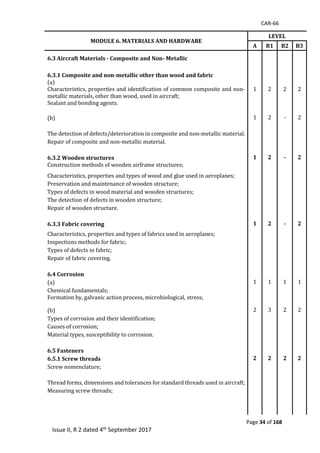
Issue II, R 2 dated 4th September 2017
MODULE 6. MATERIALS AND HARDWARE
LEVEL
A B1 B2 B3
		 	 	
6.3 Aircraft Materials - Composite and Non- Metallic
	 	 	
6.3.1 Composite and non-metallic other than wood and fabric
(a)		
Characteristics,	properties	and	identification	of	common	composite	and	non-
metallic	materials,	other	than	wood,	used	in	aircraft;	
1	 2	 2	 2	
Sealant	and	bonding	agents.	
	
	 	
(b)		 1	 2	 -	 2	
The	detection	of	defects/deterioration	in	composite	and	non-metallic	material.	
	 	
Repair	of	composite	and	non-metallic	material.	 	 	
		 	 	
6.3.2 Wooden structures 1 2 - 2
Construction	methods	of	wooden	airframe	structures;	 	 	
Characteristics,	properties	and	types	of	wood	and	glue	used	in	aeroplanes;	
	 	
Preservation	and	maintenance	of	wooden	structure;	 	 	
Types	of	defects	in	wood	material	and	wooden	structures;	 	 	
The	detection	of	defects	in	wooden	structure;	 	 	
Repair	of	wooden	structure.	 	 	
		 	 	
6.3.3 Fabric covering 1 2 - 2
Characteristics,	properties	and	types	of	fabrics	used	in	aeroplanes;	
	 	
Inspections	methods	for	fabric;	 	 	
Types	of	defects	in	fabric;	 	 	
Repair	of	fabric	covering.	 	 	
		 	 	
6.4 Corrosion
(a)		 1	 1	 1	 1	
Chemical	fundamentals;	 	 	
Formation	by,	galvanic	action	process,	microbiological,	stress;	
	 	
(b)		 2	 3	 2	 2	
Types	of	corrosion	and	their	identification;	 	 	
Causes	of	corrosion;	 	 	
Material	types,	susceptibility	to	corrosion.	 	 	
		 	 	
6.5 Fasteners
6.5.1 Screw threads 2 2 2 2
Screw	nomenclature;	 	 	
Thread	forms,	dimensions	and	tolerances	for	standard	threads	used	in	aircraft;	
	 	
Measuring	screw	threads;
CAR-66
Page 35 of 168
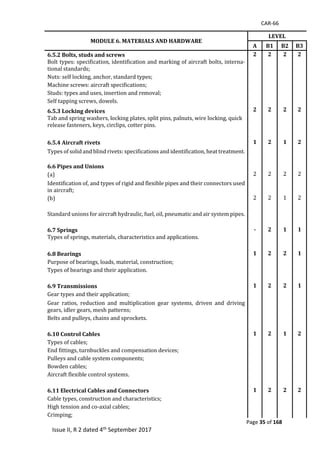
Issue II, R 2 dated 4th September 2017
MODULE 6. MATERIALS AND HARDWARE
LEVEL
A B1 B2 B3
6.5.2 Bolts, studs and screws 2 2 2 2
Bolt	types:	specification,	identification	and	marking	of	aircraft	bolts,	interna-
tional	standards;	
	 	
Nuts:	self	locking,	anchor,	standard	types;	 	 	
Machine	screws:	aircraft	specifications;	 	 	
Studs:	types	and	uses,	insertion	and	removal;	 	 	
Self	tapping	screws,	dowels.	 	 	
6.5.3 Locking devices 2 2 2 2
Tab	and	spring	washers,	locking	plates,	split	pins,	palnuts,	wire	locking,	quick	
release	fasteners,	keys,	circlips,	cotter	pins.	
	 	
6.5.4 Aircraft rivets 1 2 1 2
Types	of	solid	and	blind	rivets:	specifications	and	identification,	heat	treatment.	
	
	 	
6.6 Pipes and Unions
(a)		 2	 2	 2	 2	
Identification	of,	and	types	of	rigid	and	flexible	pipes	and	their	connectors	used	
in	aircraft;	
	 	
(b)		 2	 2	 1	 2	
Standard	unions	for	aircraft	hydraulic,	fuel,	oil,	pneumatic	and	air	system	pipes.	
	 	
		 	 	
6.7 Springs - 2 1 1
Types	of	springs,	materials,	characteristics	and	applications.	
	 	
6.8 Bearings 1 2 2 1
Purpose	of	bearings,	loads,	material,	construction;	 	 	
Types	of	bearings	and	their	application.	 	 	
		 	 	
6.9 Transmissions 1 2 2 1
Gear	types	and	their	application;	 	 	
Gear	 ratios,	 reduction	 and	 multiplication	 gear	 systems,	 driven	 and	 driving	
gears,	idler	gears,	mesh	patterns;	
	 	
Belts	and	pulleys,	chains	and	sprockets.	 	 	
	
	 	
6.10 Control Cables 1 2 1 2
Types	of	cables;	 	 	
End	fittings,	turnbuckles	and	compensation	devices;	 	 	
Pulleys	and	cable	system	components;	 	 	
Bowden	cables;	 	 	
Aircraft	flexible	control	systems.	 	 	
		 	 	
6.11 Electrical Cables and Connectors 1 2 2 2
Cable	types,	construction	and	characteristics;	 	 	
High	tension	and	co-axial	cables;	 	 	
Crimping;
CAR-66
Page 36 of 168
Issue II, R 2 dated 4th September 2017
MODULE 6. MATERIALS AND HARDWARE
LEVEL
A B1 B2 B3
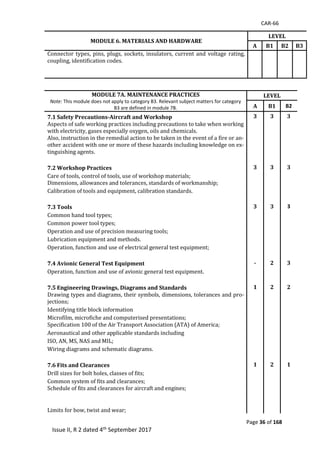
Connector	types,	pins,	plugs,	sockets,	insulators,	current	and	voltage	rating,	
coupling,	identification	codes.	


MODULE 7A. MAINTENANCE PRACTICES
Note: This module does not apply to category B3. Relevant subject matters for category
B3 are defined in module 7B.
LEVEL
A B1 B2
7.1 Safety Precautions-Aircraft and Workshop 3 3 3
Aspects	of	safe	working	practices	including	precautions	to	take	when	working	
with	electricity,	gases	especially	oxygen,	oils	and	chemicals.	
	 	
Also,	instruction	in	the	remedial	action	to	be	taken	in	the	event	of	a	fire	or	an-
other	accident	with	one	or	more	of	these	hazards	including	knowledge	on	ex-
tinguishing	agents.	
	 	
		 	 	
7.2 Workshop Practices 3 3 3
Care	of	tools,	control	of	tools,	use	of	workshop	materials;	 	 	
Dimensions,	allowances	and	tolerances,	standards	of	workmanship;	
	 	
Calibration	of	tools	and	equipment,	calibration	standards.	 	 	
7.3 Tools 3 3 3
Common	hand	tool	types;	 	 	
Common	power	tool	types;	 	 	
Operation	and	use	of	precision	measuring	tools;	 	 	
Lubrication	equipment	and	methods.	 	 	
Operation,	function	and	use	of	electrical	general	test	equipment;	 	 	
		 	 	
7.4 Avionic General Test Equipment - 2 3
Operation,	function	and	use	of	avionic	general	test	equipment.	 	 	
		 	 	
7.5 Engineering Drawings, Diagrams and Standards 1 2 2
Drawing	types	and	diagrams,	their	symbols,	dimensions,	tolerances	and	pro-
jections;	
Identifying	title	block	information	
Microfilm,	microfiche	and	computerised	presentations;	 	 	
Specification	100	of	the	Air	Transport	Association	(ATA)	of	America;	
	 	
Aeronautical	and	other	applicable	standards	including	
	 	
ISO,	AN,	MS,	NAS	and	MIL;	 	 	
Wiring	diagrams	and	schematic	diagrams.	 	 	
		 	 	
7.6 Fits and Clearances 1 2 1
Drill	sizes	for	bolt	holes,	classes	of	fits;	 	 	
Common	system	of	fits	and	clearances;	 	 	
Schedule	of	fits	and	clearances	for	aircraft	and	engines;	


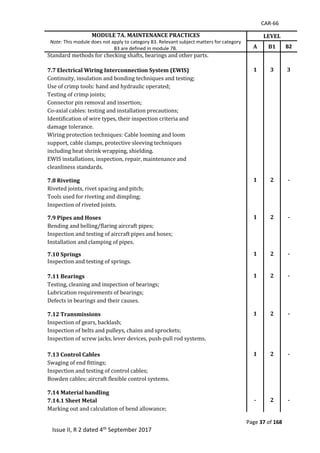
Limits	for	bow,	twist	and	wear;
CAR-66
Page 37 of 168
Issue II, R 2 dated 4th September 2017
MODULE 7A. MAINTENANCE PRACTICES
Note: This module does not apply to category B3. Relevant subject matters for category
B3 are defined in module 7B.
LEVEL
A B1 B2
Standard	methods	for	checking	shafts,	bearings	and	other	parts.	
	
	 	
7.7 Electrical Wiring Interconnection System (EWIS) 1 3 3
Continuity,	insulation	and	bonding	techniques	and	testing;	 	 	
Use	of	crimp	tools:	hand	and	hydraulic	operated;	 	 	
Testing	of	crimp	joints;	 	 	
Connector	pin	removal	and	insertion;	 	 	
Co-axial	cables:	testing	and	installation	precautions;	 	 	
Identification	of	wire	types,	their	inspection	criteria	and		 	 	
damage	tolerance.	 	 	
Wiring	protection	techniques:	Cable	looming	and	loom	 	 	
support,	cable	clamps,	protective	sleeving	techniques	 	 	
including	heat	shrink	wrapping,	shielding.	 	 	
EWIS	installations,	inspection,	repair,	maintenance	and	 	 	
cleanliness	standards.	 	 	
		 	 	
7.8 Riveting 1 2 -
Riveted	joints,	rivet	spacing	and	pitch;	 	 	
Tools	used	for	riveting	and	dimpling;	 	 	
Inspection	of	riveted	joints.	 	 	
7.9 Pipes and Hoses 1 2 -
Bending	and	belling/flaring	aircraft	pipes;	 	 	
Inspection	and	testing	of	aircraft	pipes	and	hoses;	 	 	
Installation	and	clamping	of	pipes.	 	 	
	 	 	 	
7.10 Springs 1 2 -
Inspection	and	testing	of	springs.	
	
7.11 Bearings 1 2 -
Testing,	cleaning	and	inspection	of	bearings;	 	 	
Lubrication	requirements	of	bearings;	 	 	
Defects	in	bearings	and	their	causes.	 	 	
		 	 	
7.12 Transmissions 1 2 -
Inspection	of	gears,	backlash;	 	 	
Inspection	of	belts	and	pulleys,	chains	and	sprockets;	 	 	
Inspection	of	screw	jacks,	lever	devices,	push-pull	rod	systems.	 	 	
		
	 	
7.13 Control Cables 1 2 -
Swaging	of	end	fittings;	 	 	
Inspection	and	testing	of	control	cables;	 	 	
Bowden	cables;	aircraft	flexible	control	systems.	 	 	
		 	 	
7.14 Material handling
7.14.1 Sheet Metal - 2 -
Marking	out	and	calculation	of	bend	allowance;
CAR-66
Page 38 of 168
Issue II, R 2 dated 4th September 2017
MODULE 7A. MAINTENANCE PRACTICES
Note: This module does not apply to category B3. Relevant subject matters for category
B3 are defined in module 7B.
LEVEL
A B1 B2
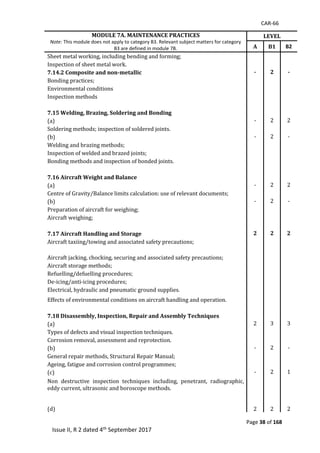
Sheet	metal	working,	including	bending	and	forming;	 	 	
Inspection	of	sheet	metal	work.	 	 	
7.14.2 Composite and non-metallic - 2 -
Bonding	practices;	 	 	
Environmental	conditions	 	 	
Inspection	methods	 	 	
		 	 	
7.15 Welding, Brazing, Soldering and Bonding
(a)		 -	 2	 2	
Soldering	methods;	inspection	of	soldered	joints.	 	 	
(b)		 -	 2	 -	
Welding	and	brazing	methods;	 	 	
Inspection	of	welded	and	brazed	joints;	 	 	
Bonding	methods	and	inspection	of	bonded	joints.	 	 	
		 	 	
7.16 Aircraft Weight and Balance
(a)	 -	 2	 2	
Centre	of	Gravity/Balance	limits	calculation:	use	of	relevant	documents;	
(b)		 -	 2	 -	
Preparation	of	aircraft	for	weighing;	 	 	
Aircraft	weighing;	 	 	
7.17 Aircraft Handling and Storage 2 2 2
Aircraft	taxiing/towing	and	associated	safety	precautions;	 	 	
Aircraft	jacking,	chocking,	securing	and	associated	safety	precautions;	
	 	
Aircraft	storage	methods;	 	 	
Refuelling/defuelling	procedures;	 	 	
De-icing/anti-icing	procedures;	 	 	
Electrical,	hydraulic	and	pneumatic	ground	supplies.	 	 	
Effects	of	environmental	conditions	on	aircraft	handling	and	operation.	
	 	
		 	 	
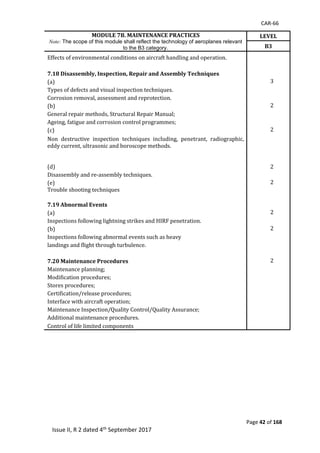
7.18 Disassembly, Inspection, Repair and Assembly Techniques
(a)		 2	 3	 3	
Types	of	defects	and	visual	inspection	techniques.	 	 	
Corrosion	removal,	assessment	and	reprotection.	 	 	
(b)		 -	 2	 -	
General	repair	methods,	Structural	Repair	Manual;	 	 	
Ageing,	fatigue	and	corrosion	control	programmes;	 	 	
(c)		 -	 2	 1	
Non	 destructive	 inspection	 techniques	 including,	 penetrant,	 radiographic,	
eddy	current,	ultrasonic	and	boroscope	methods.	


(d)		
	
	
2	
	
	
2	
	
	
2
CAR-66
Page 39 of 168
Issue II, R 2 dated 4th September 2017
MODULE 7A. MAINTENANCE PRACTICES
Note: This module does not apply to category B3. Relevant subject matters for category
B3 are defined in module 7B.
LEVEL
A B1 B2
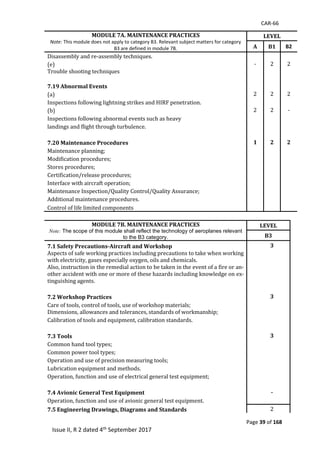
Disassembly	and	re-assembly	techniques.	 	 	
(e)		 -	 2	 2	
Trouble	shooting	techniques	
	
	 	
7.19 Abnormal Events
(a)		 2	 2	 2	
Inspections	following	lightning	strikes	and	HIRF	penetration.	 	 	
(b)		 2	 2	 -	
Inspections	following	abnormal	events	such	as	heavy	 	 	
landings	and	flight	through	turbulence.	 	 	
7.20 Maintenance Procedures 1 2 2
Maintenance	planning;	 	 	
Modification	procedures;	 	 	
Stores	procedures;	 	 	
Certification/release	procedures;	 	 	
Interface	with	aircraft	operation;	 	 	
Maintenance	Inspection/Quality	Control/Quality	Assurance;	 	 	
Additional	maintenance	procedures.	 	 	
Control	of	life	limited	components	 	 	
MODULE 7B. MAINTENANCE PRACTICES
Note: The scope of this module shall reflect the technology of aeroplanes relevant
to the B3 category.
LEVEL
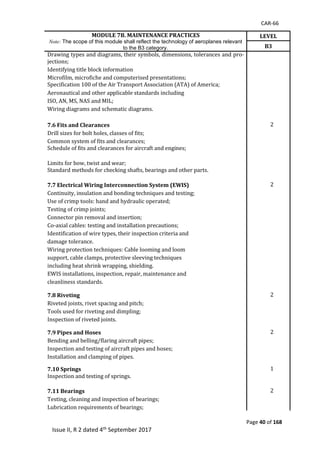
B3
7.1 Safety Precautions-Aircraft and Workshop 3
Aspects	of	safe	working	practices	including	precautions	to	take	when	working	
with	electricity,	gases	especially	oxygen,	oils	and	chemicals.	
	 	
Also,	instruction	in	the	remedial	action	to	be	taken	in	the	event	of	a	fire	or	an-
other	accident	with	one	or	more	of	these	hazards	including	knowledge	on	ex-
tinguishing	agents.	
	 	
		 	 	
7.2 Workshop Practices 3
Care	of	tools,	control	of	tools,	use	of	workshop	materials;	 	 	
Dimensions,	allowances	and	tolerances,	standards	of	workmanship;	
	 	
Calibration	of	tools	and	equipment,	calibration	standards.	 	 	
7.3 Tools 3
Common	hand	tool	types;	 	 	
Common	power	tool	types;	 	 	
Operation	and	use	of	precision	measuring	tools;	 	 	
Lubrication	equipment	and	methods.	 	 	
Operation,	function	and	use	of	electrical	general	test	equipment;	 	 	
		 	 	
7.4 Avionic General Test Equipment -
Operation,	function	and	use	of	avionic	general	test	equipment.	 	 	
7.5 Engineering Drawings, Diagrams and Standards 2
CAR-66
Page 40 of 168
Issue II, R 2 dated 4th September 2017
MODULE 7B. MAINTENANCE PRACTICES
Note: The scope of this module shall reflect the technology of aeroplanes relevant
to the B3 category.
LEVEL
B3
Drawing	types	and	diagrams,	their	symbols,	dimensions,	tolerances	and	pro-
jections;	
Identifying	title	block	information	
Microfilm,	microfiche	and	computerised	presentations;	 	 	
Specification	100	of	the	Air	Transport	Association	(ATA)	of	America;	
	 	
Aeronautical	and	other	applicable	standards	including	
	 	
ISO,	AN,	MS,	NAS	and	MIL;	 	 	
Wiring	diagrams	and	schematic	diagrams.	 	 	
		 	 	
7.6 Fits and Clearances 2	
Drill	sizes	for	bolt	holes,	classes	of	fits;	 	 	
Common	system	of	fits	and	clearances;	 	 	
Schedule	of	fits	and	clearances	for	aircraft	and	engines;	
	
	 	
Limits	for	bow,	twist	and	wear;	 	 	
Standard	methods	for	checking	shafts,	bearings	and	other	parts.	
	
	 	
7.7 Electrical Wiring Interconnection System (EWIS) 2	
Continuity,	insulation	and	bonding	techniques	and	testing;	 	 	
Use	of	crimp	tools:	hand	and	hydraulic	operated;	 	 	
Testing	of	crimp	joints;	 	 	
Connector	pin	removal	and	insertion;	 	 	
Co-axial	cables:	testing	and	installation	precautions;	 	 	
Identification	of	wire	types,	their	inspection	criteria	and	 	 	
damage	tolerance.	 	 	
Wiring	protection	techniques:	Cable	looming	and	loom	 	 	
support,	cable	clamps,	protective	sleeving	techniques	 	 	
including	heat	shrink	wrapping,	shielding.	 	 	
EWIS	installations,	inspection,	repair,	maintenance	and	 	 	
cleanliness	standards.	 	 	
		 	 	
7.8 Riveting 2	 	
Riveted	joints,	rivet	spacing	and	pitch;	 	 	
Tools	used	for	riveting	and	dimpling;	 	 	
Inspection	of	riveted	joints.	 	 	
	
7.9 Pipes and Hoses 2	 	
Bending	and	belling/flaring	aircraft	pipes;	 	 	
Inspection	and	testing	of	aircraft	pipes	and	hoses;	 	 	
Installation	and	clamping	of	pipes.	 	 	
	 	 	 	
7.10 Springs 1	 	
Inspection	and	testing	of	springs.	
	
7.11 Bearings 2	 	
Testing,	cleaning	and	inspection	of	bearings;	
Lubrication	requirements	of	bearings;
CAR-66
Page 41 of 168
Issue II, R 2 dated 4th September 2017
MODULE 7B. MAINTENANCE PRACTICES
Note: The scope of this module shall reflect the technology of aeroplanes relevant
to the B3 category.
LEVEL
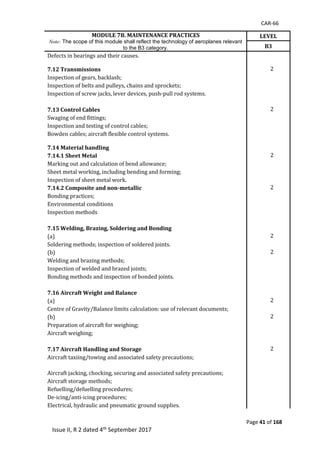
B3
Defects	in	bearings	and	their	causes.	
		
7.12 Transmissions 2	
Inspection	of	gears,	backlash;	 	 	
Inspection	of	belts	and	pulleys,	chains	and	sprockets;	 	 	
Inspection	of	screw	jacks,	lever	devices,	push-pull	rod	systems.	 	 	
		
	 	
7.13 Control Cables 2	
Swaging	of	end	fittings;	 	 	
Inspection	and	testing	of	control	cables;	 	 	
Bowden	cables;	aircraft	flexible	control	systems.	 	 	
		 	 	
7.14 Material handling
7.14.1 Sheet Metal 2	
Marking	out	and	calculation	of	bend	allowance;	 	 	
Sheet	metal	working,	including	bending	and	forming;	 	 	
Inspection	of	sheet	metal	work.	 	 	
7.14.2 Composite and non-metallic 2	
Bonding	practices;	 	 	
Environmental	conditions	 	 	
Inspection	methods	 	 	
		 	 	
7.15 Welding, Brazing, Soldering and Bonding
(a)		 	 2	 	
Soldering	methods;	inspection	of	soldered	joints.	 	 	
(b)		 	 2	 	
Welding	and	brazing	methods;	 	 	
Inspection	of	welded	and	brazed	joints;	 	 	
Bonding	methods	and	inspection	of	bonded	joints.	 	 	
		 	 	
7.16 Aircraft Weight and Balance
(a)	 	 2	 	
Centre	of	Gravity/Balance	limits	calculation:	use	of	relevant	documents;	
(b)		 	 2	 	
Preparation	of	aircraft	for	weighing;	 	 	
Aircraft	weighing;	 	 	
7.17 Aircraft Handling and Storage 2	
Aircraft	taxiing/towing	and	associated	safety	precautions;	 	 	
Aircraft	jacking,	chocking,	securing	and	associated	safety	precautions;	
	 	
Aircraft	storage	methods;	 	 	
Refuelling/defuelling	procedures;	 	 	
De-icing/anti-icing	procedures;	 	 	
Electrical,	hydraulic	and	pneumatic	ground	supplies.
CAR-66
Page 42 of 168
Issue II, R 2 dated 4th September 2017
MODULE 7B. MAINTENANCE PRACTICES
Note: The scope of this module shall reflect the technology of aeroplanes relevant
to the B3 category.
LEVEL
B3
Effects	of	environmental	conditions	on	aircraft	handling	and	operation.	
	 	
		 	 	
7.18 Disassembly, Inspection, Repair and Assembly Techniques
(a)		 	 3	 	
Types	of	defects	and	visual	inspection	techniques.	 	 	
Corrosion	removal,	assessment	and	reprotection.	 	 	
(b)		 	 2	 	
General	repair	methods,	Structural	Repair	Manual;	 	 	
Ageing,	fatigue	and	corrosion	control	programmes;	 	 	
(c)		 	 2	 	
Non	 destructive	 inspection	 techniques	 including,	 penetrant,	 radiographic,	
eddy	current,	ultrasonic	and	boroscope	methods.	


(d)		


2	


Disassembly	and	re-assembly	techniques.	 	 	
(e)		 	 2	 	
Trouble	shooting	techniques	
	
	 	
7.19 Abnormal Events
(a)		 	 2	 	
Inspections	following	lightning	strikes	and	HIRF	penetration.	 	 	
(b)		 	 2	 	
Inspections	following	abnormal	events	such	as	heavy	 	 	
landings	and	flight	through	turbulence.	 	 	
7.20 Maintenance Procedures 2	
Maintenance	planning;	 	 	
Modification	procedures;	 	 	
Stores	procedures;	 	 	
Certification/release	procedures;	 	 	
Interface	with	aircraft	operation;	 	 	
Maintenance	Inspection/Quality	Control/Quality	Assurance;	 	 	
Additional	maintenance	procedures.	 	 	
Control	of	life	limited	components
CAR-66
Page 43 of 168
Issue II, R 2 dated 4th September 2017
MODULE 8. BASIC AERODYNAMICS
LEVEL
A B1 B2 B3
8.1 Physics of the Atmosphere 1 2 2 1
International	Standard	Atmosphere	(ISA),	application	to	aerodynamics.	 		 		
		 		 		
8.2 Aerodynamics 1 2 2 1
Airflow	around	a	body;	 		 		
Boundary	layer,	laminar	and	turbulent	flow,	free	stream	flow,	relative	airflow,	
upwash	and	downwash,	vortices,	stagnation;	
		 		
The	terms:	camber,	chord,	mean	aerodynamic	chord,	profile	(parasite)	drag,	
induced	drag,	centre	of	pressure,	angle	of	attack,	wash	in	and	wash	out,	fine-
ness	ratio,	wing	shape	and	aspect	ratio;	
		 		
Thrust,	Weight,	Aerodynamic	Resultant;	 		 		
Generation	of	Lift	and	Drag:	Angle	of	Attack,	Lift	coefficient,	 		 		
Drag	coefficient,	polar	curve,	stall;	 		 		
Aerofoil	contamination	including	ice,	snow,	frost.	 		 		
		 		 		
8.3 Theory of Flight 1 2 2 1
Relationship	between	lift,	weight,	thrust	and	drag;	 		 		
Glide	ratio;	 		 		
Steady	state	flights,	performance;	 		 		
Theory	of	the	turn;	 		 		
Influence	of	load	factor:	stall,	flight	envelope	and	structural	limitations;	 		 		
Lift	augmentation.	 		 		
8.4 Flight Stability and Dynamics 1 2 2 1
Longitudinal,	lateral	and	directional	stability	(active	and	passive).	 		 		
MODULE 9A. HUMAN FACTORS
Note: This module does not apply to category B3. Relevant subject matters for category
B3 are defined in module 9B.
LEVEL
A B1 B2
9.1 General 1 2 2
The	need	to	take	human	factors	into	account;	 		 		
Incidents	attributable	to	human	factors/human	error;	 		 		
‘Murphy's’	law.	 		 		
		 		 		
9.2 Human Performance and Limitations 1 2 2
Vision;	 		 		
Hearing;	 		 		
Information	processing;	 		 		
Attention	and	perception;	 		 		
Memory;	 		 		
Claustrophobia	and	physical	access.	 		 		
		 		 		
9.3 Social Psychology 1 1 1
Responsibility:	individual	and	group;	 		 		
Motivation	and	de-motivation;
CAR-66
Page 44 of 168
Issue II, R 2 dated 4th September 2017
MODULE 9A. HUMAN FACTORS
Note: This module does not apply to category B3. Relevant subject matters for category
B3 are defined in module 9B.
LEVEL
A B1 B2
Peer	pressure;	 		 		
‘Culture’	issues;	 		 		
Team	working;	 		 		
Management,	supervision	and	leadership	
	
	 	 	
9.4 Factors Affecting Performance 2 2 2
Fitness/health;	 		 		
Stress:	domestic	and	work	related;	 		 		
Time	pressure	and	deadlines;	 		 		
Workload:	overload	and	underload;	 		 		
Sleep	and	fatigue,	shiftwork;	 		 		
Alcohol,	medication,	drug	abuse.	 		 		
		 		 		
9.5 Physical Environment 1 1 1
Noise	and	fumes;	 		 		
Illumination;	 		 		
Climate	and	temperature;	 		 		
Motion	and	vibration;	 		 		
Working	environment.	 		 		
		 		 		
9.6 Tasks 1 1 1
Physical	work;	 		 		
Repetitive	tasks;	 		 		
Visual	inspection;	 		 		
Complex	systems.	 		 		


9.7 Communication 2 2 2
Within	and	between	teams;	 		 		
Work	logging	and	recording;	 		 		
Keeping	up	to	date,	currency;	 		 		
Dissemination	of	information.	 		 		
	
	 	 	
9.8 Human Error 1 2 2
Error	models	and	theories;	 		 		
Types	of	error	in	maintenance	tasks;	 		 		
Implications	of	errors	(i.e	accidents)	 		 		
Avoiding	and	managing	errors.	 		 		
		 		 		
9.9 Hazards in the Workplace 1 2 2
Recognising	and	avoiding	hazards;	 		 		
Dealing	with	emergencies.
CAR-66
Page 45 of 168
Issue II, R 2 dated 4th September 2017
MODULE 9B. HUMAN FACTORS
Note: The scope of this module shall reflect the less demanding environment of mainte-
nance for B3 licence holders.
LEVEL
B3
9.1 General 2
The	need	to	take	human	factors	into	account;	 		 		
Incidents	attributable	to	human	factors/human	error;	 		 		
‘Murphy's’	law.	 		 		
		 		 		
9.2 Human Performance and Limitations 2
Vision;	 		 		
Hearing;	 		 		
Information	processing;	 		 		
Attention	and	perception;	 		 		
Memory;	 		 		
Claustrophobia	and	physical	access.	 		 		
		 		 		
9.3 Social Psychology 1
Responsibility:	individual	and	group;	 		 		
Motivation	and	de-motivation;	 		 		
Peer	pressure;	 		 		
‘Culture’	issues;	 		 		
Team	working;	 		 		
Management,	supervision	and	leadership	
	
	 	 	
9.4 Factors Affecting Performance 2
Fitness/health;	 		 		
Stress:	domestic	and	work	related;	 		 		
Time	pressure	and	deadlines;	 		 		
Workload:	overload	and	underload;	 		 		
Sleep	and	fatigue,	shiftwork;	 		 		
Alcohol,	medication,	drug	abuse.	 		 		
		 		 		
9.5 Physical Environment 1
Noise	and	fumes;	 		 		
Illumination;	 		 		
Climate	and	temperature;	 		 		
Motion	and	vibration;	 		 		
Working	environment.	 		 		
		 		 		
9.6 Tasks 1
Physical	work;	 		 		
Repetitive	tasks;	 		 		
Visual	inspection;	 		 		
Complex	systems.	 		 		
	
	 	 	
9.7 Communication 2
Within	and	between	teams;	 		
			Work	logging	and	recording;
CAR-66
Page 46 of 168
Issue II, R 2 dated 4th September 2017
MODULE 9B. HUMAN FACTORS
Note: The scope of this module shall reflect the less demanding environment of mainte-
nance for B3 licence holders.
LEVEL
B3
Keeping	up	to	date,	currency;	 		 		
Dissemination	of	information.	 		 		
	
	 	 	
9.8 Human Error 2
Error	models	and	theories;	 		 		
Types	of	error	in	maintenance	tasks;	 		 		
Implications	of	errors	(i.e	accidents)	 		 		
Avoiding	and	managing	errors.	 		 		
		 		 		
9.9 Hazards in the Workplace 2
Recognising	and	avoiding	hazards;	 		 		
Dealing	with	emergencies.	 		 		
MODULE 10. AVIATION LEGISLATION
LEVEL
A B1 B2 B3
10.1 Regulatory Framework 1 1 1 1
Role	of	International	Civil	Aviation	Organisation;	 		 		
The	Aircraft	Act	and	Rules	made	there	under	
Role	of	the	DGCA;	 		 		
Relationship	between	CAR-21,	CAR-M,	CAR-145,	CAR-66,	CAR	147	 		 		
The	Aircraft	Rules	(	Applicable	to	Aircraft	Maintenance	and	Release)	 		 		
Aeronautical	Information	Circulars	(	Applicable	to	Aircraft	Maintenance	and	
Release)	
		 		
CAR	Sections	1	and	2	 		 		
		 		
10.2 CAR-66 Certifying Staff - Maintenance 2 2 2 2
Detailed	understanding	of	CAR-66.	
	
	 	
10.3 CAR-145 — Approved Maintenance Organisations 2 2 2 2
Detailed	understanding	of	CAR-145	and	CAR	M	Subpart	F		
		 		
10.4 Aircraft Operations 1 1 1 1
Commercial	Air	Transport/Commercial	Operations	 		 		
Air	Operators	Certificates;	 		 		
Operators	Responsibilities,	in	particular	regarding	continuing	airworthiness	
and	maintenance;	
		 		
Documents	to	be	carried	on	board;	 		 		
Aircraft	Placarding	(Markings);	 		 		
		 		 		
10.5 Aircraft Certification
(a)	General		 -	 1	 1	 1	
Certification	rules:	such	as	FAA	&	EACS	23/25/27/29;	 		 		
Type	Certification;	 		 		
Supplemental	Type	Certification;
CAR-66
Page 47 of 168
Issue II, R 2 dated 4th September 2017
MODULE 10. AVIATION LEGISLATION
LEVEL
A B1 B2 B3
CAR-21	Design/Production	Organisation	Approvals.	 		 		
Aircraft	Modifications	and	repairs	approval	and	certification	 		 		
Permit	to	fly	requirements	
	 	 	
(b)	Documents		 -		 2		 2 2
Certificate	of	Airworthiness;	 		 		
Certificate	of	Registration;	 		 		
Noise	Certificate;	 		 		
Weight	Schedule;	 		 		
Radio	Station	Licence	and	Approval.	 		 		
10.6 CAR-M
Detail	understanding	of	CAR	M	provisions	related	to	Continuing		
Airworthiness
2 2 2 2
Detailed	understanding	of	CAR-M.	 		 		
		 		 		
10.7 Applicable National and International Requirements
(a)		 1	 2	 2	 2	
Maintenance	Programme,	Maintenance	checks	and	inspections;	 	 	
Master	Minimum	Equipment	Lists,	Minimum	Equipment	 	 	
List,	Dispatch	Deviation	Lists;	 	 	
Airworthiness	Directives;	 	 	
Service	Bulletins,	manufacturers	service	information;	 		 		
Modifications	and	repairs;	 		 		
Maintenance	documentation:	maintenance	manuals,	structural	repair	manual,	
illustrated	parts	catalogue,	etc.;	
		 		
	 	 	
(b)		 -	 1	 1	 1	
Continuing	airworthiness;	 		 		
Test	flights;	 		 		
ETOPS	/EDTO	,	maintenance	and	dispatch	requirements;	 		 		
RVSM,	maintenance	and	dispatch	requirements	 		 		
RNP,	MNPS	Operations	 		 		
All	Weather	Operations,		 		 		
Category	2/3	operations	and	minimum	equipment	requirements.	 		 		
10.8 Safety Management System 2 2 2
State	Safety	Programme	 	 	
	 	
Basic	Safety	Concepts	 	 	
Hazards	&	Safety	Risks	 	 	
SMS	Operation	 	 	
SMS	Safety	performance	 	 	
Safety	Assurance	 	 	
	
10.9 Fuel Tank Safety 2 2 2
Special	Federal	Aviation	Regulations	(SFARs)	from	14	CFR	SFAR	88	of	the	FAA	
and	of	JAA	TGL	47	
Concept	of	CDCCL,		
Airworthiness	Limitations	Items	(ALI)
CAR-66
Page 48 of 168
Issue II, R 2 dated 4th September 2017
MODULE 11A. TURBINE AEROPLANE AERODYNAMICS, STRUCTURES AND SYS-
TEMS
LEVEL
A1 B1.1
11.1 Theory of Flight
11.1.1 Aeroplane Aerodynamics and Flight Controls 1 2
Operation	and	effect	of:	
—	roll	control:	ailerons	and	spoilers;	
—	pitch	control:	elevators,	stabilators,	variable	incidence	stabilisers	and	canards;	
—	yaw	control,	rudder	limiters;	
Control	using	elevons,	ruddervators;	
High	lift	devices,	slots,	slats,	flaps,	flaperons;	
Drag	inducing	devices,	spoilers,	lift	dumpers,	speed	brakes;	
Effects	of	wing	fences,	saw	tooth	leading	edges;	
Boundary	layer	control	using,	vortex	generators,	stall	wedges	or	leading	edge	de-
vices;	
Operation	and	effect	of	trim	tabs,	balance	and	antibalance	(leading)	tabs,	servo	tabs,	
spring	tabs,	mass	balance,	control	surface	bias,	aerodynamic	balance	panels;	
	
11.1.2 High Speed Flight 1 2
Speed	of	sound,	subsonic	flight,	transonic	flight,	supersonic	flight,	
Mach	 number,	 critical	Mach	 number,	 compressibility	buffet,	 shock	wave,	 aerody-
namic	heating,	area	rule;	
Factors	affecting	airflow	in	engine	intakes	of	high	speed	aircraft;	
Effects	of	sweepback	on	critical	Mach	number.	
		
11.2 Airframe Structures — General Concepts
(a)		 2 2
Airworthiness	requirements	for	structural	strength;	
Structural	classification,	primary,	secondary	and	tertiary;	
Fail	safe,	safe	life,	damage	tolerance	concepts;	
Zonal	and	station	identification	systems;	
Stress,	strain,	bending,	compression,	shear,	torsion,	tension,	hoop	stress,	fatigue;	
Drains	and	ventilation	provisions;	
System	installation	provisions;	
Lightning	strike	protection	provision.	
Aircraft	bonding	
	
	
(b)		 1 2
Construction	methods	of:	stressed	skin	fuselage,	formers,	stringers,	longerons,	bulk-
heads,	frames,	doublers,	struts,	ties,	beams,	floor	structures,	reinforcement,	methods	
of	skinning,	anti-corrosive	protection,	wing,	empennage	and	engine	attachments;	
Structure	assembly	techniques:	riveting,	bolting,	bonding	
Methods	of	surface	protection,	such	as	chromating,	anodising,	painting;	
Surface	cleaning.	
Airframe	symmetry:	methods	of	alignment	and	symmetry	checks.
CAR-66
Page 49 of 168
Issue II, R 2 dated 4th September 2017
MODULE 11A. TURBINE AEROPLANE AERODYNAMICS, STRUCTURES AND SYS-
TEMS
LEVEL
A1 B1.1
11.3 Airframe Structures — Aeroplanes
11.3.1 Fuselage (ATA 52/53/56) 1 2
Construction	and	pressurisation	sealing;	
Wing,	stabiliser,	pylon	and	undercarriage	attachments;	
Seat	installation	and	cargo	loading	system;	
Doors	and	emergency	exits:	construction,	mechanisms,	operation	and	safety	devices;	
Windows	and	windscreen	construction	and	mechanisms.	
	
11.3.2 Wings (ATA 57) 1 2
Construction;	
Fuel	storage;	
Landing	gear,	pylon,	control	surface	and	high	lift/drag	attachments.	
11.3.3 Stabilisers (ATA 55) 1 2
Construction;	
Control	surface	attachment.	
		
11.3.4 Flight Control Surfaces (ATA 55/57) 1 2
Construction	and	attachment;	
Balancing	—	mass	and	aerodynamic.	
		
11.3.5 Nacelles/Pylons (ATA 54) 1 2
Construction;	
Firewalls;	
Engine	mounts.	
		
11.4 Air Conditioning and Cabin Pressurisation (ATA 21)
		
11.4.1 Air supply 1 2
Sources	of	air	supply	including	engine	bleed,	APU	and	ground	cart;	
		
11.4.2 Air Conditioning 1 3
Air	conditioning	systems;	
	
Air	cycle	and	vapour	cycle	machines	
Distribution	systems;	
Flow,	temperature	and	humidity	control	system.	
		
11.4.3 Pressurisation 1 3
Pressurisation	systems;	
Control	and	indication	including	control	and	safety	valves;	
Cabin	pressure	controllers.	
		
11.4.4 Safety and warning devices 1 3
CAR-66
Page 50 of 168
Issue II, R 2 dated 4th September 2017
MODULE 11A. TURBINE AEROPLANE AERODYNAMICS, STRUCTURES AND SYS-
TEMS
LEVEL
A1 B1.1
Protection	and	warning	devices.	
		
11.5 Instruments/Avionic Systems
		
11.5.1 Instrument Systems (ATA 31) 1 2
Pitot	static:	altimeter,	air	speed	indicator,	vertical	speed	indicator;	
Gyroscopic:	artificial	horizon,	attitude	director,	direction	indicator,	horizontal	situa-
tion	indicator,	turn	and	slip	indicator,	turn	coordinator;	
Compasses:	direct	reading,	remote	reading;	
Angle	of	attack	indication,	stall	warning	systems;	
Glass	Cockpit	
Other	aircraft	system	indication.	
		
11.5.2 Avionic Systems 1 1
Fundamentals	of	system	lay-outs	and	operation	of;	
Auto	Flight	(ATA	22);	
Communications	(ATA	23);	
Navigation	Systems	(ATA	34).	
		
11.6 Electrical Power (ATA 24) 1 3
Batteries	Installation	and	Operation;	
DC	power	generation;	
AC	power	generation;	
Emergency	power	generation;	
Voltage	regulation;	
Power	distribution;	
Inverters,	transformers,	rectifiers;	
Circuit	protection.	
External/Ground	power;	
11.7 Equipment and Furnishings (ATA 25)
(a)		 2 2
Emergency	equipment	requirements;	
Seats,	harnesses	and	belts.	
	
	
(b)		 1 1
Cabin	lay-out;	
Equipment	lay-out;	
Cabin	Furnishing	Installation;	
Cabin	entertainment	equipment;	
Galley	installation;	
Cargo	handling	and	retention	equipment;	
Airstairs.	
	
11.8 Fire Protection (ATA 26)
CAR-66
Page 51 of 168
Issue II, R 2 dated 4th September 2017
MODULE 11A. TURBINE AEROPLANE AERODYNAMICS, STRUCTURES AND SYS-
TEMS
LEVEL
A1 B1.1
(a) 1 3
Fire	and	smoke	detection	and	warning	systems;	
Fire	extinguishing	systems;	
System	tests.	
(b) 1 1
Portable	fire	extinguisher		
	
11.9 Flight Controls (ATA 27) 1 3
Primary	controls:	aileron,	elevator,	rudder,	spoiler;	
Trim	control;	
Active	load	control;	
High	lift	devices;	
Lift	dump,	speed	brakes;	
System	operation:	manual,	hydraulic,	pneumatic,	electrical,	fly-by-wire;	
Artificial	feel,	Yaw	damper,	Mach	trim,	rudder	limiter,	gust	locks	systems;	
Balancing	and	rigging;	
Stall	protection/warning	system.	
		
11.10 Fuel Systems (ATA 28) 1 3
System	lay-out;	
Fuel	tanks;	
Supply	systems;	
Dumping,	venting	and	draining;	
Cross-feed	and	transfer;	
Indications	and	warnings;	
Refuelling	and	defuelling;	
Longitudinal	balance	fuel	systems.	
11.11 Hydraulic Power (ATA 29) 1 3
System	lay-out;	
Hydraulic	fluids;	
Hydraulic	reservoirs	and	accumulators;	
Pressure	generation:	electric,	mechanical,	pneumatic;	
Emergency	pressure	generation;	
Filters	
	
Pressure	Control;	
Power	distribution;	
Indication	and	warning	systems;	
Interface	with	other	systems.	
	
11.12 Ice and Rain Protection (ATA 30) 1 3
Ice	formation,	classification	and	detection;	
Anti-icing	systems:	electrical,	hot	air	and	chemical;	
De-icing	systems:	electrical,	hot	air,	pneumatic	and	chemical;	
Rain	repellant;
CAR-66
Page 52 of 168
Issue II, R 2 dated 4th September 2017
MODULE 11A. TURBINE AEROPLANE AERODYNAMICS, STRUCTURES AND SYS-
TEMS
LEVEL
A1 B1.1
Probe	and	drain	heating.	
Wiper	systems	
		
11.13 Landing Gear (ATA 32) 2 3
Construction,	shock	absorbing;	
Extension	and	retraction	systems:	normal	and	emergency;	
Indications	and	warning;	
Wheels,	brakes,	antiskid	and	autobraking;	
Tyres;	
Steering.	
Air-ground	sensing	
		
11.14 Lights (ATA 33) 2 3
External:	navigation,	anti-collision,	landing,	taxiing,	ice;	
Internal:	cabin,	cockpit,	cargo;	
Emergency.	
		
11.15 Oxygen (ATA 35) 1 3
System	lay-out:	cockpit,	cabin;	
Sources,	storage,	charging	and	distribution;	
Supply	regulation;	
Indications	and	warnings;	
		
11.16 Pneumatic/Vacuum (ATA 36) 1 3
System	lay-out;	
Sources:	engine/APU,	compressors,	reservoirs,	ground	supply;	
Pressure	control;	
Distribution;	
Indications	and	warnings;	
Interfaces	with	other	systems.	
		
11.17 Water/Waste (ATA 38) 2 3
Water	system	lay-out,	supply,	distribution,	servicing	and	draining;	
Toilet	system	lay-out,	flushing	and	servicing;	
Corrosion	aspects.	
	
11.18 On Board Maintenance Systems (ATA 45) 1 2
Central	maintenance	computers;	
Data	loading	system;	
Electronic	library	system;	
Printing;	
Structure	monitoring	(damage	tolerance	monitoring).	
11.19 Integrated Modular Avionics (ATA42 )
	
1 2
CAR-66
Page 53 of 168
Issue II, R 2 dated 4th September 2017
MODULE 11A. TURBINE AEROPLANE AERODYNAMICS, STRUCTURES AND SYS-
TEMS
LEVEL
A1 B1.1
Functions	that	may	be	typically	integrated	in	the	Integrated	Modular	Avionic	(IMA)	
modules	are,	among	others:	Bleed	Management,	Air	Pressure	Control,	Air	Ventilation	
and	Control,	Avionics	and	Cockpit	Ventilation	Control,	Temperature	Control,	Air	Traf-
fic	Communication,	Avionics	Communication	Router,	Electrical	Load	Management,	
Circuit	Breaker	Monitoring,	Electrical	System	BITE,	Fuel	Management,	Braking	Con-
trol,	Steering	Control,	Landing	Gear	Extension	and	Retraction,	Tyre	Pressure	Indica-
tion,	Oleo	Pressure	Indication,	Brake	Temperature	Monitoring,	etc.	
	
	
11.20 Cabin Systems (ATA44)
	
The	units	and	components	which	furnish	a	means	of	entertaining	the	passengers	and	
providing	communication	within	the	aircraft	(Cabin	Intercommunication	Data	Sys-
tem)	and	between	the	aircraft	cabin	and	ground	stations	(Cabin	Network	Service).	
Includes	voice,	data,	music	and	video	transmissions.		
	
The	Cabin	 Intercommunication	Data	 System	 provides	an	interface	 between	cock-
pit/cabin	crew	and	cabin	systems.	These	systems	support	data	exchange	of	the	dif-
ferent	related	LRU's	and	they	are	typically	operated	via	Flight	Attendant	Panels.		
	
The	Cabin	Network	Service	typically	consists	on	a	server,	typically	interfacing	with,	
among	others,	the	following	systems:	
	—	Data/Radio	Communication,	In-Flight	Entertainment	System.		
	
	The	Cabin	Network	Service	may	host	functions	such	as:	
	—	Access	to	pre-departure/departure	reports,	
	—	E-mail/intranet/Internet	access,	—	Passenger	database;	
	
		Cabin	Core	System;	
	
	In-flight	Entertainment	System;	
	External	Communication	System;	
	Cabin	Mass	Memory	System;		
	Cabin	Monitoring	System;		
	Miscellaneous	Cabin	System.	
	
11.21 Information Systems (ATA46)
The	units	and	components	which	furnish	a	means	of	storing,	updating	and	retrieving	
digital	information	traditionally	provided	on	paper,	microfilm	or	microfiche.	Includes	
units	that	are	dedicated	to	the	information	storage	and	retrieval	function		
	
such	as	the	electronic	library	mass	storage	and	controller.	Does	not	include	units	or	
components	installed	for	other	uses	and	shared	with	other	systems,	such	as	flight	
deck	printer	or	general	use	display.	
	
Typical	examples	include	Air	Traffic	and	Information	Management	Systems	and	Net-
work	Server	Systems	
	
	Aircraft	General	Information	System;	
	Flight	Deck	Information	System;	
	Maintenance	Information	System;		
Passenger	Cabin	Information	System;	
1
1
2
2
CAR-66
Page 54 of 168
Issue II, R 2 dated 4th September 2017
MODULE 11A. TURBINE AEROPLANE AERODYNAMICS, STRUCTURES AND SYS-
TEMS
LEVEL
A1 B1.1
	Miscellaneous	Information	System.	
	
	
MODULE 11B. PISTON AEROPLANE AERODYNAMICS, STRUCTURES AND SYS-
TEMS
LEVEL
A2 B1.2
Note 1: This module does not apply to category B3. Relevant subject matters for category B3
are defined in module 11C.
Note: The scope of this Module should reflect the technology of aeroplanes pertinent
to the A2 and B1.2 subcategory.	
11.1 Theory of Flight
	
11.1.1 Aeroplane Aerodynamics and Flight Controls 1 2
Operation	and	effect	of:	
—	roll	control:	ailerons	and	spoilers;	
—	pitch	control:	elevators,	stabilators,	variable	incidence	stabilisers	and	canards;	
—	yaw	control,	rudder	limiters;	
Control	using	elevons,	ruddervators;	
High	lift	devices,	slots,	slats,	flaps,	flaperons;	
Drag	inducing	devices,	spoilers,	lift	dumpers,	speed	brakes;	
Effects	of	wing	fences,	saw	tooth	leading	edges;	
Boundary	layer	control	using,	vortex	generators,	stall	wedges	or	leading	edge	de-
vices;	
Operation	and	effect	of	trim	tabs,	balance	and	antibalance	(leading)	tabs,	servo	tabs,	
spring	tabs,	mass	balance,	control	surface	bias,	aerodynamic	balance	panels;	
11.1.2 High Speed Flight — N/A — - -
		
11.2 Airframe Structures — General Concepts
(a)		 2 2
Airworthiness	requirements	for	structural	strength;	
Structural	classification,	primary,	secondary	and	tertiary;	
Fail	safe,	safe	life,	damage	tolerance	concepts;	
Zonal	and	station	identification	systems;	
Stress,	strain,	bending,	compression,	shear,	torsion,	tension,	hoop	stress,	fatigue;	
Drains	and	ventilation	provisions;	
System	installation	provisions;	
Lightning	strike	protection	provision.	
Aircraft	bonding	
(b)		 1 2
CAR-66
Page 55 of 168
Issue II, R 2 dated 4th September 2017
MODULE 11B. PISTON AEROPLANE AERODYNAMICS, STRUCTURES AND SYS-
TEMS
LEVEL
A2 B1.2
Construction	methods	of:	stressed	skin	fuselage,	formers,	stringers,	longerons,	bulk-
heads,	frames,	doublers,	struts,	ties,	beams,	floor	structures,	reinforcement,	methods	
of	skinning,	anti-corrosive	protection,	wing,	empennage	and	engine	attachments;	
Structure	assembly	techniques:	riveting,	bolting,	bonding;	
Methods	of	surface	protection,	such	as	chromating,	
anodising,	painting;	
Surface	cleaning;	
Airframe	symmetry:	methods	of	alignment	and	symmetry	checks.	
		
11.3 Airframe Structures — Aeroplanes
11.3.1 Fuselage (ATA 52/53/56) 1 2
Construction	and	pressurisation	sealing;	
Wing,	tail-plane	pylon	and	undercarriage	attachments;	
Seat	installation;	
Doors	and	emergency	exits:	construction	and	operation;	
Window	and	windscreen	attachment.	
		
11.3.2 Wings (ATA 57) 1 2
Construction;	
Fuel	storage;	
Landing	gear,	pylon,	control	surface	and	high	lift/drag	attachments.	
11.3.3 Stabilisers (ATA 55) 1 2
Construction;	
Control	surface	attachment.	
		
11.3.4 Flight Control Surfaces (ATA 55/57) 1 2
Construction	and	attachment;	
Balancing	—	mass	and	aerodynamic.	
		
11.3.5 Nacelles/Pylons (ATA 54)
	 1 2
Nacelles/Pylons:	
—	Construction;	
—	Firewalls;	
—	Engine	mounts.	
	
11.4 Air Conditioning and Cabin Pressurisation (ATA 21) 1 3
Pressurisation	and	air	conditioning	systems;	
Cabin	pressure	controllers,	protection	and	warning	devices	
Heating	Systems	
	
11.5 Instruments/Avionic Systems
CAR-66
Page 56 of 168
Issue II, R 2 dated 4th September 2017
MODULE 11B. PISTON AEROPLANE AERODYNAMICS, STRUCTURES AND SYS-
TEMS
LEVEL
A2 B1.2
11.5.1 Instrument Systems (ATA 31) 1 2
Pitot	static:	altimeter,	air	speed	indicator,	vertical	speed	indicator;	
Gyroscopic:	artificial	horizon,	attitude	director,	direction	indicator,	horizontal	situa-
tion	indicator,	turn	and	slip	indicator,	turn	coordinator;	
Compasses:	direct	reading,	remote	reading;	
Angle	of	attack	indication,	stall	warning	systems.	
Glass	cockpit;	
Other	aircraft	system	indication.	
	
11.5.2 Avionic Systems 1 1
Fundamentals	of	system	lay-outs	and	operation	of:	
—	Auto	Flight	(ATA	22);	
—	Communications	(ATA	23);	
—	Navigation	Systems	(ATA	34).	
		
11.6 Electrical Power (ATA 24) 1 3
Batteries	Installation	and	Operation;	
DC	power	generation;	
Voltage	regulation;	
Power	distribution;	
Circuit	protection;	
Inverters,	transformers.	
		
11.7 Equipment and Furnishings (ATA 25)
(a)		 2 2
Emergency	equipment	requirements;	
Seats,	harnesses	and	belts.	
(b)		 1 1
Cabin	lay-out;	
Equipment	lay-out;	
Cabin	Furnishing	Installation	(level	2);	
Cabin	entertainment	equipment;	
Galley	installation;	
Cargo	handling	and	retention	equipment;	
Airstairs.	
11.8 Fire Protection (ATA 26)
	
(a)		 1 3
Fire	extinguishing	systems;	
Fire	and	smoke	detection	and	warning	systems;	
System	tests.	
(b)		 1 3
Portable	fire	extinguisher.	
	
11.9 Flight Controls (ATA 27) 1 3
CAR-66
Page 57 of 168
Issue II, R 2 dated 4th September 2017
MODULE 11B. PISTON AEROPLANE AERODYNAMICS, STRUCTURES AND SYS-
TEMS
LEVEL
A2 B1.2
Primary	controls:	aileron,	elevator,	rudder;	
Trim	tabs;	
High	lift	devices;	
System	operation:	manual;	
Gust	locks;	
Balancing	and	rigging;	
Stall	warning	system.	
		
11.10 Fuel Systems (ATA 28) 1 3
System	lay-out;	
Fuel	tanks;	
Supply	systems;	
Cross-feed	and	transfer;	
Indications	and	warnings;	
Refuelling	and	defuelling.	
		
11.11 Hydraulic Power (ATA 29) 1 3
System	lay-out;	
Hydraulic	fluids;	
Hydraulic	reservoirs	and	accumulators;	
Pressure	generation:	electric,	mechanical;	
Filters	
Pressure	Control;	
Power	distribution;	
Indication	and	warning	systems.	
		
11.12 Ice and Rain Protection (ATA 30) 1 3
Ice	formation,	classification	and	detection;	
De-icing	systems:	electrical,	hot	air,	pneumatic	and	chemical;	
Probe	and	drain	heating;	
Wiper	systems.	
		
11.13 Landing Gear (ATA 32) 2 3
Construction,	shock	absorbing;	
Extension	and	retraction	systems:	normal	and	emergency;	
Indications	and	warning;	
Wheels,	brakes,	antiskid	and	auto	braking;	
	
Tyres;	
Steering.	
Air-ground	sensing		
		
11.14 Lights (ATA 33) 2 3
External:	navigation,	anti	collision,	landing,	taxiing,	ice;	
Internal:	cabin,	cockpit,	cargo;	
Emergency.
CAR-66
Page 58 of 168
Issue II, R 2 dated 4th September 2017
MODULE 11B. PISTON AEROPLANE AERODYNAMICS, STRUCTURES AND SYS-
TEMS
LEVEL
A2 B1.2
		
11.15 Oxygen (ATA 35) 1 3
System	lay-out:	cockpit,	cabin;	
Sources,	storage,	charging	and	distribution;	
Supply	regulation;	
Indications	and	warnings;	
		
11.16 Pneumatic/Vacuum (ATA 36) 1 3
System	lay-out;	
Sources:	engine/APU,	compressors,	reservoirs,	ground	supply;	
Pressure	control;	
Distribution;	
Indications	and	warnings;	
Interfaces	with	other	systems.	
		
11.17 Water/Waste (ATA 38) 2 3
Water	system	lay-out,	supply,	distribution,	servicing	and	draining;	
Toilet	system	lay-out,	flushing	and	servicing;	
Corrosion	aspects.	
MODULE 11C. PISTON AEROPLANE AERODYNAMICS, STRUCTURES AND SYS-
TEMS
LEVEL
B3
Note: The scope of this module shall reflect the technology of aeroplanes pertinent to the
B3 category.	
11.1 Theory of Flight
	
11.1.1 Aeroplane Aerodynamics and Flight Controls 1
Operation	and	effect	of:	
—	roll	control:	ailerons	and	spoilers;	
—	pitch	control:	elevators,	stabilators,	variable	incidence	stabilisers	and	canards;	
—	yaw	control,	rudder	limiters;	
Control	using	elevons,	ruddervators;	
High	lift	devices,	slots,	slats,	flaps,	flaperons;	
Drag	inducing	devices,	spoilers,	lift	dumpers,	speed	brakes;	
Effects	of	wing	fences,	saw	tooth	leading	edges;	
Boundary	layer	control	using,	vortex	generators,	stall	wedges	or	leading	edge	de-
vices;	
Operation	and	effect	of	trim	tabs,	balance	and	antibalance	(leading)	tabs,	servo	tabs,	
spring	tabs,	mass	balance,	control	surface	bias,	aerodynamic	balance	panels;	
	
11.2 Airframe Structures — General Concepts
(a)		 2
CAR-66
Page 59 of 168
Issue II, R 2 dated 4th September 2017
MODULE 11C. PISTON AEROPLANE AERODYNAMICS, STRUCTURES AND SYS-
TEMS
LEVEL
B3
Airworthiness	requirements	for	structural	strength;	
Structural	classification,	primary,	secondary	and	tertiary;	
Fail	safe,	safe	life,	damage	tolerance	concepts;	
Zonal	and	station	identification	systems;	
Stress,	strain,	bending,	compression,	shear,	torsion,	tension,	hoop	stress,	fatigue;	
Drains	and	ventilation	provisions;	
System	installation	provisions;	
Lightning	strike	protection	provision.	
Aircraft	bonding	
(b)		 2
Construction	methods	of:	stressed	skin	fuselage,	formers,	stringers,	longerons,	bulk-
heads,	frames,	doublers,	struts,	ties,	beams,	floor	structures,	reinforcement,	methods	
of	skinning,	anti-corrosive	protection,	wing,	empennage	and	engine	attachments;	
Structure	assembly	techniques:	riveting,	bolting,	bonding;	
Methods	of	surface	protection,	such	as	chromating,	
anodising,	painting;	
Surface	cleaning;	
Airframe	symmetry:	methods	of	alignment	and	symmetry	checks.	
		
11.3 Airframe Structures — Aeroplanes
11.3.1 Fuselage (ATA 52/53/56) 1
Construction	and	pressurisation	sealing;	
Wing,	tail-plane	pylon	and	undercarriage	attachments;	
Seat	installation;	
Doors	and	emergency	exits:	construction	and	operation;	
Window	and	windscreen	attachment.	
		
11.3.2 Wings (ATA 57) 1
Construction;	
Fuel	storage;	
Landing	gear,	pylon,	control	surface	and	high	lift/drag	attachments.	
11.3.3 Stabilisers (ATA 55) 1
Construction;	
Control	surface	attachment.	
		
11.3.4 Flight Control Surfaces (ATA 55/57) 1
Construction	and	attachment;	
Balancing	—	mass	and	aerodynamic.	
		
11.3.5 Nacelles/Pylons (ATA 54)
	 1
Nacelles/Pylons:
CAR-66
Page 60 of 168
Issue II, R 2 dated 4th September 2017
MODULE 11C. PISTON AEROPLANE AERODYNAMICS, STRUCTURES AND SYS-
TEMS
LEVEL
B3
—	Construction;	
—	Firewalls;	
—	Engine	mounts.	
	
11.4 Air Conditioning (ATA 21) 1
Heating	and	ventilation	Systems	
	
11.5 Instruments/Avionic Systems
11.5.1 Instrument Systems (ATA 31) 1
Pitot	static:	altimeter,	air	speed	indicator,	vertical	speed	indicator;	
Gyroscopic:	artificial	horizon,	attitude	director,	direction	indicator,	horizontal	situa-
tion	indicator,	turn	and	slip	indicator,	turn	coordinator;	
Compasses:	direct	reading,	remote	reading;	
Angle	of	attack	indication,	stall	warning	systems.	
Glass	cockpit;	
Other	aircraft	system	indication.	
	
11.5.2 Avionic Systems 1
Fundamentals	of	system	lay-outs	and	operation	of:	
—	Auto	Flight	(ATA	22);	
—	Communications	(ATA	23);	
—	Navigation	Systems	(ATA	34).	
		
11.6 Electrical Power (ATA 24) 2
Batteries	Installation	and	Operation;	
DC	power	generation;	
Voltage	regulation;	
Power	distribution;	
Circuit	protection;	
Inverters,	transformers.	
		
11.7 Equipment and Furnishings (ATA 25) 2
Emergency	equipment	requirements;	
Seats,	harnesses	and	belts.	
11.8 Fire Protection (ATA 26) 2
Portable	fire	extinguisher.	
	
11.9 Flight Controls (ATA 27) 3
Primary	controls:	aileron,	elevator,	rudder;	
Trim	tabs;	
High	lift	devices;	
System	operation:	manual;	
Gust	locks;	
Balancing	and	rigging;
CAR-66
Page 61 of 168
Issue II, R 2 dated 4th September 2017
MODULE 11C. PISTON AEROPLANE AERODYNAMICS, STRUCTURES AND SYS-
TEMS
LEVEL
B3
Stall	warning	system.	
		
11.10 Fuel Systems (ATA 28) 2
System	lay-out;	
Fuel	tanks;	
Supply	systems;	
Cross-feed	and	transfer;	
Indications	and	warnings;	
Refuelling	and	defuelling.	
		
11.11 Hydraulic Power (ATA 29) 2
System	lay-out;	
Hydraulic	fluids;	
Hydraulic	reservoirs	and	accumulators;	
Pressure	generation:	electric,	mechanical;	
Filters	
Pressure	Control;	
Power	distribution;	
Indication	and	warning	systems.	
		
11.12 Ice and Rain Protection (ATA 30) 1
Ice	formation,	classification	and	detection;	
De-icing	systems:	electrical,	hot	air,	pneumatic	and	chemical;	
Probe	and	drain	heating;	
Wiper	systems.	
		
11.13 Landing Gear (ATA 32) 2
Construction,	shock	absorbing;	
Extension	and	retraction	systems:	normal	and	emergency;	
Indications	and	warning;	
Wheels,	brakes,	antiskid	and	auto	braking;	
Tyres;	
Steering.	
		
11.14 Lights (ATA 33) 2
External:	navigation,	anti	collision,	landing,	taxiing,	ice;	
Internal:	cabin,	cockpit,	cargo;	
Emergency.	
		
11.15 Oxygen (ATA 35) 2
System	lay-out:	cockpit,	cabin;	
Sources,	storage,	charging	and	distribution;	
Supply	regulation;	
Indications	and	warnings;
CAR-66
Page 62 of 168
Issue II, R 2 dated 4th September 2017
MODULE 11C. PISTON AEROPLANE AERODYNAMICS, STRUCTURES AND SYS-
TEMS
LEVEL
B3
11.16 Pneumatic/Vacuum (ATA 36) 2
System	lay-out;	
Sources:	engine/APU,	compressors,	reservoirs,	ground	supply;	
Pressure	and	vaccum	pumps	
Pressure	control;	
Distribution;	
Indications	and	warnings;	
Interfaces	with	other	systems.	
	
MODULE 12. HELICOPTER AERODYNAMICS, STRUCTURES AND SYSTEMS
LEVEL
A3
A4
B1.3
B1.4
12.1 Theory of Flight — Rotary Wing Aerodynamics 1 2
Terminology;	
Effects	of	gyroscopic	precession;	
Torque	reaction	and	directional	control;	
Dissymmetry	of	lift,	Blade	tip	stall;	
Translating	tendency	and	its	correction;	
Coriolis	effect	and	compensation;	
Vortex	ring	state,	power	settling,	overpitching;	
Auto-rotation;	
Ground	effect.	
12.2 Flight Control Systems 2 3
Cyclic	control;	
Collective	control;	
Swashplate;	
Yaw	control:	Anti-Torque	Control,	Tail	rotor,	bleed	air;	
Main	Rotor	Head:	Design	and	Operation	features;	
Blade	Dampers:	Function	and	construction;	
Rotor	Blades:	Main	and	tail	rotor	blade	construction	and	attachment;	
Trim	control,	fixed	and	adjustable	stabilisers;	
System	operation:	manual,	hydraulic,	electrical	and	flyby-wire;	
Artificial	feel;	
Balancing	and	Rigging.	
		
12.3 Blade Tracking and Vibration Analysis 1 3
Rotor	alignment;	
Main	and	tail	rotor	tracking;	
Static	and	dynamic	balancing;	
Vibration	types,	vibration	reduction	methods;	
Ground	resonance.	
		
12.4 Transmissions 1 3
CAR-66
Page 63 of 168
Issue II, R 2 dated 4th September 2017
MODULE 12. HELICOPTER AERODYNAMICS, STRUCTURES AND SYSTEMS
LEVEL
A3
A4
B1.3
B1.4
Gear	boxes,	main	and	tail	rotors;	
Clutches,	free	wheel	units	and	rotor	brake.	
Tail	rotor	drive	shafts,	flexible	couplings,	bearings,	
vibration	dampers	and	bearing	hangers	
		
12.5 Airframe Structures
(a)		 2 2
Airworthiness	requirements	for	structural	strength;	
Structural	classification,	primary,	secondary	and	tertiary;	
Fail	safe,	safe	life,	damage	tolerance	concepts;	
Zonal	and	station	identification	systems;	
Stress,	strain,	bending,	compression,	shear,	torsion,	tension,	hoop	stress,	fatigue;	
Drains	and	ventilation	provisions;	
System	installation	provisions;	
Lightning	strike	protection	provision.	
	
(b)		 1 2
Construction	methods	of:	stressed	skin	fuselage,	formers,	stringers,	longerons,	bulk-
heads,	frames,	doublers,	struts,	ties,	beams,	floor	structures,	reinforcement,	meth-
ods	of	skinning	and	anti-corrosive	protection.	
Pylon,	stabiliser	and	undercarriage	attachments;	
Seat	installation;	
Doors:	construction,	mechanisms,	operation	and	safety	devices;	
Windows	and	windscreen	construction;	
Fuel	storage;	
Firewalls;	
Engine	mounts;	
Structure	assembly	techniques:	riveting,	bolting,	bonding;	
Methods	of	surface	protection,	such	as	chromating,	anodising,	painting;	
Surface	cleaning.	
Airframe	symmetry:	methods	of	alignment	and	symmetry	checks.	
		
12.6 Air Conditioning (ATA 21)
12.6.1 Air supply 1 2
Sources	of	air	supply	including	engine	bleed	and	ground	cart;	
		
12.6.2 Air Conditioning 1 3
Air	conditioning	systems;	
Distribution	systems;	
Flow	and	temperature	control	systems;	
Protection	and	warning	devices.	
		
12.7 Instruments/Avionic Systems
12.7.1 Instrument Systems (ATA 31) 1 2
Pitot	static:altimeter,	air	speed	indicator,	vertical	speed	indicator;
CAR-66
Page 64 of 168
Issue II, R 2 dated 4th September 2017
MODULE 12. HELICOPTER AERODYNAMICS, STRUCTURES AND SYSTEMS
LEVEL
A3
A4
B1.3
B1.4
Gyroscopic:artificial	horizon,	attitude	director,	direction	indicator,	horizontal	situa-
tion	indicator,	turn	and	slip	indicator,	turn	coordinator;	
Compasses:	direct	reading,	remote	reading;	
Vibration	indicating	systems	—	HUMS;	
Glass	Cockpit	
Other	aircraft	system	indication.	
		
12.7.2 Avionic Systems 1 1
Fundamentals	of	system	layouts	and	operation	of:	
Auto	Flight	(ATA	22);	
Communications	(ATA	23);	
Navigation	Systems	(ATA	34).	
12.8 Electrical Power (ATA 24) 1 3
Batteries	Installation	and	Operation;	
DC	power	generation,	AC	power	generation;	
Emergency	power	generation;	
Voltage	regulation,	Circuit	protection.	
Power	distribution;	
Inverters,	transformers,	rectifiers;	
External/Ground	power.	
		
12.9 Equipment and Furnishings (ATA 25)
(a)		 2 2
Emergency	equipment	requirements;	
Seats,	harnesses	and	belts;	
Lifting	systems.	
(b)		 1 1
Emergency	flotation	systems;	
Cabin	lay-out,	cargo	retention;	
Equipment	lay-out;	
Cabin	Furnishing	Installation.	
		
12.10 Fire Protection (ATA 26) 1 3
Fire	and	smoke	detection	and	warning	systems;	
Fire	extinguishing	systems;	
System	tests.	
	
12.11 Fuel Systems (ATA 28) 1 3
System	lay-out;	
Fuel	tanks;	
Supply	systems;	
Dumping,	venting	and	draining;	
Cross-feed	and	transfer;	
Indications	and	warnings;
CAR-66
Page 65 of 168
Issue II, R 2 dated 4th September 2017
MODULE 12. HELICOPTER AERODYNAMICS, STRUCTURES AND SYSTEMS
LEVEL
A3
A4
B1.3
B1.4
Refuelling	and	defuelling.	
		
12.12 Hydraulic Power (ATA 29) 1 3
System	lay-out;	
Hydraulic	fluids;	
Hydraulic	reservoirs	and	accumulators;	
Pressure	generation:	electric,	mechanical,	pneumatic;	
Emergency	pressure	generation;	
Filters	
Pressure	Control;	
Power	distribution;	
Indication	and	warning	systems;	
Interface	with	other	systems.	
12.13 Ice and Rain Protection (ATA 30) 1 3
Ice	formation,	classification	and	detection;	
Anti-icing	and	de-icing	systems:	electrical,	hot	air	and	chemical;	
	
Rain	repellant	and	removal;	
Probe	and	drain	heating.	
Wiper	system	
		
12.14 Landing Gear (ATA 32) 2 3
Construction,	shock	absorbing;	
Extension	and	retraction	systems:	normal	and	emergency;	
Indications	and	warning;	
Wheels,	tyres,	brakes;	
Steering;	
Air-ground	sensing	
Skids,	floats.	
	
12.15 Lights (ATA 33) 2 3
External:	navigation,	landing,	taxiing,	ice;	
Internal:	cabin,	cockpit,	cargo;	
Emergency.	
	
12.16 Pneumatic/Vacuum (ATA 36) 1 3
System	lay-out;	
Sources:	engine,	compressors,	reservoirs,	ground	supply.;	
Pressure	control;	
Distribution;	
Indications	and	warnings;	
Interfaces	with	other	systems.	
	
12.17 Integrated Modular Avionics (ATA42) 1 2
CAR-66
Page 66 of 168
Issue II, R 2 dated 4th September 2017
MODULE 12. HELICOPTER AERODYNAMICS, STRUCTURES AND SYSTEMS
LEVEL
A3
A4
B1.3
B1.4
	
	Functions	that	may	be	typically	integrated	in	the	Integrated	Modular	Avionic	(IMA)	
modules	are,	among	others:	
	Bleed	Management,	Air	Pressure	Control,	Air	Ventilation	and	Control,	Avionics	and	
Cockpit	Ventilation	Control,	Temperature	Control,	Air	Traffic	Communication,	Avion-
ics	Communication	Router,	Electrical	Load	Management,	Circuit	Breaker	Monitoring,	
Electrical	System	BITE,	Fuel	Management,	Braking	Control,	Steering	Control,	Landing	
Gear	Extension	and	Retraction,	Tyre	Pressure	Indication,	Oleo	Pressure	Indication,	
Brake	Temperature	Monitoring,	etc.		
Core	System;	
	Network	Components.		
	
12.18 On Board Maintenance Systems (ATA45)
	
Central	maintenance	computers;		
Data	loading	system;	
Electronic	library	system;	
Printing;		
Structure	monitoring	(damage	tolerance	monitoring).	
	
12.19 Information Systems (ATA46)
	The	units	and	components	which	furnish	a	means	of	storing,	updating	and	retrieving	
digital	information	traditionally	provided	on	paper,	microfilm	or	microfiche.	Includes	
units	that	are	dedicated	to	the	information	storage	and	retrieval	function	such	as	the	
electronic	library	mass	storage	and	controller.	Does	not	include	units	or	components	
installed	for	other	uses	and	shared	with	other	systems,	such	as	flight	deck	printer	or	
general	use	display.	
	Typical	examples	include	Air	Traffic	and	Information	Management	Systems	and	Net-
work	Server	Systems.		
Aircraft	General	Information	System;		
Flight	Deck	Information	System;		
Maintenance	Information	System;		
Passenger	Cabin	Information	System;		
Miscellaneous	Information	System.	
	
1
1
2
2
MODULE 13. AIRCRAFT AERODYNAMICS, STRUCTURES AND SYSTEMS LEVEL
B2
13.1 Theory of Flight 1
(a)	Aeroplane	Aerodynamics	and	Flight	Controls		
	Operation	and	effect	of:	
—	roll	control:	ailerons	and	spoilers,	
—	pitch	control:	elevators,	stabilators,	variable	incidence	stabilisers	and	canards,	
—	yaw	control,	rudder	limiters;	
Control	using	elevons,	ruddervators;	
High	lift	devices:	slots,	slats,	flaps;
CAR-66
Page 67 of 168
Issue II, R 2 dated 4th September 2017
MODULE 13. AIRCRAFT AERODYNAMICS, STRUCTURES AND SYSTEMS LEVEL
B2
Drag	inducing	devices:	spoilers,	lift	dumpers,	speed	brakes;	
Operation	and	effect	of	trim	tabs,	servo	tabs,	control	surface	bias;	
	
(b)	High	Speed	Flight																																																																																																																																																							
Speed	of	sound,	subsonic	flight,	transonic	flight,	supersonic	flight;	
Mach	number,	critical	Mach	number;	
(c)	Rotary	Wing	Aerodynamics		
Terminology;	
Operation	and	effect	of	cyclic,	collective	and	anti-torque	controls.
		
			
1	
1	
13.2 Structures — General Concepts
(a)	
Fundamentals	of	structural	systems;	
		
	1	
	
(b)	
Zonal	and	station	identification	systems;	
Electrical	bonding;	
Lightning	strike	protection	provision.	
		
2	


13.3 Autoflight (ATA 22) 3
Fundamentals	of	automatic	flight	control	including	working	principles	and	current	
terminology;	
Command	signal	processing;	
Modes	of	operation:	roll,	pitch	and	yaw	channels;	
Yaw	dampers;	
Stability	Augmentation	System	in	helicopters;	
Automatic	trim	control;	
Autopilot	navigation	aids	interface;	
Autothrottle	systems;	
Automatic	Landing	Systems:	principles	and	categories,	modes	of	operation,	ap-
proach,	glideslope,	land,	
go-around,	system	monitors	and	failure	conditions.	
		 		
13.4 Communication/Navigation (ATA 23/34)
Fundamentals	of	radio	wave	propagation,	antennas,	transmission	lines,	communi-
cation,	receiver	and	
transmitter;	
Working	principles	of	following	systems:	
—	Very	High	Frequency	(VHF)	communication,	
—	High	Frequency	(HF)	communication,	
—	Audio,	
—	Emergency	Locator	Transmitters,	
—	Cockpit	Voice	Recorder,	
—	Very	High	Frequency	omnidirectional	range	(VOR),	
—	Automatic	Direction	Finding	(ADF),	
—	Instrument	Landing	System	(ILS),	
—	Microwave	Landing	System	(MLS),	
		
	3
CAR-66
Page 68 of 168
Issue II, R 2 dated 4th September 2017
MODULE 13. AIRCRAFT AERODYNAMICS, STRUCTURES AND SYSTEMS LEVEL
B2
—	Flight	Director	systems,	Distance	Measuring	Equipment	(DME),	
—	Very	Low	Frequency	and	hyperbolic	navigation	(VLF/Omega),	
—	Doppler	navigation,	
—	Area	navigation,	RNAV	systems,	
—	Flight	Management	Systems,	
—	Global	Positioning	System	(GPS),	Global	Navigation	Satellite	Systems	(GNSS),	
—	Inertial	Navigation	System,	
—	Air	Traffic	Control	transponder,	secondary	surveillance	radar,	
—	Traffic	Alert	and	Collision	Avoidance	System	(TCAS),	
—	Weather	avoidance	radar,	
—	Radio	altimeter,	
—	ARINC	communication	and	reporting.	


13.5 Electrical Power (ATA 24)		
Batteries	Installation	and	Operation;	
DC	power	generation;	
AC	power	generation;	
Emergency	power	generation;	
Voltage	regulation;	
Power	distribution;	
Inverters,	transformers,	rectifiers;	
Circuit	protection;	
External/Ground	power.	
		
3	


13.6 Equipment and Furnishings (ATA 25) 	
Electronic	emergency	equipment	requirements;	
Cabin	entertainment	equipment.	 		
3	


13.7 Flight Controls (ATA 27)	
(a)	
Primary	controls:	aileron,	elevator,	rudder,	spoiler;	
Trim	control;	
Active	load	control;	
High	lift	devices;	
Lift	dump,	speed	brakes;	
System	operation:	manual,	hydraulic,	pneumatic;	
Artificial	feel,	Yaw	damper,	Mach	trim,	rudder	limiter,	gust	locks.	
Stall	protection	systems;	
	
(b)		
System	operation:	electrical,	fly-by-wire.	
		
	
2	


3	
		
13.8 Instruments (ATA 31)
Classification;	
Atmosphere;	
Terminology;	
Pressure	measuring	devices	and	systems;	
Pitot	static	systems;	
3
CAR-66
Page 69 of 168
Issue II, R 2 dated 4th September 2017
MODULE 13. AIRCRAFT AERODYNAMICS, STRUCTURES AND SYSTEMS LEVEL
B2
Altimeters;	
Vertical	speed	indicators;	
Airspeed	indicators;	
Machmeters;	
Altitude	reporting/alerting	systems;	
Air	data	computers;	
Instrument	pneumatic	systems;	
Direct	reading	pressure	and	temperature	gauges;	
Temperature	indicating	systems;	
Fuel	quantity	indicating	systems;	
Gyroscopic	principles;	
Artificial	horizons;	
Slip	indicators;	
Directional	gyros;	
Ground	Proximity	Warning	Systems;	
Compass	systems;	
Flight	Data	Recording	systems;	
Electronic	Flight	Instrument	Systems;	
Instrument	warning	systems	including	master	warning	systems	and	centralised	
warning	panels;	
Stall	warning	systems	and	angle	of	attack	indicating	systems;		
Vibration	measurement	and	indication;	
Glass	cockpit
	
	 	 	
13.9 Lights (ATA 33) 3
External:	navigation,	landing,	taxiing,	ice;	
Internal:	cabin,	cockpit,	cargo;	
Emergency.	
		 		
13.10 On Board Maintenance Systems (ATA 45)
Central	maintenance	computers;	
Data	loading	system;	
Electronic	library	system;	
Printing;	
Structure	monitoring	(damage	tolerance	monitoring).
		
3	


13.11 Air Conditioning and Cabin Pressurisation (ATA21)
1)	Air	supply 	
Sources	of	air	supply	including	engine	bleed,	APU	and	ground	cart;
	
2)	Air	Conditioning	
Air	conditioning	systems;		
Air	cycle	and	vapour	cycle	machines;		
Distribution	systems;		
Flow,	temperature	and	humidity	control	system.
		
		
		2	


2	
3	
1	
3	
		 		
3)	Pressurisation
Pressurisation	systems;	
Control	and	indication	including	control	and	safety	valves;	
Cabin	pressure	controllers.
		
3
CAR-66
Page 70 of 168
Issue II, R 2 dated 4th September 2017
MODULE 13. AIRCRAFT AERODYNAMICS, STRUCTURES AND SYSTEMS LEVEL
B2
4)	Safety	and	warning	devices
Protection	and	warning	devices. 		
	3	
	
	
13.12 Fire Protection (ATA 26) 3
(a)		
Fire	and	smoke	detection	and	warning	systems;	
Fire	extinguishing	systems;	
System	tests;	
		 		
(b)		
Portable	fire	extinguisher	
		
	
1		
	
	
13.13 Fuel Systems (ATA 28)	
System	lay-out;		
Fuel	tanks;		
Supply	systems;		
Dumping,	venting	and	draining;		
Cross-feed	and	transfer;		
Indications	and	warnings;		
Refuelling	and	defuelling;		
Longitudinal	balance	fuel	systems.	
		
	
1	
1	
1	
1	
2	
3	
2	
	3		
	
13.14 Hydraulic Power (ATA 29)	
System	lay-out;		
Hydraulic	fluids;		
Hydraulic	reservoirs	and	accumulators;		
Pressure	generation:	electrical,	mechanical,	pneumatic;		
Emergency	pressure	generation;		
Filters;		
Pressure	control;		
Power	distribution;		
Indication	and	warning	systems;		
Interface	with	other	systems.	
		
	
	1	
	1	
	1	
	3	
	3	
	1	
	3	
	1	
	3	
	3	
13.15 Ice and Rain Protection (ATA 30)
Ice	formation,	classification	and	detection;		
Anti-icing	systems:	electrical,	hot	air	and	chemical;		
De-icing	systems:	electrical,	hot	air,	pneumatic,	chemical;		
Rain	repellent;		
Probe	and	drain	heating;		
Wiper	Systems.


2	
2	
3	
1	
3	
	1		
		 		 		
13.16 Landing Gear (ATA 32)
Construction,	shock	absorbing;	 		 1	
Extension	and	retraction	systems:	normal	and	emergency;	 		 3	
Indications	and	warnings;	 		 3	
Wheels,	brakes,	antiskid	and	autobraking;	 		 3	
Tyres;	 	 1	
Steering;	 	 3	
Air-ground	sensing.	 	 3
CAR-66
Page 71 of 168
Issue II, R 2 dated 4th September 2017
MODULE 13. AIRCRAFT AERODYNAMICS, STRUCTURES AND SYSTEMS LEVEL
B2
	
	 	 	
13.17 Oxygen (ATA 35)
System	lay-out:	cockpit,	cabin;	 								3	
								3	Sources,	storage,	charging	and	distribution;	
Supply	regulation;	 		 	3	
Indications	and	warnings.	 		 	3	
	
	 	 	
13.18 Pneumatic/Vacuum (ATA 36)
System	lay-out;	 		 2	
Sources:	engine/APU,	compressors,	reservoirs,	ground	supply;	 		 2	
Pressure	control;	 		 3	
Distribution;	 		 1	
Indications	and	warnings;	 	 3	
Interfaces	with	other	systems.	 	 3	
		 		 		
13.19 Water/Waste (ATA 38) 2
Water	system	lay-out,	supply,	distribution,	servicing	and	draining;	 		 		
Toilet	system	lay-out,	flushing	and	servicing.	 		 		
	 	
13.20 Integrated Modular Avionics (ATA42) 	 3	
Functions	that	may	be	typically	integrated	in	the	Integrated	Modular	Avionic	(IMA)	
modules	are,	among	others:	
	 	
Bleed	Management,	Air	Pressure	Control,	Air	Ventilation	and	Control,	Avionics	and	
Cockpit	Ventilation	Control,	Temperature	Control,	Air	Traffic	Communication,	Avion-
ics	Communication	Router,	Electrical	Load	Management,	Circuit	Breaker	Monitoring,	
Electrical	System	BITE,	Fuel	Management,	Braking	Control,	Steering	Control,	Landing	
Gear	Extension	and	Retraction,	Tyre	Pressure	Indication,	Oleo	Pressure	Indication,	
Brake	Temperature	Monitoring,	etc.;	
	 	
Core	System;	 	 	
Network	Components.	 	 	
	 	
13.21 Cabin Systems (ATA44) 	 3	
The	units	and	components	which	furnish	a	means	of	entertaining	the	passengers	and	
providing	communication	within	the	aircraft	(Cabin	Intercommunication	Data	Sys-
tem)	and	between	the	aircraft	cabin	and	ground	stations	(Cabin	Network	Service).	
Includes	voice,	data,	music	and	video	transmissions.	
	 	
The	Cabin	 Intercommunication	Data	 System	 provides	an	interface	 between	cock-
pit/cabin	crew	and	cabin	systems.	These	systems	support	data	exchange	of	the	dif-
ferent	related	LRU's	and	they	are	typically	operated	via	Flight	Attendant	Panels.	
	 	
The	Cabin	Network	Service	typically	consists	on	a	server,	typically	interfacing	with,	
among	others,	the	following	systems:	
	 	
—	Data/Radio	Communication,	In-Flight	Entertainment	System	 	 	
The	Cabin	Network	Service	may	host	functions	such	as:	 	 	
—	Access	to	pre-departure/departure	reports,	
—	E-mail/intranet/Internet	access,	
—	Passenger	database;	
	 	
Cabin	Core	System;
CAR-66
Page 72 of 168
Issue II, R 2 dated 4th September 2017
MODULE 13. AIRCRAFT AERODYNAMICS, STRUCTURES AND SYSTEMS LEVEL
B2
In-flight	Entertainment	System;	 	 	
External	Communication	System;	
Cabin	Mass	Memory	System;	
Cabin	Monitoring	System;	
Miscellaneous	Cabin	System.	
	 	
	 	
13.22 Information Systems (ATA46) 	 3	
The	units	and	components	which	furnish	a	means	of	storing,	updating	and	retriev-
ing	digital	information	traditionally	provided	on	paper,	microfilm	or	microfiche.	In-
cludes	units	that	are	dedicated	to	the	information	storage	and	retrieval	function	
such	as	the	electronic	library	mass	storage	and	controller.	Does	not	include	units	or	
components	installed	for	other	uses	and	shared	with	other	systems,	such	as	flight	
deck	printer	or	general	use	display.	
	
Typical	examples	include	Air	Traffic	and	Information	Management	Systems	and	
Network	Server	Systems.	
	
Aircraft	General	Information	System;	
Flight	Deck	Information	System;	
Maintenance	Information	System;	
Passenger	Cabin	Information	System;	
Miscellaneous	Information	System.	
	 	
	 	
MODULE 14. PROPULSION
LEVEL
B2
14.1 Turbine Engines
(a)		 1
Constructional	arrangement	and	operation	of	turbojet,	turbofan,	turbo	shaft	and	turbo	
propeller	engines;	
(b)		 2
Electronic	Engine	control	and	fuel	metering	systems	(FADEC).	
	
14.2 Engine Indicating Systems 2
Exhaust	gas	temperature/Interstage	turbine	temperature	systems;	
Engine	speed;	
Engine	Thrust	Indication:	Engine	Pressure	Ratio,	engine	turbine	discharge	pressure	or	
jet	pipe	pressure	systems;	
Oil	pressure	and	temperature;	
Fuel	pressure,	temperature	and	flow;	
Manifold	pressure;	
Engine	torque;	
Propeller	speed.	
	
14.3 Starting and Ignition Systems
Operation	of	engine	start	systems	and	components;	
Ignition	systems	and	components;		
Maintenance	safety	requirements	
2
CAR-66
Page 73 of 168
Issue II, R 2 dated 4th September 2017
	
MODULE 15. GAS TURBINE ENGINE
LEVEL
A B1
15.1 Fundamentals 1 2
Potential	energy,	kinetic	energy,	Newton's	laws	of	motion,	Brayton	cycle;	
The	relationship	between	force,	work,	power,	energy,	velocity,	acceleration;	
Constructional	arrangement	and	operation	of	turbojet,	turbofan,	turbo	shaft,	turboprop.	
		
15.2 Engine Performance - 2
Gross	 thrust,	 net	 thrust,	 choked	 nozzle	 thrust,	 thrust	 distribution,	 resultant	 thrust,	
thrust	horsepower,	equivalent	shaft	horsepower,	specific	fuel	consumption;	
Engine	efficiencies;	


By-pass	ratio	and	engine	pressure	ratio;	
Pressure,	temperature	and	velocity	of	the	gas	flow;	
Engine	ratings,	static	thrust,	influence	of	speed,	altitude	and	hot	climate,	flat	rating,	
limitations.	
15.3 Inlet 2 2
Compressor	inlet	ducts	
Effects	of	various	inlet	configurations;	
Ice	protection.	
	
15.4 Compressors 1 2
Axial	and	centrifugal	types;	
Constructional	features	and	operating	principles	and	applications;	
Fan	balancing;	
Operation:	
Causes	and	effects	of	compressor	stall	and	surge;	
Methods	of	air	flow	control:	bleed	valves,	variable	 inlet	 guide	vanes,	variable	stator	
vanes,	rotating	stator	blades;	
Compressor	ratio.	
	
15.5 Combustion Section 1 2
Constructional	features	and	principles	of	operation.	
		
15.6 Turbine Section 2 2
Operation	and	characteristics	of	different	turbine	blade	types;	
Blade	to	disk	attachment;	
Nozzle	guide	vanes;	
Causes	and	effects	of	turbine	blade	stress	and	creep.	
15.7 Exhaust 1 2
Constructional	features	and	principles	of	operation;	
Convergent,	divergent	and	variable	area	nozzles;	
Engine	noise	reduction;
CAR-66
Page 74 of 168
Issue II, R 2 dated 4th September 2017
MODULE 15. GAS TURBINE ENGINE
LEVEL
A B1
Thrust	reversers.	
		
15.8 Bearings and Seals - 2
Constructional	features	and	principles	of	operation.	
	
15.9 Lubricants and Fuels 1 2
Properties	and	specifications;	
Fuel	additives;	
Safety	precautions.	
		
15.10 Lubrication Systems 1 2
System	operation/lay-out	and	components.	
		
15.11 Fuel Systems 1 2
Operation	of	engine	control	and	fuel	metering	systems	
including	electronic	engine	control	(FADEC);	
Systems	lay-out	and	components.	
		
15.12 Air Systems 1 2
Operation	 of	 engine	 air	 distribution	 and	 anti-ice	 control	 systems,	 including	 internal	
cooling,	sealing	and	external	air	services.	
		
15.13 Starting and Ignition Systems 1 2
Operation	of	engine	start	systems	and	components;	
Ignition	systems	and	components;	
Maintenance	safety	requirements.	
	
15.14 Engine Indication Systems 1 2
Exhaust	Gas	Temperature/Interstage	Turbine	
Temperature;	
Engine	Thrust	Indication:	Engine	Pressure	Ratio,	engine	turbine	discharge	pressure	or	
jet	pipe	pressure	systems;	
Oil	pressure	and	temperature;	
Fuel	pressure	and	flow;	
Engine	speed;	
Vibration	measurement	and	indication;	
Torque;	
Power.	
		
15.15 Power Augmentation Systems - 1
Operation	and	applications;	
Water	injection,	water	methanol;	
Afterburner	systems.	
		
15.16 Turbo-prop Engines 1 2
CAR-66
Page 75 of 168
Issue II, R 2 dated 4th September 2017
MODULE 15. GAS TURBINE ENGINE
LEVEL
A B1
Gas	coupled/free	turbine	and	gear	coupled	turbines;	
Reduction	gears;	
Integrated	engine	and	propeller	controls;	
Overspeed	safety	devices.	
		
15.17 Turbo-shaft engines 1 2
Arrangements,	drive	systems,	reduction	gearing,	
couplings,	control	systems.	
		
15.18 Auxiliary Power Units (APUs) 1 2
Purpose,	operation,	protective	systems.	
		
15.19 Power plant Installation 1 2
Configuration	 of	 firewalls,	 cowlings,	 acoustic	 panels,	 engine	 mounts,	 anti-vibration	
mounts,	hoses,	pipes,	feeders,	connectors,	wiring	looms,	control	cables	and	rods,	lifting	
points	and	drains.	
		
15.20 Fire Protection Systems 1 2
Operation	of	detection	and	extinguishing	systems.	
		
15.21 Engine Monitoring and Ground Operation 1 3
Procedures	for	starting	and	ground	run-up;	
Interpretation	of	engine	power	output	and	parameters;	
Trend	(including	oil	analysis,	vibration	and	boroscope)	monitoring;	
Inspection	of	engine	and	components	to	criteria,	tolerances	and	data	specified	by	engine	
manufacturer;	
Compressor	washing/cleaning;	
Foreign	Object	Damage.	
		
15.22 Engine Storage and Preservation - 2
Preservation	and	depreservation	for	the	engine	and	accessories/	systems.	
MODULE 16. PISTON ENGINE
LEVEL
A B1 B3
16.1 Fundamentals 1 2 2
Mechanical,	thermal	and	volumetric	efficiencies;	
Operating	principles	—	2	stroke,	4	stroke,	Otto	and	Diesel;	
Piston	displacement	and	compression	ratio;	
Engine	configuration	and	firing	order.	
		
16.2 Engine Performance 1 2 2
Power	calculation	and	measurement;	
Factors	affecting	engine	power;	
Mixtures/leaning,	pre-ignition.
CAR-66
Page 76 of 168
Issue II, R 2 dated 4th September 2017
MODULE 16. PISTON ENGINE
LEVEL
A B1 B3
16.3 Engine Construction 1 2 2
Crank	case,	crank	shaft,	cam	shafts,	sumps;	
Accessory	gearbox;	
Cylinder	and	piston	assemblies;	
Connecting	rods,	inlet	and	exhaust	manifolds;	
Valve	mechanisms;	
Propeller	reduction	gearboxes.	
16.4 Engine Fuel Systems
16.4.1 Carburetors 1 2 2
Types,	construction	and	principles	of	operation;	
Icing	and	heating.	
		
16.4.2 Fuel injection systems 1 2 2
Types,	construction	and	principles	of	operation.	
		
16.4.3 Electronic engine control 1 2 2
Operation	of	engine	control	and	fuel	metering	systems	
including	electronic	engine	control	(FADEC);	
Systems	lay-out	and	components.	
		
16.5 Starting and Ignition Systems 1 2 2
Starting	systems,	pre-heat	systems;	
Magneto	types,	construction	and	principles	of	operation;	
Ignition	harnesses,	spark	plugs;	
Low	and	high	tension	systems.	
		
16.6 Induction, Exhaust and Cooling Systems 1 2 2
Construction	and	operation	of:	induction	systems	
including	alternate	air	systems;	
Exhaust	systems,	engine	cooling	systems	—	air	and	liquid.	
		
16.7 Supercharging/Turbocharging 1 2 2
Principles	and	purpose	of	supercharging	and	its	effects	on	engine	parameters;	
Construction	and	operation	of	supercharging/turbocharging	systems;	
System	terminology;	
Control	systems;	
System	protection.	
		
16.8 Lubricants and Fuels 1 2 2
Properties	and	specifications;	
Fuel	additives;	
Safety	precautions.	
		
16.9 Lubrication Systems 1 2 2
System	operation/lay-out	and	components.
CAR-66
Page 77 of 168
Issue II, R 2 dated 4th September 2017
MODULE 16. PISTON ENGINE
LEVEL
A B1 B3
		
16.10 Engine Indication Systems 1 2 2
Engine	speed;	
Cylinder	head	temperature;	
Coolant	temperature;	
Oil	pressure	and	temperature;	
Exhaust	Gas	Temperature;	
Fuel	pressure	and	flow;	
Manifold	pressure.	
	
16.11 Powerplant Installation 1 2 2
Configuration	 of	 firewalls,	 cowlings,	 acoustic	 panels,	 engine	 mounts,	 anti-vibration	
mounts,	hoses,	pipes,		feeders,	connectors,	wiring	looms,	control	cables	and	rods,	lift-
ing	points	and	drains.	
		
16.12 Engine Monitoring and Ground Operation 1 3 2
Procedures	for	starting	and	ground	run-up;	
Interpretation	of	engine	power	output	and	parameters;	
Inspection	of	engine	and	components:	criteria,	tolerances,	and	data	specified	by	engine	
manufacturer.	
		
16.13 Engine Storage and Preservation - 2 1
Preservation	and	depreservation	for	the	engine	and	accessories/	systems	
	
MODULE 17A. PROPELLER
Note: This	module	does	not	apply	to	category	B3.	Relevant	subject	matters	for	category	
B3	are	defined	in	module	17B.
LEVEL
A B1
17.1 Fundamentals 1 2
Blade	element	theory;	
High/low	blade	angle,	reverse	angle,	angle	of	attack,	rotational	speed;	
Propeller	slip;	
Aerodynamic,	centrifugal,	and	thrust	forces;	
Torque;	
Relative	airflow	on	blade	angle	of	attack;	
Vibration	and	resonance.	
17.2 Propeller Construction 1 2
Construction	methods	and	materials	used	in	wooden,	composite	and	metal		
propellers;	
Blade	station,	blade	face,	blade	shank,	blade	back	and	hub	assembly;	
Fixed	pitch,	controllable	pitch,	constant	speeding	propeller;	
Propeller/spinner	installation.	
17.3 Propeller Pitch Control 1 2
Speed	control	and	pitch	change	methods,	mechanical	and	electrical/electronic;	
Feathering	and	reverse	pitch;
CAR-66
Page 78 of 168
Issue II, R 2 dated 4th September 2017
Overspeed	protection.	
17.4 Propeller Synchronising - 2
Synchronising	and	synchrophasing	equipment.	
	
17.5 Propeller Ice Protection 1 2
Fluid	and	electrical	de-icing	equipment.	
	
	
17.6 Propeller Maintenance 1 3
Static	and	dynamic	balancing;	
Blade	tracking;	
Assessment	of	blade	damage,	erosion,	corrosion,	impact	damage,	delamination;	
Propeller	treatment/repair	schemes;	
Propeller	engine	running.	
17.7 Propeller Storage and Preservation 1 2
Propeller	preservation	and	depreservation	
	
MODULE 17B. PROPELLER
Note: The	scope	of	this	Module	shall	reflect	the	propeller	technology	of	aeroplanes	per-
tinent	to	the	B3	category.
LEVEL
B3
17.1 Fundamentals 2
2
2
2
2
Blade	element	theory;	
High/low	blade	angle,	reverse	angle,	angle	of	attack,	rotational	speed;	
Propeller	slip;	
Aerodynamic,	centrifugal,	and	thrust	forces;	
Torque;	
Relative	airflow	on	blade	angle	of	attack;	
Vibration	and	resonance.	
17.2 Propeller Construction
Construction	methods	and	materials	used	in	wooden,	composite	and	metal		
propellers;	
Blade	station,	blade	face,	blade	shank,	blade	back	and	hub	assembly;	
Fixed	pitch,	controllable	pitch,	constant	speeding	propeller;	
Propeller/spinner	installation.	
17.3 Propeller Pitch Control
Speed	control	and	pitch	change	methods,	mechanical	and	electrical/electronic;	
Feathering	and	reverse	pitch;	
Overspeed	protection.	
17.4 Propeller Synchronising
Synchronising	and	synchrophasing	equipment.	
	
17.5 Propeller Ice Protection
Fluid	and	electrical	de-icing	equipment.
CAR-66
Page 79 of 168
Issue II, R 2 dated 4th September 2017
17.6 Propeller Maintenance 2
2
Static	and	dynamic	balancing;	
Blade	tracking;	
Assessment	of	blade	damage,	erosion,	corrosion,	impact	damage,	delamination;	
Propeller	treatment/repair	schemes;	
Propeller	engine	running.	
17.7 Propeller Storage and Preservation
Propeller	preservation	and	depreservation
CAR-66
Page 80 of 168
Issue II, R 2 dated 4th September 2017
Appendix II –Basic Examination Standard
1. General
1.1 	All	basic	examinations	must	be	carried	out	using	the	multiple	choice	question.		
1.2 Each	multiple	choice	questions	must	have	more	than	two	alternative	answers	
of	which	only	one	must	be	the	correct	answer	and	the	candidate	shall	be	allowed	
a	time	per	module	which	is	based	upon	a	nominal	average	of	75	seconds	per	
question.	
1.3 The	pass	mark	for	CAR-66	module	and	sub-module	multiple	choice	part	of	the	
examination	is	75%.	
1.4 Penalty	 marking	 systems	 is	 not	 used	 to	 determine	 whether	 a	 candidate	 has	
passed.	
1.5 A	failed	module	may	not	be	retaken	for	at	least	90	days	following	the	date	of	the	
failed	module	examination	except	in	the	case	of	an	approved	maintenance	train-
ing	organisation	which	conducts	a	course	of	retraining	tailored	to	the	failed	sub-
jects	in	the	particular	module.	In	such	case,	the	failed	module	may	be	retaken	
after	30	days.	Further,	in	case	of	failed	module	related	to	limitation	papers,	such	
modules	may	be	retaken	after	30days.		
1.6 The	time	periods	required	by	point	66.A.25	apply	to	each	individual	module	ex-
amination,	with	the	exception	of	those	module	examinations	which	were	passed	
as	part	of	another	category	licence,	where	the	licence	has	already	been	issued	
1.7 The	maximum	number	of	consecutive	attempts	for	each	module	is	three.	Fur-
ther	sets	of	three	attempts	are	allowed	with	a	1	year	waiting	period	between	
sets.		
1.8 The	applicant	shall	confirm	in	writing	to	the	DGCA	for	an	examination,	the	num-
ber	and	dates	of	attempts	during	the	last	year	where	these	attempts	took	place.
CAR-66
Page 81 of 168
Issue II, R 2 dated 4th September 2017
2. Question Numbers and Examination Duration for the CAR-66 Appendix I
Modules	
Module	
Category	
Multiple	
choice	Ques-
tions	
Time	allowed	
(Minutes)	No.	 Subject	
1	 Mathematics	 All	Categories	 Not	Applicable	
2	 Physics	 All	Categories	 Not	Applicable	
3	 Electrical	Fundamentals	
A	 20	 25	
B1	 52	 65	
B2	 52	 65	
B3	 24	 30	
4	 Electronic	Fundamentals	
A	 Not	Applicable	
B1	 20	 25	
B2	 40	 50	
B3	 8	 10	
5	
Digital	Techniques/Electronic	
Instrument	Systems	
A	 16	 20	
B1.1,	B1.3	 40	 50	
B1.2,B1.4	 20	 25	
B2	 72	 90	
B3	 16	 20	
6	 Materials	and	Hardware	
A	 52	 65	
B1	 72	 90	
B2	 60	 75	
B3	 60	 75	
7A	 Maintenance	Practices	
A	 72	 90	
B1	 80	 100	
B2	 60	 75	
7B	 Maintenance	Practices	 B3	 60	 75	
8	 Basic	Aerodynamics	
A	 20	 25	
B1	 20	 25	
B2	 20	 25	
B3	 20	 25
CAR-66
Page 82 of 168
Issue II, R 2 dated 4th September 2017
Module	
Category	
Multiple	
choice	Ques-
tions	
Time	allowed	
(Minutes)	No.	 Subject	
9A	 Human	factors	
A	 20	 25	
B1	 20	 25	
B2	 20	 25	
9B	 Human	factors	 B3	 16	 20	
10	 Aviation	Legislation	
A	 32	 40	
B1	 40	 50	
B2	 40	 50	
B3	 32	 40	
11A	
Turbine	Aeroplane	Aerody-
namics,	Structures	and	Sys-
tems	
A	 108	 135	
B1	 140	 175	
B2	 0	 0	
11B	
Piston	Aeroplane	Aerodynam-
ics,	Structures	and	Systems	
A	 72	 90	
B1	 100	 125	
B2	 0	 0	
11C	
Piston	Aeroplane	Aerodynam-
ics,	Structures	and	Systems	
B3	 60	 75	
12	
Helicopter	Aerodynamics,	
Structures	and	Systems	
A	 100	 125	
B1	 128	 160	
B2	 0	 0	
13	
	
Aircraft	Aerodynamics,	Struc-
tures	and	Systems	
A	 0	 0	
B1	 0	 0	
B2	 180	 225	
14	 Propulsion	
A	 0	 0	
B1	 0	 0	
B2	 24	 30	
15	 Gas	Turbine	Engine	
A	 60	 75	
B1	 92	 115	
B2	 0	
0
CAR-66
Page 83 of 168
Issue II, R 2 dated 4th September 2017
Module	
Category	
Multiple	
choice	Ques-
tions	
Time	allowed	
(Minutes)	No.	 Subject	
	
16	
Piston	Engine	
A	 52	 65	
B1	 72	 90	
B2	 0	 0	
B3	 68	 85	
17A	 Propeller	
A	 20	 25	
B1	 32	 40	
B2	 0	 0	
17B	 Propeller	 B3	 28	 35	
3. ISSUANCE OF CERTIFICATE
Applicants	who	have	passed	all	basic	knowledge	examination	modules	in	respect	of	a	
particular	category/	sub-category	of	AME	licence	may	apply	to	CEO,	DGCA	on	Form	CA	
19-11	for	the	issuance	of	Basic	Knowledge	Examination	Certificate.
CAR-66
Page 84 of 168
Issue II, R 2 dated 4th September 2017
Appendix III -	Type training and Examination Standard	
On the job training
1. General
Aircraft	type	training	shall	consist	of	theoretical	training	and	examination,	and,	except	
for	the	category	C	ratings,	practical	training	and	assessment.		
	
(a)	Theoretical	training	and	examination	shall	comply	with	the	following	requirements:		
(i)	 Shall	 be	 conducted	 by	 a	 maintenance	 training	 organisation	 appropriately	 ap-
proved	in	accordance	with	CAR-147	or,	when	conducted	by	other	organisations,	as	
directly	approved	by	the	DGCA.	
	
	(ii)	Shall	comply,	except	as	permitted	by	the	differences	training	described	in	point	
(c),	with:		
	
- the	relevant	elements	defined	in	the	mandatory	part	of	the	operational	suita-
bility	data	established	in	accordance	with	CAR	66	or		the	standard	described	
in	point	3.1	of	this	Appendix,	and		
	
- the	type	training	examination	standard	described	in	point	4.1	of	this	Appendix.	
	
	(iii)	Reserved	
	
	(iv)	Shall	have	been	started	and	completed	within	the	3	years	preceding	the	applica		
tion	for	a	type	rating	endorsement.	
	
(b)		Practical	training	and	assessment	shall	comply	with	the	following	requirements:		
	
(i)	 Shall	 be	 conducted	 by	 a	 maintenance	 training	 organisation	 appropriately	 ap-
proved	in	accordance	with	CAR-	147	or,	when	conducted	by	other	organisations,	
as	directly	approved	by	the	DGCA.		
	
(ii)	Shall	comply,	except	as	permitted	by	the	differences	training	described	in	point	
(c),	with:		
	
- the	relevant	elements	defined	in	the	mandatory	part	of	the	operational	suita-
bility	data	established	or,	the	standard	described	in	point	3.2	of	this	Appendix,	
and		
	
- the	type	training	assessment	standard	described	in	point	4.2	of	this	Appendix.		
(iii)	Shall	include	a	representative	cross	section	of	maintenance	activities	relevant	to					
the	aircraft	type.	
(iv)	Shall	include	demonstrations	using	equipment,	components,	simulators,	other	
training	devices	or	aircraft.
CAR-66
Page 85 of 168
Issue II, R 2 dated 4th September 2017
(v)		Shall	have	been	started	and	completed	within	the	3	years	preceding	the	applica-
tion	for	a	type	rating	endorsement.		
	
(c)	Differences	training	
	
				(i)Differences	training	is	the	training	required	in	order	to	cover	the	differences	be-
tween	two	different	aircraft	type	ratings	of	the	same	manufacturer	as	determined	
by	the	DGCA.	
	
	(ii)	Differences	training	has	to	be	defined	on	a	case-to-case	basis	taking	into	account	
the	requirements contained	in	this	Appendix	III	in	respect	of	both	theoretical	and	
practical	elements	of	type	rating	training	
	
(iii)	A	type	rating	shall	only	be	endorsed	on	a	licence	after	differences	training	when	
the	applicant	also	complies	with	one	of	the	following	conditions:	
	—	having	already	endorsed	on	the	licence	the	aircraft	type	rating	from	which	the	
differences	are	being	identified,	or	
	—	having	completed	the	type	training	requirements	for	the	aircraft	from	which	
the	differences	are	being	identified.
2. Aircraft Type training levels
The	three	levels	listed	below	define	the	objectives,	the	depth	of	training	and	level	of	
knowledge	that	training	is	intended	to	achieve.	
Level 1
A	brief	overview	of	the	airframe,	systems	and	powerplants	as	outlined	in	the	Systems	
Description	Section	of	the	Aircraft	Maintenance	Manual	/	Instructions	for	Continued	Air-
worthiness. 	
Course objectives:	Upon	completion	of	the	course,	the	student	will	be	able	to:	
a) provide	a	simple	description	of	the	whole	subject,	using	common	words	and	ex-
amples,	using	typical	terms	and	identify	safety	precautions	related	to	the	air-
frame,	its	systems	and	powerplant;	
b) identify	aircraft	manuals,	maintenance	practices	important	to	the	airframe,	its	
systems	and	powerplant;	
c) define	the	general	layout	of	the	aircraft's	major	systems;	
d) define	the	general	layout	and	characteristics	of	the	powerplant;		
e) identify	special	tooling	and	test	equipment	used	with	the	aircraft	
Level 2
Basic	system	overview	of	controls,	indicators,	principal	components	including	their		
	
location	and	purpose,	servicing	and	minor	troubleshooting. General	knowledge	of	the	
theoretical and	practical	aspects	of	the	subject
CAR-66
Page 86 of 168
Issue II, R 2 dated 4th September 2017
Course objectives:	In	addition	to	the	information	contained	in	the	Level	1,	training,	at	
the	completion	of	this	Level	2	,		training	the	student	will	be	able	to:
(a)	understand	the	theoretical	fundamentals;	apply	knowledge	in	a	practical	manner	us-
ing	detailed	procedures;	
	
	(b)	recall	the	safety	precautions	to	be	observed	when	working	on	or	near	the	aircraft,	
powerplant	and	systems;	
	
(c)	describe	systems	and	aircraft	handling	particularly	access,	power	availability	and	
sources;		
	
(d)	identify	the	locations	of	the	principal	components;		
	
(e)	explain	the	normal	functioning	of	each	major	system,	including	terminology	and	no-
menclature;	
	
(f)	perform	the	procedures	for	servicing	associated	with	the	aircraft	for	the	following	
systems:	Fuel,	Power	Plants,	Hydraulics,	Landing	Gear,	Water/Waste,	and	Oxygen;		
	
(g)	demonstrate	proficiency	in	use	of	crew	reports	and	on-board	reporting	systems	(mi-
nor	troubleshooting)	and	determine	aircraft	airworthiness	per	the	MEL/CDL;		
	
(h)	demonstrate	the	use,	interpretation	and	application	of	appropriate	documentation	
including	instructions	for	continued	airworthiness,	maintenance	manual,	illustrated	
parts	catalogue,	etc.	
Level 3
Detailed	description,	operation,	component	location,	removal/installation	and	bite	and	
troubleshooting	procedures	to	maintenance	manual	level.	
Course objectives:	In	addition	to	the	information	contained	in	Level	1	and	Level	2	train-
ing,	at	the	completion	of	Level	III,	the	student	will	be	able	to:	
(a) demonstrate	a	theoretical	knowledge	of	aircraft	systems	and	structures	and	interre-
lationships	with	other	systems,	provide	a	detailed	description	of	the	subject	using	the-
oretical	fundamentals	and	specific	examples	and	to	interpret	results	from	various	
sources	and	measurements	and	apply	corrective	action	where	appropriate; 	
	
(b) Perform	system,	power	plant,	component	and	functional	checks	as	specified	in	the	
maintenance	manual.		
	
(c) demonstrate	the	use,	interpret	and	apply	appropriate	documentation	including	
structural	repair	manual,	troubleshooting	manual,	etc.;	
	
(d) Correlate	information	for	the	purpose	of	making	decisions	in	respect	of	fault	diag-
nosis	and	rectification	to	maintenance	manual	level.
CAR-66
Page 87 of 168
Issue II, R 2 dated 4th September 2017
	
(e) Describe	procedures	for	replacement	of	components	unique	to	aircraft	type	
	
3. Aircraft Type training standard
Although	aircraft	type	training	includes	both	theoretical	and	practical	elements,	courses	
can	be	approved	for	the	theoretical	element,	the	practical	element	or	for	a	combination	of	
both.	
	
3.1 Theoretical element
(a) Objective
	
On	completion	of	a	theoretical	training	course	the	student	shall	be	able	to	demonstrate,	to	
the	levels	identified	in	the	Appendix	III	syllabus,	the	detailed	theoretical	knowledge	of	the	
aircraft's	 applicable	 systems,	 structure,	 operations,	 maintenance,	 repair,	 and	 trouble-
shooting	according	to	approved	maintenance	data.	The	student	shall	be	able	to	demon-
strate	the	use	of	manuals	and	approved	procedures,	including	the	knowledge	of	relevant	
inspections	and	limitations.	
(b) Level of training:
	
Training	levels	are	those	levels	defined	in	point	2	above.	After	the	first	type	course	for	
category	C	certifying	staff	all	subsequent	courses	need	only	be	to	level	1.	During	a	level	3	
theoretical	training,	level	1	and	2	training	material	may	be	used	to	teach	the	full	scope	of	
the	chapter	if	required.	However,	during	the	training	the	majority	of	the	course	material	
and	training	time	shall	be	at	the	higher	level	
(c) Duration:
	
The	theoretical	training	minimum	tuition	hours	are	contained	in	the	following	table:
CAR-66
Page 88 of 168
Issue II, R 2 dated 4th September 2017
Category	 Hours	
	
Aeroplanes with a maximum take-off mass above 30 000 kg:	 	
B1.1	 150	
B1.2	 120	
B2	 100	
C	 30	
Aeroplanes with a maximum take-off mass equal or less than 30 000 kg and above 5 700
kg:	
	
B1.1	 120	
B1.2	 100	
B2	 100	
C	 25	
Aeroplanes with a maximum take-off mass of 5 700 kg and below(	 	
B1.1	 80	
B1.2	 60	
B2	 60	
C	 15	
Helicopters(2)	 	
B1.3	 120	
B1.4	 100	
B2	 100	
C	 25	
(1)	For	non-pressurised	piston	engine	aeroplanes	below	2	000	kg	MTOM	the	min-
imum	duration	can	be	reduced	by	50	%.	
	(2)	For	helicopters	in	group	2	(as	defined	in	point	66.A.42)	the	minimum	duration	
can	be	reduced	by	30	%.	
For	the	purpose	of	the	table	above,	a	tuition	hour	means	60	minutes	of	teaching	and	ex-
clude	any	breaks,	examination,	revision,	preparation	and	aircraft	visit.	These	hours	apply	
only	to	theoretical	courses	for	complete	aircraft/engine	combinations	according	to	the	
type	rating	as	defined	by	the	DGCA.		
	
(d) Justification of course duration:
	
	Training	courses	carried	out	in	a	maintenance	training	organisation	approved	in	accord-
ance	with	CAR-147	and	courses	directly	approved	by	the	DGCA	shall	justify	their	hour	du-
ration	and	the	coverage	of	the	full	syllabus	by	a	training	needs	analysis	based	on:	
	—	the	design	of	the	aircraft	type,	its	maintenance	needs	and	the	types	of	operation,		
	—	detailed	analysis	of	applicable	chapters		
	—	see	contents	table	in	point	3.1(e)	below,	
	—	detailed	competency	analysis	showing	that	the	objectives	as	stated	in	point	3.1(a)	
above	are	fully	met.		
	
Where	the	training	needs	analysis	shows	that	more	hours	are	needed,	course	lengths	shall	
be	longer	than	the	minimum	specified	in	the	table.
CAR-66
Page 89 of 168
Issue II, R 2 dated 4th September 2017
	
Similarly,	tuition	hours	of	differences	courses	or	other	training	course	combinations	(such	
as	combined	B1/B2	courses),	and	in	cases	of	theoretical	type	training	courses	below	the	
figures	given	in	point	3.1(c)	above,	these	shall	be	justified	to	the	DGCA		by	the	training	
needs	analysis	as	described	above.		
	
In	addition,	the	course	must	describe	and	justify	the	following:	
	—	The	minimum	attendance	required	to	the	trainee,	in	order	to	meet	the	objectives	of	the	
course.		
	
—	The	maximum	number	of	hours	of	training	per	day,	taking	into	account	pedagogical	
and	human	factors	principles.		
	
If	the	minimum	attendance	required	is	not	met,	the	certificate	of	recognition	shall	not	be	
issued.	Additional	training	may	be	provided	by	the	training	organisation	in	order	to	meet	
the	minimum	attendance	time.	
	
(e) Content:
	
As	a	minimum,	the	elements	in	the	Syllabus	below	that	are	specific	to	the	aircraft	type	shall	
be	covered.	Additional	elements	introduced	due	to	type	variations,	technological	changes,	
etc.	shall	also	be	included.	The	training	syllabus	shall	be	focused	on	mechanical	and	elec-
trical	aspects	for	B1	personnel,	and	electrical	and	avionic	aspects	for	B2.	
	
Level Chapters
Aeroplanes
Turbine
Aeroplane
Piston
Helicopter
turbine
Helicopter
Piston
Avi-
on-
ics
B1 C B1 C B1 C B1 C B2
Introduction module:
05 Time limits/maintenance
checks
1 1 1 1 1 1 1 1 1
06 Dimensions/Areas
(MTOM, etc.)
1 1 1 1 1 1 1 1 1
07 Lifting and Shoring 1 1 1 1 1 1 1 1 1
08 Levelling and weighing 1 1 1 1 1 1 1 1 1
09 Towing and taxiing 1 1 1 1 1 1 1 1 1
10 Parking/mooring, Storing
and Return to Service
1 1 1 1 1 1 1 1 1
11 Placards and Markings 1 1 1 1 1 1 1 1 1
12 Servicing 1 1 1 1 1 1 1 1 1
20 Standard practices — only
type particular
1 1 1 1 1 1 1 1 1
CAR-66
Page 90 of 168
Issue II, R 2 dated 4th September 2017
Level Chapters
Aeroplanes
Turbine
Aeroplane
Piston
Helicopter
turbine
Helicopter
Piston
Avi-
on-
ics
B1 C B1 C B1 C B1 C B2
Helicopters
18. Vibration and Noise Anal-
ysis( Blade tracking )
– -- – – 3 1 3 1 –
60 Standard Practices Rotor - - - - 3 1 3 1 -
62 Rotors – – – – 3 1 3 1 1
62A Rotors — Monitoring
and indicating
_ _ _ _ 3 1 3 1 3
63 Rotor Drives -- -- -- -- 3 1 3 1 1
63A Rotor Drives — Monitor-
ing and indicating
-- -- -- -- 3 1 3 1 3
64 Tail Rotor – – – – 3 1 3 1 1
64A Tail rotor — Monitoring
and indicating
-- -- -- -- 3 1 3 1 3
65 Tail Rotor Drive -- – – – 3 1 3 1 1
65A Tail Rotor Drive — Mon-
itoring and indicating
-- -- -- -- 3 1 3 1 3
66 Folding Blades/Pylon – – – – 3 1 3 1 –
67 Rotors Flight Control -- -- -- -- 3 1 3 1 --
53 Airframe Structure (Heli-
copter)
-- -- -- -- 3 1 3 1 --
25 Emergency Flotation
Equipment
-- -- -- -- 3 1 3 1 1
Airframe Structure
51 Standard practices and
structures (damage classifica-
tion, assessment and repair)
3 1 3 1 – – – – 1
53 Fuselage 3 1 3 1 – – – – 1
54 Nacelles/Pylons 3 1 3 1 – – – – 1
55 Stabilizers 3 1 3 1 – – – – 1
56 Windows 3 1 3 1 – – – – 1
57 Wings 3 1 3 1 – – – – 1
27A Flight Control Surfaces (
All )
3 1 3 1 – – – – 1
52 Doors 3 1 3 1 – – – – 1
Zonal & Station Identification
Systems
1 1 1 1 1 1 1 1 1
Airframe Systems
CAR-66
Page 91 of 168
Issue II, R 2 dated 4th September 2017
Level Chapters
Aeroplanes
Turbine
Aeroplane
Piston
Helicopter
turbine
Helicopter
Piston
Avi-
on-
ics
B1 C B1 C B1 C B1 C B2
21 Air Conditioning 3 1 3 1 3 1 3 1 3
21A Air Supply 3 1 3 1 1 3 3 1 2
21B Pressurization 3 1 3 1 3 1 3 1 3
21C Safety & Warning Devices 3 1 3 1 3 1 3 1 3
22 Autoflights 2 1 2 1 2 1 2 1 3
23 Communication 2 1 2 1 2 1 2 1 3
24 Electrical Power 3 1 3 1 3 1 3 1 3
25 Equipment & Furnishings 3 1 3 1 3 1 3 1 1
25A Electronic Emergency
Equip. & Cabin Entertainment
Equipment
1 1 1 1 1 1 1 1 3
26 Fire Protection 3 1 3 1 3 1 3 1 3
27 Flight Controls 3 1 3 1 3 1 3 1 2
27A Sys. Operation: Electri-
cal/Fly-by-Wire
3 1 – – – – – – 3
28 Fuel Systems 3 1 3 1 3 1 3 1 2
28A Fuel Systems — Monitor-
ing and indication
3 1 3 1 3 1 3 1 3
29 Hydraulic Power 3 1 3 1 3 1 3 1 2
29A Hydraulic Power — Mon-
itoring and indicating
3 1 3 1 3 1 3 1 3
30 Ice & Rain Protection 3 1 3 1 3 1 3 1 3
31 Indicating/Recording Sys-
tems
3 1 3 1 3 1 3 1 3
31A Instrument Systems 3 1 3 1 3 1 3 1 3
32 Landing Gear 3 1 3 1 3 1 3 1 2
32A Landing Gear — Monitor-
ing and indicating
3 1 3 1 3 1 3 1 3
33 Lights 3 1 3 1 3 1 3 1 3
34 Navigation 2 1 2 1 2 1 2 1 3
35 Oxygen 3 1 3 1 – – – – 2
36 Pneumatic 3 1 3 1 3 1 3 1 2
36A Pneumatic — Monitoring
and indicating
3 1 3 1 3 1 3 1 3
37 Vacuum 3 1 3 1 3 1 3 1 2
38 Water/Waste 3 1 3 1 -- -- -- -- 2
41 Water Ballast 3 1 3 1 -- -- -- -- 1
42 Integrated modular avion-
ics
2 1 2 1 2 1 2 1 3
CAR-66
Page 92 of 168
Issue II, R 2 dated 4th September 2017
Level Chapters
Aeroplanes
Turbine
Aeroplane
Piston
Helicopter
turbine
Helicopter
Piston
Avi-
on-
ics
B1 C B1 C B1 C B1 C B2
44 Cabin Systems 2 1 2 1 2 1 2 1 3
45 On-board Maintenance
Systems
3 1 3 1 3 1 – – 3
46 Information Systems 2 1 2 1 2 1 2 1 3
50 Cargo and Accessory Com-
partments
3 1 3 1 3 1 3 1 1
Turbine Engines:
70 Standard Practices — En-
gines,
3 1 – – 3 1 – – 1
70A constructional arrange-
ment and operation (Installa-
tion Inlet, Compressors, Com-
bustion Section, Turbine Sec-
tion, Bearings and Seals, Lu-
brication Systems).
3 1 -- -- 3 1 -- -- 1
70B Engine Performance 3 1 – – 3 1 – – 1
71 Powerplant 3 1 – – 3 1 – – 1
72 Engine Turbine/Turbo
Prop/Ducted Fan/Unducted
fan
3 1 -- -- 3 1 -- -- 1
73 Engine Fuel and Control 3 1 – – 3 1 – – 1
75 Air 3 1 – – 3 1 – – 1
76 Engine controls 3 1 – – 3 1 – – 1
78 Exhaust 3 1 – – 3 1 – – 1
79 Oil 3 1 – – 3 1 – – 1
80 Starting 3 1 – – 3 1 – – 1
82 water injection 3 1 – – 3 1 – – 1
83 Accessory Gear Boxes 3 1 – – 3 1 – – 1
84 Propulsion Augmentation 3 1 – – 3 1 – – 1
73A FADEC 2 1 – – 2 1 – – 3
74 Ignition 3 1 – – 3 1 – – 3
77 Engine Indicating Systems 3 1 – – 3 1 – – 3
49 Auxiliary Power Units
(APUs)
3 1 – – -- -- – – 2
Piston Engines:
70 Standard Practices — En-
gines
-- -- 3 1 – – 3 1 1
CAR-66
Page 93 of 168
Issue II, R 2 dated 4th September 2017
Level Chapters
Aeroplanes
Turbine
Aeroplane
Piston
Helicopter
turbine
Helicopter
Piston
Avi-
on-
ics
B1 C B1 C B1 C B1 C B2
70A Constructional arrangement
and operation (Installation, Car-
burettors, Fuel injection sys-
tems, Induction, Exhaust and
Cooling Systems, Supercharging/
Turbocharging, Lubrication Sys-
tems).
– – 3 1 -- -- 3 1 1
70B Engine Performance _ _ 3 1 -- -- 3 1 1
71 Powerplant – – 3 1 – – 3 1 1
73 Engine Fuel and Control – – 3 1 – – 3 1 1
76 Engine Control – – 3 1 – – 3 1 1
79 Oil – – 3 1 – – 3 1 1
80 Starting – – 3 1 – – 3 1 1
81 Turbine -- -- 3 1 -- -- 3 1 1
82 Water Injections – – 3 1 – – 3 1 1
83 Accessory Gear Boxes – – 3 1 – – 3 1 1
84 Propulsion Augmentation – – 3 1 – – 3 1 1
73A FADEC – – 3 1 – – 3 1 3
74 Ignition – – 3 1 – – 3 1 3
77 Engine Indication Systems – – 3 1 – – 3 1 3
Propellers:
60A Standard Practices — Pro-
peller
3 1 3 1 – – – – 1
61 Propellers/Propulsion 3 1 3 1 – – – – 1
61A Propeller Construction 3 1 3 1 -- -- -- -- 1
61B Propeller Pitch Control 3 1 3 1 – – – – –
61C Propeller Synchronizing 3 1 3 1 – – – – 1
61D Propeller Electronic con-
trol
2 1 2 1 – – – – 3
61E Propeller Ice Protection 3 1 3 1 – – – – –
61F Propeller Maintenance 3 1 3 1 – – – – 1
(f)	Multimedia	Based	Training	(MBT)	methods	may	be	used	to	satisfy	the	theoretical	train-
ing	element	either	in	the	classroom	or	in	a	virtual	controlled	environment	subject	to	the	
acceptance	of	the	DGCA	approving	the	training	course.	
	
3. 2	Practical element
CAR-66
Page 94 of 168
Issue II, R 2 dated 4th September 2017
a) Objective:
	
The	objective	of	practical	training	is	to	gain	the	required	competence	in	performing	safe	
maintenance,	inspections	and	routine	work	according	to	the	maintenance	manual	and	
other	relevant	instructions	and	tasks	as	appropriate	for	the	type	of	aircraft,	for	example	
troubleshooting,	repairs,	adjustments,	replacements,	rigging	and	functional	checks.	It	in-
cludes	the	awareness	of	the	use	of	all	technical	literature	and	documentation	for	the	air-
craft,	the	use	of	specialist/special	tooling	and	test	equipment	for	performing	removal	and	
replacement	of	components	and	modules	unique	to	type,	including	any	on-wing	mainte-
nance	activity.	
b) Content:
	
	At	least	50	%	of	the	crossed	items	in	the	table	below,	which	are	relevant	to	the	particular	
aircraft	type,	shall	be	completed	as	part	of	the	practical	training.	
	
	Tasks	crossed	represent	subjects	that	are	important	for	practical	training	purposes	to	en-
sure	that	the	operation,	function,	installation	and	safety	significance	of	key	maintenance	
tasks	is	adequately	addressed;	particularly	where	these	cannot	be	fully	explained	by	the-
oretical	training	alone.	Although	the	list	details	the	minimum	practical	training	subjects,	
other	items	may	be	added	where	applicable	to	the	particular	aircraft	type.		
	
Tasks	to	be	completed	shall	be	representative	of	the	aircraft	and	systems	both	in	complex-
ity	and	in	the	technical	input	required	to	complete	that	task.	While	relatively	simple	tasks	
may	be	included,	other	more	complex	tasks	shall	also	be	incorporated	and	undertaken	as	
appropriate	to	the	aircraft	type.		
	
Glossary	of	table:	LOC:	Location;	FOT:	Functional	/	Operation	Test;	SGH:	Service	and	Ground;	
Handling;	R/I:	Removal	/	Installation;	MEL:	Minimum	Equipment	List;	TS:	Trouble	Shooting	
Chapters
B1/B2 B1 B2
LOC FOT
SGH
R/I MEL TS FOT
SGH
R/I
ME
L
T
S
Introduction module:
05 Time limits/maintenance checks X/X -- -- -- -- -- -- -- -- -- -
06 Dimensions/Areas (MTOM, etc.) X/X -- -- -- -- -- -- -- -- -- -
07 Lifting and Shoring X/X -- -- -- -- -- -- -- -- -- -
08 Levelling and weighing X/X -- X -- -- -- -- X -- -- -
09 Towing and Taxing X/X -- X -- -- -- -- X -- -- -
10 Parking/Mooring storing and return
to service
X/X -- X -- -- -- -- X -- -- -
11 Playcard and marking X/X -- -- -- -- -- -- -- -- -- -
CAR-66
Page 95 of 168
Issue II, R 2 dated 4th September 2017
Chapters
B1/B2 B1 B2
LOC FOT
SGH
R/I MEL TS FOT
SGH
R/I
ME
L
T
S
12 Servicing X/X -- X -- -- -- -- X -- -- -
20 Standard practices –only type partic-
ular
X/X -- X -- -- -- -- X -- -- -
Helicopters:
18 Vibration and Noise Analysis (Blade
tracking)
X/-- -- -- -- -- X -- -- -- -- -
60 Standard Practices Rotor — only type
specific
X/X -- X -- -- -- -- X -- -- -
62 Rotors X/-- -- X X -- X -- -- -- -- -
62A Rotors — Monitoring and indicating X/X X X X X X -- -- X -- x
63 Rotor Drives X/-- X -- -- -- X -- -- -- -- -
63A Rotor Drives — Monitoring and indi-
cating
X/X X -- X X X -- -- X -- X
64 Tail Rotor X/-- -- X -- -- X -- -- -- -- -
64A Tail rotor -Monitoring and indicating X/X X -- X X X -- -- X -- X
65 Tail Rotor Drive X/--
X -- -- -- X -- -- -- -- -
65A Tail Rotor Drive — Monitoring and
indicating
X/X X -- X X X -- -- X -- X
66 Folding Blades/Pylon X/--
X X -- -- X -- -- -- -- -
67 Rotors Flight Control X/-- X X -- X X -- -- -- -- -
53 Airframe Structure (Helicopter) Note:
covered under Airframe structures
25 Emergency Flotation Equipment X/X X X X X X X X -- -- -
Airframe structures:
51 Standard Practices and Structures
(damage classification, assessment and
repair
53 Fuselage X/-- -- -- -- -- X -- -- -- -- -
54 Nacelles/Pylons X/-- -- -- -- -- -- -- -- -- -- -
55 Stabilisers X/-- -- -- -- -- -- -- -- -- -- -
56 Windows X/-- -- -- -- -- X -- -- -- -- -
57 Wings X/-- -- -- -- -- -- -- -- -- -- -
27A Flight Control Surfaces X/-- -- -- -- -- X -- -- -- -- -
CAR-66
Page 96 of 168
Issue II, R 2 dated 4th September 2017
Chapters
B1/B2 B1 B2
LOC FOT
SGH
R/I MEL TS FOT
SGH
R/I
ME
L
T
S
52 Doors X/X X X -- -- -- -- X -- -- -
Airframe systems:
21 Air Conditioning X/X X X -- X X X X -- X X
21A Air Supply X/X X -- -- -- -- X -- -- -- -
21B Pressurisation X/X X -- -- X X X -- -- X X
21C Safety and warning Devices X/X -- X -- -- -- -- X -- -- -
22 Autoflight
X/X -- -- -- X -- X X X X X
23 Communications
X/X -- X -- X -- X X X X X
24 Electrical Power
X/X X X X X X X X X X X
25 Equipment and Furnishings
X/X X X X -- -- X X X -- -
25A Electronic Equipment including
emergency equipment
X/X X X X -- -- X X X -- -
26 Fire Protection
X/X X X X X X X X X X X
27 Flight Controls
X/X X X X X X X -- -- -- -
27A Sys. Operation: Electrical/Fly-by-
Wire
X/X X X X X -- X -- X -- X
28 Fuel Systems
X/X X X X X X X X -- X -
28A Fuel Systems — Monitoring and in-
dicating
X/X X -- -- -- -- X -- X -- X
29 Hydraulic Power
X/X X X X X X X X -- X -
29A Hydraulic Power — Monitoring and
indicating
X/X X -- X X X X -- X X X
30 Ice and Rain Protection
X/X X X -- X X X X -- X X
31 Indicating/Recording Systems X
X/X X X X X X X X X X X
31A Instrument Systems
X/X X X X X X X X X X X
32 Landing Gear
X/X X X X X X X X X X -
32A Landing Gear — Monitoring and in-
dicating
X/X X -- X X X X -- X X X
33 Lights
X/X X X -- X -- X X X X -
CAR-66
Page 97 of 168
Issue II, R 2 dated 4th September 2017
Chapters
B1/B2 B1 B2
LOC FOT
SGH
R/I MEL TS FOT
SGH
R/I
ME
L
T
S
34 Navigation X/X -- X -- X -- X X X X X
35 Oxygen X/-- X X X -- -- X X -- -- -
36 Pneumatic X/-- X -- X X X X -- X X X
36A Pneumatic — Monitoring and indi-
cating
X/X X X X X X X X X X X
37 Vacuum X/-- X -- X X X -- -- -- -- -
38 Water/Waste X/-- X X -- -- -- X X -- -- -
41 Water Ballast X/-- -- -- -- -- -- -- -- -- -- -
42 Integrated modular avionics
X/X -- -- -- -- -- X X X X X
44 Cabin Systems
X/X -- -- -- -- -- X X X X X
45 On-Board Maintenance System (or
covered in 31)
X/X X X X X X X X X X X
46 Information Systems
X/X -- -- -- -- -- X -- X X X
50 Cargo and Accessory Compartments X/X -- X -- -- -- -- -- -- -- -
Turbine/Piston Engine Module:
70 Standard Practices — Engines — only
type particular
--- -- X -- -- -- -- X -- -- -
70A Constructional arrangement and op-
eration (Installation Inlet, Compressors,
Combustion Section, Turbine Section,
Bearings and Seals, Lubrication Systems)
X/X -- -- -- -- -- -- -- -- - -
Turbine engines:
70B Engine Performance -- -- -- -- -- X -- -- -- -- -
71 Power Plant X/-- X X -- -- -- -- X -- -- -
72 Engine Turbine/Turbo Prop/Ducted
Fan/ Unducted fan
X/-- -- -- -- -- -- -- -- -- -- -
73 Engine Fuel and Control X/X X -- -- -- -- -- -- -- -- -
73A FADEC Systems
X/X X -- X X X X -- X X X
74 Ignition X/X X -- -- -- -- X -- -- -- -
75 Air X/-- -- -- X -- X -- -- -- -- -
76 Engine Controls X/-- X -- -- -- X -- -- -- -- -
CAR-66
Page 98 of 168
Issue II, R 2 dated 4th September 2017
Chapters
B1/B2 B1 B2
LOC FOT
SGH
R/I MEL TS FOT
SGH
R/I
ME
L
T
S
77 Engine Indicating
X/X X -- -- X X X -- -- X X
78 Exhaust X/-- X -- -- X -- -- -- -- -- -
79 Oil X/-- -- X X -- -- -- -- -- -- -
80 Starting X/-- X -- -- X X -- -- -- -- -
82 Water Injection X/-- X -- -- -- -- -- -- -- -- -
83 Accessory Gearboxes X/-- -- X -- -- -- -- -- -- -- -
84 Propulsion Augmentation X/-- X -- -- -- -- -- -- -- -- -
Auxiliary Power Units (APUs):
49 Auxiliary Power Units (APUs) X/-- X X -- -- X -- -- -- -- -
Piston Engines:
70 Standard Practices — Engines — only
type particular
-- -- X -- -- -- -- X -- -- -
70A Constructional arrangement and op-
eration (Installation Inlet, Compressors,
Combustion Section, Turbine Section,
Bearings and Seals, Lubrication Systems)
X/X -- -- -- -- -- -- -- -- - -
70B Engine Performance -- -- -- -- -- X -- -- -- -- -
71 Power Plant X/-- X X -- -- -- -- X -- -- -
73 Engine Fuel and Control X/X X -- -- -- -- -- -- -- -- -
73A FADEC Systems
X/X X -- X X X X X X X X
74 Ignition X/X X -- -- -- -- X -- -- -- -
76 Engine Controls X/-- X -- -- -- X -- -- -- -- -
77 Engine Indicating
X/X X -- -- X X X -- -- X X
78 Exhaust X/-- X -- -- X X -- -- -- -- -
79 Oil X/-- -- X X -- -- -- -- -- -- -
80 Starting X/-- X -- -- X X -- -- -- -- -
81 Turbines X/-- X X X -- X -- -- -- -- -
82 Water Injection X/-- X -- -- -- -- -- -- -- -- -
83 Accessory Gearboxes X/-- -- X X -- -- -- -- -- -- -
84 Propulsion Augmentation X/-- X -- -- -- -- -- -- -- -- -
CAR-66
Page 99 of 168
Issue II, R 2 dated 4th September 2017
Chapters
B1/B2 B1 B2
LOC FOT
SGH
R/I MEL TS FOT
SGH
R/I
ME
L
T
S
Propellers:
60A Standard Practices — Propeller -- -- -- X -- -- -- -- -- -- -
61 Propellers/Propulsion
X/X X X -- X X -- -- -- -- -
61A Propeller Construction
X/-- -- X -- -- -- -- -- -- -- -
61B Propeller Pitch Control
X/-- X -- X X X -- -- -- -- -
61C Propeller Synchronising
X/-- X -- -- -- X -- -- -- X -
61D Propeller Electronic control
X/X X X X X X X X X X X
61E Propeller Ice Protection
X/-- X -- X X X -- -- -- -- -
61F Propeller Maintenance
X/X X X X X X X X X X X
4. Type training examination and assessment standard
	
4.1.	Theoretical	element	examination	standard		
	
After	the	theoretical	portion	of	the	aircraft	type	training	has	been	completed,	a	written	
examination	shall	be	performed,	which	shall	comply	with	the	following:		
	
(a)		Format	of	the	examination	is	of	the	multi-choice	type.	Each	multi-choice	question	shall	
have	3	alternative	answers	of	which	only	one	shall	be	the	correct	answer.	The	total	
time	is	based	on	the	total	number	of	questions	and	the	time	for	answering	is	based	
upon	a	nominal	average	of	90	seconds	per	question.	
	
(b)	The	incorrect	alternatives	shall	seem	equally	plausible	to	anyone	ignorant	of	the	sub-
ject.	All	the	alternatives	shall	be	clearly	related	to	the	question	and	of	similar	vocabu-
lary,	grammatical	construction	and	length.	
	
(c)		In	numerical	questions,	the	incorrect	answers	shall	correspond	to	procedural	errors	
such	as	the	use	of	incorrect	sense	(+	versus	-)	or	incorrect	measurement	units.	They	
shall	not	be	mere	random	numbers.	
	
	(d)		The	level	of	examination	for	each	chapter	(1)	shall	be	the	one	defined	in	point	2	‘Air-
craft	type	training	levels’.	However,	the	use	of	a	limited	number	of	questions	at	a	lower	
level	is	acceptable.		
	
(e)		The	examination	shall	be	of	the	closed	book	type.	No	reference	material	is	permitted.
CAR-66
Page 100 of 168
Issue II, R 2 dated 4th September 2017
An	exception	will	be	made	for	the	case	of	examining	a	B1	or	B2	candidate's	ability	to	
interpret	technical	documents.	
	
(f) The	number	of	questions	shall	be	at	least	1	question	per	hour	of	instruction.	The	num-
ber	of	questions	for	each	chapter	and	level	shall	be	proportionate	to:		
	
—	the	effective	training	hours	spent	teaching	at	that	chapter	and	level,		
	
—	the	learning	objectives	as	given	by	the	training	needs	analysis.	
	
	DGCA	will	assess	the	number	and	the	level	of	the	questions	when	approving	the	course.		
	
(g)		The	minimum	examination	pass	mark	is	75	%.	When	the	type	training	examination	is	
split	in	several	examinations,	each	examination	shall	be	passed	with	at	least	a	75	%	
mark.	In	order	to	be	possible	to	achieve	exactly	a	75	%	pass	mark,	the	number	of	ques-
tions	in	the	examination	shall	be	a	multiple	of	4.		
	
(h)	Penalty	marking	(negative	points	for	failed	questions)	is	not	to	be	used.		
	
(i)			End	of	module	phase	examinations	cannot	be	used	as	part	of	the	final	examination	
unless	they	contain	the	correct	number	and	level	of	questions	required.		
	
4.2.	Practical	element	assessment	standard.	
	
	After	the	practical	element	of	the	aircraft	type	training	has	been	completed,	an	assess-
ment	must	be	performed,	which	must	comply	with	the	following:		
	
(a)	The	assessment	shall	be	performed	by	designated	assessors	appropriately	qualified.	
	
	(b)	The	assessment	shall	evaluate	the	knowledge	and	skills	of	the	trainee.		
	
5. Type examination standard
	
Type	examination	shall	be	conducted	by	training	organisations	appropriately	approved	
under	CAR-147	or	by	the	DGCA	
	
The	examination	shall	be	oral,	written	and	or	practical	assessment	based,	or	a	combina-
tion	thereof	and	it	shall	comply	with	the	following	requirements:		
	
(a)	Oral	examination	questions	shall	be	open.		
	
(b)	Written	examination	questions	shall	be	essay	type	or	multi-choice	questions.		
	
(c)	Practical	assessment	shall	determine	a	person's	competence	to	perform	a	task.
CAR-66
Page 101 of 168
Issue II, R 2 dated 4th September 2017
	
(d)	Examinations	shall	be	on	a	sample	of	chapters	(1)	drawn	from	point	3	type	train-
ing/examination	syllabus,	at	the	indicated	level.		
	
(e)	The	incorrect	alternatives	shall	seem	equally	plausible	to	anyone	ignorant	of	the	sub-
ject.	All	of	the	alternatives	shall	be	clearly	related	to	the	question	and	of	similar	vocab-
ulary,	grammatical	construction	and	length.		
	
(f)	In	numerical	questions,	the	incorrect	answers	shall	correspond	to	procedural	errors	
such	as	corrections	applied	in	the	wrong	sense	or	incorrect	unit	conversions:	they	shall	
not	be	mere	random	numbers.	
	
(g)The	examination	shall	ensure	that	the	following	objectives	are	met:	
	
1.	Properly	discuss	with	confidence	the	aircraft	and	its	systems.	
	
	2.	Ensure	safe	performance	of	maintenance,	inspections	and	routine	work	according	
to	the	maintenance	manual	and	other	relevant	instructions	and	tasks	as	appropriate	
for	the	type	of	aircraft,	for	example	troubleshooting,	repairs,	adjustments,	replace-
ments,	rigging	and	functional	checks	such	as	engine	run,	etc.,	if	required.		
	
3.	Correctly	use	all	technical	literature	and	documentation	for	the	aircraft.		
	
4.	Correctly	use	specialist/special	tooling	and	test	equipment,	perform	removal	and	re-
placement	 of	 components	 and	 modules	 unique	 to	 type,	 including	 any	 on-wing	
maintenance	activity		
	
(h)	The	following	conditions	apply	to	the	examination:	
	
1. The	maximum	number	of	consecutive	attempts	is	three.	Further	sets	of	three	attempts	
are	allowed	with	a	1	year	waiting	period	between	sets.	A	waiting	period	of	30	days	is	
required	after	the	first	failed	attempt	within	one	set,	and	a	waiting	period	of	60	days	is	
required	after	the	second	failed	attempt.		
	
	
					The	applicant	shall	confirm	in	writing	to	the	DGCA	the	number	and	dates	of	attempts	
during	the	last	year..		DGCA	is	responsible	for	checking	the	number	of	attempts	within	
the	applicable	timeframes.	
	
	2.	The	type	examination	shall	be	passed	and	the	required	practical	experience	shall	be	
completed	within	the	3	years	preceding	the	application	for	the	rating	endorsement	on	
the	aircraft	maintenance	licence.
CAR-66
Page 102 of 168
Issue II, R 2 dated 4th September 2017
	3.	Type	examination	shall	be	performed	with	at	least	one	examiner	present.	The	exam-
iner(s)	shall	not	have	been	involved	in	the	applicant's	training.	
	
	(i)		A	written	and	signed	report	shall	be	made	by	the	examiner(s)	to	explain	why	the				can-
didate	has	passed	or	failed.	
		
6. On the Job Training
	
On	the	Job	Training	(OJT)	shall	be	approved	by	the	DGCA.	
	
	It	shall	be	conducted	at	and	under	the	control	of	a	maintenance	organisation	appropri-
ately	approved	for	the	maintenance	of	the	particular	aircraft	type	and	shall	be	assessed	by	
designated	assessors	appropriately	qualified.	
	
	It	shall	have	been	started	and	completed	within	the	3	years	preceding	the	application	for	
a	type	rating	endorsement.		
	
(a) Objective:				
	
The	objective	of	OJT	is	to	gain	the	required	competence	and	experience	in	performing	safe	
maintenance.		
	
Content:
	
OJT	shall	cover	a	cross	section	of	tasks	acceptable	to	the	DGCA.	The	OJT	tasks	to	be	com-
pleted	shall	be	representative	of	the	aircraft	and	systems	both	in	complexity	and	in	the	
technical	input	required	to	complete	that	task.	While	relatively	simple	tasks	may	be	in-
cluded,	other	more	complex	maintenance	tasks	shall	also	be	incorporated	and	undertaken	
as	appropriate	to	the	aircraft	type.		
	
Each	task	shall	be	signed	off	by	the	student	and	countersigned	by	a	designated	supervisor.	
The	tasks	listed	shall	refer	to	an	actual	job	card/work	sheet,	etc.	
	
	The	final	assessment	of	the	completed	OJT	is	mandatory	and	shall	be	performed	by	a	des-
ignated	assessor	appropriately	qualified.		
	
The	following	data	shall	be	addressed	on	the	OJT	worksheets/logbook:		
	
1.	Name	of	Trainee;		
2.	Date	of	Birth;	
3.	Approved	Maintenance	Organisation;	
4.	Location;		
5.	Name	of	supervisor(s)	and	assessor,	(including	licence	number	if	applicable);	
6.	Date	of	task	completion;	
7.	Description	of	task	and	job	card/work	order/tech	log,	etc.;
CAR-66
Page 103 of 168
Issue II, R 2 dated 4th September 2017
8.	Aircraft	type	and	aircraft	registration;	
9.	Aircraft	rating	applied	for.		
	 	
In	order	to	facilitate	the	verification	by	the	DGCA,	demonstration	of	the	OJT	shall	consist	
of	i)	detailed	worksheets/logbook	and	(ii)	a	compliance	report	demonstrating	how	the	
OJT	meets	the	requirement	of	this	Part.
CAR-66
Page 104 of 168
Issue II, R 2 dated 4th September 2017
Appendix IV - Experience requirements for extending a CAR-
66 Aircraft Maintenance Engineer’s Licence
The	table	below	shows	the	experience	requirements	for	adding	a	new	category	or	sub-
category	to	an	existing	CAR-66	licence.		
The	experience	must	be	practical	maintenance	experience	on	an	operating	aircraft	in	the	
subcategory	relevant	to	the	application.		
The	experience	is	to	be	signed	by	the	post	holder	only	and	this	procedure	is	to	be	re-
flected	in	MOE	
The	experience	requirement	will	be	reduced	by	50	%	if	the	applicant	has	completed	an	
approved	CAR-147	course	relevant	to	the	subcategory	
	 	
To: A1 A2 A3 A4 B1.1 B1.2 B1.3 B1.4 B2 B3
From - - - - - - - - -
A1 X	 	 6	months	 6	months	 2	years	 6	months	 2	years	 1	year	 2	years	 6	months	
A2 6	months	 X	 6	months	 6	months	 2	years	 6	months	 2	years	 1	year	 2	years	 6	months	
A3 6	months	 6	months	 X	 6	months	 2	years	 1	year	 2	years	
6	
months	
2	years	 1	year	
A4 6	months	 6	months	 6	months	 X	 2	years	 1	years	 2	years	
6	
months	
2	years	 1	year	
B1.1 NONE	 6	months	 6	months	 6	months	
	
X	
6	months	
6	
months	
6	
months	
1	year	 6	months	
B1.2 6	months	 NONE	 6	months	 6	months	 2	years	
	
X	
2	years	
6	
months	
2	years	 NONE	
B1.3 6	months	 6	months	 NONE	 6	months	
6	
months	
6	months	
	
X	
6	
months	
1	year	 6	months	
B1.4 6	months	 6	months	 6	months	 NONE	 2	years	 6	months	 2	years	 X	 2	years	 6	months	
B2 6	months	 6	months	 6	months	 6	months	 1	year	 1	year	 1	year	 1	year	 X	 1	year	
B3 6	months	 NONE	 6	months	 6	months	 2	years	 6	months	 2	years	 1	year	 2	years	 --
CAR-66
Page 105 of 168
Issue II, R 2 dated 4th September 2017
Appendix V- Applications and Formats
Application forms
(published in DGCA Website dgca.nic.in )
CAR-66
Page 106 of 168
Issue II, R 2 dated 4th September 2017
Appendix	VI	-	Aircraft	Maintenance	Engineer’s	Licence	referred	
to	in	Rule	61	of	the	Aircraft	Rules,	1937-CA	Form	26	
CA	26	
	
	
GOVERNMENT	OF	INDIA	
DIRECTORATE	GENERAL	OF		CIVIL	AVIATION	
	
CAR-66	
AIRCRAFT	MAINTENANCE	ENGINEER’s	LICENCE	


I INDIA	 IX. CONDITIONS
II. Aircraft Maintenance Engineer’s Licence
a. 	Certified	that	 holder	is	 authorized	 to	 exercise	 the	 privi-
leges	of	the	licence	as	given	in	Rule	61	of	the	Aircraft	Rules,	
1937.			
b.	Endorsement	of	aircraft	types	at	section	XII	(b)	titled	AIR-
CRAFT	TYPE	RATING	means	the	holder	is	qualified	to	issue	
a	certificate	of	release	to	service	for	such	aircraft	from	the	
date	of	endorsement	with	a	valid	authorization	issued	by	
approved	maintenance	organization.		
	c.	Holder	of	this	licence	shall	not	exercise	the	privileges	of	
the	licence	and	related	ratings	at	any	time	when	he/she	is	
aware	of	any	decrease	in	medical	fitness	which	might	ren-
der	him/her	unable	to	safely	and	properly	exercise	these	
privileges.	
d.	This	licence	is	not	valid	unless	it	bears	the	signature	of	the	
holder.	
e.	This	licence	remains	current	until	the	expiry	date	specified	
at	section	XIV	whilst	in	compliance	with	the	Aircraft	Rule	
61	and	CAR	66	unless	previously	suspended	or	revoked.		
f.	This	licence	when	endorsed	with	an	aircraft	type	rating	
meets	the	intent	of	ICAO	Annex	1.		
g.	Entry,	endorsement	or	alteration	in	the	licence	shall	be	
made	by	person	authorized	for	this	purpose	by	the	Director	
General.	
	
III. Licence		number	
STAMP	SIZE	
PHOTO	
IV.
Name	of		holder	
in	full	
	
IVa Date	of	birth	
V.
Address	of			
holder	
	
VI. Nationality	
VII. Signature	of		
Holder	
	
	
VIII.
	
Issued	in	accordance	with	the	provisions	of	the	Aircraft	Act	
1934,	and	Aircraft	Rules	1937.	
X Signature	of	Issu-
ing	Authority	
	
………………………………………………..……	
					(for	the	Director	General	of	Civil		Aviation)	
Da		Date	of	Issue:				 	
XI. Stamp	of	the	Is-
suing	Authority														
	
1 III. LIC No. 2
CAR-66
Page 107 of 168
Issue II, R 2 dated 4th September 2017
XII (a). LICENCE (SUB) CATEGORIES XII (b). AIRCARFT TYPE RATING
CATEGORIES	 A	 B1	 B2	 B3	 C	 DATE	 AIRCRAFT		TYPE	OR	GROUP	
CATE-
GORY	
STAMP	&	DATE	
AEROPLANES	TUR-
BINE	
	 	
n/
a	
n/
a	
n/
a	
	
	 	 	
AEROPLANES		PISTON	 	 	
n/
a	
n/
a	
n/
a	
	
	 	 	
HELICOPTERS	TUR-
BINE	
	 	
n/
a	
n/
a	
n/
a	


HELICOPTERS		PISTON	 	 	
n/
a	
n/
a	
n/
a	
	
	 	 	
AVIONICS	
n/
a	
n/
a	
	
n/
a	
n/
a	
	 	 	 	
AIRCRAFT	
n/
a	
n/
a	
n/
a	
n/
a	


PISTON-ENGINE	NON-
PRESSURISED	AERO-
PLANES	OF	2000KG	
MTOM	AND	BELOW	
n/
a	
n/
a	
n/
a	
	
n/
a	


III. LIC No. 3 III. LIC No. 4
	
XIII. LIMITATIONS XIV. LICENCE VALIDITY
AIRCRAFT		
TYPE		OR	
GROUP	
CATEGORY	
LIMITA-
TION	
CODE	
SIGNATURE	WITH	
DATE	(REMOVAL	OF	
LIMITATION)	
DATE	OF	EXPIRY	
SIGNATURE	WITH	
DATE	
SEAL	


III. LIC No. 5 III. LIC No 6
CAR-66
Page 108 of 168
Issue II, R 2 dated 4th September 2017
XIV a). LICENCE ENDORSEMENTS INHERITED FROM THE AME
LICENCE HELD PRIOR TO CAR-66 LICENCE
XIV (b). REMARKS
RATING	 CATEGORY	
SIGNATURE	WITH	
DATE	


III. LIC No. 7 III. LIC No. 8
CAR-66
Page 109 of 168
Issue II, R 2 dated 4th September 2017
CAR-66
Page 110 of 168
Issue II, R 2 dated 4th September 2017
1. The	aircraft	maintenance	engineer’s	licence	once	issued	is	required	to	be	kept	by	the	person	
to	whom	it	applies	in	good	condition	and	who	shall	remain	accountable	for	ensuring	that	no	
unauthorized	entries	are	made.	
2. Failure	to	comply	with	paragraph	1	may	invalidate	the	document	and	could	lead	to	the	
holder	not	being	permitted	to	hold	any	CAR	-145	certification	authorization.	
	
3. Failure	to	comply	with	paragraph	1	may	also	result	in	prosecution	under	relevant	Indian	Pe-
nal	Code.	
4. Each	page	issued	shall	be	in	this	format	and	contain	the	specified	information	for	that	page.	
5. If	there	are	no	limitations	applicable,	the	LIMITATIONS	page	will	be	issued	stating	‘No	limi-
tations’.
CAR-66
Page 111 of 168
Issue II, R 2 dated 4th September 2017
	 	
Acceptable Means of Compliance (AMC) / Guidance Material
(GM) to SECTION A of CAR-66
This	chapter	contains	Acceptable	Means	of	Compliance	(AMC)	and	Guidance	Material				
(GM)	to	CAR	-	66	Section	A–	Technical	Requirements.	Acceptable	Means	of	Compliance	
(AMC)	illustrate	a	means,	or	several	alternative	means,	but	not	necessarily	the	only	pos-
sible	means	by	which	a	requirement	can	be	met.	
	
SECTION A
TECHNICAL REQUIREMENTS
GM 66.A.03 Licence categories
Individual	aircraft	maintenance	licence	holders	need	not	be	restricted	to	a	single	cate-
gory.	Provided	that	each	qualification	requirement	is	satisfied,	any	combination	of	cate-
gories	may	be	granted.	
AMC 66.A.10 Application
1.		Maintenance	experience	should	be	written	in	a	manner	that	the	reader	has	a	reason-
able	understanding	of	where,	when	and	what	maintenance	constitutes	the	experi-
ence.	A	task	by	task	account	is	not	necessary	but	at	the	same	time	a	blank	statement	
“X	year’s	maintenance	experience	completed”	is	not	acceptable.	A	log	book	of	mainte-
nance	experience	is	desirable	and	be	kept.	It	is	acceptable	to	cross	refer	in	the	CA	
Form	19-01	to	other	documents	containing	information	on	maintenance.		
2.		Applicants	claiming	the	maximum	reduction	in	66.A.30	(a)	total	experience	based	
upon	having	successfully	completed	approved	basic	training	should	include	the	cer-
tificate	of	approval	with	its	validity	schedule	of	the	training	establishment.		
3.		Applicants	claiming	reduction	in	66.A.30	(a)	total	experience	based	upon	having	suc-
cessfully	completed	technical	training	in	an	organization	or	institute	recognized	by	
DGCA	as	a	competent	organization	or	institute	should	include	the	relevant	certificate	
of	successful	completion	of	training.
AMC 66.A.15 (a) Eligibility
Diploma	in	Aeronautical,	Mechanical,	Electrical	and	Electronics	engineering	recognized	
by	state	technical	education	board	shall	be	considered	as	equivalent	qualification.
To	prove	the	equivalence	to	10	+2,	the	applicant	is	required	to	submit	a	certificate	from	
a	competent	authority	such	as	Association	of	Indian	Universities	(AIU).
CAR-66
Page 112 of 168
Issue II, R 2 dated 4th September 2017
GM 66.A.20 (a) Privileges
1. The	following	definitions	apply:	
Electrical system	means	the	aircraft	electrical	power	supply	source,	plus	the	distri-
bution	system	to	the	different	components	contained	in	the	aircraft	and	relevant	con-
nectors.	Lighting	systems	are	also	included	in	this	definition.	When	working	on	cables	
and	connectors	which	are	part	of	these	electrical	systems,	the	following	typical	prac-
tices	are	included	in	the	privileges:	
	
 Continuity,	insulation	and	bonding	techniques	and	testing;	
 Crimping	and	testing	of	crimped	joints;	
 Connector	pin	removal	and	insertion;	
 Wiring	protection	techniques.	
Avionics system	 means	 an	 aircraft	 system	 that	 transfers,	 processes,	 displays	 or	
stores	analogue	or	digital	data	using	data	lines,	data	buses,	coaxial	cables,	wireless	or	
other	data	transmission	medium,	and	includes	the	system’s	components	and	connect-
ors.	Examples	of	avionics	systems	include	the	following:	
 	Autoflight;	
 	Communication,	Radar	and	Navigation;	
 	Instruments	(see	NOTE	below);	
 	In-Flight	Entertainment	Systems;	
 	Integrated	Modular	Avionics	(IMA);	
 	On-Board	Maintenance	Systems;	
 	Information	Systems;	
 	Fly-by-Wire	Systems	(related	to	ATA27	“Flight	Controls”);	
 	Fibre	Optic	Control	Systems.	
	
NOTE: Instruments are formally included in the privileges of the B2 licence holders. How-
ever, maintenance on electromechanical and pitot-static components may also be re-
leased by a B1 license holder.
Simple test	means	a	test	described	in	approved	maintenance	data	and	meeting	all	the	
following	criteria:	
	
 The	serviceability	of	the	system	can	be	verified	using	aircraft	controls,	switches,	
					Built-in	Test	Equipment	(BITE),	Central	Maintenance	Computer	(CMC)	or	external	
test	equipment	not	involving	special	training.	
	
 The	outcome	of	the	test	is	a	unique	go–no	go	indication	or	parameter,	which	can	
be	a	single	value	or	a	value	within	an	interval	tolerance.	No	interpretation	of	the	
test	result	or	interdependence	of	different	values	is	allowed.	
	
 The	 test	 does	 not	 involve	 more	 than	 10	 actions	 as	 described	 in	 the	 approved	
maintenance	data	(not	including	those	required	to	configure	the	aircraft	prior	to	
the	test,	i.e.	jacking,	flaps	down,	etc.,	or	to	return	the	aircraft	to	its	initial	configu-
ration).	Pushing	a	control,	switch	or	button,	and	reading	the	corresponding	out-
come	may	be	considered	as	a	single	step	even	if	the	maintenance	data	shows	them	
separated.
CAR-66
Page 113 of 168
Issue II, R 2 dated 4th September 2017
Troubleshooting	means	the	procedures	and	actions	necessary	using	approved	mainte-
nance	data,	in	order	to	identify	the	root	cause	of	a	defect	or	malfunction.	It	may	include	
the	use	of	BITE	or	external	test	equipment.	
	
Line maintenance means	any	maintenance	that	is	carried	out	before	flight	to	ensure	
that	the	aircraft	is	fit	for	the	intended	flight.	It	may	include:	
	
 trouble	shooting;	
	
 defect	rectification;	
	
 component	replacement	with	the	use	of	external	test	equipment,	if	required.	Com-
ponent	replacement	may	include	components	such	as	engines	and	propellers;	
	
 scheduled	maintenance	and/or	checks	including	visual	inspections	that	will	detect	
obvious	unsatisfactory	conditions/discrepancies	but	do	not	require	extensive	in-
depth	inspection.	It	may	also	include	internal	structure,	systems	and	power	plant	
items	which	are	visible	through	quick	opening	access	panels/doors;	
	
 minor	repairs	and	modifications	which	do	not	require	extensive	disassembly	and	
can	be	accomplished	by	simple	means;	
	
 for	temporary	or	occasional	cases	(Airworthiness	Directives,	hereinafter	AD;	ser-
vice	bulletins,	hereinafter	SB)	the	quality	manager	may	accept	base	maintenance	
tasks	to	be	performed	by	a	line	maintenance	organisation	provided	all	require-
ments	are	fulfilled.	The	DGCA	will	prescribe	the	conditions	under	which	these	tasks	
may	be	performed.		
Base Maintenance	means	any	task	falling	outside	the	criteria	are	given	above	for	Line	
Maintenance.	
NOTE:	
Aircraft	maintained	in	accordance	with	“progressive”	type	programmes	need	to	be	indi-
vidually	assessed	in	relation	to	this	paragraph.	In	principle,	the	decision	to	allow	some	
“progressive”	checks	to	be	carried	out	is	determined	by	the	assessment	that	all	tasks	
within	the	particular	check	can	be	carried	out	safely	to	the	required	standards	at	the	
designated	line	maintenance	station.	
	
2.		The	category	B3	licence	does	not	include	any	A	subcategory.	Nevertheless,	this	does	
not	prevent	the	B3	licence	holder	from	releasing	maintenance	tasks	typical	of	the	A1.2	
subcategory	for	piston-engine	non-pressurized	aeroplanes	of	2000	kg	MTOM	and	be-
low,	within	the	limitations	contained	in	the	B3	licence.	
	
3.	The	category	C	licence	permits	certification	of	scheduled	base	maintenance	by	the	is-
sue	of	a	single	certificate	of	release	to	service	for	the	complete	aircraft	after	the	com-
pletion	of	all	such	maintenance.	The	basis	for	this	certification	is	that	the	maintenance	
has	been	carried	out	by	competent	mechanics	and	category	B1,	B2	and	B3	support	
staff,	as	appropriate,	have	signed	for	the	maintenance	tasks	under	their	respective	
specialization.	The	principal	function	of	the	category	C	certifying	staff	is	to	ensure	that	
all	required	maintenance	has	been	called	up	and	signed	off	by	the	category	B1,	B2	and
CAR-66
Page 114 of 168
Issue II, R 2 dated 4th September 2017
B3	support	staff,	as	appropriate,	before	issue	of	the	certificate	of	release	to	service.	
Only	category	C	personnel	who	also	hold	category	B1,	B2	or	B3	qualifications	may	
perform	both	roles	in	base	maintenance.	
	
AMC 66.A.20 (b) (2) Privileges
The	6	months	maintenance	experience	in	2	years	should	be	understood	as	consisting	of	
two	elements,	duration	and	nature	of	the	experience.	The	minimum	to	meet	the	require-
ments	for	these	elements	may	vary	depending	on	the	size	and	complexity	of	the	aircraft	
and	type	of	operation	and	maintenance.	
1.	Duration:	
Within	an	approved	maintenance	organization:	
 6	months	continuous	employment	within	the	same	organisation;	or	
 6	months	split	up	into	different	blocks,	employed	within	the	same	or	in	different	
organisations.	
The	6	months	period	can	be	replaced	by	100	days	of	maintenance	experience	in	ac-
cordance	with	the	privileges,	whether	these	have	been	performed	within	an	approved	
organisation	or	as	independent	certifying	staff	according	to	M.A.801	(b)	2	or	as	a	com-
bination	thereof.	
When	licence	holder	maintains	and	releases	aircraft	in	accordance	with	M.A.801	(b)	
2,	in	certain	circumstances	this	number	of	days	may	even	be	reduced	by	50%	when	
agreed	in	advance	by	the	DGCA.	These	circumstances	consider	the	cases	where	the	
holder	of	a	CAR-66	licence	happens	to	be	the	owner	of	an	aircraft	and	carries	out	
maintenance	on	his	own	aircraft,	or	where	a	licence	holder	maintains	an	aircraft	op-
erated	for	low	utilization,	that	does	not	allow	the	licence	holder	to	accumulate	the	
required	experience.	This	reduction	should	not	be	combined	with	the	20%	reduction	
permitted	when	carrying	out	technical	support,	or	maintenance	planning,	continuing	
airworthiness	management	or	engineering	activities.	To	avoid	a	too	long	period	with-
out	experience,	the	working	days	should	be	spread	over	the	intended	6	months	pe-
riod.	
2.	Nature	of	the	experience:	
Depending	on	the	category	of	the	aircraft	maintenance	engineer’s	licence,	the	following	
activities	are	considered	relevant	for	maintenance	experience:	
-	Servicing;	
-	Inspection;	
-	Operational	and	functional	testing;	
-	Trouble-shooting;	
-	Repairing;
CAR-66
Page 115 of 168
Issue II, R 2 dated 4th September 2017
-	Modifying;	
-	Changing	component;	
-	Supervising	these	activities;	
-	Releasing	aircraft	to	service.	
For	category	A	licence	holder,	the	experience	should	include	exercising	the	privileges,	
by	means	of	performing	tasks	related	to	the	authorization	on	at	least	one	aircraft	type	
for	each	licence	subcategory.	This	means	tasks	as	mentioned	in	AMC	145.A.30	(g),	in-
cluding	servicing,	component	changes	and	simple	defect	rectifications.	
For	category	B1,	B2	and	B3,	for	every	aircraft	type	rating	included	in	the	authorization	
the	experience	should	be	on	that	particular	aircraft	or	on	a	similar	aircraft	within	the	
same	licence	(sub)	category.	Two	aircraft	can	be	considered	as	similar	when	they	have	
similar	 technology,	 construction	 and	 comparable	 systems,	 which	 means	 equally	
equipped	with	the	following	(as	applicable	to	the	licence	category):	
(a) Propulsion	systems	(piston	or	turboprop	or	turbofan	or	turboshaft	or	jet-engine	
or	push	propellers);	and	
(b) Flight	control	systems	(only	mechanical	controls	or	hydro-mechanically	powered	
controls	or	electro-mechanically	powered	controls);	and	
(c) Avionic	systems	(analog	systems	or	digital	systems);	and	
(d) Structure	(manufactured	of	metal	or	composite	or	wood).	
For	licenses	endorsed	with	(sub)	group	ratings:	
	
 In	the	case	of	B1	licence	endorsed	with	(sub)	group	ratings	(either	manufacturer	
sub	group	or	full	(sub)	group)	as	defined	in	66.A.45	the	holder	may	show	experi-
ence	on	at	least	one	aircraft	type	per	(sub)	group	and	per	aircraft	structure	(metal,	
composite,	wood).	
 In	the	case	of	a	B2	licence	endorsed	with	(sub)	group	ratings	(either	manufacturer	
group	or	full	(sub)	group)	as	defined	in	66.A.45	the	holder	may	show	experience	
on	at	least	one	aircraft	type	per	(sub)	group.		
 In	the	case	of	a	B3	licence	endorsed	with	the	rating	‘piston-engine	non-pressurized	
aeroplanes	of	2000kg	MTOM	and	below’	as	defined	in	66.A.45,	the	holder	should	
show	experience	on	at	least	one	aircraft	type	per	aircraft	structure	(metal,	compo-
site,	wooden).	
For	category	C,	the	experience	should	cover	at	least	one	of	the	aircraft	types	endorsed	
on	the	licence.	
For	a	combination	of	categories,	the	experience	should	include	some	activities	of	the	na-
ture	shown	in	paragraph	2	in	each	category.
CAR-66
Page 116 of 168
Issue II, R 2 dated 4th September 2017
A	maximum	of	20%	of	the	experience	duration	required	may	be	replaced	by	the	follow-
ing	relevant	activities	on	an	aircraft	type	of	similar	technology,	construction	and	with	
comparable	systems:	
 Aircraft	maintenance	related	training	as	an	instructor/assessor	or	as	a	student;	
 Maintenance	technical	support/engineering;	
 Maintenance	management/planning.	
The	experience	should	be	documented	in	an	individual	log	book	or	in	any	other	record-
ing	system	(which	may	be	an	automated	one)	containing	the	following	data:	
(a) Date	and	time;	
(b) Aircraft	type;	
(c) Aircraft	identification	i.e.	registration;	
(d) ATA	chapter;	
(e) Operation	performed	i.e.	100	FH	check,	MLG	wheel	change,	engine	oil	check	and	
complement,	 SB	 embodiment,	 trouble	 shooting,	 structural	 repair,	 STC	 embodi-
ment…;	
(f)	Type	of	maintenance	i.e.	base,	line;	
(g) Type	of	activity	i.e.	perform,	supervise,	release;	
(h) Category	used	A,	B1,	B2,	B3	or	C. 	
(i)	Duration	in	days	or	partial-days.	
GM 66.A.20 (b) 2 Privileges
The	sentence	“met	the	provision	for	the	issue	of	the	appropriate	privileges”	included	in	
66.A.20(b)2	means	that	during	the	previous	2	years	the	person	has	met	all	the	require-
ments	for	the	endorsement	of	the	corresponding	aircraft	rating	(for	example,	in	the	case	
of	aircraft	in	Group	1,	theoretical	plus	practical	element	plus,	if	applicable,	on-the-job	
training).	This	supersedes	the	need	for	6	months	of	experience	for	the	first	2	years.	How-
ever,	the	requirement	of	6	months	of	experience	in	the	preceding	2	years	will	need	to	be	
met	after	the	second	year.	
AMC 66.A.20 (b) 3 Privileges
The	wording	“has	the	adequate	competence	to	certify	maintenance	on	the	correspond-
ing	aircraft”	means	that	the	licence	holder	and,	if	applicable,	the	organisation	where	
he/she	is	contracted/employed,	should	ensure	that	he/she	has	acquired	the	appropriate	
knowledge,	skills,	attitude	and	experience	to	release	the	aircraft	being	maintained.	This	
is	essential	because	some	systems	and	technology	present	in	the	particular	aircraft	being
CAR-66
Page 117 of 168
Issue II, R 2 dated 4th September 2017
maintained	 may	 not	 have	 been	 covered	 by	 the	 training/examination/experience	 re-
quired	to	obtain	the	licence	and	ratings.	
This	is	typically	the	case,	among	others,	in	the	following	situations:	
 Type	ratings	which	have	been	endorsed	on	a	licence	in	accordance	with	Appendix	
I	to	AMC	to	CAR-66	“List	of	Type	Ratings”	after	attending	type	training/on-the-job	
training	which	did	not	cover	all	the	models/variants	included	in	such	rating.	For	
example,	 a	 licence	 endorsed	 with	 the	 rating	 Airbus	 A318/A319/A320/A321	
(CFM56)	after	attending	type	training/on-the-job	training	covering	only	the	Air-
bus	320	(CFM56).	
	
 Type	ratings	which	have	been	endorsed	on	a	licence	in	accordance	with	Appendix	
I	to	AMC	to	CAR-66	“List	of	Type	Ratings”	after	a	new	variant	has	been	added	to	
the	rating	in	Appendix	I,	without	performing	difference	training.	For	example,	a	
licence	endorsed	with	the	rating	Boeing	737-600/700/800/900	for	a	person	who	
already	had	the	rating	Boeing	737-600/700/800,	without	performing	any	differ-
ence	training	for	the	737-900.	
	
 Work	being	carried	out	on	a	model/variant	for	which	the	technical	design	and	
maintenance	techniques	have	significantly	evolved	from	the	original	model	used	
in	the	type	training/on-the-job	training.	
	
 Specific	technology	and	options	selected	by	each	customer	which	may	not	have	
been	covered	by	the	type	training/on-the-job	training.	
	
 Changes	in	the	basic	knowledge	requirements	of	Appendix	I	to	CAR	-66	not	requir-
ing	reexamination	of	existing	licence	holders	(grandfathered	privileges).	
	
 The	endorsement	of	group/subgroup	ratings	based	on	experience	on	a	representa-
tive	number	of	tasks/aircraft	or	based	on	type	training/examination	on	a	repre-
sentative	number	of	aircraft.	
	
 Persons	meeting	the	requirements	of	6	months	of	experience	every	2	years	only	
on	certain	similar	aircraft	types	as	allowed	by	AMC	66.A.20(b)2.	
	
 Persons	holding	a	CAR-66	licence	with	limitations,	obtained	through	conversion	of	
pre-existing	qualifications	(66.A.70),	where	such	limitations	are	going	to	be	lifted	
after	performing	the	corresponding	basic	knowledge	examinations.	In	this	case,	
the	type	ratings	endorsed	in	the	licence	may	have	been	obtained	without	covering	
all	the	aircraft	systems	(because	of	the	previous	limitations)	and	there	will	be	need	
to	assess	and,	if	applicable,	to	train	this	person	on	the	missing	systems.	
	Additional	information	is	provided	in	AMC	145.A.35	(a).		
GM 66. A. 20 (b) 4 Privileges
CAR-66
Page 118 of 168
Issue II, R 2 dated 4th September 2017
1.		Holders	of	a	CAR-66	aircraft	maintenance	licence	may	not	exercise	certification	priv-
ileges	unless	they	have	a	general	knowledge	of	the	language	used	within	the	mainte-
nance	environment	including	knowledge	of	common	aeronautical	terms	in	the	lan-
guage.	The	level	of	knowledge	should	be	such	that	the	licence	holder	is	able	to:	
	
 read	 and	 understand	 the	 instructions	 and	 technical	 manuals	 in	 use	 within	 the								
organisation;	
 make	written	technical	entries	and	any	maintenance	documentation	entries,	which	
can	be	understood	by	those	with	whom	they	are	normally	required	to	communi-
cate;	
 read	and	understand	the	maintenance	organisation	procedures;	
 communicate	at	such	a	level	as	to	prevent	any	misunderstanding	when	exercising	
certification	privileges.
2. In	all	cases,	the	level	of	understanding	should	be	compatible	with	the	level	of	certifi-
cation	privileges	exercised.	
	
GM 66.A.25 (a) Basic knowledge requirements
The	levels	of	knowledge	for	each	licence	(sub)	category	are	directly	related	to	the	com-
plexity	of	the	certifications	related	to	the	corresponding	licence	(sub)category,	which	
means	that	category	A	should	demonstrate	a	limited	but	adequate	level	of	knowledge,	
whereas	category	B1,	B2	and	B3	should	demonstrate	a	complete	level	of	knowledge	in	
the	appropriate	subject	module.	
AMC 66.A.30 (a) Experience requirements
1. Provided	that	the	experience	requirement	specified	at	66.A.30.a.(1)	and	(2)	shall	be	
reduced	by	one	year	in	case	of	an	applicant	who	has	satisfactorily	completed	train-
ing	in	any	training	organization	approved	under	rule	133B	or	who	has	acquired	a	
Degree	in	an	allied	field	of	Engineering	from	a	recognized	University;	
	
2. While	an	applicant	to	a	CAR-66	Category	C	licence	may	be	qualified	by	having	3	
years’	experience	as	category	B1	or	B2	certifying	staff	only	in	line	maintenance,	it	is	
however		rrecommended	that	any	applicant		for	a	category	C	holding	a	B1	or	B2	
licence	demonstrate	at	least	12	months	experience	as	a	B1	or	B2	base	maintenance	
support	staff.		
	
3.			A	skilled	worker	is	a	person	who	has	successfully	completed	a	training	acceptable			to	
the	DGCA	and	involving	the	manufacture,	repair,	overhaul	or	inspection	of	mechan-
ical,	electrical	or	electronic	equipment.	The	training	would	include	the	use	of	tools	
and	measuring	devices.	
	
	
4.		Maintenance	experience	on	operating	aircraft:	
	
-			Means	the	experience	of	being	involved	in	maintenance	tasks	on	aircraft	which	
are	being	operated	by	airlines,	air	taxi	organisations,	owners,	etc.;
CAR-66
Page 119 of 168
Issue II, R 2 dated 4th September 2017
	
	
-				Should	cover	a	wide	range	of	tasks	in	length,	complexity	and	variety;	
	
	
-			Aims	at	gaining	sufficient	experience	in	the	real	environment	of	maintenance	as	
opposed	to	only	the	training	school	environment;	
	
	
-			May	be	gained	within	different	types	of	maintenance	organisations	(CAR-145,	
M.A.		Subpart	F	etc.)	or	under	the	supervision	of	independent	certifying	staff;	
	
	
-	May	be	combined	with	CAR-147	approved	training	so	that	periods	of	training	can	
be		intermixed	with	periods	of	experience,	similar	to	an	apprenticeship	
	
AMC 66.A.30 (d) Experience requirements		
To	be	considered	as	recent	experience;	at	least	50%	of	the	required	12	month	experience	
should	be	gained	within	the	12	month	period	prior	to	the	date	of	application	for	the	CAR-
66	 aircraft	 maintenance	 license.	 The	 remainder	 of	 the	 experience	 should	 have	 been	
gained	within	the	7 year	period	prior	to	application. It	must	be	noted	that	the	rest	of	the	
basic	experience	required	by	66.A.30	must	be	obtained	within	the	10	years	prior	to	the	
application	as	required	by	66.A.30	(f).	
AMC 66.A.30 (e) Experience requirements
1. For	category	A	the	additional	experience	of	civil	aircraft	maintenance	should	be	a	
minimum	of	6	months.	For	category	B1,	B2	or	B3,	the	additional	experience	of	civil	
aircraft	maintenance	should	be	a	minimum	of	12	months.	
	
2. Aircraft	maintenance	experience	gained	outside	a	civil	aircraft	maintenance	environ-
ment	 can	 include	 aircraft	 maintenance	 experience	 gained	 in	 armed	 forces,	 coast	
guards,	police	etc.	or	in	aircraft	manufacturing.	
	
	
GM 66.A.40 Continued validity of the aircraft maintenance licence
Validity	of	the	CAR-66	aircraft	maintenance	licence	is	not	affected	by	recency	of	mainte-
nance	experience	whereas	the	validity	of	the	66.A.20	privileges	is	affected	by	mainte-
nance	experience	as	specified	in	66.A.20	(a).	
	
GM 66.A.45 (b) Endorsement with aircraft ratings
CAR-66
Page 120 of 168
Issue II, R 2 dated 4th September 2017
An	aircraft	type	rating	includes	all	the	aircraft	models/variants	listed	in	column	2	of	Ap-
pendix	I	to	AMC	to	CAR-66.	
When	 a	 person	 already	 holds	 a	 type	 rating	 on	 the	 licence	 and	 such	 type	 rating	 is	
amended	in	the	Appendix	I	to	AMC	to	CAR-66	in	order	to	include	additional	models/var-
iants,	there	is	no	need	for	additional	type	training	for	the	purpose	of	amending	the	type	
rating	in	the	licence.	The	rating	should	be	amended	to	include	the	new	variants,	upon	
request	by	the	applicant,	without	additional	requirements.	However,	it	is	the	responsi-
bility	of	the	licence	holder	and,	if	applicable,	the	maintenance	organisation	where	he/she	
is	employed	to	comply	with	66.A.20(b)3,	145.A.35(a)	and	M.A.607(a),	as	applicable,	be-
fore	he/she	exercises	certification	privileges.	
Similarly,	 type	 training	 courses	 covering	 certain,	 but	 not	 all	 the	 models/variants	 in-
cluded	in	a	type	rating,	are	valid	for	the	purpose	of	endorsing	the	full	type	rating		
	
AMC 66.A.45 (e) Endorsement with aircraft ratings
	
1. For	the	granting	of	manufacturer	subgroup	ratings	for	Group	2	aircraft,	for	B1	and	C	
licence		holders,	the	sentence	“at	least	two	aircraft	types	from	the	same	manufacturer	
which		combined	are	representative	of	the	applicable	manufacturer	subgroup”	means	
that	the		selected	aircraft	types	should	cover	all	the	technologies	relevant	to	the	man-
ufacturer		subgroup	in	the	following	areas:	
	
-		Flight	control	systems	(mechanical	controls/hydro	mechanically	powered	con-
trols/electromechanically	powered	controls);	and	
	
-	Avionic	systems	(analogue	systems/digital	systems);	and	
	
-	Structure	(manufactured	of	metal/composite/wood).	
	
In	cases	where	there	are	very	different	aircraft	types	within	the	same	manufacturer	
subgroup,	it	may	be	necessary	to	cover	more	than	two	aircraft	types	to	ensure	ade-
quate	representation.		
	
For	this	purpose	it	may	be	possible	to	use	aircraft	types	from	the	same	manufacturer	
classified	in	Group	1	as	long	as	the	selected	aircraft	belong	to	the	same	licence	sub	
category	for	which	the	rating	will	be	endorsed.	
	
2. For	the	granting	of	full	subgroup	ratings	for	Group	2	aircraft,	for	B1	and	C	licence	
holders,	 the	 sentence	 “at	 least	 three	 aircraft	 types	 from	 different	 manufacturers	
which	combined	are	representative	of	the	applicable	subgroup”	means	that	the	se-
lected	aircraft	types	should	cover	all	the	technologies	relevant	to	the	manufacturer	
subgroup	in	the	following	areas:		
	
-	 Flight	 control	 systems	 (mechanical	 controls/hydro	 mechanically	 powered	 con-
trols/electromechanically	powered	controls);	and	
	
-	Avionic	systems	(analogue	systems/digital	systems);	and
CAR-66
Page 121 of 168
Issue II, R 2 dated 4th September 2017
-	Structure	(manufactured	of	metal/composite/wood).	
	
In	cases	where	there	are	very	different	aircraft	types	within	the	same	subgroup,	it	may	
be	necessary	to	cover	more	than	three	aircraft	types	to	ensure	adequate	representation.	
For	this	purpose	it	may	be	possible	to	use	aircraft	types	from	different	manufacturers	
classified	in	Group	1	as	long	as	the	selected	aircraft	belong	to	the	same	licence	subcate-
gory	for	which	the	rating	will	be	endorsed.	
	
3. For	manufacturer	subgroup	ratings,	the	term	“manufacturer”	means	the	TC	holder	
defined	in	the	certification	data	sheet,	which	is	reflected	in	the	list	of	type	ratings	in	
Appendix	I	to	AMC	to	CAR-66.	
	
In	the	case	of	an	aircraft	rating	where	the	type	rating	refers	to	a	TC	holder	made	of	a	
Combination	of	two	manufacturers	which	produce	a	similar	aircraft	(i.e.	AGUSTA/BEL-
LELICOPTER	TEXTRON	or	any	case	of	aircraft	similarly	built	by	another	manufacturer),	
this	combination	should	be	considered	as	one	manufacturer.	
	
As	a	consequence:	
	
 When	a	licence	holder	gets	a	manufacturer	type	or	a	manufacturer	subgroup	rating	
made	of	a	combination	of	manufacturers,	it	covers	the	combination	of	such	manu-
facturers.	
	
 When	a	licence	holder	who	intends	to	endorse	a	full	subgroup	rating	selects	three	
aircraft	from	different	manufacturers,	this	means	from	different	combinations	of	
manufacturers	as	applicable.	
	
AMC 66.A.45 (d), (e) 3, (f) 1 and (g) 1 Endorsement with aircraft ratings
1 	The	“practical	experience”	should	cover	a	representative	cross	section	including	at	
least	50	%	of	tasks	contained	in	Appendix	II	to	AMC	relevant	to	the	licence	category	
and	to	the	applicable	aircraft	type	ratings	or	aircraft	(sub)	group	ratings	being	en-
dorsed.	This	experience	should	cover	tasks	from	each	paragraph	of	the	Appendix	II	
list.	Other	tasks	than	those	in	the	Appendix	II	may	be	considered	as	a	replacement	
when	they	are	relevant.	In	the	case	of	(sub)group	ratings,	this	experience	may	be	
shown	by	covering	one	or	several	aircraft	types	of	the	applicable	(sub)group	and	may	
include	experience	on	aircraft	classified	in	group	1,	2	and/or	3	as	long	as	the	experi-
ence	is	relevant.	The	practical	experience	should	be	obtained	under	the	supervision	
of	authorised	certifying	staff.	
	
2 	In	the	case	of	endorsement	of	individual	type	ratings	for	Group	2	and	Group	3	aircraft,	
for	the	second	aircraft	type	of	each	manufacturer	(sub)	group	the	practical	experience	
should	be	reduced	to	30	%	of	the	tasks	contained	in	Appendix	II	to	AMC	relevant	to	
the	licence	category	and	to	the	applicable	aircraft	type.	For	subsequent	aircraft	types	
of	each	manufacturer	(sub)	group	this	should	be	reduced	to	20	%.
CAR-66
Page 122 of 168
Issue II, R 2 dated 4th September 2017
3.	Practical	experience	should	be	demonstrated	by	the	submission	of	records	or	a	log-
book	showing	the	Appendix	II	tasks	performed	by	the	applicant.	Typical	data	to	be	
recorded	are	similar	to	those	described	in	AMC	66.A.20	(b)	2.	
	
GM 66.A.45 Endorsement with aircraft ratings
	
The	following	table	shows	a	summary	of	the	aircraft	rating	requirements	contained	in	
66.A.45,	66.A.50	and	Appendix	III	to	CAR-66.	
The	table	contains	the	following:		
	
 The	different	aircraft	groups;		
	
 For	each	licence	(sub)category,	which	ratings	are	possible	(at	the	choice	of	the	appli-
cant)	
	
o	Individual	type	ratings;	
	
o	Full	and/or	Manufacturer	(sub)group	ratings;	
	
 For	each	rating	option,	which	are	the	qualification	options;	
	
 For	the	B1.2	licence	(Group	3	aircraft)	and	for	the	B3	licence	(piston-engine	non-pres-
surized	aeroplanes	of	2000	kg	MTOM	and	below)	which	are	the	possible	limitations	
to	be	included	in	the	licence	if	not	sufficient	experience	can	be	demonstrated	in	those	
areas.	
	
Note:	OJT	means	“On-the-Job	Training”	(Appendix	III	to	CAR-66,	Section	6)	and	is	only	
required	for	the	first	aircraft	rating	in	the	licence	(sub)	category.
CAR-66
Page 123 of 168
Issue II, R 2 dated 4th September 2017
	
Aircraft rating requirements
Aircraft Groups B1/B3 Licence B2 licence C licence
Group 1
 Complex motor powered
aircraft.
 Multiple engine helicopters.
 Aeroplanes certified above
FL290.
 Aircraft equipped with
fly-by-wire.
 Other aircraft when defined
DGCA
(For B1)
Individual TYPE RATING
Type training:
- Theory + examination
- Practical + assessment
PLUS
OJT (for first aircraft in licence subcat-
egory
Individual TYPE
RATING
Type training:
- Theory + examina-
tion
- Practical + assess-
ment
PLUS
OJT (for first aircraft in
licence category
Individual TYPE
RATING
Type training:
- Theory + examination
Group 2:
Subgroups:
2a: single turboprop
aeroplanes (*)
2b: single turbine engine
helicopters (*)
2c: single piston-engine
helicopters (*)
(*) Except those classified in
Group 1.
(For B1.1, B1.3, B1.4)
Individual TYPE RATING
(type training + OJT) or
(type examination + practical experi-
ence)
Full SUBGROUP RATING
(type training + OJT) or (type exami-
nation + practical experience) on at
least 3 aircraft representative of that
subgroup
Manufacturer SUBGROUP RATING
(type training + OJT) or
(type examination + practical experi-
ence) on at least 2 aircraft
representative of that manufacturer
subgroup
Individual TYPE
RATING
(type training + OJT)
or (type examination +
practical experience)
Full SUBGROUP
RATING
based on demonstra-
tion of practical experi-
ence
Manufacturer
SUBGROUP RATING
based on demonstra-
tion of practical experi-
ence
Individual TYPE
RATING
type training or type
examination
Full SUBGROUP
RATING
type training or type
examination on at least
3 aircraft representa-
tive of that subgroup
Manufacturer
SUBGROUP RATING
type training or type
examination on at least
2 aircraft representa-
tive of that manufac-
turer subgroup
Group 3
Piston-engine aeroplanes
(except those classified in
Group 1.
(For B1.2)
Individual TYPE RATING
(type training + OJT) or
(type examination + practical experi-
ence)
Full GROUP 3 RATING
based on demonstration of practical
experience
Limitations:
 Pressurised aeroplanes
 Metal aeroplanes
 Composite aeroplanes
 Wooden aeroplanes
 Metal tubing & fabric aeroplanes
Individual TYPE
RATING
(type training + OJT)
or
(type examination +
practical experience)
Full GROUP 3 RAT-
ING
based on demonstra-
tion of practical experi-
ence
Individual TYPE
RATING
type training or type
examination
Full GROUP 3 RAT-
ING
based on demonstra-
tion of practical experi-
ence
Piston-engine nonpressur-
ized aeroplanes of
2 000 kg MTOM and below
(For B3)
FULL RATING "Piston-engine
non-pressurized aeroplanes of
2 000 kg MTOM and below"
based on demonstration
of practical experience
Limitations:
 Metal aeroplanes
 Composite aeroplanes
 Wooden aeroplanes
 Metal tubing & fabric
aeroplanes
Not applicable Not applicable
CAR-66
Page 124 of 168
Issue II, R 2 dated 4th September 2017
AMC 66.A.50 (b) Limitations
1.	The	appropriate	experience	required	to	remove	the	limitations	referred	to	in	66.A.45	
(f)	and	(g)	should	consist	of	the	performance	of	a	variety	of	tasks	appropriate	to	the	
limitations	under	the	supervision	of	authorised	certifying	staff.	This	should	include	
the	tasks	required	by	a	scheduled	annual	inspection.	Alternatively,	this	experience	
may	also	be	gained,	if	agreed	by	the	DGCA,	by	theoretical	and	practical	training	pro-
vided	by	the	manufacturer,	as	long	as	an	assessment	is	further	carried	out	and	rec-
orded	by	this	manufacturer.	
	
2.		It	may	be	acceptable	to	have	this	experience	on	just	one	aircraft	type,	provided	that	
this	type	is	representative	of	the	(sub)	group	in	relation	to	the	limitation	being	re-
moved.	
	
3.	The	application	for	the	limitation	removal	should	be	supported	by	a	record	of	experi-
ence	signed	by	the	authorised	certifying	staff	or	by	an	assessment	signed	by	the	man-
ufacturer	after	completion	of	the	applicable	theoretical	and	practical	training.	
GM 66.A.70 Conversion provisions
	
1. As	described	in	point	66.A.70,	the	conversion	provisions	apply	to	the	holder	of	a	AME	
Licence	prior	to	the	date	of	entry	into	force	of	CAR-66.	.
2. The	conversion	applies	to	“certifying	staff	qualifications”	such	as,	for	example:	
	
 Holding	a	AME	licence	(or	completed	the	process	to	obtain	such	a	licence;)	
	
This	does	not	mean	that	in	order	to	be	entitled	to	a	conversion	process,	the	applicant	has	
to	be	exercising	certification	privileges.	A	person	may	hold	a	“certifying	staff	qualifica-
tion”	while	not	having	certification	privileges	(or	while	exercising	very	limited	certifica-
tion	privileges	below	his/her	qualification)	for	different	reasons	such	as,	for	example,	
the	following:	
	
 The	person	is	working	as	“support	staff”	in	the	base	maintenance	environment;	
	
 The	person	has	been	authorised	only	for	a	very	limited	range	of	tasks	(lower			than	
what	he/she	would	be	entitled	if	his/her	qualification	is	considered)	since	the	per-
son	is	working	in	a	line	station	where	the	scope	of	tasks	is	very	limited;	
	
 The	person	holds	a	licence	with	a	wider	scope	than	the	scope	of	the	organisation	
where	he/she	is	employed;	
	
 The	person	is	working	outside	the	aviation	industry	or	is	temporarily	on	leave	due	
to	different	reasons	(medical,	personal,	etc.).
CAR-66
Page 125 of 168
Issue II, R 2 dated 4th September 2017
	
								These	persons	are	entitled	to	have	the	conversion	performed	in	accordance	with	the	full	
scope	of	their	qualification	and	the	full	privileges	that	they	would	be	entitled	to	hold	on	
the	basis	of	such	qualification.	
	
3. As	described	in	point	66.A.70,	certifying	staff	qualifications	eligible	for	conversion	are	
those	valid	“prior	to	the	date	of	entry	into	force	of	CAR-66.	
	
4.	Although	only	those	certifying	staff	qualifications	gained	as	indicated	above	are	eligi-
ble	for	conversion,	this	does	not	mean	that	the	application	for	conversion	has	to	be	
submitted	prior	to	those	dates.	The	applicant	is	entitled	to	have	the	conversion	per-
formed	irrespective	of	when	he/she	applies	for	conversion.	
	
5.	A	certifying	staff	qualification	can	be	subject	to	more	than	one	conversion	process	and	
can	also	be	converted	to	more	than	one	licence	(with	any	applicable	limitations).	This	
could	be	the	case,	for	example,	for	a	person	who	already	had	the	certifying	staff	qual-
ification	converted	to	a	B1.2	licence	with	limitations	linked	to	some	missing	elements	
of	the	CAR-66	Appendix	I	and	II	standard	(following	66.A.70(c)).	This	person	would	
be	entitled	to	apply	and	have	his/her	certifying	staff	qualification	converted	to	a	B1.2	
or	a	B3	licence		on	the		basis	of	66.A.70(d),	which	would	mean	that	there	is	no	need	to	
compare	with	the	CAR-66		Appendix	I	and	II	standard,	introducing	only	those	limita-
tions	required	to	maintain	the		existing	privileges.	
GM 66.A.70(c) Conversion provisions
	
For	example,	a	limitation	could	be	where	a	person	holds	a	pre-existing	certifying	staff	
qualification	which	covered,	to	the	standard	of	CAR-66	Appendix	I	and	II,	all	the	mod-			
ules/subjects	corresponding	to	the	B1	licence	except	for	electrical	power	systems.	This	
person	would	receive	a	CAR-66	aircraft	maintenance	licence	in	the	B1	category	with	a	
limitation	(exclusion)	on	electrical	power	systems.	
	
For	removal	of	limitations,	refer	to	66.A.50(c).	
GM 66.A.70 (d) Conversion provisions
In	the	case	of	aircraft	not	involved	in	commercial	air	transport	other	than	large	aircraft,	
an	example	of	limitations	could	be	where	a	person	holds	a	pre	CAR-66	qualification	
which	covered	privileges	to	release	work	performed	on	aircraft	structures,	power	plant,	
mechanical	and	electrical	systems	but	excluded	privileges	on	aircraft	equipped	with	tur-
bine	engine,	aircraft	above	2	000	kg	MTOM,	pressurised	aircraft	and	aircraft	equipped	
with	retractable	landing	gear.	This	person	would	receive	a	CAR-66	aircraft	maintenance	
licence	in	the	B1.2	or	B3	(sub)	category	with	the	following	limitations	(exclusions):	
	Aircraft	involved	in	commercial	air	transport	(this	limitation	always	exists);		
	Aircraft	above	2	000	kg	MTOM;
CAR-66
Page 126 of 168
Issue II, R 2 dated 4th September 2017
	Pressurized	aircraft;	
	Aircraft	equipped	with	retractable	landing	gear.	
Another	example	of	limitations	could	be	where	a	pilot-owner	holds	a	pre	CAR-66	quali-
fication	 which	 covered	 privileges	 to	 release	 work	 performed	 on	 aircraft	 structures,	
power	plant,	mechanical	and	electrical	systems	but	limited	to	his/her	own	aircraft	and	
to	a	particular	aircraft	type	(for	example,	a	Cessna	172).	This	pilot-owner	would	receive	
a	CAR-66	aircraft	maintenance	licence	in	the	B1.2	or	B3	(sub)	category	with	the	follow-
ing	limitations	(exclusions):	
	Aircraft	involved	in	commercial	air	transport	(this	limitation	always	exists);	
	Aircraft	other	than	a	Cessna	172;	
	Aircraft	not	owned	by	the	licence	holder.	
The	essential	aspect	is	that	the	limitations	are	established	in	order	to	maintain	the	priv-
ileges	of	the	pre	CAR-66	qualification,	without	comparing	the	previous	qualification	with	
the	standard	of	CAR-66	Appendix	I	and	II.	
For	removal	of	limitations,	refer	to	66.A.50(c).	
AMC to Section 1 of Appendix III to CAR-66 “Aircraft Type Training and Examina-
tion Standard. On-the-Job Training”
	
Aircraft	type	training	
	
1.	Aircraft	type	training	may	be	subdivided	in	airframe	and/or	power	plant	and/or	
				avionics/electrical	systems	type	training	courses	
	
i. Airframe	type	training	course	means	a	type	training	course	including	all	rele-
vant	 aircraft	 structure	 and	 electrical	 and	 mechanical	 systems	 excluding	 the	
power	plant.	
	
ii. Power	plant	type	training	course	means	a	type	training	course	on	the	bare	en-
gine,	including	the	build-up	to	a	quick	engine	change	unit.	
	
iii. The	interface	of	the	engine/airframe	systems	should	be	addressed	by	either	air-
frame	or	power	plant	type	training	course.	In	some	cases,	such	as	for	general	
aviation,	it	may	be	more	appropriate	to	cover	the	interface	during	the	airframe	
course	due	to	the	large	variety	of	aircraft	that	can	have	the	same	engine	type	
installed.	
	
iv. Avionics/electrical	systems	type	training	course	means	type	training	on	avion-
ics	and	electrical	systems	covered	by	but	not	necessarily	limited	to	ATA	(Air	
Transport	Association)	Chapters	22,	23,	24,	25,	27,	31,	33,	34,	42,	44,	45,	46,	73	
and	77	or	equivalent.
CAR-66
Page 127 of 168
Issue II, R 2 dated 4th September 2017
	
2.		Practical	training	may	be	performed	either	following	or	integrated	with	the	theoreti-
cal	elements.	However,	it	should	not	be	performed	before	theoretical	training.	
	
3.	The	content	of	the	theoretical	and	practical	training	should:	
	
i. address	the	different	parts	of	the	aircraft	which	are	representative	of	the	struc-
ture,	the	systems/components	installed	and	the	cabin;	and	
	
ii. include	training	on	the	use	of	technical	manuals,	maintenance	procedures	and	
the	interface	with	the	operation	of	the	aircraft.	
	
iii. Therefore,	it	should	be	based	on	the	following	elements:	
	
a. Type	design	including	relevant	type	design	variants,	new	technology	and	tech-
niques;	
	
b. Feedback	from	in-service	difficulties,	occurrence	reporting,	etc.;	
	
c. Significant	applicable	airworthiness	directives	and	service	bulletins;	
	
d. Known	human	factor	issues	associated	with	the	particular	aircraft	type;	
	
e. Use	of	common	and	specific	documentation,	(when	applicable,	such	as	MMEL,	
AMM,MPD,	 TSM,	 SRM,	WD,	 AFM,	 tool	handbook),	 philosophy	of	the	 trouble-
shooting,	etc.;	
	
f. Knowledge	of	the	maintenance	on-board	reporting	systems	and	ETOPS	mainte-
nance	conditions,	when	applicable;	
	
g. Use	of	special	tooling	and	test	equipment	and	specific	maintenance	practices	
including	critical	safety	items	and	safety	precautions;	
	
h. Significant	 and	critical	tasks/aspects	 from	the	 MMEL,	 CDL,	Fuel	 Tank	Safety	
(FTS),	airworthiness	limitation	items	(ALI)	including	Critical	Design	Configura-
tion	Control	Limitations	(CDCCL),	CMR	and	all	ICA	documentation	such	as	MRB,	
MPD,	SRM,	AMM,	etc.,	when	applicable.	
	
i. Maintenance	actions	and	procedures	to	be	followed	as	a	consequence	of	specific		
certification	requirements,	such	as,	but	not	limited	to,	RVSM	(Reduced	Vertical	
Separation	Minimum)	and	NVIS	(Night	Vision	Imaging	Systems);
CAR-66
Page 128 of 168
Issue II, R 2 dated 4th September 2017
j. Knowledge	of	relevant	inspections	and	limitations	as	applicable	to	the	effects	of	
environmental	factors	or	operational	procedures	such	as	cold	and	hot	climates,	
wind,	moisture,	sand,	de-icing/anti-icing,	etc.	
	
The	type	training	does	not	necessarily	need	to	include	all	possible	customer	options,	
corresponding	to	the	type	rating	described	in	the	Appendix	I	to	AMC	to	CAR-66.	
	
4.		Limited	avionic	system	training	should	be	included	in	the	category	B1	type	training	
as	the	B1	privileges	include	work	on	avionics	systems	requiring	simple	tests	to	prove	
their	serviceability.	
	
5.	Electrical	systems	should	be	included	in	both	categories	of	B1	and	B2	type	training.	
	
	6.	The	theoretical	and	practical	training	should	be	complementary	and	may	be:	
	
i. Integrated	or	split;	
	
ii. Supported	by	the	use	of	training	aids,	such	as,	trainers,	virtual	aircraft,	aircraft	
components,	 synthetic	training	devices	(STD),	computer-based	training	de-
vices	(CBT),	etc.	
	
AMC to Paragraph 3.1(d) of Appendix III to CAR-66 “Aircraft Type Training and
Examination Standard. On-the-Job Training”
Training Needs Analysis for the theoretical element of the aircraft type training
	
1.		The	minimum	duration	for	the	theoretical	element	of	the	type	rating	training	course,					
as	described	in	Appendix	III	to	CAR-66,	has	been	determined	based	on:	
	
i. generic	categories	of	aircraft	and	minimum	standard	equipment	fit;	
ii. the	estimated	average	duration	of	standard	courses	imparted.	
	
2.		The	purpose	of	the	Training	Needs	Analysis	(TNA)	is	to	adapt	and	justify	the	duration	
of	the	course	for	a	specific	aircraft	type.	This	means	that	the	TNA	is	the	main	driver	
for	determining	the	duration	of	the	course,	regardless	of	whether	it	is	above	or	below	
the	minimum	duration	described	in	Appendix	III	to	CAR-66.	
	
In	the	particular	case	of	type	training	courses	approved	on	the	basis	of	the	require-
ments	valid	before			this	CAR	is		applicable	and	having	a	duration	for	the	theoretical	
element	equal	to	or	above	the	minimum	duration	contained	in	paragraph	3.1(c)	of	
Appendix	III	to	CAR-66,	it	is	acceptable	that	the	TNA	only	covers	the	differences	in-
troduced	by	this	CAR	in	paragraph	3.1(e)	“Content”	and	the	criteria	introduced	in	par-
agraph	3.1(d)	“Justification	of	course	duration”	related	to	the	minimum	attendance	
and	the	maximum	number	of	training	hours	per	day.	This	TNA	may	result	in	a	change	
in	the	duration	of	the	theoretical	element.	
	
3.		The	content	and	the	duration	deriving	from	the	TNA	may	be	supported	by	an	analysis	
from	the	Type	Certificate	holder.
CAR-66
Page 129 of 168
Issue II, R 2 dated 4th September 2017
	4.	In	order	to	approve	a	reduction	of	such	minimum	duration,	the	evaluation	done	by	
the	DGCA	should	be	performed	on	a	case-by-case	basis	appropriate	to	the	aircraft	
type.	For	example,	while	it	would	be	exceptional	for	a	theoretical	course	for	a	large	
transport	category	aircraft	such	as	an	A330	or	B757	to	be	below	the	minimum	dura-
tion	shown,	it	would	not	necessarily	be	exceptional	in	the	case	of	a	General	Aviation	
(GA)	business	aircraft	such	as	a	Learjet	45	or	similar.	Typically,	the	TNA	for	a	GA	air-
craft	course	would	demonstrate	that	a	course	of	a	shorter	duration	satisfies	the	re-
quirements.	
	
5.				When	developing	the	TNA,	the	following	should	be	considered:	
	
a)	The	TNA	should	include	an	analysis	identifying	all	the	areas	and	elements	where	there	
is	a	need	for	training	as	well	as	the	associated	learning	objectives,	considering	the	
design	philosophy	of	the	aircraft	type,	the	operational	environment,	the	type	of	oper-
ations	and	the	operational	experience.	This	analysis	should	be	written	in	a	manner	
which	provides	a	reasonable	understanding	of	which	areas	and	elements	constitute	
the	course	to	meet	the	learning	objectives.	
	
b)		As	a	minimum,	the	Training	Need	Analysis	(TNA)	should	take	into	account	all	the	
	 	applicable	elements	contained	in	paragraph	3.1	of	CAR-66	Appendix	III	and		
						associated	AMCs.	
	
c)	The	TNA	should	set	up	the	course	content	considering	the	Appendix	III	objectives	for	
each	level	of	training	and	the	prescribed	topics	in	the	theoretical	element	table	con-
tained	in	paragraph	3.1	of	CAR-66	Appendix	III.	
	
d)	For	each	Chapter	described	in	the	theoretical	element	table	contained	in	paragraph	
3.1	of	CAR-66	Appendix	III,	the	corresponding	training	time	should	be	recorded	
	
e)	Typical	documents	to	be	used	to	identify	the	areas	and	elements	where	there	is	a	need	
for	training	typically	include,	among	others,	the	Aircraft	Maintenance	Manual,	MRB	
report,	CMRs,	airworthiness	limitations,	Troubleshooting	Manual,	Structural	Repair	
Manual,	Illustrated	Parts	Catalogue,	Airworthiness	Directives	and	Service	Bulletins.	
	
f)	During	the	analysis	of	these	documents:	
	
i) Consideration	should	be	given	to	the	following	typical	activities:	
	
1. Activation/reactivation;	
2. Removal/installation;	
3. Testing;	
4. Servicing;	
5. Inspection,	check	and	repairs;	
6. Troubleshooting/diagnosis.	
	
ii) For	the	purpose	of	identifying	the	specific	elements	constituting	the	training	
course,	it	is	acceptable	to	use	a	filtering	method	based	on	criteria	such	as:	
	
1. Frequency	of	the	task;	
2. Human	factor	issues	associated	to	the	task;	
3. Difficulty	of	the	task;
CAR-66
Page 130 of 168
Issue II, R 2 dated 4th September 2017
4. Criticality	and	safety	impact	of	the	task;	
5. In-service	experience;	
6. Novel	or	unusual	design	features	(not	covered	by	CAR-66	Appendix	I);	
7. Similarities	with	other	aircraft	types;	
8. Special	tests	and	tools/equipment.	
	
iii) It	is	acceptable	to	follow	an	approach	based	on:	
	
1. Tasks	or	groups	of	tasks;	or	
2. Systems	or	subsystems	or	components.	
	
g)	The	TNA	should:	
	
i. Identify	the	learning	objectives	for	each	task,	group	of	tasks,	system,	subsystem	
or	component;	
	
ii. Associate	the	identified	tasks	to	be	trained	to	the	regulatory	requirements	(ta-
ble	in	paragraph	3.1	of	Appendix	III	to	CAR-66);	
	
iii. Organise	the	training	into	modules	in	a	logical	sequence	(adequate	combination	
of	chapters	as	defined	in	Appendix	III	of	CAR-66);	
	
iv. Determine	the	sequence	of	learning	(within	a	lesson	and	for	the	whole	sylla-
bus);	
	
v. Identify	the	scope	of	information	and	level	of	detail	with	regard	to	the	minimum	
standard	to	which	the	topics	of	the	TNA	should	be	taught	according	to	the	set-
up	objectives.	
	
vi. Address	the	following:	
	
1. Description	of	each	system/component	including	the	structure	(where	
		applicable);	
2. System/component	operation	taking	into	account:	
	
a. Complexity	of	the	system	(e.g.	the	need	of	further	breakdown	into	sub	
systems,	etc.);	
	
							b.	Design	specifics	which	may	require	more	detailed	presentation	or	may	
												contribute	to	maintenance	errors;	
	
						c.	Normal	and	emergency	functioning;	
			
						d.	Troubleshooting;	
	
						e.	Interpretation	of	indicators	and	malfunctions.	
																										
																									f.	Use	of	maintenance	publications;	
	
	
						g.	Identification	of	special	tools	and	equipment	required	for	servicing	and
CAR-66
Page 131 of 168
Issue II, R 2 dated 4th September 2017
																	maintaining	the	aircraft;	
	
												h.	Maintenance	Practices;	
	
																							i.	Routine	inspections,	functional	or	operational	tests,	rigging/adjustment,			
																											etc.	
	
vii. Describe	the	following:	
	
1. The	instructional	methods	and	equipment,	teaching	methods	and	blending	of										
the	teaching	methods	to	ensure	the	effectiveness	of	the	training;	
2. The	maintenance	training	documentation/material	to	be	delivered	to	the	stu-
dent;		Facilitated	discussions,	questioning	session,	additional	practice-oriented	
training,	etc.;	
3. The	homework,	if	developed;	
4. The	training	provider’s	resources	available	to	the	learner.	
	
h)	It	is	acceptable	to	differentiate	between	issues	which	have	to	be	led	by	an	instructor	
and	issues	which	may	be	delivered	through	interactive	simulation	training	devices	
and/or	covered	by	web-based	elements.	Overall	time	of	the	course	will	be	allocated	
accordingly.	
	
i)		The	maximum	number	of	training	hours	per	day	for	the	theoretical	element	of	type			
training	should	not	be	more	than	6	hours.	A	training	hour	means	60	minutes	of	tuition	
excluding	any	breaks,	examination,	revision,	preparation	and	aircraft	visit.	In	excep-
tional	cases,	the	DGCA	may	allow	deviation	from	this	standard	when	it	is	properly	
justified	that	the	proposed	number	of	hours	follows	pedagogical	and	human	factors	
principles.	These	principles	are	especially	important	in	those	cases	where:	
	
i. Theoretical	and	practical	training	are	performed	at	the	same	time;	
ii. Training	 and	 normal	 maintenance	 duty/apprenticeship	 are	performed	at	 the	
same	time.	
	
j)	The	minimum	participation	time	for	the	trainee	to	meet	the	objectives	of	the	course	
should	not	be	less	than	90	%	of	the	tuition	hours	of	the	theoretical	training	course.	
Additional	training	may	be	provided	by	the	training	organisation	in	order	to	meet	the	
minimum	participation	time.	If	the	minimum	participation	defined	for	the	course	is	
not	met,	a	certificate	of	recognition	should	not	be	issued.	
	
k)		The	TNA	is	a	living	process	and	should	be	reviewed/updated	based	on	operation	
						feedback,	maintenance	occurrences,	Airworthiness	Directives,	major	service	bulle-
tins	impacting	maintenance	activities	or	requiring	new	competencies	for	mechanics,	
alert	service	bulletins,	feedback	from	trainees	or	customer	satisfaction,	evolution	of	
the	maintenance	documentation	such	as	MRBs,	MPDs,	MMs,	etc.	The	frequency	at	
which	the	TNA	should	be	reviewed/updated	is	left	to	the	discretion	of	the	organisa-
tion	conducting	the	course.	
	
NOTE: The examination is not part of the TNA. However, it should be prepared in accord-
ance with the learning objectives described in the TNA.
AMC to Paragraphs 1(b), 3.2 and 4.2 of Appendix III to CAR-66 “Aircraft Type
Training and Examination Standard. On-the-Job Training”
CAR-66
Page 132 of 168
Issue II, R 2 dated 4th September 2017
Practical element of the aircraft type training
1.	The	practical	training	may	include	instruction	in	a	classroom	or	in	simulators	but	part	
of	the	practical	training	should	be	conducted	in	a	real	maintenance	or	manufacturer	
environment.	
	 	
2.	The	tasks	should	be	selected	because	of	their	frequency,	complexity,	variety,	safety,	
					criticality,	novelty,	etc.	The	selected	tasks	should	cover	all	the	chapters	described	in	
the	table	contained	in	paragraph	3.2	of	Appendix	III	to	CAR-66.	
	
3.	The	duration	of	the	practical	training	should	ensure	that	the	content	of	training	re-
quired	by	paragraph	3.2	of	Appendix	III	to	CAR-66	is	completed.	Nevertheless,	for	
aeroplanes	with	a	MTOM	equal	or	above	30	000	kg,	the	duration	for	the	practical	ele-
ment	of	a	type	rating	training	course	should	not	be	less	than	two	weeks,	unless	a	
shorter	duration	meeting	the	objectives	of	the	training	and	taking	into	account	peda-
gogical	aspects	(maximum	duration	per	day)	is	justified	to	the	DGCA.	
	
4.	The	organisation	providing	the	practical	element	of	the	type	training	should	provide	
trainees	with	a	schedule	or	plan	indicating	the	list	of	tasks	to	be	performed	under	
instruction	or	supervision.	A	record	of	the	tasks	completed	should	be	entered	into	a	
logbook	which	should	be	designed	such	that	each	task	or	group	of	tasks	may	be	coun-
tersigned	by	the	designated	assessor.	The	logbook	format	and	its	use	should	be	clearly	
defined.	
	
5.	In	paragraph	4.2	of	Appendix	III	to	CAR-66,	the	term	“designated	assessors	appropri-
ately	qualified”	means	that	the	assessors	should	demonstrate	training	and	experience	
on	the	assessment	process	being	undertaken	and	be	authorised	to	do	so	by	the	organ-
isation.	
	
Further	guidance	about	the	assessment	and	the	designated	assessors	is	provided	in	
Appendix	III	to	AMC	to	CAR-66.	
	
6.	The	practical	element	(for	power	plant	and	avionic	systems)	of	the	Type	Rating	Train-
ing	may	be	subcontracted	by	the	approved	CAR-147	organisation	under	its	quality	
system	according	to	the	provisions	of	147.A.145	(d)	3	and	the	corresponding	Guid-
ance	Material.	
	
AMC to Paragraph 1(c) of Appendix III to CAR-66 “Aircraft Type Training and Ex-
amination Standard. On-the-Job Training”
Differences training
Approved	difference	training	is	not	required	for	different	variants	within	the	same	air-
craft	type	rating	(as	specified	in	Appendix	I	to	AMC	to	CAR-66)	for	the	purpose	of	type	
rating	endorsement	on	the	aircraft	maintenance	licence.	
	
However,	this	does	not	necessarily	mean	that	no	training	is	required	before	a	certifying	
staff	authorization	can	be	issued	by	the	maintenance	organisation	(refer	to	AMC	66.A.20	
(b)	3).
CAR-66
Page 133 of 168
Issue II, R 2 dated 4th September 2017
AMC to Section 5 of Appendix III to CAR-66 “Aircraft Type Training and Examina-
tion Standard. On-the-Job Training”
Type Examination Standard
	
This	Section	5	“Type	Examination	Standard”	does	not	apply	to	the	examination	per-
formed	as	part	of	type	training.	This	Section	only	applies	to	those	cases	where	type	ex-
amination	is	performed	as	a	substitute	for	type	training.	
	
AMC to Section 6 of Appendix III to CAR-66 “Aircraft Type Training and Examina-
tion Standard. On-the-Job Training”
On-the-Job Training (OJT)
1.	“A	maintenance	organisation	appropriately	approved	for	the	maintenance	of	the	par-
ticular	aircraft	type”	means	a	CAR-145	or	M.A.	Subpart	F	approved	maintenance	or-
ganisation	holding	an	A	rating	for	such	aircraft.	
	
2.	The	OJT	should	include	one-to-one	supervision	and	should	involve	actual	work	task	
				performance	on	aircraft/components,	covering	line	and/or	base	maintenance	tasks.	
	
3.	The	use	of	simulators	for	OJT	should	not	be	allowed.	
	
4.	The	OJT	should	cover	at	least	50	%	of	the	tasks	contained	in	Appendix	II	to	AMC	to	
CAR-66.	Some	tasks	should	be	selected	from	each	paragraph	of	the	Appendix	II	list.	
Tasks	should	be	selected	among	those	applicable	to	the	type	of	aircraft	and	licence	
(sub)	category	applied	for.	Other	tasks	than	those	in	the	Appendix	II	may	be	consid-
ered	as	a	replacement	when	they	are	relevant.	Typically,	in	addition	to	the	variety	and	
the	complexity,	the	OJT	tasks	should	be	selected	because	of	their	frequency,	safety,	
novelty,	etc.	
	
5.	Up	to	50	%	of	the	required	OJT	may	be	undertaken	before	the	aircraft	theoretical	type	
training	starts.	
	
6.	The	organisation	providing	the	on-the-job	training	should	provide	trainees		a	schedule	
or	plan	indicating	the	list	of	tasks	to	be	performed	under	supervision.	A	record	of	the	
tasks	completed	should	be	entered	into	a	logbook	which	should	be	designed	such	that	
each	task	or	group	of	tasks	is	countersigned	by	the	corresponding	supervisor.	The	
logbook	format	and	its	use	should	be	clearly	defined.	
	
7.	Regarding	the	day-to-day	supervision	of	the	OJT	programme	in	the	approved	mainte-
nance	organisation	and	the	role	of	the	supervisor(s),	the	following	should	be	consid-
ered:	
	
i. It	is	sufficient	that	the	completion	of	individual	OJT	tasks	is	confirmed	by	the	
direct	supervisor(s),	without	being	necessary	the	direct	evaluation	of	the	asses-
sor.
CAR-66
Page 134 of 168
Issue II, R 2 dated 4th September 2017
ii. During	the	day-to-day	OJT	performance,	the	supervision	aims	at	overseeing	the	
complete	process,	including	task	completion,	use	of	manuals	and	procedures,	ob-
servance	of	safety	measures,	warnings	and	recommendations	and	adequate	be-
havior	in	the	maintenance	environment.	
	
iii. The	supervisor(s)	should	personally	observe	the	work	being	performed	to	en-
sure	the	safe	completeness	and	should	be	readily	available	for	consultation,	if	
needed	during	the	OJT	performance.	
	
iv. The	 supervisor(s)	should	 countersign	 the	 tasks	 and	 release	 the	 maintenance	
tasks	as	the	trainee	is	still	not	qualified	to	do	so.	
	
v. The	supervisor(s)	should	therefore:	
	
a) have	certifying	staff	or	support	staff	privileges	relevant	to	the	OJT	tasks;	
	
b) be	competent	for	the	selected	tasks;	
	
c) be	safety-orientated;	
	
d) be	capable	to	coach	(setting	objectives,	giving	training,	performing	supervi-
sion,	evaluating,	handling	trainee’s	reactions	and	cultural	issues,	managing	
objectively	and	positively	debriefing	sessions,	determining	the	need	for	ex-
tra	training	or	reorientate	the	training,	reporting,	etc.);	
	
e) be	designated	by	the	approved	maintenance	organisation	to	carry	out	the	
supervision.	
	
8.		Regarding	the	assessor,	the	following	should	be	considered:	
	
a) The	function	of	the	assessor,	as	described	in	Section	6	of	Appendix	III	to	CAR-66,	
is	to	conduct	the	final	assessment	of	the	completed	OJT.	This	assessment	should	
include	confirmation	of	the	completion	of	the	required	diversity	and	quantity	of	
OJT	and	should	be	based	on	the	supervisor(s)	reports	and	feedback.	
	
b) In	Section	6	of	Appendix	III	to	CAR-66,	the	term	“designated	assessor	appropri-
ately	qualified”	means	that	the	assessor	should	demonstrate	training	and	expe-
rience	on	the	assessment	process	being	undertaken	and	should	be	authorised	to	
do	so	by	the	organisation.	
	
	Further	guidance	about	the	assessment	and	the	designated	assessors	is	provided	in	Ap-
pendix	III	to	AMC	to	CAR-66.	
	
9	 The	 procedures	 for	 OJT	 should	 be	 included	 into	 the	 Exposition	 Manual	 of	 the	 ap								
proved	maintenance	organisation	(Chapter	3.15,	as	indicated	in	AMC	145.A.70	(a)).	
				These	procedures	in	the	Exposition	Manual	are	approved	by	the	DGCA,	and	providing	
training	is	not	one	of	the	privileges	of	a	maintenance	organisation,	they	can	only	be	
used	when	the	licencing	authority	is	the	DGCA.	In	other	cases,	it	is	up	to	the	licencing	
authority	to	decide	whether	it	accepts	such	procedures	for	the	purpose	of	approving	
the	OJT	(refer	to	AMC	66.B.115).
CAR-66
Page 135 of 168
Issue II, R 2 dated 4th September 2017
AMC to Appendix III to CAR-66 “Aircraft Type Training and Examination Stand-
ard. On-the-Job Training”
Aircraft type training and On-the-Job Training
	
				The	theoretical	and	practical	training	providers,	as	well	as	the	OJT	provider,	may	contract	
the	services	of	a	language	translator	in	the	case	where	training	is	imparted	to	students	
not	conversant	in	the	language	of	the	training	material.	Nevertheless,	it	remains	essen-
tial	that	the	students	understand	all	the	relevant	maintenance	documentation.	During	
the	 performance	 of	 examinations	 and	 assessments,	 the	 assistance	 of	 the	 translator	
should	be	limited	to	the	translation	of	the	questions,	but	should	not	provide	clarifica-
tions	or	help	in	relation	to	those	questions.	
	
	
SUBPART C
	
AMC 66.A.205 (c) Requirements
Must	have	passed			relevant	modules	of	CAR	66	approved	by	the	DGCA	means	modules	
appropriate	for	the	knowledge	required	for	the	maintenance	of	class	of	components	
for	which	certification	authorization	is	required.		
AMC 66.A.205 (g) Requirements.
For	the	grant	of	certification	authorization	the	competency	of	the	candidate	shall	be	
assessed	by	the	organization,	following	procedures	documented	in	the	organization	
exposition.		Guidelines	for	competency	check	is	detailed	in	AMC	and	GM	of	CAR	145-
30(e).
CAR-66
Page 136 of 168
Issue II, R 2 dated 4th September 2017
APPENDICES to AMC for CAR-66	
	
Appendix I
AIRCRAFT TYPE RATINGS 	
FOR CAR-66 AIRCRAFT MAINTENANCE ENGINEER’S LICENCE 	
The	 following	 aircraft	 type	 ratings	 should	 be	 used	 to	 ensure	 a	 common	 standard	
throughout	India.		
The	inclusion	of	an	aircraft	type	in	the	licence	does	not	indicate	that	the	aircraft	type	has	
been	granted	a	type	certificate	under	the	Aircraft	Rule	No.	49A	and	CAR-21,	this	list	is	
only	intended	for	the	maintenance	purposes.		
In	order	to	keep	this	list	current	and	type	ratings	consistent,	such	information	should	be	
first	passed	on	to	the	DGCA		daw@dgca.nic.in		by	affected	personnel	or	organizations	to	
issue	a	type	rating	that	is	not	included	in	this	list.		
Notes:
When	a	modification	is	introduced	to	an	aircraft	type	rating	or	to	an	engine	designation	
in	the	rating	which	affect	licences	already	issued,	the	ratings	on	the	AME	licences	may	
be	modified	at	the	next	renewal	or	when	the	licence	is	received	for	endorsement	/re-
issued,	unless	there	is	an	urgent	reason	to	modify	the	licence.	
	Notes	on	aircraft	modified	by	Supplemental	Type	Certificate	STC:		
 When	an	aircraft	has	been	modified	by	an	STC	for	installation	of	another	engine,	
the	CAR-66	type	rating	of	this	aircraft	may	change	i.e.	from	Group	2	to	Group	1.	
This	is	not	reflected	in	this	document.	In	case	the	applicant	to	a	licence	faces	such	
a	case,	the	holder	of	AME	License	may	inform	the	DGCA	and	a	new	type	rating	will	
be	defined	by	the	DGCA		
Notes on Type Rating endorsement covering several models/variant:
The	endorsement	of	a	type	rating	(TR)	on	the	Aircraft	Maintenance	Engineer’s	(AME)	
license	covering	several	models/variants,	does	not	automatically	imply	that	the	AME	li-
cence	holder	has	acquired	the	appropriate	knowledge	on	each	model/variant.	The	TR	
course	received	or	the	experience	the	AME	licence	holder	has	gained,	may	have	been	
limited	to	one	or	several	model(s)/variant(s)	but	not	to	all	models/variants.	To	demon-
strate	 adequate	 competence	 on	 the	 relevant	 model(s)/variant(s),	 the	 AMEL	 holder	
and/or	the	maintenance	organisation	where	the	AME	licence	holder	is	contracted/em-
ployed,	are	responsible	to	verify	whether	the	model/variant	has	been	adequately	cov-
ered	by	the	TR	course	or	gained	experience.
CAR-66
Page 137 of 168
Issue II, R 2 dated 4th September 2017
In	the	following	tables:		
 The	column	‘TC	Holder’	includes	the	TC	holder	as	defined	in	the	Type	Certificate	
Data	Sheets	TCDS	(EASA,	FAA	or	other)	or	the	Specific	Airworthiness	Specifications	
(SAS).		
 	In	Group	3,	a	third	column	has	been	added	which	is	called	‘Type	of	structure’	and	
which	intends	to	assist	the	DGCA	in	identifying	the	experience	required	for	this	type	
with	a	view	on	removing	existing	limitations	on	the	licence.		
 Wooden	structure	covered	with	fabric	is	considered	to	fall	under	wooden	structure.	
For	 Aeroplanes	 with	 a	 combination	 of	 structures;	 e.g.	 metal	 tubing	 fuselage	 and	
wooden	wings,	both	experience	‘metal	tube	covered	with	fabric’	and	‘wooden	struc-
ture’	are	required.	
 In	Group	3,	a	fourth	column	has	been	added	which	is	called	‘MTOM’	and	which	intends	
to	 assist	 in	 identifying	 the	 aeroplanes	 types	 where	 the	 Maximum	 Take-Off	 Mass	
(MTOM)	is:		
—	above	2T	and	is	subject	to	a	B1.2	licence,	or		
—	2T	and	below	and	is	subject	to	a	B1.2	or	B3	licence.		
Column	1	includes	the	TC	holder	as	defined	in	the	TCDS	(EASA,	FAA	or	other).		
For	aeroplanes	of	group	1	and	2	and	helicopters,	the	Column	2	includes	the	aircraft	mod-
els	as	defined	in	the	relevant	TCDS	(EASA,	FAA	or	other).		
The	following	column	includes	the	“commercial	designation”	when	available.		
Column	3	includes	the	relevant	individual	type	rating.	Only	the	designations	of	ratings	
in	column	3	should	be	used	for	endorsing	individual	type	ratings	on	CAR-66	licences.		
Note:	aircraft	STC	data	are	not	included	in	this	table.
CAR-66
Page 138 of 168
Issue II, R 2 dated 4th September 2017
Group -1 Aeroplanes
Group -1 Aeroplanes
1. TC holder 2 Aeroplanes Model
Commercial Desig-
nation
3 Type Rating Endorsement
Airbus	
A310-304	
		
			
Airbus	A310	(GE	CF6)	
A310-324	 			 Airbus	A310	(PW	4000)	
A318-110	series	


Airbus	 A318/A319/A320/A321	
(CFM56)	


A319-110	series	
A320-111	
A320-210	series	
A321-110	series	
A321-210	series	
A319-130	series	


Airbus	 A319/A320/A321	 (IAE	
V2500)	
	
A320-230	series	
A321-130	series	
A321-230	series	
A319-170	 A319	NEO	 Airbus	 A319/A320/A321	 (IAE	
PW1100G)	
	
A320-270	 A320	NEO	
A321-270	 A321	NEO	
A319-150	 A319	NEO	 Airbus	 A319/A320/A321	 (CFM	
LEAP-1A)	
	
A320-250	 A320	NEO	
A321-250	 A321	NEO	
A330-200	series	
		
		
Airbus	A330	(GE	CF6)	
A330-300	series	
A330-220	series	
		
		
Airbus	A330	(PW	4000)	
		
A330-320	series	
A330-240	Series	 	 Airbus	A330	(	RR	RB	211	Trent	700)	
	A330-340	Series	
A340-210	 	 Airbus	A340	(	CFM	56)	
	A340-310	
AIRCRAFT	 IN-
DUSTRIES	
L410	M	
	
L-410	UVP-E9	
	
	
Turbolet	
Let	L-410	(Walter	M601)		
ATR	42-200	
		
		
ATR	 42-200/300	 series	 (PWC	
PW120)
CAR-66
Page 139 of 168
Issue II, R 2 dated 4th September 2017
Group -1 Aeroplanes
1. TC holder 2 Aeroplanes Model
Commercial Desig-
nation
3 Type Rating Endorsement
ATR-GIE	 Avions	
de	Transport	 Ré-
gionals	
ATR	42-320	
		
ATR	72-212	 	 ATR	72-200	series	(PWC		
PW120)	
ATR	42-500	
42-500	
42-600	 ATR	42-400/500/72-212A	(PWC		
PW120)	
ATR	72-212	A	
72-500,		
72-600	
BAE	SYSTEMS	
BAe	ATP	 	 ATP	(PWC	PW120)	
AVRO	146-RJ70	 	 BAe	146/	AVRO	146-RJ	(Honeywell	
ALF500	Series)	
HS.748	Series	1	


HS748	(RRD	Dart)		
	
	
HS.748	Series	2	
HS	748	Series	2A	
HS	748	Series	2B	
Boeing	
B737-200	


Boeing	737-200	(PW	JT8D)	
B737-400,	 B737-
300/500	


Boeing	737-300/400/500	(CFM56)	
B737-700	


Boeing	737-700/800/900	(CFM56)	
B737-800	
B737-900	
B737-900ER	
B747-400	
		
		
Boeing	747-400	(PW	4000)		
B747-400F/SF(BCF)	
B747-400	 	 Boeing	747-400	(GE	CF	6)	
B747-400F/SF(BCF)	
B757-200	


Boeing	757-200/300	(PW	2000)	B757-200PF	
B757-300	
B757-200	


Boeing	757-200	(RR	RB211)	
B777-200	
		
		
Boeing	777-200/300	(GE	90)
CAR-66
Page 140 of 168
Issue II, R 2 dated 4th September 2017
Group -1 Aeroplanes
1. TC holder 2 Aeroplanes Model
Commercial Desig-
nation
3 Type Rating Endorsement
B777-200LR	
		
B777-300ER	
	
B777-200	
		
		
Boeing	777-200/300	(PW	4000)		
B777-300	
B	787-8	 Dreamliner	
Boeing 787-8 (GE GEnx)
	
B	787-8	 Dreamliner	
Boeing 787-8 (RR RB 211 Trent
1000)
BOMBARDIER	
	
BD-100-1A10	 Challenger	300	
Bombardier	 BD-100-1A10	 (Honey-
well	AS907)	
BD-700-1A10	
Global	Express	
Global	6000	
Bombardier	BD-700	Series	(RRD	
BR710)	
	
	BD-700-1A11	
Global	5000	
Global	5000	GVFD	
CL-600-2B16	 (CL	 604	
Variant)	
Challenger-604	
(MSN	<	5701)	
Bombardier	CL-600-2B16	(variant	
CL	604)	(GE	CF34}	
	
	
CL-600-2B16	 (CL	 604	
Variant)	
Challenger-605	
(MSN	>	5701)	
CL-600-2B19	 Regional	 Jet	 Series	
100/200	
	
Bombardier	CL-600-2B19	(GE	CF34)	
CRJ	200	
Bombardier	CRJ	200(GE	CF34)	
	
CL-600-2C10	
Regional	 Jet	 Series	
700/701/702	 Bombardier	 CL-600-2C10/-2D15/-
2D24/-2E25	(GE	CF34)	
	
CL-600-2D15	
Regional	 Jet	 Series	
705	
DHC	-8-401	
DHC-8-402	
DHC-8 Series 400 Bombardier DHC-8-400 (PWC
PW150)
CESSNA	 AIR-
CRAFT	Company	


525	
Citation Jet CJ1
Cessna 525/525A (Williams FJ 44)
	
525A	
Citation Jet CJ2
525B	 Citation	Jet	CJ3	 Cessna	C	(Williams	FJ	44	)	
525C	 Citation	Jet	CJ4	 Cessna	C	(Williams	FJ	44	)	
550	 Citation	Bravo	
Cessna	550/560	(PWC	PW530/535)	560	 Citation	Encore	
560	 Citation	Encore	+	
550	 Citation	II	 Cessna	550/560	(PWC	JT15D)
CAR-66
Page 141 of 168
Issue II, R 2 dated 4th September 2017
Group -1 Aeroplanes
1. TC holder 2 Aeroplanes Model
Commercial Desig-
nation
3 Type Rating Endorsement
S550	 Citation	S/II	
560	 Citation	V	
560	 Citation	Ultra	
560XL	 Citation	Excel	
Cessna	560XL/XLS	(PWC	PW545)	
560	XLS	 Citation	XLS	
650	 Citation	III	–	VI	IV	
Cessna	650	(Honeywell	TFE731)		
650	 Citation	VII	
Cessna	
680	
Sovereign	
Sovereign	+	
Cessna	680(PWC	PW	306)	
750	 Citation	X	 Cessna	750(RR	Corp	AE3007	C)	
Dassault		
Aviation	
Falcon	900EX	 		 Falcon	900EX	(Honeywell	TFE731)	
Falcon	900EX	 F900EX	EASy	
Falcon	 900EX	 EASy	 (Honeywell	
TFE731)	
Falcon	900EX	 F900DX	
Falcon	900EX	 F900LX	
Falcon	2000	 		 Falcon	2000	(CFE	738)	
Falcon	2000EX	 		 Falcon	2000EX	(PWC	PW308)	
Falcon	2000EX	 F2000EX	EASy	
Falcon	2000EX	EASy	(PWC	PW308)	
	
Falcon	2000EX	 F2000DX	
Falcon	2000EX	 F2000LX	
Falcon	7X	
		
	
Falcon	7X	(PWC	PW307A)	
RUAG	 Aerospace	
GmbH	 (DORN-
IER)		
228-200	series	 		 Dornier	228	(Honeywell	TPE331)	
EMBRAER	
EMB-500	 Phenon-100	 Embraer	EMB-500	(	PWC	PW617)	
EMB-135BJ	
EMB	145		
Legacy	600	
Legacy	650	
Embraer	 EMB-135/145	 (RR	 Corp	
AE3007A)	
ERJ	170-100	LR	
ERJ170-200LR	
ERJ-170	
ERJ-175	
Embraer	ERJ-170	Series	(GE	CF34)	
	
ERJ	190-100		/200	
ERJ-190	
ERJ-195	
Embraer	ERJ-190		Series(GE	CF34)
CAR-66
Page 142 of 168
Issue II, R 2 dated 4th September 2017
Group -1 Aeroplanes
1. TC holder 2 Aeroplanes Model
Commercial Desig-
nation
3 Type Rating Endorsement
FOKKER	 SER-
VICES	


F27	Mark	100	 Friendship	
Fokker	F27	/	Fairchild	F-27/FH-227	
(RRD	Dart)	
F27	Mark	200	 Friendship	
F27	Mark	300	 Friendship	
F27	Mark	400	 Friendship	
F27	Mark	500	 Friendship	
GULFSTREAM		
AEROSPACE	LP		
(GALP)	c/o	Israel		
Aircraft		
Industries	
Gulfstream	200	/	Galaxy	 Galaxy	200	
Gulfstream	 (IAI)	 200/Galaxy	 (PWC	
PW306)	
Gulfstream	G150		
	
	
Gulfstream	G150		
	
Gulfstream	(IAI)	G150	(Honeywell	
TFE731		
G	IV	
GIV	/	SP	
	
Gulfstream	G	IV	/GIV	
/SP	
	
Gulfstream	GIV	Series	(RRD	Tay	)	
GV-SP	(G500)	
GV-SP	(	G550)	
	
Gulfstream	G	500	
Gulfstream	G	550	
	
Gulfstream	G	V	SP	Series	(	RRD	–
BR710	)	
	 G100	
Gulfstream	G	100	 Gulfstream	G	100	(	Honeywell	TFE	
731	)	
HAWKER	
BEECHCRAFT	
Corporation	
HS.125	series	700	 "Hawker	Siddeley"	
BAe	 125	 Series	 700	 (Honeywell	
TFE731)	
Hawker	750	 Hawker	750	
BAe	 125	 Series	
750/800XP/850XP/900XP	 (Honey-
well	TFE731)	
Hawker	800XP	 Hawker	800XP	
Hawker	850XP	 Hawker	850XP	
Hawker	900XP	 Hawker	900XP	
300	 Super	King	Air	
Beech	300	Series	(PWC	PT6)	
300LW	 Super	King	Air	
B300	 Super	King	Air	350	
B300C	 Super	King	Air	350	C	
400	 Beechjet	
Beech	 400	 /	 Mitsubishi	 MU-300	
(PWC	JT15)	
400A	
Beechjet	 (Hawker	
400XP)	
1900	 Airliner	 Beech	1900	(PWC	PT6)
CAR-66
Page 143 of 168
Issue II, R 2 dated 4th September 2017
Group -1 Aeroplanes
1. TC holder 2 Aeroplanes Model
Commercial Desig-
nation
3 Type Rating Endorsement
1900C	 Airliner	
1900D	 Airliner	
4000	 Hawker	4000	 Hawker	4000	(PWC	PW308)	
Lear	Jet	
Learjet	45	 LJ45	
Learjet	 Model	 45	 (Honeywell	
TFE731)	
Learjet	40	 LJ45	
Learjet	60	 LJ60	
LJ60XR	
Learjet	60	(PWC	PW305)	
	
BEECHCRAFT	
Corporation	
BEECHCRAFT	
Corporation	
65-90	
King	Air		
Beech	90	Series	(PWC	PT6)	
C90		
C90	A	
C90GT	
C90GTi	
B200/	B200C	
Beech	200	Series	(PWC	PT6)	
B200	CT	
B200GT	
B200T	
390	 Premier	1,	1A	 Beech	390	(Williams	FJ44)	
99/99A/100	 King	Air	 Beech	99/100	Series	(PWC	PT6)	
	
PIAGGIO	Aero	In-
dustries		
P180		 Avanti		 	
Piaggio	P180	Avanti/Avanti	II	(PWC	
PT6)		
P180		 Avanti	II		
PILATUS	 AIR-
CRAFT		
PC-12		 		 Pilatus	PC-12	(PWC	PT6)		
ASI		Aviation		
	
F	406	 Caravan	2	 Reims-Cessna	F406	(PWC	PT6)	
	
	
VIKING	 AIR	
(Bombardier)	
(De	Havilland)		
	
DHC-6-1	 Twin	Otter		
	
De	Havilland	DHC-6	(PWC	PT6)	
DHC-6-100/110		
	
DHC-6-200/210		
	
DHC-6-300/310/320		
	
DHC-6-400
CAR-66
Page 144 of 168
Issue II, R 2 dated 4th September 2017
Group 1 Helicopter
1 TC Holder 2 Aeroplanes Model Commercial
Designation
3 Type rating endorsement
AGUSTA	Westland	 A109E		 		


Agusta	 A109	 Series	 (PWC	
PW206/207)	
A109S		
	
	
AW109SP	
AW		/109	N	
A109		
	
	
Agusta	 A109	 Series	 (RR	 Corp	
250)	
A109A	
	
109	C	
	
AW139	 		 Agusta	AW139	(PWC	PT6)	
BELL	 HELICOPTER	 TEX-
TRON	
212	
	
Bell	212	/	Agusta	AB212	(PWC	
PT6)	
412	 		 Bell	412	/	Agusta	AB412	(PWC	
PT6)	
412EP	
412CF	
BELL	 HELICOPTER	 CAN-
ADA	
427	 		 Bell	427	(PWC	PW207D)	
222	 		 Bell	222	(Honeywell	LTS	101)	
222B	
222U	
230	 230	 Execu-
tive	
Bell	230	(RR	Corp	250)	
230	Utility		
230	EMS	
429	 		 Bell	429	(PWC	PW207D)	
430	 		 Bell	430	(RR	Corp	250)	
	
AIR	BUS	HELICOPTERS	


AS	355	E		 		 Eurocopter	 AS	 355	 (RR	 Corp	
250)	
	AS	355	F		
AS	355	F1		
AS	355	F2	
AS	355	N		 		 Eurocopter	AS	355	(Turbomeca	
Arrius	1)	
AS	355	NP
CAR-66
Page 145 of 168
Issue II, R 2 dated 4th September 2017
Group 1 Helicopter
1 TC Holder 2 Aeroplanes Model Commercial
Designation
3 Type rating endorsement
AIR	BUS	HELICOPTERS	
	
	
SA	365	N	 Dauphin	 Eurocopter	 SA	 365	 N	 (Tur-
bomeca	Arriel	1)	
SA	365	N1	 Dauphin	 Eurocopter	SA	365	N1,	AS	 365	
N2	(Turbomeca	Arriel	1)	
AS	365	N2	
AS	365	N3	 Dauphin	 Eurocopter	 AS	 365	 N3	 (Tur-
bomeca	Arriel	2C)	
EC	155	B		 		 Eurocopter	EC	155	(Turbomeca	
Arriel	2)	
EC	155	B1	
EUROCOPTER	
Deutschland	GMBH	
EC	135	P1	Series		 		 Eurocopter	EC	135	(PWC	206)	
EC	135	P2	Series		
EC	135	P3	Series	
EC	135	T1	
	
	
Eurocopter	EC	135	(Turbomeca	
Arrius	2B	)	
EC	135	T2	
	
EC	135	T3	
	
MBB-BK	117	C2	 EC145	 Eurocopter	 MBB-BK	 117	 C2	
(Turbomeca	Arriel	1)	
MBB-BK	117	D2	 EC145	T2	 Eurocopter	 MBB-BK	 117	 D2	
(Turbomeca	Arriel	2)	
HINDUSTAN	 AERO-
NAUTICS	Ltd.	
DHRUV	 		 DHRUV	 (Turbomeca	 TM	 333-
2B2)	
MD	HELICOPTERS,	INC.	 MD900	 		 MD	 Helicopters	 MD900	 (PWC	
PW206/207)	
MOSCOW	HELICOPTERS	
PLANT	
MI	172	
	
M1	 172	 -	 	 Klimo	 TV/TB-3-117	
VM/BM			
SIKORSKY	AIRCRAFT	
S-76C	 S-76C+	 Sikorsky	 S-76C(Turbomeca	 Ar-
riel	2)	
	S-76C	 S-76C++	
S-76C	
	
Sikorsky	 S-76C(Turbomeca	 Ar-
riel	1)
CAR-66
Page 146 of 168
Issue II, R 2 dated 4th September 2017
SUBGROUP 2a: SINGLE TURBO-PROPELLER ENGINE AEROPLANES (Other
than those in Group 1)
TC holder Type rating endorsement
CESSNA	AIRCRAFT	Company	 Cessna	208	Series	(PWC	PT6)		
PILATUS	AIRCRAFT		
Pilatus	PC-6	Series	(PWC	PT6)		
Pilatus	PC-6	Series	(Turbomeca	Astazou)		
Pilatus	PC-6	Series	(Honeywell	TPE	331)
CAR-66
Page 147 of 168
Issue II, R 2 dated 4th September 2017
SUBGROUP 2b: SINGLE TURBINE ENGINE HELICOPTERS (Other than those
in Group 1)
1 TC Holder 2 Helicopter Model Commercial
Designation
3 Type Rating Endorsement
AGUSTA	 A119		
AW	119	MK	II	
Koala	 Agusta	 A119/Agusta	 AW119	
MKII	(PWC	PT6)	
BELL	HELICOPTER	CANADA		 407	 		 Bell	407	(RR	Corp	250)		
AGUSTA	
AB	206A	
	
	 Agusta	AB206	/	Bell	206	(RR	
Corp	250)	
AB	206B	
	
BELL	 HELICOPTER	 TEX-
TRON	CANADA	LIMITED		
206	series	from	A	to	L		
THE	 ENSTROM	 HELICOP-
TER	CORPORATION		
480	 		 Enstrom	480	(RR	Corp	250)	
480B	
	
AIRBUS HELICOP-
TERS


AS	350		 	Ecureuil	 Eurocopter	AS	350		(Turbomeca	
Arriel	1)		
AS	350	B1		
AS	350	B2		
AS	350	BA		
AS	350	BB	
AS	350	B3	 		 Eurocopter	AS	350	(Turbomeca	
Arriel	2)	
AS	350	D	 		 Eurocopter	 AS	 350	 (Honeywell	
LTS	101)	
EC	120	B	 Colibri	 Eurocopter	EC	120	(Turbomeca	
Arrius	2F)	
EC	130	B4	
EC	130	T2	
		 Eurocopter	EC	130	(Turbomeca	
Arriel	2)	
SA	315	B	 Lama	 Eurocopter	 SA	 315B	 (Tur-
bomeca	Artouste)	
SA	316	B		
Alouette	III	
Eurocopter	SA	316	B	(Tur-
bomeca	Artouste)	
MD	HELICOPTERS	INC.	
(MDHI)	
500N	
	
	
MD	Helicopters	500N	N/	
AMD500N	(RR	Corp	250)		
	
MD	600N			
ROBINSON	HELICOPTER	 R	66	 	 Robinson	R66	(RR	Corps	250	)	
SCHEIZER	AIRCRAFT	CORP	 269	D	 	 Scgeizer	269	D	(	RR	Corp	250	)
CAR-66
Page 148 of 168
Issue II, R 2 dated 4th September 2017
SUBGROUP 2C: SINGLE PISTON ENGINE HELICOPTERS (Other than those
in Group 1)
1 TC Holder 2 Helicopter Model Commercial
Designation
3 Type rating endorsement
THE	 ENSTROM	 HELICOP-
TER	CORPORATION	
F-28	series	 		
		
Enstrom	F-28	(Lycoming)	
SEI	(BREDA-NARDI)	 NH	300C	 Model	300C	 Schweizer	 /	 Breda	 Nardi	
(Hughes)	269/300	(Lycoming)	
SCHWEIZER	AIRCRAFT	
CORPORATION	
269A	
	
269B	
	
269C	
	
ROBINSON	HELICOPTER	
COMPANY	
R	22	
	
R	44	
	 Robinson	R22	/	R44	Series	(Ly-
coming)
CAR-66
Page 149 of 168
Issue II, R 2 dated 4th September 2017
GROUP – 3 PISTON ENGINE AEROPLANE ( Other than in Group – 1 )
TC holder Type rating endorsement Type of struc-
ture
Maximum Take off Mass
2 T and Be-
low
Above 2 T
	 	 	
AEROSTAR	AIRCRAFT	
Corporation		
Piper	PA-60/61	Series	(Ly-
coming)		
Metal	 	 X	
American	Champion		 Champion	8	Series	(Ly-
coming)	
Wood	+	Metal	
tubing	fabrics	
X	 	
CESSNA	 AIRCRAFT	 Com-
pany/	REIMS	AVIATION		
Cessna	310/320	Series	(Conti-
nental)		
Metal	 	 X	
Cessna	336	(Continental)		 Metal	 X	 	
Cessna	421	(Continental)		 Composite	 X	 	
Cessna	T303	(Continental)		 Metal	 	 X	
Beech	55	Series	(Continental)		 Metal	 	 X	
Beech	58	Series	(Continental)		 Metal	 	 X	
Beech	58P	(Continental)		 Metal	+	Pres-
surised	
	 X	
Beech	65-80	Series	(Ly-
coming)		
Metal	 	 X	 	
Beech	76	(Lycoming)		 Metal	 X	 	
Beech	95	Series	(Lycoming)		 Metal	 	 X	
Piper	Aircraft	
Piper	PA-30	Series	(Ly-
coming)		
	
Composite	
	
X	
	
Piper	PA-31	Series	(Ly-
coming)		
	
Composite	
	
	
X	
Piper	PA-31P	(Lycoming)		 Metal	+	Pres-
surised	
	 X	
Piper	PA-34	Series	(Ly-
coming)		
Metal	 X	 	
Piper	PA-34	Series	(Continen-
tal)		
Metal	 X	 	
VULCANAIR		 Vulcanair	P.68	Series	(Ly-
coming)		
Metal	 X	 	
Cessna	Aircraft	Company		
Cessna/Reims-Cessna	
150/F150	Series	(Continen-
tal)		
Metal	 X	 	
Cessna/Reims-Cessna	
152/F152	Series	(Lycoming)		
Metal	 X	 	
Cessna/Reims-Cessna	
172/F172	Series	(Lycoming)		
Metal	 X	 	
Cessna/Reims-Cessna	
172/F172	Series	(Continen-
tal)		
Metal	 X	 	
Cessna	172	Series	(Thielert)		 Metal	 X
CAR-66
Page 150 of 168
Issue II, R 2 dated 4th September 2017
GROUP – 3 PITON ENGINE AEROPLANE ( Other than in Group – 1 )
TC holder Type rating endorsement Type of struc-
ture
Maximum Take off Mass
2 T and Be-
low
Above 2 T
	 	 	
	
Cessna	175	Series	(Conti-
nental)		
Metal	 X	 	
Cessna	177	Series	(Ly-
coming)		
Metal	 X	 	
Cessna	180	Series	(Conti-
nental)		
Metal	 X	 	
Cessna/Reims-Cessna	
182/F182	Series	(Lycoming)		
Metal	 X	 	
Cessna/Reims-Cessna	
182/F182	Series	(Continen-
tal)		
Metal	 X	 	
Cessna/Reims-Cessna	
182/F182	Series	(SMA)		
Metal	 X	 	
Cessna	185	Series	(Conti-
nental)		
Metal	 X	 	
Cessna	206	Series	(Conti-
nental)		
Metal	 X	 	
Cessna	206	Series	(Ly-
coming)		
Metal	 X	 	
HAWKER	BEECHCRAFT	
Corporation		
Beech	35	Series	(Continen-
tal)		
Metal	 X	 	
Beech	36	Series	(Continen-
tal)		
Metal	 X	 	
LAVIA		Argentina	S.A	(La-
viasa)	
Piper	PA-25	Series	(Ly-
coming)	
Metal	 X	 	
PILATUS	AIRCRAFT		 Pilatus	PC-6	Series	(Ly-
coming)		
Metal	 	 X	
PIPER	AIRCRAFT		 Piper	PA-23	Aztec	(Ly-
coming)		
Metal	 X	 	
Piper	PA-24	Series	(Ly-
coming)		
Metal	 X	 	
Piper	PA-28	Series	(Ly-
coming)		
Metal	 X	 	
Piper	PA-28	Series	(Conti-
nental)		
Metal	 X	 	
Piper	PA-28	Series	(Thielert)		 Metal	 X	 	
Piper	PA-32	Series	(Ly-
coming)		
Metal	 X	 	
Piper	PA-36	Series	(Ly-
coming)		
Metal	 X	 	
Piper	PA-36	Series	(Conti-
nental)		
Metal	 X	 	
SKY	Int		 Aviat	Husky	A	(Lycoming)		 Metal	
	
	
X
CAR-66
Page 151 of 168
Issue II, R 2 dated 4th September 2017
GROUP – 3 PITON ENGINE AEROPLANE ( Other than in Group – 1 )
TC holder Type rating endorsement Type of
structure
Maximum Take off Mass
2 T and Be-
low
Above 2 T
	 	 	
DIAMOND	AIRCRAFT	Indus-
tries		
Diamond	DA42	Series	(Thielert)		 	
Composite	
	
X	
	
Diamond	DA42	Series	(Austro	En-
gine)		
	
Composite	
	
X	
	
CIRRUS	Design	Corporation		 Cirrus	SR20	(Continental)		 	
Composite	
	
X	
	
Cirrus	 SR22	 Series	 (Continen-
tal)		
DIAMOND	 AIRCRAFT	 In-
dustries		
Diamond	DA40	(Lycoming)		 	
Composite	
	
X	
	
Diamond	DA40	D	(Thielert)		 	
Composite	
	
X	
	
Diamond	 DA40	 (Austro	 En-
gine)		
	
Composite	
	
X	
	
NATIONAL	 AEROSPACE	
LABORATORIES	
Hansa	3	(Rotax)	 	
Composite	
X	 	
	
Zlin	Aircraft	(Moravan	Avi-
ation	
Zlin	Z-242	L	(Lycoming)	 Metal	 x
CAR-66
Page 152 of 168
Issue II, R 2 dated 4th September 2017
Appendix	II	to	AMC	to	CAR-66	
Aircraft type practical experience and On-the-Job Training
list of tasks	
	
I	 Time limits/Maintenance checks (
ATA 05 )
a. 100	hour	check	(general	aviation		
aircraft).
b. B	or	C	Check	(transport		
category	aircraft)
c. Assist	carrying	out	a	scheduled		
maintenance	check	i.a.w.	AMM	
d. Review	aircraft	maintenance	log	
	for	correct	completion	
e. Review	records	for	compliance	with		
airworthiness	directives.
f. Review	records	for	compliance	with		
component	life	limits.	
g. Procedure	for	Inspection	following		
heavy	landing.	
h. Procedure	for	Inspection	following	
lightning	strike.	
II	 Dimensions/Areas(ATA 06)
a. Locate	component(s)	by	station	
number.	
b. Perform	symmetry	check.	
III	 Lifting and Shoring(ATA 07)	
Assist	in	:	
a. Jack	aircraft	nose	or	tail	wheel.	
b. Jack	complete	aircraft.	
c. Sling	or	trestle	major	component.	
IV	 Leveling /Weighing(ATA 08)
a. Level	aircraft.	
b. Weigh	aircraft.	
c. Prepare	weight	and	balance	amend-
ment.	
d. Check	aircraft	against	equipment	
list.	
V	 Towing and Taxiing( ATA 09 )
a. Prepare	for	aircraft	towing	
b. Tow	aircraft	
c. Be	part	of	aircraft	towing	team.	
VI	 Parking and mooring(ATA 10)
a. Tie	down	aircraft.	
b. Park,	secure	and	cover	aircraft.	
c. Position	aircraft	in	dock.
d. Secure	rotor	blades.	
VII	 Placards and Marking ( ATA11)
a. Check	aircraft	for	correct	placards.	
b. Check	aircraft	for	correct	markings.	
	
VII	 Servicing ( ATA 12 )
a. Refuel	aircraft.	
b. Defuel	aircraft	
c. Carry	out	tank	to	tank	fuel	transfer	
d. Check	/	adjust	tire	pressures.	
e. Check	/	replenish	oil	level.	
f. Check/	replenish	hydraulic	fluid	
level.	
g. Check/	replenish	accumulator	pres-
sure.	
h. Charge	pneumatic	system.	
i. Grease	aircraft.	
j. Connect	ground	power.	
k. Service	toilet/water	system	
l. Perform	pre-flight/daily	check	
IX	 Vibration and Noise Analysis (
ATA 18 )
a. Analyze	helicopter	vibration	prob-
lem.	
b. Analyze	noise	spectrum.
c. Analyse	engine	vibration.	
X	 Air Conditioning ( ATA 21 )
a. Replace	combustion	heater.
b. Replace	flow	control	valve.	
c. Replace	outflow	valve.	
d. Replace	safety	valve.	
e. Replace	vapour	cycle	unit.	
f. Replace	air	cycle	unit.	
g. Replace	cabin	blower.	
h. Replace	heat	exchanger.	
i. Replace	pressurization	controller.	
j. Clean	outflow	valves.	
k. Deactivate/reactivate	cargo	isola-
tion	valve.	
l. Deactivate/reactivate	avionics	venti-
lation	components	
m. Check	operation	of	air	
conditioning/heating	system	
n. Check	operation	of	pressurization	
system	
o. Troubleshoot	faulty	system	
XI	 Auto flight ( ATA 22)
a. Install	servos.	
b. Rig	bridle	cables	
c. Replace	controller.	
d. Replace	amplifier.
CAR-66
Page 153 of 168
Issue II, R 2 dated 4th September 2017
e. Replacement	of	the	auto	flight	sys-
tem	LRUs	in	case	of	fly-	by	-wire	air-
craft		
f. Check	operation	of	auto-pilot.	
g. Check	operation	of	auto-throttle	/	
auto	thrust.	
h. Check	operation	of	yaw	damper.	
i. Check	and	adjust	servo	clutch.	
j. Perform	autopilot	gain	adjustments.	
k. Perform	mach	trim	functional	check.	
l. Troubleshoot	faulty	system.	
m. Check	auto	land	system	
n. Check	flight	management	systems	
o. Check	stability	augmentation	system	
XII	 Communications ( ATA 23 )
a. Replace	VHF	com	unit.	
b. Replace	HF	com	unit.	
c. Replace	existing	antenna.	
d. Replace	static	discharge	wicks.	
e. Check	operation	of	radios.	
f. Perform	antenna	VSWR	check.	
g. Perform	Selcal	operational	check.	
h. Perform	operational	check	of	pas-
senger	address	system.	
i. Functionally	check	audio	integrating	
system.	
j. Repair	co-axial	cable.	
k. Troubleshoot	faulty	system	
XIII	 Electrical Power ( ATA 24 )
a. Charge	lead/acid	battery.	
b. Charge	Ni-Cd	battery.	
c. Check	battery	capacity.	
d. Deep-cycle	Ni-Cd	battery.	
e. Replace	Integrated	drive/genera-
tor/alternator.	
f. Replace	switches.	
g. Replace	circuit	breakers.	
h. Adjust	voltage	regulator.	
i. Amend	electrical	load	analysis	re-
port.	
j. Repair/replace	electrical	feeder	ca-
ble.	
k. Perform	functional	check	of	IDG	/	
Generator	/	Alternator		
l. Perform	functional	check	of	voltage	
regulator.	
m. Perform	functional	check	of	emer-
gency	generation	system.	
n. Troubleshoot	faulty	system	
XIV	 Equipment/Furnishings (ATA 25 )
a. Replace	carpets	
b. Replace	crew	seats.	
c. Replace	passenger	seats.	
d. Check	inertia	reels.	
e. Check	seats/belts	for	security.	
f. Check	emergency	equipment.	
g. Check	ELT	for	compliance	with	regu-
lations.	
h. Repair	toilet	waste	container.	
i. Repair	upholstery.	
j. Change	cabin	configuration.	
k. Replace	escape	slides/ropes	
l. Replace	cargo	loading	system	actua-
tor.	
m. Test	cargo	loading	system.	
XV	 Fire protection ( ATA 26)
a. Check	fire	bottle	contents.	
b. Check	/	test	operation	of	fire	/	
smoke	detection	and	warning	sys-
tem.	
c. Check	cabin	fire	extinguisher	con-
tents.	
d. Check	lavatory	smoke	detector	sys-
tem.	
e. Check	cargo	panel	sealing.	
f. Install	new	fire	bottle.	
g. Replace	fire	bottle	squib.	
h. Troubleshoot	faulty	system.	
i. Inspect	engine	fire	wire	detection	
systems.	
XVI	 Flight Controls ( ATA 27 )
a. Inspect	primary	flight	controls	and	
related	components	i.a.w.	AMM.	
b. Extending/retracting	flaps	&	slats.	
c. Replace	horizontal	stabilizer.	
d. Replace	spoiler/lift	damper.	
e. Replace	elevator.	
f. Deactivation/reactivation	of	aileron	
servo	control.	
g. Replace	aileron.	
h. Replace	rudder.	
i. Replace	trim	tabs.	
j. Install	control	cable	and	fittings.	
k. Replace	slats.	
l. Replace	flaps.	
m. Replace	powered	flying	control	unit.	
n. Replace	flap	actuator	
o. Adjust	trim	tab.	
p. Adjust	control	cable	tension.	
q. Check	control	range	and	direction	of	
movement.	
r. Check	for	correct	assembly	and	lock-
ing.	
s. Troubleshoot	faulty	system.	
t. Functional	test	of	primary	flight	con-
trols.	
u. Functional	test	of	flap	system.
CAR-66
Page 154 of 168
Issue II, R 2 dated 4th September 2017
v. Operational	test	of	the	side	stick	as-
sembly.	
w. Operational	test	of	the	THS.	
x. THS	system	wear	check.	
XVII	 Fuel ( ATA 28 )
a. Water	drain	system	(operation).	
b. Replace	booster	pump.	
c. Replace	fuel	selector.	
d. Replace	fuel	tank	cells.	
e. Replace/test	fuel	control	valves.	
f. Replace	magnetic	fuel	level	indica-
tors.	
g. Replace	water	drain	valve.	
h. Check	filters.	
i. Flow	check	system.	
j. Check	calibration	of	fuel	quantity	
gauges.	
k. Check	operation	feed/selectors	
l. Check	operation	of	fuel	dump/jetti-
son	system.	
m. Fuel	transfer	between	tanks.	
n. Pressure	defuel.	Pressure	refuel	
(manual	control).	
o. Troubleshoot	faulty	system.	
XVIII	 Hydraulics ( ATA 29 )
a. Replace	engine	driven	pump.	
b. Check/replace	case	drain	filter.	
c. Replace	hydraulic	motor	pump/gen-
erator.	
d. Replace	standby	pump.	
e. Replace	accumulator.	
f. Check	operation	of	shut	off	valve.	
g. Check	filters	/	Clog	indicators.	
h. Check	indicating	systems.	
i. Perform	functional	checks.	
j. Pressurisation/depressurisation	of	
the	hydraulic	system.	
k. Power	Transfer	Unit	(PTU)	opera-
tion	
l. Replacement	of	PTU.	
m. Troubleshoot	faulty	system.	
XIX	 Ice and rain protection ( ATA 30 )
a. Replace	pump.	
b. Replace	timer.	
c. Inspect	repair	propeller	deice	boot.	
d. Test	propeller	de-icing	system.	
e. Inspect/test	wing	leading	edge	de-
icer	boot.	
f. Replace	anti-ice/deice	valve.	
g. Install	wiper	motor.	
h. Check	operation	of	systems.	
i. Operational	test	of	the	pitot-probe	
ice	protection.	
j. Operational	test	of	the	TAT	ice	pro-
tection.	
k. Operational	test	of	the	wing	ice	pro-
tection	system.	
l. Assistance	to	the	operational	test	of	
the	engine	air-intake	ice	protection	
(with	engines	operating)	
m. Troubleshoot	faulty	system.	
XX	 Indicating/recording systems
(ATA 31 )
a. Replace	flight	data	recorder.	
b. Replace	cockpit	voice	recorder.	
c. Replace	clock.	
d. Replace	master	caution	unit.	
e. Replace	FDR.	
f. Perform	FDR	data	retrieval.	
g. Troubleshoot	faulty	system.	
h. Implement	ESDS	procedures	
i. Inspect	for	HIRF	requirements	
j. Start/stop	EIS	procedure.	
k. Bite	test	of	the	CFDIU.	
l. Ground	scanning	of	the	central	
warning	system.	
XXI	 Landing Gear ( ATA 32 )
a. Build	up	wheel.	
b. Replace	main	wheel.	
c. Replace	nose	wheel.	
d. Replace	steering	actuator.	
e. Replace	truck	tilt	actuator.	
f. Replace	gear	retraction	actuator.	
g. Replace	uplock/downlock	assembly.	
h. Replace	shimmy	damper.	
i. Rig	nose	wheel	steering.	
j. Replace	shock	strut	seals.	
k. Servicing	of	shock	strut.	
l. Replace	brake	unit.	
m. Replace	brake	control	valve.	
n. Bleed	brakes.	
o. Replace	brake	fan.	
p. Test	anti-skid	unit.	
q. Test	gear	retraction.	
r. Change	bungees.	
s. Adjust	micro	switches/sensors.		
t. Charge	struts	with	oil	and	air.	
u. Troubleshoot	faulty	system.		
v. Test	auto-brake	system.	
w. Replace	rotorcraft	skids.	
x. Replace	rotorcraft	skid	shoes.	
y. Pack	and	check	floats.	
z. Flotation	equipment.	
aa. Check/test	emergency	blowdown	
(emergency	landing	gear	extension).
CAR-66
Page 155 of 168
Issue II, R 2 dated 4th September 2017
bb. Operational	test	of	the	landing	gear	
doors.	
XXII	 Lights ( ATA 33 )
a. Repair/replace	rotating	beacon.	
b. Repair/replace	landing	lights.	
c. Repair/replace	navigation	lights.	
d. Repair/replace	interior	lights.	
e. Replace	ice	inspection	lights.	
f. Repair/replace	logo	lights.	
g. Repair/replace	emergency	lighting	
system.	
h. Perform	emergency	lighting	system	
checks.	
i. Troubleshoot	faulty	system	
XXIII	 Navigation ( ATA 34 )
a. Calibrate	magnetic	direction	indica-
tor.	
b. Replace	airspeed	indicator.	
c. Replace	altimeter.	
d. Replace	air	data	computer.	
e. Replace	VOR	unit.	
f. Replace	ADI.	
g. Replace	HSI.	
h. Check	pitot	static	system	for	leaks.	
i. Check	operation	of	directional	gyro.	
j. Functional	check	weather	radar.	
k. Functional	check	Doppler.	
l. Functional	check	TCAS.	
m. Functional	check	DME.	
n. Functional	check	ATC	Transponder.	
o. Functional	check	flight	director	sys-
tem.	
p. Functional	check	inertial	nav	sys-
tem.	
q. Complete	quadrantal	error	correc-
tion	of	ADF	system.	
r. Update	flight	management	system	
database.	
s. Check	calibration	of	pitot	static	in-
struments.	
t. Check	calibration	of	pressure	alti-
tude	reporting	system.	
u. Troubleshoot	faulty	system.	
v. Check	marker	systems.	
w. Compass	replacement	direct/indi-
rect.	
x. Check		Satcom.	
y. Check	GPS.	
z. Test	AVM.	
XXIV	 Oxygen ( ATA 35 )
a. Inspect	on	board	oxygen	equipment.	
b. Purge	and	recharge	oxygen	system.	
c. Replace	regulator.	
d. Replace	oxygen	generator.	
e. Test	crew	oxygen	system.	
f. Perform	auto	oxygen	system	deploy-
ment	check.	
g. Troubleshoot	faulty	system.	
XXV	 Pneumatic systems ( ATA 36 )
a. Replace	filter.	
b. Replace	air	shut	off	valve.	
c. Replace	pressure	regulating	valve.	
d. Replace	compressor.	
e. Recharge	dessicators.	
f. Adjust	regulator.	
g. Check	for	leaks.	
h. Troubleshoot	faulty	system.	
XXVI	 Vacuum systems ( ATA 37 )
a. Inspect	the	vacuum	system	i.a.w.	
AMM.	
b. Replace	vacuum	pump.	
c. Check/replace	filters.	
d. Adjust	regulator.	
e. Troubleshoot	faulty	system.	
XXVII	 Water/Waste ( ATA 38 )
a. Replace	water	pump.	
b. Replace	tap.	
c. Replace	toilet	pump.	
d. Perform	water	heater	functional	
check.	
e. Troubleshoot	faulty	system.	
f. Inspect	waste	bin	flap	closure.	
	
XXVIII	 Central Maintenance System (
ATA45 )
a. Retrieve	data	from	CMU.	
b. Replace	CMU.	
c. Perform	Bite	check.	
d. Troubleshoot	faulty	system.	
XXIX	 Airborne Auxiliary power (ATA
49)
a. Removal	/Installation	of	APU.	
b. Removal/installation	of	the	inlet	guide-
vane	actuator.	
c. Operational	test	of	the	APU	emergency	
shut-down	test.	
d. Operational	test	of	APU.	
	
XXX	 Structures ( ATA 51 )
a. Assessment	of	damage.	
b. Sheet	metal	repair.	
c. Fibre	glass	repair.
CAR-66
Page 156 of 168
Issue II, R 2 dated 4th September 2017
d. Wooden	repair.	
XXXI	 Fabric repair ( ATA 51 )
a. Recover	fabric	control	surface.	
b. Treat	corrosion.	
c. Apply	protective	treatment.	
XXXI	 Doors (ATA 52 )
a. Inspect	passenger	door	i.a.w.	AMM.	
b. Rig/adjust	locking	mechanism.	
c. Adjust	air	stair	system.	
d. Check	operation	of	emergency	exits.	
e. Test	door	warning	system.	
f. Troubleshoot	faulty	system.	
g. Remove	and	install	passenger	door	
i.a.w.	AMM.	
h. Remove	and	install	emergency	exit	
i.a.w.	AMM.	
i. Inspect	cargo	door	i.a.w.	AMM.	
XXXII	 Windows ( ATA 56 )
a. Replace	windshield.	
b. Replace	direct	vision	window.	
c. Replace	cabin	window	
d. Repair	transparency.	
XXXIII	 Wings (ATA 57 )
e. Skin	repair.	
f. Recover	fabric	wing.	
g. Replace	tip.	
h. Replace	rib.	
i. Replace	integral	fuel	tank	panel.	
j. Check	incidence/rig.	
XXXIV	 Propeller (ATA 61 )
a. Assemble	prop	after	transportation.	
b. Replace	propeller.	
c. Replace	governor.	
d. Adjust	governor.	
e. Perform	static	functional	checks.	
f. Check	operation	during	ground	run.	
g. Check	track.	
h. Check	setting	of	micro	switches.	
i. Dress	out	blade	damage.	
j. Dynamically	balance	prop.	
k. Troubleshoot	faulty	system.	
XXXV	 Main Rotors ( ATA 62 )
a. Replace	blades.	
b. Replace	damper	assembly.	
c. Check	track.	
d. Check	static	balance.	
e. Check	dynamic	balance.	
f. Troubleshoot.	
	
		XXXVI	 Rotor Drive (ATA 63 )
a. Replace	mast.	
b. Replace	drive	coupling.	
c. Replace	clutch/freewheel	unit	
d. Replace	drive	belt.	
e. Install	main	gearbox.	
f. Overhaul	main	gearbox.	
g. Check	gearbox	chip	detectors.	
XXXVII	 Tail Rotors (ATA 64 )
a. Install	rotor	assembly.	
b. Replace	blades.	
c. Troubleshoot.	
XXXVIII	 Tail Rotor Drive ( ATA 65 )
a. Replace	bevel	gearbox.	
b. Replace	universal	joints.	
c. Overhaul	bevel	gearbox.	
d. Install	drive	assembly.	
e. Check	chip	detectors.	
f. Check/install	bearings	and	hangers.	
g. Check/service/assemble	flexible	
couplings.	
h. Check	alignment	of	drive	shafts.	
i. Install	and	rig	drive	shafts.	
XXXIX	 Rotorcraft flight controls (ATA 67 )
a. Install	swash	plate.	
b. Install	mixing	box.	
c. Adjust	pitch	links.	
d. Rig	collective	system.	
e. Rig	cyclic	system.	
f. Rig	anti-torque	system.	
g. Check	controls	for	assembly	and	
locking.	
h. Check	controls	for	operation	and	
sense.	
i. Troubleshoot	faulty	system.	
XL	 Power Plant ( ATA 71 )
a. Build	up	ECU.	
b. Replace	engine.	
c. Repair	cooling	baffles.	
d. Repair	cowling.	
e. Adjust	cowl	flaps.	
f. Repair	faulty	wiring.	
g. Troubleshoot.	
h. Assist	in	dry	motoring	check.	
i. Assist	in	wet	motoring	check.	
j. Assist	in	engine	start	(manual	
mode).	
XLI	 Piston Engines(ATA 72 )
a. Remove/install	reduction	gear.	
b. Check	crankshaft	run-out.	
c. Check	tappet	clearance.	
d. Check	compression.	
e. Extract	broken	stud.
CAR-66
Page 157 of 168
Issue II, R 2 dated 4th September 2017
f. Install	helicoil.	
g. Perform	ground	run.	
h. Establish/check	reference	RPM.	
i. Troubleshoot.	
XLII	 Turbine Engines ( ATA 72 )
a. Replace	module.	
b. Replace	fan	blade.	
c. Hot	section	inspection/borescope	
check.	
d. Carry	out	engine/compressor	wash.	
e. Carry	out	engine	dry	cycle.	
f. Engine	ground	run.	
g. Establish	reference	power.	
h. Trend	monitoring/gas	path	analysis.	
i. Troubleshoot.	
XLIII	 Fuel and control, piston ( ATA 73 )
a. Replace	engine	driven	pump.	
b. Adjust	AMC.	
c. Adjust	ABC.	
d. Install	carburetor/injector.	
e. Adjust	carburetor/injector.	
f. Clean	injector	nozzles.	
g. Replace	primer	line.	
h. Check	carburetor	float	setting.	
XLIV	 Fuel and control, turbine (ATA 73)
a. Replace	FCU.	
b. Replace	engine	electronic	control	
unit	(FADEC).	
c. Replace	fuel	metering	unit	(FADEC).	
d. Replace	engine	driven	pump.	
e. Clean/test	fuel	nozzles.	
f. Clean/replace	filters.	
g. Adjust	FCU.	
h. Troubleshoot	faulty	system.	
i. Functional	test	of	FADEC.	
XLV	 Ignition systems, piston (ATA 74)
a. Change	magneto.	
b. Change	ignition	vibrator.	
c. Change	plugs.	
d. Test	plugs.	
e. Check	H.T.	leads.	
f. Install	new	leads.	
g. Check	timing.	
h. Check	system	bonding.	
i. Troubleshoot	faulty	system.	
XLVI	 Ignition systems, turbine (ATA 74)
a. Perform	functional	test	of	the	igni-
tion	system.	
b. Check	glow	plugs/	ignitors.	
c. Check	H.T.	leads.	
d. Check	ignition	unit.	
e. Replace	ignition	unit.	
f. Troubleshoot	faulty	system.	
XLVII	 Engine Controls( ATA 76 )
a. Rig	thrust	lever.	
b. Rig	RPM	control.	
c. Rig	mixture	HP	cock	lever.	
d. Rig	power	lever.	
e. Check	control	sync	(multi-eng).	
f. Check	controls	for	correct	assembly	
and	locking.	
g. Check	controls	for	range	and	direc-
tion	of	movement.	
h. Adjust	pedestal	micro-switches.	
i. Troubleshoot	faulty	system.	
XLVIII	 Engine Indicating ( ATA 77 )
a. Replace	engine	instruments(s).	
b. Replace	oil	temperature	bulb.	
c. Replace	thermocouples.	
d. Check	calibration.	
e. Troubleshoot	faulty	system.	
XLIX	 Exhaust, piston ( ATA 78 )
a. Replace	exhaust	gasket.	
b. Inspect	welded	repair.	
c. Pressure	check	cabin	heater	muff.	
d. Troubleshoot	faulty	system.	
L	 Exhaust, turbine ( ATA 78 )
a. Change	jet	pipe.	
b. Change	shroud	assembly.	
c. Install	trimmers.	
d. Inspect/replace	thrust	reverser.	
e. Replace	thrust	reverser	component.	
f. Deactivate/reactivate	thrust	re-
verser.	
g. Operational	test	of	the	thrust	re-
verser	system.	
	
LI	 Oil ( ATA 79 )
a. Change	oil.	
b. Check	filter(s).	
c. Adjust	pressure	relief	valve.	
d. Replace	oil	tank.	
e. Replace	oil	pump.	
f. Replace	oil	cooler.
CAR-66
Page 158 of 168
Issue II, R 2 dated 4th September 2017
g. Replace	firewall	shut	off	valve.	
h. Perform	oil	dilution.	
i. Troubleshoot	faulty	system.	
	
LII	 Starting ( ATA 80 )
a. Replace	starter.	
b. Replace	start	relay.	
c. Replace	start	control	valve.	
d. Check	cranking	speed.	
e. Troubleshoot	faulty	system.	
LIII	 Turbines, piston engines ( 70 )
a. Replace	PRT.	
b. Replace	turbo-blower.	
c. Replace	heat	shields.	
d. Replace	waste	gate.	
e. Adjust	density	controller.	
LIV	 Engine water injection ( ATA 82 )
a. Replace	water/methanol	pump.	
b. Flow	check	water/methanol	system.	
c. Adjust	water/methanol	control	unit.	
d. Check	fluid	for	quality.	
e. Troubleshoot	faulty	system	
LV	 Accessory gear boxes ( ATA 83)
a. Replace	gearbox.	
b. Replace	drive	shaft.	
c. Check	Chip	detector
CAR 66
159
Issue II R 2 4th
September 2017
APPENDIX III to AMC of CAR-66
Evaluation of the competence: assessment and assessors
This	Appendix	applies	to	the	competence	assessment	performed	by	the	designated	as-
sessors	(and	their	qualifications).	
	
1) What does “competence” mean and areas of focus for assessment
The	assessment	should	aim	at	measuring	the	competence	by	evaluating	three	major	fac-
tors	associated	to	the	learning	objectives:	
	
 Knowledge;	
 Skills;	
 Attitude.	
	
Generally,	knowledge	is	evaluated	by	examination.	The	purpose	of	this	document	is	not	
to	describe	the	examination	process:	this	material	mainly	addresses	the	evaluation	of	
“skills”	 and	 “attitude”	 after	 training	 containing	 practical	 elements.	 	 Nevertheless,	 the	
trainee	needs	to	demonstrate	sufficient	knowledge	to	perform	the	required	tasks.	
	
“Attitude”	is	indivisible	from	the	“skill”	as	this	greatly	contributes	to	the	safe	perfor-
mance	of	the	tasks.	
	
The	evaluation	of	the	competence	should	be	based	on	the	learning	objectives	of	the	
training,	in	particular:	
	
 the	(observable)	desired	performance.	This	covers	what	the	trainee	is	expected	to	be	
able	to	do	and	how	the	trainee	is	expected	to	behave	at	the	end	of	the	training;	
	
 	the	(measurable)	performance	standard	that	must	be	attained	to	confirm	the	
trainee’s	level	of	competence	in	the	form	of	tolerances,	constraints,	limits,	perfor-
mance	rates	or	qualitative	statements;	and	
	
 	the	conditions	under	which	the	trainee	will	demonstrate	competence.	Conditions	
consist	of	the	training	methods,	the	environmental,	situational	and	regulatory	fac-
tors.	
	
The	assessment	should	focus	on	the	competencies	relevant	to	the	aircraft	type	and	its	
maintenance	including,	but	not	limited	to:	
	
 Environmental	awareness	(act	safely,	apply	safety	precautions	and	prevent	danger-
ous	situations);	
	
 Systems	integration	(demonstrate	understanding	of	aircraft	systems	interaction,		
identify,	describe,	explain,	plan,	execute);
CAR 66
160
Issue II R 2 4th
September 2017
 Knowledge	and	understanding	of	areas	requiring	special	emphasis	or	novelty	(areas		
peculiar	to	the	aircraft	type,	domains	not	covered	by	CAR		66	Appendix	I,	practical	
training	elements	that	cannot	be	imparted	through	simulation	devices,	etc.);	
	
 Using	reports	and	indications	(the	ability	to	read	and	interpret);	
	
 Aircraft	documentation	finding	and	handling	(identify	the	appropriate	aircraft	
	 documentation,	navigate,	execute	and	obey	the	prescribed	maintenance	procedures);	
	
 Perform	maintenance	actions	(demonstrate	safe	handling	of	aircraft,	engines,	
	 components	and	tools);	
	
 Aircraft	final/close-up	and	report	(apply	close	up,	initiate	appropriate	actions	/fol-
low-up/	records	of	testing,	establish	and	sign	maintenance	reords	/logbooks).	
	
2) How to assess
As	far	as	feasible,	the	objectives	of	the	assessment	should	be	associated	with	the	learning	
objectives	and	the	passing	level;	it	means	that	observable	criteria	should	be	set	to	meas-
ure	the	performance	and	should	remain	as	objective	as	possible.	
	
The	general	characteristics	 of	effective	assessment	are:	objective,	 flexible,	 acceptable,	
comprehensive,	constructive,	organized	and	thoughtful.	At	the	conclusion,	the	trainee	
should	 have	 no	 doubt	 about	 what	 he/she	 did	 well,	 what	 he/she	 did	 poorly	 and	 how	
he/she	can	improve.	
	
The	following	is	a	non-exhaustive	list	of	questions	that	may	be	posed	to	assist	the	as-
sessment:	
	
 What	are	the	success	factors	for	the	job?	
 What	are	typical	characteristics	of	a	correct	behavior	for	the	task?	
 	What	criteria	should	be	observed?	
 What	level	of	expertise	is	expected?	
 	Is	there	any	standard	available?	
 	What	is	the	pass	mark?	For	example:	
o	“Go-no	go”	situation;	
o			How	to	allocate	points?	Minimum	amount	to	succeed;	
o	“Must	know	or	execute”	versus	“Good	to	know	or	execute”	versus	“Don’t	expect	
					the	candidate	to	be	an	expert”.	
 	Minimum	or	maximum	time	to	achieve?	Use	time	effectively	and	efficiently.	
 	What	if	the	trainee	fails?	How	many	times	is	the	trainee	allowed	to	fail?	
 	When	and	how	should	the	trainee	be	prepared	for	the	assessment?	
 	What	proportion	of	judgment	by	the	instructor	out	of	collaboration	with	the	trainee			
is	needed	during	the	evaluation	stage?	
	
The	assessment	may	be:	
	
 diagnostic	(prior	to	a	course),	formative	(reorientate	the	course	on	areas	where	there	
is	a	need	to	reinforce)	or	summative	(partial	or	final	evaluation);
CAR 66
161
Issue II R 2 4th
September 2017
 	performed	task-by-task,	as	a	group	of	tasks	or	as	a	final	assessment.	
	
One	method	might	be	an	initial	assessment	to	be	performed	by	the	trainee	himself	/her-
self,	then	discussing	areas	where	the	perceptions	of	the	trainee’s	performance	by	the	as-
sessors	differ	in	order	to:	
	
 	develop	the	self-assessment	habits;	
 	make	the	assessment	more	acceptable	and	understandable	to	both	parties.	
	
A	 “box-ticking”	 exercise	 would	 be	 pointless.	 Experience	 has	 shown	 that	 assessment	
sheets	have	largely	evolved	over	time	into	assessment	of	groups	of	“skills”	because	in	
practice	such	things	eventually	detracted	from	the	training	and	assessment	that	it	was	
intended	to	serve:	evaluate	at	a	point	of	time,	encourage	and	orientate	the	training	needs,	
improve	safety	and	ultimately	qualify	people	for	their	duties.	
	
In	addition,	many	other	aspects	should	be	appropriately	considered	during	the	assess-
ment	process	such	as	stress	and	environmental	conditions,	difficulty	of	the	test,	history	
of	evaluation	(such	as	tangible	progresses	or	sudden	and	unexpected	poor	performance	
made	by	the	trainee),	amount	of	time	necessary	to	build	competence,	etc.	
All	these	reasons	place	more	emphasis	on	the	assessor	and	highlight	the	function	of	the	
organisation’s	approval.		
3) Who should assess
In	order	to	qualify,	the	assessor	should:	
 Be	proficient	and	have	sufficient	experience	or	knowledge	in:
o human	performance	and	safety	culture;	
o			the	aircraft	type	(necessary	to	have	the	certifying	staff	privileges	in	case	of	CRS	
						issuances);	
o			training/coaching/testing	skills;	
o			instructional	tools	to	use;	
	
 	Understand	the	objective	and	the	content	of	the	practical	elements	of	the	training		
that	is	being	assessed;	
	
 Have	interpersonal	skills	to	manage	the	assessment	process	(professionalism,	sincer-
ity	objectivity	and	neutrality,	analysis	skills,	sense	of	judgment,	flexibility,	capability	
of	evaluating	the	supervisor’s	or	instructor’s	reports,	handling	of	trainee’s	reactions	
to	failing	assessment	with	the	cultural	environment,	being	constructive,	etc.);	
	
 	Be	ultimately	designated	by	the	organisation	to	carry	out	the	assessment.	
	
The	roles	may	be	combined	for:	
	
 	the	assessor	and	the	instructor	for	the	practical	elements	of	the	Type	Rating	Train-
ing;	or
CAR 66
162
Issue II R 2 4th
September 2017
 	the	assessor	and	the	supervisor	for	the	On-the-Job	Training	
	
Provided	that	the	objectives	associated	with	each	role	are	clearly	understood	and	that	
the	competence	and	qualification	criteria	according	to	the	company’s	procedures	are	
met	for	both	functions.	Whenever	possible	(depending	on	the	size	of	the	organisation),	
it	is	recommended	to	split	the	roles	(two	different	persons)	in	order	to	avoid	any	con-
flicts	of	interests.	
	
When	the	functions	are	not	combined,	the	role	of	each	function	should	be	clearly	under-
stood
CAR 66
163
Issue II R 2 4th
September 2017
Appendix IV to AMC of CAR- 66. A. 45(d)
Fuel Tank Safety training
This	appendix	includes	general	instructions	for	providing	training	on	Fuel	Tank	Safety	
issues.	
1. Level	of	training	required	by	this	Annex	is	only	level	2.	
Level	2	Detailed	training	
Objectives:		The	attendant	should,	after	the	completion	of	the	training:	
1. know	the	history	and	the	theoretical	and	practical	elements	of	the	subject,	have	an	
overview	of	Special	Federal	Aviation	Regulations	(SFARs)	from	14	CFR	SFAR	88	of	the	
FAA	and	of	JAA	TGL	47,	be	able	to	give	a	detailed	description	of	the	concept	of	CDCCL,	
Airworthiness	Limitations	Items	(ALI)	and	using	theoretical	fundamentals	and	specific	
examples,	
2. have	the	capacity	to	combine	and	apply	the	separate	elements	of	knowledge	in	a	logical	
and	comprehensive	manner.	
3. have	detailed	information	on	how	the	above	items	affect	the	aircraft	in	the	scope	of	the	
activity	of	the	organisation	or	in	the	fleet.	
4. understand	and	carry	out	activities	with	the	use	of	manufacturer	and	regulatory	au-
thority	data	providing	instructions	on	design	and	maintenance,	such	as	Service	Bulle-
tins,	Airworthiness	Directives,	Aircraft	Maintenance	Manual,	Component	Maintenance	
Manual	etc.	
5. use	easily	the	manufacturer’s	documentation	from	various	sources	and	apply	correc-
tive	action	where	appropriate.	
6. identify	the	components	or	parts	or	the	aircraft	subject	to	FTS	from	the	manufacturer’s	
documentation,	plan	the	action	or	apply	a	Service	Bulletin	and	an	Airworthiness	Di-
rective.	
Continuing	training	
The	interval	between	continuing	training	shall	be	established	by	the	organisation	em-
ploying	such	personnel,	but	should	not	exceed	two	years.	The	continuing	training	shall	
include	knowledge	on	evolution	of	material,	tools,	documentation	and	manufacturer’s	or	
DGCA			directives.	
2. The	personnel	directly	involved	in	Fuel	Tank	Safety	(FTS)	systems	shall	be	qualified	
according	to	the	following	table:
CAR 66
164
Issue II R 2 4th
September 2017
Organisation Personnel
Level of
knowledge
Continuing
training
CAR-66	licence	holders	in	a	
continuing	 airworthiness	
management	organisation	
The	airworthiness	re-
view	staff	as	required	
by	M.A.707.	
2	 Yes	
CAR-66	 licence	 holders	 in	
aircraft	 and	 component	
maintenance	organisations	
Maintenance	 organi-
sation	 support	 and	
certifying	staff	
2	 Yes	
3. General	requirements	
The	training	for	the	personnel	designated	in	table	above	has	to	be	carried	out	before	any	
airworthiness	review	certificate	is	issued	or	any	maintenance	task	is	certified	on	an	air-
craft	or	a	component.	
The	training	should	be	made	in	appropriate	facilities	containing	examples	of	components,	
systems	and	parts	affected	by	FTS	issues	and	having	access	to	aircraft	or	component	
where	typical	examples	of	FTS	issues	can	be	shown.	The	use	of	pictures,	films	and	practi-
cal	examples	of	the	maintenance	on	fuel	tank	system	is	recommended.	The	training	shall	
include	a	representative	number	of	repair	and	inspections	as	required	by	the	mainte-
nance	programme	showing	the	necessity	of	using	the	manufacturer’s	data.	
4. Characteristics	of	the	training	
The	following	characteristics	shall	be	taken	into	consideration	when	the	level	2	training	
programme	are	being	established:	
(a) understanding	of	the	background	and	concepts	of	fuel	tank	safety	as	developed				dur-
ing	the	last	10	years,	and	
(b) how	in	maintenance	organisations	mechanics	can	recognize,	interpret	and	handle	the	
improvements	 that	 have	 been	 made	 or	 are	 being	 made	 during	 fuel	 tank	 system	
maintenance,	
(c) awareness	of	any	hazards	working	on	the	Fuel	System,	and	especially	with	a	Flam-
mability	Reduction	System	using	nitrogen.	
				a),	b)	and	c)	should	be	introduced	in	the	training	programme	addressing	the	following	
issues:	
i) The	theoretical	background	behind	the	fuel	tank	safety:	the	explosions	of	mixtures	
of	fuel	and	air,	the	behavior	of	those	mixtures	in	an	aviation	environment,	the	effects	
of	temperature	and	pressure,	energy	needed	for	ignition	etc,	the	‘fire	triangle’,	-	Ex-
plain	2	concepts	to	prevent	explosions:	(1)	ignition	source	prevention	and	(2)	flam-
mability	reduction,	
ii) The	major	accidents	and	accident	investigations	and	their	conclusions,
CAR 66
165
Issue II R 2 4th
September 2017
iii) SFARs	from	14	CFR	SFAR	88	of	the	FAA	and	JAA	Internal	Policy	INT	POL	25/12:	
reason	of	these	documents,	and	what	was	the	ultimate	goal,	margins	of	fuel	system	
safety	improvements	(from	10-6	to	10-9,	in	fact	improvement	by	a	factor	100-	1000,	
to	identify	unsafe	conditions	and	to	correct	them,	to	systematically	improve	fuel	
tank	maintenance),	
iv)Explain	the	concepts	that	are	being	used:	the	results	of	SFAR	88	of	the	FAA	and	JAA	
INT/POL	25/12:	modifications,	airworthiness	limitations	and	CDCCL,	
v) Where	relevant	information	can	be	found	by	the	mechanics	and	how	to	use	and	in-
terpret	this	information	(maintenance	manuals,	component	maintenance	manuals)	
vi)Fuel	Tank	Safety	and	Maintenance:	fuel	tank	entry	and	exit	procedures,	clean	work-
ing	environment,	what	is	meant	by	configuration	control,	wire	separation,	bonding	
of	components	etc,	
vii) Flammability	reduction	systems:	reason	for	their	presence,	their	effects,	the	haz-
ards	 of	 an	 FRS	 using	 nitrogen	 for	 maintenance,	 safety	 precautions	 in	 mainte-
nance/working	with	an	FRS,	
viii)Recording	maintenance	actions,	recording	measures	and	results	of	inspections.
CAR 66
166
Issue II R 2 4th
September 2017
DGCA application forms for licenses and examinations
Form No Description
CA Form 19-01	
Application	For	Initial	Issue	Of	CAR-	66	Aircraft	Maintenance	Engineer’s	
Licence	
CA Form 19-02 Application	for	extension	of	CAR-	66	aircraft	maintenance	engineer’s	li-
cence	
CA Form 19-03 Application	for	renewal	of	CAR-	66	aircraft	maintenance	engineer’s	li-
cence	
CA Form 19-04 Application	for	conversion/removal	of	limitations	of	CAR-	66	aircraft	
maintenance	engineer’s	licence	
CA Form 19-05 Application	for	issue	of	duplicate	CAR-	66	aircraft	maintenance	engineer’s	li-
cence	
CA Form 19-06 Medical	certificate	
CA Form 19-07 Application	for	allotment	of	computer	number	for	appearing	in	AME	li-
cence	examinations	
CA Form 19-08A Application	for	appearing	in	written	paper(s)	of	CAR	66	basic	knowledge	
examination	
CA Form 19-08B	 Application for appearing in CAR 66 type examination	
CA Form 19-09 Application	for	appearing	in	skill	test	of	CAR-66	AME	licence	
CA Form 19-10	 Format	of		aircraft	maintenance	engineer	work	record	/	log	book	
CA Form 19-11 Application	for	issue	of	basic	knowledge	examination	certificate
CAR 66
167
Issue II R 2 4th
September 2017
Highlights of the CAR 66 Issue II R1
	
Sl.	
No.	
CAR	66	Issue	02	R1	Reference	 Description	
1.	 66.A.03	Licence	Categories	 In	the	existing	AME	licence	category,	category	B3	is	introduced	for	
certifying	 unpressurised	 piston	 engine	 aircraft	 below	 2000kgs	
MTOW	
2.	 66.A.20	Privileges	
	
66.A.20	 privileges	 of	 AME	 licence	 has	 been	 replaced	 with	
new	one	in	line	with	rule	61	
3.	 66.A.30	Experience	require-
ments	
66.A.30	Aircraft	Maintenance	Experience	requirements	of	is-
sue	of	Category	A,	B1.2	and	B	1.4	has	been	revised	to	3	years		
from	4	years.			
4.	 66.A.45	 Endorsement	 with	 air-
craft	ratings	
66.A.45	(a)	(3)	endorsement	on	AME	licence	for	aircraft	rat-
ings	 has	 been	 revised	 suitably	 to	 include	 category	 B3	 re-
quirement.	
Provision	 has	 been	 made	 for	 issue	 of	 Category-	 A	 licence	
without	type	rating.	
5.	 	Sub-part	B	
	66.A.100	General	
Provision	 for	 the	 certification	 of	 Microlight,	 light	 sport	 aircraft,	
glider,	balloon	or	an	airship	subject	to	meeting	the	requirements	
as	specified	in	the	relevant	CAR	
6.	 Sub-part	C		
	
66.A.200	–	225	General	
Requirements	for	certifying	staff	for	certification	of	aircraft	com-
ponents	introduced.		
7.	 GM	66.A.20(a)	Privileges	
	
Definition	of	Trouble	shooting	has	been	amended.	
In	Base	maintenance	a	new	para	has	been	added	to	include	cate-
gory	B3.	
8.	 GM	 66.A.25(a)	 Basic	 knowledge	
requirements	
This	para	has	been	amended	to	include	category	B3.	
	
9.	 AMC	 66.A.30	 (e)	 Experience	 re-
quirements	
This	para	has	been	amended	to	include	category	B3.	
	
10.	 GM	 66.A.45	 Endorsement	 with	
aircraft	ratings.	
This	para	has	been	amended	to	include	category	B3.	
	
11.	 GM	66.A.70	Conversion	provi-
sions	
GM	66.A.70	has	been	amended	to	include	category	B3.	
	
12.	 GM	66.A.70(d)	Conversion	provi-
sions	
This	para	has	been	amended	to	include	category	B3.	
	
13.	 AMC	66.A.205	(	c)	Requirements	 New	AMC	has	been	added	to	explain	“relevant	modules	of	CAR	66	
approved	by	the	DGCA”.	
14.	 AMC	66.A.205	(	g)	Requirements	 New	AMC	has	been	added	to	explain	requirement	for	the	grant	of	
certification	authorization.	
15.	 Appendix	I	–		
Basic	Knowledge	Requirements	
Appendix	–I	Basic	knowledge	requirement	has	been	revised	
to	include	syllabus	for	category			B3.
CAR 66
168
Issue II R 2 4th
September 2017
	
New	knowledge	level	has	been	added	in	modules	3,4,5,6,8,10	and	
16	for	B3	category.	
New	Modules	7B,	9B,	11C	and	17B	has	been	added	to	meet	cate-
gory	B3	knowledge	requirements.		
16.	 Appendix	II	–	
Basic	Examination	Standard	
Question	number	and	Examination	duration	has	been	amended	to	
include	B3	category.	
	
17.	 Appendix	IV	–		
Experience	requirements	for	ex-
tending	a	CAR-66	Aircraft	
Maintenance	Engineer’s	Licence	
Experience	requirements	for	adding	a	new	category	or	subcate-
gory	to	an	existing	CAR-66	licence	has	been	amended	to	include	
Category	B3	
18.	 Appendix	V-		
Application	and	forms	
Appendix	V	-	Application	and	format	are	separated	from	the	
main	CAR	and	published	in	the	form	section	on	DGCA	web-
site.				
19.	 Appendix	VI	–		
Aircraft	Maintenance	Engineer’s	
Licence	referred	to	in	Rule	61	of	
the	Aircraft	Rules,	1937-	CA	
Form	26	
In	Licence	book	“XII	(a).	LICENCE	(SUB)	CATEGORIES”	column	has	
been	amended	to	include	Category	B3	
20.	 Appendix	I	to	AMC	of	CAR66		Air-
craft	Type	ratings	
List	 of	 Aircraft	 updated	 to	 include	 new	 aircraft	inducted	in	 the	
country.	
	
Highlights of the CAR 66 Issue II R2
	
Sl.	
No.	
CAR	66	Issue	02	R1	Reference	 Description	
1.	 66.A.35	 Amended	to	replace	skill	test	requirement	with	demonstra-
tion	of	skill.	
2.	 66.A.215	(b)	 Amended	to	include	AME	Course.	
3.	 Appendix	–II	(Basic	Examina-
tion	Standard)	para	1.5	
Amended	to	make	provision	for	appearing	in	failed	module	
related	to	limitation	papers	from	90	days	to	30	days.	
4.	 GM	 66.A.35	 (Skill	 Test	 Re-
quirements)	
Deleted.	
5.	 Appendix-I	 (Appendices	 to	
AMC	for	CAR	66)	
Amended	to	add	a	note	on	Type	rating	endorsement	covering	
several	models/	variant.	Group	1	Helicopter	Table	amended	
in	line	with	EASA	guidelines.	
	
*********

Car 66 issue2 rev.2 170904

  • 1.
    CAR-66 Page 1 of168 Issue II, R 2 dated 4th September 2017 CAR – 66 ISSUE II R 2 LICENSING OF AIRCRAFT MAINTENANCE ENGINEERS DIRECTORATE GENERAL OF CIVIL AVIATION TECHNICAL CENTRE, OPP SAFDURJUNG AIRPORT, NEW DELHI
  • 2.
    CAR-66 Page 2 of168 Issue II, R 2 dated 4th September 2017 Salient Features of the CAR-66 The CAR-66  has been drafted in line with the current Rule 61 and to harmonise the aircraft maintenance personnel licensing system with EASA Part 66 ( General).  details, requirements for qualifying an individual to obtain an Aircraft Maintenance Engineer’s Licence and extension of such licence [CAR-66]  eliminates the system of obtaining Airframe, Engine, Electrical, Instrument and Ra- dio System Licences separately [66.A.03]  redefines the syllabus for basic knowledge examination in modular pattern [66.A.25]  provides for endorsement of an AME licence after successful completion of type training and the type training examination/type examination which shall consist of both theoretical and practical examinations [66.A.45 (c)]  lists the details of practical tasks to qualify an individual to obtain a type rating [Ap- pendix II to AMC]  provides for acquiring group type rating of aircraft and certification privileges [66.A.45 (a)]  has a provision to convert the existing AME licence to CAR 66 licence [66.A.70] with or without limitation.
  • 3.
    CAR-66 Page 3 of168 Issue II, R 2 dated 4th September 2017 GENERAL In order to harmonize Indian requirements for licensing of aircraft maintenance engi- neers with international requirements; CAR-66 Rev.0 dated 11th November 2011, was introduced. This CAR is issued on the basis of amended Rule 61(6th amendment) of the Aircraft Rules, 1937 as notified vide GSR 1001(E) dated 22ndDecember 2010. This CAR is effective from 01.01.2012. However the existing requirements of CAR Section -2 Series L will also continue till the date notified by the Director General for facilitating smooth transition of aircraft maintenance engineer licensing system into CAR 66 pattern. The CAR-66 is applicable to all personnel / Organizations engaged in maintenance and /or certification of aircraft registered in India. The Section A of CAR-66 establishes the requirements for the issue and extension of an aircraft maintenance engineer’s license, conditions of its validity and use. It also has a provision for converting the aircraft maintenance engineer’s (AME) license issued prior to the CAR-66 coming into force. The requirements are followed by Acceptable means of compliance (AMC) and Guidance Material (GM) The AME licenses in CAR 66 pattern will be available in two different ways: a) After conversion of existing AME licenses with applicable limitation. b) Issue of fresh license after passing of applicable modules of Basic Knowledge Exam to be conducted by CEO.
  • 4.
    CAR-66 Page 4 of168 Issue II, R 2 dated 4th September 2017 Record of Revisions Initial Issue (Revision 0) 11th November 2011 This CAR 66 provides requirements for the issue of an aircraft maintenance engineer’s licence and conditions of its validity and use for aeroplanes and helicopters. Revision 1, 23rd April 2015 The Revision-01 to CAR 66 was issued to revise conversion of licences issued prior to CAR-66 and examination credits. The revision also revises the License format. CAR 66 Issue II The CAR 66 Issue II is being issued to amend the training, examination, knowledge and experience requirements for the issuance of aircraft maintenance licences Salient features of the CAR 66 Issue II are: 1. The training, examination, knowledge and experience requirements for the issuance of aircraft maintenance licences and to adapt these requirements to the complexity of the different categories of aircraft amended 2. The AMCs and GMs related to a point have been brought together for easy reference purposes. 3. Provision for aircraft grouping added (66.A.5) 4. Requirements for completing all the module for basic knowledge within 10 year (66.A.25 (b)) added 5. Heading of (66.A.45) is changed from type /task training to Endorsement with aircraft rating. Related AMC and GM amended. 6. Point 66. A. 50 and related AMC added to make a provision for introducing or removal of limitation from the license 7. Existing AMCs and GMs are suitable amended. 8. Appendix -1- Basic knowledge requirements amended to revise the syllabus for knowledge examination 9. Appendix -2 -Basic examination standard have been revised 10. Appendix-3- Type examination standard have been amended, minimum standard and duration for type training, course curriculum have been introduced, practical elements requirements to be covered during type training added, type training exam- inations and assessment standard have been revised, relevant AMC and GM have been also amended/added
  • 5.
    CAR-66 Page 5 of168 Issue II, R 2 dated 4th September 2017 11. Appendix-III to AMC of CAR 66 for competency assessment of assessors added. 12. Procedures for CAR -66 (Section –B) is removed from this CAR and shall be part of Airworthiness Procedures Manual (Chapter- 17) CAR Issue II Revision 1 The Revision-01 to CAR 66 Issue II is proposed to be issued to incorporate amendments made in Rule 61 of the Aircraft Rules, 1937 published vide GSR 911 (E) dated 16-9-2016. Salient revision in the CAR as follows:- 1. CAR 66.A.3 In the existing AME licence category, category B3 is introduced for cer- tifying unpressurised piston engine aircraft below 2000kgs MTOW. 2. Provision has been made for issue of Category A licence without type rating 3. 66. A. 20 privileges of AME licence has been replaced with new one in line with rule 61. 4. 66.A.30 Aircraft Maintenance Experience requirements of issue of Category A, B1.2 and B 1.4 has been revised to 3 years. 5. Related paragraph in this CAR revised to include new category B3 where ever re- quired. 6. 66.A.45 endorsement on AME licence for aircraft ratings has been revised suitably to include category B3 requirement. 7. Appendix –I Basic knowledge requirement has been revised to include syllabus for category B3. 8. Requirements for certifying staff engaged in certification of aircraft components are detailed in Subpart C (Component). 9. Application and format are separated from the main CAR and published in the form section on DGCA website. CAR Issue II Revision 2 The salient features of this revision are as follows: 1. 66.A.35 amended to replace skill test requirement with demonstration of skill. 2. 66.A.215 (b) amended to include AME Course. 3. Appendix –II (Basic Examination Standard) para 1.5 amended to make provision for appearing in failed module related to limitation papers from 90 days to 30 days. 4. GM 66.A.35 (Skill Test Requirements) – Deleted. 5. Appendix-I (Appendices to AMC for CAR 66) amended to add a note on Type rating endorsement covering several models/ variant. Group 1 Helicopter Table amended in line with EASA guidelines.
  • 6.
    CAR-66 Page 6 of168 Issue II, R 2 dated 4th September 2017 CONTENTS Paragraph Description Page No General 3 Record of Revisions 4 SECTION A TECHNICAL REQUIREMENTS SUBPART A AIRCRAFT MAINTENANCE ENGINEER’S LICENCE AEROPLANES AND HEL- COPTERS 66.A.01 66.A.03 66.A.05 Scope Licence Categories Aircraft Groups 10 10 10 66.A.10 Application 11 66.A.15 Eligibility 11 66.A.20 Privileges 11 66.A.25 Basic knowledge requirements 13 66.A.30 Basic Experience Requirements 13 66.A.35 Demonstration of Skill 14 66.A.40 Continued validity of the aircraft maintenance engineer’s licence 14 66.A.45 66.A.50 Endorsement with Aircraft ratings Limitations 15 17 66.A.55 Evidence of qualification 17 66.A.70 Conversion provisions 17 Subpart-B Aircraft other than Aeroplane and helicopters 66.A.100 General 18 Subpart-C Components 66.A.200 General 19 66.A.205 Requirements 19
  • 7.
    CAR-66 Page 7 of168 Issue II, R 2 dated 4th September 2017 66.A.210 Extension to scope of Authorization 20 66.A.215 Privileges 20 66.A.220 Validity of Certification Authorization 21 66.A.225 Suspensions, Cancellation and Return of certification Au- thorization 21 Appendices Appendix I Basic Knowledge Requirements 23 Appendix II Basic Examination and Standard 80 Appendix III Aircraft Type training and Examination Standard 84 On the job training Appendix IV Experience requirements for extending a CAR-66 Aircraft Maintenance Engineer’s Licence 104 Appendix V Applications and Formats (Refer CAR 66 part II) 105 Appendix VI Aircraft Maintenance Engineer’s Licence referred to in Rule 61 of the Aircraft Rules, 1937 (CAR-66) - CA Form 26 106 Acceptable Means of Compliance (AMC) and Guidance Material to SECTION A of CAR 66 GM 66.A.03 Licence categories 110 AMC 66.A.10 Application 110 AMC 66.A.15 (a) Eligibility 110 GM 66.A.20(a) Privileges 111 AMC 66.A.20(b) 2 Privileges 113 GM 66.A.20(b)2 Privileges 115 AMC 66.A.20(b)3 GM 66.A.20(b)4 GM 66.A.25 (a) Privileges 115 Privileges 117 Basic knowledge requirements 117
  • 8.
    CAR-66 Page 8 of168 Issue II, R 2 dated 4th September 2017 AMC 66.A.30(a) Experience requirements 117 AMC 66.A.30(d) Experience requirements 118 GM 66.A.40 Continued validity of the Aircraft Maintenance Licence 118 GM 66.A.45(b) Endorsement with aircraft ratings 119 AMC 66.A.45(e) AMC 66.A.45(d), (e)3, (f)1 and g)1 GM 66.A.45 AMC 66.A.50(b) GM 66. A. 70 GM 66.A.70(c) Endorsement with aircraft ratings 119 Endorsement with aircraft ratings 120 Endorsement with aircraft ratings 121 Limitations 123 Conversion Provisions 123 Conversion provisions 124 GM 66.A.70(d) AMC to Section 1 of Appendix III to CAR-66 AMC to Paragraph 3.1(d ) of Appen- dix III to CAR-66 AMC to Para- graphs 1(b) 3.2 and 4.2 of Appen- dix III to CAR-66 AMC to Paragraph 1(c) of Appendix III to CAR-66 AMC to Section 5 of Appendix III to CAR-66 AMC to Section 6 of Appendix III to CAR-66 AMC to Appendix III to CAR-66 AMC 66.A.205(c) Conversion provisions 124 Aircraft Type Training and Examination Standard 125 On-the-Job Training “Aircraft Type Training and Examination Standard 127 On-the-Job Training “Aircraft Type Training and Examination Standard 131 On-the-Job Training “Aircraft Type Training and Examination Standard 131 On-the-Job Training “Aircraft Type Training and Examination Standard 132 On-the-Job Training “Aircraft Type Training and Examination standard 132 On-the-Job Training Aircraft Type Training and Examination Standard 134 On-the-Job Training Requirements 134
  • 9.
    CAR-66 Page 9 of168 Issue II, R 2 dated 4th September 2017 AMC 66.A.205(c) Appendix I to AMC of CAR 66 Appendix II to AMC of CAR 66 Requirements 134 Aircraft type ratings 135 Aircraft type practical experience and On-the-Job 151 Training list of task Appendix III to AMC of CAR 66 Evaluation of the competence: assessment and 158 assessors Appendix IV to AMC of CAR 66 Fuel Tank Safety training 162 Applications Form 165 Highlights of CAR 66 Issue II R1 166
  • 10.
    CAR-66 Page 10 of168 Issue II, R 2 dated 4th September 2017 SECTION A Technical Requirements SUBPART A AIRCRAFT MAINTENANCE ENGINEER’S LICENCE AEROPLANES AND HELICOPTERS 66. A.01 Scope This section defines the aircraft maintenance engineer’s licence and establishes the re- quirements for application, issue and conditions of its validity 66. A.03 Licence categories (a) Aircraft maintenance licences include the following categories: - Category A - Category B1 - Category B2 - Category B3 - Category C (b) Categories A and B1 are subdivided into subcategories relative to combinations of aeroplanes, helicopters, turbine and piston engines. The subcategories are: - A1 and B1.1 Aeroplanes Turbine - A2 and B1.2 Aeroplanes Piston - A3 and B1.3 Helicopters Turbine - A4 and B1.4 Helicopters Piston (c) Category B3 is applicable to piston-engine non-pressurised aeroplanes of 2000 kg MTOM and below. 66. A.05 Aircraft groups For the purpose of ratings on aircraft maintenance engineers licences, aircraft shall be classified in the following groups:
  • 11.
    CAR-66 Page 11 of168 Issue II, R 2 dated 4th September 2017 1. Group 1: complex motor-powered aircraft as well as multiple engine helicopters, aer- oplanes with maximum certified operating altitude exceeding FL290, aircraft equipped with fly-by-wire systems and other aircraft requiring an aircraft type rating when defined so by the DGCA 2. Group 2: aircraft other than those in Group 1 belonging to the following subgroups: — sub-group 2a: single turbo-propeller engine aeroplanes — sub-group 2b: single turbine engine helicopters — sub-group 2c: single piston engine helicopters. 3. Group 3: piston engine aeroplanes other than those in Group 1. 66. A.10. Application a) An application for an aircraft maintenance engineer’s licence or change to such li- cence shall be made on CA Form 19-01/02 (Refer Appendix-V) with necessary docu- ments and fees to DGCA. b) Reserved. c) In addition to the documents required in points 66.A.10 (a) as appropriate, the appli- cant for additional categories or sub-categories to an aircraft maintenance engineer’s licence shall submit his/her current original aircraft maintenance engineer’s licence to the DGCA together with CA Form 19-02. d) Reserved e) Reserved (f) Each application shall be supported by documentation to demonstrate compliance with the applicable theoretical knowledge, practical training and experience require- ments at the time of application. 66. A.15.Eligibility a) The applicant must have passed 10+2 examination in Physics, Chemistry and Mathematics from a recognized board or university or its equivalent b) An applicant for an aircraft maintenance engineer’s licence shall be at least 18 years of age. 66. A.20 Privileges a) Subject to the compliance with paragraph (b), the following privileges shall apply: 1. Category A licence holder to issue certificates for release to service after minor scheduled line maintenance and simple defect rectification within the limits of
  • 12.
    CAR-66 Page 12 of168 Issue II, R 2 dated 4th September 2017 maintenance tasks specifically endorsed on the authorisation issued by a mainte- nance organisation approved under rule 133B for the broad category of aircraft endorsed on the licence and the certification privileges shall be restricted to the work carried out by the licence holder himself in the maintenance organization that issues the authorisation. 2. Category B1 licence holder to issue certificates for release to service and act as support staff following the maintenance performed on aircraft structure, power- plant, mechanical and electrical systems, work on avionics system requiring sim- ple tests to prove their serviceability and not requiring trouble shooting, in re- spect of an aircraft type endorsed on the licence. NOTE: (a) Category B1 shall include the appropriate sub-category of Category A; 3 Category B2 licence holder to issue ― (a) certificates of release to service after maintenance on avionic and electrical systems, avionics and electrical system within engine and mechanical systems re- quiring only simple tests to prove their serviceability of aircraft type endorsed on the licence; (b) certificates of release to service after minor scheduled line maintenance and simple defect rectification within the limits of tasks specifically endorsed on the certification authorisation issued by an approved maintenance organisation of air- craft type endorsed on the licence and this certification privilege shall be restricted to work that the licence holder has personally performed in the maintenance or- ganisation which issued the certification authorisation and limited to the rating al- ready endorsed on the licence. 4. Category B3 licence holders to issue certificates of release to service after mainte- nance on aeroplane structure, engine and mechanical and electrical systems, work on avionic systems requiring only simple tests to prove their serviceability and not requiring troubleshooting of ‘piston-engine non-pressurised aeroplanes of 2000 kg Maximum Take-off Mass and below’ 5 Category C licence holders to issue certificates of release to service after base maintenance in respect of an aircraft of the type endorsed on the licence. The priv- ileges apply to the aircraft in its entirety including all systems. NOTE―Simple test means a test described in approved maintenance data and such in nature that aircraft system serviceability is verified through aircraft controls, switches, Built-in Test Equipment (BITE), Central Maintenance Computer (CMC) or external test equipment not requiring special training.” ; b) The holder of Aircraft Maintenance Engineer license may not exercise certification privileges unless: 1. in compliance with the applicable requirements of CAR M and/or CAR 145 ; and
  • 13.
    CAR-66 Page 13 of168 Issue II, R 2 dated 4th September 2017 2. in the preceding two year period he/she has either acquired six months of mainte- nance experience in accordance with the privileges granted by the Aircraft Mainte- nance Engineer’s Licence or met the provision for the issue of appropriate privi- leges; and 3. he/she has the adequate competence to certify maintenance on the corresponding aircraft; and 4. he/she is able to read, write and communicate to an understandable level in the language(s) in which the technical documentation and procedures necessary to support the issue of the certificate of release to service are written. 66. A.25 Basic Knowledge requirements: a) An applicant for an aircraft maintenance engineer’s licence or the addition of a cate- gory or subcategory to such an aircraft maintenance engineer’s licence shall demon- strate by examination, a level of knowledge in the appropriate subject modules in ac- cordance with Appendix I to this CAR. The basic knowledge examination shall be con- ducted by Central Examination Organization of DGCA. b) The training courses and examinations shall be passed within 10 years prior to the application for an aircraft maintenance licence or the addition of a category or sub- category to such aircraft maintenance licence. Should this not be the case, examina- tion credits may however be obtained in accordance with point (c). (c) The applicant may apply to the DGCA for full or partial examination credit to the basic knowledge requirements for 1. basic knowledge examinations that do not meet the requirement described in point (b) above; and 2. any other technical qualification considered by the DGCA to be equivalent to the knowledge standard of CAR -66 Credits shall be granted in accordance with APM Chapter 17. d) Credits expire 10 years after they were granted to the applicant by the DGCA. The applicant may apply for new credits after expiration. 66. A.30 Basic Experience requirements: a) An applicant for an aircraft maintenance engineer’s licence shall have acquired: 1. for category A, sub categories B1.2 and B1.4 and category B3 three years of prac- tical aircraft maintenance experience on operating aircraft . 2. for category B2 and sub-categories B1.1 and B1.3 five years of practical aircraft maintenance experience on operating aircraft. 3. for Category C with respect to large aircraft:
  • 14.
    CAR-66 Page 14 of168 Issue II, R 2 dated 4th September 2017 i. three years of experience exercising category B1.1 or B1.3 or B2 privileges on large aircraft or as CAR 145 B1.1, B1.3 or B2 support staff, or, a combination of both; or ii. five years of experience exercising category B1.2 or B1.4 privileges on large air- craft or as CAR 145 B1.2 or B1.4 support staff, or a combination of both; or 4. for category C with respect to non large aircraft: Three years of experience exercising category B1 or B2 privileges on non large air- craft or as CAR 145 B1 or B2 support staff, or a combination of both. b) An applicant for an extension to an aircraft maintenance engineer’s licence shall have a minimum civil aircraft maintenance experience requirement appropriate to the ad- ditional category or sub-category of licence applied for as defined in Appendix IV to this CAR. c) The experience shall be practical and involve with a representative cross section of maintenance tasks on aircraft. d) At least one year of the required experience shall be recent maintenance experience on aircraft of the category/subcategory for which the initial aircraft maintenance en- gineer’s licence is sought. For subsequent category /subcategory additions to an ex- isting aircraft maintenance engineer’s licence, the additional recent maintenance ex- perience required may be less than one year, but shall be at least three months. The required experience shall be dependent upon the difference between the licence cat- egory/subcategory held and applied for. Such additional experience must be typical of the new licence category/subcategory sought. e) Twelve years of practical aircraft maintenance experience, gained outside a civil air- craft maintenance environment shall be accepted as equivalent to the requirements laid down in (1) and (2) of Paragraph (a) above, in the relevant category supple- mented by at least one year of recent experience in the civil aircraft maintenance en- vironment; (f) Experience shall have been acquired within the 10 years preceding the application for an aircraft maintenance licence or the addition of a category or subcategory to such a licence. Notwithstanding to this, the aircraft maintenance experience gained in defense environment in the preceding fifteen years shall be acceptable. 66. A. 35 Demonstration of Skill An applicant for grant or extension of Aircraft Maintenance Engineer’s licence shall demonstrate his aircraft maintenance skill in respect of each category or sub-category of license or specific type of aircraft in accordance with CAR 66.A.45 for which the application has been made to the Director General 66. A.40 Continued validity of the aircraft maintenance engineer’s licence
  • 15.
    CAR-66 Page 15 of168 Issue II, R 2 dated 4th September 2017 (a) The aircraft maintenance engineer’s licence becomes invalid after five years of its last issue or renewal, unless the holder submits his/her aircraft maintenance en- gineer’s licence to the DGCA, in order to verify the information contained in the licence is the same as that contained in the DGCA records, pursuant to point 66. B. 120. (b) The holder of an aircraft maintenance engineer’s licence shall complete the CA Form 19-03 (Refer Appendix-V) and submit it with the holder’s copy of the licence to the DGCA, unless the holder works in a maintenance organization approved in accordance with CAR 145 that has a procedure in its exposition where by such or- ganisation may submit the necessary documentation on behalf of the aircraft maintenance engineer’s licence holder. (c) Any certification privileges based upon an aircraft maintenance engineer’s licence becomes invalid as soon as the aircraft maintenance engineer’s licence is invalid. (d) The aircraft maintenance engineer’s licence is only valid when issued and/or changed by DGCA and when the holder has signed the document. 66. A.45 Endorsement with aircraft ratings (a) In order to be entitled to exercise certification privileges on a specific aircraft type, the holder of an aircraft maintenance engineer licence need to have his/her licence endorsed with the relevant aircraft ratings. — For category B1, B2 or C the relevant aircraft ratings are the following: 1. For group 1 aircraft, the appropriate aircraft type rating. 2. For group 2 aircraft, the appropriate aircraft type rating, manufacturer sub-group rating or full subgroup rating. 3. For group 3 aircraft, the appropriate aircraft type rating or full group rating. — For category B3, the relevant rating is ‘piston-engine non-pressurised aeroplanes of 2000 kg MTOM and below. — For category A, no rating is required, subject to compliance with the require ments of paragraph 145.A.35 of CAR-145. (b) The endorsement of aircraft type ratings requires the satisfactory completion of the relevant category B1, B2 or C aircraft type training. (c) In addition to the requirement of point (b), the endorsement of the first aircraft type rating within a given category/sub-category requires satisfactory completion of the corresponding On the Job Training, as described in Appendix III to CAR-66 (d) By derogation from points (b) and (c), for group 2 and 3 aircraft, aircraft type rat- ings may also be granted after:
  • 16.
    CAR-66 Page 16 of168 Issue II, R 2 dated 4th September 2017 — satisfactory completion of the relevant category B1 and B2 or C aircraft type ex- amination described in Appendix III to this Annex (CAR-66), and — in the case of B1 and B2 category, demonstration of practical experience on the aircraft type. In that case, the practical experience shall include a representative cross section of maintenance activities relevant to the licence category. (e) For group 2 aircraft: 1. the endorsement of manufacturer sub-group ratings for category B1 and C licence holders requires complying with the aircraft type rating requirements of at least two aircraft types from the same manufacturer which combined are representative of the applicable manufacturer sub-group; 2. the endorsement of full sub-group ratings for category B1 and C licence holders requires complying with the aircraft type rating requirements of at least three air- craft types from different manufacturers which combined are representative of the applicable sub-group; 3. the endorsement of manufacturer sub-groups and full sub-group ratings for cate- gory B2 licence holders requires demonstration of practical experience which shall include a representative cross section of maintenance activities relevant to the li- cence category and to the applicable aircraft sub-group. (f) For group 3 aircraft: 1. the endorsement of the full group 3 rating for category B1, B2 and C licence holders requires demonstration of practical experience, which shall include a representa- tive cross section of maintenance activities relevant to the licence category and to the group 3. 2. for category B1, unless the applicant provides evidence of appropriate experience, the group 3 rating shall be subject to the following limitations, which shall be en- dorsed on the licence: — pressurised aeroplanes — metal structure aeroplanes — composite structure aeroplanes — wooden structure aeroplanes — aeroplanes with metal tubing structure covered with fabric. (g) For the B3 licence: 1. the endorsement of the rating ‘piston-engine non-pressurised aeroplanes of 2000 kg MTOM and below’ requires demonstration of practical experience which shall include a representative cross-section of maintenance activities relevant to the licence category. 2. unless the applicant provides evidence of appropriate experience, the rating re- ferred to in point 1 shall be subject to the following limitations, which shall be
  • 17.
    CAR-66 Page 17 of168 Issue II, R 2 dated 4th September 2017 endorsed on the licence: — wooden structure aeroplanes — aeroplanes with metal tubing structure covered with fabric — metal structure aeroplanes — composite structure aeroplanes. 66. A.50 Limitations (a) Limitations introduced on an aircraft maintenance licence are exclusions from the certification privileges and affect the aircraft in its entirety. (b) For limitations referred to in point 66.A.45, limitations shall be removed upon: 1. demonstration of appropriate experience; or 2. after a satisfactory practical assessment performed by the DGCA. c) For limitations referred to in point 66.A.70, limitations shall be removed upon satis- factory completion of examination on those modules/subjects defined in the applica- ble conversion report referred to in APM Chapter 17 66. A.55 Evidence of qualification Personnel exercising certification privileges as well as support staff must produce their licence as evidence of qualification, if required by an authorized person of DGCA, within 24 hours. 66. A.70 Conversion provisions- a) The holder of a valid Aircraft Maintenance Engineer’s Licence on the date of coming into force of this CAR may continue to exercise the privileges of his licence and shall be issued, with or without limitation and without further examination, an Aircraft Maintenance Engineer’s Licence in the appropriate category subject to such condi- tions specified in Airworthiness Procedures Manual Chapter 17 b) A person undergoing a qualification process, prior to the GSR No. 1001(E) dated 22.12.2010 regarding the Rule 61 of the Aircraft Rules, 1937 shall continue to be qual- ified till date as specified by the Director General. The holder of a qualification gained following such qualification process may be issued an aircraft maintenance engineer’s licence subject to the conditions specified in Airworthiness Procedures Manual Chap- ter 17 c) Where necessary, the aircraft maintenance engineer’s licence shall contain limitations in accordance with point 66. A.50 to reflect the differences between (i) the scope of the certifying staff qualification (ii) the basic knowledge requirements and the basic examination standards laid down in Appendix I and II to this CAR 66. d) Aircraft Maintenance Engineer’s Licences issued prior to this CAR coming into force in category “A” to cover Gliders, Balloons and in category “B”, “D” and “X” to cover Aircraft, Engine, propeller and items of equipment to carryout maintenance and issue ‘Certificate of Release to Service’ that could not be transferred to CAR-66 licence ‘Type
  • 18.
    CAR-66 Page 18 of168 Issue II, R 2 dated 4th September 2017 Rating’ shall be transferred to the CAR-66 licence section XIV (a) without altering the privileges hitherto exercised by the holder. SUBPART B AIRCRAFT OTHER THAN AEROPLANES AND HELICOPTERS 66. A.100 General Microlight, light sport aircraft, glider, balloon or an airship shall be certified by an air- craft maintenance engineer holding a licence in Category A or Category B1 or Category B3 or an authorised person subject to meeting the requirements as specified in the rel- evant CAR.
  • 19.
    CAR-66 Page 19 of168 Issue II, R 2 dated 4th September 2017 SUBPART C COMPONENTS 66. A. 200 General This subpart lays down the minimum requirements in respect of knowledge, training, experience, examination and procedure for issue of authorisation by CAR -145 / CAR M Subpart-F approved organisations to certifying staff employed in their organisation for maintenance and certification of components /aircraft maintenance as per manufac- turer maintenance data. 66. A.205 Requirements Candidate for grant of authorization to carryout and certify overhaul, major repairs of aircraft, power plants, components and accessories thereof, shall meet the following re- quirements: (a) He shall not be less than 21 years of age. (b) Knowledge:- The applicant shall have passed 10+2 with Physics, Chemistry and Mathematics or equivalent and (c) should hold CAR 66 licence in appropriate category or i) passed 3 years basic AME training course/Diploma / Degree in Engineering in the appropriate branch and must have passed relevant portions of modules of CAR 66 knowledge examination approved by the DGCA for the purpose in the MOE and examination conducted by the approved organisation in association with DGCA or eligible for grant of suitable credit for particular module. Note 1: Depending on the scope of authorization required, the CAR 145 / CAR M- Sub Part F approved organization shall documents the module(s) of examination required to be passed by the applicant in the organisations expositions. (d) Training: The applicant must have undergone a training programme conducted by: Manufacturer of the equipment; OR An organization approved to impart such training; OR Trained by a person having specific approval covering the activity for a period of 2 years.
  • 20.
    CAR-66 Page 20 of168 Issue II, R 2 dated 4th September 2017 (e) Experience: Applicants meeting the knowledge requirements shall have the fol- lowing experience: i) For persons holding CAR 66 Aircraft Engineers’ License: one year experience in overhaul, major repairs, modifications of the system components and accesso- ries, including three months recent experience. ii) For persons holding Diploma/ Degree in Engineering: two years’ experience in overhaul, major repairs, modifications of the system components and accesso- ries, including six months recent experience. iii) Candidate for certification of structural repair/ modification should have mini- mum two years relevant field experience, and produce evidence that he has per- formed similar structural repairs at least twice under the supervision of an ap- proved person in the preceding six months. (f) Medical Fitness The applicant should have been assessed medically fit by a registered medical practitioner to perform the scope of work applied for. (g) Competency check :- Before grant of authorization the competency of the candidate shall be assessed by the organization, following procedures documented in the organization expo- sition. (h) Organizations desirous of using the provisions of this CAR shall detail their train- ing programme, activities requiring certification authorisation, education, expe- rience, on job training requirements and assessment procedure in their Mainte- nance Organization Exposition. 66. A.210 Extension to Scope of Authorization Candidate seeking extension to their scope of authorization of a particular stream ( Mechanical or Avionics ) , in addition to meeting the training requirements of para 66.A.205 ( c) of this CAR ,shall have additional six months experience on the type of components for which certification authorisation is required. When the au- thorization is required to be granted for additional stream, the applicant shall have 24 months maintenance experience out of which 6 months must be recent experi- ence. Before grant of extension of authorization, the competency of the candidate shall be assessed by the organization, following procedures as mentioned in 66.A.205 (g). 66. A.215 Privileges
  • 21.
    CAR-66 Page 21 of168 Issue II, R 2 dated 4th September 2017 The privileges of component certifying staff shall cover ;- a) Holder of certification authorization on the basis of CAR 66 AME Licence: Issuance of Certificate of Maintenance (CRS) for shops and systems of air- craft/ engine (when at shop level and not fitted on the aircraft) Note: CRS on aircraft and/ or engine shall be done provided the Approval holder has AME licence in relevant Category. b) Holder of certification authorization on the basis of AME Course/Diploma in Engineering/ Degree in Engineering: Certify work carried out as endorsed on the certification authorization Note 1: Such a certification authorization shall be limited only to shop level work and shall not include major maintenance of aircraft and/or engine Note 2: Persons already holding approvals with CRS privileges may continue to be permitted to issue CRS on being permitted under the CAR 145 / CAR M Subpart F approval even if they are not meeting the requirement of this CAR. Such persons may also be considered for grant of additional certification au- thorization subject to meeting the requirements 66. A.220 Validity of Certification Authorization a) The Certification Authorization shall be valid for a period of one year and may be renewed by the Quality Manager subject to the condition that that the person i) Has exercised the privileges of the authorization for a minimum period of three months in the preceding 12 months; ii) Has undergone refresher course in the preceding 24 months; iii) Has been assessed medically fit; and iv) Continues to remain in the employment or employment contract of the or- ganization. 66. A.225 Suspensions, Cancellation and Return of Certification Authorization (a) A Certification Authorization may be withdrawn where an enquiry con- ducted by the approved organization or DGCA establishes that :- i) the holder of such an authorization has performed work or granted a cer- tificate in respect of work which has not been performed in a careful and competent manner, or ii) the holder of such an authorization has signed a certificate in respect of any matter which he is not authorized to deal with, or
  • 22.
    CAR-66 Page 22 of168 Issue II, R 2 dated 4th September 2017 iii) it is undesirable for any other reason that the holder of such authorization should continue to exercise the functions of an approval holder. iv) Authorization of a person withdrawn as a result of an enquiry shall not be restored without approval of the DGCA (Regional Airworthiness Office). Such person shall also not be granted other Authorization without the con- currence of the DGCA (Regional Airworthiness Office). v) All disciplinary actions taken against approved persons shall be immedi- ately intimated to the DGCA (Regional Airworthiness Office). Copies of warnings/ memoranda issued to the approved persons shall also be for- warded to the DGCA (Regional Airworthiness Office). (B S BHULLAR) Director General of Civil Aviation
  • 23.
    CAR-66 Page 23 of168 Issue II, R 2 dated 4th September 2017 Appendix I - Basic Knowledge Requirements 1. KNOWLEDGE LEVELS - CATEGORY A, B1, B2, B3 AND C AIRCRAFT MAINTENANCE ENGINEER’s LICENCE Basic knowledge for categories A, B1, B2 and B3 are indicated by the knowledge levels (1, 2 or 3) against each applicable subject. Category C applicant shall meet either cat- egory B1 or B2 basic knowledge level. The knowledge level indicators are defined on defined on 3 levels as follows: LEVEL 1 Familiarization with the principal elements of the subject. Objectives: (a) The applicant should be familiar with the basic elements of the subject. (b) The applicant should be able to give a simple description of the whole subject, using common words and examples. (c) The applicant should be able to use typical terms. LEVEL 2 A general knowledge of the theoretical and practical aspects of the subject and an ability to apply that knowledge. Objectives: (a) The applicant should be able to understand theoretical fundamentals of the subject. (b) The applicant should be able to give a general description of the subject using as appropriate, typical examples. (c) The applicant should be able to use mathematical formulae in conjunction with physical laws describing the subject. (d) The applicant should be able to read and understand sketches, drawings and schematics describing the subject. (e) The applicant should be able to apply his knowledge in a practical manner using detailed procedures. LEVEL 3
  • 24.
    CAR-66 Page 24 of168 Issue II, R 2 dated 4th September 2017 A detailed knowledge of the theoretical and practical aspects of the subject and a capacity to combine and apply the separate elements of knowledge in a logical and comprehensive manner. Objectives: (a) The applicant should know the theory of the subject and interrelation ship with other subjects. (b) The applicant should be able to give a detailed description of the subject using theoretical fundamentals and specific examples. (c) The applicant should understand and be able to use mathematical formulae related to the subject. (d) The applicant should be able to read, understand and prepare sketches, simple drawings and schematics describing the subject. (e) The applicant should be able to apply his knowledge in a practical manner us- ing manufacturer's instructions. (f) The applicant should be able to interpret results from various sources and measurements and apply corrective action where appropriate.
  • 25.
    CAR-66 Page 25 of168 Issue II, R 2 dated 4th September 2017 2. MODULARISATION Qualification on basic subjects for each CAR 66 aircraft maintenance engineer’s licence category or subcategory should be in accordance with the following matrix. Applicable subjects are indicated by an ‘X’: Subject Modules A or B1 aeroplane with A or B1 helicopter with B2 B3 Turbine engine (s) Piston engine (s) Turbine engine (s) Piston engine (s) Avionics Piston-engine Non-pressurised aeroplanes 2 000 kg MTOM and below 1 Not Applicable 2 Not Applicable 3 X X X X X X 4 X X X X X X 5 X X X X X X 6 X X X X X X 7A X X X X X 7B X 8 X X X X X X 9A X X X X X 9B X 10 X X X X X X 11A X 11B X 11C X 12 X X 13 X 14 X 15 X X 16 X X X 17A X X 17B X
  • 26.
    CAR-66 Page 26 of168 Issue II, R 2 dated 4th September 2017 MODULES & SYLLABUS LEVEL A B1 B2 B3 MODULE 1. Reserved - - - MODULE 2. Reserved - - - MODULE 3. ELECTRICAL FUNDAMENTALS LEVEL A B1 B2 B3 3.1 Electron Theory 1 1 1 1 Structure and distribution of electrical charges within: atoms, molecules, ions, compounds; Molecular structure of conductors, semiconductors and insulators. 3.2 Static Electricity and Conduction 1 2 2 1 Static electricity and distribution of electrostatic charges; Electrostatic laws of attraction and repulsion; Units of charge, Coulomb's Law; Conduction of electricity in solids, liquids, gases and a vacuum. 3.3 Electrical Terminology 1 2 2 1 The following terms, their units and factors affecting them: potential differ- ence, electromotive force, voltage, current, resistance, conductance, charge, conventional current flow, electron flow. 3.4 Generation of Electricity 1 1 1 1 Production of electricity by the following methods: light, heat, friction, pres- sure, chemical action, magnetism and motion. 3.5 DC Sources of Electricity 1 2 2 2 Construction and basic chemical action of: primary cells, secondary cells, lead acid cells, nickel cadmium cells, other alkaline cells; Cells connected in series and parallel; Internal resistance and its effect on a battery; Construction, materials and operation of thermocouples; Operation of photo-cells. 3.6 DC Circuits - 2 2 1 Ohms Law, Kirchoff's Voltage and Current Laws; Calculations using the above laws to find resistance, voltage and current; Significance of the internal resistance of a supply. 3.7 Resistance/Resistor (a) - 2 2 1 Resistance and affecting factors; Specific resistance; Resistor colour code, values and tolerances, preferred values, wattage rat- ings;
  • 27.
    CAR-66 Page 27 of168 Issue II, R 2 dated 4th September 2017 MODULE 3. ELECTRICAL FUNDAMENTALS LEVEL A B1 B2 B3 Resistors in series and parallel; Calculation of total resistance using series, parallel and series parallel combi- nations; Operation and use of potentiometers and rheostats; Operation of Wheatstone Bridge. (b) - 1 1 - Positive and negative temperature coefficient conductance; Fixed resistors, stability, tolerance and limitations, methods of construction; Variable resistors, thermistors, voltage dependent resistors; Construction of potentiometers and rheostats; Construction of Wheatstone Bridge; 3.8 Power - 2 2 1 Power, work and energy (kinetic and potential); Dissipation of power by a resistor; Power formula; Calculations involving power, work and energy. 3.9 Capacitance/Capacitor - 2 2 1 Operation and function of a capacitor; Factors affecting capacitance area of plates, distance between plates, number of plates, dielectric and dielectric constant, working voltage, voltage rating; Capacitor types, construction and function; Capacitor colour coding; Calculations of capacitance and voltage in series and parallel circuits; Exponential charge and discharge of a capacitor, time constants; Testing of capacitors. 3.10 Magnetism (a) - 2 2 1 Theory of magnetism; Properties of a magnet Action of a magnet suspended in the Earth's magnetic field; Magnetisation and demagnetisation; Magnetic shielding; Various types of magnetic material; Electromagnets construction and principles of operation; Hand clasp rules to determine: magnetic field around current carrying con- ductor. (b) - 2 2 1 Magnetomotive force, field strength, magnetic flux density, permeability, hys- teresis loop, retentivity, coercive force reluctance, saturation point, eddy cur- rents; Precautions for care and storage of magnets.
  • 28.
    CAR-66 Page 28 of168 Issue II, R 2 dated 4th September 2017 MODULE 3. ELECTRICAL FUNDAMENTALS LEVEL A B1 B2 B3 3.11 Inductance/Inductor - 2 2 1 Faraday's Law; Action of inducing a voltage in a conductor moving in a magnetic field; Induction principles; Effects of the following on the magnitude of an induced voltage: magnetic field strength, rate of change of flux, number of conductor turns; Mutual induction; The effect the rate of change of primary current and mutual inductance has on induced voltage; Factors affecting mutual inductance: number of turns in coil, physical size of coil, permeability of coil, position of coils with respect to each other; Lenz's Law and polarity determining rules; Back emf, self induction; Saturation point; Principle uses of inductors; 3.12 DC Motor/Generator Theory - 2 2 1 Basic motor and generator theory; Construction and purpose of components in DC generator; Operation of, and factors affecting output and direction of current flow in DC generators; Operation of, and factors affecting output power, torque, speed and direction of rotation of DC motors; Series wound, shunt wound and compound motors; Starter Generator construction. 3.13 AC Theory 1 2 2 1 Sinusoidal waveform: phase, period, frequency, cycle; Instantaneous, average, root mean square, peak, peak to peak current values and calculations of these values, in relation to voltage, current and power Triangular/Square waves; Single/3 phase principles. 3.14 Resistive (R), Capacitive (C) and Inductive (L) Circuits - 2 2 1 Phase relationship of voltage and current in L, C and R circuits, parallel, series and series parallel; Power dissipation in L, C and R circuits; Impedance, phase angle, power factor and current calculations; True power, apparent power and reactive power calculations. 3.15 Transformers - 2 2 1 Transformer construction principles and operation; Transformer losses and methods for overcoming them; Transformer action under load and no-load conditions; Power transfer, efficiency, polarity markings;
  • 29.
    CAR-66 Page 29 of168 Issue II, R 2 dated 4th September 2017 MODULE 3. ELECTRICAL FUNDAMENTALS LEVEL A B1 B2 B3 Calculation of line and phase voltages and currents; Calculation of power in a three phase system; Primary and Secondary current, voltage, turns ratio, power, efficiency; Auto transformers. 3.16 Filters - 1 1 - Operation, application and uses of the following filters: low pass, high pass, band pass, band stop. 3.17 AC Generators - 2 2 1 Rotation of loop in a magnetic field and waveform produced; Operation and construction of revolving armature and revolving field type AC generators; Single phase, two phase and three phase alternators; Three phase star and delta connections advantages and uses; Permanent Magnet Generators. 3.18 AC Motors - 2 2 1 Construction, principles of operation and characteristics of: AC synchronous and induction motors both single and polyphase; Methods of speed control and direction of rotation; Methods of producing a rotating field: capacitor, inductor, shaded or split pole. MODULE 4. ELECTRONIC FUNDAMENTALS LEVEL A B1 B2 B3 4.1 Semiconductors 4.1.1 Diodes (a) - 2 2 1 Diode symbols; Diode characteristics and properties; Diodes in series and parallel; Main characteristics and use of silicon controlled rectifiers (thyristors), light emitting diode, photo conductive diode, varistor, rectifier diodes; Functional testing of diodes. (b) - - 2 - Materials, electron configuration, electrical properties; P and N type materials: effects of impurities on conduction, majority and mi- nority characters; PN junction in a semiconductor, development of a potential across a PN junc- tion in unbiased, forward biased and reverse biased conditions; Operation and function of diodes in the following circuits: clippers, clampers, full and half wave rectifiers, bridge rectifiers, voltage doublers and triplers;
  • 30.
    CAR-66 Page 30 of168 Issue II, R 2 dated 4th September 2017 MODULE 4. ELECTRONIC FUNDAMENTALS LEVEL A B1 B2 B3 Detailed operation and characteristics of the following devices: silicon con- trolled rectifier (thyristor), light emitting diode, Shottky diode, photo con- ductive diode, varactor diode, varistor, rectifier diodes, Zener diode. 4.1.2 Transistors (a) - 1 2 1 Transistor symbols; Component description and orientation; Transistor characteristics and properties. (b) - - 2 - Construction and operation of PNP and NPN transistors; Base, collector and emitter configurations; Testing of transistors. Basic appreciation of other transistor types and their uses. Application of transistors: classes of amplifier (A, B, C); Simple circuits including: bias, decoupling, feedback and stabilisation; Multistage circuit principles: cascades, push-pull, oscillators, multivibrators, flip-flop circuits. 4.1.3 Integrated Circuits (a) - 1 - 1 Description and operation of logic circuits and linear circuits/operational amplifiers. (b) - - 2 - Description and operation of logic circuits and linear circuits; Introduction to operation and function of an operational amplifier used as: integrator, differentiator, voltage follower, comparator; Operation and amplifier stages connecting methods: resistive capacitive, in- ductive (transformer), inductive resistive (IR), direct; Advantages and disadvantages of positive and negative feedback. 4.2 Printed Circuit Boards - 1 2 - Description and use of printed circuit boards. 4.3 Servomechanisms (a) - 1 - - Understanding of the following terms: Open and closed loop systems, feed- back, follow up, analogue transducers; Principles of operation and use of the following synchro system compo- nents/features: resolvers, differential, control and torque, transformers, in- ductance and capacitance transmitters.
  • 31.
    CAR-66 Page 31 of168 Issue II, R 2 dated 4th September 2017 MODULE 4. ELECTRONIC FUNDAMENTALS LEVEL A B1 B2 B3 (b) - - 2 - Understanding of the following terms: Open and closed loop, follow up, ser- vomechanism, analogue, transducer, null, damping, feedback, deadband; Construction operation and use of the following synchro system compo- nents: resolvers, differential, control and torque, E and I transformers, in- ductance transmitters, capacitance transmitters, synchronous transmitters; Servomechanism defects, reversal of synchro leads, hunting. MODULE 5. DIGITAL TECHNIQUES ELECTRONIC INSTRUMENT SYSTEMS LEVEL A B1.1 B1.3 B1.2 B1.4 B2 B3 5.1 Electronic Instrument Systems 1 2 2 3 1 Typical systems arrangements and cockpit layout of electronic instru- ment systems. 5.2 Numbering Systems - 1 - 2 - Numbering systems: binary, octal and hexadecimal; Demonstration of conversions between the decimal and binary, octal and hexadecimal systems and vice versa. 5.3 Data Conversion - 1 - 2 - Analogue Data, Digital Data; Operation and application of analogue to digital, and digital to ana- logue converters, inputs and outputs, limitations of various types. 5.4 Data Buses - 2 - 2 - Operation of data buses in aircraft systems, including knowledge of ARINC and other specifications. 5.5 Logic Circuits (a) - 2 - 2 1 Identification of common logic gate symbols, tables and equivalent cir- cuits; Applications used for aircraft systems, schematic diagrams. (b)Interpretation of logic diagrams. - - - 2 - 5.6 Basic Computer Structure (a) 1 2 - - - Computer terminology (including bit, byte, software, hardware, CPU, IC, and various memory devices such as RAM, ROM, PROM); Computer technology (as applied in aircraft systems). (b) - - - 2 - Computer related terminology; Operation, layout and interface of the major components in a micro computer including their associated bus systems; Information contained in single and multi address instruction words;
  • 32.
    CAR-66 Page 32 of168 Issue II, R 2 dated 4th September 2017 MODULE 5. DIGITAL TECHNIQUES ELECTRONIC INSTRUMENT SYSTEMS LEVEL A B1.1 B1.3 B1.2 B1.4 B2 B3 Memory associated terms; Operation of typical memory devices; Operation, advantages and disadvantages of the various data storage systems. 5.7 Microprocessors - - - 2 - Functions performed and overall operation of a microprocessor; Basic operation of each of the following microprocessor elements: control and processing unit, clock, register, arithmetic logic unit. 5.8 Integrated Circuits - - - 2 - Operation and use of encoders and decoders Function of encoder types Uses of medium, large and very large scale integration. 5.9 Multiplexing - - - 2 - Operation, application and identification in logic diagrams of multi- plexers and demultiplexers. 5.10 Fibre Optics - 1 1 2 - Advantages and disadvantages of fibre optic data transmission over electrical wire propagation; Fibre optic data bus; Fibre optic related terms; Terminations; Couplers, control terminals, remote terminals; Application of fibre optics in aircraft systems. 5.11 Electronic Displays - 2 1 2 1 Principles of operation of common types of displays used in modern aircraft, including Cathode Ray Tubes, Light Emitting Diodes and Liquid Crystal Display. 5.12 Electrostatic Sensitive Devices 1 2 2 2 1 Special handling of components sensitive to electrostatic discharges; Awareness of risks and possible damage, component and personnel anti-static protection devices. 5.13 Software Management Control - 2 1 2 1 Awareness of restrictions, airworthiness requirements and possible catastrophic effects of unapproved changes to software programmes.
  • 33.
    CAR-66 Page 33 of168 Issue II, R 2 dated 4th September 2017 MODULE 5. DIGITAL TECHNIQUES ELECTRONIC INSTRUMENT SYSTEMS LEVEL A B1.1 B1.3 B1.2 B1.4 B2 B3 5.14 Electromagnetic Environment - 2 2 2 1 Influence of the following phenomena on maintenance practices for electronic system: EMC-Electromagnetic Compatibility EMI-Electromagnetic Interference HIRF-High Intensity Radiated Field Lightning/lightning protection 5.15 Typical Electronic/Digital Aircraft Systems - 2 2 2 1 General arrangement of typical electronic/digital aircraft systems and associated BITE(Built In Test Equipment) testing such as: (a) For B1 and B2 only: ACARS-ARINC Communication and Addressing and Reporting System EICAS-Engine Indication and Crew Alerting System FBW-Fly by Wire FMS-Flight Management System IRS-Inertial reference system (b) For B1, B2 and B3: ECAM-Electronic Centralised Aircraft Monitoring EFIS-Electronic Flight Instrument System GPS-Global Positioning System TCAS-Traffic Collission Avoidance system Integrated modular Avionica Cabin System Information system MODULE 6. MATERIALS AND HARDWARE LEVEL A B1 B2 B3 6.1 Aircraft Materials — Ferrous (a) 1 2 1 2 Characteristics, properties and identification of common alloy steels used in aircraft; Heat treatment and application of alloy steels; (b) - 1 1 1 Testing of ferrous materials for hardness, tensile strength, fatigue strength and impact resistance. 6.2 Aircraft Materials — Non-Ferrous (a) 1 2 1 2 Characteristics, properties and identification of common non-ferrous materials used in aircraft; Heat treatment and application of non-ferrous materials; (b) - 1 1 1 Testing of non-ferrous material for hardness, tensile strength, fatigue strength and impact resistance.
  • 34.
    CAR-66 Page 34 of168 Issue II, R 2 dated 4th September 2017 MODULE 6. MATERIALS AND HARDWARE LEVEL A B1 B2 B3 6.3 Aircraft Materials - Composite and Non- Metallic 6.3.1 Composite and non-metallic other than wood and fabric (a) Characteristics, properties and identification of common composite and non- metallic materials, other than wood, used in aircraft; 1 2 2 2 Sealant and bonding agents. (b) 1 2 - 2 The detection of defects/deterioration in composite and non-metallic material. Repair of composite and non-metallic material. 6.3.2 Wooden structures 1 2 - 2 Construction methods of wooden airframe structures; Characteristics, properties and types of wood and glue used in aeroplanes; Preservation and maintenance of wooden structure; Types of defects in wood material and wooden structures; The detection of defects in wooden structure; Repair of wooden structure. 6.3.3 Fabric covering 1 2 - 2 Characteristics, properties and types of fabrics used in aeroplanes; Inspections methods for fabric; Types of defects in fabric; Repair of fabric covering. 6.4 Corrosion (a) 1 1 1 1 Chemical fundamentals; Formation by, galvanic action process, microbiological, stress; (b) 2 3 2 2 Types of corrosion and their identification; Causes of corrosion; Material types, susceptibility to corrosion. 6.5 Fasteners 6.5.1 Screw threads 2 2 2 2 Screw nomenclature; Thread forms, dimensions and tolerances for standard threads used in aircraft; Measuring screw threads;
  • 35.
    CAR-66 Page 35 of168 Issue II, R 2 dated 4th September 2017 MODULE 6. MATERIALS AND HARDWARE LEVEL A B1 B2 B3 6.5.2 Bolts, studs and screws 2 2 2 2 Bolt types: specification, identification and marking of aircraft bolts, interna- tional standards; Nuts: self locking, anchor, standard types; Machine screws: aircraft specifications; Studs: types and uses, insertion and removal; Self tapping screws, dowels. 6.5.3 Locking devices 2 2 2 2 Tab and spring washers, locking plates, split pins, palnuts, wire locking, quick release fasteners, keys, circlips, cotter pins. 6.5.4 Aircraft rivets 1 2 1 2 Types of solid and blind rivets: specifications and identification, heat treatment. 6.6 Pipes and Unions (a) 2 2 2 2 Identification of, and types of rigid and flexible pipes and their connectors used in aircraft; (b) 2 2 1 2 Standard unions for aircraft hydraulic, fuel, oil, pneumatic and air system pipes. 6.7 Springs - 2 1 1 Types of springs, materials, characteristics and applications. 6.8 Bearings 1 2 2 1 Purpose of bearings, loads, material, construction; Types of bearings and their application. 6.9 Transmissions 1 2 2 1 Gear types and their application; Gear ratios, reduction and multiplication gear systems, driven and driving gears, idler gears, mesh patterns; Belts and pulleys, chains and sprockets. 6.10 Control Cables 1 2 1 2 Types of cables; End fittings, turnbuckles and compensation devices; Pulleys and cable system components; Bowden cables; Aircraft flexible control systems. 6.11 Electrical Cables and Connectors 1 2 2 2 Cable types, construction and characteristics; High tension and co-axial cables; Crimping;
  • 36.
    CAR-66 Page 36 of168 Issue II, R 2 dated 4th September 2017 MODULE 6. MATERIALS AND HARDWARE LEVEL A B1 B2 B3 Connector types, pins, plugs, sockets, insulators, current and voltage rating, coupling, identification codes. MODULE 7A. MAINTENANCE PRACTICES Note: This module does not apply to category B3. Relevant subject matters for category B3 are defined in module 7B. LEVEL A B1 B2 7.1 Safety Precautions-Aircraft and Workshop 3 3 3 Aspects of safe working practices including precautions to take when working with electricity, gases especially oxygen, oils and chemicals. Also, instruction in the remedial action to be taken in the event of a fire or an- other accident with one or more of these hazards including knowledge on ex- tinguishing agents. 7.2 Workshop Practices 3 3 3 Care of tools, control of tools, use of workshop materials; Dimensions, allowances and tolerances, standards of workmanship; Calibration of tools and equipment, calibration standards. 7.3 Tools 3 3 3 Common hand tool types; Common power tool types; Operation and use of precision measuring tools; Lubrication equipment and methods. Operation, function and use of electrical general test equipment; 7.4 Avionic General Test Equipment - 2 3 Operation, function and use of avionic general test equipment. 7.5 Engineering Drawings, Diagrams and Standards 1 2 2 Drawing types and diagrams, their symbols, dimensions, tolerances and pro- jections; Identifying title block information Microfilm, microfiche and computerised presentations; Specification 100 of the Air Transport Association (ATA) of America; Aeronautical and other applicable standards including ISO, AN, MS, NAS and MIL; Wiring diagrams and schematic diagrams. 7.6 Fits and Clearances 1 2 1 Drill sizes for bolt holes, classes of fits; Common system of fits and clearances; Schedule of fits and clearances for aircraft and engines; Limits for bow, twist and wear;
  • 37.
    CAR-66 Page 37 of168 Issue II, R 2 dated 4th September 2017 MODULE 7A. MAINTENANCE PRACTICES Note: This module does not apply to category B3. Relevant subject matters for category B3 are defined in module 7B. LEVEL A B1 B2 Standard methods for checking shafts, bearings and other parts. 7.7 Electrical Wiring Interconnection System (EWIS) 1 3 3 Continuity, insulation and bonding techniques and testing; Use of crimp tools: hand and hydraulic operated; Testing of crimp joints; Connector pin removal and insertion; Co-axial cables: testing and installation precautions; Identification of wire types, their inspection criteria and damage tolerance. Wiring protection techniques: Cable looming and loom support, cable clamps, protective sleeving techniques including heat shrink wrapping, shielding. EWIS installations, inspection, repair, maintenance and cleanliness standards. 7.8 Riveting 1 2 - Riveted joints, rivet spacing and pitch; Tools used for riveting and dimpling; Inspection of riveted joints. 7.9 Pipes and Hoses 1 2 - Bending and belling/flaring aircraft pipes; Inspection and testing of aircraft pipes and hoses; Installation and clamping of pipes. 7.10 Springs 1 2 - Inspection and testing of springs. 7.11 Bearings 1 2 - Testing, cleaning and inspection of bearings; Lubrication requirements of bearings; Defects in bearings and their causes. 7.12 Transmissions 1 2 - Inspection of gears, backlash; Inspection of belts and pulleys, chains and sprockets; Inspection of screw jacks, lever devices, push-pull rod systems. 7.13 Control Cables 1 2 - Swaging of end fittings; Inspection and testing of control cables; Bowden cables; aircraft flexible control systems. 7.14 Material handling 7.14.1 Sheet Metal - 2 - Marking out and calculation of bend allowance;
  • 38.
    CAR-66 Page 38 of168 Issue II, R 2 dated 4th September 2017 MODULE 7A. MAINTENANCE PRACTICES Note: This module does not apply to category B3. Relevant subject matters for category B3 are defined in module 7B. LEVEL A B1 B2 Sheet metal working, including bending and forming; Inspection of sheet metal work. 7.14.2 Composite and non-metallic - 2 - Bonding practices; Environmental conditions Inspection methods 7.15 Welding, Brazing, Soldering and Bonding (a) - 2 2 Soldering methods; inspection of soldered joints. (b) - 2 - Welding and brazing methods; Inspection of welded and brazed joints; Bonding methods and inspection of bonded joints. 7.16 Aircraft Weight and Balance (a) - 2 2 Centre of Gravity/Balance limits calculation: use of relevant documents; (b) - 2 - Preparation of aircraft for weighing; Aircraft weighing; 7.17 Aircraft Handling and Storage 2 2 2 Aircraft taxiing/towing and associated safety precautions; Aircraft jacking, chocking, securing and associated safety precautions; Aircraft storage methods; Refuelling/defuelling procedures; De-icing/anti-icing procedures; Electrical, hydraulic and pneumatic ground supplies. Effects of environmental conditions on aircraft handling and operation. 7.18 Disassembly, Inspection, Repair and Assembly Techniques (a) 2 3 3 Types of defects and visual inspection techniques. Corrosion removal, assessment and reprotection. (b) - 2 - General repair methods, Structural Repair Manual; Ageing, fatigue and corrosion control programmes; (c) - 2 1 Non destructive inspection techniques including, penetrant, radiographic, eddy current, ultrasonic and boroscope methods. (d) 2 2 2
  • 39.
    CAR-66 Page 39 of168 Issue II, R 2 dated 4th September 2017 MODULE 7A. MAINTENANCE PRACTICES Note: This module does not apply to category B3. Relevant subject matters for category B3 are defined in module 7B. LEVEL A B1 B2 Disassembly and re-assembly techniques. (e) - 2 2 Trouble shooting techniques 7.19 Abnormal Events (a) 2 2 2 Inspections following lightning strikes and HIRF penetration. (b) 2 2 - Inspections following abnormal events such as heavy landings and flight through turbulence. 7.20 Maintenance Procedures 1 2 2 Maintenance planning; Modification procedures; Stores procedures; Certification/release procedures; Interface with aircraft operation; Maintenance Inspection/Quality Control/Quality Assurance; Additional maintenance procedures. Control of life limited components MODULE 7B. MAINTENANCE PRACTICES Note: The scope of this module shall reflect the technology of aeroplanes relevant to the B3 category. LEVEL B3 7.1 Safety Precautions-Aircraft and Workshop 3 Aspects of safe working practices including precautions to take when working with electricity, gases especially oxygen, oils and chemicals. Also, instruction in the remedial action to be taken in the event of a fire or an- other accident with one or more of these hazards including knowledge on ex- tinguishing agents. 7.2 Workshop Practices 3 Care of tools, control of tools, use of workshop materials; Dimensions, allowances and tolerances, standards of workmanship; Calibration of tools and equipment, calibration standards. 7.3 Tools 3 Common hand tool types; Common power tool types; Operation and use of precision measuring tools; Lubrication equipment and methods. Operation, function and use of electrical general test equipment; 7.4 Avionic General Test Equipment - Operation, function and use of avionic general test equipment. 7.5 Engineering Drawings, Diagrams and Standards 2
  • 40.
    CAR-66 Page 40 of168 Issue II, R 2 dated 4th September 2017 MODULE 7B. MAINTENANCE PRACTICES Note: The scope of this module shall reflect the technology of aeroplanes relevant to the B3 category. LEVEL B3 Drawing types and diagrams, their symbols, dimensions, tolerances and pro- jections; Identifying title block information Microfilm, microfiche and computerised presentations; Specification 100 of the Air Transport Association (ATA) of America; Aeronautical and other applicable standards including ISO, AN, MS, NAS and MIL; Wiring diagrams and schematic diagrams. 7.6 Fits and Clearances 2 Drill sizes for bolt holes, classes of fits; Common system of fits and clearances; Schedule of fits and clearances for aircraft and engines; Limits for bow, twist and wear; Standard methods for checking shafts, bearings and other parts. 7.7 Electrical Wiring Interconnection System (EWIS) 2 Continuity, insulation and bonding techniques and testing; Use of crimp tools: hand and hydraulic operated; Testing of crimp joints; Connector pin removal and insertion; Co-axial cables: testing and installation precautions; Identification of wire types, their inspection criteria and damage tolerance. Wiring protection techniques: Cable looming and loom support, cable clamps, protective sleeving techniques including heat shrink wrapping, shielding. EWIS installations, inspection, repair, maintenance and cleanliness standards. 7.8 Riveting 2 Riveted joints, rivet spacing and pitch; Tools used for riveting and dimpling; Inspection of riveted joints. 7.9 Pipes and Hoses 2 Bending and belling/flaring aircraft pipes; Inspection and testing of aircraft pipes and hoses; Installation and clamping of pipes. 7.10 Springs 1 Inspection and testing of springs. 7.11 Bearings 2 Testing, cleaning and inspection of bearings; Lubrication requirements of bearings;
  • 41.
    CAR-66 Page 41 of168 Issue II, R 2 dated 4th September 2017 MODULE 7B. MAINTENANCE PRACTICES Note: The scope of this module shall reflect the technology of aeroplanes relevant to the B3 category. LEVEL B3 Defects in bearings and their causes. 7.12 Transmissions 2 Inspection of gears, backlash; Inspection of belts and pulleys, chains and sprockets; Inspection of screw jacks, lever devices, push-pull rod systems. 7.13 Control Cables 2 Swaging of end fittings; Inspection and testing of control cables; Bowden cables; aircraft flexible control systems. 7.14 Material handling 7.14.1 Sheet Metal 2 Marking out and calculation of bend allowance; Sheet metal working, including bending and forming; Inspection of sheet metal work. 7.14.2 Composite and non-metallic 2 Bonding practices; Environmental conditions Inspection methods 7.15 Welding, Brazing, Soldering and Bonding (a) 2 Soldering methods; inspection of soldered joints. (b) 2 Welding and brazing methods; Inspection of welded and brazed joints; Bonding methods and inspection of bonded joints. 7.16 Aircraft Weight and Balance (a) 2 Centre of Gravity/Balance limits calculation: use of relevant documents; (b) 2 Preparation of aircraft for weighing; Aircraft weighing; 7.17 Aircraft Handling and Storage 2 Aircraft taxiing/towing and associated safety precautions; Aircraft jacking, chocking, securing and associated safety precautions; Aircraft storage methods; Refuelling/defuelling procedures; De-icing/anti-icing procedures; Electrical, hydraulic and pneumatic ground supplies.
  • 42.
    CAR-66 Page 42 of168 Issue II, R 2 dated 4th September 2017 MODULE 7B. MAINTENANCE PRACTICES Note: The scope of this module shall reflect the technology of aeroplanes relevant to the B3 category. LEVEL B3 Effects of environmental conditions on aircraft handling and operation. 7.18 Disassembly, Inspection, Repair and Assembly Techniques (a) 3 Types of defects and visual inspection techniques. Corrosion removal, assessment and reprotection. (b) 2 General repair methods, Structural Repair Manual; Ageing, fatigue and corrosion control programmes; (c) 2 Non destructive inspection techniques including, penetrant, radiographic, eddy current, ultrasonic and boroscope methods. (d) 2 Disassembly and re-assembly techniques. (e) 2 Trouble shooting techniques 7.19 Abnormal Events (a) 2 Inspections following lightning strikes and HIRF penetration. (b) 2 Inspections following abnormal events such as heavy landings and flight through turbulence. 7.20 Maintenance Procedures 2 Maintenance planning; Modification procedures; Stores procedures; Certification/release procedures; Interface with aircraft operation; Maintenance Inspection/Quality Control/Quality Assurance; Additional maintenance procedures. Control of life limited components
  • 43.
    CAR-66 Page 43 of168 Issue II, R 2 dated 4th September 2017 MODULE 8. BASIC AERODYNAMICS LEVEL A B1 B2 B3 8.1 Physics of the Atmosphere 1 2 2 1 International Standard Atmosphere (ISA), application to aerodynamics. 8.2 Aerodynamics 1 2 2 1 Airflow around a body; Boundary layer, laminar and turbulent flow, free stream flow, relative airflow, upwash and downwash, vortices, stagnation; The terms: camber, chord, mean aerodynamic chord, profile (parasite) drag, induced drag, centre of pressure, angle of attack, wash in and wash out, fine- ness ratio, wing shape and aspect ratio; Thrust, Weight, Aerodynamic Resultant; Generation of Lift and Drag: Angle of Attack, Lift coefficient, Drag coefficient, polar curve, stall; Aerofoil contamination including ice, snow, frost. 8.3 Theory of Flight 1 2 2 1 Relationship between lift, weight, thrust and drag; Glide ratio; Steady state flights, performance; Theory of the turn; Influence of load factor: stall, flight envelope and structural limitations; Lift augmentation. 8.4 Flight Stability and Dynamics 1 2 2 1 Longitudinal, lateral and directional stability (active and passive). MODULE 9A. HUMAN FACTORS Note: This module does not apply to category B3. Relevant subject matters for category B3 are defined in module 9B. LEVEL A B1 B2 9.1 General 1 2 2 The need to take human factors into account; Incidents attributable to human factors/human error; ‘Murphy's’ law. 9.2 Human Performance and Limitations 1 2 2 Vision; Hearing; Information processing; Attention and perception; Memory; Claustrophobia and physical access. 9.3 Social Psychology 1 1 1 Responsibility: individual and group; Motivation and de-motivation;
  • 44.
    CAR-66 Page 44 of168 Issue II, R 2 dated 4th September 2017 MODULE 9A. HUMAN FACTORS Note: This module does not apply to category B3. Relevant subject matters for category B3 are defined in module 9B. LEVEL A B1 B2 Peer pressure; ‘Culture’ issues; Team working; Management, supervision and leadership 9.4 Factors Affecting Performance 2 2 2 Fitness/health; Stress: domestic and work related; Time pressure and deadlines; Workload: overload and underload; Sleep and fatigue, shiftwork; Alcohol, medication, drug abuse. 9.5 Physical Environment 1 1 1 Noise and fumes; Illumination; Climate and temperature; Motion and vibration; Working environment. 9.6 Tasks 1 1 1 Physical work; Repetitive tasks; Visual inspection; Complex systems. 9.7 Communication 2 2 2 Within and between teams; Work logging and recording; Keeping up to date, currency; Dissemination of information. 9.8 Human Error 1 2 2 Error models and theories; Types of error in maintenance tasks; Implications of errors (i.e accidents) Avoiding and managing errors. 9.9 Hazards in the Workplace 1 2 2 Recognising and avoiding hazards; Dealing with emergencies.
  • 45.
    CAR-66 Page 45 of168 Issue II, R 2 dated 4th September 2017 MODULE 9B. HUMAN FACTORS Note: The scope of this module shall reflect the less demanding environment of mainte- nance for B3 licence holders. LEVEL B3 9.1 General 2 The need to take human factors into account; Incidents attributable to human factors/human error; ‘Murphy's’ law. 9.2 Human Performance and Limitations 2 Vision; Hearing; Information processing; Attention and perception; Memory; Claustrophobia and physical access. 9.3 Social Psychology 1 Responsibility: individual and group; Motivation and de-motivation; Peer pressure; ‘Culture’ issues; Team working; Management, supervision and leadership 9.4 Factors Affecting Performance 2 Fitness/health; Stress: domestic and work related; Time pressure and deadlines; Workload: overload and underload; Sleep and fatigue, shiftwork; Alcohol, medication, drug abuse. 9.5 Physical Environment 1 Noise and fumes; Illumination; Climate and temperature; Motion and vibration; Working environment. 9.6 Tasks 1 Physical work; Repetitive tasks; Visual inspection; Complex systems. 9.7 Communication 2 Within and between teams; Work logging and recording;
  • 46.
    CAR-66 Page 46 of168 Issue II, R 2 dated 4th September 2017 MODULE 9B. HUMAN FACTORS Note: The scope of this module shall reflect the less demanding environment of mainte- nance for B3 licence holders. LEVEL B3 Keeping up to date, currency; Dissemination of information. 9.8 Human Error 2 Error models and theories; Types of error in maintenance tasks; Implications of errors (i.e accidents) Avoiding and managing errors. 9.9 Hazards in the Workplace 2 Recognising and avoiding hazards; Dealing with emergencies. MODULE 10. AVIATION LEGISLATION LEVEL A B1 B2 B3 10.1 Regulatory Framework 1 1 1 1 Role of International Civil Aviation Organisation; The Aircraft Act and Rules made there under Role of the DGCA; Relationship between CAR-21, CAR-M, CAR-145, CAR-66, CAR 147 The Aircraft Rules ( Applicable to Aircraft Maintenance and Release) Aeronautical Information Circulars ( Applicable to Aircraft Maintenance and Release) CAR Sections 1 and 2 10.2 CAR-66 Certifying Staff - Maintenance 2 2 2 2 Detailed understanding of CAR-66. 10.3 CAR-145 — Approved Maintenance Organisations 2 2 2 2 Detailed understanding of CAR-145 and CAR M Subpart F 10.4 Aircraft Operations 1 1 1 1 Commercial Air Transport/Commercial Operations Air Operators Certificates; Operators Responsibilities, in particular regarding continuing airworthiness and maintenance; Documents to be carried on board; Aircraft Placarding (Markings); 10.5 Aircraft Certification (a) General - 1 1 1 Certification rules: such as FAA & EACS 23/25/27/29; Type Certification; Supplemental Type Certification;
  • 47.
    CAR-66 Page 47 of168 Issue II, R 2 dated 4th September 2017 MODULE 10. AVIATION LEGISLATION LEVEL A B1 B2 B3 CAR-21 Design/Production Organisation Approvals. Aircraft Modifications and repairs approval and certification Permit to fly requirements (b) Documents - 2 2 2 Certificate of Airworthiness; Certificate of Registration; Noise Certificate; Weight Schedule; Radio Station Licence and Approval. 10.6 CAR-M Detail understanding of CAR M provisions related to Continuing Airworthiness 2 2 2 2 Detailed understanding of CAR-M. 10.7 Applicable National and International Requirements (a) 1 2 2 2 Maintenance Programme, Maintenance checks and inspections; Master Minimum Equipment Lists, Minimum Equipment List, Dispatch Deviation Lists; Airworthiness Directives; Service Bulletins, manufacturers service information; Modifications and repairs; Maintenance documentation: maintenance manuals, structural repair manual, illustrated parts catalogue, etc.; (b) - 1 1 1 Continuing airworthiness; Test flights; ETOPS /EDTO , maintenance and dispatch requirements; RVSM, maintenance and dispatch requirements RNP, MNPS Operations All Weather Operations, Category 2/3 operations and minimum equipment requirements. 10.8 Safety Management System 2 2 2 State Safety Programme Basic Safety Concepts Hazards & Safety Risks SMS Operation SMS Safety performance Safety Assurance 10.9 Fuel Tank Safety 2 2 2 Special Federal Aviation Regulations (SFARs) from 14 CFR SFAR 88 of the FAA and of JAA TGL 47 Concept of CDCCL, Airworthiness Limitations Items (ALI)
  • 48.
    CAR-66 Page 48 of168 Issue II, R 2 dated 4th September 2017 MODULE 11A. TURBINE AEROPLANE AERODYNAMICS, STRUCTURES AND SYS- TEMS LEVEL A1 B1.1 11.1 Theory of Flight 11.1.1 Aeroplane Aerodynamics and Flight Controls 1 2 Operation and effect of: — roll control: ailerons and spoilers; — pitch control: elevators, stabilators, variable incidence stabilisers and canards; — yaw control, rudder limiters; Control using elevons, ruddervators; High lift devices, slots, slats, flaps, flaperons; Drag inducing devices, spoilers, lift dumpers, speed brakes; Effects of wing fences, saw tooth leading edges; Boundary layer control using, vortex generators, stall wedges or leading edge de- vices; Operation and effect of trim tabs, balance and antibalance (leading) tabs, servo tabs, spring tabs, mass balance, control surface bias, aerodynamic balance panels; 11.1.2 High Speed Flight 1 2 Speed of sound, subsonic flight, transonic flight, supersonic flight, Mach number, critical Mach number, compressibility buffet, shock wave, aerody- namic heating, area rule; Factors affecting airflow in engine intakes of high speed aircraft; Effects of sweepback on critical Mach number. 11.2 Airframe Structures — General Concepts (a) 2 2 Airworthiness requirements for structural strength; Structural classification, primary, secondary and tertiary; Fail safe, safe life, damage tolerance concepts; Zonal and station identification systems; Stress, strain, bending, compression, shear, torsion, tension, hoop stress, fatigue; Drains and ventilation provisions; System installation provisions; Lightning strike protection provision. Aircraft bonding (b) 1 2 Construction methods of: stressed skin fuselage, formers, stringers, longerons, bulk- heads, frames, doublers, struts, ties, beams, floor structures, reinforcement, methods of skinning, anti-corrosive protection, wing, empennage and engine attachments; Structure assembly techniques: riveting, bolting, bonding Methods of surface protection, such as chromating, anodising, painting; Surface cleaning. Airframe symmetry: methods of alignment and symmetry checks.
  • 49.
    CAR-66 Page 49 of168 Issue II, R 2 dated 4th September 2017 MODULE 11A. TURBINE AEROPLANE AERODYNAMICS, STRUCTURES AND SYS- TEMS LEVEL A1 B1.1 11.3 Airframe Structures — Aeroplanes 11.3.1 Fuselage (ATA 52/53/56) 1 2 Construction and pressurisation sealing; Wing, stabiliser, pylon and undercarriage attachments; Seat installation and cargo loading system; Doors and emergency exits: construction, mechanisms, operation and safety devices; Windows and windscreen construction and mechanisms. 11.3.2 Wings (ATA 57) 1 2 Construction; Fuel storage; Landing gear, pylon, control surface and high lift/drag attachments. 11.3.3 Stabilisers (ATA 55) 1 2 Construction; Control surface attachment. 11.3.4 Flight Control Surfaces (ATA 55/57) 1 2 Construction and attachment; Balancing — mass and aerodynamic. 11.3.5 Nacelles/Pylons (ATA 54) 1 2 Construction; Firewalls; Engine mounts. 11.4 Air Conditioning and Cabin Pressurisation (ATA 21) 11.4.1 Air supply 1 2 Sources of air supply including engine bleed, APU and ground cart; 11.4.2 Air Conditioning 1 3 Air conditioning systems; Air cycle and vapour cycle machines Distribution systems; Flow, temperature and humidity control system. 11.4.3 Pressurisation 1 3 Pressurisation systems; Control and indication including control and safety valves; Cabin pressure controllers. 11.4.4 Safety and warning devices 1 3
  • 50.
    CAR-66 Page 50 of168 Issue II, R 2 dated 4th September 2017 MODULE 11A. TURBINE AEROPLANE AERODYNAMICS, STRUCTURES AND SYS- TEMS LEVEL A1 B1.1 Protection and warning devices. 11.5 Instruments/Avionic Systems 11.5.1 Instrument Systems (ATA 31) 1 2 Pitot static: altimeter, air speed indicator, vertical speed indicator; Gyroscopic: artificial horizon, attitude director, direction indicator, horizontal situa- tion indicator, turn and slip indicator, turn coordinator; Compasses: direct reading, remote reading; Angle of attack indication, stall warning systems; Glass Cockpit Other aircraft system indication. 11.5.2 Avionic Systems 1 1 Fundamentals of system lay-outs and operation of; Auto Flight (ATA 22); Communications (ATA 23); Navigation Systems (ATA 34). 11.6 Electrical Power (ATA 24) 1 3 Batteries Installation and Operation; DC power generation; AC power generation; Emergency power generation; Voltage regulation; Power distribution; Inverters, transformers, rectifiers; Circuit protection. External/Ground power; 11.7 Equipment and Furnishings (ATA 25) (a) 2 2 Emergency equipment requirements; Seats, harnesses and belts. (b) 1 1 Cabin lay-out; Equipment lay-out; Cabin Furnishing Installation; Cabin entertainment equipment; Galley installation; Cargo handling and retention equipment; Airstairs. 11.8 Fire Protection (ATA 26)
  • 51.
    CAR-66 Page 51 of168 Issue II, R 2 dated 4th September 2017 MODULE 11A. TURBINE AEROPLANE AERODYNAMICS, STRUCTURES AND SYS- TEMS LEVEL A1 B1.1 (a) 1 3 Fire and smoke detection and warning systems; Fire extinguishing systems; System tests. (b) 1 1 Portable fire extinguisher 11.9 Flight Controls (ATA 27) 1 3 Primary controls: aileron, elevator, rudder, spoiler; Trim control; Active load control; High lift devices; Lift dump, speed brakes; System operation: manual, hydraulic, pneumatic, electrical, fly-by-wire; Artificial feel, Yaw damper, Mach trim, rudder limiter, gust locks systems; Balancing and rigging; Stall protection/warning system. 11.10 Fuel Systems (ATA 28) 1 3 System lay-out; Fuel tanks; Supply systems; Dumping, venting and draining; Cross-feed and transfer; Indications and warnings; Refuelling and defuelling; Longitudinal balance fuel systems. 11.11 Hydraulic Power (ATA 29) 1 3 System lay-out; Hydraulic fluids; Hydraulic reservoirs and accumulators; Pressure generation: electric, mechanical, pneumatic; Emergency pressure generation; Filters Pressure Control; Power distribution; Indication and warning systems; Interface with other systems. 11.12 Ice and Rain Protection (ATA 30) 1 3 Ice formation, classification and detection; Anti-icing systems: electrical, hot air and chemical; De-icing systems: electrical, hot air, pneumatic and chemical; Rain repellant;
  • 52.
    CAR-66 Page 52 of168 Issue II, R 2 dated 4th September 2017 MODULE 11A. TURBINE AEROPLANE AERODYNAMICS, STRUCTURES AND SYS- TEMS LEVEL A1 B1.1 Probe and drain heating. Wiper systems 11.13 Landing Gear (ATA 32) 2 3 Construction, shock absorbing; Extension and retraction systems: normal and emergency; Indications and warning; Wheels, brakes, antiskid and autobraking; Tyres; Steering. Air-ground sensing 11.14 Lights (ATA 33) 2 3 External: navigation, anti-collision, landing, taxiing, ice; Internal: cabin, cockpit, cargo; Emergency. 11.15 Oxygen (ATA 35) 1 3 System lay-out: cockpit, cabin; Sources, storage, charging and distribution; Supply regulation; Indications and warnings; 11.16 Pneumatic/Vacuum (ATA 36) 1 3 System lay-out; Sources: engine/APU, compressors, reservoirs, ground supply; Pressure control; Distribution; Indications and warnings; Interfaces with other systems. 11.17 Water/Waste (ATA 38) 2 3 Water system lay-out, supply, distribution, servicing and draining; Toilet system lay-out, flushing and servicing; Corrosion aspects. 11.18 On Board Maintenance Systems (ATA 45) 1 2 Central maintenance computers; Data loading system; Electronic library system; Printing; Structure monitoring (damage tolerance monitoring). 11.19 Integrated Modular Avionics (ATA42 ) 1 2
  • 53.
    CAR-66 Page 53 of168 Issue II, R 2 dated 4th September 2017 MODULE 11A. TURBINE AEROPLANE AERODYNAMICS, STRUCTURES AND SYS- TEMS LEVEL A1 B1.1 Functions that may be typically integrated in the Integrated Modular Avionic (IMA) modules are, among others: Bleed Management, Air Pressure Control, Air Ventilation and Control, Avionics and Cockpit Ventilation Control, Temperature Control, Air Traf- fic Communication, Avionics Communication Router, Electrical Load Management, Circuit Breaker Monitoring, Electrical System BITE, Fuel Management, Braking Con- trol, Steering Control, Landing Gear Extension and Retraction, Tyre Pressure Indica- tion, Oleo Pressure Indication, Brake Temperature Monitoring, etc. 11.20 Cabin Systems (ATA44) The units and components which furnish a means of entertaining the passengers and providing communication within the aircraft (Cabin Intercommunication Data Sys- tem) and between the aircraft cabin and ground stations (Cabin Network Service). Includes voice, data, music and video transmissions. The Cabin Intercommunication Data System provides an interface between cock- pit/cabin crew and cabin systems. These systems support data exchange of the dif- ferent related LRU's and they are typically operated via Flight Attendant Panels. The Cabin Network Service typically consists on a server, typically interfacing with, among others, the following systems: — Data/Radio Communication, In-Flight Entertainment System. The Cabin Network Service may host functions such as: — Access to pre-departure/departure reports, — E-mail/intranet/Internet access, — Passenger database; Cabin Core System; In-flight Entertainment System; External Communication System; Cabin Mass Memory System; Cabin Monitoring System; Miscellaneous Cabin System. 11.21 Information Systems (ATA46) The units and components which furnish a means of storing, updating and retrieving digital information traditionally provided on paper, microfilm or microfiche. Includes units that are dedicated to the information storage and retrieval function such as the electronic library mass storage and controller. Does not include units or components installed for other uses and shared with other systems, such as flight deck printer or general use display. Typical examples include Air Traffic and Information Management Systems and Net- work Server Systems Aircraft General Information System; Flight Deck Information System; Maintenance Information System; Passenger Cabin Information System; 1 1 2 2
  • 54.
    CAR-66 Page 54 of168 Issue II, R 2 dated 4th September 2017 MODULE 11A. TURBINE AEROPLANE AERODYNAMICS, STRUCTURES AND SYS- TEMS LEVEL A1 B1.1 Miscellaneous Information System. MODULE 11B. PISTON AEROPLANE AERODYNAMICS, STRUCTURES AND SYS- TEMS LEVEL A2 B1.2 Note 1: This module does not apply to category B3. Relevant subject matters for category B3 are defined in module 11C. Note: The scope of this Module should reflect the technology of aeroplanes pertinent to the A2 and B1.2 subcategory. 11.1 Theory of Flight 11.1.1 Aeroplane Aerodynamics and Flight Controls 1 2 Operation and effect of: — roll control: ailerons and spoilers; — pitch control: elevators, stabilators, variable incidence stabilisers and canards; — yaw control, rudder limiters; Control using elevons, ruddervators; High lift devices, slots, slats, flaps, flaperons; Drag inducing devices, spoilers, lift dumpers, speed brakes; Effects of wing fences, saw tooth leading edges; Boundary layer control using, vortex generators, stall wedges or leading edge de- vices; Operation and effect of trim tabs, balance and antibalance (leading) tabs, servo tabs, spring tabs, mass balance, control surface bias, aerodynamic balance panels; 11.1.2 High Speed Flight — N/A — - - 11.2 Airframe Structures — General Concepts (a) 2 2 Airworthiness requirements for structural strength; Structural classification, primary, secondary and tertiary; Fail safe, safe life, damage tolerance concepts; Zonal and station identification systems; Stress, strain, bending, compression, shear, torsion, tension, hoop stress, fatigue; Drains and ventilation provisions; System installation provisions; Lightning strike protection provision. Aircraft bonding (b) 1 2
  • 55.
    CAR-66 Page 55 of168 Issue II, R 2 dated 4th September 2017 MODULE 11B. PISTON AEROPLANE AERODYNAMICS, STRUCTURES AND SYS- TEMS LEVEL A2 B1.2 Construction methods of: stressed skin fuselage, formers, stringers, longerons, bulk- heads, frames, doublers, struts, ties, beams, floor structures, reinforcement, methods of skinning, anti-corrosive protection, wing, empennage and engine attachments; Structure assembly techniques: riveting, bolting, bonding; Methods of surface protection, such as chromating, anodising, painting; Surface cleaning; Airframe symmetry: methods of alignment and symmetry checks. 11.3 Airframe Structures — Aeroplanes 11.3.1 Fuselage (ATA 52/53/56) 1 2 Construction and pressurisation sealing; Wing, tail-plane pylon and undercarriage attachments; Seat installation; Doors and emergency exits: construction and operation; Window and windscreen attachment. 11.3.2 Wings (ATA 57) 1 2 Construction; Fuel storage; Landing gear, pylon, control surface and high lift/drag attachments. 11.3.3 Stabilisers (ATA 55) 1 2 Construction; Control surface attachment. 11.3.4 Flight Control Surfaces (ATA 55/57) 1 2 Construction and attachment; Balancing — mass and aerodynamic. 11.3.5 Nacelles/Pylons (ATA 54) 1 2 Nacelles/Pylons: — Construction; — Firewalls; — Engine mounts. 11.4 Air Conditioning and Cabin Pressurisation (ATA 21) 1 3 Pressurisation and air conditioning systems; Cabin pressure controllers, protection and warning devices Heating Systems 11.5 Instruments/Avionic Systems
  • 56.
    CAR-66 Page 56 of168 Issue II, R 2 dated 4th September 2017 MODULE 11B. PISTON AEROPLANE AERODYNAMICS, STRUCTURES AND SYS- TEMS LEVEL A2 B1.2 11.5.1 Instrument Systems (ATA 31) 1 2 Pitot static: altimeter, air speed indicator, vertical speed indicator; Gyroscopic: artificial horizon, attitude director, direction indicator, horizontal situa- tion indicator, turn and slip indicator, turn coordinator; Compasses: direct reading, remote reading; Angle of attack indication, stall warning systems. Glass cockpit; Other aircraft system indication. 11.5.2 Avionic Systems 1 1 Fundamentals of system lay-outs and operation of: — Auto Flight (ATA 22); — Communications (ATA 23); — Navigation Systems (ATA 34). 11.6 Electrical Power (ATA 24) 1 3 Batteries Installation and Operation; DC power generation; Voltage regulation; Power distribution; Circuit protection; Inverters, transformers. 11.7 Equipment and Furnishings (ATA 25) (a) 2 2 Emergency equipment requirements; Seats, harnesses and belts. (b) 1 1 Cabin lay-out; Equipment lay-out; Cabin Furnishing Installation (level 2); Cabin entertainment equipment; Galley installation; Cargo handling and retention equipment; Airstairs. 11.8 Fire Protection (ATA 26) (a) 1 3 Fire extinguishing systems; Fire and smoke detection and warning systems; System tests. (b) 1 3 Portable fire extinguisher. 11.9 Flight Controls (ATA 27) 1 3
  • 57.
    CAR-66 Page 57 of168 Issue II, R 2 dated 4th September 2017 MODULE 11B. PISTON AEROPLANE AERODYNAMICS, STRUCTURES AND SYS- TEMS LEVEL A2 B1.2 Primary controls: aileron, elevator, rudder; Trim tabs; High lift devices; System operation: manual; Gust locks; Balancing and rigging; Stall warning system. 11.10 Fuel Systems (ATA 28) 1 3 System lay-out; Fuel tanks; Supply systems; Cross-feed and transfer; Indications and warnings; Refuelling and defuelling. 11.11 Hydraulic Power (ATA 29) 1 3 System lay-out; Hydraulic fluids; Hydraulic reservoirs and accumulators; Pressure generation: electric, mechanical; Filters Pressure Control; Power distribution; Indication and warning systems. 11.12 Ice and Rain Protection (ATA 30) 1 3 Ice formation, classification and detection; De-icing systems: electrical, hot air, pneumatic and chemical; Probe and drain heating; Wiper systems. 11.13 Landing Gear (ATA 32) 2 3 Construction, shock absorbing; Extension and retraction systems: normal and emergency; Indications and warning; Wheels, brakes, antiskid and auto braking; Tyres; Steering. Air-ground sensing 11.14 Lights (ATA 33) 2 3 External: navigation, anti collision, landing, taxiing, ice; Internal: cabin, cockpit, cargo; Emergency.
  • 58.
    CAR-66 Page 58 of168 Issue II, R 2 dated 4th September 2017 MODULE 11B. PISTON AEROPLANE AERODYNAMICS, STRUCTURES AND SYS- TEMS LEVEL A2 B1.2 11.15 Oxygen (ATA 35) 1 3 System lay-out: cockpit, cabin; Sources, storage, charging and distribution; Supply regulation; Indications and warnings; 11.16 Pneumatic/Vacuum (ATA 36) 1 3 System lay-out; Sources: engine/APU, compressors, reservoirs, ground supply; Pressure control; Distribution; Indications and warnings; Interfaces with other systems. 11.17 Water/Waste (ATA 38) 2 3 Water system lay-out, supply, distribution, servicing and draining; Toilet system lay-out, flushing and servicing; Corrosion aspects. MODULE 11C. PISTON AEROPLANE AERODYNAMICS, STRUCTURES AND SYS- TEMS LEVEL B3 Note: The scope of this module shall reflect the technology of aeroplanes pertinent to the B3 category. 11.1 Theory of Flight 11.1.1 Aeroplane Aerodynamics and Flight Controls 1 Operation and effect of: — roll control: ailerons and spoilers; — pitch control: elevators, stabilators, variable incidence stabilisers and canards; — yaw control, rudder limiters; Control using elevons, ruddervators; High lift devices, slots, slats, flaps, flaperons; Drag inducing devices, spoilers, lift dumpers, speed brakes; Effects of wing fences, saw tooth leading edges; Boundary layer control using, vortex generators, stall wedges or leading edge de- vices; Operation and effect of trim tabs, balance and antibalance (leading) tabs, servo tabs, spring tabs, mass balance, control surface bias, aerodynamic balance panels; 11.2 Airframe Structures — General Concepts (a) 2
  • 59.
    CAR-66 Page 59 of168 Issue II, R 2 dated 4th September 2017 MODULE 11C. PISTON AEROPLANE AERODYNAMICS, STRUCTURES AND SYS- TEMS LEVEL B3 Airworthiness requirements for structural strength; Structural classification, primary, secondary and tertiary; Fail safe, safe life, damage tolerance concepts; Zonal and station identification systems; Stress, strain, bending, compression, shear, torsion, tension, hoop stress, fatigue; Drains and ventilation provisions; System installation provisions; Lightning strike protection provision. Aircraft bonding (b) 2 Construction methods of: stressed skin fuselage, formers, stringers, longerons, bulk- heads, frames, doublers, struts, ties, beams, floor structures, reinforcement, methods of skinning, anti-corrosive protection, wing, empennage and engine attachments; Structure assembly techniques: riveting, bolting, bonding; Methods of surface protection, such as chromating, anodising, painting; Surface cleaning; Airframe symmetry: methods of alignment and symmetry checks. 11.3 Airframe Structures — Aeroplanes 11.3.1 Fuselage (ATA 52/53/56) 1 Construction and pressurisation sealing; Wing, tail-plane pylon and undercarriage attachments; Seat installation; Doors and emergency exits: construction and operation; Window and windscreen attachment. 11.3.2 Wings (ATA 57) 1 Construction; Fuel storage; Landing gear, pylon, control surface and high lift/drag attachments. 11.3.3 Stabilisers (ATA 55) 1 Construction; Control surface attachment. 11.3.4 Flight Control Surfaces (ATA 55/57) 1 Construction and attachment; Balancing — mass and aerodynamic. 11.3.5 Nacelles/Pylons (ATA 54) 1 Nacelles/Pylons:
  • 60.
    CAR-66 Page 60 of168 Issue II, R 2 dated 4th September 2017 MODULE 11C. PISTON AEROPLANE AERODYNAMICS, STRUCTURES AND SYS- TEMS LEVEL B3 — Construction; — Firewalls; — Engine mounts. 11.4 Air Conditioning (ATA 21) 1 Heating and ventilation Systems 11.5 Instruments/Avionic Systems 11.5.1 Instrument Systems (ATA 31) 1 Pitot static: altimeter, air speed indicator, vertical speed indicator; Gyroscopic: artificial horizon, attitude director, direction indicator, horizontal situa- tion indicator, turn and slip indicator, turn coordinator; Compasses: direct reading, remote reading; Angle of attack indication, stall warning systems. Glass cockpit; Other aircraft system indication. 11.5.2 Avionic Systems 1 Fundamentals of system lay-outs and operation of: — Auto Flight (ATA 22); — Communications (ATA 23); — Navigation Systems (ATA 34). 11.6 Electrical Power (ATA 24) 2 Batteries Installation and Operation; DC power generation; Voltage regulation; Power distribution; Circuit protection; Inverters, transformers. 11.7 Equipment and Furnishings (ATA 25) 2 Emergency equipment requirements; Seats, harnesses and belts. 11.8 Fire Protection (ATA 26) 2 Portable fire extinguisher. 11.9 Flight Controls (ATA 27) 3 Primary controls: aileron, elevator, rudder; Trim tabs; High lift devices; System operation: manual; Gust locks; Balancing and rigging;
  • 61.
    CAR-66 Page 61 of168 Issue II, R 2 dated 4th September 2017 MODULE 11C. PISTON AEROPLANE AERODYNAMICS, STRUCTURES AND SYS- TEMS LEVEL B3 Stall warning system. 11.10 Fuel Systems (ATA 28) 2 System lay-out; Fuel tanks; Supply systems; Cross-feed and transfer; Indications and warnings; Refuelling and defuelling. 11.11 Hydraulic Power (ATA 29) 2 System lay-out; Hydraulic fluids; Hydraulic reservoirs and accumulators; Pressure generation: electric, mechanical; Filters Pressure Control; Power distribution; Indication and warning systems. 11.12 Ice and Rain Protection (ATA 30) 1 Ice formation, classification and detection; De-icing systems: electrical, hot air, pneumatic and chemical; Probe and drain heating; Wiper systems. 11.13 Landing Gear (ATA 32) 2 Construction, shock absorbing; Extension and retraction systems: normal and emergency; Indications and warning; Wheels, brakes, antiskid and auto braking; Tyres; Steering. 11.14 Lights (ATA 33) 2 External: navigation, anti collision, landing, taxiing, ice; Internal: cabin, cockpit, cargo; Emergency. 11.15 Oxygen (ATA 35) 2 System lay-out: cockpit, cabin; Sources, storage, charging and distribution; Supply regulation; Indications and warnings;
  • 62.
    CAR-66 Page 62 of168 Issue II, R 2 dated 4th September 2017 MODULE 11C. PISTON AEROPLANE AERODYNAMICS, STRUCTURES AND SYS- TEMS LEVEL B3 11.16 Pneumatic/Vacuum (ATA 36) 2 System lay-out; Sources: engine/APU, compressors, reservoirs, ground supply; Pressure and vaccum pumps Pressure control; Distribution; Indications and warnings; Interfaces with other systems. MODULE 12. HELICOPTER AERODYNAMICS, STRUCTURES AND SYSTEMS LEVEL A3 A4 B1.3 B1.4 12.1 Theory of Flight — Rotary Wing Aerodynamics 1 2 Terminology; Effects of gyroscopic precession; Torque reaction and directional control; Dissymmetry of lift, Blade tip stall; Translating tendency and its correction; Coriolis effect and compensation; Vortex ring state, power settling, overpitching; Auto-rotation; Ground effect. 12.2 Flight Control Systems 2 3 Cyclic control; Collective control; Swashplate; Yaw control: Anti-Torque Control, Tail rotor, bleed air; Main Rotor Head: Design and Operation features; Blade Dampers: Function and construction; Rotor Blades: Main and tail rotor blade construction and attachment; Trim control, fixed and adjustable stabilisers; System operation: manual, hydraulic, electrical and flyby-wire; Artificial feel; Balancing and Rigging. 12.3 Blade Tracking and Vibration Analysis 1 3 Rotor alignment; Main and tail rotor tracking; Static and dynamic balancing; Vibration types, vibration reduction methods; Ground resonance. 12.4 Transmissions 1 3
  • 63.
    CAR-66 Page 63 of168 Issue II, R 2 dated 4th September 2017 MODULE 12. HELICOPTER AERODYNAMICS, STRUCTURES AND SYSTEMS LEVEL A3 A4 B1.3 B1.4 Gear boxes, main and tail rotors; Clutches, free wheel units and rotor brake. Tail rotor drive shafts, flexible couplings, bearings, vibration dampers and bearing hangers 12.5 Airframe Structures (a) 2 2 Airworthiness requirements for structural strength; Structural classification, primary, secondary and tertiary; Fail safe, safe life, damage tolerance concepts; Zonal and station identification systems; Stress, strain, bending, compression, shear, torsion, tension, hoop stress, fatigue; Drains and ventilation provisions; System installation provisions; Lightning strike protection provision. (b) 1 2 Construction methods of: stressed skin fuselage, formers, stringers, longerons, bulk- heads, frames, doublers, struts, ties, beams, floor structures, reinforcement, meth- ods of skinning and anti-corrosive protection. Pylon, stabiliser and undercarriage attachments; Seat installation; Doors: construction, mechanisms, operation and safety devices; Windows and windscreen construction; Fuel storage; Firewalls; Engine mounts; Structure assembly techniques: riveting, bolting, bonding; Methods of surface protection, such as chromating, anodising, painting; Surface cleaning. Airframe symmetry: methods of alignment and symmetry checks. 12.6 Air Conditioning (ATA 21) 12.6.1 Air supply 1 2 Sources of air supply including engine bleed and ground cart; 12.6.2 Air Conditioning 1 3 Air conditioning systems; Distribution systems; Flow and temperature control systems; Protection and warning devices. 12.7 Instruments/Avionic Systems 12.7.1 Instrument Systems (ATA 31) 1 2 Pitot static:altimeter, air speed indicator, vertical speed indicator;
  • 64.
    CAR-66 Page 64 of168 Issue II, R 2 dated 4th September 2017 MODULE 12. HELICOPTER AERODYNAMICS, STRUCTURES AND SYSTEMS LEVEL A3 A4 B1.3 B1.4 Gyroscopic:artificial horizon, attitude director, direction indicator, horizontal situa- tion indicator, turn and slip indicator, turn coordinator; Compasses: direct reading, remote reading; Vibration indicating systems — HUMS; Glass Cockpit Other aircraft system indication. 12.7.2 Avionic Systems 1 1 Fundamentals of system layouts and operation of: Auto Flight (ATA 22); Communications (ATA 23); Navigation Systems (ATA 34). 12.8 Electrical Power (ATA 24) 1 3 Batteries Installation and Operation; DC power generation, AC power generation; Emergency power generation; Voltage regulation, Circuit protection. Power distribution; Inverters, transformers, rectifiers; External/Ground power. 12.9 Equipment and Furnishings (ATA 25) (a) 2 2 Emergency equipment requirements; Seats, harnesses and belts; Lifting systems. (b) 1 1 Emergency flotation systems; Cabin lay-out, cargo retention; Equipment lay-out; Cabin Furnishing Installation. 12.10 Fire Protection (ATA 26) 1 3 Fire and smoke detection and warning systems; Fire extinguishing systems; System tests. 12.11 Fuel Systems (ATA 28) 1 3 System lay-out; Fuel tanks; Supply systems; Dumping, venting and draining; Cross-feed and transfer; Indications and warnings;
  • 65.
    CAR-66 Page 65 of168 Issue II, R 2 dated 4th September 2017 MODULE 12. HELICOPTER AERODYNAMICS, STRUCTURES AND SYSTEMS LEVEL A3 A4 B1.3 B1.4 Refuelling and defuelling. 12.12 Hydraulic Power (ATA 29) 1 3 System lay-out; Hydraulic fluids; Hydraulic reservoirs and accumulators; Pressure generation: electric, mechanical, pneumatic; Emergency pressure generation; Filters Pressure Control; Power distribution; Indication and warning systems; Interface with other systems. 12.13 Ice and Rain Protection (ATA 30) 1 3 Ice formation, classification and detection; Anti-icing and de-icing systems: electrical, hot air and chemical; Rain repellant and removal; Probe and drain heating. Wiper system 12.14 Landing Gear (ATA 32) 2 3 Construction, shock absorbing; Extension and retraction systems: normal and emergency; Indications and warning; Wheels, tyres, brakes; Steering; Air-ground sensing Skids, floats. 12.15 Lights (ATA 33) 2 3 External: navigation, landing, taxiing, ice; Internal: cabin, cockpit, cargo; Emergency. 12.16 Pneumatic/Vacuum (ATA 36) 1 3 System lay-out; Sources: engine, compressors, reservoirs, ground supply.; Pressure control; Distribution; Indications and warnings; Interfaces with other systems. 12.17 Integrated Modular Avionics (ATA42) 1 2
  • 66.
    CAR-66 Page 66 of168 Issue II, R 2 dated 4th September 2017 MODULE 12. HELICOPTER AERODYNAMICS, STRUCTURES AND SYSTEMS LEVEL A3 A4 B1.3 B1.4 Functions that may be typically integrated in the Integrated Modular Avionic (IMA) modules are, among others: Bleed Management, Air Pressure Control, Air Ventilation and Control, Avionics and Cockpit Ventilation Control, Temperature Control, Air Traffic Communication, Avion- ics Communication Router, Electrical Load Management, Circuit Breaker Monitoring, Electrical System BITE, Fuel Management, Braking Control, Steering Control, Landing Gear Extension and Retraction, Tyre Pressure Indication, Oleo Pressure Indication, Brake Temperature Monitoring, etc. Core System; Network Components. 12.18 On Board Maintenance Systems (ATA45) Central maintenance computers; Data loading system; Electronic library system; Printing; Structure monitoring (damage tolerance monitoring). 12.19 Information Systems (ATA46) The units and components which furnish a means of storing, updating and retrieving digital information traditionally provided on paper, microfilm or microfiche. Includes units that are dedicated to the information storage and retrieval function such as the electronic library mass storage and controller. Does not include units or components installed for other uses and shared with other systems, such as flight deck printer or general use display. Typical examples include Air Traffic and Information Management Systems and Net- work Server Systems. Aircraft General Information System; Flight Deck Information System; Maintenance Information System; Passenger Cabin Information System; Miscellaneous Information System. 1 1 2 2 MODULE 13. AIRCRAFT AERODYNAMICS, STRUCTURES AND SYSTEMS LEVEL B2 13.1 Theory of Flight 1 (a) Aeroplane Aerodynamics and Flight Controls Operation and effect of: — roll control: ailerons and spoilers, — pitch control: elevators, stabilators, variable incidence stabilisers and canards, — yaw control, rudder limiters; Control using elevons, ruddervators; High lift devices: slots, slats, flaps;
  • 67.
    CAR-66 Page 67 of168 Issue II, R 2 dated 4th September 2017 MODULE 13. AIRCRAFT AERODYNAMICS, STRUCTURES AND SYSTEMS LEVEL B2 Drag inducing devices: spoilers, lift dumpers, speed brakes; Operation and effect of trim tabs, servo tabs, control surface bias; (b) High Speed Flight Speed of sound, subsonic flight, transonic flight, supersonic flight; Mach number, critical Mach number; (c) Rotary Wing Aerodynamics Terminology; Operation and effect of cyclic, collective and anti-torque controls. 1 1 13.2 Structures — General Concepts (a) Fundamentals of structural systems; 1 (b) Zonal and station identification systems; Electrical bonding; Lightning strike protection provision. 2 13.3 Autoflight (ATA 22) 3 Fundamentals of automatic flight control including working principles and current terminology; Command signal processing; Modes of operation: roll, pitch and yaw channels; Yaw dampers; Stability Augmentation System in helicopters; Automatic trim control; Autopilot navigation aids interface; Autothrottle systems; Automatic Landing Systems: principles and categories, modes of operation, ap- proach, glideslope, land, go-around, system monitors and failure conditions. 13.4 Communication/Navigation (ATA 23/34) Fundamentals of radio wave propagation, antennas, transmission lines, communi- cation, receiver and transmitter; Working principles of following systems: — Very High Frequency (VHF) communication, — High Frequency (HF) communication, — Audio, — Emergency Locator Transmitters, — Cockpit Voice Recorder, — Very High Frequency omnidirectional range (VOR), — Automatic Direction Finding (ADF), — Instrument Landing System (ILS), — Microwave Landing System (MLS), 3
  • 68.
    CAR-66 Page 68 of168 Issue II, R 2 dated 4th September 2017 MODULE 13. AIRCRAFT AERODYNAMICS, STRUCTURES AND SYSTEMS LEVEL B2 — Flight Director systems, Distance Measuring Equipment (DME), — Very Low Frequency and hyperbolic navigation (VLF/Omega), — Doppler navigation, — Area navigation, RNAV systems, — Flight Management Systems, — Global Positioning System (GPS), Global Navigation Satellite Systems (GNSS), — Inertial Navigation System, — Air Traffic Control transponder, secondary surveillance radar, — Traffic Alert and Collision Avoidance System (TCAS), — Weather avoidance radar, — Radio altimeter, — ARINC communication and reporting. 13.5 Electrical Power (ATA 24) Batteries Installation and Operation; DC power generation; AC power generation; Emergency power generation; Voltage regulation; Power distribution; Inverters, transformers, rectifiers; Circuit protection; External/Ground power. 3 13.6 Equipment and Furnishings (ATA 25) Electronic emergency equipment requirements; Cabin entertainment equipment. 3 13.7 Flight Controls (ATA 27) (a) Primary controls: aileron, elevator, rudder, spoiler; Trim control; Active load control; High lift devices; Lift dump, speed brakes; System operation: manual, hydraulic, pneumatic; Artificial feel, Yaw damper, Mach trim, rudder limiter, gust locks. Stall protection systems; (b) System operation: electrical, fly-by-wire. 2 3 13.8 Instruments (ATA 31) Classification; Atmosphere; Terminology; Pressure measuring devices and systems; Pitot static systems; 3
  • 69.
    CAR-66 Page 69 of168 Issue II, R 2 dated 4th September 2017 MODULE 13. AIRCRAFT AERODYNAMICS, STRUCTURES AND SYSTEMS LEVEL B2 Altimeters; Vertical speed indicators; Airspeed indicators; Machmeters; Altitude reporting/alerting systems; Air data computers; Instrument pneumatic systems; Direct reading pressure and temperature gauges; Temperature indicating systems; Fuel quantity indicating systems; Gyroscopic principles; Artificial horizons; Slip indicators; Directional gyros; Ground Proximity Warning Systems; Compass systems; Flight Data Recording systems; Electronic Flight Instrument Systems; Instrument warning systems including master warning systems and centralised warning panels; Stall warning systems and angle of attack indicating systems; Vibration measurement and indication; Glass cockpit 13.9 Lights (ATA 33) 3 External: navigation, landing, taxiing, ice; Internal: cabin, cockpit, cargo; Emergency. 13.10 On Board Maintenance Systems (ATA 45) Central maintenance computers; Data loading system; Electronic library system; Printing; Structure monitoring (damage tolerance monitoring). 3 13.11 Air Conditioning and Cabin Pressurisation (ATA21) 1) Air supply Sources of air supply including engine bleed, APU and ground cart; 2) Air Conditioning Air conditioning systems; Air cycle and vapour cycle machines; Distribution systems; Flow, temperature and humidity control system. 2 2 3 1 3 3) Pressurisation Pressurisation systems; Control and indication including control and safety valves; Cabin pressure controllers. 3
  • 70.
    CAR-66 Page 70 of168 Issue II, R 2 dated 4th September 2017 MODULE 13. AIRCRAFT AERODYNAMICS, STRUCTURES AND SYSTEMS LEVEL B2 4) Safety and warning devices Protection and warning devices. 3 13.12 Fire Protection (ATA 26) 3 (a) Fire and smoke detection and warning systems; Fire extinguishing systems; System tests; (b) Portable fire extinguisher 1 13.13 Fuel Systems (ATA 28) System lay-out; Fuel tanks; Supply systems; Dumping, venting and draining; Cross-feed and transfer; Indications and warnings; Refuelling and defuelling; Longitudinal balance fuel systems. 1 1 1 1 2 3 2 3 13.14 Hydraulic Power (ATA 29) System lay-out; Hydraulic fluids; Hydraulic reservoirs and accumulators; Pressure generation: electrical, mechanical, pneumatic; Emergency pressure generation; Filters; Pressure control; Power distribution; Indication and warning systems; Interface with other systems. 1 1 1 3 3 1 3 1 3 3 13.15 Ice and Rain Protection (ATA 30) Ice formation, classification and detection; Anti-icing systems: electrical, hot air and chemical; De-icing systems: electrical, hot air, pneumatic, chemical; Rain repellent; Probe and drain heating; Wiper Systems. 2 2 3 1 3 1 13.16 Landing Gear (ATA 32) Construction, shock absorbing; 1 Extension and retraction systems: normal and emergency; 3 Indications and warnings; 3 Wheels, brakes, antiskid and autobraking; 3 Tyres; 1 Steering; 3 Air-ground sensing. 3
  • 71.
    CAR-66 Page 71 of168 Issue II, R 2 dated 4th September 2017 MODULE 13. AIRCRAFT AERODYNAMICS, STRUCTURES AND SYSTEMS LEVEL B2 13.17 Oxygen (ATA 35) System lay-out: cockpit, cabin; 3 3 Sources, storage, charging and distribution; Supply regulation; 3 Indications and warnings. 3 13.18 Pneumatic/Vacuum (ATA 36) System lay-out; 2 Sources: engine/APU, compressors, reservoirs, ground supply; 2 Pressure control; 3 Distribution; 1 Indications and warnings; 3 Interfaces with other systems. 3 13.19 Water/Waste (ATA 38) 2 Water system lay-out, supply, distribution, servicing and draining; Toilet system lay-out, flushing and servicing. 13.20 Integrated Modular Avionics (ATA42) 3 Functions that may be typically integrated in the Integrated Modular Avionic (IMA) modules are, among others: Bleed Management, Air Pressure Control, Air Ventilation and Control, Avionics and Cockpit Ventilation Control, Temperature Control, Air Traffic Communication, Avion- ics Communication Router, Electrical Load Management, Circuit Breaker Monitoring, Electrical System BITE, Fuel Management, Braking Control, Steering Control, Landing Gear Extension and Retraction, Tyre Pressure Indication, Oleo Pressure Indication, Brake Temperature Monitoring, etc.; Core System; Network Components. 13.21 Cabin Systems (ATA44) 3 The units and components which furnish a means of entertaining the passengers and providing communication within the aircraft (Cabin Intercommunication Data Sys- tem) and between the aircraft cabin and ground stations (Cabin Network Service). Includes voice, data, music and video transmissions. The Cabin Intercommunication Data System provides an interface between cock- pit/cabin crew and cabin systems. These systems support data exchange of the dif- ferent related LRU's and they are typically operated via Flight Attendant Panels. The Cabin Network Service typically consists on a server, typically interfacing with, among others, the following systems: — Data/Radio Communication, In-Flight Entertainment System The Cabin Network Service may host functions such as: — Access to pre-departure/departure reports, — E-mail/intranet/Internet access, — Passenger database; Cabin Core System;
  • 72.
    CAR-66 Page 72 of168 Issue II, R 2 dated 4th September 2017 MODULE 13. AIRCRAFT AERODYNAMICS, STRUCTURES AND SYSTEMS LEVEL B2 In-flight Entertainment System; External Communication System; Cabin Mass Memory System; Cabin Monitoring System; Miscellaneous Cabin System. 13.22 Information Systems (ATA46) 3 The units and components which furnish a means of storing, updating and retriev- ing digital information traditionally provided on paper, microfilm or microfiche. In- cludes units that are dedicated to the information storage and retrieval function such as the electronic library mass storage and controller. Does not include units or components installed for other uses and shared with other systems, such as flight deck printer or general use display. Typical examples include Air Traffic and Information Management Systems and Network Server Systems. Aircraft General Information System; Flight Deck Information System; Maintenance Information System; Passenger Cabin Information System; Miscellaneous Information System. MODULE 14. PROPULSION LEVEL B2 14.1 Turbine Engines (a) 1 Constructional arrangement and operation of turbojet, turbofan, turbo shaft and turbo propeller engines; (b) 2 Electronic Engine control and fuel metering systems (FADEC). 14.2 Engine Indicating Systems 2 Exhaust gas temperature/Interstage turbine temperature systems; Engine speed; Engine Thrust Indication: Engine Pressure Ratio, engine turbine discharge pressure or jet pipe pressure systems; Oil pressure and temperature; Fuel pressure, temperature and flow; Manifold pressure; Engine torque; Propeller speed. 14.3 Starting and Ignition Systems Operation of engine start systems and components; Ignition systems and components; Maintenance safety requirements 2
  • 73.
    CAR-66 Page 73 of168 Issue II, R 2 dated 4th September 2017 MODULE 15. GAS TURBINE ENGINE LEVEL A B1 15.1 Fundamentals 1 2 Potential energy, kinetic energy, Newton's laws of motion, Brayton cycle; The relationship between force, work, power, energy, velocity, acceleration; Constructional arrangement and operation of turbojet, turbofan, turbo shaft, turboprop. 15.2 Engine Performance - 2 Gross thrust, net thrust, choked nozzle thrust, thrust distribution, resultant thrust, thrust horsepower, equivalent shaft horsepower, specific fuel consumption; Engine efficiencies; By-pass ratio and engine pressure ratio; Pressure, temperature and velocity of the gas flow; Engine ratings, static thrust, influence of speed, altitude and hot climate, flat rating, limitations. 15.3 Inlet 2 2 Compressor inlet ducts Effects of various inlet configurations; Ice protection. 15.4 Compressors 1 2 Axial and centrifugal types; Constructional features and operating principles and applications; Fan balancing; Operation: Causes and effects of compressor stall and surge; Methods of air flow control: bleed valves, variable inlet guide vanes, variable stator vanes, rotating stator blades; Compressor ratio. 15.5 Combustion Section 1 2 Constructional features and principles of operation. 15.6 Turbine Section 2 2 Operation and characteristics of different turbine blade types; Blade to disk attachment; Nozzle guide vanes; Causes and effects of turbine blade stress and creep. 15.7 Exhaust 1 2 Constructional features and principles of operation; Convergent, divergent and variable area nozzles; Engine noise reduction;
  • 74.
    CAR-66 Page 74 of168 Issue II, R 2 dated 4th September 2017 MODULE 15. GAS TURBINE ENGINE LEVEL A B1 Thrust reversers. 15.8 Bearings and Seals - 2 Constructional features and principles of operation. 15.9 Lubricants and Fuels 1 2 Properties and specifications; Fuel additives; Safety precautions. 15.10 Lubrication Systems 1 2 System operation/lay-out and components. 15.11 Fuel Systems 1 2 Operation of engine control and fuel metering systems including electronic engine control (FADEC); Systems lay-out and components. 15.12 Air Systems 1 2 Operation of engine air distribution and anti-ice control systems, including internal cooling, sealing and external air services. 15.13 Starting and Ignition Systems 1 2 Operation of engine start systems and components; Ignition systems and components; Maintenance safety requirements. 15.14 Engine Indication Systems 1 2 Exhaust Gas Temperature/Interstage Turbine Temperature; Engine Thrust Indication: Engine Pressure Ratio, engine turbine discharge pressure or jet pipe pressure systems; Oil pressure and temperature; Fuel pressure and flow; Engine speed; Vibration measurement and indication; Torque; Power. 15.15 Power Augmentation Systems - 1 Operation and applications; Water injection, water methanol; Afterburner systems. 15.16 Turbo-prop Engines 1 2
  • 75.
    CAR-66 Page 75 of168 Issue II, R 2 dated 4th September 2017 MODULE 15. GAS TURBINE ENGINE LEVEL A B1 Gas coupled/free turbine and gear coupled turbines; Reduction gears; Integrated engine and propeller controls; Overspeed safety devices. 15.17 Turbo-shaft engines 1 2 Arrangements, drive systems, reduction gearing, couplings, control systems. 15.18 Auxiliary Power Units (APUs) 1 2 Purpose, operation, protective systems. 15.19 Power plant Installation 1 2 Configuration of firewalls, cowlings, acoustic panels, engine mounts, anti-vibration mounts, hoses, pipes, feeders, connectors, wiring looms, control cables and rods, lifting points and drains. 15.20 Fire Protection Systems 1 2 Operation of detection and extinguishing systems. 15.21 Engine Monitoring and Ground Operation 1 3 Procedures for starting and ground run-up; Interpretation of engine power output and parameters; Trend (including oil analysis, vibration and boroscope) monitoring; Inspection of engine and components to criteria, tolerances and data specified by engine manufacturer; Compressor washing/cleaning; Foreign Object Damage. 15.22 Engine Storage and Preservation - 2 Preservation and depreservation for the engine and accessories/ systems. MODULE 16. PISTON ENGINE LEVEL A B1 B3 16.1 Fundamentals 1 2 2 Mechanical, thermal and volumetric efficiencies; Operating principles — 2 stroke, 4 stroke, Otto and Diesel; Piston displacement and compression ratio; Engine configuration and firing order. 16.2 Engine Performance 1 2 2 Power calculation and measurement; Factors affecting engine power; Mixtures/leaning, pre-ignition.
  • 76.
    CAR-66 Page 76 of168 Issue II, R 2 dated 4th September 2017 MODULE 16. PISTON ENGINE LEVEL A B1 B3 16.3 Engine Construction 1 2 2 Crank case, crank shaft, cam shafts, sumps; Accessory gearbox; Cylinder and piston assemblies; Connecting rods, inlet and exhaust manifolds; Valve mechanisms; Propeller reduction gearboxes. 16.4 Engine Fuel Systems 16.4.1 Carburetors 1 2 2 Types, construction and principles of operation; Icing and heating. 16.4.2 Fuel injection systems 1 2 2 Types, construction and principles of operation. 16.4.3 Electronic engine control 1 2 2 Operation of engine control and fuel metering systems including electronic engine control (FADEC); Systems lay-out and components. 16.5 Starting and Ignition Systems 1 2 2 Starting systems, pre-heat systems; Magneto types, construction and principles of operation; Ignition harnesses, spark plugs; Low and high tension systems. 16.6 Induction, Exhaust and Cooling Systems 1 2 2 Construction and operation of: induction systems including alternate air systems; Exhaust systems, engine cooling systems — air and liquid. 16.7 Supercharging/Turbocharging 1 2 2 Principles and purpose of supercharging and its effects on engine parameters; Construction and operation of supercharging/turbocharging systems; System terminology; Control systems; System protection. 16.8 Lubricants and Fuels 1 2 2 Properties and specifications; Fuel additives; Safety precautions. 16.9 Lubrication Systems 1 2 2 System operation/lay-out and components.
  • 77.
    CAR-66 Page 77 of168 Issue II, R 2 dated 4th September 2017 MODULE 16. PISTON ENGINE LEVEL A B1 B3 16.10 Engine Indication Systems 1 2 2 Engine speed; Cylinder head temperature; Coolant temperature; Oil pressure and temperature; Exhaust Gas Temperature; Fuel pressure and flow; Manifold pressure. 16.11 Powerplant Installation 1 2 2 Configuration of firewalls, cowlings, acoustic panels, engine mounts, anti-vibration mounts, hoses, pipes, feeders, connectors, wiring looms, control cables and rods, lift- ing points and drains. 16.12 Engine Monitoring and Ground Operation 1 3 2 Procedures for starting and ground run-up; Interpretation of engine power output and parameters; Inspection of engine and components: criteria, tolerances, and data specified by engine manufacturer. 16.13 Engine Storage and Preservation - 2 1 Preservation and depreservation for the engine and accessories/ systems MODULE 17A. PROPELLER Note: This module does not apply to category B3. Relevant subject matters for category B3 are defined in module 17B. LEVEL A B1 17.1 Fundamentals 1 2 Blade element theory; High/low blade angle, reverse angle, angle of attack, rotational speed; Propeller slip; Aerodynamic, centrifugal, and thrust forces; Torque; Relative airflow on blade angle of attack; Vibration and resonance. 17.2 Propeller Construction 1 2 Construction methods and materials used in wooden, composite and metal propellers; Blade station, blade face, blade shank, blade back and hub assembly; Fixed pitch, controllable pitch, constant speeding propeller; Propeller/spinner installation. 17.3 Propeller Pitch Control 1 2 Speed control and pitch change methods, mechanical and electrical/electronic; Feathering and reverse pitch;
  • 78.
    CAR-66 Page 78 of168 Issue II, R 2 dated 4th September 2017 Overspeed protection. 17.4 Propeller Synchronising - 2 Synchronising and synchrophasing equipment. 17.5 Propeller Ice Protection 1 2 Fluid and electrical de-icing equipment. 17.6 Propeller Maintenance 1 3 Static and dynamic balancing; Blade tracking; Assessment of blade damage, erosion, corrosion, impact damage, delamination; Propeller treatment/repair schemes; Propeller engine running. 17.7 Propeller Storage and Preservation 1 2 Propeller preservation and depreservation MODULE 17B. PROPELLER Note: The scope of this Module shall reflect the propeller technology of aeroplanes per- tinent to the B3 category. LEVEL B3 17.1 Fundamentals 2 2 2 2 2 Blade element theory; High/low blade angle, reverse angle, angle of attack, rotational speed; Propeller slip; Aerodynamic, centrifugal, and thrust forces; Torque; Relative airflow on blade angle of attack; Vibration and resonance. 17.2 Propeller Construction Construction methods and materials used in wooden, composite and metal propellers; Blade station, blade face, blade shank, blade back and hub assembly; Fixed pitch, controllable pitch, constant speeding propeller; Propeller/spinner installation. 17.3 Propeller Pitch Control Speed control and pitch change methods, mechanical and electrical/electronic; Feathering and reverse pitch; Overspeed protection. 17.4 Propeller Synchronising Synchronising and synchrophasing equipment. 17.5 Propeller Ice Protection Fluid and electrical de-icing equipment.
  • 79.
    CAR-66 Page 79 of168 Issue II, R 2 dated 4th September 2017 17.6 Propeller Maintenance 2 2 Static and dynamic balancing; Blade tracking; Assessment of blade damage, erosion, corrosion, impact damage, delamination; Propeller treatment/repair schemes; Propeller engine running. 17.7 Propeller Storage and Preservation Propeller preservation and depreservation
  • 80.
    CAR-66 Page 80 of168 Issue II, R 2 dated 4th September 2017 Appendix II –Basic Examination Standard 1. General 1.1 All basic examinations must be carried out using the multiple choice question. 1.2 Each multiple choice questions must have more than two alternative answers of which only one must be the correct answer and the candidate shall be allowed a time per module which is based upon a nominal average of 75 seconds per question. 1.3 The pass mark for CAR-66 module and sub-module multiple choice part of the examination is 75%. 1.4 Penalty marking systems is not used to determine whether a candidate has passed. 1.5 A failed module may not be retaken for at least 90 days following the date of the failed module examination except in the case of an approved maintenance train- ing organisation which conducts a course of retraining tailored to the failed sub- jects in the particular module. In such case, the failed module may be retaken after 30 days. Further, in case of failed module related to limitation papers, such modules may be retaken after 30days. 1.6 The time periods required by point 66.A.25 apply to each individual module ex- amination, with the exception of those module examinations which were passed as part of another category licence, where the licence has already been issued 1.7 The maximum number of consecutive attempts for each module is three. Fur- ther sets of three attempts are allowed with a 1 year waiting period between sets. 1.8 The applicant shall confirm in writing to the DGCA for an examination, the num- ber and dates of attempts during the last year where these attempts took place.
  • 81.
    CAR-66 Page 81 of168 Issue II, R 2 dated 4th September 2017 2. Question Numbers and Examination Duration for the CAR-66 Appendix I Modules Module Category Multiple choice Ques- tions Time allowed (Minutes) No. Subject 1 Mathematics All Categories Not Applicable 2 Physics All Categories Not Applicable 3 Electrical Fundamentals A 20 25 B1 52 65 B2 52 65 B3 24 30 4 Electronic Fundamentals A Not Applicable B1 20 25 B2 40 50 B3 8 10 5 Digital Techniques/Electronic Instrument Systems A 16 20 B1.1, B1.3 40 50 B1.2,B1.4 20 25 B2 72 90 B3 16 20 6 Materials and Hardware A 52 65 B1 72 90 B2 60 75 B3 60 75 7A Maintenance Practices A 72 90 B1 80 100 B2 60 75 7B Maintenance Practices B3 60 75 8 Basic Aerodynamics A 20 25 B1 20 25 B2 20 25 B3 20 25
  • 82.
    CAR-66 Page 82 of168 Issue II, R 2 dated 4th September 2017 Module Category Multiple choice Ques- tions Time allowed (Minutes) No. Subject 9A Human factors A 20 25 B1 20 25 B2 20 25 9B Human factors B3 16 20 10 Aviation Legislation A 32 40 B1 40 50 B2 40 50 B3 32 40 11A Turbine Aeroplane Aerody- namics, Structures and Sys- tems A 108 135 B1 140 175 B2 0 0 11B Piston Aeroplane Aerodynam- ics, Structures and Systems A 72 90 B1 100 125 B2 0 0 11C Piston Aeroplane Aerodynam- ics, Structures and Systems B3 60 75 12 Helicopter Aerodynamics, Structures and Systems A 100 125 B1 128 160 B2 0 0 13 Aircraft Aerodynamics, Struc- tures and Systems A 0 0 B1 0 0 B2 180 225 14 Propulsion A 0 0 B1 0 0 B2 24 30 15 Gas Turbine Engine A 60 75 B1 92 115 B2 0 0
  • 83.
    CAR-66 Page 83 of168 Issue II, R 2 dated 4th September 2017 Module Category Multiple choice Ques- tions Time allowed (Minutes) No. Subject 16 Piston Engine A 52 65 B1 72 90 B2 0 0 B3 68 85 17A Propeller A 20 25 B1 32 40 B2 0 0 17B Propeller B3 28 35 3. ISSUANCE OF CERTIFICATE Applicants who have passed all basic knowledge examination modules in respect of a particular category/ sub-category of AME licence may apply to CEO, DGCA on Form CA 19-11 for the issuance of Basic Knowledge Examination Certificate.
  • 84.
    CAR-66 Page 84 of168 Issue II, R 2 dated 4th September 2017 Appendix III - Type training and Examination Standard On the job training 1. General Aircraft type training shall consist of theoretical training and examination, and, except for the category C ratings, practical training and assessment. (a) Theoretical training and examination shall comply with the following requirements: (i) Shall be conducted by a maintenance training organisation appropriately ap- proved in accordance with CAR-147 or, when conducted by other organisations, as directly approved by the DGCA. (ii) Shall comply, except as permitted by the differences training described in point (c), with: - the relevant elements defined in the mandatory part of the operational suita- bility data established in accordance with CAR 66 or the standard described in point 3.1 of this Appendix, and - the type training examination standard described in point 4.1 of this Appendix. (iii) Reserved (iv) Shall have been started and completed within the 3 years preceding the applica tion for a type rating endorsement. (b) Practical training and assessment shall comply with the following requirements: (i) Shall be conducted by a maintenance training organisation appropriately ap- proved in accordance with CAR- 147 or, when conducted by other organisations, as directly approved by the DGCA. (ii) Shall comply, except as permitted by the differences training described in point (c), with: - the relevant elements defined in the mandatory part of the operational suita- bility data established or, the standard described in point 3.2 of this Appendix, and - the type training assessment standard described in point 4.2 of this Appendix. (iii) Shall include a representative cross section of maintenance activities relevant to the aircraft type. (iv) Shall include demonstrations using equipment, components, simulators, other training devices or aircraft.
  • 85.
    CAR-66 Page 85 of168 Issue II, R 2 dated 4th September 2017 (v) Shall have been started and completed within the 3 years preceding the applica- tion for a type rating endorsement. (c) Differences training (i)Differences training is the training required in order to cover the differences be- tween two different aircraft type ratings of the same manufacturer as determined by the DGCA. (ii) Differences training has to be defined on a case-to-case basis taking into account the requirements contained in this Appendix III in respect of both theoretical and practical elements of type rating training (iii) A type rating shall only be endorsed on a licence after differences training when the applicant also complies with one of the following conditions: — having already endorsed on the licence the aircraft type rating from which the differences are being identified, or — having completed the type training requirements for the aircraft from which the differences are being identified. 2. Aircraft Type training levels The three levels listed below define the objectives, the depth of training and level of knowledge that training is intended to achieve. Level 1 A brief overview of the airframe, systems and powerplants as outlined in the Systems Description Section of the Aircraft Maintenance Manual / Instructions for Continued Air- worthiness. Course objectives: Upon completion of the course, the student will be able to: a) provide a simple description of the whole subject, using common words and ex- amples, using typical terms and identify safety precautions related to the air- frame, its systems and powerplant; b) identify aircraft manuals, maintenance practices important to the airframe, its systems and powerplant; c) define the general layout of the aircraft's major systems; d) define the general layout and characteristics of the powerplant; e) identify special tooling and test equipment used with the aircraft Level 2 Basic system overview of controls, indicators, principal components including their location and purpose, servicing and minor troubleshooting. General knowledge of the theoretical and practical aspects of the subject
  • 86.
    CAR-66 Page 86 of168 Issue II, R 2 dated 4th September 2017 Course objectives: In addition to the information contained in the Level 1, training, at the completion of this Level 2 , training the student will be able to: (a) understand the theoretical fundamentals; apply knowledge in a practical manner us- ing detailed procedures; (b) recall the safety precautions to be observed when working on or near the aircraft, powerplant and systems; (c) describe systems and aircraft handling particularly access, power availability and sources; (d) identify the locations of the principal components; (e) explain the normal functioning of each major system, including terminology and no- menclature; (f) perform the procedures for servicing associated with the aircraft for the following systems: Fuel, Power Plants, Hydraulics, Landing Gear, Water/Waste, and Oxygen; (g) demonstrate proficiency in use of crew reports and on-board reporting systems (mi- nor troubleshooting) and determine aircraft airworthiness per the MEL/CDL; (h) demonstrate the use, interpretation and application of appropriate documentation including instructions for continued airworthiness, maintenance manual, illustrated parts catalogue, etc. Level 3 Detailed description, operation, component location, removal/installation and bite and troubleshooting procedures to maintenance manual level. Course objectives: In addition to the information contained in Level 1 and Level 2 train- ing, at the completion of Level III, the student will be able to: (a) demonstrate a theoretical knowledge of aircraft systems and structures and interre- lationships with other systems, provide a detailed description of the subject using the- oretical fundamentals and specific examples and to interpret results from various sources and measurements and apply corrective action where appropriate; (b) Perform system, power plant, component and functional checks as specified in the maintenance manual. (c) demonstrate the use, interpret and apply appropriate documentation including structural repair manual, troubleshooting manual, etc.; (d) Correlate information for the purpose of making decisions in respect of fault diag- nosis and rectification to maintenance manual level.
  • 87.
    CAR-66 Page 87 of168 Issue II, R 2 dated 4th September 2017 (e) Describe procedures for replacement of components unique to aircraft type 3. Aircraft Type training standard Although aircraft type training includes both theoretical and practical elements, courses can be approved for the theoretical element, the practical element or for a combination of both. 3.1 Theoretical element (a) Objective On completion of a theoretical training course the student shall be able to demonstrate, to the levels identified in the Appendix III syllabus, the detailed theoretical knowledge of the aircraft's applicable systems, structure, operations, maintenance, repair, and trouble- shooting according to approved maintenance data. The student shall be able to demon- strate the use of manuals and approved procedures, including the knowledge of relevant inspections and limitations. (b) Level of training: Training levels are those levels defined in point 2 above. After the first type course for category C certifying staff all subsequent courses need only be to level 1. During a level 3 theoretical training, level 1 and 2 training material may be used to teach the full scope of the chapter if required. However, during the training the majority of the course material and training time shall be at the higher level (c) Duration: The theoretical training minimum tuition hours are contained in the following table:
  • 88.
    CAR-66 Page 88 of168 Issue II, R 2 dated 4th September 2017 Category Hours Aeroplanes with a maximum take-off mass above 30 000 kg: B1.1 150 B1.2 120 B2 100 C 30 Aeroplanes with a maximum take-off mass equal or less than 30 000 kg and above 5 700 kg: B1.1 120 B1.2 100 B2 100 C 25 Aeroplanes with a maximum take-off mass of 5 700 kg and below( B1.1 80 B1.2 60 B2 60 C 15 Helicopters(2) B1.3 120 B1.4 100 B2 100 C 25 (1) For non-pressurised piston engine aeroplanes below 2 000 kg MTOM the min- imum duration can be reduced by 50 %. (2) For helicopters in group 2 (as defined in point 66.A.42) the minimum duration can be reduced by 30 %. For the purpose of the table above, a tuition hour means 60 minutes of teaching and ex- clude any breaks, examination, revision, preparation and aircraft visit. These hours apply only to theoretical courses for complete aircraft/engine combinations according to the type rating as defined by the DGCA. (d) Justification of course duration: Training courses carried out in a maintenance training organisation approved in accord- ance with CAR-147 and courses directly approved by the DGCA shall justify their hour du- ration and the coverage of the full syllabus by a training needs analysis based on: — the design of the aircraft type, its maintenance needs and the types of operation, — detailed analysis of applicable chapters — see contents table in point 3.1(e) below, — detailed competency analysis showing that the objectives as stated in point 3.1(a) above are fully met. Where the training needs analysis shows that more hours are needed, course lengths shall be longer than the minimum specified in the table.
  • 89.
    CAR-66 Page 89 of168 Issue II, R 2 dated 4th September 2017 Similarly, tuition hours of differences courses or other training course combinations (such as combined B1/B2 courses), and in cases of theoretical type training courses below the figures given in point 3.1(c) above, these shall be justified to the DGCA by the training needs analysis as described above. In addition, the course must describe and justify the following: — The minimum attendance required to the trainee, in order to meet the objectives of the course. — The maximum number of hours of training per day, taking into account pedagogical and human factors principles. If the minimum attendance required is not met, the certificate of recognition shall not be issued. Additional training may be provided by the training organisation in order to meet the minimum attendance time. (e) Content: As a minimum, the elements in the Syllabus below that are specific to the aircraft type shall be covered. Additional elements introduced due to type variations, technological changes, etc. shall also be included. The training syllabus shall be focused on mechanical and elec- trical aspects for B1 personnel, and electrical and avionic aspects for B2. Level Chapters Aeroplanes Turbine Aeroplane Piston Helicopter turbine Helicopter Piston Avi- on- ics B1 C B1 C B1 C B1 C B2 Introduction module: 05 Time limits/maintenance checks 1 1 1 1 1 1 1 1 1 06 Dimensions/Areas (MTOM, etc.) 1 1 1 1 1 1 1 1 1 07 Lifting and Shoring 1 1 1 1 1 1 1 1 1 08 Levelling and weighing 1 1 1 1 1 1 1 1 1 09 Towing and taxiing 1 1 1 1 1 1 1 1 1 10 Parking/mooring, Storing and Return to Service 1 1 1 1 1 1 1 1 1 11 Placards and Markings 1 1 1 1 1 1 1 1 1 12 Servicing 1 1 1 1 1 1 1 1 1 20 Standard practices — only type particular 1 1 1 1 1 1 1 1 1
  • 90.
    CAR-66 Page 90 of168 Issue II, R 2 dated 4th September 2017 Level Chapters Aeroplanes Turbine Aeroplane Piston Helicopter turbine Helicopter Piston Avi- on- ics B1 C B1 C B1 C B1 C B2 Helicopters 18. Vibration and Noise Anal- ysis( Blade tracking ) – -- – – 3 1 3 1 – 60 Standard Practices Rotor - - - - 3 1 3 1 - 62 Rotors – – – – 3 1 3 1 1 62A Rotors — Monitoring and indicating _ _ _ _ 3 1 3 1 3 63 Rotor Drives -- -- -- -- 3 1 3 1 1 63A Rotor Drives — Monitor- ing and indicating -- -- -- -- 3 1 3 1 3 64 Tail Rotor – – – – 3 1 3 1 1 64A Tail rotor — Monitoring and indicating -- -- -- -- 3 1 3 1 3 65 Tail Rotor Drive -- – – – 3 1 3 1 1 65A Tail Rotor Drive — Mon- itoring and indicating -- -- -- -- 3 1 3 1 3 66 Folding Blades/Pylon – – – – 3 1 3 1 – 67 Rotors Flight Control -- -- -- -- 3 1 3 1 -- 53 Airframe Structure (Heli- copter) -- -- -- -- 3 1 3 1 -- 25 Emergency Flotation Equipment -- -- -- -- 3 1 3 1 1 Airframe Structure 51 Standard practices and structures (damage classifica- tion, assessment and repair) 3 1 3 1 – – – – 1 53 Fuselage 3 1 3 1 – – – – 1 54 Nacelles/Pylons 3 1 3 1 – – – – 1 55 Stabilizers 3 1 3 1 – – – – 1 56 Windows 3 1 3 1 – – – – 1 57 Wings 3 1 3 1 – – – – 1 27A Flight Control Surfaces ( All ) 3 1 3 1 – – – – 1 52 Doors 3 1 3 1 – – – – 1 Zonal & Station Identification Systems 1 1 1 1 1 1 1 1 1 Airframe Systems
  • 91.
    CAR-66 Page 91 of168 Issue II, R 2 dated 4th September 2017 Level Chapters Aeroplanes Turbine Aeroplane Piston Helicopter turbine Helicopter Piston Avi- on- ics B1 C B1 C B1 C B1 C B2 21 Air Conditioning 3 1 3 1 3 1 3 1 3 21A Air Supply 3 1 3 1 1 3 3 1 2 21B Pressurization 3 1 3 1 3 1 3 1 3 21C Safety & Warning Devices 3 1 3 1 3 1 3 1 3 22 Autoflights 2 1 2 1 2 1 2 1 3 23 Communication 2 1 2 1 2 1 2 1 3 24 Electrical Power 3 1 3 1 3 1 3 1 3 25 Equipment & Furnishings 3 1 3 1 3 1 3 1 1 25A Electronic Emergency Equip. & Cabin Entertainment Equipment 1 1 1 1 1 1 1 1 3 26 Fire Protection 3 1 3 1 3 1 3 1 3 27 Flight Controls 3 1 3 1 3 1 3 1 2 27A Sys. Operation: Electri- cal/Fly-by-Wire 3 1 – – – – – – 3 28 Fuel Systems 3 1 3 1 3 1 3 1 2 28A Fuel Systems — Monitor- ing and indication 3 1 3 1 3 1 3 1 3 29 Hydraulic Power 3 1 3 1 3 1 3 1 2 29A Hydraulic Power — Mon- itoring and indicating 3 1 3 1 3 1 3 1 3 30 Ice & Rain Protection 3 1 3 1 3 1 3 1 3 31 Indicating/Recording Sys- tems 3 1 3 1 3 1 3 1 3 31A Instrument Systems 3 1 3 1 3 1 3 1 3 32 Landing Gear 3 1 3 1 3 1 3 1 2 32A Landing Gear — Monitor- ing and indicating 3 1 3 1 3 1 3 1 3 33 Lights 3 1 3 1 3 1 3 1 3 34 Navigation 2 1 2 1 2 1 2 1 3 35 Oxygen 3 1 3 1 – – – – 2 36 Pneumatic 3 1 3 1 3 1 3 1 2 36A Pneumatic — Monitoring and indicating 3 1 3 1 3 1 3 1 3 37 Vacuum 3 1 3 1 3 1 3 1 2 38 Water/Waste 3 1 3 1 -- -- -- -- 2 41 Water Ballast 3 1 3 1 -- -- -- -- 1 42 Integrated modular avion- ics 2 1 2 1 2 1 2 1 3
  • 92.
    CAR-66 Page 92 of168 Issue II, R 2 dated 4th September 2017 Level Chapters Aeroplanes Turbine Aeroplane Piston Helicopter turbine Helicopter Piston Avi- on- ics B1 C B1 C B1 C B1 C B2 44 Cabin Systems 2 1 2 1 2 1 2 1 3 45 On-board Maintenance Systems 3 1 3 1 3 1 – – 3 46 Information Systems 2 1 2 1 2 1 2 1 3 50 Cargo and Accessory Com- partments 3 1 3 1 3 1 3 1 1 Turbine Engines: 70 Standard Practices — En- gines, 3 1 – – 3 1 – – 1 70A constructional arrange- ment and operation (Installa- tion Inlet, Compressors, Com- bustion Section, Turbine Sec- tion, Bearings and Seals, Lu- brication Systems). 3 1 -- -- 3 1 -- -- 1 70B Engine Performance 3 1 – – 3 1 – – 1 71 Powerplant 3 1 – – 3 1 – – 1 72 Engine Turbine/Turbo Prop/Ducted Fan/Unducted fan 3 1 -- -- 3 1 -- -- 1 73 Engine Fuel and Control 3 1 – – 3 1 – – 1 75 Air 3 1 – – 3 1 – – 1 76 Engine controls 3 1 – – 3 1 – – 1 78 Exhaust 3 1 – – 3 1 – – 1 79 Oil 3 1 – – 3 1 – – 1 80 Starting 3 1 – – 3 1 – – 1 82 water injection 3 1 – – 3 1 – – 1 83 Accessory Gear Boxes 3 1 – – 3 1 – – 1 84 Propulsion Augmentation 3 1 – – 3 1 – – 1 73A FADEC 2 1 – – 2 1 – – 3 74 Ignition 3 1 – – 3 1 – – 3 77 Engine Indicating Systems 3 1 – – 3 1 – – 3 49 Auxiliary Power Units (APUs) 3 1 – – -- -- – – 2 Piston Engines: 70 Standard Practices — En- gines -- -- 3 1 – – 3 1 1
  • 93.
    CAR-66 Page 93 of168 Issue II, R 2 dated 4th September 2017 Level Chapters Aeroplanes Turbine Aeroplane Piston Helicopter turbine Helicopter Piston Avi- on- ics B1 C B1 C B1 C B1 C B2 70A Constructional arrangement and operation (Installation, Car- burettors, Fuel injection sys- tems, Induction, Exhaust and Cooling Systems, Supercharging/ Turbocharging, Lubrication Sys- tems). – – 3 1 -- -- 3 1 1 70B Engine Performance _ _ 3 1 -- -- 3 1 1 71 Powerplant – – 3 1 – – 3 1 1 73 Engine Fuel and Control – – 3 1 – – 3 1 1 76 Engine Control – – 3 1 – – 3 1 1 79 Oil – – 3 1 – – 3 1 1 80 Starting – – 3 1 – – 3 1 1 81 Turbine -- -- 3 1 -- -- 3 1 1 82 Water Injections – – 3 1 – – 3 1 1 83 Accessory Gear Boxes – – 3 1 – – 3 1 1 84 Propulsion Augmentation – – 3 1 – – 3 1 1 73A FADEC – – 3 1 – – 3 1 3 74 Ignition – – 3 1 – – 3 1 3 77 Engine Indication Systems – – 3 1 – – 3 1 3 Propellers: 60A Standard Practices — Pro- peller 3 1 3 1 – – – – 1 61 Propellers/Propulsion 3 1 3 1 – – – – 1 61A Propeller Construction 3 1 3 1 -- -- -- -- 1 61B Propeller Pitch Control 3 1 3 1 – – – – – 61C Propeller Synchronizing 3 1 3 1 – – – – 1 61D Propeller Electronic con- trol 2 1 2 1 – – – – 3 61E Propeller Ice Protection 3 1 3 1 – – – – – 61F Propeller Maintenance 3 1 3 1 – – – – 1 (f) Multimedia Based Training (MBT) methods may be used to satisfy the theoretical train- ing element either in the classroom or in a virtual controlled environment subject to the acceptance of the DGCA approving the training course. 3. 2 Practical element
  • 94.
    CAR-66 Page 94 of168 Issue II, R 2 dated 4th September 2017 a) Objective: The objective of practical training is to gain the required competence in performing safe maintenance, inspections and routine work according to the maintenance manual and other relevant instructions and tasks as appropriate for the type of aircraft, for example troubleshooting, repairs, adjustments, replacements, rigging and functional checks. It in- cludes the awareness of the use of all technical literature and documentation for the air- craft, the use of specialist/special tooling and test equipment for performing removal and replacement of components and modules unique to type, including any on-wing mainte- nance activity. b) Content: At least 50 % of the crossed items in the table below, which are relevant to the particular aircraft type, shall be completed as part of the practical training. Tasks crossed represent subjects that are important for practical training purposes to en- sure that the operation, function, installation and safety significance of key maintenance tasks is adequately addressed; particularly where these cannot be fully explained by the- oretical training alone. Although the list details the minimum practical training subjects, other items may be added where applicable to the particular aircraft type. Tasks to be completed shall be representative of the aircraft and systems both in complex- ity and in the technical input required to complete that task. While relatively simple tasks may be included, other more complex tasks shall also be incorporated and undertaken as appropriate to the aircraft type. Glossary of table: LOC: Location; FOT: Functional / Operation Test; SGH: Service and Ground; Handling; R/I: Removal / Installation; MEL: Minimum Equipment List; TS: Trouble Shooting Chapters B1/B2 B1 B2 LOC FOT SGH R/I MEL TS FOT SGH R/I ME L T S Introduction module: 05 Time limits/maintenance checks X/X -- -- -- -- -- -- -- -- -- - 06 Dimensions/Areas (MTOM, etc.) X/X -- -- -- -- -- -- -- -- -- - 07 Lifting and Shoring X/X -- -- -- -- -- -- -- -- -- - 08 Levelling and weighing X/X -- X -- -- -- -- X -- -- - 09 Towing and Taxing X/X -- X -- -- -- -- X -- -- - 10 Parking/Mooring storing and return to service X/X -- X -- -- -- -- X -- -- - 11 Playcard and marking X/X -- -- -- -- -- -- -- -- -- -
  • 95.
    CAR-66 Page 95 of168 Issue II, R 2 dated 4th September 2017 Chapters B1/B2 B1 B2 LOC FOT SGH R/I MEL TS FOT SGH R/I ME L T S 12 Servicing X/X -- X -- -- -- -- X -- -- - 20 Standard practices –only type partic- ular X/X -- X -- -- -- -- X -- -- - Helicopters: 18 Vibration and Noise Analysis (Blade tracking) X/-- -- -- -- -- X -- -- -- -- - 60 Standard Practices Rotor — only type specific X/X -- X -- -- -- -- X -- -- - 62 Rotors X/-- -- X X -- X -- -- -- -- - 62A Rotors — Monitoring and indicating X/X X X X X X -- -- X -- x 63 Rotor Drives X/-- X -- -- -- X -- -- -- -- - 63A Rotor Drives — Monitoring and indi- cating X/X X -- X X X -- -- X -- X 64 Tail Rotor X/-- -- X -- -- X -- -- -- -- - 64A Tail rotor -Monitoring and indicating X/X X -- X X X -- -- X -- X 65 Tail Rotor Drive X/-- X -- -- -- X -- -- -- -- - 65A Tail Rotor Drive — Monitoring and indicating X/X X -- X X X -- -- X -- X 66 Folding Blades/Pylon X/-- X X -- -- X -- -- -- -- - 67 Rotors Flight Control X/-- X X -- X X -- -- -- -- - 53 Airframe Structure (Helicopter) Note: covered under Airframe structures 25 Emergency Flotation Equipment X/X X X X X X X X -- -- - Airframe structures: 51 Standard Practices and Structures (damage classification, assessment and repair 53 Fuselage X/-- -- -- -- -- X -- -- -- -- - 54 Nacelles/Pylons X/-- -- -- -- -- -- -- -- -- -- - 55 Stabilisers X/-- -- -- -- -- -- -- -- -- -- - 56 Windows X/-- -- -- -- -- X -- -- -- -- - 57 Wings X/-- -- -- -- -- -- -- -- -- -- - 27A Flight Control Surfaces X/-- -- -- -- -- X -- -- -- -- -
  • 96.
    CAR-66 Page 96 of168 Issue II, R 2 dated 4th September 2017 Chapters B1/B2 B1 B2 LOC FOT SGH R/I MEL TS FOT SGH R/I ME L T S 52 Doors X/X X X -- -- -- -- X -- -- - Airframe systems: 21 Air Conditioning X/X X X -- X X X X -- X X 21A Air Supply X/X X -- -- -- -- X -- -- -- - 21B Pressurisation X/X X -- -- X X X -- -- X X 21C Safety and warning Devices X/X -- X -- -- -- -- X -- -- - 22 Autoflight X/X -- -- -- X -- X X X X X 23 Communications X/X -- X -- X -- X X X X X 24 Electrical Power X/X X X X X X X X X X X 25 Equipment and Furnishings X/X X X X -- -- X X X -- - 25A Electronic Equipment including emergency equipment X/X X X X -- -- X X X -- - 26 Fire Protection X/X X X X X X X X X X X 27 Flight Controls X/X X X X X X X -- -- -- - 27A Sys. Operation: Electrical/Fly-by- Wire X/X X X X X -- X -- X -- X 28 Fuel Systems X/X X X X X X X X -- X - 28A Fuel Systems — Monitoring and in- dicating X/X X -- -- -- -- X -- X -- X 29 Hydraulic Power X/X X X X X X X X -- X - 29A Hydraulic Power — Monitoring and indicating X/X X -- X X X X -- X X X 30 Ice and Rain Protection X/X X X -- X X X X -- X X 31 Indicating/Recording Systems X X/X X X X X X X X X X X 31A Instrument Systems X/X X X X X X X X X X X 32 Landing Gear X/X X X X X X X X X X - 32A Landing Gear — Monitoring and in- dicating X/X X -- X X X X -- X X X 33 Lights X/X X X -- X -- X X X X -
  • 97.
    CAR-66 Page 97 of168 Issue II, R 2 dated 4th September 2017 Chapters B1/B2 B1 B2 LOC FOT SGH R/I MEL TS FOT SGH R/I ME L T S 34 Navigation X/X -- X -- X -- X X X X X 35 Oxygen X/-- X X X -- -- X X -- -- - 36 Pneumatic X/-- X -- X X X X -- X X X 36A Pneumatic — Monitoring and indi- cating X/X X X X X X X X X X X 37 Vacuum X/-- X -- X X X -- -- -- -- - 38 Water/Waste X/-- X X -- -- -- X X -- -- - 41 Water Ballast X/-- -- -- -- -- -- -- -- -- -- - 42 Integrated modular avionics X/X -- -- -- -- -- X X X X X 44 Cabin Systems X/X -- -- -- -- -- X X X X X 45 On-Board Maintenance System (or covered in 31) X/X X X X X X X X X X X 46 Information Systems X/X -- -- -- -- -- X -- X X X 50 Cargo and Accessory Compartments X/X -- X -- -- -- -- -- -- -- - Turbine/Piston Engine Module: 70 Standard Practices — Engines — only type particular --- -- X -- -- -- -- X -- -- - 70A Constructional arrangement and op- eration (Installation Inlet, Compressors, Combustion Section, Turbine Section, Bearings and Seals, Lubrication Systems) X/X -- -- -- -- -- -- -- -- - - Turbine engines: 70B Engine Performance -- -- -- -- -- X -- -- -- -- - 71 Power Plant X/-- X X -- -- -- -- X -- -- - 72 Engine Turbine/Turbo Prop/Ducted Fan/ Unducted fan X/-- -- -- -- -- -- -- -- -- -- - 73 Engine Fuel and Control X/X X -- -- -- -- -- -- -- -- - 73A FADEC Systems X/X X -- X X X X -- X X X 74 Ignition X/X X -- -- -- -- X -- -- -- - 75 Air X/-- -- -- X -- X -- -- -- -- - 76 Engine Controls X/-- X -- -- -- X -- -- -- -- -
  • 98.
    CAR-66 Page 98 of168 Issue II, R 2 dated 4th September 2017 Chapters B1/B2 B1 B2 LOC FOT SGH R/I MEL TS FOT SGH R/I ME L T S 77 Engine Indicating X/X X -- -- X X X -- -- X X 78 Exhaust X/-- X -- -- X -- -- -- -- -- - 79 Oil X/-- -- X X -- -- -- -- -- -- - 80 Starting X/-- X -- -- X X -- -- -- -- - 82 Water Injection X/-- X -- -- -- -- -- -- -- -- - 83 Accessory Gearboxes X/-- -- X -- -- -- -- -- -- -- - 84 Propulsion Augmentation X/-- X -- -- -- -- -- -- -- -- - Auxiliary Power Units (APUs): 49 Auxiliary Power Units (APUs) X/-- X X -- -- X -- -- -- -- - Piston Engines: 70 Standard Practices — Engines — only type particular -- -- X -- -- -- -- X -- -- - 70A Constructional arrangement and op- eration (Installation Inlet, Compressors, Combustion Section, Turbine Section, Bearings and Seals, Lubrication Systems) X/X -- -- -- -- -- -- -- -- - - 70B Engine Performance -- -- -- -- -- X -- -- -- -- - 71 Power Plant X/-- X X -- -- -- -- X -- -- - 73 Engine Fuel and Control X/X X -- -- -- -- -- -- -- -- - 73A FADEC Systems X/X X -- X X X X X X X X 74 Ignition X/X X -- -- -- -- X -- -- -- - 76 Engine Controls X/-- X -- -- -- X -- -- -- -- - 77 Engine Indicating X/X X -- -- X X X -- -- X X 78 Exhaust X/-- X -- -- X X -- -- -- -- - 79 Oil X/-- -- X X -- -- -- -- -- -- - 80 Starting X/-- X -- -- X X -- -- -- -- - 81 Turbines X/-- X X X -- X -- -- -- -- - 82 Water Injection X/-- X -- -- -- -- -- -- -- -- - 83 Accessory Gearboxes X/-- -- X X -- -- -- -- -- -- - 84 Propulsion Augmentation X/-- X -- -- -- -- -- -- -- -- -
  • 99.
    CAR-66 Page 99 of168 Issue II, R 2 dated 4th September 2017 Chapters B1/B2 B1 B2 LOC FOT SGH R/I MEL TS FOT SGH R/I ME L T S Propellers: 60A Standard Practices — Propeller -- -- -- X -- -- -- -- -- -- - 61 Propellers/Propulsion X/X X X -- X X -- -- -- -- - 61A Propeller Construction X/-- -- X -- -- -- -- -- -- -- - 61B Propeller Pitch Control X/-- X -- X X X -- -- -- -- - 61C Propeller Synchronising X/-- X -- -- -- X -- -- -- X - 61D Propeller Electronic control X/X X X X X X X X X X X 61E Propeller Ice Protection X/-- X -- X X X -- -- -- -- - 61F Propeller Maintenance X/X X X X X X X X X X X 4. Type training examination and assessment standard 4.1. Theoretical element examination standard After the theoretical portion of the aircraft type training has been completed, a written examination shall be performed, which shall comply with the following: (a) Format of the examination is of the multi-choice type. Each multi-choice question shall have 3 alternative answers of which only one shall be the correct answer. The total time is based on the total number of questions and the time for answering is based upon a nominal average of 90 seconds per question. (b) The incorrect alternatives shall seem equally plausible to anyone ignorant of the sub- ject. All the alternatives shall be clearly related to the question and of similar vocabu- lary, grammatical construction and length. (c) In numerical questions, the incorrect answers shall correspond to procedural errors such as the use of incorrect sense (+ versus -) or incorrect measurement units. They shall not be mere random numbers. (d) The level of examination for each chapter (1) shall be the one defined in point 2 ‘Air- craft type training levels’. However, the use of a limited number of questions at a lower level is acceptable. (e) The examination shall be of the closed book type. No reference material is permitted.
  • 100.
    CAR-66 Page 100 of168 Issue II, R 2 dated 4th September 2017 An exception will be made for the case of examining a B1 or B2 candidate's ability to interpret technical documents. (f) The number of questions shall be at least 1 question per hour of instruction. The num- ber of questions for each chapter and level shall be proportionate to: — the effective training hours spent teaching at that chapter and level, — the learning objectives as given by the training needs analysis. DGCA will assess the number and the level of the questions when approving the course. (g) The minimum examination pass mark is 75 %. When the type training examination is split in several examinations, each examination shall be passed with at least a 75 % mark. In order to be possible to achieve exactly a 75 % pass mark, the number of ques- tions in the examination shall be a multiple of 4. (h) Penalty marking (negative points for failed questions) is not to be used. (i) End of module phase examinations cannot be used as part of the final examination unless they contain the correct number and level of questions required. 4.2. Practical element assessment standard. After the practical element of the aircraft type training has been completed, an assess- ment must be performed, which must comply with the following: (a) The assessment shall be performed by designated assessors appropriately qualified. (b) The assessment shall evaluate the knowledge and skills of the trainee. 5. Type examination standard Type examination shall be conducted by training organisations appropriately approved under CAR-147 or by the DGCA The examination shall be oral, written and or practical assessment based, or a combina- tion thereof and it shall comply with the following requirements: (a) Oral examination questions shall be open. (b) Written examination questions shall be essay type or multi-choice questions. (c) Practical assessment shall determine a person's competence to perform a task.
  • 101.
    CAR-66 Page 101 of168 Issue II, R 2 dated 4th September 2017 (d) Examinations shall be on a sample of chapters (1) drawn from point 3 type train- ing/examination syllabus, at the indicated level. (e) The incorrect alternatives shall seem equally plausible to anyone ignorant of the sub- ject. All of the alternatives shall be clearly related to the question and of similar vocab- ulary, grammatical construction and length. (f) In numerical questions, the incorrect answers shall correspond to procedural errors such as corrections applied in the wrong sense or incorrect unit conversions: they shall not be mere random numbers. (g)The examination shall ensure that the following objectives are met: 1. Properly discuss with confidence the aircraft and its systems. 2. Ensure safe performance of maintenance, inspections and routine work according to the maintenance manual and other relevant instructions and tasks as appropriate for the type of aircraft, for example troubleshooting, repairs, adjustments, replace- ments, rigging and functional checks such as engine run, etc., if required. 3. Correctly use all technical literature and documentation for the aircraft. 4. Correctly use specialist/special tooling and test equipment, perform removal and re- placement of components and modules unique to type, including any on-wing maintenance activity (h) The following conditions apply to the examination: 1. The maximum number of consecutive attempts is three. Further sets of three attempts are allowed with a 1 year waiting period between sets. A waiting period of 30 days is required after the first failed attempt within one set, and a waiting period of 60 days is required after the second failed attempt. The applicant shall confirm in writing to the DGCA the number and dates of attempts during the last year.. DGCA is responsible for checking the number of attempts within the applicable timeframes. 2. The type examination shall be passed and the required practical experience shall be completed within the 3 years preceding the application for the rating endorsement on the aircraft maintenance licence.
  • 102.
    CAR-66 Page 102 of168 Issue II, R 2 dated 4th September 2017 3. Type examination shall be performed with at least one examiner present. The exam- iner(s) shall not have been involved in the applicant's training. (i) A written and signed report shall be made by the examiner(s) to explain why the can- didate has passed or failed. 6. On the Job Training On the Job Training (OJT) shall be approved by the DGCA. It shall be conducted at and under the control of a maintenance organisation appropri- ately approved for the maintenance of the particular aircraft type and shall be assessed by designated assessors appropriately qualified. It shall have been started and completed within the 3 years preceding the application for a type rating endorsement. (a) Objective: The objective of OJT is to gain the required competence and experience in performing safe maintenance. Content: OJT shall cover a cross section of tasks acceptable to the DGCA. The OJT tasks to be com- pleted shall be representative of the aircraft and systems both in complexity and in the technical input required to complete that task. While relatively simple tasks may be in- cluded, other more complex maintenance tasks shall also be incorporated and undertaken as appropriate to the aircraft type. Each task shall be signed off by the student and countersigned by a designated supervisor. The tasks listed shall refer to an actual job card/work sheet, etc. The final assessment of the completed OJT is mandatory and shall be performed by a des- ignated assessor appropriately qualified. The following data shall be addressed on the OJT worksheets/logbook: 1. Name of Trainee; 2. Date of Birth; 3. Approved Maintenance Organisation; 4. Location; 5. Name of supervisor(s) and assessor, (including licence number if applicable); 6. Date of task completion; 7. Description of task and job card/work order/tech log, etc.;
  • 103.
    CAR-66 Page 103 of168 Issue II, R 2 dated 4th September 2017 8. Aircraft type and aircraft registration; 9. Aircraft rating applied for. In order to facilitate the verification by the DGCA, demonstration of the OJT shall consist of i) detailed worksheets/logbook and (ii) a compliance report demonstrating how the OJT meets the requirement of this Part.
  • 104.
    CAR-66 Page 104 of168 Issue II, R 2 dated 4th September 2017 Appendix IV - Experience requirements for extending a CAR- 66 Aircraft Maintenance Engineer’s Licence The table below shows the experience requirements for adding a new category or sub- category to an existing CAR-66 licence. The experience must be practical maintenance experience on an operating aircraft in the subcategory relevant to the application. The experience is to be signed by the post holder only and this procedure is to be re- flected in MOE The experience requirement will be reduced by 50 % if the applicant has completed an approved CAR-147 course relevant to the subcategory To: A1 A2 A3 A4 B1.1 B1.2 B1.3 B1.4 B2 B3 From - - - - - - - - - A1 X 6 months 6 months 2 years 6 months 2 years 1 year 2 years 6 months A2 6 months X 6 months 6 months 2 years 6 months 2 years 1 year 2 years 6 months A3 6 months 6 months X 6 months 2 years 1 year 2 years 6 months 2 years 1 year A4 6 months 6 months 6 months X 2 years 1 years 2 years 6 months 2 years 1 year B1.1 NONE 6 months 6 months 6 months X 6 months 6 months 6 months 1 year 6 months B1.2 6 months NONE 6 months 6 months 2 years X 2 years 6 months 2 years NONE B1.3 6 months 6 months NONE 6 months 6 months 6 months X 6 months 1 year 6 months B1.4 6 months 6 months 6 months NONE 2 years 6 months 2 years X 2 years 6 months B2 6 months 6 months 6 months 6 months 1 year 1 year 1 year 1 year X 1 year B3 6 months NONE 6 months 6 months 2 years 6 months 2 years 1 year 2 years --
  • 105.
    CAR-66 Page 105 of168 Issue II, R 2 dated 4th September 2017 Appendix V- Applications and Formats Application forms (published in DGCA Website dgca.nic.in )
  • 106.
    CAR-66 Page 106 of168 Issue II, R 2 dated 4th September 2017 Appendix VI - Aircraft Maintenance Engineer’s Licence referred to in Rule 61 of the Aircraft Rules, 1937-CA Form 26 CA 26 GOVERNMENT OF INDIA DIRECTORATE GENERAL OF CIVIL AVIATION CAR-66 AIRCRAFT MAINTENANCE ENGINEER’s LICENCE I INDIA IX. CONDITIONS II. Aircraft Maintenance Engineer’s Licence a. Certified that holder is authorized to exercise the privi- leges of the licence as given in Rule 61 of the Aircraft Rules, 1937. b. Endorsement of aircraft types at section XII (b) titled AIR- CRAFT TYPE RATING means the holder is qualified to issue a certificate of release to service for such aircraft from the date of endorsement with a valid authorization issued by approved maintenance organization. c. Holder of this licence shall not exercise the privileges of the licence and related ratings at any time when he/she is aware of any decrease in medical fitness which might ren- der him/her unable to safely and properly exercise these privileges. d. This licence is not valid unless it bears the signature of the holder. e. This licence remains current until the expiry date specified at section XIV whilst in compliance with the Aircraft Rule 61 and CAR 66 unless previously suspended or revoked. f. This licence when endorsed with an aircraft type rating meets the intent of ICAO Annex 1. g. Entry, endorsement or alteration in the licence shall be made by person authorized for this purpose by the Director General. III. Licence number STAMP SIZE PHOTO IV. Name of holder in full IVa Date of birth V. Address of holder VI. Nationality VII. Signature of Holder VIII. Issued in accordance with the provisions of the Aircraft Act 1934, and Aircraft Rules 1937. X Signature of Issu- ing Authority ………………………………………………..…… (for the Director General of Civil Aviation) Da Date of Issue: XI. Stamp of the Is- suing Authority 1 III. LIC No. 2
  • 107.
    CAR-66 Page 107 of168 Issue II, R 2 dated 4th September 2017 XII (a). LICENCE (SUB) CATEGORIES XII (b). AIRCARFT TYPE RATING CATEGORIES A B1 B2 B3 C DATE AIRCRAFT TYPE OR GROUP CATE- GORY STAMP & DATE AEROPLANES TUR- BINE n/ a n/ a n/ a AEROPLANES PISTON n/ a n/ a n/ a HELICOPTERS TUR- BINE n/ a n/ a n/ a HELICOPTERS PISTON n/ a n/ a n/ a AVIONICS n/ a n/ a n/ a n/ a AIRCRAFT n/ a n/ a n/ a n/ a PISTON-ENGINE NON- PRESSURISED AERO- PLANES OF 2000KG MTOM AND BELOW n/ a n/ a n/ a n/ a III. LIC No. 3 III. LIC No. 4 XIII. LIMITATIONS XIV. LICENCE VALIDITY AIRCRAFT TYPE OR GROUP CATEGORY LIMITA- TION CODE SIGNATURE WITH DATE (REMOVAL OF LIMITATION) DATE OF EXPIRY SIGNATURE WITH DATE SEAL III. LIC No. 5 III. LIC No 6
  • 108.
    CAR-66 Page 108 of168 Issue II, R 2 dated 4th September 2017 XIV a). LICENCE ENDORSEMENTS INHERITED FROM THE AME LICENCE HELD PRIOR TO CAR-66 LICENCE XIV (b). REMARKS RATING CATEGORY SIGNATURE WITH DATE III. LIC No. 7 III. LIC No. 8
  • 109.
    CAR-66 Page 109 of168 Issue II, R 2 dated 4th September 2017
  • 110.
    CAR-66 Page 110 of168 Issue II, R 2 dated 4th September 2017 1. The aircraft maintenance engineer’s licence once issued is required to be kept by the person to whom it applies in good condition and who shall remain accountable for ensuring that no unauthorized entries are made. 2. Failure to comply with paragraph 1 may invalidate the document and could lead to the holder not being permitted to hold any CAR -145 certification authorization. 3. Failure to comply with paragraph 1 may also result in prosecution under relevant Indian Pe- nal Code. 4. Each page issued shall be in this format and contain the specified information for that page. 5. If there are no limitations applicable, the LIMITATIONS page will be issued stating ‘No limi- tations’.
  • 111.
    CAR-66 Page 111 of168 Issue II, R 2 dated 4th September 2017 Acceptable Means of Compliance (AMC) / Guidance Material (GM) to SECTION A of CAR-66 This chapter contains Acceptable Means of Compliance (AMC) and Guidance Material (GM) to CAR - 66 Section A– Technical Requirements. Acceptable Means of Compliance (AMC) illustrate a means, or several alternative means, but not necessarily the only pos- sible means by which a requirement can be met. SECTION A TECHNICAL REQUIREMENTS GM 66.A.03 Licence categories Individual aircraft maintenance licence holders need not be restricted to a single cate- gory. Provided that each qualification requirement is satisfied, any combination of cate- gories may be granted. AMC 66.A.10 Application 1. Maintenance experience should be written in a manner that the reader has a reason- able understanding of where, when and what maintenance constitutes the experi- ence. A task by task account is not necessary but at the same time a blank statement “X year’s maintenance experience completed” is not acceptable. A log book of mainte- nance experience is desirable and be kept. It is acceptable to cross refer in the CA Form 19-01 to other documents containing information on maintenance. 2. Applicants claiming the maximum reduction in 66.A.30 (a) total experience based upon having successfully completed approved basic training should include the cer- tificate of approval with its validity schedule of the training establishment. 3. Applicants claiming reduction in 66.A.30 (a) total experience based upon having suc- cessfully completed technical training in an organization or institute recognized by DGCA as a competent organization or institute should include the relevant certificate of successful completion of training. AMC 66.A.15 (a) Eligibility Diploma in Aeronautical, Mechanical, Electrical and Electronics engineering recognized by state technical education board shall be considered as equivalent qualification. To prove the equivalence to 10 +2, the applicant is required to submit a certificate from a competent authority such as Association of Indian Universities (AIU).
  • 112.
    CAR-66 Page 112 of168 Issue II, R 2 dated 4th September 2017 GM 66.A.20 (a) Privileges 1. The following definitions apply: Electrical system means the aircraft electrical power supply source, plus the distri- bution system to the different components contained in the aircraft and relevant con- nectors. Lighting systems are also included in this definition. When working on cables and connectors which are part of these electrical systems, the following typical prac- tices are included in the privileges:  Continuity, insulation and bonding techniques and testing;  Crimping and testing of crimped joints;  Connector pin removal and insertion;  Wiring protection techniques. Avionics system means an aircraft system that transfers, processes, displays or stores analogue or digital data using data lines, data buses, coaxial cables, wireless or other data transmission medium, and includes the system’s components and connect- ors. Examples of avionics systems include the following:  Autoflight;  Communication, Radar and Navigation;  Instruments (see NOTE below);  In-Flight Entertainment Systems;  Integrated Modular Avionics (IMA);  On-Board Maintenance Systems;  Information Systems;  Fly-by-Wire Systems (related to ATA27 “Flight Controls”);  Fibre Optic Control Systems. NOTE: Instruments are formally included in the privileges of the B2 licence holders. How- ever, maintenance on electromechanical and pitot-static components may also be re- leased by a B1 license holder. Simple test means a test described in approved maintenance data and meeting all the following criteria:  The serviceability of the system can be verified using aircraft controls, switches, Built-in Test Equipment (BITE), Central Maintenance Computer (CMC) or external test equipment not involving special training.  The outcome of the test is a unique go–no go indication or parameter, which can be a single value or a value within an interval tolerance. No interpretation of the test result or interdependence of different values is allowed.  The test does not involve more than 10 actions as described in the approved maintenance data (not including those required to configure the aircraft prior to the test, i.e. jacking, flaps down, etc., or to return the aircraft to its initial configu- ration). Pushing a control, switch or button, and reading the corresponding out- come may be considered as a single step even if the maintenance data shows them separated.
  • 113.
    CAR-66 Page 113 of168 Issue II, R 2 dated 4th September 2017 Troubleshooting means the procedures and actions necessary using approved mainte- nance data, in order to identify the root cause of a defect or malfunction. It may include the use of BITE or external test equipment. Line maintenance means any maintenance that is carried out before flight to ensure that the aircraft is fit for the intended flight. It may include:  trouble shooting;  defect rectification;  component replacement with the use of external test equipment, if required. Com- ponent replacement may include components such as engines and propellers;  scheduled maintenance and/or checks including visual inspections that will detect obvious unsatisfactory conditions/discrepancies but do not require extensive in- depth inspection. It may also include internal structure, systems and power plant items which are visible through quick opening access panels/doors;  minor repairs and modifications which do not require extensive disassembly and can be accomplished by simple means;  for temporary or occasional cases (Airworthiness Directives, hereinafter AD; ser- vice bulletins, hereinafter SB) the quality manager may accept base maintenance tasks to be performed by a line maintenance organisation provided all require- ments are fulfilled. The DGCA will prescribe the conditions under which these tasks may be performed. Base Maintenance means any task falling outside the criteria are given above for Line Maintenance. NOTE: Aircraft maintained in accordance with “progressive” type programmes need to be indi- vidually assessed in relation to this paragraph. In principle, the decision to allow some “progressive” checks to be carried out is determined by the assessment that all tasks within the particular check can be carried out safely to the required standards at the designated line maintenance station. 2. The category B3 licence does not include any A subcategory. Nevertheless, this does not prevent the B3 licence holder from releasing maintenance tasks typical of the A1.2 subcategory for piston-engine non-pressurized aeroplanes of 2000 kg MTOM and be- low, within the limitations contained in the B3 licence. 3. The category C licence permits certification of scheduled base maintenance by the is- sue of a single certificate of release to service for the complete aircraft after the com- pletion of all such maintenance. The basis for this certification is that the maintenance has been carried out by competent mechanics and category B1, B2 and B3 support staff, as appropriate, have signed for the maintenance tasks under their respective specialization. The principal function of the category C certifying staff is to ensure that all required maintenance has been called up and signed off by the category B1, B2 and
  • 114.
    CAR-66 Page 114 of168 Issue II, R 2 dated 4th September 2017 B3 support staff, as appropriate, before issue of the certificate of release to service. Only category C personnel who also hold category B1, B2 or B3 qualifications may perform both roles in base maintenance. AMC 66.A.20 (b) (2) Privileges The 6 months maintenance experience in 2 years should be understood as consisting of two elements, duration and nature of the experience. The minimum to meet the require- ments for these elements may vary depending on the size and complexity of the aircraft and type of operation and maintenance. 1. Duration: Within an approved maintenance organization:  6 months continuous employment within the same organisation; or  6 months split up into different blocks, employed within the same or in different organisations. The 6 months period can be replaced by 100 days of maintenance experience in ac- cordance with the privileges, whether these have been performed within an approved organisation or as independent certifying staff according to M.A.801 (b) 2 or as a com- bination thereof. When licence holder maintains and releases aircraft in accordance with M.A.801 (b) 2, in certain circumstances this number of days may even be reduced by 50% when agreed in advance by the DGCA. These circumstances consider the cases where the holder of a CAR-66 licence happens to be the owner of an aircraft and carries out maintenance on his own aircraft, or where a licence holder maintains an aircraft op- erated for low utilization, that does not allow the licence holder to accumulate the required experience. This reduction should not be combined with the 20% reduction permitted when carrying out technical support, or maintenance planning, continuing airworthiness management or engineering activities. To avoid a too long period with- out experience, the working days should be spread over the intended 6 months pe- riod. 2. Nature of the experience: Depending on the category of the aircraft maintenance engineer’s licence, the following activities are considered relevant for maintenance experience: - Servicing; - Inspection; - Operational and functional testing; - Trouble-shooting; - Repairing;
  • 115.
    CAR-66 Page 115 of168 Issue II, R 2 dated 4th September 2017 - Modifying; - Changing component; - Supervising these activities; - Releasing aircraft to service. For category A licence holder, the experience should include exercising the privileges, by means of performing tasks related to the authorization on at least one aircraft type for each licence subcategory. This means tasks as mentioned in AMC 145.A.30 (g), in- cluding servicing, component changes and simple defect rectifications. For category B1, B2 and B3, for every aircraft type rating included in the authorization the experience should be on that particular aircraft or on a similar aircraft within the same licence (sub) category. Two aircraft can be considered as similar when they have similar technology, construction and comparable systems, which means equally equipped with the following (as applicable to the licence category): (a) Propulsion systems (piston or turboprop or turbofan or turboshaft or jet-engine or push propellers); and (b) Flight control systems (only mechanical controls or hydro-mechanically powered controls or electro-mechanically powered controls); and (c) Avionic systems (analog systems or digital systems); and (d) Structure (manufactured of metal or composite or wood). For licenses endorsed with (sub) group ratings:  In the case of B1 licence endorsed with (sub) group ratings (either manufacturer sub group or full (sub) group) as defined in 66.A.45 the holder may show experi- ence on at least one aircraft type per (sub) group and per aircraft structure (metal, composite, wood).  In the case of a B2 licence endorsed with (sub) group ratings (either manufacturer group or full (sub) group) as defined in 66.A.45 the holder may show experience on at least one aircraft type per (sub) group.  In the case of a B3 licence endorsed with the rating ‘piston-engine non-pressurized aeroplanes of 2000kg MTOM and below’ as defined in 66.A.45, the holder should show experience on at least one aircraft type per aircraft structure (metal, compo- site, wooden). For category C, the experience should cover at least one of the aircraft types endorsed on the licence. For a combination of categories, the experience should include some activities of the na- ture shown in paragraph 2 in each category.
  • 116.
    CAR-66 Page 116 of168 Issue II, R 2 dated 4th September 2017 A maximum of 20% of the experience duration required may be replaced by the follow- ing relevant activities on an aircraft type of similar technology, construction and with comparable systems:  Aircraft maintenance related training as an instructor/assessor or as a student;  Maintenance technical support/engineering;  Maintenance management/planning. The experience should be documented in an individual log book or in any other record- ing system (which may be an automated one) containing the following data: (a) Date and time; (b) Aircraft type; (c) Aircraft identification i.e. registration; (d) ATA chapter; (e) Operation performed i.e. 100 FH check, MLG wheel change, engine oil check and complement, SB embodiment, trouble shooting, structural repair, STC embodi- ment…; (f) Type of maintenance i.e. base, line; (g) Type of activity i.e. perform, supervise, release; (h) Category used A, B1, B2, B3 or C. (i) Duration in days or partial-days. GM 66.A.20 (b) 2 Privileges The sentence “met the provision for the issue of the appropriate privileges” included in 66.A.20(b)2 means that during the previous 2 years the person has met all the require- ments for the endorsement of the corresponding aircraft rating (for example, in the case of aircraft in Group 1, theoretical plus practical element plus, if applicable, on-the-job training). This supersedes the need for 6 months of experience for the first 2 years. How- ever, the requirement of 6 months of experience in the preceding 2 years will need to be met after the second year. AMC 66.A.20 (b) 3 Privileges The wording “has the adequate competence to certify maintenance on the correspond- ing aircraft” means that the licence holder and, if applicable, the organisation where he/she is contracted/employed, should ensure that he/she has acquired the appropriate knowledge, skills, attitude and experience to release the aircraft being maintained. This is essential because some systems and technology present in the particular aircraft being
  • 117.
    CAR-66 Page 117 of168 Issue II, R 2 dated 4th September 2017 maintained may not have been covered by the training/examination/experience re- quired to obtain the licence and ratings. This is typically the case, among others, in the following situations:  Type ratings which have been endorsed on a licence in accordance with Appendix I to AMC to CAR-66 “List of Type Ratings” after attending type training/on-the-job training which did not cover all the models/variants included in such rating. For example, a licence endorsed with the rating Airbus A318/A319/A320/A321 (CFM56) after attending type training/on-the-job training covering only the Air- bus 320 (CFM56).  Type ratings which have been endorsed on a licence in accordance with Appendix I to AMC to CAR-66 “List of Type Ratings” after a new variant has been added to the rating in Appendix I, without performing difference training. For example, a licence endorsed with the rating Boeing 737-600/700/800/900 for a person who already had the rating Boeing 737-600/700/800, without performing any differ- ence training for the 737-900.  Work being carried out on a model/variant for which the technical design and maintenance techniques have significantly evolved from the original model used in the type training/on-the-job training.  Specific technology and options selected by each customer which may not have been covered by the type training/on-the-job training.  Changes in the basic knowledge requirements of Appendix I to CAR -66 not requir- ing reexamination of existing licence holders (grandfathered privileges).  The endorsement of group/subgroup ratings based on experience on a representa- tive number of tasks/aircraft or based on type training/examination on a repre- sentative number of aircraft.  Persons meeting the requirements of 6 months of experience every 2 years only on certain similar aircraft types as allowed by AMC 66.A.20(b)2.  Persons holding a CAR-66 licence with limitations, obtained through conversion of pre-existing qualifications (66.A.70), where such limitations are going to be lifted after performing the corresponding basic knowledge examinations. In this case, the type ratings endorsed in the licence may have been obtained without covering all the aircraft systems (because of the previous limitations) and there will be need to assess and, if applicable, to train this person on the missing systems. Additional information is provided in AMC 145.A.35 (a). GM 66. A. 20 (b) 4 Privileges
  • 118.
    CAR-66 Page 118 of168 Issue II, R 2 dated 4th September 2017 1. Holders of a CAR-66 aircraft maintenance licence may not exercise certification priv- ileges unless they have a general knowledge of the language used within the mainte- nance environment including knowledge of common aeronautical terms in the lan- guage. The level of knowledge should be such that the licence holder is able to:  read and understand the instructions and technical manuals in use within the organisation;  make written technical entries and any maintenance documentation entries, which can be understood by those with whom they are normally required to communi- cate;  read and understand the maintenance organisation procedures;  communicate at such a level as to prevent any misunderstanding when exercising certification privileges. 2. In all cases, the level of understanding should be compatible with the level of certifi- cation privileges exercised. GM 66.A.25 (a) Basic knowledge requirements The levels of knowledge for each licence (sub) category are directly related to the com- plexity of the certifications related to the corresponding licence (sub)category, which means that category A should demonstrate a limited but adequate level of knowledge, whereas category B1, B2 and B3 should demonstrate a complete level of knowledge in the appropriate subject module. AMC 66.A.30 (a) Experience requirements 1. Provided that the experience requirement specified at 66.A.30.a.(1) and (2) shall be reduced by one year in case of an applicant who has satisfactorily completed train- ing in any training organization approved under rule 133B or who has acquired a Degree in an allied field of Engineering from a recognized University; 2. While an applicant to a CAR-66 Category C licence may be qualified by having 3 years’ experience as category B1 or B2 certifying staff only in line maintenance, it is however rrecommended that any applicant for a category C holding a B1 or B2 licence demonstrate at least 12 months experience as a B1 or B2 base maintenance support staff. 3. A skilled worker is a person who has successfully completed a training acceptable to the DGCA and involving the manufacture, repair, overhaul or inspection of mechan- ical, electrical or electronic equipment. The training would include the use of tools and measuring devices. 4. Maintenance experience on operating aircraft: - Means the experience of being involved in maintenance tasks on aircraft which are being operated by airlines, air taxi organisations, owners, etc.;
  • 119.
    CAR-66 Page 119 of168 Issue II, R 2 dated 4th September 2017 - Should cover a wide range of tasks in length, complexity and variety; - Aims at gaining sufficient experience in the real environment of maintenance as opposed to only the training school environment; - May be gained within different types of maintenance organisations (CAR-145, M.A. Subpart F etc.) or under the supervision of independent certifying staff; - May be combined with CAR-147 approved training so that periods of training can be intermixed with periods of experience, similar to an apprenticeship AMC 66.A.30 (d) Experience requirements To be considered as recent experience; at least 50% of the required 12 month experience should be gained within the 12 month period prior to the date of application for the CAR- 66 aircraft maintenance license. The remainder of the experience should have been gained within the 7 year period prior to application. It must be noted that the rest of the basic experience required by 66.A.30 must be obtained within the 10 years prior to the application as required by 66.A.30 (f). AMC 66.A.30 (e) Experience requirements 1. For category A the additional experience of civil aircraft maintenance should be a minimum of 6 months. For category B1, B2 or B3, the additional experience of civil aircraft maintenance should be a minimum of 12 months. 2. Aircraft maintenance experience gained outside a civil aircraft maintenance environ- ment can include aircraft maintenance experience gained in armed forces, coast guards, police etc. or in aircraft manufacturing. GM 66.A.40 Continued validity of the aircraft maintenance licence Validity of the CAR-66 aircraft maintenance licence is not affected by recency of mainte- nance experience whereas the validity of the 66.A.20 privileges is affected by mainte- nance experience as specified in 66.A.20 (a). GM 66.A.45 (b) Endorsement with aircraft ratings
  • 120.
    CAR-66 Page 120 of168 Issue II, R 2 dated 4th September 2017 An aircraft type rating includes all the aircraft models/variants listed in column 2 of Ap- pendix I to AMC to CAR-66. When a person already holds a type rating on the licence and such type rating is amended in the Appendix I to AMC to CAR-66 in order to include additional models/var- iants, there is no need for additional type training for the purpose of amending the type rating in the licence. The rating should be amended to include the new variants, upon request by the applicant, without additional requirements. However, it is the responsi- bility of the licence holder and, if applicable, the maintenance organisation where he/she is employed to comply with 66.A.20(b)3, 145.A.35(a) and M.A.607(a), as applicable, be- fore he/she exercises certification privileges. Similarly, type training courses covering certain, but not all the models/variants in- cluded in a type rating, are valid for the purpose of endorsing the full type rating AMC 66.A.45 (e) Endorsement with aircraft ratings 1. For the granting of manufacturer subgroup ratings for Group 2 aircraft, for B1 and C licence holders, the sentence “at least two aircraft types from the same manufacturer which combined are representative of the applicable manufacturer subgroup” means that the selected aircraft types should cover all the technologies relevant to the man- ufacturer subgroup in the following areas: - Flight control systems (mechanical controls/hydro mechanically powered con- trols/electromechanically powered controls); and - Avionic systems (analogue systems/digital systems); and - Structure (manufactured of metal/composite/wood). In cases where there are very different aircraft types within the same manufacturer subgroup, it may be necessary to cover more than two aircraft types to ensure ade- quate representation. For this purpose it may be possible to use aircraft types from the same manufacturer classified in Group 1 as long as the selected aircraft belong to the same licence sub category for which the rating will be endorsed. 2. For the granting of full subgroup ratings for Group 2 aircraft, for B1 and C licence holders, the sentence “at least three aircraft types from different manufacturers which combined are representative of the applicable subgroup” means that the se- lected aircraft types should cover all the technologies relevant to the manufacturer subgroup in the following areas: - Flight control systems (mechanical controls/hydro mechanically powered con- trols/electromechanically powered controls); and - Avionic systems (analogue systems/digital systems); and
  • 121.
    CAR-66 Page 121 of168 Issue II, R 2 dated 4th September 2017 - Structure (manufactured of metal/composite/wood). In cases where there are very different aircraft types within the same subgroup, it may be necessary to cover more than three aircraft types to ensure adequate representation. For this purpose it may be possible to use aircraft types from different manufacturers classified in Group 1 as long as the selected aircraft belong to the same licence subcate- gory for which the rating will be endorsed. 3. For manufacturer subgroup ratings, the term “manufacturer” means the TC holder defined in the certification data sheet, which is reflected in the list of type ratings in Appendix I to AMC to CAR-66. In the case of an aircraft rating where the type rating refers to a TC holder made of a Combination of two manufacturers which produce a similar aircraft (i.e. AGUSTA/BEL- LELICOPTER TEXTRON or any case of aircraft similarly built by another manufacturer), this combination should be considered as one manufacturer. As a consequence:  When a licence holder gets a manufacturer type or a manufacturer subgroup rating made of a combination of manufacturers, it covers the combination of such manu- facturers.  When a licence holder who intends to endorse a full subgroup rating selects three aircraft from different manufacturers, this means from different combinations of manufacturers as applicable. AMC 66.A.45 (d), (e) 3, (f) 1 and (g) 1 Endorsement with aircraft ratings 1 The “practical experience” should cover a representative cross section including at least 50 % of tasks contained in Appendix II to AMC relevant to the licence category and to the applicable aircraft type ratings or aircraft (sub) group ratings being en- dorsed. This experience should cover tasks from each paragraph of the Appendix II list. Other tasks than those in the Appendix II may be considered as a replacement when they are relevant. In the case of (sub)group ratings, this experience may be shown by covering one or several aircraft types of the applicable (sub)group and may include experience on aircraft classified in group 1, 2 and/or 3 as long as the experi- ence is relevant. The practical experience should be obtained under the supervision of authorised certifying staff. 2 In the case of endorsement of individual type ratings for Group 2 and Group 3 aircraft, for the second aircraft type of each manufacturer (sub) group the practical experience should be reduced to 30 % of the tasks contained in Appendix II to AMC relevant to the licence category and to the applicable aircraft type. For subsequent aircraft types of each manufacturer (sub) group this should be reduced to 20 %.
  • 122.
    CAR-66 Page 122 of168 Issue II, R 2 dated 4th September 2017 3. Practical experience should be demonstrated by the submission of records or a log- book showing the Appendix II tasks performed by the applicant. Typical data to be recorded are similar to those described in AMC 66.A.20 (b) 2. GM 66.A.45 Endorsement with aircraft ratings The following table shows a summary of the aircraft rating requirements contained in 66.A.45, 66.A.50 and Appendix III to CAR-66. The table contains the following:  The different aircraft groups;  For each licence (sub)category, which ratings are possible (at the choice of the appli- cant) o Individual type ratings; o Full and/or Manufacturer (sub)group ratings;  For each rating option, which are the qualification options;  For the B1.2 licence (Group 3 aircraft) and for the B3 licence (piston-engine non-pres- surized aeroplanes of 2000 kg MTOM and below) which are the possible limitations to be included in the licence if not sufficient experience can be demonstrated in those areas. Note: OJT means “On-the-Job Training” (Appendix III to CAR-66, Section 6) and is only required for the first aircraft rating in the licence (sub) category.
  • 123.
    CAR-66 Page 123 of168 Issue II, R 2 dated 4th September 2017 Aircraft rating requirements Aircraft Groups B1/B3 Licence B2 licence C licence Group 1  Complex motor powered aircraft.  Multiple engine helicopters.  Aeroplanes certified above FL290.  Aircraft equipped with fly-by-wire.  Other aircraft when defined DGCA (For B1) Individual TYPE RATING Type training: - Theory + examination - Practical + assessment PLUS OJT (for first aircraft in licence subcat- egory Individual TYPE RATING Type training: - Theory + examina- tion - Practical + assess- ment PLUS OJT (for first aircraft in licence category Individual TYPE RATING Type training: - Theory + examination Group 2: Subgroups: 2a: single turboprop aeroplanes (*) 2b: single turbine engine helicopters (*) 2c: single piston-engine helicopters (*) (*) Except those classified in Group 1. (For B1.1, B1.3, B1.4) Individual TYPE RATING (type training + OJT) or (type examination + practical experi- ence) Full SUBGROUP RATING (type training + OJT) or (type exami- nation + practical experience) on at least 3 aircraft representative of that subgroup Manufacturer SUBGROUP RATING (type training + OJT) or (type examination + practical experi- ence) on at least 2 aircraft representative of that manufacturer subgroup Individual TYPE RATING (type training + OJT) or (type examination + practical experience) Full SUBGROUP RATING based on demonstra- tion of practical experi- ence Manufacturer SUBGROUP RATING based on demonstra- tion of practical experi- ence Individual TYPE RATING type training or type examination Full SUBGROUP RATING type training or type examination on at least 3 aircraft representa- tive of that subgroup Manufacturer SUBGROUP RATING type training or type examination on at least 2 aircraft representa- tive of that manufac- turer subgroup Group 3 Piston-engine aeroplanes (except those classified in Group 1. (For B1.2) Individual TYPE RATING (type training + OJT) or (type examination + practical experi- ence) Full GROUP 3 RATING based on demonstration of practical experience Limitations:  Pressurised aeroplanes  Metal aeroplanes  Composite aeroplanes  Wooden aeroplanes  Metal tubing & fabric aeroplanes Individual TYPE RATING (type training + OJT) or (type examination + practical experience) Full GROUP 3 RAT- ING based on demonstra- tion of practical experi- ence Individual TYPE RATING type training or type examination Full GROUP 3 RAT- ING based on demonstra- tion of practical experi- ence Piston-engine nonpressur- ized aeroplanes of 2 000 kg MTOM and below (For B3) FULL RATING "Piston-engine non-pressurized aeroplanes of 2 000 kg MTOM and below" based on demonstration of practical experience Limitations:  Metal aeroplanes  Composite aeroplanes  Wooden aeroplanes  Metal tubing & fabric aeroplanes Not applicable Not applicable
  • 124.
    CAR-66 Page 124 of168 Issue II, R 2 dated 4th September 2017 AMC 66.A.50 (b) Limitations 1. The appropriate experience required to remove the limitations referred to in 66.A.45 (f) and (g) should consist of the performance of a variety of tasks appropriate to the limitations under the supervision of authorised certifying staff. This should include the tasks required by a scheduled annual inspection. Alternatively, this experience may also be gained, if agreed by the DGCA, by theoretical and practical training pro- vided by the manufacturer, as long as an assessment is further carried out and rec- orded by this manufacturer. 2. It may be acceptable to have this experience on just one aircraft type, provided that this type is representative of the (sub) group in relation to the limitation being re- moved. 3. The application for the limitation removal should be supported by a record of experi- ence signed by the authorised certifying staff or by an assessment signed by the man- ufacturer after completion of the applicable theoretical and practical training. GM 66.A.70 Conversion provisions 1. As described in point 66.A.70, the conversion provisions apply to the holder of a AME Licence prior to the date of entry into force of CAR-66. . 2. The conversion applies to “certifying staff qualifications” such as, for example:  Holding a AME licence (or completed the process to obtain such a licence;) This does not mean that in order to be entitled to a conversion process, the applicant has to be exercising certification privileges. A person may hold a “certifying staff qualifica- tion” while not having certification privileges (or while exercising very limited certifica- tion privileges below his/her qualification) for different reasons such as, for example, the following:  The person is working as “support staff” in the base maintenance environment;  The person has been authorised only for a very limited range of tasks (lower than what he/she would be entitled if his/her qualification is considered) since the per- son is working in a line station where the scope of tasks is very limited;  The person holds a licence with a wider scope than the scope of the organisation where he/she is employed;  The person is working outside the aviation industry or is temporarily on leave due to different reasons (medical, personal, etc.).
  • 125.
    CAR-66 Page 125 of168 Issue II, R 2 dated 4th September 2017 These persons are entitled to have the conversion performed in accordance with the full scope of their qualification and the full privileges that they would be entitled to hold on the basis of such qualification. 3. As described in point 66.A.70, certifying staff qualifications eligible for conversion are those valid “prior to the date of entry into force of CAR-66. 4. Although only those certifying staff qualifications gained as indicated above are eligi- ble for conversion, this does not mean that the application for conversion has to be submitted prior to those dates. The applicant is entitled to have the conversion per- formed irrespective of when he/she applies for conversion. 5. A certifying staff qualification can be subject to more than one conversion process and can also be converted to more than one licence (with any applicable limitations). This could be the case, for example, for a person who already had the certifying staff qual- ification converted to a B1.2 licence with limitations linked to some missing elements of the CAR-66 Appendix I and II standard (following 66.A.70(c)). This person would be entitled to apply and have his/her certifying staff qualification converted to a B1.2 or a B3 licence on the basis of 66.A.70(d), which would mean that there is no need to compare with the CAR-66 Appendix I and II standard, introducing only those limita- tions required to maintain the existing privileges. GM 66.A.70(c) Conversion provisions For example, a limitation could be where a person holds a pre-existing certifying staff qualification which covered, to the standard of CAR-66 Appendix I and II, all the mod- ules/subjects corresponding to the B1 licence except for electrical power systems. This person would receive a CAR-66 aircraft maintenance licence in the B1 category with a limitation (exclusion) on electrical power systems. For removal of limitations, refer to 66.A.50(c). GM 66.A.70 (d) Conversion provisions In the case of aircraft not involved in commercial air transport other than large aircraft, an example of limitations could be where a person holds a pre CAR-66 qualification which covered privileges to release work performed on aircraft structures, power plant, mechanical and electrical systems but excluded privileges on aircraft equipped with tur- bine engine, aircraft above 2 000 kg MTOM, pressurised aircraft and aircraft equipped with retractable landing gear. This person would receive a CAR-66 aircraft maintenance licence in the B1.2 or B3 (sub) category with the following limitations (exclusions):  Aircraft involved in commercial air transport (this limitation always exists);  Aircraft above 2 000 kg MTOM;
  • 126.
    CAR-66 Page 126 of168 Issue II, R 2 dated 4th September 2017  Pressurized aircraft;  Aircraft equipped with retractable landing gear. Another example of limitations could be where a pilot-owner holds a pre CAR-66 quali- fication which covered privileges to release work performed on aircraft structures, power plant, mechanical and electrical systems but limited to his/her own aircraft and to a particular aircraft type (for example, a Cessna 172). This pilot-owner would receive a CAR-66 aircraft maintenance licence in the B1.2 or B3 (sub) category with the follow- ing limitations (exclusions):  Aircraft involved in commercial air transport (this limitation always exists);  Aircraft other than a Cessna 172;  Aircraft not owned by the licence holder. The essential aspect is that the limitations are established in order to maintain the priv- ileges of the pre CAR-66 qualification, without comparing the previous qualification with the standard of CAR-66 Appendix I and II. For removal of limitations, refer to 66.A.50(c). AMC to Section 1 of Appendix III to CAR-66 “Aircraft Type Training and Examina- tion Standard. On-the-Job Training” Aircraft type training 1. Aircraft type training may be subdivided in airframe and/or power plant and/or avionics/electrical systems type training courses i. Airframe type training course means a type training course including all rele- vant aircraft structure and electrical and mechanical systems excluding the power plant. ii. Power plant type training course means a type training course on the bare en- gine, including the build-up to a quick engine change unit. iii. The interface of the engine/airframe systems should be addressed by either air- frame or power plant type training course. In some cases, such as for general aviation, it may be more appropriate to cover the interface during the airframe course due to the large variety of aircraft that can have the same engine type installed. iv. Avionics/electrical systems type training course means type training on avion- ics and electrical systems covered by but not necessarily limited to ATA (Air Transport Association) Chapters 22, 23, 24, 25, 27, 31, 33, 34, 42, 44, 45, 46, 73 and 77 or equivalent.
  • 127.
    CAR-66 Page 127 of168 Issue II, R 2 dated 4th September 2017 2. Practical training may be performed either following or integrated with the theoreti- cal elements. However, it should not be performed before theoretical training. 3. The content of the theoretical and practical training should: i. address the different parts of the aircraft which are representative of the struc- ture, the systems/components installed and the cabin; and ii. include training on the use of technical manuals, maintenance procedures and the interface with the operation of the aircraft. iii. Therefore, it should be based on the following elements: a. Type design including relevant type design variants, new technology and tech- niques; b. Feedback from in-service difficulties, occurrence reporting, etc.; c. Significant applicable airworthiness directives and service bulletins; d. Known human factor issues associated with the particular aircraft type; e. Use of common and specific documentation, (when applicable, such as MMEL, AMM,MPD, TSM, SRM, WD, AFM, tool handbook), philosophy of the trouble- shooting, etc.; f. Knowledge of the maintenance on-board reporting systems and ETOPS mainte- nance conditions, when applicable; g. Use of special tooling and test equipment and specific maintenance practices including critical safety items and safety precautions; h. Significant and critical tasks/aspects from the MMEL, CDL, Fuel Tank Safety (FTS), airworthiness limitation items (ALI) including Critical Design Configura- tion Control Limitations (CDCCL), CMR and all ICA documentation such as MRB, MPD, SRM, AMM, etc., when applicable. i. Maintenance actions and procedures to be followed as a consequence of specific certification requirements, such as, but not limited to, RVSM (Reduced Vertical Separation Minimum) and NVIS (Night Vision Imaging Systems);
  • 128.
    CAR-66 Page 128 of168 Issue II, R 2 dated 4th September 2017 j. Knowledge of relevant inspections and limitations as applicable to the effects of environmental factors or operational procedures such as cold and hot climates, wind, moisture, sand, de-icing/anti-icing, etc. The type training does not necessarily need to include all possible customer options, corresponding to the type rating described in the Appendix I to AMC to CAR-66. 4. Limited avionic system training should be included in the category B1 type training as the B1 privileges include work on avionics systems requiring simple tests to prove their serviceability. 5. Electrical systems should be included in both categories of B1 and B2 type training. 6. The theoretical and practical training should be complementary and may be: i. Integrated or split; ii. Supported by the use of training aids, such as, trainers, virtual aircraft, aircraft components, synthetic training devices (STD), computer-based training de- vices (CBT), etc. AMC to Paragraph 3.1(d) of Appendix III to CAR-66 “Aircraft Type Training and Examination Standard. On-the-Job Training” Training Needs Analysis for the theoretical element of the aircraft type training 1. The minimum duration for the theoretical element of the type rating training course, as described in Appendix III to CAR-66, has been determined based on: i. generic categories of aircraft and minimum standard equipment fit; ii. the estimated average duration of standard courses imparted. 2. The purpose of the Training Needs Analysis (TNA) is to adapt and justify the duration of the course for a specific aircraft type. This means that the TNA is the main driver for determining the duration of the course, regardless of whether it is above or below the minimum duration described in Appendix III to CAR-66. In the particular case of type training courses approved on the basis of the require- ments valid before this CAR is applicable and having a duration for the theoretical element equal to or above the minimum duration contained in paragraph 3.1(c) of Appendix III to CAR-66, it is acceptable that the TNA only covers the differences in- troduced by this CAR in paragraph 3.1(e) “Content” and the criteria introduced in par- agraph 3.1(d) “Justification of course duration” related to the minimum attendance and the maximum number of training hours per day. This TNA may result in a change in the duration of the theoretical element. 3. The content and the duration deriving from the TNA may be supported by an analysis from the Type Certificate holder.
  • 129.
    CAR-66 Page 129 of168 Issue II, R 2 dated 4th September 2017 4. In order to approve a reduction of such minimum duration, the evaluation done by the DGCA should be performed on a case-by-case basis appropriate to the aircraft type. For example, while it would be exceptional for a theoretical course for a large transport category aircraft such as an A330 or B757 to be below the minimum dura- tion shown, it would not necessarily be exceptional in the case of a General Aviation (GA) business aircraft such as a Learjet 45 or similar. Typically, the TNA for a GA air- craft course would demonstrate that a course of a shorter duration satisfies the re- quirements. 5. When developing the TNA, the following should be considered: a) The TNA should include an analysis identifying all the areas and elements where there is a need for training as well as the associated learning objectives, considering the design philosophy of the aircraft type, the operational environment, the type of oper- ations and the operational experience. This analysis should be written in a manner which provides a reasonable understanding of which areas and elements constitute the course to meet the learning objectives. b) As a minimum, the Training Need Analysis (TNA) should take into account all the applicable elements contained in paragraph 3.1 of CAR-66 Appendix III and associated AMCs. c) The TNA should set up the course content considering the Appendix III objectives for each level of training and the prescribed topics in the theoretical element table con- tained in paragraph 3.1 of CAR-66 Appendix III. d) For each Chapter described in the theoretical element table contained in paragraph 3.1 of CAR-66 Appendix III, the corresponding training time should be recorded e) Typical documents to be used to identify the areas and elements where there is a need for training typically include, among others, the Aircraft Maintenance Manual, MRB report, CMRs, airworthiness limitations, Troubleshooting Manual, Structural Repair Manual, Illustrated Parts Catalogue, Airworthiness Directives and Service Bulletins. f) During the analysis of these documents: i) Consideration should be given to the following typical activities: 1. Activation/reactivation; 2. Removal/installation; 3. Testing; 4. Servicing; 5. Inspection, check and repairs; 6. Troubleshooting/diagnosis. ii) For the purpose of identifying the specific elements constituting the training course, it is acceptable to use a filtering method based on criteria such as: 1. Frequency of the task; 2. Human factor issues associated to the task; 3. Difficulty of the task;
  • 130.
    CAR-66 Page 130 of168 Issue II, R 2 dated 4th September 2017 4. Criticality and safety impact of the task; 5. In-service experience; 6. Novel or unusual design features (not covered by CAR-66 Appendix I); 7. Similarities with other aircraft types; 8. Special tests and tools/equipment. iii) It is acceptable to follow an approach based on: 1. Tasks or groups of tasks; or 2. Systems or subsystems or components. g) The TNA should: i. Identify the learning objectives for each task, group of tasks, system, subsystem or component; ii. Associate the identified tasks to be trained to the regulatory requirements (ta- ble in paragraph 3.1 of Appendix III to CAR-66); iii. Organise the training into modules in a logical sequence (adequate combination of chapters as defined in Appendix III of CAR-66); iv. Determine the sequence of learning (within a lesson and for the whole sylla- bus); v. Identify the scope of information and level of detail with regard to the minimum standard to which the topics of the TNA should be taught according to the set- up objectives. vi. Address the following: 1. Description of each system/component including the structure (where applicable); 2. System/component operation taking into account: a. Complexity of the system (e.g. the need of further breakdown into sub systems, etc.); b. Design specifics which may require more detailed presentation or may contribute to maintenance errors; c. Normal and emergency functioning; d. Troubleshooting; e. Interpretation of indicators and malfunctions. f. Use of maintenance publications; g. Identification of special tools and equipment required for servicing and
  • 131.
    CAR-66 Page 131 of168 Issue II, R 2 dated 4th September 2017 maintaining the aircraft; h. Maintenance Practices; i. Routine inspections, functional or operational tests, rigging/adjustment, etc. vii. Describe the following: 1. The instructional methods and equipment, teaching methods and blending of the teaching methods to ensure the effectiveness of the training; 2. The maintenance training documentation/material to be delivered to the stu- dent; Facilitated discussions, questioning session, additional practice-oriented training, etc.; 3. The homework, if developed; 4. The training provider’s resources available to the learner. h) It is acceptable to differentiate between issues which have to be led by an instructor and issues which may be delivered through interactive simulation training devices and/or covered by web-based elements. Overall time of the course will be allocated accordingly. i) The maximum number of training hours per day for the theoretical element of type training should not be more than 6 hours. A training hour means 60 minutes of tuition excluding any breaks, examination, revision, preparation and aircraft visit. In excep- tional cases, the DGCA may allow deviation from this standard when it is properly justified that the proposed number of hours follows pedagogical and human factors principles. These principles are especially important in those cases where: i. Theoretical and practical training are performed at the same time; ii. Training and normal maintenance duty/apprenticeship are performed at the same time. j) The minimum participation time for the trainee to meet the objectives of the course should not be less than 90 % of the tuition hours of the theoretical training course. Additional training may be provided by the training organisation in order to meet the minimum participation time. If the minimum participation defined for the course is not met, a certificate of recognition should not be issued. k) The TNA is a living process and should be reviewed/updated based on operation feedback, maintenance occurrences, Airworthiness Directives, major service bulle- tins impacting maintenance activities or requiring new competencies for mechanics, alert service bulletins, feedback from trainees or customer satisfaction, evolution of the maintenance documentation such as MRBs, MPDs, MMs, etc. The frequency at which the TNA should be reviewed/updated is left to the discretion of the organisa- tion conducting the course. NOTE: The examination is not part of the TNA. However, it should be prepared in accord- ance with the learning objectives described in the TNA. AMC to Paragraphs 1(b), 3.2 and 4.2 of Appendix III to CAR-66 “Aircraft Type Training and Examination Standard. On-the-Job Training”
  • 132.
    CAR-66 Page 132 of168 Issue II, R 2 dated 4th September 2017 Practical element of the aircraft type training 1. The practical training may include instruction in a classroom or in simulators but part of the practical training should be conducted in a real maintenance or manufacturer environment. 2. The tasks should be selected because of their frequency, complexity, variety, safety, criticality, novelty, etc. The selected tasks should cover all the chapters described in the table contained in paragraph 3.2 of Appendix III to CAR-66. 3. The duration of the practical training should ensure that the content of training re- quired by paragraph 3.2 of Appendix III to CAR-66 is completed. Nevertheless, for aeroplanes with a MTOM equal or above 30 000 kg, the duration for the practical ele- ment of a type rating training course should not be less than two weeks, unless a shorter duration meeting the objectives of the training and taking into account peda- gogical aspects (maximum duration per day) is justified to the DGCA. 4. The organisation providing the practical element of the type training should provide trainees with a schedule or plan indicating the list of tasks to be performed under instruction or supervision. A record of the tasks completed should be entered into a logbook which should be designed such that each task or group of tasks may be coun- tersigned by the designated assessor. The logbook format and its use should be clearly defined. 5. In paragraph 4.2 of Appendix III to CAR-66, the term “designated assessors appropri- ately qualified” means that the assessors should demonstrate training and experience on the assessment process being undertaken and be authorised to do so by the organ- isation. Further guidance about the assessment and the designated assessors is provided in Appendix III to AMC to CAR-66. 6. The practical element (for power plant and avionic systems) of the Type Rating Train- ing may be subcontracted by the approved CAR-147 organisation under its quality system according to the provisions of 147.A.145 (d) 3 and the corresponding Guid- ance Material. AMC to Paragraph 1(c) of Appendix III to CAR-66 “Aircraft Type Training and Ex- amination Standard. On-the-Job Training” Differences training Approved difference training is not required for different variants within the same air- craft type rating (as specified in Appendix I to AMC to CAR-66) for the purpose of type rating endorsement on the aircraft maintenance licence. However, this does not necessarily mean that no training is required before a certifying staff authorization can be issued by the maintenance organisation (refer to AMC 66.A.20 (b) 3).
  • 133.
    CAR-66 Page 133 of168 Issue II, R 2 dated 4th September 2017 AMC to Section 5 of Appendix III to CAR-66 “Aircraft Type Training and Examina- tion Standard. On-the-Job Training” Type Examination Standard This Section 5 “Type Examination Standard” does not apply to the examination per- formed as part of type training. This Section only applies to those cases where type ex- amination is performed as a substitute for type training. AMC to Section 6 of Appendix III to CAR-66 “Aircraft Type Training and Examina- tion Standard. On-the-Job Training” On-the-Job Training (OJT) 1. “A maintenance organisation appropriately approved for the maintenance of the par- ticular aircraft type” means a CAR-145 or M.A. Subpart F approved maintenance or- ganisation holding an A rating for such aircraft. 2. The OJT should include one-to-one supervision and should involve actual work task performance on aircraft/components, covering line and/or base maintenance tasks. 3. The use of simulators for OJT should not be allowed. 4. The OJT should cover at least 50 % of the tasks contained in Appendix II to AMC to CAR-66. Some tasks should be selected from each paragraph of the Appendix II list. Tasks should be selected among those applicable to the type of aircraft and licence (sub) category applied for. Other tasks than those in the Appendix II may be consid- ered as a replacement when they are relevant. Typically, in addition to the variety and the complexity, the OJT tasks should be selected because of their frequency, safety, novelty, etc. 5. Up to 50 % of the required OJT may be undertaken before the aircraft theoretical type training starts. 6. The organisation providing the on-the-job training should provide trainees a schedule or plan indicating the list of tasks to be performed under supervision. A record of the tasks completed should be entered into a logbook which should be designed such that each task or group of tasks is countersigned by the corresponding supervisor. The logbook format and its use should be clearly defined. 7. Regarding the day-to-day supervision of the OJT programme in the approved mainte- nance organisation and the role of the supervisor(s), the following should be consid- ered: i. It is sufficient that the completion of individual OJT tasks is confirmed by the direct supervisor(s), without being necessary the direct evaluation of the asses- sor.
  • 134.
    CAR-66 Page 134 of168 Issue II, R 2 dated 4th September 2017 ii. During the day-to-day OJT performance, the supervision aims at overseeing the complete process, including task completion, use of manuals and procedures, ob- servance of safety measures, warnings and recommendations and adequate be- havior in the maintenance environment. iii. The supervisor(s) should personally observe the work being performed to en- sure the safe completeness and should be readily available for consultation, if needed during the OJT performance. iv. The supervisor(s) should countersign the tasks and release the maintenance tasks as the trainee is still not qualified to do so. v. The supervisor(s) should therefore: a) have certifying staff or support staff privileges relevant to the OJT tasks; b) be competent for the selected tasks; c) be safety-orientated; d) be capable to coach (setting objectives, giving training, performing supervi- sion, evaluating, handling trainee’s reactions and cultural issues, managing objectively and positively debriefing sessions, determining the need for ex- tra training or reorientate the training, reporting, etc.); e) be designated by the approved maintenance organisation to carry out the supervision. 8. Regarding the assessor, the following should be considered: a) The function of the assessor, as described in Section 6 of Appendix III to CAR-66, is to conduct the final assessment of the completed OJT. This assessment should include confirmation of the completion of the required diversity and quantity of OJT and should be based on the supervisor(s) reports and feedback. b) In Section 6 of Appendix III to CAR-66, the term “designated assessor appropri- ately qualified” means that the assessor should demonstrate training and expe- rience on the assessment process being undertaken and should be authorised to do so by the organisation. Further guidance about the assessment and the designated assessors is provided in Ap- pendix III to AMC to CAR-66. 9 The procedures for OJT should be included into the Exposition Manual of the ap proved maintenance organisation (Chapter 3.15, as indicated in AMC 145.A.70 (a)). These procedures in the Exposition Manual are approved by the DGCA, and providing training is not one of the privileges of a maintenance organisation, they can only be used when the licencing authority is the DGCA. In other cases, it is up to the licencing authority to decide whether it accepts such procedures for the purpose of approving the OJT (refer to AMC 66.B.115).
  • 135.
    CAR-66 Page 135 of168 Issue II, R 2 dated 4th September 2017 AMC to Appendix III to CAR-66 “Aircraft Type Training and Examination Stand- ard. On-the-Job Training” Aircraft type training and On-the-Job Training The theoretical and practical training providers, as well as the OJT provider, may contract the services of a language translator in the case where training is imparted to students not conversant in the language of the training material. Nevertheless, it remains essen- tial that the students understand all the relevant maintenance documentation. During the performance of examinations and assessments, the assistance of the translator should be limited to the translation of the questions, but should not provide clarifica- tions or help in relation to those questions. SUBPART C AMC 66.A.205 (c) Requirements Must have passed relevant modules of CAR 66 approved by the DGCA means modules appropriate for the knowledge required for the maintenance of class of components for which certification authorization is required. AMC 66.A.205 (g) Requirements. For the grant of certification authorization the competency of the candidate shall be assessed by the organization, following procedures documented in the organization exposition. Guidelines for competency check is detailed in AMC and GM of CAR 145- 30(e).
  • 136.
    CAR-66 Page 136 of168 Issue II, R 2 dated 4th September 2017 APPENDICES to AMC for CAR-66 Appendix I AIRCRAFT TYPE RATINGS FOR CAR-66 AIRCRAFT MAINTENANCE ENGINEER’S LICENCE The following aircraft type ratings should be used to ensure a common standard throughout India. The inclusion of an aircraft type in the licence does not indicate that the aircraft type has been granted a type certificate under the Aircraft Rule No. 49A and CAR-21, this list is only intended for the maintenance purposes. In order to keep this list current and type ratings consistent, such information should be first passed on to the DGCA daw@dgca.nic.in by affected personnel or organizations to issue a type rating that is not included in this list. Notes: When a modification is introduced to an aircraft type rating or to an engine designation in the rating which affect licences already issued, the ratings on the AME licences may be modified at the next renewal or when the licence is received for endorsement /re- issued, unless there is an urgent reason to modify the licence. Notes on aircraft modified by Supplemental Type Certificate STC:  When an aircraft has been modified by an STC for installation of another engine, the CAR-66 type rating of this aircraft may change i.e. from Group 2 to Group 1. This is not reflected in this document. In case the applicant to a licence faces such a case, the holder of AME License may inform the DGCA and a new type rating will be defined by the DGCA Notes on Type Rating endorsement covering several models/variant: The endorsement of a type rating (TR) on the Aircraft Maintenance Engineer’s (AME) license covering several models/variants, does not automatically imply that the AME li- cence holder has acquired the appropriate knowledge on each model/variant. The TR course received or the experience the AME licence holder has gained, may have been limited to one or several model(s)/variant(s) but not to all models/variants. To demon- strate adequate competence on the relevant model(s)/variant(s), the AMEL holder and/or the maintenance organisation where the AME licence holder is contracted/em- ployed, are responsible to verify whether the model/variant has been adequately cov- ered by the TR course or gained experience.
  • 137.
    CAR-66 Page 137 of168 Issue II, R 2 dated 4th September 2017 In the following tables:  The column ‘TC Holder’ includes the TC holder as defined in the Type Certificate Data Sheets TCDS (EASA, FAA or other) or the Specific Airworthiness Specifications (SAS).  In Group 3, a third column has been added which is called ‘Type of structure’ and which intends to assist the DGCA in identifying the experience required for this type with a view on removing existing limitations on the licence.  Wooden structure covered with fabric is considered to fall under wooden structure. For Aeroplanes with a combination of structures; e.g. metal tubing fuselage and wooden wings, both experience ‘metal tube covered with fabric’ and ‘wooden struc- ture’ are required.  In Group 3, a fourth column has been added which is called ‘MTOM’ and which intends to assist in identifying the aeroplanes types where the Maximum Take-Off Mass (MTOM) is: — above 2T and is subject to a B1.2 licence, or — 2T and below and is subject to a B1.2 or B3 licence. Column 1 includes the TC holder as defined in the TCDS (EASA, FAA or other). For aeroplanes of group 1 and 2 and helicopters, the Column 2 includes the aircraft mod- els as defined in the relevant TCDS (EASA, FAA or other). The following column includes the “commercial designation” when available. Column 3 includes the relevant individual type rating. Only the designations of ratings in column 3 should be used for endorsing individual type ratings on CAR-66 licences. Note: aircraft STC data are not included in this table.
  • 138.
    CAR-66 Page 138 of168 Issue II, R 2 dated 4th September 2017 Group -1 Aeroplanes Group -1 Aeroplanes 1. TC holder 2 Aeroplanes Model Commercial Desig- nation 3 Type Rating Endorsement Airbus A310-304 Airbus A310 (GE CF6) A310-324 Airbus A310 (PW 4000) A318-110 series Airbus A318/A319/A320/A321 (CFM56) A319-110 series A320-111 A320-210 series A321-110 series A321-210 series A319-130 series Airbus A319/A320/A321 (IAE V2500) A320-230 series A321-130 series A321-230 series A319-170 A319 NEO Airbus A319/A320/A321 (IAE PW1100G) A320-270 A320 NEO A321-270 A321 NEO A319-150 A319 NEO Airbus A319/A320/A321 (CFM LEAP-1A) A320-250 A320 NEO A321-250 A321 NEO A330-200 series Airbus A330 (GE CF6) A330-300 series A330-220 series Airbus A330 (PW 4000) A330-320 series A330-240 Series Airbus A330 ( RR RB 211 Trent 700) A330-340 Series A340-210 Airbus A340 ( CFM 56) A340-310 AIRCRAFT IN- DUSTRIES L410 M L-410 UVP-E9 Turbolet Let L-410 (Walter M601) ATR 42-200 ATR 42-200/300 series (PWC PW120)
  • 139.
    CAR-66 Page 139 of168 Issue II, R 2 dated 4th September 2017 Group -1 Aeroplanes 1. TC holder 2 Aeroplanes Model Commercial Desig- nation 3 Type Rating Endorsement ATR-GIE Avions de Transport Ré- gionals ATR 42-320 ATR 72-212 ATR 72-200 series (PWC PW120) ATR 42-500 42-500 42-600 ATR 42-400/500/72-212A (PWC PW120) ATR 72-212 A 72-500, 72-600 BAE SYSTEMS BAe ATP ATP (PWC PW120) AVRO 146-RJ70 BAe 146/ AVRO 146-RJ (Honeywell ALF500 Series) HS.748 Series 1 HS748 (RRD Dart) HS.748 Series 2 HS 748 Series 2A HS 748 Series 2B Boeing B737-200 Boeing 737-200 (PW JT8D) B737-400, B737- 300/500 Boeing 737-300/400/500 (CFM56) B737-700 Boeing 737-700/800/900 (CFM56) B737-800 B737-900 B737-900ER B747-400 Boeing 747-400 (PW 4000) B747-400F/SF(BCF) B747-400 Boeing 747-400 (GE CF 6) B747-400F/SF(BCF) B757-200 Boeing 757-200/300 (PW 2000) B757-200PF B757-300 B757-200 Boeing 757-200 (RR RB211) B777-200 Boeing 777-200/300 (GE 90)
  • 140.
    CAR-66 Page 140 of168 Issue II, R 2 dated 4th September 2017 Group -1 Aeroplanes 1. TC holder 2 Aeroplanes Model Commercial Desig- nation 3 Type Rating Endorsement B777-200LR B777-300ER B777-200 Boeing 777-200/300 (PW 4000) B777-300 B 787-8 Dreamliner Boeing 787-8 (GE GEnx) B 787-8 Dreamliner Boeing 787-8 (RR RB 211 Trent 1000) BOMBARDIER BD-100-1A10 Challenger 300 Bombardier BD-100-1A10 (Honey- well AS907) BD-700-1A10 Global Express Global 6000 Bombardier BD-700 Series (RRD BR710) BD-700-1A11 Global 5000 Global 5000 GVFD CL-600-2B16 (CL 604 Variant) Challenger-604 (MSN < 5701) Bombardier CL-600-2B16 (variant CL 604) (GE CF34} CL-600-2B16 (CL 604 Variant) Challenger-605 (MSN > 5701) CL-600-2B19 Regional Jet Series 100/200 Bombardier CL-600-2B19 (GE CF34) CRJ 200 Bombardier CRJ 200(GE CF34) CL-600-2C10 Regional Jet Series 700/701/702 Bombardier CL-600-2C10/-2D15/- 2D24/-2E25 (GE CF34) CL-600-2D15 Regional Jet Series 705 DHC -8-401 DHC-8-402 DHC-8 Series 400 Bombardier DHC-8-400 (PWC PW150) CESSNA AIR- CRAFT Company 525 Citation Jet CJ1 Cessna 525/525A (Williams FJ 44) 525A Citation Jet CJ2 525B Citation Jet CJ3 Cessna C (Williams FJ 44 ) 525C Citation Jet CJ4 Cessna C (Williams FJ 44 ) 550 Citation Bravo Cessna 550/560 (PWC PW530/535) 560 Citation Encore 560 Citation Encore + 550 Citation II Cessna 550/560 (PWC JT15D)
  • 141.
    CAR-66 Page 141 of168 Issue II, R 2 dated 4th September 2017 Group -1 Aeroplanes 1. TC holder 2 Aeroplanes Model Commercial Desig- nation 3 Type Rating Endorsement S550 Citation S/II 560 Citation V 560 Citation Ultra 560XL Citation Excel Cessna 560XL/XLS (PWC PW545) 560 XLS Citation XLS 650 Citation III – VI IV Cessna 650 (Honeywell TFE731) 650 Citation VII Cessna 680 Sovereign Sovereign + Cessna 680(PWC PW 306) 750 Citation X Cessna 750(RR Corp AE3007 C) Dassault Aviation Falcon 900EX Falcon 900EX (Honeywell TFE731) Falcon 900EX F900EX EASy Falcon 900EX EASy (Honeywell TFE731) Falcon 900EX F900DX Falcon 900EX F900LX Falcon 2000 Falcon 2000 (CFE 738) Falcon 2000EX Falcon 2000EX (PWC PW308) Falcon 2000EX F2000EX EASy Falcon 2000EX EASy (PWC PW308) Falcon 2000EX F2000DX Falcon 2000EX F2000LX Falcon 7X Falcon 7X (PWC PW307A) RUAG Aerospace GmbH (DORN- IER) 228-200 series Dornier 228 (Honeywell TPE331) EMBRAER EMB-500 Phenon-100 Embraer EMB-500 ( PWC PW617) EMB-135BJ EMB 145 Legacy 600 Legacy 650 Embraer EMB-135/145 (RR Corp AE3007A) ERJ 170-100 LR ERJ170-200LR ERJ-170 ERJ-175 Embraer ERJ-170 Series (GE CF34) ERJ 190-100 /200 ERJ-190 ERJ-195 Embraer ERJ-190 Series(GE CF34)
  • 142.
    CAR-66 Page 142 of168 Issue II, R 2 dated 4th September 2017 Group -1 Aeroplanes 1. TC holder 2 Aeroplanes Model Commercial Desig- nation 3 Type Rating Endorsement FOKKER SER- VICES F27 Mark 100 Friendship Fokker F27 / Fairchild F-27/FH-227 (RRD Dart) F27 Mark 200 Friendship F27 Mark 300 Friendship F27 Mark 400 Friendship F27 Mark 500 Friendship GULFSTREAM AEROSPACE LP (GALP) c/o Israel Aircraft Industries Gulfstream 200 / Galaxy Galaxy 200 Gulfstream (IAI) 200/Galaxy (PWC PW306) Gulfstream G150 Gulfstream G150 Gulfstream (IAI) G150 (Honeywell TFE731 G IV GIV / SP Gulfstream G IV /GIV /SP Gulfstream GIV Series (RRD Tay ) GV-SP (G500) GV-SP ( G550) Gulfstream G 500 Gulfstream G 550 Gulfstream G V SP Series ( RRD – BR710 ) G100 Gulfstream G 100 Gulfstream G 100 ( Honeywell TFE 731 ) HAWKER BEECHCRAFT Corporation HS.125 series 700 "Hawker Siddeley" BAe 125 Series 700 (Honeywell TFE731) Hawker 750 Hawker 750 BAe 125 Series 750/800XP/850XP/900XP (Honey- well TFE731) Hawker 800XP Hawker 800XP Hawker 850XP Hawker 850XP Hawker 900XP Hawker 900XP 300 Super King Air Beech 300 Series (PWC PT6) 300LW Super King Air B300 Super King Air 350 B300C Super King Air 350 C 400 Beechjet Beech 400 / Mitsubishi MU-300 (PWC JT15) 400A Beechjet (Hawker 400XP) 1900 Airliner Beech 1900 (PWC PT6)
  • 143.
    CAR-66 Page 143 of168 Issue II, R 2 dated 4th September 2017 Group -1 Aeroplanes 1. TC holder 2 Aeroplanes Model Commercial Desig- nation 3 Type Rating Endorsement 1900C Airliner 1900D Airliner 4000 Hawker 4000 Hawker 4000 (PWC PW308) Lear Jet Learjet 45 LJ45 Learjet Model 45 (Honeywell TFE731) Learjet 40 LJ45 Learjet 60 LJ60 LJ60XR Learjet 60 (PWC PW305) BEECHCRAFT Corporation BEECHCRAFT Corporation 65-90 King Air Beech 90 Series (PWC PT6) C90 C90 A C90GT C90GTi B200/ B200C Beech 200 Series (PWC PT6) B200 CT B200GT B200T 390 Premier 1, 1A Beech 390 (Williams FJ44) 99/99A/100 King Air Beech 99/100 Series (PWC PT6) PIAGGIO Aero In- dustries P180 Avanti Piaggio P180 Avanti/Avanti II (PWC PT6) P180 Avanti II PILATUS AIR- CRAFT PC-12 Pilatus PC-12 (PWC PT6) ASI Aviation F 406 Caravan 2 Reims-Cessna F406 (PWC PT6) VIKING AIR (Bombardier) (De Havilland) DHC-6-1 Twin Otter De Havilland DHC-6 (PWC PT6) DHC-6-100/110 DHC-6-200/210 DHC-6-300/310/320 DHC-6-400
  • 144.
    CAR-66 Page 144 of168 Issue II, R 2 dated 4th September 2017 Group 1 Helicopter 1 TC Holder 2 Aeroplanes Model Commercial Designation 3 Type rating endorsement AGUSTA Westland A109E Agusta A109 Series (PWC PW206/207) A109S AW109SP AW /109 N A109 Agusta A109 Series (RR Corp 250) A109A 109 C AW139 Agusta AW139 (PWC PT6) BELL HELICOPTER TEX- TRON 212 Bell 212 / Agusta AB212 (PWC PT6) 412 Bell 412 / Agusta AB412 (PWC PT6) 412EP 412CF BELL HELICOPTER CAN- ADA 427 Bell 427 (PWC PW207D) 222 Bell 222 (Honeywell LTS 101) 222B 222U 230 230 Execu- tive Bell 230 (RR Corp 250) 230 Utility 230 EMS 429 Bell 429 (PWC PW207D) 430 Bell 430 (RR Corp 250) AIR BUS HELICOPTERS AS 355 E Eurocopter AS 355 (RR Corp 250) AS 355 F AS 355 F1 AS 355 F2 AS 355 N Eurocopter AS 355 (Turbomeca Arrius 1) AS 355 NP
  • 145.
    CAR-66 Page 145 of168 Issue II, R 2 dated 4th September 2017 Group 1 Helicopter 1 TC Holder 2 Aeroplanes Model Commercial Designation 3 Type rating endorsement AIR BUS HELICOPTERS SA 365 N Dauphin Eurocopter SA 365 N (Tur- bomeca Arriel 1) SA 365 N1 Dauphin Eurocopter SA 365 N1, AS 365 N2 (Turbomeca Arriel 1) AS 365 N2 AS 365 N3 Dauphin Eurocopter AS 365 N3 (Tur- bomeca Arriel 2C) EC 155 B Eurocopter EC 155 (Turbomeca Arriel 2) EC 155 B1 EUROCOPTER Deutschland GMBH EC 135 P1 Series Eurocopter EC 135 (PWC 206) EC 135 P2 Series EC 135 P3 Series EC 135 T1 Eurocopter EC 135 (Turbomeca Arrius 2B ) EC 135 T2 EC 135 T3 MBB-BK 117 C2 EC145 Eurocopter MBB-BK 117 C2 (Turbomeca Arriel 1) MBB-BK 117 D2 EC145 T2 Eurocopter MBB-BK 117 D2 (Turbomeca Arriel 2) HINDUSTAN AERO- NAUTICS Ltd. DHRUV DHRUV (Turbomeca TM 333- 2B2) MD HELICOPTERS, INC. MD900 MD Helicopters MD900 (PWC PW206/207) MOSCOW HELICOPTERS PLANT MI 172 M1 172 - Klimo TV/TB-3-117 VM/BM SIKORSKY AIRCRAFT S-76C S-76C+ Sikorsky S-76C(Turbomeca Ar- riel 2) S-76C S-76C++ S-76C Sikorsky S-76C(Turbomeca Ar- riel 1)
  • 146.
    CAR-66 Page 146 of168 Issue II, R 2 dated 4th September 2017 SUBGROUP 2a: SINGLE TURBO-PROPELLER ENGINE AEROPLANES (Other than those in Group 1) TC holder Type rating endorsement CESSNA AIRCRAFT Company Cessna 208 Series (PWC PT6) PILATUS AIRCRAFT Pilatus PC-6 Series (PWC PT6) Pilatus PC-6 Series (Turbomeca Astazou) Pilatus PC-6 Series (Honeywell TPE 331)
  • 147.
    CAR-66 Page 147 of168 Issue II, R 2 dated 4th September 2017 SUBGROUP 2b: SINGLE TURBINE ENGINE HELICOPTERS (Other than those in Group 1) 1 TC Holder 2 Helicopter Model Commercial Designation 3 Type Rating Endorsement AGUSTA A119 AW 119 MK II Koala Agusta A119/Agusta AW119 MKII (PWC PT6) BELL HELICOPTER CANADA 407 Bell 407 (RR Corp 250) AGUSTA AB 206A Agusta AB206 / Bell 206 (RR Corp 250) AB 206B BELL HELICOPTER TEX- TRON CANADA LIMITED 206 series from A to L THE ENSTROM HELICOP- TER CORPORATION 480 Enstrom 480 (RR Corp 250) 480B AIRBUS HELICOP- TERS AS 350 Ecureuil Eurocopter AS 350 (Turbomeca Arriel 1) AS 350 B1 AS 350 B2 AS 350 BA AS 350 BB AS 350 B3 Eurocopter AS 350 (Turbomeca Arriel 2) AS 350 D Eurocopter AS 350 (Honeywell LTS 101) EC 120 B Colibri Eurocopter EC 120 (Turbomeca Arrius 2F) EC 130 B4 EC 130 T2 Eurocopter EC 130 (Turbomeca Arriel 2) SA 315 B Lama Eurocopter SA 315B (Tur- bomeca Artouste) SA 316 B Alouette III Eurocopter SA 316 B (Tur- bomeca Artouste) MD HELICOPTERS INC. (MDHI) 500N MD Helicopters 500N N/ AMD500N (RR Corp 250) MD 600N ROBINSON HELICOPTER R 66 Robinson R66 (RR Corps 250 ) SCHEIZER AIRCRAFT CORP 269 D Scgeizer 269 D ( RR Corp 250 )
  • 148.
    CAR-66 Page 148 of168 Issue II, R 2 dated 4th September 2017 SUBGROUP 2C: SINGLE PISTON ENGINE HELICOPTERS (Other than those in Group 1) 1 TC Holder 2 Helicopter Model Commercial Designation 3 Type rating endorsement THE ENSTROM HELICOP- TER CORPORATION F-28 series Enstrom F-28 (Lycoming) SEI (BREDA-NARDI) NH 300C Model 300C Schweizer / Breda Nardi (Hughes) 269/300 (Lycoming) SCHWEIZER AIRCRAFT CORPORATION 269A 269B 269C ROBINSON HELICOPTER COMPANY R 22 R 44 Robinson R22 / R44 Series (Ly- coming)
  • 149.
    CAR-66 Page 149 of168 Issue II, R 2 dated 4th September 2017 GROUP – 3 PISTON ENGINE AEROPLANE ( Other than in Group – 1 ) TC holder Type rating endorsement Type of struc- ture Maximum Take off Mass 2 T and Be- low Above 2 T AEROSTAR AIRCRAFT Corporation Piper PA-60/61 Series (Ly- coming) Metal X American Champion Champion 8 Series (Ly- coming) Wood + Metal tubing fabrics X CESSNA AIRCRAFT Com- pany/ REIMS AVIATION Cessna 310/320 Series (Conti- nental) Metal X Cessna 336 (Continental) Metal X Cessna 421 (Continental) Composite X Cessna T303 (Continental) Metal X Beech 55 Series (Continental) Metal X Beech 58 Series (Continental) Metal X Beech 58P (Continental) Metal + Pres- surised X Beech 65-80 Series (Ly- coming) Metal X Beech 76 (Lycoming) Metal X Beech 95 Series (Lycoming) Metal X Piper Aircraft Piper PA-30 Series (Ly- coming) Composite X Piper PA-31 Series (Ly- coming) Composite X Piper PA-31P (Lycoming) Metal + Pres- surised X Piper PA-34 Series (Ly- coming) Metal X Piper PA-34 Series (Continen- tal) Metal X VULCANAIR Vulcanair P.68 Series (Ly- coming) Metal X Cessna Aircraft Company Cessna/Reims-Cessna 150/F150 Series (Continen- tal) Metal X Cessna/Reims-Cessna 152/F152 Series (Lycoming) Metal X Cessna/Reims-Cessna 172/F172 Series (Lycoming) Metal X Cessna/Reims-Cessna 172/F172 Series (Continen- tal) Metal X Cessna 172 Series (Thielert) Metal X
  • 150.
    CAR-66 Page 150 of168 Issue II, R 2 dated 4th September 2017 GROUP – 3 PITON ENGINE AEROPLANE ( Other than in Group – 1 ) TC holder Type rating endorsement Type of struc- ture Maximum Take off Mass 2 T and Be- low Above 2 T Cessna 175 Series (Conti- nental) Metal X Cessna 177 Series (Ly- coming) Metal X Cessna 180 Series (Conti- nental) Metal X Cessna/Reims-Cessna 182/F182 Series (Lycoming) Metal X Cessna/Reims-Cessna 182/F182 Series (Continen- tal) Metal X Cessna/Reims-Cessna 182/F182 Series (SMA) Metal X Cessna 185 Series (Conti- nental) Metal X Cessna 206 Series (Conti- nental) Metal X Cessna 206 Series (Ly- coming) Metal X HAWKER BEECHCRAFT Corporation Beech 35 Series (Continen- tal) Metal X Beech 36 Series (Continen- tal) Metal X LAVIA Argentina S.A (La- viasa) Piper PA-25 Series (Ly- coming) Metal X PILATUS AIRCRAFT Pilatus PC-6 Series (Ly- coming) Metal X PIPER AIRCRAFT Piper PA-23 Aztec (Ly- coming) Metal X Piper PA-24 Series (Ly- coming) Metal X Piper PA-28 Series (Ly- coming) Metal X Piper PA-28 Series (Conti- nental) Metal X Piper PA-28 Series (Thielert) Metal X Piper PA-32 Series (Ly- coming) Metal X Piper PA-36 Series (Ly- coming) Metal X Piper PA-36 Series (Conti- nental) Metal X SKY Int Aviat Husky A (Lycoming) Metal X
  • 151.
    CAR-66 Page 151 of168 Issue II, R 2 dated 4th September 2017 GROUP – 3 PITON ENGINE AEROPLANE ( Other than in Group – 1 ) TC holder Type rating endorsement Type of structure Maximum Take off Mass 2 T and Be- low Above 2 T DIAMOND AIRCRAFT Indus- tries Diamond DA42 Series (Thielert) Composite X Diamond DA42 Series (Austro En- gine) Composite X CIRRUS Design Corporation Cirrus SR20 (Continental) Composite X Cirrus SR22 Series (Continen- tal) DIAMOND AIRCRAFT In- dustries Diamond DA40 (Lycoming) Composite X Diamond DA40 D (Thielert) Composite X Diamond DA40 (Austro En- gine) Composite X NATIONAL AEROSPACE LABORATORIES Hansa 3 (Rotax) Composite X Zlin Aircraft (Moravan Avi- ation Zlin Z-242 L (Lycoming) Metal x
  • 152.
    CAR-66 Page 152 of168 Issue II, R 2 dated 4th September 2017 Appendix II to AMC to CAR-66 Aircraft type practical experience and On-the-Job Training list of tasks I Time limits/Maintenance checks ( ATA 05 ) a. 100 hour check (general aviation aircraft). b. B or C Check (transport category aircraft) c. Assist carrying out a scheduled maintenance check i.a.w. AMM d. Review aircraft maintenance log for correct completion e. Review records for compliance with airworthiness directives. f. Review records for compliance with component life limits. g. Procedure for Inspection following heavy landing. h. Procedure for Inspection following lightning strike. II Dimensions/Areas(ATA 06) a. Locate component(s) by station number. b. Perform symmetry check. III Lifting and Shoring(ATA 07) Assist in : a. Jack aircraft nose or tail wheel. b. Jack complete aircraft. c. Sling or trestle major component. IV Leveling /Weighing(ATA 08) a. Level aircraft. b. Weigh aircraft. c. Prepare weight and balance amend- ment. d. Check aircraft against equipment list. V Towing and Taxiing( ATA 09 ) a. Prepare for aircraft towing b. Tow aircraft c. Be part of aircraft towing team. VI Parking and mooring(ATA 10) a. Tie down aircraft. b. Park, secure and cover aircraft. c. Position aircraft in dock. d. Secure rotor blades. VII Placards and Marking ( ATA11) a. Check aircraft for correct placards. b. Check aircraft for correct markings. VII Servicing ( ATA 12 ) a. Refuel aircraft. b. Defuel aircraft c. Carry out tank to tank fuel transfer d. Check / adjust tire pressures. e. Check / replenish oil level. f. Check/ replenish hydraulic fluid level. g. Check/ replenish accumulator pres- sure. h. Charge pneumatic system. i. Grease aircraft. j. Connect ground power. k. Service toilet/water system l. Perform pre-flight/daily check IX Vibration and Noise Analysis ( ATA 18 ) a. Analyze helicopter vibration prob- lem. b. Analyze noise spectrum. c. Analyse engine vibration. X Air Conditioning ( ATA 21 ) a. Replace combustion heater. b. Replace flow control valve. c. Replace outflow valve. d. Replace safety valve. e. Replace vapour cycle unit. f. Replace air cycle unit. g. Replace cabin blower. h. Replace heat exchanger. i. Replace pressurization controller. j. Clean outflow valves. k. Deactivate/reactivate cargo isola- tion valve. l. Deactivate/reactivate avionics venti- lation components m. Check operation of air conditioning/heating system n. Check operation of pressurization system o. Troubleshoot faulty system XI Auto flight ( ATA 22) a. Install servos. b. Rig bridle cables c. Replace controller. d. Replace amplifier.
  • 153.
    CAR-66 Page 153 of168 Issue II, R 2 dated 4th September 2017 e. Replacement of the auto flight sys- tem LRUs in case of fly- by -wire air- craft f. Check operation of auto-pilot. g. Check operation of auto-throttle / auto thrust. h. Check operation of yaw damper. i. Check and adjust servo clutch. j. Perform autopilot gain adjustments. k. Perform mach trim functional check. l. Troubleshoot faulty system. m. Check auto land system n. Check flight management systems o. Check stability augmentation system XII Communications ( ATA 23 ) a. Replace VHF com unit. b. Replace HF com unit. c. Replace existing antenna. d. Replace static discharge wicks. e. Check operation of radios. f. Perform antenna VSWR check. g. Perform Selcal operational check. h. Perform operational check of pas- senger address system. i. Functionally check audio integrating system. j. Repair co-axial cable. k. Troubleshoot faulty system XIII Electrical Power ( ATA 24 ) a. Charge lead/acid battery. b. Charge Ni-Cd battery. c. Check battery capacity. d. Deep-cycle Ni-Cd battery. e. Replace Integrated drive/genera- tor/alternator. f. Replace switches. g. Replace circuit breakers. h. Adjust voltage regulator. i. Amend electrical load analysis re- port. j. Repair/replace electrical feeder ca- ble. k. Perform functional check of IDG / Generator / Alternator l. Perform functional check of voltage regulator. m. Perform functional check of emer- gency generation system. n. Troubleshoot faulty system XIV Equipment/Furnishings (ATA 25 ) a. Replace carpets b. Replace crew seats. c. Replace passenger seats. d. Check inertia reels. e. Check seats/belts for security. f. Check emergency equipment. g. Check ELT for compliance with regu- lations. h. Repair toilet waste container. i. Repair upholstery. j. Change cabin configuration. k. Replace escape slides/ropes l. Replace cargo loading system actua- tor. m. Test cargo loading system. XV Fire protection ( ATA 26) a. Check fire bottle contents. b. Check / test operation of fire / smoke detection and warning sys- tem. c. Check cabin fire extinguisher con- tents. d. Check lavatory smoke detector sys- tem. e. Check cargo panel sealing. f. Install new fire bottle. g. Replace fire bottle squib. h. Troubleshoot faulty system. i. Inspect engine fire wire detection systems. XVI Flight Controls ( ATA 27 ) a. Inspect primary flight controls and related components i.a.w. AMM. b. Extending/retracting flaps & slats. c. Replace horizontal stabilizer. d. Replace spoiler/lift damper. e. Replace elevator. f. Deactivation/reactivation of aileron servo control. g. Replace aileron. h. Replace rudder. i. Replace trim tabs. j. Install control cable and fittings. k. Replace slats. l. Replace flaps. m. Replace powered flying control unit. n. Replace flap actuator o. Adjust trim tab. p. Adjust control cable tension. q. Check control range and direction of movement. r. Check for correct assembly and lock- ing. s. Troubleshoot faulty system. t. Functional test of primary flight con- trols. u. Functional test of flap system.
  • 154.
    CAR-66 Page 154 of168 Issue II, R 2 dated 4th September 2017 v. Operational test of the side stick as- sembly. w. Operational test of the THS. x. THS system wear check. XVII Fuel ( ATA 28 ) a. Water drain system (operation). b. Replace booster pump. c. Replace fuel selector. d. Replace fuel tank cells. e. Replace/test fuel control valves. f. Replace magnetic fuel level indica- tors. g. Replace water drain valve. h. Check filters. i. Flow check system. j. Check calibration of fuel quantity gauges. k. Check operation feed/selectors l. Check operation of fuel dump/jetti- son system. m. Fuel transfer between tanks. n. Pressure defuel. Pressure refuel (manual control). o. Troubleshoot faulty system. XVIII Hydraulics ( ATA 29 ) a. Replace engine driven pump. b. Check/replace case drain filter. c. Replace hydraulic motor pump/gen- erator. d. Replace standby pump. e. Replace accumulator. f. Check operation of shut off valve. g. Check filters / Clog indicators. h. Check indicating systems. i. Perform functional checks. j. Pressurisation/depressurisation of the hydraulic system. k. Power Transfer Unit (PTU) opera- tion l. Replacement of PTU. m. Troubleshoot faulty system. XIX Ice and rain protection ( ATA 30 ) a. Replace pump. b. Replace timer. c. Inspect repair propeller deice boot. d. Test propeller de-icing system. e. Inspect/test wing leading edge de- icer boot. f. Replace anti-ice/deice valve. g. Install wiper motor. h. Check operation of systems. i. Operational test of the pitot-probe ice protection. j. Operational test of the TAT ice pro- tection. k. Operational test of the wing ice pro- tection system. l. Assistance to the operational test of the engine air-intake ice protection (with engines operating) m. Troubleshoot faulty system. XX Indicating/recording systems (ATA 31 ) a. Replace flight data recorder. b. Replace cockpit voice recorder. c. Replace clock. d. Replace master caution unit. e. Replace FDR. f. Perform FDR data retrieval. g. Troubleshoot faulty system. h. Implement ESDS procedures i. Inspect for HIRF requirements j. Start/stop EIS procedure. k. Bite test of the CFDIU. l. Ground scanning of the central warning system. XXI Landing Gear ( ATA 32 ) a. Build up wheel. b. Replace main wheel. c. Replace nose wheel. d. Replace steering actuator. e. Replace truck tilt actuator. f. Replace gear retraction actuator. g. Replace uplock/downlock assembly. h. Replace shimmy damper. i. Rig nose wheel steering. j. Replace shock strut seals. k. Servicing of shock strut. l. Replace brake unit. m. Replace brake control valve. n. Bleed brakes. o. Replace brake fan. p. Test anti-skid unit. q. Test gear retraction. r. Change bungees. s. Adjust micro switches/sensors. t. Charge struts with oil and air. u. Troubleshoot faulty system. v. Test auto-brake system. w. Replace rotorcraft skids. x. Replace rotorcraft skid shoes. y. Pack and check floats. z. Flotation equipment. aa. Check/test emergency blowdown (emergency landing gear extension).
  • 155.
    CAR-66 Page 155 of168 Issue II, R 2 dated 4th September 2017 bb. Operational test of the landing gear doors. XXII Lights ( ATA 33 ) a. Repair/replace rotating beacon. b. Repair/replace landing lights. c. Repair/replace navigation lights. d. Repair/replace interior lights. e. Replace ice inspection lights. f. Repair/replace logo lights. g. Repair/replace emergency lighting system. h. Perform emergency lighting system checks. i. Troubleshoot faulty system XXIII Navigation ( ATA 34 ) a. Calibrate magnetic direction indica- tor. b. Replace airspeed indicator. c. Replace altimeter. d. Replace air data computer. e. Replace VOR unit. f. Replace ADI. g. Replace HSI. h. Check pitot static system for leaks. i. Check operation of directional gyro. j. Functional check weather radar. k. Functional check Doppler. l. Functional check TCAS. m. Functional check DME. n. Functional check ATC Transponder. o. Functional check flight director sys- tem. p. Functional check inertial nav sys- tem. q. Complete quadrantal error correc- tion of ADF system. r. Update flight management system database. s. Check calibration of pitot static in- struments. t. Check calibration of pressure alti- tude reporting system. u. Troubleshoot faulty system. v. Check marker systems. w. Compass replacement direct/indi- rect. x. Check Satcom. y. Check GPS. z. Test AVM. XXIV Oxygen ( ATA 35 ) a. Inspect on board oxygen equipment. b. Purge and recharge oxygen system. c. Replace regulator. d. Replace oxygen generator. e. Test crew oxygen system. f. Perform auto oxygen system deploy- ment check. g. Troubleshoot faulty system. XXV Pneumatic systems ( ATA 36 ) a. Replace filter. b. Replace air shut off valve. c. Replace pressure regulating valve. d. Replace compressor. e. Recharge dessicators. f. Adjust regulator. g. Check for leaks. h. Troubleshoot faulty system. XXVI Vacuum systems ( ATA 37 ) a. Inspect the vacuum system i.a.w. AMM. b. Replace vacuum pump. c. Check/replace filters. d. Adjust regulator. e. Troubleshoot faulty system. XXVII Water/Waste ( ATA 38 ) a. Replace water pump. b. Replace tap. c. Replace toilet pump. d. Perform water heater functional check. e. Troubleshoot faulty system. f. Inspect waste bin flap closure. XXVIII Central Maintenance System ( ATA45 ) a. Retrieve data from CMU. b. Replace CMU. c. Perform Bite check. d. Troubleshoot faulty system. XXIX Airborne Auxiliary power (ATA 49) a. Removal /Installation of APU. b. Removal/installation of the inlet guide- vane actuator. c. Operational test of the APU emergency shut-down test. d. Operational test of APU. XXX Structures ( ATA 51 ) a. Assessment of damage. b. Sheet metal repair. c. Fibre glass repair.
  • 156.
    CAR-66 Page 156 of168 Issue II, R 2 dated 4th September 2017 d. Wooden repair. XXXI Fabric repair ( ATA 51 ) a. Recover fabric control surface. b. Treat corrosion. c. Apply protective treatment. XXXI Doors (ATA 52 ) a. Inspect passenger door i.a.w. AMM. b. Rig/adjust locking mechanism. c. Adjust air stair system. d. Check operation of emergency exits. e. Test door warning system. f. Troubleshoot faulty system. g. Remove and install passenger door i.a.w. AMM. h. Remove and install emergency exit i.a.w. AMM. i. Inspect cargo door i.a.w. AMM. XXXII Windows ( ATA 56 ) a. Replace windshield. b. Replace direct vision window. c. Replace cabin window d. Repair transparency. XXXIII Wings (ATA 57 ) e. Skin repair. f. Recover fabric wing. g. Replace tip. h. Replace rib. i. Replace integral fuel tank panel. j. Check incidence/rig. XXXIV Propeller (ATA 61 ) a. Assemble prop after transportation. b. Replace propeller. c. Replace governor. d. Adjust governor. e. Perform static functional checks. f. Check operation during ground run. g. Check track. h. Check setting of micro switches. i. Dress out blade damage. j. Dynamically balance prop. k. Troubleshoot faulty system. XXXV Main Rotors ( ATA 62 ) a. Replace blades. b. Replace damper assembly. c. Check track. d. Check static balance. e. Check dynamic balance. f. Troubleshoot. XXXVI Rotor Drive (ATA 63 ) a. Replace mast. b. Replace drive coupling. c. Replace clutch/freewheel unit d. Replace drive belt. e. Install main gearbox. f. Overhaul main gearbox. g. Check gearbox chip detectors. XXXVII Tail Rotors (ATA 64 ) a. Install rotor assembly. b. Replace blades. c. Troubleshoot. XXXVIII Tail Rotor Drive ( ATA 65 ) a. Replace bevel gearbox. b. Replace universal joints. c. Overhaul bevel gearbox. d. Install drive assembly. e. Check chip detectors. f. Check/install bearings and hangers. g. Check/service/assemble flexible couplings. h. Check alignment of drive shafts. i. Install and rig drive shafts. XXXIX Rotorcraft flight controls (ATA 67 ) a. Install swash plate. b. Install mixing box. c. Adjust pitch links. d. Rig collective system. e. Rig cyclic system. f. Rig anti-torque system. g. Check controls for assembly and locking. h. Check controls for operation and sense. i. Troubleshoot faulty system. XL Power Plant ( ATA 71 ) a. Build up ECU. b. Replace engine. c. Repair cooling baffles. d. Repair cowling. e. Adjust cowl flaps. f. Repair faulty wiring. g. Troubleshoot. h. Assist in dry motoring check. i. Assist in wet motoring check. j. Assist in engine start (manual mode). XLI Piston Engines(ATA 72 ) a. Remove/install reduction gear. b. Check crankshaft run-out. c. Check tappet clearance. d. Check compression. e. Extract broken stud.
  • 157.
    CAR-66 Page 157 of168 Issue II, R 2 dated 4th September 2017 f. Install helicoil. g. Perform ground run. h. Establish/check reference RPM. i. Troubleshoot. XLII Turbine Engines ( ATA 72 ) a. Replace module. b. Replace fan blade. c. Hot section inspection/borescope check. d. Carry out engine/compressor wash. e. Carry out engine dry cycle. f. Engine ground run. g. Establish reference power. h. Trend monitoring/gas path analysis. i. Troubleshoot. XLIII Fuel and control, piston ( ATA 73 ) a. Replace engine driven pump. b. Adjust AMC. c. Adjust ABC. d. Install carburetor/injector. e. Adjust carburetor/injector. f. Clean injector nozzles. g. Replace primer line. h. Check carburetor float setting. XLIV Fuel and control, turbine (ATA 73) a. Replace FCU. b. Replace engine electronic control unit (FADEC). c. Replace fuel metering unit (FADEC). d. Replace engine driven pump. e. Clean/test fuel nozzles. f. Clean/replace filters. g. Adjust FCU. h. Troubleshoot faulty system. i. Functional test of FADEC. XLV Ignition systems, piston (ATA 74) a. Change magneto. b. Change ignition vibrator. c. Change plugs. d. Test plugs. e. Check H.T. leads. f. Install new leads. g. Check timing. h. Check system bonding. i. Troubleshoot faulty system. XLVI Ignition systems, turbine (ATA 74) a. Perform functional test of the igni- tion system. b. Check glow plugs/ ignitors. c. Check H.T. leads. d. Check ignition unit. e. Replace ignition unit. f. Troubleshoot faulty system. XLVII Engine Controls( ATA 76 ) a. Rig thrust lever. b. Rig RPM control. c. Rig mixture HP cock lever. d. Rig power lever. e. Check control sync (multi-eng). f. Check controls for correct assembly and locking. g. Check controls for range and direc- tion of movement. h. Adjust pedestal micro-switches. i. Troubleshoot faulty system. XLVIII Engine Indicating ( ATA 77 ) a. Replace engine instruments(s). b. Replace oil temperature bulb. c. Replace thermocouples. d. Check calibration. e. Troubleshoot faulty system. XLIX Exhaust, piston ( ATA 78 ) a. Replace exhaust gasket. b. Inspect welded repair. c. Pressure check cabin heater muff. d. Troubleshoot faulty system. L Exhaust, turbine ( ATA 78 ) a. Change jet pipe. b. Change shroud assembly. c. Install trimmers. d. Inspect/replace thrust reverser. e. Replace thrust reverser component. f. Deactivate/reactivate thrust re- verser. g. Operational test of the thrust re- verser system. LI Oil ( ATA 79 ) a. Change oil. b. Check filter(s). c. Adjust pressure relief valve. d. Replace oil tank. e. Replace oil pump. f. Replace oil cooler.
  • 158.
    CAR-66 Page 158 of168 Issue II, R 2 dated 4th September 2017 g. Replace firewall shut off valve. h. Perform oil dilution. i. Troubleshoot faulty system. LII Starting ( ATA 80 ) a. Replace starter. b. Replace start relay. c. Replace start control valve. d. Check cranking speed. e. Troubleshoot faulty system. LIII Turbines, piston engines ( 70 ) a. Replace PRT. b. Replace turbo-blower. c. Replace heat shields. d. Replace waste gate. e. Adjust density controller. LIV Engine water injection ( ATA 82 ) a. Replace water/methanol pump. b. Flow check water/methanol system. c. Adjust water/methanol control unit. d. Check fluid for quality. e. Troubleshoot faulty system LV Accessory gear boxes ( ATA 83) a. Replace gearbox. b. Replace drive shaft. c. Check Chip detector
  • 159.
    CAR 66 159 Issue IIR 2 4th September 2017 APPENDIX III to AMC of CAR-66 Evaluation of the competence: assessment and assessors This Appendix applies to the competence assessment performed by the designated as- sessors (and their qualifications). 1) What does “competence” mean and areas of focus for assessment The assessment should aim at measuring the competence by evaluating three major fac- tors associated to the learning objectives:  Knowledge;  Skills;  Attitude. Generally, knowledge is evaluated by examination. The purpose of this document is not to describe the examination process: this material mainly addresses the evaluation of “skills” and “attitude” after training containing practical elements. Nevertheless, the trainee needs to demonstrate sufficient knowledge to perform the required tasks. “Attitude” is indivisible from the “skill” as this greatly contributes to the safe perfor- mance of the tasks. The evaluation of the competence should be based on the learning objectives of the training, in particular:  the (observable) desired performance. This covers what the trainee is expected to be able to do and how the trainee is expected to behave at the end of the training;  the (measurable) performance standard that must be attained to confirm the trainee’s level of competence in the form of tolerances, constraints, limits, perfor- mance rates or qualitative statements; and  the conditions under which the trainee will demonstrate competence. Conditions consist of the training methods, the environmental, situational and regulatory fac- tors. The assessment should focus on the competencies relevant to the aircraft type and its maintenance including, but not limited to:  Environmental awareness (act safely, apply safety precautions and prevent danger- ous situations);  Systems integration (demonstrate understanding of aircraft systems interaction, identify, describe, explain, plan, execute);
  • 160.
    CAR 66 160 Issue IIR 2 4th September 2017  Knowledge and understanding of areas requiring special emphasis or novelty (areas peculiar to the aircraft type, domains not covered by CAR 66 Appendix I, practical training elements that cannot be imparted through simulation devices, etc.);  Using reports and indications (the ability to read and interpret);  Aircraft documentation finding and handling (identify the appropriate aircraft documentation, navigate, execute and obey the prescribed maintenance procedures);  Perform maintenance actions (demonstrate safe handling of aircraft, engines, components and tools);  Aircraft final/close-up and report (apply close up, initiate appropriate actions /fol- low-up/ records of testing, establish and sign maintenance reords /logbooks). 2) How to assess As far as feasible, the objectives of the assessment should be associated with the learning objectives and the passing level; it means that observable criteria should be set to meas- ure the performance and should remain as objective as possible. The general characteristics of effective assessment are: objective, flexible, acceptable, comprehensive, constructive, organized and thoughtful. At the conclusion, the trainee should have no doubt about what he/she did well, what he/she did poorly and how he/she can improve. The following is a non-exhaustive list of questions that may be posed to assist the as- sessment:  What are the success factors for the job?  What are typical characteristics of a correct behavior for the task?  What criteria should be observed?  What level of expertise is expected?  Is there any standard available?  What is the pass mark? For example: o “Go-no go” situation; o How to allocate points? Minimum amount to succeed; o “Must know or execute” versus “Good to know or execute” versus “Don’t expect the candidate to be an expert”.  Minimum or maximum time to achieve? Use time effectively and efficiently.  What if the trainee fails? How many times is the trainee allowed to fail?  When and how should the trainee be prepared for the assessment?  What proportion of judgment by the instructor out of collaboration with the trainee is needed during the evaluation stage? The assessment may be:  diagnostic (prior to a course), formative (reorientate the course on areas where there is a need to reinforce) or summative (partial or final evaluation);
  • 161.
    CAR 66 161 Issue IIR 2 4th September 2017  performed task-by-task, as a group of tasks or as a final assessment. One method might be an initial assessment to be performed by the trainee himself /her- self, then discussing areas where the perceptions of the trainee’s performance by the as- sessors differ in order to:  develop the self-assessment habits;  make the assessment more acceptable and understandable to both parties. A “box-ticking” exercise would be pointless. Experience has shown that assessment sheets have largely evolved over time into assessment of groups of “skills” because in practice such things eventually detracted from the training and assessment that it was intended to serve: evaluate at a point of time, encourage and orientate the training needs, improve safety and ultimately qualify people for their duties. In addition, many other aspects should be appropriately considered during the assess- ment process such as stress and environmental conditions, difficulty of the test, history of evaluation (such as tangible progresses or sudden and unexpected poor performance made by the trainee), amount of time necessary to build competence, etc. All these reasons place more emphasis on the assessor and highlight the function of the organisation’s approval. 3) Who should assess In order to qualify, the assessor should:  Be proficient and have sufficient experience or knowledge in: o human performance and safety culture; o the aircraft type (necessary to have the certifying staff privileges in case of CRS issuances); o training/coaching/testing skills; o instructional tools to use;  Understand the objective and the content of the practical elements of the training that is being assessed;  Have interpersonal skills to manage the assessment process (professionalism, sincer- ity objectivity and neutrality, analysis skills, sense of judgment, flexibility, capability of evaluating the supervisor’s or instructor’s reports, handling of trainee’s reactions to failing assessment with the cultural environment, being constructive, etc.);  Be ultimately designated by the organisation to carry out the assessment. The roles may be combined for:  the assessor and the instructor for the practical elements of the Type Rating Train- ing; or
  • 162.
    CAR 66 162 Issue IIR 2 4th September 2017  the assessor and the supervisor for the On-the-Job Training Provided that the objectives associated with each role are clearly understood and that the competence and qualification criteria according to the company’s procedures are met for both functions. Whenever possible (depending on the size of the organisation), it is recommended to split the roles (two different persons) in order to avoid any con- flicts of interests. When the functions are not combined, the role of each function should be clearly under- stood
  • 163.
    CAR 66 163 Issue IIR 2 4th September 2017 Appendix IV to AMC of CAR- 66. A. 45(d) Fuel Tank Safety training This appendix includes general instructions for providing training on Fuel Tank Safety issues. 1. Level of training required by this Annex is only level 2. Level 2 Detailed training Objectives: The attendant should, after the completion of the training: 1. know the history and the theoretical and practical elements of the subject, have an overview of Special Federal Aviation Regulations (SFARs) from 14 CFR SFAR 88 of the FAA and of JAA TGL 47, be able to give a detailed description of the concept of CDCCL, Airworthiness Limitations Items (ALI) and using theoretical fundamentals and specific examples, 2. have the capacity to combine and apply the separate elements of knowledge in a logical and comprehensive manner. 3. have detailed information on how the above items affect the aircraft in the scope of the activity of the organisation or in the fleet. 4. understand and carry out activities with the use of manufacturer and regulatory au- thority data providing instructions on design and maintenance, such as Service Bulle- tins, Airworthiness Directives, Aircraft Maintenance Manual, Component Maintenance Manual etc. 5. use easily the manufacturer’s documentation from various sources and apply correc- tive action where appropriate. 6. identify the components or parts or the aircraft subject to FTS from the manufacturer’s documentation, plan the action or apply a Service Bulletin and an Airworthiness Di- rective. Continuing training The interval between continuing training shall be established by the organisation em- ploying such personnel, but should not exceed two years. The continuing training shall include knowledge on evolution of material, tools, documentation and manufacturer’s or DGCA directives. 2. The personnel directly involved in Fuel Tank Safety (FTS) systems shall be qualified according to the following table:
  • 164.
    CAR 66 164 Issue IIR 2 4th September 2017 Organisation Personnel Level of knowledge Continuing training CAR-66 licence holders in a continuing airworthiness management organisation The airworthiness re- view staff as required by M.A.707. 2 Yes CAR-66 licence holders in aircraft and component maintenance organisations Maintenance organi- sation support and certifying staff 2 Yes 3. General requirements The training for the personnel designated in table above has to be carried out before any airworthiness review certificate is issued or any maintenance task is certified on an air- craft or a component. The training should be made in appropriate facilities containing examples of components, systems and parts affected by FTS issues and having access to aircraft or component where typical examples of FTS issues can be shown. The use of pictures, films and practi- cal examples of the maintenance on fuel tank system is recommended. The training shall include a representative number of repair and inspections as required by the mainte- nance programme showing the necessity of using the manufacturer’s data. 4. Characteristics of the training The following characteristics shall be taken into consideration when the level 2 training programme are being established: (a) understanding of the background and concepts of fuel tank safety as developed dur- ing the last 10 years, and (b) how in maintenance organisations mechanics can recognize, interpret and handle the improvements that have been made or are being made during fuel tank system maintenance, (c) awareness of any hazards working on the Fuel System, and especially with a Flam- mability Reduction System using nitrogen. a), b) and c) should be introduced in the training programme addressing the following issues: i) The theoretical background behind the fuel tank safety: the explosions of mixtures of fuel and air, the behavior of those mixtures in an aviation environment, the effects of temperature and pressure, energy needed for ignition etc, the ‘fire triangle’, - Ex- plain 2 concepts to prevent explosions: (1) ignition source prevention and (2) flam- mability reduction, ii) The major accidents and accident investigations and their conclusions,
  • 165.
    CAR 66 165 Issue IIR 2 4th September 2017 iii) SFARs from 14 CFR SFAR 88 of the FAA and JAA Internal Policy INT POL 25/12: reason of these documents, and what was the ultimate goal, margins of fuel system safety improvements (from 10-6 to 10-9, in fact improvement by a factor 100- 1000, to identify unsafe conditions and to correct them, to systematically improve fuel tank maintenance), iv)Explain the concepts that are being used: the results of SFAR 88 of the FAA and JAA INT/POL 25/12: modifications, airworthiness limitations and CDCCL, v) Where relevant information can be found by the mechanics and how to use and in- terpret this information (maintenance manuals, component maintenance manuals) vi)Fuel Tank Safety and Maintenance: fuel tank entry and exit procedures, clean work- ing environment, what is meant by configuration control, wire separation, bonding of components etc, vii) Flammability reduction systems: reason for their presence, their effects, the haz- ards of an FRS using nitrogen for maintenance, safety precautions in mainte- nance/working with an FRS, viii)Recording maintenance actions, recording measures and results of inspections.
  • 166.
    CAR 66 166 Issue IIR 2 4th September 2017 DGCA application forms for licenses and examinations Form No Description CA Form 19-01 Application For Initial Issue Of CAR- 66 Aircraft Maintenance Engineer’s Licence CA Form 19-02 Application for extension of CAR- 66 aircraft maintenance engineer’s li- cence CA Form 19-03 Application for renewal of CAR- 66 aircraft maintenance engineer’s li- cence CA Form 19-04 Application for conversion/removal of limitations of CAR- 66 aircraft maintenance engineer’s licence CA Form 19-05 Application for issue of duplicate CAR- 66 aircraft maintenance engineer’s li- cence CA Form 19-06 Medical certificate CA Form 19-07 Application for allotment of computer number for appearing in AME li- cence examinations CA Form 19-08A Application for appearing in written paper(s) of CAR 66 basic knowledge examination CA Form 19-08B Application for appearing in CAR 66 type examination CA Form 19-09 Application for appearing in skill test of CAR-66 AME licence CA Form 19-10 Format of aircraft maintenance engineer work record / log book CA Form 19-11 Application for issue of basic knowledge examination certificate
  • 167.
    CAR 66 167 Issue IIR 2 4th September 2017 Highlights of the CAR 66 Issue II R1 Sl. No. CAR 66 Issue 02 R1 Reference Description 1. 66.A.03 Licence Categories In the existing AME licence category, category B3 is introduced for certifying unpressurised piston engine aircraft below 2000kgs MTOW 2. 66.A.20 Privileges 66.A.20 privileges of AME licence has been replaced with new one in line with rule 61 3. 66.A.30 Experience require- ments 66.A.30 Aircraft Maintenance Experience requirements of is- sue of Category A, B1.2 and B 1.4 has been revised to 3 years from 4 years. 4. 66.A.45 Endorsement with air- craft ratings 66.A.45 (a) (3) endorsement on AME licence for aircraft rat- ings has been revised suitably to include category B3 re- quirement. Provision has been made for issue of Category- A licence without type rating. 5. Sub-part B 66.A.100 General Provision for the certification of Microlight, light sport aircraft, glider, balloon or an airship subject to meeting the requirements as specified in the relevant CAR 6. Sub-part C 66.A.200 – 225 General Requirements for certifying staff for certification of aircraft com- ponents introduced. 7. GM 66.A.20(a) Privileges Definition of Trouble shooting has been amended. In Base maintenance a new para has been added to include cate- gory B3. 8. GM 66.A.25(a) Basic knowledge requirements This para has been amended to include category B3. 9. AMC 66.A.30 (e) Experience re- quirements This para has been amended to include category B3. 10. GM 66.A.45 Endorsement with aircraft ratings. This para has been amended to include category B3. 11. GM 66.A.70 Conversion provi- sions GM 66.A.70 has been amended to include category B3. 12. GM 66.A.70(d) Conversion provi- sions This para has been amended to include category B3. 13. AMC 66.A.205 ( c) Requirements New AMC has been added to explain “relevant modules of CAR 66 approved by the DGCA”. 14. AMC 66.A.205 ( g) Requirements New AMC has been added to explain requirement for the grant of certification authorization. 15. Appendix I – Basic Knowledge Requirements Appendix –I Basic knowledge requirement has been revised to include syllabus for category B3.
  • 168.
    CAR 66 168 Issue IIR 2 4th September 2017 New knowledge level has been added in modules 3,4,5,6,8,10 and 16 for B3 category. New Modules 7B, 9B, 11C and 17B has been added to meet cate- gory B3 knowledge requirements. 16. Appendix II – Basic Examination Standard Question number and Examination duration has been amended to include B3 category. 17. Appendix IV – Experience requirements for ex- tending a CAR-66 Aircraft Maintenance Engineer’s Licence Experience requirements for adding a new category or subcate- gory to an existing CAR-66 licence has been amended to include Category B3 18. Appendix V- Application and forms Appendix V - Application and format are separated from the main CAR and published in the form section on DGCA web- site. 19. Appendix VI – Aircraft Maintenance Engineer’s Licence referred to in Rule 61 of the Aircraft Rules, 1937- CA Form 26 In Licence book “XII (a). LICENCE (SUB) CATEGORIES” column has been amended to include Category B3 20. Appendix I to AMC of CAR66 Air- craft Type ratings List of Aircraft updated to include new aircraft inducted in the country. Highlights of the CAR 66 Issue II R2 Sl. No. CAR 66 Issue 02 R1 Reference Description 1. 66.A.35 Amended to replace skill test requirement with demonstra- tion of skill. 2. 66.A.215 (b) Amended to include AME Course. 3. Appendix –II (Basic Examina- tion Standard) para 1.5 Amended to make provision for appearing in failed module related to limitation papers from 90 days to 30 days. 4. GM 66.A.35 (Skill Test Re- quirements) Deleted. 5. Appendix-I (Appendices to AMC for CAR 66) Amended to add a note on Type rating endorsement covering several models/ variant. Group 1 Helicopter Table amended in line with EASA guidelines. *********