Your Guide to an Effective Job Search! 
6 Steps To Get You Through Your Job Search (With Success!)
“Successful job seekers must have both good information and well-developed job hunting skills. Three important factors for a successful job search are an awareness of your skills and goals, an understanding of the labour market and a well planned job search campaign”. 
The following six steps will help you conduct an effective job search… 
LINE & SINKER: YOUR NEXT JOB COULD BE THE ‘CATCH OF THE DAY’
Identifying your values, interests and skills will help you with your job search. Although self-assessment can be a time consuming process it will provide you with valuable information and help you to facilitate career decisions and prepare you to market yourself as a potential employee. 
STEP 1: SELF-ASSESSMENT
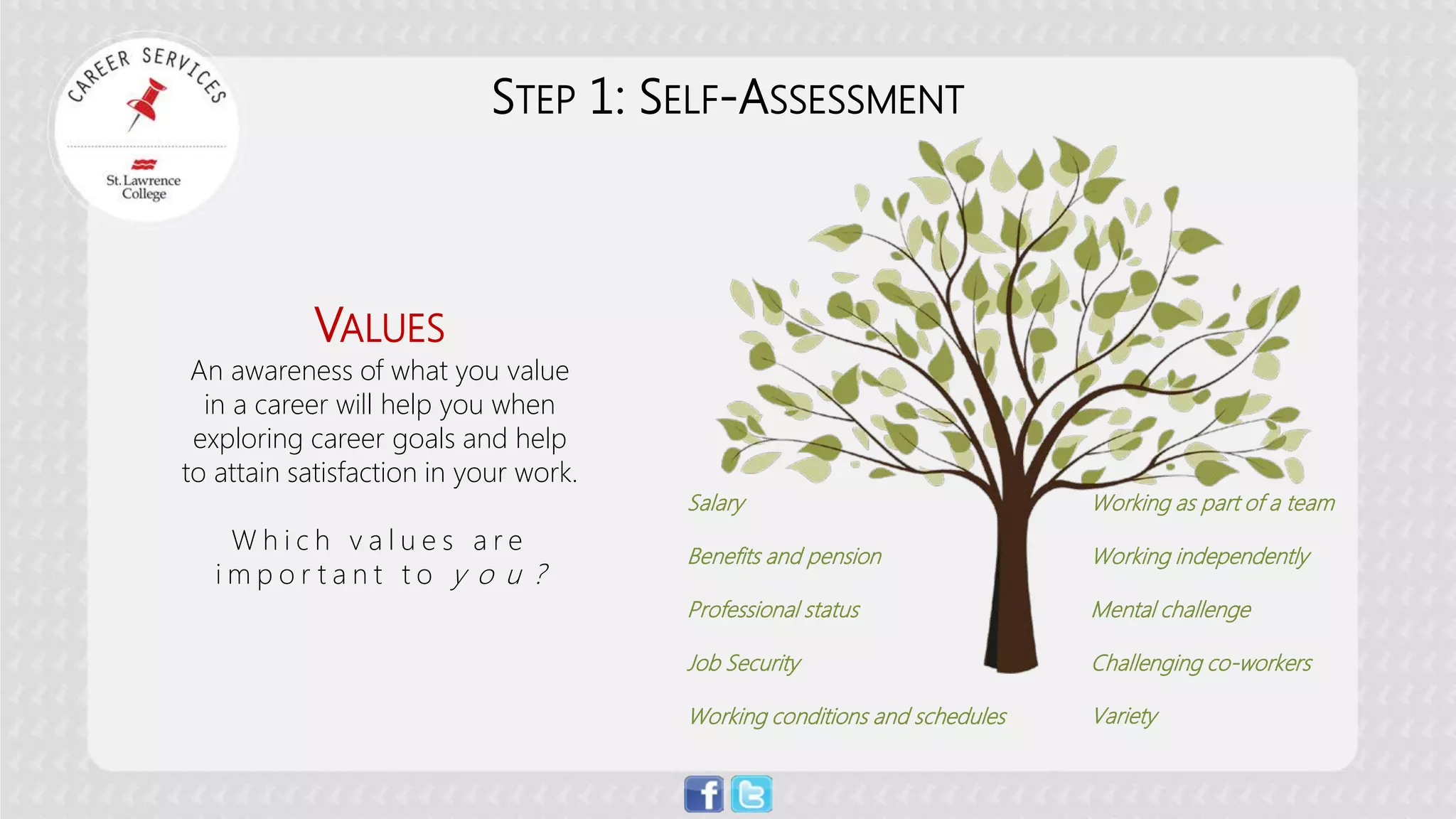
VALUES An awareness of what you value in a career will help you when exploring career goals and help to attain satisfaction in your work. Which values are important to you? 
STEP 1: SELF-ASSESSMENT 
Salary Benefits and pension Professional status Job Security Working conditions and schedules Working as part of a team Working independently Mental challenge Challenging co-workers Variety
INTERESTS 
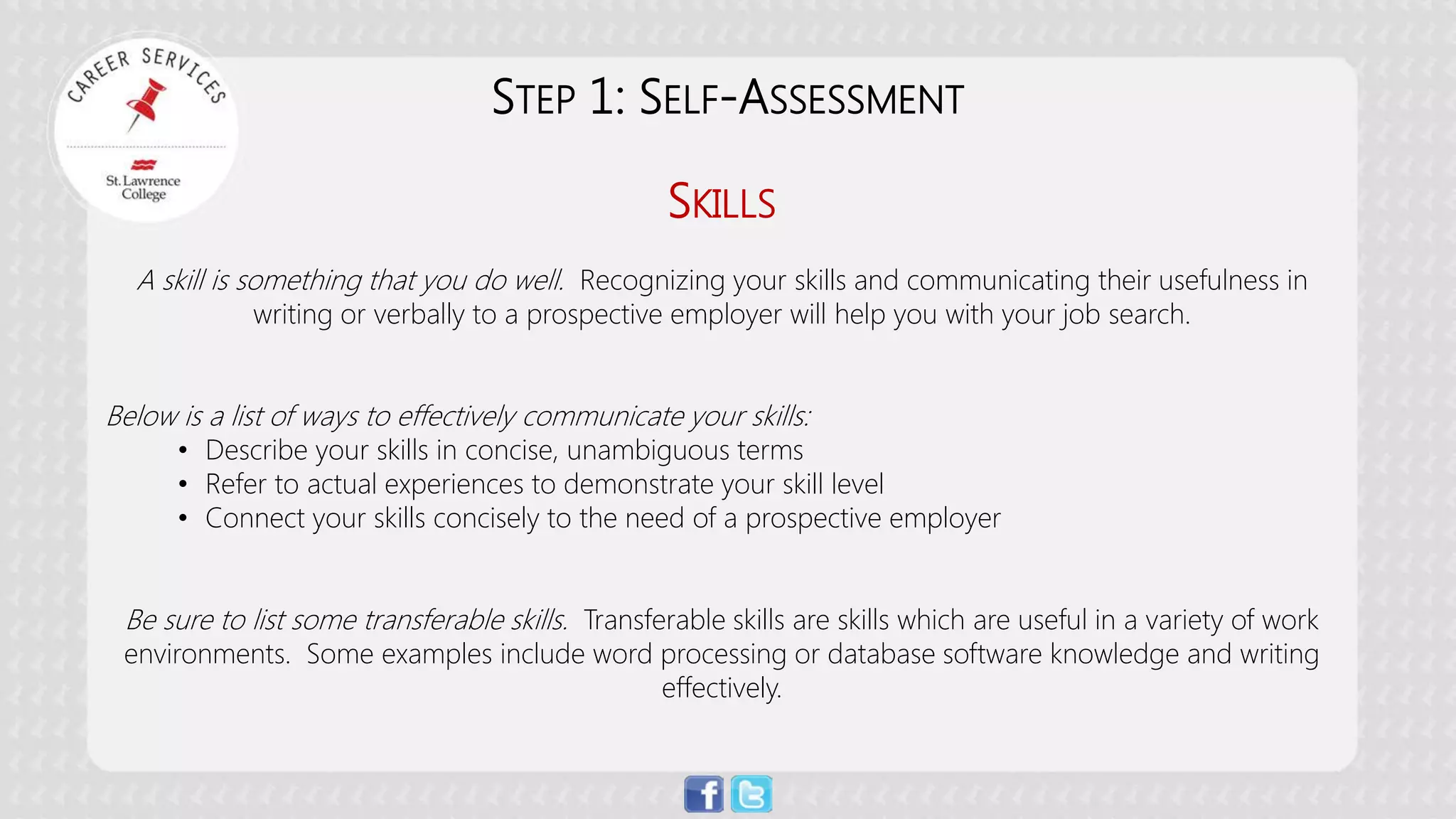
Interests are closely related to values and frequently trigger skill development. You can identify your interests by looking at enduring themes in your life such as activities that persist over time, consistent choices or the way you spend your time. A tip for discovering your interests is to keep a log of what you like to do and then rank them. 
STEP 1: SELF-ASSESSMENT
SKILLS A skill is something that you do well. Recognizing your skills and communicating their usefulness in writing or verbally to a prospective employer will help you with your job search. Below is a list of ways to effectively communicate your skills: 
• 
Describe your skills in concise, unambiguous terms 
• 
Refer to actual experiences to demonstrate your skill level 
• 
Connect your skills concisely to the need of a prospective employer Be sure to list some transferable skills. Transferable skills are skills which are useful in a variety of work environments. Some examples include word processing or database software knowledge and writing effectively. 
STEP 1: SELF-ASSESSMENT
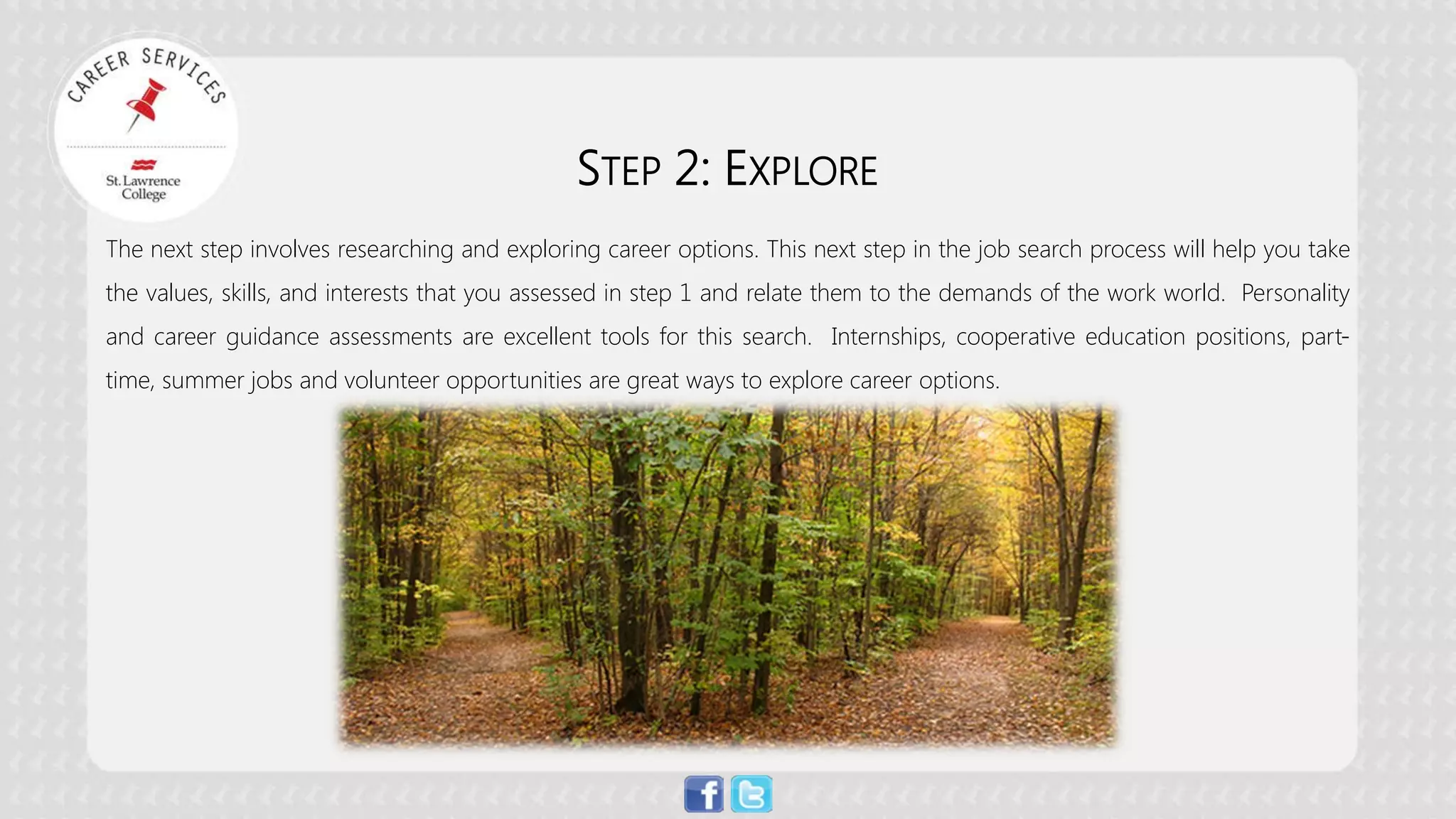
STEP 2: EXPLORE The next step involves researching and exploring career options. This next step in the job search process will help you take the values, skills, and interests that you assessed in step 1 and relate them to the demands of the work world. Personality and career guidance assessments are excellent tools for this search. Internships, cooperative education positions, part- time, summer jobs and volunteer opportunities are great ways to explore career options.
STEP 3: CHOOSE A PATH 
After you have completed researching possible careers, several 
field options will emerge as realistic and attractive. It is most likely 
that there will not be one single career that will utilize all of your 
skills, interests and values. Therefore it is important that you try 
to target a career that will satisfy some of your high priority needs. 
At this point it would be beneficial to speak to a career counselor 
or get feedback from professionals in the prospective field which 
you have chosen. Good research on employers will not only 
provide you with a competitive edge, but it will also help you 
when deciding which employers you want to reach and which 
strategies you could use to contact them.
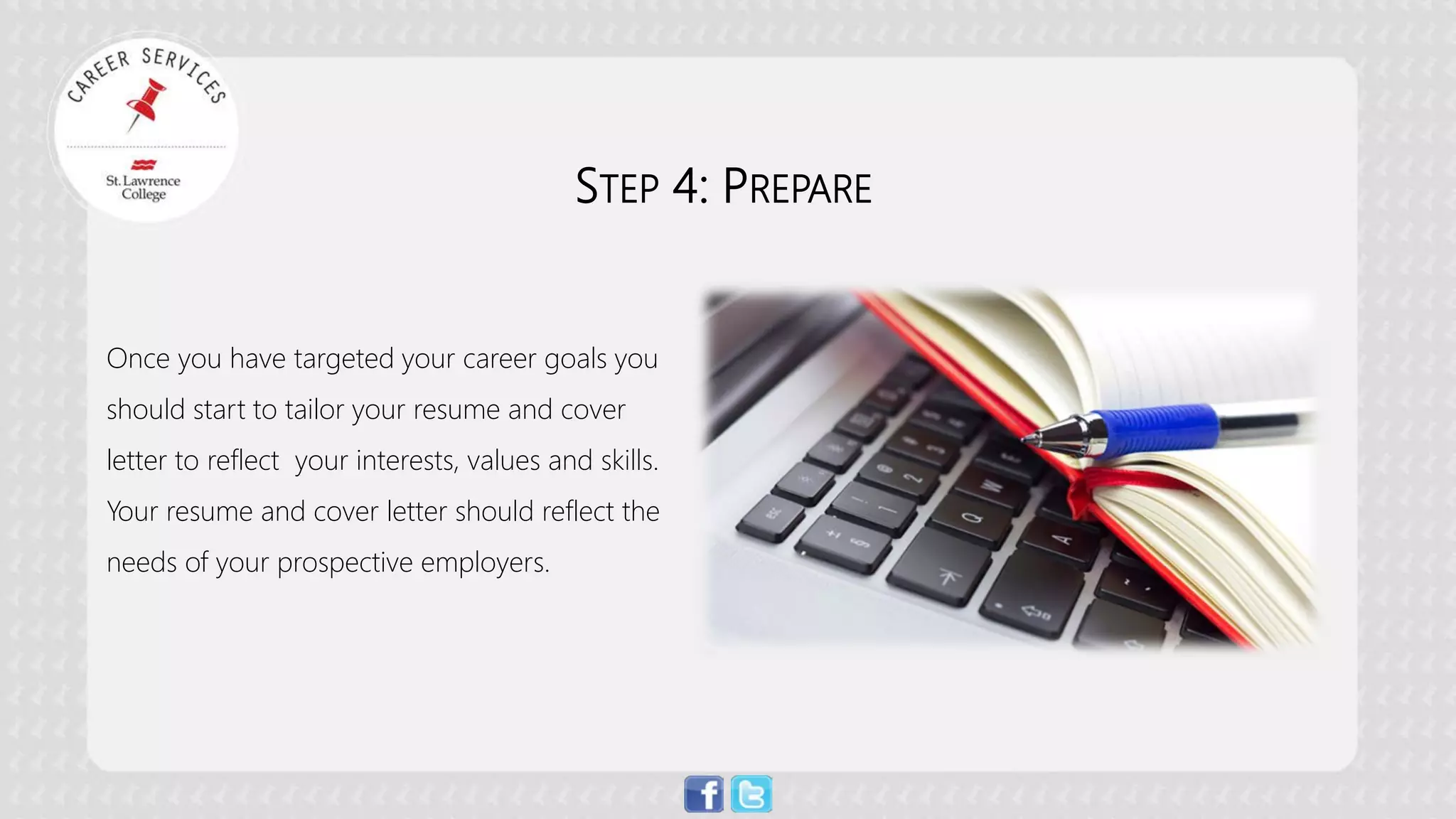
STEP 4: PREPARE Once you have targeted your career goals you should start to tailor your resume and cover letter to reflect your interests, values and skills. Your resume and cover letter should reflect the needs of your prospective employers.
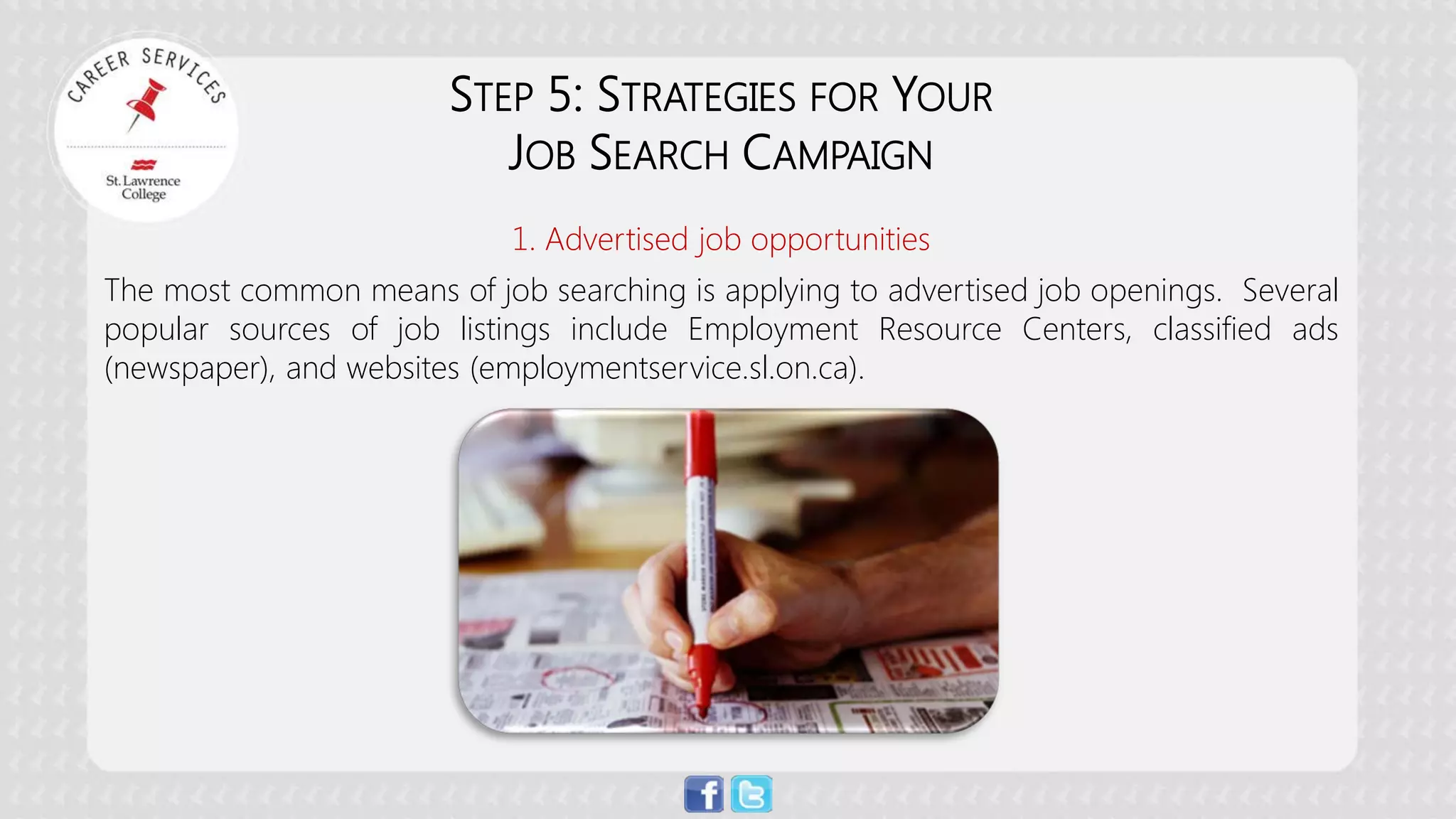
STEP 5: STRATEGIES FOR YOUR JOB SEARCH CAMPAIGN 1. Advertised job opportunities The most common means of job searching is applying to advertised job openings. Several popular sources of job listings include Employment Resource Centers, classified ads (newspaper), and websites (employmentservice.sl.on.ca).
STEP 5: STRATEGIES FOR YOUR 
JOB SEARCH CAMPAIGN 
2. Develop a contact network 
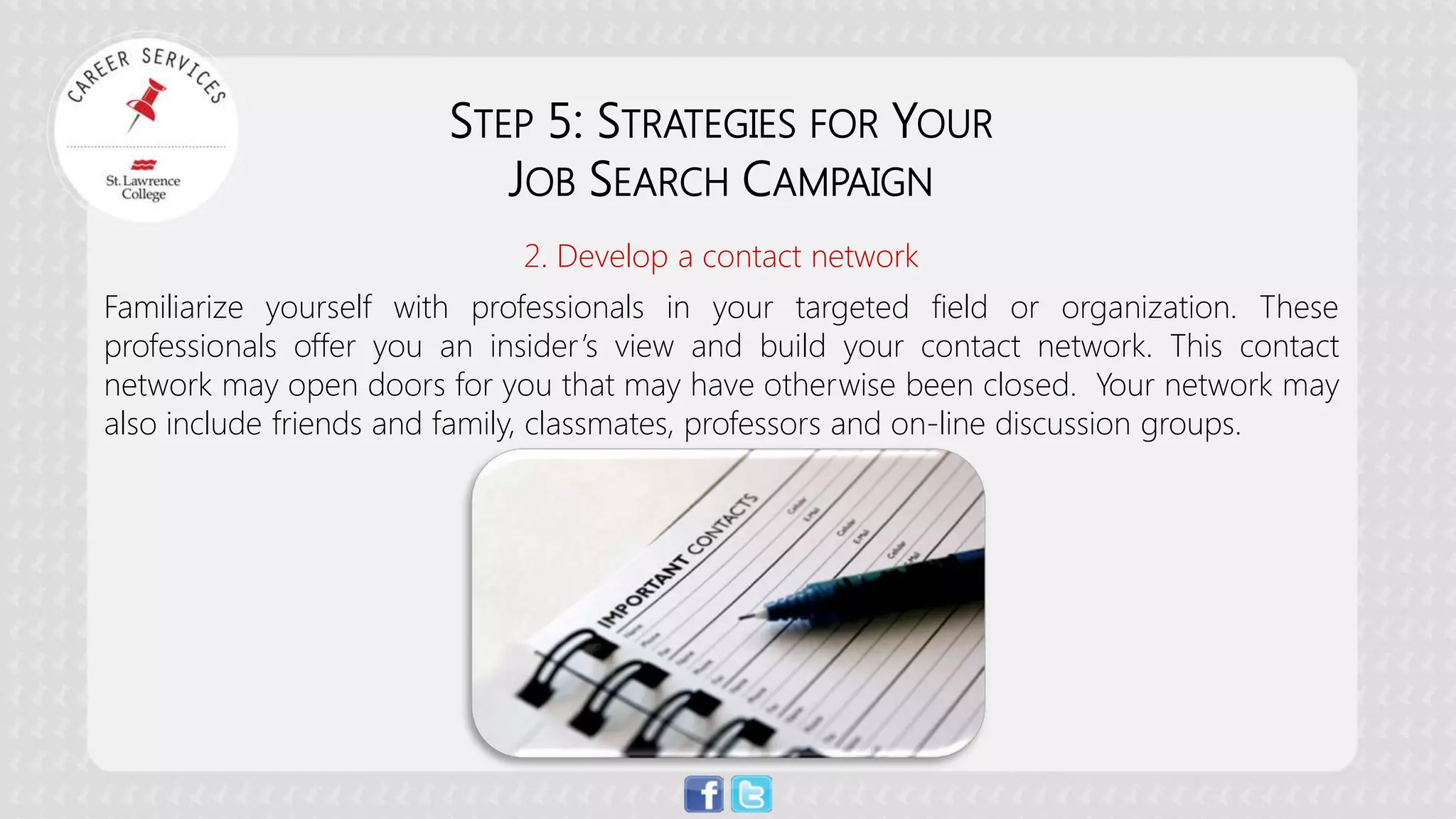
Familiarize yourself with professionals in your targeted field or organization. These professionals offer you an insider’s view and build your contact network. This contact network may open doors for you that may have otherwise been closed. Your network may also include friends and family, classmates, professors and on-line discussion groups.
STEP 5: STRATEGIES FOR YOUR JOB SEARCH CAMPAIGN 3. Contact Employers Directly There are several ways that a job seeker can go about contacting a potential employer, including: 
•Send a cover letter and resume to the Human Resources department. 
•Contact managers in organizations that interest you to request an appointment to discuss possible employment opportunities. During your appointment emphasize your knowledge and interest in their organization. 
•Be sure to follow up all interviews with a thank you letter or phone call.
STEP 5: PLAN AND CONDUCT A JOB SEARCH CAMPAIGN 4. Follow-up and record keeping No matter how many job search strategies you choose, always be sure to follow up and keep records. Maintain a careful record of all interviews, thank you notes and referrals. 5. Be Persistent If your job search is not producing the results you are looking for try a new approach. If your job search campaign has been successful, you may end up with multiple offers. Determine which position you would like to accept and thank everyone else.
STEP 6: NETWORK 
What is networking? 
Networking is the art of building alliances. It's talking to people you know and asking them to introduce you to others. It's not contacting everyone you know when you are looking for a new job and asking if they know of any job openings. Networking starts long before a job search, and you probably don't even realize you are doing it. 
What is a network? 
A network is a group of people connected to you through family, friends, education, employment and community. 
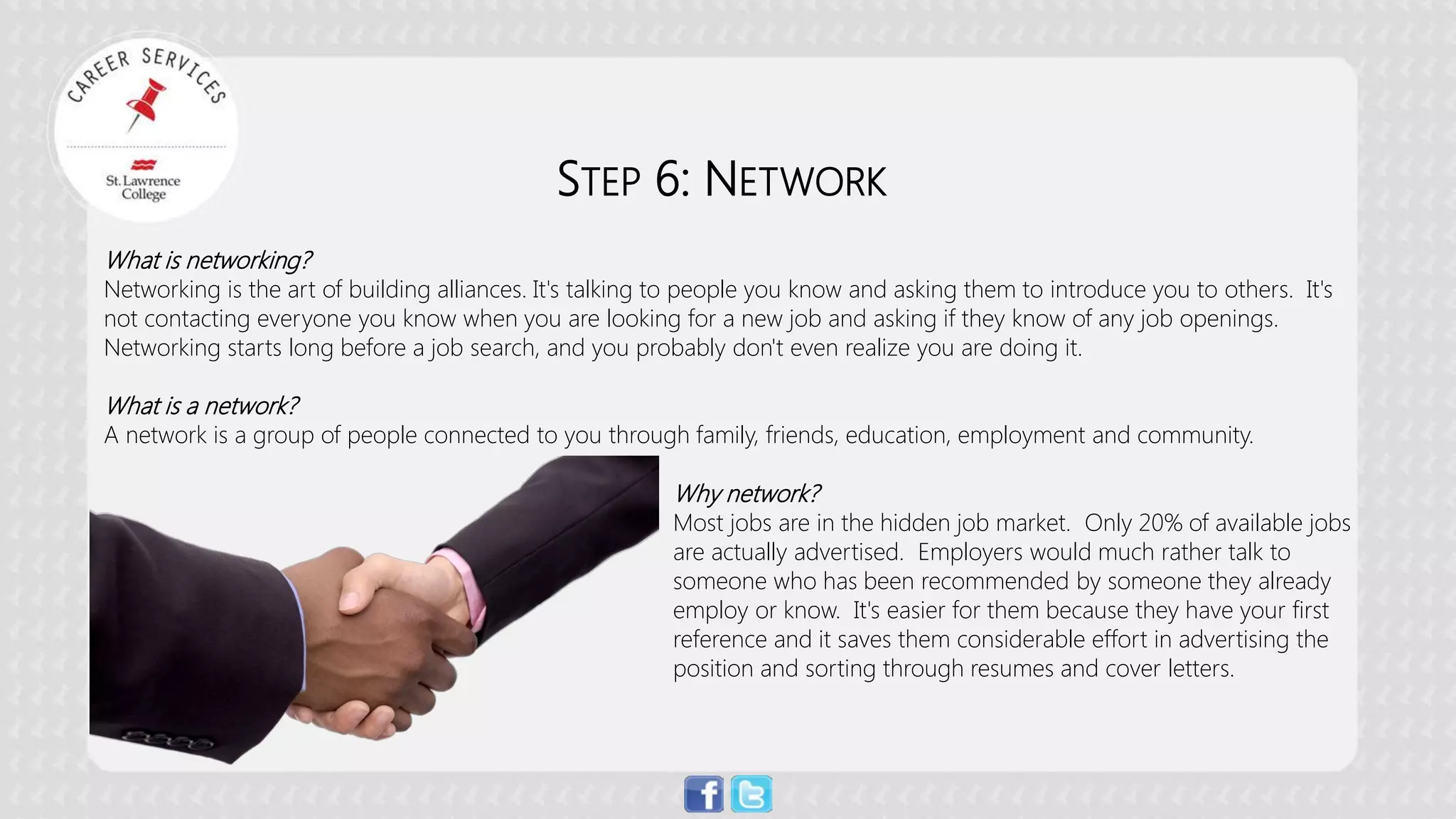
Why network? Most jobs are in the hidden job market. Only 20% of available jobs are actually advertised. Employers would much rather talk to someone who has been recommended by someone they already employ or know. It's easier for them because they have your first reference and it saves them considerable effort in advertising the position and sorting through resumes and cover letters.
STEP 6: NETWORK You are networking when you: 
•Attend professional association meetings or trade shows 
•Talk to other people at sporting or music events 
•Volunteer for a local charity or community event 
•Join a social club or religious group Who should be in my network? 
•Family 
•Friends 
•Neighbours 
•Employers and co-workers 
•Teachers 
•Teammates and classmates 
•Coaches 
•Club members and leaders 
•Community leaders
JOB SEARCH WEBSITES 
Adecco 
Apparel Human Resources Council 
CACEE 
Canada Employment Weekly 
Canada Job Search 
Canadian Forces Personnel Support Agency 
Canuck Careers 
Charity Village 
City of Kingston Career Opportunities 
Cool Jobs Canada 
Cultural Human Resources Council 
Drake International 
Employment & Business Journal 
Job Shark 
Kelly Services 
Kingston Canada 
Kingston Employment Youth Services 
Kingston This Week 
Kijiji Kingston 
Manpower 
Monster 
Public Service Commission of Canada 
Service Canada Job Bank 
St. Lawrence College Career Services 
St. Lawrence College Employment Service 
Working in Canada 
The Kingston Whig Standard 
The Ontario Public Service Careers 
Workopolis 
Youth Canada 
Job Search Websites
FOR MORE INFORMATION: VISIT THE CAREER CENTRE: Room 11180 - 100 Portsmouth Avenue, Kingston, ON VISIT OUR WEBSITE: www.stlawrencecollege.ca/careerservices EMAIL: careerservices@sl.on.ca PHONE: 613-544-5400 Ext. 1844 613-345-0660 Ext. 1844 613-933-3259 Ext. 1844

6 Steps for a Successful Job Search!

  • 1.
    Your Guide toan Effective Job Search! 6 Steps To Get You Through Your Job Search (With Success!)
  • 3.
    “Successful job seekersmust have both good information and well-developed job hunting skills. Three important factors for a successful job search are an awareness of your skills and goals, an understanding of the labour market and a well planned job search campaign”. The following six steps will help you conduct an effective job search… LINE & SINKER: YOUR NEXT JOB COULD BE THE ‘CATCH OF THE DAY’
  • 4.
    Identifying your values,interests and skills will help you with your job search. Although self-assessment can be a time consuming process it will provide you with valuable information and help you to facilitate career decisions and prepare you to market yourself as a potential employee. STEP 1: SELF-ASSESSMENT
  • 5.
    VALUES An awarenessof what you value in a career will help you when exploring career goals and help to attain satisfaction in your work. Which values are important to you? STEP 1: SELF-ASSESSMENT Salary Benefits and pension Professional status Job Security Working conditions and schedules Working as part of a team Working independently Mental challenge Challenging co-workers Variety
  • 6.
    INTERESTS Interests areclosely related to values and frequently trigger skill development. You can identify your interests by looking at enduring themes in your life such as activities that persist over time, consistent choices or the way you spend your time. A tip for discovering your interests is to keep a log of what you like to do and then rank them. STEP 1: SELF-ASSESSMENT
  • 7.
    SKILLS A skillis something that you do well. Recognizing your skills and communicating their usefulness in writing or verbally to a prospective employer will help you with your job search. Below is a list of ways to effectively communicate your skills: • Describe your skills in concise, unambiguous terms • Refer to actual experiences to demonstrate your skill level • Connect your skills concisely to the need of a prospective employer Be sure to list some transferable skills. Transferable skills are skills which are useful in a variety of work environments. Some examples include word processing or database software knowledge and writing effectively. STEP 1: SELF-ASSESSMENT
  • 8.
    STEP 2: EXPLOREThe next step involves researching and exploring career options. This next step in the job search process will help you take the values, skills, and interests that you assessed in step 1 and relate them to the demands of the work world. Personality and career guidance assessments are excellent tools for this search. Internships, cooperative education positions, part- time, summer jobs and volunteer opportunities are great ways to explore career options.
  • 9.
    STEP 3: CHOOSEA PATH After you have completed researching possible careers, several field options will emerge as realistic and attractive. It is most likely that there will not be one single career that will utilize all of your skills, interests and values. Therefore it is important that you try to target a career that will satisfy some of your high priority needs. At this point it would be beneficial to speak to a career counselor or get feedback from professionals in the prospective field which you have chosen. Good research on employers will not only provide you with a competitive edge, but it will also help you when deciding which employers you want to reach and which strategies you could use to contact them.
  • 10.
    STEP 4: PREPAREOnce you have targeted your career goals you should start to tailor your resume and cover letter to reflect your interests, values and skills. Your resume and cover letter should reflect the needs of your prospective employers.
  • 11.
    STEP 5: STRATEGIESFOR YOUR JOB SEARCH CAMPAIGN 1. Advertised job opportunities The most common means of job searching is applying to advertised job openings. Several popular sources of job listings include Employment Resource Centers, classified ads (newspaper), and websites (employmentservice.sl.on.ca).
  • 12.
    STEP 5: STRATEGIESFOR YOUR JOB SEARCH CAMPAIGN 2. Develop a contact network Familiarize yourself with professionals in your targeted field or organization. These professionals offer you an insider’s view and build your contact network. This contact network may open doors for you that may have otherwise been closed. Your network may also include friends and family, classmates, professors and on-line discussion groups.
  • 13.
    STEP 5: STRATEGIESFOR YOUR JOB SEARCH CAMPAIGN 3. Contact Employers Directly There are several ways that a job seeker can go about contacting a potential employer, including: •Send a cover letter and resume to the Human Resources department. •Contact managers in organizations that interest you to request an appointment to discuss possible employment opportunities. During your appointment emphasize your knowledge and interest in their organization. •Be sure to follow up all interviews with a thank you letter or phone call.
  • 14.
    STEP 5: PLANAND CONDUCT A JOB SEARCH CAMPAIGN 4. Follow-up and record keeping No matter how many job search strategies you choose, always be sure to follow up and keep records. Maintain a careful record of all interviews, thank you notes and referrals. 5. Be Persistent If your job search is not producing the results you are looking for try a new approach. If your job search campaign has been successful, you may end up with multiple offers. Determine which position you would like to accept and thank everyone else.
  • 15.
    STEP 6: NETWORK What is networking? Networking is the art of building alliances. It's talking to people you know and asking them to introduce you to others. It's not contacting everyone you know when you are looking for a new job and asking if they know of any job openings. Networking starts long before a job search, and you probably don't even realize you are doing it. What is a network? A network is a group of people connected to you through family, friends, education, employment and community. Why network? Most jobs are in the hidden job market. Only 20% of available jobs are actually advertised. Employers would much rather talk to someone who has been recommended by someone they already employ or know. It's easier for them because they have your first reference and it saves them considerable effort in advertising the position and sorting through resumes and cover letters.
  • 16.
    STEP 6: NETWORKYou are networking when you: •Attend professional association meetings or trade shows •Talk to other people at sporting or music events •Volunteer for a local charity or community event •Join a social club or religious group Who should be in my network? •Family •Friends •Neighbours •Employers and co-workers •Teachers •Teammates and classmates •Coaches •Club members and leaders •Community leaders
  • 17.
    JOB SEARCH WEBSITES Adecco Apparel Human Resources Council CACEE Canada Employment Weekly Canada Job Search Canadian Forces Personnel Support Agency Canuck Careers Charity Village City of Kingston Career Opportunities Cool Jobs Canada Cultural Human Resources Council Drake International Employment & Business Journal Job Shark Kelly Services Kingston Canada Kingston Employment Youth Services Kingston This Week Kijiji Kingston Manpower Monster Public Service Commission of Canada Service Canada Job Bank St. Lawrence College Career Services St. Lawrence College Employment Service Working in Canada The Kingston Whig Standard The Ontario Public Service Careers Workopolis Youth Canada Job Search Websites
  • 18.
    FOR MORE INFORMATION:VISIT THE CAREER CENTRE: Room 11180 - 100 Portsmouth Avenue, Kingston, ON VISIT OUR WEBSITE: www.stlawrencecollege.ca/careerservices EMAIL: careerservices@sl.on.ca PHONE: 613-544-5400 Ext. 1844 613-345-0660 Ext. 1844 613-933-3259 Ext. 1844