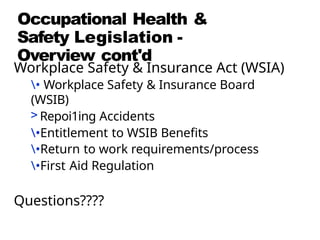
Occupational Health &
SafetyLegislation -
Overview cont'd
Workplace Safety & Insurance Act (WSIA)
• Workplace Safety & Insurance Board
(WSIB)
> Repoi1ing Accidents
•Entitlement to WSIB Benefits
•Return to work requirements/process
•First Aid Regulation
Questions????
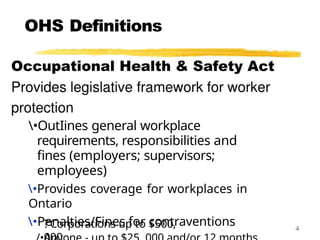
4.
OHS Definitions
•OutIines generalworkplace
requirements, responsibilities and
fines (employers; supervisors;
employees)
•Provides coverage for workplaces in
Ontario
•Penalties/Fines for contraventions
?‘Corporations up to $500, 4
5.
5
OHS Definitions
Regulations
Applied underthe Act
• Specific requirements for
procedures or equipment; chemicals
(WHMIS); designated substances;First
Aid; workplace conditions; protective
equipment etc...
6.
Definitions Continued
6
•Person w
h
ohas authority o
v
er a w
o
rk
e
r o
r
is in
c
h
a
rg
e of w
o
rk
p
l
a
c
e
•TypicaIIy have hiring/firing power
Worker
•Anyone who performs work for pay.
7.
Definitions Continued
/• Knowledgeableabout hazards in
workplace 7
• Investigate critical injuries (places life in jeopardy;
unconsciousness; substantial blood loss; fractured
arm or leg; amputation or arm/hand/leg/foot);
burns to major portion of body; loss of sight in an
eye)
Competent Person
• A person who is qualified
(knowIedge,training or experience) to
organize and perform work safely
T Familiar with legislative requirements
• Act & Regulations
8.
Employer Responsibilities
Continued
”e Makesure first aid is given
promptly 8
‘> Make sure proper equipment is used and in
good condition
• Protective devices, equipment and materials
asprescribed
> Provide instruction, training and supervision
to
protect H&S of worker
¥- Take every precaution reasonable in the
circumstances for the protection of a
worker
The biq hammer
9.
Supervisor Responsibilities
9
•Ensure workerswork in compliance with
the
Act and Regs
•Ensure workers use or wear
equipment, protective devices or
clothing required by employer
fi• Take every precaution reasonable in the
circumstances for the protection of a
worker
•Provide written instruction where
10.
1
0
• Know yourrights and responsibilities under
the
OHS Act and Regulations
• Use/wear any protective equipment
required
• E.g. hearing protection; protective
gloves; safety glasses
• Know proper procedures for any
equipment to be used or process to be
performed
11.
1
1
Employee Responsibilities
Cont'd
• Askfor help if you don't know how to
use“a particular piece of equipment or
perform a particular task.
• Report any unsafe conditions or
broken/defective equipment to your
supervisor
• Report accidents immediately
• Know emergency evacuation procedures
• Know where first aid stations are located
12.
Employee Responsibilities
Cont°d ......
...
—.
,
• Know where the nearest fire
extinguisher is
located in your area and how to use
one
• Only operate equipment if authorized
and trained.
• K
n
o
w the safety resources available to
you:
• Supervisor
• Joint Health & Safety Committee
• OHS Coordinator/Department 1
2
13.
Health
Committee
s
13
Safet
y
— .
. :.
• Required in workplaces with twenty or
more
workers
• At least 2 members for < 50
employees; at least 4
members for 50 or more employees
> Mgt. and labour representatives (at
least 50O
›9
must be non-mgt.)
• Certified members (Mgt and Labour) —
certified by WSIB (special training
14.
14
Joint Health &Safety
Committees Cont°d
Typically have one JHSC per work
location but may apply to Ministry for
a multi-site committee
• Advisory committee
•Identify hazards and make
recommendations to
improve safety
•Recommend practices, procedures
and programs
• Post member names and work
15.
Joint Health &Safety
Committees Cont°d
15
unions
>Meet a
t l
e
a
s
t x 3 m
o
n
t
h
s
>I
n
s
p
e
c
t
i
o
n
s
• P
h
y
s
i
c
a
l
ly i
n
s
p
e
c
t w
o
r
k
p
l
a
c
e a
t l
e
a
s
t
m
o
n
t
h
ly
• L
a
r
g
e w
o
r
k
p
l
a
c
e
s
D
e
v
e
l
o
p a s
c
h
e
d
u
l
e to c
o
v
e
r the entire
w
o
rk
p
l
a
c
eat l
e
a
s
t 1/yr
.
16.
Employee
Rights
Anyone (exceptions include— police;
ambulance; fire or where refusal would
directly endanger someone) can refuse to
perform work if they believe they are
endangered.
•The Right to Participate
Investigations, Inspections
17.
Right to Know-
Workplace
Hazard
s ! ——
.
. —
Obviously to w
o
rk safely
, you must k
n
o
w
wha
t
hazards you m
a
y be exposed to:
Manually handling materials
• Use proper lifting techniques
• Use 2 hands to grab heavy materials
• Keep the load close to your body
• Keep you back straight
• LiX with your legs....not your back!
• Avoid awkward reaches
• Ask for help with very heavy and/or large
items
•
Office Hazards
Chemicals
• Pipesystems/processes
• Cleaning agents
• Toners
• Blueprint machines
• Flammable/combustible liquids
Indoor air
• T
emperature, R
H
, stale stuffy air; C
O
,
CO2
• Mould 19
20.
Workplace Hazards Continued
WHMISRegulation applies in respect to
hazardous products used, stored and handled at
a workplace. This is a far reaching regulation
affecting virtually all employers
• Glues/adhesives
• Toners
• Oils/Fuels
• Cleaning agents
• Paints
• Lab operations
• Compressed gases/aerosols
• Retail 2
0
21.
Workplace Hazards Continued
TrippingHazards
• Extension cords or other wires
• Filing Cabinets
• Beware of open drawers (you may bang into or trip
over them.
• M
a
k
e sure cabinets are not top-hea
vy —
l
o
w le
v
eldraw
ers should b
e loaded first — w
i
t
h
hea
vy i
t
e
m
s f
orstability
.
• Only open one drawer at a time (safety feature).
2
1
22.
Continue
d
22
Workplace
Tripping Hazards Cont*d
•Materials stored on floor
• Chairs, boxes or other items
• WeLSlippery Surfaces
• Wet floors — clean spills promptly
or report to housekeeping
Pushing/Pulling rolling stock (e.g.
Carts)
• Pushing is usually more safe than
pulling
• Use body weight to push
• Can see where you're going
24
Workplace Hazards Continued
Electrical
•Donot use electrical equipment in
w
e
t
conditions.
• Caution around water/sinks
• Make sure electrical cords are in
good
condition
• Do not overload circuits
25.
25
Workplace Hazards
Continued ...,......:
VideoDisplay Terminals (abbr. VDTs)
Ergonomic considerations
• A
v
oid co
nti
nued use for e
x
t
e
n
d
e
d
periods t
o
al
l
o
w y
our body (wrisLarms/eyes/back) t
o
rest
• T
a
k
e s
h
o
rt b
re
a
k
s (5 min/hr).
• “Break” refers to doing something
(another task perhaps) that uses other
muscles/actions - It doesn't necessarily
have to be a total break.
26.
Workplac
e
26
Continue
d
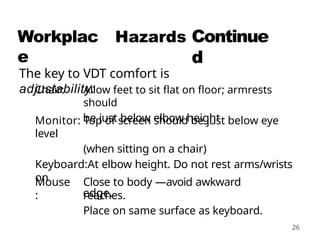
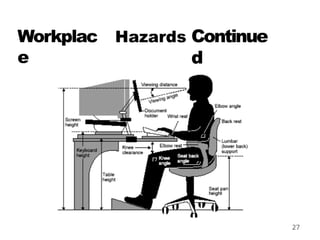
The key toVDT comfort is
adjustability:
Chair: Allow feet to sit flat on floor; armrests
should
be just below elbow height
Monitor: Top of screen should be just below eye
level
(when sitting on a chair)
Keyboard:At elbow height. Do not rest arms/wrists
on
edge.
Mouse
:
Close to body —avoid awkward
reaches.
Place on same surface as keyboard.
Fire
Safety
28
•SingIe Stage (onealarm only)
• Evacuate when alarm sounds
•2-Stage (two different alarms)
• First alarm (intermittent)
means----be prepared to evacuate, wait for
instructions
• Second alarm (constant) - Evacuate
• Know your escape routes
30.
Overview
• Employers andworkers in respect of controlled
products used, stored and handled at a
w
orkplace
• Far reaching regulation that applies to virtually
all
workplaces
Three components of WHMIS:
• Material Safety Data Sheets
(MSDS)
• Labels 3
O
31.
Roles and Responsibilities
Suppliers'
Must evaluate/determine whether their
products are
classified as a “controlled” product.
• Criteria under the Hazardous Products Act — very
technical
x There are several exemptions to WHMIS
Consumer products
Explosives (has its own Act and Regulations)
Tobacco Products
Food, Drugs and Cosmetics (Food and Drug Act/Regs)
Radiation (has its own specific Act and Regulations)
Wood or products made of
wood Manufactured articles
Hazardous 3
1
32.
Suppliers Cont°d
•Must ensureproducts are classified
properly (governed by Hazardous
Products Act and Regulations)
•Must ensure products are properly
labeled
‘Must provide material safety data
sheets
3
2
33.
Suppliers
Cont'd
Several Classifications forControlled
Products
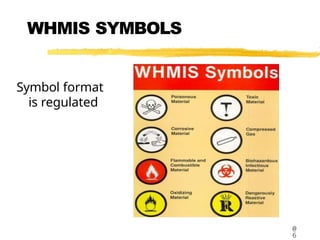
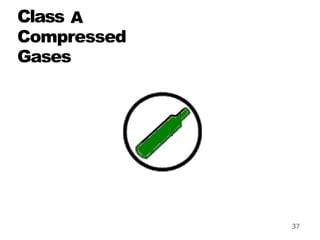
•Compressed Gases
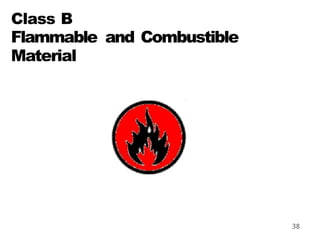
•Flammable and Combustible Material
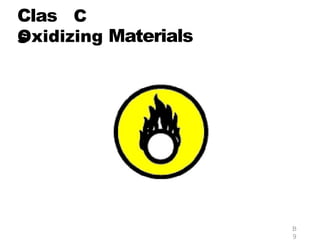
•Oxidizing Materials
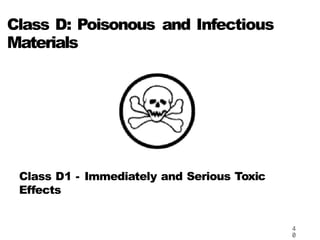
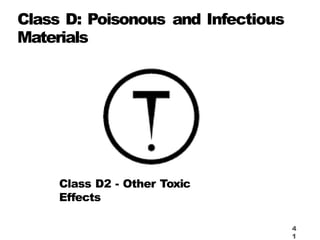
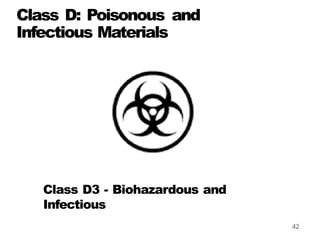
•Poisonous and Infections Materials
• Immediate and Serious
• Other Toxic Effects
• Biohazardous Infectious
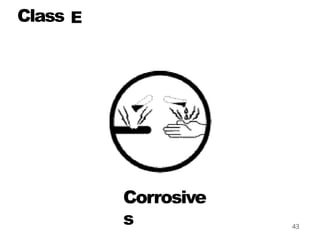
•Corrosive
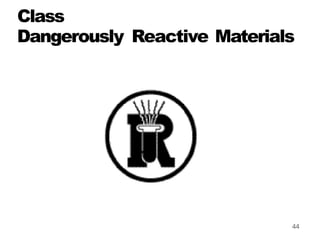
•Dangerously Reactive
45
Material Safety DataSheets
• Material Safety Data Sheets are required for all
hazardous substances.
s• Valid for 3 years
/• They contain technical product- specific
information for hazardous products.
• At least 9 sections of information required
46.
46
MSDS Cont'd
1) ProductInformation (Product Name; Supplier,
Manufacturer)
2) Hazardous Ingredients (concentration/toxicity)
3) Physical Data (solid/liquid/gas....)
4) Fire or Explosion Hazard (conditions for
ignition/explosion)
5) Reactivity Data (stability/ other chemicals..)
6) Toxicological Properties (short and long-term effects.)
7) Preventive Measures (ventilation, ppe; emergency
measures)
8) First Aid (treatment for overexposed individuals -all
routes
of exposure)
47.
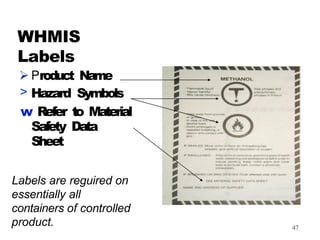
WHMIS
Labels
47
roduct Name
> HazardSymbols
w Refer to Material
Safety Data
Sheet
Labels are reguired on
essentially all
containers of controlled
product.
49
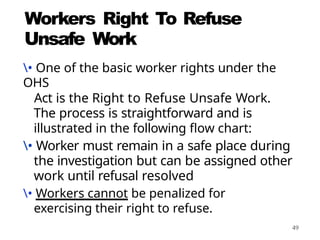
Workers Right ToRefuse
Unsafe Work
• One of the basic worker rights under the
OHS
Act is the Right to Refuse Unsafe Work.
The process is straightforward and is
illustrated in the following flow chart:
• Worker must remain in a safe place during
the investigation but can be assigned other
work until refusal resolved
• Workers cannot be penalized for
exercising their right to refuse.
50.
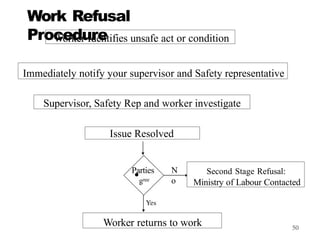
Work Refusal
Procedure
50
Worker Identifiesunsafe act or condition
Immediately notify your supervisor and Safety representative
Supervisor, Safety Rep and worker investigate
Issue Resolved
N
o
Parties
•gree
Second Stage Refusal:
Ministry of Labour Contacted
Worker returns to work
51.
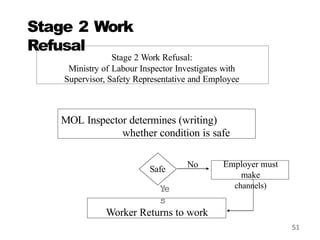
Stage 2 Work
Refusal
51
Stage2 Work Refusal:
Ministry of Labour Inspector Investigates with
Supervisor, Safety Representative and Employee
MOL Inspector determines (writing)
whether condition is safe
Safe
No Employer must
make
channels)
Ye
s
Worker Returns to work
WSIA: Regulation
53
Regulation appliesto all employers
covered
by WSIB.
• Requires all employers to have first aid
equipment, facilities and trained personnel
• Employees required to seek first aid in
event of an accident
54.
54
Reporting an
Accident
If youhave an accident.
•Repoi1 all accidents to your supervisor
•Get first aid or medical aid immediately
•Medical aid accidents must be reported to
the WSIB — Employer Accident Report
(Form 7) for benefits
55.
55
In event ofan accident requiring
medical
attentio
n:
s• Employer must notify the WSIB (72 hrs).
• Form 7 (Repol of Accident)
• Employer must work with employee (and
medical professionals) to safely return
them to work
• May require modified duties or other
workplace accommodations
• Duty to accommodate
56.
56
Adjudication and Be
-
nefits
Claimsare reviewed by WSIB to
determine workplace relationship.
s• If allowed, worker entitled to
benefits
• Health care
• Loss of earnings (85% net income) if
applicable.
• Non-economic loss (ca. pain and
suffering)
• Future economic loss (oPset future loss
of earnings if applicable).
57.
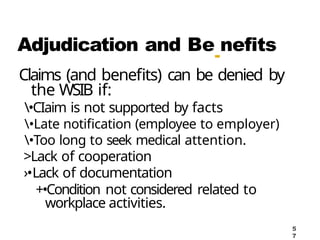
Adjudication and Be
-
nefits
Claims(and benefits) can be denied by
the WSIB if:
•CIaim is not supported by facts
•Late notification (employee to employer)
•Too long to seek medical attention.
>Lack of cooperation
›•Lack of documentation
+•Condition not considered related to
workplace activities.
5
7
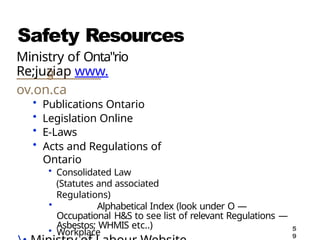
Safety Resources
Ministry ofOnta"rio
Re;juziap www.
ov.on.ca
• Publications Ontario
• Legislation Online
• E-Laws
• Acts and Regulations of
Ontario
• Consolidated Law
(Statutes and associated
Regulations)
• Alphabetical Index (look under O —
Occupational H&S to see list of relevant Regulations —
Asbestos; WHMIS etc..)
• Workplace 5
9
60.
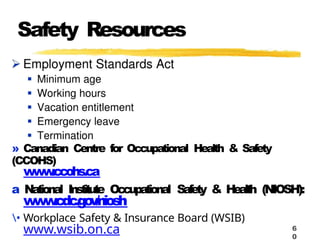
Safety Resources
» CanadianCentre for Occupational Health & Safety
(CCOHS)
www
.ccohs.ca
a Na
tional I
ns
ti
tute Occupa
tional Saf
ety & H
e
al
th (NIOSH):
www
.cdc.go
v/niosh
• Workplace Safety & Insurance Board (WSIB)
www.wsib.on.ca 6
0