4/26/2010
sales@ebusinessmantra.com               1
   Web Browser is a software that is installed on your
    computer. It is used to locate and display web
    pages and other online content. Behind the scene,
    a browser performs lot of functions but its key role
    is to take your request to the web server and bring
    the content to you and display it.


                                                   4/26/2010
                    sales@ebusinessmantra.com                  2
   Finds the web server
   Takes your request and transports data
   Transports cookies
   Brings back content
   Processes the content and renders it
   Executes scripts (code)


                                               4/26/2010
                   sales@ebusinessmantra.com               3
   Enter a URL into a browser
    ◦ Breaks the URL into a host + path
       Asks a DNS server for an IP address for the host
       DNS server returns a IP address for that host
    ◦ Browser sends a request to the IP address
       Path is used to determine what file to obtain
       Data for web server to process, maintain state
       Server replies to the request – HTML, PDF, mp3, etc.
    ◦ Browser reads the HTML file and asks for all the files referenced in the
      original HTML file
       These additional files could be images, more HTML, or other types on content.
       Additional files could reside on different hosts requiring more DNS requests
       After browser gets all the pieces, it processes the data and renders a single
        “page”
       Non-HTML file are opened in the browser of associated application.


                                                                               4/26/2010
                            sales@ebusinessmantra.com                                      4
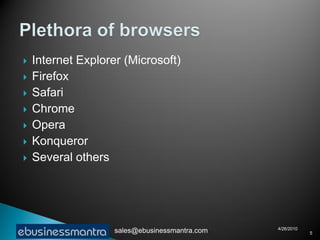
   Internet Explorer (Microsoft)
   Firefox
   Safari
   Chrome
   Opera
   Konqueror
   Several others


                                                4/26/2010
                    sales@ebusinessmantra.com               5
4/26/2010
sales@ebusinessmantra.com               6
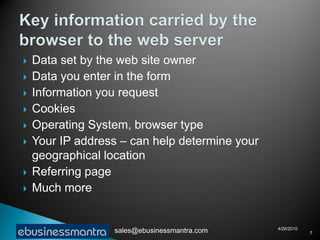
   Data set by the web site owner
   Data you enter in the form
   Information you request
   Cookies
   Operating System, browser type
   Your IP address – can help determine your
    geographical location
   Referring page
   Much more


                                                4/26/2010
                  sales@ebusinessmantra.com                 7
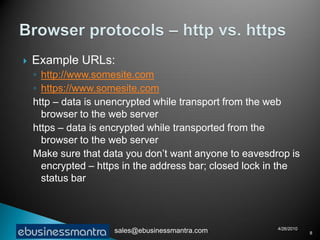
   Example URLs:
    ◦ http://www.somesite.com
    ◦ https://www.somesite.com
    http – data is unencrypted while transport from the web
      browser to the web server
    https – data is encrypted while transported from the
      browser to the web server
    Make sure that data you don’t want anyone to eavesdrop is
      encrypted – https in the address bar; closed lock in the
      status bar


                                                         4/26/2010
                     sales@ebusinessmantra.com                       8
4/26/2010
sales@ebusinessmantra.com               9
   Use one browser for your “important” surfing and another for “casual”
    browsing. That way data from one can't leak to the other (generally
    speaking)
   Always keep an eye on the URL in the address bar
   Read, Pause before clicking on anything
   Logout and always close the browser window
   Nothing is “really” free. Only download
    files from websites you trust
   Don’t open attachments forwarded from your friend’s computer is
    corrupted
   Logout and close browser/tab
   The browser’s back and refresh features can be used to steal
    passwords from insecurely written applications.
   Be careful of Google search results
   Always type URL for sites where confidential information is in use.


                                                                     4/26/2010
                          sales@ebusinessmantra.com                              10
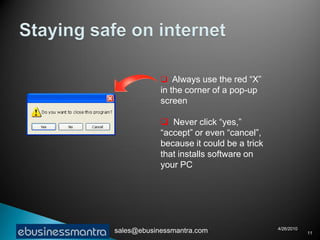
 Always use the red “X”
            in the corner of a pop-up
            screen

             Never click “yes,”
            “accept” or even “cancel”,
            because it could be a trick
            that installs software on
            your PC


                                          4/26/2010
sales@ebusinessmantra.com                             11
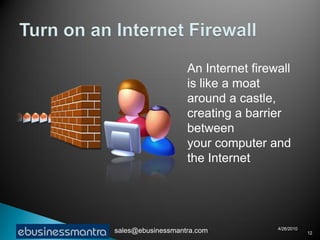
An Internet firewall
                   is like a moat
                   around a castle,
                   creating a barrier
                   between
                   your computer and
                   the Internet


                                    4/26/2010
sales@ebusinessmantra.com                       12
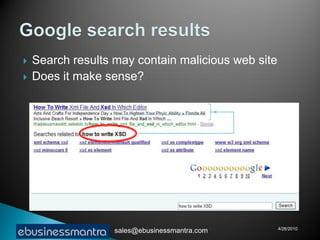
   Search results may contain malicious web site
   Does it make sense?


                                                    4/26/2010
                   sales@ebusinessmantra.com
   Keep passwords private and create ones that are
    hard to “crack”
   Use password checker (See resources)
    Never share your passwords with friends or be
    tricked into giving them away
   Do not email login name and password together
   Do not text message your login information
   If you do have to write, keep the paper in safe
    keeping


                                                4/26/2010
                   sales@ebusinessmantra.com                14
   Avoid creating passwords using
    ◦ Dictionary words in any language.
      Words in all languages are vulnerable
      Words spelled backwards, common misspellings, and
       abbreviations
    ◦ Sequences or repeated characters.
      Examples: 12345678, 222222, abcdefg, or adjacent letters
       on your keyboard (qwerty)
    ◦ Personal information.
      Your name, birthday, driver's license, passport number, or
       similar information


                                                              4/26/2010
                      sales@ebusinessmantra.com                           15
   Web browser
    ◦ http://en.wikipedia.org/wiki/Web_browser
   How browser works
    ◦ http://taligarsiel.com/Projects/howbrowserswork1.htm
   Securing your browser
    ◦ http://www.cert.org/tech_tips/securing_browser/
   Analysis: Browser Security
    ◦ http://www.networkcomputing.com/wireless/analysis-browser-
      security.php
   Microsoft Online Safety
    ◦ http://www.microsoft.com/protect
   Get Wise
    ◦ http://www.getnetwise.org
   Password Checker
    ◦ https://www.microsoft.com/protect/fraud/passwords/checker.aspx?WT.mc
      _id=Site_Link


                                                                    4/26/2010
                          sales@ebusinessmantra.com                             16

Safer browsing

  • 1.
  • 2.
    Web Browser is a software that is installed on your computer. It is used to locate and display web pages and other online content. Behind the scene, a browser performs lot of functions but its key role is to take your request to the web server and bring the content to you and display it. 4/26/2010 sales@ebusinessmantra.com 2
  • 3.
    Finds the web server  Takes your request and transports data  Transports cookies  Brings back content  Processes the content and renders it  Executes scripts (code) 4/26/2010 sales@ebusinessmantra.com 3
  • 4.
    Enter a URL into a browser ◦ Breaks the URL into a host + path  Asks a DNS server for an IP address for the host  DNS server returns a IP address for that host ◦ Browser sends a request to the IP address  Path is used to determine what file to obtain  Data for web server to process, maintain state  Server replies to the request – HTML, PDF, mp3, etc. ◦ Browser reads the HTML file and asks for all the files referenced in the original HTML file  These additional files could be images, more HTML, or other types on content.  Additional files could reside on different hosts requiring more DNS requests  After browser gets all the pieces, it processes the data and renders a single “page”  Non-HTML file are opened in the browser of associated application. 4/26/2010 sales@ebusinessmantra.com 4
  • 5.
    Internet Explorer (Microsoft)  Firefox  Safari  Chrome  Opera  Konqueror  Several others 4/26/2010 sales@ebusinessmantra.com 5
  • 6.
  • 7.
    Data set by the web site owner  Data you enter in the form  Information you request  Cookies  Operating System, browser type  Your IP address – can help determine your geographical location  Referring page  Much more 4/26/2010 sales@ebusinessmantra.com 7
  • 8.
    Example URLs: ◦ http://www.somesite.com ◦ https://www.somesite.com http – data is unencrypted while transport from the web browser to the web server https – data is encrypted while transported from the browser to the web server Make sure that data you don’t want anyone to eavesdrop is encrypted – https in the address bar; closed lock in the status bar 4/26/2010 sales@ebusinessmantra.com 8
  • 9.
  • 10.
    Use one browser for your “important” surfing and another for “casual” browsing. That way data from one can't leak to the other (generally speaking)  Always keep an eye on the URL in the address bar  Read, Pause before clicking on anything  Logout and always close the browser window  Nothing is “really” free. Only download files from websites you trust  Don’t open attachments forwarded from your friend’s computer is corrupted  Logout and close browser/tab  The browser’s back and refresh features can be used to steal passwords from insecurely written applications.  Be careful of Google search results  Always type URL for sites where confidential information is in use. 4/26/2010 sales@ebusinessmantra.com 10
  • 11.
     Always usethe red “X” in the corner of a pop-up screen  Never click “yes,” “accept” or even “cancel”, because it could be a trick that installs software on your PC 4/26/2010 sales@ebusinessmantra.com 11
  • 12.
    An Internet firewall is like a moat around a castle, creating a barrier between your computer and the Internet 4/26/2010 sales@ebusinessmantra.com 12
  • 13.
    Search results may contain malicious web site  Does it make sense? 4/26/2010 sales@ebusinessmantra.com
  • 14.
    Keep passwords private and create ones that are hard to “crack”  Use password checker (See resources)  Never share your passwords with friends or be tricked into giving them away  Do not email login name and password together  Do not text message your login information  If you do have to write, keep the paper in safe keeping 4/26/2010 sales@ebusinessmantra.com 14
  • 15.
    Avoid creating passwords using ◦ Dictionary words in any language.  Words in all languages are vulnerable  Words spelled backwards, common misspellings, and abbreviations ◦ Sequences or repeated characters.  Examples: 12345678, 222222, abcdefg, or adjacent letters on your keyboard (qwerty) ◦ Personal information.  Your name, birthday, driver's license, passport number, or similar information 4/26/2010 sales@ebusinessmantra.com 15
  • 16.
    Web browser ◦ http://en.wikipedia.org/wiki/Web_browser  How browser works ◦ http://taligarsiel.com/Projects/howbrowserswork1.htm  Securing your browser ◦ http://www.cert.org/tech_tips/securing_browser/  Analysis: Browser Security ◦ http://www.networkcomputing.com/wireless/analysis-browser- security.php  Microsoft Online Safety ◦ http://www.microsoft.com/protect  Get Wise ◦ http://www.getnetwise.org  Password Checker ◦ https://www.microsoft.com/protect/fraud/passwords/checker.aspx?WT.mc _id=Site_Link 4/26/2010 sales@ebusinessmantra.com 16