Unconventional Reservoir
Characterization
Supervised by:
Prof. Dr. Abdel Moktader A. El-Sayed
(Professor of petrophysics, Ain Shams University)
Ain Shams University
Faculty of Science
Department of Geophysics
By:
Shehab Hosny Khallaf
Contents
2
• Introduction
• Chapter 1 Reservoir types
• Chapter 2 Unconventional reservoir characterization
• Chapter 3 Production technique
• Chapter 4 Production of Non-conventional reservoir
• Summary and conclusion
• References
Introduction
3
Why unconventional Reservoir ?
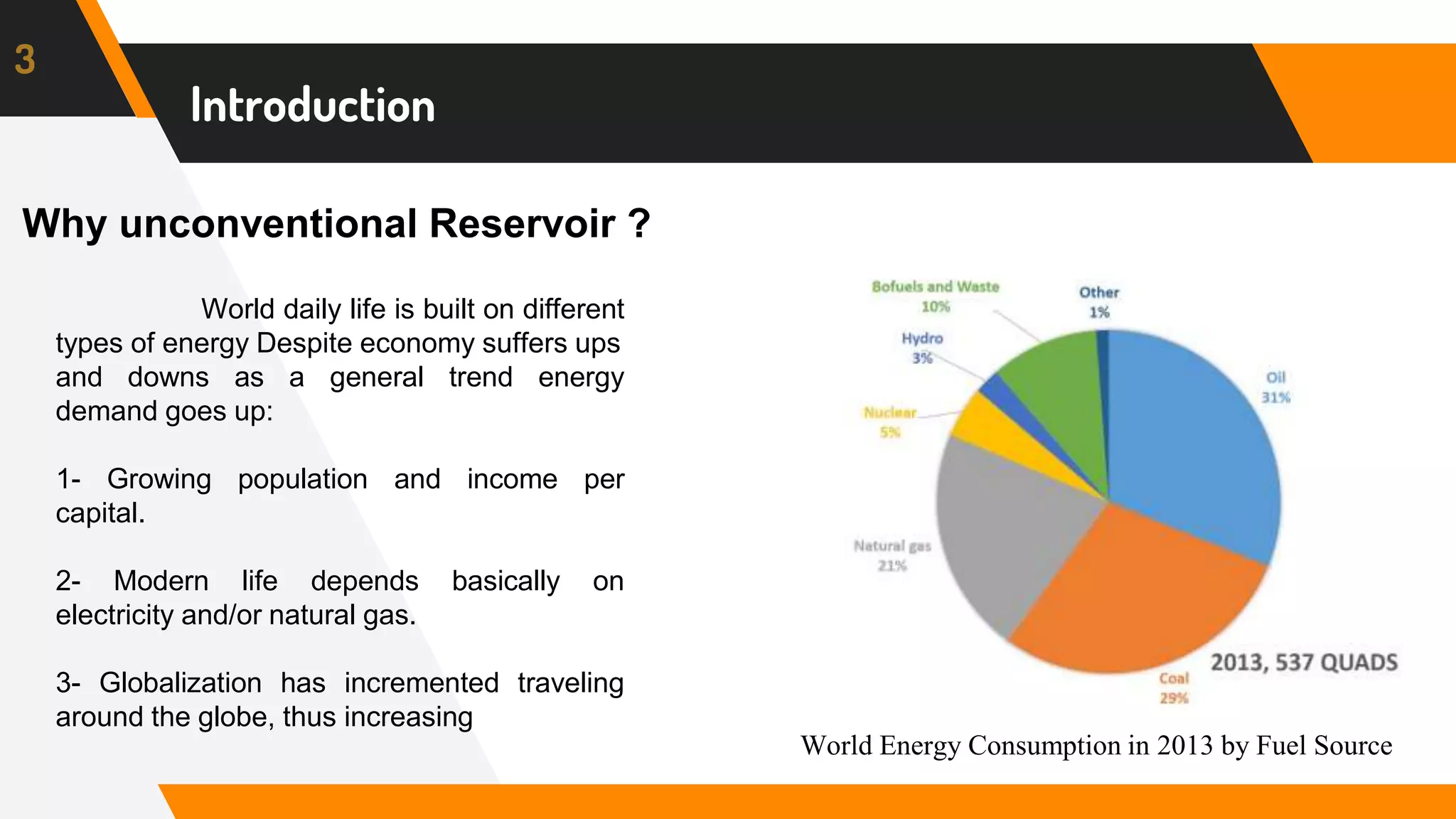
World Energy Consumption in 2013 by Fuel Source
World daily life is built on different
types of energy Despite economy suffers ups
and downs as a general trend energy
demand goes up:
1- Growing population and income per
capital.
2- Modern life depends basically on
electricity and/or natural gas.
3- Globalization has incremented traveling
around the globe, thus increasing
Introduction
4
Why unconventional Reservoir ?
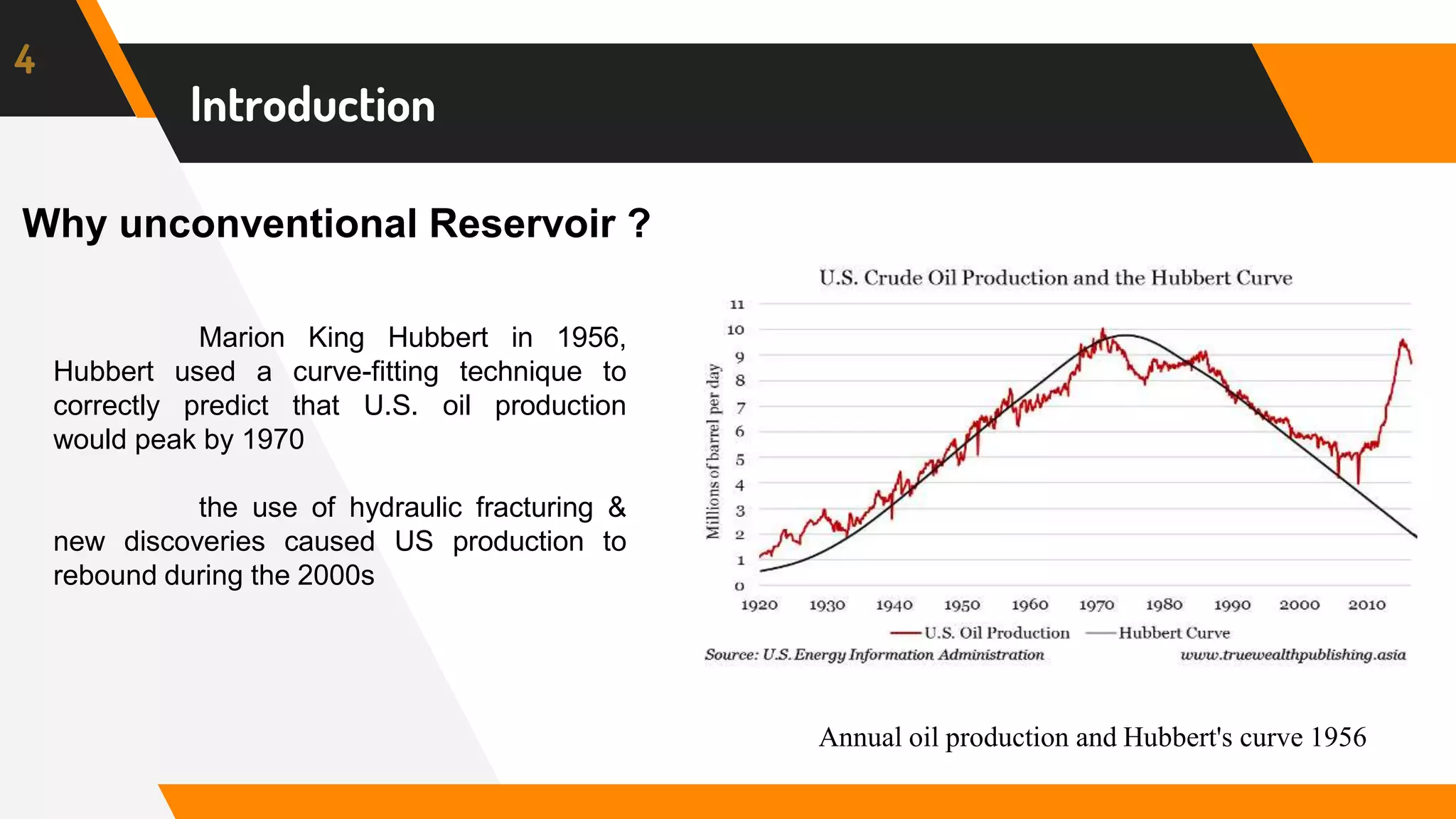
Annual oil production and Hubbert's curve 1956
Marion King Hubbert in 1956,
Hubbert used a curve-fitting technique to
correctly predict that U.S. oil production
would peak by 1970
the use of hydraulic fracturing &
new discoveries caused US production to
rebound during the 2000s
Introduction
5
Why unconventional Reservoir ?
A more sophisticated system of evaluating
petroleum accumulations was adopted in
2007 by the Society of Petroleum
Engineers (SPE),World Petroleum Council
(WPC),American Association of Petroleum
Geologists (AAPG), and Society of
Petroleum Evaluation Engineers (SPEE).
Note: conventional resources make up
less than a third of the total
Worldwide hydrocarbon reserves
Content
6
Contents
• Introduction
• Chapter 1 Reservoir types
• Chapter 2 Unconventional reservoir characterization
• Chapter 3 Production technique
• Chapter 4 Production of Non-conventional reservoirs
• Summary and Conclusion
• References
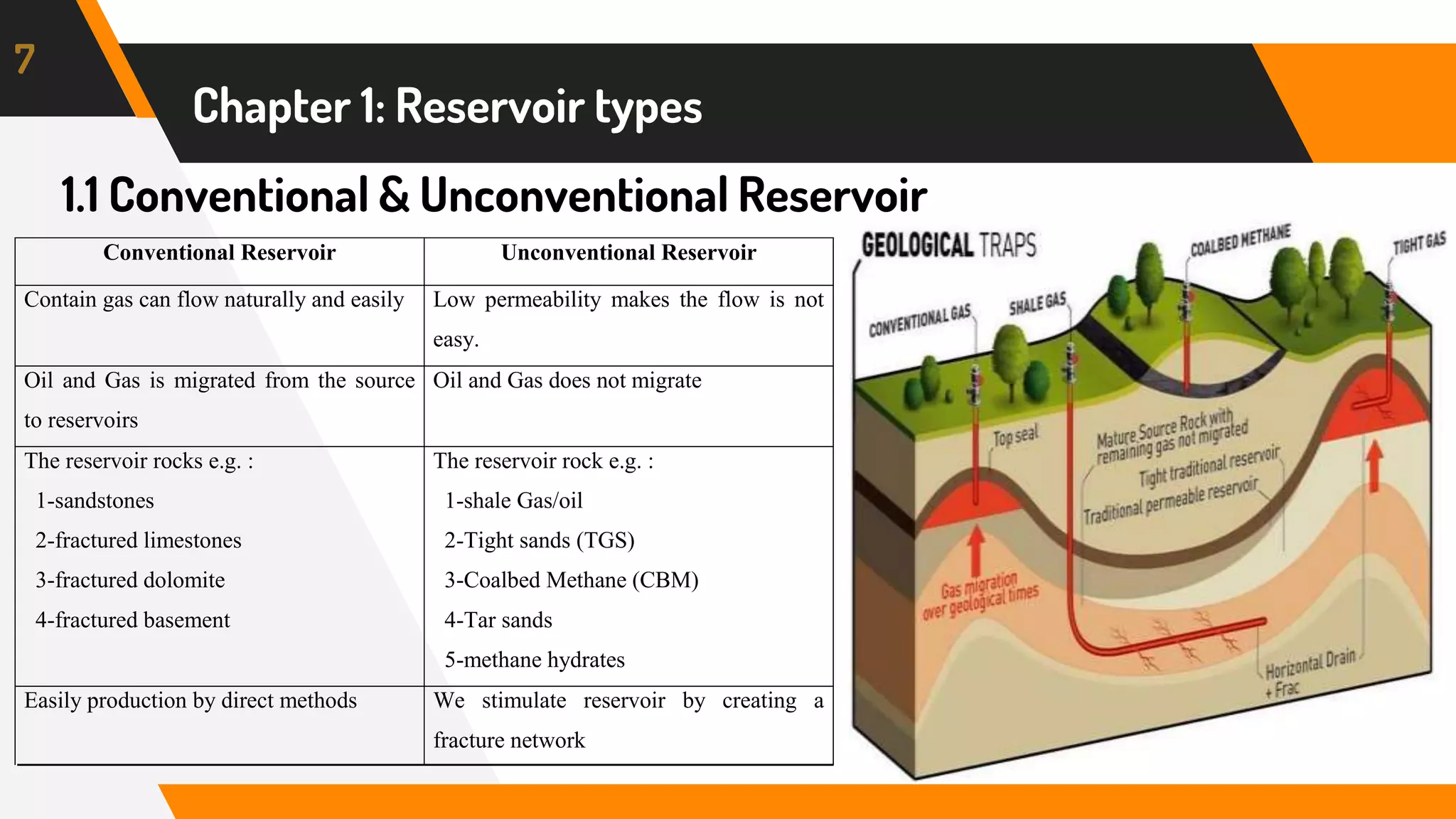
1.1 Conventional & Unconventional Reservoir
7
Chapter 1: Reservoir types
Conventional Reservoir Unconventional Reservoir
Contain gas can flow naturally and easily Low permeability makes the flow is not
easy.
Oil and Gas is migrated from the source
to reservoirs
Oil and Gas does not migrate
The reservoir rocks e.g. :
1-sandstones
2-fractured limestones
3-fractured dolomite
4-fractured basement
The reservoir rock e.g. :
1-shale Gas/oil
2-Tight sands (TGS)
3-Coalbed Methane (CBM)
4-Tar sands
5-methane hydrates
Easily production by direct methods We stimulate reservoir by creating a
fracture network
1.2 Unconventional Reservoir Types
8
Chapter 1: Reservoir types
1. Tight Gas Sands (TGS):
The gas is sourced outside the
reservoir and migrates into the reservoir over
geological time. Some Tight Gas reservoirs have
also been found to be sourced by underlying
coal and shales source rocks. in the so called
Basin Centered Gas (BCG) accumulations.
Tight Gas Sands (TGS)
1.2 Unconventional Reservoir Types
9
Chapter 1: Reservoir types
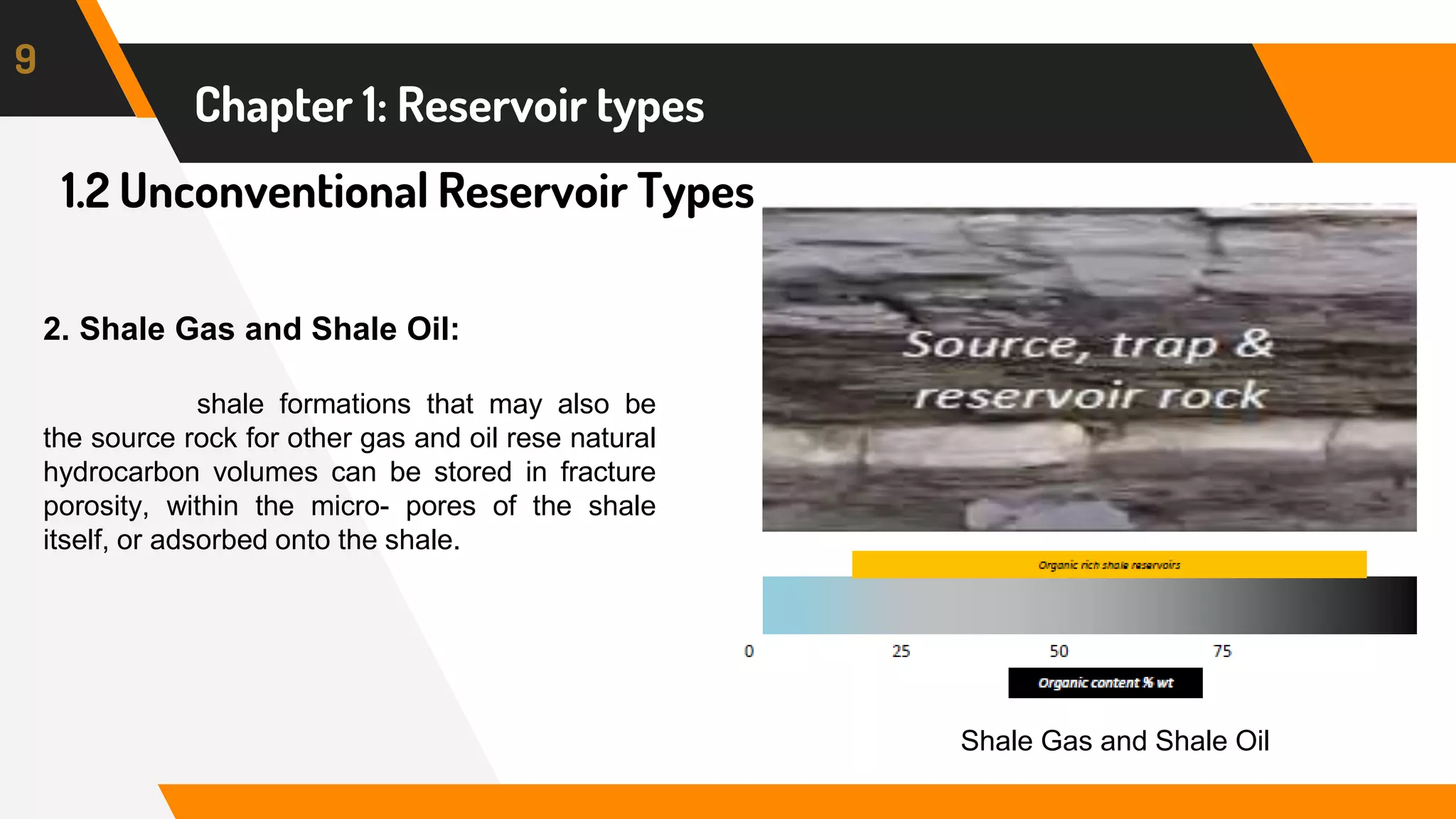
2. Shale Gas and Shale Oil:
shale formations that may also be
the source rock for other gas and oil rese natural
hydrocarbon volumes can be stored in fracture
porosity, within the micro- pores of the shale
itself, or adsorbed onto the shale.
Shale Gas and Shale Oil
1.2 Unconventional Reservoir Types
10
Chapter 1: Reservoir types
3. Coal Bed Methane (CBM):
coal seams which act as source and
reservoir to the produced gas. The wells often
produce water in the initial production phase, as
well as natural gas. Economic CBM reservoirs
are normally shallow.
Coal Bed Methane (CBM)
Source , trap &
Reservoir rock
1.2 Unconventional Reservoir Types
11
Chapter 1: Reservoir types
4. Tar sands:
Oil sands are either loose sands or
partially consolidated sandstone containing a
naturally occurring mixture of sand, clay, and
water, saturated with a dense and extremely
viscous form of petroleum technically referred to
as bitumen.
Tar sands
1.2 Unconventional Reservoir Types
12
Chapter 1: Reservoir types
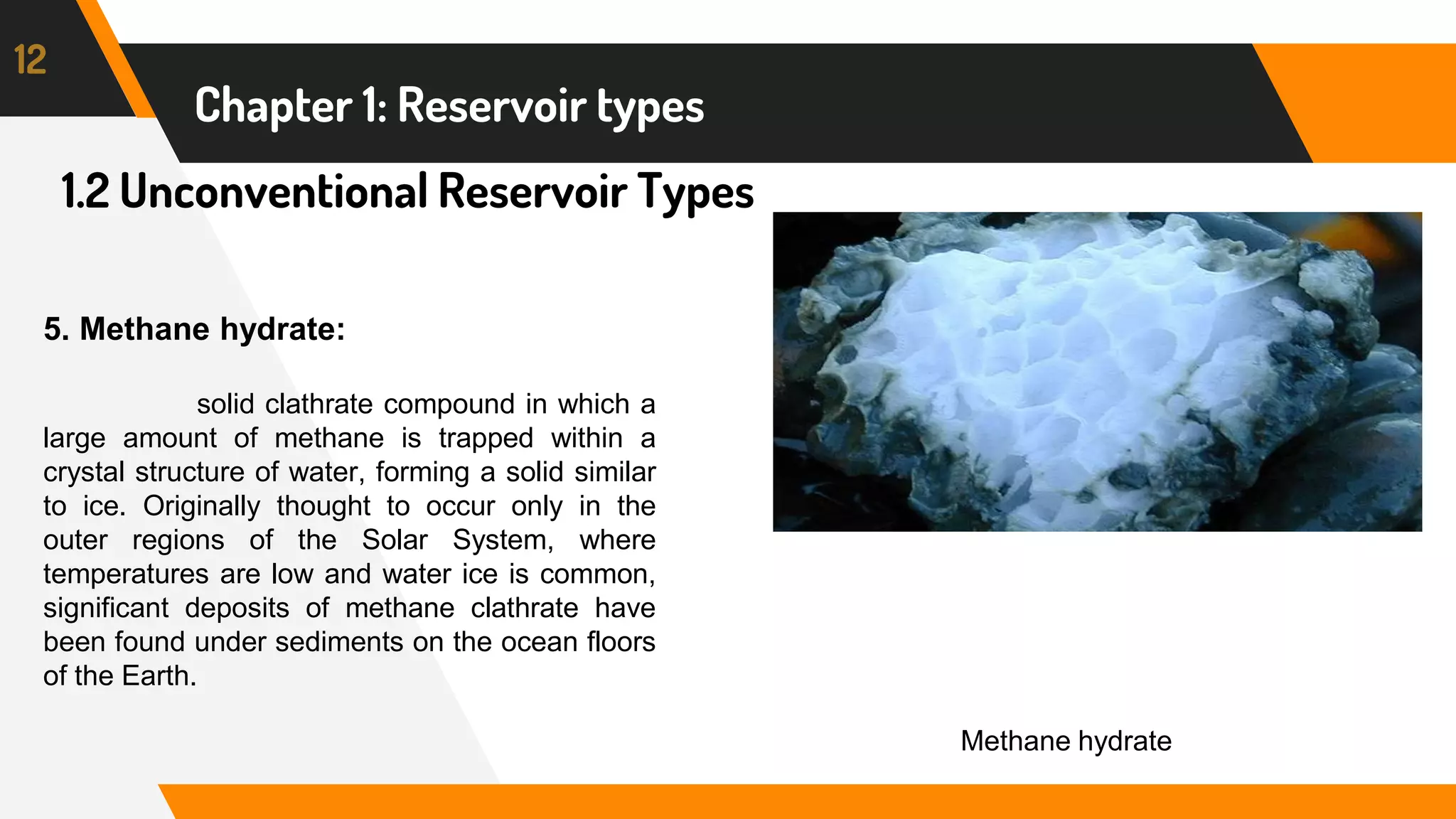
5. Methane hydrate:
solid clathrate compound in which a
large amount of methane is trapped within a
crystal structure of water, forming a solid similar
to ice. Originally thought to occur only in the
outer regions of the Solar System, where
temperatures are low and water ice is common,
significant deposits of methane clathrate have
been found under sediments on the ocean floors
of the Earth.
Methane hydrate
Content
13
Contents
• Introduction
• Chapter 1 Reservoir types
• Chapter 2 Unconventional reservoir characterization
• Chapter 3 Production technique
• Chapter 4 Production of Non-conventional reservoir
• Summary and conclusion
• References
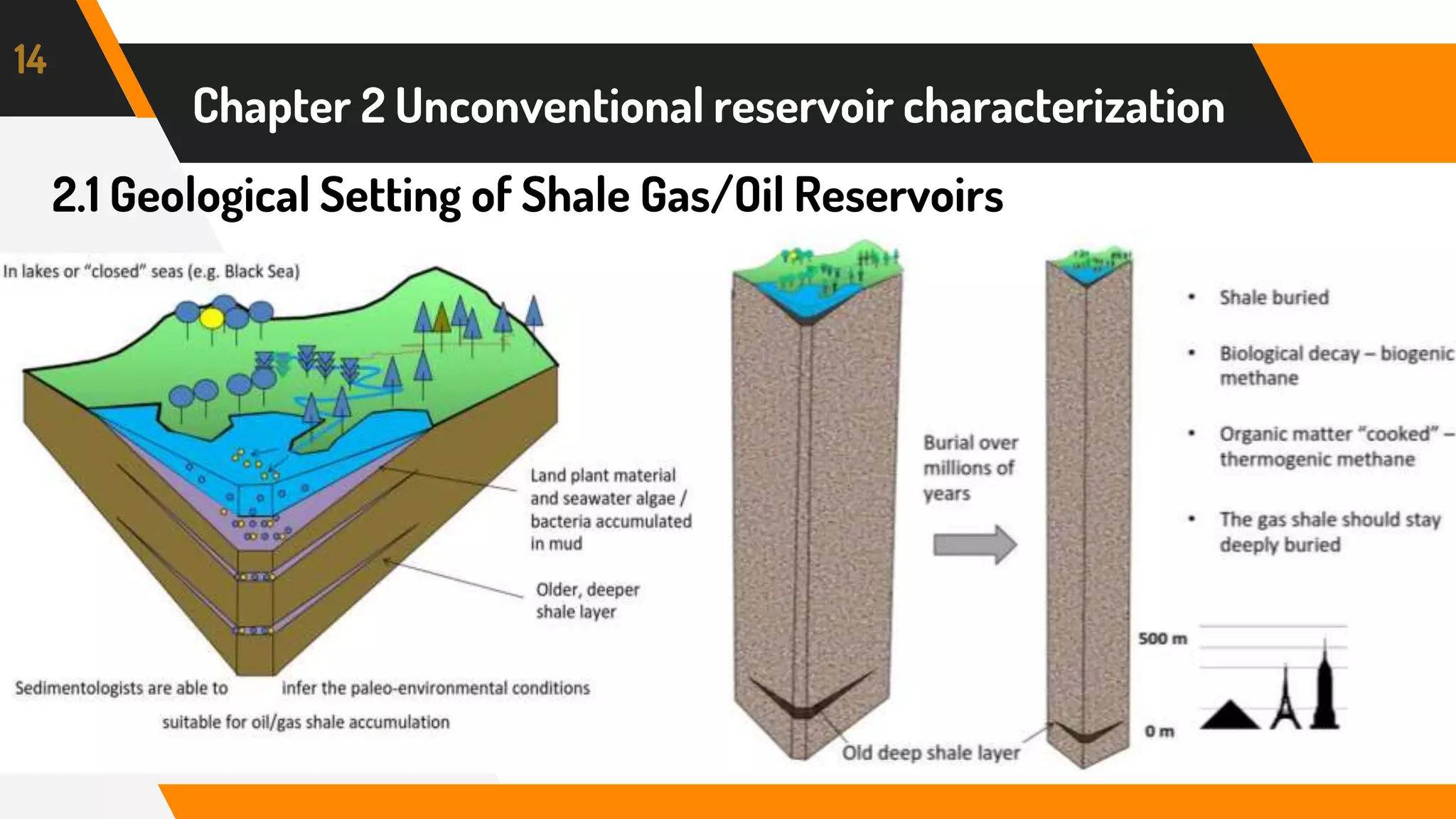
2.1 Geological Setting of Shale Gas/Oil Reservoirs
14
Chapter 2 Unconventional reservoir characterization
2.2 Petrophysical Aspects of Non-Conventional Reservoirs
15
Chapter 2 Unconventional reservoir characterization
1. Porosity:
Gas storage in shale gas reservoirs
occurs in the adsorbed state within kerogen , in
the released or free state within kerogen porosity
Types of porosity
intergranular porosity
Fracture porosity
organic porosity
A petrophysical rock model for clastic rock formation
2.2 Petrophysical Aspects of Non-Conventional Reservoirs
16
Chapter 2 Unconventional reservoir characterization
2. Permeability :
For shale gas and oil reservoirs, if
there are no fractures, there will be no
economical hydrocarbon productions.
Permeability is achieved through
natural fracture systems or hydraulic stimulation,
For dry gas, no commercial rates below 0.1 mD
unless well is hydraulically fractured If
multiphase flow exists
Comparison of Conventional and Unconventional permeability
2.2 Petrophysical Aspects of Non-Conventional Reservoirs
17
Chapter 2 Unconventional reservoir characterization
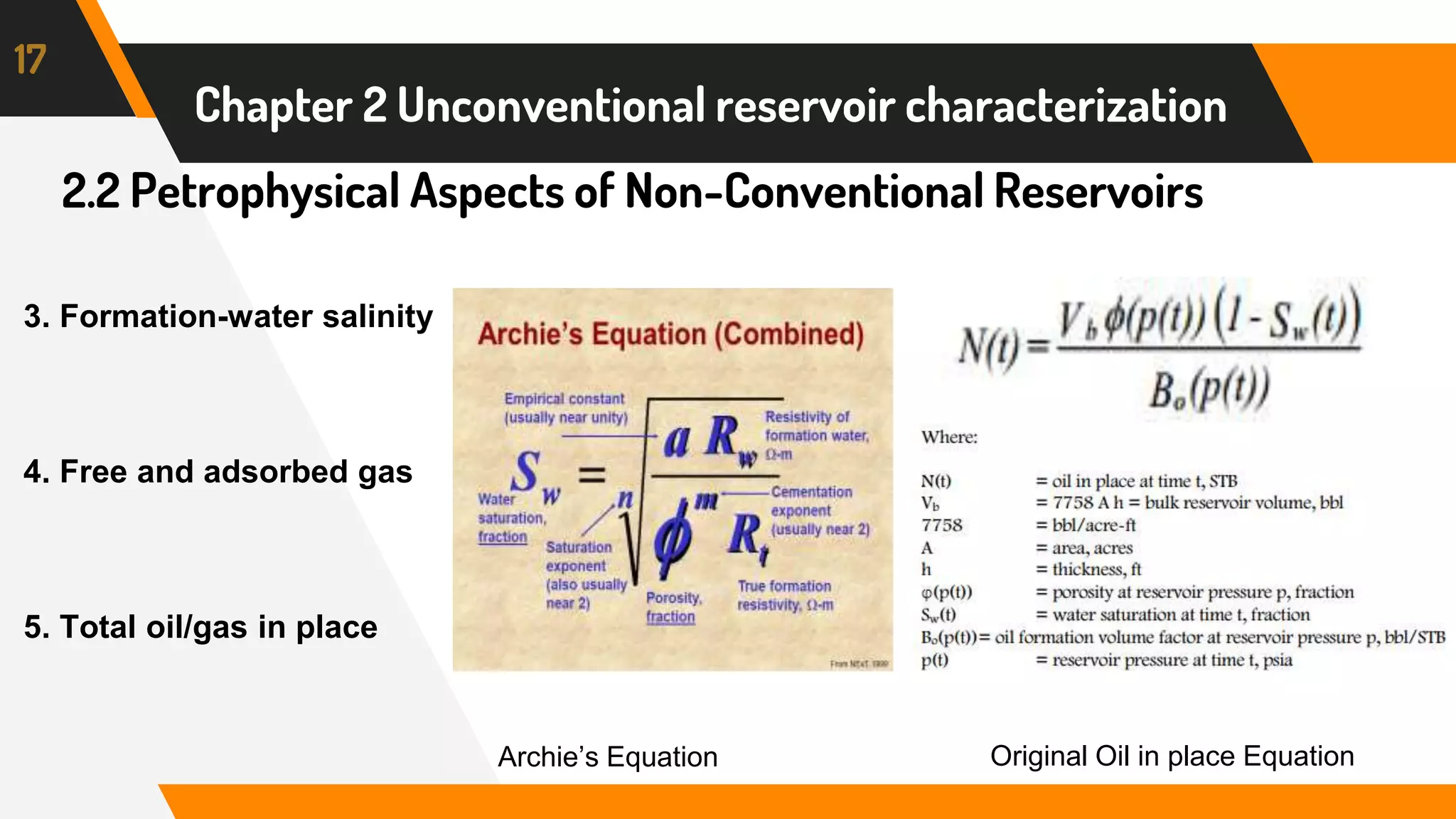
3. Formation-water salinity
4. Free and adsorbed gas
5. Total oil/gas in place
Original Oil in place EquationArchie’s Equation
2.2 Geochemical Aspects of Non-Conventional Reservoirs
18
Chapter 2 Unconventional reservoir characterization
. Type of generated hydrocarbons (e.g.
HI versus OI)
. Quality (e.g. visual kerogen analysis)
. The rock's organic richness (i.e., total
organic carbon TOC),
. maturity (e.g., vitrine reflectance, etc.)
. Quantity (e.g. Rock Eval analysis)
2.2 Geomechanical Aspects of Non-Conventional Reservoirs
19
Chapter 2 Unconventional reservoir characterization
Stress-strain diagram showing the behavior of brittle and ductile rocks
The importance is the ability to
predict the relative brittleness or ductility of
rock within a stratified shale sequence.
The two common measures of
rock strength and deformation are Young's
Modulus and Poisson's Ratio.
brittle shale is preferable in
production to facilities the production when
a hydraulic fracturing system is
established.
Content
20
Contents
• Introduction
• Chapter 1 Reservoir types
• Chapter 2 Unconventional reservoir characterization
• Chapter 3 Production technique
• Chapter 4 Production of Non-conventional reservoir
• Summary and conclusion
• References
Chapter 3 Production technique
21
https://www.marathonoil.com ,(Edited)
Content
22
Contents
• Introduction
• Chapter 1 Reservoir types
• Chapter 2 Unconventional reservoir characterization
• Chapter 3 Production technique
• Chapter 4 Production of Non-conventional reservoir
• Summary and conclusion
• References
4.1 Challenges
23
Chapter 4 Production of Non-conventional reservoir
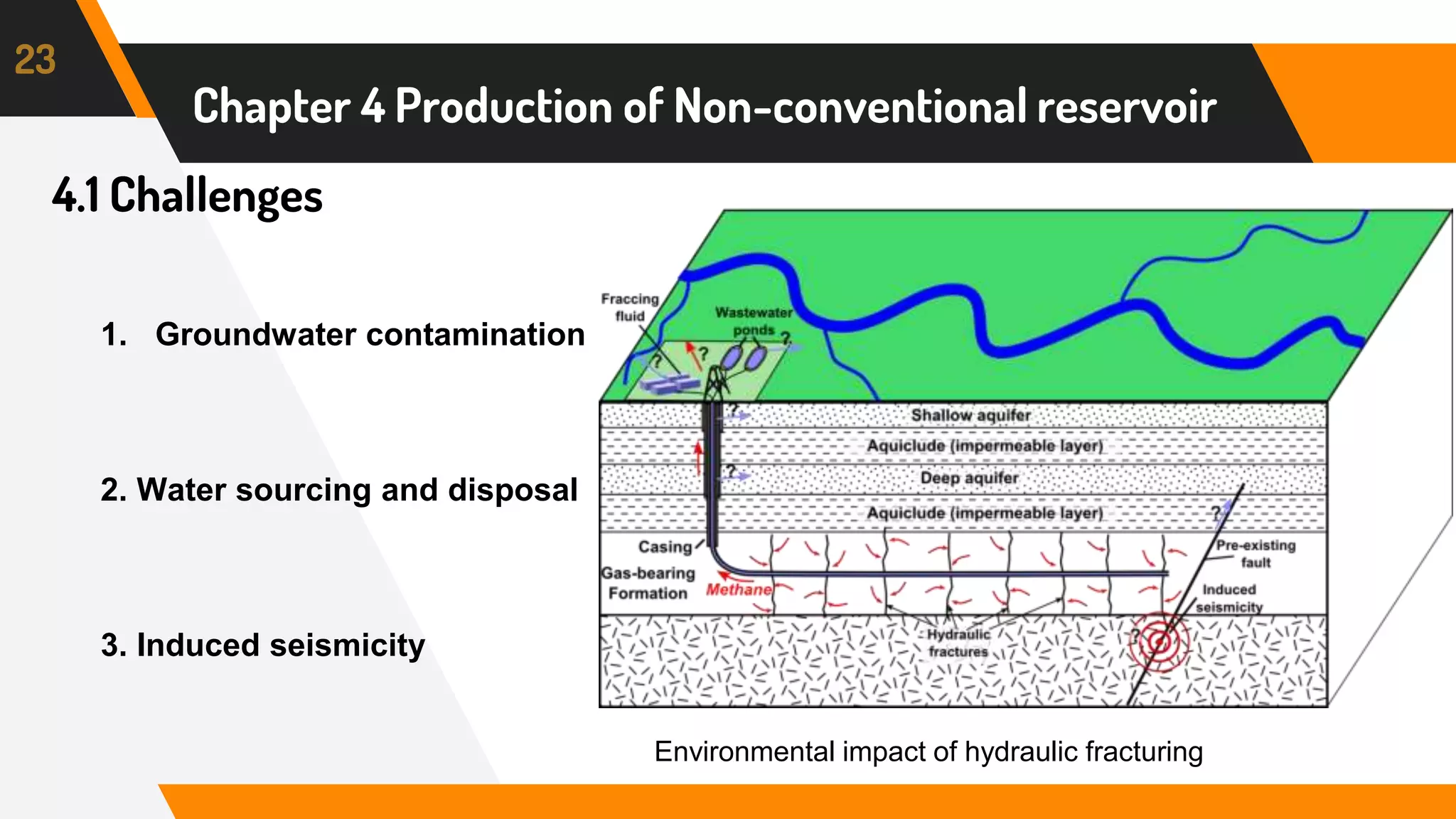
1. Groundwater contamination
2. Water sourcing and disposal
3. Induced seismicity
Environmental impact of hydraulic fracturing
4.2 Production Worldwide
24
Chapter 4 Production of Non-conventional reservoir
World Shale Gas and Shale oil resources ,2013,
A successful production example at
USA, more than 4 million oil and gas wells
,nearly 150 years ago. At least 2 million of
these have been hydraulically fracture-treated.
. Shale Development: 1- Canada
2Argentina
. Shale Exploration: 1- China 2- Algeria
3-Mexico 4-Australia
4.3 Production in Egypt
25
Chapter 4 Production of Non-conventional reservoir
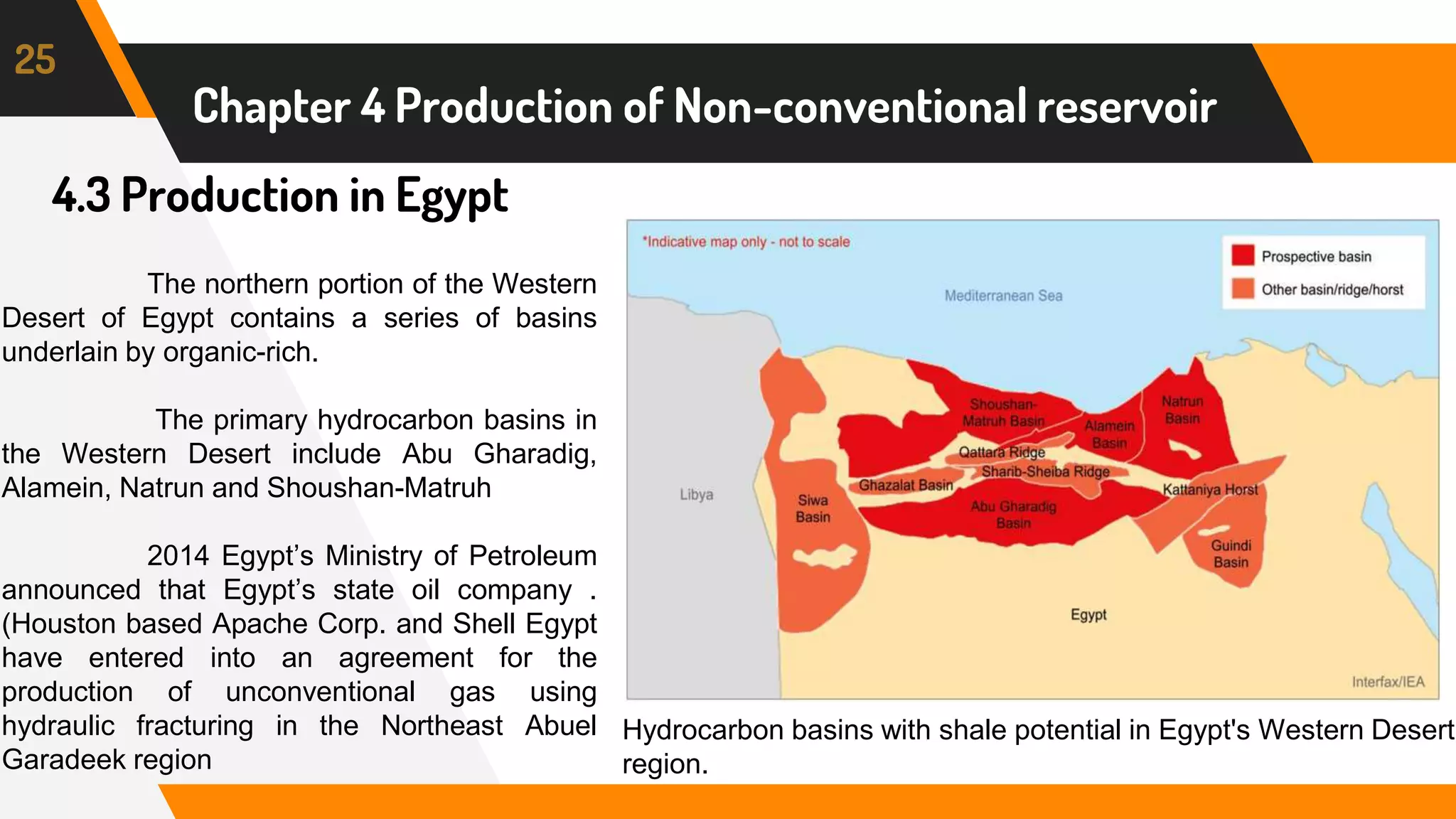
Hydrocarbon basins with shale potential in Egypt's Western Desert
region.
The northern portion of the Western
Desert of Egypt contains a series of basins
underlain by organic-rich.
The primary hydrocarbon basins in
the Western Desert include Abu Gharadig,
Alamein, Natrun and Shoushan-Matruh
2014 Egypt’s Ministry of Petroleum
announced that Egypt’s state oil company .
(Houston based Apache Corp. and Shell Egypt
have entered into an agreement for the
production of unconventional gas using
hydraulic fracturing in the Northeast Abuel
Garadeek region
Content
26
Contents
• Introduction
• Chapter 1 Reservoir types
• Chapter 2 Unconventional reservoir characterization
• Chapter 3 Production technique
• Chapter 4 Production of Non-conventional reservoir
• Summary and conclusion
• References
Summary and conclusion
▹Unconventional resources are hydrocarbon reservoirs that have low permeability and so
are difficult to produce. Often enhanced recovery techniques, such as fracture stimulation
or steam injection, etc., must be performed, making the process more difficult than a
conventional play.
▸Studying of Geological and petrophysical aspects helps out in preparing for an adequate
design to produce the oil/gas from an Unconventional reservoir.
▸Only a third of worldwide oil and gas reserves are conventional, the remainder are in
unconventional resources. Shale gas has become an increasingly important source of
natural gas in the United States since the start of this century.
▸Egypt has four basins in the Western Desert with potential for shale gas and shale oil:
Abu Gharadig, Alamein, Natrun and Shoushan-Matruh. The target horizon is the organic-
rich Khatatba Shale
27
Content
28
Contents
• Introduction
• Chapter 1 Reservoir types
• Chapter 2 Unconventional reservoir characterization
• Chapter 3 Production technique
• Chapter 4 Production of Non-conventional reservoir
• Summary and conclusion
• References
References
29
-Calbertson, W.J. and Pitman, J.K. “Oil Shale” in United States Mineral Resources, USGS Professional
Paper 820, Probst and Pratt, eds. P. 497 - 503, 1973.
- Final Environmental Statement for the Prototype Leasing Program –U.S. Department of the Interior,
Bureau of Land Management, Volume I, 1973
- Q.R. Passey, K.M. Bohacs, WL. Esch, R. Klimentidis, and S. Sinha, 2010, SPE 131-350 From Oil-Prone
Source Rock to Gas-Producing Shale Reservoir
- Treatise of Petroleum Geology/Handbook of Petroleum Geology: Exploring for Oil and Gas Traps, Pages
6-1 - 6-41, Edited by Edward A. Beaumont and Norman H. Foster
- Walsh, J., J. Wattcrson, and G. Yielding: “Fractal analysis of facture patterns using the standard box-
counting technique: valid and invalid methodologies,” , j. of struct. Geol. 15, No (1993) 1509-1512.
References
30
Internet access:
-https://en.wikipedia.org/wiki/Hydraulic_ fracturing
-http://www.cgg.com/default.aspx?cid=3501
-http://www.slb.com/services/technical_challenges/geomechanics/reservoir_managent/unconventional
reservoirs.aspx
-http://www. glossary.oilfield.slb.com/en/Terms/c/conventional reservoir.aspx
-https://en.wikipedia.org/wiki/Methane_clathrate
-http://www.adv-res.com/library.php#TightGasSands
-https://www.oilandgas360.com/egypt-turns-hydraulic-fracturing/
31
THANKS ❤
Any questions?
Shehab.hosny1997@gmail.com

Unconventional Reservoir Characterization

  • 1.
    Unconventional Reservoir Characterization Supervised by: Prof.Dr. Abdel Moktader A. El-Sayed (Professor of petrophysics, Ain Shams University) Ain Shams University Faculty of Science Department of Geophysics By: Shehab Hosny Khallaf
  • 2.
    Contents 2 • Introduction • Chapter1 Reservoir types • Chapter 2 Unconventional reservoir characterization • Chapter 3 Production technique • Chapter 4 Production of Non-conventional reservoir • Summary and conclusion • References
  • 3.
    Introduction 3 Why unconventional Reservoir? World Energy Consumption in 2013 by Fuel Source World daily life is built on different types of energy Despite economy suffers ups and downs as a general trend energy demand goes up: 1- Growing population and income per capital. 2- Modern life depends basically on electricity and/or natural gas. 3- Globalization has incremented traveling around the globe, thus increasing
  • 4.
    Introduction 4 Why unconventional Reservoir? Annual oil production and Hubbert's curve 1956 Marion King Hubbert in 1956, Hubbert used a curve-fitting technique to correctly predict that U.S. oil production would peak by 1970 the use of hydraulic fracturing & new discoveries caused US production to rebound during the 2000s
  • 5.
    Introduction 5 Why unconventional Reservoir? A more sophisticated system of evaluating petroleum accumulations was adopted in 2007 by the Society of Petroleum Engineers (SPE),World Petroleum Council (WPC),American Association of Petroleum Geologists (AAPG), and Society of Petroleum Evaluation Engineers (SPEE). Note: conventional resources make up less than a third of the total Worldwide hydrocarbon reserves
  • 6.
    Content 6 Contents • Introduction • Chapter1 Reservoir types • Chapter 2 Unconventional reservoir characterization • Chapter 3 Production technique • Chapter 4 Production of Non-conventional reservoirs • Summary and Conclusion • References
  • 7.
    1.1 Conventional &Unconventional Reservoir 7 Chapter 1: Reservoir types Conventional Reservoir Unconventional Reservoir Contain gas can flow naturally and easily Low permeability makes the flow is not easy. Oil and Gas is migrated from the source to reservoirs Oil and Gas does not migrate The reservoir rocks e.g. : 1-sandstones 2-fractured limestones 3-fractured dolomite 4-fractured basement The reservoir rock e.g. : 1-shale Gas/oil 2-Tight sands (TGS) 3-Coalbed Methane (CBM) 4-Tar sands 5-methane hydrates Easily production by direct methods We stimulate reservoir by creating a fracture network
  • 8.
    1.2 Unconventional ReservoirTypes 8 Chapter 1: Reservoir types 1. Tight Gas Sands (TGS): The gas is sourced outside the reservoir and migrates into the reservoir over geological time. Some Tight Gas reservoirs have also been found to be sourced by underlying coal and shales source rocks. in the so called Basin Centered Gas (BCG) accumulations. Tight Gas Sands (TGS)
  • 9.
    1.2 Unconventional ReservoirTypes 9 Chapter 1: Reservoir types 2. Shale Gas and Shale Oil: shale formations that may also be the source rock for other gas and oil rese natural hydrocarbon volumes can be stored in fracture porosity, within the micro- pores of the shale itself, or adsorbed onto the shale. Shale Gas and Shale Oil
  • 10.
    1.2 Unconventional ReservoirTypes 10 Chapter 1: Reservoir types 3. Coal Bed Methane (CBM): coal seams which act as source and reservoir to the produced gas. The wells often produce water in the initial production phase, as well as natural gas. Economic CBM reservoirs are normally shallow. Coal Bed Methane (CBM) Source , trap & Reservoir rock
  • 11.
    1.2 Unconventional ReservoirTypes 11 Chapter 1: Reservoir types 4. Tar sands: Oil sands are either loose sands or partially consolidated sandstone containing a naturally occurring mixture of sand, clay, and water, saturated with a dense and extremely viscous form of petroleum technically referred to as bitumen. Tar sands
  • 12.
    1.2 Unconventional ReservoirTypes 12 Chapter 1: Reservoir types 5. Methane hydrate: solid clathrate compound in which a large amount of methane is trapped within a crystal structure of water, forming a solid similar to ice. Originally thought to occur only in the outer regions of the Solar System, where temperatures are low and water ice is common, significant deposits of methane clathrate have been found under sediments on the ocean floors of the Earth. Methane hydrate
  • 13.
    Content 13 Contents • Introduction • Chapter1 Reservoir types • Chapter 2 Unconventional reservoir characterization • Chapter 3 Production technique • Chapter 4 Production of Non-conventional reservoir • Summary and conclusion • References
  • 14.
    2.1 Geological Settingof Shale Gas/Oil Reservoirs 14 Chapter 2 Unconventional reservoir characterization
  • 15.
    2.2 Petrophysical Aspectsof Non-Conventional Reservoirs 15 Chapter 2 Unconventional reservoir characterization 1. Porosity: Gas storage in shale gas reservoirs occurs in the adsorbed state within kerogen , in the released or free state within kerogen porosity Types of porosity intergranular porosity Fracture porosity organic porosity A petrophysical rock model for clastic rock formation
  • 16.
    2.2 Petrophysical Aspectsof Non-Conventional Reservoirs 16 Chapter 2 Unconventional reservoir characterization 2. Permeability : For shale gas and oil reservoirs, if there are no fractures, there will be no economical hydrocarbon productions. Permeability is achieved through natural fracture systems or hydraulic stimulation, For dry gas, no commercial rates below 0.1 mD unless well is hydraulically fractured If multiphase flow exists Comparison of Conventional and Unconventional permeability
  • 17.
    2.2 Petrophysical Aspectsof Non-Conventional Reservoirs 17 Chapter 2 Unconventional reservoir characterization 3. Formation-water salinity 4. Free and adsorbed gas 5. Total oil/gas in place Original Oil in place EquationArchie’s Equation
  • 18.
    2.2 Geochemical Aspectsof Non-Conventional Reservoirs 18 Chapter 2 Unconventional reservoir characterization . Type of generated hydrocarbons (e.g. HI versus OI) . Quality (e.g. visual kerogen analysis) . The rock's organic richness (i.e., total organic carbon TOC), . maturity (e.g., vitrine reflectance, etc.) . Quantity (e.g. Rock Eval analysis)
  • 19.
    2.2 Geomechanical Aspectsof Non-Conventional Reservoirs 19 Chapter 2 Unconventional reservoir characterization Stress-strain diagram showing the behavior of brittle and ductile rocks The importance is the ability to predict the relative brittleness or ductility of rock within a stratified shale sequence. The two common measures of rock strength and deformation are Young's Modulus and Poisson's Ratio. brittle shale is preferable in production to facilities the production when a hydraulic fracturing system is established.
  • 20.
    Content 20 Contents • Introduction • Chapter1 Reservoir types • Chapter 2 Unconventional reservoir characterization • Chapter 3 Production technique • Chapter 4 Production of Non-conventional reservoir • Summary and conclusion • References
  • 21.
    Chapter 3 Productiontechnique 21 https://www.marathonoil.com ,(Edited)
  • 22.
    Content 22 Contents • Introduction • Chapter1 Reservoir types • Chapter 2 Unconventional reservoir characterization • Chapter 3 Production technique • Chapter 4 Production of Non-conventional reservoir • Summary and conclusion • References
  • 23.
    4.1 Challenges 23 Chapter 4Production of Non-conventional reservoir 1. Groundwater contamination 2. Water sourcing and disposal 3. Induced seismicity Environmental impact of hydraulic fracturing
  • 24.
    4.2 Production Worldwide 24 Chapter4 Production of Non-conventional reservoir World Shale Gas and Shale oil resources ,2013, A successful production example at USA, more than 4 million oil and gas wells ,nearly 150 years ago. At least 2 million of these have been hydraulically fracture-treated. . Shale Development: 1- Canada 2Argentina . Shale Exploration: 1- China 2- Algeria 3-Mexico 4-Australia
  • 25.
    4.3 Production inEgypt 25 Chapter 4 Production of Non-conventional reservoir Hydrocarbon basins with shale potential in Egypt's Western Desert region. The northern portion of the Western Desert of Egypt contains a series of basins underlain by organic-rich. The primary hydrocarbon basins in the Western Desert include Abu Gharadig, Alamein, Natrun and Shoushan-Matruh 2014 Egypt’s Ministry of Petroleum announced that Egypt’s state oil company . (Houston based Apache Corp. and Shell Egypt have entered into an agreement for the production of unconventional gas using hydraulic fracturing in the Northeast Abuel Garadeek region
  • 26.
    Content 26 Contents • Introduction • Chapter1 Reservoir types • Chapter 2 Unconventional reservoir characterization • Chapter 3 Production technique • Chapter 4 Production of Non-conventional reservoir • Summary and conclusion • References
  • 27.
    Summary and conclusion ▹Unconventionalresources are hydrocarbon reservoirs that have low permeability and so are difficult to produce. Often enhanced recovery techniques, such as fracture stimulation or steam injection, etc., must be performed, making the process more difficult than a conventional play. ▸Studying of Geological and petrophysical aspects helps out in preparing for an adequate design to produce the oil/gas from an Unconventional reservoir. ▸Only a third of worldwide oil and gas reserves are conventional, the remainder are in unconventional resources. Shale gas has become an increasingly important source of natural gas in the United States since the start of this century. ▸Egypt has four basins in the Western Desert with potential for shale gas and shale oil: Abu Gharadig, Alamein, Natrun and Shoushan-Matruh. The target horizon is the organic- rich Khatatba Shale 27
  • 28.
    Content 28 Contents • Introduction • Chapter1 Reservoir types • Chapter 2 Unconventional reservoir characterization • Chapter 3 Production technique • Chapter 4 Production of Non-conventional reservoir • Summary and conclusion • References
  • 29.
    References 29 -Calbertson, W.J. andPitman, J.K. “Oil Shale” in United States Mineral Resources, USGS Professional Paper 820, Probst and Pratt, eds. P. 497 - 503, 1973. - Final Environmental Statement for the Prototype Leasing Program –U.S. Department of the Interior, Bureau of Land Management, Volume I, 1973 - Q.R. Passey, K.M. Bohacs, WL. Esch, R. Klimentidis, and S. Sinha, 2010, SPE 131-350 From Oil-Prone Source Rock to Gas-Producing Shale Reservoir - Treatise of Petroleum Geology/Handbook of Petroleum Geology: Exploring for Oil and Gas Traps, Pages 6-1 - 6-41, Edited by Edward A. Beaumont and Norman H. Foster - Walsh, J., J. Wattcrson, and G. Yielding: “Fractal analysis of facture patterns using the standard box- counting technique: valid and invalid methodologies,” , j. of struct. Geol. 15, No (1993) 1509-1512.
  • 30.
    References 30 Internet access: -https://en.wikipedia.org/wiki/Hydraulic_ fracturing -http://www.cgg.com/default.aspx?cid=3501 -http://www.slb.com/services/technical_challenges/geomechanics/reservoir_managent/unconventional reservoirs.aspx -http://www.glossary.oilfield.slb.com/en/Terms/c/conventional reservoir.aspx -https://en.wikipedia.org/wiki/Methane_clathrate -http://www.adv-res.com/library.php#TightGasSands -https://www.oilandgas360.com/egypt-turns-hydraulic-fracturing/
  • 31.