S.K.Sinha
Talk Index


 Smart Card Based Indian e-ID’s
 Interoperability standards
National e-ID based Projects
 National ID Card (New Name is NPR)
 Driver’s License
 e-Passport
 Social Security (RSBY
 Public Distribution System
 Unique ID (Number only, no smart card)
National ID (NPR Card)
 Total Volume is 1 Billion +
 No existing Data
 To be rolled-out in phased manner in geographic
  order
 Step 1 : Creation of NPR (National Population
  Register)
       Data Collection through census and survey
       Demographic data with fingerprint and facial image
       Fingerprint based de-duplication (gigantic …!!)
 Step 2: Issuance of e-ID on Smart Cards
National ID (NPR Card)

 First Pilot was conducted in 2007
 Smart Cards issued to 3 Million citizen.
 Second Pilot is on the move – 10 Million – coastal
  population.
 2011 Census is the basis. eID to be issued on the basis
  of this census.
National ID (NPR Card) - Objectives

 Border and Costal Security
 Check illegal immigration
 Better Law Enforcement
 Identity Verification and Authentication
 Border Management
National ID (NPR Card) -
Challenges
 Managing Data Collection
 Managing Accuracy
 Political Challenges
 Social Challenges
 Technological Challenges
       Size
       Interoperability
National ID (NPR Card) -
Technology
 Biometrics based de-duplication
 SCOSTA based Smart Cards with 64 kB EEPROM
 Passive Authentication for data integrity.
 Symmetric Key based Active Authentication for
  document authenticity.
 Fingerprint 1:1 verification for entity authentication.
 Identity and biometrics info to be digitally signed by
  RGI (MHA)
Driver’s License
 Total Volume – 100 Millions
 Acts and Regulation by MoRT&H
 Enforcement and Issuance by State Transport
  Authorities.
 Once issued, entitled to drive across country.
 Cross Province Reading and Writing is crucial
Driver’s License
 State Wise Roll Out through Transport Offices
 Automated Process flow for back-end processes.
 Regional-Provincial-National Registers of Licensee.
 Implemented through Public-Private-Partnership.
Driver’s License - Objectives
 To provide an authentic mechanism to check-out the
  counterfeit.
 Better law enforcement.
 Provide a fool-proof off-line mechanism of
  authentication.
Driver’s License - Technology
 SCOSTA based Smart Cards with minimum 64 k bytes
  (after recent notification by MoRT&H).
 Back-end process automation Vahan and Sarathi
 Role based Authority Delegation Framework
       Issuance
       Booking offence
       Tax Payment
       Card Data management
 Standard for Hand Held Smart Card Readers for
 verification and challan endorsement
Indian ePassport
 Pilot was implemented in 2007
 National Roll out to be launched soon
 Totally Indigenous technology based on SCOSTA –CL
  Standards.
 Perfect marriage of ICAO and SCOSTA
 Provides complete Interoperability, free from vendor
  locking.
 Interoperability not only in terms of reading and
  verification, but also for manufacturing and
  personalization. All because of SCOSTA Standards.
Indian ePassport - Technology
 64 Kbytes µ processor based Inlays – embedded to the
  back cover.
 SCOSTA-CL compliant Operating System.
 SCOSTA-CL is superset of ICAO Standards.
 Passive Authentication and Basic Access Control.
 LDS DG1, DG2, DG3, DG11, DG13 and SOD.
 SCOSTA-CL ensures that project does not get into
  vendor or technology locking.
 PKI Setup as per PKD Guidelines (India is a PKD
  member)
Social Security (Health)
 Name of scheme RSBY (National Health Insurance
  Scheme) (
 For economically weaker section of population
 Cash-less treatment at all the hospitals just through
  Smart Cards (Health Card)
 Fool-proof off-line mechanism of authentication.
 Role based Authority Delegation Framework for
  delivering services in Hospitals and Health
  Organizations.
National Health Insurance Scheme
 Free Annual Health Cover of Rs 30,000
 Premium paid by Government
 Instant Smart Card issuance thru Field Camps
  (SCOSTA 32 K Contact)
 Beneficiary group is pre defined
 Card Issuer – ISP (Insurance Service Provider) on
  behalf of Government
 Hospital, empanelled by ISP
 Variety of choice with beneficiary to choose the best
  hospital
National Health Insurance Scheme
 Claims settled by Hospital from ISP, no fee to be paid
  by beneficiary.
 True PPP Model
   Premium Paid by Government
   Technology Standards by Government
   Card issued by ISP but owned by Government
   Security Framework by Government
   Health services by empanelled hospitals
   Health Cover by ISP
   Data ownership joint, ISP and Government
Public Distribution System
 Pilot is under roll out in State of Haryana and UT of Chandigarh
 System of distribution of Government Subsidies to entitled
    families
   Subsidies are given for food grains, cooking oil/gas etc.
   Smart Cards to each entitled family.
   Smart Cards to each entity in supply chain.
   Card to Card transaction at every point in supply chain.
   This ensures accountability at every point and stops leakage.
   64 K Byte SCOSTA compliant Smart Cards
   Finger Print based verification
   Fool-proof off-line mechanism of authentication.
Interoperability Standards
Smart Card Standards
Finger Print and Biometric
 Standards
Data Standards
Process Standards
SCOSTA
Smart Card Standards
 Indian Smart Card Standards are called as “SCOSTA”
 Open Standards
 No royalty or membership fee
 Maintained by Government of India
 Derived from ISO 7816 -4, -8 and -9
 Any one can develop and apply for compliance
  certificate
 Web site http://scosta.gov.in; explains everything i.e.
  Standard, process of testing and certification,
  application procedure etc.
Biometrics Standards
 Available at http://egovstandards.gov.in
 Finger Print, face and Iris
 Fingerprint Standards
        Fingerprint Image
        Fingerprint Minutia storage and transmission
        Fingerprint minutia extraction and matching
        Basis is ISO 19794
 Facial Image
        Basis is ISO 19794 and ICAO
        Currently only for manual matching
 Iris
        Basis is ISO 19794 (is it matured..?)
Data Standards
 Data Standards on eID are crucial for all kind of
  interoperabilities.
 Cross application Standardization for common data
  elements
       E.g. Name, Address, DOB, POB, Parentage etc.
 Application specific Data Standards
       E.g. http://www.rsby.in, http://parivahan.nic.in etc.
Thanks !!!!!
Contact:
Email - sinha.sk@nic.in
Cell - +919818238658
Phone - +911124365085


                                 S.K.Sinha
                          National Informatics Center
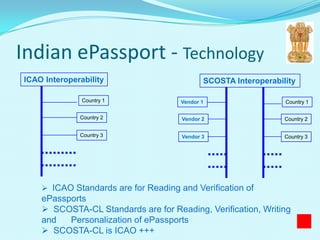
Indian ePassport - Technology
ICAO Interoperability                        SCOSTA Interoperability

               Country 1              Vendor 1                   Country 1

              Country 2               Vendor 2                   Country 2


              Country 3               Vendor 3                   Country 3


     ICAO Standards are for Reading and Verification of
    ePassports
     SCOSTA-CL Standards are for Reading, Verification, Writing
    and   Personalization of ePassports
     SCOSTA-CL is ICAO +++

S K Sinha

  • 1.
  • 2.
    Talk Index  SmartCard Based Indian e-ID’s  Interoperability standards
  • 3.
    National e-ID basedProjects  National ID Card (New Name is NPR)  Driver’s License  e-Passport  Social Security (RSBY  Public Distribution System  Unique ID (Number only, no smart card)
  • 4.
    National ID (NPRCard)  Total Volume is 1 Billion +  No existing Data  To be rolled-out in phased manner in geographic order  Step 1 : Creation of NPR (National Population Register)  Data Collection through census and survey  Demographic data with fingerprint and facial image  Fingerprint based de-duplication (gigantic …!!)  Step 2: Issuance of e-ID on Smart Cards
  • 5.
    National ID (NPRCard)  First Pilot was conducted in 2007  Smart Cards issued to 3 Million citizen.  Second Pilot is on the move – 10 Million – coastal population.  2011 Census is the basis. eID to be issued on the basis of this census.
  • 6.
    National ID (NPRCard) - Objectives  Border and Costal Security  Check illegal immigration  Better Law Enforcement  Identity Verification and Authentication  Border Management
  • 7.
    National ID (NPRCard) - Challenges  Managing Data Collection  Managing Accuracy  Political Challenges  Social Challenges  Technological Challenges  Size  Interoperability
  • 8.
    National ID (NPRCard) - Technology  Biometrics based de-duplication  SCOSTA based Smart Cards with 64 kB EEPROM  Passive Authentication for data integrity.  Symmetric Key based Active Authentication for document authenticity.  Fingerprint 1:1 verification for entity authentication.  Identity and biometrics info to be digitally signed by RGI (MHA)
  • 9.
    Driver’s License  TotalVolume – 100 Millions  Acts and Regulation by MoRT&H  Enforcement and Issuance by State Transport Authorities.  Once issued, entitled to drive across country.  Cross Province Reading and Writing is crucial
  • 10.
    Driver’s License  StateWise Roll Out through Transport Offices  Automated Process flow for back-end processes.  Regional-Provincial-National Registers of Licensee.  Implemented through Public-Private-Partnership.
  • 11.
    Driver’s License -Objectives  To provide an authentic mechanism to check-out the counterfeit.  Better law enforcement.  Provide a fool-proof off-line mechanism of authentication.
  • 12.
    Driver’s License -Technology  SCOSTA based Smart Cards with minimum 64 k bytes (after recent notification by MoRT&H).  Back-end process automation Vahan and Sarathi  Role based Authority Delegation Framework  Issuance  Booking offence  Tax Payment  Card Data management  Standard for Hand Held Smart Card Readers for verification and challan endorsement
  • 13.
    Indian ePassport  Pilotwas implemented in 2007  National Roll out to be launched soon  Totally Indigenous technology based on SCOSTA –CL Standards.  Perfect marriage of ICAO and SCOSTA  Provides complete Interoperability, free from vendor locking.  Interoperability not only in terms of reading and verification, but also for manufacturing and personalization. All because of SCOSTA Standards.
  • 14.
    Indian ePassport -Technology  64 Kbytes µ processor based Inlays – embedded to the back cover.  SCOSTA-CL compliant Operating System.  SCOSTA-CL is superset of ICAO Standards.  Passive Authentication and Basic Access Control.  LDS DG1, DG2, DG3, DG11, DG13 and SOD.  SCOSTA-CL ensures that project does not get into vendor or technology locking.  PKI Setup as per PKD Guidelines (India is a PKD member)
  • 15.
    Social Security (Health) Name of scheme RSBY (National Health Insurance Scheme) (  For economically weaker section of population  Cash-less treatment at all the hospitals just through Smart Cards (Health Card)  Fool-proof off-line mechanism of authentication.  Role based Authority Delegation Framework for delivering services in Hospitals and Health Organizations.
  • 16.
    National Health InsuranceScheme  Free Annual Health Cover of Rs 30,000  Premium paid by Government  Instant Smart Card issuance thru Field Camps (SCOSTA 32 K Contact)  Beneficiary group is pre defined  Card Issuer – ISP (Insurance Service Provider) on behalf of Government  Hospital, empanelled by ISP  Variety of choice with beneficiary to choose the best hospital
  • 17.
    National Health InsuranceScheme  Claims settled by Hospital from ISP, no fee to be paid by beneficiary.  True PPP Model  Premium Paid by Government  Technology Standards by Government  Card issued by ISP but owned by Government  Security Framework by Government  Health services by empanelled hospitals  Health Cover by ISP  Data ownership joint, ISP and Government
  • 18.
    Public Distribution System Pilot is under roll out in State of Haryana and UT of Chandigarh  System of distribution of Government Subsidies to entitled families  Subsidies are given for food grains, cooking oil/gas etc.  Smart Cards to each entitled family.  Smart Cards to each entity in supply chain.  Card to Card transaction at every point in supply chain.  This ensures accountability at every point and stops leakage.  64 K Byte SCOSTA compliant Smart Cards  Finger Print based verification  Fool-proof off-line mechanism of authentication.
  • 19.
    Interoperability Standards Smart CardStandards Finger Print and Biometric Standards Data Standards Process Standards
  • 20.
    SCOSTA Smart Card Standards Indian Smart Card Standards are called as “SCOSTA”  Open Standards  No royalty or membership fee  Maintained by Government of India  Derived from ISO 7816 -4, -8 and -9  Any one can develop and apply for compliance certificate  Web site http://scosta.gov.in; explains everything i.e. Standard, process of testing and certification, application procedure etc.
  • 21.
    Biometrics Standards  Availableat http://egovstandards.gov.in  Finger Print, face and Iris  Fingerprint Standards  Fingerprint Image  Fingerprint Minutia storage and transmission  Fingerprint minutia extraction and matching  Basis is ISO 19794  Facial Image  Basis is ISO 19794 and ICAO  Currently only for manual matching  Iris  Basis is ISO 19794 (is it matured..?)
  • 22.
    Data Standards  DataStandards on eID are crucial for all kind of interoperabilities.  Cross application Standardization for common data elements  E.g. Name, Address, DOB, POB, Parentage etc.  Application specific Data Standards  E.g. http://www.rsby.in, http://parivahan.nic.in etc.
  • 23.
    Thanks !!!!! Contact: Email -sinha.sk@nic.in Cell - +919818238658 Phone - +911124365085 S.K.Sinha National Informatics Center
  • 24.
    Indian ePassport -Technology ICAO Interoperability SCOSTA Interoperability Country 1 Vendor 1 Country 1 Country 2 Vendor 2 Country 2 Country 3 Vendor 3 Country 3  ICAO Standards are for Reading and Verification of ePassports  SCOSTA-CL Standards are for Reading, Verification, Writing and Personalization of ePassports  SCOSTA-CL is ICAO +++