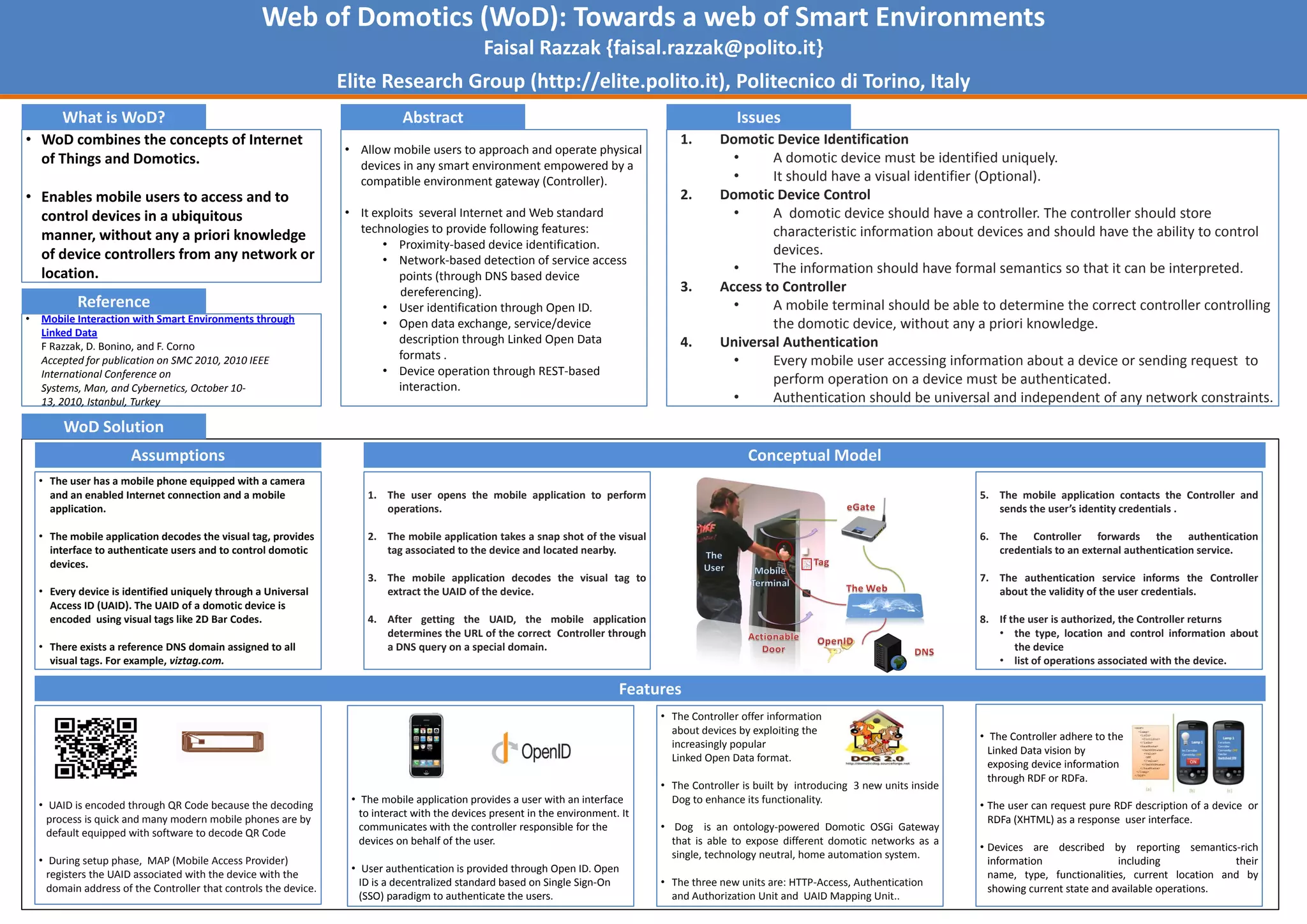
Web of Domotics (WoD): Towards a web of Smart EnvironmentsFaisal Razzak {faisal.razzak@polito.it}Elite Research Group (http://elite.polito.it), Politecnicodi Torino, ItalyWhat is WoD? AbstractIssues WoD combines the concepts of Internet of Things and Domotics.

Web of Domotics Poster

  • 1.
    Web of Domotics(WoD): Towards a web of Smart EnvironmentsFaisal Razzak {faisal.razzak@polito.it}Elite Research Group (http://elite.polito.it), Politecnicodi Torino, ItalyWhat is WoD? AbstractIssues WoD combines the concepts of Internet of Things and Domotics.
  • 2.
    Enables mobile usersto access and to control devices in a ubiquitous manner, without any a priori knowledge of device controllers from any network or location.Domotic Device IdentificationA domotic device must be identified uniquely.
  • 3.
    It should havea visual identifier (Optional). Domotic Device ControlA domotic device should have a controller. The controller should store characteristic information about devices and should have the ability to control devices.
  • 4.
    The information shouldhave formal semantics so that it can be interpreted. Access to ControllerA mobile terminal should be able to determine the correct controller controlling the domotic device, without any a priori knowledge.Universal AuthenticationEvery mobile user accessing information about a device or sending request to perform operation on a device must be authenticated.
  • 5.
    Authentication should beuniversal and independent of any network constraints.
  • 6.
    Allow mobile usersto approach and operate physical devices in any smart environment empowered by a compatible environment gateway (Controller).
  • 7.
    It exploits several Internet and Web standard technologies to provide following features:
  • 8.
  • 9.
    Network-based detection ofservice access points (through DNS based device dereferencing). User identification through Open ID.
  • 10.
    Open data exchange,service/device description through Linked Open Data formats .
  • 11.
    Device operation throughREST-based interaction.Faisal Razzakfaisal.razzak@polito.itReferenceMobile Interaction with Smart Environments through Linked DataF Razzak, D. Bonino, and F. CornoAccepted for publication on SMC 2010, 2010 IEEE International Conference on Systems, Man, and Cybernetics, October 10-13, 2010, Istanbul, TurkeyWoD SolutionAssumptionsConceptual ModelThe user has a mobile phone equipped with a camera and an enabled Internet connectionand a mobile application.
  • 12.
    The mobile applicationdecodes the visual tag, provides interface to authenticate users and to control domotic devices.
  • 13.
    Every device isidentified uniquely through a Universal Access ID (UAID). The UAID of a domotic device is encoded using visual tags like 2D Bar Codes.
  • 14.
    There exists areference DNS domain assigned to all visual tags. For example, viztag.com.The mobile application contacts the Controller and sends the user’s identity credentials .The Controller forwards the authentication credentials to an external authentication service. The authentication service informs the Controller about the validity of the user credentials.If the user is authorized, the Controller returnsthe type, location and control information about the device
  • 15.
    list of operationsassociated with the device.The user opens the mobile application to perform operations.The mobile application takes a snap shot of the visual tag associated to the device and located nearby.The mobile application decodes the visual tag to extract the UAID of the device.After getting the UAID, the mobile application determines the URL of the correct Controller through a DNS query on a special domain.Features The Controller adhere to theLinked Data vision by exposing device information through RDF or RDFa.
  • 16.
    The user canrequest pure RDF description of a device or RDFa (XHTML) as a response user interface.
  • 17.
    Devices are describedby reporting semantics-rich information including their name, type, functionalities, current location and by showing current state and available operations.
  • 18.
    The Controller offerinformation about devices by exploiting theincreasingly popularLinked Open Data format.
  • 19.
    The Controller isbuilt by introducing 3 new units inside Dog to enhance its functionality.
  • 20.
    Dog is an ontology-powered DomoticOSGi Gateway that is able to expose different domotic networks as a single, technology neutral, home automation system.
  • 21.
    The three newunits are: HTTP-Access, Authentication and Authorization Unit and UAID Mapping Unit..
  • 22.
    The mobileapplication provides a user with an interface to interact with the devices present in the environment. It communicates with the controller responsible for the devices on behalf of the user.
  • 23.
    User authenticationis provided through Open ID. Open ID is a decentralized standard based on Single Sign-On (SSO) paradigm to authenticate the users.
  • 24.
    UAID isencoded through QR Code because the decoding process is quick and many modern mobile phones are by default equipped with software to decode QR Code
  • 25.
    During setupphase, MAP (Mobile Access Provider) registers the UAID associated with the device with the domain address of the Controller that controls the device.