
Rainwater Harvesting and Ecosystems Elizabeth Khaka UNEP   /   Division of Environmental Policy Implementation Regional Conference for Southeast Asia on Rainwater Harvesting in IWRM: An Exchange of Practices and Learning 25-26 November, 2008
Flow Introduction Ecosystems services Contribution of ecosystems Ecosystems degradation RWH and ecosystems UNEP ecosystems and RWH initiative
Introduction Definition ecosystem- ‘a dynamic complex of plant, animal, and microorganism communities and the nonliving environment interacting as a functional unit. Humans are an integral part of ecosystems’.  CBD
Introduction Ecosystems major source of livelihood to billions  Dependency high in developing countries
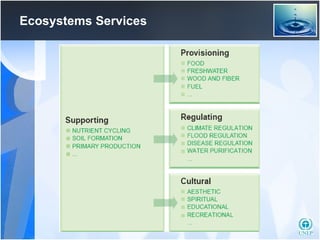
Ecosystems  S ervices
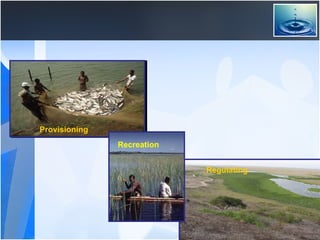
Provisioning Recreation Regulating
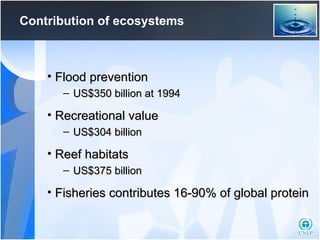
Contribution of ecosystems Flood prevention US$350 billion at 1994  Recreational value US$304 billion Reef habitats US$375 billion  Fisheries contributes 16-90% of global protein
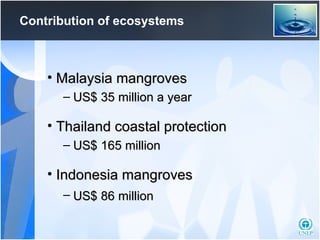
Contribution of ecosystems Malaysia mangrove s US$  35 million a year Thailand coastal protection US$  165 million Indonesia mangroves  US$  86 million
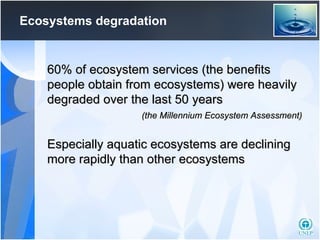
Ecosystems degradation 60% of ecosystem services (the benefits people obtain from ecosystems) were heavily degraded over the last 50 years   (the Millennium Ecosystem Assessment) Especially aquatic ecosystems are declining more rapidly than other ecosystems
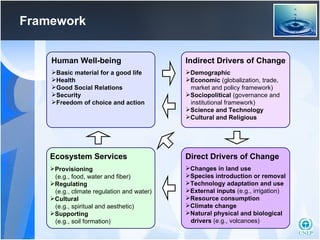
Framework Ecosystem Services Provisioning (e.g., food, water and fiber) Regulating (e.g., climate regulation and water) Cultural (e.g., spiritual and aesthetic) Supporting (e.g., soil formation) Human Well-being Basic material for a good life Health Good Social Relations Security Freedom of choice and action Direct Drivers of Change Changes in land use  Species introduction or removal Technology adaptation and use External inputs  (e.g., irrigation)  Resource consumption Climate change Natural physical and biological  drivers  (e.g., volcanoes) Ind irect Drivers of Change Demographic Economic  (globalization, trade, market and policy framework) Sociopolitical  (governance and  institutional framework) Science and Technology Cultural and Religious
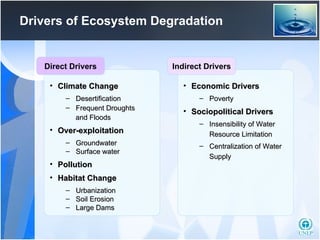
Drivers of Ecosystem Degradation Climate Change Desertification Frequent Droughts  and Floods Over-exploitation Groundwater Surface water Pollution Habitat Change Urbanization Soil Erosion Large Dams Direct Drivers Indirect Drivers Economic Drivers Poverty Sociopolitical Drivers Insensibility  of Water Resource Limitation Centralization of Water Supply
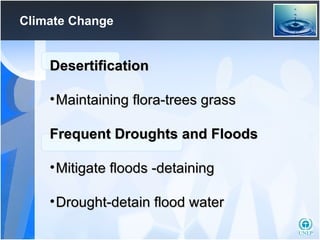
Climate Change Desertification Maintaining flora-trees grass Frequent Droughts and Floods Mitigate floods -detaining Drought-detain flood water
Over-exploitation Improve storage Groundwater recharge  Individual and community structures Soil  Reduce over exploitation Irrigation Household Industrial
Pollution Pollutant Discharges Retaining and detaining urban runoff -reduces the potential for pollutant discharges from overflow Controlling non-point source of pollution is an important broader strategy for the protection of surface water quality in urban areas.
Habitat Change Urbanization Prevents unban floods Groundwater recharge Soil Erosion Reduce runoff  Trees- vegetation Large Dams Reduce reliance on water storage dams  can be reduced
Economic Drivers Poverty Improve production –agriculture Catalyst for development Improve access to water and sanitation Reduce time for fetching water-girl child and school Water for sanitation
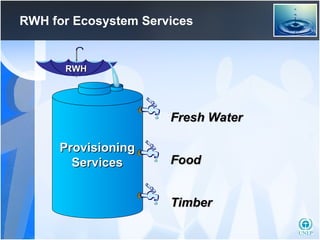
RWH for Ecosystem Services Provisioning Services Fresh Water Food Timber RWH
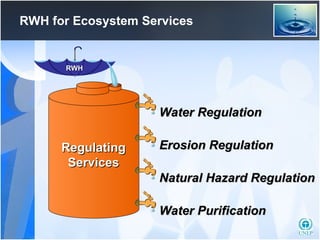
RWH for Ecosystem Services Water Regulation Erosion Regulation Natural Hazard Regulation Water Purification Regulating Services RWH
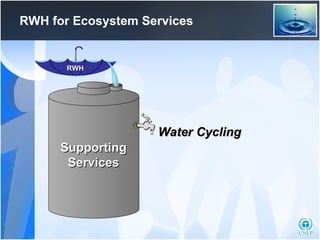
RWH for Ecosystem Services Water Cycling Supporting Services RWH
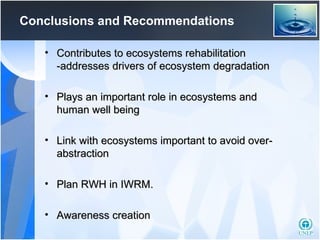
Conclusions and Recommendations Contributes to ecosystems rehabilitation -addresses drivers of ecosystem degradation Plays an important role in ecosystems and human well being Link with ecosystems important to avoid over-abstraction Plan RWH in IWRM. Awareness creation
UNEP   P ublication   on  RWH  &  ecosyst e m s Introduction and background 1a) Introduction, scope 1b) Background: rainwater harvesting the concept 1c) Ecosystems framework and human wellbeing RWH and catchment /watershed management   2 a).  RWH and surface water 2 b).  RWH and ground water recharge RWH and agriculture   3 a). RWH and crop production 3 b). RWH and livestock production 3 c). RWH and cash crop production  (non food production)
UNEP   P ublication   on  RWH  &  ecosyst e m s RWH and forestry  4 a). RWH and forests (incl. aspects on natural and plantation) 4 b). RWH and agroforestry RWH for water supply in rural and urban areas  5 a) RWH and domestic water supply in rural urban context 5 b) RWH and industry RWH in the future 7 a) climate change and  adaptation: the role of RWH 7 b) global drivers of change/ ecosystems degradation & water stress  Conclusions and recommendations 8 a) Synthesis and discussions 8 b) Policy implications: gaps and pot. ways ahead
Thank You

Rwh And Ecosystems Unep

  • 1.
    Rainwater Harvesting andEcosystems Elizabeth Khaka UNEP / Division of Environmental Policy Implementation Regional Conference for Southeast Asia on Rainwater Harvesting in IWRM: An Exchange of Practices and Learning 25-26 November, 2008
  • 2.
    Flow Introduction Ecosystemsservices Contribution of ecosystems Ecosystems degradation RWH and ecosystems UNEP ecosystems and RWH initiative
  • 3.
    Introduction Definition ecosystem-‘a dynamic complex of plant, animal, and microorganism communities and the nonliving environment interacting as a functional unit. Humans are an integral part of ecosystems’. CBD
  • 4.
    Introduction Ecosystems majorsource of livelihood to billions Dependency high in developing countries
  • 5.
    Ecosystems Services
  • 6.
  • 7.
    Contribution of ecosystemsFlood prevention US$350 billion at 1994 Recreational value US$304 billion Reef habitats US$375 billion Fisheries contributes 16-90% of global protein
  • 8.
    Contribution of ecosystemsMalaysia mangrove s US$ 35 million a year Thailand coastal protection US$ 165 million Indonesia mangroves US$ 86 million
  • 9.
    Ecosystems degradation 60%of ecosystem services (the benefits people obtain from ecosystems) were heavily degraded over the last 50 years (the Millennium Ecosystem Assessment) Especially aquatic ecosystems are declining more rapidly than other ecosystems
  • 10.
    Framework Ecosystem ServicesProvisioning (e.g., food, water and fiber) Regulating (e.g., climate regulation and water) Cultural (e.g., spiritual and aesthetic) Supporting (e.g., soil formation) Human Well-being Basic material for a good life Health Good Social Relations Security Freedom of choice and action Direct Drivers of Change Changes in land use Species introduction or removal Technology adaptation and use External inputs (e.g., irrigation) Resource consumption Climate change Natural physical and biological drivers (e.g., volcanoes) Ind irect Drivers of Change Demographic Economic (globalization, trade, market and policy framework) Sociopolitical (governance and institutional framework) Science and Technology Cultural and Religious
  • 11.
    Drivers of EcosystemDegradation Climate Change Desertification Frequent Droughts and Floods Over-exploitation Groundwater Surface water Pollution Habitat Change Urbanization Soil Erosion Large Dams Direct Drivers Indirect Drivers Economic Drivers Poverty Sociopolitical Drivers Insensibility of Water Resource Limitation Centralization of Water Supply
  • 12.
    Climate Change DesertificationMaintaining flora-trees grass Frequent Droughts and Floods Mitigate floods -detaining Drought-detain flood water
  • 13.
    Over-exploitation Improve storageGroundwater recharge Individual and community structures Soil Reduce over exploitation Irrigation Household Industrial
  • 14.
    Pollution Pollutant DischargesRetaining and detaining urban runoff -reduces the potential for pollutant discharges from overflow Controlling non-point source of pollution is an important broader strategy for the protection of surface water quality in urban areas.
  • 15.
    Habitat Change UrbanizationPrevents unban floods Groundwater recharge Soil Erosion Reduce runoff Trees- vegetation Large Dams Reduce reliance on water storage dams can be reduced
  • 16.
    Economic Drivers PovertyImprove production –agriculture Catalyst for development Improve access to water and sanitation Reduce time for fetching water-girl child and school Water for sanitation
  • 17.
    RWH for EcosystemServices Provisioning Services Fresh Water Food Timber RWH
  • 18.
    RWH for EcosystemServices Water Regulation Erosion Regulation Natural Hazard Regulation Water Purification Regulating Services RWH
  • 19.
    RWH for EcosystemServices Water Cycling Supporting Services RWH
  • 20.
    Conclusions and RecommendationsContributes to ecosystems rehabilitation -addresses drivers of ecosystem degradation Plays an important role in ecosystems and human well being Link with ecosystems important to avoid over-abstraction Plan RWH in IWRM. Awareness creation
  • 21.
    UNEP P ublication on RWH & ecosyst e m s Introduction and background 1a) Introduction, scope 1b) Background: rainwater harvesting the concept 1c) Ecosystems framework and human wellbeing RWH and catchment /watershed management 2 a). RWH and surface water 2 b). RWH and ground water recharge RWH and agriculture 3 a). RWH and crop production 3 b). RWH and livestock production 3 c). RWH and cash crop production (non food production)
  • 22.
    UNEP P ublication on RWH & ecosyst e m s RWH and forestry 4 a). RWH and forests (incl. aspects on natural and plantation) 4 b). RWH and agroforestry RWH for water supply in rural and urban areas 5 a) RWH and domestic water supply in rural urban context 5 b) RWH and industry RWH in the future 7 a) climate change and adaptation: the role of RWH 7 b) global drivers of change/ ecosystems degradation & water stress Conclusions and recommendations 8 a) Synthesis and discussions 8 b) Policy implications: gaps and pot. ways ahead
  • 23.