

ECOSYSTEM MANAGEMENT PROGRAMME
A CONTRIBUTION TO THE UNITED NATIONS WORLD WATER ASSESSMENT PROGRAMME


                                                                                                  WATER SECURITY AND ECOSYSTEM SERVICES


                                                                                                                  THE
                                                                                                          CRITICAL
                                                                                                          CONNECTION


                                                                        © MIST | DREAMSTIME.COM
UNEP promotes
         environmentally sound practices
       globally and in its own activities. This
  publication is printed on 100% recycled paper
    using vegetable-based inks and other eco-
friendly practices. Our distribution policy aims to
          reduce UNEP’s carbon footprint.
Water security and ecosystem services:


The critical connection


      A Contribution to the United Nations
  World Water Assessment Programme (WWAP)


        United Nations Environment Programme
                    Nairobi, Kenya
                     March, 2009
ACKNOWLEDGEMENTS


    This document represents the collective expertise of a         completion. These individuals, listed alphabetically, include
    diverse group of individuals concerned with ecosystem          Gunilla Björklund (Sweden), Marti Colley (Panama), Mogens
    degradation, and the continuing loss of the services           Dyhr-Nielsen (Denmark), Mohan Kodarkar (India), Hillary
    provided by these ecosystems. Attention is given to            Masundire (Botswana) and Jeffrey Thornton (USA). The
    aquatic ecosystems because of water`s fundamental role         advice offered by David Coates (Convention on Biological
    as the `blood` of ecosystem structure and functions, and       Diversity), David Molden (IWMI) and David Tickner (IUCN) in
    an engine of economic production. These characteristics        regard to the content and form of this report is also gratefully
    make the goal of maintaining ecosystem services and            acknowledged. The enormous contribution of Walter Rast
    water security a complementary and overlapping task. It is     under tight timeframes is highly appreciated, having ably
    hoped the contents of this report, which was developed as      put the publication together in this form. The enormous
    a contribution to the 3rd World Water Development Report,      contribution of Walter Rast, who put the publication together
    will facilitate more in-depth discussion on these important    under tight timeframes, is highly appreciated. The many
    life-supporting topics.                                        valuable comments and suggestions provided by a range of
                                                                   reviewers, both within and outside the UNEP family, are also
    In view of the importance of water security in supporting      greatly appreciated, as is the last-minute editing and design
    human survival and economic livelihoods, as well as water      work by Peter Hulm and Nikki Meith.
    needs of the ecosystems providing these services, the
    efforts of the Working Group in preparing this report are      The hard work and perseverance of all these individuals
    gratefully acknowledged. Their hard work and insightful        made the preparation of this report possible, and sincere
    contributions to this effort were the primary reason for its   thanks go to all of them.


2    WATER SECURITY AND ECOSYSTEM SERVICES
FOREWORD


We live in a world of ecosystems – and our existence
would not be possible without the life-supporting services
they provide. Properly-functioning ecosystems in turn are
fundamentally related to water security. This report, although
brief in content, is meant to serve as food for thought about
the linkages and interactions between human survival and
well-being, and about the ecosystem services and water
security that result from these linkages and interactions.
This complex topic requires discussion at many levels of
government, society and science. Continuing experience
around the world, however, highlights the fact that water
security and ecosystem services must be viewed with
the same degree of importance in national development
programmes as do social welfare and economic growth.
These considerations are also relevant to achieving the
targets outlined in the Millennium Development Goals
(MDGs). Unfortunately, however, the results of the Millennium
Ecosystem Assessment clearly illustrate that we are failing
to recognize these linkages and ensure their sustainability.
Instead, humanity is continuing to overexploit and pollute
ecosystems throughout the world, and at all scales.

This report makes the link between sustainable development
and ecosystem services, highlighting that the former is           sustainability and water security must be pursued vigorously
not possible without the latter. Economic development             and in a timely manner, since it could take decades before
in turn requires an adequate natural resources base, and          we master the political, institutional and technical aspects
humans are constantly engaged in activities to access these       that enable humanity to use the full potential of ecosystem
resources. The dilemma is that the activities involved in         management for water security. This report is meant to
accessing and using these resources, although directed to         highlight this reality, and to provide examples of cases in
beneficial uses, also have the potential to negatively impact      which various measures were used to facilitate ecosystem
the very ecosystems that provide them in the first place.          sustainability and water security. Although only providing a
Thus, activities that result in ecosystem degradation can be      brief discussion of these important issues, it is hoped this
significant constraints to sustainable development.                report will provide the impetus necessary for governments,
                                                                  non-governmental organizations, industry, agriculture and
The role of water security in addressing ecosystem                other ecosystem services stakeholders to consider such
sustainability is fundamental to this goal. As discussed in       issues in addressing both our short-term needs and our
this report, continued provision of ecosystem services for        long-term goals.
human welfare and economic development is dependent
on properly-functioning and sustainable ecosystem                                                               Achim Steiner
services. Further, water security is at the core of sustainable                 Under Secretary General of the United Nations
ecosystem management,.. The dual goal of ecosystem                                           and Executive Director of UNEP


                                                                                        THE CRITICAL CONNECTION                  3
CONTENTS


    1 Introduction . . . . . . . . . . . . . . . . . . . . . . . . . . . . . . . . . . . . . . . . . . . . . . . . . . . . . . . . . . . . . . . 7
       Sustainable development and human well-being . . . . . . . . . . . . . . . . . . . . . . . . . . . . . . . . . . . . . . . . . . . . . . . . . . . . . . . 7
       Ecosystem services and the Millennium Ecosystem Assessment. . . . . . . . . . . . . . . . . . . . . . . . . . . . . . . . . . . . . . . . . . . 7
       The nature and scope of ecosystem services . . . . . . . . . . . . . . . . . . . . . . . . . . . . . . . . . . . . . . . . . . . . . . . . . . . . . . . . . 9


    2 The ecosystem approach and water security . . . . . . . . . . . . . . . . . . . . . . . . . . . . . . . . . . . . 13
       Freshwater resources and human impacts . . . . . . . . . . . . . . . . . . . . . . . . . . . . . . . . . . . . . . . . . . . . . . . . . . . . . . . . . . 13
       Sustainable ecosystem services and Integrated Water Resources Management (IWRM) . . . . . . . . . . . . . . . . . . . . . . . . 14
       An ecosystem approach to water resources management . . . . . . . . . . . . . . . . . . . . . . . . . . . . . . . . . . . . . . . . . . . . . . 16
       Facilitating water security and properly functioning ecosystems. . . . . . . . . . . . . . . . . . . . . . . . . . . . . . . . . . . . . . . . . . . 17


    3 Water security and ecosystem services case studies: lessons learned . . . . . . . . . . . . . . . 19
       Introduction . . . . . . . . . . . . . . . . . .                                                                                                               19
       Lessons learned from case studies                                                                                                                              20
           Habitat rehabilitation . . . . . . . .                                                                                                                     20
                1. Aral Sea (Central Asia) . .                                                                                                                        20
                2. Chilika Lake (India) . . . . .                                                                                                                     22
                3. Lake Hornborgasjön (Sweden) . . . . . . . . . . . . . . . . . . . . . . . . . . . . . . . . . . . . . . . . . . . . . . . . . . . . . . . . . . . 23
                4. Delavan Lake (USA) . . . .                                                                                                                         24
                5. Lower Danube River and Danube Delta (Southeast Europe). . . . . . . . . . . . . . . . . . . . . . . . . . . . . . . . . . . . . . 25
           Pollution control . . . . . . . . . . . .                                                                                                                  27
           Hartbeespoort Dam (South Africa) . . . . . . . . . . . . . . . . . . . . . . . . . . . . . . . . . . . . . . . . . . . . . . . . . . . . . . . . . . . . . . 27
           Environmental flows . . . . . . . . .                                                                                                                       29
                1. Rouse Hill Recycled Water Area (Australia) . . . . . . . . . . . . . . . . . . . . . . . . . . . . . . . . . . . . . . . . . . . . . . . . . . . 29
                2. Kelly Lakes (USA) . . . . .                                                                                                                        31
       Enhancing Stakeholder Involvement . . . . . . . . . . . . . . . . . . . . . . . . . . . . . . . . . . . . . . . . . . . . . . . . . . . . . . . . . . . . . . . 32
                Lakes Osmansagar and Himayatsagar (India) . . . . . . . . . . . . . . . . . . . . . . . . . . . . . . . . . . . . . . . . . . . . . . . . . . . 32


4    WATER SECURITY AND ECOSYSTEM SERVICES
Integrated watershed management . . . . . . . . . . . . . . . . . . . . . . . . . . . . . . . . . . . . . . . . . . . . . . . . . . . . . . . . . . . . . . . 33
           1. Bermejo River (Bolivia, Argentina) . . . . . . . . . . . . . . . . . . . . . . . . . . . . . . . . . . . . . . . . . . . . . . . . . . . . . . . . . 33
           2. Southern Africa . . . . . . .                                                                                                                        35
               A. Southern African Development Community . . . . . . . . . . . . . . . . . . . . . . . . . . . . . . . . . . . . . . . . . . . . . . . 35
               B. Okavango River Basin . . . . . . . . . . . . . . . . . . . . . . . . . . . . . . . . . . . . . . . . . . . . . . . . . . . . . . . . . . . . . . . 37
               C. Okavango Delta Management Plan (ODMP). . . . . . . . . . . . . . . . . . . . . . . . . . . . . . . . . . . . . . . . . . . . . . . 39
           3. Panama Canal Watershed (Panama) . . . . . . . . . . . . . . . . . . . . . . . . . . . . . . . . . . . . . . . . . . . . . . . . . . . . . . . 40
           4. Bang Pakong River (Thailand) . . . . . . . . . . . . . . . . . . . . . . . . . . . . . . . . . . . . . . . . . . . . . . . . . . . . . . . . . . . . 43


4 Response options on water security for sustainable ecosystem services . . . . . . . . . . . . . . 47
  Consider ecosystem services and water security early in economic development activities . . . . . . . . . . . . . . . . . . . . . . 48

  IWRM must balance ecosystems services to be most effective . . . . . . . . . . . . . . . . . . . . . . . . . . . . . . . . . . . . . . . . . . . 48

  Undertake activities directed to enhancing ecosystem services via water security . . . . . . . . . . . . . . . . . . . . . . . . . . . . . 49

  Rehabilitate degraded ecosystems                                                                                                                                 49

  Undertake appropriate ecosystem monitoring activities . . . . . . . . . . . . . . . . . . . . . . . . . . . . . . . . . . . . . . . . . . . . . . . . . 49

  Adaptive management to accommodate changing ecosystem management goals . . . . . . . . . . . . . . . . . . . . . . . . . . . . 49

  Develop partnerships to promote management of balanced ecosystem services . . . . . . . . . . . . . . . . . . . . . . . . . . . . . 50

  Utilize global venues to promote management of balanced ecosystem services . . . . . . . . . . . . . . . . . . . . . . . . . . . . . . 50

  Establish coherent ecosystem services goals and activities within the UN organizations . . . . . . . . . . . . . . . . . . . . . . . . 50

  Enhance public awareness about ecosystem services and water security . . . . . . . . . . . . . . . . . . . . . . . . . . . . . . . . . . . 51


References                                                                                                                                                        52


                                                                                                                  THE CRITICAL CONNECTION                                 5
6   WATER SECURITY AND ECOSYSTEM SERVICES
CHAPTER ONE


                                                              Introduction

                             Sustainable development and
                             human well-being
                             Sustainable economic development has become an
                             encompassing goal of the international community, and
                             at the national level, as a means of improving the health
                             and well-being of citizens over the long term. Achieving
                             sustainable development at any level, however, remains a
                             daunting task, and underpins the targets identified in the
                             Millennium Development Goals. These targets are many
                             and diverse, addressing basic human health issues such as
                             hunger, poverty, education and health. At the same time,
                             however, these targets are also directly or implicitly related to
                             the health and sustainability of our ecosystems, upon which
                             the target of sustainable development rests. Many factors,
                             including scarce financial and human resources, fragmented
                             authority and responsibility, and lack of political will, remain
                             formidable obstacles to sustainable development. The
                             greatest impediment to achieving sustainable development,
                             however, is depletion and degradation of natural resources,
                             which represent the essential ingredients for human survival,
                             and the ‘fuel’ and building blocks for human well-being and
                             economic development. The long-term sustainability of
                             ecosystems is critical, therefore, since they are the ultimate
                             source of these resources.


                             Ecosystem services and the
                             Millennium Ecosystem Assessment
                             We live in a world of ecosystems. Simply stated, an
                             ecosystem is a complex of living organisms (plants, animals,
                             microorganisms) and their non-living surroundings (water,
                             soil, minerals). These living (including humans) and non-
                             living components are linked as a functional unit by an
© JUSTINB | DREAMSTIME.COM


                             incredibly complex series of interactions and processes
                             that impact the status of both groups of components.
                             Further, ecosystems provide a range of services to humans,
                             including provisioning, regulating, supporting and cultural,


                                                    THE CRITICAL CONNECTION                      7
There is virtually no place on our planet isolated from
       the potential impacts of human activities.


    without which our survival and well-being would simply not        however, the MA reported that 60% of the ecosystem
    be possible.                                                      services accessed are in decline, with the main drivers of
                                                                      this decline being anthropogenic in nature. More precisely, it
    This document was developed as a follow-up to address             is human-environment interactions that result in the greatest
    the findings of the Millennium Ecosystem Assessment (MA).          disturbances or imbalances in the structure or function of
    The MA, begun in June 2001, was a four-year international         ecosystems.
    work programme to provide decision-makers with scientific
    information on the links between ecosystem changes and            It is easy to say that we must take care of our ecosystems.
    the well-being of humans. An ideal economic development           Experience from around the world, however, clearly indicates
    scenario would be one in which humanity interacted with           that we continue to degrade or over-exploit ecosystems to
    ecosystems with the guiding principle that of sustaining          meet our natural resource needs, whether by the very poor
    their services rather than presiding over their continuing        to meet simple survival needs or by the more affluent to
    degradation. It also would include recognition of the             satisfy an increasing appetite for material goods. There is
    inseparable connections between humans and ecosystems.            virtually no place on our planet isolated from the potential
    The interactions between humans and the ecosystems that           impacts of human activities. Climate change, for example,
    surround them control their health and vitality. Unfortunately,   is a global-scale phenomenon affecting our entire world.


                                                                                                                                       © MANUELTELES | DREAMSTIME.COM


8    WATER SECURITY AND ECOSYSTEM SERVICES
Persistent synthetic organic pollutants exist in measurable
quantities in the fatty tissues of seals and other organisms at
the earth’s poles. Pollutants from industrial activities in one
location can travel long distances from their source to impact
ecosystems in other locations. Examples of human use (and
misuse) of our natural capital (resources) abound, including
polluted rivers, lakes and wetlands, depleted groundwater
aquifers, erosion and loss of productive land, deforestation,
desertification, decreased biological diversity, etc.

The drivers of environmental degradation and over-
exploitation are numerous, multifaceted and synergistic in


                                                                                                                                    © OLIWKOWYGAJ | DREAMSTIME.COM
impact. As highlighted in the 3rd World Water Development
Report, many important environmental drivers actually exist
outside the domain of ‘the environment’. As examples,
significant environmental change drivers include population
growth and human migration from one location to another,
resulting in a range of environmental stresses. Social drivers
range from activities of the very poor to meet simple survival
needs, to unsustainable production and consumption                Human survival is completely dependent upon the continued
patterns in developed nations, both with their related            flow of ecosystem services. Some countries have the
environmental stresses. Technological advances represent a        resources, both human and financial, and technology to
double-edged sword in that they can be rapid in application       address the immediate impacts of ecosystem changes.
and impact. An example is improved water conservation,            These resources are not infinite, however, and their utilization
processing and re-use technology, as well as increased            comes with an environmental price tag, substantial in
agricultural and industrial productivity associated with          some cases. Over-exploitation (depletion of supply) and
existing water resources.                                         degradation (depletion of quality) are two aspects of the
                                                                  price to pay, with the causes ranging from economic growth
On the other hand, the emergence of biofuels has led to an        to demographic changes, and even individual choices.
unanticipated use of water resources for crop production,         Thus, recognition of the limits of nature to provide these
with consequences for grain production patterns and water         services at the pace needed to meet human demands is
resource needs. Laws, policies and institutions represent         critical, although often ignored or subordinated, in national
governance elements, whether directed at environmental            economic development plans and programs.
issues in general, or water security in particular. Further,
climate change represents a global-scale consequence
of human actions, attributed by many to the impacts of            The nature of ecosystem services
the excessive and unsustainable use of fossil fuels for
transportation and energy production. In fact, humans can         Ecosystem services represent the benefits that humans
claim to be the most ‘successful’ species on our planet           obtain from ecosystems. These services are both direct
in that they are the most capable of significantly changing        and indirect in nature, some easily recognized and others
the natural environment by engaging in activities to meet         more subtle. And human well-being is fundamentally
their resource needs. This is the basis for some to view the      dependent upon all these services. As noted in the MA
environment as something to be conquered to meet human            (2003), changes in these services can affect humanity,
needs, in contrast to the role of humans as stewards of the       sometimes dramatically, with negative impacts on security,
environment, ensuring its sustainable use (Brinkman and           basic materials for human health and well-being, and the
Pedersen, 2000).                                                  maintenance of social and cultural relations.


                                                                                        THE CRITICAL CONNECTION                                                      9
... humans have changed ecosystems more rapidly and
        more extensively during the past half-century than ever
        before in human existence.


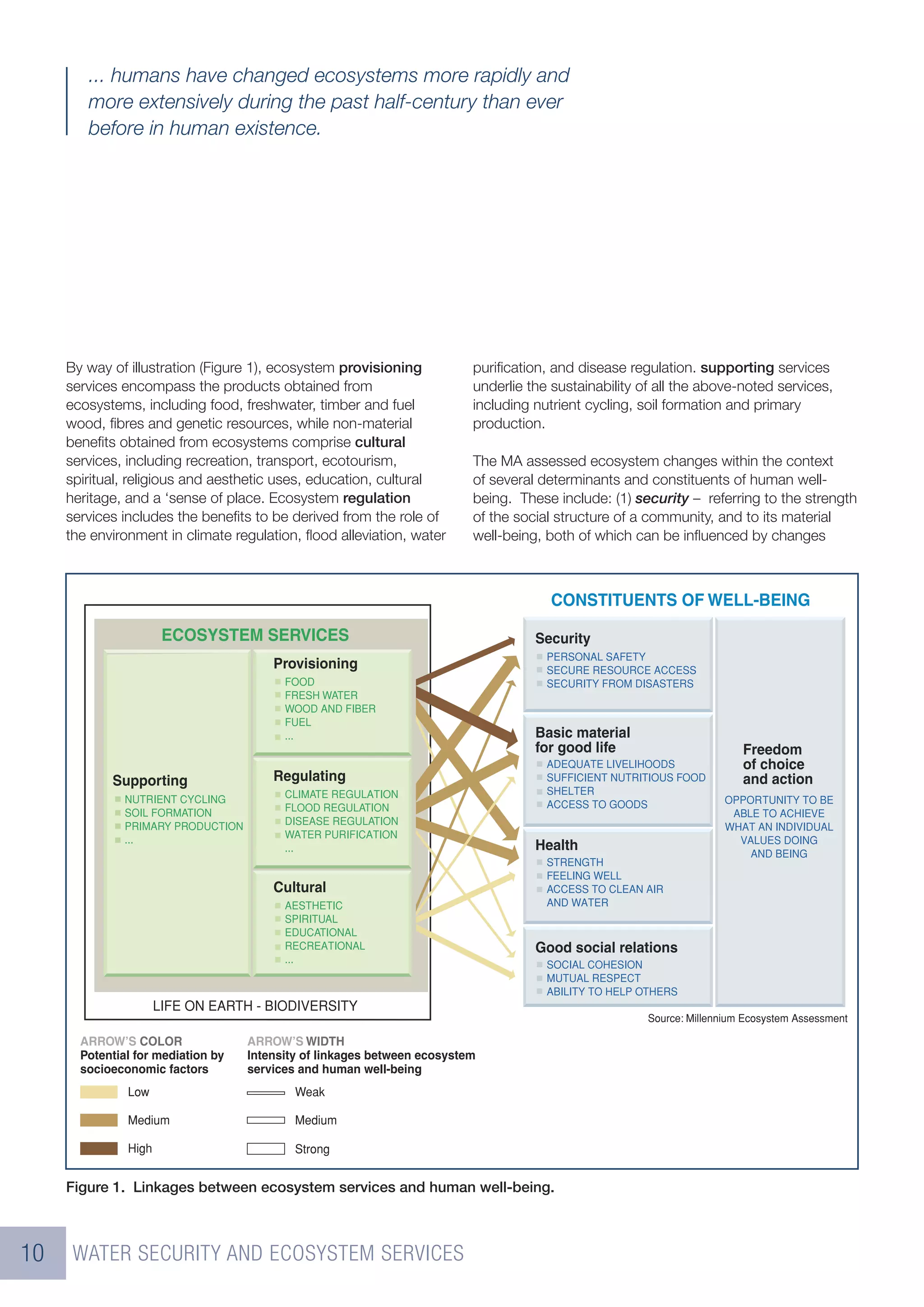
     By way of illustration (Figure 1), ecosystem provisioning        purification, and disease regulation. supporting services
     services encompass the products obtained from                    underlie the sustainability of all the above-noted services,
     ecosystems, including food, freshwater, timber and fuel          including nutrient cycling, soil formation and primary
     wood, fibres and genetic resources, while non-material            production.
     benefits obtained from ecosystems comprise cultural
     services, including recreation, transport, ecotourism,           The MA assessed ecosystem changes within the context
     spiritual, religious and aesthetic uses, education, cultural     of several determinants and constituents of human well-
     heritage, and a ‘sense of place. Ecosystem regulation            being. These include: (1) security – referring to the strength
     services includes the benefits to be derived from the role of     of the social structure of a community, and to its material
     the environment in climate regulation, flood alleviation, water   well-being, both of which can be influenced by changes


     Figure 1. Linkages between ecosystem services and human well-being.


10    WATER SECURITY AND ECOSYSTEM SERVICES
© VICTOO | DREAMSTIME.COM
in provisioning and cultural services; (2) basic material       determinants are underpinned by so-called ‘freedoms and
for human well-being – which can be influenced both              choices,’ which can be influenced by changes in all the
by provisioning (food, fibre, etc.) and regulating services      above-noted services (MA, 2003).
such as water purification; (3) human health – which is
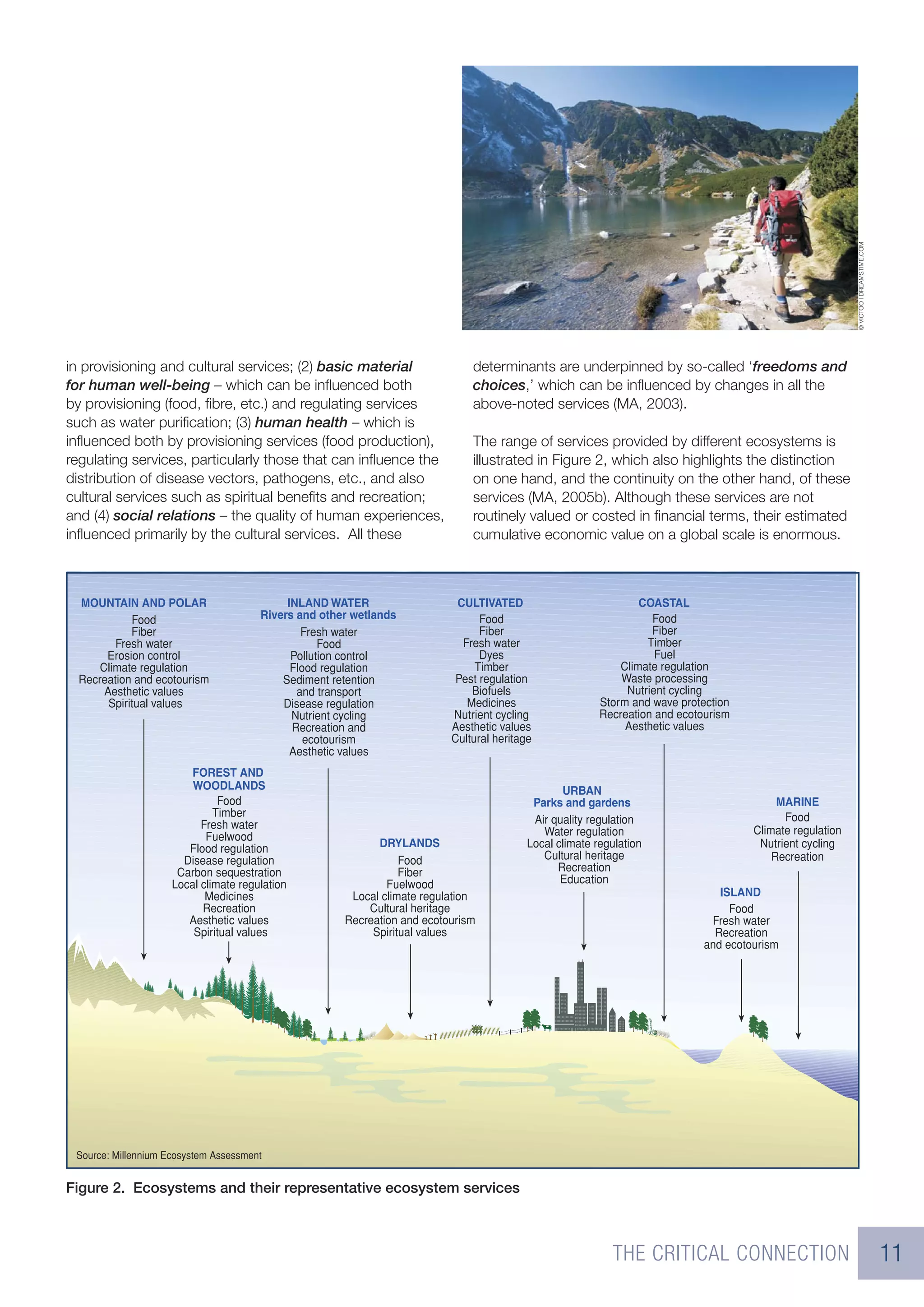
influenced both by provisioning services (food production),      The range of services provided by different ecosystems is
regulating services, particularly those that can influence the   illustrated in Figure 2, which also highlights the distinction
distribution of disease vectors, pathogens, etc., and also      on one hand, and the continuity on the other hand, of these
cultural services such as spiritual benefits and recreation;     services (MA, 2005b). Although these services are not
and (4) social relations – the quality of human experiences,    routinely valued or costed in financial terms, their estimated
influenced primarily by the cultural services. All these         cumulative economic value on a global scale is enormous.


Figure 2. Ecosystems and their representative ecosystem services


                                                                                      THE CRITICAL CONNECTION                                                11
... demand for ecosystem services around the world
        is now so great that trade-offs between ecosystem
        services ... are becoming increasingly necessary.


     In an often-cited example, Costanza et al. (1997) provided        resource managers to secure the resilience of ecosystems.
     an estimate of the value of the world’s ecosystem services
     and natural capital, and the benefits to be derived from           In addition, to meet growing demands for freshwater, food,
     them. Based on their work, the estimated economic value           fibre, fuel, etc., humans have changed ecosystems more
     of 17 ecosystem services provided by 16 biomes averaged           rapidly and more extensively during the past half-century
     US$ 33 trillion per year. The aquatic biomes examined in          than ever before. Although these changes have contributed
     their study (both marine and freshwater) made up about            to human well-being and economic development, they
     US$ 27 trillion of this total estimate. This compares to          also have resulted in substantial ecosystem degradation
     a total GDP, of all the countries in the world combined,          in many locations. They have reduced global biodiversity,
     of approximately US $17 trillion during the study period.         as well as exacerbated the poverty of some groups of
     Although some assumptions used in determining the                 people, particularly the rural poor who often depend directly
     economic value of specific ecosystem services in the study         on ecosystem services for their economic survival and
     have been questioned, there is no doubt that the total value      livelihoods.
     of ecosystem services provided to humanity totals in the
     tens of trillions of dollars annually.                            Even more significant was the conclusion that the demand
                                                                       for ecosystem services around the world is now so great
     Against this background, the MA reached a number of               that trade-offs between ecosystem services (e.g., conversion
     important conclusions regarding ecosystem changes on a            of forests to agricultural land, with attendant gains in some
     global scale, many with distressing long-term implications        ecosystem services at the expense of perhaps even more
     (MA, 2005a). Fifteen (60%) of the 24 ecosystem services           important supporting or regulating services) are becoming
     examined in the MA are being used in an unsustainable             increasingly necessary. Assuming a continuing trend in this
     manner, resulting in pollution, degradation and over-             direction, the MA concludes that future generations will
     exploitation. Further, human-induced ecosystem changes            experience a substantial reduction in the human benefits to
     are increasing the possibility of non-linear changes in           be derived from these ecosystem services. It also means
     ecosystems (e.g., accelerating or reversing trends) with          that future efforts may have to be directed to balancing
     potentially significant consequences regarding their ability       between ecosystem services in some locations and under
     to provide life-supporting ecosystem services to humanity.        some circumstances, particularly when they are being
     This observation highlights the great responsibility of natural   overexploited or degraded.


12    WATER SECURITY AND ECOSYSTEM SERVICES
CHAPTER TWO


The ecosystem approach and water security

                                             Freshwater resources and
                                             human impacts
                                             Of all the resources required for sustaining ecosystems
                                             and the services they provide for human health and well-
                                             being, water is arguably the most important. In contrast
                                             to all other resources, no living organism can survive in
                                             the complete absence of water, making it an essential
                                             ingredient necessary for all life as we know it. The Earth’s
                                             water resources can be characterized as: (1) finite - there is
                                             a fixed quantity on our planet; (ii) sensitive – it can be easily
                                             degraded by human activities; and (iii) irreplaceable – it has
                                             no substitute in all its uses (Illueca and Rast, 1996). Further,
                                             the hydrologic cycle links our planetary components of
                                             water, land and the atmosphere via a never-ending pattern
                                             of precipitation, runoff, infiltration, and evaporation.

                                             Sustainable utilization of water resources is the primary goal
                                             of water resources management. Water resources were
                                             initially viewed primarily as a commodity to be utilized in the
                                             same sense as oil, ore or other extractable resources, with
                                             meeting human water needs being the primary concern of
                                             water resources managers. Attention focused on obtaining
                                             additional water sources when existing supplies became fully
                                             allocated or utilized.

                                             This approach was not sustainable, however, since human
                                             ability to extract and utilize water resources can easily
                                             overwhelm the ability of our ecosystems to provide them in
                                             the quantity or quality for which they are being used. Only
                                             in recent years, with the development and advocacy of
                                             integrated water resources management approaches, have
                                             the other fundamentally important roles of water become
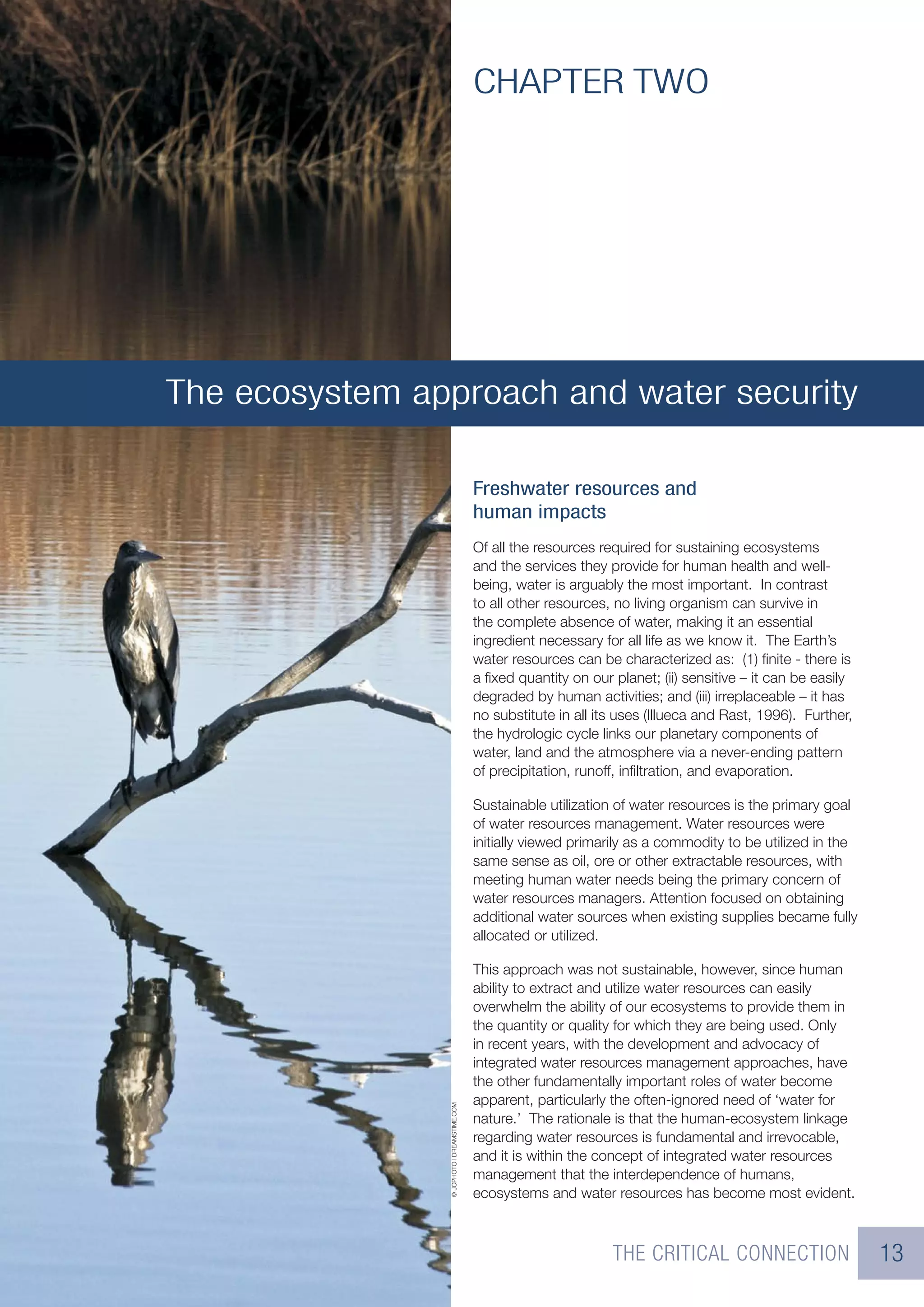
                                             apparent, particularly the often-ignored need of ‘water for
                © JOPHOTO | DREAMSTIME.COM


                                             nature.’ The rationale is that the human-ecosystem linkage
                                             regarding water resources is fundamental and irrevocable,
                                             and it is within the concept of integrated water resources
                                             management that the interdependence of humans,
                                             ecosystems and water resources has become most evident.


                                                                    THE CRITICAL CONNECTION                     13
The top four groups of organisms facing
        extinction ... are aquatic species.


     The results of misusing water resources, and resulting          was of “paramount importance for action in the 1990s and
     ecosystem degradation and its impacts on ecosystem              beyond”. This conclusion included recognition of freshwater
     services, illustrate the negative impacts of non-sustainable    as a finite and vulnerable resource, and the need to integrate
     water use. Water systems are very sensitive to human            the water plans and programs of different water-use sectors
     activities in their surrounding drainage basins. Lakes, for     into social and economic policies on a national scale. In the
     example, are sinks for inputs of water, and the materials and   freshwater chapter of Agenda 21, the governments defined
     pollutants carried in it, thereby being sensitive barometers    IWRM as a process based on water being “an integral
     of human activities in their surrounding watersheds (ILBM,      part of the ecosystem, a natural resource and a social and
     2005). Nor does the concern rest solely with direct human       economic good, whose quantity and quality determine the
     water uses. The top four groups of organisms facing             nature of its utilization.” The Global Water Partnership (GWP,
     extinction, for example, are aquatic species (WWDR, 2003).      2000) provided a more operational definition of IWRM as a
     Consequently, the degradation or elimination of ecosystem       methodology that promotes the coordinated development
     services because of the unsustainable use of ecosystems is      and management of water, land and related resources
     usually readily visible where water resources are concerned.    in order to “maximize the resultant economic and social
                                                                     welfare in an equitable manner without compromising the
                                                                     sustainability of vital ecosystems.” IWRM views watersheds
     Sustainable ecosystem services and                              in a comprehensive manner – within the context of their
     Integrated Water Resources Management                           geographic position in the landscape, and the entirety of
     (IWRM)                                                          their human influences and ecosystem functions.

     In addition to being an essential requirement for human         The integrated approach embodied within the concept of
     survival and a fuel for economic development, as the            IWRM marks a fundamental departure from the perspective
     ‘life blood’ of ecosystem functioning, water is therefore       of water as a commodity, to one that considers all major
     fundamental to sustainable ecosystem services. Water            water uses on an equal basis, including the water needs
     management therefore translates into managing ecosystem         of nature. It collectively considers both the scientific
     services, and must be a fundamental goal of virtually all       and technical elements of water management (e.g.,
     such efforts.                                                   water quantity and quality; geology; physiography and
                                                                     topography; flora; fauna; water supply and demands),
     With this goal in mind, and the need to address the             and the socioeconomic components (often referred to
     continuing degradation and over-exploitation of aquatic         as water governance, and including such elements as
     ecosystems, the concept of Integrated Water Resources           institutions, regulations, policy, public awareness, financial
     Management (IWRM) has gained increasing acceptance              concerns, cultural values, political realities, etc.). The
     by water stakeholders and decision-makers, both in the          distinction between these two groupings is that the former
     international water arena and on the national level. Touched    fundamentally define and describe the quantity, quality
     upon in varying degrees since the 1972 UN Conference on         and location of water resources (what; where), while the
     the Human Environment, the concept of IWRM was more             latter represent elements that fundamentally control or
     firmly grasped at the 1992 UN Conference on Environment          define how and why humans use their water resources.
     and Development (United Nations, 1992). Among the               Although more qualitative in nature, and more difficult to
     water-related observations arising from this ‘Earth Summit,’    identify and assess, these latter elements are fundamentally
     convened to adopt the principles for sustainability action in   important in developing and implementing sustainable water
     the 21st century known as Agenda 21, was the recognition        management programs. The International Lake Environment
     that the degree to which human social well-being and            Committee (ILEC, 2005) also evaluated the importance and
     economic productivity was dependent upon development of         interrelations of the scientific and socioeconomic elements
     water resources was often not appreciated. Further, it was      within the latter elements within the context of integrated
     concluded that a holistic approach to water management          lake basin management (ILBM).


14    WATER SECURITY AND ECOSYSTEM SERVICES
As promulgated by the Global Water Partnership (GWP,           to be simultaneously considered with this approach.
2000), IWRM focuses on three main goals, including: (i)        Nevertheless, the desirability of an integrated water
maximizing economic efficiency in water use in response         resources management approach was highlighted at
to increasing water demands; (ii) equity in the basic access   the 2002 Johannesburg World Summit on Sustainable
of people to water resources; and (iii) environmental and      Development, with the request that countries develop
ecological sustainability, which translates into managing      IWRM-based ‘water efficiency plans’ as a means of
water systems so as not to undermine their ecosystem           facilitating the management of their freshwater resources for
services. Achieving these goals requires, among other          sustainable use. The Global Water Partnership (2004, 2006)
elements: (i) a general enabling framework comprising          subsequently provided two interim reports on the progress
policies, legislation, regulations and information; (ii)       of this effort. UN-Water (2008) subsequently completed
institutional roles and functions of various administrative    a more comprehensive status report on IWRM plans on
levels and stakeholders; and (iii) operational management      a global scale for the 16th Session of the Commission
instruments for regulating, monitoring and enforcement for     on Sustainable Development. Although these efforts
decision-makers. The cross-sectoral integration of these       have indicated mixed results to some degree, the overall
elements as they relate to various water needs also was        indications are that this request is being seriously pursued by
stressed, including water for maintaining ecosystem services   governments in many countries around the world.
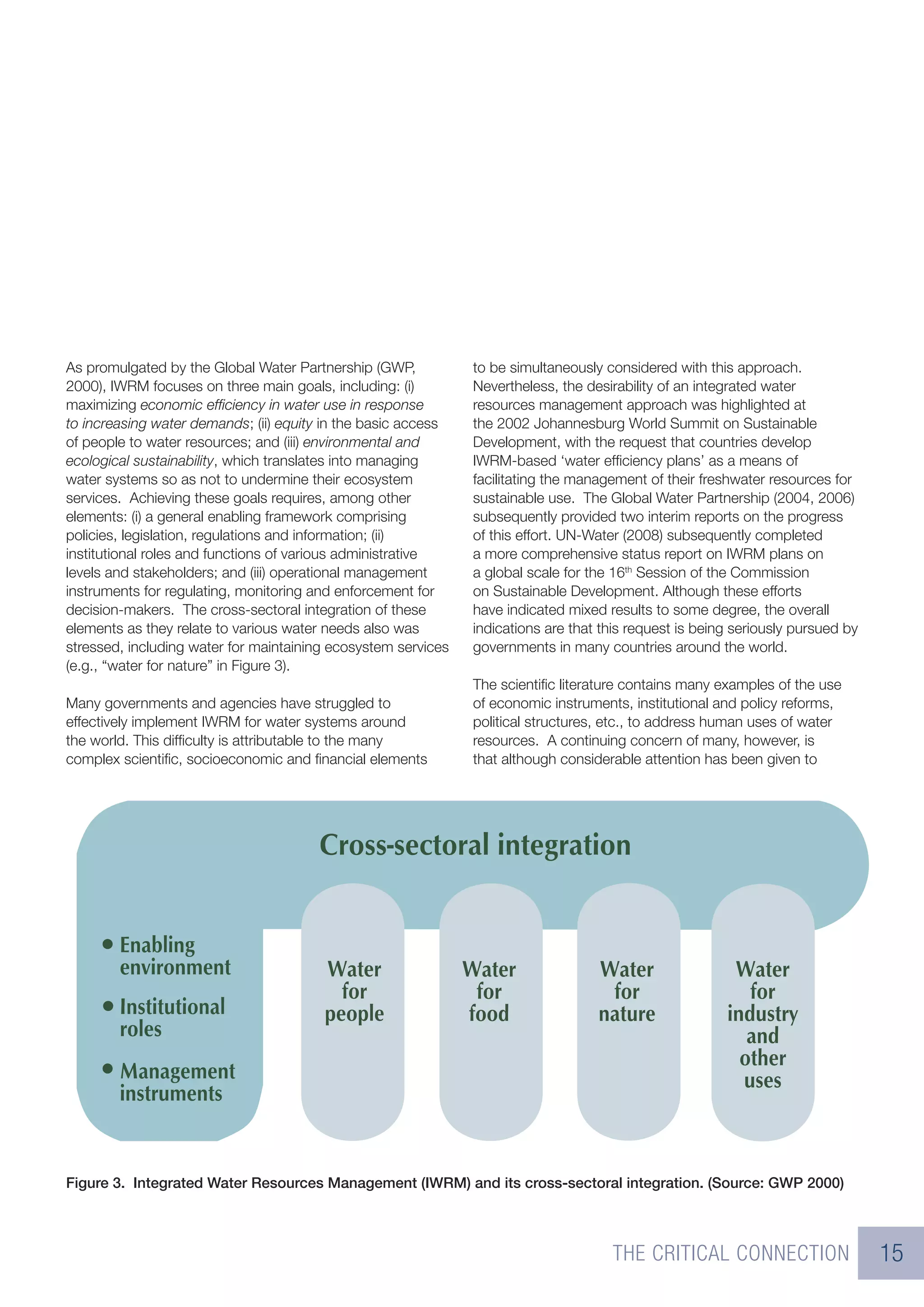
(e.g., “water for nature” in Figure 3).
                                                               The scientific literature contains many examples of the use
Many governments and agencies have struggled to                of economic instruments, institutional and policy reforms,
effectively implement IWRM for water systems around            political structures, etc., to address human uses of water
the world. This difficulty is attributable to the many          resources. A continuing concern of many, however, is
complex scientific, socioeconomic and financial elements         that although considerable attention has been given to


                                       ��������������� �����������


        ��������
        �����������                     �����                  �����               �����                 �����
                                          ���                   ���                 ���                    ���
        �������������                   ������                 ����                ������               ��������
        �����                                                                                              ���
                                                                                                          �����
        ����������                                                                                        ����
        �����������


Figure 3. Integrated Water Resources Management (IWRM) and its cross-sectoral integration. (Source: GWP 2000)


                                                                                     THE CRITICAL CONNECTION                     15
... every time we access, develop, transport or utilize water
        resources, we leave an impact that may degrade the
        service provided by the river, lake, wetland or groundwater
        aquifer that supplied the water in the first place.


     human water needs for drinking water and sanitation,            the variability among all living organisms and the range of
     food production and industry (Figure 3), less attention         ecosystems in which they reside, and refers to diversity
     has been given to the ‘environmental and ecological             at a number of scales, including genetic, species and
     sustainability’ element, the ultimate focus of which is         ecosystems. The importance of biodiversity is that many of
     sustainable ecosystem services. On the basis of the             its products are ecosystem services (e.g., food). Biodiversity
     previous discussion of the foundational role of ecosystem       changes, therefore, can influence the provision of ecosystem
     services in supporting human life and well-being, it could      services.
     readily be argued that if the environmental components
     providing ecosystem services are not maintained or are          The Earth’s ecosystems could not function without adequate
     degraded by human activities, the existence of the entire       supplies of water of suitable quality. However, every time
     water sub-sector structure is at risk. Thus, the need to        we access, develop, transport or utilize water resources, we
     effectively manage ecosystems and their services has            leave an impact that may degrade the service provided by
     far-reaching implications for human health, well-being and      the river, lake, wetland or groundwater aquifer that supplied
     economic stability. Yet, environmental concerns in general,     the water in the first place. Water security, therefore,
     and ecosystem services in particular, are often afterthoughts   depends on how well we can address disturbances to these
     in economic development, or are not incorporated into           water systems which can, in turn, affect their services.
     development and economic policies until late in the process,
     if at all, thereby ensuring they are often inadequately         Because the notion of an ecosystem represents a useful
     addressed. Further complicating the situation is that           framework to consider the many linkages between humans
     ecosystem degradation is often an incremental process,          and their environment, a so-called ‘ecosystem approach’
     with each stage of degradation proceeding at such a rate        has been advocated by many organizations and individuals
     that small changes can go unnoticed for long periods of         as a means of addressing the interrelations between water,
     time, ultimately culminating in major environmental impacts.    land, air, and all living organisms, and encompassing
     Glantz (1999), for example, highlighted the ‘creeping’ nature   ecosystems and their services. This concept was previously
     of environmental degradation, and particularly the manner in    advocated, for example, by the International Joint
     which many problems related to the demise of the Aral Sea       Commission to the governments of the United States and
     became evident.                                                 Canada within the context of the 1978 Great Lakes Water
                                                                     Quality Agreement, as a means of restoring and maintaining
     Current water resources management practices do not             the chemical, physical and biological integrity of the waters
     consider all relevant ecosystem services, even in those         of the Great Lakes Basin Ecosystem (Great Lakes Research
     situations in which IWRM is applied. As a result, many          Advisory Board, 1978). Used in varying ways by others in
     management efforts only focus on selected services. One         the interim, the ecosystem approach was formally proposed
     clear conclusion is that IWRM must balance all ecosystem        in 2000 by the 5th Conference of Parties to the Convention
     services to be most effective. Further, it must assess          of Biological Diversity as a “strategy for the integrated
     mechanisms that consider both present and alternative           management of land, water and living resources that
     future ecosystem services, including steps to improve           promotes conservation and sustainable use in an equitable
     ecosystem resilience and decrease vulnerability, particularly   way”. The conservation of ecosystem structure and function
     as regards the very poor.                                       was a priority of this approach, as it was in the MA (2003).
                                                                     The Conference of Parties also provided 12 principles of
                                                                     the ecosystem approach, including the need to understand
     An ecosystem approach to water resources                        and manage an ecosystem in an economic context, at
     management                                                      appropriate spatial and temporal scales, and in consultation
                                                                     with all relevant sectors of society and scientific disciplines
     Ecosystems and biological diversity (biodiversity) are          (CBD, 2009). An integrated ecosystem approach is therefore
     closely related concepts (MA, 2003). Diversity represents       crucial to maintaining both ecosystem health and our own.


16    WATER SECURITY AND ECOSYSTEM SERVICES
Nevertheless, managing ecosystems is complex and difficult.    An ecosystem-based management approach can facilitate
The overriding goal is to maintain ecosystem resilience       and integrate actions to meet multiple societal goals,
and functioning in order to ensure sustainable delivery of    including: (1) finding a balance between different water users
ecosystem services, taking into account both land and         and uses; (2) preserving water use opportunities (services);
water, and the living resources they support. Because         (3) integrating water quantity and quality; and (4) merging
many water managers and agencies often do not consider        aquatic and terrestrial concerns. Thus, managing ecosystem
the value of ecosystem services, the result is degraded       services by ensuring that ecosystems have sufficient water
ecosystems. Indeed, water management has traditionally        of adequate quality available is the key to achieving both
focused on specific factors directed more toward individual    water security and human health and well-being.
concerns such as water pollution control, water supply
and allocation, and specific targeted water-use sectors,
rather than considering them collectively. The value of an    Facilitating water security and properly
ecosystem approach rests in the fact that it focuses on       functioning ecosystems
the broader goal of balancing and sustaining ecosystem
services as the prerequisite for meeting these (and other)    Many environmental management options exist to tackle
sectoral needs. In doing so, the ecosystem approach           sustainable ecosystem functioning and services. Although
complements IWRM as a strategy for the integrated             not an exhaustive list, major ecosystem management
management of not only water, but also the associated         options and goals include:
land and living resources in a way that maintains ecosystem
health and productivity, in balance with sustainable water    •   Maintaining environmental flows – Determining and
use by humans. In other words – it links ecosystem service        ensuring minimum water flows, and regulating the
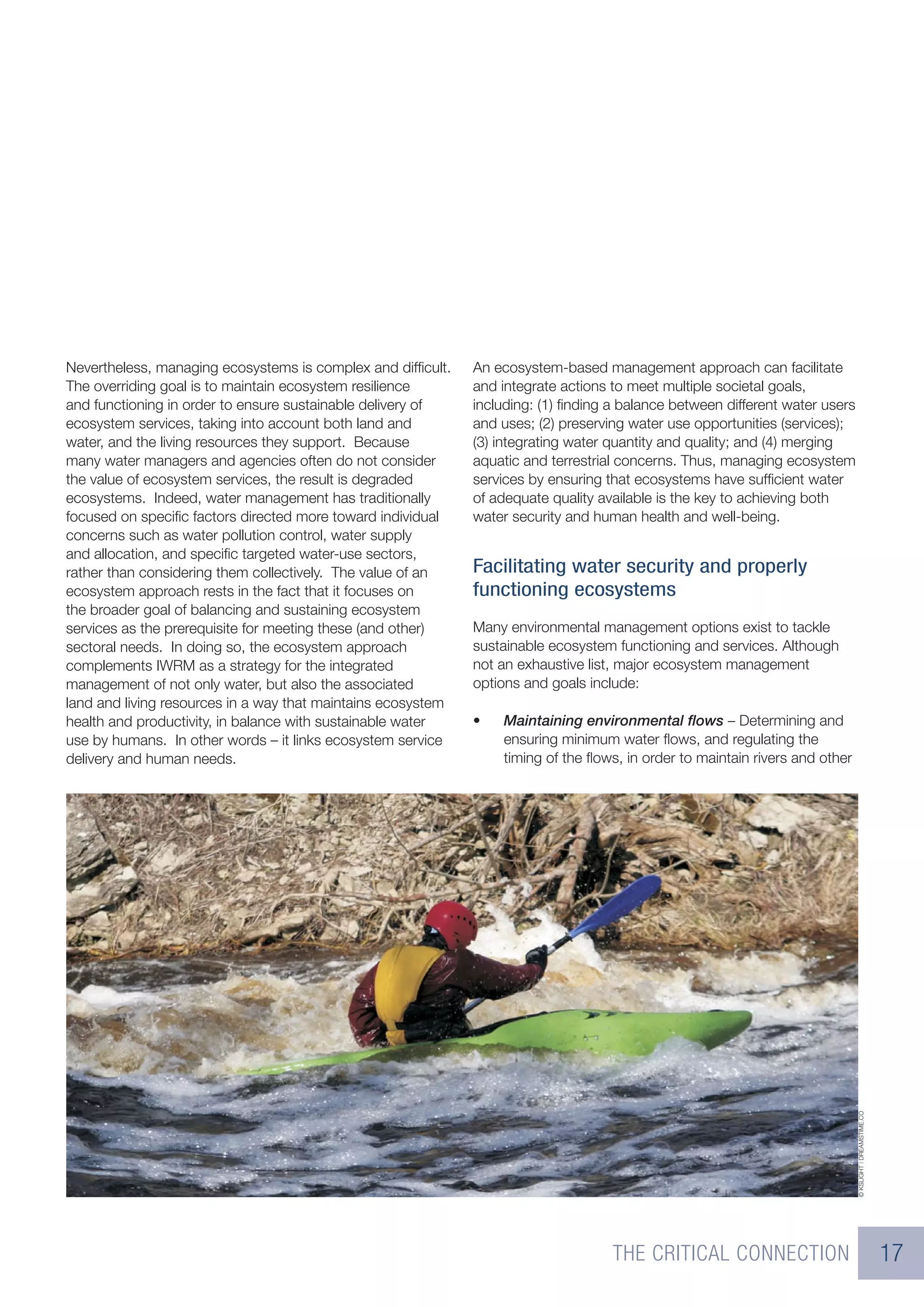
delivery and human needs.                                         timing of the flows, in order to maintain rivers and other


                                                                                                                              © KSLIGHT | DREAMSTIME.CO


                                                                                    THE CRITICAL CONNECTION                                               17
Continuing evidence of the economic development benefits
         inherent in sustaining ecosystem services, as well as
         ensuring the water security required to provide them ...
         makes it appropriate to take action to develop them.


         aquatic ecosystems and their resources and diversity of           ‘pay’ for excessive use, or degradation, of ecosystem
         existing and potential services.                                  services, typically applicable to industry and similar
                                                                           water users.
     •   Pollution control – Reducing the load of contaminants
         emanating from point and nonpoint sources, including         The MA highlighted continuing ecosystem degradation
         water reuse and recycling and pollution reduction at         through the world, particularly its significant consequences
         the source, as well as preventing the entry of such          on the ability of ecosystems to continue to deliver life-
         polluting materials into receiving water systems through     supporting services. It also highlighted water systems as
         nonpoint-source best management practices (e.g.,             being very sensitive to such disruptions.
         buffer strips; conservation tillage; detention basins;
         grassed waterways).                                          Ironically, water security also is a unifying element in that it
                                                                      supplies people with drinking water, sanitation, food and
     •   Ecohydrology and phytoremediation – Using natural            fish, industrial resources, energy, transportation and natural
         hydrology, or the ability of specific aquatic organisms, to   aesthetic amenities, all of which depend on maintaining
         reduce the impacts of pollution on aquatic ecosystems,       ecosystem health and productivity. Continuing evidence of
         or to reverse the adverse effects of these pollutants.       the economic development benefits inherent in sustaining
                                                                      ecosystem services, as well as ensuring the water security
     •   Habitat rehabilitation – Undertaking reconstruction          required to provide them – in contrast to the continuing
         and similar activities to rehabilitate aquatic ecosystems    negative impacts of not considering these concepts – makes
         and related natural habitats (e.g., bank reconstruction,     it appropriate to take action to develop them.
         artificial wetlands) to preserve or restore a range of
         ecosystem functions.                                         To this end, governments and other relevant organizations
                                                                      take all necessary action to ensure ecosystem services and
     •   Conjunctive use of surface and groundwater                   water security – even if done step-by-step, and we learn
         – Utilizing a combination of surface and groundwater         through trial and error.
         to meet human water demands in a manner that
         maximizes the sustainable use of both water sources.         The primary lessons learned from our management of water-
                                                                      related ecosystems to date are that:
     •   Watershed management – Utilizing structural or non-
         structural approaches within the context of IWRM or          •    Continued provision of ecosystem services for
         other management framework designed specifically to                human welfare is dependent on sustainable and
         prevent or reduce degradation of aquatic ecosystems,              properly functioning ecosystems; and
         or to rehabilitate already-degraded aquatic ecosystems.
                                                                      •    Water security is at the core of management of
     •   Water demand management – Implementing policies                   sustainable ecosystems.
         to control consumer demands for water resources,
         and specifically managing the distribution of, or access      The next chapter provides case studies of various
         to, water on the basis of needs, including allocating        programmes and activities undertaken to address specific
         existing water resources according to a hierarchy            ecosystem degradation issues, with the goal of restoring
         of neediness, rather than increasing the quantity of         degraded or damaged ecosystem services. Although not
         available water.                                             all were undertaken within the larger framework of IWRM,
                                                                      they provide examples showing that properly-functioning
     •   Payment for ecosystem goods and services –                   ecosystems, and the services they provide, remain
         Employing economic instruments (incentives, penalties,       central to human society on a local, national and even
         user fees, licenses, etc.) to compensate or otherwise        regional scale.


18   WATER SECURITY AND ECOSYSTEM SERVICES
CHAPTER THREE


Water security and ecosystem services
        case studies: lessons learned

                                      Introduction
                                      All ecosystems are impacted in one way or another
                                      when they are utilized to meet human needs (e.g., water
                                      supply, food production). The concern is whether or not
                                      these impacts are sufficient to overwhelm the ability of
                                      an ecosystem to continue to provide such services in a
                                      sustainable and balanced manner, or to provide different
                                      ecosystem services as communities and countries continue
                                      to change and develop. This chapter provides summaries
                                      of aquatic ecosystem management case studies in different
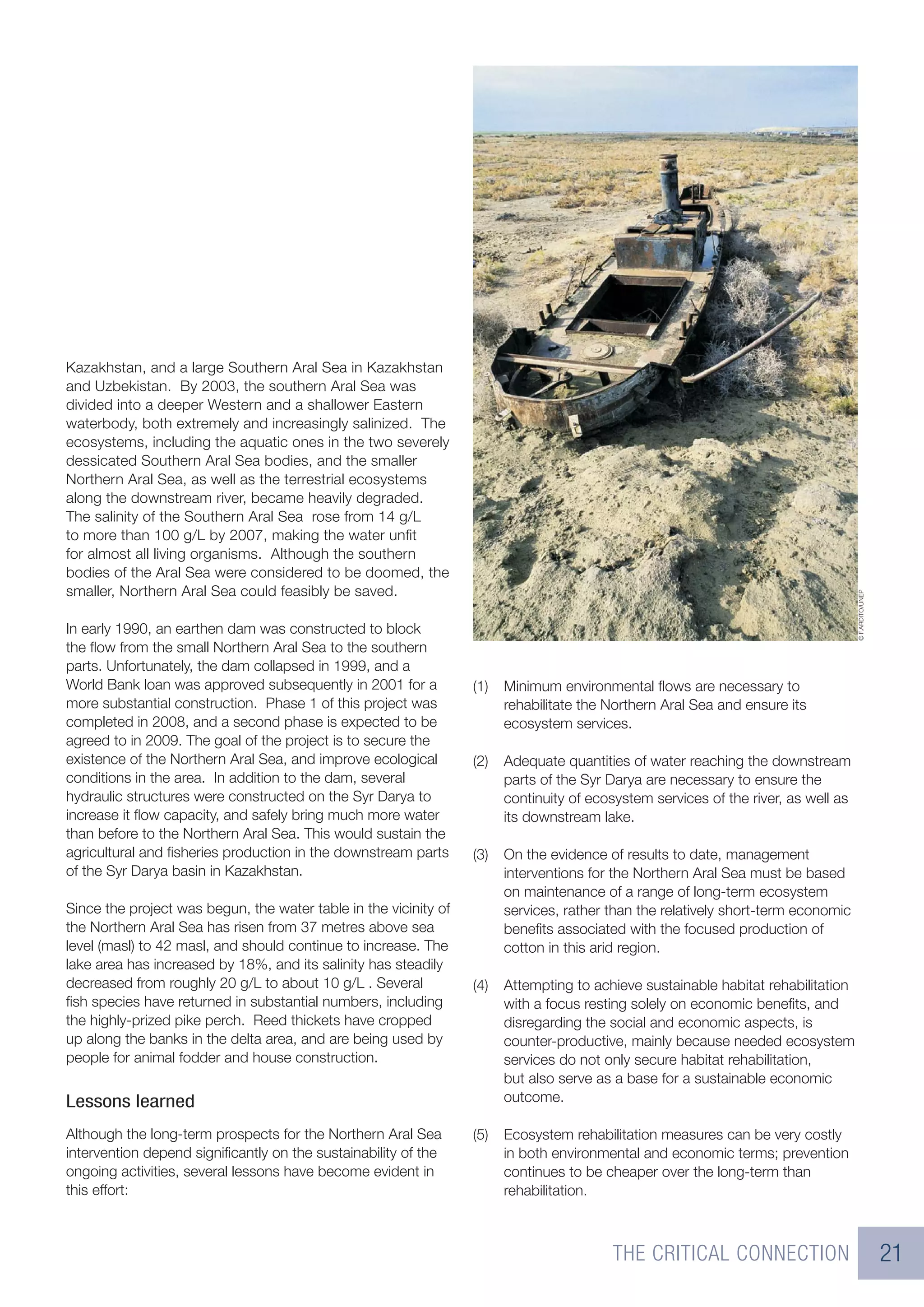
                                      locations in the world (Figure 4). In presenting these
                                      summaries, it is acknowledged that IWRM is still being
                                      developed and refined, and we are continuing to learn
                                      how to better apply it in different locations, contexts and
                                      conditions. The case study summaries in this chapter are
                                      meant to illustrate the potential of supporting IWRM with the
                                      use of an ecosystem approach for water management.

                                      These case study summaries illustrate how ecosystem
                                      services were valued in specific cases, and demonstrate
                                      that it is possible to restore degraded ecosystems and
                                      the diversity of services they provide, within the context of
                                      sustainable management of water resources. The examples
                                      range from largely technical and technological approaches
                                      to socioeconomic approaches, and encompass both
                                      developed and developing nations. Based on the case
                                      studies provided by the identified authors, each summary
                                      highlights: (i) the ecosystem being addressed and the
                                      services they provide; (ii) the constraints to their sustainable
                                      use and the impacts of these constraints; (iii) the actions
                                      taken to ensure ecosystem structure and functioning; and
            © DIXI | DREAMSTIME.COM


                                      (iv) the results of the actions taken within the context of
                                      sustainable ecosystem services and water security. Although
                                      each water system must be viewed within the context of its
                                      unique characteristics and problems, and illustrate lessons


                                                             THE CRITICAL CONNECTION                     19
... virtually all ecosystems provide multiple services, both
        for meeting human needs and maintaining other living
        organisms.


     learned in regard to the problems specific to the water
     system being discussed, these case study summaries also                     HABITAT REHABILITATION
     offer general lessons that can be used to facilitate effective
     management of similar aquatic systems for sustainable use.       1. Aral Sea (Central Asia)
                                                                      Source: Syr Darya River Contribution to Habitat
     Lessons learned from case studies                                Rehabilitation in the Northern Aral Sea, contributed by
                                                                      Gunilla Björklund, Akkadia Consulting, Stockholm
     In discussing the case studies in this section, it is noted
     that virtually all ecosystems provide multiple services, both    The Aral Sea is located in Central Asia in the former
     for meeting human needs and maintaining other living             Soviet republics of Kazakhstan and Uzbekistan. Formerly
     organisms. The examples presented here, however, may             the site of a thriving fishing and agricultural industry, a
     focus on measures taken to address one or only a few of          management system was imposed diverting water from
     these needs, even though the measures may have been              the influent Syr Darya and Amu Darya rivers for irrigation
     formulated and implemented within the context of more            of cotton. The quantity of water used for irrigation
     comprehensive management programmes. In this way, the            along the rivers doubled between 1965 and 1986,
     results of specific management activities can be more easily      resulting in serious economic, social and environmental
     highlighted, and the lessons learned from them more easily       damage. Drinking water supplies became polluted and
     identified. The case study summaries are grouped below on         human health problems increased sharply. The salinity
     the basis of the primary ecosystem management approach           and pollution levels rose dramatically, and the Aral Sea
     being discussed. The full case studies are provided as           decreased to 10% of its former size. In 1989 the Aral
     separate background material to this report.                     Sea split into a small Northern Aral Sea in the territory of


                                                             ����
                                                         �������������


                   ������� ����                                            ���� ���
                  ����� �����
                                                           ����� ������
                                                           ����� � �����
                                                                                       ������� ����


               ������ �����                                                ���������� �        ���� ������ �����
                                                                           ������������
                                                                              �����
                                                     �������� �����
                                                        � �����
                     ������� �����
                                                                �������������
                                                                     ���                        �����������������
                                                                                                   ����� ������


                                                                                                            �������� ����� ����� ������ ����


     Figure 4. Location of case study water systems


20    WATER SECURITY AND ECOSYSTEM SERVICES
Kazakhstan, and a large Southern Aral Sea in Kazakhstan
and Uzbekistan. By 2003, the southern Aral Sea was
divided into a deeper Western and a shallower Eastern
waterbody, both extremely and increasingly salinized. The
ecosystems, including the aquatic ones in the two severely
dessicated Southern Aral Sea bodies, and the smaller
Northern Aral Sea, as well as the terrestrial ecosystems
along the downstream river, became heavily degraded.
The salinity of the Southern Aral Sea rose from 14 g/L
to more than 100 g/L by 2007, making the water unfit
for almost all living organisms. Although the southern
bodies of the Aral Sea were considered to be doomed, the
smaller, Northern Aral Sea could feasibly be saved.


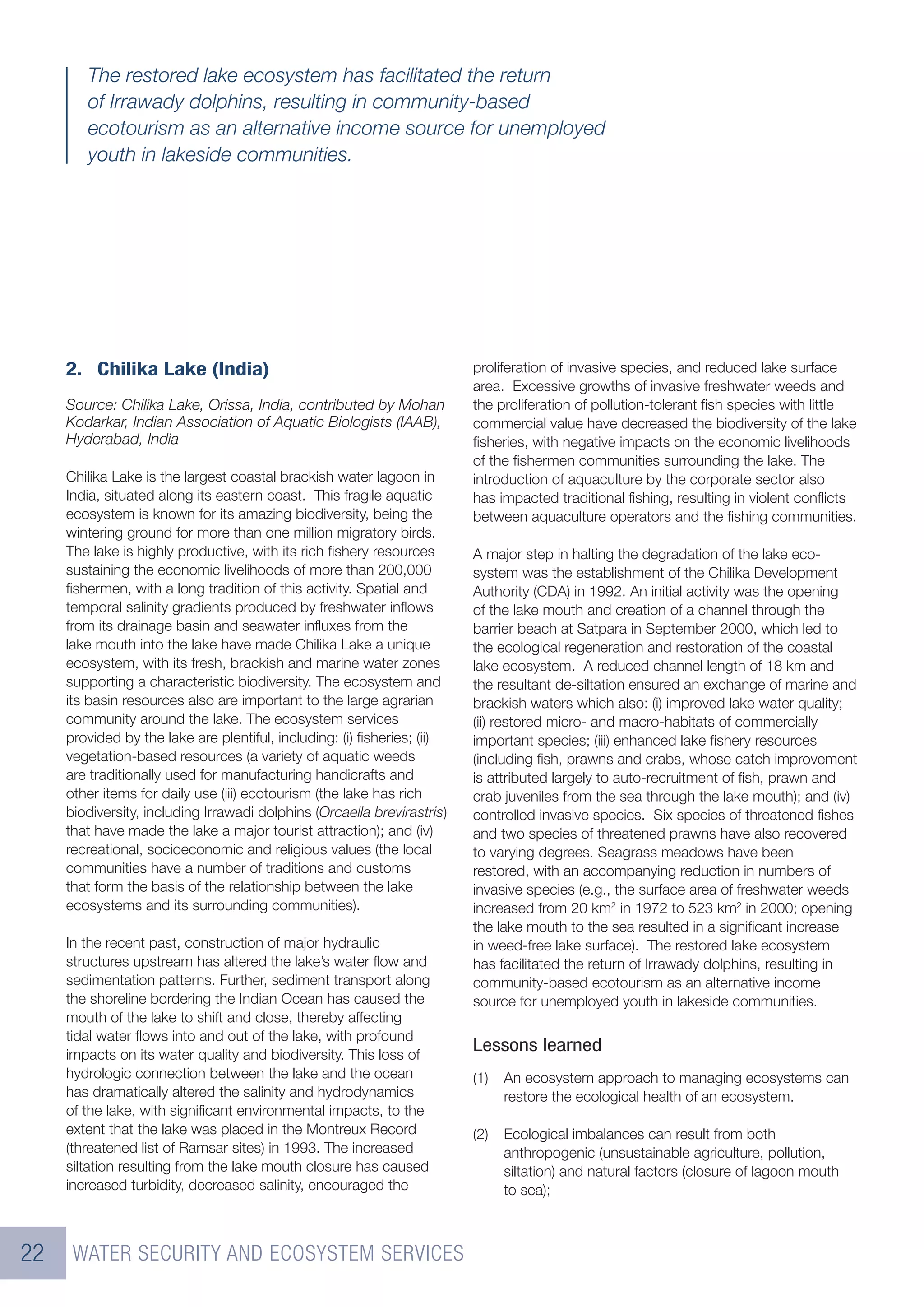
                                                                                                                                    © F.ARDITO/UNEP
In early 1990, an earthen dam was constructed to block
the flow from the small Northern Aral Sea to the southern
parts. Unfortunately, the dam collapsed in 1999, and a
World Bank loan was approved subsequently in 2001 for a           (1)   Minimum environmental flows are necessary to
more substantial construction. Phase 1 of this project was              rehabilitate the Northern Aral Sea and ensure its
completed in 2008, and a second phase is expected to be                 ecosystem services.
agreed to in 2009. The goal of the project is to secure the
existence of the Northern Aral Sea, and improve ecological        (2)   Adequate quantities of water reaching the downstream
conditions in the area. In addition to the dam, several                 parts of the Syr Darya are necessary to ensure the
hydraulic structures were constructed on the Syr Darya to               continuity of ecosystem services of the river, as well as
increase it flow capacity, and safely bring much more water              its downstream lake.
than before to the Northern Aral Sea. This would sustain the
agricultural and fisheries production in the downstream parts      (3)   On the evidence of results to date, management
of the Syr Darya basin in Kazakhstan.                                   interventions for the Northern Aral Sea must be based
                                                                        on maintenance of a range of long-term ecosystem
Since the project was begun, the water table in the vicinity of         services, rather than the relatively short-term economic
the Northern Aral Sea has risen from 37 metres above sea                benefits associated with the focused production of
level (masl) to 42 masl, and should continue to increase. The           cotton in this arid region.
lake area has increased by 18%, and its salinity has steadily
decreased from roughly 20 g/L to about 10 g/L . Several           (4)   Attempting to achieve sustainable habitat rehabilitation
fish species have returned in substantial numbers, including             with a focus resting solely on economic benefits, and
the highly-prized pike perch. Reed thickets have cropped                disregarding the social and economic aspects, is
up along the banks in the delta area, and are being used by             counter-productive, mainly because needed ecosystem
people for animal fodder and house construction.                        services do not only secure habitat rehabilitation,
                                                                        but also serve as a base for a sustainable economic
Lessons learned                                                         outcome.

Although the long-term prospects for the Northern Aral Sea        (5)   Ecosystem rehabilitation measures can be very costly
intervention depend significantly on the sustainability of the           in both environmental and economic terms; prevention
ongoing activities, several lessons have become evident in              continues to be cheaper over the long-term than
this effort:                                                            rehabilitation.


                                                                                         THE CRITICAL CONNECTION                                      21
The restored lake ecosystem has facilitated the return
        of Irrawady dolphins, resulting in community-based
        ecotourism as an alternative income source for unemployed
        youth in lakeside communities.


     2. Chilika Lake (India)                                             proliferation of invasive species, and reduced lake surface
                                                                         area. Excessive growths of invasive freshwater weeds and
     Source: Chilika Lake, Orissa, India, contributed by Mohan           the proliferation of pollution-tolerant fish species with little
     Kodarkar, Indian Association of Aquatic Biologists (IAAB),          commercial value have decreased the biodiversity of the lake
     Hyderabad, India                                                    fisheries, with negative impacts on the economic livelihoods
                                                                         of the fishermen communities surrounding the lake. The
     Chilika Lake is the largest coastal brackish water lagoon in        introduction of aquaculture by the corporate sector also
     India, situated along its eastern coast. This fragile aquatic       has impacted traditional fishing, resulting in violent conflicts
     ecosystem is known for its amazing biodiversity, being the          between aquaculture operators and the fishing communities.
     wintering ground for more than one million migratory birds.
     The lake is highly productive, with its rich fishery resources       A major step in halting the degradation of the lake eco-
     sustaining the economic livelihoods of more than 200,000            system was the establishment of the Chilika Development
     fishermen, with a long tradition of this activity. Spatial and       Authority (CDA) in 1992. An initial activity was the opening
     temporal salinity gradients produced by freshwater inflows           of the lake mouth and creation of a channel through the
     from its drainage basin and seawater influxes from the               barrier beach at Satpara in September 2000, which led to
     lake mouth into the lake have made Chilika Lake a unique            the ecological regeneration and restoration of the coastal
     ecosystem, with its fresh, brackish and marine water zones          lake ecosystem. A reduced channel length of 18 km and
     supporting a characteristic biodiversity. The ecosystem and         the resultant de-siltation ensured an exchange of marine and
     its basin resources also are important to the large agrarian        brackish waters which also: (i) improved lake water quality;
     community around the lake. The ecosystem services                   (ii) restored micro- and macro-habitats of commercially
     provided by the lake are plentiful, including: (i) fisheries; (ii)   important species; (iii) enhanced lake fishery resources
     vegetation-based resources (a variety of aquatic weeds              (including fish, prawns and crabs, whose catch improvement
     are traditionally used for manufacturing handicrafts and            is attributed largely to auto-recruitment of fish, prawn and
     other items for daily use (iii) ecotourism (the lake has rich       crab juveniles from the sea through the lake mouth); and (iv)
     biodiversity, including Irrawadi dolphins (Orcaella brevirastris)   controlled invasive species. Six species of threatened fishes
     that have made the lake a major tourist attraction); and (iv)       and two species of threatened prawns have also recovered
     recreational, socioeconomic and religious values (the local         to varying degrees. Seagrass meadows have been
     communities have a number of traditions and customs                 restored, with an accompanying reduction in numbers of
     that form the basis of the relationship between the lake            invasive species (e.g., the surface area of freshwater weeds
     ecosystems and its surrounding communities).                        increased from 20 km2 in 1972 to 523 km2 in 2000; opening
                                                                         the lake mouth to the sea resulted in a significant increase
     In the recent past, construction of major hydraulic                 in weed-free lake surface). The restored lake ecosystem
     structures upstream has altered the lake’s water flow and            has facilitated the return of Irrawady dolphins, resulting in
     sedimentation patterns. Further, sediment transport along           community-based ecotourism as an alternative income
     the shoreline bordering the Indian Ocean has caused the             source for unemployed youth in lakeside communities.
     mouth of the lake to shift and close, thereby affecting
     tidal water flows into and out of the lake, with profound
     impacts on its water quality and biodiversity. This loss of
                                                                         Lessons learned
     hydrologic connection between the lake and the ocean                (1)   An ecosystem approach to managing ecosystems can
     has dramatically altered the salinity and hydrodynamics                   restore the ecological health of an ecosystem.
     of the lake, with significant environmental impacts, to the
     extent that the lake was placed in the Montreux Record              (2)   Ecological imbalances can result from both
     (threatened list of Ramsar sites) in 1993. The increased                  anthropogenic (unsustainable agriculture, pollution,
     siltation resulting from the lake mouth closure has caused                siltation) and natural factors (closure of lagoon mouth
     increased turbidity, decreased salinity, encouraged the                   to sea);


22    WATER SECURITY AND ECOSYSTEM SERVICES
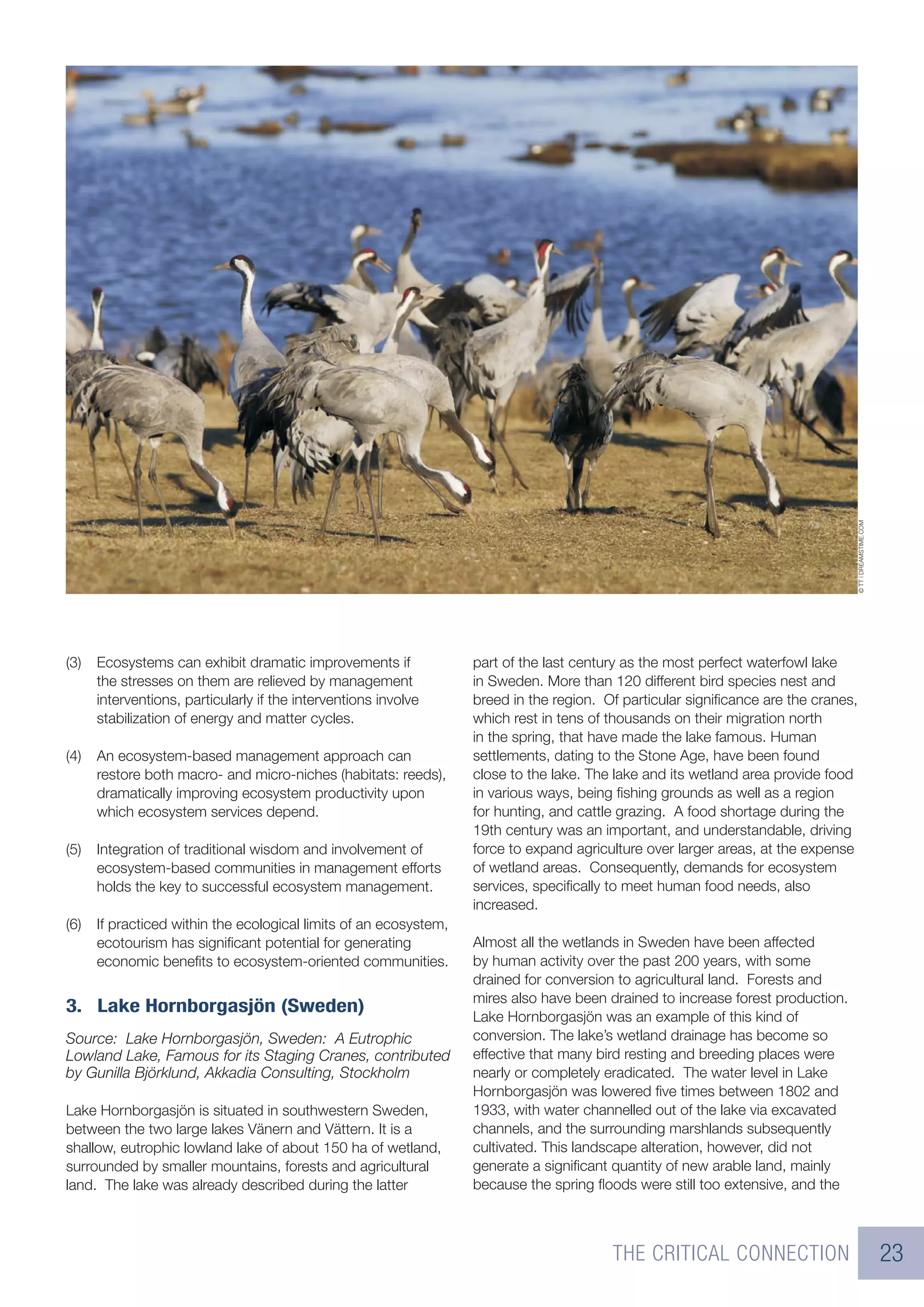
© TT | DREAMSTIME.COM
(3)   Ecosystems can exhibit dramatic improvements if              part of the last century as the most perfect waterfowl lake
      the stresses on them are relieved by management              in Sweden. More than 120 different bird species nest and
      interventions, particularly if the interventions involve     breed in the region. Of particular significance are the cranes,
      stabilization of energy and matter cycles.                   which rest in tens of thousands on their migration north
                                                                   in the spring, that have made the lake famous. Human
(4)   An ecosystem-based management approach can                   settlements, dating to the Stone Age, have been found
      restore both macro- and micro-niches (habitats: reeds),      close to the lake. The lake and its wetland area provide food
      dramatically improving ecosystem productivity upon           in various ways, being fishing grounds as well as a region
      which ecosystem services depend.                             for hunting, and cattle grazing. A food shortage during the
                                                                   19th century was an important, and understandable, driving
(5)   Integration of traditional wisdom and involvement of         force to expand agriculture over larger areas, at the expense
      ecosystem-based communities in management efforts            of wetland areas. Consequently, demands for ecosystem
      holds the key to successful ecosystem management.            services, specifically to meet human food needs, also
                                                                   increased.
(6)   If practiced within the ecological limits of an ecosystem,
      ecotourism has significant potential for generating           Almost all the wetlands in Sweden have been affected
      economic benefits to ecosystem-oriented communities.          by human activity over the past 200 years, with some
                                                                   drained for conversion to agricultural land. Forests and
                                                                   mires also have been drained to increase forest production.
3. Lake Hornborgasjön (Sweden)
                                                                   Lake Hornborgasjön was an example of this kind of
Source: Lake Hornborgasjön, Sweden: A Eutrophic                    conversion. The lake’s wetland drainage has become so
Lowland Lake, Famous for its Staging Cranes, contributed           effective that many bird resting and breeding places were
by Gunilla Björklund, Akkadia Consulting, Stockholm                nearly or completely eradicated. The water level in Lake
                                                                   Hornborgasjön was lowered five times between 1802 and
Lake Hornborgasjön is situated in southwestern Sweden,             1933, with water channelled out of the lake via excavated
between the two large lakes Vänern and Vättern. It is a            channels, and the surrounding marshlands subsequently
shallow, eutrophic lowland lake of about 150 ha of wetland,        cultivated. This landscape alteration, however, did not
surrounded by smaller mountains, forests and agricultural          generate a significant quantity of new arable land, mainly
land. The lake was already described during the latter             because the spring floods were still too extensive, and the


                                                                                         THE CRITICAL CONNECTION                                         23
Utilizing ecosystem services for agricultural production
           may not always be more positive than managing for a
           near-natural ecosystem condition that supports not only
           agriculture but also tourism and recreational uses.


     lake bottom, although dry in summer, remained soft and                    can generate more income in some situations than
     impossible to cultivate efficiently. As a result, the lake started         agricultural activities.
     to become overgrown with shoreline forest, shrubs, sedge
     and reeds. Its water level decreased to 2.5 m below its level       (3)   Ecosystem interactions must be considered within
     before 1802, with the remainder of the lake being a reed                  a wider, longer-term perspective when undertaking
     area with some pools. The bioactivity subsequently became                 construction work that impacts the water cycle,
     imbalanced, being reduced in some areas, and extremely                    since a sustainable ecology may not be achieved,
     increased in other areas, on a seasonal basis resulting in                and a second habitat rehabilitation may be needed,
     rapid sedimentation of organic material and a continually                 if a positive ‘impact-chain’ cannot be identified as an
     overgrown lake.                                                           outcome of such measures.

     The first attempts at lake restoration were begun in the
                                                                         4. Delavan Lake (USA)
     1950s, with the first restoration plan initiated in the latter
     part of the 1960s. The original restoration plan, approved          Source: Rehabilitation of Delevan Lake (Wisconsin,
     by the Swedish Parliament in 1977, essentially involved: (i)        USA), contributed by Jeffrey Thornton and T.M. Slawski,
     destruction of reed root mats; (ii) building of embankments at      Southeastern Wisconsin Regional Planning Commission,
     the lake outlet, and at certain low-lying points around the lake,   Waukesha, Wisconsin USA, and M.E. Eiswerth, University
     thereby protecting agricultural land close to the lake; and (iii)   of Wisconsin-Whitewater, USA
     raising the lake’s mean summer water level by about 1.5 m.
                                                                         Delavan Lake is situated on Jackson Creek, which drains
     The envisaged increase in water level in the 1977 restoration       through the town of Delavan, Wisconsin, and ultimately
     plan of 1.5 m was achieved in the late-1980s. Construction          to the Mississippi River. The Lake has a surface area of
     of about 25 km of embankments to prevent flooding of                 approximately 838.5 ha, a mean and maximum depth of
     agricultural land was slightly changed, due partly to the           about 6.4 and 17 m, respectively, and a water volume of
     costs of their maintenance and potential subsidence                 about 55.3 million m3. The lake level is augmented by a
     problems on soft lake sub-strata. The revisions affected            2.5 m dam constructed at the lake outlet. Development
     construction of the southeastern and northern edges of              of the lake began in 1875 with the construction of the first
     the embankments, resulting in shallow shoreline meadows,            permanent residence along the lake’s north shore. Today,
     excellent for waterfowl.                                            the lake serves multiple purposes, ranging from providing
                                                                         a venue for waterfront residential (and limited commercial)
     Another positive result was an increased tourism associated         development, to providing a popular recreational venue for
     with cranes attracted to the wetland area by waste potatoes         residents and visitors alike, to being a visual amenity for the
     and barley from a distillery. Several tourist amenities have        community and its visitors.
     been created, and the so-called “Crane Dance” is closely
     followed in the news media.                                         Delavan Lake historically has experienced various ecosystem
                                                                         impairments, including excessive aquatic plant and algal
     Lessons learned                                                     growths, water quality-related use limitations, and public
                                                                         concerns over its aesthetic degradation. Concerns have
     (1)    Utilizing ecosystem services for agricultural production     been raised regarding deteriorating water quality conditions,
            may not always be more positive than managing for a          the need to protect environmentally sensitive areas, and to
            near-natural ecosystem condition that supports not only      prevent the spread of exotic plant species within its basin.
            agriculture but also tourism and recreational uses.          To improve the usability of Delavan Lake, and to prevent
                                                                         future deterioration of its natural assets and recreational
     (2)    Restoring a lake to a pre-disturbance condition              potential, federal, state, and local agencies began a major,
            may result in a more favourable biodiversity, which          multi-year programme of lake rehabilitation between 1969


24    WATER SECURITY AND ECOSYSTEM SERVICES
© BRM1949 | DREAMSTIME.COM
and 1993. The remedial measures were intended to achieve         Delevan region annually spent about US $9 million, with
and maintain fishable and swimmable conditions within the         angler activity alone generating an estimated US$1.38 million
lake, and included: (i) formation of a town sanitary district    per year. The sum of direct and secondary spending as a
in 1969, and provision of public sanitary sewer service          result of the existence of Delavan Lake was estimated to be
during 1979-1981; (ii) elimination of wastewater discharges      between US$ 70–80 million per year, with about 812 jobs
from a fertilizer plant on the Jackson Creek Tributary in        generated as a result of these expenditures.
1984; (iii) implementation of various agricultural and urban
management practices beginning in 1985; (iv) extension of
                                                                 Lessons learned
a peninsula in the northeastern part of the lake by about
300 m, modification of the outlet dam and alteration of its       (1)   The Delavan Lake remediation programme resulted in
operational regime and deepening of the inlet and outlet               substantial economic benefits to the local community
channels between 1989 and 1990; (v) restoration of a 6-ha              in terms of both property valuations and recreational
wetland, and recreation of a 38-ha shallow marsh and low               dollars, which more than offset the community
prairie marsh system, upstream of the lake during 1992, to             investments in clean water.
trap incoming sediment from the Jackson Creek drainage
area; (vi) eradication of all fish in the lake during 1989, and   (2)   The water quality improvement project, although
subsequent re-introduction of game and forage fish during               having exceeded the expectations of the management
1990 and 1991, with densities of piscivorous fish arranged              agencies, is nearing the end of its design life, and
so as to maintain low numbers of planktivorous fish and                 further interventions may be required in the foreseeable
high numbers of large-bodied zooplankton that are efficient             future.
consumers of algae; (vii) prohibition of fishing on the lake
through spring of 1992, and subsequent introduction of size      (3)   A continuing challenge is to convince the local
limits on all game fish during the angling harvest to maintain          community that further investments in the lake
a desired predator-prey balance; and (viii) application of             ecosystem are of value to the community as a whole.
aluminum sulfate during April-May 1991, when the lake was
drawn down, to facilitate carp eradication.                      (4)   Interventions to rehabilitate ecosystems can be very
                                                                       costly, but ultimately result in enhanced financial
Such activities resulted in a number of positive outcomes,             benefits, with monitoring being necessary to verify
including: (i) a decrease in total phosphorus concentration            results.
from about 0.3 mg/L in 1983 to about 0.1 mg/L in 1991,
and to about 0.02 mg/L in the year following alum treatment
(although the concentration subsequently increased over          5. Lower Danube River and Danube Delta
time to about 0.05 mg/L); (ii) decreased total phosphorus           (Southeast Europe)
concentration in the hypolimnion from about 0.4 mg/L in
1990 to about 0.2 mg/L following the alum treatment; (iii) an    Source: Lower Danube River and Danube Delta,
increase in water transparency (mean Secchi depth) from          contributed by contributed by Gunilla Björklund, Akkadia
1.8 m in 1990 to about 4.25 m following the alum treatment;      Consulting, Stockholm)
(iv) a decreased chlorophyll-a concentration from more than
10 µg/L through 1990 (often approaching 30 µg/L) to less         The Lower Danube is the natural flowing river stretch
than 4 µg/L following the alum treatment, but increasing         between Romania and Bulgaria in southeastern Europe.
to more than 10 µg/L in 1999; (v) a shift in aquatic plant       It contains remnants of floodplain forests and many well-
populations from bloom-forming blue-green algae to rooted        preserved wetlands, and ends in the important Danube
aquatic macrophytes; and (vi) a shift in the fishery from         Delta on the Black Sea. The biggest hydropower dam and
carp and bigmouth buffalo to northern pike and walleyed          reservoir system along the entire Danube River is located at
pike. A related study illustrated that visitors to the Lake      the Djerdap (Iron Gate) gorge, about 200 km downstream


                                                                                        THE CRITICAL CONNECTION                                                25
© DREAMSTOCK | DREAMSTIME.COM
                                                                                                       species of fauna in the lower Danube, and 1,642 species
                                                                                                       of flora and 3,767 species of fauna in the Danube Delta).
                                                                                                       Supporting ecosystem services include nutrient cycling and
                                                                                                       primary production, while provisioning services include fish,
                                                                                                       reeds, wood and drinking water, while regulatory services
                                                                                                       include flood protection, nutrient retention, groundwater
                                                                                                       recharge and climate regulation. Also dependent on the
                                                                                                       river and its basin in their daily lives are the 29 million
                                                                                                       people residing in the river basin who directly benefit from
                                                                         © STANICAT | DREAMSTIME.COM


                                                                                                       the many services provided by the river, including drinking
                                                                                                       water supply, flood protection, income production, and
                                                                                                       recreational pursuits.

                                                                                                       About 75% of the original large floodplain area of the Lower
                                                                                                       Danube has been cut off from the river, and transformed into
                                                                                                       fish ponds or drained for agricultural use, reducing floodplain
                                                                                                       functions and typical habitats. A total area of 97,408 ha in
                                                                                                       the Danube Delta was cut-off from natural flow in 1990 (with
                                                                                                       about 39,974 ha dedicated to agriculture use). Because of
                                                                                                       the loss of the large floodplain areas, the remaining areas
                                                                                                       of river, fish ponds and floodplain lakes have become even
                                                                                                       more important refugia for flora and fauna. The floodplain
                                                                     © SANGIORZBOY | DREAMSTIME.COM


                                                                                                       has lost part of its ability to protect the surrounding
                                                                                                       watershed against floods and droughts.

                                                                                                       The ongoing trend may lead to the loss of the remaining
                                                                                                       natural areas and the services they provide, as was
                                                                                                       demonstrated during the major floods in 2005 (displacing
                                                                                                       2,000 people and inundating 690 km2) and 2006 (displacing
     of Belgrade, where the Lower Danube starts. The 3.2 billion                                       17,000 people and inundating 1450 km2). Navigation has
     m3 volume reservoir serves as an important sink for nutrients                                     been a major cause of environmental degradation on the
     and hazardous and toxic pollutants from sources in the                                            Danube: activities that deepened, dammed or straightened
     upstream Danube catchment.                                                                        the river have resulted in the destruction of parts of the
                                                                                                       remaining floodplains and wetlands, and significantly lowered
     The floodplain between the flood protection dike and                                                the water table and threatened groundwater sources.
     the river bank contains cut-off oxbow lakes as well as
     flood channels and depressions, inlets, and remnants of                                            To address such concerns, the Convention for the
     wetlands and floodplain lakes. These different ecosystem                                           Protection of the Danube River was agreed in 1994,
     types are ecologically important, and many are protected                                          and the Lower Danube Green Corridor Agreement, was
     under the Ramsar Convention and the European Union                                                signed by the governments of Bulgaria, Romania, Ukraine
     (EU) Birds and Habitat Directives. A primary ecosystem                                            and Moldova in 2000, committing these governments
     service provided by the Lower Danube floodplain and                                                to preserving a total of 935,000 ha, including enhanced
     Danube Delta is its capacity to support a rich biodiversity.                                      protection for 775,000 ha of existing protected areas and
     The lower Danube area contains a number of endangered                                             new protection for another 160,000 ha; to restoring 223,000
     habitats and species (over 1,124 species of flora and 1,050                                        ha of former wetland areas; and to promoting sustainable


26    WATER SECURITY AND ECOSYSTEM SERVICES
© ERIKFF | DREAMSTIME.COM
development along the Lower Danube. Further, the Lower                 and biogeochemical stabilizers, and provide ecological
Danube Green Corridor (LDGC), the most ambitious                       functions; (ii) improved socioeconomic functions;
wetland protection and restoration project in the world, is            and (iii) benefits to the people and nature by ensuring
intended to restore a floodplain area of 2,236 km2 when                 sustainable livelihoods.
fully implemented; moderate floods; restore biodiversity;
improve water quality; and increase possibilities for better     (3)   Flood plain restoration in large-scale areas may also
livelihoods. The restoration of the Lower Danube Green                 contribute to a more stable hydrologic condition
Corridor is enhancing biodiversity conservation, thereby               by ensuring restored ecosystem services (including
also enhancing resilience to some climate change impacts.              wetlands functioning) which, in turn, can result in more
The UNDP/GEF Danube Regional Project (“Integrated                      stable conditions for ecosystems and human beings, as
Land Use Assessment and Inventory of Protected Areas”)                 well as increased resilience to climate change.
includes recommendations to rehabilitate floodplain areas
and re-profile river channels; control soil erosion; improve
hydrological conditions by removing underground drainage                       POLLUTION CONTROL
systems; and increase public awareness programs to
promote restoration.                                             Hartbeespoort Dam (South Africa)
To address such concerns, the objectives of the LDGC             Source: Pollution Control: Application of Phosphorus
are to: (i) increase capacity for long-term sustainable          Effluent Standards to Remediate Hypertrophic
management by improving international cooperation for            Hartbeespoort Dam (South Africa), contributed by Jeffrey
restoring, protecting, and sustainably managing the Lower        Thornton and W.R. Harding, International Environmental
Danube; (ii) reduce threats to freshwater ecosystems by          Management Services Ltd, Waukesha, Wisconsin, USA
mitigating and/or eliminating key threats from unsustainable
agriculture, forestry and navigation; (iii) deliver successful   Hartbeespoort Dam is a multi-purpose water storage
field projects and communicate results from targeted field         reservoir located in the North West Province of South Africa.
projects, highlighting socio-economic and ecological benefits     It provides water resources ranging from bulk water supply
of natural or semi-natural freshwater ecosystems; and (iv)       to irrigated farming areas, to the supply of industrial process
ensure national policies for water management integrate          water and domestic drinking water in urban areas adjacent
experience from the field projects, encourage good practice       to and downstream of the impoundment. It also supports
in freshwater ecosystem management, and integrate the            recreational uses, ranging from noncontact, passive
LDGC into major international processes. Floodplain              recreational activities (picnicking, hiking along shoreline) to
restoration has reduced vulnerability to floods, while the        full-contact, active recreational activities (swimming, boating,
diversification in livelihood strategies increased livestock      waterskiing, etc.). Extensive urban development is present
grazing, seasonal pastures, and ecotourism.                      along the shoreline margins, with a portion of the impounded
                                                                 water utilized for domestic supply within the riparian
Lessons learned                                                  community and in downstream urban centres. About 90%
                                                                 of the annual reservoir inflow is from the upstream Crocodile
(1)   In regions like the Lower Danube and Danube Delta,         River.
      protection of individual high-quality reserves does not
      ensure provision of ecological functions over the long     Hartbeespoort Dam was for many years (1975-1985)
      term;                                                      the focus of one of the most comprehensive limnological
                                                                 investigations of a reservoir ever conducted. The study
(2)   Using a sustainable ecological service approach for        was a benchmark in developing an understanding of
      ecological restoration results in: (i) improved wetland    eutrophication, and resilience within highly regulated
      functions, where the wetlands serve as hydrological        environments. Land use in its drainage basin is primarily


                                                                                        THE CRITICAL CONNECTION                                               27
Major nutrient load reductions (on the order of 60% or
        greater) are required to bring about a sustained change
        in in-lake conditions in hypertrophic reservoirs like
        Hartbeespoort Dam.


     rural agricultural, although the headwater portions of            Implementation of the standard coincided with the recovery
     the Crocodile River system are the highly urbanized               of the reservoir, following the extensive drought conditions
     northern areas of the Johannesburg metroplex. The dam             experienced between 1981-1982 and 1987-1988. Refilling
     receives treated wastewaters from the Johannesburg-               the impoundment resulted in further dilution of the extremely
     Krugersdorp-Pretoria conurbation. Excessive nutrient              high phosphorus levels observed in the waterbody, reducing
     loads, originating largely as point source discharges from        in-lake phosphate-phosphorus concentration from nearly 0.5
     wastewater treatment works into the Jukskei River, have           mg/L to 0.13 mg/L. During that year, the blue-green alga,
     resulted in the reservoir being hypertrophic for many years.      Microcystis aeruginosa, was virtually absent from the system
     Large phosphorus loads (80-300 tonnes of phosphorus)              for the first time in more than a decade. Concomitant and
     discharged into the dam have supported sustained                  significant changes (increases) in zooplankton abundance,
     dominance of very dense aggregations of blue-green algae,         indicative of an increase in the grazing of herbivores, were
     producing a characteristic suite of user-related problems         also observed.
     since the early-1970s, including: (i) tastes and odours in
     potable waters produced from the impoundment; (ii) the            It was suggested in 1985 that simply setting an effluent
     presence of blue-green algal toxins within the lake and           concentration limit, rather than a limitation based on a
     treated waters derived therein; (iii) impaired recreational and   total load, would have little beneficial impact. Given the
     aesthetic uses; and (iv) decreased revenue from lake-related      phosphorus volume being discharged to the Crocodile
     commercial activities and residential sales.                      catchment, it was further suggested that an effluent
                                                                       concentration limit down to 0.1 mg/L would probably still
     To address these issues, Government Notice 1567 of                be inadequate. An assessment of the efficacy of the 1
     1980 prescribed a phosphorus standard of 1 mg/L                   mg/L standard subsequently proved inconclusive, due
     as P for effluent discharges. Implementation of the                to lack of adherence to this standard within the drainage
     standard was delayed until 1985, when it was decided to           area. At the same time, residents reported improved water
     implement it only in the Vaal River to the Barrage, and in        quality conditions, at least in the short term, with reduced
     the Crocodile River Catchment to the confluence of the             occurrences of periods of heavy algal growths. These
     Crocodile with the Pienaars River, which contain five of the       improvements were subsequently short-lived, with a return
     top ten impoundments identified as the highest priorities          of extensive blue-green algae blooms during 2000, 2001
     in terms of eutrophication. An informal receiving-water           and 2003.
     quality objective of 130 µg/L total phosphorus (TP) was
     introduced in 1988 for reservoirs in sensitive catchments,        A public meeting was held by the Hartbeespoort Dam
     including Hartbeespoort Dam, which currently receives             community to discuss the resurgence of algal blooms, one
     a median inflow concentration of about 700 µg/L as TP.             outcome being the formation of the Hartbeespoort Water
     Nine wastewater treatment plants currently discharge              Action Group (HWAG) charged with seeking short-term
     more than 8 million m3 of treated effluent on a monthly            and longer-term solutions to the problem. HWAG realized
     basis into tributary streams draining to Hartbeespoort Dam        a permanent solution would have to be found to address
     (approximately 40% of the total water load to the reservoir).     the causes of the algae problems, which remains a major,
     The average phosphate-phosphorus concentrations in the            ongoing effort aimed at identifying and understanding the
     treated effluents ranged between 3 and 4.5 mg/L during             problems and their causes and implementing solutions.
     1986-1988, with the largest plants discharging effluents           The interventions are centred on a three-pronged strategy,
     with concentrations between 4 and 5 mg/L phosphate-               including (i) continuing to reduce the external phosphorus
     phosphorus. A few treatment plants have subsequently              load to the reservoir; (ii) managing in-lake nutrient availability;
     achieved the mandated 1 mg/L phosphate-phosphorus                 and (iii) relaxing impaired food web structures that no longer
     concentration, including the Johannesburg Northern Works          support or provide a natural resilience to the eutrophication
     which contributes between one-third and one-half of the           process. These longer-term efforts have been done in
     total phosphate-phosphorus load to Hartbeespoort Dam.             partnership with the appropriate governmental authorities at


28    WATER SECURITY AND ECOSYSTEM SERVICES
© RATMANDUDE | DREAMSTIME.COM
the national and provincial levels – namely, the Department     The Hawkesbury-Nepean River system flows through
of Agriculture, Conservation and the Environment (DACE)         the western edge of the Sydney basin of Australia, with a
of the Government of North West Province (NWPG),                catchment area of 2.2 million ha. Its catchment includes
and AGRICOR (Agricultural Development Corporation of            World Heritage-listed wilderness areas, rainforests, open
Bophuthatswana), as well as the national water law.             woodlands, heath lands, wetlands, and the Hawkesbury
                                                                River estuary. The river system supports a diverse range of
                                                                ecosystems, including the threatened Cumberland Plains
Lessons learned
                                                                Woodlands that provide a habitat for a large group of plants
(1)   Major nutrient load reductions (on the order of 60% or    and animals. The system has nourished the Sydney Basin
      greater) are required to bring about a sustained change   for thousands of years, more recently supporting agricultural
      in in-lake conditions in hypertrophic reservoirs like     and horticultural industries. The water that produces 70%
      Hartbeespoort Dam, being typical of highly regulated      of New South Wales goods and services comes from this
      and nutrient-enriched environments such as reservoirs.    system, which also provides the drinking water and sewage
                                                                disposal system for more than five million people.
(2)   While reduction of high external nutrient loading
      must remain a priority for long-term management of        The Hawkesbury Nepean River sub-catchment is situated in
      hypertrophic impoundments, benefits also may be            the agricultural and peri-urban areas surrounding urbanized
      derived from the manipulation of the food web (fishery),   northwestern Sydney. Situated in this vulnerable region, the
      as a means of alleviating top-down control pressures      river is threatened by a multitude of land use impacts. Most
      that have become both established and resistant to        natural vegetation in the catchment has been cleared for
      change during the extended period such reservoirs         agriculture, housing and industry, with only 13% remaining
      have become eutrophic.                                    intact. Chemical and nutrient runoff from industry, residential
                                                                development and agriculture, and waste from more than 20
(3)   There are indications that food web management may        major sewerage plants, pollutes the river, causing frequent
      be an effective management intervention following         toxic blue-green algal blooms. Noxious weeds cover parts
      nutrient load reduction control measures.                 of the riverbanks and impede natural water flows, which also
                                                                suffer from serious riverbank erosion. Polluted water from
(4)   Participatory approaches can produce valuable results     sewage treatment plants poses serious health risks to both
      in regard to identifying and addressing ecosystem         humans and ecosystems. These impacts also are directly
      degradation.                                              affecting the survival of native plants and animals dependent
                                                                on the river system. The system’s poor water quality is
(5)   Monitoring efforts, when appropriately undertaken, can    further exacerbated by the quantity of water constantly being
      provide useful information regarding ecosystem base-      drawn from it, resulting in decreasing water volumes where
      line conditions and for assessing degradation impacts.    the degree of pollution has increased.

                                                                Ongoing actions to address such problems in the region
            ENVIRONMENTAL FLOWS                                 are being implemented under the Hawkesbury Nepean
                                                                Catchment Action Plan (CAP), some of which directly
1. Rouse Hill Recycled Water Area                               address degraded ecosystem functioning. The aim of the
                                                                Greening Australia Hawkesbury-Nepean River Recovery
   (Australia)                                                  Program is to rehabilitate 2,500 km of river, creek and stream
Source: Sydney’s Rouse Hill Recycled Water Area and             banks by 2015 to ensure the future of the catchment’s
its Discharge River System, Hawkesbury-Nepean River,            water quality, biodiversity and recreational values, including:
contributed by Gunilla Björklund, Akkadia Consulting,           (i) restoring and rehabilitating native riverbank vegetation;
Stockholm                                                       (ii) fencing to improve riverbank rehabilitation; (iii) removing


                                                                                       THE CRITICAL CONNECTION                                                  29
© PHILLIPMINNIS | DREAMSTIME.COM
     weeds and fostering re-establishment of aquatic native              water by about 40% on average, thereby also reducing
     vegetation and their habitats; (iv) working strategically           Hawkesbury-Nepean River ecosystem degradation.
     with stakeholders to address major causes of poor water
     quality (e.g., sewage treatment works); (v) working with            Since 1990, upgrading or closuring of sewage treatment
     government to ensure adequate water flows are maintained             plants, recycling water to decrease water discharges,
     to protect the health of the river system; and (vi) improving       providing sewerage services to previously-unsewered urban
     the river system’s resilience to climate change by early            village areas, and providing improved sewerage services
     adoption of prevention and adaptation methods. Another              in the Blue Mountains and Western Sydney has resulted in
     activity is Sydney’s Rouse Hill Recycled Water Area scheme,         remarkable improvements of Hawkesbury-Nepean River
     which helps decrease the environmental impacts of urban             water quality. Work to date has contributed to a 75%
     development on the Hawkesbury Nepean River. Sydney                  reduction in the total phosphorus load discharged to the
     Water owns and manages the trunk drainage system in                 river, in spite of significant population growth within the
     the Rouse Hill area. Under a framework of integrated water          catchment over the last 10 years. Streams in some areas
     (cycle) management, it manages water, wastewater and                are returning to a natural, near-pristine condition, with a
     stormwater together. Sustainable ecosystem management               marked increase in the number of some indicator species
     is achieved by activities in several areas: (i) monitoring the      since the closure of the treatment plants. The Hawkesbury
     impacts of all three water sources on the quality of water in       Nepean CAP, approved in March 2008, sets targets and
     local rivers, including inclusion of a river management charge      timetables to: (i) improve riverine ecosystem conditions; (ii)
     on water user bills; (ii) providing extra treatment of Rouse        improve the conditions and extent of important wetlands; (iii)
     Hill water to a standard allowing it to be recycled and fed         reduce declining marine water and ecosystem conditions;
     back to homes in the area in a separate pipeline for outdoor        (iv) improve the ability of groundwater systems to support
     use and toilet flushing (non-recycled wastewater released            groundwater-dependent ecosystems; and (v) improve
     into human-made wetlands, thereby providing ecosystem               estuarine conditions. The implementation timeframe for the
     services while also reducing polluting substances, and              Hawkesbury Nepean CAP is through 2016, and depends a
     imitating and speeding up the natural processes of the water        great deal on stakeholder cooperation.
     cycle); and (iii) collecting Rouse Hill stormwater in grass-lined
     channels entering the stormwater system through a series of         Lessons learned
     rubbish traps and wetlands, in order to reduce the pollutants
     entering the river system. Begun in 2001, the Rouse Hill            (1)   Any activity undertaken to address ecosystem impacts,
     scheme is estimated to have reduced demand for drinking                   whether it utilizes wetlands as a system for treating


30    WATER SECURITY AND ECOSYSTEM SERVICES
© SUYDAM | DREAMSTIME.COM
      storm water, or constructing fencing to improve             Residential lands are the principal urban feature of the Kelly
      riverbank rehabilitation, must be viewed as an integral     Lakes drainage area, with about 3,370 persons residing in
      part of sustainable use of river basin ecosystems, and      approximately 1,120 housing units within the Kelly Lakes
      the services they provide.                                  drainage area in 2000. The Lakes, particularly Upper Kelly
                                                                  Lake, are visual and recreational amenities in this lake-
(2)   Measures undertaken to ensure the provision of              oriented community, and also part of the City of New Berlin
      ecosystem services must be taken within an IWRM             stormwater management system, providing both water
      approach, within which urban impacts on water               quality benefit and flood management services.
      quantity and quality must be addressed together.
                                                                  By the late 1990s, the level of urban-density development
(3)   Because every action undertaken in a given area can         in the watershed reached a level such that the lands
      have impacts on downstream ecosystems and the               surrounding the Kelly Lakes were identified as both a water
      services they provide, the sustainable development of a     quality and flooding risk in the City of New Berlin stormwater
      large watershed containing a large population requires      management plan. The inflowing Upper Kelly Lake tributary
      an all-encompassing planning framework, particularly        was channelized from the headwaters to its confluence
      to ensure all the synergistic efforts of actions taken to   with the lake, limiting the amount, quality, and diversity of
      ensure long-term sustainability are recognized.             available in-stream fisheries and macroinvertebrate habitat.
                                                                  The tributary and project site were characterized by unstable
(4)   Rehabilitation can take a long time, and monitoring         streambanks, sediment deposition from construction
      efforts are necessary to determine the extent               activities within the stream channel, habitat degradation
      rehabilitation goals are achieved.                          from past channelization, wetland loss and degraded water
                                                                  quality as a result of urban nonpoint source pollution.
2. Kelly Lakes (USA)
                                                                  Historic channelization of the Upper Kelly Lake tributary
Source: Stream and Wetland Recreation at the Kelly                led to a limited pool/riffle structure. While the streambanks
Lakes (Wisconsin, USA), contributed by Jeffrey Thornton           were moderately stable, they were slightly entrenched
and T.M. Slawski, Southeastern Wisconsin Regional                 with moderately steep banks. To meet flood management
Planning Commission, Waukesha, Wisconsin USA                      objectives, it was necessary to reconnect the stream
                                                                  channel with its floodplain, stabilize channel banks, and
Upper and Lower Kelly Lakes are glacial lakes located in          re-establish natural meanders and a more natural wetland
southeastern Wisconsin, in the southeastern portion of            plant community within the floodplain, thereby developing a
the City of New Berlin and western portion of the Village         stable, biologically diverse channel and a range of physically
of Hales Corners. Lower Kelly Lake, a 1 ha spring-fed             diverse habitats. Remedial measures included: (i) removal
lake, drains northwards into Upper Kelly Lake. The 5 ha           of between 0.5 and 1.0 m of historically placed fill from the
Upper Kelly Lake is located on a tributary to the Root            project site; (ii) recreation of in-stream meanders; and (iii)
River, which subsequently drains to Lake Michigan in the          establishment of native wetland vegetation adjacent to the
Laurentian Great Lakes. Upper Kelly Lake is elongate in           stream and in its floodplain. Post-design analysis indicated
shape with a single large drainage basin area of 398 ha, a        the project decreased the 100-year flood stage by about
mean and maximum depth of 5.2 and 9.4 m, and a volume             0.1 m within the newly-created floodplain/wetland, providing
of 260,000 m3. Prior to 1950, the surrounding lands were          additional floodwater storage volume, and adequately
primarily agricultural, resulting in the perennial stream that    preserving flood storage capacity. Further, because the
flows into Upper Kelly Lake being ditched, straightened and        stream was re-connected with its floodplain, sufficient
relocated to the west of Upper Kelly Lake. Current land uses      floodwater storage volume was achieved to offset the
within the drainage basin are primarily urban, with some          placement of fill associated with a new pump house serving
open lands (wetlands, woodlands, other natural areas).            the City of New Berlin Water Utility.


                                                                                         THE CRITICAL CONNECTION                                               31
Designing interventions mimicking the natural structure
           and function of aquatic systems can provide cost-effective,
           sustainable solutions to shared concerns, even in heavily-
           built urban environments.


     Lessons learned                                                  31 species of zooplankton and 17 species of fishes).
                                                                      The lakes support a flourishing fishery, and are used for
     (1)    Completion of this stream and wetland restoration         recreational purposes and as picnic areas.
            project for Upper Kelly Lake and its inflowing stream
            highlights the success of an holistic approach to         The watershed of the two reservoirs has undergone
            managing environmental problems.                          significant alteration over the past few years because
                                                                      of the development of large-scale rainwater harvesting
     (2)    Stakeholder participation can be empowered by the         structures. A recent study indicated that there is some kind
            process, leading to real, sustainable changes.            of intervention, in the form of check dams, percolation tanks
                                                                      or contour trenching, for every 2 ha of the watershed. The
     (3)    Designing interventions mimicking the natural structure   structures have, in effect, blocked water flows on such a
            and function of aquatic systems can provide cost-         scale that the waterbodies have not reached Full Tank Level
            effective, sustainable solutions to shared concerns,      (FTL) in recent years, and have gone completely dry during
            even in heavily-built urban environments.                 some years. This situation is exacerbated by perceptible
                                                                      changes in the monsoon pattern over the last 25 years. Both
     (4)    Coupling adaptive management and monitoring               reservoirs are exhibiting signs of eutrophication for want of
            efforts provides a more efficient means for adjusting to   sewage treatment facilities serving the urbanization littoral
            changing ecosystem conditions.                            villages.

                                                                      As an example, Chilkur, once a sleepy rural settlement
                ENHANCING STAKEHOLDER                                 on the shore of Osmansagar, has emerged as a major
                                                                      pilgrimage centre visited daily by thousands of people.
                     INVOLVEMENT
                                                                      Further, although the state government issued a number of
                                                                      provisions in 1996 for conserving these two drinking water
     Lakes Osmansagar and Himayatsagar                                resources – including prohibition of polluting industries,
                                                                      major hotels and residential colonies within a 10 km
     (India)
                                                                      peripheral conservation zone, many violations of these
     Source: Lakes Osmansagar and Himayatsagar:                       provisions have resulted adjacent to the lakes and in their
     Two Drinking Water Reservoirs in Hyderabad, India,               basins in recent years.
     contributed by Mohan Kodarkar, Indian Association of
     Aquatic Biologists (IAAB), Hyderabad, India)                     The real challenge to implementation of the comprehensive
                                                                      Government Order (GO 111) lies in determining how to meet
     Lakes Osmansagar and Himayatsagar, twin drinking                 the developmental demands and economic aspirations of
     supply reservoirs, are located about 100 km northwest            the basin population, while at the same time maintaining
     of Hyderabad. The Lakes were constructed in 1908 as              the ecological integrity of the reservoirs. To this end,
     a product of disaster management efforts following the           Hyderabad has a seen the emergence of a strong people’s
     devastating floods of the Musi River. The lakes have              movement. The civil society demands can be articulated
     catchment areas of 740 and 1,307 km2, surface areas of           along the following lines: (i) obstructions to water inflows by
     22 and 21 km, and maximum depths of 31.7 and 23.9                check dams and other water harvesting structures must be
     m, respectively. The two reservoirs together supply more         removed to ensure natural water flows to maintain reservoir
     than 6,000 m3 of drinking water, or about 5-10% of the           hydrology; (ii) organic farming must be promoted, and
     total water demand of Hyderabad, the sixth largest city          farmers provided with all possible incentives to reduce the
     in India. A high level of biodiversity supported by these        load of pesticides and fertilizers on the water resources; (iii)
     two ecosystems confirms their good ecological health              funding must be provided to revive the forest reserves in the
     (Osmangasar, for example, has 27 species of algae,               catchment areas of both reservoirs; (iv) commercial activities


32    WATER SECURITY AND ECOSYSTEM SERVICES
© SNEHITDESIGN | DREAMSTIME.COM
of a polluting nature must not be allowed in the reservoir       (6)   Strong people’s organizations, non-governmental
basin; (v) a high-level committee with representatives from            organizations (NGOs), and knowledge and information-
key government departments and civil society should review             based networks have a special place in integrated
actual enforcement scenarios of GO 111 on a quarterly                  ecosystem conservation and management, including
basis; (vi) decentralized and ecologically sustainable                 functioning as watchdogs to facilitate good water and
sewage treatment systems in basin habitations should                   ecosystem governance.
be encouraged by a suitably designed subsidy policy to
avoid surface and groundwater pollution; and (vii) modern
technologies (e.g., global positioning systems and remote                   INTEGRATED WATERSHED
sensing) should be used to monitor the 22 water inlets                           MANAGEMENT
feeding both reservoirs.

                                                                 1. Bermejo River (Bolivia, Argentina)
Lessons learned
                                                                 Source: Habitat Restoration: Stabilization of Erosion
(1)   Water basins exert profound influences on the               in the Binational Bermejo River Basin (Argentina,
      ecological health of their component ecosystems, in        Bolivia), contributed by Jeffrey Thornton, International
      turn affecting ecosystem services, thereby requiring top   Environmental Management Services Ltd, Waukesha,
      priority in managing water resources.                      Wisconsin USA

(2)   Synergy must be established between lake-basin and         The transboundary Bermejo River Basin is an important
      lake-dependent communities, typically requiring a single   tributary of the La Plata River located in southern Bolivia and
      authority to coordinate inter-departmental activities,     northwestern Argentina. The river is 1,300 km in length,
      conflict resolution and the decision-making process,        passing though the entire extent of the Chaco Plain, forming
      so as to maximize ecosystem benefits to all the             a link between the two major geographic features of the
      communities.                                               Andes Mountain Range and the Paraguay-Parana River
                                                                 system, and providing an important corridor connecting the
(3)   Alternate income generation opportunities for basin        biotic elements of the Andean mountains and the Chaco
      communities through the introduction of eco-friendly       Plain.
      activities have the potential to prevent/preempt
      negative developments with adverse impacts on water        This large river basin contains urban centers and areas of
      resources.                                                 differing degrees of social, agricultural, commercial and
                                                                 industrial development, many producing goods of national
(4)   Laws enacted to protect water resources must be            significance, and all being sustained and supported at least
      implemented in letter and spirit, including amending or    partly, by the waters of the Bermejo River. The river exhibits
      developing laws to address challenges regarding the        an exceptional diversity of habitats, as well as great potential
      sustainable use of water resources.                        for human development and sustainable exploitation of its
                                                                 resources. Extensive livestock operations (cattle, sheep,
(5)   Handling the diverse impacts emerging from                 goats) are widespread in the basin. Some crops (soybeans)
      urbanization of reservoir basins is a major challenge      are gaining importance in the piedmont zone of the upper
      for long-term sustainability, ecological integrity and     basin in Argentina, and rice growing is increasing in the lower
      uninterrupted flow of ecosystem goods from a water          basin, with high seasonal demands on water resources.
      resource, including handling of sewage as a potential
      resource rather than as a waste management issue,          Despite this wealth of natural resources, however, the
      and ensuring toxic industrial effluents receive effective   basin population suffers from low income levels, and the
      treatment and safe disposal.                               education, health and sanitary conditions are among the


                                                                                        THE CRITICAL CONNECTION                                                      33
© COSMOPOL | DREAMSTIME.COM
     lowest anywhere in the two riparian countries. An estimated       basin. These interventions, typically joint ventures between
     1.2 million people were living below the poverty line in the      provincial governments, university extension services,
     late 1990s, with the indigenous population being the most         and the local communities, included: (i) constructing
     disadvantaged, followed by rural workers and small-scale          check dams or soil erosion control structures in the upper
     agricultural producers. Erosion and sedimentation are             portions of the basin; (ii) recreating terraces for sustainable
     serious environmental problems in the basin, and severe soil      agricultural development in the middle basin; (iii) restoring
     erosion and desertification are found to varying degrees in        seasonal flooding of grasslands in the lower basin; and (iv)
     much of the basin. As a result, soil productivity in the basin    introducing community-based informational and educational
     is low, resulting in unsustainable farming practices that         programmes to encourage re-vegetation of river corridors
     exacerbate erosion and transportation of sediments into           in the lower basin and adoption of sustainable agricultural
     the river.                                                        practices.

     The initial step in the ecosystem stabilization and restoration   In addition, the proposed Multi-Use Project (APM) for the
     process was preparation of a GEF-funded “Strategic                upper Rio Bermejo basin, sponsored by the governments
     Action Program for Binational Basin of the Rio Bermejo”.          of both countries calls for the regulation of flows in the Río
     The subsequently developed Strategic Action Program               Grande de Tarija and production of hydroelectric energy.
     (SAP) is an instrument for coordinating the work of basin         These latter activities will allow regulation of water flows
     management between responsible local institutions, in             to increase minimum flows during the dry season, thereby
     order to achieve sustainable development of the basin by          facilitating the irrigation for large areas suitable for agriculture
     incorporating environmental concerns into development             in Bolivia and Argentina, as well as generating hydroelectric
     policies, plans and programs.                                     power, providing partial flood control and supplying water for
                                                                       human and industrial consumption.
     Preparation of the SAP was a joint effort by the governments
     of Argentina and Bolivia, working through the Binational          As a result of the SAP formulation, the Binational
     Commission for Development of the Upper Basin of the              Commission for Development of the Upper Basin of
     Rio Bermejo and the Rio Grande de Tarija. As part of              the Rio Bermejo and the Rio Grande de Tarija has been
     the SAP formulation, a number of interventions were               strengthened by creating a framework for integrating the
     undertaken to stabilize the highly-erodible sediments in the      activities of the many organizations with responsibilities or


34    WATER SECURITY AND ECOSYSTEM SERVICES
involvement in managing water and other natural resources
in the Bermejo River basin. The project also was successful                          SOUTHERN AFRICA
in bringing about sustainable changes at the community
level, including non-governmental organizations that helped          A. Southern African Development
shift the agricultural production base from pastoral activities         Community
to row crop cultivation. Removal of livestock reduced the
impact of hooves on the soil surface, reducing erosion,              Source: River Basin Management in Southern Africa: (A)
while introducing row crops diversified the diet of the local         River Basins in Southern Africa, contributed by Hillary
population, contributing to enhanced public health.                  Masundire, Department of Biological Science, University of
                                                                     Botswana)
Activities of the university extension service encouraged the
introduction of terraced agriculture in the cloud forests of         Eleven countries share seven major river basins in southern
the Andean piedmont, reducing the degree of ‘slash and               Africa, including the Zambezi (8 states); Limpopo (4 states);
burn’ exploitation occurring on the cloud forest lands, while        Orange/Senqu (4 states); Okavango (3 states); Ruvuma
permitting more sustained use of the soils. In response              (3 states); Cunene (2 states); and Komati (3 states). Some
to periodic inundation and flash floods, exacerbated by                countries are riparians of several transboundary river basins,
upstream deforestation, actions were introduced in the               including Angola (4); Botswana (4); Mozambique (4); South
lower basin to include environmental education in the school         Africa (4); and Zimbabwe (4).
curriculum, resulting in concerted community interest in
sustainable activities (e.g., restoring riverine forests and         The southern African river basins are associated with a
protecting Bermejo River floodplains).                                wide variety of ecosystem services, including domestic and
                                                                     industrial water; agriculture; hydroelectric power generation;
Lessons learned                                                      thermal power generation; wildlife reserves; navigation;
                                                                     tourism; fishing; mining; and timber and non-timber forest
(1)   The practices installed in the basin will ultimately require   products.
      maintenance or replacement, particularly in the case of
      check dams and other soil stabilization practices in the       Many southern African river basins are experiencing
      upper portions of the basin, necessitating a competent         problems such as land degradation, water pollution, high
      authority tasked with such management.                         water consumption and high water losses, all of which
                                                                     result in water scarcity and shortages (both quantity and
(2)   Empowerment of local communities that embraced the             quality). The Southern African Development Community
      structural interventions increased the probability that        (SADC) is attempting to address river basin management
      maintenance will be undertaken even in the absence of          at the sub-continental (regional) level, but has encountered
      governmental interventions.                                    the following problems: (i) weak legal and regulatory
                                                                     framework; (ii) inadequate institutional capacities of national
(3)   A fully mature and functional basin management                 water authorities, regional and river basin organizations;
      organization in the binational Bermejo River Basin will        (iii) weak policy framework for sustainable development of
      require further work, with many recommendations in the         national water resources; (iv) poor information acquisition,
      SAP yet to be fully implemented, due partly to basin-          management and dissemination systems; (v) low levels of
      scale investments and interventions being beset by             awareness, education and training with respect to economic,
      financial and political instabilities affecting the region.     social, environmental and political issues related to water
                                                                     resources development and management; (vi) lack of
(4)   The success of community-level actions provides an             effective public participation by all stakeholders, particularly
      excellent example of the adage, “think globally [at the        women and the poor; and (vii) inadequate infrastructure to
      basin level], but act locally.”                                meeting growing water service demands. To achieve regional


                                                                                            THE CRITICAL CONNECTION                     35
The importance of the SADC treaty and its protocols is to
        create an enabling environment for actions to be taken on
        the ground – in ecosystems – at the appropriate scale in
        space, time and institution.


     cooperation, especially regarding ecosystem management,
     SADC states have signed several protocols under the SADC
     Treaty, including protocols on (i) shared watercourses; (ii)
     trade; (iii) education and training; (iv) mining; (v) development
     of tourism; (vi) wildlife conservation and law enforcement; (vii)
     fisheries; and (viii) forestry.

     The SADC Protocol on Shared Watercourse Systems is
     most directly relevant to IWRM. Some of the principles
     guiding the protocol include utilization of shared watercourse
     systems within riparian states for agricultural, domestic,
     industrial and navigational uses, while maintaining a proper
     balance between resource development for a higher
     standard of living for their peoples and environmental
     conservation and enhancement to promote sustainable
     development. The latter include establishing close
     cooperation in regard to study and execution of all projects
     likely to have an effect on the flow regime of the system, and


                                                                                                                                           © CHARLESOUTCALT | DREAMSTIME.COM
     exchanging information and data regarding the hydrological,
     hydrogeological, water quality, meteorological and ecological
     conditions of such systems. It also includes establishment
     of river basin management institutions (e.g., river basin
     commissions, authorities or boards) with the responsibilities
     for developing monitoring policies for shared watershed
     courses, promoting the equitable utilization of shared
     watercourses, formulating strategies for developing shared
     watercourses, and monitoring execution of integrated water          establishments include acceptance by SADC states of: (i)
     resource development plans for shared watercourses.                 the requirement for Environmental Impact Assessments
                                                                         (EIAs) for developments that may have potential negative
     The importance of the SADC treaty and its protocols is              impacts on shared watercourses; (ii) the requirement for
     to create an enabling environment for actions to be taken           member states sharing a watercourse system to inform
     on the ground – in ecosystems – at the appropriate scale            one another of any planned activity that may impact the
     in space, time and institution. Further, the SADC Water             ecosystem; and (iii) the establishment of an early-warning
     Sector Coordinating Unit was established within the SADC            system in the Zambezi and Limpopo River Basins to monitor
     Secretariat to facilitate implementation of the protocol, with      and inform downstream states of impending floods.
     some achievements being improved dialogue among SADC
     member states on issues pertaining to use and management            Lessons learned
     of shared watercourse systems and establishment of
     three functioning basin management institutions, including          (1)   The SADC Treaty and its protocols provide a politically
     the Okavango Joint Permanent Commission (OKACOM;                          defined enabling environment for managing river basins
     1994); Komati Basin Water Authority (KOBWA; 1992); and                    as ecosystems.
     Orange-Senqu River Basin Commission (ORASECOM;
     2000). Others are in the process of being created, including        (2)   Establishment of river basin management institutions
     the Zambezi Basin Commission (ZAMCOM) and Limpopo                         does not necessarily follow ratification of protocols; two
     Basin Commission (LIMCOM). Some results of these                          of the three functioning basin institutions (OKACOM;


36    WATER SECURITY AND ECOSYSTEM SERVICES
KOBWA) had already been established before the                subsist on the natural resources of the basin. The second
      protocol came into force in 1998.                             group of beneficiaries is commercial farmers who use the
                                                                    water of the Okavango for crop irrigation. The third group of
(3)   Incentives for cooperation were more appealing than           beneficiaries is the tourists, especially in the Okavango Delta
      simply waiting for protocol ratification (e.g., South Africa   where tourism and hunting are significant contributors to the
      and Swaziland went ahead with an agreement because            economy.
      of an urgent need to jointly manage the Komati
      River for the benefit of the two countries and avert           The three states sharing the basin have used the Okavango
      looming conflicts relating to water use; ORASECOM              River Basin ecosystem to varying degrees and have
      establishment seems to have arisen because of acute           aspirations for greater use of the ecosystem services. The
      water shortage in the basin).                                 governments of Angola, Botswana and Namibia decided
                                                                    that, in order to alleviate imminent, long-term threats to the
(4) The urgency and acuteness of a shared problem tends to          linked land and water systems of the Okavango River, there
     facilitate the development of agreements to co-manage          is a need to: (i) manage the Okavango River basin as a
     shared ecosystems.                                             single entity; (ii) jointly manage the basin’s water resources
                                                                    and to protect its linked aquatic and terrestrial ecosystems
                                                                    and their biological diversity; (iii) promote coordinated
B. Okavango River Basin
                                                                    and environmentally sustainable regional water resources
Source: River Basin Management in Southern Africa:                  development, while addressing the legitimate social and
Okavango River Basin, contributed by Hillary Masundire,             economic needs of each of the riparian states; and (iv) form
Department of Biological Science, University of Botswana)           the Okavango Joint Permanent Commission (OKACOM)
                                                                    to act as technical advisor to the governments of the three
The Okavango River Basin is located in Angola, Botswana             states on matters relating to the conservation, development
and Namibia in southern Africa, covering an area of about           and utilization of the resources of common interest to
710,000 km2. The basin, sensu strictu, covers an area of            the states.
about 415,000 km2, with slightly more than 600,000 people
living within the basin which has no major urban centres.
Much of the basin within Angola was ravaged by war for
almost three decades resulting in very little development
and, hence, little human-induced modification to the
ecosystem. Although there are some human developments
in Namibia and Botswana, the Okavango River is generally
considered to be near-pristine. The Okavango River is
among the few riverbasins in the world that empty into an
inland delta, covering about 15,000 km2. The hydrology of
the Okavango is dominated by runoff from Angola.

The basin flora can be broadly grouped as aquatic and
terrestrial, being used variously by the local communities for
construction, energy, dug-out canoes, crafts, basketry, fish
                                                                                                                                     © POCO_BW | DREAMSTIME.COM


traps and for medicinal purposes. Fish are the dominant
visible aquatic fauna, and are exploited for subsistence
fishing, commercial fishing and recreational/sport fishing.
There are three main groups of ecosystem beneficiaries in
the Okavango Basin. The first is the local/native peoples who


                                                                                           THE CRITICAL CONNECTION                                                37
© DSABO | DREAMSTIME.COM
                                                                      OKACOM’s responsibilities include: (i) determining the river’s
                                                                      safe long-term yield; (ii) estimate reasonable consumer water
                                                                      demands; (iii) prepare criteria for conservation, equitable
                                                                      allocation and sustainable utilization of water resources; (iv)
                                                                      conduct investigations related to water infrastructure; (v)
                                                                      recommend pollution prevention measures; and (vi) develop
                                                                      measures for alleviating short-term water difficulties such as
                                                                      temporary droughts.

                                                                      A GEF-funded transboundary diagnostic analysis (TDA)
                                        © POCO_BW | DREAMSTIME.COM


                                                                      is nearing completion, and funding to develop strategic
                                                                      plans based on the TDA has been secured from the GEF.
                                                                      OKACOM also initiated the Environmental Protection and
                                                                      Sustainable Management of the Okavango River Basin
                                                                      Project (EPSMO) in 2003. Further, Botswana developed
                                                                      the Okavango Delta Management Plan (ODMP; also see
                                                                      next section) with the blessing of the OKACOM. Other
                                                                      results include information-sharing on river development
                                                                      (e.g., Namibia in regard to development of hydropower at
                                                                      Epupa) and to drought, as well as facilitating stakeholders to
                                                                      organize themselves to share experiences (e.g., “Every River
                                                                      has its People” stakeholder project)


                                                                      Lessons learned
                                        © LEKSELE | DREAMSTIME.COM


                                                                      (1)   Progress with the OKACOM accelerated after the SADC
                                                                            States ratified and began implementing the Protocol of
                                                                            Shared Watercourse Systems, with the SADC Treaty
                                                                            providing the overall politically-enabling environment for
                                                                            the basin states to engage in collaborative management
                                                                            work on the Okavango River Basin.

                                                                      (2)   Facilitated by OKACOM, a basin-wide stakeholder
                                                                            project (“Every River has its People”) concluded that
                                                                            effective stakeholder participation in transboundary
                                                                            river basin management requires: (i) a shared vision
                                                                            with basin stakeholders participating actively with the
                                                                            OKACOM in basin co-management and development
                                                                            for enhanced livelihoods and sustainable development;
                                                                            (ii) appropriate Institutional mechanisms at local,
                                        © MSCHALKE | DREAMSTIME.COM


                                                                            regional, national and basin-wide levels; and (iii)
                                                                            development of a shared agenda based on agreed
                                                                            priority issues; this project clearly demonstrated the
                                                                            need and value of involving all stakeholders, utilizing the
                                                                            lowest possible governance level for implementation.


38   WATER SECURITY AND ECOSYSTEM SERVICES
One achievement of the ODMP was to get sectors of
                                                   government that normally do not communicate with
                                                            each other to work toward the same goal.


C. Okavango Delta Management Plan                                management for the Okavango Delta to ensure its long-
   (ODMP)                                                        term conservation and provide benefits for the present and
                                                                 future well being of the people, through sustainable use of
Source: River Basin Management in Southern Africa:               its natural resources, with one of the key aspects of the plan
Okavango Delta Management Plan (ODMP), contributed               being to engage as many stakeholders as possible. One
by Hillary Masundire, Department of Biological Science,          achievement of the ODMP was to get sectors of government
University of Botswana)                                          that normally do not communicate with each other to work
                                                                 toward the same goal, including regular meetings and
The Okavango River forms an endorheic inland delta in the        discussions between government officers, local communities
middle of the Kalahari Desert in northwestern Botawana.          and the private sector. Several research projects are being
The delta area varies, being dictated by hydrology, including    conducted in the delta as part of ODMP implementation,
water inflows (through the river) and water losses (mainly due    including (i) the Darwin Initiative Project, which will enable
to evapotranspiration). There are perennial channels, pools      simulation of aquatic biological diversity responses to future
and lagoons, seasonal channels, permanent and seasonal           change scenarios involving basin climate and hydrology,
swamps all interspaced with high dry ground. The delta           which are crucial to informing policy decisions for biodiversity
provides habitat for a wide and diverse range of flora and        protection/conservation within the ODMP, and (ii) the
fauna. It also is home to about 150,000 inhabitants, most        BIOKAVANGO Project, created as a way to implement the
subsisting on fishing, crop production and livestock rearing.     ODMP biodiversity conservation component. A basin-wide
The abundance and diversity of wildlife makes the delta a        study on environmental flows is currently underway under
tourist paradise. Tourism revenue generally exceeds US $4        the auspices of both the OKACOM and the ODMP.
million per year. Vegetation is used for construction (poles,
reeds and grass), energy (firewood), crafts (carving and
                                                                 Lessons learned
basketry), dug-out canoes and medicinal purposes.
                                                                 (1)   The ODMP project, aligned with the OKACOM from
Some delta uses are mutually conflicting (e.g., commercial              the beginning, could be used as a model for national
fishing conflicts with subsistence and sport fishing; water               planning in those parts of the Okavango River Basin in
abstractions conflict with maintenance of the wetland                   other OKACOM states.
ecosystem). Other problems include land-use changes from
increased urbanization, water quality impacts from waste         (2)   Although application of an ecosystem approach can
disposal from tourist campsites, land degradation leading to           produce products that all stakeholders can claim
soil erosion and siltation, and from uncontrolled and/or over-         ownership of, the process can be physically, financially
exploited natural resources,. There have been increasing               and emotionally exhausting.
conflicts between local communities and tour operators,
because their activities often clash. Resurgence of tsetse       (3)   Although working at the grassroots level can achieve
flies in early 2000 led to spraying with chemical insecticides,         a great deal, there also is a need to have higher
raising concerns about impacts to the wider ecosystem.                 government levels in the process from the start.
Other threats to the delta include developmental aspirations
of the upstream states of Angola and Namibia. To curb
                                                                 (4)   Effective ecosystem management will benefit from
potential conflicts between the various uses and users of
                                                                       mainstreaming the ecosystem approach in all sectors
the delta ecosystems, Botswana embarked on a project to
                                                                       involved in development planning and implementation.
develop the Okavango Delta Management Plan (ODMP),
utilizing an ecosystem approach. The ODMP goals included:
                                                                 (5)   Applying the ecosystem approach enables sectors that
(i) developing a comprehensive, integrated management plan
                                                                       do not normally work together can actively seek to set
for the conservation and sustainable use of the Okavango
                                                                       out and work toward achievement of common goals.
Delta and surrounding areas, and (ii) integrating resource


                                                                                        THE CRITICAL CONNECTION                     39
The Panama Canal has been described both as one of
           mankind’s most spectacular engineering feats, and “the
           greatest liberty ever taken with nature.”


     (6)   Ongoing work on environmental flows arose from              PCW’s forests help regulate water flows, protect against soil
           discussions emanating from implementing both the           degradation and sedimentation, act as a carbon sink, and
           Protocol on Shared Watercourse Systems and the             serve as a habitat for numerous wildlife species that keeps
           OKACOM.                                                    the ecosystem functioning.


     3. Panama Canal Watershed                                        The freshwater flow in the PCW is used for drinking water,
                                                                      hydroelectricity, flood control, tourism and recreation, and
     Source: The Panama Canal Watershed: An Ecosystem-                operation of the Canal locks. It is also fundamental to the
     Based Management Approach, contributed by Marti                  functioning of the surrounding ecosystem and sustains
     Colley and Jorge Illueca, Environmental Consultants,             agriculture and farming for the poorer, rural populations
     Panama                                                           directly dependent on the land for food production. Of the
                                                                      total freshwater extracted from the ecosystem, about 54.4%
     Panama, the southernmost country in Central America, is          (2,553 million m3) is used for navigation, 31.2% (1,465 million
     a narrow land bridge connecting North America and South          m3) for hydroelectric generation, 9.5% (446 million m3) as
     America. The Panama Canal Watershed (PCW) spans the              run-off surplus (i.e., flood control) and 4.9% (232 million
     narrowest part of the isthmus, extending over 5,527 km2.         m3) for domestic and industrial use. Each ship transiting
     The human-made Canal is the only waterway in the world           the Canal requires about 202,000 m3 (52 million gallons) of
     draining into two oceans. Forests account for around half        freshwater, with a total daily requirement of about 8,080,000
     of the total land area, two-thirds being found in the seven      m3 of water for this purpose. The Panama Canal handles
     protected areas covering 199,189 ha (36% of the total PCW;       5% of global shipping, with 13,147 ships transiting the canal
     10.4% of Panama’s total protected areas). The Chagres            in 2008. Its revenue from tolls and other services rose to a
     National Park provides 80% of the water harnessed for            record US $2 billion for the year through September 2008,
     human use. One of the world’s richest biodiversity areas,        with almost US $699 million of this total transferred to the
     the watershed provides a variety of habitats for numerous        national economy.
     biological resources, particularly forests and macroscopic
     fauna. About 2.2 million people, almost two-thirds of the        The Panama Canal has been described both as one
     country’s population, live immediately adjacent to the           of mankind’s most spectacular engineering feats, and
     watershed in the cities of Panama and Colon and in-              “the greatest liberty ever taken with nature.” The original
     between areas, being directly dependent on the PCW for           construction cut the Americas in half, decapitated
     freshwater, hydroelectricity, flood control, etc. The level       mountains, submerged 425 km2 of pristine tropical forests
     of socio-economic development within the watershed               under a human-made lake, displaced numerous human
     varies enormously. Most development has taken place              settlements that had been established for centuries, and
     in the east, close to Panama and Colon, and along the            caused vast expanses of wetlands to be drained, filled
     Transisthmic Highway connecting the two cities. This axis        and sprayed with millions of gallons of crude oil to control
     generates about 75% of Panama`s GDP and exports,                 mosquitoes. More recently, four development processes
     and contains 50% of the total population. In contrast, the       (intense population growth; uncontrolled urbanization;
     western region and the rural areas of the eastern region rank    industrialization; deforestation) have put pressure on
     among the poorest in the country, with per capita incomes        ecosystem resources, particularly freshwater supply and
     about a quarter of national levels, high poverty rates, little   quality. Over the last half of the 20th century, the PCW
     infrastructure, and fewer opportunities for inhabitants to       population increased from 21,000 to 153,000 people, the
     improve their socio-economic situation. About 27% of             number of people residing in nearby urban areas quadrupled
     land in the eastern region and 22.2% in the western region       from 400,000 to almost 1,600,000. In the process, one-
     land are under cultivation, principally subsistence foods        third of the watershed’s trees were lost to deforestation,
     and small-scale crops, and livestock is raised on both a         largely by slash-and-burn agriculture, and only about half
     subsistence basis and as small commercial enterprises. The       of the PCW remained under forest cover by 2001. Illegal


40    WATER SECURITY AND ECOSYSTEM SERVICES
© SEARAGEN | DREAMSTIME.COM
deforestation activities have altered seasonal water flow        was found. This could allow seawater to flow into Lake
patterns. Raw domestic, industrial and solid waste is           Gatún, however, making it brackish with unpredictable
flushed directly into rivers in the more populated areas, and    consequences. Besides affecting drinking water, it could
certain secondary tributaries in the upper Chagras River        open a gate to salt water species that spawn in freshwater.
watershed, because of inadequate water treatment facilities     Even if the water does not become contaminated, there
throughout the PCW. Many watercourses are severely              are fears the canal expansion project will end up creating
polluted, with some becoming unsuitable for human use,          water shortages for the 80% of Panamanians living in the
even for recreational purposes. There is still no separation    metropolitan area.
of sewage from rainwater drainage systems in many areas,
and salinization is a growing concern. Management of            Activities to address such issues include: (1) institutional
Panama’s natural resources also has been impaired by legal      development; and (2) stakeholder involvement. Attempts to
and institutional shortcomings of the agencies regulating it.   manage the watershed ecosystem as a whole only began
Rapid environmental deterioration at certain points of the      after the handover of the Canal to Panama in 2000. The
watershed is almost entirely due to slack environmental and     institutional structure for this purpose was established in
zoning controls. Areas not under official protection are even    1997 with creation of the Panama Canal Authority (PAC) to:
more problematic.                                               (i) administer, maintain, use, and conserve the PCW water
                                                                resources; (ii) supply water to principal human settlements;
The Panama Canal is undergoing expansion to allow the           and (iii) modernize the Canal. The PAC established the Inter-
transit of substantially-large vessels and, when completed      Institutional Watershed Commission (CICH) in December
in 2014, will double the canal’s tonnage capacity. The          2002 to administer, maintain, use, protect, develop and
expansion involves building a third set of locks, widening      manage the watershed’s natural resources, and promote
existing navigational channels, deepening Lake Gatún by         its sustainable development, to ensure effective Canal
three feet, creating new freshwater reservoirs to service       operation and an efficient supply of potable water for
canal operations, and excavating and disposing of about         neighbouring metropolitan areas, generation of hydroelectric
133 million m3 of material. After fierce opposition from         energy, maintenance of biodiversity for future generations,
subsistence farmers in the western area, where new              and integration of resources and conservation efforts of
reservoirs were to be constructed, a solution involving         several institutions to promote sustainable development and
constructing a set of water recycling basins to reduce the      socio-economic growth. The government subsequently
massive quantities of freshwater required by the new locks      launched the Panama Canal Watershed Strategic Objective


                                                                                      THE CRITICAL CONNECTION                                                 41
Ecosystem management must be based on sustainable
        development principles that aim at alleviating poverty.


                                                                                                        focused on domestic and industrial water quality and
                                                                                                        sanitation, waste management, water contamination
                                                                                                        from agricultural runoff, silvi-pastoral management,
                                                                                                        afforestation for soil stabilization and capacity-building
                                                                                                        for local committees to manage water resources. The
                                                                                                        programme was extended in 2007 into a third phase,
                                                                                                        focusing on consolidating improvements in protected
                                                                                                        areas management, furthering sustainable resource use in
                                                                                                        critical sub-watersheds and strengthening environmental
                                                                                                        governance.

                                                                                                        The Plan produced several positive outcomes. Educational
                                                                                                        campaigns were successful in introducing environmental
                                                                                                        conservation and restoration, particularly of water
                                                                                                        resources, to people with little knowledge of such concepts.
                                                                                                        Communities were made aware that managing watersheds
                                                                                                        in a sustainable manner can increase individual income,
                                                                                                        or improve their quality of life in significant ways. They also
                                                                                                        experienced the benefits of participating with government
                                                                                                        and other institutions to find solutions to community
                                                                                                        problems.

                                                                                                        Both governmental and non-government organizations
                                                                                                        also gained experience in implementing cross-sectoral
                                                                                                        watershed management projects addressing specific
                                                                    © BLUEICE69CADDY | DREAMSTIME.COM


                                                                                                        environmental problems. Local government institutions and
                                                                                                        organizations also were made more aware of norms for
                                                                                                        best practices in clean agro-production. Livestock raisers
                                                                                                        were made aware of laws for clean disposal of livestock
                                                                                                        wastes, and understood why it should be prevented from
                                                                                                        contaminating the watershed. Unsustainable traditional
                                                                                                        agricultural practices, including slash-and-burn cultivation
                                                                                                        of fields to remove weeds and unwanted bush, were
     Program (2000-2006), with the goal of achieving sustainable                                        actively discouraged and preventive measures introduced.
     management of the PCW and its buffer areas. An Action                                              Agrochemical overuse, and growing on slopes with low
     Plan was prepared, with participation of local stakeholders,                                       productivity soils, were discouraged and farmers given more
     to address the principal socio-environmental problems                                              technical input from agricultural organizations. Community
     identified by representatives of local communities. During                                          and institutional involvement was promoted to establish
     the Plan`s first two years, an environmental awareness and                                          tree nurseries for reforesting with native species to protect
     educational activities programme was launched to generate                                          freshwater resources (streams, rivers, springs, wells, etc.)
     support for sustainable management and development of                                              and to restore the soil and decrease erosion and siltation.
     the PCW. It was revised in 2003 to consolidate activities                                          Water supply and sewage disposal infrastructure also was
     into two goals: (i) integrated watershed management,                                               improved or installed in many rural communities and schools
     demonstrated in selected sub-watersheds; and (ii) upgraded                                         to allow adequate access to fresh water resources in
     environmental management of protected areas. Activities                                            neglected communities.


42    WATER SECURITY AND ECOSYSTEM SERVICES
Lessons learned                                                  4. Bang Pakong River (Thailand)
(1)   An appropriate governance structure for effective          Source: Bang Pakong: Addressing Ecosystem Services
      coordination and cooperation is essential to achieve       via the IWRM Approach, contributed by Mogens Dyhr-
      sustainable integrated watershed management, and           Nielsen, DHI, Denmark
      cooperation is fundamental to creating synergies and
      avoiding undesired duplication of efforts.                 The rich natural resources and biodiversity of the Bang
                                                                 Pakong River Basin in Thailand has supported the livelihoods
(2)   Political will to establish governance over freshwater     of many communities for centuries. The basin has a total
      resources is essential, with projects given governmental   drainage area of about 18,500 km2 and can be divided
      priority being in a much better position to succeed.       into the upper Prachinburi River Basin and the lower Bang
                                                                 Pakong River Basin. Because of its proximity to Bangkok,
                                                                 the basin has experienced rapid industrial and agriculture
(3)   Sustainable ecosystem management plans can only
                                                                 development and rapidly-increasing water demands. Water
      succeed if implemented, and environmental laws can
                                                                 allocations have had significant impacts on ecosystem
      only have an impact if enforced.

(4)   Institutional behavioural change is generally a slow
      process achieved only with time and persistent effort.

(5)   A solid diagnostic study of the status of a watershed,
      based on reliable scientific and technical information
      and data, is critically important for designing a solid,
      ecologically sound integrated watershed management
      plan and strategy.

(6)   Protection of existing, intact, vegetative watershed
      cover remains the best, lowest-cost option for any
      watershed management program.

(7)   Actions with direct financial or material benefits to key
      players will be most likely to succeed.

(8)   Best practice is to implement ecosystem management
      plans at the sub-watershed level and build on
      small successes.

(9)   It is necessary to monitor and evaluate the effects of
      an ecosystem management plan, using a clear set
      of environmental indicators designed to determine
                                                                                                                            © TNPHOTO | DREAMSTIME.COM


      whether actions are achieving their goals.

(10) Ecosystem management must be based on
     sustainable development principles that aim at
     alleviating poverty.


                                                                                      THE CRITICAL CONNECTION                                            43
© KONKAR | DREAMSTIME.COM
     services provided by the rivers, leading to issues affecting                                major delicacies, as well as home to endangered species
     the resources and livelihoods of the people. Below the                                      (e.g., Irawaddy dolphin). It also has important recreational
     hilly ranges in the catchments in the upper parts of the                                    potential. Characterized by high biological productivity and
     Prachinburi River, the basin`s flat topography is ideal for                                  diverse estuarine plant communities (especially mangrove
     rice and other farming activities. The basin’s natural water                                forests), the estuary is an important habitat, feeding ground
     storage capacity is limited, but there are several dam sites                                and nursery area for a variety of fish species, as well as
     for storing water for dry season water demands.                                             offering opportunities for increased waste assimilation and
                                                                                                 bank erosion control.
     The lower part of Bang Pakong is a tidal river, with a
     brackish water ecosystem reaching 120 km upstream                                           The Bang Pakong ecosystems have become increasingly
     during the dry season. This important estuary ecosystem                                     threatened by water allocations and demands from
     is characterized by high biological productivity, and                                       agricultural, industrial, and household users over the last
     supports a highly-profitable shrimp industry and coastal                                     20 years, and water pollution impacts. Farmers along the
     tourism industry. Diverse estuarine plant communities,                                      river now run out of freshwater in the dry season, and
     especially mangrove forests, provide an important habitat,                                  freshwater shortages have become serious in the Bang
     feeding grounds and nursery area for many fish species.                                      Pakong area, since upstream industries utilize the water
     The population of the drainage area of Bang Pakong and                                      and transfer it to nearby Chonburi province. Many local
     Prachinburi River basins is nearly two million, with one-                                   people find construction of three reservoirs, instituted to
     third living in the province of Chachoengsao. The basin                                     manage water resources issues, a major cause of many
     population is mostly rural, with rural poverty being a major                                problems, including more than 100 land erosion hotspots
     downstream concern.                                                                         along the river bank. Water quality issues in the estuary
                                                                                                 from shrimp farming are compounded by domestic and
     The Bang Pakong Basin provides a number of ecosystem                                        industrial wastewater discharges and agricultural point
     services, including source water for irrigation, urban and                                  sources. Complex water uses by modern agricultural and
     industrial water supply. Agriculture has for centuries                                      marine activities and certain water management structures
     been the most important activity in the basin, providing                                    have exacerbated the pollution problems. The river is now
     livelihoods and alleviating poverty. More than 70% of the                                   so polluted that economic livelihoods have been drastically
     total land area is dedicated to agriculture, with 95% of the                                altered. A major water resources facility within the basin
     basin’s available water being used for irrigated agriculture.                               is the Bang Pakong Diversion dam, located about 70 km
     Shrimp farming has become an increasingly important                                         from the rivermouth, and constructed to divert and store 30
     activity in recent years, extending into Thailand`s central                                 million m3 of freshwater for different uses, mainly urban, and
     plain freshwater areas, previously under paddy cultivation.                                 to prevent saltwater intrusion into irrigation areas during the
     Seasonal availability of brackish water within streams and                                  dry season. The natural estuarine flows have been disrupted
     irrigation canals also has encouraged intensive shrimp                                      by closing of the dam gates, and the water quality along
     farming along the river more than 100 km from the coast.                                    the river’s banks has deteriorated. The land below the dam
     Urban and industrial development within the basin has                                       structure was flooded by seawater tides, whose upstream
     increased in recent years, with industry now competing                                      movement was barred by the dam, and the river’s banks
     with the irrigation sector for water. New industrial zones                                  are being eroded by tidal waves amplified by the 900 m
     host polluting industries, with many factories discharging                                  dam wall.
     minimally treated wastewater. Following rapid population
     growth, combined with economic development, the Bang                                        Addressing such problems requires managing the basin’s
     Pakong Basin water resources are now heavily exploited                                      resources in a more holistic manner, considering not only
     by the agriculture, industry and urban sectors. Further                                     water allocation issues, but also the benefits of all ecosystem
     downstream, the estuarine lower reach of the Bang Pakong                                    services. To this end, the Royal Irrigation Department (RID)
     is perfect for the river shrimp, Gung Yai, one of Thailand’s                                established a Master Plan for Water Resources Development


44    WATER SECURITY AND ECOSYSTEM SERVICES
Experience over the last ten years has demonstrated
                                               the importance of coherent management of ecosystem
                                                       services to maintain human welfare, as well as
                                                                            social and political stability.


and Management in Eastern Region in 2000, emphasizing
water allocation to address rapidly-increasing water
demands, as well as pending water conflicts. The main
water-related problems in the basin were water shortages,
water quality and flooding. The plan identified reservoir
construction as the primary solution to upcoming water
shortages. The issue of ecosystem health, however, was
ignored, despite its fundamental importance to economic
livelihoods.

An IWRM plan was developed for the river basin in 2004
with stakeholder participation, specifying strategies to
mitigate and prevent water pollution by reducing pollutants
from domestic, agriculture, aquaculture, and industrial
wastewater. The focus was again on water quality (including
salinity), rather than ecosystem health. One result was that
the RID was quickly compelled to cease operations and
evaluate options for future operation of the dam, and an
environmental impact assessment was initiated. Although
studies were made to find more appropriate operation
rules to minimize detrimental dam operation effects, the
dam continues to be kept fully open, however, as a political
compromise. Further, traditional rice growing and small


                                                                                                                                 © DUSANZIDAR | DREAMSTIME.COM
fishery are being slowly replaced by private agricultural
enterprises. Over the past ten years, many farmers and
fishermen have turned to pig, shrimp and fish farming for
additional income.

Over the same period, national authorities recognized that
efficient water resources management requires strong local
management and, hence, the need for decentralization.           in dealing with conflicts in specific local areas, concerns still
The National Water Resources Council established the            exist regarding ecological damage from interventions beyond
Bang Pakong River Basin Committee (BPRBC) in 2001,              the local scale.
with the mandate of managing water resources regulation
of the basin. The BPRBC consists of representatives from        Experience over the last ten years has demonstrated the
relevant governmental agencies, local governments, and          importance of coherent management of ecosystem services
from every stakeholder group, with a mandate of managing        to maintain human welfare, as well as social and political
basin water resources. The Bang Pakong Dialogue Initiative      stability. It is also apparent that the Thai Government,
was established to help the involved parties find solutions to   local communities and the private sector have been paying
the river’s problems, while at the same time strengthening      much attention to addressing the problems, with this case
the work of IWRM in the basin and the capacity of the River     appearing several times in various international contexts.
Basin Committee to fulfil its mandate to reduce conflicts         Nevertheless, little appears to have changed for the better in
within the river basin. A public awareness campaign was         the river ecosystems over the period. The barrage remains
also launched, targeting about two million people living in     decommissioned to avoid even worse situations, and the
the basin. Although the Dialogue Initiative has served locals   reservoir releases still appear insufficient to maintain the


                                                                                      THE CRITICAL CONNECTION                                                    45
Much trouble and wasteful spending may have been avoided
           if the traditional water allocation and pollution approach of the
           1980s had been replaced by an ecosystem approach.


     environmental flows in the dry season. It also will take a                   to account for all the various local interests or benefits
     long-term effort to reduce nonpoint source pollution loads,                 in the basin, and caused decommissioning of a costly
     as well as the more controllable municipal and industrial                   barrage infrastructure because of public and political
     wastewater point sources, and to balance available water                    pressures.
     resources against water demands in one of Southeast Asia’s
     economic hotspots. Local communities are so attached to               (2) Communities depend on the benefits of ecosystems,
     their local ecosystems that they can be politically mobilized              more than on the water itself; and truly integrated water
     to force the closure of major government-constructed water                 resources management must focus on the “benefits to
     infrastructure. Still, there are no readily available solutions for        people,” not just on “water” per se.
     ecosystem problems, and a persistent, decade-long effort is
     required. One result of these efforts appears evident. Much           (3)   Local community wisdom and knowledge counts as
     trouble and wasteful spending may have been avoided if                      much as academic studies; local people often know
     the traditional water allocation and pollution approach of the              about their local ecosystems and their multiple benefits
     1980s had been replaced by an ecosystem approach. It also                   through age-old experiences and observations carried
     appears the formal introduction of IWRM during the 1990s                    out through generations, and can provide important
     was not sufficient to provide the needed results. Thus, there                and useful insights which may never be achieved with
     is a need to move forward to find approaches where one                       traditional scientific approaches.
     takes points of departure in managing “the benefits of water”
     and not just “the water”.                                             (4)   Integrated water management is about local people
                                                                                 and politicians as much as it is about water experts and
     Lessons learned                                                             bureaucracies.

     (1)    The conventional IWRM focus on water allocation and            (5)   Because remediating failures in managing ecosystem
            pollution, with limited attention paid to fisheries and               benefits takes time, it is important to address the issues
            freshwater-coastal water interfaces, was insufficient                 early in the planning phases.


46    WATER SECURITY AND ECOSYSTEM SERVICES
CHAPTER FOUR


Response options on water security for
      sustainable ecosystem services

                                        Because of their fundamental role in supplying life-
                                        supporting services critical to human existence and
                                        well-being, ecosystems have been described by some
                                        as “engines of production,” and as “natural infrastructure
                                        and foodstores”. And based on the case studies and
                                        experiences summarized in the previous chapter, it is clear
                                        that water security and properly-functioning ecosystems also
                                        represent a critical connection.

                                        The Millennium Ecosystem Assessment, however,
                                        highlighted a continuing trend of ecosystem degradation
                                        throughout the world, with obvious consequences on the
                                        ability of ecosystems to deliver services (MA, 2005a, 2005b).
                                        Water systems (rivers, lakes, groundwater) are the most
                                        sensitive to such degradation, being accurate indicators of
                                        degrading human activities in the surrounding watersheds.

                                        Against this background, water security represents a unifying
                                        element supplying humanity with drinking water, hygiene
                                        and sanitation, food and fish, industrial resources, energy,
                                        transportation and natural amenities, all dependent upon
                                        maintaining ecosystem health and productivity. Positive
                                        evidence of the benefits of economic development inherent
                                        in sustainable ecosystem services – and the water security
                                        required to provide them – makes it appropriate to take
                                        action to develop and disseminate these concepts. In
                                        view of increasing population numbers and associated
                                        resource demands, natural resources managers must
                                        also increasingly consider how to best balance ecosystem
                                        services among sometimes competing users, in order
                                        to achieve the maximum benefit for the largest number
                                        of people without compromising sustainable ecosystem
            © RAYCAN | DREAMSTIME.COM


                                        functioning. This means that IWRM, as a more holistic
                                        approach to managing water systems, also must balance
                                        ecosystem services to be most effective, including the goal
                                        of enhancing ecosystem resilience.


                                                              THE CRITICAL CONNECTION                   47
© DRBOUZ | DREAMSTIME.COM
     The 3rd World Water Development Report identifies a range                                   of governments around the world. And past experience
     of response options existing both within and outside the                                   suggests that some level of economic development
     water domain for addressing water resources issues. One                                    appears to be a prerequisite for enabling environmental and
     option is to support institutional reforms to allow them                                   ecosystem concern. The very poor, for example, are both
     to better deal with current and future water challenges,                                   causes and victims of environmental degradation. They must
     including such actions and programmes as decentralization,                                 do what is necessary to survive, without always being able
     stakeholder participation and transparency, increased                                      to consider the negative environmental consequences. In
     corporatization where feasible and fair, and partnerships                                  contrast, the developed countries use a disproportionately
     and coordination involving public-private, public-public,                                  large quantity of the Earth’s resources because of their
     and public-civil society linkages. Another option is due                                   relative wealth, and their consumption and production
     consideration of formal and informal water law influences                                   patterns. As a result, consideration of the ecosystem
     on water resources, including relevant regulations in other                                consequences of such activities often may be ignored,
     sectors that coincidentally influence water resources                                       or only considered in later stages of national economic
     management either directly or indirectly. Consultation with                                development plans and programmes.
     stakeholders as a means of ensuring accountability in water
     resources planning, implementation and management is                                       Thus, a recommended action is to recognize and optimize
     an important option, as well as a means of building trust.                                 ecosystem services during – rather than after –
     Also needed is the development of institutional and human                                  development and implementation of national economic
     capacity for sectors both inside and outside of the water                                  and related water-resources plan and policies. This
     domain, ranging from traditional forms of education to                                     recommendation includes ensuring that ecosystem resiliency
     on-the-job training, e-learning, public awareness raising,                                 is considered in planning activities, as well as in adaptations
     knowledge management and professional networks.                                            to climate change, at whatever scale they are undertaken.

     Because the range of response options noted above also
     underlie broader actions and programmes, governments                                       IWRM must balance ecosystems services to
     must take specific actions to ensure sustainable ecosystem                                  be most effective.
     services and water security. The various organizations
     comprising the United Nations and its specialized agencies                                 Human demands for ecosystem services continue to increase
     also can act in many ways to facilitate this goal. The Water                               with increasing population growth, agricultural development
     Policy and Strategy of the United Nations Environment                                      and industrialization. Because ecosystems typically provide
     Programme (UNEP), and its focus on ecosystem-based                                         multiple services, and because different sectors will have
     management approaches to water resources, provides a                                       differing ecosystem service needs, water resources managers
     useful guide for this purpose. As discussed further below,                                 will increasingly be faced with the problem of balancing
     actions and programs directed to optimizing, balancing and                                 ecosystem services, particularly as a means of resolving
     sustaining water-related ecosystem services are at the core                                resource use conflicts. This need also is apparently Thus,
     of this goal.                                                                              IWRM efforts must recognize the need to manage and
                                                                                                balance the benefits to be derived from water resources,
                                                                                                rather than simply managing the water resource itself.
     Consider ecosystem services and water                                                      These benefits include the whole range of provisioning,
     security early in economic development                                                     regulating, and cultural services (water supply, food, fuelwood,
     activities                                                                                 water purification, flood control, recreation, etc.)

     Economic development as a means of improving human                                         This perspective represents a departure from the traditional
     health and economic livelihoods, as exemplified in the                                      water allocation and pollution control approach that
     targets of the Millennium Development Goals, is a pursuit                                  characterized the 1980s, and facilitated the emergence of an


48    WATER SECURITY AND ECOSYSTEM SERVICES
© NEOTAKEZO | DREAMSTIME.COM
ecosystem approach to complement the traditional focus of      were provided in the previous chapter, highlighting the
IWRM efforts.                                                  utility of this approach. Thus, it is recommended that
                                                               governments and other ecosystem service stakeholders
                                                               should mobilize resources to identify, evaluate and
Undertake activities directed to enhancing                     rehabilitate degraded ecosystems.
ecosystem services via water security
The previous chapter provided examples of many                 Undertake appropriate ecosystem
approaches to enhancing, restoring or maintaining              monitoring activities
ecosystem services. Although many were not explicitly
implemented as an integral component of a comprehensive        Environmental conditions are a function of both natural
IWRM approach, they do provide examples of actions             and human-induced drivers and influences. Economic
and programmes undertaken to enhance both ecosystem            development activities also are not static processes.
services and water security. These useful examples ranged      Inadequate data also was cited as a deficiency in the
from habitat restoration to pollution control to watershed     Millennium Ecosystem Assessment (MA, 2005a, 2005b).
management. They were meant to illustrate the importance       Ecosystem management activities, therefore, must
of identifying and enhancing ecosystem provisioning,           be accompanied by a means of monitoring progress.
regulating, cultural and supporting services in a range of     Accordingly, ecosystem rehabilitation activities should
environmental and socioeconomic settings. Further, although    be accompanied by monitoring activities, both during
not necessarily integral parts of economic development         and after their implementation. Monitoring serves multiple
plans and activities, their value in ensuring ecosystem        purposes, including determining baseline conditions,
services and water security is evident.                        identifying trends and assessing progress made in
                                                               addressing ecosystem degradation and, in some instances,
Another recommended action is to develop and implement         enlightening hard-to-see connections (ILEC, 2005).
activities directed to enhancing the functioning of            Monitoring information and data also serves as a basis for
ecosystems, and enhancing water security at all                making adjustment to management programs over time.
scales (regional, basin, national, local). As identified
in Chapter 2, and discussed in many of the case study
summaries provided in Chapter 3, there are a range of          Adaptive management to accommodate
specific activities relevant to this goal, including habitat    changing management goals
restoration, ecohydrology, pollution control, maintenance of
environmental flows, and watershed management.                  Ecosystem changes are inevitable as the human population
                                                               continues to grow, with accompanying increasing demands
                                                               for natural resources, including freshwater. The availability
Rehabilitate degraded ecosystems                               of ecosystem services, therefore, also will change over
                                                               time. Economic development activities, in turn, will be
This report has emphasized the need to maintain or             affected by ecosystem changes. Although sustainability
rehabilitate ecosystems in order to ensure sustainable         remains the overall goal, it also must be recognized that
ecosystem services, including the fundamental role of          ecosystem and economic development changes, as well
water security in facilitating ecosystem sustainability.       as unanticipated emerging issues, must be acknowledged
Degradation and over-exploitation reduces the range of         and accommodated in the pursuit of this goal. Thus, it is
potential ecosystem services, with consequences for human      recommended that we maintain consistency, but also
health and well-being, as well as the sustainability of the    allow for adaptive management to accommodate
ecosystems themselves. Multiple examples of the value of       needed adjustments to changed ecosystem and water
rehabilitating ecosystems, using a variety of approaches,      security management goals. Data and information gained


                                                                                     THE CRITICAL CONNECTION                                                  49
The concept of ecosystems as providers of provisioning,
        regulating, cultural and supporting services to humanity is
        becoming more widely acknowledged among the scientific
        community and, to some degree, within the economic sector.


     from monitoring activities will significant aid in such adaptive   gathering, including the 1972 Conference on the
     management considerations.                                        Environment, the 1992 International Conference on Water
                                                                       and the Environment and the Conference on Environment
                                                                       and Development (Earth Summit), and the 2002 World
     Develop partnerships to promote                                   Summit on Sustainable Development, are examples of
     management of balanced ecosystem                                  global-scale discussions on various elements of both
     services                                                          sustainable ecosystem services and water security, whether
                                                                       or not explicitly recognized as such. Even gatherings not
     Fostering and promoting balanced ecosystem services               explicitly directed to ecosystem services and water security
     and water security can be pursued at many scales,                 often touch upon these issues in their discussions and goals.
     and within the context of both ongoing and planned                Examples of the latter include the FAO’s 1995 World Food
     programmes. Such activities can obviously be enhanced             Summit and the UNCHS 1996 Sustainable Cities Summit.
     by collaboration and cooperation. This goal requires the          Such venues will continue to be major fora for discussion of
     development of appropriate partnerships to provide synergy        water systems and the ecosystem services they provide.
     regarding sustainable ecosystem functioning. It also will
     facilitate development of common visions regarding the            Another recommended action, therefore, is to promote
     roles, functions and sensitivity of water systems to human        coherent organized management of balanced
     activities.                                                       ecosystem services through relevant global-scale
                                                                       venues. Prominent examples include the World Water
     Such collaborative partnerships can be developed at               Forum, the Commission on Sustainable Development, World
     many levels, including governmental, non-governmental             Water Day and the Stockholm World Water Week.
     organizations, social and religious organizations, and
     within the context of civil society. Accordingly, another
     recommended action is to engage partnerships to                   Establish coherent ecosystem services goals
     promote management of balanced ecosystem services                 and activities within the UN organizations
     and water security. In addition to unilateral and multilateral
     governmental programs and activities, there are a range           As a follow-up process of the 2002 World Summit on
     of potential partners for pursuing this goal, including           Sustainable Development, UN-Water was endorsed by the
     UN-Water, IUCN, Global Water Partnership, World Wide              United Nations to support States in their water-related efforts
     Fund for Nature, The Nature Conservancy, and the Global           to achieve the Millennium Development Goals. UN-Water
     Environment Facility, to cite a few prominent examples.           is comprised of 24 UN agencies, programs and funds
                                                                       involved in water polices to varying degrees, including UNEP,
                                                                       UNESCO, UNDP, UNESCO, WHO, FAO, WMO, World Bank,
     Utilize global venues to promote                                  and various non-governmental organizations, among others.
     management of balanced ecosystem                                  It represents the inter-agency mechanism that promotes
     services                                                          coherence in, and coordination of, UN system actions
                                                                       directed to implementation the Millennium Development
     There are a multitude of global-scale water-related               Goals, with the overall goal of improving cooperation
     conferences, meetings, workshops and symposia that take           between these governing bodies and development
     place because of significant interest in specific topics, or as     organizations.
     periodic, recurring events. These include professional society
     meetings, as well as gatherings on a broader or larger            Ecosystem services and water security underlie the activities
     scale. Although focusing on specific issues, the concept of        of many of these agencies and organizations. Accordingly,
     maintaining or rehabilitating ecosystem services underlies        it is recommended that optimizing ecosystem services
     many of these gatherings. Previous major international            become a core goal in the activities and programmes


50    WATER SECURITY AND ECOSYSTEM SERVICES
© JHETTA | DREAMSTIME.COM
developed and implemented by member organizations             services, and the linkages between these services and
of UN-Water. In addition to serving as a basis for            water security, among governments, decision-makers,
cooperation, this goal represents a unifying element in the   the general public, industry and the media. This is
development and implementation of the activities of this      one of the goals of this report, and the professional and
diverse group of UN organizations.                            global venues identified above are prominent outlets for
                                                              dissemination of such information and data. Widespread
                                                              acceptance of the importance of ecosystem services,
Increase public awareness about ecosystem                     and their linkages to water security, requires widespread
services and water security                                   knowledge of these elements. Creating public awareness,
                                                              therefore, remains a major and formidable goal.
As stated early in this report, the concept of ecosystems
as providers of provisioning, regulating, cultural and        In closing, it is reiterated that the purpose of this report,
supporting services to humanity is becoming more widely       despite its brevity, is to serve – as Achim Steiner notes – as
acknowledged among the scientific community and, to            food for thought, and facilitate discussion, about the linkages
some degree, within the economic sector. Nevertheless, the    and interactions between human survival and well-being,
traditional view of treating water resources as a commodity   and the ecosystem services and water security necessary to
like minerals or oil remains a reality on many levels. The    address these needs. The targets identified in the Millennium
fundamental linkage between ecosystem sustainability          Development Goals also depend fundamentally on these
and water security also remains a vague concept to many.      linkages and interactions. Accordingly, water security and
Further, the Millennium Ecosystem Assessment (MA 2005a,       ecosystem services must be given the same degree of
2005b) indicated that ecosystem degradation and over-         importance in national development programmes as social
exploitation continue in many regions of the world. It is     welfare and economic growth. All are basic components
clear, therefore, that knowledge about the fundamental        of sustainable development. Further, this ecosystem-
role of ecosystem services in supporting human health and     based water resources management approach should
well-being, and the intrinsic linkage between sustainable     be implemented as rapidly as possible, since it can take
ecosystems and water security, must be better expressed       decades before we master the political, institutional and
and disseminated. To this end, another recommended action     technical aspects that enable humanity to utilize the full
is to create more general awareness about ecosystem           potential of ecosystem services and water security.


                                                                                    THE CRITICAL CONNECTION                                             51
REFERENCES


     Brinkman, J.T. and K.P. Pedersen (eds.), 2000. Earth          ILEC, 2005. Managing Lakes and their Basins for
         and Faith. A Book of Reflection for Action. Regional          Sustainable Use. A Report for Lake Basin Managers and
         Office for North America, United Nations Environment          Stakeholders. International Lake Environment Committee
         Programme, New York. 79 p.                                   Foundation, Kusatsu, Japan. 146 p.

     CBD, 2009. Ecosystem Approach Principles. Convention          Illueca, J.I. and W. Rast, 1996. Precious, Finite and
       on Biological Diversity, Montreal, Canada. http://www.           Irreplaceable. Our Planet 8:19-21.
       cbd.int/programmes/cross-cutting/ecosystem/principles.
       asp, accessed January 2, 2009.                              MA, 2003. Ecosystems and Human Well-being. A
     Costanza, R., R. d’Arge, R. de Groot, S. Farber, M. Grasso,     Framework for Assessment. Millennium Ecosystem
       B. Hannon, K. Limburg, S. Naeem, R.V. O’Neill, J.             Assessment, Island Press, Washington, D.C. 245 p.
       Paruelo, R.G. Raskin, P. Sutton and M. van den Belt,
       1997. The Value of the World’s Ecosystem Services and       MA, 2005a. Ecosystems and Human Well-being: Synthesis.
       Natural Capital. Science, 387: 253-260.                       Millennium Ecosystem Assessment, Island Press,
                                                                     Washington, DC.
     Dyhr-Nielsen, M, 2008. Addressing Environmental Aspects
        and Ecosystem Issues in Integrated Water Resources         MA, 2005b. Living Beyond our Means. Natural Assets and
        Management. Merging IWRM and the Ecosystem                   Human Well-being. Millennium Ecosystem Assessment,
        Approach. Concepts and Issues Paper No. 1, UNEP              Board Statement, Island Press, Washington, D.C. 24 p.
        Collaborating Centre on Water and Environment. 33 p.

     Glantz, M.H. (ed.), 1999. Creeping Environmental Problems
        and Sustainable Development in the Aral Sea Basin.
        Cambridge University Press, United Kingdom. 291 p.

     Great Lakes Research Advisory Board, 1978. The
        Ecosystem Approach: Scope and Implications of an
        Ecosystem Approach to Transboundary Problems in the
        Great Lakes Basin. Special Report to the International
        Joint Commission, Windsor, Ontario. 47 p.

     GWP, 2000. Integrated Water Resources Management.
       TAC Background Paper no. 4, Technical Advisory
       Committee, Global Water Partnership, Stockholm. 67 p.

     GWP, 2004. Current Status of National Efforts to Move
       Towards Sustainable Water Management Using an
       IWRM Approach. Global Water Partnership, Stockholm.
       28 p.

     GWP, 2006. Setting the Stage for Change. Second Informal
       Survey by the GWP Network Giving the Status of
       the 2005 WSSD Target on National Integrated Water
       Resources Management and Water Efficiency Plans.
       Global Water Partnership, Stockholm. 75 p.


52    WATER SECURITY AND ECOSYSTEM SERVICES
First published in March 2009
              © 2009 United Nations Environment Programme
                     ISBN 978 - 92 - 807 - 3018 - 0
                          Job No. DEP/1161/NA

   This publication may be reproduced in whole or in part and in any form
    for educational or non-profit purposes without special permission from
    the copyright holder provided acknowledgment of the source is made.
 UNEP would appreciate receiving a copy of any publication that uses this
 publication as a source. No use of this publication may be made for resale
 or for any other commercial purpose whatsoever without prior permission
in writing from UNEP. The designation of geographical entities in this report,
   and the presentation of the material herein, do not imply the expression
 of any opinion whatsoever on the part of the publisher or the participating
organizations concerning the legal status of any country, territory or area, or
of its authorities, or concerning the delimitation of its frontiers or boundaries.

      Cover and title page image: © Ximagination | Dreamstime.com
           Printed by Minuteman Press, San Marcos, TX (USA)
������������
                                                                            ������� �������� ������������ ���������
                                                                                 � ���� ������ ��������� �����
                                                                                  ����
                                                                                       ����� ����� ��� ��������
                                                                                       ����� ����� ���� �������
                                                                                   ������� ����������������
                                                                                        ����� ������������


Coordinated by the World Water Assessment Programme, the United Nations World Water Development
Report 3: Water in a Changing World (WWDR3) is a joint effort of the 26 United Nations agencies and entities
that make up UN-Water, working in partnership with governments, international organizations, non-governmental
organizations and other stakeholders

The United Nations’ flagship report on water, the World Water Development Report offers a comprehensive
review of the state of the world’s freshwater resources and provides decision-makers with the tools to implement
sustainable use of our water. The WWDR represents a mechanism for monitoring changes in the resource and its
management and tracking progress towards achieving international development targets. Published every three
years since 2003, it offers best practices as well as in-depth theoretical analyses to help stimulate ideas and
actions for better stewardship in the water sector.

The current report, Water security and ecosystem services: The critical connection has been prepared by the
UNEP as a contribution to the World Water Assessment Programme and offered to the partners of UN-Water for
their consideration.

This is part of the Dialogue series of side publications accompany the WWDR3, providing more focused,
in-depth information and scientific background knowledge, and a closer look at some less conventional water
sectors. These series provides scientific information on subjects covered in the WWDR and serves as bridge
between the WWDR3’s contents and scientific, peer-reviewed publications.

                           World Water Assessment Programme side publications,
                           March 2009
                           During the consultation process for the third edition of the World Water Development
                           Report, a general consensus emerged as to the need to make the forthcoming report
                           more concise, while highlighting major future challenges associated with water
                           availability in terms of quantity and quality.

This series of side publications has been developed to ensure that all issues and debates that might not benefit
from sufficient coverage within the report would find space for publication.

The 17 side publications, including this one released on the occasion of the World Water Forum in Istanbul
in March 2009, in conjunction with the WWDR3, represent the first of what will become an ongoing series of
scientific papers, insight reports and dialogue papers that will continue to provide more in-depth or focused
information on water–related topics and issues.


Division of Environmental Policy Implementation
United Nations Environment Programme (UNEP)
P.O. Box 30552
Nairobi, Kenya
Tel: [+245] 20 762 3508
Fax: [+245] 20 762 3917
e-mail: depiinfo@unep.org


                                                                                 ISBN 978 - 92 - 807 - 3018 - 0
www.unep.org/depi/                                                               Job No. DEP/1161/NA

Water security and ecosystem services

  • 1.
    ECOSYSTEM MANAGEMENT PROGRAMME ACONTRIBUTION TO THE UNITED NATIONS WORLD WATER ASSESSMENT PROGRAMME WATER SECURITY AND ECOSYSTEM SERVICES THE CRITICAL CONNECTION © MIST | DREAMSTIME.COM
  • 2.
    UNEP promotes environmentally sound practices globally and in its own activities. This publication is printed on 100% recycled paper using vegetable-based inks and other eco- friendly practices. Our distribution policy aims to reduce UNEP’s carbon footprint.
  • 3.
    Water security andecosystem services: The critical connection A Contribution to the United Nations World Water Assessment Programme (WWAP) United Nations Environment Programme Nairobi, Kenya March, 2009
  • 4.
    ACKNOWLEDGEMENTS This document represents the collective expertise of a completion. These individuals, listed alphabetically, include diverse group of individuals concerned with ecosystem Gunilla Björklund (Sweden), Marti Colley (Panama), Mogens degradation, and the continuing loss of the services Dyhr-Nielsen (Denmark), Mohan Kodarkar (India), Hillary provided by these ecosystems. Attention is given to Masundire (Botswana) and Jeffrey Thornton (USA). The aquatic ecosystems because of water`s fundamental role advice offered by David Coates (Convention on Biological as the `blood` of ecosystem structure and functions, and Diversity), David Molden (IWMI) and David Tickner (IUCN) in an engine of economic production. These characteristics regard to the content and form of this report is also gratefully make the goal of maintaining ecosystem services and acknowledged. The enormous contribution of Walter Rast water security a complementary and overlapping task. It is under tight timeframes is highly appreciated, having ably hoped the contents of this report, which was developed as put the publication together in this form. The enormous a contribution to the 3rd World Water Development Report, contribution of Walter Rast, who put the publication together will facilitate more in-depth discussion on these important under tight timeframes, is highly appreciated. The many life-supporting topics. valuable comments and suggestions provided by a range of reviewers, both within and outside the UNEP family, are also In view of the importance of water security in supporting greatly appreciated, as is the last-minute editing and design human survival and economic livelihoods, as well as water work by Peter Hulm and Nikki Meith. needs of the ecosystems providing these services, the efforts of the Working Group in preparing this report are The hard work and perseverance of all these individuals gratefully acknowledged. Their hard work and insightful made the preparation of this report possible, and sincere contributions to this effort were the primary reason for its thanks go to all of them. 2 WATER SECURITY AND ECOSYSTEM SERVICES
  • 5.
    FOREWORD We live ina world of ecosystems – and our existence would not be possible without the life-supporting services they provide. Properly-functioning ecosystems in turn are fundamentally related to water security. This report, although brief in content, is meant to serve as food for thought about the linkages and interactions between human survival and well-being, and about the ecosystem services and water security that result from these linkages and interactions. This complex topic requires discussion at many levels of government, society and science. Continuing experience around the world, however, highlights the fact that water security and ecosystem services must be viewed with the same degree of importance in national development programmes as do social welfare and economic growth. These considerations are also relevant to achieving the targets outlined in the Millennium Development Goals (MDGs). Unfortunately, however, the results of the Millennium Ecosystem Assessment clearly illustrate that we are failing to recognize these linkages and ensure their sustainability. Instead, humanity is continuing to overexploit and pollute ecosystems throughout the world, and at all scales. This report makes the link between sustainable development and ecosystem services, highlighting that the former is sustainability and water security must be pursued vigorously not possible without the latter. Economic development and in a timely manner, since it could take decades before in turn requires an adequate natural resources base, and we master the political, institutional and technical aspects humans are constantly engaged in activities to access these that enable humanity to use the full potential of ecosystem resources. The dilemma is that the activities involved in management for water security. This report is meant to accessing and using these resources, although directed to highlight this reality, and to provide examples of cases in beneficial uses, also have the potential to negatively impact which various measures were used to facilitate ecosystem the very ecosystems that provide them in the first place. sustainability and water security. Although only providing a Thus, activities that result in ecosystem degradation can be brief discussion of these important issues, it is hoped this significant constraints to sustainable development. report will provide the impetus necessary for governments, non-governmental organizations, industry, agriculture and The role of water security in addressing ecosystem other ecosystem services stakeholders to consider such sustainability is fundamental to this goal. As discussed in issues in addressing both our short-term needs and our this report, continued provision of ecosystem services for long-term goals. human welfare and economic development is dependent on properly-functioning and sustainable ecosystem Achim Steiner services. Further, water security is at the core of sustainable Under Secretary General of the United Nations ecosystem management,.. The dual goal of ecosystem and Executive Director of UNEP THE CRITICAL CONNECTION 3
  • 6.
    CONTENTS 1 Introduction . . . . . . . . . . . . . . . . . . . . . . . . . . . . . . . . . . . . . . . . . . . . . . . . . . . . . . . . . . . . . . . 7 Sustainable development and human well-being . . . . . . . . . . . . . . . . . . . . . . . . . . . . . . . . . . . . . . . . . . . . . . . . . . . . . . . 7 Ecosystem services and the Millennium Ecosystem Assessment. . . . . . . . . . . . . . . . . . . . . . . . . . . . . . . . . . . . . . . . . . . 7 The nature and scope of ecosystem services . . . . . . . . . . . . . . . . . . . . . . . . . . . . . . . . . . . . . . . . . . . . . . . . . . . . . . . . . 9 2 The ecosystem approach and water security . . . . . . . . . . . . . . . . . . . . . . . . . . . . . . . . . . . . 13 Freshwater resources and human impacts . . . . . . . . . . . . . . . . . . . . . . . . . . . . . . . . . . . . . . . . . . . . . . . . . . . . . . . . . . 13 Sustainable ecosystem services and Integrated Water Resources Management (IWRM) . . . . . . . . . . . . . . . . . . . . . . . . 14 An ecosystem approach to water resources management . . . . . . . . . . . . . . . . . . . . . . . . . . . . . . . . . . . . . . . . . . . . . . 16 Facilitating water security and properly functioning ecosystems. . . . . . . . . . . . . . . . . . . . . . . . . . . . . . . . . . . . . . . . . . . 17 3 Water security and ecosystem services case studies: lessons learned . . . . . . . . . . . . . . . 19 Introduction . . . . . . . . . . . . . . . . . . 19 Lessons learned from case studies 20 Habitat rehabilitation . . . . . . . . 20 1. Aral Sea (Central Asia) . . 20 2. Chilika Lake (India) . . . . . 22 3. Lake Hornborgasjön (Sweden) . . . . . . . . . . . . . . . . . . . . . . . . . . . . . . . . . . . . . . . . . . . . . . . . . . . . . . . . . . . 23 4. Delavan Lake (USA) . . . . 24 5. Lower Danube River and Danube Delta (Southeast Europe). . . . . . . . . . . . . . . . . . . . . . . . . . . . . . . . . . . . . . 25 Pollution control . . . . . . . . . . . . 27 Hartbeespoort Dam (South Africa) . . . . . . . . . . . . . . . . . . . . . . . . . . . . . . . . . . . . . . . . . . . . . . . . . . . . . . . . . . . . . . 27 Environmental flows . . . . . . . . . 29 1. Rouse Hill Recycled Water Area (Australia) . . . . . . . . . . . . . . . . . . . . . . . . . . . . . . . . . . . . . . . . . . . . . . . . . . . 29 2. Kelly Lakes (USA) . . . . . 31 Enhancing Stakeholder Involvement . . . . . . . . . . . . . . . . . . . . . . . . . . . . . . . . . . . . . . . . . . . . . . . . . . . . . . . . . . . . . . . 32 Lakes Osmansagar and Himayatsagar (India) . . . . . . . . . . . . . . . . . . . . . . . . . . . . . . . . . . . . . . . . . . . . . . . . . . . 32 4 WATER SECURITY AND ECOSYSTEM SERVICES
  • 7.
    Integrated watershed management. . . . . . . . . . . . . . . . . . . . . . . . . . . . . . . . . . . . . . . . . . . . . . . . . . . . . . . . . . . . . . . 33 1. Bermejo River (Bolivia, Argentina) . . . . . . . . . . . . . . . . . . . . . . . . . . . . . . . . . . . . . . . . . . . . . . . . . . . . . . . . . 33 2. Southern Africa . . . . . . . 35 A. Southern African Development Community . . . . . . . . . . . . . . . . . . . . . . . . . . . . . . . . . . . . . . . . . . . . . . . 35 B. Okavango River Basin . . . . . . . . . . . . . . . . . . . . . . . . . . . . . . . . . . . . . . . . . . . . . . . . . . . . . . . . . . . . . . . 37 C. Okavango Delta Management Plan (ODMP). . . . . . . . . . . . . . . . . . . . . . . . . . . . . . . . . . . . . . . . . . . . . . . 39 3. Panama Canal Watershed (Panama) . . . . . . . . . . . . . . . . . . . . . . . . . . . . . . . . . . . . . . . . . . . . . . . . . . . . . . . 40 4. Bang Pakong River (Thailand) . . . . . . . . . . . . . . . . . . . . . . . . . . . . . . . . . . . . . . . . . . . . . . . . . . . . . . . . . . . . 43 4 Response options on water security for sustainable ecosystem services . . . . . . . . . . . . . . 47 Consider ecosystem services and water security early in economic development activities . . . . . . . . . . . . . . . . . . . . . . 48 IWRM must balance ecosystems services to be most effective . . . . . . . . . . . . . . . . . . . . . . . . . . . . . . . . . . . . . . . . . . . 48 Undertake activities directed to enhancing ecosystem services via water security . . . . . . . . . . . . . . . . . . . . . . . . . . . . . 49 Rehabilitate degraded ecosystems 49 Undertake appropriate ecosystem monitoring activities . . . . . . . . . . . . . . . . . . . . . . . . . . . . . . . . . . . . . . . . . . . . . . . . . 49 Adaptive management to accommodate changing ecosystem management goals . . . . . . . . . . . . . . . . . . . . . . . . . . . . 49 Develop partnerships to promote management of balanced ecosystem services . . . . . . . . . . . . . . . . . . . . . . . . . . . . . 50 Utilize global venues to promote management of balanced ecosystem services . . . . . . . . . . . . . . . . . . . . . . . . . . . . . . 50 Establish coherent ecosystem services goals and activities within the UN organizations . . . . . . . . . . . . . . . . . . . . . . . . 50 Enhance public awareness about ecosystem services and water security . . . . . . . . . . . . . . . . . . . . . . . . . . . . . . . . . . . 51 References 52 THE CRITICAL CONNECTION 5
  • 8.
    6 WATER SECURITY AND ECOSYSTEM SERVICES
  • 9.
    CHAPTER ONE Introduction Sustainable development and human well-being Sustainable economic development has become an encompassing goal of the international community, and at the national level, as a means of improving the health and well-being of citizens over the long term. Achieving sustainable development at any level, however, remains a daunting task, and underpins the targets identified in the Millennium Development Goals. These targets are many and diverse, addressing basic human health issues such as hunger, poverty, education and health. At the same time, however, these targets are also directly or implicitly related to the health and sustainability of our ecosystems, upon which the target of sustainable development rests. Many factors, including scarce financial and human resources, fragmented authority and responsibility, and lack of political will, remain formidable obstacles to sustainable development. The greatest impediment to achieving sustainable development, however, is depletion and degradation of natural resources, which represent the essential ingredients for human survival, and the ‘fuel’ and building blocks for human well-being and economic development. The long-term sustainability of ecosystems is critical, therefore, since they are the ultimate source of these resources. Ecosystem services and the Millennium Ecosystem Assessment We live in a world of ecosystems. Simply stated, an ecosystem is a complex of living organisms (plants, animals, microorganisms) and their non-living surroundings (water, soil, minerals). These living (including humans) and non- living components are linked as a functional unit by an © JUSTINB | DREAMSTIME.COM incredibly complex series of interactions and processes that impact the status of both groups of components. Further, ecosystems provide a range of services to humans, including provisioning, regulating, supporting and cultural, THE CRITICAL CONNECTION 7
  • 10.
    There is virtuallyno place on our planet isolated from the potential impacts of human activities. without which our survival and well-being would simply not however, the MA reported that 60% of the ecosystem be possible. services accessed are in decline, with the main drivers of this decline being anthropogenic in nature. More precisely, it This document was developed as a follow-up to address is human-environment interactions that result in the greatest the findings of the Millennium Ecosystem Assessment (MA). disturbances or imbalances in the structure or function of The MA, begun in June 2001, was a four-year international ecosystems. work programme to provide decision-makers with scientific information on the links between ecosystem changes and It is easy to say that we must take care of our ecosystems. the well-being of humans. An ideal economic development Experience from around the world, however, clearly indicates scenario would be one in which humanity interacted with that we continue to degrade or over-exploit ecosystems to ecosystems with the guiding principle that of sustaining meet our natural resource needs, whether by the very poor their services rather than presiding over their continuing to meet simple survival needs or by the more affluent to degradation. It also would include recognition of the satisfy an increasing appetite for material goods. There is inseparable connections between humans and ecosystems. virtually no place on our planet isolated from the potential The interactions between humans and the ecosystems that impacts of human activities. Climate change, for example, surround them control their health and vitality. Unfortunately, is a global-scale phenomenon affecting our entire world. © MANUELTELES | DREAMSTIME.COM 8 WATER SECURITY AND ECOSYSTEM SERVICES
  • 11.
    Persistent synthetic organicpollutants exist in measurable quantities in the fatty tissues of seals and other organisms at the earth’s poles. Pollutants from industrial activities in one location can travel long distances from their source to impact ecosystems in other locations. Examples of human use (and misuse) of our natural capital (resources) abound, including polluted rivers, lakes and wetlands, depleted groundwater aquifers, erosion and loss of productive land, deforestation, desertification, decreased biological diversity, etc. The drivers of environmental degradation and over- exploitation are numerous, multifaceted and synergistic in © OLIWKOWYGAJ | DREAMSTIME.COM impact. As highlighted in the 3rd World Water Development Report, many important environmental drivers actually exist outside the domain of ‘the environment’. As examples, significant environmental change drivers include population growth and human migration from one location to another, resulting in a range of environmental stresses. Social drivers range from activities of the very poor to meet simple survival needs, to unsustainable production and consumption Human survival is completely dependent upon the continued patterns in developed nations, both with their related flow of ecosystem services. Some countries have the environmental stresses. Technological advances represent a resources, both human and financial, and technology to double-edged sword in that they can be rapid in application address the immediate impacts of ecosystem changes. and impact. An example is improved water conservation, These resources are not infinite, however, and their utilization processing and re-use technology, as well as increased comes with an environmental price tag, substantial in agricultural and industrial productivity associated with some cases. Over-exploitation (depletion of supply) and existing water resources. degradation (depletion of quality) are two aspects of the price to pay, with the causes ranging from economic growth On the other hand, the emergence of biofuels has led to an to demographic changes, and even individual choices. unanticipated use of water resources for crop production, Thus, recognition of the limits of nature to provide these with consequences for grain production patterns and water services at the pace needed to meet human demands is resource needs. Laws, policies and institutions represent critical, although often ignored or subordinated, in national governance elements, whether directed at environmental economic development plans and programs. issues in general, or water security in particular. Further, climate change represents a global-scale consequence of human actions, attributed by many to the impacts of The nature of ecosystem services the excessive and unsustainable use of fossil fuels for transportation and energy production. In fact, humans can Ecosystem services represent the benefits that humans claim to be the most ‘successful’ species on our planet obtain from ecosystems. These services are both direct in that they are the most capable of significantly changing and indirect in nature, some easily recognized and others the natural environment by engaging in activities to meet more subtle. And human well-being is fundamentally their resource needs. This is the basis for some to view the dependent upon all these services. As noted in the MA environment as something to be conquered to meet human (2003), changes in these services can affect humanity, needs, in contrast to the role of humans as stewards of the sometimes dramatically, with negative impacts on security, environment, ensuring its sustainable use (Brinkman and basic materials for human health and well-being, and the Pedersen, 2000). maintenance of social and cultural relations. THE CRITICAL CONNECTION 9
  • 12.
    ... humans havechanged ecosystems more rapidly and more extensively during the past half-century than ever before in human existence. By way of illustration (Figure 1), ecosystem provisioning purification, and disease regulation. supporting services services encompass the products obtained from underlie the sustainability of all the above-noted services, ecosystems, including food, freshwater, timber and fuel including nutrient cycling, soil formation and primary wood, fibres and genetic resources, while non-material production. benefits obtained from ecosystems comprise cultural services, including recreation, transport, ecotourism, The MA assessed ecosystem changes within the context spiritual, religious and aesthetic uses, education, cultural of several determinants and constituents of human well- heritage, and a ‘sense of place. Ecosystem regulation being. These include: (1) security – referring to the strength services includes the benefits to be derived from the role of of the social structure of a community, and to its material the environment in climate regulation, flood alleviation, water well-being, both of which can be influenced by changes Figure 1. Linkages between ecosystem services and human well-being. 10 WATER SECURITY AND ECOSYSTEM SERVICES
  • 13.
    © VICTOO |DREAMSTIME.COM in provisioning and cultural services; (2) basic material determinants are underpinned by so-called ‘freedoms and for human well-being – which can be influenced both choices,’ which can be influenced by changes in all the by provisioning (food, fibre, etc.) and regulating services above-noted services (MA, 2003). such as water purification; (3) human health – which is influenced both by provisioning services (food production), The range of services provided by different ecosystems is regulating services, particularly those that can influence the illustrated in Figure 2, which also highlights the distinction distribution of disease vectors, pathogens, etc., and also on one hand, and the continuity on the other hand, of these cultural services such as spiritual benefits and recreation; services (MA, 2005b). Although these services are not and (4) social relations – the quality of human experiences, routinely valued or costed in financial terms, their estimated influenced primarily by the cultural services. All these cumulative economic value on a global scale is enormous. Figure 2. Ecosystems and their representative ecosystem services THE CRITICAL CONNECTION 11
  • 14.
    ... demand forecosystem services around the world is now so great that trade-offs between ecosystem services ... are becoming increasingly necessary. In an often-cited example, Costanza et al. (1997) provided resource managers to secure the resilience of ecosystems. an estimate of the value of the world’s ecosystem services and natural capital, and the benefits to be derived from In addition, to meet growing demands for freshwater, food, them. Based on their work, the estimated economic value fibre, fuel, etc., humans have changed ecosystems more of 17 ecosystem services provided by 16 biomes averaged rapidly and more extensively during the past half-century US$ 33 trillion per year. The aquatic biomes examined in than ever before. Although these changes have contributed their study (both marine and freshwater) made up about to human well-being and economic development, they US$ 27 trillion of this total estimate. This compares to also have resulted in substantial ecosystem degradation a total GDP, of all the countries in the world combined, in many locations. They have reduced global biodiversity, of approximately US $17 trillion during the study period. as well as exacerbated the poverty of some groups of Although some assumptions used in determining the people, particularly the rural poor who often depend directly economic value of specific ecosystem services in the study on ecosystem services for their economic survival and have been questioned, there is no doubt that the total value livelihoods. of ecosystem services provided to humanity totals in the tens of trillions of dollars annually. Even more significant was the conclusion that the demand for ecosystem services around the world is now so great Against this background, the MA reached a number of that trade-offs between ecosystem services (e.g., conversion important conclusions regarding ecosystem changes on a of forests to agricultural land, with attendant gains in some global scale, many with distressing long-term implications ecosystem services at the expense of perhaps even more (MA, 2005a). Fifteen (60%) of the 24 ecosystem services important supporting or regulating services) are becoming examined in the MA are being used in an unsustainable increasingly necessary. Assuming a continuing trend in this manner, resulting in pollution, degradation and over- direction, the MA concludes that future generations will exploitation. Further, human-induced ecosystem changes experience a substantial reduction in the human benefits to are increasing the possibility of non-linear changes in be derived from these ecosystem services. It also means ecosystems (e.g., accelerating or reversing trends) with that future efforts may have to be directed to balancing potentially significant consequences regarding their ability between ecosystem services in some locations and under to provide life-supporting ecosystem services to humanity. some circumstances, particularly when they are being This observation highlights the great responsibility of natural overexploited or degraded. 12 WATER SECURITY AND ECOSYSTEM SERVICES
  • 15.
    CHAPTER TWO The ecosystemapproach and water security Freshwater resources and human impacts Of all the resources required for sustaining ecosystems and the services they provide for human health and well- being, water is arguably the most important. In contrast to all other resources, no living organism can survive in the complete absence of water, making it an essential ingredient necessary for all life as we know it. The Earth’s water resources can be characterized as: (1) finite - there is a fixed quantity on our planet; (ii) sensitive – it can be easily degraded by human activities; and (iii) irreplaceable – it has no substitute in all its uses (Illueca and Rast, 1996). Further, the hydrologic cycle links our planetary components of water, land and the atmosphere via a never-ending pattern of precipitation, runoff, infiltration, and evaporation. Sustainable utilization of water resources is the primary goal of water resources management. Water resources were initially viewed primarily as a commodity to be utilized in the same sense as oil, ore or other extractable resources, with meeting human water needs being the primary concern of water resources managers. Attention focused on obtaining additional water sources when existing supplies became fully allocated or utilized. This approach was not sustainable, however, since human ability to extract and utilize water resources can easily overwhelm the ability of our ecosystems to provide them in the quantity or quality for which they are being used. Only in recent years, with the development and advocacy of integrated water resources management approaches, have the other fundamentally important roles of water become apparent, particularly the often-ignored need of ‘water for © JOPHOTO | DREAMSTIME.COM nature.’ The rationale is that the human-ecosystem linkage regarding water resources is fundamental and irrevocable, and it is within the concept of integrated water resources management that the interdependence of humans, ecosystems and water resources has become most evident. THE CRITICAL CONNECTION 13
  • 16.
    The top fourgroups of organisms facing extinction ... are aquatic species. The results of misusing water resources, and resulting was of “paramount importance for action in the 1990s and ecosystem degradation and its impacts on ecosystem beyond”. This conclusion included recognition of freshwater services, illustrate the negative impacts of non-sustainable as a finite and vulnerable resource, and the need to integrate water use. Water systems are very sensitive to human the water plans and programs of different water-use sectors activities in their surrounding drainage basins. Lakes, for into social and economic policies on a national scale. In the example, are sinks for inputs of water, and the materials and freshwater chapter of Agenda 21, the governments defined pollutants carried in it, thereby being sensitive barometers IWRM as a process based on water being “an integral of human activities in their surrounding watersheds (ILBM, part of the ecosystem, a natural resource and a social and 2005). Nor does the concern rest solely with direct human economic good, whose quantity and quality determine the water uses. The top four groups of organisms facing nature of its utilization.” The Global Water Partnership (GWP, extinction, for example, are aquatic species (WWDR, 2003). 2000) provided a more operational definition of IWRM as a Consequently, the degradation or elimination of ecosystem methodology that promotes the coordinated development services because of the unsustainable use of ecosystems is and management of water, land and related resources usually readily visible where water resources are concerned. in order to “maximize the resultant economic and social welfare in an equitable manner without compromising the sustainability of vital ecosystems.” IWRM views watersheds Sustainable ecosystem services and in a comprehensive manner – within the context of their Integrated Water Resources Management geographic position in the landscape, and the entirety of (IWRM) their human influences and ecosystem functions. In addition to being an essential requirement for human The integrated approach embodied within the concept of survival and a fuel for economic development, as the IWRM marks a fundamental departure from the perspective ‘life blood’ of ecosystem functioning, water is therefore of water as a commodity, to one that considers all major fundamental to sustainable ecosystem services. Water water uses on an equal basis, including the water needs management therefore translates into managing ecosystem of nature. It collectively considers both the scientific services, and must be a fundamental goal of virtually all and technical elements of water management (e.g., such efforts. water quantity and quality; geology; physiography and topography; flora; fauna; water supply and demands), With this goal in mind, and the need to address the and the socioeconomic components (often referred to continuing degradation and over-exploitation of aquatic as water governance, and including such elements as ecosystems, the concept of Integrated Water Resources institutions, regulations, policy, public awareness, financial Management (IWRM) has gained increasing acceptance concerns, cultural values, political realities, etc.). The by water stakeholders and decision-makers, both in the distinction between these two groupings is that the former international water arena and on the national level. Touched fundamentally define and describe the quantity, quality upon in varying degrees since the 1972 UN Conference on and location of water resources (what; where), while the the Human Environment, the concept of IWRM was more latter represent elements that fundamentally control or firmly grasped at the 1992 UN Conference on Environment define how and why humans use their water resources. and Development (United Nations, 1992). Among the Although more qualitative in nature, and more difficult to water-related observations arising from this ‘Earth Summit,’ identify and assess, these latter elements are fundamentally convened to adopt the principles for sustainability action in important in developing and implementing sustainable water the 21st century known as Agenda 21, was the recognition management programs. The International Lake Environment that the degree to which human social well-being and Committee (ILEC, 2005) also evaluated the importance and economic productivity was dependent upon development of interrelations of the scientific and socioeconomic elements water resources was often not appreciated. Further, it was within the latter elements within the context of integrated concluded that a holistic approach to water management lake basin management (ILBM). 14 WATER SECURITY AND ECOSYSTEM SERVICES
  • 17.
    As promulgated bythe Global Water Partnership (GWP, to be simultaneously considered with this approach. 2000), IWRM focuses on three main goals, including: (i) Nevertheless, the desirability of an integrated water maximizing economic efficiency in water use in response resources management approach was highlighted at to increasing water demands; (ii) equity in the basic access the 2002 Johannesburg World Summit on Sustainable of people to water resources; and (iii) environmental and Development, with the request that countries develop ecological sustainability, which translates into managing IWRM-based ‘water efficiency plans’ as a means of water systems so as not to undermine their ecosystem facilitating the management of their freshwater resources for services. Achieving these goals requires, among other sustainable use. The Global Water Partnership (2004, 2006) elements: (i) a general enabling framework comprising subsequently provided two interim reports on the progress policies, legislation, regulations and information; (ii) of this effort. UN-Water (2008) subsequently completed institutional roles and functions of various administrative a more comprehensive status report on IWRM plans on levels and stakeholders; and (iii) operational management a global scale for the 16th Session of the Commission instruments for regulating, monitoring and enforcement for on Sustainable Development. Although these efforts decision-makers. The cross-sectoral integration of these have indicated mixed results to some degree, the overall elements as they relate to various water needs also was indications are that this request is being seriously pursued by stressed, including water for maintaining ecosystem services governments in many countries around the world. (e.g., “water for nature” in Figure 3). The scientific literature contains many examples of the use Many governments and agencies have struggled to of economic instruments, institutional and policy reforms, effectively implement IWRM for water systems around political structures, etc., to address human uses of water the world. This difficulty is attributable to the many resources. A continuing concern of many, however, is complex scientific, socioeconomic and financial elements that although considerable attention has been given to ��������������� ����������� �������� ����������� ����� ����� ����� ����� ��� ��� ��� ��� ������������� ������ ���� ������ �������� ����� ��� ����� ���������� ���� ����������� Figure 3. Integrated Water Resources Management (IWRM) and its cross-sectoral integration. (Source: GWP 2000) THE CRITICAL CONNECTION 15
  • 18.
    ... every timewe access, develop, transport or utilize water resources, we leave an impact that may degrade the service provided by the river, lake, wetland or groundwater aquifer that supplied the water in the first place. human water needs for drinking water and sanitation, the variability among all living organisms and the range of food production and industry (Figure 3), less attention ecosystems in which they reside, and refers to diversity has been given to the ‘environmental and ecological at a number of scales, including genetic, species and sustainability’ element, the ultimate focus of which is ecosystems. The importance of biodiversity is that many of sustainable ecosystem services. On the basis of the its products are ecosystem services (e.g., food). Biodiversity previous discussion of the foundational role of ecosystem changes, therefore, can influence the provision of ecosystem services in supporting human life and well-being, it could services. readily be argued that if the environmental components providing ecosystem services are not maintained or are The Earth’s ecosystems could not function without adequate degraded by human activities, the existence of the entire supplies of water of suitable quality. However, every time water sub-sector structure is at risk. Thus, the need to we access, develop, transport or utilize water resources, we effectively manage ecosystems and their services has leave an impact that may degrade the service provided by far-reaching implications for human health, well-being and the river, lake, wetland or groundwater aquifer that supplied economic stability. Yet, environmental concerns in general, the water in the first place. Water security, therefore, and ecosystem services in particular, are often afterthoughts depends on how well we can address disturbances to these in economic development, or are not incorporated into water systems which can, in turn, affect their services. development and economic policies until late in the process, if at all, thereby ensuring they are often inadequately Because the notion of an ecosystem represents a useful addressed. Further complicating the situation is that framework to consider the many linkages between humans ecosystem degradation is often an incremental process, and their environment, a so-called ‘ecosystem approach’ with each stage of degradation proceeding at such a rate has been advocated by many organizations and individuals that small changes can go unnoticed for long periods of as a means of addressing the interrelations between water, time, ultimately culminating in major environmental impacts. land, air, and all living organisms, and encompassing Glantz (1999), for example, highlighted the ‘creeping’ nature ecosystems and their services. This concept was previously of environmental degradation, and particularly the manner in advocated, for example, by the International Joint which many problems related to the demise of the Aral Sea Commission to the governments of the United States and became evident. Canada within the context of the 1978 Great Lakes Water Quality Agreement, as a means of restoring and maintaining Current water resources management practices do not the chemical, physical and biological integrity of the waters consider all relevant ecosystem services, even in those of the Great Lakes Basin Ecosystem (Great Lakes Research situations in which IWRM is applied. As a result, many Advisory Board, 1978). Used in varying ways by others in management efforts only focus on selected services. One the interim, the ecosystem approach was formally proposed clear conclusion is that IWRM must balance all ecosystem in 2000 by the 5th Conference of Parties to the Convention services to be most effective. Further, it must assess of Biological Diversity as a “strategy for the integrated mechanisms that consider both present and alternative management of land, water and living resources that future ecosystem services, including steps to improve promotes conservation and sustainable use in an equitable ecosystem resilience and decrease vulnerability, particularly way”. The conservation of ecosystem structure and function as regards the very poor. was a priority of this approach, as it was in the MA (2003). The Conference of Parties also provided 12 principles of the ecosystem approach, including the need to understand An ecosystem approach to water resources and manage an ecosystem in an economic context, at management appropriate spatial and temporal scales, and in consultation with all relevant sectors of society and scientific disciplines Ecosystems and biological diversity (biodiversity) are (CBD, 2009). An integrated ecosystem approach is therefore closely related concepts (MA, 2003). Diversity represents crucial to maintaining both ecosystem health and our own. 16 WATER SECURITY AND ECOSYSTEM SERVICES
  • 19.
    Nevertheless, managing ecosystemsis complex and difficult. An ecosystem-based management approach can facilitate The overriding goal is to maintain ecosystem resilience and integrate actions to meet multiple societal goals, and functioning in order to ensure sustainable delivery of including: (1) finding a balance between different water users ecosystem services, taking into account both land and and uses; (2) preserving water use opportunities (services); water, and the living resources they support. Because (3) integrating water quantity and quality; and (4) merging many water managers and agencies often do not consider aquatic and terrestrial concerns. Thus, managing ecosystem the value of ecosystem services, the result is degraded services by ensuring that ecosystems have sufficient water ecosystems. Indeed, water management has traditionally of adequate quality available is the key to achieving both focused on specific factors directed more toward individual water security and human health and well-being. concerns such as water pollution control, water supply and allocation, and specific targeted water-use sectors, rather than considering them collectively. The value of an Facilitating water security and properly ecosystem approach rests in the fact that it focuses on functioning ecosystems the broader goal of balancing and sustaining ecosystem services as the prerequisite for meeting these (and other) Many environmental management options exist to tackle sectoral needs. In doing so, the ecosystem approach sustainable ecosystem functioning and services. Although complements IWRM as a strategy for the integrated not an exhaustive list, major ecosystem management management of not only water, but also the associated options and goals include: land and living resources in a way that maintains ecosystem health and productivity, in balance with sustainable water • Maintaining environmental flows – Determining and use by humans. In other words – it links ecosystem service ensuring minimum water flows, and regulating the delivery and human needs. timing of the flows, in order to maintain rivers and other © KSLIGHT | DREAMSTIME.CO THE CRITICAL CONNECTION 17
  • 20.
    Continuing evidence ofthe economic development benefits inherent in sustaining ecosystem services, as well as ensuring the water security required to provide them ... makes it appropriate to take action to develop them. aquatic ecosystems and their resources and diversity of ‘pay’ for excessive use, or degradation, of ecosystem existing and potential services. services, typically applicable to industry and similar water users. • Pollution control – Reducing the load of contaminants emanating from point and nonpoint sources, including The MA highlighted continuing ecosystem degradation water reuse and recycling and pollution reduction at through the world, particularly its significant consequences the source, as well as preventing the entry of such on the ability of ecosystems to continue to deliver life- polluting materials into receiving water systems through supporting services. It also highlighted water systems as nonpoint-source best management practices (e.g., being very sensitive to such disruptions. buffer strips; conservation tillage; detention basins; grassed waterways). Ironically, water security also is a unifying element in that it supplies people with drinking water, sanitation, food and • Ecohydrology and phytoremediation – Using natural fish, industrial resources, energy, transportation and natural hydrology, or the ability of specific aquatic organisms, to aesthetic amenities, all of which depend on maintaining reduce the impacts of pollution on aquatic ecosystems, ecosystem health and productivity. Continuing evidence of or to reverse the adverse effects of these pollutants. the economic development benefits inherent in sustaining ecosystem services, as well as ensuring the water security • Habitat rehabilitation – Undertaking reconstruction required to provide them – in contrast to the continuing and similar activities to rehabilitate aquatic ecosystems negative impacts of not considering these concepts – makes and related natural habitats (e.g., bank reconstruction, it appropriate to take action to develop them. artificial wetlands) to preserve or restore a range of ecosystem functions. To this end, governments and other relevant organizations take all necessary action to ensure ecosystem services and • Conjunctive use of surface and groundwater water security – even if done step-by-step, and we learn – Utilizing a combination of surface and groundwater through trial and error. to meet human water demands in a manner that maximizes the sustainable use of both water sources. The primary lessons learned from our management of water- related ecosystems to date are that: • Watershed management – Utilizing structural or non- structural approaches within the context of IWRM or • Continued provision of ecosystem services for other management framework designed specifically to human welfare is dependent on sustainable and prevent or reduce degradation of aquatic ecosystems, properly functioning ecosystems; and or to rehabilitate already-degraded aquatic ecosystems. • Water security is at the core of management of • Water demand management – Implementing policies sustainable ecosystems. to control consumer demands for water resources, and specifically managing the distribution of, or access The next chapter provides case studies of various to, water on the basis of needs, including allocating programmes and activities undertaken to address specific existing water resources according to a hierarchy ecosystem degradation issues, with the goal of restoring of neediness, rather than increasing the quantity of degraded or damaged ecosystem services. Although not available water. all were undertaken within the larger framework of IWRM, they provide examples showing that properly-functioning • Payment for ecosystem goods and services – ecosystems, and the services they provide, remain Employing economic instruments (incentives, penalties, central to human society on a local, national and even user fees, licenses, etc.) to compensate or otherwise regional scale. 18 WATER SECURITY AND ECOSYSTEM SERVICES
  • 21.
    CHAPTER THREE Water securityand ecosystem services case studies: lessons learned Introduction All ecosystems are impacted in one way or another when they are utilized to meet human needs (e.g., water supply, food production). The concern is whether or not these impacts are sufficient to overwhelm the ability of an ecosystem to continue to provide such services in a sustainable and balanced manner, or to provide different ecosystem services as communities and countries continue to change and develop. This chapter provides summaries of aquatic ecosystem management case studies in different locations in the world (Figure 4). In presenting these summaries, it is acknowledged that IWRM is still being developed and refined, and we are continuing to learn how to better apply it in different locations, contexts and conditions. The case study summaries in this chapter are meant to illustrate the potential of supporting IWRM with the use of an ecosystem approach for water management. These case study summaries illustrate how ecosystem services were valued in specific cases, and demonstrate that it is possible to restore degraded ecosystems and the diversity of services they provide, within the context of sustainable management of water resources. The examples range from largely technical and technological approaches to socioeconomic approaches, and encompass both developed and developing nations. Based on the case studies provided by the identified authors, each summary highlights: (i) the ecosystem being addressed and the services they provide; (ii) the constraints to their sustainable use and the impacts of these constraints; (iii) the actions taken to ensure ecosystem structure and functioning; and © DIXI | DREAMSTIME.COM (iv) the results of the actions taken within the context of sustainable ecosystem services and water security. Although each water system must be viewed within the context of its unique characteristics and problems, and illustrate lessons THE CRITICAL CONNECTION 19
  • 22.
    ... virtually allecosystems provide multiple services, both for meeting human needs and maintaining other living organisms. learned in regard to the problems specific to the water system being discussed, these case study summaries also HABITAT REHABILITATION offer general lessons that can be used to facilitate effective management of similar aquatic systems for sustainable use. 1. Aral Sea (Central Asia) Source: Syr Darya River Contribution to Habitat Lessons learned from case studies Rehabilitation in the Northern Aral Sea, contributed by Gunilla Björklund, Akkadia Consulting, Stockholm In discussing the case studies in this section, it is noted that virtually all ecosystems provide multiple services, both The Aral Sea is located in Central Asia in the former for meeting human needs and maintaining other living Soviet republics of Kazakhstan and Uzbekistan. Formerly organisms. The examples presented here, however, may the site of a thriving fishing and agricultural industry, a focus on measures taken to address one or only a few of management system was imposed diverting water from these needs, even though the measures may have been the influent Syr Darya and Amu Darya rivers for irrigation formulated and implemented within the context of more of cotton. The quantity of water used for irrigation comprehensive management programmes. In this way, the along the rivers doubled between 1965 and 1986, results of specific management activities can be more easily resulting in serious economic, social and environmental highlighted, and the lessons learned from them more easily damage. Drinking water supplies became polluted and identified. The case study summaries are grouped below on human health problems increased sharply. The salinity the basis of the primary ecosystem management approach and pollution levels rose dramatically, and the Aral Sea being discussed. The full case studies are provided as decreased to 10% of its former size. In 1989 the Aral separate background material to this report. Sea split into a small Northern Aral Sea in the territory of ���� ������������� ������� ���� ���� ��� ����� ����� ����� ������ ����� � ����� ������� ���� ������ ����� ���������� � ���� ������ ����� ������������ ����� �������� ����� � ����� ������� ����� ������������� ��� ����������������� ����� ������ �������� ����� ����� ������ ���� Figure 4. Location of case study water systems 20 WATER SECURITY AND ECOSYSTEM SERVICES
  • 23.
    Kazakhstan, and alarge Southern Aral Sea in Kazakhstan and Uzbekistan. By 2003, the southern Aral Sea was divided into a deeper Western and a shallower Eastern waterbody, both extremely and increasingly salinized. The ecosystems, including the aquatic ones in the two severely dessicated Southern Aral Sea bodies, and the smaller Northern Aral Sea, as well as the terrestrial ecosystems along the downstream river, became heavily degraded. The salinity of the Southern Aral Sea rose from 14 g/L to more than 100 g/L by 2007, making the water unfit for almost all living organisms. Although the southern bodies of the Aral Sea were considered to be doomed, the smaller, Northern Aral Sea could feasibly be saved. © F.ARDITO/UNEP In early 1990, an earthen dam was constructed to block the flow from the small Northern Aral Sea to the southern parts. Unfortunately, the dam collapsed in 1999, and a World Bank loan was approved subsequently in 2001 for a (1) Minimum environmental flows are necessary to more substantial construction. Phase 1 of this project was rehabilitate the Northern Aral Sea and ensure its completed in 2008, and a second phase is expected to be ecosystem services. agreed to in 2009. The goal of the project is to secure the existence of the Northern Aral Sea, and improve ecological (2) Adequate quantities of water reaching the downstream conditions in the area. In addition to the dam, several parts of the Syr Darya are necessary to ensure the hydraulic structures were constructed on the Syr Darya to continuity of ecosystem services of the river, as well as increase it flow capacity, and safely bring much more water its downstream lake. than before to the Northern Aral Sea. This would sustain the agricultural and fisheries production in the downstream parts (3) On the evidence of results to date, management of the Syr Darya basin in Kazakhstan. interventions for the Northern Aral Sea must be based on maintenance of a range of long-term ecosystem Since the project was begun, the water table in the vicinity of services, rather than the relatively short-term economic the Northern Aral Sea has risen from 37 metres above sea benefits associated with the focused production of level (masl) to 42 masl, and should continue to increase. The cotton in this arid region. lake area has increased by 18%, and its salinity has steadily decreased from roughly 20 g/L to about 10 g/L . Several (4) Attempting to achieve sustainable habitat rehabilitation fish species have returned in substantial numbers, including with a focus resting solely on economic benefits, and the highly-prized pike perch. Reed thickets have cropped disregarding the social and economic aspects, is up along the banks in the delta area, and are being used by counter-productive, mainly because needed ecosystem people for animal fodder and house construction. services do not only secure habitat rehabilitation, but also serve as a base for a sustainable economic Lessons learned outcome. Although the long-term prospects for the Northern Aral Sea (5) Ecosystem rehabilitation measures can be very costly intervention depend significantly on the sustainability of the in both environmental and economic terms; prevention ongoing activities, several lessons have become evident in continues to be cheaper over the long-term than this effort: rehabilitation. THE CRITICAL CONNECTION 21
  • 24.
    The restored lakeecosystem has facilitated the return of Irrawady dolphins, resulting in community-based ecotourism as an alternative income source for unemployed youth in lakeside communities. 2. Chilika Lake (India) proliferation of invasive species, and reduced lake surface area. Excessive growths of invasive freshwater weeds and Source: Chilika Lake, Orissa, India, contributed by Mohan the proliferation of pollution-tolerant fish species with little Kodarkar, Indian Association of Aquatic Biologists (IAAB), commercial value have decreased the biodiversity of the lake Hyderabad, India fisheries, with negative impacts on the economic livelihoods of the fishermen communities surrounding the lake. The Chilika Lake is the largest coastal brackish water lagoon in introduction of aquaculture by the corporate sector also India, situated along its eastern coast. This fragile aquatic has impacted traditional fishing, resulting in violent conflicts ecosystem is known for its amazing biodiversity, being the between aquaculture operators and the fishing communities. wintering ground for more than one million migratory birds. The lake is highly productive, with its rich fishery resources A major step in halting the degradation of the lake eco- sustaining the economic livelihoods of more than 200,000 system was the establishment of the Chilika Development fishermen, with a long tradition of this activity. Spatial and Authority (CDA) in 1992. An initial activity was the opening temporal salinity gradients produced by freshwater inflows of the lake mouth and creation of a channel through the from its drainage basin and seawater influxes from the barrier beach at Satpara in September 2000, which led to lake mouth into the lake have made Chilika Lake a unique the ecological regeneration and restoration of the coastal ecosystem, with its fresh, brackish and marine water zones lake ecosystem. A reduced channel length of 18 km and supporting a characteristic biodiversity. The ecosystem and the resultant de-siltation ensured an exchange of marine and its basin resources also are important to the large agrarian brackish waters which also: (i) improved lake water quality; community around the lake. The ecosystem services (ii) restored micro- and macro-habitats of commercially provided by the lake are plentiful, including: (i) fisheries; (ii) important species; (iii) enhanced lake fishery resources vegetation-based resources (a variety of aquatic weeds (including fish, prawns and crabs, whose catch improvement are traditionally used for manufacturing handicrafts and is attributed largely to auto-recruitment of fish, prawn and other items for daily use (iii) ecotourism (the lake has rich crab juveniles from the sea through the lake mouth); and (iv) biodiversity, including Irrawadi dolphins (Orcaella brevirastris) controlled invasive species. Six species of threatened fishes that have made the lake a major tourist attraction); and (iv) and two species of threatened prawns have also recovered recreational, socioeconomic and religious values (the local to varying degrees. Seagrass meadows have been communities have a number of traditions and customs restored, with an accompanying reduction in numbers of that form the basis of the relationship between the lake invasive species (e.g., the surface area of freshwater weeds ecosystems and its surrounding communities). increased from 20 km2 in 1972 to 523 km2 in 2000; opening the lake mouth to the sea resulted in a significant increase In the recent past, construction of major hydraulic in weed-free lake surface). The restored lake ecosystem structures upstream has altered the lake’s water flow and has facilitated the return of Irrawady dolphins, resulting in sedimentation patterns. Further, sediment transport along community-based ecotourism as an alternative income the shoreline bordering the Indian Ocean has caused the source for unemployed youth in lakeside communities. mouth of the lake to shift and close, thereby affecting tidal water flows into and out of the lake, with profound impacts on its water quality and biodiversity. This loss of Lessons learned hydrologic connection between the lake and the ocean (1) An ecosystem approach to managing ecosystems can has dramatically altered the salinity and hydrodynamics restore the ecological health of an ecosystem. of the lake, with significant environmental impacts, to the extent that the lake was placed in the Montreux Record (2) Ecological imbalances can result from both (threatened list of Ramsar sites) in 1993. The increased anthropogenic (unsustainable agriculture, pollution, siltation resulting from the lake mouth closure has caused siltation) and natural factors (closure of lagoon mouth increased turbidity, decreased salinity, encouraged the to sea); 22 WATER SECURITY AND ECOSYSTEM SERVICES
  • 25.
    © TT |DREAMSTIME.COM (3) Ecosystems can exhibit dramatic improvements if part of the last century as the most perfect waterfowl lake the stresses on them are relieved by management in Sweden. More than 120 different bird species nest and interventions, particularly if the interventions involve breed in the region. Of particular significance are the cranes, stabilization of energy and matter cycles. which rest in tens of thousands on their migration north in the spring, that have made the lake famous. Human (4) An ecosystem-based management approach can settlements, dating to the Stone Age, have been found restore both macro- and micro-niches (habitats: reeds), close to the lake. The lake and its wetland area provide food dramatically improving ecosystem productivity upon in various ways, being fishing grounds as well as a region which ecosystem services depend. for hunting, and cattle grazing. A food shortage during the 19th century was an important, and understandable, driving (5) Integration of traditional wisdom and involvement of force to expand agriculture over larger areas, at the expense ecosystem-based communities in management efforts of wetland areas. Consequently, demands for ecosystem holds the key to successful ecosystem management. services, specifically to meet human food needs, also increased. (6) If practiced within the ecological limits of an ecosystem, ecotourism has significant potential for generating Almost all the wetlands in Sweden have been affected economic benefits to ecosystem-oriented communities. by human activity over the past 200 years, with some drained for conversion to agricultural land. Forests and mires also have been drained to increase forest production. 3. Lake Hornborgasjön (Sweden) Lake Hornborgasjön was an example of this kind of Source: Lake Hornborgasjön, Sweden: A Eutrophic conversion. The lake’s wetland drainage has become so Lowland Lake, Famous for its Staging Cranes, contributed effective that many bird resting and breeding places were by Gunilla Björklund, Akkadia Consulting, Stockholm nearly or completely eradicated. The water level in Lake Hornborgasjön was lowered five times between 1802 and Lake Hornborgasjön is situated in southwestern Sweden, 1933, with water channelled out of the lake via excavated between the two large lakes Vänern and Vättern. It is a channels, and the surrounding marshlands subsequently shallow, eutrophic lowland lake of about 150 ha of wetland, cultivated. This landscape alteration, however, did not surrounded by smaller mountains, forests and agricultural generate a significant quantity of new arable land, mainly land. The lake was already described during the latter because the spring floods were still too extensive, and the THE CRITICAL CONNECTION 23
  • 26.
    Utilizing ecosystem servicesfor agricultural production may not always be more positive than managing for a near-natural ecosystem condition that supports not only agriculture but also tourism and recreational uses. lake bottom, although dry in summer, remained soft and can generate more income in some situations than impossible to cultivate efficiently. As a result, the lake started agricultural activities. to become overgrown with shoreline forest, shrubs, sedge and reeds. Its water level decreased to 2.5 m below its level (3) Ecosystem interactions must be considered within before 1802, with the remainder of the lake being a reed a wider, longer-term perspective when undertaking area with some pools. The bioactivity subsequently became construction work that impacts the water cycle, imbalanced, being reduced in some areas, and extremely since a sustainable ecology may not be achieved, increased in other areas, on a seasonal basis resulting in and a second habitat rehabilitation may be needed, rapid sedimentation of organic material and a continually if a positive ‘impact-chain’ cannot be identified as an overgrown lake. outcome of such measures. The first attempts at lake restoration were begun in the 4. Delavan Lake (USA) 1950s, with the first restoration plan initiated in the latter part of the 1960s. The original restoration plan, approved Source: Rehabilitation of Delevan Lake (Wisconsin, by the Swedish Parliament in 1977, essentially involved: (i) USA), contributed by Jeffrey Thornton and T.M. Slawski, destruction of reed root mats; (ii) building of embankments at Southeastern Wisconsin Regional Planning Commission, the lake outlet, and at certain low-lying points around the lake, Waukesha, Wisconsin USA, and M.E. Eiswerth, University thereby protecting agricultural land close to the lake; and (iii) of Wisconsin-Whitewater, USA raising the lake’s mean summer water level by about 1.5 m. Delavan Lake is situated on Jackson Creek, which drains The envisaged increase in water level in the 1977 restoration through the town of Delavan, Wisconsin, and ultimately plan of 1.5 m was achieved in the late-1980s. Construction to the Mississippi River. The Lake has a surface area of of about 25 km of embankments to prevent flooding of approximately 838.5 ha, a mean and maximum depth of agricultural land was slightly changed, due partly to the about 6.4 and 17 m, respectively, and a water volume of costs of their maintenance and potential subsidence about 55.3 million m3. The lake level is augmented by a problems on soft lake sub-strata. The revisions affected 2.5 m dam constructed at the lake outlet. Development construction of the southeastern and northern edges of of the lake began in 1875 with the construction of the first the embankments, resulting in shallow shoreline meadows, permanent residence along the lake’s north shore. Today, excellent for waterfowl. the lake serves multiple purposes, ranging from providing a venue for waterfront residential (and limited commercial) Another positive result was an increased tourism associated development, to providing a popular recreational venue for with cranes attracted to the wetland area by waste potatoes residents and visitors alike, to being a visual amenity for the and barley from a distillery. Several tourist amenities have community and its visitors. been created, and the so-called “Crane Dance” is closely followed in the news media. Delavan Lake historically has experienced various ecosystem impairments, including excessive aquatic plant and algal Lessons learned growths, water quality-related use limitations, and public concerns over its aesthetic degradation. Concerns have (1) Utilizing ecosystem services for agricultural production been raised regarding deteriorating water quality conditions, may not always be more positive than managing for a the need to protect environmentally sensitive areas, and to near-natural ecosystem condition that supports not only prevent the spread of exotic plant species within its basin. agriculture but also tourism and recreational uses. To improve the usability of Delavan Lake, and to prevent future deterioration of its natural assets and recreational (2) Restoring a lake to a pre-disturbance condition potential, federal, state, and local agencies began a major, may result in a more favourable biodiversity, which multi-year programme of lake rehabilitation between 1969 24 WATER SECURITY AND ECOSYSTEM SERVICES
  • 27.
    © BRM1949 |DREAMSTIME.COM and 1993. The remedial measures were intended to achieve Delevan region annually spent about US $9 million, with and maintain fishable and swimmable conditions within the angler activity alone generating an estimated US$1.38 million lake, and included: (i) formation of a town sanitary district per year. The sum of direct and secondary spending as a in 1969, and provision of public sanitary sewer service result of the existence of Delavan Lake was estimated to be during 1979-1981; (ii) elimination of wastewater discharges between US$ 70–80 million per year, with about 812 jobs from a fertilizer plant on the Jackson Creek Tributary in generated as a result of these expenditures. 1984; (iii) implementation of various agricultural and urban management practices beginning in 1985; (iv) extension of Lessons learned a peninsula in the northeastern part of the lake by about 300 m, modification of the outlet dam and alteration of its (1) The Delavan Lake remediation programme resulted in operational regime and deepening of the inlet and outlet substantial economic benefits to the local community channels between 1989 and 1990; (v) restoration of a 6-ha in terms of both property valuations and recreational wetland, and recreation of a 38-ha shallow marsh and low dollars, which more than offset the community prairie marsh system, upstream of the lake during 1992, to investments in clean water. trap incoming sediment from the Jackson Creek drainage area; (vi) eradication of all fish in the lake during 1989, and (2) The water quality improvement project, although subsequent re-introduction of game and forage fish during having exceeded the expectations of the management 1990 and 1991, with densities of piscivorous fish arranged agencies, is nearing the end of its design life, and so as to maintain low numbers of planktivorous fish and further interventions may be required in the foreseeable high numbers of large-bodied zooplankton that are efficient future. consumers of algae; (vii) prohibition of fishing on the lake through spring of 1992, and subsequent introduction of size (3) A continuing challenge is to convince the local limits on all game fish during the angling harvest to maintain community that further investments in the lake a desired predator-prey balance; and (viii) application of ecosystem are of value to the community as a whole. aluminum sulfate during April-May 1991, when the lake was drawn down, to facilitate carp eradication. (4) Interventions to rehabilitate ecosystems can be very costly, but ultimately result in enhanced financial Such activities resulted in a number of positive outcomes, benefits, with monitoring being necessary to verify including: (i) a decrease in total phosphorus concentration results. from about 0.3 mg/L in 1983 to about 0.1 mg/L in 1991, and to about 0.02 mg/L in the year following alum treatment (although the concentration subsequently increased over 5. Lower Danube River and Danube Delta time to about 0.05 mg/L); (ii) decreased total phosphorus (Southeast Europe) concentration in the hypolimnion from about 0.4 mg/L in 1990 to about 0.2 mg/L following the alum treatment; (iii) an Source: Lower Danube River and Danube Delta, increase in water transparency (mean Secchi depth) from contributed by contributed by Gunilla Björklund, Akkadia 1.8 m in 1990 to about 4.25 m following the alum treatment; Consulting, Stockholm) (iv) a decreased chlorophyll-a concentration from more than 10 µg/L through 1990 (often approaching 30 µg/L) to less The Lower Danube is the natural flowing river stretch than 4 µg/L following the alum treatment, but increasing between Romania and Bulgaria in southeastern Europe. to more than 10 µg/L in 1999; (v) a shift in aquatic plant It contains remnants of floodplain forests and many well- populations from bloom-forming blue-green algae to rooted preserved wetlands, and ends in the important Danube aquatic macrophytes; and (vi) a shift in the fishery from Delta on the Black Sea. The biggest hydropower dam and carp and bigmouth buffalo to northern pike and walleyed reservoir system along the entire Danube River is located at pike. A related study illustrated that visitors to the Lake the Djerdap (Iron Gate) gorge, about 200 km downstream THE CRITICAL CONNECTION 25
  • 28.
    © DREAMSTOCK |DREAMSTIME.COM species of fauna in the lower Danube, and 1,642 species of flora and 3,767 species of fauna in the Danube Delta). Supporting ecosystem services include nutrient cycling and primary production, while provisioning services include fish, reeds, wood and drinking water, while regulatory services include flood protection, nutrient retention, groundwater recharge and climate regulation. Also dependent on the river and its basin in their daily lives are the 29 million people residing in the river basin who directly benefit from © STANICAT | DREAMSTIME.COM the many services provided by the river, including drinking water supply, flood protection, income production, and recreational pursuits. About 75% of the original large floodplain area of the Lower Danube has been cut off from the river, and transformed into fish ponds or drained for agricultural use, reducing floodplain functions and typical habitats. A total area of 97,408 ha in the Danube Delta was cut-off from natural flow in 1990 (with about 39,974 ha dedicated to agriculture use). Because of the loss of the large floodplain areas, the remaining areas of river, fish ponds and floodplain lakes have become even more important refugia for flora and fauna. The floodplain © SANGIORZBOY | DREAMSTIME.COM has lost part of its ability to protect the surrounding watershed against floods and droughts. The ongoing trend may lead to the loss of the remaining natural areas and the services they provide, as was demonstrated during the major floods in 2005 (displacing 2,000 people and inundating 690 km2) and 2006 (displacing of Belgrade, where the Lower Danube starts. The 3.2 billion 17,000 people and inundating 1450 km2). Navigation has m3 volume reservoir serves as an important sink for nutrients been a major cause of environmental degradation on the and hazardous and toxic pollutants from sources in the Danube: activities that deepened, dammed or straightened upstream Danube catchment. the river have resulted in the destruction of parts of the remaining floodplains and wetlands, and significantly lowered The floodplain between the flood protection dike and the water table and threatened groundwater sources. the river bank contains cut-off oxbow lakes as well as flood channels and depressions, inlets, and remnants of To address such concerns, the Convention for the wetlands and floodplain lakes. These different ecosystem Protection of the Danube River was agreed in 1994, types are ecologically important, and many are protected and the Lower Danube Green Corridor Agreement, was under the Ramsar Convention and the European Union signed by the governments of Bulgaria, Romania, Ukraine (EU) Birds and Habitat Directives. A primary ecosystem and Moldova in 2000, committing these governments service provided by the Lower Danube floodplain and to preserving a total of 935,000 ha, including enhanced Danube Delta is its capacity to support a rich biodiversity. protection for 775,000 ha of existing protected areas and The lower Danube area contains a number of endangered new protection for another 160,000 ha; to restoring 223,000 habitats and species (over 1,124 species of flora and 1,050 ha of former wetland areas; and to promoting sustainable 26 WATER SECURITY AND ECOSYSTEM SERVICES
  • 29.
    © ERIKFF |DREAMSTIME.COM development along the Lower Danube. Further, the Lower and biogeochemical stabilizers, and provide ecological Danube Green Corridor (LDGC), the most ambitious functions; (ii) improved socioeconomic functions; wetland protection and restoration project in the world, is and (iii) benefits to the people and nature by ensuring intended to restore a floodplain area of 2,236 km2 when sustainable livelihoods. fully implemented; moderate floods; restore biodiversity; improve water quality; and increase possibilities for better (3) Flood plain restoration in large-scale areas may also livelihoods. The restoration of the Lower Danube Green contribute to a more stable hydrologic condition Corridor is enhancing biodiversity conservation, thereby by ensuring restored ecosystem services (including also enhancing resilience to some climate change impacts. wetlands functioning) which, in turn, can result in more The UNDP/GEF Danube Regional Project (“Integrated stable conditions for ecosystems and human beings, as Land Use Assessment and Inventory of Protected Areas”) well as increased resilience to climate change. includes recommendations to rehabilitate floodplain areas and re-profile river channels; control soil erosion; improve hydrological conditions by removing underground drainage POLLUTION CONTROL systems; and increase public awareness programs to promote restoration. Hartbeespoort Dam (South Africa) To address such concerns, the objectives of the LDGC Source: Pollution Control: Application of Phosphorus are to: (i) increase capacity for long-term sustainable Effluent Standards to Remediate Hypertrophic management by improving international cooperation for Hartbeespoort Dam (South Africa), contributed by Jeffrey restoring, protecting, and sustainably managing the Lower Thornton and W.R. Harding, International Environmental Danube; (ii) reduce threats to freshwater ecosystems by Management Services Ltd, Waukesha, Wisconsin, USA mitigating and/or eliminating key threats from unsustainable agriculture, forestry and navigation; (iii) deliver successful Hartbeespoort Dam is a multi-purpose water storage field projects and communicate results from targeted field reservoir located in the North West Province of South Africa. projects, highlighting socio-economic and ecological benefits It provides water resources ranging from bulk water supply of natural or semi-natural freshwater ecosystems; and (iv) to irrigated farming areas, to the supply of industrial process ensure national policies for water management integrate water and domestic drinking water in urban areas adjacent experience from the field projects, encourage good practice to and downstream of the impoundment. It also supports in freshwater ecosystem management, and integrate the recreational uses, ranging from noncontact, passive LDGC into major international processes. Floodplain recreational activities (picnicking, hiking along shoreline) to restoration has reduced vulnerability to floods, while the full-contact, active recreational activities (swimming, boating, diversification in livelihood strategies increased livestock waterskiing, etc.). Extensive urban development is present grazing, seasonal pastures, and ecotourism. along the shoreline margins, with a portion of the impounded water utilized for domestic supply within the riparian Lessons learned community and in downstream urban centres. About 90% of the annual reservoir inflow is from the upstream Crocodile (1) In regions like the Lower Danube and Danube Delta, River. protection of individual high-quality reserves does not ensure provision of ecological functions over the long Hartbeespoort Dam was for many years (1975-1985) term; the focus of one of the most comprehensive limnological investigations of a reservoir ever conducted. The study (2) Using a sustainable ecological service approach for was a benchmark in developing an understanding of ecological restoration results in: (i) improved wetland eutrophication, and resilience within highly regulated functions, where the wetlands serve as hydrological environments. Land use in its drainage basin is primarily THE CRITICAL CONNECTION 27
  • 30.
    Major nutrient loadreductions (on the order of 60% or greater) are required to bring about a sustained change in in-lake conditions in hypertrophic reservoirs like Hartbeespoort Dam. rural agricultural, although the headwater portions of Implementation of the standard coincided with the recovery the Crocodile River system are the highly urbanized of the reservoir, following the extensive drought conditions northern areas of the Johannesburg metroplex. The dam experienced between 1981-1982 and 1987-1988. Refilling receives treated wastewaters from the Johannesburg- the impoundment resulted in further dilution of the extremely Krugersdorp-Pretoria conurbation. Excessive nutrient high phosphorus levels observed in the waterbody, reducing loads, originating largely as point source discharges from in-lake phosphate-phosphorus concentration from nearly 0.5 wastewater treatment works into the Jukskei River, have mg/L to 0.13 mg/L. During that year, the blue-green alga, resulted in the reservoir being hypertrophic for many years. Microcystis aeruginosa, was virtually absent from the system Large phosphorus loads (80-300 tonnes of phosphorus) for the first time in more than a decade. Concomitant and discharged into the dam have supported sustained significant changes (increases) in zooplankton abundance, dominance of very dense aggregations of blue-green algae, indicative of an increase in the grazing of herbivores, were producing a characteristic suite of user-related problems also observed. since the early-1970s, including: (i) tastes and odours in potable waters produced from the impoundment; (ii) the It was suggested in 1985 that simply setting an effluent presence of blue-green algal toxins within the lake and concentration limit, rather than a limitation based on a treated waters derived therein; (iii) impaired recreational and total load, would have little beneficial impact. Given the aesthetic uses; and (iv) decreased revenue from lake-related phosphorus volume being discharged to the Crocodile commercial activities and residential sales. catchment, it was further suggested that an effluent concentration limit down to 0.1 mg/L would probably still To address these issues, Government Notice 1567 of be inadequate. An assessment of the efficacy of the 1 1980 prescribed a phosphorus standard of 1 mg/L mg/L standard subsequently proved inconclusive, due as P for effluent discharges. Implementation of the to lack of adherence to this standard within the drainage standard was delayed until 1985, when it was decided to area. At the same time, residents reported improved water implement it only in the Vaal River to the Barrage, and in quality conditions, at least in the short term, with reduced the Crocodile River Catchment to the confluence of the occurrences of periods of heavy algal growths. These Crocodile with the Pienaars River, which contain five of the improvements were subsequently short-lived, with a return top ten impoundments identified as the highest priorities of extensive blue-green algae blooms during 2000, 2001 in terms of eutrophication. An informal receiving-water and 2003. quality objective of 130 µg/L total phosphorus (TP) was introduced in 1988 for reservoirs in sensitive catchments, A public meeting was held by the Hartbeespoort Dam including Hartbeespoort Dam, which currently receives community to discuss the resurgence of algal blooms, one a median inflow concentration of about 700 µg/L as TP. outcome being the formation of the Hartbeespoort Water Nine wastewater treatment plants currently discharge Action Group (HWAG) charged with seeking short-term more than 8 million m3 of treated effluent on a monthly and longer-term solutions to the problem. HWAG realized basis into tributary streams draining to Hartbeespoort Dam a permanent solution would have to be found to address (approximately 40% of the total water load to the reservoir). the causes of the algae problems, which remains a major, The average phosphate-phosphorus concentrations in the ongoing effort aimed at identifying and understanding the treated effluents ranged between 3 and 4.5 mg/L during problems and their causes and implementing solutions. 1986-1988, with the largest plants discharging effluents The interventions are centred on a three-pronged strategy, with concentrations between 4 and 5 mg/L phosphate- including (i) continuing to reduce the external phosphorus phosphorus. A few treatment plants have subsequently load to the reservoir; (ii) managing in-lake nutrient availability; achieved the mandated 1 mg/L phosphate-phosphorus and (iii) relaxing impaired food web structures that no longer concentration, including the Johannesburg Northern Works support or provide a natural resilience to the eutrophication which contributes between one-third and one-half of the process. These longer-term efforts have been done in total phosphate-phosphorus load to Hartbeespoort Dam. partnership with the appropriate governmental authorities at 28 WATER SECURITY AND ECOSYSTEM SERVICES
  • 31.
    © RATMANDUDE |DREAMSTIME.COM the national and provincial levels – namely, the Department The Hawkesbury-Nepean River system flows through of Agriculture, Conservation and the Environment (DACE) the western edge of the Sydney basin of Australia, with a of the Government of North West Province (NWPG), catchment area of 2.2 million ha. Its catchment includes and AGRICOR (Agricultural Development Corporation of World Heritage-listed wilderness areas, rainforests, open Bophuthatswana), as well as the national water law. woodlands, heath lands, wetlands, and the Hawkesbury River estuary. The river system supports a diverse range of ecosystems, including the threatened Cumberland Plains Lessons learned Woodlands that provide a habitat for a large group of plants (1) Major nutrient load reductions (on the order of 60% or and animals. The system has nourished the Sydney Basin greater) are required to bring about a sustained change for thousands of years, more recently supporting agricultural in in-lake conditions in hypertrophic reservoirs like and horticultural industries. The water that produces 70% Hartbeespoort Dam, being typical of highly regulated of New South Wales goods and services comes from this and nutrient-enriched environments such as reservoirs. system, which also provides the drinking water and sewage disposal system for more than five million people. (2) While reduction of high external nutrient loading must remain a priority for long-term management of The Hawkesbury Nepean River sub-catchment is situated in hypertrophic impoundments, benefits also may be the agricultural and peri-urban areas surrounding urbanized derived from the manipulation of the food web (fishery), northwestern Sydney. Situated in this vulnerable region, the as a means of alleviating top-down control pressures river is threatened by a multitude of land use impacts. Most that have become both established and resistant to natural vegetation in the catchment has been cleared for change during the extended period such reservoirs agriculture, housing and industry, with only 13% remaining have become eutrophic. intact. Chemical and nutrient runoff from industry, residential development and agriculture, and waste from more than 20 (3) There are indications that food web management may major sewerage plants, pollutes the river, causing frequent be an effective management intervention following toxic blue-green algal blooms. Noxious weeds cover parts nutrient load reduction control measures. of the riverbanks and impede natural water flows, which also suffer from serious riverbank erosion. Polluted water from (4) Participatory approaches can produce valuable results sewage treatment plants poses serious health risks to both in regard to identifying and addressing ecosystem humans and ecosystems. These impacts also are directly degradation. affecting the survival of native plants and animals dependent on the river system. The system’s poor water quality is (5) Monitoring efforts, when appropriately undertaken, can further exacerbated by the quantity of water constantly being provide useful information regarding ecosystem base- drawn from it, resulting in decreasing water volumes where line conditions and for assessing degradation impacts. the degree of pollution has increased. Ongoing actions to address such problems in the region ENVIRONMENTAL FLOWS are being implemented under the Hawkesbury Nepean Catchment Action Plan (CAP), some of which directly 1. Rouse Hill Recycled Water Area address degraded ecosystem functioning. The aim of the Greening Australia Hawkesbury-Nepean River Recovery (Australia) Program is to rehabilitate 2,500 km of river, creek and stream Source: Sydney’s Rouse Hill Recycled Water Area and banks by 2015 to ensure the future of the catchment’s its Discharge River System, Hawkesbury-Nepean River, water quality, biodiversity and recreational values, including: contributed by Gunilla Björklund, Akkadia Consulting, (i) restoring and rehabilitating native riverbank vegetation; Stockholm (ii) fencing to improve riverbank rehabilitation; (iii) removing THE CRITICAL CONNECTION 29
  • 32.
    © PHILLIPMINNIS |DREAMSTIME.COM weeds and fostering re-establishment of aquatic native water by about 40% on average, thereby also reducing vegetation and their habitats; (iv) working strategically Hawkesbury-Nepean River ecosystem degradation. with stakeholders to address major causes of poor water quality (e.g., sewage treatment works); (v) working with Since 1990, upgrading or closuring of sewage treatment government to ensure adequate water flows are maintained plants, recycling water to decrease water discharges, to protect the health of the river system; and (vi) improving providing sewerage services to previously-unsewered urban the river system’s resilience to climate change by early village areas, and providing improved sewerage services adoption of prevention and adaptation methods. Another in the Blue Mountains and Western Sydney has resulted in activity is Sydney’s Rouse Hill Recycled Water Area scheme, remarkable improvements of Hawkesbury-Nepean River which helps decrease the environmental impacts of urban water quality. Work to date has contributed to a 75% development on the Hawkesbury Nepean River. Sydney reduction in the total phosphorus load discharged to the Water owns and manages the trunk drainage system in river, in spite of significant population growth within the the Rouse Hill area. Under a framework of integrated water catchment over the last 10 years. Streams in some areas (cycle) management, it manages water, wastewater and are returning to a natural, near-pristine condition, with a stormwater together. Sustainable ecosystem management marked increase in the number of some indicator species is achieved by activities in several areas: (i) monitoring the since the closure of the treatment plants. The Hawkesbury impacts of all three water sources on the quality of water in Nepean CAP, approved in March 2008, sets targets and local rivers, including inclusion of a river management charge timetables to: (i) improve riverine ecosystem conditions; (ii) on water user bills; (ii) providing extra treatment of Rouse improve the conditions and extent of important wetlands; (iii) Hill water to a standard allowing it to be recycled and fed reduce declining marine water and ecosystem conditions; back to homes in the area in a separate pipeline for outdoor (iv) improve the ability of groundwater systems to support use and toilet flushing (non-recycled wastewater released groundwater-dependent ecosystems; and (v) improve into human-made wetlands, thereby providing ecosystem estuarine conditions. The implementation timeframe for the services while also reducing polluting substances, and Hawkesbury Nepean CAP is through 2016, and depends a imitating and speeding up the natural processes of the water great deal on stakeholder cooperation. cycle); and (iii) collecting Rouse Hill stormwater in grass-lined channels entering the stormwater system through a series of Lessons learned rubbish traps and wetlands, in order to reduce the pollutants entering the river system. Begun in 2001, the Rouse Hill (1) Any activity undertaken to address ecosystem impacts, scheme is estimated to have reduced demand for drinking whether it utilizes wetlands as a system for treating 30 WATER SECURITY AND ECOSYSTEM SERVICES
  • 33.
    © SUYDAM |DREAMSTIME.COM storm water, or constructing fencing to improve Residential lands are the principal urban feature of the Kelly riverbank rehabilitation, must be viewed as an integral Lakes drainage area, with about 3,370 persons residing in part of sustainable use of river basin ecosystems, and approximately 1,120 housing units within the Kelly Lakes the services they provide. drainage area in 2000. The Lakes, particularly Upper Kelly Lake, are visual and recreational amenities in this lake- (2) Measures undertaken to ensure the provision of oriented community, and also part of the City of New Berlin ecosystem services must be taken within an IWRM stormwater management system, providing both water approach, within which urban impacts on water quality benefit and flood management services. quantity and quality must be addressed together. By the late 1990s, the level of urban-density development (3) Because every action undertaken in a given area can in the watershed reached a level such that the lands have impacts on downstream ecosystems and the surrounding the Kelly Lakes were identified as both a water services they provide, the sustainable development of a quality and flooding risk in the City of New Berlin stormwater large watershed containing a large population requires management plan. The inflowing Upper Kelly Lake tributary an all-encompassing planning framework, particularly was channelized from the headwaters to its confluence to ensure all the synergistic efforts of actions taken to with the lake, limiting the amount, quality, and diversity of ensure long-term sustainability are recognized. available in-stream fisheries and macroinvertebrate habitat. The tributary and project site were characterized by unstable (4) Rehabilitation can take a long time, and monitoring streambanks, sediment deposition from construction efforts are necessary to determine the extent activities within the stream channel, habitat degradation rehabilitation goals are achieved. from past channelization, wetland loss and degraded water quality as a result of urban nonpoint source pollution. 2. Kelly Lakes (USA) Historic channelization of the Upper Kelly Lake tributary Source: Stream and Wetland Recreation at the Kelly led to a limited pool/riffle structure. While the streambanks Lakes (Wisconsin, USA), contributed by Jeffrey Thornton were moderately stable, they were slightly entrenched and T.M. Slawski, Southeastern Wisconsin Regional with moderately steep banks. To meet flood management Planning Commission, Waukesha, Wisconsin USA objectives, it was necessary to reconnect the stream channel with its floodplain, stabilize channel banks, and Upper and Lower Kelly Lakes are glacial lakes located in re-establish natural meanders and a more natural wetland southeastern Wisconsin, in the southeastern portion of plant community within the floodplain, thereby developing a the City of New Berlin and western portion of the Village stable, biologically diverse channel and a range of physically of Hales Corners. Lower Kelly Lake, a 1 ha spring-fed diverse habitats. Remedial measures included: (i) removal lake, drains northwards into Upper Kelly Lake. The 5 ha of between 0.5 and 1.0 m of historically placed fill from the Upper Kelly Lake is located on a tributary to the Root project site; (ii) recreation of in-stream meanders; and (iii) River, which subsequently drains to Lake Michigan in the establishment of native wetland vegetation adjacent to the Laurentian Great Lakes. Upper Kelly Lake is elongate in stream and in its floodplain. Post-design analysis indicated shape with a single large drainage basin area of 398 ha, a the project decreased the 100-year flood stage by about mean and maximum depth of 5.2 and 9.4 m, and a volume 0.1 m within the newly-created floodplain/wetland, providing of 260,000 m3. Prior to 1950, the surrounding lands were additional floodwater storage volume, and adequately primarily agricultural, resulting in the perennial stream that preserving flood storage capacity. Further, because the flows into Upper Kelly Lake being ditched, straightened and stream was re-connected with its floodplain, sufficient relocated to the west of Upper Kelly Lake. Current land uses floodwater storage volume was achieved to offset the within the drainage basin are primarily urban, with some placement of fill associated with a new pump house serving open lands (wetlands, woodlands, other natural areas). the City of New Berlin Water Utility. THE CRITICAL CONNECTION 31
  • 34.
    Designing interventions mimickingthe natural structure and function of aquatic systems can provide cost-effective, sustainable solutions to shared concerns, even in heavily- built urban environments. Lessons learned 31 species of zooplankton and 17 species of fishes). The lakes support a flourishing fishery, and are used for (1) Completion of this stream and wetland restoration recreational purposes and as picnic areas. project for Upper Kelly Lake and its inflowing stream highlights the success of an holistic approach to The watershed of the two reservoirs has undergone managing environmental problems. significant alteration over the past few years because of the development of large-scale rainwater harvesting (2) Stakeholder participation can be empowered by the structures. A recent study indicated that there is some kind process, leading to real, sustainable changes. of intervention, in the form of check dams, percolation tanks or contour trenching, for every 2 ha of the watershed. The (3) Designing interventions mimicking the natural structure structures have, in effect, blocked water flows on such a and function of aquatic systems can provide cost- scale that the waterbodies have not reached Full Tank Level effective, sustainable solutions to shared concerns, (FTL) in recent years, and have gone completely dry during even in heavily-built urban environments. some years. This situation is exacerbated by perceptible changes in the monsoon pattern over the last 25 years. Both (4) Coupling adaptive management and monitoring reservoirs are exhibiting signs of eutrophication for want of efforts provides a more efficient means for adjusting to sewage treatment facilities serving the urbanization littoral changing ecosystem conditions. villages. As an example, Chilkur, once a sleepy rural settlement ENHANCING STAKEHOLDER on the shore of Osmansagar, has emerged as a major pilgrimage centre visited daily by thousands of people. INVOLVEMENT Further, although the state government issued a number of provisions in 1996 for conserving these two drinking water Lakes Osmansagar and Himayatsagar resources – including prohibition of polluting industries, major hotels and residential colonies within a 10 km (India) peripheral conservation zone, many violations of these Source: Lakes Osmansagar and Himayatsagar: provisions have resulted adjacent to the lakes and in their Two Drinking Water Reservoirs in Hyderabad, India, basins in recent years. contributed by Mohan Kodarkar, Indian Association of Aquatic Biologists (IAAB), Hyderabad, India) The real challenge to implementation of the comprehensive Government Order (GO 111) lies in determining how to meet Lakes Osmansagar and Himayatsagar, twin drinking the developmental demands and economic aspirations of supply reservoirs, are located about 100 km northwest the basin population, while at the same time maintaining of Hyderabad. The Lakes were constructed in 1908 as the ecological integrity of the reservoirs. To this end, a product of disaster management efforts following the Hyderabad has a seen the emergence of a strong people’s devastating floods of the Musi River. The lakes have movement. The civil society demands can be articulated catchment areas of 740 and 1,307 km2, surface areas of along the following lines: (i) obstructions to water inflows by 22 and 21 km, and maximum depths of 31.7 and 23.9 check dams and other water harvesting structures must be m, respectively. The two reservoirs together supply more removed to ensure natural water flows to maintain reservoir than 6,000 m3 of drinking water, or about 5-10% of the hydrology; (ii) organic farming must be promoted, and total water demand of Hyderabad, the sixth largest city farmers provided with all possible incentives to reduce the in India. A high level of biodiversity supported by these load of pesticides and fertilizers on the water resources; (iii) two ecosystems confirms their good ecological health funding must be provided to revive the forest reserves in the (Osmangasar, for example, has 27 species of algae, catchment areas of both reservoirs; (iv) commercial activities 32 WATER SECURITY AND ECOSYSTEM SERVICES
  • 35.
    © SNEHITDESIGN |DREAMSTIME.COM of a polluting nature must not be allowed in the reservoir (6) Strong people’s organizations, non-governmental basin; (v) a high-level committee with representatives from organizations (NGOs), and knowledge and information- key government departments and civil society should review based networks have a special place in integrated actual enforcement scenarios of GO 111 on a quarterly ecosystem conservation and management, including basis; (vi) decentralized and ecologically sustainable functioning as watchdogs to facilitate good water and sewage treatment systems in basin habitations should ecosystem governance. be encouraged by a suitably designed subsidy policy to avoid surface and groundwater pollution; and (vii) modern technologies (e.g., global positioning systems and remote INTEGRATED WATERSHED sensing) should be used to monitor the 22 water inlets MANAGEMENT feeding both reservoirs. 1. Bermejo River (Bolivia, Argentina) Lessons learned Source: Habitat Restoration: Stabilization of Erosion (1) Water basins exert profound influences on the in the Binational Bermejo River Basin (Argentina, ecological health of their component ecosystems, in Bolivia), contributed by Jeffrey Thornton, International turn affecting ecosystem services, thereby requiring top Environmental Management Services Ltd, Waukesha, priority in managing water resources. Wisconsin USA (2) Synergy must be established between lake-basin and The transboundary Bermejo River Basin is an important lake-dependent communities, typically requiring a single tributary of the La Plata River located in southern Bolivia and authority to coordinate inter-departmental activities, northwestern Argentina. The river is 1,300 km in length, conflict resolution and the decision-making process, passing though the entire extent of the Chaco Plain, forming so as to maximize ecosystem benefits to all the a link between the two major geographic features of the communities. Andes Mountain Range and the Paraguay-Parana River system, and providing an important corridor connecting the (3) Alternate income generation opportunities for basin biotic elements of the Andean mountains and the Chaco communities through the introduction of eco-friendly Plain. activities have the potential to prevent/preempt negative developments with adverse impacts on water This large river basin contains urban centers and areas of resources. differing degrees of social, agricultural, commercial and industrial development, many producing goods of national (4) Laws enacted to protect water resources must be significance, and all being sustained and supported at least implemented in letter and spirit, including amending or partly, by the waters of the Bermejo River. The river exhibits developing laws to address challenges regarding the an exceptional diversity of habitats, as well as great potential sustainable use of water resources. for human development and sustainable exploitation of its resources. Extensive livestock operations (cattle, sheep, (5) Handling the diverse impacts emerging from goats) are widespread in the basin. Some crops (soybeans) urbanization of reservoir basins is a major challenge are gaining importance in the piedmont zone of the upper for long-term sustainability, ecological integrity and basin in Argentina, and rice growing is increasing in the lower uninterrupted flow of ecosystem goods from a water basin, with high seasonal demands on water resources. resource, including handling of sewage as a potential resource rather than as a waste management issue, Despite this wealth of natural resources, however, the and ensuring toxic industrial effluents receive effective basin population suffers from low income levels, and the treatment and safe disposal. education, health and sanitary conditions are among the THE CRITICAL CONNECTION 33
  • 36.
    © COSMOPOL |DREAMSTIME.COM lowest anywhere in the two riparian countries. An estimated basin. These interventions, typically joint ventures between 1.2 million people were living below the poverty line in the provincial governments, university extension services, late 1990s, with the indigenous population being the most and the local communities, included: (i) constructing disadvantaged, followed by rural workers and small-scale check dams or soil erosion control structures in the upper agricultural producers. Erosion and sedimentation are portions of the basin; (ii) recreating terraces for sustainable serious environmental problems in the basin, and severe soil agricultural development in the middle basin; (iii) restoring erosion and desertification are found to varying degrees in seasonal flooding of grasslands in the lower basin; and (iv) much of the basin. As a result, soil productivity in the basin introducing community-based informational and educational is low, resulting in unsustainable farming practices that programmes to encourage re-vegetation of river corridors exacerbate erosion and transportation of sediments into in the lower basin and adoption of sustainable agricultural the river. practices. The initial step in the ecosystem stabilization and restoration In addition, the proposed Multi-Use Project (APM) for the process was preparation of a GEF-funded “Strategic upper Rio Bermejo basin, sponsored by the governments Action Program for Binational Basin of the Rio Bermejo”. of both countries calls for the regulation of flows in the Río The subsequently developed Strategic Action Program Grande de Tarija and production of hydroelectric energy. (SAP) is an instrument for coordinating the work of basin These latter activities will allow regulation of water flows management between responsible local institutions, in to increase minimum flows during the dry season, thereby order to achieve sustainable development of the basin by facilitating the irrigation for large areas suitable for agriculture incorporating environmental concerns into development in Bolivia and Argentina, as well as generating hydroelectric policies, plans and programs. power, providing partial flood control and supplying water for human and industrial consumption. Preparation of the SAP was a joint effort by the governments of Argentina and Bolivia, working through the Binational As a result of the SAP formulation, the Binational Commission for Development of the Upper Basin of the Commission for Development of the Upper Basin of Rio Bermejo and the Rio Grande de Tarija. As part of the Rio Bermejo and the Rio Grande de Tarija has been the SAP formulation, a number of interventions were strengthened by creating a framework for integrating the undertaken to stabilize the highly-erodible sediments in the activities of the many organizations with responsibilities or 34 WATER SECURITY AND ECOSYSTEM SERVICES
  • 37.
    involvement in managingwater and other natural resources in the Bermejo River basin. The project also was successful SOUTHERN AFRICA in bringing about sustainable changes at the community level, including non-governmental organizations that helped A. Southern African Development shift the agricultural production base from pastoral activities Community to row crop cultivation. Removal of livestock reduced the impact of hooves on the soil surface, reducing erosion, Source: River Basin Management in Southern Africa: (A) while introducing row crops diversified the diet of the local River Basins in Southern Africa, contributed by Hillary population, contributing to enhanced public health. Masundire, Department of Biological Science, University of Botswana) Activities of the university extension service encouraged the introduction of terraced agriculture in the cloud forests of Eleven countries share seven major river basins in southern the Andean piedmont, reducing the degree of ‘slash and Africa, including the Zambezi (8 states); Limpopo (4 states); burn’ exploitation occurring on the cloud forest lands, while Orange/Senqu (4 states); Okavango (3 states); Ruvuma permitting more sustained use of the soils. In response (3 states); Cunene (2 states); and Komati (3 states). Some to periodic inundation and flash floods, exacerbated by countries are riparians of several transboundary river basins, upstream deforestation, actions were introduced in the including Angola (4); Botswana (4); Mozambique (4); South lower basin to include environmental education in the school Africa (4); and Zimbabwe (4). curriculum, resulting in concerted community interest in sustainable activities (e.g., restoring riverine forests and The southern African river basins are associated with a protecting Bermejo River floodplains). wide variety of ecosystem services, including domestic and industrial water; agriculture; hydroelectric power generation; Lessons learned thermal power generation; wildlife reserves; navigation; tourism; fishing; mining; and timber and non-timber forest (1) The practices installed in the basin will ultimately require products. maintenance or replacement, particularly in the case of check dams and other soil stabilization practices in the Many southern African river basins are experiencing upper portions of the basin, necessitating a competent problems such as land degradation, water pollution, high authority tasked with such management. water consumption and high water losses, all of which result in water scarcity and shortages (both quantity and (2) Empowerment of local communities that embraced the quality). The Southern African Development Community structural interventions increased the probability that (SADC) is attempting to address river basin management maintenance will be undertaken even in the absence of at the sub-continental (regional) level, but has encountered governmental interventions. the following problems: (i) weak legal and regulatory framework; (ii) inadequate institutional capacities of national (3) A fully mature and functional basin management water authorities, regional and river basin organizations; organization in the binational Bermejo River Basin will (iii) weak policy framework for sustainable development of require further work, with many recommendations in the national water resources; (iv) poor information acquisition, SAP yet to be fully implemented, due partly to basin- management and dissemination systems; (v) low levels of scale investments and interventions being beset by awareness, education and training with respect to economic, financial and political instabilities affecting the region. social, environmental and political issues related to water resources development and management; (vi) lack of (4) The success of community-level actions provides an effective public participation by all stakeholders, particularly excellent example of the adage, “think globally [at the women and the poor; and (vii) inadequate infrastructure to basin level], but act locally.” meeting growing water service demands. To achieve regional THE CRITICAL CONNECTION 35
  • 38.
    The importance ofthe SADC treaty and its protocols is to create an enabling environment for actions to be taken on the ground – in ecosystems – at the appropriate scale in space, time and institution. cooperation, especially regarding ecosystem management, SADC states have signed several protocols under the SADC Treaty, including protocols on (i) shared watercourses; (ii) trade; (iii) education and training; (iv) mining; (v) development of tourism; (vi) wildlife conservation and law enforcement; (vii) fisheries; and (viii) forestry. The SADC Protocol on Shared Watercourse Systems is most directly relevant to IWRM. Some of the principles guiding the protocol include utilization of shared watercourse systems within riparian states for agricultural, domestic, industrial and navigational uses, while maintaining a proper balance between resource development for a higher standard of living for their peoples and environmental conservation and enhancement to promote sustainable development. The latter include establishing close cooperation in regard to study and execution of all projects likely to have an effect on the flow regime of the system, and © CHARLESOUTCALT | DREAMSTIME.COM exchanging information and data regarding the hydrological, hydrogeological, water quality, meteorological and ecological conditions of such systems. It also includes establishment of river basin management institutions (e.g., river basin commissions, authorities or boards) with the responsibilities for developing monitoring policies for shared watershed courses, promoting the equitable utilization of shared watercourses, formulating strategies for developing shared watercourses, and monitoring execution of integrated water establishments include acceptance by SADC states of: (i) resource development plans for shared watercourses. the requirement for Environmental Impact Assessments (EIAs) for developments that may have potential negative The importance of the SADC treaty and its protocols is impacts on shared watercourses; (ii) the requirement for to create an enabling environment for actions to be taken member states sharing a watercourse system to inform on the ground – in ecosystems – at the appropriate scale one another of any planned activity that may impact the in space, time and institution. Further, the SADC Water ecosystem; and (iii) the establishment of an early-warning Sector Coordinating Unit was established within the SADC system in the Zambezi and Limpopo River Basins to monitor Secretariat to facilitate implementation of the protocol, with and inform downstream states of impending floods. some achievements being improved dialogue among SADC member states on issues pertaining to use and management Lessons learned of shared watercourse systems and establishment of three functioning basin management institutions, including (1) The SADC Treaty and its protocols provide a politically the Okavango Joint Permanent Commission (OKACOM; defined enabling environment for managing river basins 1994); Komati Basin Water Authority (KOBWA; 1992); and as ecosystems. Orange-Senqu River Basin Commission (ORASECOM; 2000). Others are in the process of being created, including (2) Establishment of river basin management institutions the Zambezi Basin Commission (ZAMCOM) and Limpopo does not necessarily follow ratification of protocols; two Basin Commission (LIMCOM). Some results of these of the three functioning basin institutions (OKACOM; 36 WATER SECURITY AND ECOSYSTEM SERVICES
  • 39.
    KOBWA) had alreadybeen established before the subsist on the natural resources of the basin. The second protocol came into force in 1998. group of beneficiaries is commercial farmers who use the water of the Okavango for crop irrigation. The third group of (3) Incentives for cooperation were more appealing than beneficiaries is the tourists, especially in the Okavango Delta simply waiting for protocol ratification (e.g., South Africa where tourism and hunting are significant contributors to the and Swaziland went ahead with an agreement because economy. of an urgent need to jointly manage the Komati River for the benefit of the two countries and avert The three states sharing the basin have used the Okavango looming conflicts relating to water use; ORASECOM River Basin ecosystem to varying degrees and have establishment seems to have arisen because of acute aspirations for greater use of the ecosystem services. The water shortage in the basin). governments of Angola, Botswana and Namibia decided that, in order to alleviate imminent, long-term threats to the (4) The urgency and acuteness of a shared problem tends to linked land and water systems of the Okavango River, there facilitate the development of agreements to co-manage is a need to: (i) manage the Okavango River basin as a shared ecosystems. single entity; (ii) jointly manage the basin’s water resources and to protect its linked aquatic and terrestrial ecosystems and their biological diversity; (iii) promote coordinated B. Okavango River Basin and environmentally sustainable regional water resources Source: River Basin Management in Southern Africa: development, while addressing the legitimate social and Okavango River Basin, contributed by Hillary Masundire, economic needs of each of the riparian states; and (iv) form Department of Biological Science, University of Botswana) the Okavango Joint Permanent Commission (OKACOM) to act as technical advisor to the governments of the three The Okavango River Basin is located in Angola, Botswana states on matters relating to the conservation, development and Namibia in southern Africa, covering an area of about and utilization of the resources of common interest to 710,000 km2. The basin, sensu strictu, covers an area of the states. about 415,000 km2, with slightly more than 600,000 people living within the basin which has no major urban centres. Much of the basin within Angola was ravaged by war for almost three decades resulting in very little development and, hence, little human-induced modification to the ecosystem. Although there are some human developments in Namibia and Botswana, the Okavango River is generally considered to be near-pristine. The Okavango River is among the few riverbasins in the world that empty into an inland delta, covering about 15,000 km2. The hydrology of the Okavango is dominated by runoff from Angola. The basin flora can be broadly grouped as aquatic and terrestrial, being used variously by the local communities for construction, energy, dug-out canoes, crafts, basketry, fish © POCO_BW | DREAMSTIME.COM traps and for medicinal purposes. Fish are the dominant visible aquatic fauna, and are exploited for subsistence fishing, commercial fishing and recreational/sport fishing. There are three main groups of ecosystem beneficiaries in the Okavango Basin. The first is the local/native peoples who THE CRITICAL CONNECTION 37
  • 40.
    © DSABO |DREAMSTIME.COM OKACOM’s responsibilities include: (i) determining the river’s safe long-term yield; (ii) estimate reasonable consumer water demands; (iii) prepare criteria for conservation, equitable allocation and sustainable utilization of water resources; (iv) conduct investigations related to water infrastructure; (v) recommend pollution prevention measures; and (vi) develop measures for alleviating short-term water difficulties such as temporary droughts. A GEF-funded transboundary diagnostic analysis (TDA) © POCO_BW | DREAMSTIME.COM is nearing completion, and funding to develop strategic plans based on the TDA has been secured from the GEF. OKACOM also initiated the Environmental Protection and Sustainable Management of the Okavango River Basin Project (EPSMO) in 2003. Further, Botswana developed the Okavango Delta Management Plan (ODMP; also see next section) with the blessing of the OKACOM. Other results include information-sharing on river development (e.g., Namibia in regard to development of hydropower at Epupa) and to drought, as well as facilitating stakeholders to organize themselves to share experiences (e.g., “Every River has its People” stakeholder project) Lessons learned © LEKSELE | DREAMSTIME.COM (1) Progress with the OKACOM accelerated after the SADC States ratified and began implementing the Protocol of Shared Watercourse Systems, with the SADC Treaty providing the overall politically-enabling environment for the basin states to engage in collaborative management work on the Okavango River Basin. (2) Facilitated by OKACOM, a basin-wide stakeholder project (“Every River has its People”) concluded that effective stakeholder participation in transboundary river basin management requires: (i) a shared vision with basin stakeholders participating actively with the OKACOM in basin co-management and development for enhanced livelihoods and sustainable development; (ii) appropriate Institutional mechanisms at local, © MSCHALKE | DREAMSTIME.COM regional, national and basin-wide levels; and (iii) development of a shared agenda based on agreed priority issues; this project clearly demonstrated the need and value of involving all stakeholders, utilizing the lowest possible governance level for implementation. 38 WATER SECURITY AND ECOSYSTEM SERVICES
  • 41.
    One achievement ofthe ODMP was to get sectors of government that normally do not communicate with each other to work toward the same goal. C. Okavango Delta Management Plan management for the Okavango Delta to ensure its long- (ODMP) term conservation and provide benefits for the present and future well being of the people, through sustainable use of Source: River Basin Management in Southern Africa: its natural resources, with one of the key aspects of the plan Okavango Delta Management Plan (ODMP), contributed being to engage as many stakeholders as possible. One by Hillary Masundire, Department of Biological Science, achievement of the ODMP was to get sectors of government University of Botswana) that normally do not communicate with each other to work toward the same goal, including regular meetings and The Okavango River forms an endorheic inland delta in the discussions between government officers, local communities middle of the Kalahari Desert in northwestern Botawana. and the private sector. Several research projects are being The delta area varies, being dictated by hydrology, including conducted in the delta as part of ODMP implementation, water inflows (through the river) and water losses (mainly due including (i) the Darwin Initiative Project, which will enable to evapotranspiration). There are perennial channels, pools simulation of aquatic biological diversity responses to future and lagoons, seasonal channels, permanent and seasonal change scenarios involving basin climate and hydrology, swamps all interspaced with high dry ground. The delta which are crucial to informing policy decisions for biodiversity provides habitat for a wide and diverse range of flora and protection/conservation within the ODMP, and (ii) the fauna. It also is home to about 150,000 inhabitants, most BIOKAVANGO Project, created as a way to implement the subsisting on fishing, crop production and livestock rearing. ODMP biodiversity conservation component. A basin-wide The abundance and diversity of wildlife makes the delta a study on environmental flows is currently underway under tourist paradise. Tourism revenue generally exceeds US $4 the auspices of both the OKACOM and the ODMP. million per year. Vegetation is used for construction (poles, reeds and grass), energy (firewood), crafts (carving and Lessons learned basketry), dug-out canoes and medicinal purposes. (1) The ODMP project, aligned with the OKACOM from Some delta uses are mutually conflicting (e.g., commercial the beginning, could be used as a model for national fishing conflicts with subsistence and sport fishing; water planning in those parts of the Okavango River Basin in abstractions conflict with maintenance of the wetland other OKACOM states. ecosystem). Other problems include land-use changes from increased urbanization, water quality impacts from waste (2) Although application of an ecosystem approach can disposal from tourist campsites, land degradation leading to produce products that all stakeholders can claim soil erosion and siltation, and from uncontrolled and/or over- ownership of, the process can be physically, financially exploited natural resources,. There have been increasing and emotionally exhausting. conflicts between local communities and tour operators, because their activities often clash. Resurgence of tsetse (3) Although working at the grassroots level can achieve flies in early 2000 led to spraying with chemical insecticides, a great deal, there also is a need to have higher raising concerns about impacts to the wider ecosystem. government levels in the process from the start. Other threats to the delta include developmental aspirations of the upstream states of Angola and Namibia. To curb (4) Effective ecosystem management will benefit from potential conflicts between the various uses and users of mainstreaming the ecosystem approach in all sectors the delta ecosystems, Botswana embarked on a project to involved in development planning and implementation. develop the Okavango Delta Management Plan (ODMP), utilizing an ecosystem approach. The ODMP goals included: (5) Applying the ecosystem approach enables sectors that (i) developing a comprehensive, integrated management plan do not normally work together can actively seek to set for the conservation and sustainable use of the Okavango out and work toward achievement of common goals. Delta and surrounding areas, and (ii) integrating resource THE CRITICAL CONNECTION 39
  • 42.
    The Panama Canalhas been described both as one of mankind’s most spectacular engineering feats, and “the greatest liberty ever taken with nature.” (6) Ongoing work on environmental flows arose from PCW’s forests help regulate water flows, protect against soil discussions emanating from implementing both the degradation and sedimentation, act as a carbon sink, and Protocol on Shared Watercourse Systems and the serve as a habitat for numerous wildlife species that keeps OKACOM. the ecosystem functioning. 3. Panama Canal Watershed The freshwater flow in the PCW is used for drinking water, hydroelectricity, flood control, tourism and recreation, and Source: The Panama Canal Watershed: An Ecosystem- operation of the Canal locks. It is also fundamental to the Based Management Approach, contributed by Marti functioning of the surrounding ecosystem and sustains Colley and Jorge Illueca, Environmental Consultants, agriculture and farming for the poorer, rural populations Panama directly dependent on the land for food production. Of the total freshwater extracted from the ecosystem, about 54.4% Panama, the southernmost country in Central America, is (2,553 million m3) is used for navigation, 31.2% (1,465 million a narrow land bridge connecting North America and South m3) for hydroelectric generation, 9.5% (446 million m3) as America. The Panama Canal Watershed (PCW) spans the run-off surplus (i.e., flood control) and 4.9% (232 million narrowest part of the isthmus, extending over 5,527 km2. m3) for domestic and industrial use. Each ship transiting The human-made Canal is the only waterway in the world the Canal requires about 202,000 m3 (52 million gallons) of draining into two oceans. Forests account for around half freshwater, with a total daily requirement of about 8,080,000 of the total land area, two-thirds being found in the seven m3 of water for this purpose. The Panama Canal handles protected areas covering 199,189 ha (36% of the total PCW; 5% of global shipping, with 13,147 ships transiting the canal 10.4% of Panama’s total protected areas). The Chagres in 2008. Its revenue from tolls and other services rose to a National Park provides 80% of the water harnessed for record US $2 billion for the year through September 2008, human use. One of the world’s richest biodiversity areas, with almost US $699 million of this total transferred to the the watershed provides a variety of habitats for numerous national economy. biological resources, particularly forests and macroscopic fauna. About 2.2 million people, almost two-thirds of the The Panama Canal has been described both as one country’s population, live immediately adjacent to the of mankind’s most spectacular engineering feats, and watershed in the cities of Panama and Colon and in- “the greatest liberty ever taken with nature.” The original between areas, being directly dependent on the PCW for construction cut the Americas in half, decapitated freshwater, hydroelectricity, flood control, etc. The level mountains, submerged 425 km2 of pristine tropical forests of socio-economic development within the watershed under a human-made lake, displaced numerous human varies enormously. Most development has taken place settlements that had been established for centuries, and in the east, close to Panama and Colon, and along the caused vast expanses of wetlands to be drained, filled Transisthmic Highway connecting the two cities. This axis and sprayed with millions of gallons of crude oil to control generates about 75% of Panama`s GDP and exports, mosquitoes. More recently, four development processes and contains 50% of the total population. In contrast, the (intense population growth; uncontrolled urbanization; western region and the rural areas of the eastern region rank industrialization; deforestation) have put pressure on among the poorest in the country, with per capita incomes ecosystem resources, particularly freshwater supply and about a quarter of national levels, high poverty rates, little quality. Over the last half of the 20th century, the PCW infrastructure, and fewer opportunities for inhabitants to population increased from 21,000 to 153,000 people, the improve their socio-economic situation. About 27% of number of people residing in nearby urban areas quadrupled land in the eastern region and 22.2% in the western region from 400,000 to almost 1,600,000. In the process, one- land are under cultivation, principally subsistence foods third of the watershed’s trees were lost to deforestation, and small-scale crops, and livestock is raised on both a largely by slash-and-burn agriculture, and only about half subsistence basis and as small commercial enterprises. The of the PCW remained under forest cover by 2001. Illegal 40 WATER SECURITY AND ECOSYSTEM SERVICES
  • 43.
    © SEARAGEN |DREAMSTIME.COM deforestation activities have altered seasonal water flow was found. This could allow seawater to flow into Lake patterns. Raw domestic, industrial and solid waste is Gatún, however, making it brackish with unpredictable flushed directly into rivers in the more populated areas, and consequences. Besides affecting drinking water, it could certain secondary tributaries in the upper Chagras River open a gate to salt water species that spawn in freshwater. watershed, because of inadequate water treatment facilities Even if the water does not become contaminated, there throughout the PCW. Many watercourses are severely are fears the canal expansion project will end up creating polluted, with some becoming unsuitable for human use, water shortages for the 80% of Panamanians living in the even for recreational purposes. There is still no separation metropolitan area. of sewage from rainwater drainage systems in many areas, and salinization is a growing concern. Management of Activities to address such issues include: (1) institutional Panama’s natural resources also has been impaired by legal development; and (2) stakeholder involvement. Attempts to and institutional shortcomings of the agencies regulating it. manage the watershed ecosystem as a whole only began Rapid environmental deterioration at certain points of the after the handover of the Canal to Panama in 2000. The watershed is almost entirely due to slack environmental and institutional structure for this purpose was established in zoning controls. Areas not under official protection are even 1997 with creation of the Panama Canal Authority (PAC) to: more problematic. (i) administer, maintain, use, and conserve the PCW water resources; (ii) supply water to principal human settlements; The Panama Canal is undergoing expansion to allow the and (iii) modernize the Canal. The PAC established the Inter- transit of substantially-large vessels and, when completed Institutional Watershed Commission (CICH) in December in 2014, will double the canal’s tonnage capacity. The 2002 to administer, maintain, use, protect, develop and expansion involves building a third set of locks, widening manage the watershed’s natural resources, and promote existing navigational channels, deepening Lake Gatún by its sustainable development, to ensure effective Canal three feet, creating new freshwater reservoirs to service operation and an efficient supply of potable water for canal operations, and excavating and disposing of about neighbouring metropolitan areas, generation of hydroelectric 133 million m3 of material. After fierce opposition from energy, maintenance of biodiversity for future generations, subsistence farmers in the western area, where new and integration of resources and conservation efforts of reservoirs were to be constructed, a solution involving several institutions to promote sustainable development and constructing a set of water recycling basins to reduce the socio-economic growth. The government subsequently massive quantities of freshwater required by the new locks launched the Panama Canal Watershed Strategic Objective THE CRITICAL CONNECTION 41
  • 44.
    Ecosystem management mustbe based on sustainable development principles that aim at alleviating poverty. focused on domestic and industrial water quality and sanitation, waste management, water contamination from agricultural runoff, silvi-pastoral management, afforestation for soil stabilization and capacity-building for local committees to manage water resources. The programme was extended in 2007 into a third phase, focusing on consolidating improvements in protected areas management, furthering sustainable resource use in critical sub-watersheds and strengthening environmental governance. The Plan produced several positive outcomes. Educational campaigns were successful in introducing environmental conservation and restoration, particularly of water resources, to people with little knowledge of such concepts. Communities were made aware that managing watersheds in a sustainable manner can increase individual income, or improve their quality of life in significant ways. They also experienced the benefits of participating with government and other institutions to find solutions to community problems. Both governmental and non-government organizations also gained experience in implementing cross-sectoral watershed management projects addressing specific © BLUEICE69CADDY | DREAMSTIME.COM environmental problems. Local government institutions and organizations also were made more aware of norms for best practices in clean agro-production. Livestock raisers were made aware of laws for clean disposal of livestock wastes, and understood why it should be prevented from contaminating the watershed. Unsustainable traditional agricultural practices, including slash-and-burn cultivation of fields to remove weeds and unwanted bush, were Program (2000-2006), with the goal of achieving sustainable actively discouraged and preventive measures introduced. management of the PCW and its buffer areas. An Action Agrochemical overuse, and growing on slopes with low Plan was prepared, with participation of local stakeholders, productivity soils, were discouraged and farmers given more to address the principal socio-environmental problems technical input from agricultural organizations. Community identified by representatives of local communities. During and institutional involvement was promoted to establish the Plan`s first two years, an environmental awareness and tree nurseries for reforesting with native species to protect educational activities programme was launched to generate freshwater resources (streams, rivers, springs, wells, etc.) support for sustainable management and development of and to restore the soil and decrease erosion and siltation. the PCW. It was revised in 2003 to consolidate activities Water supply and sewage disposal infrastructure also was into two goals: (i) integrated watershed management, improved or installed in many rural communities and schools demonstrated in selected sub-watersheds; and (ii) upgraded to allow adequate access to fresh water resources in environmental management of protected areas. Activities neglected communities. 42 WATER SECURITY AND ECOSYSTEM SERVICES
  • 45.
    Lessons learned 4. Bang Pakong River (Thailand) (1) An appropriate governance structure for effective Source: Bang Pakong: Addressing Ecosystem Services coordination and cooperation is essential to achieve via the IWRM Approach, contributed by Mogens Dyhr- sustainable integrated watershed management, and Nielsen, DHI, Denmark cooperation is fundamental to creating synergies and avoiding undesired duplication of efforts. The rich natural resources and biodiversity of the Bang Pakong River Basin in Thailand has supported the livelihoods (2) Political will to establish governance over freshwater of many communities for centuries. The basin has a total resources is essential, with projects given governmental drainage area of about 18,500 km2 and can be divided priority being in a much better position to succeed. into the upper Prachinburi River Basin and the lower Bang Pakong River Basin. Because of its proximity to Bangkok, the basin has experienced rapid industrial and agriculture (3) Sustainable ecosystem management plans can only development and rapidly-increasing water demands. Water succeed if implemented, and environmental laws can allocations have had significant impacts on ecosystem only have an impact if enforced. (4) Institutional behavioural change is generally a slow process achieved only with time and persistent effort. (5) A solid diagnostic study of the status of a watershed, based on reliable scientific and technical information and data, is critically important for designing a solid, ecologically sound integrated watershed management plan and strategy. (6) Protection of existing, intact, vegetative watershed cover remains the best, lowest-cost option for any watershed management program. (7) Actions with direct financial or material benefits to key players will be most likely to succeed. (8) Best practice is to implement ecosystem management plans at the sub-watershed level and build on small successes. (9) It is necessary to monitor and evaluate the effects of an ecosystem management plan, using a clear set of environmental indicators designed to determine © TNPHOTO | DREAMSTIME.COM whether actions are achieving their goals. (10) Ecosystem management must be based on sustainable development principles that aim at alleviating poverty. THE CRITICAL CONNECTION 43
  • 46.
    © KONKAR |DREAMSTIME.COM services provided by the rivers, leading to issues affecting major delicacies, as well as home to endangered species the resources and livelihoods of the people. Below the (e.g., Irawaddy dolphin). It also has important recreational hilly ranges in the catchments in the upper parts of the potential. Characterized by high biological productivity and Prachinburi River, the basin`s flat topography is ideal for diverse estuarine plant communities (especially mangrove rice and other farming activities. The basin’s natural water forests), the estuary is an important habitat, feeding ground storage capacity is limited, but there are several dam sites and nursery area for a variety of fish species, as well as for storing water for dry season water demands. offering opportunities for increased waste assimilation and bank erosion control. The lower part of Bang Pakong is a tidal river, with a brackish water ecosystem reaching 120 km upstream The Bang Pakong ecosystems have become increasingly during the dry season. This important estuary ecosystem threatened by water allocations and demands from is characterized by high biological productivity, and agricultural, industrial, and household users over the last supports a highly-profitable shrimp industry and coastal 20 years, and water pollution impacts. Farmers along the tourism industry. Diverse estuarine plant communities, river now run out of freshwater in the dry season, and especially mangrove forests, provide an important habitat, freshwater shortages have become serious in the Bang feeding grounds and nursery area for many fish species. Pakong area, since upstream industries utilize the water The population of the drainage area of Bang Pakong and and transfer it to nearby Chonburi province. Many local Prachinburi River basins is nearly two million, with one- people find construction of three reservoirs, instituted to third living in the province of Chachoengsao. The basin manage water resources issues, a major cause of many population is mostly rural, with rural poverty being a major problems, including more than 100 land erosion hotspots downstream concern. along the river bank. Water quality issues in the estuary from shrimp farming are compounded by domestic and The Bang Pakong Basin provides a number of ecosystem industrial wastewater discharges and agricultural point services, including source water for irrigation, urban and sources. Complex water uses by modern agricultural and industrial water supply. Agriculture has for centuries marine activities and certain water management structures been the most important activity in the basin, providing have exacerbated the pollution problems. The river is now livelihoods and alleviating poverty. More than 70% of the so polluted that economic livelihoods have been drastically total land area is dedicated to agriculture, with 95% of the altered. A major water resources facility within the basin basin’s available water being used for irrigated agriculture. is the Bang Pakong Diversion dam, located about 70 km Shrimp farming has become an increasingly important from the rivermouth, and constructed to divert and store 30 activity in recent years, extending into Thailand`s central million m3 of freshwater for different uses, mainly urban, and plain freshwater areas, previously under paddy cultivation. to prevent saltwater intrusion into irrigation areas during the Seasonal availability of brackish water within streams and dry season. The natural estuarine flows have been disrupted irrigation canals also has encouraged intensive shrimp by closing of the dam gates, and the water quality along farming along the river more than 100 km from the coast. the river’s banks has deteriorated. The land below the dam Urban and industrial development within the basin has structure was flooded by seawater tides, whose upstream increased in recent years, with industry now competing movement was barred by the dam, and the river’s banks with the irrigation sector for water. New industrial zones are being eroded by tidal waves amplified by the 900 m host polluting industries, with many factories discharging dam wall. minimally treated wastewater. Following rapid population growth, combined with economic development, the Bang Addressing such problems requires managing the basin’s Pakong Basin water resources are now heavily exploited resources in a more holistic manner, considering not only by the agriculture, industry and urban sectors. Further water allocation issues, but also the benefits of all ecosystem downstream, the estuarine lower reach of the Bang Pakong services. To this end, the Royal Irrigation Department (RID) is perfect for the river shrimp, Gung Yai, one of Thailand’s established a Master Plan for Water Resources Development 44 WATER SECURITY AND ECOSYSTEM SERVICES
  • 47.
    Experience over thelast ten years has demonstrated the importance of coherent management of ecosystem services to maintain human welfare, as well as social and political stability. and Management in Eastern Region in 2000, emphasizing water allocation to address rapidly-increasing water demands, as well as pending water conflicts. The main water-related problems in the basin were water shortages, water quality and flooding. The plan identified reservoir construction as the primary solution to upcoming water shortages. The issue of ecosystem health, however, was ignored, despite its fundamental importance to economic livelihoods. An IWRM plan was developed for the river basin in 2004 with stakeholder participation, specifying strategies to mitigate and prevent water pollution by reducing pollutants from domestic, agriculture, aquaculture, and industrial wastewater. The focus was again on water quality (including salinity), rather than ecosystem health. One result was that the RID was quickly compelled to cease operations and evaluate options for future operation of the dam, and an environmental impact assessment was initiated. Although studies were made to find more appropriate operation rules to minimize detrimental dam operation effects, the dam continues to be kept fully open, however, as a political compromise. Further, traditional rice growing and small © DUSANZIDAR | DREAMSTIME.COM fishery are being slowly replaced by private agricultural enterprises. Over the past ten years, many farmers and fishermen have turned to pig, shrimp and fish farming for additional income. Over the same period, national authorities recognized that efficient water resources management requires strong local management and, hence, the need for decentralization. in dealing with conflicts in specific local areas, concerns still The National Water Resources Council established the exist regarding ecological damage from interventions beyond Bang Pakong River Basin Committee (BPRBC) in 2001, the local scale. with the mandate of managing water resources regulation of the basin. The BPRBC consists of representatives from Experience over the last ten years has demonstrated the relevant governmental agencies, local governments, and importance of coherent management of ecosystem services from every stakeholder group, with a mandate of managing to maintain human welfare, as well as social and political basin water resources. The Bang Pakong Dialogue Initiative stability. It is also apparent that the Thai Government, was established to help the involved parties find solutions to local communities and the private sector have been paying the river’s problems, while at the same time strengthening much attention to addressing the problems, with this case the work of IWRM in the basin and the capacity of the River appearing several times in various international contexts. Basin Committee to fulfil its mandate to reduce conflicts Nevertheless, little appears to have changed for the better in within the river basin. A public awareness campaign was the river ecosystems over the period. The barrage remains also launched, targeting about two million people living in decommissioned to avoid even worse situations, and the the basin. Although the Dialogue Initiative has served locals reservoir releases still appear insufficient to maintain the THE CRITICAL CONNECTION 45
  • 48.
    Much trouble andwasteful spending may have been avoided if the traditional water allocation and pollution approach of the 1980s had been replaced by an ecosystem approach. environmental flows in the dry season. It also will take a to account for all the various local interests or benefits long-term effort to reduce nonpoint source pollution loads, in the basin, and caused decommissioning of a costly as well as the more controllable municipal and industrial barrage infrastructure because of public and political wastewater point sources, and to balance available water pressures. resources against water demands in one of Southeast Asia’s economic hotspots. Local communities are so attached to (2) Communities depend on the benefits of ecosystems, their local ecosystems that they can be politically mobilized more than on the water itself; and truly integrated water to force the closure of major government-constructed water resources management must focus on the “benefits to infrastructure. Still, there are no readily available solutions for people,” not just on “water” per se. ecosystem problems, and a persistent, decade-long effort is required. One result of these efforts appears evident. Much (3) Local community wisdom and knowledge counts as trouble and wasteful spending may have been avoided if much as academic studies; local people often know the traditional water allocation and pollution approach of the about their local ecosystems and their multiple benefits 1980s had been replaced by an ecosystem approach. It also through age-old experiences and observations carried appears the formal introduction of IWRM during the 1990s out through generations, and can provide important was not sufficient to provide the needed results. Thus, there and useful insights which may never be achieved with is a need to move forward to find approaches where one traditional scientific approaches. takes points of departure in managing “the benefits of water” and not just “the water”. (4) Integrated water management is about local people and politicians as much as it is about water experts and Lessons learned bureaucracies. (1) The conventional IWRM focus on water allocation and (5) Because remediating failures in managing ecosystem pollution, with limited attention paid to fisheries and benefits takes time, it is important to address the issues freshwater-coastal water interfaces, was insufficient early in the planning phases. 46 WATER SECURITY AND ECOSYSTEM SERVICES
  • 49.
    CHAPTER FOUR Response optionson water security for sustainable ecosystem services Because of their fundamental role in supplying life- supporting services critical to human existence and well-being, ecosystems have been described by some as “engines of production,” and as “natural infrastructure and foodstores”. And based on the case studies and experiences summarized in the previous chapter, it is clear that water security and properly-functioning ecosystems also represent a critical connection. The Millennium Ecosystem Assessment, however, highlighted a continuing trend of ecosystem degradation throughout the world, with obvious consequences on the ability of ecosystems to deliver services (MA, 2005a, 2005b). Water systems (rivers, lakes, groundwater) are the most sensitive to such degradation, being accurate indicators of degrading human activities in the surrounding watersheds. Against this background, water security represents a unifying element supplying humanity with drinking water, hygiene and sanitation, food and fish, industrial resources, energy, transportation and natural amenities, all dependent upon maintaining ecosystem health and productivity. Positive evidence of the benefits of economic development inherent in sustainable ecosystem services – and the water security required to provide them – makes it appropriate to take action to develop and disseminate these concepts. In view of increasing population numbers and associated resource demands, natural resources managers must also increasingly consider how to best balance ecosystem services among sometimes competing users, in order to achieve the maximum benefit for the largest number of people without compromising sustainable ecosystem © RAYCAN | DREAMSTIME.COM functioning. This means that IWRM, as a more holistic approach to managing water systems, also must balance ecosystem services to be most effective, including the goal of enhancing ecosystem resilience. THE CRITICAL CONNECTION 47
  • 50.
    © DRBOUZ |DREAMSTIME.COM The 3rd World Water Development Report identifies a range of governments around the world. And past experience of response options existing both within and outside the suggests that some level of economic development water domain for addressing water resources issues. One appears to be a prerequisite for enabling environmental and option is to support institutional reforms to allow them ecosystem concern. The very poor, for example, are both to better deal with current and future water challenges, causes and victims of environmental degradation. They must including such actions and programmes as decentralization, do what is necessary to survive, without always being able stakeholder participation and transparency, increased to consider the negative environmental consequences. In corporatization where feasible and fair, and partnerships contrast, the developed countries use a disproportionately and coordination involving public-private, public-public, large quantity of the Earth’s resources because of their and public-civil society linkages. Another option is due relative wealth, and their consumption and production consideration of formal and informal water law influences patterns. As a result, consideration of the ecosystem on water resources, including relevant regulations in other consequences of such activities often may be ignored, sectors that coincidentally influence water resources or only considered in later stages of national economic management either directly or indirectly. Consultation with development plans and programmes. stakeholders as a means of ensuring accountability in water resources planning, implementation and management is Thus, a recommended action is to recognize and optimize an important option, as well as a means of building trust. ecosystem services during – rather than after – Also needed is the development of institutional and human development and implementation of national economic capacity for sectors both inside and outside of the water and related water-resources plan and policies. This domain, ranging from traditional forms of education to recommendation includes ensuring that ecosystem resiliency on-the-job training, e-learning, public awareness raising, is considered in planning activities, as well as in adaptations knowledge management and professional networks. to climate change, at whatever scale they are undertaken. Because the range of response options noted above also underlie broader actions and programmes, governments IWRM must balance ecosystems services to must take specific actions to ensure sustainable ecosystem be most effective. services and water security. The various organizations comprising the United Nations and its specialized agencies Human demands for ecosystem services continue to increase also can act in many ways to facilitate this goal. The Water with increasing population growth, agricultural development Policy and Strategy of the United Nations Environment and industrialization. Because ecosystems typically provide Programme (UNEP), and its focus on ecosystem-based multiple services, and because different sectors will have management approaches to water resources, provides a differing ecosystem service needs, water resources managers useful guide for this purpose. As discussed further below, will increasingly be faced with the problem of balancing actions and programs directed to optimizing, balancing and ecosystem services, particularly as a means of resolving sustaining water-related ecosystem services are at the core resource use conflicts. This need also is apparently Thus, of this goal. IWRM efforts must recognize the need to manage and balance the benefits to be derived from water resources, rather than simply managing the water resource itself. Consider ecosystem services and water These benefits include the whole range of provisioning, security early in economic development regulating, and cultural services (water supply, food, fuelwood, activities water purification, flood control, recreation, etc.) Economic development as a means of improving human This perspective represents a departure from the traditional health and economic livelihoods, as exemplified in the water allocation and pollution control approach that targets of the Millennium Development Goals, is a pursuit characterized the 1980s, and facilitated the emergence of an 48 WATER SECURITY AND ECOSYSTEM SERVICES
  • 51.
    © NEOTAKEZO |DREAMSTIME.COM ecosystem approach to complement the traditional focus of were provided in the previous chapter, highlighting the IWRM efforts. utility of this approach. Thus, it is recommended that governments and other ecosystem service stakeholders should mobilize resources to identify, evaluate and Undertake activities directed to enhancing rehabilitate degraded ecosystems. ecosystem services via water security The previous chapter provided examples of many Undertake appropriate ecosystem approaches to enhancing, restoring or maintaining monitoring activities ecosystem services. Although many were not explicitly implemented as an integral component of a comprehensive Environmental conditions are a function of both natural IWRM approach, they do provide examples of actions and human-induced drivers and influences. Economic and programmes undertaken to enhance both ecosystem development activities also are not static processes. services and water security. These useful examples ranged Inadequate data also was cited as a deficiency in the from habitat restoration to pollution control to watershed Millennium Ecosystem Assessment (MA, 2005a, 2005b). management. They were meant to illustrate the importance Ecosystem management activities, therefore, must of identifying and enhancing ecosystem provisioning, be accompanied by a means of monitoring progress. regulating, cultural and supporting services in a range of Accordingly, ecosystem rehabilitation activities should environmental and socioeconomic settings. Further, although be accompanied by monitoring activities, both during not necessarily integral parts of economic development and after their implementation. Monitoring serves multiple plans and activities, their value in ensuring ecosystem purposes, including determining baseline conditions, services and water security is evident. identifying trends and assessing progress made in addressing ecosystem degradation and, in some instances, Another recommended action is to develop and implement enlightening hard-to-see connections (ILEC, 2005). activities directed to enhancing the functioning of Monitoring information and data also serves as a basis for ecosystems, and enhancing water security at all making adjustment to management programs over time. scales (regional, basin, national, local). As identified in Chapter 2, and discussed in many of the case study summaries provided in Chapter 3, there are a range of Adaptive management to accommodate specific activities relevant to this goal, including habitat changing management goals restoration, ecohydrology, pollution control, maintenance of environmental flows, and watershed management. Ecosystem changes are inevitable as the human population continues to grow, with accompanying increasing demands for natural resources, including freshwater. The availability Rehabilitate degraded ecosystems of ecosystem services, therefore, also will change over time. Economic development activities, in turn, will be This report has emphasized the need to maintain or affected by ecosystem changes. Although sustainability rehabilitate ecosystems in order to ensure sustainable remains the overall goal, it also must be recognized that ecosystem services, including the fundamental role of ecosystem and economic development changes, as well water security in facilitating ecosystem sustainability. as unanticipated emerging issues, must be acknowledged Degradation and over-exploitation reduces the range of and accommodated in the pursuit of this goal. Thus, it is potential ecosystem services, with consequences for human recommended that we maintain consistency, but also health and well-being, as well as the sustainability of the allow for adaptive management to accommodate ecosystems themselves. Multiple examples of the value of needed adjustments to changed ecosystem and water rehabilitating ecosystems, using a variety of approaches, security management goals. Data and information gained THE CRITICAL CONNECTION 49
  • 52.
    The concept ofecosystems as providers of provisioning, regulating, cultural and supporting services to humanity is becoming more widely acknowledged among the scientific community and, to some degree, within the economic sector. from monitoring activities will significant aid in such adaptive gathering, including the 1972 Conference on the management considerations. Environment, the 1992 International Conference on Water and the Environment and the Conference on Environment and Development (Earth Summit), and the 2002 World Develop partnerships to promote Summit on Sustainable Development, are examples of management of balanced ecosystem global-scale discussions on various elements of both services sustainable ecosystem services and water security, whether or not explicitly recognized as such. Even gatherings not Fostering and promoting balanced ecosystem services explicitly directed to ecosystem services and water security and water security can be pursued at many scales, often touch upon these issues in their discussions and goals. and within the context of both ongoing and planned Examples of the latter include the FAO’s 1995 World Food programmes. Such activities can obviously be enhanced Summit and the UNCHS 1996 Sustainable Cities Summit. by collaboration and cooperation. This goal requires the Such venues will continue to be major fora for discussion of development of appropriate partnerships to provide synergy water systems and the ecosystem services they provide. regarding sustainable ecosystem functioning. It also will facilitate development of common visions regarding the Another recommended action, therefore, is to promote roles, functions and sensitivity of water systems to human coherent organized management of balanced activities. ecosystem services through relevant global-scale venues. Prominent examples include the World Water Such collaborative partnerships can be developed at Forum, the Commission on Sustainable Development, World many levels, including governmental, non-governmental Water Day and the Stockholm World Water Week. organizations, social and religious organizations, and within the context of civil society. Accordingly, another recommended action is to engage partnerships to Establish coherent ecosystem services goals promote management of balanced ecosystem services and activities within the UN organizations and water security. In addition to unilateral and multilateral governmental programs and activities, there are a range As a follow-up process of the 2002 World Summit on of potential partners for pursuing this goal, including Sustainable Development, UN-Water was endorsed by the UN-Water, IUCN, Global Water Partnership, World Wide United Nations to support States in their water-related efforts Fund for Nature, The Nature Conservancy, and the Global to achieve the Millennium Development Goals. UN-Water Environment Facility, to cite a few prominent examples. is comprised of 24 UN agencies, programs and funds involved in water polices to varying degrees, including UNEP, UNESCO, UNDP, UNESCO, WHO, FAO, WMO, World Bank, Utilize global venues to promote and various non-governmental organizations, among others. management of balanced ecosystem It represents the inter-agency mechanism that promotes services coherence in, and coordination of, UN system actions directed to implementation the Millennium Development There are a multitude of global-scale water-related Goals, with the overall goal of improving cooperation conferences, meetings, workshops and symposia that take between these governing bodies and development place because of significant interest in specific topics, or as organizations. periodic, recurring events. These include professional society meetings, as well as gatherings on a broader or larger Ecosystem services and water security underlie the activities scale. Although focusing on specific issues, the concept of of many of these agencies and organizations. Accordingly, maintaining or rehabilitating ecosystem services underlies it is recommended that optimizing ecosystem services many of these gatherings. Previous major international become a core goal in the activities and programmes 50 WATER SECURITY AND ECOSYSTEM SERVICES
  • 53.
    © JHETTA |DREAMSTIME.COM developed and implemented by member organizations services, and the linkages between these services and of UN-Water. In addition to serving as a basis for water security, among governments, decision-makers, cooperation, this goal represents a unifying element in the the general public, industry and the media. This is development and implementation of the activities of this one of the goals of this report, and the professional and diverse group of UN organizations. global venues identified above are prominent outlets for dissemination of such information and data. Widespread acceptance of the importance of ecosystem services, Increase public awareness about ecosystem and their linkages to water security, requires widespread services and water security knowledge of these elements. Creating public awareness, therefore, remains a major and formidable goal. As stated early in this report, the concept of ecosystems as providers of provisioning, regulating, cultural and In closing, it is reiterated that the purpose of this report, supporting services to humanity is becoming more widely despite its brevity, is to serve – as Achim Steiner notes – as acknowledged among the scientific community and, to food for thought, and facilitate discussion, about the linkages some degree, within the economic sector. Nevertheless, the and interactions between human survival and well-being, traditional view of treating water resources as a commodity and the ecosystem services and water security necessary to like minerals or oil remains a reality on many levels. The address these needs. The targets identified in the Millennium fundamental linkage between ecosystem sustainability Development Goals also depend fundamentally on these and water security also remains a vague concept to many. linkages and interactions. Accordingly, water security and Further, the Millennium Ecosystem Assessment (MA 2005a, ecosystem services must be given the same degree of 2005b) indicated that ecosystem degradation and over- importance in national development programmes as social exploitation continue in many regions of the world. It is welfare and economic growth. All are basic components clear, therefore, that knowledge about the fundamental of sustainable development. Further, this ecosystem- role of ecosystem services in supporting human health and based water resources management approach should well-being, and the intrinsic linkage between sustainable be implemented as rapidly as possible, since it can take ecosystems and water security, must be better expressed decades before we master the political, institutional and and disseminated. To this end, another recommended action technical aspects that enable humanity to utilize the full is to create more general awareness about ecosystem potential of ecosystem services and water security. THE CRITICAL CONNECTION 51
  • 54.
    REFERENCES Brinkman, J.T. and K.P. Pedersen (eds.), 2000. Earth ILEC, 2005. Managing Lakes and their Basins for and Faith. A Book of Reflection for Action. Regional Sustainable Use. A Report for Lake Basin Managers and Office for North America, United Nations Environment Stakeholders. International Lake Environment Committee Programme, New York. 79 p. Foundation, Kusatsu, Japan. 146 p. CBD, 2009. Ecosystem Approach Principles. Convention Illueca, J.I. and W. Rast, 1996. Precious, Finite and on Biological Diversity, Montreal, Canada. http://www. Irreplaceable. Our Planet 8:19-21. cbd.int/programmes/cross-cutting/ecosystem/principles. asp, accessed January 2, 2009. MA, 2003. Ecosystems and Human Well-being. A Costanza, R., R. d’Arge, R. de Groot, S. Farber, M. Grasso, Framework for Assessment. Millennium Ecosystem B. Hannon, K. Limburg, S. Naeem, R.V. O’Neill, J. Assessment, Island Press, Washington, D.C. 245 p. Paruelo, R.G. Raskin, P. Sutton and M. van den Belt, 1997. The Value of the World’s Ecosystem Services and MA, 2005a. Ecosystems and Human Well-being: Synthesis. Natural Capital. Science, 387: 253-260. Millennium Ecosystem Assessment, Island Press, Washington, DC. Dyhr-Nielsen, M, 2008. Addressing Environmental Aspects and Ecosystem Issues in Integrated Water Resources MA, 2005b. Living Beyond our Means. Natural Assets and Management. Merging IWRM and the Ecosystem Human Well-being. Millennium Ecosystem Assessment, Approach. Concepts and Issues Paper No. 1, UNEP Board Statement, Island Press, Washington, D.C. 24 p. Collaborating Centre on Water and Environment. 33 p. Glantz, M.H. (ed.), 1999. Creeping Environmental Problems and Sustainable Development in the Aral Sea Basin. Cambridge University Press, United Kingdom. 291 p. Great Lakes Research Advisory Board, 1978. The Ecosystem Approach: Scope and Implications of an Ecosystem Approach to Transboundary Problems in the Great Lakes Basin. Special Report to the International Joint Commission, Windsor, Ontario. 47 p. GWP, 2000. Integrated Water Resources Management. TAC Background Paper no. 4, Technical Advisory Committee, Global Water Partnership, Stockholm. 67 p. GWP, 2004. Current Status of National Efforts to Move Towards Sustainable Water Management Using an IWRM Approach. Global Water Partnership, Stockholm. 28 p. GWP, 2006. Setting the Stage for Change. Second Informal Survey by the GWP Network Giving the Status of the 2005 WSSD Target on National Integrated Water Resources Management and Water Efficiency Plans. Global Water Partnership, Stockholm. 75 p. 52 WATER SECURITY AND ECOSYSTEM SERVICES
  • 55.
    First published inMarch 2009 © 2009 United Nations Environment Programme ISBN 978 - 92 - 807 - 3018 - 0 Job No. DEP/1161/NA This publication may be reproduced in whole or in part and in any form for educational or non-profit purposes without special permission from the copyright holder provided acknowledgment of the source is made. UNEP would appreciate receiving a copy of any publication that uses this publication as a source. No use of this publication may be made for resale or for any other commercial purpose whatsoever without prior permission in writing from UNEP. The designation of geographical entities in this report, and the presentation of the material herein, do not imply the expression of any opinion whatsoever on the part of the publisher or the participating organizations concerning the legal status of any country, territory or area, or of its authorities, or concerning the delimitation of its frontiers or boundaries. Cover and title page image: © Ximagination | Dreamstime.com Printed by Minuteman Press, San Marcos, TX (USA)
  • 56.
    ������������ ������� �������� ������������ ��������� � ���� ������ ��������� ����� ���� ����� ����� ��� �������� ����� ����� ���� ������� ������� ���������������� ����� ������������ Coordinated by the World Water Assessment Programme, the United Nations World Water Development Report 3: Water in a Changing World (WWDR3) is a joint effort of the 26 United Nations agencies and entities that make up UN-Water, working in partnership with governments, international organizations, non-governmental organizations and other stakeholders The United Nations’ flagship report on water, the World Water Development Report offers a comprehensive review of the state of the world’s freshwater resources and provides decision-makers with the tools to implement sustainable use of our water. The WWDR represents a mechanism for monitoring changes in the resource and its management and tracking progress towards achieving international development targets. Published every three years since 2003, it offers best practices as well as in-depth theoretical analyses to help stimulate ideas and actions for better stewardship in the water sector. The current report, Water security and ecosystem services: The critical connection has been prepared by the UNEP as a contribution to the World Water Assessment Programme and offered to the partners of UN-Water for their consideration. This is part of the Dialogue series of side publications accompany the WWDR3, providing more focused, in-depth information and scientific background knowledge, and a closer look at some less conventional water sectors. These series provides scientific information on subjects covered in the WWDR and serves as bridge between the WWDR3’s contents and scientific, peer-reviewed publications. World Water Assessment Programme side publications, March 2009 During the consultation process for the third edition of the World Water Development Report, a general consensus emerged as to the need to make the forthcoming report more concise, while highlighting major future challenges associated with water availability in terms of quantity and quality. This series of side publications has been developed to ensure that all issues and debates that might not benefit from sufficient coverage within the report would find space for publication. The 17 side publications, including this one released on the occasion of the World Water Forum in Istanbul in March 2009, in conjunction with the WWDR3, represent the first of what will become an ongoing series of scientific papers, insight reports and dialogue papers that will continue to provide more in-depth or focused information on water–related topics and issues. Division of Environmental Policy Implementation United Nations Environment Programme (UNEP) P.O. Box 30552 Nairobi, Kenya Tel: [+245] 20 762 3508 Fax: [+245] 20 762 3917 e-mail: depiinfo@unep.org ISBN 978 - 92 - 807 - 3018 - 0 www.unep.org/depi/ Job No. DEP/1161/NA