Rain Water Harvesting as Alternative Water Source  “Changes start from inside the Campus” Indonesia Case of RWH Presented by:  Toha Saleh Center for Environmental and Water Engineering Research Civil Engineering Department, Faculty of Engineering – University of Indonesia  Research Team: Toha Saleh, Elkhobar, Dwinanti, Dwita SM Participated Students: Adi Pauna, Ahmad Dzaky, Robby Regional Conference for Southeast Asia on Rainwater Harvesting in Integrated Water Resources Management: "An Exchange of Practices and Learnings“ 25-26 November 2008, Davao City - Philippines.
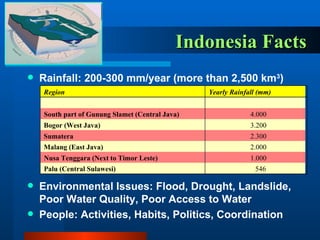
Indonesia Facts  Rainfall: 200-300 mm/year (more than 2,500 km 3 ) Environmental Issues: Flood, Drought, Landslide, Poor Water Quality, Poor Access to Water People: Activities, Habits, Politics, Coordination Region Yearly Rainfall (mm) South part of Gunung Slamet (Central Java) 4.000 Bogor (West Java) 3.200 Sumatera 2.300 Malang (East Java) 2.000 Nusa Tenggara (Next to Timor Leste) 1.000 Palu (Central Sulawesi) 546
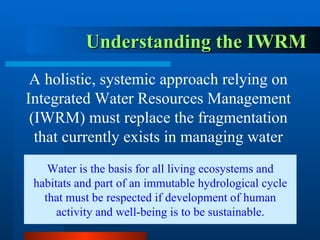
Understanding the IWRM  Water is the basis for all living ecosystems and habitats and part of an immutable hydrological cycle that must be respected if development of human activity and well-being is to be sustainable. A holistic, systemic approach relying on Integrated Water Resources Management (IWRM) must replace the fragmentation that currently exists in managing water
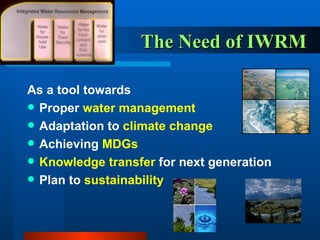
The Need of IWRM  As a tool towards Proper  water management Adaptation to  climate change Achieving  MDGs Knowledge transfer  for next generation Plan to  sustainability
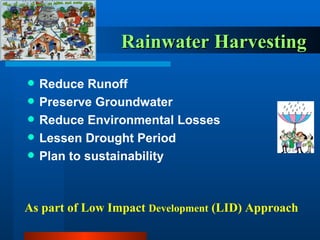
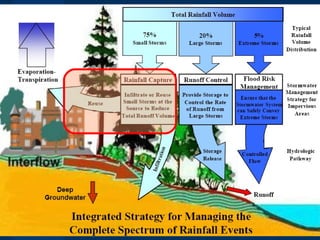
Rainwater Harvesting  Reduce Runoff Preserve Groundwater Reduce Environmental Losses Lessen Drought Period Plan to sustainability As part of Low Impact  Development  (LID) Approach
 
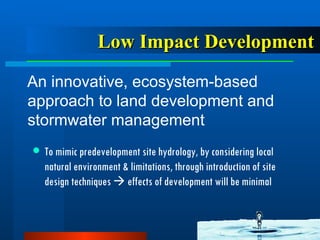
Low Impact Development An innovative, ecosystem-based approach to land development and stormwater management   To mimic predevelopment site hydrology, by considering local natural environment & limitations, through introduction of site design techniques    effects of development will be minimal
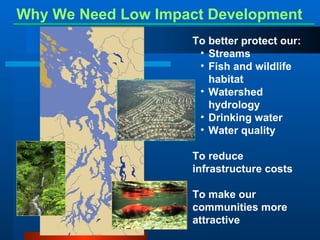
Why We Need Low Impact Development   To better protect our: Streams Fish and wildlife habitat Watershed hydrology Drinking water  Water quality To reduce infrastructure costs To make our communities more attractive
Primary Goal of LID   Design each development site to protect, or restore, the natural hydrology of the site so that the overall integrity of the watershed is protected. This is done by creating a “hydrologically” functional landscape.
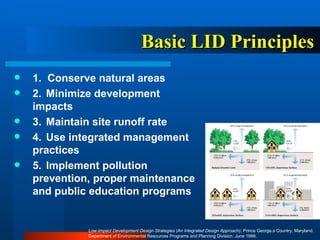
Basic LID   Principles 1.  Conserve natural areas 2.  Minimize development impacts 3.  Maintain site runoff rate  4.  Use integrated management practices 5.  Implement pollution prevention, proper maintenance and public education programs Low-Impact Development Design Strategies (An Integrated Design Approach) , Prince George.s Country, Maryland. Department of Environmental Resources Programs and Planning Division. June 1999.
LID Implementation Identify and develop applicable regulations and requirements Use drainage/hydrology as a design foundation Allow designs that reflect conservation plans Reduce site imperviousness and minimize directly connected impervious areas Use sustainable integrated management practices Develop pollution prevention, maintenance, public outreach and education programs
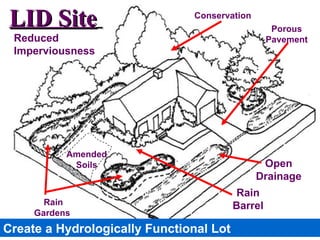
Conservation   Open Drainage Rain Gardens  Amended Soils Rain Barrel Reduced Imperviousness LID Site   Porous Pavement  Create a Hydrologically Functional Lot
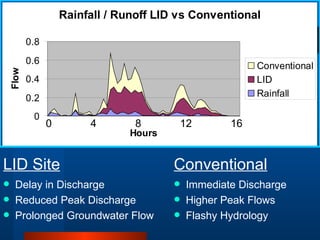
0  4  8  12  16 LID Site Delay in Discharge Reduced Peak Discharge  Prolonged Groundwater Flow Conventional Immediate Discharge  Higher Peak Flows Flashy Hydrology
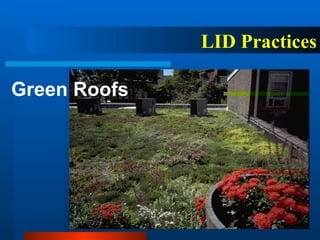
LID Practices Green Roofs
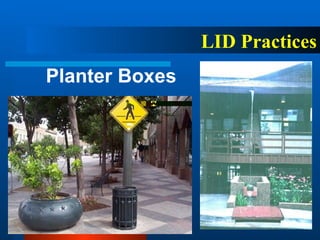
Planter Boxes LID Practices
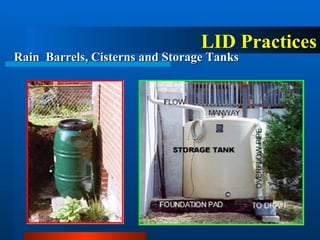
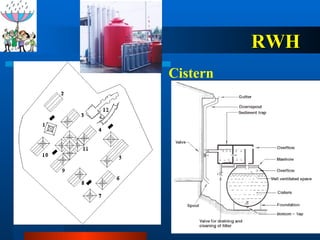
Rain  Barrels, Cisterns and Storage Tanks LID Practices
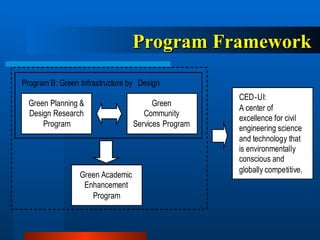
Green Infrastructure by Design: Sustainable Urban Water Management … One of the program The Development of UI Campus as Natural Laboratory
Firstly, Welcome… to the   University of Indonesia
University of Indonesia To be acknowledged as a research university –  the center for excellence in science, technology, and culture the  vision the  goals Enhance Science and Technology in the Indonesian culture through Research, Disseminate the Knowledge through quality software, and Implement the Idea through public service
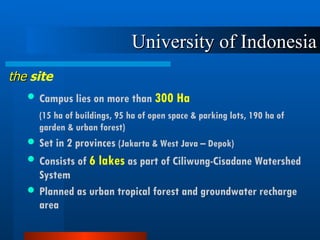
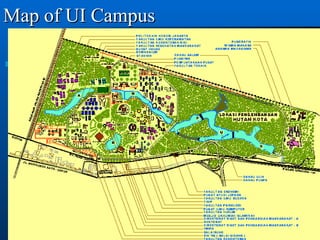
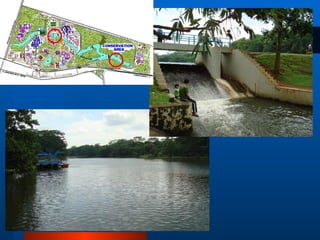
University of Indonesia Campus lies on more than  300 Ha (15 ha of buildings, 95 ha of open space & parking lots, 190 ha of garden & urban forest) Set in 2 provinces  (Jakarta & West Java – Depok)   Consists of  6 lakes  as part of Ciliwung-Cisadane Watershed System  Planned as urban tropical forest and groundwater recharge area the  site
Map of UI Campus
Motivations of the Program Environmental consciousness in planning & design of infrastructure system leading to sustainability of the environment = Green Design Vision: to become the center of excellence having strong environmental consciousness
Utilizing the water courses within the campus as reservoir,  water and land conservation , to support the government program Optimizing  the  water resources management  in the campus and surroundings (Depok area) by integrating the Ciliwung-Cisadane watershed management Utilizing the campus area (the lakes, the urban forest, and surroundings) as research areas for student and community Purpose of the Program
Program Framework
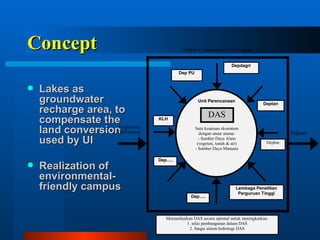
Concept Lakes as groundwater recharge area, to compensate the land conversion used by UI  Realization of environmental-friendly campus
Utilization Groundwater recharge area Research laboratory and education support Flood control Urban forest and conservation Landscape component which introduce the beautifulness, freshness, and technologically developed Sport and recreation facilities and infrastructures for student, academics, and community
Water & Land Conservation Lakes and ponds rehabilitation as water system component in Greater Jakarta Role model for environmental-friendly campus through the development of water conservation area Harvest the rain to reduce runoff and GW abstraction
 
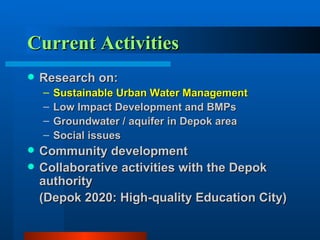
Current Activities Research on: Sustainable Urban Water Management Low Impact Development and BMPs Groundwater / aquifer in Depok area Social issues Community development Collaborative activities with the Depok authority (Depok 2020: High-quality Education City)
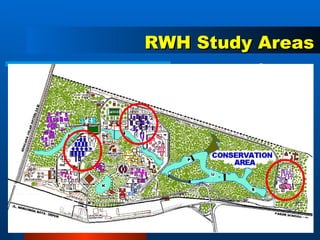
RWH Study Areas K A M P U S Kenanga Agatis Mahoni Puspa Ulin Salam
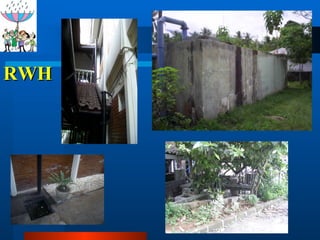
RWH
RWH Cistern
Beneficiaries Internal beneficiaries:  academic staff  students External beneficiaries:  decision makers (local authorities, people’s representatives),  industry,  intermediaries (developers, consultants, contractors, NGOs) academics within the inter-university network general public.
Result RWH is effective approach to replace GW Daily cost reduction High investment?  but the investment is not the money nor the cost, but the sustainability itself Still need water treatment to be able for drink More researches
Summary LID is an approach to land development and stormwater management that helps protect water resources and watershed hydrology.  We’re gaining a better understanding of how LID can be used to protect the environment, reduce costs and make our communities more attractive. Rainwater harvesting can be advantageous Let’s start from ourselves, then tell others
Thank You

Rain Water Harvesting As Alternative Water Source

  • 1.
    Rain Water Harvestingas Alternative Water Source “Changes start from inside the Campus” Indonesia Case of RWH Presented by: Toha Saleh Center for Environmental and Water Engineering Research Civil Engineering Department, Faculty of Engineering – University of Indonesia Research Team: Toha Saleh, Elkhobar, Dwinanti, Dwita SM Participated Students: Adi Pauna, Ahmad Dzaky, Robby Regional Conference for Southeast Asia on Rainwater Harvesting in Integrated Water Resources Management: "An Exchange of Practices and Learnings“ 25-26 November 2008, Davao City - Philippines.
  • 2.
    Indonesia Facts Rainfall: 200-300 mm/year (more than 2,500 km 3 ) Environmental Issues: Flood, Drought, Landslide, Poor Water Quality, Poor Access to Water People: Activities, Habits, Politics, Coordination Region Yearly Rainfall (mm) South part of Gunung Slamet (Central Java) 4.000 Bogor (West Java) 3.200 Sumatera 2.300 Malang (East Java) 2.000 Nusa Tenggara (Next to Timor Leste) 1.000 Palu (Central Sulawesi) 546
  • 3.
    Understanding the IWRM Water is the basis for all living ecosystems and habitats and part of an immutable hydrological cycle that must be respected if development of human activity and well-being is to be sustainable. A holistic, systemic approach relying on Integrated Water Resources Management (IWRM) must replace the fragmentation that currently exists in managing water
  • 4.
    The Need ofIWRM As a tool towards Proper water management Adaptation to climate change Achieving MDGs Knowledge transfer for next generation Plan to sustainability
  • 5.
    Rainwater Harvesting Reduce Runoff Preserve Groundwater Reduce Environmental Losses Lessen Drought Period Plan to sustainability As part of Low Impact Development (LID) Approach
  • 6.
  • 7.
    Low Impact DevelopmentAn innovative, ecosystem-based approach to land development and stormwater management To mimic predevelopment site hydrology, by considering local natural environment & limitations, through introduction of site design techniques  effects of development will be minimal
  • 8.
    Why We NeedLow Impact Development To better protect our: Streams Fish and wildlife habitat Watershed hydrology Drinking water Water quality To reduce infrastructure costs To make our communities more attractive
  • 9.
    Primary Goal ofLID Design each development site to protect, or restore, the natural hydrology of the site so that the overall integrity of the watershed is protected. This is done by creating a “hydrologically” functional landscape.
  • 10.
    Basic LID Principles 1. Conserve natural areas 2. Minimize development impacts 3. Maintain site runoff rate 4. Use integrated management practices 5. Implement pollution prevention, proper maintenance and public education programs Low-Impact Development Design Strategies (An Integrated Design Approach) , Prince George.s Country, Maryland. Department of Environmental Resources Programs and Planning Division. June 1999.
  • 11.
    LID Implementation Identifyand develop applicable regulations and requirements Use drainage/hydrology as a design foundation Allow designs that reflect conservation plans Reduce site imperviousness and minimize directly connected impervious areas Use sustainable integrated management practices Develop pollution prevention, maintenance, public outreach and education programs
  • 12.
    Conservation Open Drainage Rain Gardens Amended Soils Rain Barrel Reduced Imperviousness LID Site Porous Pavement Create a Hydrologically Functional Lot
  • 13.
    0 4 8 12 16 LID Site Delay in Discharge Reduced Peak Discharge Prolonged Groundwater Flow Conventional Immediate Discharge Higher Peak Flows Flashy Hydrology
  • 14.
  • 15.
  • 16.
    Rain Barrels,Cisterns and Storage Tanks LID Practices
  • 17.
    Green Infrastructure byDesign: Sustainable Urban Water Management … One of the program The Development of UI Campus as Natural Laboratory
  • 18.
    Firstly, Welcome… tothe University of Indonesia
  • 19.
    University of IndonesiaTo be acknowledged as a research university – the center for excellence in science, technology, and culture the vision the goals Enhance Science and Technology in the Indonesian culture through Research, Disseminate the Knowledge through quality software, and Implement the Idea through public service
  • 20.
    University of IndonesiaCampus lies on more than 300 Ha (15 ha of buildings, 95 ha of open space & parking lots, 190 ha of garden & urban forest) Set in 2 provinces (Jakarta & West Java – Depok) Consists of 6 lakes as part of Ciliwung-Cisadane Watershed System Planned as urban tropical forest and groundwater recharge area the site
  • 21.
    Map of UICampus
  • 22.
    Motivations of theProgram Environmental consciousness in planning & design of infrastructure system leading to sustainability of the environment = Green Design Vision: to become the center of excellence having strong environmental consciousness
  • 23.
    Utilizing the watercourses within the campus as reservoir, water and land conservation , to support the government program Optimizing the water resources management in the campus and surroundings (Depok area) by integrating the Ciliwung-Cisadane watershed management Utilizing the campus area (the lakes, the urban forest, and surroundings) as research areas for student and community Purpose of the Program
  • 24.
  • 25.
    Concept Lakes asgroundwater recharge area, to compensate the land conversion used by UI Realization of environmental-friendly campus
  • 26.
    Utilization Groundwater rechargearea Research laboratory and education support Flood control Urban forest and conservation Landscape component which introduce the beautifulness, freshness, and technologically developed Sport and recreation facilities and infrastructures for student, academics, and community
  • 27.
    Water & LandConservation Lakes and ponds rehabilitation as water system component in Greater Jakarta Role model for environmental-friendly campus through the development of water conservation area Harvest the rain to reduce runoff and GW abstraction
  • 28.
  • 29.
    Current Activities Researchon: Sustainable Urban Water Management Low Impact Development and BMPs Groundwater / aquifer in Depok area Social issues Community development Collaborative activities with the Depok authority (Depok 2020: High-quality Education City)
  • 30.
    RWH Study AreasK A M P U S Kenanga Agatis Mahoni Puspa Ulin Salam
  • 31.
  • 32.
  • 33.
    Beneficiaries Internal beneficiaries: academic staff students External beneficiaries: decision makers (local authorities, people’s representatives), industry, intermediaries (developers, consultants, contractors, NGOs) academics within the inter-university network general public.
  • 34.
    Result RWH iseffective approach to replace GW Daily cost reduction High investment? but the investment is not the money nor the cost, but the sustainability itself Still need water treatment to be able for drink More researches
  • 35.
    Summary LID isan approach to land development and stormwater management that helps protect water resources and watershed hydrology. We’re gaining a better understanding of how LID can be used to protect the environment, reduce costs and make our communities more attractive. Rainwater harvesting can be advantageous Let’s start from ourselves, then tell others
  • 36.