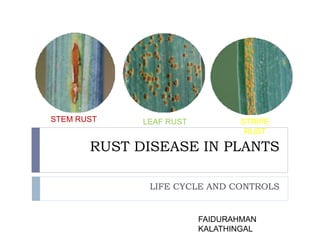
RUST DISEASE IN PLANTS
LIFE CYCLE AND CONTROLS
FAIDURAHMAN
KALATHINGAL
STEM RUST LEAF RUST STRIPE
RUST
INTRODUCTION
 Rusts are plant diseases caused by pathogenic fungi of the
order Pucciniales (previously known as Uredinales).
 An estimated 168 rust genera and approximately 7,000
species, more than half of which belong to the genus Puccinia,
are currently accepted.[1] Rust fungi are highly specialized
plant pathogens with several unique features. Taken as a
group, rust fungi are diverse and affect many kinds of plants.
However, each species has a very narrow range of hosts and
cannot be transmitted to non-host plants. In addition, most rust
fungi cannot be grown easily in pure culture.
 A single species of rust fungi may be able to infect two
different plant hosts in different stages of its life cycle, and may
produce up to five morphologically and cytologically distinct
spore-producing structures
viz., spermogonia, aecia, uredinia, telia, and basidia in
successive stages of reproduction.[2] Each spore type is very
host specific, and can typically infect only one kind of plant.FAIDURAHMAN KALATHINGAL
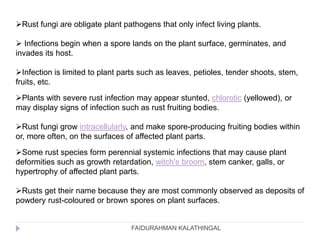
Rust fungi are obligate plant pathogens that only infect living plants.
 Infections begin when a spore lands on the plant surface, germinates, and
invades its host.
Infection is limited to plant parts such as leaves, petioles, tender shoots, stem,
fruits, etc.
Plants with severe rust infection may appear stunted, chlorotic (yellowed), or
may display signs of infection such as rust fruiting bodies.
Rust fungi grow intracellularly, and make spore-producing fruiting bodies within
or, more often, on the surfaces of affected plant parts.
Some rust species form perennial systemic infections that may cause plant
deformities such as growth retardation, witch's broom, stem canker, galls, or
hypertrophy of affected plant parts.
Rusts get their name because they are most commonly observed as deposits of
powdery rust-coloured or brown spores on plant surfaces.
FAIDURAHMAN KALATHINGAL
TYPES OF RUSTS
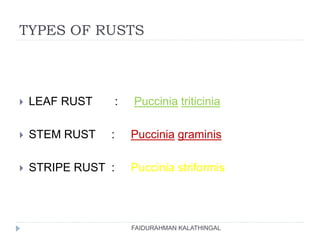
 LEAF RUST : Puccinia triticinia
 STEM RUST : Puccinia graminis
 STRIPE RUST : Puccinia striformis
FAIDURAHMAN KALATHINGAL
STAGES OF SPORES
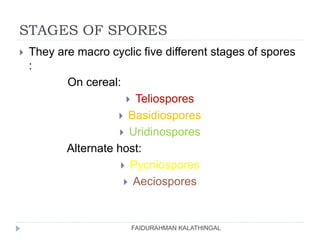
 They are macro cyclic five different stages of spores
:
On cereal:
 Teliospores
 Basidiospores
 Uridinospores
Alternate host:
 Pycniospores
 Aeciospores
FAIDURAHMAN KALATHINGAL
STEM RUST
FAIDURAHMAN KALATHINGAL
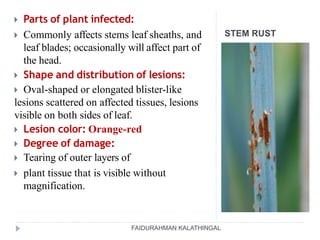
 Parts of plant infected:
 Commonly affects stems leaf sheaths, and
leaf blades; occasionally will affect part of
the head.
 Shape and distribution of lesions:
 Oval-shaped or elongated blister-like
lesions scattered on affected tissues, lesions
visible on both sides of leaf.
 Lesion color: Orange-red
 Degree of damage:
 Tearing of outer layers of
 plant tissue that is visible without
magnification.
LEAF RUST
FAIDURAHMAN KALATHINGAL
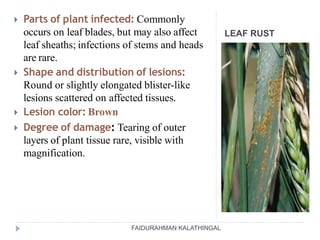
 Parts of plant infected: Commonly
occurs on leaf blades, but may also affect
leaf sheaths; infections of stems and heads
are rare.
 Shape and distribution of lesions:
Round or slightly elongated blister-like
lesions scattered on affected tissues.
 Lesion color: Brown
 Degree of damage: Tearing of outer
layers of plant tissue rare, visible with
magnification.
STRIPE RUST
FAIDURAHMAN KALATHINGAL
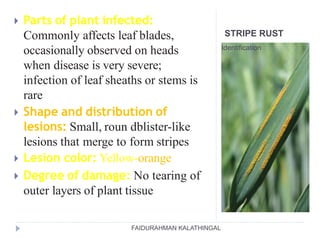
 Parts of plant infected:
Commonly affects leaf blades,
occasionally observed on heads
when disease is very severe;
infection of leaf sheaths or stems is
rare
 Shape and distribution of
lesions: Small, roun dblister-like
lesions that merge to form stripes
 Lesion color: Yellow-orange
 Degree of damage: No tearing of
outer layers of plant tissue
Identification
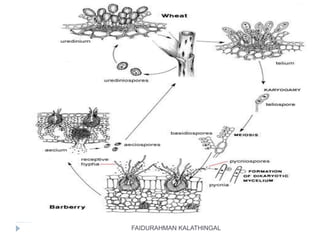
LIFE CYCLE
FAIDURAHMAN KALATHINGAL
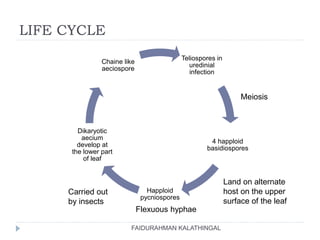
Teliospores in
uredinial
infection
4 happloid
basidiospores
Happloid
pycniospores
Dikaryotic
aecium
develop at
the lower part
of leaf
Chaine like
aeciospore
Meiosis
Land on alternate
host on the upper
surface of the leaf
Flexuous hyphae
Carried out
by insects
FAIDURAHMAN KALATHINGAL
IDENTIFICATION
OF RUST
FAIDURAHMAN KALATHINGAL
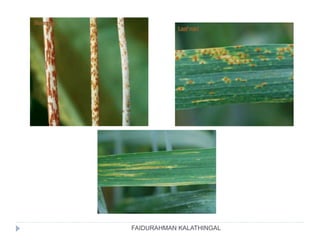
 Differentiating the rust diseases can be difficult, but with
 practice they can be reliably identified.Begin by
considering
 broad characteristics such as which plant parts are affected
 Figure 1) or arrangement of the blister-like lesions on
plants.
 These characteristics will often separate one or more of
these
 diseases quickly. Continue by examining less obvious
charac-
 teristics including lesion size, shape, and color to either
confirmthe diagnosis or separate the more similar diseases.
For example, stripe rust is the only one of these diseases to
have the blister-like lesions organized into stripes on the
leaves (left).
 If the lesions are scattered on the affected plant parts, both
stem rust and leaf rust are a possibility and additional
characteristics must be considered. Leaf rust typically
causes small, round lesions on the leaf blades and leaf
sheaths. In comparison, stem rust causes oval or elongated
lesions and is capable of infecting nearly all aboveground
parts of the plant, most notably the true stems (Figure 2).
FAIDURAHMAN KALATHINGAL
CONTROL OF RUST DISEASE
FAIDURAHMAN KALATHINGAL
CONTROLS:
 Remove all the infected part and destroy them.
 Clean away all the debris between plants to prevent
spreading.
 Avoid splashing water on the leaves.
 Seed fertilizer treatment.
PREVENTION:
 Dust plant with sulphur early in the season.
 Space your plant for good aeration.
 Avoid wetting the leaves when watering plants.
 There are many fungicides also.
FAIDURAHMAN KALATHINGAL

Rust disease in plants lin

  • 1.
    RUST DISEASE INPLANTS LIFE CYCLE AND CONTROLS FAIDURAHMAN KALATHINGAL STEM RUST LEAF RUST STRIPE RUST
  • 2.
    INTRODUCTION  Rusts areplant diseases caused by pathogenic fungi of the order Pucciniales (previously known as Uredinales).  An estimated 168 rust genera and approximately 7,000 species, more than half of which belong to the genus Puccinia, are currently accepted.[1] Rust fungi are highly specialized plant pathogens with several unique features. Taken as a group, rust fungi are diverse and affect many kinds of plants. However, each species has a very narrow range of hosts and cannot be transmitted to non-host plants. In addition, most rust fungi cannot be grown easily in pure culture.  A single species of rust fungi may be able to infect two different plant hosts in different stages of its life cycle, and may produce up to five morphologically and cytologically distinct spore-producing structures viz., spermogonia, aecia, uredinia, telia, and basidia in successive stages of reproduction.[2] Each spore type is very host specific, and can typically infect only one kind of plant.FAIDURAHMAN KALATHINGAL
  • 3.
    Rust fungi areobligate plant pathogens that only infect living plants.  Infections begin when a spore lands on the plant surface, germinates, and invades its host. Infection is limited to plant parts such as leaves, petioles, tender shoots, stem, fruits, etc. Plants with severe rust infection may appear stunted, chlorotic (yellowed), or may display signs of infection such as rust fruiting bodies. Rust fungi grow intracellularly, and make spore-producing fruiting bodies within or, more often, on the surfaces of affected plant parts. Some rust species form perennial systemic infections that may cause plant deformities such as growth retardation, witch's broom, stem canker, galls, or hypertrophy of affected plant parts. Rusts get their name because they are most commonly observed as deposits of powdery rust-coloured or brown spores on plant surfaces. FAIDURAHMAN KALATHINGAL
  • 4.
    TYPES OF RUSTS LEAF RUST : Puccinia triticinia  STEM RUST : Puccinia graminis  STRIPE RUST : Puccinia striformis FAIDURAHMAN KALATHINGAL
  • 5.
    STAGES OF SPORES They are macro cyclic five different stages of spores : On cereal:  Teliospores  Basidiospores  Uridinospores Alternate host:  Pycniospores  Aeciospores FAIDURAHMAN KALATHINGAL
  • 6.
    STEM RUST FAIDURAHMAN KALATHINGAL Parts of plant infected:  Commonly affects stems leaf sheaths, and leaf blades; occasionally will affect part of the head.  Shape and distribution of lesions:  Oval-shaped or elongated blister-like lesions scattered on affected tissues, lesions visible on both sides of leaf.  Lesion color: Orange-red  Degree of damage:  Tearing of outer layers of  plant tissue that is visible without magnification.
  • 7.
    LEAF RUST FAIDURAHMAN KALATHINGAL Parts of plant infected: Commonly occurs on leaf blades, but may also affect leaf sheaths; infections of stems and heads are rare.  Shape and distribution of lesions: Round or slightly elongated blister-like lesions scattered on affected tissues.  Lesion color: Brown  Degree of damage: Tearing of outer layers of plant tissue rare, visible with magnification.
  • 8.
    STRIPE RUST FAIDURAHMAN KALATHINGAL Parts of plant infected: Commonly affects leaf blades, occasionally observed on heads when disease is very severe; infection of leaf sheaths or stems is rare  Shape and distribution of lesions: Small, roun dblister-like lesions that merge to form stripes  Lesion color: Yellow-orange  Degree of damage: No tearing of outer layers of plant tissue Identification
  • 9.
    LIFE CYCLE FAIDURAHMAN KALATHINGAL Teliosporesin uredinial infection 4 happloid basidiospores Happloid pycniospores Dikaryotic aecium develop at the lower part of leaf Chaine like aeciospore Meiosis Land on alternate host on the upper surface of the leaf Flexuous hyphae Carried out by insects
  • 10.
  • 11.
    IDENTIFICATION OF RUST FAIDURAHMAN KALATHINGAL Differentiating the rust diseases can be difficult, but with  practice they can be reliably identified.Begin by considering  broad characteristics such as which plant parts are affected  Figure 1) or arrangement of the blister-like lesions on plants.  These characteristics will often separate one or more of these  diseases quickly. Continue by examining less obvious charac-  teristics including lesion size, shape, and color to either confirmthe diagnosis or separate the more similar diseases. For example, stripe rust is the only one of these diseases to have the blister-like lesions organized into stripes on the leaves (left).  If the lesions are scattered on the affected plant parts, both stem rust and leaf rust are a possibility and additional characteristics must be considered. Leaf rust typically causes small, round lesions on the leaf blades and leaf sheaths. In comparison, stem rust causes oval or elongated lesions and is capable of infecting nearly all aboveground parts of the plant, most notably the true stems (Figure 2).
  • 12.
  • 13.
    CONTROL OF RUSTDISEASE FAIDURAHMAN KALATHINGAL CONTROLS:  Remove all the infected part and destroy them.  Clean away all the debris between plants to prevent spreading.  Avoid splashing water on the leaves.  Seed fertilizer treatment. PREVENTION:  Dust plant with sulphur early in the season.  Space your plant for good aeration.  Avoid wetting the leaves when watering plants.  There are many fungicides also.
  • 14.