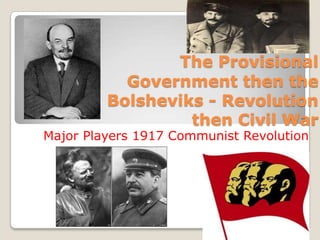
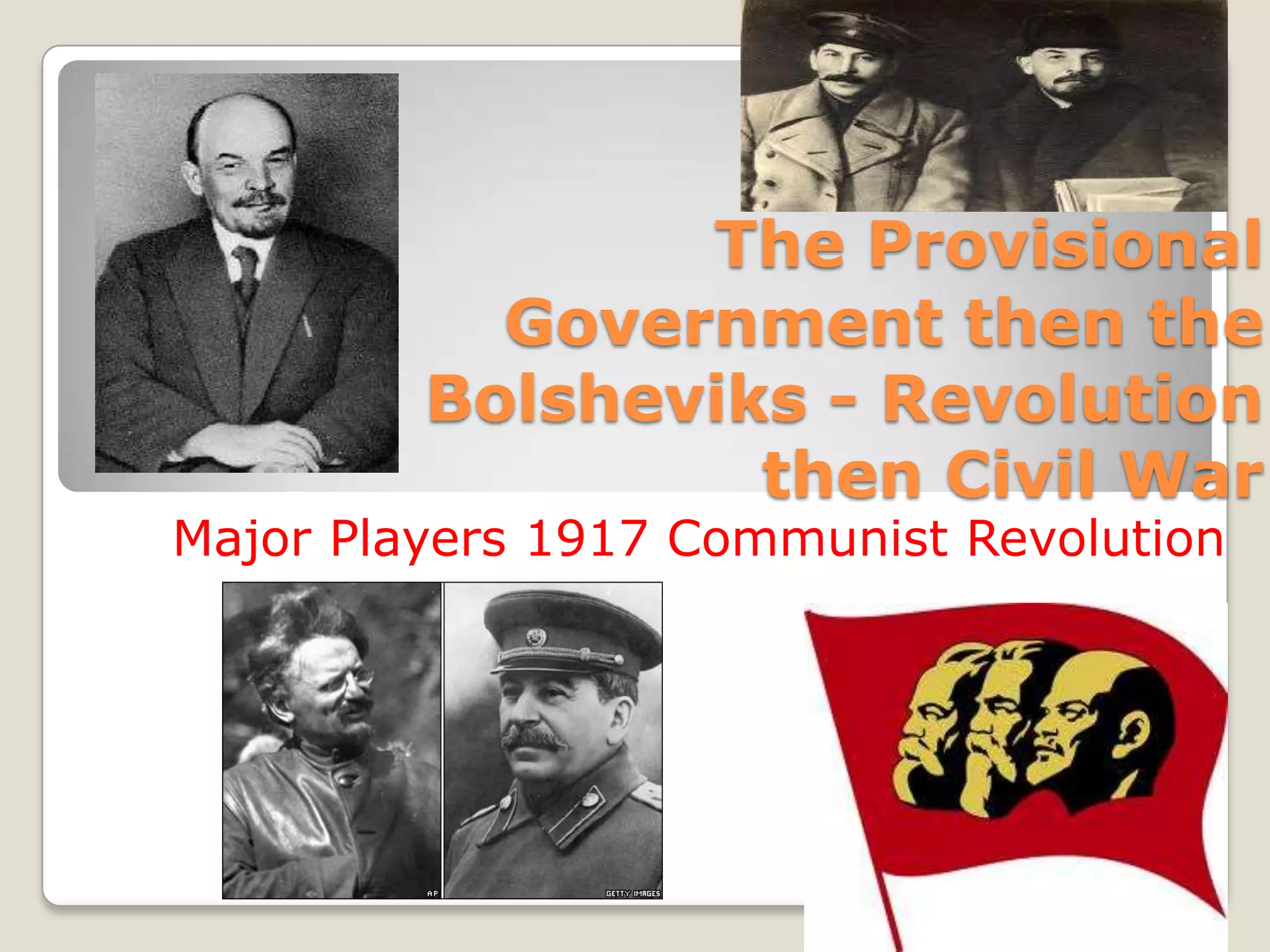
The ProvisionalGovernment then the Bolsheviks - Revolution then Civil WarMajor Players 1917 Communist Revolution
In response to Russia’s defeat on the front, Czar Nicholas II was dethroned in the first stage of the revolution in March 1917
A new government of mixed liberal-conservative complexion came into being. (ProvisionalGovernment)
As political deadlock and defeats on the front WW1 continued, the socialists gained in popularity and their radical wing, the Bolshevik party, under Lenin, called for immediate peace and apportionment of land to the peasants.
In November 1917, the Bolsheviks seized power.
The new government concluded an armistice with Germany in December 1917 and a separate peace treaty with Germany in March 1918, but slid into a protracted civil war with its opponents.Russian Revolution Many Small Revolutions
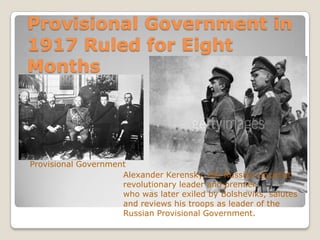
Provisional Government in 1917 Ruled for Eight MonthsProvisional GovernmentAlexander Kerensky, the Russian Socialist revolutionary leader and premier, who was later exiled by Bolsheviks, salutes and reviews his troops as leader of the Russian Provisional Government.
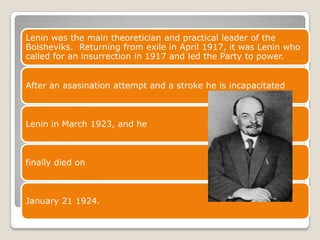
V I Lenin 
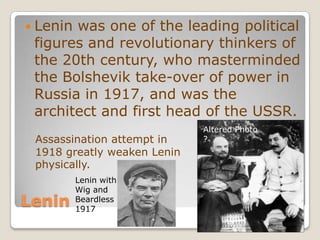
Lenin was one of the leading political figures and revolutionary thinkers of the 20th century, who masterminded the Bolshevik take-over of power in Russia in 1917, and was the architect and first head of the USSR. Altered Photo ?Assassination attempt in 1918 greatly weaken Lenin physically.Lenin withWig and Beardless1917Lenin
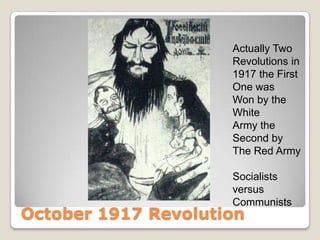
Actually Two Revolutions in 1917 the First  One wasWon by the White Army the Second byThe Red ArmySocialists versus CommunistsOctober 1917 Revolution
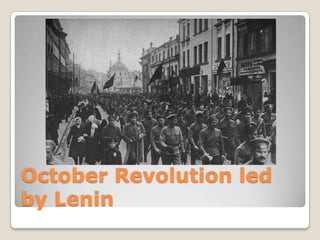
October Revolution led by Lenin
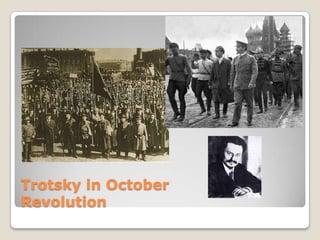
Trotsky in October Revolution
Inflexible will-power, his sense of responsibility, care for the future of his country further development of the Land of Soviets let Lenin work right up to the end.
Lenin had the strength to overcome the suffering inflicted by his disease, and to accomplish that which seemed beyond the bounds of human possibility-to create in just a month and a half an entire collection of outstanding works despite his serious ailment.Lenin had His strength and Will Power till the end.
Russian Civil War... (1918-20), conflict in which the Red Army successfully defended the newly formed Bolshevik government against various Russian and interventionist anti-Bolshevik armies.White Army versus the Red ArmyTrotsky Formed the Red army
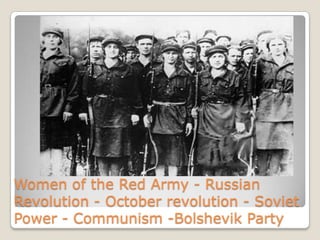
Women of the Red Army - Russian Revolution - October revolution - Soviet Power - Communism -Bolshevik Party
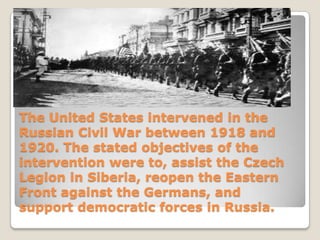
The United States intervened in the Russian Civil War between 1918 and 1920. The stated objectives of the intervention were to, assist the Czech Legion in Siberia, reopen the Eastern Front against the Germans, and support democratic forces in Russia. 
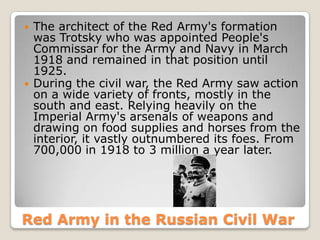
The architect of the Red Army's formation was Trotsky who was appointed People's Commissar for the Army and Navy in March 1918 and remained in that position until 1925. 
During the civil war, the Red Army saw action on a wide variety of fronts, mostly in the south and east. Relying heavily on the Imperial Army's arsenals of weapons and drawing on food supplies and horses from the interior, it vastly outnumbered its foes. From 700,000 in 1918 to 3 million a year later.Red Army in the Russian Civil War
The White Russian forces would typically be formed from a remnant of the former Tsarist Army that had been kept intact by a combination of circumstance and charismatic leaders. These were typically formed from a core of professional officers and non-commissioned officers who had only known a military life and were personally dedicated to their respective generals.The White Russian Armies 1917-1923
Lenin Led Bolshevik take over in October 1917. Ruthless Leader during Three Years of Civil WarLenin was ruthless however he was also pragmaticShortly before his death started to oppose Stalin, Lenin one of the only ones strong enough to stop Stalin
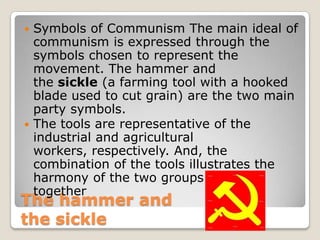
Symbols of Communism The main ideal of communism is expressed through the symbols chosen to represent the movement. The hammer and the sickle (a farming tool with a hooked blade used to cut grain) are the two main party symbols.
The tools are representative of the industrial and agricultural workers, respectively. And, the combination of the tools illustrates the harmony of the two groups working together                The hammer and the sickle
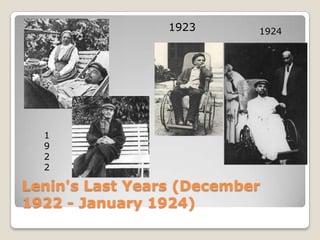
192319241922Lenin's Last Years (December 1922 - January 1924)

Russian history 1917 1924 Class Two - Year 3 (Fall 2010)

  • 1.
    The ProvisionalGovernment thenthe Bolsheviks - Revolution then Civil WarMajor Players 1917 Communist Revolution
  • 2.
    In response toRussia’s defeat on the front, Czar Nicholas II was dethroned in the first stage of the revolution in March 1917
  • 3.
    A new governmentof mixed liberal-conservative complexion came into being. (ProvisionalGovernment)
  • 4.
    As political deadlockand defeats on the front WW1 continued, the socialists gained in popularity and their radical wing, the Bolshevik party, under Lenin, called for immediate peace and apportionment of land to the peasants.
  • 5.
    In November 1917,the Bolsheviks seized power.
  • 6.
    The new governmentconcluded an armistice with Germany in December 1917 and a separate peace treaty with Germany in March 1918, but slid into a protracted civil war with its opponents.Russian Revolution Many Small Revolutions
  • 7.
    Provisional Government in1917 Ruled for Eight MonthsProvisional GovernmentAlexander Kerensky, the Russian Socialist revolutionary leader and premier, who was later exiled by Bolsheviks, salutes and reviews his troops as leader of the Russian Provisional Government.
  • 8.
  • 9.
    Lenin was oneof the leading political figures and revolutionary thinkers of the 20th century, who masterminded the Bolshevik take-over of power in Russia in 1917, and was the architect and first head of the USSR. Altered Photo ?Assassination attempt in 1918 greatly weaken Lenin physically.Lenin withWig and Beardless1917Lenin
  • 10.
    Actually Two Revolutionsin 1917 the First One wasWon by the White Army the Second byThe Red ArmySocialists versus CommunistsOctober 1917 Revolution
  • 11.
  • 12.
  • 13.
    Inflexible will-power, hissense of responsibility, care for the future of his country further development of the Land of Soviets let Lenin work right up to the end.
  • 14.
    Lenin had thestrength to overcome the suffering inflicted by his disease, and to accomplish that which seemed beyond the bounds of human possibility-to create in just a month and a half an entire collection of outstanding works despite his serious ailment.Lenin had His strength and Will Power till the end.
  • 15.
    Russian Civil War...(1918-20), conflict in which the Red Army successfully defended the newly formed Bolshevik government against various Russian and interventionist anti-Bolshevik armies.White Army versus the Red ArmyTrotsky Formed the Red army
  • 16.
    Women of theRed Army - Russian Revolution - October revolution - Soviet Power - Communism -Bolshevik Party
  • 17.
    The United Statesintervened in the Russian Civil War between 1918 and 1920. The stated objectives of the intervention were to, assist the Czech Legion in Siberia, reopen the Eastern Front against the Germans, and support democratic forces in Russia. 
  • 18.
    The architect ofthe Red Army's formation was Trotsky who was appointed People's Commissar for the Army and Navy in March 1918 and remained in that position until 1925. 
  • 19.
    During the civilwar, the Red Army saw action on a wide variety of fronts, mostly in the south and east. Relying heavily on the Imperial Army's arsenals of weapons and drawing on food supplies and horses from the interior, it vastly outnumbered its foes. From 700,000 in 1918 to 3 million a year later.Red Army in the Russian Civil War
  • 20.
    The White Russianforces would typically be formed from a remnant of the former Tsarist Army that had been kept intact by a combination of circumstance and charismatic leaders. These were typically formed from a core of professional officers and non-commissioned officers who had only known a military life and were personally dedicated to their respective generals.The White Russian Armies 1917-1923
  • 21.
    Lenin Led Bolsheviktake over in October 1917. Ruthless Leader during Three Years of Civil WarLenin was ruthless however he was also pragmaticShortly before his death started to oppose Stalin, Lenin one of the only ones strong enough to stop Stalin
  • 22.
    Symbols of CommunismThe main ideal of communism is expressed through the symbols chosen to represent the movement. The hammer and the sickle (a farming tool with a hooked blade used to cut grain) are the two main party symbols.
  • 23.
    The tools arerepresentative of the industrial and agricultural workers, respectively. And, the combination of the tools illustrates the harmony of the two groups working together The hammer and the sickle
  • 24.
    192319241922Lenin's Last Years(December 1922 - January 1924)