McGraw-Hill
3
Writing Sentences, Paragraphs, and Essays
3-23-2
McGraw-Hill
Learning Objectives
• Writing complete sentences, including topic
sentences and thesis statements.
• Writing and developing effective paragraphs
using transitional words and phrases to create
better flow.
• Writing effective multi-paragraph essays that
include an introduction, a body, and a
conclusion.
3-33-3
McGraw-Hill
Sentences (LO 3.1)
Incomplete sentences
• Unable to stand on
their own.
• Missing at least one of
the 3 elements required
to be a complete
sentence.
Complete sentences
Contain 3 elements:
• Subject (Topic)
• Verb (Action)
• Complete thought
(Allows the sentence
to stand on its own)
3-43-4
McGraw-Hill
Parts of Speech (LO 3.1)
Nouns
– Name of a person, place, or thing (e.g., Mr. Smith,
hotel, dog)
Pronouns
– Replace a noun (e.g., he, she, it)
Verbs
– Show action or a state of being (e.g., climb,
moved, are)
3-53-5
McGraw-Hill
Parts of Speech (contd.)
Adjectives
– Modify or describe a noun (e.g., shiny, smart,
colorful)
Adverbs
– Modify or describe verbs, adjectives, or other
adverbs (e.g., slowly, quickly)
Prepositions
– Link a noun to another word (e.g., under, beneath)
3-63-6
McGraw-Hill
Parts of Speech (contd.)
Conjunctions
– Join clauses, sentences, or words (e.g., for, and,
but)
Interjections
– Express a strong feeling(e.g., Wow!, Oh no!)
3-73-7
McGraw-Hill
Sentence Variety (LO 3.1)
• Vary your sentence length.
• Short sentences emphasize a key point.
• Longer, complex sentences can illustrate
relationships among the ideas presented.
3-83-8
McGraw-Hill
Writing a Paragraph (LO 3.2)
Topic sentence
• Contains a topic.
• Contains an opinion about the topic.
• Must be a complete sentence.
3-93-9
McGraw-Hill
Writing a Paragraph (contd.)
Supporting sentences
• Main points that support the opinion in
your topic sentence.
• Usually require 3-5 supporting sentences.
• More common to have too few supporting
sentences than too many.
• All sentences should support the topic sentence.
3-103-10
McGraw-Hill
Writing a Paragraph (contd.)
Transitions help notify the reader that the
writer is changing directions or making a new
point:
• To give examples: for example, for instance
• To show time or order: first, later
• To show location: above, near
• To compare: similarly
3-113-11
McGraw-Hill
Writing a Paragraph (contd.)
Transitions continued:
• To contrast: in contrast
• To show a cause: because
• To show an effect: as a result
• To add information: additionally, along with
• To show emphasis or repetition: in other words,
in fact
• To conclude or summarize: finally, as a result
3-123-12
McGraw-Hill
Writing a Paragraph (contd.)
A Concluding sentence is used for a standalone
paragraph.
• Restate the main idea and opinion you
wrote in the topic sentence.
• Use different words than the original thesis.
• Consider writing an additional memorable
sentence for the reader.
3-133-13
McGraw-Hill
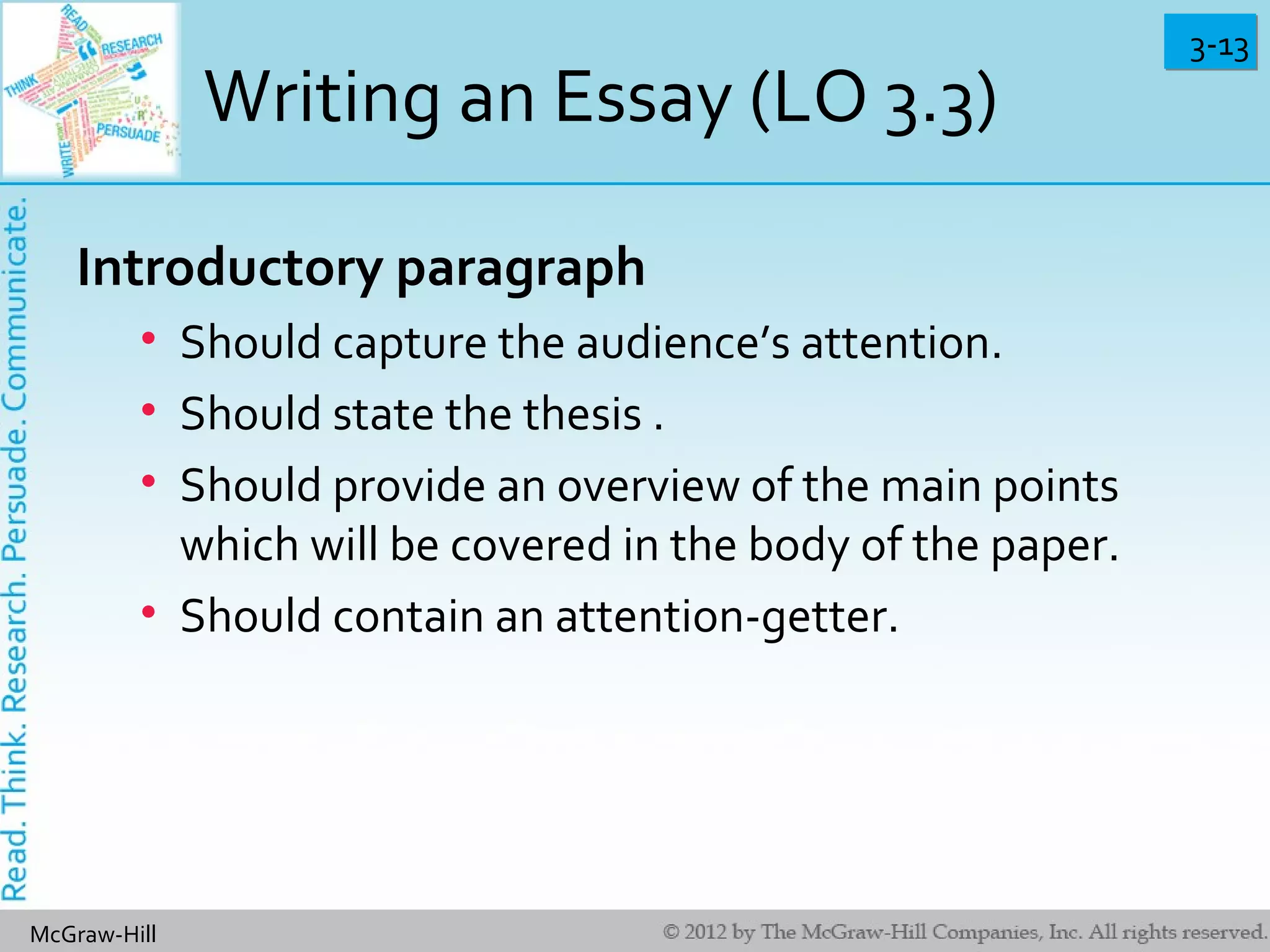
Writing an Essay (LO 3.3)
Introductory paragraph
• Should capture the audience’s attention.
• Should state the thesis .
• Should provide an overview of the main points
which will be covered in the body of the paper.
• Should contain an attention-getter.
3-143-14
McGraw-Hill
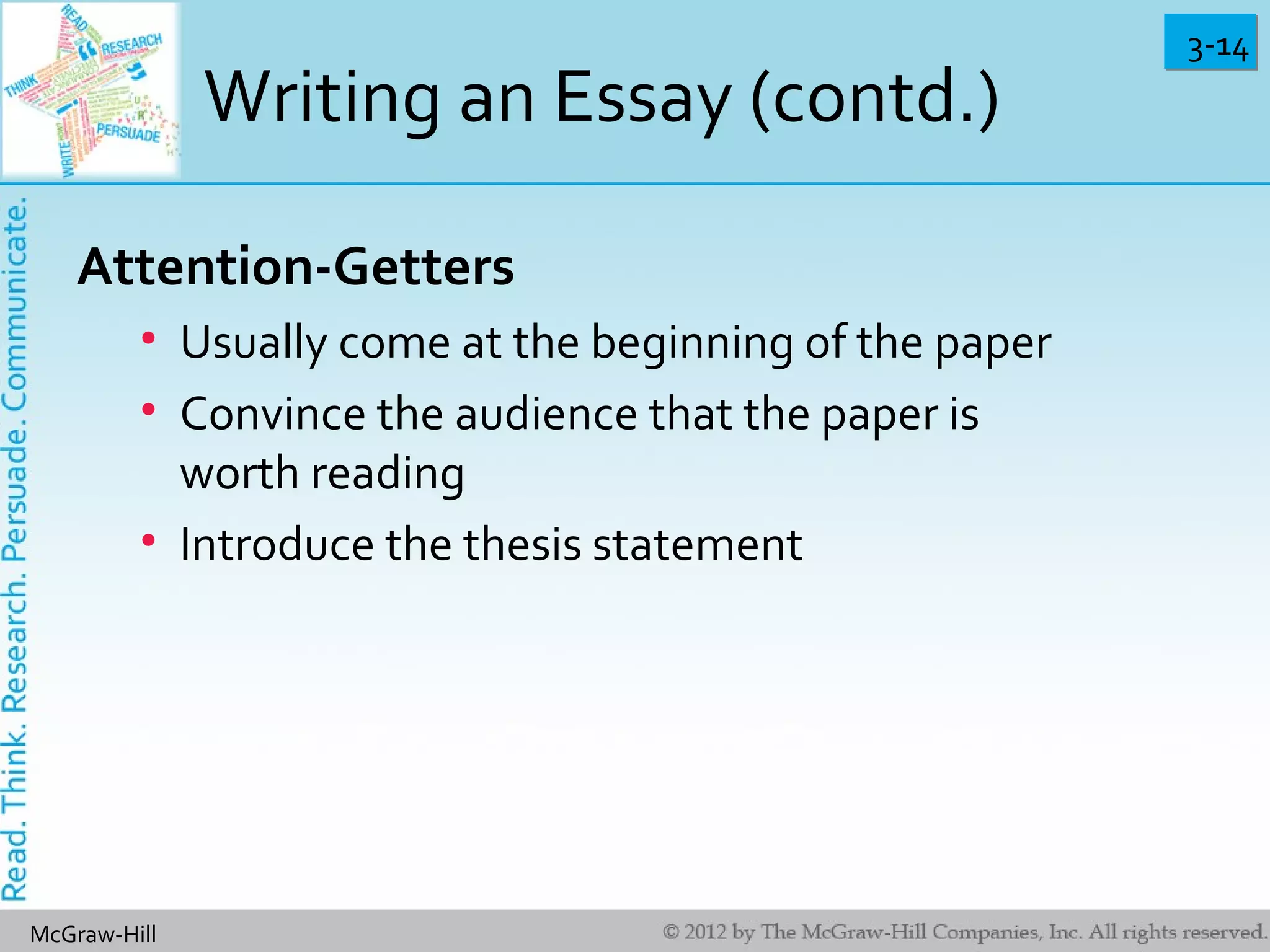
Writing an Essay (contd.)
Attention-Getters
• Usually come at the beginning of the paper
• Convince the audience that the paper is
worth reading
• Introduce the thesis statement
3-153-15
McGraw-Hill
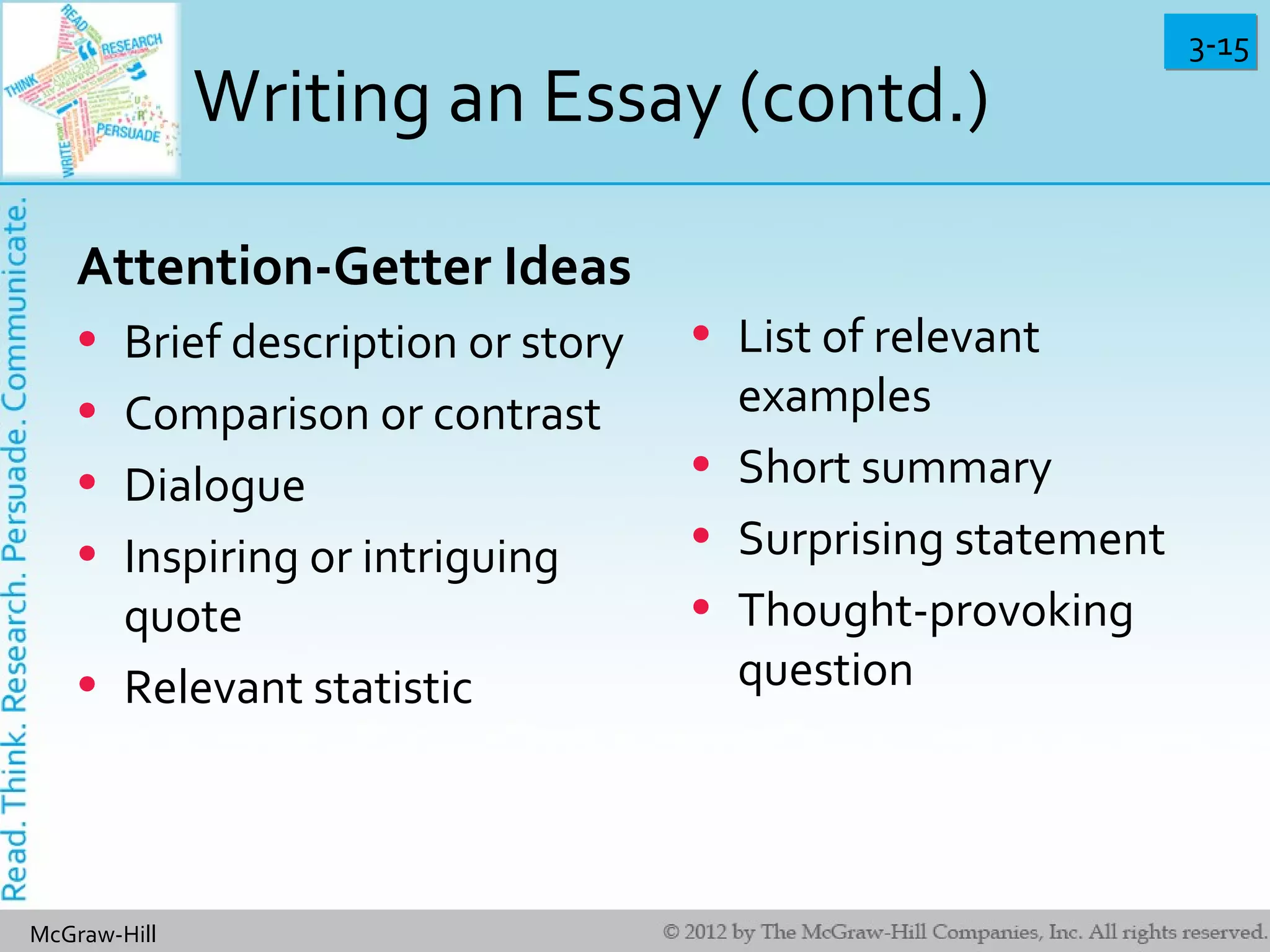
Writing an Essay (contd.)
Attention-Getter Ideas
• Brief description or story
• Comparison or contrast
• Dialogue
• Inspiring or intriguing
quote
• Relevant statistic
• List of relevant
examples
• Short summary
• Surprising statement
• Thought-provoking
question
3-163-16
McGraw-Hill
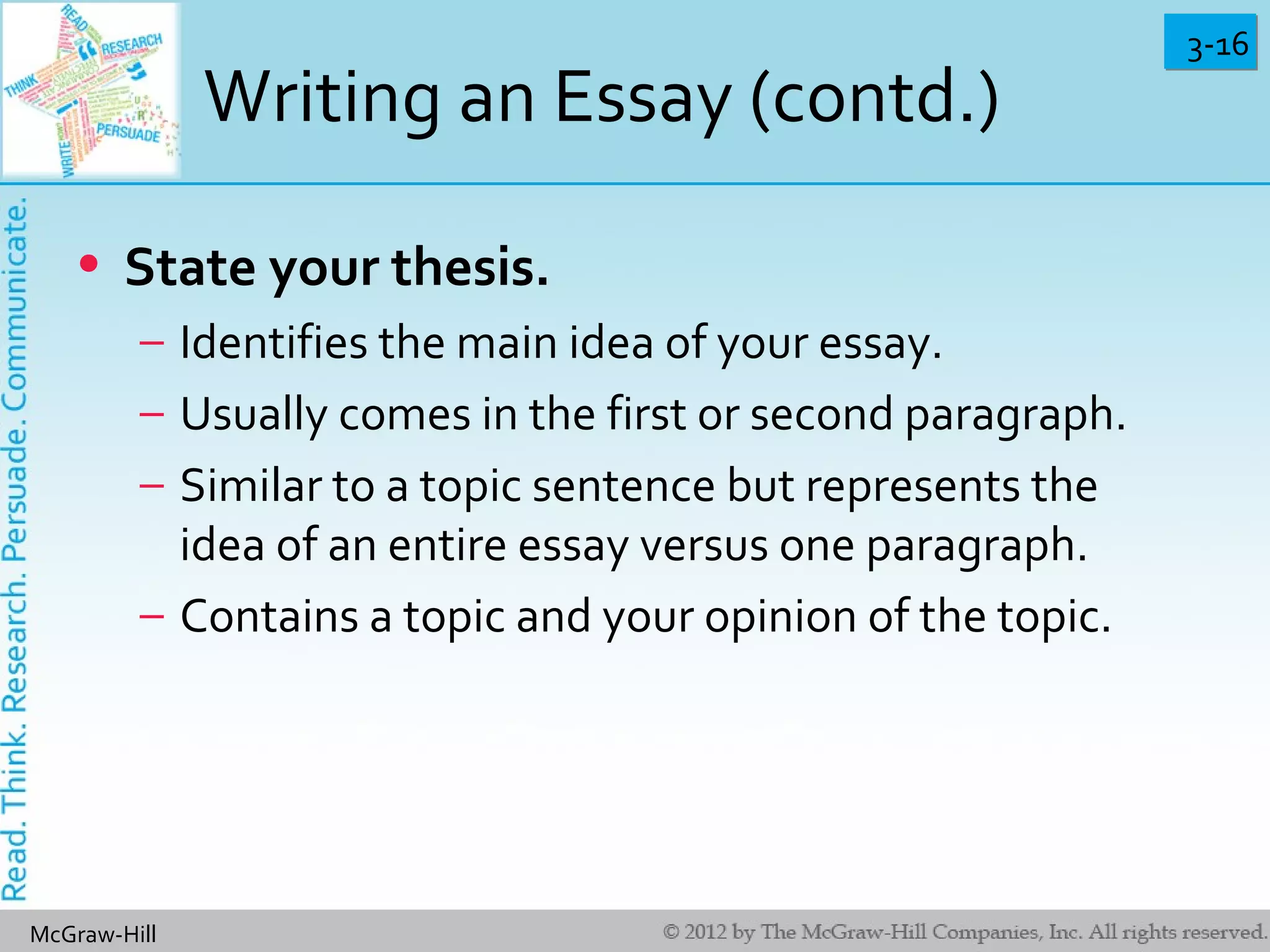
Writing an Essay (contd.)
• State your thesis.
– Identifies the main idea of your essay.
– Usually comes in the first or second paragraph.
– Similar to a topic sentence but represents the
idea of an entire essay versus one paragraph.
– Contains a topic and your opinion of the topic.
3-173-17
McGraw-Hill
Writing an Essay (contd.)
• Provide an overview of the main points.
– Additional sentences may be used if the
main points are not identified in the thesis.
– Avoid a mechanical list of points.
– Give the reader a clear idea of what is going to
be covered.
3-183-18
McGraw-Hill
Writing an Essay (contd.)
Body paragraphs
• Often begin with a topic sentence
• Include several supporting sentences
• Use transitions to help ideas flow smoothly
• Make sure all ideas relate to the overall thesis
of the essay
3-193-19
McGraw-Hill
Writing an Essay (contd.)
Concluding paragraph
• Should wrap up the entire essay
• Should restate the thesis
• Should summarize the main points
• Should end with a memorable thought
• Avoid introducing new ideas or concepts
• Avoid clichés

Russell writenow ch03-1 chapter 3 power point

  • 1.
  • 2.
    3-23-2 McGraw-Hill Learning Objectives • Writingcomplete sentences, including topic sentences and thesis statements. • Writing and developing effective paragraphs using transitional words and phrases to create better flow. • Writing effective multi-paragraph essays that include an introduction, a body, and a conclusion.
  • 3.
    3-33-3 McGraw-Hill Sentences (LO 3.1) Incompletesentences • Unable to stand on their own. • Missing at least one of the 3 elements required to be a complete sentence. Complete sentences Contain 3 elements: • Subject (Topic) • Verb (Action) • Complete thought (Allows the sentence to stand on its own)
  • 4.
    3-43-4 McGraw-Hill Parts of Speech(LO 3.1) Nouns – Name of a person, place, or thing (e.g., Mr. Smith, hotel, dog) Pronouns – Replace a noun (e.g., he, she, it) Verbs – Show action or a state of being (e.g., climb, moved, are)
  • 5.
    3-53-5 McGraw-Hill Parts of Speech(contd.) Adjectives – Modify or describe a noun (e.g., shiny, smart, colorful) Adverbs – Modify or describe verbs, adjectives, or other adverbs (e.g., slowly, quickly) Prepositions – Link a noun to another word (e.g., under, beneath)
  • 6.
    3-63-6 McGraw-Hill Parts of Speech(contd.) Conjunctions – Join clauses, sentences, or words (e.g., for, and, but) Interjections – Express a strong feeling(e.g., Wow!, Oh no!)
  • 7.
    3-73-7 McGraw-Hill Sentence Variety (LO3.1) • Vary your sentence length. • Short sentences emphasize a key point. • Longer, complex sentences can illustrate relationships among the ideas presented.
  • 8.
    3-83-8 McGraw-Hill Writing a Paragraph(LO 3.2) Topic sentence • Contains a topic. • Contains an opinion about the topic. • Must be a complete sentence.
  • 9.
    3-93-9 McGraw-Hill Writing a Paragraph(contd.) Supporting sentences • Main points that support the opinion in your topic sentence. • Usually require 3-5 supporting sentences. • More common to have too few supporting sentences than too many. • All sentences should support the topic sentence.
  • 10.
    3-103-10 McGraw-Hill Writing a Paragraph(contd.) Transitions help notify the reader that the writer is changing directions or making a new point: • To give examples: for example, for instance • To show time or order: first, later • To show location: above, near • To compare: similarly
  • 11.
    3-113-11 McGraw-Hill Writing a Paragraph(contd.) Transitions continued: • To contrast: in contrast • To show a cause: because • To show an effect: as a result • To add information: additionally, along with • To show emphasis or repetition: in other words, in fact • To conclude or summarize: finally, as a result
  • 12.
    3-123-12 McGraw-Hill Writing a Paragraph(contd.) A Concluding sentence is used for a standalone paragraph. • Restate the main idea and opinion you wrote in the topic sentence. • Use different words than the original thesis. • Consider writing an additional memorable sentence for the reader.
  • 13.
    3-133-13 McGraw-Hill Writing an Essay(LO 3.3) Introductory paragraph • Should capture the audience’s attention. • Should state the thesis . • Should provide an overview of the main points which will be covered in the body of the paper. • Should contain an attention-getter.
  • 14.
    3-143-14 McGraw-Hill Writing an Essay(contd.) Attention-Getters • Usually come at the beginning of the paper • Convince the audience that the paper is worth reading • Introduce the thesis statement
  • 15.
    3-153-15 McGraw-Hill Writing an Essay(contd.) Attention-Getter Ideas • Brief description or story • Comparison or contrast • Dialogue • Inspiring or intriguing quote • Relevant statistic • List of relevant examples • Short summary • Surprising statement • Thought-provoking question
  • 16.
    3-163-16 McGraw-Hill Writing an Essay(contd.) • State your thesis. – Identifies the main idea of your essay. – Usually comes in the first or second paragraph. – Similar to a topic sentence but represents the idea of an entire essay versus one paragraph. – Contains a topic and your opinion of the topic.
  • 17.
    3-173-17 McGraw-Hill Writing an Essay(contd.) • Provide an overview of the main points. – Additional sentences may be used if the main points are not identified in the thesis. – Avoid a mechanical list of points. – Give the reader a clear idea of what is going to be covered.
  • 18.
    3-183-18 McGraw-Hill Writing an Essay(contd.) Body paragraphs • Often begin with a topic sentence • Include several supporting sentences • Use transitions to help ideas flow smoothly • Make sure all ideas relate to the overall thesis of the essay
  • 19.
    3-193-19 McGraw-Hill Writing an Essay(contd.) Concluding paragraph • Should wrap up the entire essay • Should restate the thesis • Should summarize the main points • Should end with a memorable thought • Avoid introducing new ideas or concepts • Avoid clichés