KSZU Faculty of Languages and Literature
Presentator: Khair Mohammad AyubzaiTopic: Essay Writing
KSZU Faculty of Languages and Literature
Presentator: Khair Mohammad AyubzaiTopic: Essay Writing
This monograph is written by the final year student at SZU
(Sheikh Zayed University) as it is a final year written piece of subject
and it is also the last exigency which is submitted the related department
(English Department) for receiving our four years degree of diploma of
Languages and Literature, and all those information for which consider
much need they are covered in this monograph.
Firstly, we cover the definition of essay, and the body parts of
essay they will help with the readers in improvement of writing.
Secondly, outline of the essay, and making various types of outline for
essay are covered in this chapter, which are regarded more important for
organizing information in an essay. Thirdly, the process of the essay and
types of the essay are covered with much more description. Finally, all
those information which are related my topic explain, use in easy, and
useful ways.
KSZU Faculty of Languages and Literature
Presentator: Khair Mohammad AyubzaiTopic: Essay Writing
KSZU Faculty of Languages and Literature
Presentator: Khair Mohammad AyubzaiTopic: Essay Writing
After reading this chapter, the readers will be able
to write an essay, to know parts of essay, to make
outline for essay, to differentiate among various
types of essay.
KSZU Faculty of Languages and Literature
Presentator: Khair Mohammad AyubzaiTopic: Essay Writing
What Is an Essay
An essay is simply a paper of several paragraphs,
rather than one paragraph that support a single point
or idea.
Essay Topic
The topic of an essay is too long and too complex to
discuss in one paragraph. Therefore, it must be
divided into several paragraphs, one for each major
point then must be tied all of the separate
paragraphs together with adding an introduction
and conclusion.
KSZU Faculty of Languages and Literature
Presentator: Khair Mohammad AyubzaiTopic: Essay Writing
Parts of Essay
Generally an essay has the following three main parts:
An introductory Paragraph
A body (at least one, but usually two or more Paragraphs)
A concluding paragraph
The introduction guides your reader into the paper by
introducing the topic. It should begin with a hook that catches
the reader’s interest. The ideas within the introduction should
be general enough for the reader to understand the main claim
and gradually become more specific to lead into the thesis
statement or shortly, we can say that introduction attracts the
readers’ interest.
KSZU Faculty of Languages and Literature
Presentator: Khair Mohammad AyubzaiTopic: Essay Writing
Attract the reader’s interest.
Present a thesis sentence clear, direct statement of
the central idea that we will develop our essay.
Indicate a plan of development “ a preview of the
major points that will support your thesis statement.
The introductory paragraph consists of two parts as
they are:
A few general statements about your subject to attract
reader’s attention.
A thesis statement to state the specific subdivision of your
topic or the plan of your paper.
1
2
KSZU Faculty of Languages and Literature
Presentator: Khair Mohammad AyubzaiTopic: Essay Writing
Note: A thesis statement for an essay is just like a topic sentence for a paragraph; it
names the specific topic and the controlling idea or subdivisions of the topic.
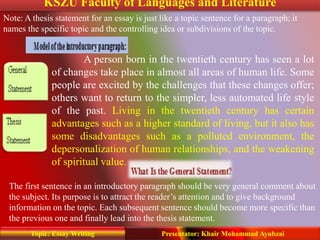
A person born in the twentieth century has seen a lot
of changes take place in almost all areas of human life. Some
people are excited by the challenges that these changes offer;
others want to return to the simpler, less automated life style
of the past. Living in the twentieth century has certain
advantages such as a higher standard of living, but it also has
some disadvantages such as a polluted environment, the
depersonalization of human relationships, and the weakening
of spiritual value.
The first sentence in an introductory paragraph should be very general comment about
the subject. Its purpose is to attract the reader’s attention and to give background
information on the topic. Each subsequent sentence should become more specific than
the previous one and finally lead into the thesis statement.
KSZU Faculty of Languages and Literature
Presentator: Khair Mohammad AyubzaiTopic: Essay Writing
Function of the General
StatementIntroduce the topic of the essay.
Give background information on the topic.
The thesis statement is the most important sentence in
the introduction. It states the specific topic and lists the major
subtopics that will be discussed in the body of the essay.
Furthermore, it often indicates the methods of organization
such as chronological order or order of importance.
Function of the Thesis
Statement
What Is the Thesis Statement
. state the main topic.
. lists the subdivisions of the topic.
. May indicate the method of organization of the entire paper.
1
2
3
KSZU Faculty of Languages and Literature
Presentator: Khair Mohammad AyubzaiTopic: Essay Writing
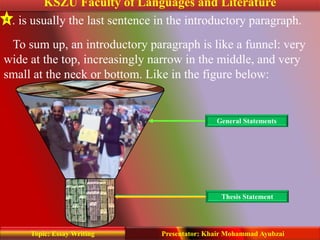
. is usually the last sentence in the introductory paragraph.4
To sum up, an introductory paragraph is like a funnel: very
wide at the top, increasingly narrow in the middle, and very
small at the neck or bottom. Like in the figure below:
General Statements
Thesis Statement
KSZU Faculty of Languages and Literature
Presentator: Khair Mohammad AyubzaiTopic: Essay Writing
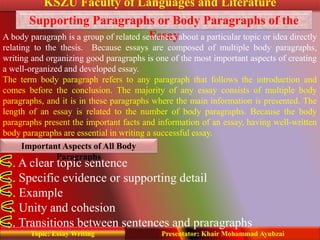
Supporting Paragraphs or Body Paragraphs of the
EssayA body paragraph is a group of related sentences about a particular topic or idea directly
relating to the thesis. Because essays are composed of multiple body paragraphs,
writing and organizing good paragraphs is one of the most important aspects of creating
a well-organized and developed essay.
The term body paragraph refers to any paragraph that follows the introduction and
comes before the conclusion. The majority of any essay consists of multiple body
paragraphs, and it is in these paragraphs where the main information is presented. The
length of an essay is related to the number of body paragraphs. Because the body
paragraphs present the important facts and information of an essay, having well-written
body paragraphs are essential in writing a successful essay.
Important Aspects of All Body
Paragraphs
. A clear topic sentence
. Specific evidence or supporting detail
. Example
. Unity and cohesion
. Transitions between sentences and praragraphs
KSZU Faculty of Languages and Literature
Presentator: Khair Mohammad AyubzaiTopic: Essay Writing
. A concluding sentence that ties the evidence or details back
to the main point and brings the paragraph to a close.
A topic sentence generally appears early in a body paragraph (often the first or second
sentence) and controls the paragraph. A topic sentence is like a mini thesis sentence for
each paragraph and serves to unify the contents of the paragraph. Everything that
follows in the paragraph needs to relate to the topic sentence. Not all essays call for
explicit topic sentences, but most beginning writers should learn how to write effective
topic sentences early on in order to achieve paragraph unity. Since body paragraphs for
an essay should be centered around one main idea that relates the thesis. Creating a
clear topic sentence is helpful for both the writer and the reader. For the writer, a topic
sentence makes it easier to stay on topic and develop the main idea without getting off
track. For the reader, topic sentences announce what the paragraph will be about and
demonstrate how different paragraphs and ideas are connected to each other.
It is also important that all topic sentences relate to the thesis statement. This allows for
the essay to have greater unity and focus.
Topic Sentences of Body Paragraphs
KSZU Faculty of Languages and Literature
Presentator: Khair Mohammad AyubzaiTopic: Essay Writing
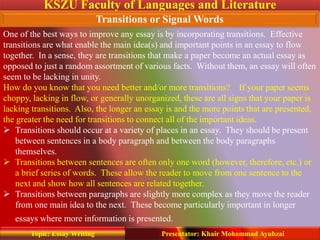
Transitions or Signal Words
One of the best ways to improve any essay is by incorporating transitions. Effective
transitions are what enable the main idea(s) and important points in an essay to flow
together. In a sense, they are transitions that make a paper become an actual essay as
opposed to just a random assortment of various facts. Without them, an essay will often
seem to be lacking in unity.
How do you know that you need better and/or more transitions? If your paper seems
choppy, lacking in flow, or generally unorganized, these are all signs that your paper is
lacking transitions. Also, the longer an essay is and the more points that are presented,
the greater the need for transitions to connect all of the important ideas.
 Transitions should occur at a variety of places in an essay. They should be present
between sentences in a body paragraph and between the body paragraphs
themselves.
 Transitions between sentences are often only one word (however, therefore, etc.) or
a brief series of words. These allow the reader to move from one sentence to the
next and show how all sentences are related together.
 Transitions between paragraphs are slightly more complex as they move the reader
from one main idea to the next. These become particularly important in longer
essays where more information is presented.
KSZU Faculty of Languages and Literature
Presentator: Khair Mohammad AyubzaiTopic: Essay Writing
The following is a categorized list of transitional words that
can be used, depending on the type of transition that is needed:
To add: additionally, in addition, again, besides, moreover, what’s more, equally important (also
important), finally, further, furthermore, first (second, third, etc.) next, lastly
To repeat: as mentioned, as has been noted, in brief
To show exception: however, nevertheless, in spite of, yet, still, despite, of course, once in a while,
sometimes, unfortunately
To compare: however, on the other hand, on the contrary, in contrast, whereas, but, yet,
nevertheless, by comparison, compared to, conversely, up against, balanced against, but, although,
meanwhile, after all, while this may be true
To emphasize: indeed, certainly, in any case, without a doubt, obviously, definitely, extremely, in
fact, absolutely, positively, naturally, surprisingly, emphatically, unquestionably , undeniably, without
reservation, always, never
To prove: furthermore, moreover, in example, in fact, indeed, because, for, since, for the same reason, for
this reason, obviously, evidently, besides, in addition, in any case
To give an example: for example, for instance, to demonstrate, to illustrate, as an illustration, in
another case, take the case of, on this occasion, in this situation
To show sequence: as a result, subsequently, consequently, concurrently, following this, now, at this
point, afterward, simultaneously, thus, hence, therefore, first (second, third, etc.)
To show time: immediately, thereafter, then, soon after, next, and then, finally, later, previously,
formerly, first (second, third, etc.)
KSZU Faculty of Languages and Literature
Presentator: Khair Mohammad AyubzaiTopic: Essay Writing
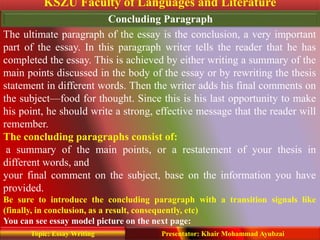
Concluding Paragraph
The ultimate paragraph of the essay is the conclusion, a very important
part of the essay. In this paragraph writer tells the reader that he has
completed the essay. This is achieved by either writing a summary of the
main points discussed in the body of the essay or by rewriting the thesis
statement in different words. Then the writer adds his final comments on
the subject—food for thought. Since this is his last opportunity to make
his point, he should write a strong, effective message that the reader will
remember.
The concluding paragraphs consist of:
a summary of the main points, or a restatement of your thesis in
different words, and
your final comment on the subject, base on the information you have
provided.
Be sure to introduce the concluding paragraph with a transition signals like
(finally, in conclusion, as a result, consequently, etc)
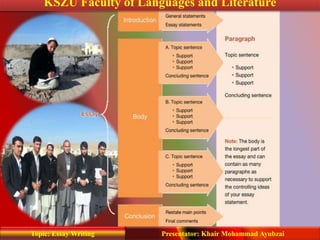
You can see essay model picture on the next page:
KSZU Faculty of Languages and Literature
Presentator: Khair Mohammad AyubzaiTopic: Essay Writing
KSZU Faculty of Languages and Literature
Presentator: Khair Mohammad AyubzaiTopic: Essay Writing
The Title of Your Essay
Even if your title is the last part of the essay you write, it is the
first thing readers read. Use your title to get your readers
attention and to tell them, in a brief way, what your paper is
about with vivid, strong, and specific words.
Basics of a good essay title
 It makes people want to read the essay.
 It does not merely repeat the thesis statement.
 It may hint at the main point but does not state it outright.
When we write an essay, planning is crucial for success. We should plan
our essay by outlining in four ways. As we know that making outline is
very important, because through outline we can provide much work in
less time, that is, it avoids the consuming of time. Thus, I regarded better
to shed light on the outline, briefly.
Planning an Essay
KSZU Faculty of Languages and Literature
Presentator: Khair Mohammad AyubzaiTopic: Essay Writing
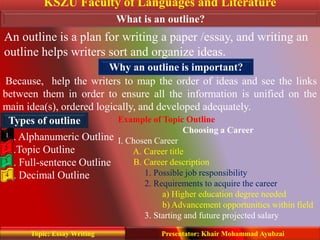
What is an outline?
An outline is a plan for writing a paper /essay, and writing an
outline helps writers sort and organize ideas.
Because, help the writers to map the order of ideas and see the links
between them in order to ensure all the information is unified on the
main idea(s), ordered logically, and developed adequately.
Why an outline is important?
. Alphanumeric Outline
.Topic Outline
. Full-sentence Outline
. Decimal Outline
Types of outline
1
2
3
4
Example of Topic Outline
Choosing a Career
I. Chosen Career
A. Career title
B. Career description
1. Possible job responsibility
2. Requirements to acquire the career
a) Higher education degree needed
b) Advancement opportunities within field
3. Starting and future projected salary
KSZU Faculty of Languages and Literature
Presentator: Khair Mohammad AyubzaiTopic: Essay Writing
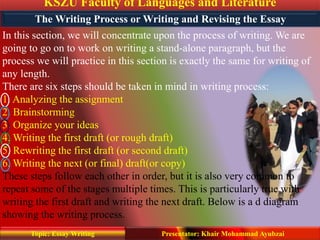
The Writing Process or Writing and Revising the Essay
In this section, we will concentrate upon the process of writing. We are
going to go on to work on writing a stand-alone paragraph, but the
process we will practice in this section is exactly the same for writing of
any length.
There are six steps should be taken in mind in writing process:
1. Analyzing the assignment
2. Brainstorming
3. Organize your ideas
4. Writing the first draft (or rough draft)
5. Rewriting the first draft (or second draft)
6. Writing the next (or final) draft(or copy)
These steps follow each other in order, but it is also very common to
repeat some of the stages multiple times. This is particularly true with
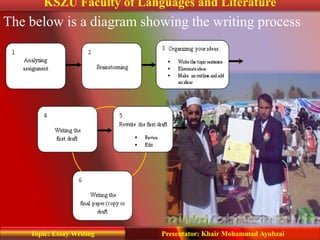
writing the first draft and writing the next draft. Below is a d diagram
showing the writing process.
KSZU Faculty of Languages and Literature
Presentator: Khair Mohammad AyubzaiTopic: Essay Writing
The below is a diagram showing the writing process
KSZU Faculty of Languages and Literature
Presentator: Khair Mohammad AyubzaiTopic: Essay Writing
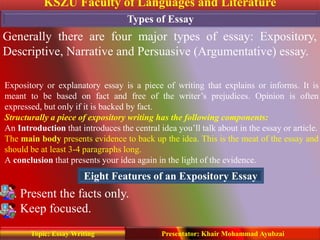
Types of Essay
Generally there are four major types of essay: Expository,
Descriptive, Narrative and Persuasive (Argumentative) essay.
. Present the facts only.
. Keep focused.
Expository or explanatory essay is a piece of writing that explains or informs. It is
meant to be based on fact and free of the writer’s prejudices. Opinion is often
expressed, but only if it is backed by fact.
Structurally a piece of expository writing has the following components:
An Introduction that introduces the central idea you’ll talk about in the essay or article.
The main body presents evidence to back up the idea. This is the meat of the essay and
should be at least 3-4 paragraphs long.
A conclusion that presents your idea again in the light of the evidence.
Eight Features of an Expository Essay
KSZU Faculty of Languages and Literature
Presentator: Khair Mohammad AyubzaiTopic: Essay Writing
. Compare and contrast
.Determine the causes and effects
. Describe the process
. Give a definition
. Find a solution
. Stick to the five-paragraph
A descriptive essay tells about a certain topic or story, using
details to appeal to the five senses. It gives readers the ability
to vividly imagine the situation or scene and feel as if they are
experiencing if firsthand. To write a descriptive essay, you
could choose a person, place, event, object, or experience and
describe it thoroughly using many sensory details.
Descriptive Essay
KSZU Faculty of Languages and Literature
Presentator: Khair Mohammad AyubzaiTopic: Essay Writing
1. Use sensory details. Appeal to sight, sound, smell, taste, and touch.
2. Use active verbs (in which the subject is doing the acting instead of being acted
upon by something or someone else). Also, use the a variety of sentence types, such
as simple sentences, compound sentences, complex sentences, and compound
complex sentences.
3. A void vague language, such as “pretty,” “really,” “a lot,” and “very.”
4. It creates a main impression an overall effect, feeling or image about the topic.
5. Create a dominant impression (overall attitude, mood, or feeling about the subject),
such as causing the readers to sympathize with you about a sad event that happened
or to agree with you strongly on a certain controversial topic. Choose the details
and descriptions that will help accomplish this impression.
6. Use comparison. In order to help make the descriptions even more vivid to the
reader, use similes (such as “His emotional was like a roller coaster.”), metaphors (
such as “ Her smile s was a ray of sunlight in the dark sea of unfamiliar faces.”),
personification ( giving human characteristics to an object, such as “ The wind
howled in my ears and beckoned me to walk further into the forest.”, and analogies
(brief stories that relate to the topic). Determine the method of organization that
works best for your essay: spatial (top to bottom, inside to outside, near to far),
chronological (the order in which events happened), least-to-most, or most-to-least.
Guidelines for Writing a Descriptive Essay
KSZU Faculty of Languages and Literature
Presentator: Khair Mohammad AyubzaiTopic: Essay Writing
Narration is writing that tells the story of an event or an experience.
Then, a narrative essay achieves a certain purpose through telling a story,
which makes it interesting to the reader and also results in getting some
point across or a narrative essay tells a story. It can also be called a
“short story.” Generally the narrative essay is conversational in style, and
tells of a personal experience. It is most commonly written in the first
person.
Narrative Essay
Guidelines for Narrative Essay
1. Make a specific point. Determine what the purpose of your essay is. State that point in your thesis
statement, or controlling idea, and building upon it throughout the essay by using examples, stories, and other
details that all relate back to the main idea.
2. Involve readers in the story and create a visual picture by using dialogue and physical description, which is
achieved through telling events that happened and presenting problems that arose. Also include specific
descriptive details so that the reader can easily picture the scene in each of the events.
3. Sequence events. Often this is done chronologically(the order in which events happened), but using
flashbacks ( writing the story from one point in time but then talking briefly about something that happened
in the past) and foreshadowing (briefly talking about something that will happen in the future) can make the
story more interesting.
KSZU Faculty of Languages and Literature
Presentator: Khair Mohammad AyubzaiTopic: Essay Writing
4. Decide which point of view, first-person (from the author’s point of view, using “I”)
or third-person (using “he” “she” “them” etc. instead of “I”), works best for your essay,
and tell the story from that viewpoint.
Situation: The background; the who, what, when, and where of the
account.
Conflict: The problem, friction, or issue at the heart of the story.
Struggle: What happen? The struggle adds action and develops the plot.
Outcome: Result of the struggle; the resolution.
Meaning: Lessons learned; the “moral of the story.”
Elements of the Narrative Essay
Argument is writing that takes a position on an issue and gives
supporting evidence to persuade someone else to accept, or at least
consider, the position. Argument is also used to convince someone to
take (or not take) an action. Then, we can define it as an argumentative
essay makes a claim and then gives examples and evidence to prove that
point.
Argumentative or Persuasive Essay
KSZU Faculty of Languages and Literature
Presentator: Khair Mohammad AyubzaiTopic: Essay Writing
1. Choose a narrow issue.
2. Tell your reader what you believe about the issue very clearly and specifically in your
thesis statement, or controlling idea.
3. Be aware of your audience and anticipate the reader’s views. This means that if you
know your readers will most likely not believe a certain statement because it goes
against traditional beliefs or their personal viewpoints. Make sure you give solid
evidence to back it up.
4. Use convincing details as evidence to support your claim. These should be from
believable and reliable sources. For example, if you are stating something that has to do
with human health, quote a doctor who knows about that topic, or if you are talking
about a trend in society, include statistics from a well-known organization.
5. Choose the most appropriate way of arguing your point (inductive or deductive)
Inductive = start with stating all the evidence and then move on to one conclusion.
Deductive= start with one basic statement of belief and move on to the supporting
points of evidence.
6. Acknowledge opposing viewpoints to prove you have thought about the topic
thoroughly yet still find that your point is correct.
Guidelines for Writing an Argumentative Essay
KSZU Faculty of Languages and Literature
Presentator: Khair Mohammad AyubzaiTopic: Essay Writing
Now, this is what I was wishing to accomplish. The information supplemented in this
monograph truly described the essay overtly. Considerations of the first chapter, which
introduced you to essay has given hope to know about the preliminary thoughts of it. As an ESL
fans, your reading desire accomplished the task to get acquainted with the needs and
requirements of essay, with the background of essay in English languages, and more specifically
you got familiar with writing rules(grammar, style, usage of punctuation) in essay.
Consecutively, we went through the major parts of essay in which are included
(introductory paragraph, supporting or body paragraphs and conclusion paragraph). The
identification of their models or shapes and various illustrations with example might paved you
the ways that how to write an essay. Next, we covered how to make an essay outline with many
types has been illustrated, and the usage of transitions or connecting words which are significant
for connecting ideas. We understood how to fulfill the process of essay and various types of essay
and for writing their basic rules. If you include this monograph in your routing study hope to be
fulfilled your wishes.
In order to move the basic regulations, in the middle of chapter of this documentation
illustrated rules and basics regarded to title, but this was need to be described without their
description it might create headache for the ESL students. Suggestively, getting idea could not
fulfill the rights of this monograph, this would be more valuable to make it a part of your
pragmatic writing via getting help from the examples provided in that chapter. God willing, it
will quench completely your thirst about essay writing.
Conclusion
KSZU Faculty of Languages and Literature
Presentator: Khair Mohammad AyubzaiTopic: Essay Writing
1. Ankar, S. (2010). Real Writing with Readings (Fifth ed.). New York, United State of America:
Befords/St.Martin's.
2. Bailey, S. (2006). Academic Witting (2nd ed.).Great Britain , United Kingdom : MPG Books.Ltd,
Bodmin..
3. Dorothy, A. Z., & Lisa, A. R. (2005). Academic Writing (2nd ed.).UK: Macmillan Publisher limited.
4. Heinle, T. (2006). Composition Skills for Academic Writing (First ed., Vol. 2nd). Richmond , Virginia:
Houghton Mifflin Company.
5. Jayakaran, I. (2008). Master Your English Grammar (1st ed.). Mumbai, India: Wilco Publishing House.
6. Langan, J. (2008). English Skills with Readings (7th ed.). New York, America: McGraw- Hill Higher
Education.
7. Oshima, A., & Hogue, A. (1990). Writing Academic English (second ed.).United State of America:
Addison Wesley Publishing Company.
8.Wadsworth, T. (2007). From Paragraph to Essay (2nd ed.). Boston, Massachusetts , USA: Thomson
Corporation.
References
KSZU Faculty of Languages and Literature
Presentator: Khair Mohammad AyubzaiTopic: Essay Writing

Essay writing

  • 1.
    KSZU Faculty ofLanguages and Literature Presentator: Khair Mohammad AyubzaiTopic: Essay Writing
  • 2.
    KSZU Faculty ofLanguages and Literature Presentator: Khair Mohammad AyubzaiTopic: Essay Writing This monograph is written by the final year student at SZU (Sheikh Zayed University) as it is a final year written piece of subject and it is also the last exigency which is submitted the related department (English Department) for receiving our four years degree of diploma of Languages and Literature, and all those information for which consider much need they are covered in this monograph. Firstly, we cover the definition of essay, and the body parts of essay they will help with the readers in improvement of writing. Secondly, outline of the essay, and making various types of outline for essay are covered in this chapter, which are regarded more important for organizing information in an essay. Thirdly, the process of the essay and types of the essay are covered with much more description. Finally, all those information which are related my topic explain, use in easy, and useful ways.
  • 3.
    KSZU Faculty ofLanguages and Literature Presentator: Khair Mohammad AyubzaiTopic: Essay Writing
  • 4.
    KSZU Faculty ofLanguages and Literature Presentator: Khair Mohammad AyubzaiTopic: Essay Writing After reading this chapter, the readers will be able to write an essay, to know parts of essay, to make outline for essay, to differentiate among various types of essay.
  • 5.
    KSZU Faculty ofLanguages and Literature Presentator: Khair Mohammad AyubzaiTopic: Essay Writing What Is an Essay An essay is simply a paper of several paragraphs, rather than one paragraph that support a single point or idea. Essay Topic The topic of an essay is too long and too complex to discuss in one paragraph. Therefore, it must be divided into several paragraphs, one for each major point then must be tied all of the separate paragraphs together with adding an introduction and conclusion.
  • 6.
    KSZU Faculty ofLanguages and Literature Presentator: Khair Mohammad AyubzaiTopic: Essay Writing Parts of Essay Generally an essay has the following three main parts: An introductory Paragraph A body (at least one, but usually two or more Paragraphs) A concluding paragraph The introduction guides your reader into the paper by introducing the topic. It should begin with a hook that catches the reader’s interest. The ideas within the introduction should be general enough for the reader to understand the main claim and gradually become more specific to lead into the thesis statement or shortly, we can say that introduction attracts the readers’ interest.
  • 7.
    KSZU Faculty ofLanguages and Literature Presentator: Khair Mohammad AyubzaiTopic: Essay Writing Attract the reader’s interest. Present a thesis sentence clear, direct statement of the central idea that we will develop our essay. Indicate a plan of development “ a preview of the major points that will support your thesis statement. The introductory paragraph consists of two parts as they are: A few general statements about your subject to attract reader’s attention. A thesis statement to state the specific subdivision of your topic or the plan of your paper. 1 2
  • 8.
    KSZU Faculty ofLanguages and Literature Presentator: Khair Mohammad AyubzaiTopic: Essay Writing Note: A thesis statement for an essay is just like a topic sentence for a paragraph; it names the specific topic and the controlling idea or subdivisions of the topic. A person born in the twentieth century has seen a lot of changes take place in almost all areas of human life. Some people are excited by the challenges that these changes offer; others want to return to the simpler, less automated life style of the past. Living in the twentieth century has certain advantages such as a higher standard of living, but it also has some disadvantages such as a polluted environment, the depersonalization of human relationships, and the weakening of spiritual value. The first sentence in an introductory paragraph should be very general comment about the subject. Its purpose is to attract the reader’s attention and to give background information on the topic. Each subsequent sentence should become more specific than the previous one and finally lead into the thesis statement.
  • 9.
    KSZU Faculty ofLanguages and Literature Presentator: Khair Mohammad AyubzaiTopic: Essay Writing Function of the General StatementIntroduce the topic of the essay. Give background information on the topic. The thesis statement is the most important sentence in the introduction. It states the specific topic and lists the major subtopics that will be discussed in the body of the essay. Furthermore, it often indicates the methods of organization such as chronological order or order of importance. Function of the Thesis Statement What Is the Thesis Statement . state the main topic. . lists the subdivisions of the topic. . May indicate the method of organization of the entire paper. 1 2 3
  • 10.
    KSZU Faculty ofLanguages and Literature Presentator: Khair Mohammad AyubzaiTopic: Essay Writing . is usually the last sentence in the introductory paragraph.4 To sum up, an introductory paragraph is like a funnel: very wide at the top, increasingly narrow in the middle, and very small at the neck or bottom. Like in the figure below: General Statements Thesis Statement
  • 11.
    KSZU Faculty ofLanguages and Literature Presentator: Khair Mohammad AyubzaiTopic: Essay Writing Supporting Paragraphs or Body Paragraphs of the EssayA body paragraph is a group of related sentences about a particular topic or idea directly relating to the thesis. Because essays are composed of multiple body paragraphs, writing and organizing good paragraphs is one of the most important aspects of creating a well-organized and developed essay. The term body paragraph refers to any paragraph that follows the introduction and comes before the conclusion. The majority of any essay consists of multiple body paragraphs, and it is in these paragraphs where the main information is presented. The length of an essay is related to the number of body paragraphs. Because the body paragraphs present the important facts and information of an essay, having well-written body paragraphs are essential in writing a successful essay. Important Aspects of All Body Paragraphs . A clear topic sentence . Specific evidence or supporting detail . Example . Unity and cohesion . Transitions between sentences and praragraphs
  • 12.
    KSZU Faculty ofLanguages and Literature Presentator: Khair Mohammad AyubzaiTopic: Essay Writing . A concluding sentence that ties the evidence or details back to the main point and brings the paragraph to a close. A topic sentence generally appears early in a body paragraph (often the first or second sentence) and controls the paragraph. A topic sentence is like a mini thesis sentence for each paragraph and serves to unify the contents of the paragraph. Everything that follows in the paragraph needs to relate to the topic sentence. Not all essays call for explicit topic sentences, but most beginning writers should learn how to write effective topic sentences early on in order to achieve paragraph unity. Since body paragraphs for an essay should be centered around one main idea that relates the thesis. Creating a clear topic sentence is helpful for both the writer and the reader. For the writer, a topic sentence makes it easier to stay on topic and develop the main idea without getting off track. For the reader, topic sentences announce what the paragraph will be about and demonstrate how different paragraphs and ideas are connected to each other. It is also important that all topic sentences relate to the thesis statement. This allows for the essay to have greater unity and focus. Topic Sentences of Body Paragraphs
  • 13.
    KSZU Faculty ofLanguages and Literature Presentator: Khair Mohammad AyubzaiTopic: Essay Writing Transitions or Signal Words One of the best ways to improve any essay is by incorporating transitions. Effective transitions are what enable the main idea(s) and important points in an essay to flow together. In a sense, they are transitions that make a paper become an actual essay as opposed to just a random assortment of various facts. Without them, an essay will often seem to be lacking in unity. How do you know that you need better and/or more transitions? If your paper seems choppy, lacking in flow, or generally unorganized, these are all signs that your paper is lacking transitions. Also, the longer an essay is and the more points that are presented, the greater the need for transitions to connect all of the important ideas.  Transitions should occur at a variety of places in an essay. They should be present between sentences in a body paragraph and between the body paragraphs themselves.  Transitions between sentences are often only one word (however, therefore, etc.) or a brief series of words. These allow the reader to move from one sentence to the next and show how all sentences are related together.  Transitions between paragraphs are slightly more complex as they move the reader from one main idea to the next. These become particularly important in longer essays where more information is presented.
  • 14.
    KSZU Faculty ofLanguages and Literature Presentator: Khair Mohammad AyubzaiTopic: Essay Writing The following is a categorized list of transitional words that can be used, depending on the type of transition that is needed: To add: additionally, in addition, again, besides, moreover, what’s more, equally important (also important), finally, further, furthermore, first (second, third, etc.) next, lastly To repeat: as mentioned, as has been noted, in brief To show exception: however, nevertheless, in spite of, yet, still, despite, of course, once in a while, sometimes, unfortunately To compare: however, on the other hand, on the contrary, in contrast, whereas, but, yet, nevertheless, by comparison, compared to, conversely, up against, balanced against, but, although, meanwhile, after all, while this may be true To emphasize: indeed, certainly, in any case, without a doubt, obviously, definitely, extremely, in fact, absolutely, positively, naturally, surprisingly, emphatically, unquestionably , undeniably, without reservation, always, never To prove: furthermore, moreover, in example, in fact, indeed, because, for, since, for the same reason, for this reason, obviously, evidently, besides, in addition, in any case To give an example: for example, for instance, to demonstrate, to illustrate, as an illustration, in another case, take the case of, on this occasion, in this situation To show sequence: as a result, subsequently, consequently, concurrently, following this, now, at this point, afterward, simultaneously, thus, hence, therefore, first (second, third, etc.) To show time: immediately, thereafter, then, soon after, next, and then, finally, later, previously, formerly, first (second, third, etc.)
  • 15.
    KSZU Faculty ofLanguages and Literature Presentator: Khair Mohammad AyubzaiTopic: Essay Writing Concluding Paragraph The ultimate paragraph of the essay is the conclusion, a very important part of the essay. In this paragraph writer tells the reader that he has completed the essay. This is achieved by either writing a summary of the main points discussed in the body of the essay or by rewriting the thesis statement in different words. Then the writer adds his final comments on the subject—food for thought. Since this is his last opportunity to make his point, he should write a strong, effective message that the reader will remember. The concluding paragraphs consist of: a summary of the main points, or a restatement of your thesis in different words, and your final comment on the subject, base on the information you have provided. Be sure to introduce the concluding paragraph with a transition signals like (finally, in conclusion, as a result, consequently, etc) You can see essay model picture on the next page:
  • 16.
    KSZU Faculty ofLanguages and Literature Presentator: Khair Mohammad AyubzaiTopic: Essay Writing
  • 17.
    KSZU Faculty ofLanguages and Literature Presentator: Khair Mohammad AyubzaiTopic: Essay Writing The Title of Your Essay Even if your title is the last part of the essay you write, it is the first thing readers read. Use your title to get your readers attention and to tell them, in a brief way, what your paper is about with vivid, strong, and specific words. Basics of a good essay title  It makes people want to read the essay.  It does not merely repeat the thesis statement.  It may hint at the main point but does not state it outright. When we write an essay, planning is crucial for success. We should plan our essay by outlining in four ways. As we know that making outline is very important, because through outline we can provide much work in less time, that is, it avoids the consuming of time. Thus, I regarded better to shed light on the outline, briefly. Planning an Essay
  • 18.
    KSZU Faculty ofLanguages and Literature Presentator: Khair Mohammad AyubzaiTopic: Essay Writing What is an outline? An outline is a plan for writing a paper /essay, and writing an outline helps writers sort and organize ideas. Because, help the writers to map the order of ideas and see the links between them in order to ensure all the information is unified on the main idea(s), ordered logically, and developed adequately. Why an outline is important? . Alphanumeric Outline .Topic Outline . Full-sentence Outline . Decimal Outline Types of outline 1 2 3 4 Example of Topic Outline Choosing a Career I. Chosen Career A. Career title B. Career description 1. Possible job responsibility 2. Requirements to acquire the career a) Higher education degree needed b) Advancement opportunities within field 3. Starting and future projected salary
  • 19.
    KSZU Faculty ofLanguages and Literature Presentator: Khair Mohammad AyubzaiTopic: Essay Writing The Writing Process or Writing and Revising the Essay In this section, we will concentrate upon the process of writing. We are going to go on to work on writing a stand-alone paragraph, but the process we will practice in this section is exactly the same for writing of any length. There are six steps should be taken in mind in writing process: 1. Analyzing the assignment 2. Brainstorming 3. Organize your ideas 4. Writing the first draft (or rough draft) 5. Rewriting the first draft (or second draft) 6. Writing the next (or final) draft(or copy) These steps follow each other in order, but it is also very common to repeat some of the stages multiple times. This is particularly true with writing the first draft and writing the next draft. Below is a d diagram showing the writing process.
  • 20.
    KSZU Faculty ofLanguages and Literature Presentator: Khair Mohammad AyubzaiTopic: Essay Writing The below is a diagram showing the writing process
  • 21.
    KSZU Faculty ofLanguages and Literature Presentator: Khair Mohammad AyubzaiTopic: Essay Writing Types of Essay Generally there are four major types of essay: Expository, Descriptive, Narrative and Persuasive (Argumentative) essay. . Present the facts only. . Keep focused. Expository or explanatory essay is a piece of writing that explains or informs. It is meant to be based on fact and free of the writer’s prejudices. Opinion is often expressed, but only if it is backed by fact. Structurally a piece of expository writing has the following components: An Introduction that introduces the central idea you’ll talk about in the essay or article. The main body presents evidence to back up the idea. This is the meat of the essay and should be at least 3-4 paragraphs long. A conclusion that presents your idea again in the light of the evidence. Eight Features of an Expository Essay
  • 22.
    KSZU Faculty ofLanguages and Literature Presentator: Khair Mohammad AyubzaiTopic: Essay Writing . Compare and contrast .Determine the causes and effects . Describe the process . Give a definition . Find a solution . Stick to the five-paragraph A descriptive essay tells about a certain topic or story, using details to appeal to the five senses. It gives readers the ability to vividly imagine the situation or scene and feel as if they are experiencing if firsthand. To write a descriptive essay, you could choose a person, place, event, object, or experience and describe it thoroughly using many sensory details. Descriptive Essay
  • 23.
    KSZU Faculty ofLanguages and Literature Presentator: Khair Mohammad AyubzaiTopic: Essay Writing 1. Use sensory details. Appeal to sight, sound, smell, taste, and touch. 2. Use active verbs (in which the subject is doing the acting instead of being acted upon by something or someone else). Also, use the a variety of sentence types, such as simple sentences, compound sentences, complex sentences, and compound complex sentences. 3. A void vague language, such as “pretty,” “really,” “a lot,” and “very.” 4. It creates a main impression an overall effect, feeling or image about the topic. 5. Create a dominant impression (overall attitude, mood, or feeling about the subject), such as causing the readers to sympathize with you about a sad event that happened or to agree with you strongly on a certain controversial topic. Choose the details and descriptions that will help accomplish this impression. 6. Use comparison. In order to help make the descriptions even more vivid to the reader, use similes (such as “His emotional was like a roller coaster.”), metaphors ( such as “ Her smile s was a ray of sunlight in the dark sea of unfamiliar faces.”), personification ( giving human characteristics to an object, such as “ The wind howled in my ears and beckoned me to walk further into the forest.”, and analogies (brief stories that relate to the topic). Determine the method of organization that works best for your essay: spatial (top to bottom, inside to outside, near to far), chronological (the order in which events happened), least-to-most, or most-to-least. Guidelines for Writing a Descriptive Essay
  • 24.
    KSZU Faculty ofLanguages and Literature Presentator: Khair Mohammad AyubzaiTopic: Essay Writing Narration is writing that tells the story of an event or an experience. Then, a narrative essay achieves a certain purpose through telling a story, which makes it interesting to the reader and also results in getting some point across or a narrative essay tells a story. It can also be called a “short story.” Generally the narrative essay is conversational in style, and tells of a personal experience. It is most commonly written in the first person. Narrative Essay Guidelines for Narrative Essay 1. Make a specific point. Determine what the purpose of your essay is. State that point in your thesis statement, or controlling idea, and building upon it throughout the essay by using examples, stories, and other details that all relate back to the main idea. 2. Involve readers in the story and create a visual picture by using dialogue and physical description, which is achieved through telling events that happened and presenting problems that arose. Also include specific descriptive details so that the reader can easily picture the scene in each of the events. 3. Sequence events. Often this is done chronologically(the order in which events happened), but using flashbacks ( writing the story from one point in time but then talking briefly about something that happened in the past) and foreshadowing (briefly talking about something that will happen in the future) can make the story more interesting.
  • 25.
    KSZU Faculty ofLanguages and Literature Presentator: Khair Mohammad AyubzaiTopic: Essay Writing 4. Decide which point of view, first-person (from the author’s point of view, using “I”) or third-person (using “he” “she” “them” etc. instead of “I”), works best for your essay, and tell the story from that viewpoint. Situation: The background; the who, what, when, and where of the account. Conflict: The problem, friction, or issue at the heart of the story. Struggle: What happen? The struggle adds action and develops the plot. Outcome: Result of the struggle; the resolution. Meaning: Lessons learned; the “moral of the story.” Elements of the Narrative Essay Argument is writing that takes a position on an issue and gives supporting evidence to persuade someone else to accept, or at least consider, the position. Argument is also used to convince someone to take (or not take) an action. Then, we can define it as an argumentative essay makes a claim and then gives examples and evidence to prove that point. Argumentative or Persuasive Essay
  • 26.
    KSZU Faculty ofLanguages and Literature Presentator: Khair Mohammad AyubzaiTopic: Essay Writing 1. Choose a narrow issue. 2. Tell your reader what you believe about the issue very clearly and specifically in your thesis statement, or controlling idea. 3. Be aware of your audience and anticipate the reader’s views. This means that if you know your readers will most likely not believe a certain statement because it goes against traditional beliefs or their personal viewpoints. Make sure you give solid evidence to back it up. 4. Use convincing details as evidence to support your claim. These should be from believable and reliable sources. For example, if you are stating something that has to do with human health, quote a doctor who knows about that topic, or if you are talking about a trend in society, include statistics from a well-known organization. 5. Choose the most appropriate way of arguing your point (inductive or deductive) Inductive = start with stating all the evidence and then move on to one conclusion. Deductive= start with one basic statement of belief and move on to the supporting points of evidence. 6. Acknowledge opposing viewpoints to prove you have thought about the topic thoroughly yet still find that your point is correct. Guidelines for Writing an Argumentative Essay
  • 27.
    KSZU Faculty ofLanguages and Literature Presentator: Khair Mohammad AyubzaiTopic: Essay Writing Now, this is what I was wishing to accomplish. The information supplemented in this monograph truly described the essay overtly. Considerations of the first chapter, which introduced you to essay has given hope to know about the preliminary thoughts of it. As an ESL fans, your reading desire accomplished the task to get acquainted with the needs and requirements of essay, with the background of essay in English languages, and more specifically you got familiar with writing rules(grammar, style, usage of punctuation) in essay. Consecutively, we went through the major parts of essay in which are included (introductory paragraph, supporting or body paragraphs and conclusion paragraph). The identification of their models or shapes and various illustrations with example might paved you the ways that how to write an essay. Next, we covered how to make an essay outline with many types has been illustrated, and the usage of transitions or connecting words which are significant for connecting ideas. We understood how to fulfill the process of essay and various types of essay and for writing their basic rules. If you include this monograph in your routing study hope to be fulfilled your wishes. In order to move the basic regulations, in the middle of chapter of this documentation illustrated rules and basics regarded to title, but this was need to be described without their description it might create headache for the ESL students. Suggestively, getting idea could not fulfill the rights of this monograph, this would be more valuable to make it a part of your pragmatic writing via getting help from the examples provided in that chapter. God willing, it will quench completely your thirst about essay writing. Conclusion
  • 28.
    KSZU Faculty ofLanguages and Literature Presentator: Khair Mohammad AyubzaiTopic: Essay Writing 1. Ankar, S. (2010). Real Writing with Readings (Fifth ed.). New York, United State of America: Befords/St.Martin's. 2. Bailey, S. (2006). Academic Witting (2nd ed.).Great Britain , United Kingdom : MPG Books.Ltd, Bodmin.. 3. Dorothy, A. Z., & Lisa, A. R. (2005). Academic Writing (2nd ed.).UK: Macmillan Publisher limited. 4. Heinle, T. (2006). Composition Skills for Academic Writing (First ed., Vol. 2nd). Richmond , Virginia: Houghton Mifflin Company. 5. Jayakaran, I. (2008). Master Your English Grammar (1st ed.). Mumbai, India: Wilco Publishing House. 6. Langan, J. (2008). English Skills with Readings (7th ed.). New York, America: McGraw- Hill Higher Education. 7. Oshima, A., & Hogue, A. (1990). Writing Academic English (second ed.).United State of America: Addison Wesley Publishing Company. 8.Wadsworth, T. (2007). From Paragraph to Essay (2nd ed.). Boston, Massachusetts , USA: Thomson Corporation. References
  • 29.
    KSZU Faculty ofLanguages and Literature Presentator: Khair Mohammad AyubzaiTopic: Essay Writing