English	102H	College	Writing	and	Rhetoric	
	
	
Rhetorical	Analysis	of	an	Text	
	
Purpose	
To	develop	and	practice	the	skills	necessary	for	synthesizing	arguments,	this	
assignment	focuses	on	reading,	summarizing,	and	analyzing	an	argument	in	a	single	
text.	
	
Description	
This	unit	is	about	how	messages	persuade.	The	assignment	is	based	on	Ch.	3:	
Summarizing	and	Responding	(specifically,	on	how	a	text	is	written)	and	Ch.	11:	
Analyzing	Texts.	
	
We	will	be	reading	a	long-form,	non-fiction	essay,	“The	War	on	Public	Schools”	by	
Erika	Christakis,	critically	and	rhetorically,	to	identify	what	it	is	arguing	and	how	it	is	
making	its	argument.	
	
You	will	compose	a	3-	to	5-page	rhetorical	analysis	to	include	the	following	
elements:	
a. Thesis	–	make	a	claim	about	which	rhetorical	strategy	(or	strategies)	is	the	
most	important	for	achieving	the	purpose	of	the	text.	
b. Summary	–	briefly	summarize	the	significant	aspects	of	the	text	
c. Support	–	using	material	from	the	Analytical	Circle	assignment,	describe	
what	the	text	does,	explain	how	what	it	does	attempts	to	fulfill	its	purpose,	
and	explain	how	that	supports	your	thesis.	
d. Conclusion	–	comment	on	why	this	article,	its	argument,	or	your	rhetorical	
analysis	of	it	matters.	
e. MLA	citation	style	and	Works	Cited	page	
	
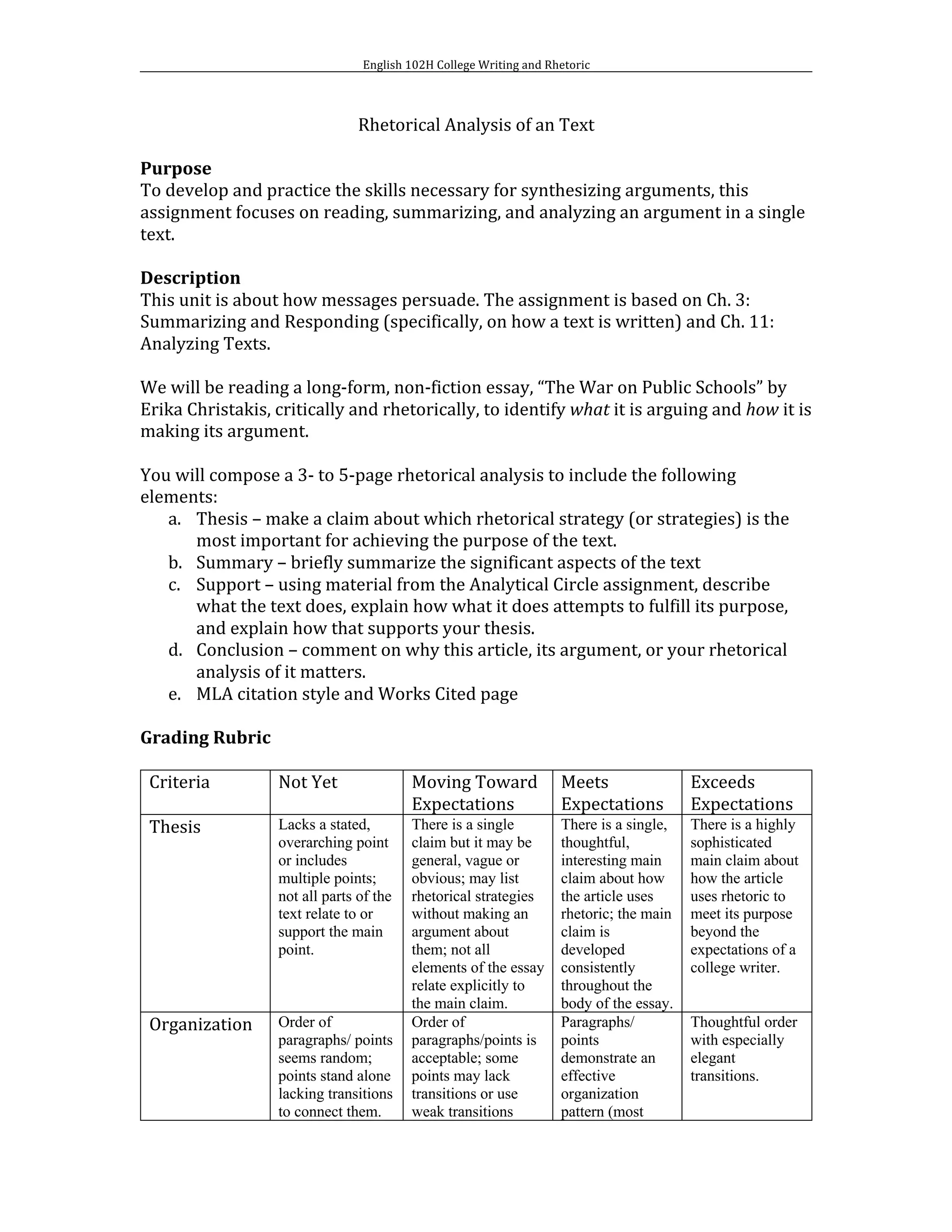
Grading	Rubric	
	
Criteria	 Not	Yet	 Moving	Toward	
Expectations	
Meets	
Expectations	
Exceeds	
Expectations	
Thesis	 Lacks a stated,
overarching point
or includes
multiple points;
not all parts of the
text relate to or
support the main
point.	
There is a single
claim but it may be
general, vague or
obvious; may list
rhetorical strategies
without making an
argument about
them; not all
elements of the essay
relate explicitly to
the main claim. 	
There is a single,
thoughtful,
interesting main
claim about how
the article uses
rhetoric; the main
claim is
developed
consistently
throughout the
body of the essay. 	
There is a highly
sophisticated
main claim about
how the article
uses rhetoric to
meet its purpose
beyond the
expectations of a
college writer. 	
Organization	 Order of
paragraphs/ points
seems random;
points stand alone
lacking transitions
to connect them. 	
Order of
paragraphs/points is
acceptable; some
points may lack
transitions or use
weak transitions
Paragraphs/
points
demonstrate an
effective
organization
pattern (most
Thoughtful order
with especially
elegant
transitions.
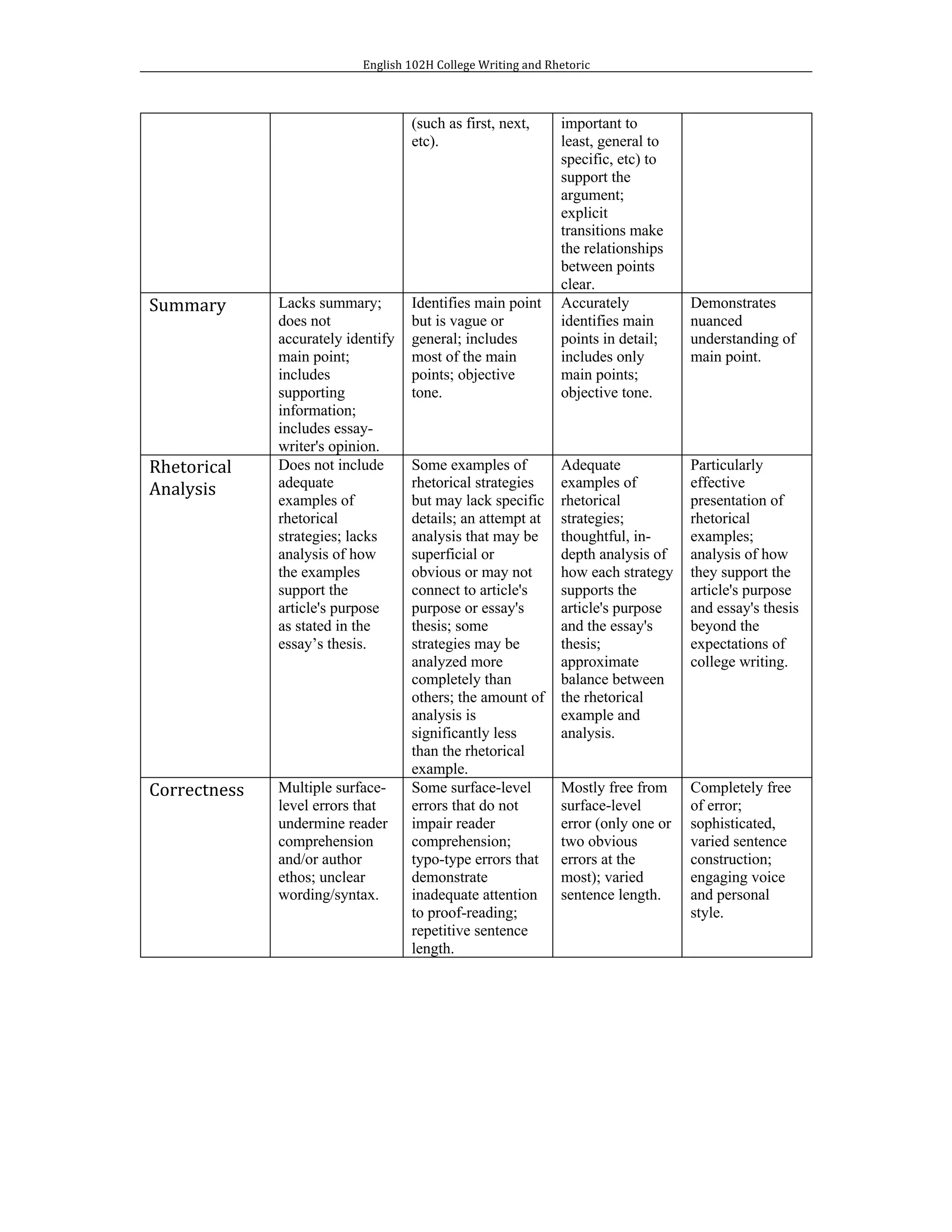
English	102H	College	Writing	and	Rhetoric	
	
	
(such as first, next,
etc). 	
important to
least, general to
specific, etc) to
support the
argument;
explicit
transitions make
the relationships
between points
clear.	
Summary	 Lacks summary;
does not
accurately identify
main point;
includes
supporting
information;
includes essay-
writer's opinion.	
Identifies main point
but is vague or
general; includes
most of the main
points; objective
tone. 	
Accurately
identifies main
points in detail;
includes only
main points;
objective tone. 	
Demonstrates
nuanced
understanding of
main point.	
Rhetorical	
Analysis	
Does not include
adequate
examples of
rhetorical
strategies; lacks
analysis of how
the examples
support the
article's purpose
as stated in the
essay’s thesis. 	
Some examples of
rhetorical strategies
but may lack specific
details; an attempt at
analysis that may be
superficial or
obvious or may not
connect to article's
purpose or essay's
thesis; some
strategies may be
analyzed more
completely than
others; the amount of
analysis is
significantly less
than the rhetorical
example. 	
Adequate
examples of
rhetorical
strategies;
thoughtful, in-
depth analysis of
how each strategy
supports the
article's purpose
and the essay's
thesis;
approximate
balance between
the rhetorical
example and
analysis. 	
Particularly
effective
presentation of
rhetorical
examples;
analysis of how
they support the
article's purpose
and essay's thesis
beyond the
expectations of
college writing.	
Correctness	 Multiple surface-
level errors that
undermine reader
comprehension
and/or author
ethos; unclear
wording/syntax. 	
Some surface-level
errors that do not
impair reader
comprehension;
typo-type errors that
demonstrate
inadequate attention
to proof-reading;
repetitive sentence
length. 	
Mostly free from
surface-level
error (only one or
two obvious
errors at the
most); varied
sentence length. 	
Completely free
of error;
sophisticated,
varied sentence
construction;
engaging voice
and personal
style.

Eng 102H Rhetorical Analysis of a Text Assignment Sheet