Written Expression IV
ISFD 41
Martinez Maria Florencia
Prof: Saubidet Stella
HOW DO A
PARAGRAPH
IS
ORGANIZED?
A USEFUL WAY OF
UNDERSTANDING
PARAGRAPH
STRUCTURE IS TO
THINK OF IT AS A
BLOCK THAT IS DIVIDED
INTO THREE SECTIONS:
THE BEGINNING, THE
MIDDLE, AND THE END.
A BASIC PARAGRAPH
FOLLOWS THIS
STRUCTURE:
Topic Sentence (TS) - the beginning
•Needs to state ONE idea clearly
•Useful Tip: Always put the most important information first!
Supporting Sentences (SS) - the middle
•Elaborates and explains the idea introduced in the topic sentence
•Provides evidence and examples
•Explains the evidence or example included - why is it relevant?
Concluding Sentence (CS) - the end
•Makes links: back to the main idea of the paragraph; back to research
question or topic of the assignment; to the next paragraph
AN EASY AND FUNNY WAY
TO REMEMBER THE
PARAGRAPH STRUCTURE…
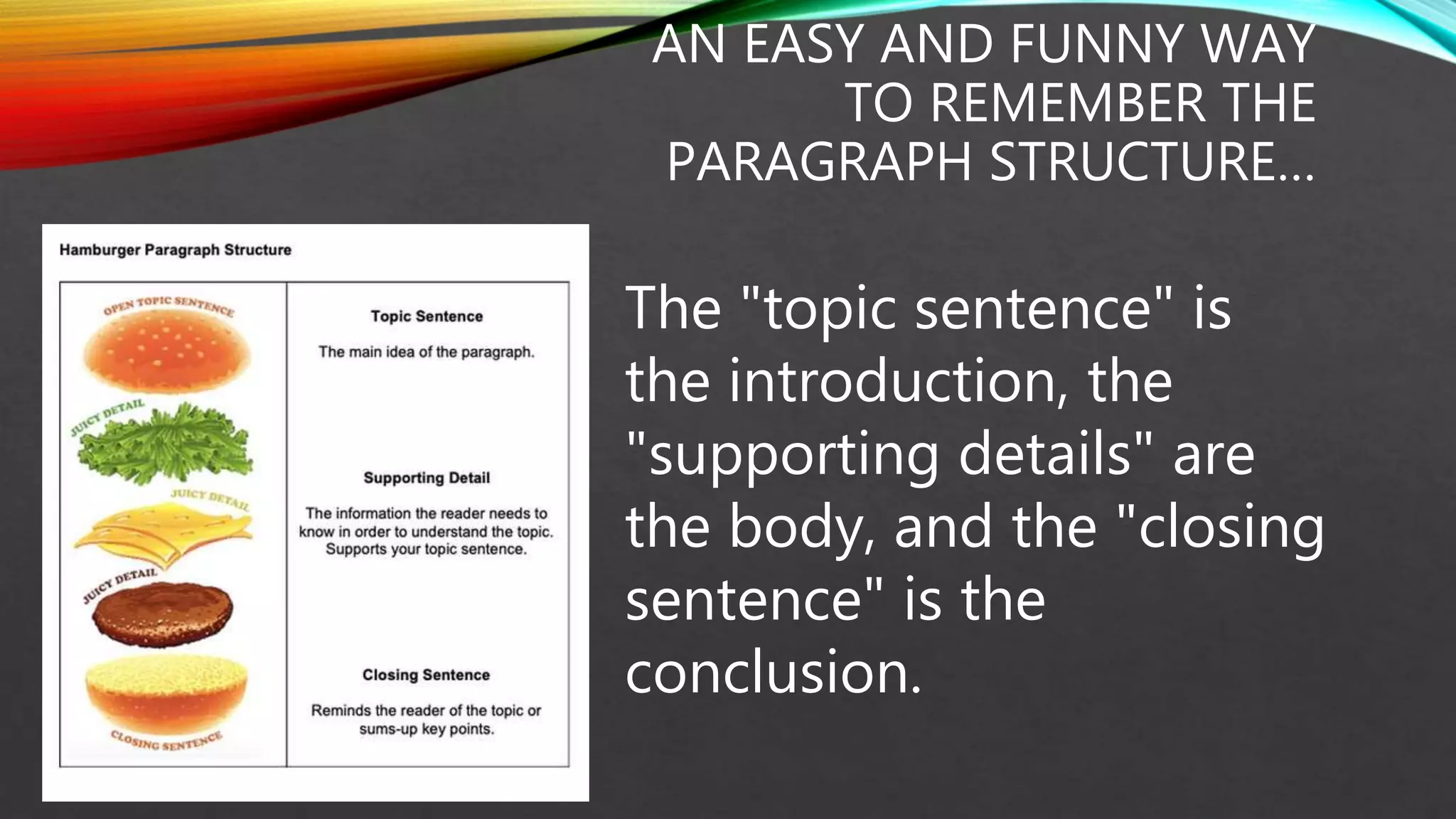
The "topic sentence" is
the introduction, the
"supporting details" are
the body, and the "closing
sentence" is the
conclusion.
PARAGRAPH STRUCTURE
• PARAGRAPH STRUCTURE
• Most paragraphs in an essay have a three-part structure—introduction, body, and
conclusion. You can see this structure in paragraphs whether they are narrating, describing,
comparing, contrasting, or analyzing information. Each part of the paragraph plays an
important role in communicating your meaning to your reader.
• Introduction: the first section of a paragraph; should include the topic sentence and any
other sentences at the beginning of the paragraph that give background information or
provide a transition.
• Body: follows the introduction; discusses the controlling idea, using facts, arguments,
analysis, examples, and other information.
• Conclusion: the final section; summarizes the connections between the information
discussed in the body of the paragraph and the paragraph’s controlling idea.
CHARACTERISTICS
OF A WELL WRITTEN
PARAGRAPH:
WRITING LOGICAL
PARAGRAPHS
• Organizing the sentences in your paragraph
according to a logical order helps the
reader to follow the development of your
ideas
• Some common kinds of logical order are:
• Chronological order
• Comparison/contrast
• Logical division of ideas
• Order of importance
• Cause and effect
• Using chronological order: you would use
expressions of time: first, next, after that, finally,
before the last war, after 2010, since then
• Describing differences (contrast): you would use
expressions like these: the most significant difference,
larger than, unlike, on the other hand, in contrast,
differ from
• showing similarities (comparison): you would use
expressions such as: similarity, similarly, as expensive
as, just as, just like, compare with, in comparison
• Logical division of ideas simply means that ideas are
grouped together, and each group is discussed
accordingly. They may be introduced in order of
importance, or in some other order that makes
sense to the reader. You would use transition words
such as firstly, secondly, thirdly to introduce each
group.
• A cause and effect paragraph uses transition words
that express reasons and results, such as: the first
cause, the next reason, because of ... the first effect,
as a result, therefore
THE TOPIC
SENTENCE
What is a topic sentence?
A well-organized paragraph supports or
develops a single controlling idea, which is
expressed in a sentence called the topic
sentence.
What is it function?
A topic sentence has several important
functions:
• it substantiates or supports an essay’s
thesis statement;
• it unifies the content of a paragraph and
directs the order of the sentences;
• it advises the reader of the subject to be
discussed and how the paragraph will
discuss it.
Readers generally look to the first few sentences in a
paragraph to determine the subject and perspective of the
paragraph. That’s why it’s often best to put the topic sentence
at the very beginning of the paragraph. In some cases,
however, it’s more effective to place another sentence before
the topic sentence—for example, a sentence linking the
current paragraph to the previous one, or one providing
background information.
The university of Otawa provides you a very interesting activity
in which you have to choose best the topic sentence to the
paragraph
This is the paragraph:
. I saw around Velva a release from what was like slavery to the tyrannical soil,
release from the ignorance that darkens the soul and from the loneliness that
corrodes it. In this generation my Velva friends have rejoined the general
American society that their pioneering fathers left behind when they first made
the barren trek in the days of the wheat rush. As I sit here in Washington writing
this, I can feel their nearness. (from Eric Sevareid, "Velva, North Dakota")
The best topic sentence for it is:
Many politicians deplore the passing of the old family-sized farm, but
I'm not so sure.
GOOD VS
BAD TOPIC
SENTENCE
Bad: Abraham Lincoln was born in 1809.
Why isn’t this a good topic sentence? First and
foremost, it tells the reader very little about what
you are going to say. Not only that, but you are not
using this valuable space in your paragraph to
make a real point.
Good: Abraham Lincoln, born in 1809, was one of
the most influential politicians in history.
With this topic sentence, you are making a strong
point, which you will ideally back up with plenty of
facts and good information. The reader also knows
what to expect when you use this kind of
statement.
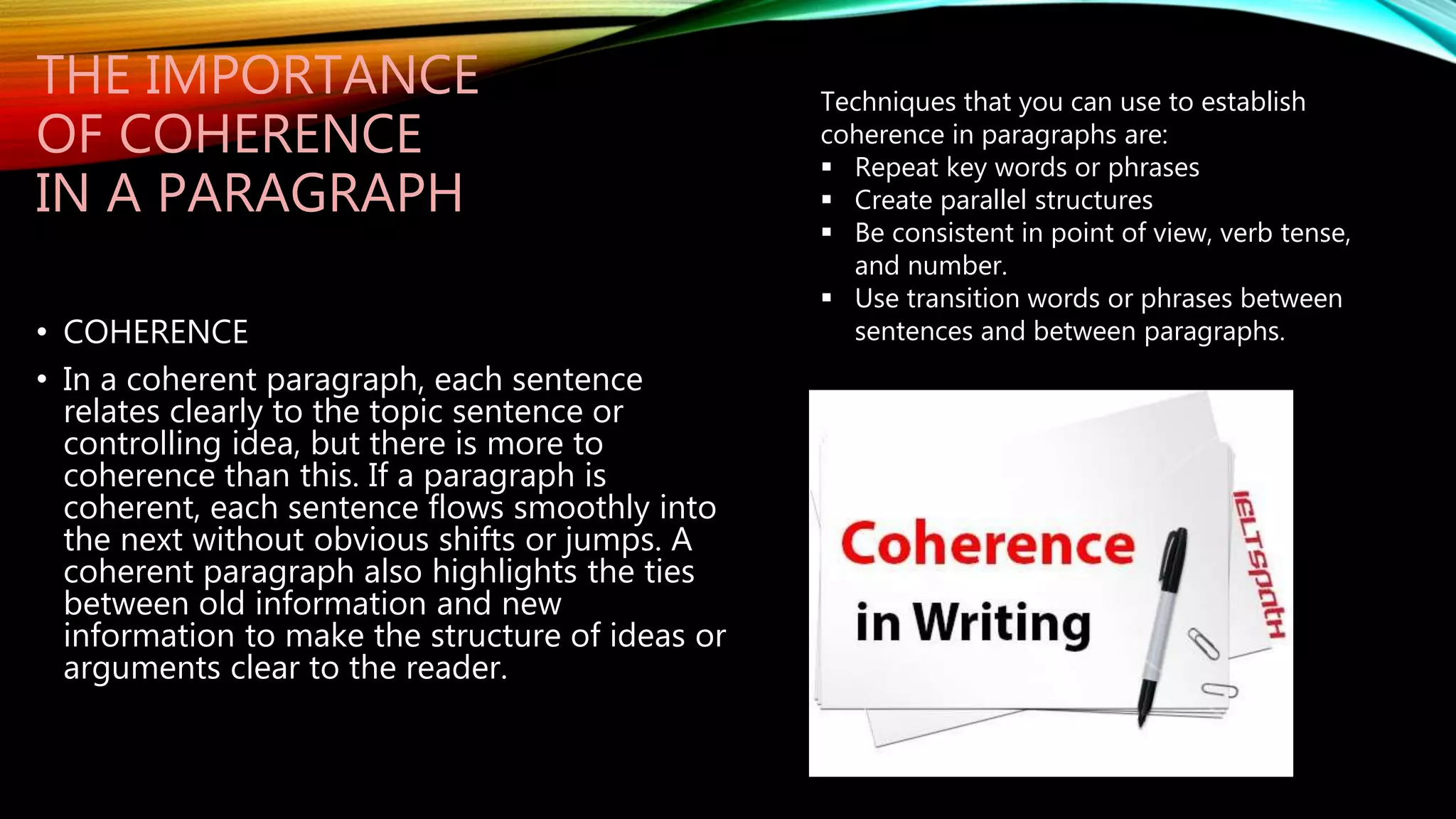
THE IMPORTANCE
OF COHERENCE
IN A PARAGRAPH
• COHERENCE
• In a coherent paragraph, each sentence
relates clearly to the topic sentence or
controlling idea, but there is more to
coherence than this. If a paragraph is
coherent, each sentence flows smoothly into
the next without obvious shifts or jumps. A
coherent paragraph also highlights the ties
between old information and new
information to make the structure of ideas or
arguments clear to the reader.
Techniques that you can use to establish
coherence in paragraphs are:
 Repeat key words or phrases
 Create parallel structures
 Be consistent in point of view, verb tense,
and number.
 Use transition words or phrases between
sentences and between paragraphs.
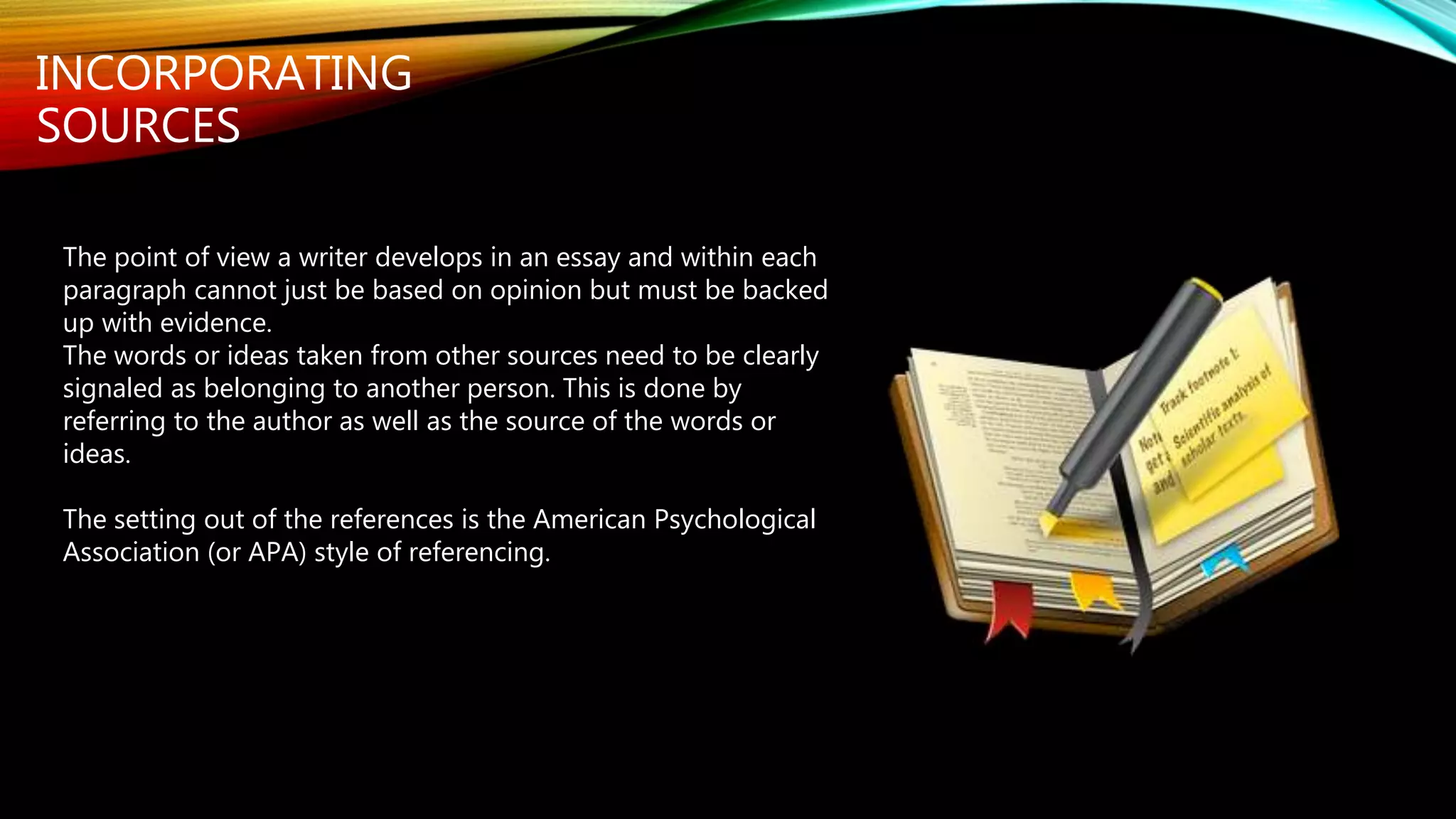
INCORPORATING
SOURCES
The point of view a writer develops in an essay and within each
paragraph cannot just be based on opinion but must be backed
up with evidence.
The words or ideas taken from other sources need to be clearly
signaled as belonging to another person. This is done by
referring to the author as well as the source of the words or
ideas.
The setting out of the references is the American Psychological
Association (or APA) style of referencing.
YOU CAN FIND
MANY
INTERESTING
SITES FOR
FURTHER
PRACTICE AND
DEVELOP YOUR
WRITING SKILLS
• University of Ottawa includes an interesting
exercises.
https://arts.uottawa.ca/writingcentre/en/hypergram
mar/writing-paragraphs/review-topic-sentences
• Udemy is a site that delivers online courses. Here
you will find more information concerning HOW
to write a good topic sentence.
https://blog.udemy.com/examples-of-topic-
sentences/
• University of Wellington, New Zealand also has
some useful material.
• https://www.wgtn.ac.nz/llc/llc_resources/academi
c-writing/index.html
BIBLIOGRAPHY
• https://libguides.newcastle.edu.au/writing-paragraphs/structure
• https://blog.udemy.com/examples-of-topic-sentences/
• https://www.wgtn.ac.nz/llc/llc_resources/academic-writing/tsent1.html
• https://arts.uottawa.ca/writingcentre/en/hypergrammar/writing-
paragraphs/review-topic-sentences

Paragraph structure

  • 1.
    Written Expression IV ISFD41 Martinez Maria Florencia Prof: Saubidet Stella
  • 2.
    HOW DO A PARAGRAPH IS ORGANIZED? AUSEFUL WAY OF UNDERSTANDING PARAGRAPH STRUCTURE IS TO THINK OF IT AS A BLOCK THAT IS DIVIDED INTO THREE SECTIONS: THE BEGINNING, THE MIDDLE, AND THE END. A BASIC PARAGRAPH FOLLOWS THIS STRUCTURE: Topic Sentence (TS) - the beginning •Needs to state ONE idea clearly •Useful Tip: Always put the most important information first! Supporting Sentences (SS) - the middle •Elaborates and explains the idea introduced in the topic sentence •Provides evidence and examples •Explains the evidence or example included - why is it relevant? Concluding Sentence (CS) - the end •Makes links: back to the main idea of the paragraph; back to research question or topic of the assignment; to the next paragraph
  • 3.
    AN EASY ANDFUNNY WAY TO REMEMBER THE PARAGRAPH STRUCTURE… The "topic sentence" is the introduction, the "supporting details" are the body, and the "closing sentence" is the conclusion.
  • 4.
    PARAGRAPH STRUCTURE • PARAGRAPHSTRUCTURE • Most paragraphs in an essay have a three-part structure—introduction, body, and conclusion. You can see this structure in paragraphs whether they are narrating, describing, comparing, contrasting, or analyzing information. Each part of the paragraph plays an important role in communicating your meaning to your reader. • Introduction: the first section of a paragraph; should include the topic sentence and any other sentences at the beginning of the paragraph that give background information or provide a transition. • Body: follows the introduction; discusses the controlling idea, using facts, arguments, analysis, examples, and other information. • Conclusion: the final section; summarizes the connections between the information discussed in the body of the paragraph and the paragraph’s controlling idea.
  • 5.
    CHARACTERISTICS OF A WELLWRITTEN PARAGRAPH: WRITING LOGICAL PARAGRAPHS • Organizing the sentences in your paragraph according to a logical order helps the reader to follow the development of your ideas • Some common kinds of logical order are: • Chronological order • Comparison/contrast • Logical division of ideas • Order of importance • Cause and effect • Using chronological order: you would use expressions of time: first, next, after that, finally, before the last war, after 2010, since then • Describing differences (contrast): you would use expressions like these: the most significant difference, larger than, unlike, on the other hand, in contrast, differ from • showing similarities (comparison): you would use expressions such as: similarity, similarly, as expensive as, just as, just like, compare with, in comparison • Logical division of ideas simply means that ideas are grouped together, and each group is discussed accordingly. They may be introduced in order of importance, or in some other order that makes sense to the reader. You would use transition words such as firstly, secondly, thirdly to introduce each group. • A cause and effect paragraph uses transition words that express reasons and results, such as: the first cause, the next reason, because of ... the first effect, as a result, therefore
  • 6.
    THE TOPIC SENTENCE What isa topic sentence? A well-organized paragraph supports or develops a single controlling idea, which is expressed in a sentence called the topic sentence. What is it function? A topic sentence has several important functions: • it substantiates or supports an essay’s thesis statement; • it unifies the content of a paragraph and directs the order of the sentences; • it advises the reader of the subject to be discussed and how the paragraph will discuss it. Readers generally look to the first few sentences in a paragraph to determine the subject and perspective of the paragraph. That’s why it’s often best to put the topic sentence at the very beginning of the paragraph. In some cases, however, it’s more effective to place another sentence before the topic sentence—for example, a sentence linking the current paragraph to the previous one, or one providing background information. The university of Otawa provides you a very interesting activity in which you have to choose best the topic sentence to the paragraph This is the paragraph: . I saw around Velva a release from what was like slavery to the tyrannical soil, release from the ignorance that darkens the soul and from the loneliness that corrodes it. In this generation my Velva friends have rejoined the general American society that their pioneering fathers left behind when they first made the barren trek in the days of the wheat rush. As I sit here in Washington writing this, I can feel their nearness. (from Eric Sevareid, "Velva, North Dakota") The best topic sentence for it is: Many politicians deplore the passing of the old family-sized farm, but I'm not so sure.
  • 7.
    GOOD VS BAD TOPIC SENTENCE Bad:Abraham Lincoln was born in 1809. Why isn’t this a good topic sentence? First and foremost, it tells the reader very little about what you are going to say. Not only that, but you are not using this valuable space in your paragraph to make a real point. Good: Abraham Lincoln, born in 1809, was one of the most influential politicians in history. With this topic sentence, you are making a strong point, which you will ideally back up with plenty of facts and good information. The reader also knows what to expect when you use this kind of statement.
  • 8.
    THE IMPORTANCE OF COHERENCE INA PARAGRAPH • COHERENCE • In a coherent paragraph, each sentence relates clearly to the topic sentence or controlling idea, but there is more to coherence than this. If a paragraph is coherent, each sentence flows smoothly into the next without obvious shifts or jumps. A coherent paragraph also highlights the ties between old information and new information to make the structure of ideas or arguments clear to the reader. Techniques that you can use to establish coherence in paragraphs are:  Repeat key words or phrases  Create parallel structures  Be consistent in point of view, verb tense, and number.  Use transition words or phrases between sentences and between paragraphs.
  • 9.
    INCORPORATING SOURCES The point ofview a writer develops in an essay and within each paragraph cannot just be based on opinion but must be backed up with evidence. The words or ideas taken from other sources need to be clearly signaled as belonging to another person. This is done by referring to the author as well as the source of the words or ideas. The setting out of the references is the American Psychological Association (or APA) style of referencing.
  • 10.
    YOU CAN FIND MANY INTERESTING SITESFOR FURTHER PRACTICE AND DEVELOP YOUR WRITING SKILLS • University of Ottawa includes an interesting exercises. https://arts.uottawa.ca/writingcentre/en/hypergram mar/writing-paragraphs/review-topic-sentences • Udemy is a site that delivers online courses. Here you will find more information concerning HOW to write a good topic sentence. https://blog.udemy.com/examples-of-topic- sentences/ • University of Wellington, New Zealand also has some useful material. • https://www.wgtn.ac.nz/llc/llc_resources/academi c-writing/index.html
  • 11.
    BIBLIOGRAPHY • https://libguides.newcastle.edu.au/writing-paragraphs/structure • https://blog.udemy.com/examples-of-topic-sentences/ •https://www.wgtn.ac.nz/llc/llc_resources/academic-writing/tsent1.html • https://arts.uottawa.ca/writingcentre/en/hypergrammar/writing- paragraphs/review-topic-sentences

Editor's Notes

  • #3 QuickStarter ha creado un esquema para ayudarle a empezar a trabajar en la presentación. Algunas diapositivas incluyen información aquí en las notas para proporcionar temas adicionales para que investigue.
  • #8 Considere la posibilidad de hablar acerca de: Evolución de la escritura Lengua hablada y lengua escrita Sistemas de escritura Funciones de la escritura
  • #11 Considere la posibilidad de hablar acerca de: Bibliografía